
Fake Mobile Game Ads: Why They Exist and How to Spot Them
Why mobile game ads show different gameplay, how to check whether the advertised game is real, and what marketers can learn from the creative patterns.
The AdMapix editorial team updated this introduction on September 10, 2026.
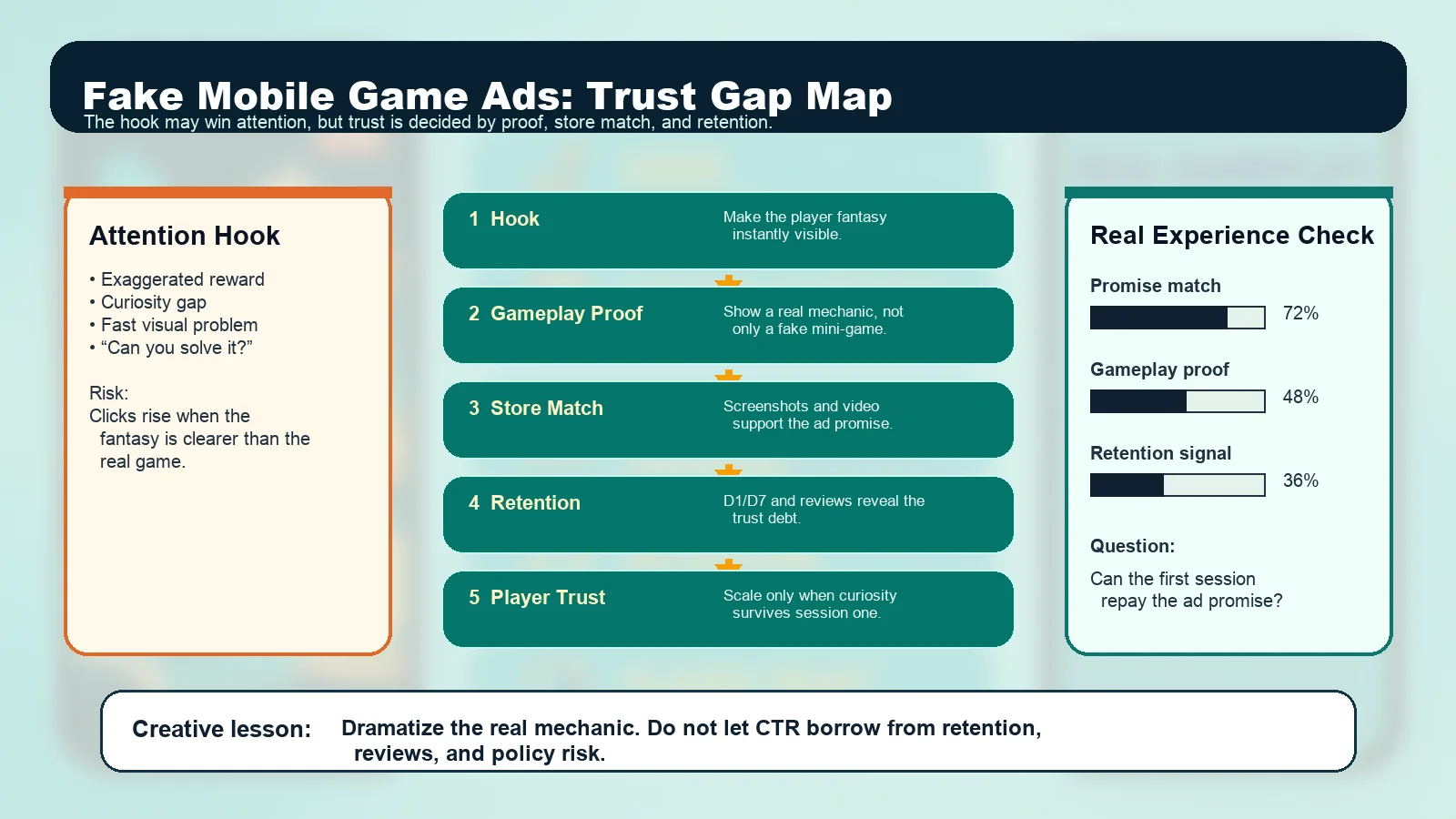
Fake mobile game ads show gameplay that a player cannot find or experience as advertised after installing. Common patterns include pull-the-pin rescues, deliberately failed puzzles, exaggerated rewards, and instant progression. The useful check is whether the advertised mechanic matches the game you actually play.
Why do mobile game ads show different gameplay? A simple visual challenge is easy to understand, and a deliberate mistake can make viewers want to try it themselves. Those mechanisms explain the appeal of the hook; they do not establish better retention or revenue.
Can you play the game shown in the ad? Check the store listing's gameplay footage, recent player reviews, and a current gameplay walkthrough. A game may contain an advertised mini-game without making it the main experience or available at the start. One ad alone cannot establish what the whole game offers.
| Pattern in the ad | What to check before installing |
|---|---|
| Pin-pulling, rescues, or an obvious puzzle failure | Whether gameplay footage shows that mechanic and when it appears |
| Instant levels or unusually large rewards | The real progression and any conditions on the reward |
| A puzzle ad for a store listing about building or combat | How much of the actual experience uses the advertised mechanic |
For a marketer's comparison, use the Royal Match creative strategy and Gossip Harbor creative strategy studies to record hooks, gameplay, and end cards. These are creative-research examples, not findings that those games use misleading ads.
What Fake Mobile Game Ads Are
Fake mobile game ads are not just "highly edited" ads. A strong ad can simplify gameplay, dramatize stakes, or compress progression honestly. The problem begins when the advertised experience is materially different from the product.
Common patterns:
| Pattern | What the ad shows | Why it becomes misleading |
|---|---|---|
| Fake mini-game | A puzzle, rescue, merge, or choice scene that is not in the actual game. | The user installs for a mechanic that does not exist. |
| Impossible reward | "Win free rare hero" or "get massive currency now." | The reward is unavailable, conditional, tiny, or delayed. |
| False difficulty | A simple challenge looks playable and satisfying. | The real game is a different genre or much slower. |
| Misleading progression | Level 1 to empire, poor to rich, weak to powerful in seconds. | The real progress takes days or depends on payment. |
| Fake multiplayer or social proof | The ad implies real opponents, guild action, or live competition. | The product does not support that experience early or at all. |
| Store mismatch | The ad hook is not reflected in screenshots, video, or first-session play. | The landing page breaks the promise before or after install. |
The difference between dramatized and fake is evidence. A dramatized ad highlights a real mechanic with compressed editing. A fake ad substitutes a more clickable mechanic for the actual product.
Why Fake Game Ads Get Attention
Fake game ads often use the same psychology as strong legitimate ads. That is why marketers should study them carefully.
They Make The Goal Obvious
Many real games are hard to explain in two seconds. Fake ads often show a simple visual problem: pull the pin, save the character, choose left or right, fix the room, merge the item, defeat the boss. The viewer knows what should happen before reading any text.
The ethical lesson is not "fake the mechanic." The lesson is "make the real player goal visible faster."
They Create A Curiosity Gap
A near-fail state keeps people watching. The character might almost drown. The wrong choice might be obvious. The puzzle might look one move away from being solved. The viewer wants closure.
The safer version is to use a real fail state from the game: a failed merge, a missed combo, a bad build, a wrong upgrade, or a lost battle.
They Compress Progress
Mobile players respond to transformation. Weak to strong, messy to clean, poor to rich, empty to upgraded, noob to expert. Fake mobile game ads often compress that arc into seconds.
The ethical version is to show real progression with clear labels: early level, mid-game example, event reward, before/after upgrade, or "sample sequence shortened."
They Reduce Cognitive Load
Many mobile game ad examples fail because the viewer sees menus, UI clutter, and unclear goals. Fake ads often remove all of that. The hook becomes one action and one outcome.
The ethical lesson is to simplify the creative, not the truth. Show one real mechanic and one real outcome.
The Real Cost Of Misleading Mobile Game Ads
A misleading ad can look successful if the team only checks CTR or CPI. The cost appears later.
| Risk | Where it appears |
|---|---|
| Store conversion drop | Users click the ad, then reject the store page because screenshots do not match. |
| Poor retention | Installs churn when the promised mechanic is absent. |
| Review damage | Users complain that the ad was fake or the game was not as advertised. |
| Bad creative learning | The team learns that the fake hook works, not what the product can support. |
| Policy exposure | Platforms may reject, limit, or penalize deceptive claims or mismatched creative. |
| Brand trust loss | Even if installs rise, player trust and community reputation may fall. |
Official policy language varies by platform, but the direction is consistent: ads and store listings should not deceive users about what the app does. Teams should review platform and advertising rules before testing edge-case claims. Useful references include the FTC truth in advertising topic page, Google Play Developer Content Policy, and Apple App Review Guidelines.
The business problem is just as important as policy. If a campaign relies on a fake promise, scaling spend becomes harder because the product cannot absorb the expectation.
Teardown Framework For Fake Mobile Game Ads
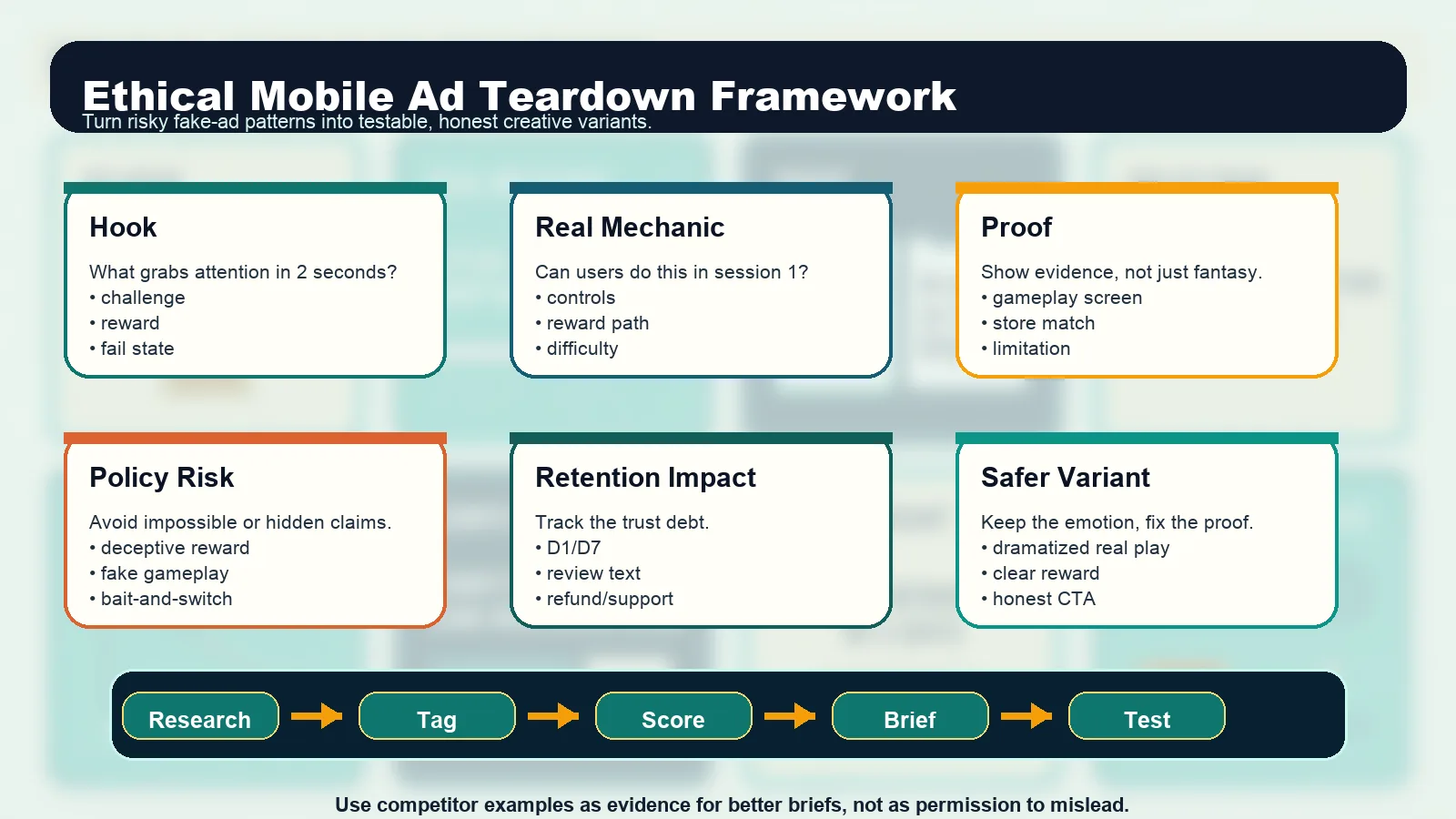
Use fake ad examples as research inputs, not as permission to mislead.
Use this framework when reviewing competitor examples:
| Question | What to inspect | Safer output |
|---|---|---|
| What is the hook? | Challenge, reward, danger, transformation, social proof. | Keep the emotional trigger. |
| Is the mechanic real? | Can a new player do this in the first session? | Replace fake action with a real action. |
| Is proof visible? | Does the store page or first session show the same thing? | Add store screenshots, gameplay clips, or UI proof. |
| What is the policy risk? | Is the reward impossible, hidden, or exaggerated? | Rewrite the claim with conditions and limits. |
| What is the retention risk? | Would a user feel tricked after 10 minutes? | Track D1/D7, reviews, and refund/support signals. |
| What variant can be tested? | Can the same curiosity work with real footage? | Brief a dramatized but honest version. |
The key is to separate the attention mechanism from the deception. The hook might be useful. The false promise is not.
Ethical Alternatives That Keep The Same Performance Logic
You can usually keep the reason fake mobile game ads work while removing the misleading claim.
| Risky fake-ad pattern | Ethical alternative |
|---|---|
| Fake puzzle mechanic | Use a real tutorial or level fail state with the same "solve it" tension. |
| Impossible reward | Show the actual reward path, requirement, and use case. |
| Fake instant transformation | Use real before/after progress with a shortened sequence label. |
| Fake multiplayer claim | Show real guild, leaderboard, co-op, or event moments only if available. |
| Overpromised power fantasy | Show a real upgrade path and explain what the player unlocks. |
| Bait-and-switch store page | Build screenshots and custom landing pages around the same real promise. |
Examples:
| Fake version | Better version |
|---|---|
| "Only 1% can solve this puzzle" for a game without puzzles. | "This level fails when you choose the wrong merge path" using a real level. |
| "Claim rare hero now" when the hero is locked behind conditions. | "Complete the first event track to unlock a healer shard." |
| "Build an empire in 30 seconds" for a slow strategy game. | "Your first base upgrade changes defense and resource speed." |
| A playable mini-game unrelated to the product. | A playable demo of the first real mechanic, even if shorter and simpler. |
The best creative teams use constraints as a forcing function. If the real product has no compelling two-second hook, the answer is not a fake hook. The answer is better onboarding, better store assets, better event design, or a clearer first-session proof.
How To Research Mobile Game Ad Examples Without Copying
Competitor research is still useful. The mistake is copying the surface.
Run this workflow:
- Collect 20 to 50 mobile game ad examples from direct and adjacent competitors.
- Tag the first two seconds: challenge, reward, fail state, transformation, social proof, power fantasy.
- Tag the mechanic: real, dramatized, unclear, or likely fake.
- Compare the ad to the store page and first-session gameplay.
- Mark the risk: store mismatch, reward claim, fake mechanic, policy language, retention debt.
- Convert the strongest hooks into honest briefs.
- Test against quality metrics, not only CTR.
AdMapix reports can support this process by helping teams organize competitor patterns and creative evidence. Use reports to build a swipe file, then connect findings to a brief, landing-page check, and quality review. If you need an ongoing workflow, review pricing.
A Safer Creative Testing Plan
For a mobile game team, test in this order:
| Step | Action | Quality check |
|---|---|---|
| 1 | Identify one real mechanic with visual tension. | Can a new player experience it quickly? |
| 2 | Create three hooks around that mechanic. | Challenge, reward, transformation. |
| 3 | Match store assets to the same promise. | Screenshot order and video support the ad. |
| 4 | Run a small test. | Track CTR, store CVR, CPI, and D1 retention. |
| 5 | Review comments and store reviews. | Watch for "fake ad" language. |
| 6 | Scale only if quality survives. | Retention and reviews must support spend. |
For a marketing team studying fake ads, use a stricter rule:
If the product cannot repay the promise in the first session, do not scale the promise.This protects creative learning. Otherwise every winning report teaches the team to move farther away from the product.
FAQ
What are fake mobile game ads?
Fake mobile game ads are ads that show mechanics, rewards, progression, or gameplay that users cannot actually experience in the advertised game, or that exaggerate the product so much that the first session cannot match the promise.
Why do fake game ads work?
They work because they make the goal obvious, create curiosity, compress progress, and reduce cognitive load. Those are useful creative principles, but they should be applied to real gameplay rather than false promises.
Are fake mobile game ads legal or allowed?
Rules depend on the jurisdiction, platform, claim, and campaign. This article is not legal advice. In practice, teams should avoid deceptive claims and review advertising, app store, and platform policies before launching risky creative.
What is the difference between dramatized ads and misleading ads?
A dramatized ad compresses or heightens a real mechanic. A misleading ad substitutes a more clickable mechanic, reward, or outcome that the user cannot actually experience.
How can marketers make ethical versions of fake ad hooks?
Keep the attention trigger, but replace the false promise with real proof. Use real fail states, real tutorial moments, real rewards, real progression, and store assets that match the ad.
How can teams research mobile game ad examples?
Collect competitor ads, tag the hook and mechanic, compare each ad to the store page and first session, score the trust risk, and turn strong patterns into original briefs. Tools like AdMapix reports can make this process repeatable.
Related Reading
- Gossip Harbor ad strategy teardown — a full look at the merge game whose dramatized hooks define the genre
- Township ad strategy teardown — how Playrix balances minigame hooks against its real gameplay
- Ad strategy teardowns (series index) — real advertisers' UA playbooks broken down with AdMapix delivery data
- Royal Match ad strategy teardown — a 305-day creative and zero resets: how the biggest match-3 advertiser runs without fake-ad bait
- Mobile game ad spy tools — the broader UA creative-intelligence workflow for game teams.
- Mobile game ad spend by platform — budget context across Meta, Google, TikTok, and DSPs.
- Top-performing mobile game ad formats — format choices across video, playable, static, and rewarded placements.
- Playable ad analysis for mobile games — a method for reverse-engineering interactive creatives without copying them.
- Ad creative intelligence workflow for mobile UA teams — turning competitor examples into weekly briefs.
- State of Mobile Advertising H2 2026 — market-wide creative volume, vertical shares, and country benchmarks behind these examples.
Bottom Line
Fake mobile game ads are useful to study because they reveal what gets attention: visible goals, curiosity gaps, quick transformation, and simple interaction. They are risky to copy because they can create a trust gap that shows up in retention, reviews, policy exposure, and brand reputation.
The sustainable strategy is not to make fake ads. It is to make the real game easier to understand, more visually testable, and better matched from ad to store page to first session.
Turn these observations into your next creative study
Open the creative library and select samples for your market, network and research question.
Related Articles
In-Game Advertising: What Brands and Game Studios Need to Know
A practical 2026 guide to in-game advertising formats, inventory types, brand safety, measurement, examples, and competitor research.
Meta Ads Creative for Mobile Games: 9 Facebook Ad Angles to Test
A practical 2026 guide to Meta and Facebook ads creative for mobile games: playable ads, UGC reactions, fail hooks, progression loops, app campaign setup, competitor research, and KPI guardrails.
Mobile Game Ads Guide: Formats, Real Examples, and Competitor Research
A practical 2026 guide to mobile game ads formats, creative examples measured from live US fleets, channel fit, research tools, competitor research, testing plans, and KPI guardrails.