
Dropispy Alternative in 2026: The Honest Buyer's Guide to Switching Ad-Spy Tools
A bottom-funnel buyer's guide to choosing a Dropispy alternative in 2026 — what Dropispy is genuinely best at, the exact gaps that push dropshippers and agencies to switch, a five-criterion scoring rubric, head-to-head comparisons with Minea, PiPiAds, and AdMapix, migration SOPs, pricing reality checks, and an honest account of where AdMapix fits and where it does not.
Dropispy Alternative in 2026: The Honest Buyer's Guide to Switching Ad-Spy Tools
Updated June 21, 2026 — written and reviewed by the AdMapix Research team.
If you are searching for a Dropispy alternative, you are almost certainly past the discovery stage. You already use an ad-spy tool, you already know what Dropispy does, and something specific has started to grind: maybe TikTok creatives keep slipping through the net, maybe a client wants a report your tool cannot produce, maybe you have outgrown a Facebook-product-ad lens and need cross-network creative evidence. This guide is written for that exact moment — the moment a working dropshipper, ecommerce media buyer, or agency strategist decides whether to keep Dropispy, layer a second tool on top, or replace it outright. We are not going to tell you Dropispy is bad. It is a focused, genuinely good tool for one job. We are going to help you name the job you now have, then match it to the right alternative, including an honest read on where AdMapix fits and — just as importantly — where it does not. For the wider landscape, pair this with our best ad spy tools 2026 roundup and our competitor ad analysis framework; if you want the deeper Minea contrast, read it alongside our Minea ad spy review.
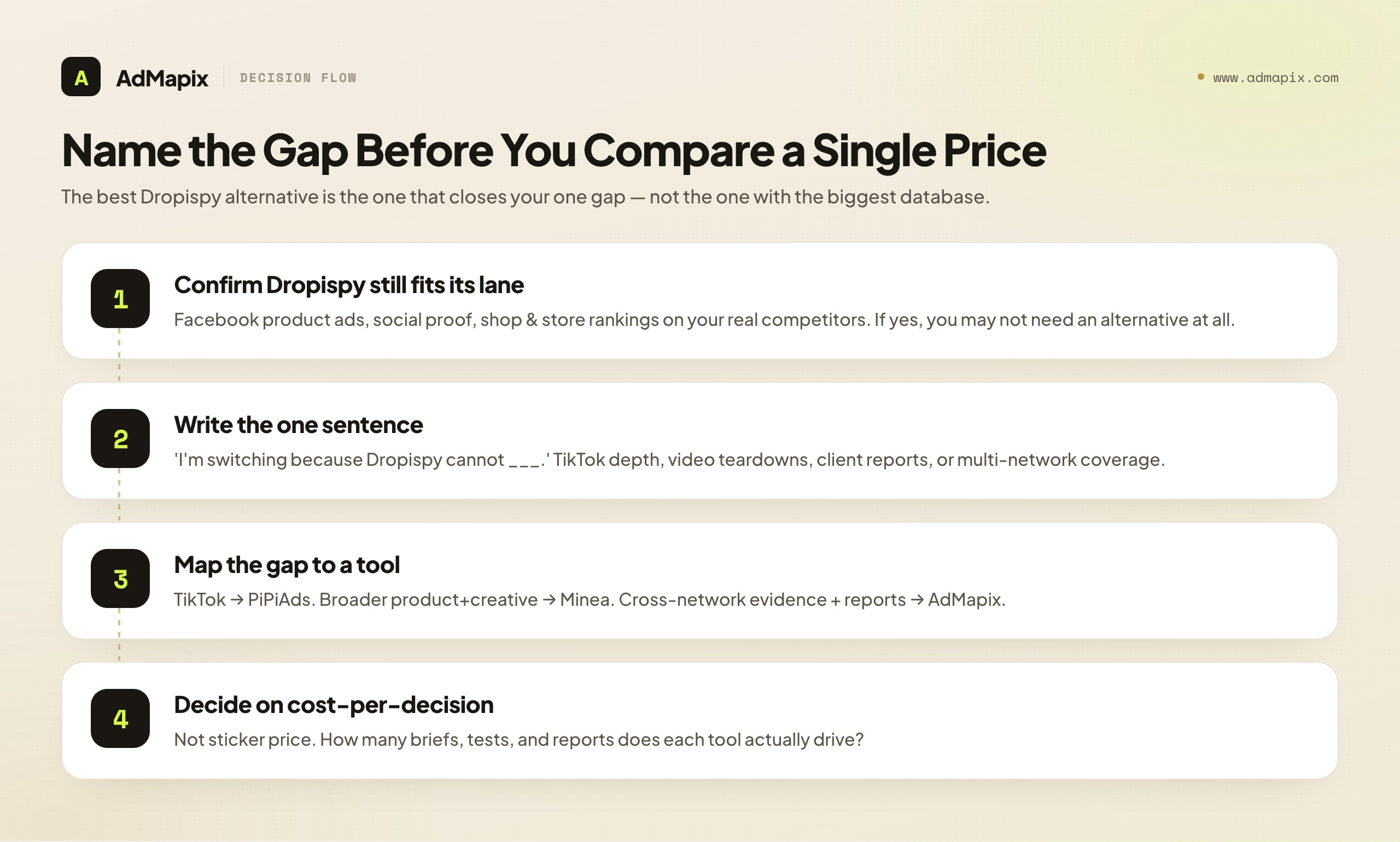
The hard truth that the "top 10 alternatives" listicles bury is this: the best Dropispy alternative is not the tool with the largest ad database or the longest feature grid. It is the tool that closes the one gap you feel this week — and turns an interesting ad into a testable creative brief, a budget decision, or a client-ready report. A bigger library that still dead-ends at "wow, nice ad" is not an upgrade. It is the same dead end with more screenshots. So before you compare a single price, we are going to make you write down the decision you are trying to improve. Everything downstream — the scoring rubric, the head-to-head tables, the migration SOP — hangs off that one sentence.
TL;DR — Choosing a Dropispy Alternative
- Keep Dropispy when Facebook-style product ads, social-proof signals, shop data, and dropshipping store rankings are the literal center of your week and it performs well on your real competitors.
- Switch or add a tool the moment your decisions lean on TikTok-native creative depth, multi-network coverage (YouTube, app ads), structured video breakdowns, or exportable client reports — these are not Dropispy's core strengths.
- Score candidates on five criteria — dropshipping fit, platform coverage, creative-analysis depth, reporting/export, and validation path — and ignore anything that does not change a real decision.
- The three alternatives worth your time in 2026 are Minea (broadest product-and-creative research with influencer signals), PiPiAds (TikTok-first creative depth), and AdMapix (searchable cross-network creative evidence, video breakdowns, and recurring reports).
- AdMapix is creative-evidence, not a spend tool. It shows saved cross-network ad examples, video teardowns, and shareable reports. It cannot show competitor ad spend, ROAS, impressions, or audience targeting. If your gap is spend estimation, AdMapix is the wrong alternative — and we will say so.
- Run a structured 10-day trial on your real competitors and geos, not the vendor demo, and judge tools by cost-per-decision, not sticker price.
- The validation loop always ends inside your own analytics. No spy tool, Dropispy or otherwise, can confirm what actually converts for you.
What Dropispy Is Genuinely Best At
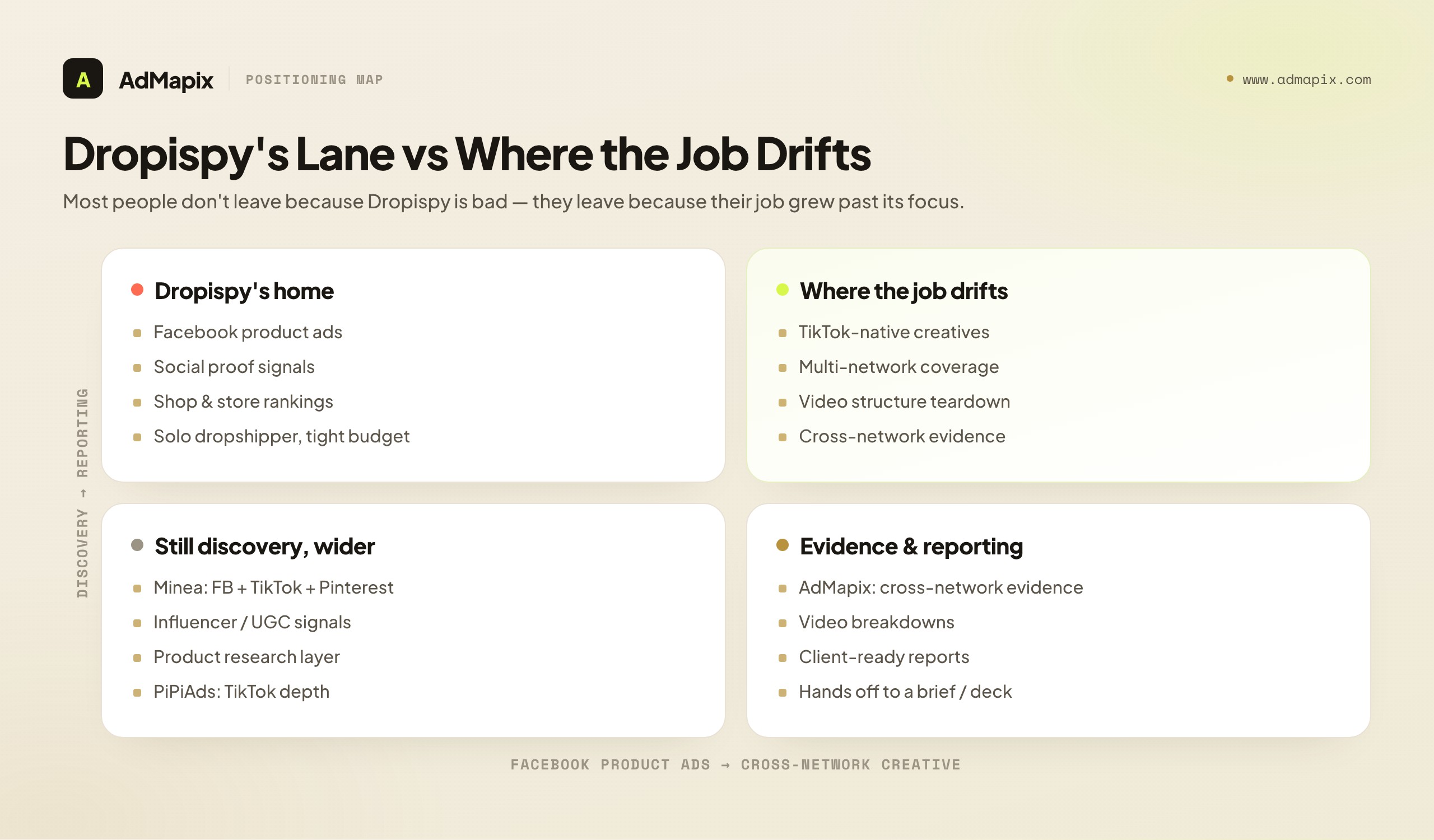
Let us be fair to Dropispy before we talk about leaving it, because an honest alternative guide has to start by respecting the incumbent. Dropispy was built around one job and it does that job well: finding winning Facebook-style product ads and the dropshipping stores running them. Its toolkit reflects that focus — ad filters, social-proof signals (likes, comments, shares as a proxy for traction), audience and product detail, shop data, and dropshipping store rankings. If you are a product-led dropshipper whose entire research loop is "what product ads are getting engagement on Facebook, and which stores are scaling them," Dropispy is not a compromise. It is purpose-built for exactly that.
The strength is the focus. Dropispy does not try to be a market-intelligence suite, an app-store analytics platform, or a cross-network creative library. It picks the dropshipping-on-Facebook lane and goes deep. For a solo dropshipper or a small store testing products on a tight budget, that narrowness is a feature: you are not paying for fifteen modules you will never open, and the interface is not buried under enterprise dashboards built for someone else's job. When people churn off bloated "everything" platforms, they often churn toward something with Dropispy's clarity.
So the question is never "is Dropispy good?" It usually is, for its lane. The question is whether your job has quietly drifted out of that lane. Most people searching for a Dropispy alternative did not wake up disliking the tool. Their work changed. They started running TikTok. They picked up agency clients who want decks. They expanded into new countries. The tool stayed the same while the job got bigger — and that mismatch, not any defect in Dropispy, is what sends people looking.
Where Dropispy Stops — The Five Gaps That Trigger a Switch
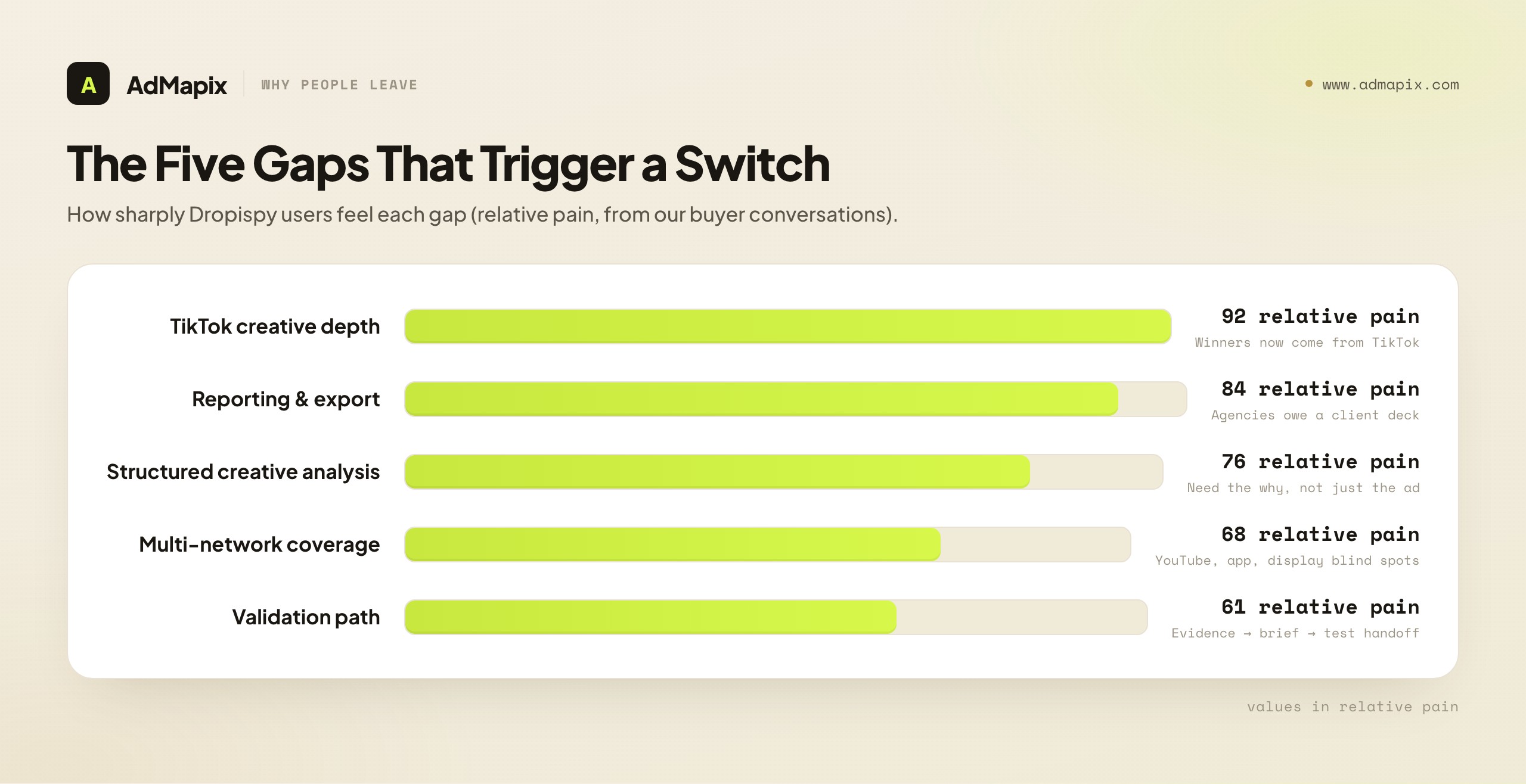
Across the dropshippers, buyers, and agencies we talk to, the reasons to leave Dropispy cluster into five recognizable gaps. You probably feel one or two of them sharply right now. Naming yours is the whole game, because the right alternative is defined entirely by which gap you are closing.
Gap 1 — TikTok-native creative depth. Dropispy's center of gravity is Facebook-style product ads. As TikTok becomes the dominant testing ground for dropshipping creatives — UGC hooks, native sounds, spark-ad mechanics — a Facebook-first lens starts to miss where your audience actually scrolls. If your winners increasingly come from TikTok, you feel this gap every single week.
Gap 2 — Multi-network coverage. A pure product-ad view does not cover YouTube ads, app-install ads, or display in any depth. As your funnel matures and you test across surfaces, "one network, one ad type" leaves blind spots that compound.
Gap 3 — Structured creative analysis. Finding an ad is step one. Understanding why it works — the hook in the first three seconds, the offer construction, the proof stacking, the CTA, the editing pace and video structure — is what turns evidence into a brief. Static screenshots and engagement counts do not give you that teardown layer.
Gap 4 — Reporting and export. A solo dropshipper can live inside a tool's UI. An agency cannot. The moment you owe a client a recommendation, a swipe deck, or a monthly creative-trends report, a tool with no clean export becomes a bottleneck. Your research has to survive the next meeting, and screenshots pasted into a Google Doc at 11pm do not scale.
Gap 5 — Validation path. This is the quietest and most expensive gap. A spy tool that ends at "here is an interesting ad" leaves the hardest part — turning it into a testable hypothesis and a budget move — entirely on you. If your tool does not help you get from evidence to a brief to a test, you are paying for a discovery engine and doing the synthesis by hand.
Notice what is not on this list: "Dropispy is too expensive" or "Dropispy is bad." Those are rarely the real reason. The real reason is a job that grew past the tool. The next sections turn these five gaps into a scoring rubric you can run in twenty minutes.
How to Score a Dropispy Alternative (The 5-Criterion Rubric)
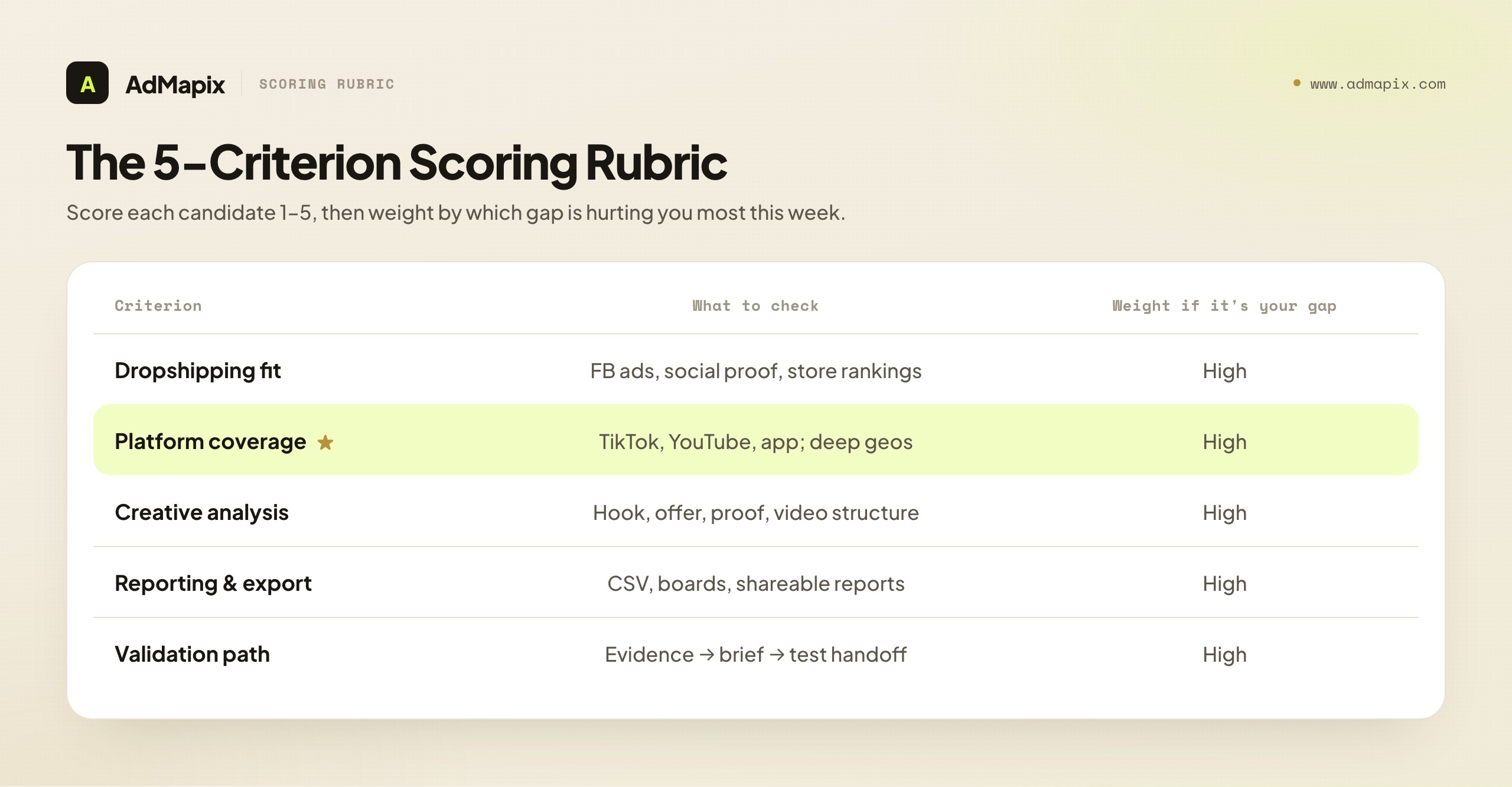
Do not shop for the longest feature list. Shop for the criterion that maps to your gap, weight it heavily, and let everything else fall away. Here is the rubric we use, with what to check and why it matters. Score each candidate 1–5 on each criterion, then weight by which gap is hurting you.
| Criterion | What to check | Why it matters |
|---|---|---|
| Dropshipping fit | Facebook product ads, social proof, shop and store rankings, product detail | Dropispy's home turf; only switch here if a rival genuinely beats it on your competitors |
| Platform coverage | TikTok, YouTube, app-install ads, display; how many countries are deep, not just listed | A product-ad-only view misses where your audience actually scrolls in 2026 |
| Creative analysis | Hook, offer, proof, CTA, and video structure — not just static screenshots and like counts | Paid social is won in the first 3 seconds, the proof stack, and the CTA |
| Reporting & export | CSV/board exports, saved boards, shareable reports, repeatable note structure | Agencies and teams need research that survives the next meeting |
| Validation path | Can a finding become a brief, a test, a budget move — and does it hand off cleanly? | A spy tool that ends at "interesting" silently wastes hours every week |
The discipline is in the weighting. If your single gap is TikTok depth, then a tool that scores 5 on platform coverage and creative analysis beats a tool that scores 5 on dropshipping fit, even though Dropispy "wins" the latter. You are not buying a balanced scorecard. You are buying a fix for a specific bottleneck. Multiply each criterion score by how much that gap currently costs you (1 = mild annoyance, 3 = real friction, 5 = blocking your week), sum the weighted scores, and the winner is rarely the tool with the biggest raw database.
One more rule: discount any criterion that does not change a decision you actually make. If you never run YouTube ads and never will, a tool's YouTube coverage is worth zero to you no matter how impressive — do not let a feature you will not use tip your scoring.
The Three Alternatives Worth Your Time in 2026
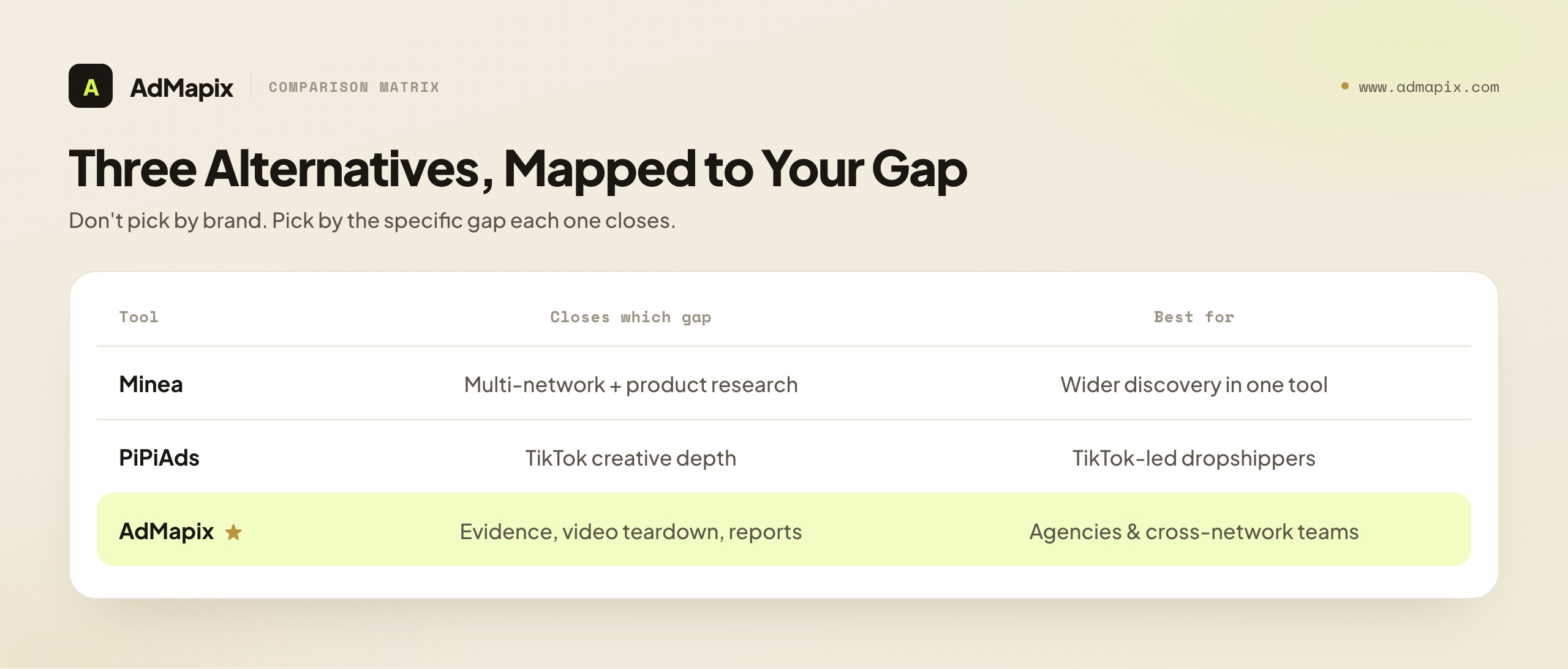
There are dozens of ad-spy tools. Most are noise for a Dropispy user, because they either do the same Facebook-product-ad job (no upgrade) or solve a problem you do not have. Three close real gaps for the typical Dropispy user, and they map cleanly to the five gaps above.
Minea — Broadest Product-and-Creative Research
Minea is the closest thing to a "do-more-of-the-same-but-wider" alternative. It covers Facebook and TikTok and Pinterest product ads, layers in influencer/UGC signals, and adds product-research workflows that go beyond pure ad discovery. For a dropshipper who likes Dropispy's job but wants more networks and a product-research layer in one place, Minea is the natural step up. It closes Gap 1 (some TikTok depth), Gap 2 (multi-network), and part of Gap 3. Its honest limitation is the same as any product-ad aggregator: the deeper you go on structured video teardown and client reporting, the more you feel the edges. We cover this in depth in the Minea ad spy review.
PiPiAds — TikTok-First Creative Depth
If your single gap is TikTok (Gap 1) and you want the deepest possible TikTok ad library with filters built for that platform's mechanics, PiPiAds is the specialist. It is not trying to be a Facebook tool; it goes deep on TikTok creatives, sounds, and the metrics that matter there. For a dropshipper whose winners now come overwhelmingly from TikTok, a TikTok specialist beats a generalist that "also has TikTok." Its limitation is the mirror image of Dropispy's: outside TikTok, you are back to needing another tool.
AdMapix — Cross-Network Creative Evidence and Reports
AdMapix is the right alternative when your gap is creative evidence across networks, structured video breakdowns, and client-ready reporting — Gaps 3, 4, and 5. It is a searchable database of real ad creatives across networks, with video teardowns and recurring report formats designed to hand off cleanly into a brief or a client deck. Where it does not fit: AdMapix is creative evidence, not a spend or revenue estimator. It cannot tell you a competitor's ad spend, ROAS, impressions, or audience targeting. If your gap is "I need spend numbers," AdMapix is the wrong tool and we will not pretend otherwise. If your gap is "I need to find, understand, and report on the creatives that are running," it is squarely in the lane. Browse the ad creative database and the best ad intelligence tools overview to see where it sits.
Side-by-Side: Dropispy vs Minea vs PiPiAds vs AdMapix
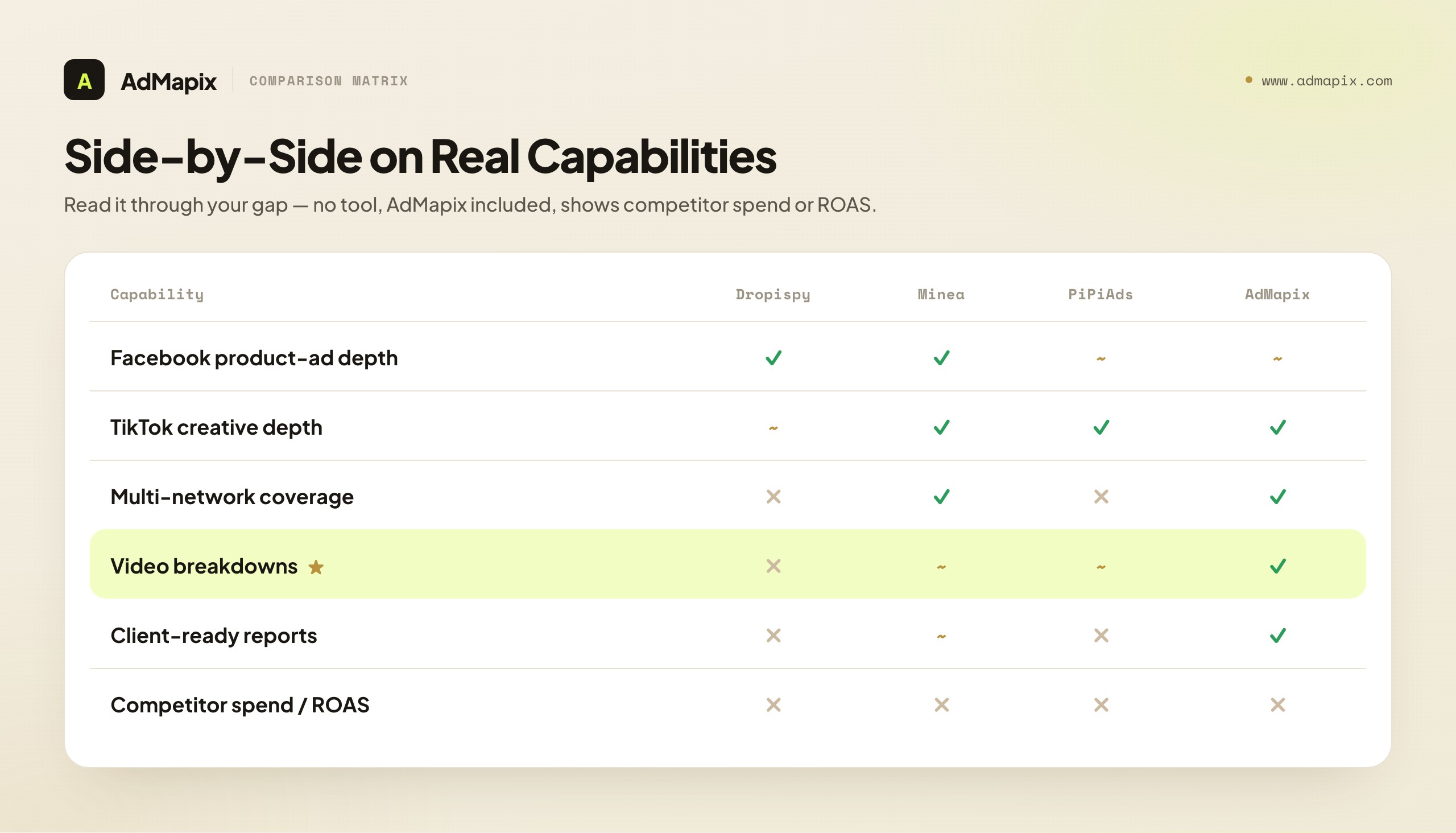
Feature grids lie when they pretend every cell weighs the same. Read this one through the lens of your gap, not as a horse race. A tick is "does it well," a tilde is "partial or shallow," a cross is "not its job."
| Capability | Dropispy | Minea | PiPiAds | AdMapix |
|---|---|---|---|---|
| Facebook product-ad depth | ✓ | ✓ | ~ | ~ |
| TikTok creative depth | ~ | ✓ | ✓ | ✓ |
| Multi-network coverage | ✗ | ✓ | ✗ | ✓ |
| Structured video breakdowns | ✗ | ~ | ~ | ✓ |
| Influencer / UGC signals | ~ | ✓ | ~ | ~ |
| Shop / store rankings | ✓ | ~ | ✗ | ✗ |
| Client-ready reports & export | ✗ | ~ | ✗ | ✓ |
| Competitor ad spend / ROAS | ✗ | ✗ | ✗ | ✗ |
Two things jump out. First, no tool in this table — including AdMapix — shows competitor ad spend or ROAS, because that data is not public; anything claiming otherwise is selling you a model dressed up as a fact. Second, the "winner" changes per row depending on what you need. Match your weighted gap to the column that ticks it, and stop comparing rows that do not change your decision.
A word on how to read a comparison grid like this without being misled, because grids are where most buying mistakes are born. A tick mark flattens enormous differences in depth. "Has TikTok" can mean a token TikTok tab bolted onto a Facebook tool, or it can mean a TikTok-native engine with sound-level filtering and spark-ad mechanics — the grid shows both as a tick. The only way to see the difference is to run your real job, which is why the trial section later in this guide matters more than any table. Treat the grid as a way to eliminate obviously-wrong tools quickly, not as the final arbiter between two finalists. Once you are down to two candidates that both tick your priority row, the grid has done its job and the live trial takes over.
There is also an order-of-operations point hiding in this table that explains every difference between these four tools. Dropispy and Minea grew outward from the product ad — they start with "what product is selling and which ad sells it." PiPiAds grew outward from the TikTok feed — it starts with "what's winning on this one platform." AdMapix grew outward from the creative as evidence — it starts with "here is the ad, dissected, in a form you can save, explain, and report." Those starting points never fully converge, which is why the tools feel different even where their feature lists overlap. When you pick, you are really picking a starting point, and the right starting point is the one closest to the decision you owe.
Deep Dive: The TikTok Coverage Gap and Why It Hurts Most
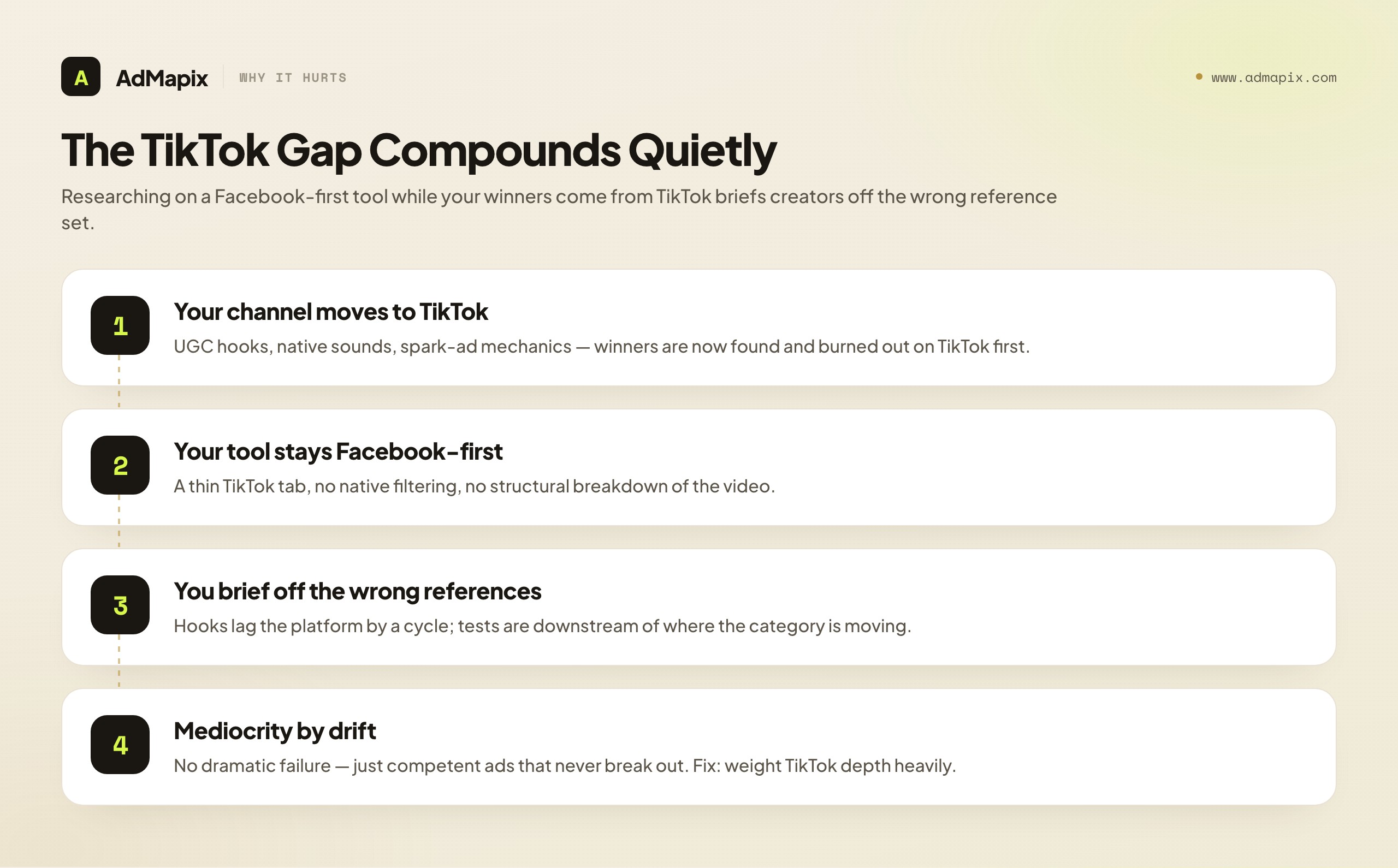
Of the five gaps, TikTok depth is the one that sends the most Dropispy users looking, so it deserves its own treatment. The shift is structural, not a fad. For a growing share of dropshipping and DTC products, TikTok is now the primary creative testing ground: it is where a hook either earns the next three seconds or dies, where UGC-style talking-head ads outperform polished studio spots, and where native sounds and trends move faster than any planning cycle. A tool that treats TikTok as a secondary tab cannot keep up with a channel that reinvents its creative grammar every few weeks.
What "TikTok depth" actually means in a tool, concretely: the ability to filter by the mechanics that matter on the platform (sound, format, hook archetype, posting recency), enough volume of recent TikTok creatives that you are seeing this week's winners and not last quarter's, and ideally a teardown of the video structure so you can brief a creator without re-watching the ad twenty times. A Facebook-first tool gives you, at best, a thin slice of this — a handful of TikTok ads, no native filtering, no structural breakdown.
The cost of the gap compounds quietly. Every week you research on a Facebook-first tool while your winners come from TikTok, you are briefing creators off the wrong reference set. Your hooks lag the platform. Your tests are downstream of where the category is actually moving. It does not show up as a single dramatic failure; it shows up as a slow drift into mediocrity, where your ads are competent but never break out because the patterns you are copying are one platform behind. This is exactly why the role map sends TikTok-led dropshippers to a specialist (PiPiAds) or a genuinely multi-network tool (Minea), and why AdMapix's value here is the teardown — turning a TikTok winner into a structured brief, not just surfacing that it exists.
If TikTok is your gap, weight platform coverage and creative analysis heavily in the rubric and treat dropshipping-store rankings as a nice-to-have. The store-rankings feature is real and useful, but it is a Facebook-era strength, and optimizing your tool choice around it while your channel has moved to TikTok is the classic mistake of buying for yesterday's job.
Deep Dive: The Reporting Gap and the Agency Reality
The second-most-common reason to leave Dropispy is reporting, and it is almost entirely an agency and freelancer problem. If you are a solo dropshipper researching for your own store, you can live inside a tool's UI indefinitely — you are the only consumer of the research. The moment you have clients, the math changes completely. Now your research has to leave your screen and land in someone else's inbox as a recommendation they can act on and pay for.
This is where a discovery-only tool becomes a bottleneck. You find brilliant ads, you understand exactly why they work, and then you spend two hours every Friday screenshotting them into a Google Doc, writing captions, and trying to make it look like a deliverable rather than a scrapbook. That manual assembly step is pure overhead, it scales linearly with your client count, and it is the first thing that gets cut when you are busy — which means your "weekly creative report" quietly becomes a "whenever I have time" report, and the client notices.
A reporting-capable tool collapses that step. Exportable creative evidence, saved boards, and recurring report formats mean the research is the deliverable, or close to it. This is the specific gap AdMapix is built to close: cross-network creative evidence that hands off into a client-ready report without the Friday-night assembly tax. It does not replace your discovery tool — you still need to find the ads — but it carries the evidence into the format your client pays for. For an agency, this often justifies running a two-tool stack on its own: a discovery tool for finding, AdMapix for evidence-and-reporting.
The honest caveat, again, applies here. AdMapix's reports are built on creative evidence — the ads themselves, dissected. They cannot contain competitor spend or ROAS figures, because those are not knowable. A client who wants a "how much is our competitor spending" report is asking for something no tool can truthfully deliver; the most honest version of that report shows what the competitor is running and how, and labels any spend talk as estimate or omits it entirely. Setting that expectation with clients is part of doing this work with integrity, and it is a better position than a competitor who quietly presents a model as fact.
Deep Dive: Coverage Is Not Database Size
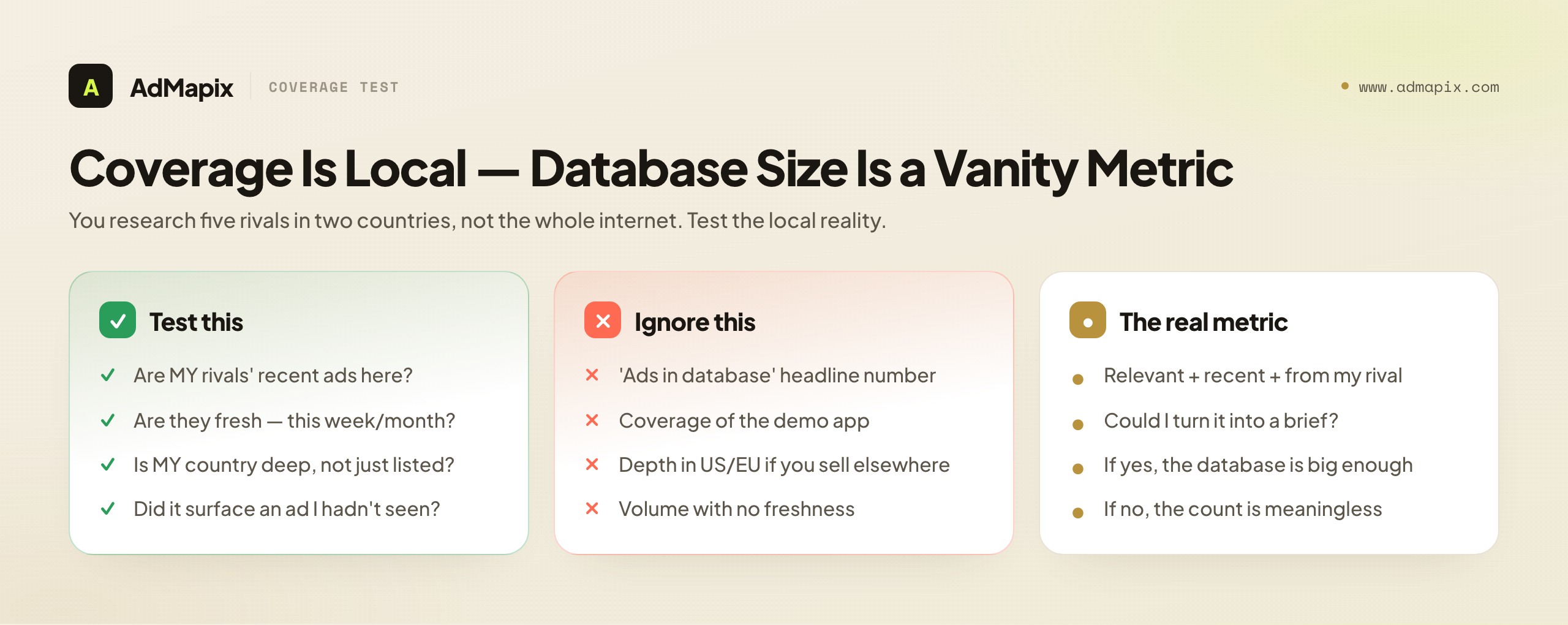
The single most misleading number in this entire category is "ads in database." Every vendor quotes it, every listicle ranks by it, and it is almost worthless for your decision. Here is why: a database of fifty million ads that does not deeply and freshly cover your five real competitors in your two real countries is worse for you than a database of five million that does. You do not research the whole internet. You research a handful of rivals in a handful of markets. Coverage is local, and local coverage is what the headline number hides.
Test coverage the only way that works: take your actual competitor list and your actual geos, and search for them in the candidate tool. Are your rivals' recent ads there? Are they recent — this week, this month — or stale? Is your country's market represented in depth, or is it a global tool that is rich in the US and thin everywhere else? A tool can be the biggest in the world and still be a desert exactly where you sell. The baseline snapshot from the migration SOP exists precisely to make this test rigorous: you are comparing the candidate against what Dropispy already gives you on the same competitors, not against a vendor's highlight reel.
Freshness is the half of coverage that vendors hide hardest. Creative fatigue is brutal — winning ads burn out in days to a couple of weeks on the hot platforms. A tool whose data on your competitors is weeks stale is showing you a museum, and museums do not help you ship this week's test. When you trial, check the dates on your competitors' ads, not just whether they appear. Two tools can both "cover" your rival; one shows you what they launched yesterday and the other shows you what they launched in the spring. Only one of those is intelligence.
This is also the cleanest argument against the database-size sales pitch: you cannot eat a number. The metric that matters is "did this tool surface a relevant, recent ad from my real competitor that I had not already seen, and could I turn it into a brief?" If yes, the database is big enough. If no, it does not matter how many ads it claims, because none of them were the ones you needed.
Building a Two-Tool Stack (When One Tool Is the Wrong Answer)
A surprising number of "which Dropispy alternative should I buy" questions have the answer "two tools, on purpose." This is not indecision or overspending — it is recognizing that discovery and evidence-and-reporting are different jobs, and the best tool for each is rarely the same tool. The trap to avoid is paying twice for the same job; the smart move is paying once each for two different jobs.
The canonical stack for an agency or a serious multi-channel operator looks like this. A discovery layer — Dropispy if you stay Facebook-led, Minea for breadth, or PiPiAds for TikTok — answers "what is running and worth a look." An evidence-and-reporting layer — AdMapix — answers "let me dissect it, save it, and hand it to a client or a creator." Your own analytics is the third, non-negotiable layer that answers "did it actually convert for us." Each layer has a distinct job and a distinct owner of the question; none replaces another.
How to know you need a stack rather than a single tool: if your one-sentence gap actually contains an "and" — "I need TikTok depth and client reports" — you have two gaps, and a single tool that is mediocre at both is worse than two tools that are each great at one. Write both sentences. Buy for each. The cost-per-decision math usually still favors the stack, because each tool is fully utilized on the job it is best at instead of half-utilized on a job it was not built for.
The discipline that keeps a stack from becoming bloat is brutal honesty about utilization. Every quarter, ask of each tool: how many decisions did this drive that the others could not? If a tool's answer is "none," it is not part of your stack, it is a subscription you forgot to cancel. The stack earns its keep only when each layer is doing a job no other layer does. Run that audit and the stack stays lean; skip it and you slide back into the bloated-suite problem you left Dropispy's competitors to avoid.
A Worked Example: From "Interesting Ad" to a Shipped Test
Abstract advice is easy to nod along to and hard to act on, so here is the whole loop on a concrete, if illustrative, example. Say you run a kitchen-gadget dropshipping store, you are TikTok-led, and you have picked up two agency-style clients. Your one sentence has an "and": TikTok depth and client reports. So you run a stack — PiPiAds or Minea for discovery, AdMapix for evidence and reporting — and your own Shopify and ads analytics for validation.
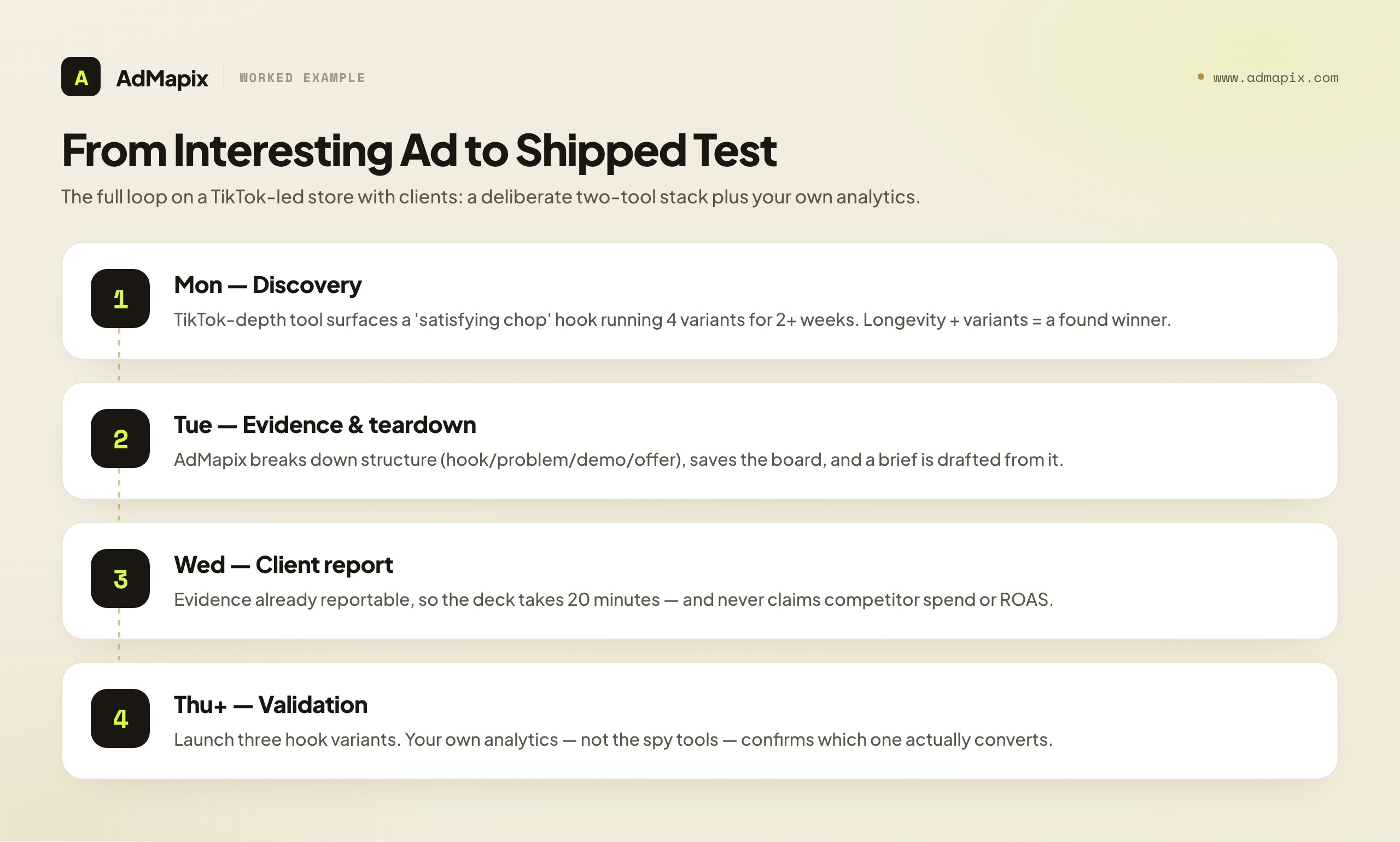
Monday, discovery. In your TikTok-depth tool you find that a competitor's "satisfying chop" hook — three seconds of fast cuts of the product slicing, no talking — is running across four creative variants and has been live for over two weeks. Longevity plus variant count is your signal: they are not testing it, they have found it. That is the kind of pattern a single screenshot would have hidden and the shape of the series reveals.
Tuesday, evidence and teardown. You pull the winning variants into AdMapix, break down the structure — hook (0–3s fast chop), problem (0–8s implied mess), demo (8–18s), offer and CTA (18–25s) — and save the board. Now you have not just "a competitor is running a chop hook" but a dissected understanding of why it works and a reusable reference. You draft a creative brief from the teardown: same structural beats, your product, your angle, three hook variations to test.
Wednesday, the client report. Because the evidence already lives in a reportable form, the client deck takes twenty minutes, not two hours: here is what is winning in the category, here is why, here is what we are testing this week. The reporting gap that would have cost you a Friday night is closed. Note what the report does not claim — it never states the competitor's spend or ROAS, because you cannot know them; it states what they are running and how, which is both true and useful.
Thursday onward, validation. You launch your three hook variants. A week later your own analytics tells you which one converts. That number — not anything the spy tools showed you — is the truth. The spy stack got you a better hypothesis faster and a report that earned the client's trust; your analytics confirmed the result. That is the full loop, and it is the loop every tool decision in this guide is ultimately serving.
Who Should Choose What — A Decision Map by Role and Channel
The same "alternative" is right for one person and wrong for the next, because the deciding factor is your role and your dominant channel, not the tool's marketing. Use this map as a shortcut, then confirm with the rubric.
Solo dropshipper, Facebook-led: If Facebook product ads still drive your decisions and Dropispy performs on your real competitors, keep Dropispy. You do not need an alternative; you need to use the tool you have more rigorously. The only reason to move is if a specific rival's ads keep slipping past Dropispy's coverage.
Solo dropshipper, TikTok-led: Your winners come from TikTok now. Add or switch to PiPiAds for depth, or Minea if you also want Facebook and product research in one tool. Dropispy alone is leaving your primary channel under-covered.
Multi-channel store owner: You test across Facebook, TikTok, and beyond. Minea's breadth fits, and AdMapix complements it when you need cross-network creative evidence and a structured teardown of what is actually working. Two focused tools often beat one bloated suite.
Agency strategist or freelancer with clients: Your bottleneck is reporting and the validation path, not discovery. AdMapix's exportable creative evidence and recurring reports close the gap that ends your week — the client deck. Keep a discovery tool (Dropispy, Minea, or PiPiAds) for finding ads, and let AdMapix carry the evidence into the report.
Performance media buyer at a brand: You likely already run your own analytics for spend and ROAS. What you lack is fast, searchable cross-network creative evidence and a way to brief creators. AdMapix fits there; do not buy a dropshipping spy tool to do a brand job.
The Migration SOP — Switching Without Losing Your Research
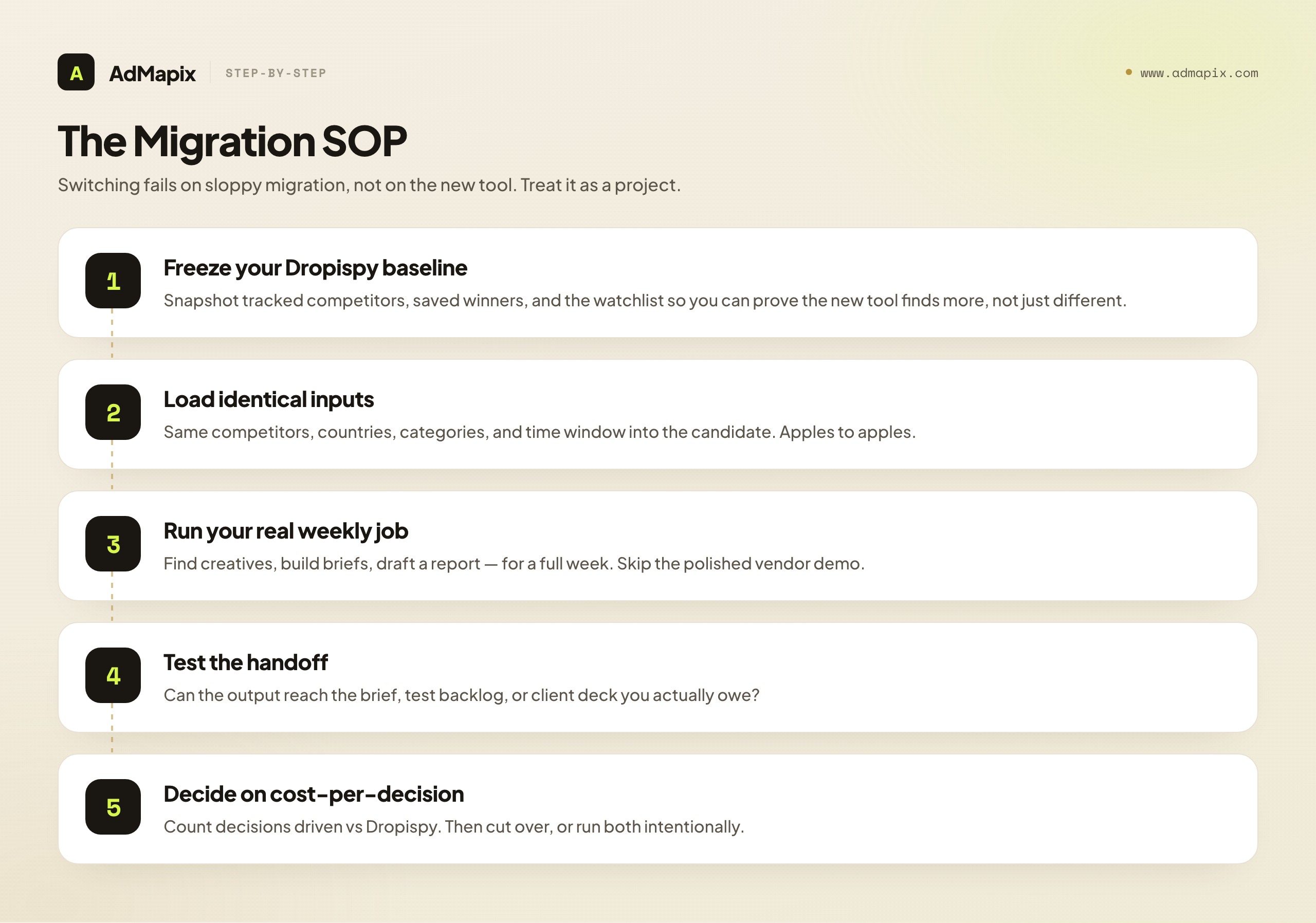
Switching tools fails most often not because the new tool is worse, but because the migration is sloppy and the team quietly drifts back to the old habit. Treat the switch as a project with steps, not a vibe. Here is the SOP we recommend.
Step 1 — Export and freeze your Dropispy baseline. Before you touch anything new, snapshot your current research: the competitors you track, the winning ads you have saved, the stores on your watchlist. If Dropispy lets you export, export. If not, screenshot the watchlist into a single doc. You want a baseline so you can prove the new tool actually finds more, not just different.
Step 2 — Define the one gap you are closing. Write a single sentence: "I am switching because Dropispy cannot ___." TikTok depth. Client reports. Video teardowns. Multi-network. This sentence is your acceptance test. If the new tool does not close that gap, the trial fails regardless of how shiny it is.
Step 3 — Load identical inputs into the candidate. Same competitors, same countries, same product categories, same time window. Apples to apples. A tool that "finds more ads" on a different competitor set has not proven anything.
Step 4 — Run your real weekly job, not the demo. Do the actual work you do every week — find creatives, build a brief, draft a report — inside the new tool for at least a week. Vendor demos are tuned to look good; your real competitors and geos are the only honest test.
Step 5 — Test the handoff. Can the output reach the deliverable you owe? A creative brief, a test backlog row, a client deck. If the evidence dies inside the tool's UI and cannot travel, the validation gap is still open.
Step 6 — Decide on cost-per-decision. Compare the candidate to Dropispy not on monthly price but on how many good decisions each produced during the trial. The cheaper tool that produces no extra decisions is the expensive one.
Step 7 — Cut over deliberately or run both. If the new tool fully replaces Dropispy's job, cut over and cancel. If it closes a different gap (very common — e.g., AdMapix for reports while you keep Dropispy for discovery), run both intentionally and budget for the stack.
Pricing Reality Check — Cost-Per-Decision Beats Sticker Price
Ad-spy pricing is a minefield of demo-led quotes, hidden tiers, and feature gates, so do not anchor on the headline number. Anchor on cost-per-decision. A €49/month tool that helps you ship one extra winning creative test per week is radically cheaper than a €19/month tool that produces zero extra decisions, even though the spreadsheet says the opposite.
Run the math honestly. Estimate how many decisions a tool drives in a month: creative briefs written, tests launched, products validated or killed, client reports delivered. Divide the monthly cost by that number. Now compare. The tool with the lowest cost-per-decision wins, and it is almost never the cheapest sticker. This reframing also kills the "but it has a bigger database" argument cold: a database you do not convert into decisions has a cost-per-decision of infinity.
A few pricing traps specific to this category. First, demo tiers are richer than the plan you will actually buy — never judge freshness or coverage from the sales demo. Second, "number of ads in database" is a vanity metric; coverage of your competitors and geos is what matters, and a tool can have ten million ads and miss your five rivals. Third, watch what happens to your saved work on cancellation. If churning means losing every board and report, the switching cost is higher than the price tag suggests. Ask before you buy.
| Buying question | Why it matters |
|---|---|
| How fresh is the data at my tier (not the demo)? | Stale creative evidence leads to last quarter's hooks |
| Is my exact geo and category deep, or only US/EU? | A global database can be thin where you actually sell |
| What exports, seats, and modules are in this plan? | Feature gates turn a "yes" in the demo into a "no" on your invoice |
| What happens to saved boards/reports if I cancel? | High lock-out cost raises the true price of switching |
| Cost-per-decision vs Dropispy over a real month? | The only comparison that reflects value, not vanity |
The Honest Limits — What No Dropispy Alternative Can Do
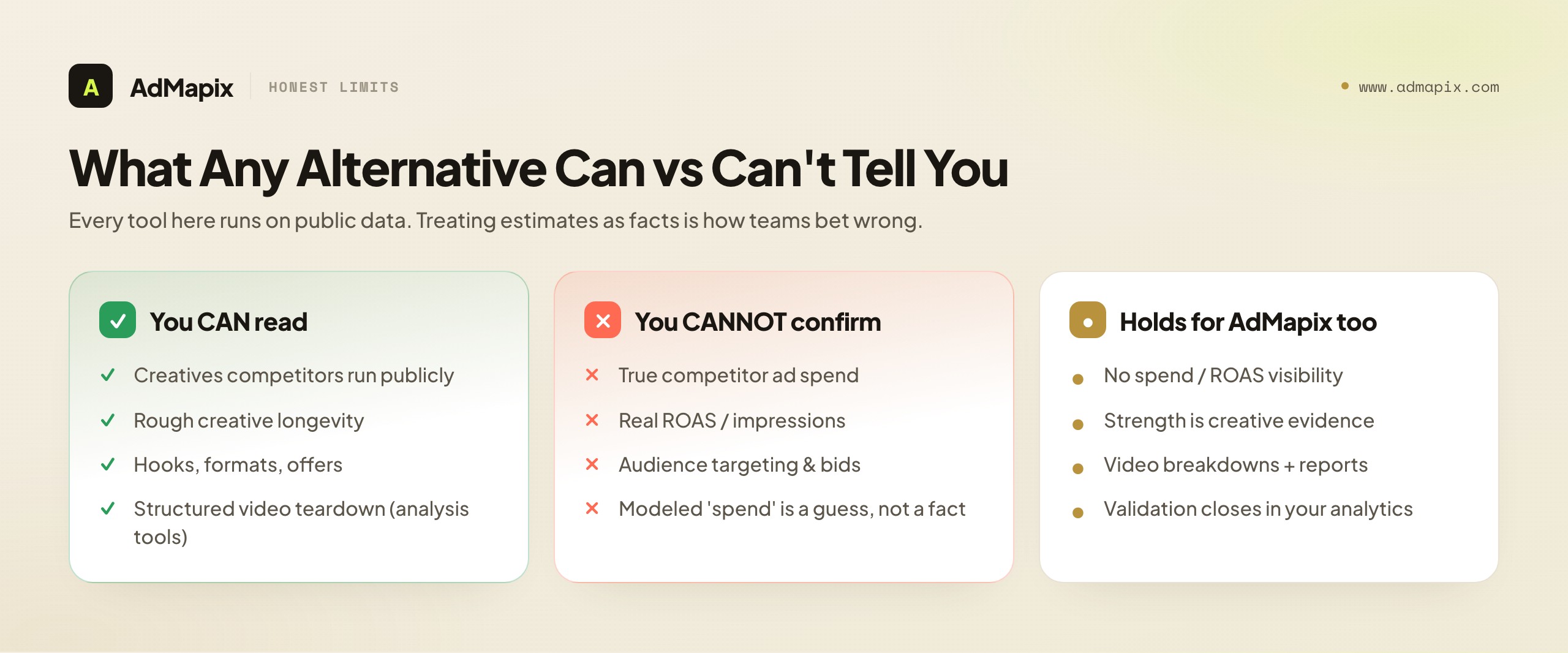
This is the section the listicles skip, and it is the most useful one. Every ad-spy tool in this category — Dropispy, Minea, PiPiAds, AdMapix, all of them — runs on public data. That hard boundary defines what any alternative can and cannot tell you, and pretending otherwise is how teams place confident bets on guesses.
What every tool can genuinely show you: the creatives a competitor is running publicly, rough longevity (the same ad still live after 45 days is a signal), formats and hooks, and — for the creative-analysis tools — a structured teardown of why an ad might be working. That is real, useful evidence.
What no tool in this category can confirm: a competitor's actual ad spend, their true ROAS, their real impressions, or their audience targeting and bids. Those numbers are not public. Some tools present modeled estimates and label them as spend — read that label carefully. An estimate is a hypothesis, not a fact, and treating a modeled spend number as gospel is how teams justify the wrong budget move.
This applies to AdMapix without exception, and we say it plainly because the brief we hold ourselves to demands it: AdMapix is searchable cross-network creative evidence — saved ad examples, video breakdowns, recurring reports. It cannot show you competitor spend, ROAS, impressions, or audience targeting. If your gap is spend estimation, AdMapix is the wrong alternative for you, full stop. Its strength is helping you find, understand, and report on the creatives that are running — and to do that across networks in a form that hands off to a brief or a deck.
The deepest limit of all: even perfect creative evidence cannot tell you what will convert for you. The only source of real ROAS is your own analytics after your own test. Every spy tool, Dropispy included, is an input to a hypothesis. The validation loop closes inside your account, not inside any vendor's dashboard. Buy the tool that helps you form better hypotheses faster — and never confuse a confident-looking estimate for the truth.
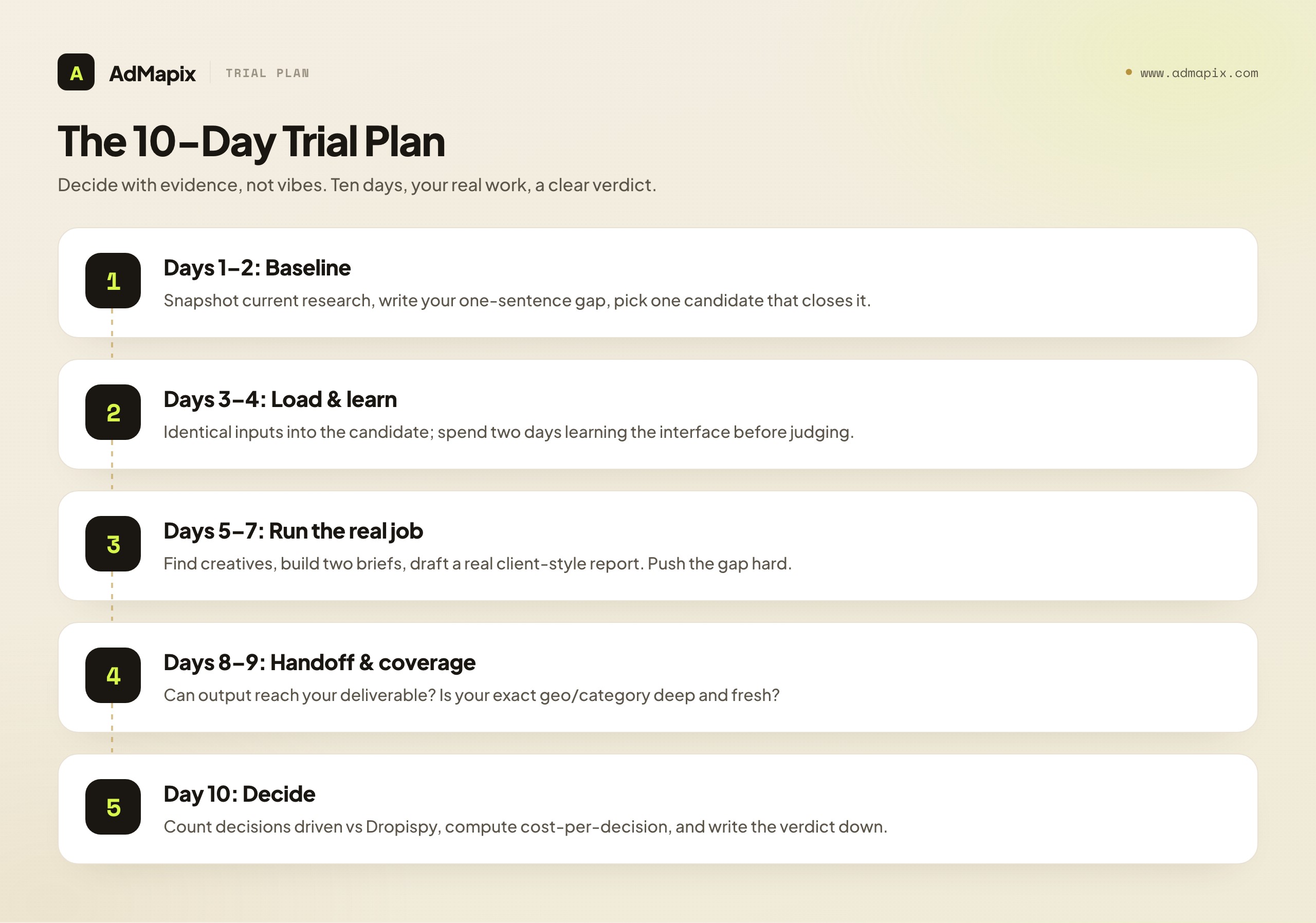
A 10-Day Trial Plan to Choose Your Alternative
Talking yourself in circles is how people stay on a tool that no longer fits. Run a structured trial instead. Ten days, your real work, a clear verdict.
Days 1–2: Baseline. Snapshot your current Dropispy research (competitors, saved winners, watchlist). Write your one-sentence gap. Pick one candidate that closes that gap (use the role map above).
Days 3–4: Load and learn. Load identical inputs — same competitors, geos, categories, time window — into the candidate. Spend two days just learning where things live. Do not judge yet; learning curves are not the same as capability gaps.
Days 5–7: Run the real job. Do your actual weekly work in the candidate. Find creatives. Build at least two creative briefs. If you are an agency, draft a real client-style report. Push the tool to do the thing your gap is about.
Days 8–9: Test the handoff and coverage. Can the output reach your real deliverable? Is your exact geo/category deep and fresh, or thin? This is where shallow coverage and weak exports get exposed.
Day 10: Decide on cost-per-decision. Count the decisions the candidate drove versus Dropispy over the trial window. Compute cost-per-decision for both. Decide: keep Dropispy, switch, or run both intentionally. Write the verdict down so you do not relitigate it next month.
If the candidate fails the trial, that is a successful trial — you saved yourself a switch. If it passes, execute the migration SOP and cancel what you are replacing. Either way, you decided with evidence, not vibes.
Common Mistakes When Choosing a Dropispy Alternative
A few failure patterns show up again and again. Avoid them and you will pick well.
Chasing database size. "It has more ads" is the most seductive and least useful criterion. A larger database that you cannot convert into decisions is not an upgrade. Coverage of your competitors beats raw count every time.
Buying the suite before the job is real. It is tempting to buy the broadest tool "to be safe." But you pay for modules you do not use, and the breadth slows you down on the one job you actually have. Buy for the gap, not for the hypothetical.
Judging from the demo. Vendor demos are tuned. The demo tier is richer than your plan. Coverage on the demo app is not coverage on your competitors. Always trial on your real inputs.
Confusing "different" with "better." A new tool that finds different ads is not necessarily finding more relevant ads. The baseline snapshot exists precisely to catch this — measure against your real competitors, not the tool's highlight reel.
Treating estimates as facts. This is the costliest mistake. A modeled spend number is a guess. Build your budget on it and you have built your budget on someone's model. Use estimates as direction, never as decision.
Never closing the loop. The tool is an input. If you stop at "interesting ad" and never run the test, no alternative will help. The discipline of evidence → brief → test → your-analytics is what makes any of these tools pay off.
FAQ
What is the best Dropispy alternative in 2026?
There is no single best alternative — it depends entirely on the gap you are closing. For TikTok depth, PiPiAds is the specialist. For broader product-and-creative research across networks with influencer signals, Minea is the natural step up. For cross-network creative evidence, structured video breakdowns, and client-ready reports, AdMapix fits. Score candidates on the five-criterion rubric, weight by your actual bottleneck, and the right one becomes obvious. The "best" tool is the one that fixes your specific problem, not the one with the biggest database.
Is AdMapix a true Dropispy alternative?
AdMapix is an alternative for some of Dropispy's jobs and not others. It is searchable cross-network creative evidence with video breakdowns and exportable reports, so it closes the creative-analysis, reporting, and validation-handoff gaps very well. It does not replicate Dropispy's dropshipping-store rankings or shop data, and crucially it does not show competitor ad spend or ROAS — no tool in this category does. If your job is finding, understanding, and reporting on creatives across networks, AdMapix is a strong fit. If your job is Facebook-store rankings or spend numbers, it is not the right match.
Should I keep Dropispy and add a tool, or replace it entirely?
It depends on whether the new tool does Dropispy's job or a different job. If the alternative fully covers your dropshipping discovery and does it as well or better on your real competitors, replace and cancel. But many of the strongest pairings are complementary — for example, keeping Dropispy for Facebook discovery while adding AdMapix for cross-network evidence and client reports. If the new tool closes a different gap, running both intentionally usually beats forcing one tool to do everything.
Why does Dropispy miss so many TikTok ads?
Dropispy's center of gravity is Facebook-style product ads — that is what it was built around. TikTok-native creative research, with its UGC hooks, native sounds, and spark-ad mechanics, is simply not its core strength. As TikTok becomes the dominant dropshipping testing ground, a Facebook-first tool naturally under-covers it. This is not a defect; it is a focus. If TikTok now drives your winners, a TikTok specialist like PiPiAds or a broad tool like Minea will cover the channel Dropispy was never built to lead on.
How do I compare ad-spy tools fairly?
Load identical inputs — the same competitors, countries, product categories, and time window — into each tool, then run your real weekly job inside both, not the vendor demo. Judge on whether the output reaches the deliverable you owe (a brief, a test, a client report), on coverage of your exact geos and categories, and on cost-per-decision rather than sticker price. A fair comparison measures the work you actually do, against the competitors you actually track, on the plan you will actually buy.
Can any Dropispy alternative show competitor ad spend or ROAS?
No. Competitor ad spend, ROAS, real impressions, and audience targeting are not public data. Some tools present modeled estimates and label them as spend — read that label carefully, because an estimate is a hypothesis, not a fact. This applies to every tool in the category, AdMapix included. If a vendor implies they can show a competitor's true spend or ROAS, treat the claim with deep skepticism. Use estimates as directional signal only, and confirm what actually works inside your own analytics.
What is "cost-per-decision" and why does it matter more than price?
Cost-per-decision is the monthly cost of a tool divided by the number of real decisions it drives — creative briefs written, tests launched, products validated or killed, client reports delivered. It matters more than sticker price because a cheap tool that produces no extra decisions is, in practice, infinitely expensive, while a pricier tool that helps you ship an extra winning test each week pays for itself many times over. Computing cost-per-decision during a trial cuts through both the "it's too expensive" reflex and the "it has more features" seduction.
How long should I trial a Dropispy alternative before switching?
About ten days of real work is enough. Spend the first two days baselining your current research and naming your one gap, two days loading identical inputs and learning the interface, three days running your actual weekly job, two days testing the handoff and coverage, and a final day deciding on cost-per-decision. Anything shorter and you are judging the learning curve instead of the capability; much longer and you are procrastinating. Ten days against your real competitors gives a confident verdict.
Is a more expensive ad-spy tool always better?
No. Price tracks features and database size, neither of which is what you are buying. You are buying decisions. A focused, cheaper tool that nails your one gap routinely beats an expensive suite whose breadth you never use. Worse, broad suites can slow you down on the single job you actually have. Score on cost-per-decision and on fit for your weighted gap, and let the price fall out of that — never lead with it.
What if I run both Dropispy and an alternative?
Running two tools intentionally is often the smartest setup, not a failure to choose. Use Dropispy (or another discovery tool) for finding ads, and a complementary tool like AdMapix for cross-network creative evidence and client-ready reporting. The trap is running two tools that do the same job — that is just paying twice. Running two that close different gaps — discovery plus evidence-and-reporting — is a deliberate stack, and for agencies it is frequently the right answer. Budget for it on cost-per-decision, not guilt.
Does AdMapix help with the validation step?
AdMapix helps you form better hypotheses faster — it gets you from scattered evidence to a structured brief and a shareable report, which is the input to a good test. But it cannot tell you what will convert for you. No spy tool can. The validation loop closes inside your own analytics after your own test runs. Think of AdMapix as sharpening the hypothesis, not confirming the result. The confirmation always lives in your account.
Related Reading
- Best Minea alternatives in 2026 — 7 tools compared for ad & creative intelligence If you are evaluating a switch, work through these in order: start with our best ad spy tools 2026 roundup for the full landscape, then read the Minea ad spy review for the closest like-for-like alternative. Use the competitor ad analysis framework to turn whatever tool you pick into repeatable decisions, the ad creative database to understand the evidence layer, and the creative testing framework to close the validation loop inside your own analytics. For the broader category view, the best ad intelligence tools guide maps where each type of tool fits.
Turn these observations into your next creative study
Open the creative library and select samples for your market, network and research question.
Related Articles
Dropispy vs Minea in 2026: Dropshipping Ad Spy or Broad Product Research?
A 2026 head-to-head of Dropispy vs Minea — Facebook-first dropshipping ad spy with shop signals versus broad ecommerce product research with daily winning products and multi-channel layers, compared on coverage, pricing, and use-case fit, with a test-before-you-buy method and the honest limits of what ad spy data can prove.
PowerAdSpy Alternative in 2026: 7 Tools Compared (Coverage, Video & Pricing)
A 2026 guide to choosing a PowerAdSpy alternative — why tier-gated filters send teams looking, a 7-tool comparison with pricing and coverage, the discovery-vs-video-vs-reporting framework, a migration plan, and an honest read on when AdMapix fits.
Minea vs BigSpy in 2026: Ecommerce Product Research or Broad Ad Library?
A 2026 head-to-head of Minea vs BigSpy — product-and-sourcing research versus broad cross-platform ad discovery, compared on coverage, signals, pricing, and use-case fit, with a test-before-you-buy method, what public ad data can and cannot prove, and where a creative-evidence layer fits.