
Anstrex vs Adbeat in 2026: Native Affiliate Spy or Display Intelligence Platform?
A 2026 head-to-head of Anstrex vs Adbeat — native and push affiliate funnel research with a landing-page ripper versus display competitive intelligence with publisher paths and estimated spend trends, compared on channel, data type, depth, pricing shape, and use-case fit, with a test-before-you-buy method and the honest limits of what each tool's public data can prove.
By the AdMapix Research Team — Updated June 21, 2026
Anstrex vs Adbeat in 2026: Native Affiliate Spy or Display Intelligence Platform?
Anstrex vs Adbeat is a channel-and-data-type decision, and the right pick turns on whether your job is native/push affiliate funnel research or display competitive intelligence. Pick Anstrex if your daily work is native and push affiliate research — spying on offers, ripping prelanders, and finding funnels that are already converting across native ad networks. Pick Adbeat if your job is understanding a competitor's display advertising at the media-buying level — which publishers and ad networks they buy through, what their estimated spend trend looks like, and how it is changing, packaged into shareable reports. Both surface competitors' running ads, but they enter the problem from opposite ends: Anstrex enters from the affiliate funnel, Adbeat from the media-buying footprint. This 2026 guide is for affiliate and native buyers, display advertisers, media buyers, agencies, and competitive-intelligence teams deciding which one to buy. After reading it you will know which tool to test first, how they differ on channel and data and price, how to test them before you pay, what each tool's public data can and cannot prove, and where a cross-network creative-evidence layer fills the gap neither is built for.
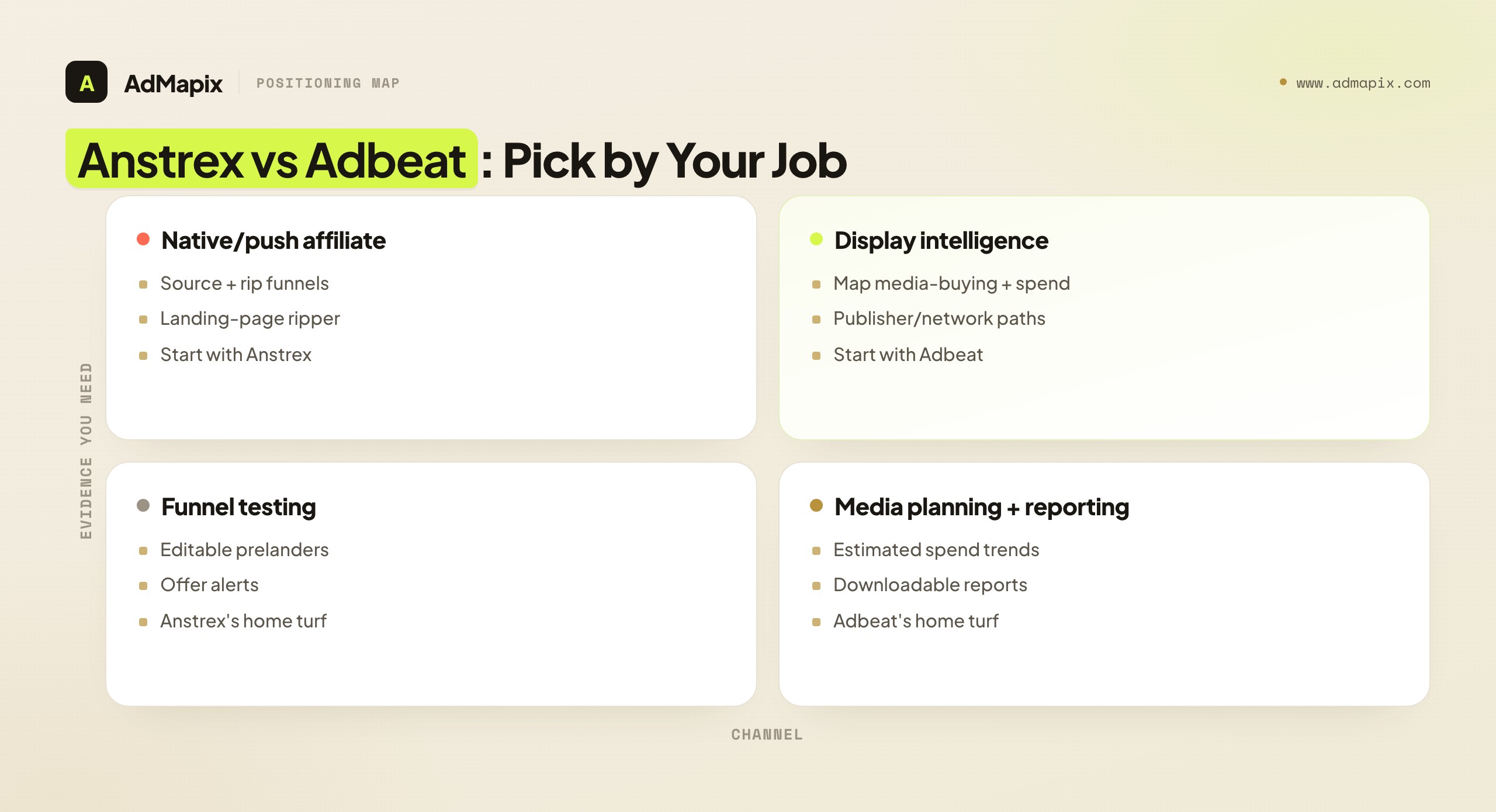
TL;DR — Anstrex vs Adbeat in One Screen
- Anstrex is the native/push affiliate choice — built around spying offers, ripping landing pages, and copying funnels across native ad networks. If your job is sourcing the next affiliate campaign, it is purpose-built for it.
- Adbeat is the display-intelligence choice — built around understanding who buys display inventory, through which networks and publishers, with estimated spend trend signals and downloadable reports. If your job is competitive media-buying intelligence, it fits that.
- The deciding question is not database size but which tool gets you from a competitor's ad to a usable next action — a ripped funnel to test, or a media-buying map to plan against — for the channel you actually work in.
- They map to two different jobs. "Which native/push offers are converting and what does the funnel look like?" points to Anstrex. "Where is this brand buying display, through which publishers, and how is spend trending?" points to Adbeat.
- Neither proves performance directly. Anstrex shows what is running, not its true ROI; Adbeat's spend figures are estimates, not a competitor's actual invoices. Treat both as hypotheses to validate.
- A cross-network creative-evidence layer (such as AdMapix) fits on top of either when you need cross-network paid-social creative search, saved media, video breakdowns, and recurring reports — not a replacement for funnel ripping or display spend intelligence.
What These Tools Actually Solve
They solve two different jobs that only look similar because both involve "competitor ads," and confusing them is the most common reason teams buy the wrong one. Anstrex is built around native and push affiliate research. Native ads are the "recommended for you" content units you see at the bottom of articles; push ads are the notification-style ads delivered through ad networks. Anstrex indexes ads across many native networks and a wide set of countries, and its differentiator is workflow depth on the funnel side: advanced search and filtering to find live offers, a landing-page ripper to download and edit prelanders, and competitor alerts so you can track when a rival pushes a new angle. The unit of value is the affiliate funnel you can copy and test.
Adbeat is built around display competitive intelligence. It is a platform for understanding a competitor's display advertising at the media-buying and publisher level: it surfaces competitor ads, the media-buying sources and ad networks behind them, the publishers running those ads, the landing pages, and estimated spend trend signals, with alerts, side-by-side comparisons, and downloadable reports. Adbeat states that its data covers display, native, video, interstitial, and page-takeover formats, so its format scope is broader than native and push alone. The unit of value is the media-buying map and spend trend — not a funnel to rip, but an understanding of where and how a competitor spends.
That split maps to two questions you are probably asking. If the question is "which native/push offers are running right now, and what does the funnel behind them look like," Anstrex is purpose-built for it — its ripper and offer filters are designed to answer exactly that. If the question is "where is this brand buying display, through which networks and publishers, and how is that changing," Adbeat covers that ground because the media-buying footprint and spend trend are its native objects rather than a funnel to copy.
The cascade from this difference touches everything. It changes what each tool indexes, what it filters by, who it is priced for, and — most importantly — what you walk away with. An Anstrex session ends with an offer and a ripped, editable prelander ready to test. An Adbeat session ends with a map of a competitor's display footprint — publishers, networks, estimated spend over time — ready to inform a placement plan or a board slide. If you confuse the two, you will buy the wrong tool and be quietly frustrated that it does not do the job you actually needed — not because it is bad, but because it was never built for your job. An affiliate who buys Adbeat to rip native funnels will find it shows the footprint but not the workflow depth on the funnel side. A display planner who buys Anstrex to map a brand's media-buying will find it strong on native/push offers but not built to answer the publisher-and-spend question.
So the first question is not "which has more ads" but "is my job native/push affiliate funnel research, or display media-buying intelligence?" Answer that honestly and the comparison mostly resolves; everything below is the detail that confirms it. A useful mental model: Anstrex is a funnel-research workbench for affiliates; Adbeat is a media-buying intelligence platform for display advertisers and analysts. A workbench is the right buy when copying and testing funnels is your constraint; an intelligence platform is the right buy when understanding a competitor's spend and placements is.
There is a second-order effect of this split that does not show up in any feature matrix but governs whether you actually get value: the tool you pick shapes the questions you think to ask. Buy a funnel workbench and you will naturally frame your week around "what offer do I rip and test next" — a productive frame for an affiliate and a narrowing one for an analyst who needs to be thinking about competitive spend and placement strategy. Buy an intelligence platform and you will frame your week around "what is this brand's media-buying footprint and how is it changing" — productive for a planner, but it can pull an affiliate away from the fast funnel-testing loop that was their actual job. In other words, the tool does not just answer questions; it teaches you which questions to ask. Picking the one that matches your real job keeps your research aligned with how you make money. Picking the mismatched one slowly drags your attention toward the work the tool is good at and away from the work you needed done — a subtle tax that compounds over a subscription year and is far more expensive than any price difference between the two.
It is also worth being precise about why these two so often get compared at all, given how different they are. The reason is that both sit under the broad umbrella of "competitor ad intelligence," and a buyer searching for "spy on competitor ads" lands on both. But the umbrella hides the real divide: Anstrex serves the performance-marketing affiliate whose economics depend on finding and testing converting funnels fast, while Adbeat serves the brand-side or agency analyst whose economics depend on understanding where competitors spend and reading market movements. Those are different people with different budgets, different success metrics, and different bosses to answer to. When an affiliate and an analyst both type "competitor ad tool" into a search bar and land on the same comparison, the honest answer is not "here is the better tool" but "here is which of you each tool was built for" — and recognizing which one you are is most of the decision.
What Anstrex Is Best At
Anstrex is strongest when the job is finding and copying native/push affiliate funnels, and its defining feature is the landing-page ripper combined with deep offer search — the ability to go from "this native offer is running" to "here is an editable copy of the prelander behind it" inside one workflow. For an affiliate or native buyer, that funnel-level depth is the core job. A native ad with no way to study and replicate the funnel behind it is far less useful to an affiliate than one you can rip, edit, and test against your own traffic.
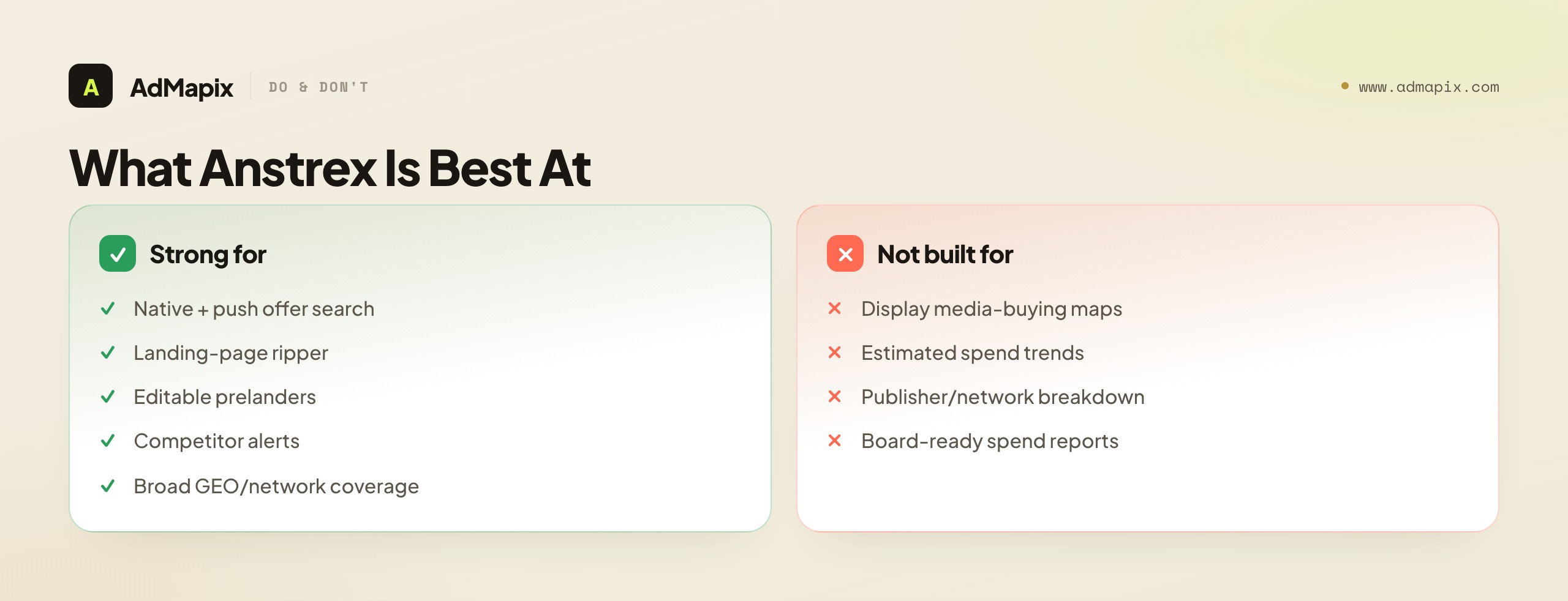
The affiliate-first design shows up in concrete strengths. Advanced offer search and filtering lets a buyer find live native and push offers by the signals that matter — network, country, device, and more — so the firehose of native creatives narrows to the niche they actually run. The landing-page ripper downloads and lets you edit prelanders, which is the single most workflow-defining feature for an affiliate: it compresses the tedious work of rebuilding a funnel from scratch into editing a proven structure. Competitor alerts track when a rival pushes a new angle, so you catch a fresh offer while it is still early rather than after it is saturated. And broad native-network and country coverage means an affiliate working international or specific GEOs is not boxed into one market. For a buyer whose finish line is a tested funnel, that end-to-end funnel-research depth is the entire value proposition.
Walk through what that does in a real session. You spot a native offer that looks promising. In a tool that only shows the creative, you would note it and try to rebuild the funnel by hand. In Anstrex, the ripper turns that one observation into an editable asset: you download the prelander, study its structure — the hook, the proof, the transition to the offer — and adapt it for your own traffic and compliance needs. That is the difference between "I saw a competitor's funnel" and "I have a working version of it to test by tomorrow," and for an affiliate whose edge is speed and volume of tests, that compression is the whole game.
Best fit: native and push affiliates and media buyers whose weekly constraint is "what offer do I run next, and what funnel do I test," and whose finish line is a ripped, editable prelander. If that is your bottleneck, Anstrex's funnel-research depth fits it. It also fits the buyer who works specific GEOs or networks and wants competitor alerts to catch new angles early, before the obvious winners are crowded.
Where it falls short: Anstrex is funnel-and-affiliate-led rather than spend-and-publisher-led, so it does not give you a competitor's display media-buying map, publisher breakdown, or estimated spend trend the way Adbeat does. A display planner or competitive-intelligence analyst who needs "where and how much is this brand spending on display" will find Anstrex strong on native/push offers but not built for the media-buying question. It trades display-intelligence breadth for native/push funnel depth — the right trade for an affiliate and the wrong one for a display analyst. Verify its current Native and Push plan tiers and any trial terms on the pricing page before buying.
What Adbeat Is Best At
Adbeat is strongest when the bottleneck is understanding a competitor's display advertising at the media-buying level, not ripping a funnel. Where Anstrex organizes everything around the affiliate funnel, Adbeat organizes everything around the media-buying footprint — and its defining strength is the combination of publisher and network paths plus estimated spend trends: the ability to see not just an ad but where a brand buys it, through which networks, and how that spending appears to be changing over time. For a display advertiser, agency, or competitive-intelligence team, that footprint-level view is the core job. A display ad with no context on where it runs or how spend is trending is far less useful to a planner than one mapped to its publishers, networks, and a spend trend line.
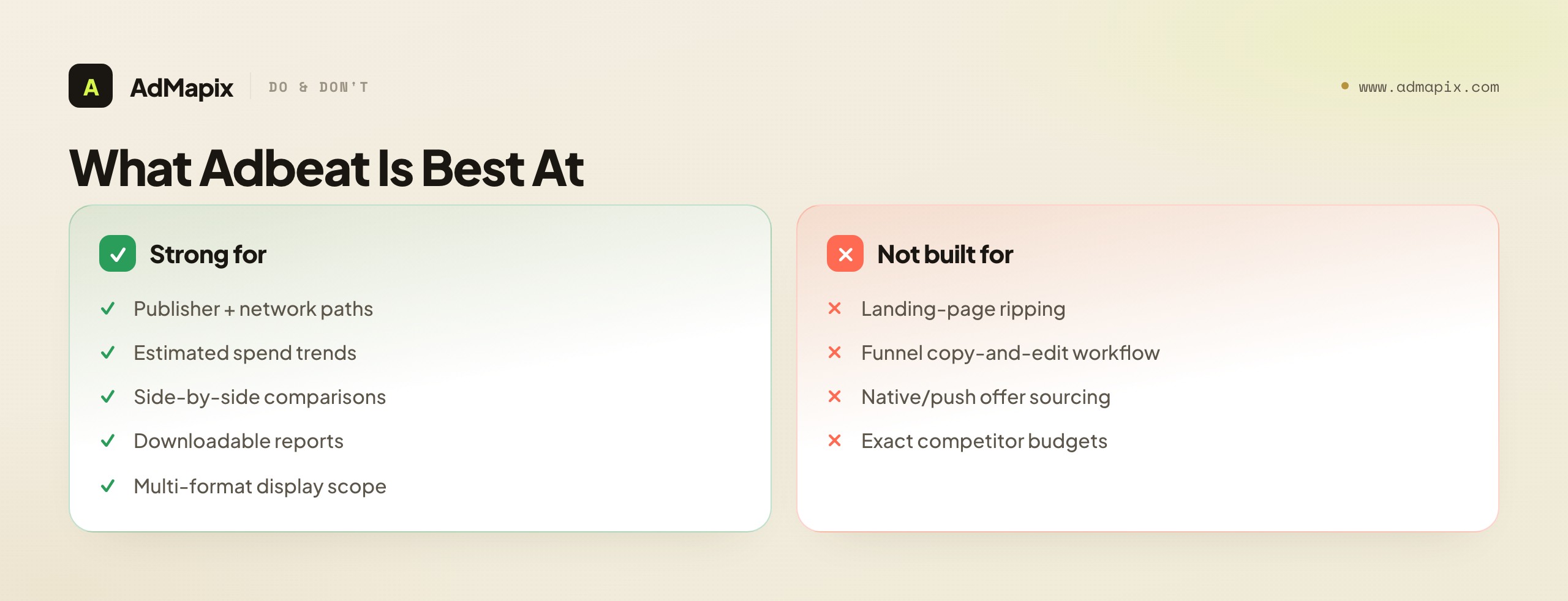
The intelligence-platform design shows up in concrete strengths. Publisher and ad-network paths show where a brand's display ads run and which media-buying sources deliver them, which is exactly what a planner needs to understand a competitor's placement strategy. Estimated spend trend signals give a directional read on how aggressively a brand is buying and whether that is rising or falling — directional, because these are modeled estimates, not the competitor's real invoices. Alerts and side-by-side comparisons let an analyst monitor a competitive set over time rather than taking a one-off snapshot. Downloadable reports turn the analysis into something a team or client can act on without re-doing the work — a property that matters enormously for agencies defending a recommendation. And broad format coverage across display, native, video, interstitial, and page-takeover means the footprint view is not limited to one ad type. For an analyst whose finish line is a media-buying map and a defensible plan, that intelligence depth is the point.
Walk through what that does in a real session. You need to understand how a competitor is spending on display. In a tool that only shows creatives, you would see the ads but not the strategy. In Adbeat, you map the footprint: which publishers run their ads, which networks deliver them, and how estimated spend has trended over the last few months. That turns "here are some competitor display ads" into "here is their apparent placement and budget strategy, and here is where we should consider buying or avoiding" — the read a media planner or competitive-intelligence analyst actually needs.
Best fit: display advertisers, agencies, and competitive-intelligence teams whose weekly constraint is "where and how is this brand buying display, and how is it changing," and whose finish line is a placement plan, a competitive report, or a board slide. If that is your bottleneck, Adbeat's publisher-and-spend intelligence fits it. It also fits the agency that has to defend media recommendations with evidence and monitor the same competitive set every week, because the reports and alerts are built for a recurring, shareable workflow.
Where it falls short: Adbeat is spend-and-publisher-led rather than funnel-led, so it does not give an affiliate the landing-page ripper and offer-copying workflow that defines native/push research. A native or push affiliate who buys Adbeat to source and rip funnels will find it shows the footprint but not the funnel workbench they actually need. And its headline spend numbers are estimates — useful for relative comparison and trend, but not a competitor's true budget. It trades native/push funnel depth for display-intelligence breadth — the right trade for a display analyst and the wrong one for an affiliate. Verify its current plan tiers and data-access limits on the pricing page before buying.
Anstrex vs Adbeat: Side-by-Side
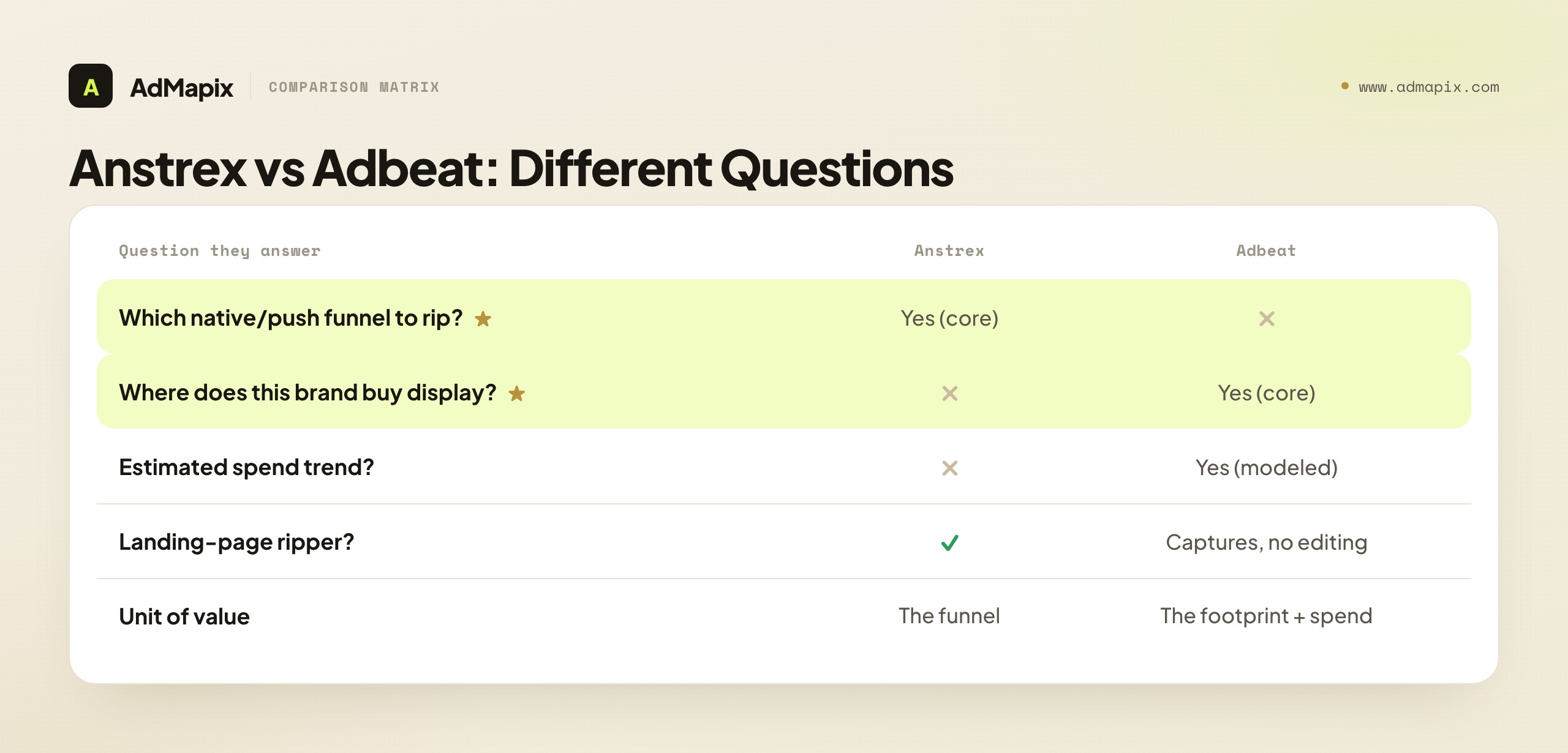
The short version: Anstrex is a funnel-research workbench for native/push affiliates, and Adbeat is a media-buying intelligence platform for display advertisers. Use the table to match each tool to the decision you actually make each week rather than to its marketing.
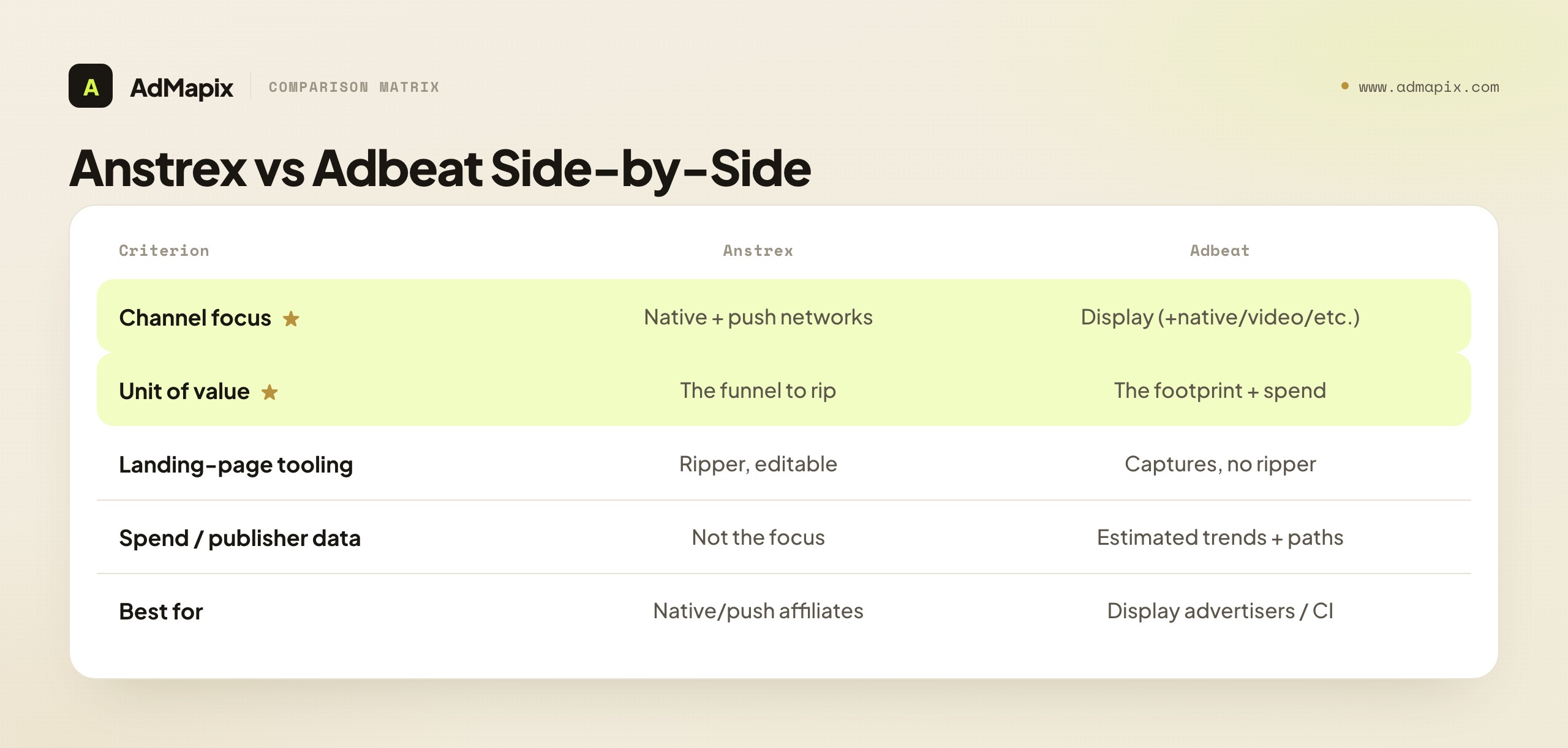
| Criterion | Anstrex | Adbeat |
|---|---|---|
| Core job | Native/push affiliate funnel research | Display media-buying intelligence |
| Unit of value | The funnel you can rip and test | The media-buying map + spend trend |
| Channel focus | Native and push ad networks | Display (plus native, video, interstitial, takeover) |
| Landing-page tooling | Ripper to download and edit prelanders | Captures landing pages, no ripper-style editing |
| Spend / publisher data | Not the focus | Estimated spend trends + publisher/network paths |
| Reporting | Offer-level, alerts | Side-by-side, downloadable reports, alerts |
| Best for | Native/push affiliates and media buyers | Display advertisers, agencies, CI teams |
| Where it falls short | No display spend/publisher map | No funnel ripper; spend is estimated |
The two rows that should drive your decision are "channel focus" and "spend/publisher data." If native/push affiliate funnels are your whole game, Anstrex's ripper and offer depth win; if display media-buying intelligence is the job, Adbeat's publisher paths and spend trends win. The rest are tie-breakers and texture. The useful question is never which tool claims the largest database — it is which gets your team from evidence to a clearer funnel test or media-buying plan, on the channel you actually work in.
A word on pricing, because comparisons go stale fastest there. We have deliberately not printed dollar figures for either tool, and you should treat any blog that does with suspicion: these vendors change tiers, data-access limits, trial terms, and discounts frequently, and a price quoted six months ago is often wrong today. What matters more than the headline number is the shape of each tool's pricing. Anstrex splits into Native and Push products with their own tiers, so the value calculation is "which product and tier covers the networks and GEOs I run." Adbeat tiers up through plans with different levels of data access and report depth, so the value calculation is "which tier unlocks the publisher, spend, and reporting depth my analysis needs." The honest comparison is per-job — what does it cost to get the specific outcome you need, on the plan that includes it — and you should pull the current numbers off each vendor's own pricing page the day you decide, not from any third-party table.
It is also worth naming what the table cannot capture: the texture of daily use, which only a trial reveals. For an affiliate, the difference between a ripper that produces a clean, editable prelander and one that mangles the page is the difference between a tool you live in and one you abandon. For an analyst, the difference between a spend trend you trust enough to put in a deck and one you have to caveat into uselessness is everything. A side-by-side grid is a starting hypothesis about fit, not a verdict. The verdict comes from running the same real competitors through both interfaces and noticing which one actually produces the artifact you need. That is why every recommendation here ends at "test it," not "buy it."
Channel and Data Type in Detail: Funnels vs Footprints
The dimension where these two tools diverge most is not a feature — it is the kind of evidence each produces, and it deserves a section because it is the single thing most likely to make one tool right and the other wrong for you.
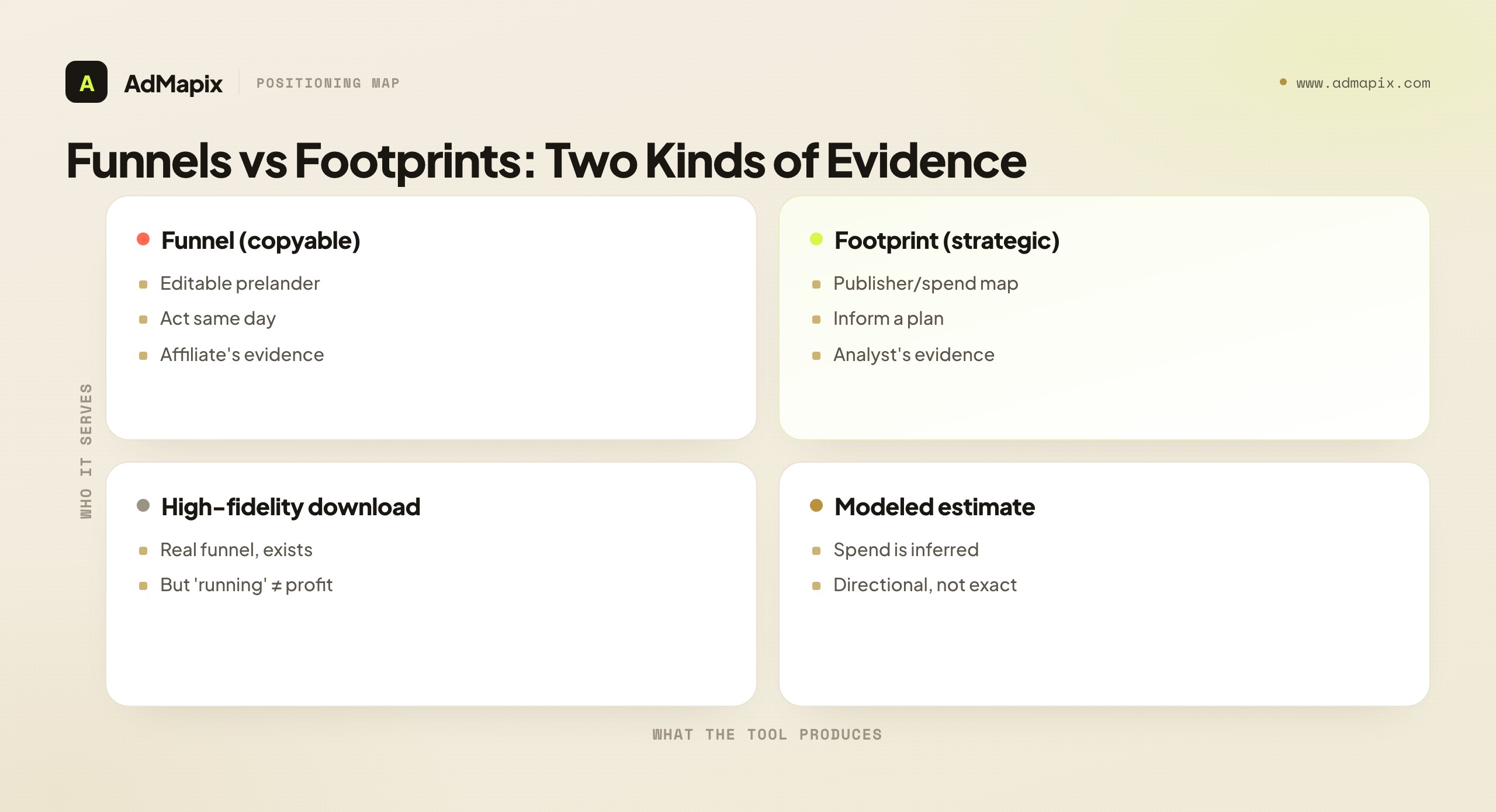
Anstrex produces funnels. Its entire workflow is organized to deliver an editable copy of a competitor's prelander and the offer behind it. That is the right kind of evidence for an affiliate, whose job is to find a converting funnel and test a version of it fast. The funnel is concrete, copyable, and immediately actionable — you can have a test live the same day. The trade-off is that a funnel tells you almost nothing about a competitor's overall scale: you see one offer's prelander, not where else the brand buys, how much it spends, or how its budget is trending. For an affiliate, that does not matter, because scale is not the question. For a planner, it is the entire question, and the funnel is the wrong unit of evidence.
Adbeat produces footprints. Its workflow is organized to deliver a map of where and how a brand buys display — publishers, networks, formats, and an estimated spend trend. That is the right kind of evidence for a media planner or competitive-intelligence analyst, whose job is to understand a competitor's strategy and budget at a level that informs placement and planning decisions. The footprint is strategic, comparable across competitors, and shareable in a report. The trade-off is that a footprint does not hand you a funnel to copy: you understand the brand's media-buying shape, but you do not get an editable prelander to test tomorrow. For an analyst, that does not matter; for an affiliate, it leaves out the most useful artifact.
There is a subtler point hiding inside "data type": the reliability of each tool's headline numbers is different in kind. Anstrex's core evidence — the ripped funnel — is a download of something that actually exists, so it is high-fidelity for what it is, limited only in that "running" is not "profitable." Adbeat's core evidence — estimated spend — is a modeled inference, which is genuinely useful for relative comparison and trend direction but is not a competitor's real budget. The discipline differs accordingly: with Anstrex you validate whether the funnel converts for you; with Adbeat you treat spend figures as directional estimates to compare and trend, never as exact dollars to quote as fact. Knowing which kind of evidence you are holding is the difference between using each tool well and over-trusting it.
There is one more wrinkle worth naming, because it trips up teams that try to use one tool for both jobs: the two kinds of evidence age differently. A ripped funnel is a snapshot of a structure that may be live today and gone next week — its value is in the moment, for a fast test, and it decays quickly as the offer saturates. A footprint and spend trend, by contrast, is a longitudinal read whose value comes from accumulation: one month of estimated spend tells you little, but six months of trend tells you whether a competitor is escalating, retreating, or holding. So Anstrex rewards frequent, fast checking — log in often, catch fresh offers, rip and test before the crowd. Adbeat rewards patient, periodic monitoring — track the same competitive set over time and let the trend lines accumulate into a story. Trying to use a funnel tool patiently or an intelligence platform frantically fights the grain of the evidence each produces, and is another reason mismatched buyers feel like the tool is "not working" when it is simply being used against its rhythm.
The practical decision: decide whether your job needs a funnel to copy or a footprint to plan against, then pick the tool that produces that evidence. If you are sourcing and testing native/push funnels, Anstrex's funnel evidence is the structural fit and Adbeat's footprint is interesting context you cannot act on directly. If you are planning display placements or briefing leadership on competitive spend, Adbeat's footprint is the structural fit and Anstrex's funnels are the wrong unit. There is no "more complete" tool here — only the tool that produces the evidence your decision actually consumes.
A Workflow That Works With Either Tool
The fastest path from a competitor signal to a decision is the same regardless of which tool you buy. Name the decision first, then collect evidence against it — a tool only helps if you can state the next action it should inform.
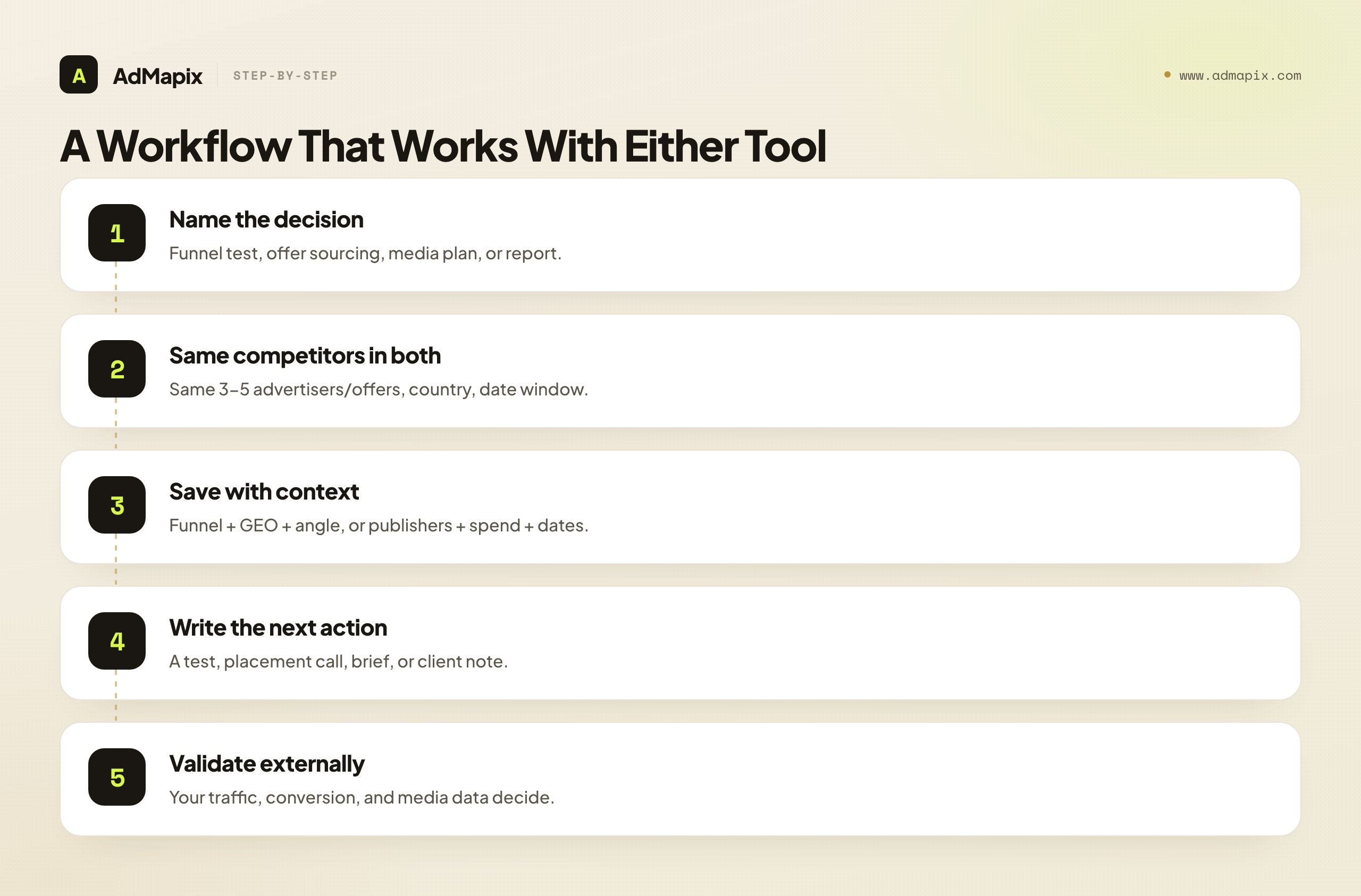
- Name the decision. Funnel testing, offer sourcing, competitive media planning, or client reporting are different jobs that need different searches. Write down which one you are doing before you open either tool.
- Use the same competitors in both tools. Search the same three to five real advertisers or offers with the same country and date window so the comparison is fair, not an artifact of how carefully you searched each.
- Save evidence with context. For Anstrex, keep the offer, the network, the GEO, the ripped funnel, and a note on the angle. For Adbeat, keep the publisher and network paths, the estimated spend trend, the date range, and the comparison set. Provenance is what makes the evidence comparable next week.
- Write the next action. Every saved funnel or footprint should become a test, a placement decision, a brief, or a client note — not a screenshot that dies in a browser tab.
- Validate externally. Spy tools reveal patterns; your own traffic, conversion, and media data decide whether the pattern actually worked. The tool generates the hypothesis; only your numbers confirm it.
The discipline is in steps 3 through 5. Anyone can search and browse; the affiliates and analysts who win are the ones who save with context, force each finding to produce a next action, and validate against their own performance before scaling. Do that with either tool and the research compounds; skip it and even the better tool produces a folder of screenshots nobody reopens.
Provenance — step 3 — matters more than it looks, and it is the step most people skip. For an affiliate, a ripped funnel with no note on the offer, GEO, and angle is just a folder of HTML you will not remember the point of in three weeks. For an analyst, a spend trend screenshot with no date range or comparison set is a number you cannot defend in a meeting. The one-line note that captures where the evidence came from and why it mattered is what turns a pile of saves into a dataset you can sort, compare, and act on. It costs about ten seconds per save and rescues the entire month of research.
Step 4 — forcing every finding into a next action — keeps research honest about its purpose. Research that does not produce a decision is entertainment, and both tools are good at being absorbing: there is always one more offer to rip or one more competitor footprint to explore. The forcing function "what will I do because of this" is what stops a session from becoming an afternoon of browsing with nothing to show. A good rule: if you cannot write a next action for a saved item within a day, delete it. Step 5 — external validation — is where the workflow earns its keep, because nothing in either tool proves profit on its own. Anstrex shows a funnel is running, not that it converts for your traffic; Adbeat shows estimated spend, not a competitor's real ROI. Run the test, read your own numbers, and let the data decide.
What Public Ad Data Can and Cannot Prove
Ad spy tools prove what is running, not what is winning — and this is the single most misread point in native, affiliate, and display research. When you see a competitor's offer in Anstrex or a competitor's display footprint in Adbeat, you are seeing that the ad or placement exists and, sometimes, an estimate of scale. You are not seeing a competitor's true spend, return on ad spend, conversion rate, or profitability.
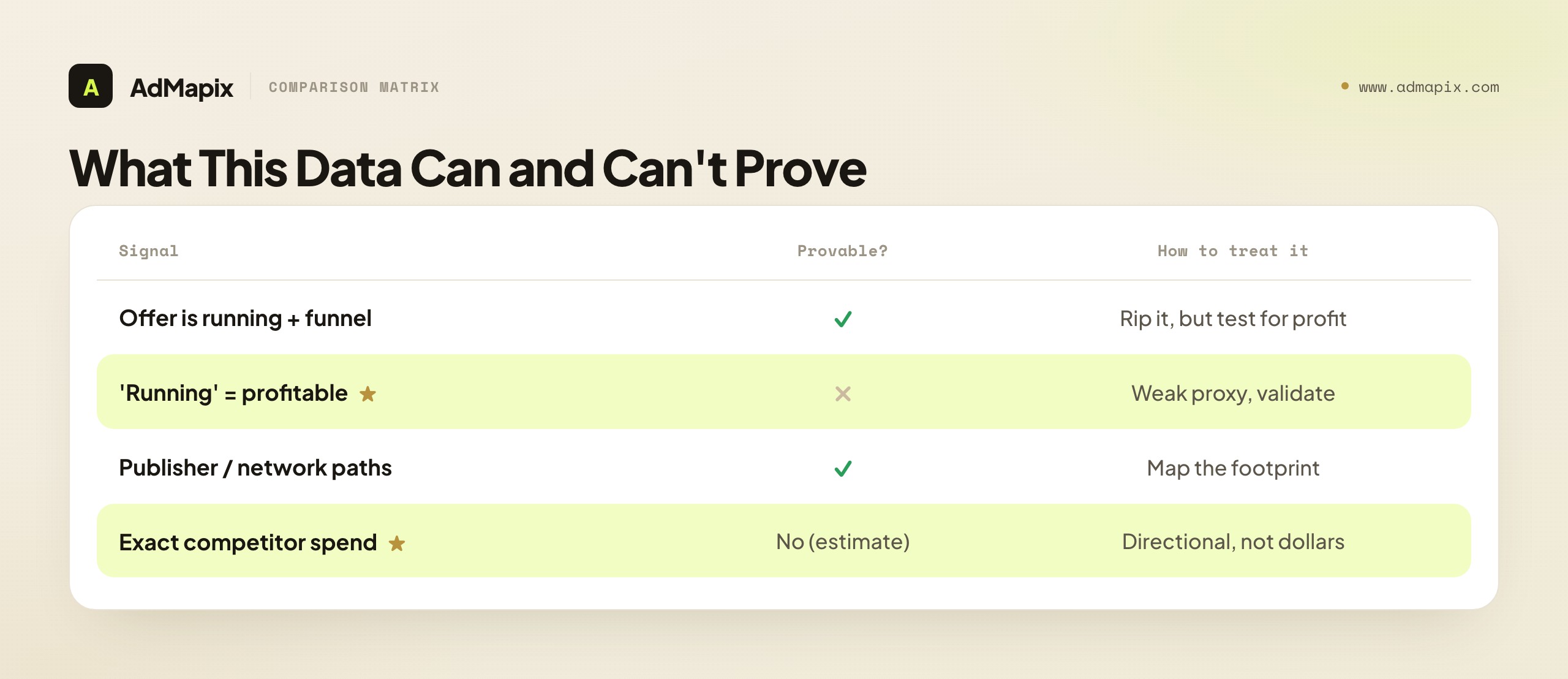
On the affiliate side, a native offer that is running and even widely visible can be a money loser, and a quiet offer can be a quiet winner. "It is running" is a weak proxy for "it is profitable": affiliates frequently test offers at a loss to gather data, and a funnel can stay live for reasons that have nothing to do with positive ROI. On the display side, the most important caveat is that Adbeat's spend figures are estimates — modeled from observed activity, not pulled from a competitor's billing. They are genuinely useful for comparing brands and reading trend direction, but they are not exact dollars, and treating them as a competitor's real budget will lead you to over-trust a number that was always an inference.
So treat everything these tools surface as a hypothesis. "This native offer keeps appearing across networks" is a testable idea, not proof it converts. "This brand's estimated display spend is rising" is a directional read worth acting on with appropriate caution, not a fact to quote as exact dollars. Validate every signal against your own traffic, conversion, and media data before you commit budget. Both tools are strongest as idea generators and direction-finders, and weakest as exact-profit predictors — and the operator who remembers this tests funnels and reads trends well, while the one who reads "running" as "profitable" or an estimate as an invoice burns budget on a funnel that loses money or builds a plan on a spend number that was never precise.
There is a specific failure mode worth naming for each tool. With Anstrex, the trap is copying a heavily-visible funnel late: by the time an offer is everywhere across native networks, the early affiliates with traffic edges and compliance know-how have often captured the easy margin, and the angle is crowded. Weight earlier, quieter offers and move fast on small tests. With Adbeat, the trap is over-precision: quoting an estimated spend figure to the dollar in a deck, when it was always a modeled range. Use the estimates for relative comparison and trend, present them as estimates, and let the directional story — not a false-precision number — carry the analysis. Both traps come from forgetting what kind of evidence you are holding.
Common Mistakes When Choosing Between Anstrex and Adbeat
Most regret in this decision traces back to a few avoidable errors.
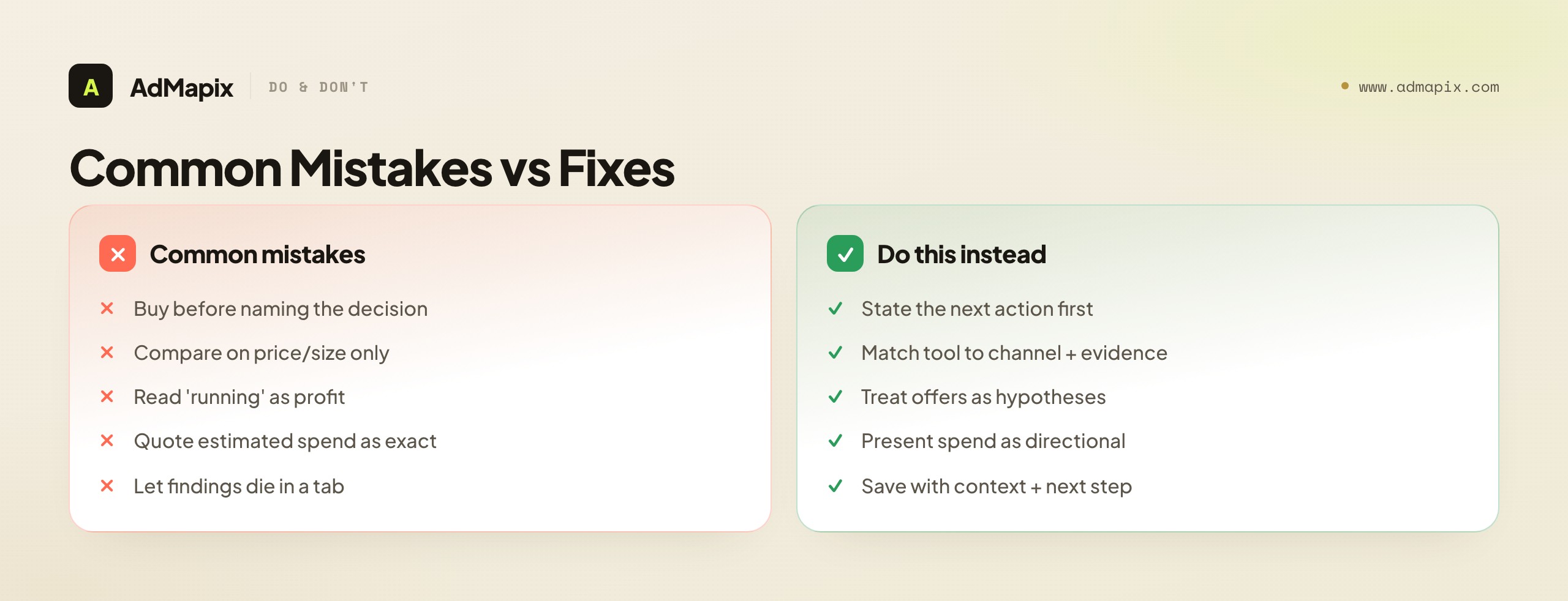
- Buying before naming the decision. A tool cannot help if you cannot state the next action it should inform. Decide whether your job is native/push funnel research or display media-buying intelligence first, then buy the tool that fits.
- Comparing only price or database size. A cheaper or larger tool still wastes time if it does not match your channel and evidence type. An affiliate does not benefit from Adbeat's publisher map, and a display analyst is not served by Anstrex's funnel ripper.
- Treating "running" as proof of profit. A live native offer is a hypothesis, not a winner. Your own traffic and conversion data validate it. Visibility is not ROI.
- Quoting estimated spend as exact budget. Adbeat's spend figures are modeled estimates, useful for trend and comparison, not a competitor's real invoices. Presenting them as exact dollars overstates what the data proves.
- Picking the funnel tool for a planning job (or vice versa). Using Anstrex to map a brand's media-buying footprint, or Adbeat to source and rip native funnels, is using a tool against its grain — it will work badly and you will blame the tool.
- Chasing saturated offers late. By the time a native offer is loudly visible everywhere, the early margin is often gone. Weight earlier, quieter signals and move fast on small tests.
- Letting findings die in a browser tab. If research cannot be saved and shared with context, it will not survive the next meeting. Save with provenance, or the research evaporates.
The two costliest errors are the third and fourth: treating "running" as proof on the affiliate side, and quoting estimates as exact dollars on the display side. They share a root with how every tool in this category fails its users — the tool generates evidence of activity or a modeled estimate, and the user mistakes it for proof of profit or exact fact. The discipline that prevents both is the same: know what kind of evidence you are holding, treat it as a hypothesis or a directional read, validate against your own data, and force every finding into a saved, actionable next step. Hold that line with either Anstrex or Adbeat and you research well; drop it and you burn budget regardless of which you bought.
A Decision Framework You Can Run in Ten Minutes
If you want to skip the deliberation and just get to an answer, here is a short, honest framework that resolves most Anstrex-versus-Adbeat decisions without a spreadsheet. Run it before you start either trial, because it tells you which trial to start with.
First, answer the channel question with evidence, not intuition. Look at your last ten research sessions and ask whether each one was about native/push offers and funnels, or about display placements and competitive spend. If most were funnel-and-offer work, you are an affiliate and Anstrex is the candidate. If most were placement-and-spend work, you are a planner or analyst and Adbeat is the candidate. This single question resolves the majority of cases, because channel is the dimension on which the two tools genuinely diverge.
Second, answer the evidence-type question. What is the artifact you need to walk away with each week? If it is "an editable funnel I can test" — a copyable artifact — Anstrex is built for that. If it is "a map of a competitor's display footprint and spend trend" — a strategic artifact — Adbeat is built for that. When the channel answer and the evidence answer agree, you are done; buy a month or the relevant product and run the test workflow. When they disagree, weight the evidence-type answer slightly higher, because the artifact you need is the truest read of your job.
Third, answer the reliability-tolerance question, which is really about how the output will be used. If your output is your own test — a funnel you will validate with real traffic — Anstrex's high-fidelity funnel evidence is ideal and the "running ≠ profitable" caveat is something you handle in testing. If your output is a report or a recommendation others will trust, you need to be comfortable presenting modeled estimates as estimates, which is exactly what Adbeat's spend data requires — and you should plan to frame it as directional, not exact. Match the tool's evidence reliability to how scrutinized your output will be.
Fourth and last, answer the budget-shape question without quoting a price. Are you buying a native/push funnel workbench or a display-intelligence platform with reporting? If your job is genuinely funnel sourcing and testing, the workbench is the value and an intelligence platform's publisher-and-spend depth is coverage you will underuse. If your job is competitive media planning and client reporting, the platform's reports and alerts are the value and a funnel ripper is the wrong tool. Match the shape of the spend to the shape of the job, validate on a monthly or trial plan, and only then commit to anything longer. Run those four questions and you will have a defensible pick in ten minutes.
Who Each Tool Is Wrong For
It is easy to write a comparison that makes both tools sound great for everyone, so let me do the opposite and be explicit about who should not buy each, because the clearest way to find your fit is often to recognize the mis-fits first.
Anstrex is the wrong buy for the display media planner or competitive-intelligence analyst. If your job is understanding where a brand buys display, through which publishers and networks, and how spend is trending, Anstrex's funnel ripper and native/push offer depth are precision on a surface that is not your bottleneck — you would get an editable prelander where you needed a media-buying map. It is also the wrong buy for the brand advertiser doing broad competitive analysis across paid social and display, who needs footprint and creative-evidence breadth more than native funnel tooling.
Adbeat is the wrong buy for the native or push affiliate whose recurring job is sourcing and ripping funnels. If your constraint is "find a converting offer and test a version of its funnel," Adbeat's publisher map and estimated spend trends are strategic context you cannot act on directly — you would get a footprint where you needed a workbench. It is also a questionable buy for anyone who needs exact competitor budgets, because Adbeat's spend is modeled; if your decision depends on precise dollars rather than trend and comparison, no estimate-based tool will satisfy you, and you should adjust the decision to use estimates appropriately instead.
And both are the wrong buy if what you actually need is a cross-network paid-social creative-evidence layer — searchable creatives across networks, saved media, video-structure breakdowns, and shareable reports — because that is a different job from both native funnel ripping and display spend intelligence, and neither tool is built to be the system of record for paid-social creative evidence across a team. Recognizing yourself in one of these mis-fit descriptions is more useful than any feature comparison, because it tells you which tool to cross off before you waste a trial on it.
When a Cross-Network Creative-Evidence Layer Helps
Once the missing layer is cross-network paid-social creative evidence and reporting — not native funnel ripping or display spend intelligence — a gap opens that neither Anstrex nor Adbeat is built to close: turning scattered discovery into searchable, saved, reportable creative evidence across networks, with the video structure broken down.
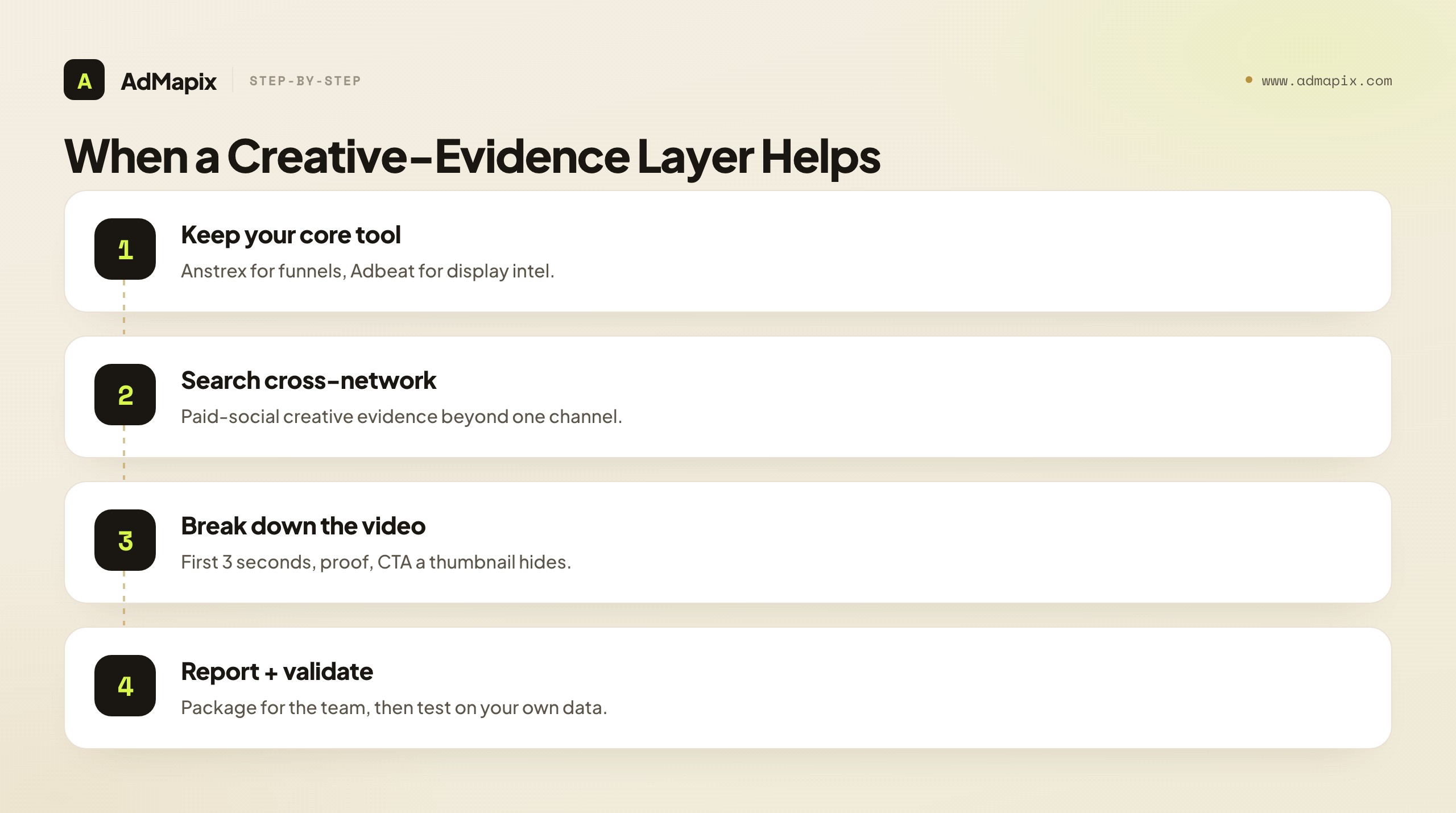
A cross-network creative-evidence layer like AdMapix fits here. It is built for teams that need to search ad creatives across networks with Search, save the media in Media, break down video structure and hooks with Video Analysis — the first three seconds, the proof, the CTA that a static thumbnail cannot show — tag what they find, and turn it into a Report. It fits agencies and in-house teams that have to defend creative recommendations with examples, monitor the same competitor set every week, or analyze why a video ad is structured the way it is across paid-social networks. A practical stack keeps the specialist tool for its strongest job — Anstrex for native/push funnel research, Adbeat for display media-buying intelligence — and adds a cross-network layer where paid-social creative evidence and reporting live. Compare access on Pricing once the workflow repeats, or log in to run your first cross-network search.
The reason this is a genuinely separate layer rather than a feature either tool should have bolted on is that the job is different in kind. Anstrex is organized around the rippable native funnel; Adbeat is organized around the display media-buying footprint; a creative-evidence layer is organized around the paid-social creative itself as a reusable artifact — something you search across networks, save with provenance, dissect for structure, and package into a report a teammate or client can act on without re-doing your work. That last property, shareability, is where the funnel and footprint tools are weakest for paid-social creative: they are built for an affiliate testing funnels or an analyst mapping display spend, not for a team that has to defend a paid-social creative recommendation, hand off context, and keep a living archive of what worked across campaigns. The moment your creative research has to survive a meeting, persuade a client, or onboard a new hire, the constraint stops being "can I find the ad" and becomes "can I turn what I found into evidence someone else trusts." That is the constraint a creative-evidence layer exists to relieve, and neither Anstrex nor Adbeat was built to relieve it — not because they are deficient, but because it was never their job.
It is honestly not the right tool if all you need is a native/push landing-page ripper — Anstrex covers that better — or display publisher-and-spend intelligence, which Adbeat fits. A cross-network creative-evidence layer earns its place specifically when observed paid-social creatives have to become structured, shareable evidence with video analysis, for a recurring workflow. The clearest way to see where it sits: Anstrex answers "which native/push funnel should I rip and test?", Adbeat answers "where and how is this brand buying display?", and a creative-evidence layer answers "what did we learn from the paid-social creatives across networks, and what are we testing because of it?" — three different questions, and the third compounds into better creative over time.
For the broader landscape beyond these two tools, our guide to the best ad spy tools of 2026 compares the whole field by price, coverage, and use case. If you are weighing alternatives, Anstrex alternatives and Adbeat alternatives cover what else fits each niche, and the related AdPlexity vs Anstrex breakdown compares Anstrex against another native-focused tool. For the display and native angle specifically, native ad spy tools and competitor display ads go deeper.
FAQ
Is Anstrex or Adbeat better?
Neither is better in the abstract — they fit different jobs. Anstrex is better for native and push affiliate funnel research: spying offers, ripping prelanders, and testing funnels. Adbeat is better for display competitive intelligence: publisher paths, ad-network sources, estimated spend trends, and shareable reports. Match the tool to your channel and whether your finish line is a ripped funnel to test or a media-buying map to plan against.
What is the main difference between Anstrex and Adbeat?
Channel and evidence type. Anstrex is a native/push funnel-research workbench built around an editable landing-page ripper and offer search — its evidence is a copyable funnel. Adbeat is a display media-buying intelligence platform built around publisher paths and estimated spend trends — its evidence is a strategic footprint. Anstrex produces something you copy and test; Adbeat produces something you analyze and plan against.
Which is better for native ad spying?
Anstrex is usually the stronger first test for native and push affiliate work, because its landing-page ripper, offer filters, and competitor alerts are purpose-built for sourcing and copying funnels across native networks. Adbeat does cover native as one of several formats within its display-intelligence scope, but it is built for the media-buying and spend question, not the funnel-ripping workflow an affiliate needs. Confirm current plan limits on each pricing page, since tiers change.
Which is better for display advertising intelligence?
Adbeat, clearly. Its publisher and ad-network paths, estimated spend trend signals, side-by-side comparisons, and downloadable reports are designed for understanding a competitor's display media-buying at the level a planner or competitive-intelligence team needs. Anstrex is native/push-and-funnel-led rather than display-spend-led, so it surfaces offers but does not map a brand's display footprint the way Adbeat does.
Does Adbeat show real competitor spend?
No — Adbeat's spend figures are modeled estimates, not a competitor's actual invoices. They are genuinely useful for relative comparison between brands and for reading trend direction over time, but they are not exact dollars. Treat them as directional intelligence, present them as estimates rather than facts, and never quote them to the dollar in a report as if they were a competitor's real budget.
Can I rip landing pages with both tools?
Not in the same way. Anstrex's landing-page ripper is a defining feature — it downloads and lets you edit prelanders so you can adapt a proven funnel. Adbeat captures landing pages as part of its competitive view, but it is built for analysis and reporting rather than the download-and-edit funnel workflow that affiliates rely on. If ripping and editing funnels is your job, Anstrex is the tool built for it.
Do these tools show ROI or conversion rates?
No. Anstrex shows that an offer is running, not whether it converts profitably; "running" is a weak proxy for profit, since affiliates often test offers at a loss. Adbeat shows estimated spend and placements, not a competitor's return on ad spend or conversion rate. Use what they show as hypotheses and directional reads, and validate against your own traffic, conversion, and media data before you commit budget.
How should I choose between them?
Run the same three to five competitors or offers through each tool using the same country and date window. With Anstrex, rip a funnel and assess whether you could test a version of it; with Adbeat, map a competitor's footprint and assess whether the spend trend informs a plan. Compare which tool produced the artifact your job actually needs — a testable funnel or a defensible footprint — and let that, not database size, decide.
Can AdMapix replace both Anstrex and Adbeat?
Not entirely. A cross-network creative-evidence layer like AdMapix supplements the paid-social creative-evidence layer with cross-network ad search, saved media, video analysis, tagging, and reports. Teams that depend on native funnel ripping will keep Anstrex, and display competitive-intelligence teams will keep Adbeat for publisher and spend data. It complements, rather than replaces, the native-funnel and display-intelligence jobs.
Should I buy annually to save money?
Not before validating the tool on your real channel and workflow. Both vendors offer longer-term or higher-tier commitments that look attractive until you are locked into a tool whose channel or evidence type turns out not to match your job — a funnel ripper when you needed a media-buying map, or a spend-estimate platform when you needed to rip funnels. Validate on a monthly or trial plan first, confirm the tool produces the artifact you need, then commit for the discount.
Key Takeaways
- Choose Anstrex for native/push affiliate funnel research — offer search, the landing-page ripper, and competitor alerts; choose Adbeat for display media-buying intelligence — publisher paths, estimated spend trends, and downloadable reports. Channel and evidence type settle the decision, not database size.
- Know what kind of evidence you are holding. Anstrex produces a high-fidelity funnel you copy and test; Adbeat produces a modeled footprint and spend estimate you analyze and present as directional, not exact.
- Verify current pricing and plan limits on each official page before buying, since tiers change; validate on a monthly or trial plan before committing longer.
- Treat every running offer as a hypothesis and every spend estimate as directional, and validate against your own performance data. "Running" is not profit, and an estimate is not an invoice.
- Add a cross-network paid-social creative-evidence layer when you need cross-network creative search, saved media, video analysis, and shareable reports — it complements, never replaces, native funnel ripping or display spend intelligence.
Sources
- Anstrex — native and push ad spy with offer search and filtering, a landing-page ripper, competitor alerts, and broad native-network and country coverage (as checked June 2026).
- Anstrex pricing — Native and Push product tiers; verify current prices and plan limits before purchase.
- Adbeat — display competitive intelligence with publisher and ad-network paths, estimated spend trend signals, side-by-side comparisons, and downloadable reports across display, native, video, interstitial, and page-takeover formats (as checked June 2026).
- Adbeat pricing — plan tiers with different data-access and report-depth levels; confirm current details before deciding.
Plan names, tiers, and discounts change often, so confirm current details on each tool's official pages before deciding. All links checked as of June 21, 2026. Disclosure: AdMapix is our own product, and its data scope covers cross-network paid-social ad creative search, saved media, video analysis, tagging, and reports — separated from claims sourced to each vendor's own pages.
Turn these observations into your next creative study
Open the creative library and select samples for your market, network and research question.
Related Articles
SocialPeta vs Sensor Tower in 2026: Ad Creative Intelligence or Full App Market Intelligence?
A 2026 decision guide for choosing between SocialPeta and Sensor Tower: ad creative analysis vs app and market intelligence with downloads, revenue, and usage estimates. A job-by-job comparison, what each platform's data can and can't prove, pricing and access realities, when to run both, and where AdMapix fits as a cross-network creative-evidence layer.
SocialPeta vs AppMagic in 2026: Ad Creative Intelligence or App Market Intelligence?
A 2026 decision guide for choosing between SocialPeta and AppMagic: ad creative analysis vs mobile app market intelligence, a job-by-job comparison, what each tool's data can and can't prove, pricing and access, when to run both, and where AdMapix fits.
AdPlexity Native Alternative in 2026: How to Compare Native Ad Spy Workflows
A 2026 decision guide to replacing or supplementing AdPlexity Native — the four jobs a real native ad spy alternative must cover, the criteria that actually separate tools (coverage depth, advertorial and prelander teardown, offer context, reporting friction), a workflow that fits any native tool, the honest limits of native ad data, and where a like-for-like native specialist versus a cross-network creative layer each fit.