
AdPlexity vs Anstrex in 2026: Native & Push Ad Intelligence Compared
A 2026 head-to-head of AdPlexity vs Anstrex — breadth across affiliate traffic sources versus native and push depth with a landing-page ripper, compared on product model, network coverage, the prelander workflow, pricing, and use-case fit, with a test-before-you-buy method and the honest limits of what spy data can prove.
By the AdMapix Research Team — Updated June 21, 2026
AdPlexity vs Anstrex in 2026: Native & Push Ad Intelligence Compared
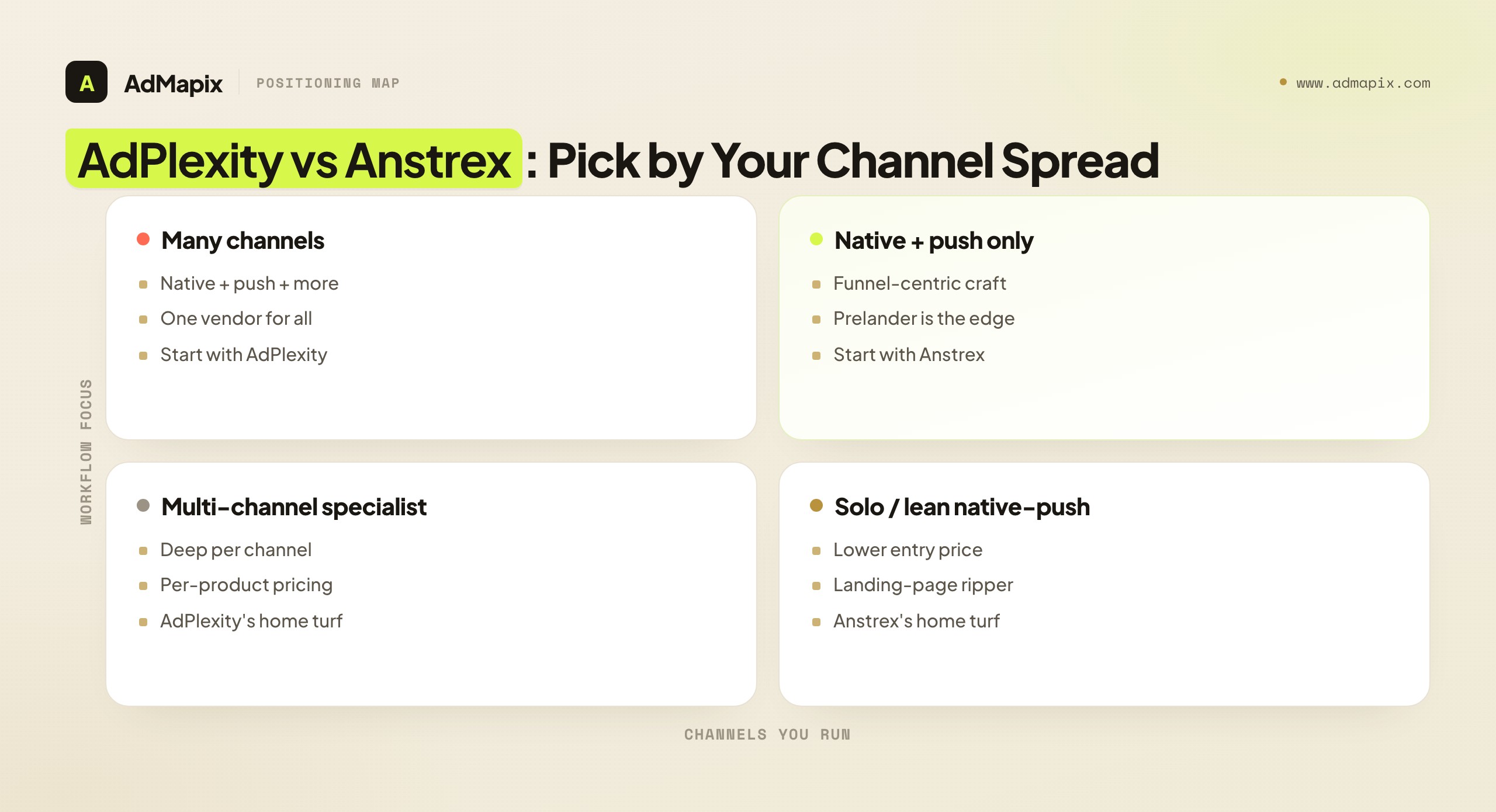
AdPlexity vs Anstrex is a breadth-versus-depth decision inside the affiliate spy-tool world, and the right pick turns on how many traffic sources you actually run. Pick AdPlexity if you buy across several affiliate channels and want one vendor for native, desktop, mobile, push, and YouTube research — its per-channel product family is built for buyers who specialize in one or two sources and want the deepest data for each. Pick Anstrex if native and push are your core channels and you want a landing-page ripper, competitor alerts, and a lower entry price in a single focused product. Both are spy tools that show you competitors' ads, offers, and funnels; neither proves a campaign is profitable. This 2026 guide is for affiliate media buyers, native and push advertisers, performance marketers, and agencies running arbitrage and lead-gen traffic across nutra, sweepstakes, financial, and lead-gen verticals. It compares the two on the criteria that actually change a media buyer's next test — product model, network coverage, the prelander workflow, alerts, and pricing — gives you a test-before-you-buy method, holds the honest line on what public spy data can and cannot prove, and notes where a cross-network creative layer covers research neither one is built for.
TL;DR — AdPlexity vs Anstrex in One Screen
- AdPlexity is a family of per-channel products (Native, Desktop, Mobile, Adult, Push, YouTube). You buy access to the channel you run, which is efficient if you specialize and costly if you only dabble across many.
- Anstrex concentrates on native and push in two flagship products, both shipping a landing-page ripper, competitor alerts, and broad network coverage at an accessible price point.
- The landing-page ripper is Anstrex's signature. In native and push, the prelander often explains a win more than the headline does, and ripping a competitor's funnel to study and adapt it is a concrete time saver.
- AdPlexity's edge is breadth, not a single deepest channel. If you run many traffic sources from one vendor, the per-product model fits; if you run one or two, you may overpay for products you never open.
- No spy tool proves profit. A long-running ad is a structure worth copying, not evidence of margin. Validate every hypothesis with your own analytics and offer payouts.
- A cross-network creative layer (such as AdMapix) covers paid-social and video creative across markets — research neither affiliate tool is built for — and complements rather than replaces them.
What You Are Actually Deciding Between
The core difference is a product model, and it shapes everything downstream. AdPlexity sells separate products for separate channels — you assemble the coverage you need by buying the channels you run. Anstrex sells two focused flagship products — native and push — that go deep on those two surfaces and the post-click funnel. One is a modular suite; the other is a focused specialist. Choosing between them is less about which database is bigger and more about whether your traffic is spread across many sources or concentrated on native and push.
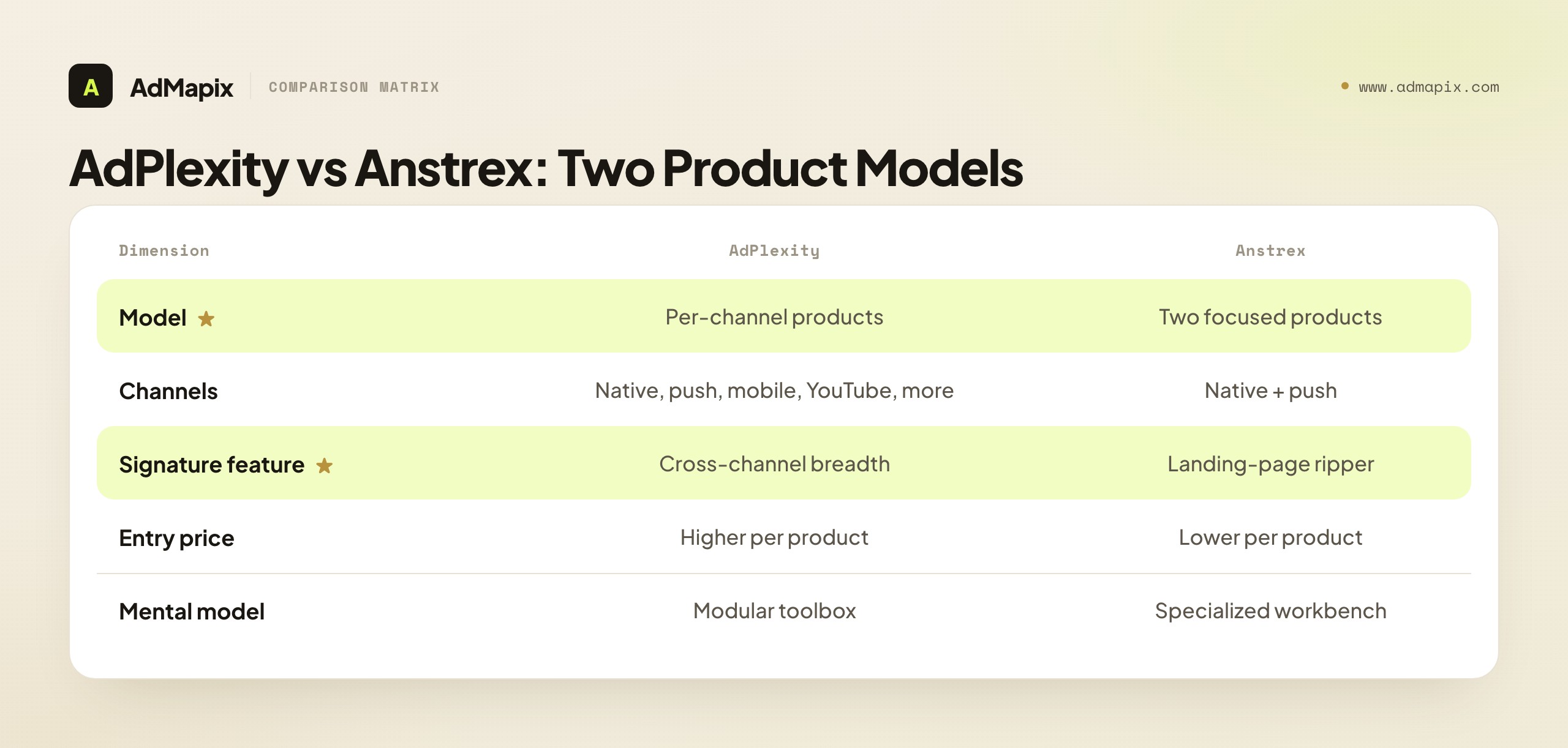
AdPlexity's defining trait is that it markets an ad-intelligence suite spanning native, desktop, mobile, adult, push, YouTube, and social research, citing a large library of winning ads. The practical consequence is structural: a buyer running native and push pays for two AdPlexity products, and the total cost scales with how many channels you cover. That model rewards specialists who run one or two traffic sources heavily and want the deepest data for each, and it punishes generalists who would rather have shallow access to everything for one flat fee.
Anstrex narrows the menu to native and push (with adjacent ecommerce and dropship tools) and goes deep on the workflow those channels actually need — especially the post-click funnel. Both flagship products include a landing-page ripper that downloads a competitor's prelander or landing page so you can study and adapt the funnel, plus competitor alerts that flag new or scaling creatives. The focus is the point: Anstrex is not trying to cover every channel, it is trying to own the native-and-push workflow end to end.
So the first question is not "which has more ads" but "how many traffic sources do I actually run, and are native and push my core?" If you specialize across several affiliate channels and want one vendor for all of them, AdPlexity's breadth fits. If native and push are where your money is made and the prelander is central to your craft, Anstrex's depth fits. Answer that honestly and the comparison mostly resolves; everything below is the detail that confirms it. Most affiliates know the answer immediately — they feel where their traffic and their craft actually live — and the rare operation that genuinely splits between many channels and deep native/push funnel work is the one case where running both tools can be worth the doubled cost.
A useful mental model: AdPlexity is a toolbox with a separate drawer for each channel — buy the drawers you use. Anstrex is a specialized workbench built for two jobs done deeply. A toolbox with many drawers is the right buy when you work across many channels; a specialized workbench is the right buy when two channels are your whole trade and you want every tool for them within reach. Buying the toolbox when you only ever open two drawers wastes money; buying the workbench when you need ten channels leaves you short.
It is worth being explicit about why this matters more for these two tools than for a typical software comparison. With most "X vs Y" decisions, the two products do roughly the same job and you are choosing on quality, price, or polish. AdPlexity and Anstrex overlap on native and push but diverge sharply on everything else — one spreads wide across channels, the other drills deep into two and the funnel. So "which is better" is the wrong question; the honest version is "what shape is my affiliate operation, and which tool's model matches it?" A team that internalizes this buys correctly; a team that asks "which affiliate spy tool is best" gets an answer that may be true and useless, because best-for-multi-channel and best-for-native-push-funnels are different titles. The whole comparison hinges on refusing to flatten two different operating models into one ranking.
A quick tell: notice how you describe your own setup. If you say "I run native, push, and a bit of mobile," you are describing AdPlexity's job. If you say "I run push funnels and I live in the prelander," you are describing Anstrex's job. The way you naturally describe your traffic reveals which model fits, and it points to the right tool faster than any feature table.
AdPlexity: Breadth Across Affiliate Traffic Sources
AdPlexity's strength is coverage across the affiliate ecosystem from a single vendor. For a media buyer who runs native today, tests push next month, and dabbles in mobile or YouTube arbitrage, having one company's products span all of those is genuinely convenient — the data conventions, the interface logic, and the export formats are consistent across channels, which lowers the friction of moving between traffic sources.
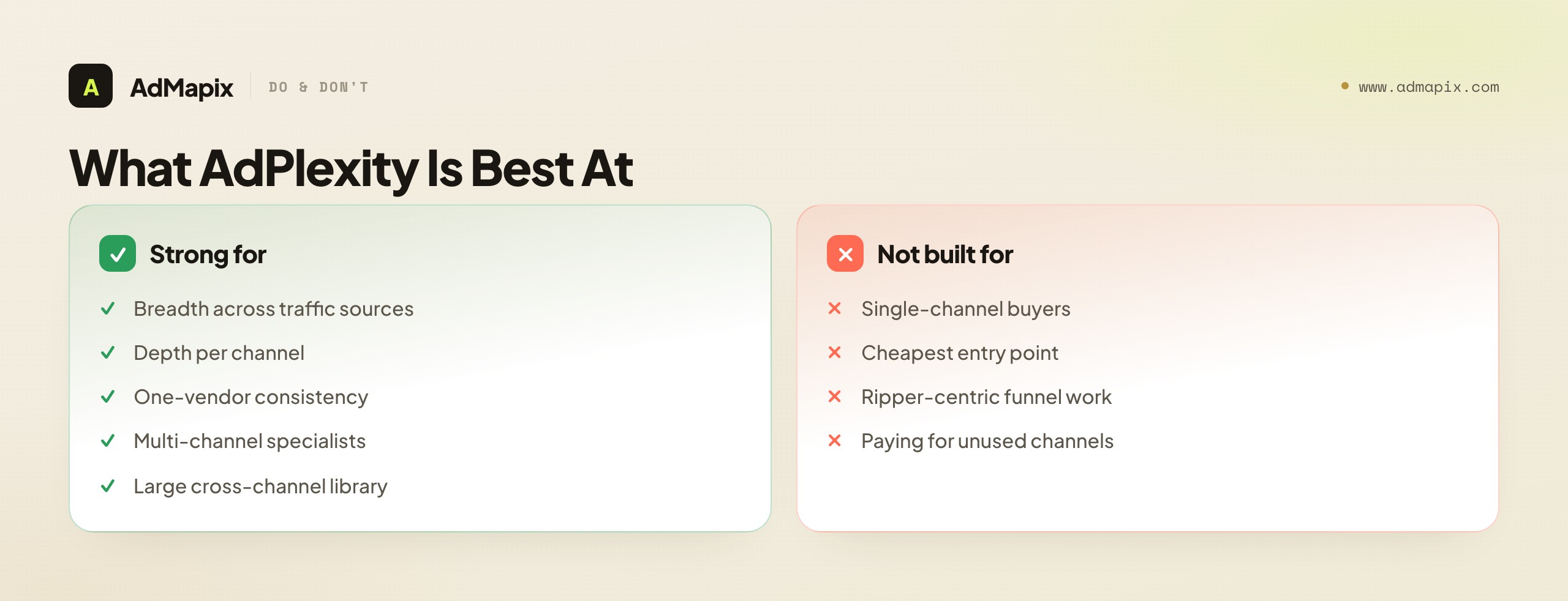
The per-channel product structure has concrete strengths for specialists. Depth per channel means each AdPlexity product is built for the conventions of its surface — native research surfaces native conventions, push research surfaces push conventions — rather than a generalist tool that treats every channel the same. A large cross-channel library gives a buyer running multiple sources a wide base to research from. And one-vendor consistency matters more than it sounds: a team running three channels does not want three different tools with three different mental models; AdPlexity lets them stay in one ecosystem.
Best fit: affiliate media buyers and teams who run several traffic sources and want one vendor for all of them, and who run each channel heavily enough to justify paying per product. If your acquisition is genuinely spread across native, push, mobile, and YouTube, AdPlexity's breadth is the efficient choice — and the more channels you run, the more that one-vendor coherence outweighs any single competitor's per-product price advantage.
Where it falls short: the per-channel pricing is efficient only if you actually run those channels regularly. A buyer who only runs native and push pays for two products and gains nothing from the desktop, mobile, or YouTube products they never open — so for a focused native-and-push buyer, AdPlexity's breadth becomes dead cost rather than a benefit. The model rewards channel breadth and penalizes channel focus, which is exactly the inverse of Anstrex. Before committing, check the public pricing page, because each product carries its own monthly and annual price and they are not interchangeable.
A specific failure mode worth naming: buying the AdPlexity suite "to have everything" and using one product. A buyer who anticipates expanding into many channels and buys broadly before they actually run those channels ends up paying for coverage they do not use — a common, expensive form of optimism. The disciplined move is to buy the AdPlexity product for the channel you run today, and add the next product when you actually start buying traffic on the next channel. AdPlexity's modularity is a feature precisely because it lets you do this; treating it as "buy the whole suite" throws away the efficiency the modular model is designed to give you. Buy the drawers you open, not the drawers you might someday open.
Worth emphasizing for multi-channel teams: AdPlexity's value compounds with the number of channels you run, not just their existence. A team running four traffic sources gets four products' worth of one-vendor consistency — shared conventions, shared exports, one mental model across the whole operation. That consistency is a real operational benefit that a stitched-together set of single-channel specialists cannot match, and it grows more valuable the more channels you add. If you genuinely run a broad portfolio, that coherence is often worth more than the per-product price difference against a cheaper focused competitor.
Anstrex: Native and Push Depth Plus Landing-Page Ripping
Anstrex's strength is depth on two channels and the post-click workflow that native and push buyers actually live in. Where AdPlexity spreads across many surfaces, Anstrex concentrates on native and push and builds its whole workflow around the thing that most determines whether an affiliate ad converts: the prelander.
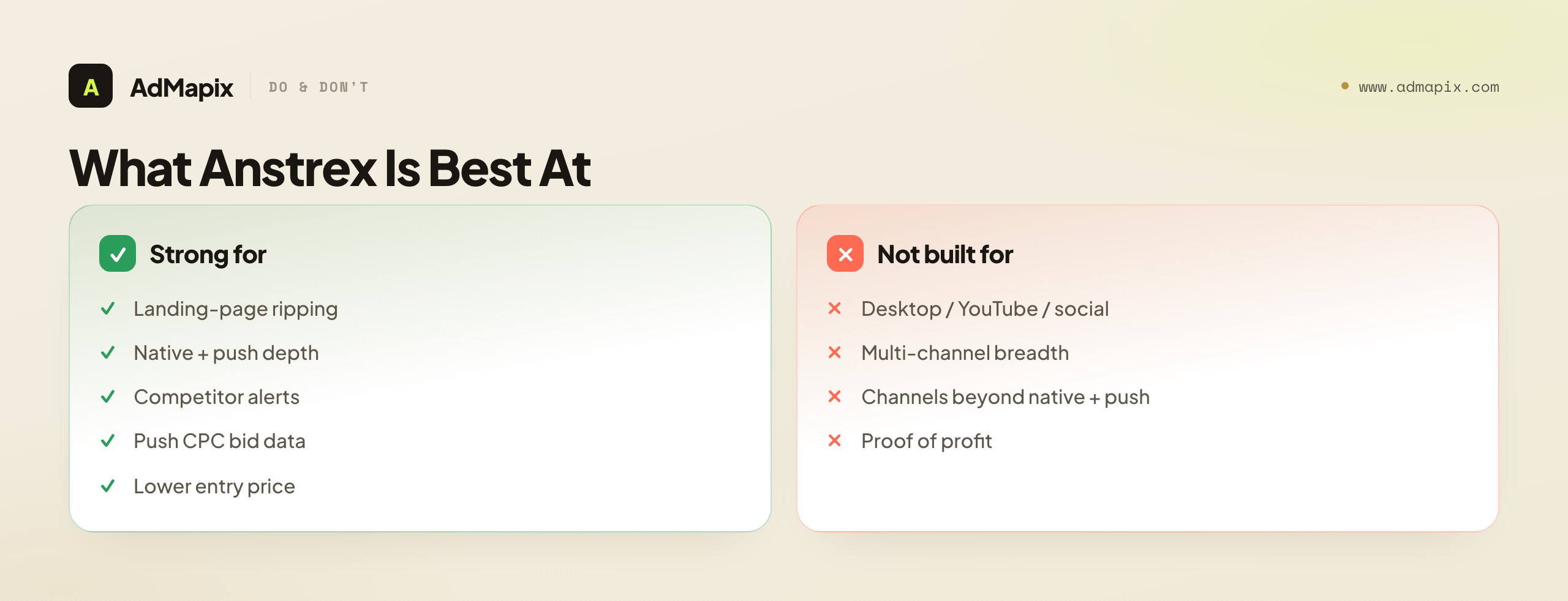
The landing-page ripper is the differentiator, and it is worth understanding why it matters so much in native and push specifically. In these channels, the ad creative is often a fairly generic curiosity hook — the real persuasion happens on the prelander, the advertorial-style bridge page that warms the click before the offer. The prelander explains why an ad converts far more often than the headline does. Anstrex's ripper downloads a competitor's prelander or landing page so you can study its structure and deploy an adapted version quickly, turning "I see this competitor is winning" into "I understand their funnel and can test my own version of it" in a fraction of the time manual reconstruction would take.
Anstrex also ships competitor alerts that flag new or scaling creatives, so a buyer can react to a rival's moves without manually re-checking. On coverage, Anstrex Native advertises advanced search across a broad set of native networks and countries with generative-AI credits, and Anstrex Push advertises a wide set of push networks across many countries with CPC bid data and creative downloads — the bid data being especially useful for push buyers sizing up the auction before they commit.
Best fit: native and push affiliate buyers whose money is made on those two channels and for whom the prelander is central to the craft. If your weekly question is "what funnel is this competitor running and how do I test my version," Anstrex's ripper-centric workflow is built for that finish line, and its lower entry price makes it accessible to solo affiliates and lean teams. The tighter the loop between "I found a winning funnel" and "I have my adapted version live," the more Anstrex's ripper-first design pays off — it is built to keep you inside that loop rather than bouncing you out to separate page-download and rebuild tools.
Where it falls short: the focus that makes Anstrex deep on native and push makes it narrow elsewhere. If your traffic spans desktop display, YouTube, or social, Anstrex does not cover those the way AdPlexity's per-channel products do. It trades breadth for depth — the right trade for a native-and-push specialist and the wrong one for a multi-channel buyer. Treat its network and country counts as vendor-stated figures that fluctuate, and verify them on the live product pages before buying.
A specific failure mode for Anstrex mirrors AdPlexity's in reverse: buying it expecting broad multi-channel coverage and being disappointed by what sits outside native and push. An affiliate whose traffic is genuinely spread across display, YouTube, and social, who picks Anstrex hoping it covers everything, will find the non-native/push surfaces thin — not because Anstrex is weak, but because they bought a specialist for a generalist job. The depth that makes Anstrex excellent on native and push is the same focus that makes it narrow elsewhere. Recognize the mismatch before you blame the tool, and if your traffic truly spans many channels, AdPlexity's breadth is the better structural fit regardless of how good Anstrex's ripper is.
Worth emphasizing for native and push specialists: Anstrex's value compounds when the prelander is a recurring part of your workflow, not an occasional check. An affiliate who deploys a new funnel every week gets enormous leverage from the ripper and alerts; one who rebuilds a funnel once a quarter gets less from them, and the lower entry price still makes Anstrex reasonable but the ripper is less of a deciding factor. Frequency of funnel work, not just the channel, should drive how heavily you weight the ripper in your decision — the more often you deploy funnels, the more the ripper-centric workflow earns its place.
Feature Comparison
A spy tool is only useful if it improves a specific weekly decision — competitor monitoring, offer research, a landing-page teardown, or a client report. Compare on that basis, not on raw feature counts.
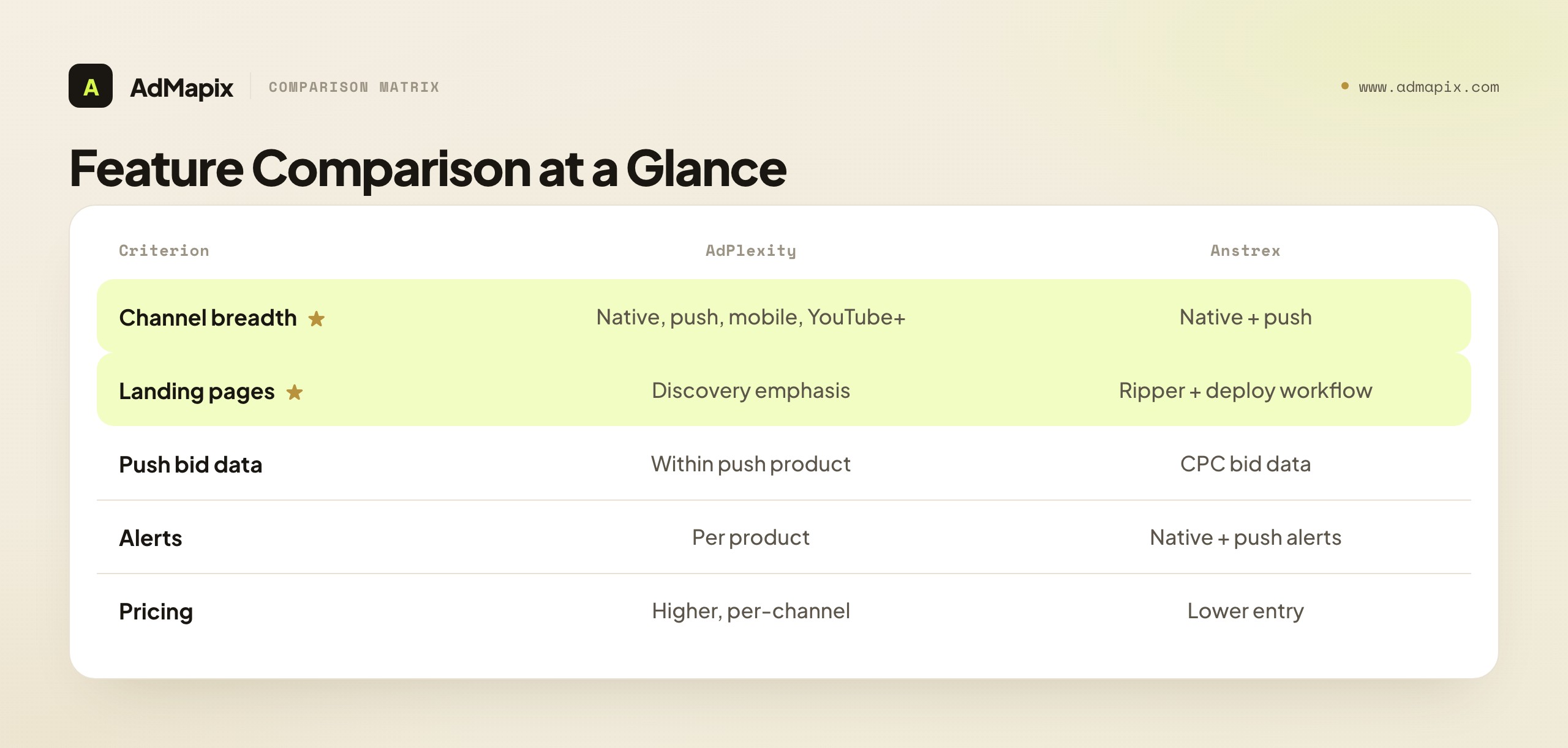
| Criterion | AdPlexity | Anstrex |
|---|---|---|
| Product model | Per-channel products bought separately | Two flagship products (Native, Push) plus ecommerce/dropship |
| Channel breadth | Native, desktop, mobile, adult, push, YouTube, social | Native and push focus |
| Native coverage | Native product; verify networks/countries on its page | Broad native networks and countries (per Anstrex Native) |
| Push coverage | Push product; verify networks/countries on its page | Broad push networks, many countries, CPC bid data (per Anstrex Push) |
| Landing pages | Campaign and offer discovery emphasis | Landing-page ripper plus deployment workflow |
| Alerts | Verify on the specific product page | Competitor alerts on Native and Push |
| Pricing shape | Higher and per-product; scales with channels | Lower entry point per product |
| Best for | Multi-channel affiliate specialists | Native and push funnel buyers |
The two rows that should drive your decision are "channel breadth" and "landing pages." If you run many channels, AdPlexity's breadth row wins; if the prelander workflow is central to your craft, Anstrex's landing-page row wins. The rest are tie-breakers and texture. As always with this category, network and country counts are vendor-stated and fluctuate, so confirm the current figures on each product's live page before you trust a comparison.
Read the table by your operation first and the rows second. A common error is to weigh every row equally and end up paralyzed — when in reality one or two rows, matched to how you actually run traffic, should dominate the rest. If you are a single-channel push funnel buyer, the "landing pages" and "push bid data" rows are nearly the whole decision, and "channel breadth" is irrelevant to you. If you run six channels, "channel breadth" alone justifies AdPlexity almost regardless of the other rows, because no ripper helps you on the four channels Anstrex does not cover well. Let your operation pick which rows matter; the table is a menu, not a scorecard where every line counts the same.
The Prelander Workflow: Why It Decides Native and Push Research
The single dimension where these two tools diverge most is the post-click funnel, and it deserves a section because it is the thing that separates good native/push research from screenshot-collecting.
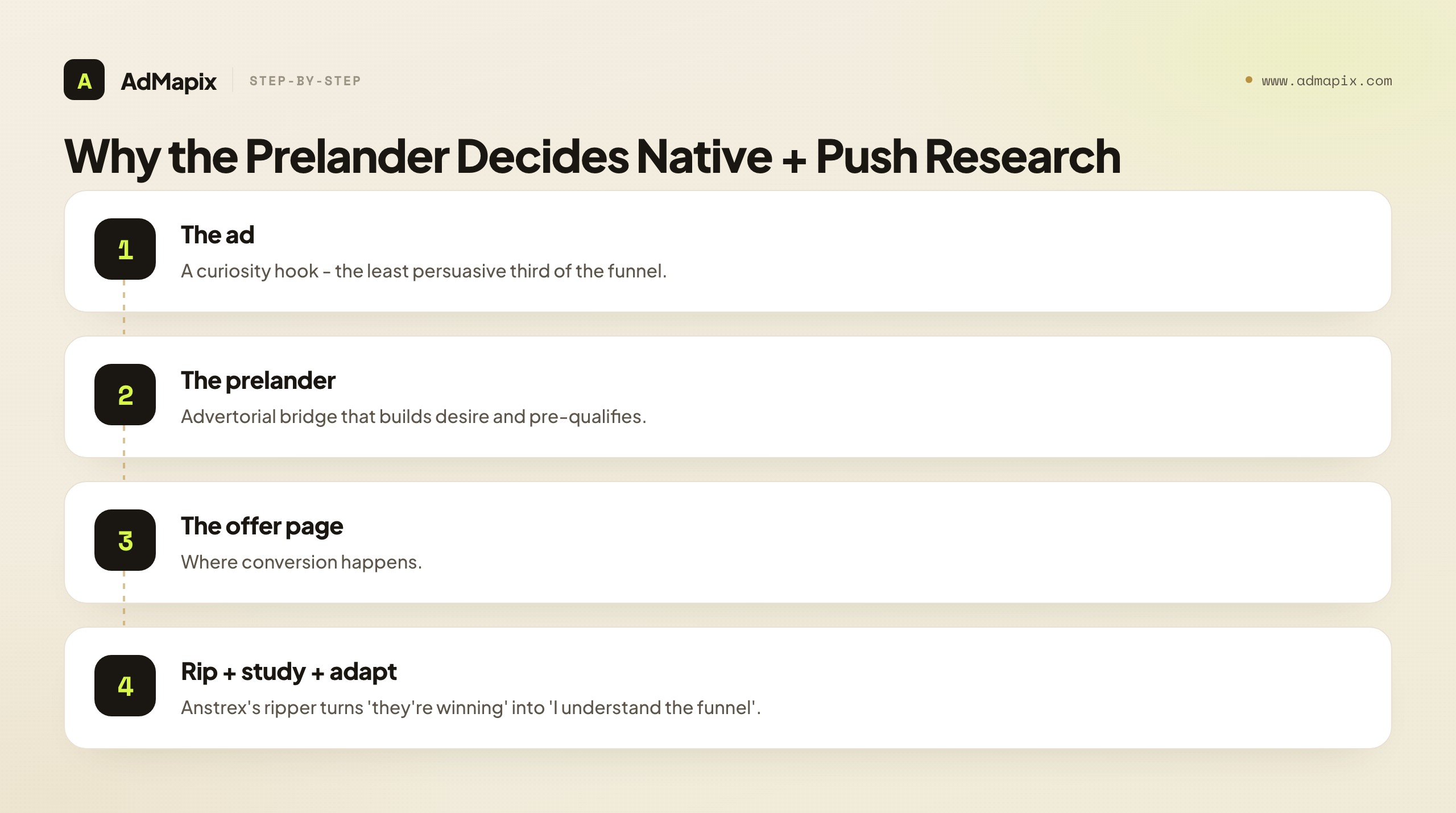
In native and push advertising, the funnel is usually three stages: the ad (a curiosity hook), the prelander (an advertorial or quiz-style bridge page that builds desire and pre-qualifies the click), and the offer page (where the conversion happens). For most verticals — nutra, sweepstakes, lead-gen, financial offers — the prelander is doing the heavy persuasion. Two competitors can run nearly identical ad creatives and get wildly different results because one has a sharp, well-structured prelander and the other does not. So researching the ad alone, without the prelander, is researching the least important third of the funnel.
This is why Anstrex builds its workflow around the landing-page ripper. By downloading a competitor's prelander, a buyer can study the structure — the hook, the story arc, the proof, the call to action, the way it pre-qualifies — and deploy an adapted, differentiated version far faster than rebuilding it by hand. For an affiliate, that speed is margin: getting a tested funnel structure live before an angle saturates is often the difference between profit and a wash. AdPlexity emphasizes campaign and offer discovery and is strong at surfacing what is running and where, but the ripper-centric, funnel-deployment workflow is Anstrex's home turf.
The honest framing for the comparison: if your craft lives in the prelander — if you win by deploying better funnel structures faster — weight Anstrex's ripper heavily, because it is the workflow that compounds your edge. If your craft is broader campaign and offer discovery across many channels, and the prelander is one of several things you study, AdPlexity's breadth may matter more than any single tool's funnel workflow. Match the tool to where your actual edge lives in the funnel.
It is worth being concrete about what "studying the prelander" actually buys you, because it is easy to undervalue from the outside. When you rip a competitor's prelander, you are not just getting a page — you are getting a teardown of their persuasion logic. You can see how they open (the hook that justifies the click), how they build the case (the story, the proof, the social cues), how they handle the obvious objection, and how they transition to the offer. That structure is transferable across offers and even verticals: a sweepstakes prelander's pre-qualification logic can inform a nutra one, and a financial-offer advertorial's proof stacking can inform a lead-gen page. An affiliate who studies dozens of competitor prelanders builds a mental library of funnel patterns that compounds over time — and the ripper is what makes building that library fast enough to be worthwhile. That compounding is the real reason the ripper is Anstrex's signature feature, and why funnel-centric affiliates weight it so heavily.
The flip side, honestly stated: an affiliate whose edge is not in the funnel — who wins on traffic-source arbitrage, on offer access, or on sheer channel breadth — gets less from the ripper, and for them AdPlexity's cross-channel discovery is the more valuable capability. The ripper is a superpower for funnel craftsmen and a nice-to-have for everyone else. Know which you are before you let the ripper decide your choice.
One caution that applies to both tools and to the prelander work specifically: ripping a competitor's landing page is a research and study technique, not a license to redeploy their page as-is. Cloning a prelander wholesale — copying the copy, the brand assets, the images — invites legal and compliance risk and produces undifferentiated funnels that the offer and network may reject. Use the ripper to understand structure, then build your own differentiated version. Inspiration is legal and smart; verbatim cloning is neither, and most affiliate networks and offers explicitly prohibit it in their compliance terms.
A Concrete Workflow in Each Tool
Abstract feature tables only get you so far; the difference becomes vivid when you watch the same affiliate run the same job through each tool. Take a realistic task: "find a winning nutra angle to test on push traffic this week, with a deployable funnel."
In Anstrex, the natural flow is ad-to-funnel. You search the nutra vertical in the push product, filter to your target countries, and scan for creatives that have been running a while. For the promising ones, you check the CPC bid data to gauge the auction, then rip the prelander to study the funnel — the hook, the advertorial arc, the proof, the pre-qualification. Within an afternoon you have a tested funnel structure you can adapt and deploy, plus a sense of the bid landscape. The ripper-centric workflow is the point: Anstrex is built to take you from "this competitor is winning" to "I have a deployable, differentiated version of their funnel" with the fewest steps.
In AdPlexity, the natural flow is broader discovery. You search the push product, see what is running across the networks AdPlexity covers, and — if you also run native or mobile — you can pivot to those products and see how the same advertiser or angle shows up across channels. That cross-channel view is AdPlexity's serendipity: you notice a nutra advertiser running the same angle on native and push, which tells you more about their strategy than either channel alone. The trade-off is that the deployable-funnel step is less central to the workflow than in Anstrex; you discover broadly, then do more of the funnel-building work yourself.
Notice that the same affiliate got two different — equally valid — flavors of value. Anstrex's flow optimizes for funnel deployment speed; AdPlexity's optimizes for cross-channel discovery. For a push specialist whose edge is deploying funnels fast, Anstrex's flow wins. For a multi-channel buyer reading a competitor's whole spread, AdPlexity's wins. The "vs" sharpens into a real either/or only when your work is predominantly one or the other — and most affiliates know which they are the moment they read those two paragraphs.
Pricing: Two Different Shapes
Price reflects the two tools' different models, and comparing headline numbers without matching to your channel count will mislead you.
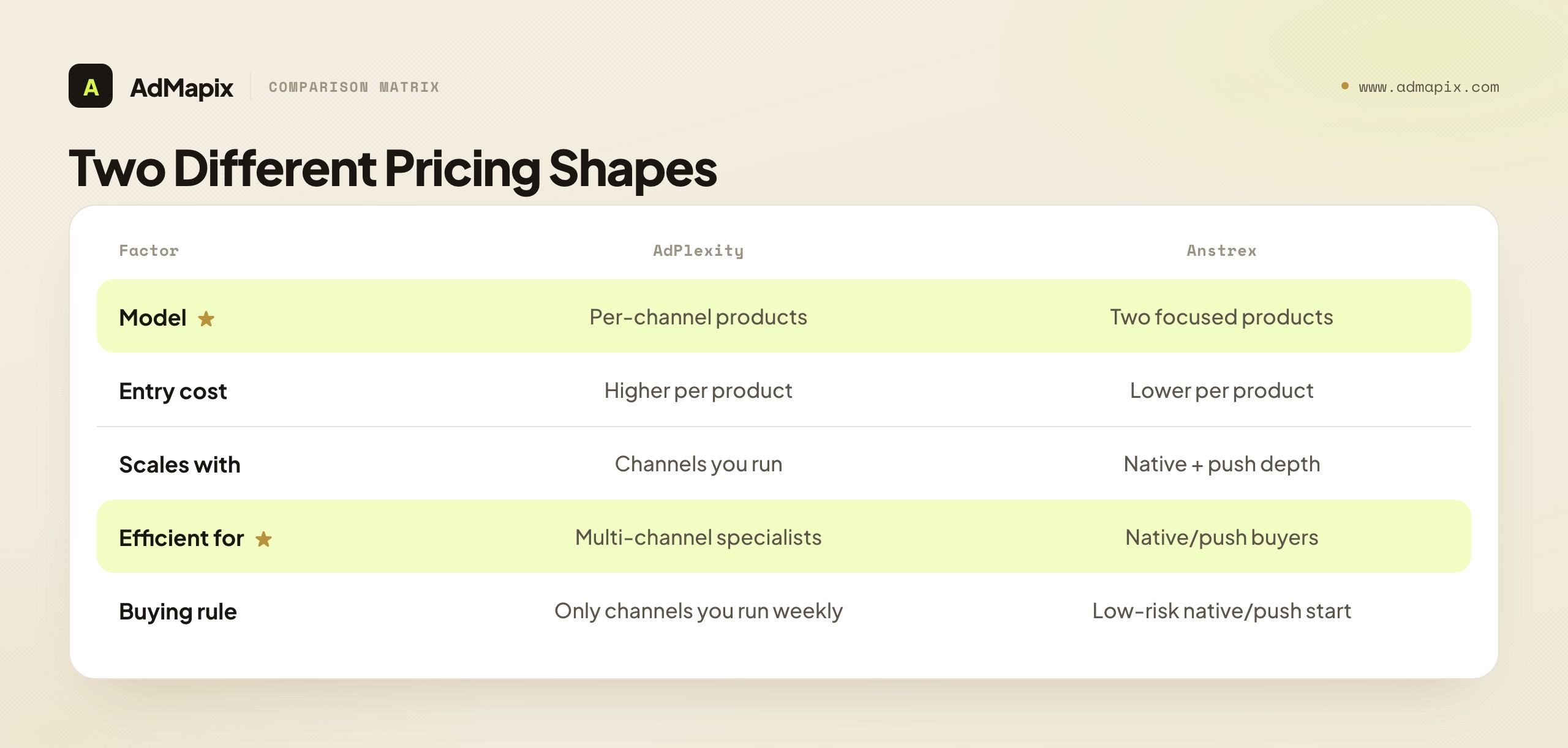
AdPlexity is priced per product. Each channel — Native, Desktop, Mobile, Adult, Push, YouTube — carries its own monthly and annual price, and they are not interchangeable. The total cost is the sum of the channels you run. For a multi-channel specialist this is efficient: you pay only for the surfaces you actually buy traffic on, at the depth each deserves. For a single-channel buyer it can be the higher absolute cost, because AdPlexity's per-product pricing tends to sit above Anstrex's entry point. The buying rule is strict: buy only the AdPlexity products for channels you run regularly, and treat any product you would not open weekly as dead cost.
Anstrex is priced per focused product at a lower entry point. Its native and push products are individually more accessible than assembling equivalent AdPlexity coverage, which makes Anstrex the friendlier starting point for solo affiliates and lean teams whose work is concentrated on those two channels. The trade-off is scope: you are buying depth on native and push, not breadth across many surfaces.
| Pricing factor | AdPlexity | Anstrex |
|---|---|---|
| Model | Per-channel products | Two focused products |
| Entry cost | Higher per product | Lower per product |
| Scales with | Number of channels you run | Native + push depth |
| Efficient for | Multi-channel specialists | Native/push-focused buyers |
| Buying rule | Buy only channels you run weekly | Lower-risk start for native/push |
The honest framing: the two prices are not directly comparable because you are buying different scopes. AdPlexity's per-product cost looks higher in isolation, but for a buyer running four channels, four AdPlexity products from one vendor may be more coherent than stitching together four separate specialists. Anstrex's lower entry point looks cheaper, but it covers two channels, not six. Compare cost per channel you actually run, not headline price, and prefer validating on a monthly plan before committing annually — locking into an annual plan before you know a tool fits your verticals is the most common way affiliate buyers overpay. Always verify the live pricing pages, because product names, plans, and limits change in this category.
A practical way to think about value here: estimate the cost against the margin one good campaign returns. For an affiliate, a single profitable funnel discovered and deployed fast can return many times the monthly cost of either tool — so the question is rarely "which is cheaper per month" but "which gets me to a profitable, deployable funnel fastest for my channels." For a native/push funnel buyer, Anstrex's ripper getting you to a deployable structure a day faster than manual reconstruction can pay for the subscription in one campaign. For a multi-channel buyer, AdPlexity's breadth surfacing a cross-channel angle you would otherwise have missed can do the same. The sticker price is almost noise against the value of one good campaign; what matters is which tool's workflow fits how you actually find and deploy winners. And as with every tool in this category, the credit and search limits on lower tiers can bind if your research volume is high, so map your real weekly usage to the tier limits before committing rather than assuming the entry tier will cover you.
How to Test AdPlexity vs Anstrex Before You Buy
A feature list tells you what a tool can do; a side-by-side run on your real verticals tells you what it does for you. This test takes an afternoon and beats any review.
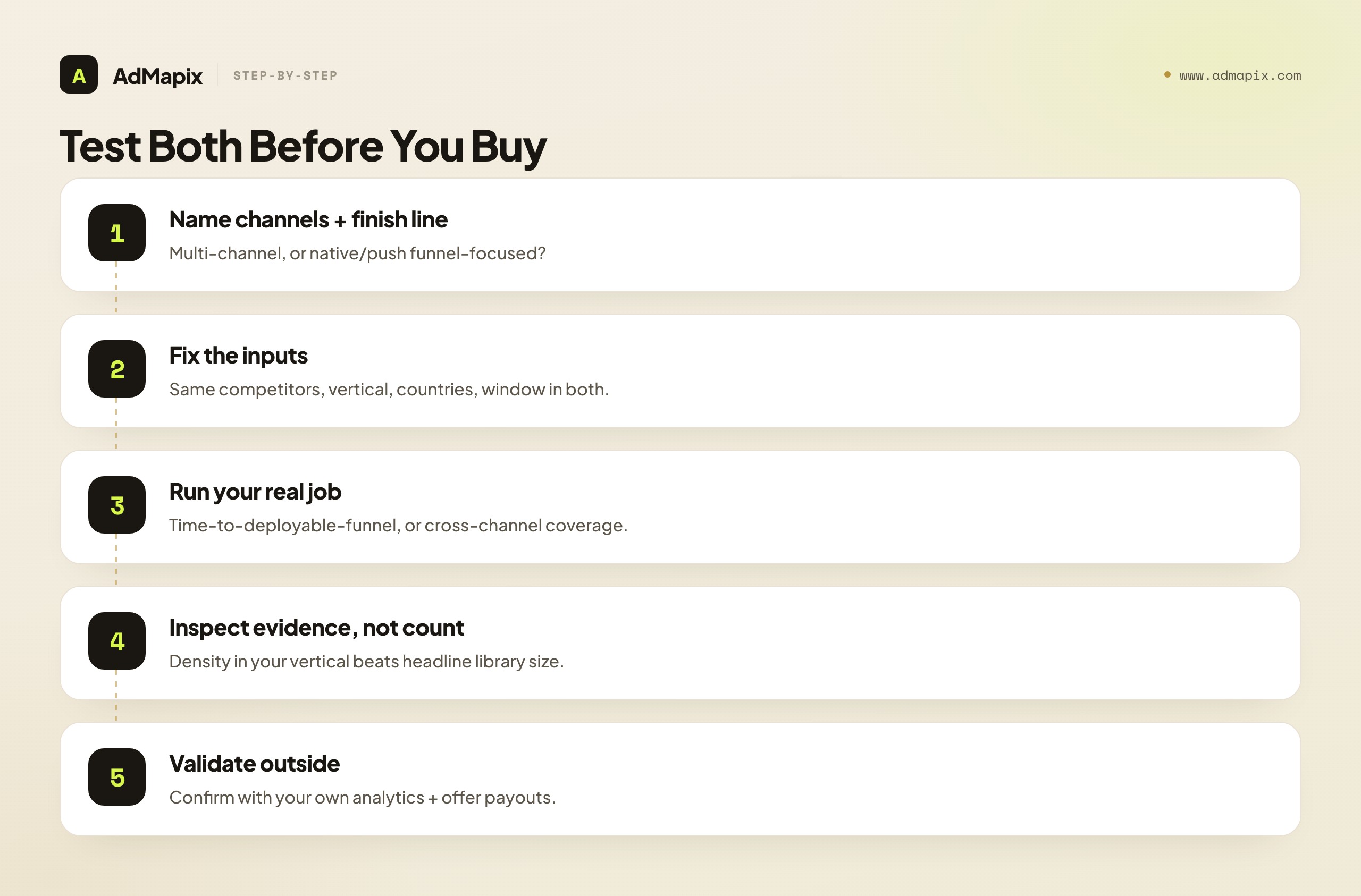
- Name your channels and finish line. Are you a multi-channel buyer who needs native, push, and more from one vendor? Or a native-and-push specialist whose finish line is a deployable funnel? Write it down — the answer largely predicts the winner.
- Fix the inputs. Pick the same three to five competitors or offers, the same vertical, the same countries, and the same time window, and run them through whichever products you trial. Otherwise you are comparing the care you put into each search, not the tools.
- Run your actual job in each. For a prelander-centric job, see which tool gets you from a competitor ad to a studied, deployable funnel structure faster. For multi-channel discovery, see which gives you a fuller cross-channel picture of a competitor's spread.
- Inspect the evidence, not the count. A large library full of stale or off-vertical ads is worse than a smaller set that is fresh and relevant to your exact niche and country. Judge density in your corner, not headline scale.
- Validate outside the tool. Whatever you find — an offer, an angle, a funnel — is a hypothesis. Confirm with your own campaign analytics and offer payouts before scaling spend.
The reason this test is decisive: the two tools are optimized for different shapes of affiliate work, so the "winner" depends entirely on yours — and thirty minutes of your own verticals in each tool tells you more than any review, including this one, because it surfaces exactly how each behaves on your niches and countries. A multi-channel specialist will rightly prefer AdPlexity; a native-and-push funnel buyer will rightly prefer Anstrex; and the only way to know which fits is to run your real verticals through both and watch which produces an output you would actually act on this week.
Which Tool Fits Your Affiliate Operation
Match the tool to the shape of your operation, not to the marketing copy. Different affiliate setups have different bottlenecks, and the right pick changes accordingly.
| Affiliate operation | Practical recommendation |
|---|---|
| Solo affiliate, native or push only | Anstrex — single focused product, lower entry, ripper-centric workflow. |
| Multi-channel media buyer | AdPlexity — one vendor across native, push, mobile, YouTube, and more. |
| Push-first performance buyer | Anstrex Push for CPC bid data + ripper; test against AdPlexity Push. |
| Native arbitrage / advertorial | Anstrex for the prelander workflow; AdPlexity if native is one of several channels. |
| Agency running varied client verticals | AdPlexity's breadth if clients span channels; add a reporting layer for handoff. |
| Team that also runs paid-social / video | Either affiliate tool plus a cross-network creative layer for the non-affiliate research. |
A clean self-diagnosis: count the traffic sources you actually buy on, and ask whether the prelander is central to your craft. If you run one or two channels and live in the funnel, Anstrex's depth and ripper fit, and its lower price makes it the safer start. If you run three or more channels and want one vendor's consistency across all of them, AdPlexity's breadth fits, and the per-product cost is justified by the channels you actually use. The rare operation that runs many channels and is deeply funnel-centric on native and push is the one case where pairing both tools genuinely pays — but for most affiliates, one of the two is clearly the right home.
There is also a maturity dimension worth naming. A newer affiliate, still finding their winning vertical and channel, is usually better served by Anstrex's lower-risk entry — they can validate native or push cheaply before committing more. A scaled affiliate running several proven channels gets more from AdPlexity's breadth, because the per-channel depth compounds across a portfolio of sources. The right answer is rarely permanent: it tracks where your operation is, and revisiting the AdPlexity-versus-Anstrex question as you add or drop channels is more sensible than treating the first pick as final.
What Public Spy Data Can and Cannot Prove
Both tools scrape ads competitors are running publicly, and it is essential to be clear about the ceiling of that data — because the most expensive mistake in affiliate spying is reading profit into a screenshot.
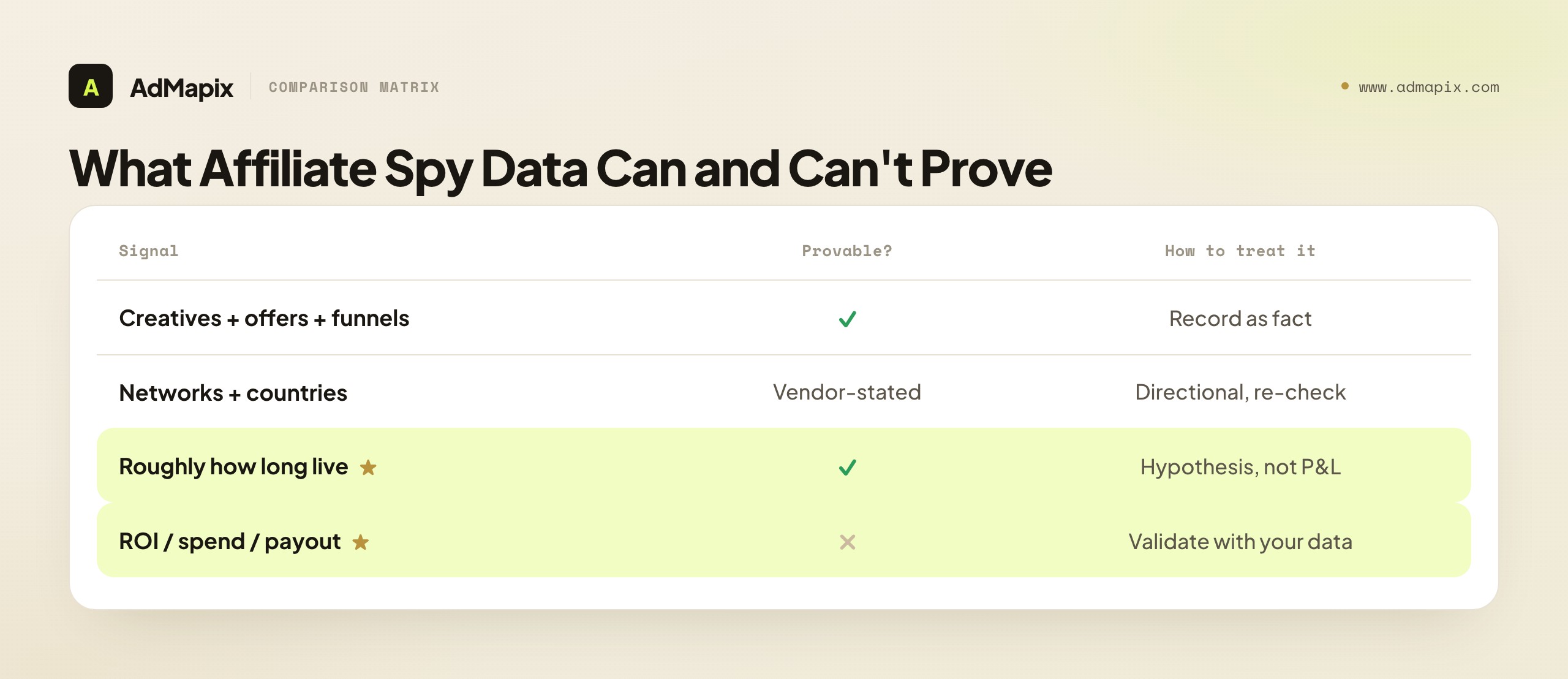
What public spy data can prove: which creatives, offers, angles, and landing pages are in market, on which networks and in which countries, and which have been running long enough to be worth imitating. A creative or funnel that has been live for a long stretch is a reasonable signal that someone is making it work — affiliates are ruthless about cutting losers, so longevity carries information. That is a real, actionable fact you can build a test on.
What it cannot prove: actual ROI, true ad spend, conversion rate, offer payout, or whether the advertiser is profitable. A creative running for months is a hypothesis — "this angle is working for someone" — not a guarantee that it will work for you, on your traffic source, with your payout, at your costs. Network counts and country counts are also vendor-stated figures that fluctuate, so treat them as directional and re-check the live product pages rather than quoting them as fixed facts.
The honest workflow that follows: use the data to start tests, not to skip them. The structure of a long-running competitor funnel is worth copying as a hypothesis; the economics are yours to validate. Owned campaign analytics and offer payouts are the only things that confirm a hypothesis a spy tool produced. Tool choice does not change this rule — AdPlexity's breadth and Anstrex's depth both produce evidence of activity, never evidence of margin. The buyer who remembers this scales winners and cuts losers fast; the buyer who reads a long-running ad as proof of profit scales a competitor's loss-leader or a funnel whose economics never applied to their traffic in the first place.
There is an affiliate-specific nuance to the longevity signal worth spelling out, because it is more reliable in native and push than in some other channels — but only somewhat. Affiliates are notoriously ruthless cost-cutters: a media buyer running native or push will kill a losing campaign fast, so a funnel that has been live and apparently unchanged for weeks does carry real information that someone is profiting. That makes longevity a stronger signal here than, say, a long-running brand ad that might be running for non-performance reasons. But "stronger" is not "proof." The competitor profiting on that funnel may have a better offer payout than you can access, cheaper traffic from a relationship you do not have, or a more optimized post-click flow you cannot see. So even in affiliate, treat a long-running funnel as a strong hypothesis worth testing fast — not as a guarantee that the same structure will be profitable on your traffic at your costs. The edge is in testing the strong hypotheses quickly, not in assuming they are already won.
Common Mistakes When Choosing Between AdPlexity and Anstrex
Most regret in this decision traces back to a few avoidable errors.
- Buying a product family before naming the channel. Native, push, social, app, and YouTube research need different databases. Decide your channels first, then buy only the products that cover them — AdPlexity's full suite is dead cost if you run two channels.
- Treating a long-running ad as proof of profit. Longevity is a signal, not a P&L. Copy the funnel structure as a hypothesis; validate the economics with your own analytics and payouts.
- Ignoring the prelander. In native and push, the post-click funnel often explains the win more than the headline. Researching the ad without the prelander is studying the least important third of the funnel — which is exactly why Anstrex's ripper matters.
- Paying for unused AdPlexity modules. The per-channel model is efficient only if you run those channels regularly; otherwise the unused products are pure dead cost. Buy the channels you open weekly, not the ones you might someday try.
- Cloning a ripped prelander verbatim. Use the ripper to understand structure, then build a differentiated version. Wholesale cloning invites legal, compliance, and offer-rejection risk and produces funnels that do not stand out.
- Stopping at research. Competitor evidence is worthless until it becomes a brief, an offer test, a funnel hypothesis, or a client report. Both tools are discovery instruments; neither closes the loop to a decision on its own.
- Comparing on vendor-stated network counts. A bigger advertised network count means nothing if your specific vertical, network, and country are thin in the tool. Test coverage locally, on your real verticals.
- Committing annually before validating. Both vendors offer annual discounts that look attractive until you are locked into a product whose coverage turns out thin in your niche. Validate monthly first, then commit.
The two errors that cost the most are the first two on this list, and they share a root: confusing a signal of activity with proof of margin. A bigger database and a longer-running funnel both feel like more certainty, but neither adds a single data point about whether the economics work for you. The discipline that prevents both mistakes is the same: treat the tool as a generator of hypotheses, and reserve the word "winner" for funnels your own analytics and payouts have confirmed. Affiliates who hold that line scale fast and cut fast with either AdPlexity or Anstrex; those who drop it burn budget on competitors' loss-leaders regardless of which tool they bought, because the failure was never the tool — it was reading activity as margin, which no spy tool can fix.
When a Cross-Network Creative Layer Helps
Affiliate native and push are a specific world, and neither AdPlexity nor Anstrex is built for the research that lives outside it: paid-social and video creative across markets. When your decisions start spanning those — when you need cross-network creative search, saved evidence, video breakdowns, and shareable reports rather than native prelanders and push CPC bids — a different layer fits.
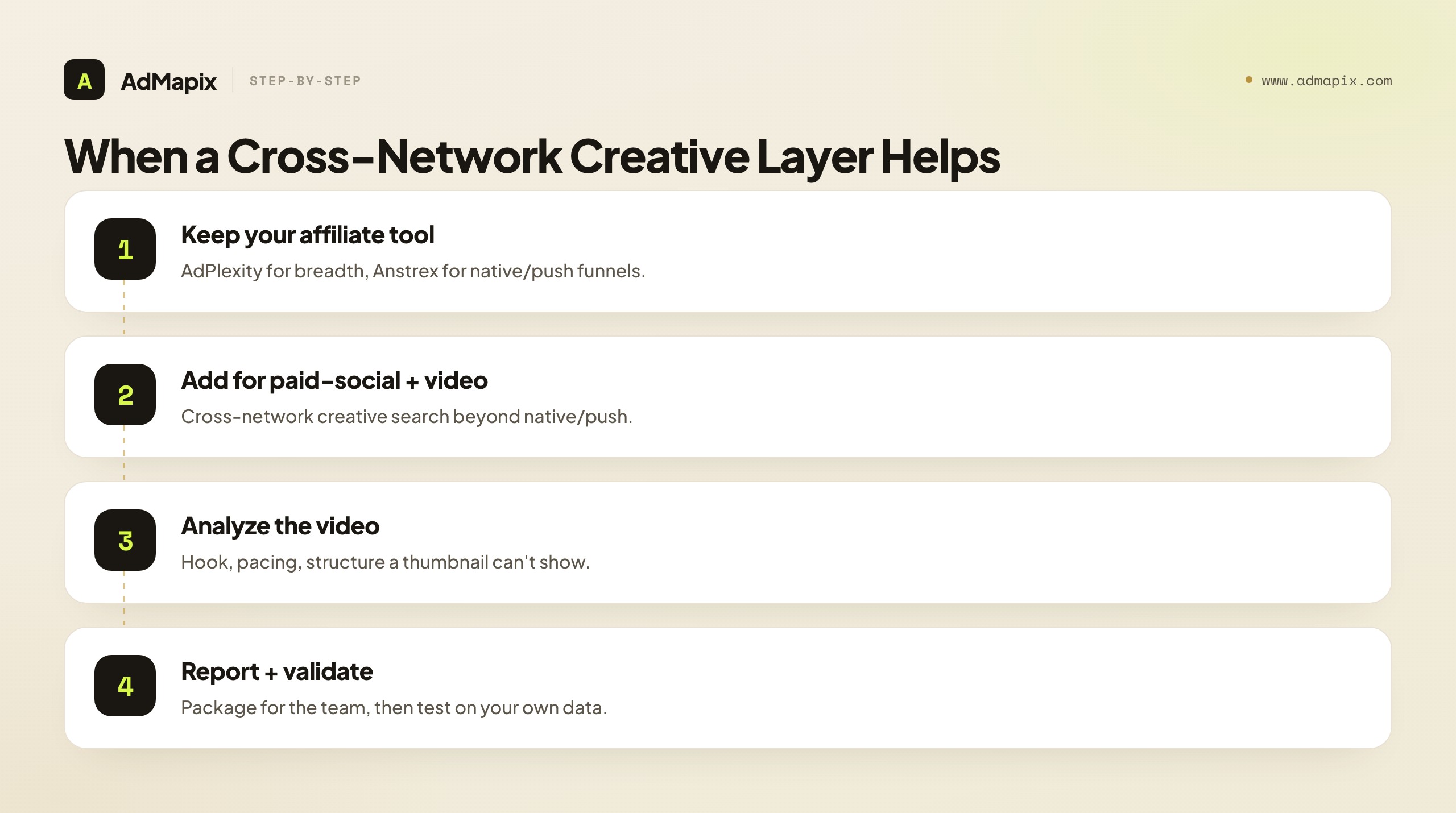
A cross-network creative layer like AdMapix is for teams whose research extends beyond affiliate native/push into paid-social and video creative across markets. It complements either AdPlexity or Anstrex rather than replacing them: search ad creatives across networks with Search, save the evidence in one place with Media, break down video hooks and structure with Video Analysis that a static thumbnail cannot show, and turn patterns into a Report a client or team can act on. A practical stack keeps the affiliate specialist tool for its strongest job — AdPlexity for multi-channel breadth, Anstrex for native/push funnel depth — and adds a cross-network layer where paid-social and video research live. Compare seats on Pricing once the workflow repeats, or log in to run your first cross-network search.
It is honestly not the right tool if your entire job is ripping native prelanders or pulling push CPC bids — the affiliate spy tools own that workflow, and no cross-network creative layer replaces a ripper or bid data. It earns its place only when paid-social or video creative across markets becomes part of the decision. The clearest way to see where it sits: AdPlexity and Anstrex answer "what is running on affiliate native and push?", and a cross-network layer answers "what is running across paid-social and video, and what did we learn from it?" — adjacent questions for adjacent jobs, best handled by the tool built for each.
The reason a separate layer makes sense, rather than expecting one tool to cover everything, is that affiliate native/push and paid-social/video are genuinely different research worlds. Native and push research is funnel-and-offer-centric: the prelander, the CPC bid, the offer payout. Paid-social and video research is creative-and-hook-centric: the first three seconds, the pacing, the proof moment, the format. A tool built for one is the wrong shape for the other, which is exactly why the affiliate specialists do not try to be cross-network creative tools and a cross-network creative tool does not try to be a prelander ripper. Each owns its world. The teams that get the most from their stack accept this and pair the right tool for each world, rather than forcing one tool to stretch across both and doing both jobs badly. If your work genuinely spans affiliate funnels and paid-social creative, two tools — one for each world — beats one tool that compromises on both.
For the broader landscape beyond these two affiliate tools, our guide to the best ad spy tools of 2026 compares the whole field by price, coverage, and use case, and the native ad spy tool guide goes deeper on the native-specific field. If you are weighing alternatives to either tool, Anstrex alternatives and AdPlexity alternatives cover what else fits the native-and-push niche, and the related Anstrex vs Adbeat breakdown adds a display-and-native specialist to the comparison.
FAQ
Is AdPlexity or Anstrex better?
Neither wins outright — they fit different shapes of affiliate work. AdPlexity is better if you need breadth across many affiliate traffic sources from one vendor and run each heavily enough to justify per-product pricing. Anstrex is better if native and push are your core channels and you want landing-page ripping, competitor alerts, and a lower entry price. Decide by how many channels you run and whether the prelander is central to your craft.
Which is better for push ads?
Anstrex Push advertises a broad set of push networks, many countries, and CPC bid data, with a landing-page ripper — a strong package for push-focused buyers. AdPlexity Push covers push within its broader suite. Test them against each other using the same vertical, country, and affiliate network, and keep whichever returns usable offers, creatives, and bids faster for your specific work.
Does Anstrex really let you copy competitor landing pages?
Yes — both Anstrex Native and Push include a landing-page ripper that downloads a competitor's landing or prelander page so you can study the funnel and adapt it. It is one of the main reasons native and push buyers choose Anstrex. Use it to understand structure and build a differentiated version, not to clone a page verbatim, which invites legal and offer-rejection risk.
What is the main difference between AdPlexity and Anstrex?
The product model. AdPlexity sells separate per-channel products (native, desktop, mobile, push, YouTube, and more) for buyers who want breadth across affiliate traffic sources from one vendor. Anstrex sells two focused flagship products — native and push — with a landing-page ripper and a lower entry price, built for buyers concentrated on those two channels. AdPlexity is a modular toolbox; Anstrex is a specialized workbench.
Which tool is better for a solo affiliate on a budget?
Usually Anstrex, if native and push are your channels — its lower per-product entry price and ripper-centric workflow suit a solo affiliate or lean team well. AdPlexity becomes more cost-effective only when you run several channels heavily enough to use multiple products. For a budget-conscious specialist, start with the single Anstrex product that matches your channel and validate it on your real verticals before expanding.
Can I use both AdPlexity and Anstrex?
Yes, and some teams do, pairing AdPlexity's broader channel coverage with Anstrex's native/push depth and ripper. Just confirm you are running enough volume in each channel to justify two subscriptions — the pairing makes sense for a buyer whose native/push work is funnel-heavy and who also runs other channels AdPlexity covers, but it is overkill for a buyer concentrated on two channels.
Do these tools show real ad spend or ROI?
No. Both surface the creatives, offers, funnels, networks, and countries competitors are running publicly, plus roughly how long an ad has been live. They do not show real ad spend, ROI, conversion rate, offer payout, or whether the advertiser is profitable. Treat a long-running ad as a hypothesis worth testing, and validate the economics with your own campaign analytics and payouts before scaling.
How reliable are the network and country counts these tools advertise?
Treat them as directional, vendor-stated figures that fluctuate, not fixed facts. Both AdPlexity and Anstrex publish network and country counts that change over time as coverage shifts. They are useful for a rough sense of breadth, but the only number that matters for your decision is whether the tool returns fresh, relevant data for your specific vertical, network, and country — which you confirm by testing, not by reading a homepage stat.
Do I still need a tool like AdMapix?
Only if your research extends beyond affiliate native/push into paid-social and video creative across markets. A cross-network layer like AdMapix handles cross-network creative search, saved media, video analysis, and reports; it does not replace a native/push spy tool's landing-page ripper or push bid data. Keep the affiliate specialist for its workflow, and add a cross-network layer only when paid-social or video research becomes part of the decision.
Should I buy annually to save money?
Not before you have validated the tool on your real verticals. Both vendors offer annual discounts that look attractive until you are locked into a product whose coverage turns out thin in your niche. Validate on a monthly plan first — run your actual competitors, offers, and countries through it for a few weeks — and switch to annual only once you have confirmed the tool earns its place in your workflow.
Key Takeaways
- Name your channels before you buy. AdPlexity's per-product model rewards multi-channel specialists; Anstrex's two-product focus suits native-and-push funnel buyers. Channel count, not database size, settles the decision.
- For native and push funnel work, weigh Anstrex's landing-page ripper and alerts heavily — the prelander often explains the win, and the ripper is the workflow differentiator.
- AdPlexity's breadth is efficient only if you run the channels. Any per-channel product you would not open weekly is dead cost; buy the surfaces you actually use.
- Treat every scraped ad and funnel as a hypothesis, and validate margin with your own analytics and offer payouts before scaling. Longevity is a signal, never a P&L.
- Add a cross-network creative layer only when paid-social or video creative across markets becomes part of the decision — it complements, never replaces, an affiliate native/push spy tool.
Authoritative Sources
- AdPlexity — ad-intelligence suite for native, desktop, mobile, adult, YouTube, push, and social research (as checked June 2026).
- AdPlexity pricing — product-specific monthly and annual plans across Native, Desktop, Mobile, Adult, Push, and YouTube; verify current plans before buying.
- Anstrex Native — native ad intelligence with advanced search, a landing-page ripper, competitor alerts, and generative-AI credits (as checked June 2026).
- Anstrex Push — push ad intelligence with CPC bid data, a landing-page ripper, competitor alerts, and creative downloads (as checked June 2026).
Network counts, country counts, products, and pricing are vendor-stated and change. All links checked as of June 21, 2026; verify the current plan before purchase. Disclosure: AdMapix is our own product, and its data scope covers cross-network ad creative search, saved media, video analysis, tagging, and reports — separated from claims sourced to each vendor's own pages.
Turn these observations into your next creative study
Open the creative library and select samples for your market, network and research question.
Related Articles
Dropispy vs Minea in 2026: Dropshipping Ad Spy or Broad Product Research?
A 2026 head-to-head of Dropispy vs Minea — Facebook-first dropshipping ad spy with shop signals versus broad ecommerce product research with daily winning products and multi-channel layers, compared on coverage, pricing, and use-case fit, with a test-before-you-buy method and the honest limits of what ad spy data can prove.
Dropispy Alternative in 2026: The Honest Buyer's Guide to Switching Ad-Spy Tools
A bottom-funnel buyer's guide to choosing a Dropispy alternative in 2026 — what Dropispy is genuinely best at, the exact gaps that push dropshippers and agencies to switch, a five-criterion scoring rubric, head-to-head comparisons with Minea, PiPiAds, and AdMapix, migration SOPs, pricing reality checks, and an honest account of where AdMapix fits and where it does not.
PowerAdSpy Alternative in 2026: 7 Tools Compared (Coverage, Video & Pricing)
A 2026 guide to choosing a PowerAdSpy alternative — why tier-gated filters send teams looking, a 7-tool comparison with pricing and coverage, the discovery-vs-video-vs-reporting framework, a migration plan, and an honest read on when AdMapix fits.