
Ad Creative Analysis Tools 2026: AI Features & Comparison
Compare five creative analysis tools by their inputs, outputs, account connections and buying conditions, with an AdMapix research workflow.
Reviewed and updated by the AdMapix editorial team on September 5, 2026.
Ad creative analysis tools help a team turn advertising evidence into a decision: what to make, what to change, or which existing creative deserves further testing. The useful comparison starts with the data you can supply. A product connected to your ad account can analyze your results; a competitor library supplies public creative evidence. Some platforms combine these jobs, but their data sources and limits still differ.
For a first shortlist, compare Segwise for creative tagging across connected networks, Motion for account-level creative analysis and reporting, Foreplay Lens for reporting alongside research and briefing, CreativeX for creative quality standards, and AdMapix for competitor creative discovery and structured analysis. The table below makes those differences explicit.
How we compared the tools
This is a review of official product documentation and public pricing checked on September 5, 2026, plus a dated AdMapix research example. It is not a hands-on benchmark of every paid product. AdMapix is our product. The comparisons describe documented capabilities; they do not independently verify vendor accuracy, advertised performance lifts, or every integration.
We compare the job, required input, output, buying conditions, and the question each product cannot answer from public evidence alone. Prices below are USD and refer to the stated billing basis, not a claim that the cheapest plan includes every workflow.
Quick comparison: five concrete options
| Tool | Most relevant job | Input and output | Public buying information checked September 5 | Check before buying |
|---|---|---|---|---|
| Segwise | Tag and analyze creatives across your connected advertising data | Ad-network/MMP connections and creatives → tags, creative-level analysis and fatigue tracking | Growth: $499/month billed monthly, up to $250K monthly connected ad spend and 500 AI tokens; seven-day trial advertised | Your integrations, token consumption and spend bracket; a correlation is not an experiment |
| Motion | Turn your account's creative results into briefs and recurring reporting | Connected account creatives/results → tags, leaderboards, analysis, briefs and reports | Starter: $750/month, up to $50K monthly ad spend; demo booking available | Your account/attribution connections and plan scope; separate recommendations from measured lift |
| Foreplay Lens | Put creative reporting beside research, saving and briefing | Connected account results plus organized creative research → shared reports and briefs | Workflow: $175/month on monthly billing, five users and Lens for one brand; seven-day trial advertised | Basic at $59/month does not include Lens; extra brands/users and billing basis change the comparison |
| CreativeX | Evaluate adherence to creative quality guidelines | Assets and configured guidelines → quality scores and related reporting | Request a scoped quote through CreativeX; no numerical price verified for this comparison | Which guidelines and platforms apply; a quality score is not a prediction of your conversions |
| AdMapix | Find and organize competitor creative evidence for analysis | Supported creative records, media and app context → searchable evidence and structured analysis | Free: 30 lifetime credits; Starter: $19.90/month with 300 monthly credits | Endpoint/task credit costs and source coverage; public observations do not reveal a rival's private ROAS |
Annual equivalents, trials and conditional discounts are not interchangeable with month-to-month prices. We excluded a conditional Segwise startup discount from the baseline so that the price row does not assume eligibility. Foreplay's annual equivalent also differs from the monthly price shown here.
Choose by the decision you need to make
Start with the question whose answer changes your next action.
| Your question | Start with | What a useful output looks like |
|---|---|---|
| What ads are competitors showing? | AdMapix and relevant official ad libraries | Dated source links, advertiser identity, unique assets and a comparison set |
| Which of our hooks correlate with better results? | Segwise or Motion, evaluated against your actual integrations | Consistent tags joined to the same campaign window and outcome definition |
| How do we report results and brief the next creative together? | Foreplay Lens or Motion | A report linked to the creatives and an editable next-test brief |
| Do our assets meet defined brand/platform standards? | CreativeX | The rule checked, the asset evidence, exceptions and remediation |
These are starting points for evaluation, not universal winners. A team can use one platform for several tasks. Require evidence that each needed task works with your inputs rather than assuming that every feature name covers the same depth.
What to inspect in an AI creative breakdown
A useful breakdown links every claim to the source material. Ask for the opening hook, spoken/on-screen words, scene boundaries, product demonstration, proof, offer and CTA, with timestamps where possible. Mark unclear audio or hidden text as unknown instead of inventing it.
Separate three types of output:
- Observed: a price shown on screen, a scene transition, an identified CTA, or an account metric with its source.
- Inferred: the likely audience, emotional angle, or reason a creative may hold attention.
- To test: a new hook, edit, offer, or landing-page treatment proposed for your product.
AI can help produce and organize all three. Only the first category is evidence; the other two require judgment or testing. For a deeper structure, use the competitor ad analysis framework.
An AdMapix example: deduplicate before comparing creative
Our Bus Traffic Fever research snapshot, collected on August 19, 2026 for the United States, illustrates a mistake a creative-analysis workflow should catch before scoring anything. The snapshot contained 22 ad instances, which resolved to nine distinct videos and eight playable end cards. Twelve 58-second video rows represented only four video files.
Those counts describe the dated source snapshot, not current campaign inventory. They do not establish creative profitability. The useful lesson is operational: treating every row as a separate video would overstate production diversity and repeat the same analysis.
| Stage | Concrete input | Required output |
|---|---|---|
| Identify the material | Instance IDs, source dates, video fingerprints and playable fingerprints | A list of distinct assets with their related delivery records |
| Read the creative | Each distinct video once, with its source link | Timestamped hook, demonstration, offer and CTA notes |
| Compare | Consistent tags across the distinct files | Which structures repeat and which genuinely differ |
| Write the next brief | Your own product loop plus the observed pattern | An original test concept, expected user action and measurement plan |
| Validate | Your launched variants and account outcomes | A decision based on your results, including retention or conversion where relevant |
The deduplication counts above are observed in our published analysis. The remaining rows are the evaluation workflow we recommend, not a claim that all five tools processed this dataset or that a new variant improved results.
A brief you can reuse
Source: advertiser, record URL, observation date, market, unique asset ID
Observed hook: timestamp + exact visual or words
Observed proof and CTA: timestamp + evidence
Audience interpretation: hypothesis, with alternatives
Our product constraint: what the actual experience can deliver
Proposed variant: one specific change to test
Control: existing creative and comparable delivery conditions
Outcome: our agreed conversion/retention measure and decision rule
Unknowns: missing metadata, unclear scenes, unavailable performance data
Use this as an output contract when evaluating a vendor. If a tool returns fluent advice without traceable input, the analysis still needs manual reconstruction.
A practical product evaluation
Bring a small set of assets you may use, known creative duplicates, and one question with a decision attached. For connected-account products, use the same reporting period and attribution definition. For competitor research, keep source, market and observation date constant.
- Check whether the tool imports the material you actually work with, including video, static or playable formats where relevant.
- Compare extracted labels with a human review; record omissions and uncertain fields.
- Check whether duplicate assets remain linked to their source records.
- Ask for a brief and inspect how much editing it needs before production.
- Confirm exports, permissions, account/brand limits and the cost of this workflow in the proposed plan.
- Run the same evaluation again on less polished material from your own category.
Do not ask a competitor library to demonstrate private advertiser conversions. Do not treat a creative-quality score as a measured causal effect. For your own account, check that the metrics use the same event and attribution definitions as your reporting system.
When AdMapix fits
AdMapix fits the evidence-gathering side: finding supported competitor creative records, preserving context and connecting creative research with app/market information. Use the methodology to understand counting and estimated fields, and pricing to check credits before planning recurring analysis.
If your immediate problem is reconciling your own campaign spend and attributed conversions, evaluate the account integrations of an analytics product first. A broad competitor index does not substitute for those connections.
FAQ
What are ad creative analysis tools?
They help organize and interpret ad assets, often alongside account performance data. Common outputs include tags, creative comparisons, reports and briefs. Check whether a tool analyzes your account, public competitor creatives, quality standards, or several of those jobs.
Which AI ad creative analysis tool is best?
There is no defensible universal winner from documentation alone. Use the table to shortlist products for your input data and decision, then evaluate them with the same materials. This article's comparison is a documented-capability review, not a measured accuracy ranking.
Can these tools predict a winning ad?
Scores and recommendations can help prioritize tests. They cannot guarantee your conversion rate or profit. A connected analytics product can show associations in your account data; causal conclusions need an appropriate experiment.
Is there a free starting point?
Official ad libraries and a manual evidence sheet can cover basic competitor research. AdMapix Free includes 30 lifetime credits. Keep free plans, limited trials and recurring paid subscriptions separate when budgeting.
Can one platform do discovery, analysis and reporting?
Some products cover several of those tasks. Compare the exact inputs, integrations and outputs for each task, and verify which plan includes them. Breadth alone does not establish suitability for your workflow.
Sources
Official documentation and pricing reviewed September 5, 2026: Segwise, Motion, Foreplay plans, Foreplay Lens, CreativeX quality metrics, AdMapix methodology and pricing. The original research example is the dated Bus Traffic Fever teardown.
Turn these observations into your next creative study
Open the creative library and select samples for your market, network and research question.
Related Articles

PPC Management Software for Agencies: How to Build a Lean Stack That Earns Its Seat in 2026
A buyer's framework for PPC management software for agencies. PPC software is not one product but a stack covering five jobs — campaign operations, reporting, quality assurance, creative research, and client communication. This guide shows how to buy by job not by logo, compares the tool categories, covers pricing models, the mistakes that inflate your tool budget, an evaluation scorecard, and where competitive creative research fits.
Cross-Channel Ad Attribution in 2026: A Practical Guide for Performance Teams
A practical cross-channel ad attribution guide for performance teams: how to compare ROAS across platforms when every platform claims credit differently, build incrementality testing into your workflow, and make budget decisions without perfect data.
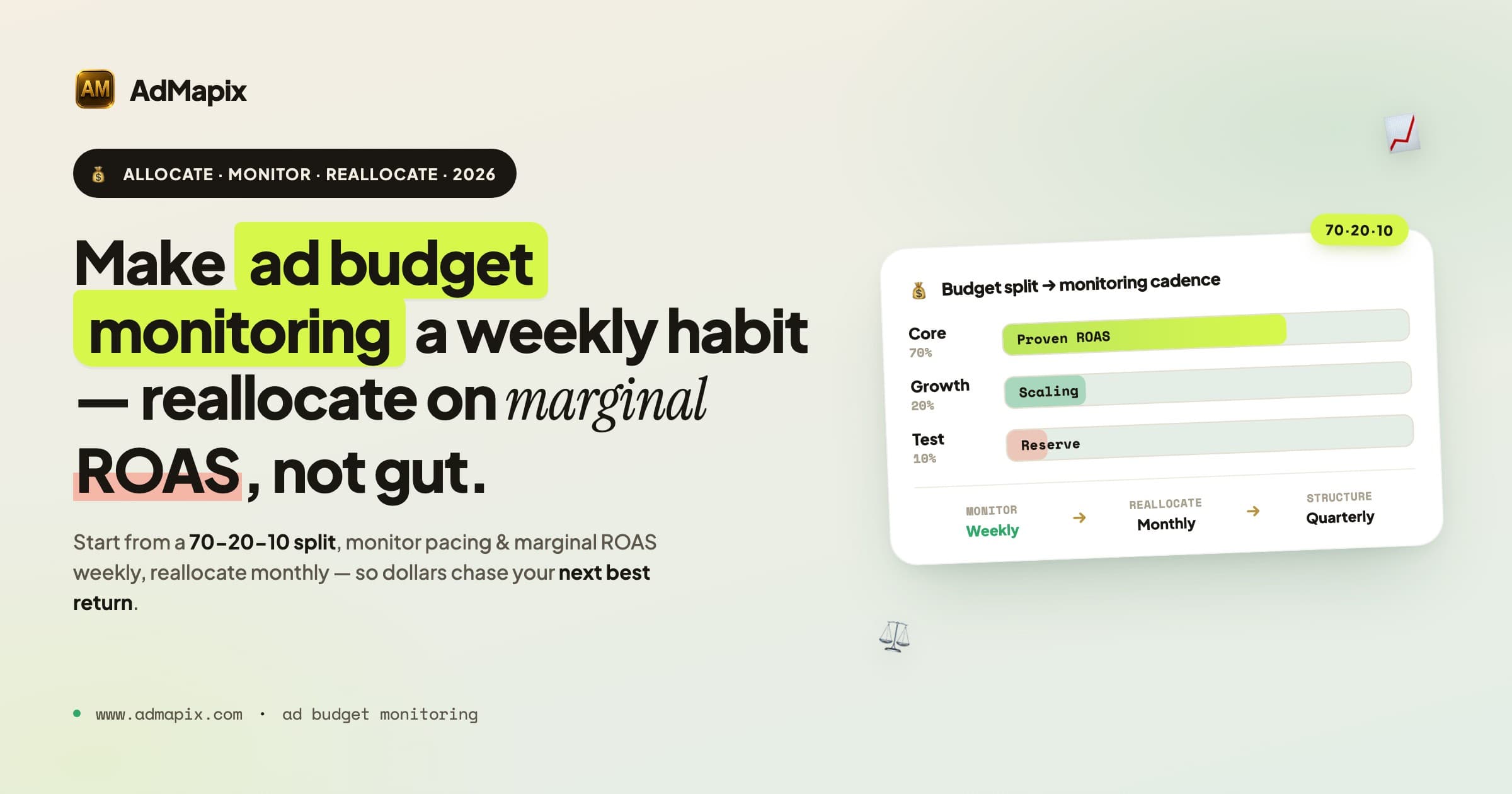
Ad Budget Optimization Framework 2026: Monitoring, Pacing & Reallocation
A 7,500-word 2026 framework for ad budget monitoring, tracking, and optimization: the 70-20-10 split, marginal ROAS, competitor ad budget signals, budget pacing, a weekly tracking dashboard, and a monthly reallocation workflow.