
Unity Ads Creatives: US Examples and Playable Specs
Analyze eight Unity-filtered US advertising examples, understand the limits of a thirty-record sample, and turn current Unity playable specifications into a practical research, production, and device-testing workflow.
Unity Ads Creatives: US Examples and Playable Specs
Last updated: 2026-11-02
AdMapix Research — prepared with Codex and checked against the dated source sample. Editorial ownership: Brad at AdMapix. This preparation disclosure does not imply personal human review.
Unity Ads creatives in this dated US sample include Search It - Hidden Objects, Gossip Harbor, Find Hidden Objects - Spot It!, Word Tiles, Merge Mansion, and Candy Crush Saga. They appear alongside advertising for Fetch, Kalshi, Reddit, and Walmart. The eight illustrated examples show object-search scenes, a presenter explaining an app, animated distress, caption-led memes, typography, and a brief brand reveal. The sample contains video records but no captured playable files.
For user-acquisition managers and creative teams, the useful decision is what to investigate and build next. This guide connects those examples to a reproducible research workflow and Unity’s official playable specifications, checked as of November 2, 2026. It covers creative research, production requirements, and previewing—not SDK integration or publisher monetization. The observations describe a historical measurement window, rather than guaranteeing that any particular advertisement is running today.
Quick Answer
Unity Ads supports more creative approaches than game demonstrations alone, and this sample provides references rather than a performance ranking.
- The US measurement window is 2026-10-03 to 2026-11-01, fetched on 2026-11-02: 30 advertising records, 30 distinct video fingerprints, and no captured playable files.
- The illustrated game examples include detailed hidden-object scenes and an animated story opening. Non-game examples add presenter, meme, typography, and brand treatments.
- As of November 2, 2026, Unity requires new playables to use a single minified HTML file under 5 MB, support MRAID 3.0, and respond to both orientations.
- Research indexed examples with AdMapix’s Unity network filter; validate your own creative packs with Unity’s documented device-testing workflow.
What This Guide Helps a Creative Team Decide
The first decision is whether you need an advertising reference, a technical specification, or evidence from your own campaign, because each answers a different question. An example can show how a scene introduces a task. A specification can establish whether an asset meets a submission requirement. Only appropriate campaign and product measurements can establish whether that asset achieves your acquisition objective.
A mobile-game team might arrive with a practical question: should the next concept show the mechanic immediately, introduce a story problem, or use a person to explain the promise? The sample helps describe those alternatives. It does not select a winner for your game, audience, or account.
Keep the deliverable concrete. A useful research session should produce a source-linked reference, an original concept, a statement of what remains unknown, and a test that could resolve that uncertainty. “Make something like the biggest ad” is too vague to guide production and too strong for the evidence.
For the broader research framework, the mobile game ad spy tool guide explains how creative, product, and channel evidence fit together. Here, the scope stays with Unity-filtered examples and the production questions that follow from them.
Methodology: Country, Dates, Query, and Sample Limits
This analysis uses a bounded, impression-sorted US search sample, with network attribution established by the saved Unity filter configuration. The measurement window is 2026-10-03 to 2026-11-01. Retrieval occurred on 2026-11-02 at 01:53:38 UTC. The keyword query was blank, so this was a network exploration rather than a search for one game or advertiser.
The search requested three pages of ten records each, ordered by descending estimated impressions. Both selected channel entries were named Unity in the frozen filter response. Every included record came from that filtered search. This supports describing the sample as Unity-filtered; it does not identify a particular publisher app, placement, buying account, or rewarded-ad experience.
The public frozen source package contains the dated batches, request parameters, and checksums. Those materials make the retrieval and record-level statements reproducible. Checksums support source integrity; they do not validate advertising effectiveness or the underlying estimation model.
The supplied sample summary reports:
| Measurement | Result | Interpretation |
|---|---|---|
| Advertising records | 30 | Returned ad instances, not a network-wide inventory |
| Records containing video | 30 | Every sampled record links a video |
| Distinct video fingerprints | 30 | No exact video-fingerprint repetition within this sample |
| Distinct image fingerprints | 9 | Associated image files, separate from the video count |
| Records containing playable files | 0 | No playable attachment captured in these records |
| Distinct playable fingerprints | 0 | No playable files available for analysis |
| Model-estimated impressions | 5,943,314,460 | Sum for the stated window and sampled records only |
| Largest record’s supplied share | 12.8% | Share of this sample’s estimated impressions |
| Leading five records’ supplied share | 35.9% | Sample concentration, not market share |
All impression figures are third-party model estimates for the explicit window. They are not observed delivery, spending, installs, revenue, profit, or lifetime totals. Product-level search aggregates are excluded because their time scope does not match this analysis.
Product associations use the store identifiers attached to each record. A listing name can be localized or change; the identifier is the anchor. A product association does not identify the ad buyer, and a developer field is not evidence of who paid for a specific placement.
Visual analysis is limited to the eight supplied timestamped contact sheets. Most show frames at 0, 2, 5, and 10 seconds; the shorter examples have fewer sampled timestamps. We did not watch complete videos, play the advertised apps, interact with playable builds, or measure conversion. Video durations below come from record metadata, not reconstructed playback.
Finally, first-seen and last-seen dates describe index observations. They do not establish a launch date, uninterrupted delivery, or a campaign shutdown. This sample cannot represent the full Unity advertising market or any advertiser’s complete creative inventory.
Evidence Table: The Eight Illustrated Records
The eight figures correspond to identifiable advertising records, and their estimated impressions belong to the same measurement window. The table keeps record duration, product association, and visual coverage separate so that a ten-second contact sheet cannot be mistaken for a complete viewing of a longer video.
All estimates below apply to 2026-10-03 to 2026-11-01, US, Unity-filtered search. Record references are shortened identifiers that can be matched to the public source package.
| Figure | Reported linked product | Record reference | Recorded video duration | Sampled timestamps | Model-estimated impressions |
|---|---|---|---|---|---|
| 1 | Search It - Hidden Objects | e574a39636bb | 60 seconds | 0, 2, 5, 10 seconds | 757,874,980 |
| 2 | Fetch: Earn Rewards Every Day | 3ced3184ca70 | 30 seconds | 0, 2, 5, 10 seconds | 386,550,438 |
| 3 | Gossip Harbor; listing titled 緋聞港口:合併&故事 | cc7ef3cbf263 | 59 seconds | 0, 2, 5, 10 seconds | 361,225,229 |
| 4 | Kalshi: Trade Sports & Events | 6fa8271835b3 | 8 seconds | 0, 2, 5 seconds | 316,172,172 |
| 5 | Search It - Hidden Objects | 7925616064ba | 60 seconds | 0, 2, 5, 10 seconds | 312,130,866 |
| 6 | Kalshi: Trade Sports & Events | da0a616fcc02 | 8 seconds | 0, 2, 5 seconds | 279,398,365 |
| 7 | Reddit: Where Real People Talk | e4a89bf12568 | 15 seconds | 0, 2, 5, 10 seconds | 211,727,900 |
| 8 | Walmart: Shopping & Savings | 5e6cd9731afd | 5 seconds | 0, 2 seconds | 202,029,328 |
The order is useful for locating examples, but it is not a production recommendation. A record’s estimated impression volume does not reveal its cost, conversion rate, audience quality, or incremental effect.
The illustrations are also not the nine image files counted in the sample summary. They are editorial contact sheets assembled from sampled video frames. Treating these two kinds of images as interchangeable would confuse the original advertising assets with the evidence used to discuss them.
Which Games Appear in the Unity Sample?
The sample links to several puzzle and casual-game listings, but the attached screenshots cover only some of them. Search It and Gossip Harbor receive visual analysis below. Other games can be identified from their linked store entries and duration metadata, without inventing a description of frames that were not supplied.
| Game or reported listing | Linked store identifier | What this article can establish |
|---|---|---|
| Search It - Hidden Objects | 6756185760 | Associated records and two illustrated object-search scenes |
| Gossip Harbor / 緋聞港口:合併&故事 | 1623318294 | Associated records and an illustrated animated story opening |
| Find Hidden Objects - Spot It! | 6474133872 | Associated video records; no attached visual example analyzed here |
| Word Tiles - Relaxing Puzzle | 6783815362 | Associated video records with differing recorded durations |
| Vita 麻將 | 6468921495 | A linked video record; no attached visual example analyzed here |
| Merge Mansion: Puzzle y Story | 1484442152 | Associated video records and repeated associated image fingerprints |
| 毛線衝擊 - Traffic Jam公車遊戲 塞車解謎 | 6743385713 | A linked video record under this reported listing title |
| Candy Crush Saga / 糖果傳奇 | 553834731; com.king.candycrushsaga | Linked iOS and Android entries appear in the sample |
| Cube Topia 3D | 6762267809 | A linked video record; no attached visual example analyzed here |
| 貨櫃分類整理:3D益智消除遊戲 | 6499306806 | A linked video record under this reported listing title |
| Modo: Play, Win & Rip | 6741076536 | A linked video record; no attached visual example analyzed here |
The localized listing titles do not change the search’s US country setting. They are labels supplied with product metadata, not evidence that the advertisements targeted a different country or used the listing’s language.
The non-game records matter too. Fetch, Kalshi, Reddit, Walmart, SHEIN, and Dave appear in the same bounded network search. That gives a creative team references beyond game footage. It does not establish how frequently a particular player saw these brands or whether they competed in the same auction.
If your question is “what is running right now?”, repeat the research with an explicit current window and preserve the resulting observation date. This article establishes what appeared in the frozen sample, with many records last observed on October 31, 2026; it cannot certify live status at the moment you read it.
Figure 1: Search It Makes the Visual Task Available Immediately
The first Search It example places a strip of object icons above a crowded illustrated office, making visual search the most apparent task in the sampled frames. Desks, monitors, cabinets, people, and small objects fill the scene. The layout gives the viewer something to inspect without requiring a paragraph of explanation.
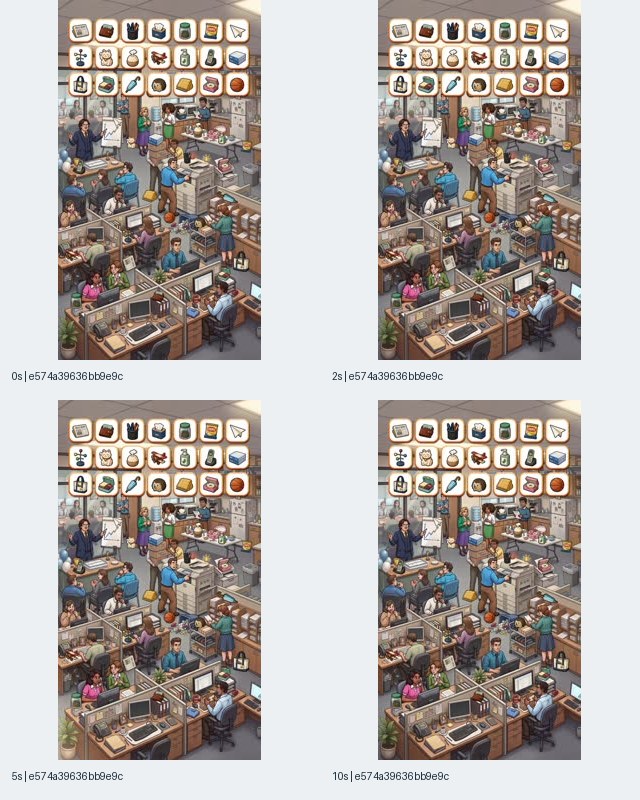
Figure 1. Search It - Hidden Objects, linked listing 6756185760; record e574a39636bb. Frames sampled at 0, 2, 5, and 10 seconds from a video recorded as 60 seconds long. Source: the November 2, 2026 Unity-filtered US sample.
The same broad office composition remains visible across the sampled timestamps. That supports describing the opening as visually persistent. It does not establish that nothing moves between those frames, that the entire video is static, or that the viewer can tap the objects.
The useful production question concerns legibility. The object strip and the scene must be readable together for the implied search task to make sense. A team adapting this structure should specify the target object, its representation in the reference strip, its scale inside the scene, and the visual relationship between them.
An original concept could use a different environment and original artwork while preserving that relationship. For example, a studio might demonstrate a real object-finding mechanic in its own workshop setting. The hypothesis would be that a clear target reference helps viewers understand the task before reading explanatory copy. That hypothesis remains untested here.
The record carries 757,874,980 model-estimated impressions for the stated window and is the largest record in this sample. Neither the estimate nor its sampled rank proves that dense scenes outperform simpler compositions. The creative reference is the visible organization of the task, not an assumed performance result.
Figure 2: Fetch Combines a Presenter, Captions, and a Phone
The Fetch example uses a person addressing the camera, purple caption boxes, and a phone displaying the Fetch name. Its visible structure connects a promised benefit with an app-opening instruction. This is an explanation-led reference rather than an observed game mechanic.
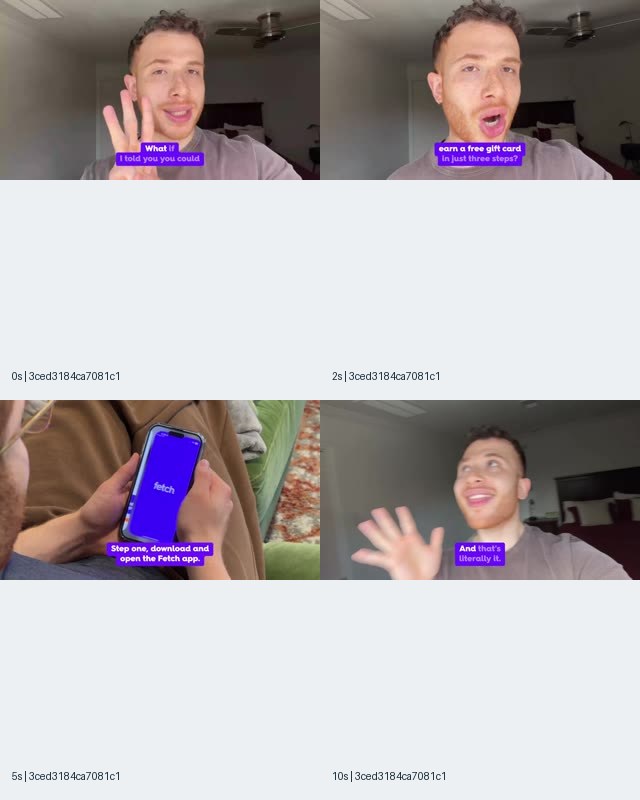
Figure 2. Fetch: Earn Rewards Every Day, linked listing 1182474649; record 3ced3184ca70. Frames sampled at 0, 2, 5, and 10 seconds from a video recorded as 30 seconds long. Source: the November 2, 2026 Unity-filtered US sample.
At the opening timestamp, the caption begins “What if I told you you could.” The two-second frame mentions earning a free gift card. At five seconds, the phone and caption introduce downloading and opening the app. The ten-second frame returns to the presenter with “And that’s literally it.”
These are advertising statements visible in the contact sheet. They do not verify eligibility, reward conditions, effort required, or the current Fetch offer. The ten-second line also does not mean the video ends there: the record reports a longer asset, and its remaining sequence is not included in the supplied frames.
For creative planning, the useful structure is a person introducing a benefit, followed by a concrete product reference. A game team could test a truthful explanation of its own mechanic or progression system using that structure. It would need to replace the reward claim with a promise supported by its actual product.
The phone shot is particularly useful as a briefing distinction. Showing an app name establishes a visible product connection; it does not necessarily demonstrate how the promised outcome happens. An original production brief should therefore separate the identification shot from whatever real action is needed to substantiate the claim.
Figure 3: Gossip Harbor Introduces a Story Problem
The Gossip Harbor contact sheet shows an animated sequence built around uncomfortable and vulnerable situations, rather than a visible merge board. Its opening close-up, snowy setting, and distressed character create a narrative question. The sampled frames do not reveal how that question connects to later gameplay.
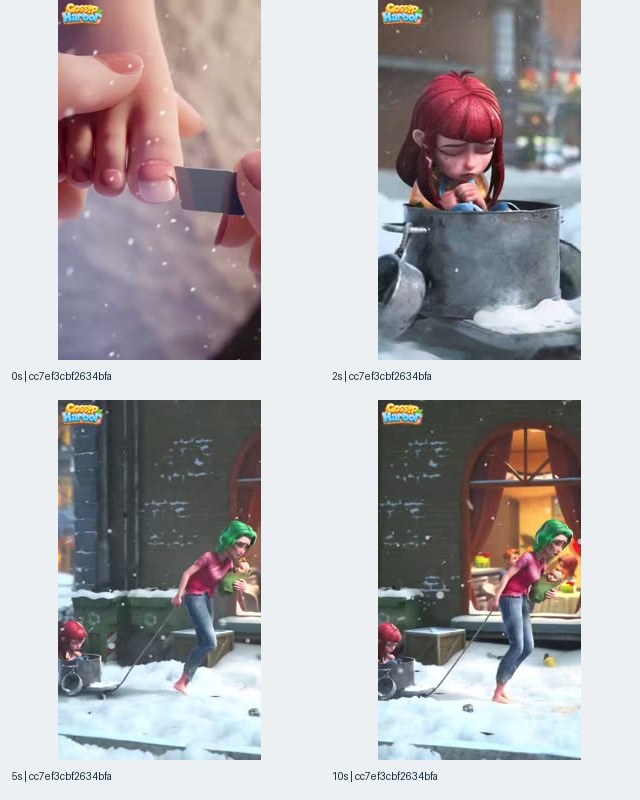
Figure 3. Gossip Harbor, linked listing 1623318294 and reported title 緋聞港口:合併&故事; record cc7ef3cbf263. Frames sampled at 0, 2, 5, and 10 seconds from a video recorded as 59 seconds long. Source: the November 2, 2026 Unity-filtered US sample.
At zero seconds, a close-up shows a foot held by a hand, with the big toenail beside a flat gray tool. At two seconds, a red-haired child sits inside a large metal pot in a snowy outdoor setting. The later sampled frames show a green-haired woman beside the pot, with a warmly lit interior visible behind her at ten seconds. The Gossip Harbor logo appears in the frames.
Those observations support a story-first description. They do not establish the characters’ relationship, the complete plot, the outcome, or whether the advertised game contains the exact actions shown. We also cannot infer a soundtrack, dialogue, or the pace of transitions from these stills.
A practical adaptation starts by naming the emotional problem your own product can legitimately resolve. If a narrative game uses restoration or helping characters, a concept might connect a visible problem to an actual player action. That connection should be specified in the storyboard rather than assumed from a dramatic opening.
The hypothesis worth testing is whether the story problem creates interest while preserving an accurate expectation of the product. A team would need to evaluate both comprehension and downstream user behavior. This contact sheet supports the creative question; it does not answer it.
Figure 4: Kalshi Puts the Product Argument in the Caption
The first Kalshi example uses a humorous cat scene while placing its product argument in text above and below the image. The visual attracts attention; the captions carry the comparison and the stated benefit. That division is the useful structure to record.
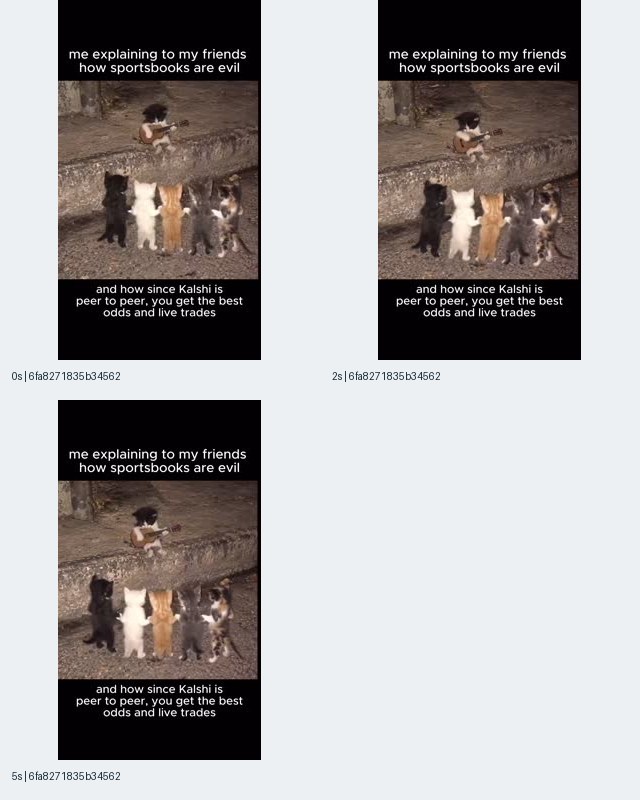
Figure 4. Kalshi: Trade Sports & Events, linked listing 1632713844; record 6fa8271835b3. Frames sampled at 0, 2, and 5 seconds from a video recorded as 8 seconds long. Source: the November 2, 2026 Unity-filtered US sample.
The upper caption says the speaker is explaining to friends “how sportsbooks are evil.” The lower caption describes Kalshi as peer to peer and claims “the best odds and live trades.” These are the advertiser’s assertions, not findings of this article. The sample supplies no evidence for the comparative “best” claim.
The cat scene and caption arrangement remain visible at the supplied timestamps. We cannot establish whether the music is important, whether the complete clip loops, or what appears during the unsampled final portion. The source is a video record even though much of the information is carried by persistent text.
For an original game concept, the transferable idea is to place a recognizable social situation around a product explanation. The risky part would be importing the financial promise or unsupported comparative language. A team could instead write a factual caption about its own mechanic, with original or properly licensed visual material.
A useful comprehension check asks viewers what product feature they remember after seeing the concept. If they recall only the joke, the caption and product connection may need revision. That is a proposed evaluation, not a result measured on this Kalshi advertisement.
Figure 5: Search It Changes the Scene While Preserving the Search Layout
The second Search It example keeps the object-reference strip and crowded illustration but places them in a different room. The visible scene contains people, workstations, art materials, shelves, and a large teddy bear. This makes it a useful example of scene variation within a recognizable visual structure.
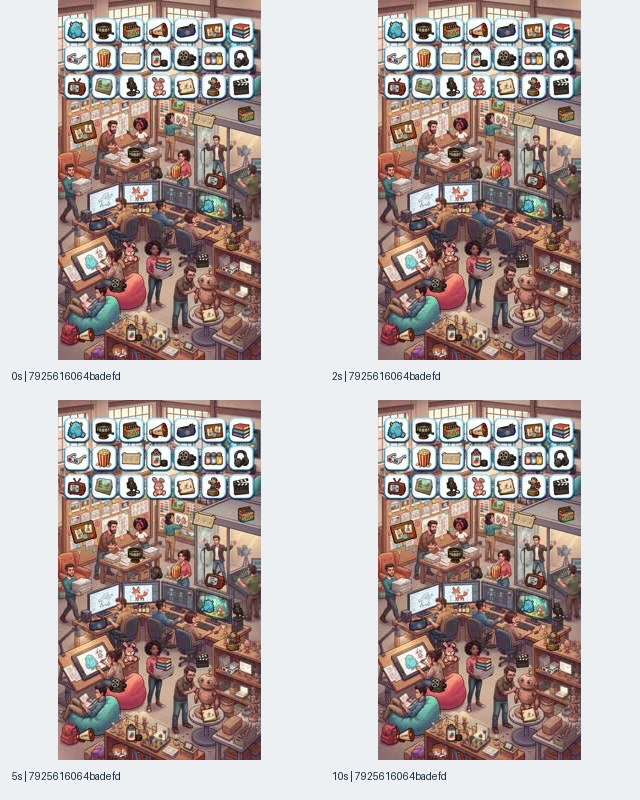
Figure 5. Search It - Hidden Objects, linked listing 6756185760; record 7925616064ba. Frames sampled at 0, 2, 5, and 10 seconds from a video recorded as 60 seconds long. Source: the November 2, 2026 Unity-filtered US sample.
The sampled frames preserve the same broad studio composition. As with Figure 1, that is evidence of visual continuity at those timestamps, not proof of a motionless full video. There is no captured interaction showing a viewer selecting or successfully finding an object.
Figures 1 and 5 link to the same store identifier but different video fingerprints. The source therefore supports calling them distinct video files associated with the same product. It does not support treating them as the same video reused under different titles.
A practical production lesson is to separate the elements that explain the task from the elements that provide thematic variety. The object strip, scene hierarchy, and relative scale might remain consistent while the setting and original art change. This is a proposed production system, not a claim about how the advertiser’s team actually worked.
For a controlled test, write down which variable changes. If the scene, object difficulty, caption, camera movement, and pacing all change together, the result will not isolate the value of the setting. The source example can inspire a scene hypothesis without supplying an answer about which environment works better.
To inspect related indexed references, search hidden-object creatives in AdMapix, then apply the Unity network filter, US country setting, and an explicit date window. The keyword link is a starting point; it does not itself reproduce the frozen network query.
Figure 6: Kalshi Uses a Reaction Premise With a Fisheye Scene
The second Kalshi example places a short reaction caption above a circular fisheye view of a gym. Its visible premise is a girlfriend’s reaction after a trade succeeds. The frame communicates a social scenario, without showing a trading interface or evidence of a particular result.
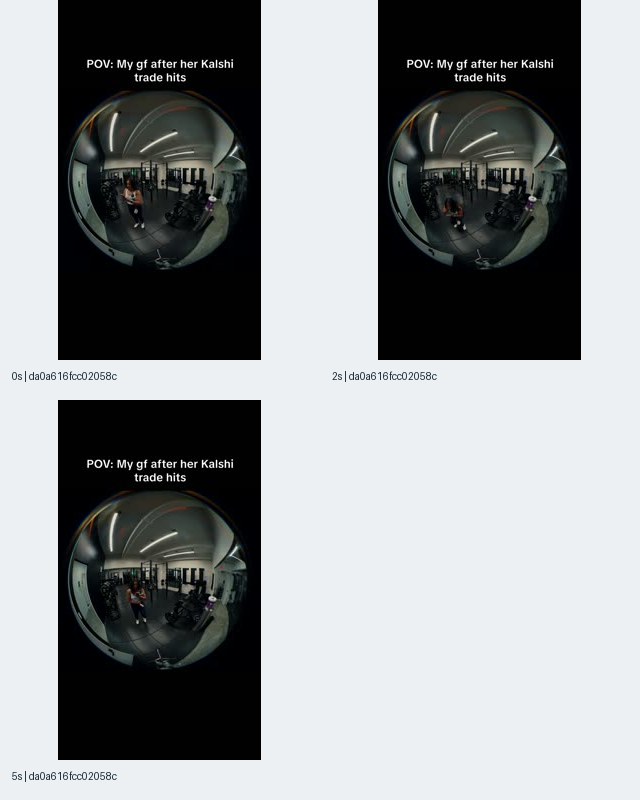
Figure 6. Kalshi: Trade Sports & Events, linked listing 1632713844; record da0a616fcc02. Frames sampled at 0, 2, and 5 seconds from a video recorded as 8 seconds long. Source: the November 2, 2026 Unity-filtered US sample.
The caption reads “POV: My gf after her Kalshi trade hits.” A person is visible within the circular gym image, with their position differing between sampled frames. The surrounding black space separates the caption from the scene and makes the circular treatment prominent.
The caption’s premise is not proof of someone’s trading outcome, earnings, or experience. Nor can the contact sheet establish the complete physical action, the audio, or the intended punchline between timestamps. Those omissions matter because a reaction clip can depend heavily on timing.
Compared qualitatively with Figure 4, this example asks the caption to establish a situation rather than explain several product claims. Both link to Kalshi, but their different video fingerprints and visible treatments make them separate references. Their estimated impressions do not tell us which message persuaded more people.
A game team could develop an original reaction concept around a real, recognizable achievement in its own game. The brief should define the achievement and the product connection instead of relying on a generic celebration. The hypothesis would concern recognition and comprehension, not a promise that success in a game or financial product is easy or guaranteed.
Figure 7: Reddit Uses Topics, Typography, and Brand Recognition
The Reddit example presents large topic words on an orange-red background, followed in later sampled frames by a broad discovery statement and the Reddit logo. The visible communication is typographic. No presenter, phone demonstration, or game board is needed to describe what these frames show.
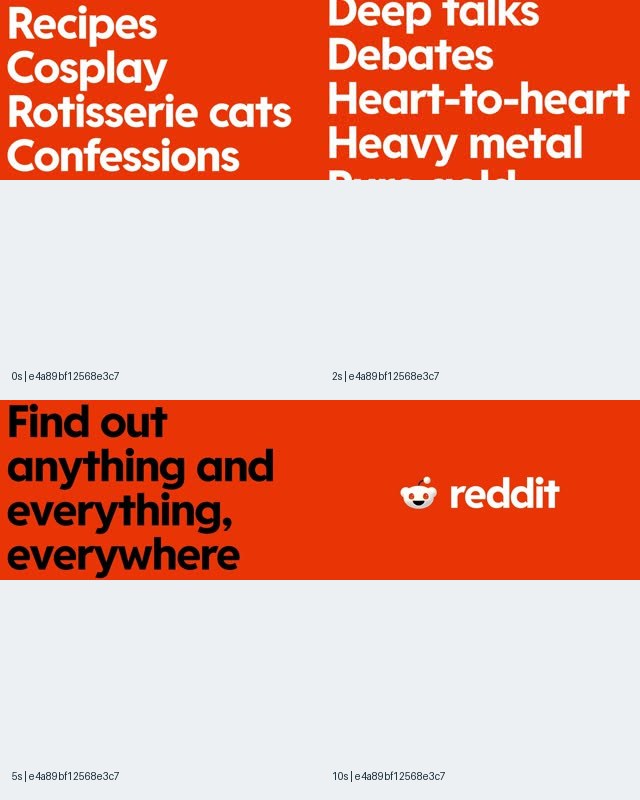
Figure 7. Reddit: Where Real People Talk, linked listing 1064216828; record e4a89bf12568. Frames sampled at 0, 2, 5, and 10 seconds from a video recorded as 15 seconds long. Source: the November 2, 2026 Unity-filtered US sample.
The opening sample includes “Recipes,” “Cosplay,” “Rotisserie cats,” and “Confessions.” The two-second frame includes “Deep talks,” “Debates,” “Heart-to-heart,” and “Heavy metal.” At five seconds, the text reads “Find out anything and everything, everywhere.” At ten seconds, the Reddit logo is visible.
That ten-second logo frame is a sampled brand frame, not a verified end card. The asset is recorded as longer than the final sampled timestamp. We cannot reconstruct the intervening motion, the duration of individual words, or what follows the logo.
The production question is how a list of interests creates a product association. For a game with several legitimate activities, an original concept could name recognizable player interests and then connect them to actual game features. The claims must remain narrower than the product’s real capabilities.
Typography also makes copy review central to production. Each visible phrase should have a defined role: establish relevance, name an activity, express a supported benefit, or identify the product. A team can test whether the sequence produces accurate recall. This sample does not establish that text-led creative is cheaper, faster, or more effective than filmed material.
Figure 8: Walmart Shows How Little a Short Preview Can Establish
The Walmart contact sheet shows a pale opening frame and a blue Walmart wordmark at two seconds. That is enough to describe a brand reveal, but not enough to infer the complete offer, call to action, or purpose of the advertisement. The sparse evidence is itself a useful research example.
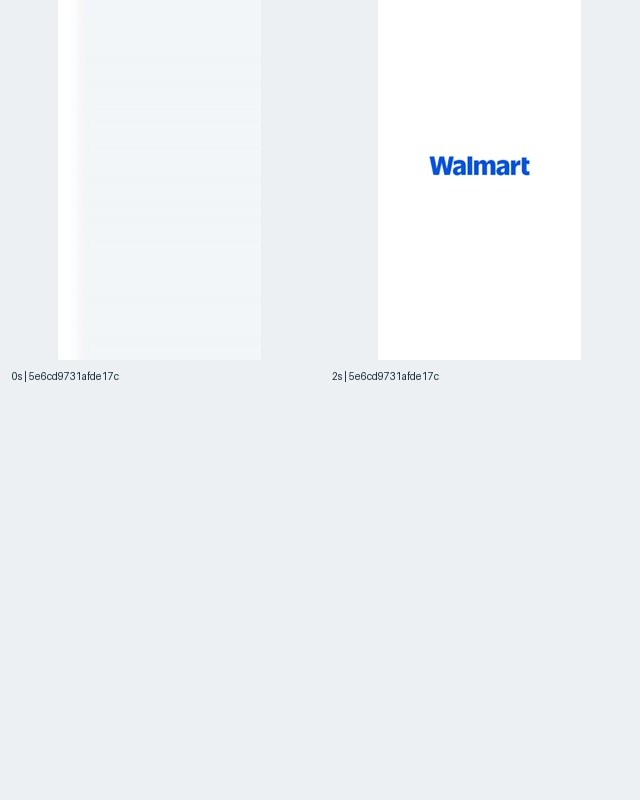
Figure 8. Walmart: Shopping & Savings, linked entries com.walmart.android and 338137227; record 5e6cd9731afd. Frames sampled at 0 and 2 seconds from a video recorded as 5 seconds long. Source: the November 2, 2026 Unity-filtered US sample.
The record associates the creative with Android and iOS store entries. This does not provide a verified split of its delivery between operating systems, and the contact sheet does not show separate device experiences. There is also no visible product assortment or shopping action to analyze.
Do not label the wordmark an end card solely because it is the last image supplied. The last sampled frame and the end of the video are different things. Similarly, a short recorded duration does not establish that the creative served as a bumper, a retargeting asset, or a particular placement type.
For a production team, this example belongs in a reference category such as “brief brand identification,” with the missing information explicitly recorded. It should not become a complete storyboard by filling the gaps with imagined transitions or offers.
An original brand-led concept could test whether a viewer recognizes the product without additional explanation. That requires an actual recognition study or campaign experiment. A familiar wordmark in an indexed advertisement is not evidence that the same treatment will communicate enough for an unfamiliar game.
What the Sample Shows About Length, Orientation, and Hooks
The sample shows varied recorded durations and visible compositions, but it does not establish an optimal Unity video length or a preferred orientation. The illustrated records range from Walmart’s five-second asset to the sixty-second Search It assets. Fetch is recorded as thirty seconds, Gossip Harbor as fifty-nine, Reddit as fifteen, and both Kalshi examples as eight.
These are individual metadata observations. No duration average, performance curve, or platform-wide distribution is supplied. A team should not choose sixty seconds because the highest estimated record uses it, or eight seconds because the Kalshi examples do.
The contact sheets also show different frame shapes. Search It, Gossip Harbor, the Kalshi examples, and Walmart use tall visible frames. Fetch and Reddit use wide visible frames. The surrounding contact-sheet canvas is an editorial layout and must not be treated as the source video’s aspect ratio. Exact encoded dimensions are not supplied here.
The visible hook categories are more actionable than an invented benchmark:
| Visible approach | Illustrated example | Production question |
|---|---|---|
| Immediate visual task | Search It, Figures 1 and 5 | Can the viewer identify what to look for? |
| Presenter plus benefit statement | Fetch, Figure 2 | Does the demonstration substantiate the promise? |
| Story problem | Gossip Harbor, Figure 3 | How does the problem connect to a real player action? |
| Caption-led explanation | Kalshi, Figure 4 | Is the product message understood beyond the joke? |
| Reaction premise | Kalshi, Figure 6 | Is the achievement or situation recognizable? |
| Topic-led typography | Reddit, Figure 7 | Do the words produce an accurate product association? |
| Brief brand identification | Walmart, Figure 8 | Is the product recognizable without more context? |
These categories describe communication choices, not audience targeting or campaign objectives. A presenter does not prove a testimonial relationship. A meme does not prove a younger audience. A logo does not prove a brand-awareness campaign.
The sample also cannot settle end-card patterns. Some records include associated image files, but the supplied contact sheets are opening excerpts rather than documented terminal sequences. Technical end-card requirements come from Unity’s documentation, discussed below, rather than from assumptions about the last available screenshot.
Video Reuse Across Titles: What Is and Is Not Present
No exact video-fingerprint reuse appears within this thirty-record sample, so it does not demonstrate the same video file running across different game titles. The supplied summary reports thirty distinct video fingerprints across thirty video-containing records. Similar genre, composition, or duration is a different kind of relationship.
The two Search It illustrations make the distinction concrete. They share a store identifier and a recognizable object-search layout, but their video fingerprints differ. A researcher can group them as related visual approaches while preserving them as distinct files.
There is associated-image reuse elsewhere in the sample. Merge Mansion records beginning 3d521482621a, f765c5b334453, and 5e92205b51ca share an associated image fingerprint while linking different videos. That establishes reuse of an image file in those record associations. The supplied evidence does not establish exactly where that image appeared during playback or whether it was the displayed end card in every served pack.
Walmart provides another distinction: one record links two store entries. Multiple store associations do not turn one video into multiple files, and they do not prove reuse across unrelated products.
For your own research, keep three separate notes: exact file reuse, similar visual concept, and multiple product associations. Exact reuse is a fingerprint relationship. Similarity requires a described visual judgment. Product association requires identifiers. Combining them into a single “reused creatives” count hides the evidence needed to support the claim.
A later sample could reveal repeated files that this one misses. The correct conclusion is local: no exact repeated video fingerprint in the supplied sample. It is not a claim that Unity advertisers never reuse video, that these advertisers produced every asset from scratch, or that similar concepts have different owners.
Why the Missing Playables Do Not Settle the Format Question
The sample contains no captured playable files, which limits this article’s playable analysis to official requirements and proposed workflows. We cannot show a sampled Unity playable interaction, report its load time, inspect its code, or describe a player’s path through it. A video depicting a task is not automatically an interactive advertisement.
This absence does not mean Unity does not support playables. Unity’s creative introduction, checked November 2, 2026, identifies video plus end card, playable, and video plus playable end card as creative-pack types.
It also does not establish the network-wide prevalence of playables. An impression-sorted sample can omit formats that occur elsewhere in the index. Capture availability and advertising availability are separate questions, and no measurement here resolves their relationship.
For planning, use the videos to study how an objective is communicated, then make a separate decision about whether interaction helps demonstrate your actual product. The Search It frames suggest a visible search task, for example, but they supply no evidence about touch targets, successful selections, feedback, or store-opening behavior.
The playable ads guide provides the broader development workflow. For Unity submission decisions, the current official specifications take precedence over generic advice or a competitor’s apparent implementation. The following requirements are documentation-based, not results from a playable test conducted for this article.
Unity Playable Requirements as of November 2, 2026
Unity requires a self-contained, responsive playable that follows MRAID 3.0 lifecycle and interaction rules. The authoritative source for this section is Unity’s playable specifications, checked as of November 2, 2026, with page metadata last modified October 28, 2026.
| Area | Documented requirement | Production implication |
|---|---|---|
| File package | A single minified index.html file less than 5 MB | Deliver the actual submission file, not a folder or externally loaded demo |
| Embedded media | Image, audio, and video assets inlined as base64 data | Inspect the final export for external dependencies |
| File references | No relative paths or remote asset URLs | A local preview working with neighboring files is insufficient |
| Supported systems | Android 5 or later and iOS 13 or later | Include supported-device behavior in QA planning |
| Interface | MRAID 3.0; full-screen ads only | Use the supported ad-container lifecycle |
| Startup | Wait for readiness and viewability | Do not begin playable content on page load |
| Store opening | mraid.open after gameplay interaction and a CTA tap | Separate gameplay input from the install action |
| Orientation | Responsive in portrait and landscape | Build adaptable layout rather than selecting one serving orientation |
| Network | Runs without XHR requests, subject to permitted analytics exceptions | Avoid dependencies on downloaded gameplay content |
“Minified” is a requirement, not a synonym for compressed delivery. Unity describes removing whitespace and shortening names. A build that meets the file-size limit can still fail the minification requirement. Keep the review focused on the final artifact submitted to the platform.
Unity injects MRAID into its webview, so the playable needs no MRAID script tag. The documented supported environment is MRAID 3.0 full-screen ads. Expand, resize, custom close buttons, SMS, telephone actions, calendar actions, and storePicture are not supported. These details come from the same specifications page, checked November 2, 2026.
Readiness and visibility deserve their own acceptance criteria. The playable should start only after the MRAID ready event and only while viewable, then pause when it is no longer viewable. That means the gameplay timer, animation, and audio behavior should be assessed as part of the ad lifecycle, rather than only during a straightforward uninterrupted preview.
The store redirect rule is equally specific. Unity requires a player tap on a CTA after interaction with gameplay, using mraid.open. The first tap cannot open the app store, and redirects without player interaction are not allowed. A visible button label alone does not establish compliance; the behavior attached to the input must match the rule.
Unity serves playables in both portrait and landscape, and advertisers cannot manually select only one orientation. Single-orientation support is marked for deprecation, and all new playables must be responsive. Text and buttons should stay away from the top and bottom areas occupied by Unity’s controls. Custom or fake close buttons, fake system interfaces, and deceptive alerts are prohibited by the documented specifications.
For network behavior, Unity states that the playable runs without XHR requests. It can permit analytics calls that contain no personal data. The playable should not fire its own attribution events; Unity handles start, view, and click server-side. This exception should not be read as permission to load gameplay assets remotely.
Audio must respect the iOS mute switch and stop when the ad is not viewable. A playable end card must meet the same build and MRAID requirements and include a CTA that opens Google Play or the App Store. Calling an asset an “end card” therefore does not exempt it from the playable rules.
Unity Recommendations Are Different From Submission Requirements
Unity’s playable recommendations help shape an experience, but they should not be reported as mandatory limits or as measured results from this advertising sample. The playable best-practices page, checked November 2, 2026 and last modified October 28, recommends making the core mechanic understandable within the first three to five seconds because the close button can appear after five seconds.
The same page recommends reaching the first interaction in under two seconds on a mid-tier device. It describes typical lengths of twenty to forty seconds for hyper-casual playables and more than two minutes for puzzle, merge, or mid-core experiences. These are recommendations about playable design, not an extension of the video specification and not a promise about acquisition performance.
The distinction matters when briefing a producer. “Make the mechanic understandable promptly” is a design objective that can be checked with users. “The HTML must be under 5 MB” is a submission requirement. A team should document both, but failure against them has different implications.
Unity also recommends testing portrait 9:16, landscape 16:9, and 4:3 tablet layouts. It says the final build should run without MRAID for desktop-browser testing, while warning that a desktop browser does not run the real ad unit. Browser compatibility is therefore one useful check, not a replacement for device previewing.
Finally, Unity says it appends its own final end card containing the app icon, rating, name, and download button, and advises against recreating it. This documented platform behavior does not let us label Reddit’s ten-second logo frame or Walmart’s two-second wordmark as a platform end card. The specification and the sampled images answer different questions.
Video and Static End-Card Specifications—and a Metadata Conflict
Unity’s documented video requirements should guide a new submission even when an indexed record appears to fall outside them. As of November 2, 2026, the video specifications state sixty seconds or less, H.264 MP4, and either 16:9 landscape or 9:16 portrait. They recommend 10 MB, set a maximum of 100 MB, and require an end card for every video ad.
The page, last modified October 19, 2026, also describes thirty-to-sixty-second long video as a beta. It does not specify a pixel resolution in the supplied official documentation. Do not turn a preferred production resolution into an asserted Unity requirement.
For static end cards, Unity’s image specifications, checked November 2, 2026, list JPG, PNG, or GIF files up to 5 MB. The documented sizes are square 800×800 as the default, landscape 800×600, and portrait 600×800, with a 100-pixel buffer against cropping.
The sample contains an unresolved discrepancy. Candy Crush record c96647fa843c is recorded as 118 seconds, and the listing 貨櫃分類整理:3D益智消除遊戲, record d52922e079aa, is recorded as 119 seconds. Those metadata values do not match the supplied current video limit.
We cannot resolve that discrepancy from contact sheets and record metadata. It would be inappropriate to invent a special permission, a historical exception, a measurement explanation, or proof that Unity accepted those exact full files under the current rules. Preserve the values as indexed observations and use the current official specification for your own submission.
This is a useful handoff rule: when a reference and documentation disagree, the producer should receive both facts and the unresolved question. Research should expose the conflict early, rather than silently changing the requirement to match a competitor example.
How to Preview and Test a Unity Creative Pack
Unity documents a device-preview workflow using the Ad Testing for Unity Ads app, and that is the appropriate official starting point for checking your own creative pack. The creative-pack testing page, checked November 2, 2026 and last modified October 19, explains that the dashboard’s “Show QR code” opens a pack in the app.
For a hosted HTML preview, Unity specifies an accessible HTTPS URL with an .html extension. Self-hosted files need the Access-Control-Allow-Origin: * header. These preview-hosting conditions do not remove the requirement for the playable itself to contain its assets and operate without prohibited network dependencies.
A practical validation sequence separates packaging, experience, and lifecycle behavior:
- Identify the exact build. Save a version identifier and file checksum so the preview and submitted artifact can be connected later. The checksum proves which build was used, not whether it is good.
- Inspect the package. Confirm the single-file structure, minification, size, and inlined assets. Look for accidental remote fonts, images, scripts, or relative paths.
- Check browser operation. Use the supported no-MRAID path to examine layout and obvious runtime issues. Record this as a browser check, without calling it a real ad-unit test.
- Preview on a device. Follow Unity’s documented app and QR workflow. Record the device, operating system, orientation, and exact build.
- Exercise the lifecycle. Check readiness, visibility changes, pause behavior, audio stopping, and the iOS mute-switch requirement where applicable.
- Exercise the interaction path. Confirm that gameplay receives the first interaction and that a later intentional CTA tap opens the correct store through the required method.
- Retest the final export. Packaging or compression changes can alter the artifact, so the final file should have its own recorded checks.
The proposed checklist is informed by Unity’s rules; it is not a claim that these tests were performed for the article. No test logs, device results, load measurements, or playable output artifacts were supplied.
Unity’s moderation checks, checked November 2, include correct minification, no polyfill issues on older Android, no console log errors, and no network requests except permitted analytics. Its creative introduction states that all new creative assets undergo human moderation when uploaded. Passing an internal checklist does not replace that platform process.
For redirect behavior, the Unity content policy, updated June 30, 2026 and checked November 2, also prohibits automatic redirects, downloads, or similar actions without intentional end-user action. Include the intended player journey in the brief so a technically functioning build does not hide an inappropriate navigation pattern.
Is There an Official Unity Ads Library?
AdMapix’s finding on November 2, 2026 was that no public Unity surface was identified for browsing other advertisers’ Unity Ads creatives. This is a dated research finding, not a statement by Unity that such a surface can never exist. The official pages checked serve different purposes.
| Official surface | What the checked page describes | Why it does not answer the competitor-browsing question |
|---|---|---|
| Unity Content Transparency Center | A hub of content policies | It is not presented as a searchable advertising gallery |
| Unity Digital Services Act page | In-ad transparency, including ad identification and advertiser information | In-ad disclosure is different from a public creative repository |
| Ad Quality Creatives | Ads that ran in your own apps, requiring the Ad Quality SDK | Its described scope is your app environment, not unrestricted competitor browsing |
| Creative-pack testing | Device previewing of creative packs | Previewing your pack does not discover other advertisers’ campaigns |
All four descriptions above reflect pages checked on November 2, 2026. The practical consequence is to choose a tool according to the research task. Official documentation is the source for submission requirements. Official testing is the source for previewing your own pack. Indexed third-party research can supply discoverable creative references within its capture limits.
For teams also researching another mobile network, the AppLovin ads research guide addresses the parallel discovery problem. Its examples and measurements are separate from this Unity sample; they should not be pooled into a cross-network performance comparison.
Avoid inventing a public “Unity Ads Library” interface from unrelated dashboard screenshots. A gallery visible inside a publisher or advertiser account can be useful without being a public repository. Access scope is part of the evidence, not a minor product-detail footnote.
A Practical Workflow for Researching Unity Creatives
A useful Unity research workflow preserves the network filter, product identity, asset evidence, and observation limits before turning references into a brief. The goal is an auditable creative decision, rather than a collection of attractive screenshots with missing context.
Start by writing the question in a way the available evidence can answer. “How do hidden-object advertisements make the task recognizable?” is answerable from suitable frames. “Which competitor has the best return on spend?” is not answerable from this source sample.
Set the scope before searching. Select Unity in the network controls, choose the country, and enter exact start and end dates. For a broad network exploration, leave the keyword blank as this sample did. For a narrower follow-up, use a product or concept query while retaining the same explicit network and date controls.
Record the sorting rule. An impression-descending search prioritizes estimated window exposure. A discovery-time sort answers a different question. Save the chosen sort with the results so the team does not later describe newly discovered examples as the highest-impression advertisements.
Preserve the returned records. Record the fetch date, product identifiers, record references, video duration, available attachments, and source links. Keep first-seen and last-seen observations in their own columns. Do not rename them “launch” and “shutdown” without evidence.
Check product associations. Use the linked store identifier to connect a reference to a product. If a record has multiple store entries, preserve all relevant associations. Do not assume that a shared name proves identity or that different developer identifiers prove unrelated ownership.
Separate records from files. Deduplicate video, image, and playable fingerprints independently. A record count measures instances returned by the search. File counts describe available media. This sample happens to have a distinct video fingerprint for each record, but that should be verified each time.
Describe only the evidence reviewed. For a contact sheet, note the exact timestamps and what is visible in each. For a future complete-video review, record that broader scope explicitly. For an actual playable test, preserve the build and test environment. These are different evidence types and should have different labels.
Write the hypothesis after the observation. “An icon strip appears above a crowded scene” is an observation. “A clearer icon strip may improve task comprehension” is a hypothesis. “This layout converts better” would require evidence not present here.
Choose the smallest useful next action. That might be a storyboard revision, a comprehension check, a device preview, or a campaign experiment. It should resolve the specific uncertainty identified in the reference analysis.
A compact research note can use this structure:
Research question: How clearly does the opening communicate the player’s task?
Scope: Unity-filtered, US, exact measurement window and retrieval date recorded.
Reference: Product identifier, record reference, source link, recorded duration, and reviewed timestamps.
Observation: What is directly visible or supplied in record metadata.
Unknown: Interaction, complete sequence, placement, targeting, and campaign outcomes not established.
Hypothesis: The specific communication change worth testing.
Deliverable: Original storyboard, acceptance checks, and the measurement needed for a decision.
This note is small enough to travel with a production brief while retaining the information a reviewer needs to challenge an unsupported conclusion.
Turning the References Into Original Creative Briefs
The useful output of the sample is an original brief that states what changes, why it might matter, and what evidence would settle the question. The following are proposed concepts for a team’s own product. They are not descriptions of completed tests or additional advertisements found in the sample.
Brief A: clarify a hidden-object task. Use Figures 1 and 5 as structural references for the relationship between target icons and a detailed scene. Build original artwork from the actual game environment. Keep the chosen target, target scale, and intended selection clearly specified. The hypothesis is that a more legible target reference improves understanding of the search objective.
The first acceptance check is descriptive: can a viewer explain what they are expected to find? A later campaign test can examine acquisition outcomes, but the brief should not skip the comprehension question. If viewers misunderstand the mechanic, an impression estimate from a reference advertisement does not repair that problem.
Brief B: connect a presenter’s promise to a real demonstration. Use Figure 2 to distinguish the benefit statement, the visible product, and the action supporting the benefit. Write copy around an actual feature of your game or app. Plan a shot that demonstrates the feature, rather than relying only on a logo or launch screen.
The hypothesis is that a concrete demonstration makes the promise more understandable. Keep the claim identical across variants if you want to isolate the demonstration treatment. Do not introduce a different reward, price, or eligibility condition merely to make one version sound more persuasive.
Brief C: connect a story problem to gameplay. Use Figure 3 as a reference for opening with a visible narrative problem. Develop an original scenario connected to the game’s real actions. Specify where the player’s role becomes clear and what result the player can actually produce.
The hypothesis is that the narrative opening creates interest without misleading viewers about the product. A useful review asks both what happened in the scene and what the viewer thinks they would do after installing. Those answers can differ, which is exactly why the connection needs testing.
Across all briefs, attach the evidence and the uncertainty. The producer should know whether the reference came from sampled frames, a full video, or an interactive build. That prevents a still-image observation from silently becoming a requirement to reproduce an unseen animation or interaction.
Common Mistakes That Change the Meaning of the Evidence
The most consequential mistakes turn a narrow observation into a broader claim about performance, identity, or platform rules. They can be avoided by checking the noun and denominator attached to every number before the report leaves the research team.
| Mistake | Why it fails | Better wording or action |
|---|---|---|
| Calling thirty records the complete Unity creative inventory | The search stopped after a bounded set of pages | “Thirty records in this dated US sample” |
| Calling estimates observed delivery or spend | The source provides model-estimated window impressions | Preserve the estimate label and exact dates |
| Dividing window impressions by ad age | The numerator and denominator describe different periods | Omit the metric |
| Calling the last sampled frame an end card | Sampling stops before the recorded end in these examples | Name the timestamp and visible content |
| Treating a gameplay-looking video as playable | Depicted interaction is not executable interaction | Check for an actual playable file and test evidence |
| Treating similar scenes as the same file | Visual resemblance and fingerprint equality differ | Record concept similarity separately from exact reuse |
| Treating a product link as buyer identity | Store association does not disclose the payer | State the linked listing only |
| Copying a long indexed duration as a submission rule | Metadata can conflict with current documentation | Follow official requirements and flag the conflict |
| Assuming old first-seen dates prove success | Persistence does not reveal cost or outcomes | Use the date as an index observation |
Another common error is assuming recent last-seen data guarantees current activity. A record observed near the measurement window’s end is evidence of a recent observation within that scope. It is not a live-status service-level guarantee.
Keep comparisons from other articles in their own dated context. Even a familiar product name does not make an earlier sample’s figures compatible with this one. Qualitative creative comparisons can be useful without sharing a table, calculating a ratio, or implying a common measurement window.
When AdMapix Fits This Workflow
AdMapix fits the discovery and evidence-organizing stage when a team needs indexed creative references filtered by network, country, and date. It is an advertising-intelligence product for researching available advertising records and associated creative material. The Unity-filtered sample in this article demonstrates that research scope, rather than promising complete network coverage.
Disclosure: AdMapix is our product, so we distinguish its research role from Unity’s official requirements and from campaign outcomes that this sample cannot measure. The article was prepared with Codex and checked against the dated source sample; editorial ownership belongs to Brad at AdMapix without implying personal human review.
Use Unity’s official documentation and device previewing for submission and runtime questions. Use your own campaign and product data for conversion, retention, and commercial decisions. AdMapix references can inform a hypothesis, but they cannot supply those missing outcomes.
If this workflow matches your task, sign up or log in to research my Unity creatives. Start with a defined country and date window, verify the network filter, and save the records that inform your next brief. You can evaluate whether the available evidence answers your question before commissioning production.
Check the live pricing page for current commercial terms. This article does not promise a paid-plan trial, an hourly refresh schedule, or a particular future result count.
FAQ
What games are advertising on Unity Ads in this sample?
The dated US sample includes records linked to Search It, Gossip Harbor, Find Hidden Objects - Spot It!, Word Tiles, Vita Mahjong, Merge Mansion, Candy Crush Saga, Cube Topia 3D, and other listed products. It establishes inclusion in the Unity-filtered search for October 3 to November 1, 2026. It does not establish a complete advertiser list or guarantee that each advertisement is still active today.
Is there an official public Unity Ads library?
AdMapix’s November 2, 2026 research did not identify a public Unity surface for browsing other advertisers’ creatives. The checked official surfaces cover content policies, in-ad transparency, ads seen in your own apps, and creative-pack testing. That is a dated finding with a defined scope, rather than an assertion that Unity could never introduce a public repository.
What file size and format does Unity require for playables?
As of November 2, 2026, Unity specifies a single minified index.html file smaller than 5 MB, with image, audio, and video assets inlined as base64 data. Relative file references and remote asset URLs are not allowed. The documented supported systems are Android 5 or later and iOS 13 or later. The current official specifications should be rechecked before submission.
Does Unity require MRAID 2.0 or MRAID 3.0?
The official specifications checked on November 2, 2026 require MRAID 3.0 and describe support for full-screen ads. Unity injects MRAID into its webview, so a separate MRAID script tag is unnecessary. Older guidance mentioning MRAID 2.0 should not override that current requirement. Readiness, visibility, pausing, and intentional store-opening behavior are part of the implementation requirements.
How should I test or preview a Unity playable?
Follow Unity’s documented creative-pack testing workflow using the Ad Testing for Unity Ads app and the dashboard’s QR-code option. Hosted HTML previews need an accessible HTTPS URL ending in .html; self-hosting also requires the documented cross-origin header. Desktop-browser checks are useful, but Unity says a desktop browser does not run the real ad unit. This article reports no completed device test.
Does this sample show that Unity has no playable advertising?
No. It shows that these thirty returned records contain no captured playable files. That is a limit on the available sample, not a network-wide conclusion. Unity’s official documentation explicitly describes playable and video-plus-playable-end-card packs. The supplied contact sheets cannot establish interaction behavior, playable availability elsewhere in the index, or the prevalence of playables across Unity.
Can I use the sample to choose a winning video length?
No winning length can be established from these records. Their metadata describes durations, while the impression figures are third-party estimates without conversion, cost, retention, or experimental controls. Some indexed durations also conflict with the supplied current video specification. Use the examples to form a hypothesis, follow Unity’s submission rules, and evaluate length with appropriate measurements from your own campaign.
Can an impression estimate tell me a competitor’s spend or profit?
An impression estimate does not disclose spend or profit. This sample supplies no verified campaign costs, conversion counts, customer value, or incremental outcomes. Its estimates apply to the stated measurement window and returned records. They can help prioritize which references to inspect, but they cannot establish that an advertiser’s creative is profitable or that copying its approach will produce the same result.
Key Takeaways
The sample is useful when its visual evidence, metadata, and official requirements remain distinct.
- Research Unity with a verified network filter, explicit country, exact dates, and a preserved source package.
- Treat the eight figures as timestamped creative references, with conclusions limited to their visible frames.
- Keep advertising records, distinct videos, associated images, and playable files as separate measures.
- Use Unity’s current MRAID 3.0, packaging, responsiveness, and interaction rules for production decisions.
- Turn an observed structure into an original hypothesis, then use device checks and your own campaign measurements to evaluate it.
Sources
The sources below support the dated advertising observations, official requirements, and research workflow; they do not establish campaign performance.
- AdMapix frozen source package — fetched 2026-11-02. Public batches, request parameters, record associations, and checksums. Scope: US, Unity-filtered, blank keyword, impression-descending sample for 2026-10-03 to 2026-11-01, with thirty advertising records and eight supplied contact sheets.
- AdMapix research workflow — observation date 2026-11-02. Indexed creative search supplies a starting point for related research; apply Unity, country, and date controls explicitly. AdMapix methodology provides the public explanation of data scope and interpretation. Live search results are separate from the frozen sample.
- Unity playable specifications — checked 2026-11-02; modified 2026-10-28. Packaging, MRAID 3.0, lifecycle, orientation, networking, audio, and redirects.
- Unity playable best practices — checked 2026-11-02; modified 2026-10-28. Recommended mechanic clarity, interaction timing, lengths, layouts, and final-card treatment. These are recommendations, separate from submission requirements.
- Unity moderation and creative types — checked 2026-11-02. Moderation checks, modified 2026-10-19, and creative-pack introduction. Scope: documented checks, pack types, and Unity’s human moderation process for uploaded assets.
- Unity creative-pack testing — checked 2026-11-02; modified 2026-10-19. Official device preview and hosted-HTML workflow. Cited as instructions, not evidence that AdMapix performed a test.
- Unity video and image specifications — checked 2026-11-02. Video requirements, modified 2026-10-19, and static image requirements.
- Unity content policy — updated 2026-06-30; checked 2026-11-02. Intentional end-user action and prohibited automatic redirects.
- Unity discovery-surface review — checked 2026-11-02. Content Transparency Center, Digital Services Act page, and Ad Quality Creatives. These support the scoped description of official surfaces, not a claim of exhaustive future availability.
AdMapix’s original contribution is the dated indexed sample, its product associations, and the bounded visual analysis. Impression estimates remain third-party model outputs; the article contains no measured conversion results or completed playable-tool tests.
Turn these observations into your next creative study
Open the creative library and select samples for your market, network and research question.
Related Articles
TikTok Ads Downloader: Official Limits and Saving Workflow
Learn what TikTok’s official research tools let you save, how to download eligible files individually in AdMapix, and how to build a traceable swipe file using eight dated US advertising examples.
Novig Ads and Commercials: What 30 US Records Show
Eight timestamped examples and 30 verified US iOS advertising records reveal Novig’s Notes-style explainers, sports comparisons, offer variants, sampled concentration, and the limits of revenue-ranking evidence.
Courtyard (Courtyard.io) Cards Ads & Revenue Rank 2026
A dated US analysis of Courtyard.io’s revenue ranking, 30 advertising records, eight visual examples, video reuse, and comparison with Rips by Triumph, with clear limits on company revenue and performance claims.