
Courtyard (Courtyard.io) Cards Ads & Revenue Rank 2026
A dated US analysis of Courtyard.io’s revenue ranking, 30 advertising records, eight visual examples, video reuse, and comparison with Rips by Triumph, with clear limits on company revenue and performance claims.
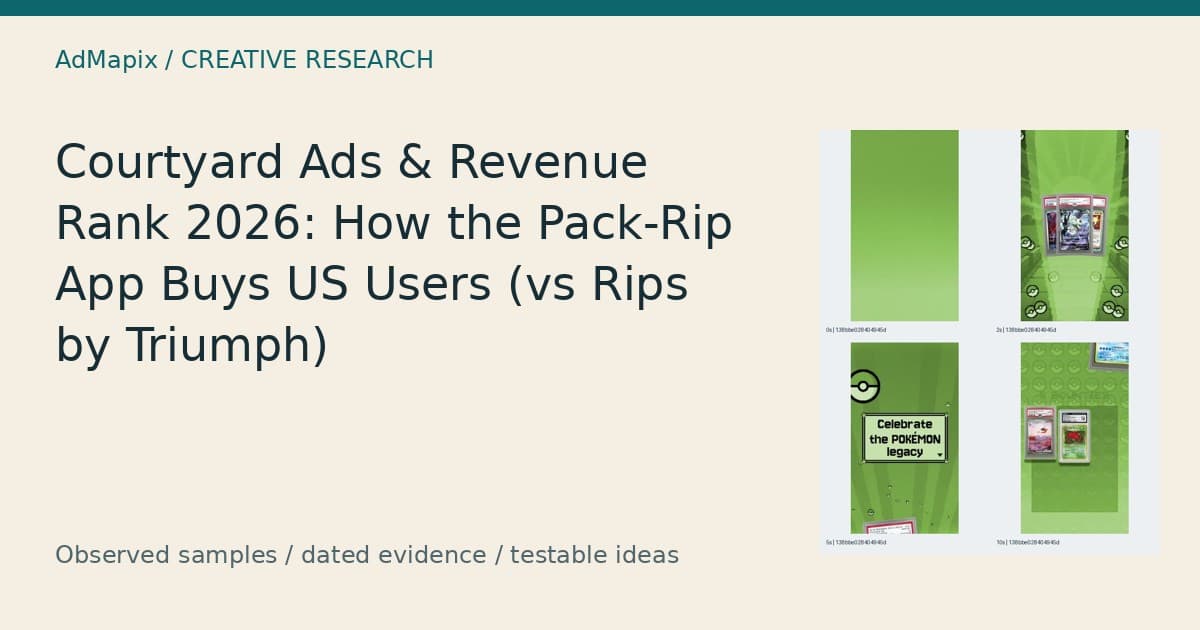
Courtyard (Courtyard.io) Cards Ads & Revenue Rank 2026
AdMapix Research — prepared with Codex and checked against the dated source sample.
Editorial ownership: Brad at AdMapix. This identifies the accountable editorial owner and does not imply personal human review.
Last updated: 2026-10-30.
Courtyard (Courtyard.io) ranked #68 for US app-store revenue, with its modelled estimate down 10.63% versus the previous period, in AdMapix’s ranking for 2026-09-29 to 2026-10-28. This does not reveal Courtyard’s company revenue, monthly GMV, annual revenue, or buyback volume. For readers researching Courtyard cards, the advertising evidence answers a different question: what the app’s sampled ads communicate. A separate US sample for its verified iOS listing contains 30 advertising records, 27 unique video files, and 987,496,801 modelled impressions for 2026-10-01 to 2026-10-30. Its supplied frames show collector callouts, graded cards, sneaker imagery, presenter-led explanations, and phone interfaces. Operators and creative teams can use these observations to plan research and original tests; they cannot use them to certify the product or infer conversion.
Quick Answer
Courtyard’s dated ranking establishes a store-listing position, while its advertising sample establishes observable creative patterns and record-level concentration.
- Revenue: Courtyard ranked #68, with a -10.63% change in the modelled estimate. The source does not state the revenue value’s unit, so no dollar amount is reported.
- Same-ranking comparison: Rips by Triumph ranked #18 (-6.51%), with an estimate 5.6 times Courtyard’s. Courtyard’s estimate was 2.5 times PrizePicks’ at #165 (+10.24%) and 3.2 times Underdog’s at #200 (+18.64%).
- Creative sample: Thirty records contain 27 unique videos and two unique playable files. The largest record represents 14.8% of sampled modelled impressions; the top five represent 40.9%.
- Recent observations: Fourteen records were first seen within the creative window. These are discovery dates, not verified production or campaign launch dates.
- Trust question: Ad data cannot establish whether Courtyard is legitimate. The frames document advertising claims and presentation, not independently verified product outcomes.
What Courtyard Cards Researchers Can Decide
The useful decision is whether Courtyard belongs in a pack-opening creative research set and which questions require evidence beyond advertising. Its verified listing and supplied frames make it a relevant reference for collector messaging, object presentation, and app demonstrations. They do not provide a complete commercial review.
The name needs disambiguation because a search for Courtyard can also refer to the hotel brand. This article concerns the verified iOS listing 6748155184, titled Courtyard: TCG, Watches, Cards, with seller Courtyard, Inc. The product ID establishes the reference entity. Similar wording, a logo, or a presenter saying the name would not be enough by itself.
Different readers should take different outputs from the same evidence. An operator can record the listing’s position relative to the comparison apps. A creative strategist can identify how the ads introduce physical-looking collectibles through a digital interface. A production lead can separate new video files from reused files. A consumer researching the product can learn what the ads claim, while recognizing that this is not a hands-on product review.
The distinction matters when a research memo moves between teams. A sentence such as “the ad displays a graded card” is useful to production. Rewriting it as “users receive authenticated graded cards” changes it into an operational claim that this sample does not establish. Keep the original observation attached to the proposed creative idea so the evidence does not become stronger as it travels.
Methodology and Evidence Boundaries
This analysis uses a US-filtered, product-verified sample captured on 2026-10-30 at 16:06 UTC, with an explicit creative measurement window of 2026-10-01 to 2026-10-30. Research began with the query Courtyard, then restricted creative retrieval to iOS product ID 6748155184. The request used impression-descending sorting and up to three pages of ten records. The resulting 30 records are a bounded sample, not a complete advertising fleet.
Product identity was checked against the verified store listing and seller. Some records also carry another linked store identifier, but inclusion here depends on the verified iOS association. Their record-level estimates are not an independently measured iOS-only delivery breakdown. The sample does not establish Android coverage, all-platform totals, the ad buyer’s identity, or every campaign associated with the brand.
The evidence reports 27 unique video files, zero unique image files, and two unique playable files, with fingerprints deduplicated across their array values. All 30 records contain video, and two also contain playable references. A playable reference identifies an associated file in the index; it does not establish that its interaction was tested. The contact sheets in this article are extracted video frames, so their presence does not contradict the absence of standalone image fingerprints.
All impression values are third-party model estimates for the specified window. They are not observed delivery, unique people reached, spend, installs, revenue, or lifetime totals. The sample total and concentration measures are taken from the supplied aggregate facts. Individual examples use each advertising record’s own impression estimate, not figures nested inside linked-app metadata. Product-search impression and spend aggregates are excluded.
The comparison material has separate dates. The Rips, Underdog, and PrizePicks creative bracket was pulled on 2026-10-30 for 2026-09-30 to 2026-10-29, using bounded top-30 samples associated with their verified iOS listings. The US store rankings cover 2026-09-29 to 2026-10-28, compared with the preceding 30 days. Those rankings place App Store and Google Play listings together at store-listing level and capture the top 300. Neither comparison dataset is added to Courtyard’s creative total.
Visual analysis is limited to the supplied 0, 2, 5, and 10-second frames for each illustrated record. We did not watch complete videos, test the app, interact with the playable files, or verify external transaction flows. The record source labels do not establish a named advertising network. No placement is inferred from vertical framing or presenter style.
The public frozen source package contains the dated batches, request parameters, checksums, and source records. These make the research scope inspectable and the extraction method reproducible. A later live query may return revised estimates; the frozen package preserves the evidence used here.
What the Courtyard Revenue Ranking Shows
Courtyard ranked #68, with a -10.63% change in its modelled revenue estimate, on the supplied US store-listing ranking for 2026-09-29 to 2026-10-28. That answers the ranking part of a Courtyard revenue search. It does not supply a company revenue amount, and the unstated unit prevents a defensible conversion into dollars.
| Verified iOS listing | US revenue rank | Modelled estimate change vs previous 30 days | Same-ranking relationship |
|---|---|---|---|
| Rips by Triumph, 6751921248 | #18 | -6.51% | Rips estimate is 5.6× Courtyard’s |
| Courtyard: TCG, Watches, Cards, 6748155184 | #68 | -10.63% | Reference listing |
| PrizePicks: Sports and Packs, 1437843273 | #165 | +10.24% | Courtyard estimate is 2.5× PrizePicks’ |
| Underdog: Sports, Games & Rips, 1514665962 | #200 | +18.64% | Courtyard estimate is 3.2× Underdog’s |
The supplied ratios are useful because they compare estimates from the same ranking and measurement window. They are not calculated from the distance between rank positions. Ranking positions are ordinal: the gap between two ranks does not itself tell you the size of the revenue gap.
The download snapshot adds a separate observation. Courtyard was not in the captured top 300 for downloads. That is not an exact download rank, a zero-download finding, or evidence that acquisition had stopped. Rips by Triumph appeared at download rank #94, with a -20.06% change in its modelled download estimate. Its supplied estimate was 835,976 for the ranking window. That figure is not attributed to any particular ad or channel.
The responsible business interpretation is that the listings occupy different positions in this dated model. It would take additional evidence to explain those positions. Pricing, purchase frequency, customer composition, product mix, acquisition sources, and measurement coverage could all matter, but this sample does not isolate them. The ranking identifies questions for further research; it does not resolve the underlying economics.
Why Monthly and Annual Company Revenue Remain Unknown
The supplied evidence cannot establish Courtyard.io’s monthly or annual company revenue, GMV, or buyback volume. Its revenue ranking concerns one store listing and one modelled period. It is not a financial statement, a transaction ledger, or a report covering every way the business might receive money.
The distinction is especially important for a collectibles product. A displayed item value, the amount paid to open a pack, a marketplace transaction value, and revenue recognized by a company are different quantities. This article does not have the records needed to connect them. It therefore does not infer take rates, inventory turnover, average order value, or the amount retained after costs.
The store title also cannot establish revenue composition. “TCG, Watches, Cards” names categories in a listing; it does not disclose their respective contribution. Likewise, sneaker imagery in an advertisement does not reveal how much money comes from sneakers or whether the depicted category was available throughout the measurement window.
Annualizing the ranking would compound the uncertainty. There is no supported dollar value to multiply, and one period would not establish seasonality or a stable run rate even if a unit were supplied. The same applies to describing the -10.63% change as a verified decline in company sales. It is a change in the listing’s modelled estimate relative to the previous period.
For an investment or operating memo, retain separate fields for store-ranking evidence, company-reported financial information, and transaction economics. Leave the latter fields unanswered when their sources are absent. That preserves the ranking’s useful directional information without allowing a precise-looking model output to stand in for a different measurement.
The Courtyard Creative Sample at a Glance
The sample shows multiple video files and a limited associated playable layer, with record-level modelled impressions distributed beyond the largest entry. Its 30 records resolve to 27 unique videos, while two records carry two unique playable files. The largest record accounts for 14.8% of the sample total, and the top five account for 40.9%.
| Measure | Frozen Courtyard result | Interpretation |
|---|---|---|
| Advertising records | 30 | Bounded product-associated sample |
| Unique video files | 27 | Deduplicated video fingerprints |
| Unique standalone image files | 0 | No image fingerprints in these records |
| Unique playable files | 2 | Deduplicated associated playable fingerprints |
| Records with video | 30 | Every sampled record includes video |
| Records with a playable | 2 | Associated references, not tested interactions |
| Modelled impressions | 987,496,801 | Window estimate for 2026-10-01 to 2026-10-30 |
| Largest record share | 14.8% | Share of sampled modelled impressions |
| Top-five record share | 40.9% | Same sample denominator |
| Largest record versus second | 1.9× | Supplied record-level comparison |
| Earliest first seen | 2026-02-26 | Earliest indexed observation in the sample |
| Latest first seen | 2026-10-06 | Latest first observation among sampled records |
| First seen during the window | 14 records | Discovery count, not verified launch count |
| Last seen in the final three days | 22 records | Observations dated 2026-10-28 to 2026-10-30 |
These measurements describe different things and should remain separate. File counts help estimate how much distinct media is represented. Record counts describe indexed configurations or instances. Impression shares describe the distribution of modelled volume across those records. None directly measures production effort, media cost, or creative effectiveness.
The illustrated examples below are also a selection within the sample. They are not the eight highest-ranked records in sequence, and their image numbers are presentation labels. The evidence table later in the article connects each illustration to its own record-level estimate so that visual prominence in the article is not mistaken for ranking position.
Sample 1: Pokémon Imagery Leads With Collector Recognition
The largest sampled record uses green Pokémon-themed graphics and graded-card imagery to establish the collecting context before a detailed product explanation. Its description reads exactly “Rip open digital packs to reveal authe......” The text is truncated in the source. The missing words are unknown and are not completed here.
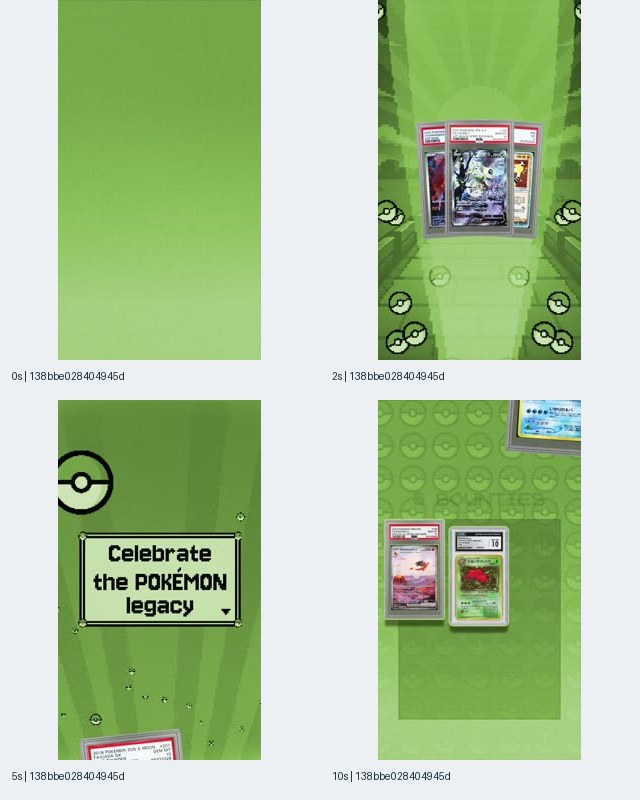
Image 1 — Record 138bbe028404945d45e4164a97246423, associated with Courtyard’s verified iOS listing. Supplied frames: 0, 2, 5, and 10 seconds. The record has 145,720,865 modelled impressions, or 14.8% of the bounded sample, for 2026-10-01 to 2026-10-30. The contact sheet documents advertising visuals, not performance.
At the sampled opening, the frame is largely green. The two-second frame introduces graded cards against a patterned background. The five-second frame shows “Celebrate the POKÉMON legacy” inside a retro-style text box, and the ten-second frame returns to graded-card imagery. The visible progression connects a recognizable collecting theme with objects that resemble items a collector would inspect.
There is no presenter in these supplied frames. The graphic treatment carries the audience cue, while the card cases and labels provide object detail. A reasonable hypothesis is that this structure assumes some existing recognition of Pokémon and graded-card collecting. The sample does not identify actual audience targeting or prove that this assumption improved response.
For production, the transferable idea is the order of explanation: establish the collectible category, make the object legible, and then connect it to the product. An original version should use assets and claims the advertiser can support. If the audience needs an explanation of grading, a purely symbolic opening may leave too much unstated; that is a comprehension question to test.
The first frame also illustrates why a contact sheet cannot settle an opening-performance debate. A mostly green image at zero seconds does not establish how long that appearance persists, what motion happens between captures, or what audio accompanies it. Calling the opening slow or ineffective would require evidence this sample does not contain.
Sample 2: A Collector Callout Connects Physical Cards to a Screen
The second example addresses collectors directly and places graded cards close to the camera before showing a phone interface. The supplied frames visibly include “Card Collectors Listen Up!”, “I’LL NEVER GO BACK”, and “OF COLLECTING CARDS.” These are separate visible text fragments, not a reconstructed transcript of the complete advertisement.
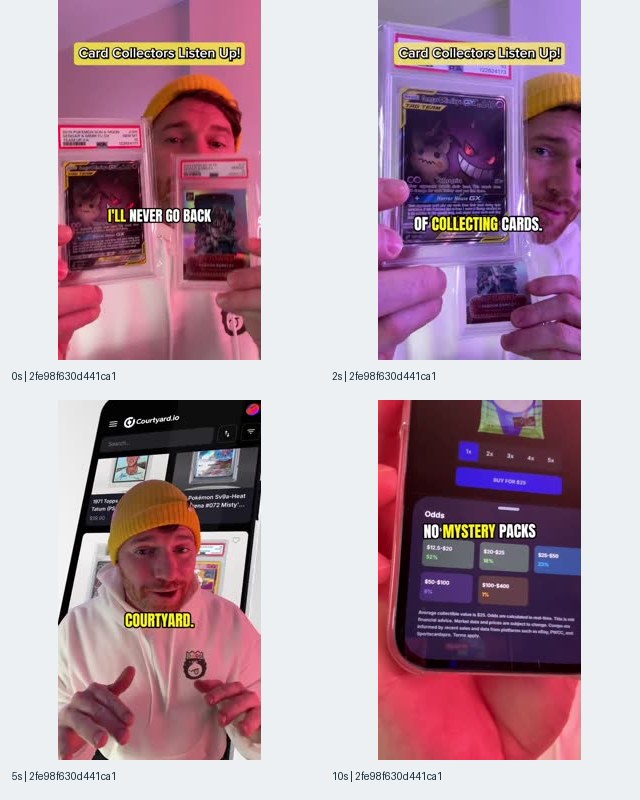
Image 2 — Record 2fe98f630d441ca121e7a35780281ff8, associated with the verified Courtyard iOS listing. Frames at 0, 2, 5, and 10 seconds show cards, a presenter, Courtyard branding, and a phone screen. The record’s window estimate is 75,307,578 impressions, with a 7.6% sample share.
The physical cards give the opening a concrete reference point. By the five-second frame, the presenter appears against a larger interface view with Courtyard branding. The ten-second frame emphasizes a phone screen with an “Odds” heading and the overlaid fragment “NO MYSTERY PACKS”. That fragment is insufficient to establish the full claim or its conditions. The visible interface is not an independently checked explanation of pack probabilities.
The testimonial-like phrase “I’LL NEVER GO BACK” suggests a changed collecting habit within the ad’s narrative. It does not establish that the presenter is a customer, that the statement reflects an independently verified experience, or that other users behave similarly. The sample also cannot identify the person or their relationship to the advertiser.
A useful original test would compare an audience callout with a plain product introduction while retaining the same object demonstration. The hypothesis would concern whether identifying collectors early improves understanding or qualified engagement. It should not assume that stronger testimonial language is inherently better.
For the production brief, request both a readable card close-up and a clean interface capture. A viewer should be able to distinguish the object being discussed from the action available on the screen. If the interface includes probabilities or conditions, their presentation needs current product verification rather than a transcription from this historical ad.
Sample 3: A Domestic Scene Creates an Attention-to-Phone Transition
The third example uses a dog wearing glasses in the foreground, a presenter on a sofa, and a later phone display to introduce Courtyard. The unusual foreground subject is the visible opening device. The phone and branding supply the product connection in subsequent sampled frames.
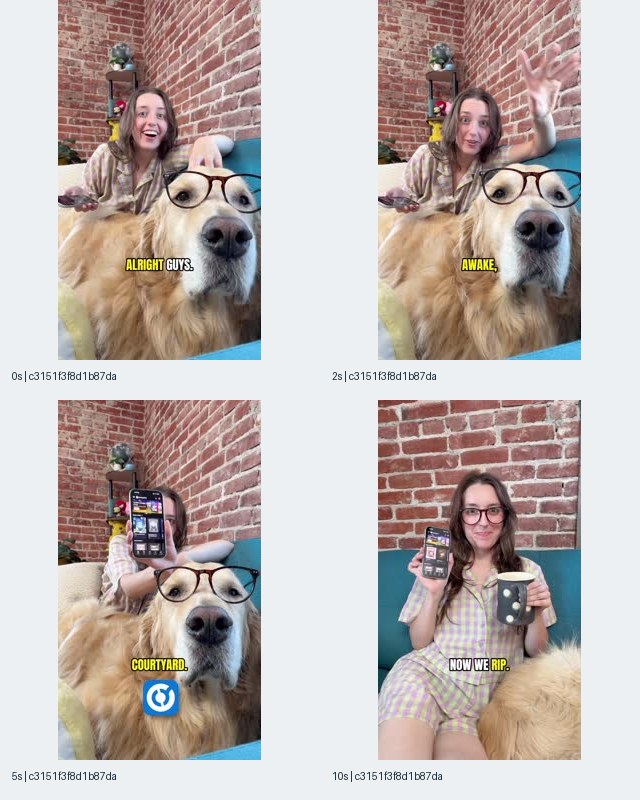
Image 3 — Record c3151f3f8d1b87da800803e389d50508, linked to Courtyard iOS listing 6748155184. The supplied 0, 2, 5, and 10-second frames show a dog, a presenter, a phone, and Courtyard branding. The window estimate is 65,571,044 impressions, representing 6.6% of the sample.
The opening frames contain “ALRIGHT GUYS.” and “AWAKE,” as separate caption fragments. At five seconds, a phone is held toward the camera and Courtyard branding appears. At ten seconds, the presenter holds a phone and mug, with “NOW WE RIP.” visible. That last phrase connects the domestic setting to the pack-rip vocabulary present elsewhere in the sample.
The scene suggests a casual routine as a creative hypothesis, but it does not establish a recurring usage habit or a particular customer demographic. A sofa, mug, and pet are visual choices in an advertisement. They are not audience research. The sampled frames also do not show the result of the proposed rip or establish what happens after the ten-second capture.
For an original brief, the critical decision is how quickly the unexpected opening becomes relevant to the product. A pet-led opening might attract attention while leaving viewers uncertain about what is advertised. A matched alternative could begin with the same presenter and phone, allowing the team to test whether the interruption adds useful comprehension or only general interest.
The handoff should specify the exact moment the app becomes visible and which product action the viewer should understand. That makes the creative idea reviewable without requiring the production team to imitate the original scene. The dog, glasses, brick wall, and mug are incidental execution choices; the attention-to-product transition is the structure worth examining.
Sample 4: Sneaker Screens Introduce a Physical-Object Question
The fourth example combines sneaker product views with a presenter and visible shipping-related wording. It shows how a collectible object can become the subject of an app explanation. The supplied frames do not establish that the displayed item was ordered, received, or available under current terms.
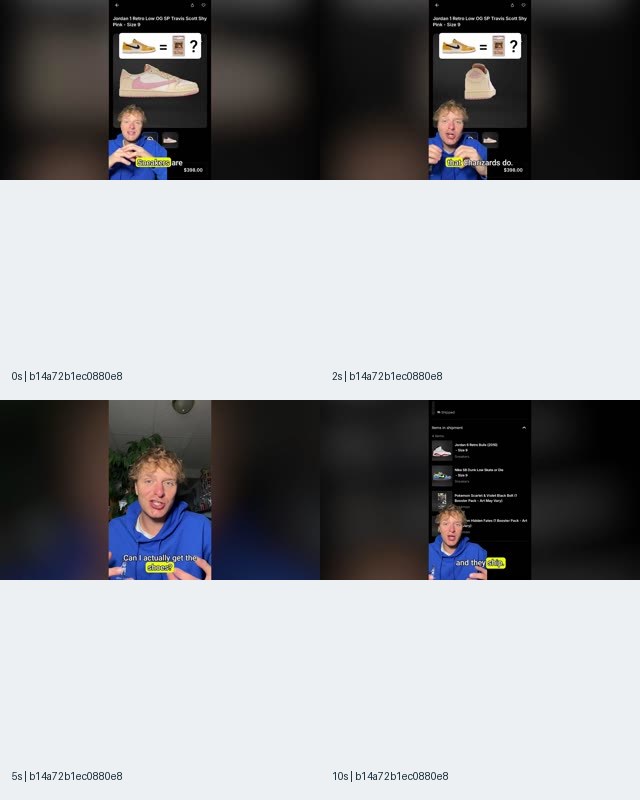
Image 4 — Record b14a72b1ec0880e8e9f32d54b402a1d9, associated with the verified Courtyard iOS listing. At the sampled timestamps, a sneaker listing, presenter, and shipment-style interface are visible. The record carries 64,757,327 modelled window impressions and a 6.6% sample share.
The early captures place the presenter over a dark product interface containing a sneaker image. The five-second frame brings the presenter forward with the visible question “Can I actually get the shoes?” The ten-second frame includes an item-list screen and “and they ship”. These words describe the ad’s question and claim; they do not verify fulfillment.
This is a distinct communication task from the green Pokémon creative. A card-themed graphic can rely on category recognition. Here, the ad visibly addresses the relationship between an on-screen object and a physical item. For someone encountering an unfamiliar collecting app, that relationship may need explanation before a call to action makes sense. Whether it is the main source of hesitation remains a hypothesis.
An original test could compare an object-led introduction with an explanation-led introduction, using a verified product flow in both. The team should define what a viewer must understand: what the screen represents, which actions are available, and which conditions govern those actions. The research sample supplies the question to investigate, not the answer for another product.
The contact sheet’s landscape presentation and blurred side areas should not be interpreted as placement evidence. They show how this reference is framed. Without a verified network association, it would be unsupported to call it a particular social or video-platform campaign or to infer a channel-specific production strategy.
Sample 5: Large Card Images Carry an Older Video Reference
The fifth example makes graded cards visually dominant and places a presenter with a microphone in front of them. Its record was first seen on 2026-02-26 and last seen on 2026-10-30. Those observations make it an older reference within the sample, without establishing uninterrupted delivery or successful performance.
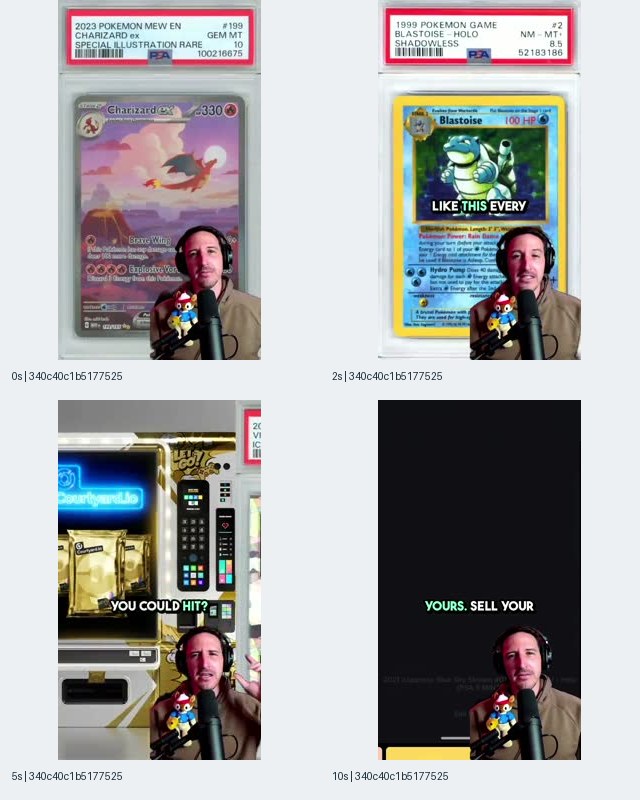
Image 5 — Record 340c40c1b5177525ec5095319315ee3a, linked to the verified Courtyard iOS listing. The 0, 2, 5, and 10-second frames show graded cards, a presenter, a machine-like visual, and partial captions. The record’s modelled window estimate is 52,458,664 impressions, or 5.3% of the sample.
The first frame shows a graded Charizard card, followed by a graded Blastoise card at two seconds. The presenter remains a smaller foreground element, so the collectible imagery occupies most of the available space. At five seconds, the background changes to a machine-like visual with Courtyard branding. At ten seconds, the background is dark and the caption fragment “YOURS. SELL YOUR” is visible.
That final fragment cannot establish a complete selling promise. It is a partial phrase sampled from a longer video. Nor does the machine-like scene establish that a physical machine is part of the current product. Both should be recorded as advertising imagery and text, with their unknown context preserved.
The transferable production decision concerns visual hierarchy. A large collectible can communicate the category while a smaller presenter explains it. An original version could compare this composition with a full-screen presenter holding the same object. The hypothesis would be that object prominence changes recognition or comprehension, not that a microphone or studio appearance guarantees credibility.
This example also matters for asset accounting. The same video fingerprint appears under another sampled record, 10fe1b9489e20cf544215a00ce88b7fb. Treating both rows as separately produced videos would inflate the apparent production count. Their record estimates remain distinct observations, but the underlying video file is shared. The sample does not disclose why the separate records exist or whether their surrounding delivery configurations differ in a meaningful way.
Sample 6: A Sneaker Callout Uses the Interface as Its Backdrop
The sixth example explicitly addresses sneaker collectors while showing a presenter over a sneaker listing. Its visible headline is “SNEAKER COLLECTORS: 🔥 CHECK THIS 🔥”. This establishes a category-specific audience callout within the ad, without proving that the actual campaign targeted sneaker collectors.
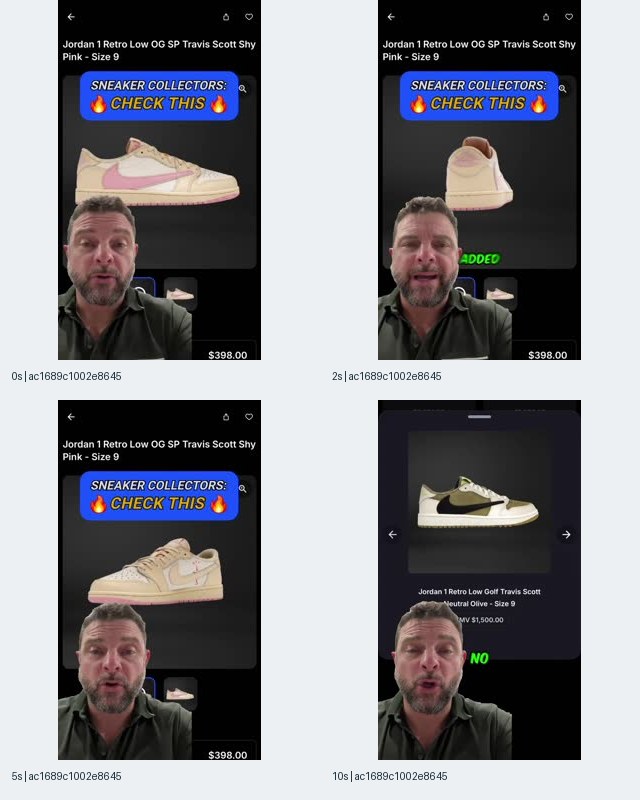
Image 6 — Record ac1689c1002e86451a3f1518e61dae29, associated with Courtyard iOS listing 6748155184. The supplied frames show sneaker product views and a presenter overlay. Its modelled window estimate is 40,703,112 impressions, representing 4.1% of the sample.
The first sampled frames show different views of a pink-accented sneaker within the same dark interface. By ten seconds, a different sneaker appears in a product panel. A green “NO” caption fragment is visible beneath it. That isolated word does not establish a rejection, comparison verdict, or reason for changing products. The missing sentence should remain missing.
This limitation changes the creative interpretation. The evidence supports category callout, object display, and product-screen context. It does not support a claim that the presenter rejects an item, evaluates authenticity, or recommends one purchase over another. A brief based on the reference should use the supported structure rather than inventing a comparison story.
For an original test, hold the product view constant and vary the opening language: address collectors explicitly or explain the product action directly. Record whether viewers understand the category and the next step. If both versions use the same item, interface, offer, and destination, the team has a clearer basis for interpreting any difference.
The product name, size, and displayed price visible in historical frames should not become evergreen offer copy. Their presence helps explain how the ad makes the object concrete, but the current inventory and commercial terms remain unverified. A production owner should replace them with a dated capture approved for the advertiser’s own product.
To inspect related indexed references, search Courtyard creatives in AdMapix. Use the results to find examples, then verify the linked listing and date scope before adding them to a comparison or production brief.
Sample 7: “Real Sneakers” Is an Advertising Claim
The seventh example places “REAL SNEAKERS. ON AN APP” above an outdoor presenter and later shows a Courtyard-branded box. This is a visible attempt to connect a physical-object category with an app. It remains an advertising claim, even when accompanied by packaging imagery.
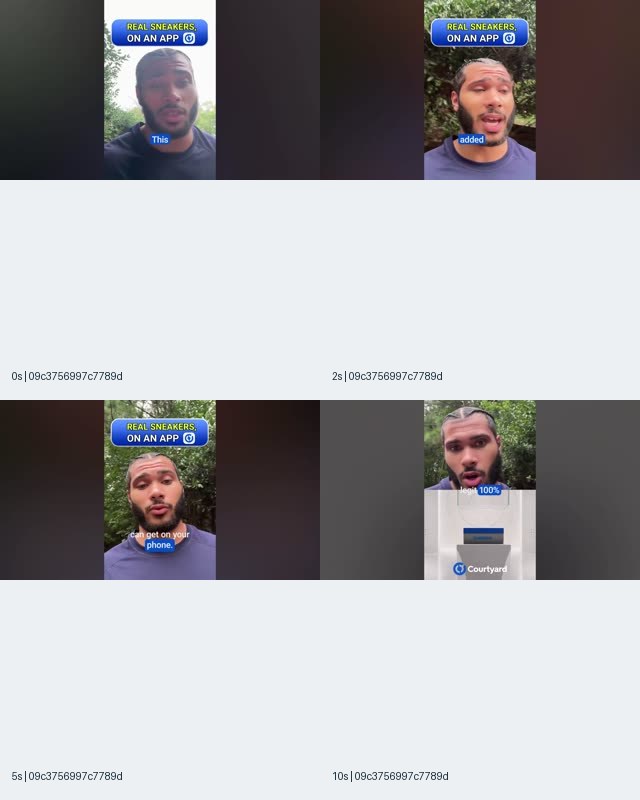
Image 7 — Record 09c3756997c7789d655b62cfd7b502ae, linked to Courtyard’s verified iOS listing. The supplied timestamps show outdoor presenter footage and a branded box. The record has 34,752,536 modelled window impressions, or 3.5% of the sample. Neither speaker identity nor the claim is independently verified.
The opening differs from the interface-heavy sneaker reference. The presenter’s face and outdoor setting occupy the central frame, with the category proposition held at the top. Later caption fragments include “can get on your phone.” At ten seconds, packaging becomes a foreground object while the presenter remains visible.
A reasonable hypothesis is that the box helps make the app-to-object relationship easier to imagine. The sample does not demonstrate that viewers interpreted it that way. It also does not show a complete order, unboxing, or delivery sequence. Packaging can function as a visual cue without establishing the operational process behind it.
For a creative team, this suggests a useful distinction between showing an object and explaining a process. A box may be easy to recognize but leave the user action unclear. An original test could retain the same verified product proposition while comparing packaging footage with a readable interface demonstration. The evaluation should include whether viewers can explain what happens after they follow the call to action.
Do not identify the presenter from appearance or infer that the outdoor setting indicates organic content. The sample establishes a person speaking to camera within an indexed ad record. Their identity, production arrangement, compensation, and personal experience are outside the supplied evidence.
Sample 8: The Phone Appears Before the Presenter’s Explanation
The eighth example begins with a phone held close to the camera, making the interface the first visible subject. The presenter becomes more prominent in later sampled frames, followed by a clear Courtyard brand cue. This supports an interface-first creative description, without establishing a complete tutorial or the video’s final call to action.
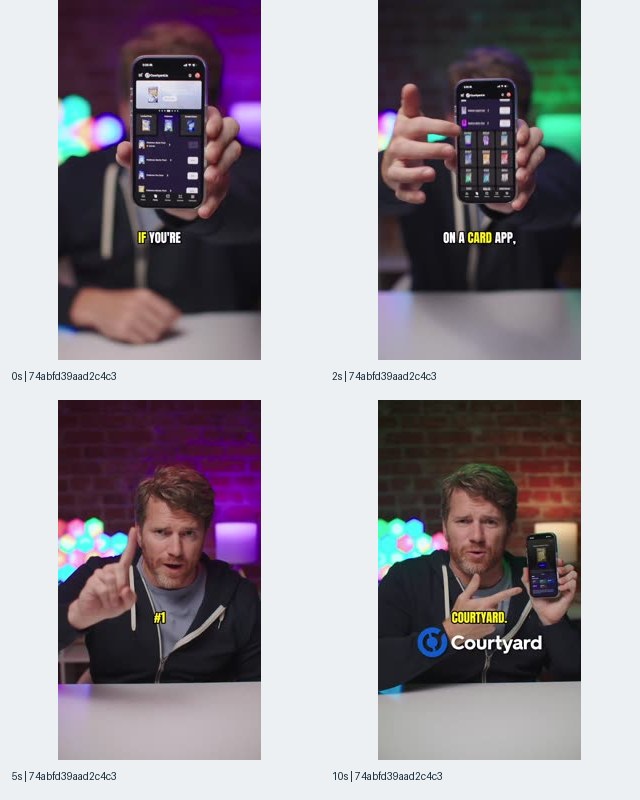
Image 8 — Record 74abfd39aad2c4c37ad1e23bd117ce14, associated with the verified Courtyard iOS listing. Frames at 0, 2, 5, and 10 seconds show a phone interface, presenter gestures, and branding. The record carries 28,844,195 modelled window impressions, or 2.9% of the sample.
At zero seconds, the phone occupies the center while the presenter is largely behind it. At two seconds, a pointing hand directs attention toward the screen. The visible caption fragments include “IF YOU’RE” and “ON A CARD APP,”. A later frame displays “#1”, but the supplied captures do not establish what is being numbered. It should not be treated as a verified ranking or superiority claim.
By ten seconds, the presenter holds the phone beside their face and Courtyard branding is visible. The record metadata describes a longer video, so this is a branding beat within the observed portion, not a verified end card. The remaining narration and final action are unknown.
The production question is legibility. A screen can make an app feel concrete while still leaving its function unclear at a small display size. An original brief should name the label or action the viewer needs to read and provide a clean capture alongside the filmed phone footage. That lets an editor choose a crop based on comprehension rather than visual resemblance alone.
The record was first seen on 2026-09-30 and last seen on 2026-10-03. This does not prove the creative failed or was deliberately retired then. It establishes the observation range available in this sample. A live follow-up would need to check the same record and file before drawing any conclusion about subsequent visibility.
Evidence Table for the Eight Illustrated Records
The illustrated records cover different creative approaches and different positions within the bounded sample. Their modelled impressions provide record-level context, while their contact sheets provide visual evidence. Neither column establishes effectiveness, and image numbering should not be read as a ranking of creative quality.
| Image | Record identifier prefix | Visible emphasis | Modelled window impressions | Sample share | First seen | Last seen |
|---|---|---|---|---|---|---|
| 1 | 138bbe028404945d | Green Pokémon graphics and graded cards | 145,720,865 | 14.8% | 2026-10-03 | 2026-10-28 |
| 2 | 2fe98f630d441ca1 | Collector callout, cards, phone screen | 75,307,578 | 7.6% | 2026-08-28 | 2026-10-30 |
| 3 | c3151f3f8d1b87da | Dog-led opening and phone introduction | 65,571,044 | 6.6% | 2026-10-03 | 2026-10-30 |
| 4 | b14a72b1ec0880e8 | Sneaker screen and physical-item question | 64,757,327 | 6.6% | 2026-10-03 | 2026-10-30 |
| 5 | 340c40c1b5177525 | Large graded-card imagery and presenter | 52,458,664 | 5.3% | 2026-02-26 | 2026-10-30 |
| 6 | ac1689c1002e8645 | Sneaker-collector callout and product views | 40,703,112 | 4.1% | 2026-10-03 | 2026-10-28 |
| 7 | 09c3756997c7789d | Outdoor presenter and branded packaging | 34,752,536 | 3.5% | 2026-10-03 | 2026-10-28 |
| 8 | 74abfd39aad2c4c3 | Phone-first explanation and branding | 28,844,195 | 2.9% | 2026-09-30 | 2026-10-03 |
All impression values in this table apply to 2026-10-01 to 2026-10-30. First-seen and last-seen dates describe indexed observations and may extend beyond or cover only part of that measurement window. They are not the denominator for an impression-per-day calculation.
The table also helps keep visual interpretation proportional. The older card reference and the more recently discovered graphic reference both appear in the sample, but the evidence does not explain their different estimates. Their objects, presentation, discovery history, and surrounding configurations differ. Comparing their modelled volume cannot isolate the value of a presenter, a particular collectible, or an opening style.
Fleet Age and Cadence: Discovery Is Not Launch
Courtyard’s sampled records combine older observations with recent additions, but the data does not establish the advertiser’s complete production calendar. The earliest first-seen date is 2026-02-26, the latest is 2026-10-06, and 14 records were first seen within 2026-10-01 to 2026-10-30. These are the supported cadence facts.
The distinction between discovery and launch matters because an index can encounter a creative after it first ran. A record first seen in October is newly observed in this dataset, not necessarily newly filmed, newly edited, or newly launched that month. An existing video can also appear in a new record, as the fingerprint relationships demonstrate.
Likewise, 22 records were last seen during 2026-10-28 to 2026-10-30. That is evidence of recent observations near the window’s end. It is not proof that all were continuously delivering, still active after the capture, or intentionally retained because of performance. A last observation earlier in the month does not prove an advertiser switched the record off.
The latest first-seen date should not become a claim that production stopped after October 6. Impression-descending sampling favors records with sufficient estimated volume to enter the bounded result set. Newer or lower-volume records could exist outside it. The same selection limit applies to statements about the oldest creative across the entire account.
For a research team, cadence tracking should therefore have separate fields for record discovery, file discovery, and later reappearance. A changed record with the same video file may be configuration reuse. A new file may represent an edit or a different concept. Only further inspection can distinguish those possibilities, and only the advertiser’s own records can confirm the actual production and launch schedule.
Concentration, Reuse, and Playable Associations
The sample has a leading record without being dominated by that record alone, and it includes concrete examples of video reuse. The largest record’s 14.8% share, the top five’s 40.9% share, and the supplied 1.9× first-versus-second comparison describe record-level concentration. They do not establish a winning creative or an asset-level share after grouping duplicates.
The reuse evidence is specific. The video shared by records 340c40c1b5177525ec5095319315ee3a and 10fe1b9489e20cf544215a00ce88b7fb appears in Image 5. Another video is shared by records 4bd74d5786a9c73fb22cfd1a1ded49e9, fbd5111d31db4c0e281cef1e81642011, and 3461011c096516e839dc6a85a957a3ae. The latter two records each carry a different playable fingerprint; the first has no playable reference in the supplied record.
That relationship is enough to establish a shared video with differing recorded associations. It is not enough to establish the playable experience, the placement, or an experiment comparing interactive endings. No playable interaction was observed, and no conversion results were supplied. Calling this a successful playable optimization would overstate the evidence.
For production planning, the distinction is useful even without performance data. A team looking at record count alone might commission too many new videos because it mistakes combinations for original media. A team looking only at video count might miss variation in associated components. Keeping video files and playable files separate makes the research more informative without inventing a combined asset total.
Do not aggregate the repeated videos into a new concentration claim unless the analysis explicitly defines and calculates that grouping from the appropriate record values. This article retains the supplied record-level shares. That keeps the denominator stable and avoids quietly changing the meaning of “top creative” between a record table and a production discussion.
Courtyard Versus Rips: Different Observed Sample Shapes
Courtyard shows more recent record discoveries and a smaller leading-record share than Rips in the supplied comparison, but the creative windows differ. Courtyard’s frozen sample covers 2026-10-01 to 2026-10-30. The Rips bracket covers 2026-09-30 to 2026-10-29. These are adjacent research vintages, not a synchronized market-share measurement.
| Product-associated sample | Creative window | Sampled modelled impressions | Leading-record share | Earliest first seen | Records first seen within its window | Records with playable |
|---|---|---|---|---|---|---|
| Courtyard | 2026-10-01 to 2026-10-30 | 987,496,801 | 14.8% | 2026-02-26 | 14 of 30 | 2 |
| Rips by Triumph | 2026-09-30 to 2026-10-29 | 5,452,524,821 | 25.9% | 2026-04-07 | 3 of 30 | 2 |
| Underdog | 2026-09-30 to 2026-10-29 | 577,611,671 | 39.1% | 2026-09-24 | 25 of 30 | 6 |
| PrizePicks | 2026-09-30 to 2026-10-29 | 289,140,298 | 17.3% | 2026-07-21 | 6 of 30 | 15 |
Every row is a bounded 30-record sample. The comparator figures were supplied in the separate pull dated 2026-10-30. They are not added together, converted into spend, or treated as the apps’ complete advertising activity.
Rips has fewer recent first observations and a larger leading-record share in this comparison. That supports describing a more concentrated top sample with fewer recent discoveries. It does not support saying Rips stopped testing or that one asset accounts for its entire acquisition strategy. The bracket does not provide a comparator top-five share, so it cannot support a claim about the relative flatness of the complete top-five distributions.
Courtyard also contains an earlier first-seen date than Rips within these samples. That prevents a simplistic “Courtyard new, Rips old” narrative. The observed distinction concerns the mix of recent discoveries and concentration, while older references can coexist with that mix. Neither age nor concentration establishes profitability.
The Rips by Triumph advertising teardown provides direct-competitor context from its own dated research. Its earlier figures should retain their original dates rather than replacing the October bracket here. The ad strategy teardown series is the topic parent for related analyses; this article keeps its conclusions limited to the present source sample.
What the Pack-Rip Bracket Means for a New Entrant
The comparison identifies different creative configurations to investigate, not a single category formula to copy. Courtyard and Rips are the direct pack-rip references in this brief. PrizePicks and Underdog broaden the research set because their verified store titles include “Packs” and “Rips” respectively. Those title changes do not establish the share of their business or advertising devoted to packs.
The bracket should therefore remain listing-level. Underdog’s 25 recently first-seen records cannot be relabelled as 25 newly launched pack ads without record-level visual evidence. PrizePicks’ 15 records with playable associations do not establish that those files simulate pack opening. No attached comparator contact sheets support those narrower claims.
What the counts do provide is a research agenda. For Rips, inspect the leading record and how its file relates to other configurations. For Courtyard, examine the variety of object and presenter approaches already visible here. For Underdog, investigate whether recent discoveries share a message or reflect unrelated parts of the product. For PrizePicks, inspect the associated interactive files before deciding whether they are relevant to a collectibles brief.
A new entrant should build comparisons around the customer question, not merely the app name. “What does this digital object represent?” is different from “What happens when I open a pack?” and different again from “Why should a collector try this interface?” Each question requires different footage and supporting product information.
The revenue bracket adds context without explaining these creative choices. Rips ranked #18 (-6.51%), with a modelled estimate 5.6 times Courtyard’s at #68 (-10.63%). Courtyard’s estimate was 2.5 times PrizePicks’ at #165 (+10.24%) and 3.2 times Underdog’s at #200 (+18.64%). These relationships do not connect a particular format to revenue, and the fantasy apps’ estimates do not disclose pack-specific revenue.
The practical entry decision is to choose a message your own product can demonstrate clearly, then test how to introduce it. Category research can reveal unanswered communication questions. It cannot supply a media budget, target acquisition cost, or expected return for a new product.
What the Ads Promise About Collecting
The supplied frames combine collector identity, recognizable objects, digital interfaces, and claims about the relationship between them. Their common creative challenge is explaining a digital action through a collectible that viewers can recognize. The evidence supports describing that presentation, while the underlying product relationship remains something to verify separately.
| Advertising element | Source-specific example | What can be recorded | What remains unverified |
|---|---|---|---|
| Category recognition | Pokémon graphics and graded cards in Image 1 | The ad uses recognizable collecting imagery | Audience targeting and viewer response |
| Collector identity | “Card Collectors Listen Up!” in Image 2 | The ad addresses collectors | Actual customer composition |
| Pack-rip language | Truncated description and “NOW WE RIP.” in Image 3 | A reveal action is promoted | The complete user journey and outcome |
| Physical-item question | Shoe question and shipping fragment in Image 4 | The ad raises and addresses an object-access question | Fulfillment and current conditions |
| Object emphasis | Large card images in Image 5 | Collectibles dominate the composition | Availability of those specific items |
| Category extension | Sneaker references in Images 6 and 7 | Sneakers appear in the advertising | Inventory, revenue mix, or category scale |
| Interface visibility | Phone-first framing in Image 8 | Screens are shown as product context | Current functionality and completion rates |
This table can become a claims worksheet for a production team. Add a column for the advertiser’s own supporting documentation and another for the exact wording approved for use. A reference image can justify testing a communication structure; it cannot justify importing a competitor’s operational promise.
Truncated descriptions require particular care. “Rip open digital packs to reveal authe......” communicates a digital-pack reveal, but its ending is incomplete. Completing the word or sentence would create unsupported copy. The same discipline applies to caption fragments such as “NO” or “YOURS. SELL YOUR”: preserve them as fragments rather than constructing a narrative around them.
Is Courtyard Legit? What This Review Can Establish
Advertising data cannot determine whether Courtyard is legitimate. This article is a review of dated advertising evidence and store-ranking estimates, not a hands-on assessment of the product. The source package does not contain independent verification of inventory, item authenticity, customer experience, transaction completion, or fulfillment.
The distinction does not make the ads uninformative. They show the promises a prospective user may encounter: pack ripping, cards and sneakers, collector-focused language, phone screens, and branded packaging. Those observations help organize the questions that a separate product review should answer.
A useful verification sequence begins with identity. Confirm that the current product and store listing match the app being researched. Then inspect how current documentation explains the relationship between a digital pack and any represented collectible. Record available actions, conditions, fees, probabilities, eligibility, and item-specific limitations where the product publishes them.
Next, separate the advertised object from the general proposition. A particular card grade or sneaker image may serve as an example rather than a universal outcome. The source sample does not establish which interpretation applies. A reviewer would need current product documentation and appropriately recorded product observations to evaluate that question.
Finally, retain unanswered questions instead of filling them with impressions from polished creative. A presenter, a graded-card label, a shipment screen, and a branded box may make a narrative more concrete. They are not substitutes for the evidence needed to verify the narrative. This article therefore offers no legitimacy verdict and no recommendation to transact.
Platform, Targeting, and Performance Remain Unresolved
The sample does not verify a named advertising network, audience segment, or campaign result. Its source labels are not a documented mapping to a placement in the supplied evidence. Vertical video, caption styling, blurred side panels, and presenter footage cannot fill that gap.
This matters because platform assumptions quickly become production prescriptions. Calling a reference a TikTok ad can lead a team to copy platform-specific pacing or infer a creator distribution arrangement. Calling it an in-app ad can lead to assumptions about interactive endings. Neither conclusion follows from the attached frames alone.
Audience language is similarly limited. “Card Collectors Listen Up!” addresses collectors in the creative. It does not reveal interest targeting, customer-list use, demographic settings, or whether the advertisement reached people already familiar with the category. Audience intent in a script and audience selection in an ad account are different evidence categories.
Performance requires another dataset. Modelled impressions cannot reveal click-through rate, installs, activation, purchase quality, contribution margin, or incremental impact. The sample’s combination of older observations and recent records does not diagnose creative fatigue. A lower-ranked record might serve a different audience or objective, but those possibilities remain unknown.
The production team can still use the references. It should translate the observed structure into an original asset, then adapt that asset to the actual placement being purchased. Placement requirements and performance decisions belong to the team’s verified account and product data, with the competitor sample retained as the origin of the hypothesis.
A Practical Research Workflow for Buyers and Creative Teams
A useful workflow preserves identity, dates, and claims before turning observations into an original test brief. The goal is a traceable decision document: another teammate should be able to see which part came from the source, which part is interpretation, and which part still needs verification.
Start with an entity card containing the listing title, product ID, seller, country, and capture date. For this article, that means Courtyard: TCG, Watches, Cards, iOS 6748155184, Courtyard, Inc., US, captured 2026-10-30. Search wording is a discovery aid; the verified identifier controls inclusion.
Then establish separate worksheets for creative evidence and store-ranking evidence. Put 2026-10-01 to 2026-10-30 above the Courtyard creative sheet and 2026-09-29 to 2026-10-28 above the ranking sheet. If the comparator creative bracket is used, label it 2026-09-30 to 2026-10-29. Do not rely on a generic “last month” heading that becomes ambiguous when the report is reopened.
For each creative, save the record identifier, video-file relationship, associated playable reference, first and last observations, and exact available text. Add timestamp-specific notes for the image rather than a summary that sounds like complete playback. “Phone visible at five seconds” is auditable. “The ad explains the complete purchase process” is not supported by the same evidence.
Use a controlled set of descriptive tags: collector callout, graphic object display, presenter with object, unexpected domestic opening, physical-item question, packaging cue, or interface-first explanation. These are analytical tags for this research workflow, not claims about how the advertiser names its campaigns.
Next, write an explicit uncertainty note. For Image 6, it would say that the isolated “NO” does not establish a rejection story. For Image 8, it would say that the ten-second branding frame is not the video’s verified ending. These notes prevent an editor from accidentally turning incomplete observations into a confident script.
Only then create the hypothesis. Specify what change is proposed, why the visible reference suggested it, what remains constant, and what outcome would support or reject the idea. The hypothesis should be about the advertiser’s own product and audience. Courtyard’s modelled impressions provide research context, not the expected result.
Finally, assign the verification task to the relevant owner. Product should confirm the available action and current interface. Creative should confirm the original visual treatment and source trail. Measurement should define the first-party outcome. The handoff is complete when the proposed test can be produced and evaluated without requiring anyone to guess what the reference proves.
An Original Brief Built From the Observations
An original collector-app brief can test how the product is introduced while keeping the underlying promise unchanged. The following is a proposed workflow for a hypothetical team with a documented product flow. It is not a Courtyard campaign, a completed experiment, or a claim about a result already measured.
The research question is: Does an explicit collector callout improve understanding compared with an interface-first introduction? Image 2 supplies the observed audience-address structure, while Image 8 supplies the interface-first structure. The proposed test isolates that difference instead of changing the presenter, object, offer, and destination simultaneously.
| Brief field | Proposed entry |
|---|---|
| Intended viewer | People interested in the collectible category, defined through the team’s own research |
| Product promise | The exact documented action available in the advertiser’s current product |
| Version A opening | Original footage of a collectible with a direct category callout |
| Version B opening | Original capture of the relevant app screen with a plain action explanation |
| Shared demonstration | The same verified product flow and object example |
| Shared ending | The same accurate next step and destination |
| Supporting evidence | Current interface capture and product documentation for each claim |
| Primary question | Can viewers explain what the app action does? |
| Campaign evaluation | First-party outcomes defined before launch |
| Unknowns | Effect on response, cost, customer quality, and commercial results |
For Version A, an illustrative line is: “Collecting starts with knowing what you’re looking at.” The shot would show a clearly labelled item and move into the documented app flow. For Version B, an illustrative line is: “Here is what this screen shows before you choose.” The wording would need adjustment to the actual product. These are original draft concepts, not quotations from Courtyard.
The brief should require a readable interface and a clean explanation of the object’s relationship to the screen. If a depicted item is illustrative, that distinction should remain clear. If a condition affects the action, it should not disappear during editing. The goal is to test presentation, not introduce a stronger unsupported promise in one version.
Before campaign testing, use a comprehension review to identify basic ambiguity. Ask viewers to explain the action in their own words and identify what they believe the next step will do. This proposed check can reveal whether the collector imagery overwhelms the product explanation. It does not replace campaign measurement or establish an effect on acquisition cost.
During the eventual campaign, interpret attention and downstream outcomes together. A version that attracts more clicks may also produce more misunderstanding. A version that explains the product more clearly may have different response characteristics. The correct decision depends on the team’s own objective and observed results, which remain unknown here.
How to Monitor the Next Sample Without Rewriting History
A follow-up should preserve the original snapshot and compare clearly defined new observations. Replacing the old numbers with a fresh query would erase the basis of this article. The dated package should remain the reference for what was reported on 2026-10-30.
Use the same verified listing, country, sample size, and sorting logic when the question concerns changes in the sampled head of activity. Record any deliberate change in scope. A broader sample can be useful, but a larger record count should not be interpreted as growth if the retrieval limit also increased.
Track record and file changes separately. If a new record uses a previously observed video, label it as a new record with a known file. If a file disappears from the next bounded sample, record its absence from that sample rather than declaring retirement. It may have moved below the selection threshold or remain visible under another configuration.
For concentration, keep the denominator explicit. A top-record share from a 30-record sample is not directly interchangeable with a share from a larger retrieval. If a team wants an asset-level view, define the grouping method before calculating it and retain the record-level view alongside it.
For store rankings, preserve rank and period change together. The next ranking should carry its own exact window and listing identity. A rank movement alone does not establish a change in company revenue, and a change in the modelled estimate does not explain which campaign or product decision caused it.
Common Mistakes That Change the Meaning of the Evidence
The most consequential mistakes replace one measurement with another: records become assets, observations become launches, and ranking estimates become company revenue. Avoiding those substitutions is more valuable than adding extra precision to a number whose meaning has already changed.
| Mistake | Why it fails | Better wording or action |
|---|---|---|
| Calling the sample the complete Courtyard fleet | Retrieval is bounded to 30 records | State the sample size, window, and selection method |
| Calling every record a new creative | Video fingerprints repeat | Report records and unique files separately |
| Saying 14 ads launched during the window | The source supplies first-seen observations | Say 14 records were first seen in the window |
| Treating last seen as a stop date | The index does not establish campaign status | Report the observation date without a retirement claim |
| Turning modelled impressions into spend | No verified spend or pricing basis is supplied | Keep the metric as modelled window impressions |
| Dividing impressions by ad age | The numerator and denominator cover different periods | Omit the derived daily measure |
| Completing truncated copy | Missing words are not in the evidence | Preserve the exact fragment |
| Calling a box proof of fulfillment | It is a visual cue in an ad | Attribute the claim to the advertisement |
| Assigning a network from style | Format does not verify placement | Leave the network unresolved |
| Reusing an old comparison number without its date | Samples and windows differ | Keep each number attached to its source vintage |
Another error is treating the illustrated selection as a complete creative taxonomy. The eight contact sheets support the approaches discussed here, but unillustrated records may contain additional ideas. The article does not assign theme percentages to all 30 records because a full visual classification was not supplied.
A final mistake is making metadata more confident than the body. A headline promising verified company revenue, a definitive product review, or proven acquisition tactics would contradict the evidence limits. The title and summary should describe the actual result: a dated ranking and advertising analysis with observable examples.
When AdMapix Fits This Research
AdMapix fits teams that need to locate indexed competitor creative and preserve a dated evidence trail for analysis. It is an ad-intelligence platform, and it is our product. In this article, its role is to connect a verified listing with creative records, modelled impression estimates, file relationships, and a bounded comparison workflow.
The practical value is visible in the separation of tasks. The store-ranking snapshot answers a listing-position question. Fingerprints prevent reused videos from becoming inflated production counts. Contact sheets support specific visual notes. The public source package preserves the original research scope so later readers can inspect what was available.
That workflow does not replace first-party attribution, company financial information, or product testing. A team seeking exact competitor spend, confirmed conversion, or a complete operational assessment needs evidence beyond this sample. A team seeking a defensible starting point for an original creative brief can use it directly, provided hypotheses remain labelled.
For current research, sign up or log in to AdMapix, find the verified product, and build a fresh comparison with explicit dates. Review the public methodology before interpreting estimates, and consult the live pricing page for current commercial terms. Access conditions and plan details should be checked there when making a purchase decision.
FAQ
The following answers address the ranking, creative, and product-review questions that this dated evidence can support.
What is Courtyard.io in this analysis?
The reference is the verified iOS listing “Courtyard: TCG, Watches, Cards,” product ID 6748155184, sold by Courtyard, Inc. Its sampled ads use digital-pack language, graded-card imagery, sneaker references, and phone interfaces. This identifies the product associated with the records; it does not establish every current feature, the ad buyer, or complete cross-platform advertising coverage.
What is Courtyard’s revenue?
Courtyard ranked #68, with a -10.63% change in its modelled revenue estimate, in the US store-listing ranking for 2026-09-29 to 2026-10-28. The source does not state the estimate’s unit. It therefore supports rank, period change, and supplied same-ranking ratios, but not monthly or annual company revenue, GMV, buyback volume, or profit.
How does Courtyard compare with Rips by Triumph?
Rips ranked #18 (-6.51%) on the same revenue ranking, with a modelled estimate 5.6 times Courtyard’s at #68 (-10.63%). In the separate creative bracket, Rips had a 25.9% leading-record share and three recent first-seen records. Courtyard’s frozen sample had a 14.8% share and 14 records first seen within its window. The creative windows differ and do not establish relative efficiency.
Does the advertising evidence show that Courtyard cards are legitimate?
No. The sample documents advertising claims, objects, interfaces, and modelled estimates. It does not independently verify item authenticity, inventory, customer experience, or fulfillment. A separate product review would need current documentation and appropriately recorded product observations. Graded-card images, presenter statements, and branded packaging should remain attributed to the advertisements rather than treated as independent validation.
How many Courtyard ads were found?
The frozen US sample contains 30 advertising records associated with the verified iOS listing for 2026-10-01 to 2026-10-30. Those records contain 27 unique video files and two unique playable files. Retrieval was limited to three pages of ten records using impression-descending sorting, so this is not a count of all Courtyard ads or all original creative concepts.
What does “Rip open digital packs to reveal authe......” establish?
It is the exact truncated description attached to several sampled records. The visible words establish a digital-pack reveal message, while the missing ending remains unknown. The description should not be completed or treated as a full product specification. It does not establish what a user receives, which conditions apply, or what actions are available after a reveal.
Which advertising platform does Courtyard use?
This frozen sample does not verify a named platform or network for the records. Vertical framing, presenter footage, captions, and interface screens do not establish placement. The analysis can describe those creative choices, but a platform-specific conclusion requires an explicit source association. The verified iOS listing identifies a product relationship, not the network that carried an advertisement.
Do the sampled Courtyard ads include playables?
Two sampled records carry playable references, corresponding to two unique playable files. Both also contain video, and they share their video file with another sampled record. This establishes recorded file associations. It does not establish the interactive experience, its placement, or its effect on results because no playable interaction or conversion test was supplied.
Key Takeaways
The evidence supports a dated store-ranking comparison and a practical creative research agenda, while leaving company economics and product verification unresolved.
- Keep revenue wording at listing level: Courtyard ranked #68 with a -10.63% change for 2026-09-29 to 2026-10-28; company revenue, GMV, and buyback volume remain unknown.
- Keep records separate from files: The creative sample contains 30 records, 27 unique videos, and two unique playable files for 2026-10-01 to 2026-10-30.
- Describe concentration accurately: The largest record represents 14.8% of sampled modelled impressions, and the top five represent 40.9%; neither measure proves performance.
- Use the frames to write specific briefs: Collector callouts, object prominence, physical-item questions, and interface-first introductions are observable structures that can inspire original tests.
- Verify before acting: Preserve exact text and dates, check current product claims, and evaluate the resulting creative with first-party measurement.
Sources
The sources below identify the frozen evidence, its observation dates, and the scope of the product and methodology references used in this article.
- Frozen Courtyard source package — captured 2026-10-30; US, verified iOS listing 6748155184; creative measurement window 2026-10-01 to 2026-10-30. Includes public batches, request parameters, checksums, records, and limitations. Visual observations in this article are limited to the supplied timestamped contact sheets.
- Courtyard: TCG, Watches, Cards on the US App Store — store-identity reference preserved in the 2026-10-30 sample for listing 6748155184 and seller Courtyard, Inc.; not a claim of a new live product test.
- AdMapix US store-ranking snapshot supplied with the dated research brief — observed 2026-10-30, covering 2026-09-29 to 2026-10-28 against the previous 30 days. Store-listing rankings combine App Store and Google Play listings and capture the top 300. The article reports supplied ranks, changes, and same-ranking revenue ratios without assigning a currency unit.
- AdMapix comparison creative snapshot supplied with the dated research brief — pulled 2026-10-30, covering 2026-09-30 to 2026-10-29; bounded top-30 samples associated with the verified iOS listings for Rips by Triumph, PrizePicks, and Underdog. These figures remain separate from Courtyard’s frozen creative total.
- AdMapix methodology — public interpretation reference for the research workflow. Product facts supplied for this draft were reviewed 2026-08-13; the subject observations are dated 2026-10-30. Modelled estimates are distinguished from observed delivery and first-party outcomes.
- AdMapix Courtyard search workflow — live discovery entry point for related indexed creatives. It is not a frozen reproduction of the 2026-10-30 results; readers should confirm listing identity, country, dates, and selection limits for new research.
About AdMapix Research: AdMapix Research is the research byline of AdMapix, an ad-intelligence platform. Its articles are built from AdMapix data (creative records, modelled impression estimates and US app-store rankings), prepared with Codex from a dated frozen sample and checked by automated evidence review. Brad at AdMapix is the accountable editorial owner; this does not imply personal human review.
Turn these observations into your next creative study
Open the creative library and select samples for your market, network and research question.
Related Articles
Pangle Ads Examples: What a Dated US Search Sample Shows
Examine eight dated advertising examples from a US-filtered Pangle research sample, distinguish product identity from placement evidence, and turn visible creative patterns into original test briefs.
Colony Flow! Ads: Pixel Hooks, Video Reuse, and Playables
A dated US sample connects 30 Colony Flow advertising records to 19 video files and six playable files, with eight visual analyses that separate observable hooks and reuse from unverified gameplay and performance claims.
Amaze GO Game Ads: Arrow Puzzles, Hooks, and Video Reuse
A verified US iOS sample links 30 Amaze GO advertising records to 24 video files and 10 playable files, with eight visual analyses covering arrow puzzles, relaxation claims, filmed challenges, and practical creative tests.