
Novig Ads and Commercials: What 30 US Records Show
Eight timestamped examples and 30 verified US iOS advertising records reveal Novig’s Notes-style explainers, sports comparisons, offer variants, sampled concentration, and the limits of revenue-ranking evidence.
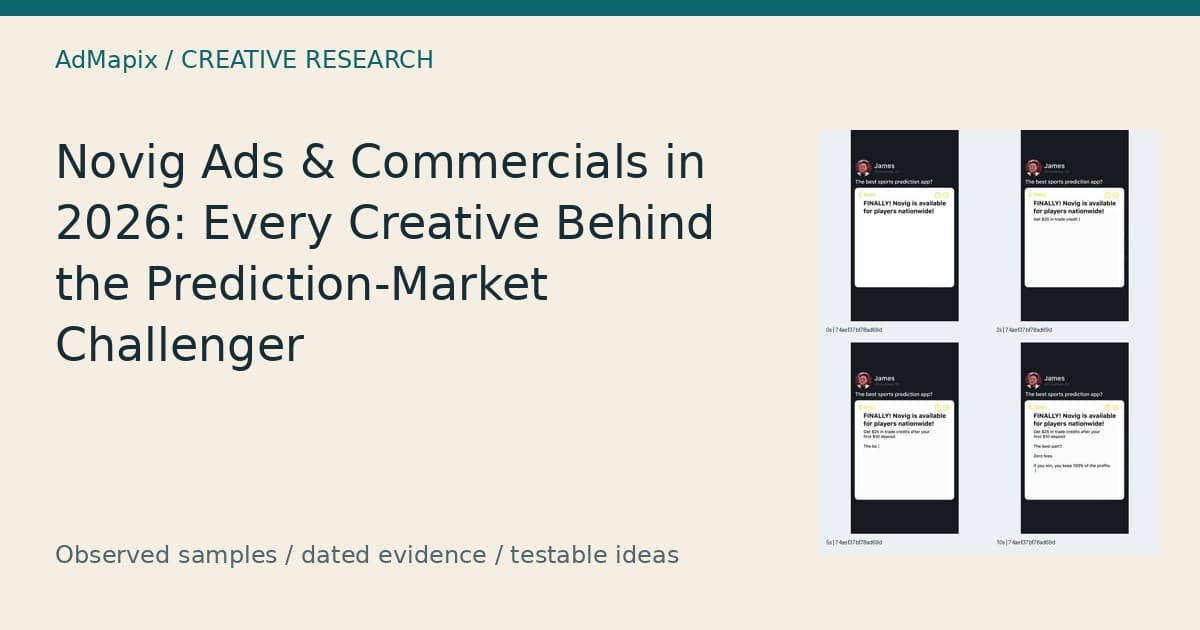
Novig Ads and Commercials: What 30 US Records Show
Novig’s sampled commercials combine typed Notes-style explainers, a filmed sports comparison, and short studio videos built around promotional trade credits. The eight illustrated examples show how the brand presents switching arguments and offers; they do not establish who appears in the ads. Across the broader, verified US iOS sample, 30 advertising records correspond to 30 distinct video files. The largest record accounts for 18.4% of the sample’s model-estimated impressions, so the visible distribution extends well beyond one headline asset. For marketers, founders, and creative teams researching a Novig ad, the useful finding is a set of related message treatments alongside different production styles. This October 2026 snapshot helps distinguish those creative choices from questions about company revenue or campaign results that advertising evidence cannot answer.
AdMapix Research — prepared with Codex and checked against the dated source sample. Editorial ownership: Brad at AdMapix; this does not imply personal human review. AdMapix is our product.
Last updated: 2026-10-30.
Quick Answer
Novig’s illustrated ads use three visible approaches: Notes-style text, an outdoor comparison, and studio offer cards. The verified US iOS sample contains 30 records and 30 distinct videos, with recorded durations of 6–32 seconds.
- The leading record contributes 18.4% of sampled model-estimated impressions; the four leading records are the illustrated Notes-style executions.
- Eleven records were first observed within the measurement window, while the oldest sampled record was first observed on 2026-08-06.
- Novig’s listing does not appear in the captured top 300 of the separate US revenue or download rankings. That does not establish company revenue or an exact rank.
- The practical lesson is to separate message, visual treatment, and offer when developing original challenger-brand tests.
What Someone Searching for a Novig Commercial Can Identify
The supplied frames can identify an execution by its visual structure and visible wording, but they cannot identify a person or reconstruct an entire commercial. Someone remembering a typing note, two people on an outdoor basketball court, or a football held against a dark studio background can compare that memory with the numbered examples below. Those are observable distinctions. A person’s identity, spoken dialogue, soundtrack, and complete ending remain outside the supplied visual evidence.
Novig is the sports prediction-market app associated here with the verified US App Store listing 6443958997, sold by Novig, Inc. The advertising index uses a slightly different product title from the verified store snapshot. The listing ID, rather than a title match, anchors this article’s attribution.
For a creative team, the article answers a different but related question: how does a challenger make its proposition visible? The Notes executions spend screen space on arguments about switching. The court execution places two alternatives beside each other. The studio examples make a promotional amount the dominant visual element. Those differences give a strategist something concrete to brief without pretending to know the advertiser’s internal plan.
For an operator researching revenue, the answer requires a separate evidence layer. The ranking snapshot describes a particular store listing and reporting period. Advertising imagery describes messages. Neither becomes a company financial statement when placed beside the other.
This article belongs to the AdMapix ad strategy teardown series. Its scope is deliberately narrower than an account reconstruction: it examines a bounded set of indexed records, eight timestamped visual examples, and a dated comparison bracket.
Methodology: Listing Identity, Dates, and Sample Limits
This analysis uses a frozen US sample collected on 2026-10-30, with an explicit advertising measurement window of 2026-10-01 to 2026-10-30. Research began with the query Novig, then used the verified iOS listing 6443958997 to select attributable records. The collection covers three pages of ten records each, ordered by descending model-estimated impressions. It is a top-30 sample under those conditions, not a complete inventory of Novig advertising.
The verified store snapshot names the app Novig: Prediction Market and the seller Novig, Inc. Each included advertising record links to that iOS listing. The broader product lookup also contains an Android-style identifier, but Android records were not included in this analysis. The findings therefore do not describe Android activity or all platforms. A listing association also does not independently identify the entity that purchased an individual placement.
The sample contains 30 advertising records, 30 distinct video fingerprints, no image fingerprints, and no playable fingerprints. A fingerprint is an identifier used to distinguish an indexed media file. The fingerprint lists were treated as lists of identifiers rather than as single strings. Record counts and distinct-file counts happen to match here; that equality should never be assumed in another sample.
Impression calculations use the advertising records’ window estimates. Product-search aggregates and separate listing-association counters are excluded. The 546,361,992 total reported below is the sum of the 30 record-level estimates for the stated window. It is a third-party model estimate, not observed delivery, unique people reached, spend, installs, profit, or a lifetime total.
Visual analysis is limited to the eight supplied contact sheets, each labelled with frames at 0, 2, 5, and 10 seconds. A contact sheet is a selection of timestamped video frames assembled into one image. Recorded full-file durations come from the associated record metadata. We did not watch complete videos, listen to their audio, use the app, inspect live offer terms, or run campaign experiments. A timestamped preview does not establish every transition between its frames.
No verified network-name mapping accompanies these records. Accordingly, this article does not assign them to a named advertising network or infer placement from a vertical layout, social-style wrapper, or Notes interface.
Two supplementary datasets use different windows. The Kalshi and Polymarket advertising bracket covers 2026-09-30 to 2026-10-29, captured on 2026-10-30. The US store-listing rankings cover 2026-09-29 to 2026-10-28, compared with the preceding 30 days. Those datasets are kept separate from Novig’s advertising total.
The public frozen source package provides the dated evidence, public collection batches, request parameters, and checksums needed to reproduce the sample calculations. Checksums establish which source artifacts were used; they do not validate the underlying estimates or establish creative quality.
Evidence Table: What the Novig Sample Establishes
The sample establishes file variety, recorded duration, first-observed dates, and the distribution of model-estimated impressions within a defined set of records. It does not establish a complete fleet size or commercial effectiveness. Keeping those columns separate matters because the same record can be useful evidence of a creative treatment while providing no evidence about whether that treatment persuaded a viewer to register or trade.
| Measure | Result | Interpretation and boundary |
|---|---|---|
| Country filter | US | Applies to this collection request |
| Advertising window | 2026-10-01 to 2026-10-30 | Explicit bounds for the impression estimates |
| Verified listing | iOS 6443958997 | Does not extend the sample to Android |
| Advertising records | 30 | A bounded, impression-descending sample |
| Distinct video files | 30 | Distinct fingerprints, not necessarily distinct concepts |
| Distinct image files | 0 | No image fingerprints in these records |
| Distinct playable files | 0 | No playable fingerprints in these records |
| Record-level estimated impressions, summed | 546,361,992 | Third-party model estimate for this sample and window |
| Largest record’s estimated impressions | 100,343,042 | The Notes-style execution illustrated in Image 1 |
| Largest record’s sample share | 18.4% | Record estimate divided by the sample total |
| Four leading records’ combined share | 39.4% | These are the four illustrated Notes-style executions |
| Records first observed during the window | 11 of 30 | Discovery timing, not verified production dates |
| Earliest first-observed date | 2026-08-06 | Oldest observation in this sample |
| Latest first-observed date | 2026-10-09 | Does not establish that later ads were absent elsewhere |
| Recorded video durations | 6–32 seconds | Metadata across all 30 records |
| Visual examples inspected | 8 contact sheets | Selected timestamps, not complete playback |
The distribution calculation is straightforward: divide a record’s window estimate by the sum of the same field across the included records. That denominator must travel with the result. Saying “18.4% of the sampled estimates” is accurate; saying “18.4% of Novig’s entire advertising” would require broader coverage than this collection provides.
The distinction between file and concept is equally consequential. A video with a changed offer, layout, crop, or timing can have a distinct fingerprint while belonging to an existing creative family. The eight illustrated examples demonstrate why a file inventory needs visual classification before it becomes a production brief.
Image 1: A Recommendation Wrapper Around a Typed Offer
The leading sampled record presents a Notes-style announcement inside a social-post-style wrapper, combining a recommendation cue with progressively revealed promotional copy. Its recorded duration is 25 seconds, and its record contributes 100,343,042 model-estimated impressions in the Novig window. That makes it the largest record in this sample by that measure, without establishing that it produced the best conversion rate or the most valuable users.
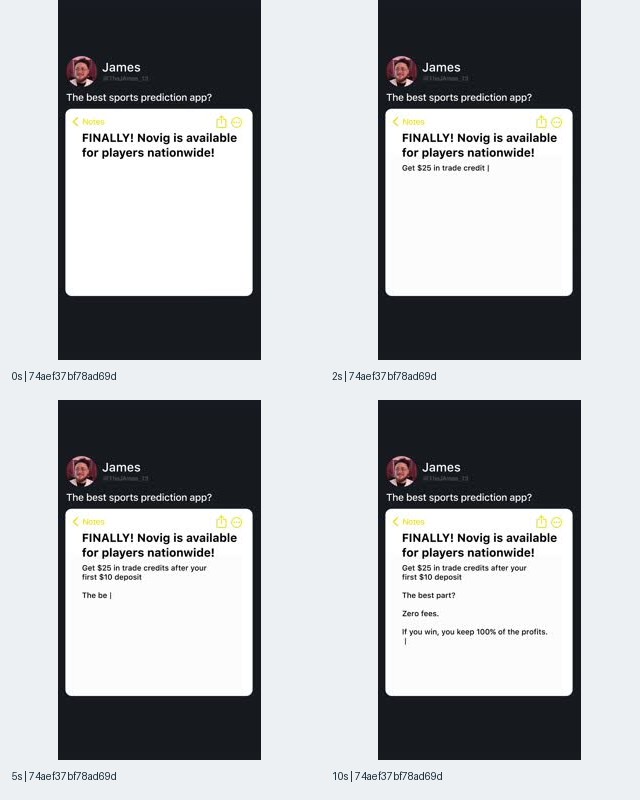
Image 1. Record 74aef37bf78ad69d, associated with verified iOS listing 6443958997. Supplied frames: 0, 2, 5, and 10 seconds; recorded full duration: 25 seconds. The contact sheet documents advertising copy and layout, not campaign performance.
The opening frame already contains the headline “FINALLY! Novig is available for players nationwide!” Above the note, a short question asks about the best sports prediction app. The visual arrangement creates two reading levels: an apparent recommendation outside the note and an explanation inside it. The availability statement is a claim in the ad; the screenshot does not independently verify availability.
By the 5-second frame, the body states “Get $25 in trade credits after your first $10 deposit.” By the 10-second frame, additional lines include “Zero fees” and a claim about keeping profits. Those statements should remain attributed to the advertisement. The source package does not supply the current terms or establish the full scope of the claims.
The design gives the headline a stable position while the body develops underneath it. A plausible creative hypothesis is that the fixed headline keeps the subject recognizable as the viewer follows new lines. Another hypothesis is that the outer recommendation provides context before the offer becomes complete. Neither has been tested here.
For a challenger brand, the reusable production question is whether an explanatory message benefits from a surrounding recommendation cue. Build an original comparison with the same approved proposition, the same offer, and a matched reading sequence, then vary the wrapper. Do not copy the profile treatment in a way that implies a real endorsement. The useful variable is the presentation of the explanation, not the identity shown in the reference.
Image 2: A Problem List Replaces the Availability Announcement
The second example keeps a social-post-style wrapper but changes the central message from availability to dissatisfaction with alternatives. A black Notes panel carries the headline “How sports betting apps keep you broke,” while the surrounding line says the speaker wishes they had switched sooner. This is an argument-led execution: the visual promise is that a list will explain a problem. Its record metadata gives a full duration of 25 seconds.
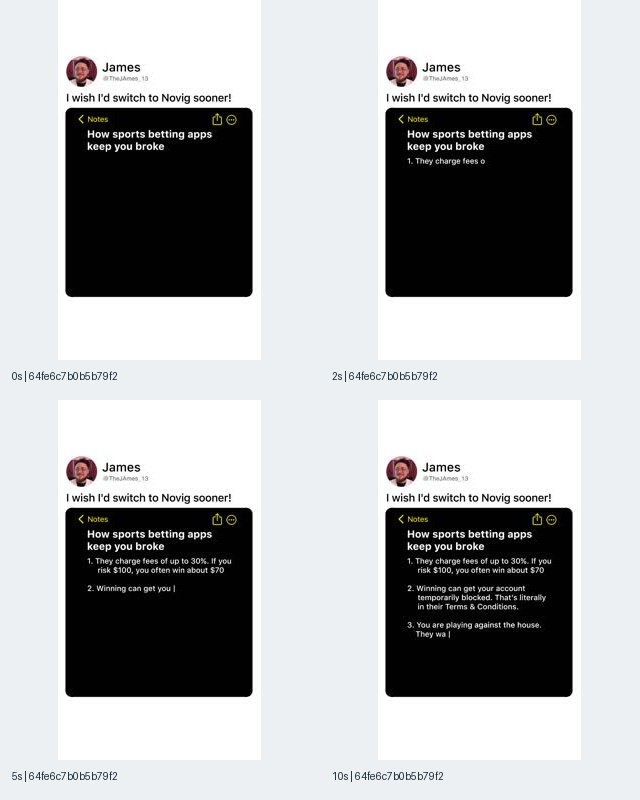
Image 2. Record 64fe6c7b0b5b79f2, associated with Novig’s verified iOS listing. Supplied frames: 0, 2, 5, and 10 seconds; recorded duration: 25 seconds. The numbered statements are advertiser claims, not independently established descriptions of other products.
The first frame presents the headline without the developed list. Later frames show numbered claims concerning fees and the relationship between a bettor and a betting service. The body becomes substantially denser by the 10-second image. That progression is visible; the exact typing speed and any simultaneous narration are not.
The switch from an announcement to a problem list changes the reader’s task. Image 1 asks the viewer to understand an offer attached to a named product. Image 2 first asks the viewer to recognize a grievance. Its outer statement supplies a switching story before the list gives reasons. This can be classified as a problem-and-switching structure without accepting the list’s assertions as facts.
A production brief should distinguish the list format from the claims placed inside it. Numbering can make separate arguments easy to scan, but each argument still needs its own support. Borrowing the structure does not justify borrowing accusations or numerical comparisons.
The corresponding test hypothesis is that an explicit explanation of a familiar problem may produce different comprehension or response from a simple availability announcement. A fair first test would use a substantiated problem relevant to the challenger’s own product and keep the subsequent offer constant. If both the problem and the offer change, any outcome becomes harder to interpret.
This record has 46,468,603 model-estimated impressions in the sampled window. Its position near the top makes it a useful reference to inspect, but the estimate cannot tell us whether viewers agreed with its claims, finished reading the list, or took action.
Image 3: The Offer Moves Into a Full-Screen Dark Note
The third example presents an availability-and-offer message in a full-screen dark Notes-style interface, removing the surrounding social-post-style context seen in Image 1. The headline remains visible at the top while short promotional lines appear beneath it. Its recorded duration is also 25 seconds. The visual similarity makes the pair useful for identifying presentation variables, although their coexistence does not prove that Novig ran a controlled experiment.
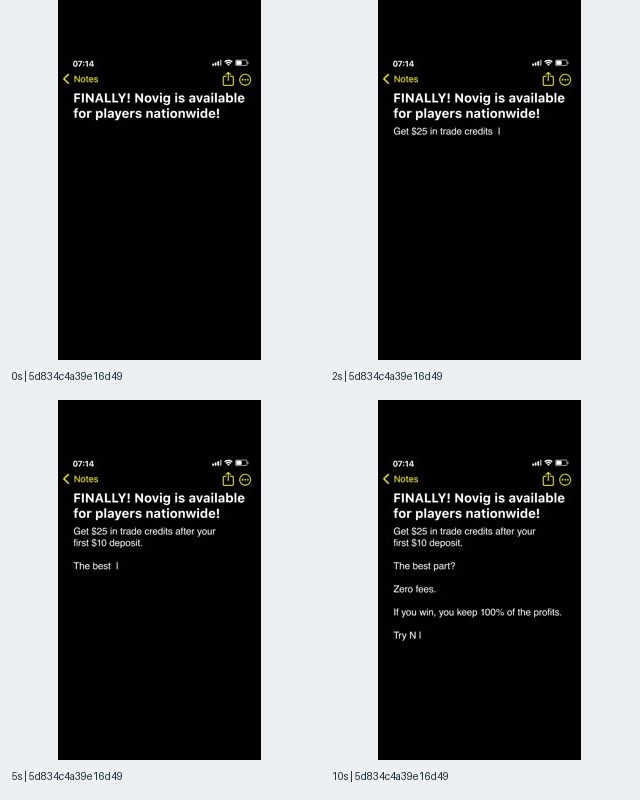
Image 3. Record 5d834c4a39e16d49, associated with iOS listing 6443958997. Supplied frames: 0, 2, 5, and 10 seconds; recorded duration: 25 seconds. Only the displayed portions of the message are assessed.
At the opening timestamp, the headline occupies the upper part of an otherwise mostly empty screen. By 5 seconds, the statement about $25 in trade credits after a first $10 deposit is visible. By 10 seconds, additional benefit claims and the beginning of another line appear. The supplied frames stop before the recorded video duration ends, so that incomplete line should not be expanded into an assumed closing call to action.
Compared with Image 1, the full-screen treatment gives the note the entire creative canvas. It also removes the separate recommendation line. Those are two changes, not one. An analyst who labels the pair merely “dark mode versus light mode” would miss the altered relationship between context and offer.
For an original test, separate background treatment from wrapper treatment. One comparison could hold the full-screen layout constant while changing contrast. Another could hold contrast and wording constant while adding a clearly branded introduction. This produces a more interpretable test than reproducing all the differences between the references at once.
The image also suggests a practical editorial check: inspect the point at which the offer becomes complete. A headline can be understood before the condition underneath has appeared. If a team adopts progressive text, it should decide which conditions must be visible alongside the offer and ensure the sequence preserves that meaning.
The record’s window estimate is 38,354,611 impressions. Its distinct fingerprint establishes a separate indexed video file, while its message resemblance to Image 1 establishes a useful visual relationship. Neither fact supplies a production cost, an audience segment, or a reason for the difference between their estimates.
Image 4: A Full-Screen Light Note Carries the Problem List
The fourth example places the problem-list headline in a full-screen light Notes-style layout, giving the argument more of the visible canvas than the wrapped treatment in Image 2. The source records a 25-second video. Across the supplied timestamps, the headline stays fixed while the numbered body develops. This completes a useful set of four references spanning announcement and problem messages alongside different surrounding layouts.
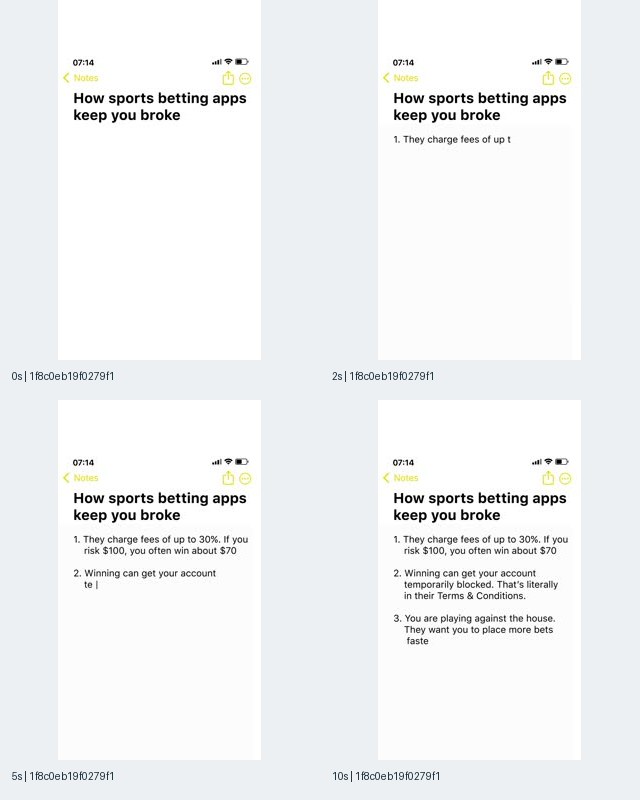
Image 4. Record 1f8c0eb19f0279f1, associated with Novig’s verified iOS listing. Supplied frames: 0, 2, 5, and 10 seconds; recorded duration: 25 seconds. Statements about alternatives remain claims made by the ad.
The opening frame contains the same problem headline visible in Image 2. At 2 seconds, the first numbered line has begun. By 5 seconds, the first point is more complete and the second is developing. By 10 seconds, the list reaches a third point. This is evidence of staged text disclosure at the selected timestamps, rather than evidence of viewer reading behavior.
The four Notes examples support a message-and-treatment map. Two illustrated records begin with availability; two begin with a problem. Two use an outer post-style presentation; two devote the full screen to the note. Light and dark treatments also vary. The visible set resembles a collection of related executions, but no internal test plan is supplied.
That distinction matters when translating the references into a challenger brief. The analyst can say that several combinations exist. The analyst cannot say that the advertiser systematically tested every combination, chose an optimal background, or discovered a winning psychological trigger.
An original production team can use the map to identify missing comparisons in its own work. If all current ads lead with the offer, a supported problem explanation may add a different message. If all current scripts use a person speaking, a text-led execution may provide another way to explain the same proposition. Those are portfolio choices to test, not conclusions already established by Novig’s sample.
This record contributes 30,113,230 model-estimated impressions. Together, Images 1–4 account for 39.4% of the sampled total. That makes the Notes family a meaningful part of this visible selection, while leaving most of the sample’s estimated impressions outside those four records.
Inspect the Indexed Examples Before Writing a Brief
A useful next step is to inspect relevant indexed records and preserve their identities before turning an attractive screenshot into a production instruction. You can search Novig creatives in AdMapix and compare visible messages, record dates, and linked listings. Live search results may differ from the frozen October sample, so save the conditions of any new research rather than treating the current page as an exact replay.
For each candidate, write down what made it relevant. “A note gradually explains the deposit condition” is a stronger research annotation than “good financial ad.” The first description identifies a mechanism a production team can discuss. The second invites everyone to substitute a different interpretation.
Also record whether the example contributes a new argument or merely a new visual treatment. The four Notes references illustrate why this helps: a collection can contain several files while repeating the same underlying proposition. A useful brief should make that repetition visible before asking for additional variants.
Image 5: An Outdoor Comparison Makes the Alternatives Spatial
The fifth example turns a switching argument into a side-by-side outdoor scene, with Novig on one side and “Sportsbooks” on the other. Two people stand on a basketball court, while labels and contrasting text carry the comparison. The recorded duration is 23 seconds. Unlike the Notes examples, the creative maintains a visible promotional strip while the comparative statements change above it.
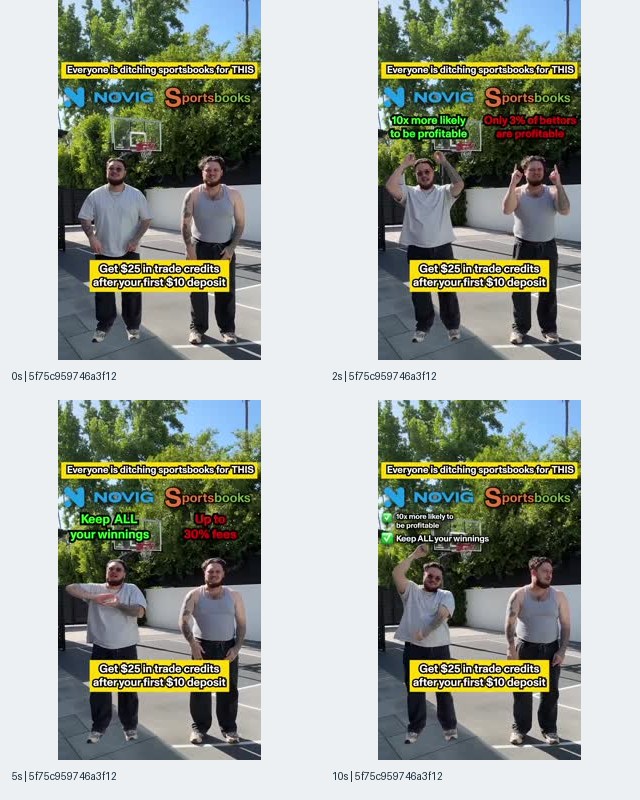
Image 5. Record 5f75c959746a3f12, associated with iOS listing 6443958997. Supplied frames: 0, 2, 5, and 10 seconds; recorded duration: 23 seconds. Comparative and profitability wording is shown as advertising copy, without independent substantiation in this sample.
The top banner reads “Everyone is ditching sportsbooks for THIS.” The two column labels give the viewer a stable comparison map. At later timestamps, green text on the Novig side and red text on the other side communicate different outcomes. One frame includes “10x more likely to be profitable,” while another contrasts keeping winnings with a claim about fees. These are statements made in the creative, not findings of this article.
The bottom strip reads “Get $25 in trade credits after your first $10 deposit.” Its persistence across the supplied images separates the offer from the changing comparison. The viewer can encounter different comparison text while still seeing the same promotional condition. That is a visible layout choice; its effect on understanding or response is unknown.
The gestures also change across the frames, but the contact sheet does not establish their complete sequence or any spoken explanation. It would be inappropriate to write a dialogue transcript or describe a full performance from these stills.
For a challenger brand, the transferable idea is a stable visual mapping of alternatives. A team could compare two verifiable workflows, features, or service conditions in fixed positions and preserve the same call to action underneath. The claim must remain specific enough to support. Color and labels can organize the comparison, but they cannot supply evidence for it.
This record contributes 28,480,992 model-estimated impressions in the Novig window. It supplies a visually different way to communicate a switching argument. It does not establish how much the advertiser invested in filmed production or whether the court setting influenced results.
Image 6: Large Offer Typography Dominates the Studio Frame
The sixth example uses a dark studio setting, a football, and oversized blue typography to make a promotional amount the central message. The record gives a full duration of 10 seconds and a first-observed date of 2026-10-09. In the supplied later frames, “DEPOSIT $10” appears above “GET $50,” with “IN TRADE CREDITS” beneath the large amount. The qualification is part of the offer’s meaning.
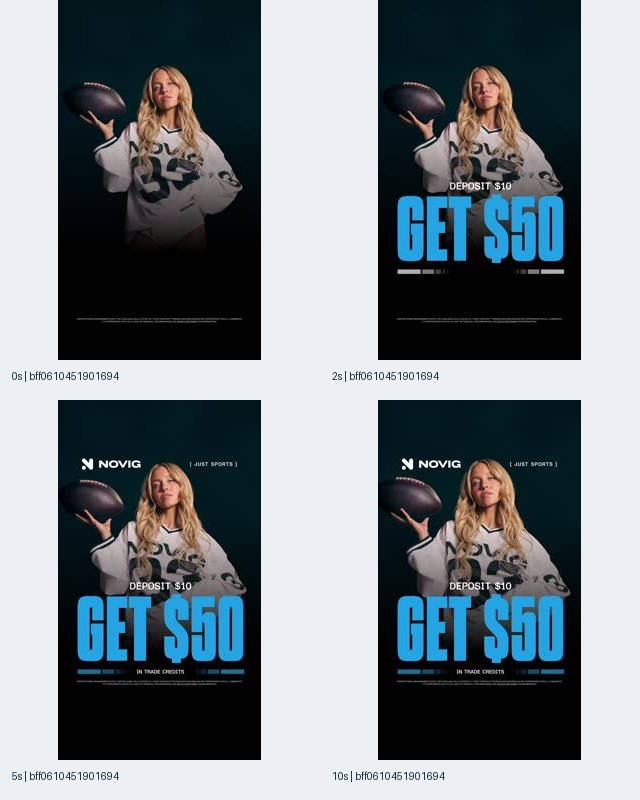
Image 6. Record bff0610451901694, associated with Novig’s verified iOS listing. Supplied frame labels: 0, 2, 5, and 10 seconds; recorded duration: 10 seconds. The displayed $50 amount is an ad’s trade-credit offer, not a verified current entitlement.
The opening image presents the person and football before the large offer appears. By the 2-second frame, the deposit line and blue amount occupy the lower center. The later frames show the brand mark and the trade-credit qualification alongside the developed layout. Small-print text is present, but the contact sheet is not an adequate basis for reconstructing all its terms.
The hierarchy differs from the Notes family. Rather than building an argument through multiple lines, the composition prioritizes a numerical offer. The sports prop supplies a category cue, while the typography gives the eye an obvious focal point. A plausible hypothesis is that this structure supports rapid offer recognition; no recognition test or response data is supplied.
A production team should avoid treating the largest words as the whole proposition. “Get $50” alone leaves out both the deposit condition and the type of value being advertised. In an original creative, the offer, required action, and qualification should remain connected as the layout changes. This can be checked during editing before media results exist.
The source record contributes 26,947,536 model-estimated impressions. Its October discovery date places it later than the illustrated August Notes records, but does not establish a strategic replacement. Both older and newer records have last-observed timestamps on 2026-10-30.
The person in the frame is not identified here. Visual resemblance, clothing, or a searcher’s expectation would not establish identity. The supported description is the visible scene and offer treatment, not a named endorsement.
Image 7: A Compact Card Groups the Offer and Its Conditions
The seventh example presents the $50 trade-credit message inside a rounded card over a similar dark sports-themed studio scene. The record is a distinct 10-second video first observed on 2026-10-09. Compared with Image 6, the most useful visible difference is the organization of the offer: the deposit requirement, amount, and trade-credit qualification are grouped into a compact panel instead of spread through a large typographic composition.
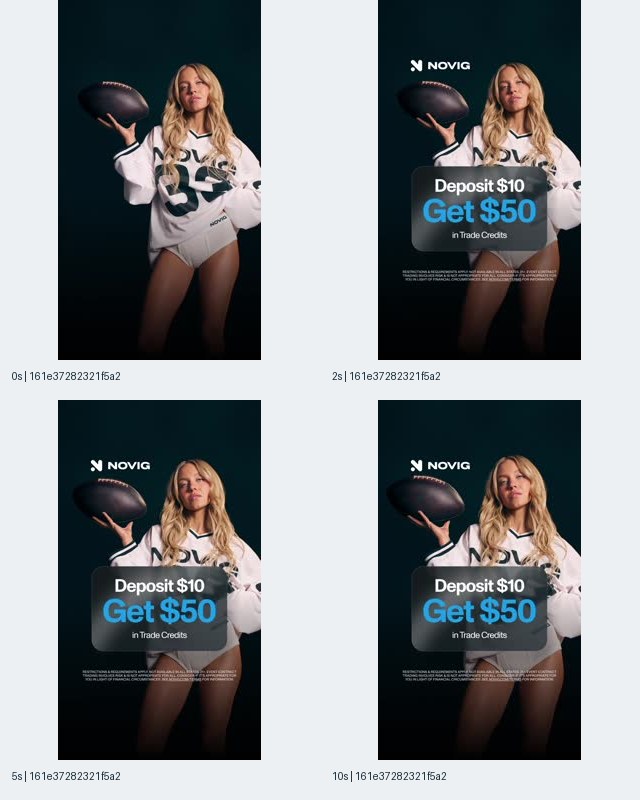
Image 7. Record 161e37282321f5a2, associated with iOS listing 6443958997. Supplied frame labels: 0, 2, 5, and 10 seconds; recorded duration: 10 seconds. The frame documents an offer-card treatment and does not identify the person shown.
The opening timestamp shows the studio scene without the developed offer panel. By 2 seconds, the card is visible, and the later sampled images retain the same main proposition. The panel’s position groups the required deposit and promotional value near one another. Small-print text sits below, separate from the main card.
This gives an analyst a specific layout comparison with Image 6. Both communicate the same headline deposit and trade-credit amounts in the supplied frames, but the visual containers differ. The comparison remains observational: separate records can differ in targeting, scheduling, distribution, or other unseen factors. Their estimated impression totals cannot isolate the effect of the rounded card.
An original challenger test could compare a grouped offer card with a more expansive type treatment while keeping the underlying proposition, approved language, footage, and destination consistent. A useful preliminary check would ask whether viewers correctly describe the required action and reward type after seeing each version. That would test a comprehension hypothesis, not substitute for campaign performance measurement.
The source record’s estimate is 25,401,535 impressions for the Novig window. Its proximity to Image 6 in the sample ranking is not a statistical comparison, and it should not be called a tie in effectiveness. The data show indexed scale within a model, not a randomized exposure experiment.
For production planning, the stronger observation is that a studio scene can support more than one message layout. Whether that is an economical approach for another team depends on its own footage rights, editing process, and actual production costs, none of which are measured here.
Image 8: A Similar Card Shows a Different Promotional Amount
The eighth example uses a similar rounded-card presentation but displays $25 in trade credits after a $10 deposit. Its record was first observed on 2026-09-10, earlier than the two illustrated $50 records. The coexistence of those records in the October sample demonstrates that different offer amounts are present in the indexed material. It does not establish a universal offer change, a controlled price experiment, or which terms apply to a particular reader today.
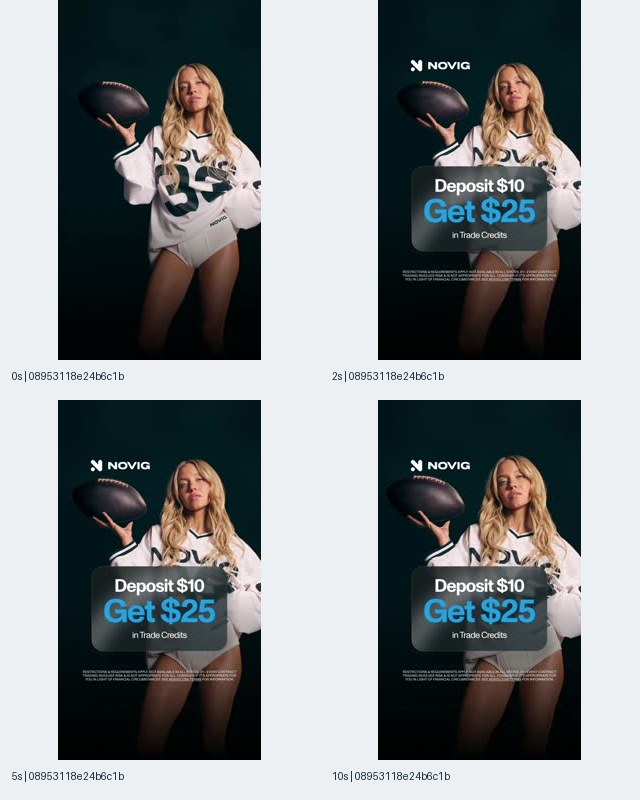
Image 8. Record 08953118e24b6c1b, associated with Novig’s verified iOS listing. Supplied frame labels: 0, 2, 5, and 10 seconds; recorded duration: 10 seconds. The $25 and $50 examples are separate historical advertising records, not a statement of current offer eligibility.
The visual relationship with Image 7 is close enough to make the amount change conspicuous. The main card retains the deposit line, promotional amount, and trade-credit label. The different amount is therefore a substantive offer difference within a similar presentation, rather than simply a background or typography change.
This is where creative research benefits from an offer ledger. Record the exact visible amount, the required action, the type of benefit, and the observation date. Do not reduce both examples to “deposit bonus,” because that removes the distinction a product or growth team may need to investigate. At the same time, do not fill in eligibility conditions that the images cannot establish.
The source record contributes 24,744,013 model-estimated impressions in the window. Its estimate cannot reveal whether the smaller amount attracted a different audience, produced different activation, or reduced acquisition cost. Those would require advertiser-side records and an appropriate comparison design.
The practical hypothesis for another challenger is about offer communication before it is about offer size: grouping the condition and benefit may help people describe the proposition accurately. A separate experiment would be needed to evaluate changing the offer itself. Combining both questions in one test can leave the team unable to explain an observed difference.
For readers seeking a promo code, none is established by these frames. The illustrated amounts are historical promotional copy. They should not be presented as a currently redeemable code, a cash amount available without conditions, or a verified promise for every viewer.
Fleet Shape: Broad File Variety With a Noticeable Leader
Novig’s top-30 sample has a noticeable leading record but does not concentrate most of its model-estimated impressions in one file. The leading record contributes 18.4%, while the top five together contribute 44.6% and the top ten contribute 66.2%. These are concentration measures within the selected records. They describe the shape of this sample, rather than the advertiser’s full distribution or dependency on an individual campaign.
The denominator is 546,361,992 model-estimated impressions. The top five sum to 243,760,478, and the top ten sum to 361,962,591. Those calculations use the same record-level field and measurement window throughout. They do not combine the separate ranking snapshot, the comparison-app bracket, or product-search aggregates.
This distribution supports a more precise answer than either “one hero ad” or “everything is evenly spread.” The first record is substantially larger than the next record, but many other files contribute meaningful portions of the sampled total. The observations therefore support a leading execution within a broader visible mix.
The file count adds another dimension. All 30 records have different video fingerprints, so there is no exact video-file repetition across the included records. However, the illustrated Notes and studio families demonstrate conceptual and visual resemblance. “Thirty distinct files” should not become “thirty entirely different ideas.”
For a challenger team, that distinction changes the production conversation. A request for more files can be satisfied by variations that leave the core argument unchanged. A request for more message diversity requires a different brief. The sample offers examples of both presentation variation and different message approaches, but it does not establish the concept classification of the 22 records without supplied visual examples.
A useful internal inventory would therefore maintain separate fields for file identity, message family, offer, and visual treatment. Exact duplication is a technical question. Strategic variety is an editorial question that requires seeing what the files actually communicate.
First-Observed Dates Show Several Cohorts, Not a Launch Calendar
The sampled records cluster around August, September, and October first-observed dates, with 11 of 30 first observed during the October measurement window. The earliest observation is 2026-08-06, and the latest is 2026-10-09. These dates describe when the index first encountered the records. They cannot establish filming dates, production completion, campaign launch approval, or the advertiser’s complete release cadence.
| First-observed grouping | Records in the sample | What can be said |
|---|---|---|
| August 2026 | 16 | Older observed records remain represented in the October sample |
| September 2026 | 3 | A smaller September cohort appears in the selected records |
| 2026-10-02 | 9 | Several records share a discovery date |
| 2026-10-09 | 2 | The two illustrated $50 studio records were first observed on this date |
The earliest observation precedes the collection date by 85 calendar days. That is a date gap, not proof of 85 uninterrupted days of advertising. Similarly, a shared discovery date does not prove that nine ads were released together. Collection processes can encounter multiple existing records at the same time.
All 30 records carry global last-observed timestamps on 2026-10-30. This supports the limited statement that they were observed again on the collection date. It does not establish continuous availability throughout the interval or predict whether any will remain visible tomorrow.
The visual evidence does permit a narrower chronological observation. The four illustrated Notes records were first observed in August. The illustrated $25 studio card was first observed in September. The two illustrated $50 studio treatments were first observed in October. Older and newer treatments coexist in the selected October records.
A hypothesis worth investigating is that the advertiser expanded its visible creative repertoire while retaining earlier messages. The sample cannot distinguish that explanation from other scheduling or indexing explanations. A challenger analyst can turn the hypothesis into a monitoring question: do later comparable samples retain the same message families, add new ones, or simply rearrange their estimated concentration?
Recorded Lengths Reveal Different Amounts of Explanation
The 30 records span 6–32 seconds, while the eight illustrated examples divide into 25-second Notes videos, a 23-second outdoor comparison, and 10-second studio offer videos. That pattern connects recorded length with visible message structure in these examples: the Notes frames develop an explanation, whereas the studio frames present a compact proposition. It does not establish an optimal duration or prove that shorter or longer videos perform better.
| Recorded duration | Number of sampled records |
|---|---|
| 6 seconds | 2 |
| 10 seconds | 6 |
| 15 seconds | 7 |
| 20 seconds | 1 |
| 22 seconds | 1 |
| 23 seconds | 4 |
| 24 seconds | 1 |
| 25 seconds | 5 |
| 27 seconds | 1 |
| 30 seconds | 1 |
| 32 seconds | 1 |
The table is a metadata inventory, not a visual classification of every file. For example, the presence of several 15-second records does not tell us whether they contain a person, text, an offer card, or a demonstration. Their content should remain unclassified until corresponding visual evidence is inspected.
For production, duration is best treated as a constraint on the message. A script that needs to explain a condition has a different editing problem from a card that groups a familiar action and benefit. Before selecting a length, decide what a viewer must be able to understand and which parts of that meaning must appear together.
A useful proposed comparison would hold the proposition constant and test different amounts of explanation. The team would record whether the additional material improves comprehension and whether its own downstream outcome changes. Simply comparing the estimates of a 25-second note and a 10-second studio ad would mix duration, imagery, wording, offer, and potentially distribution.
Novig Beside Kalshi and Polymarket: A Directional Scale Bracket
Novig’s sampled model-estimated impression total is much smaller than the supplied Kalshi and Polymarket top-30 totals, but the comparison uses adjacent rather than identical windows. The bracket places Novig in a smaller observed advertising position among these selected prediction-market apps. It does not measure total advertiser spend, market share, audience overlap, or the amount required to compete for sports-season attention.
The comparison-app pull was collected on 2026-10-30 for the US window 2026-09-30 to 2026-10-29. It selected the top 30 attributable records for each verified iOS listing using the same broad sampling approach. Novig’s frozen sample covers 2026-10-01 to 2026-10-30. The one-day shift is retained explicitly, and the totals are neither added together nor converted into precise cross-app ratios.
| App and verified iOS listing | Advertising window | Records | Summed model-estimated impressions | Leading record share | Distinct videos |
|---|---|---|---|---|---|
| Novig — 6443958997 | 2026-10-01 to 2026-10-30 | 30 | 546,361,992 | 18.4% | 30 |
| Kalshi — 1632713844 | 2026-09-30 to 2026-10-29 | 30 | 4,727,948,715 | 17.3% | 28 |
| Polymarket — 6648798962 | 2026-09-30 to 2026-10-29 | 30 | 2,517,234,302 | 12.7% | 19 |
The bracket also reports 12 of Kalshi’s 30 records and 24 of Polymarket’s 30 records as first seen in that comparison window. Their oldest sampled first-observed dates are 2026-09-04 and 2026-07-26, respectively. Those counts describe the supplied selections; they should not become company-wide creative production rates.
In the supplied Polymarket preview pull, no sampled record was last seen after 2026-10-13. That is an observation from that pull only. It is not evidence of the reason for the dates, the status of all Polymarket advertising, or activity outside the observed sources.
For a challenger marketer, the bracket’s value is context rather than a budget instruction. The selected Novig records show a mixture of explanatory and offer-led execution despite a smaller estimated sample total. A team can study that mixture without assuming it should match the larger apps’ media presence or that any particular creative style explains the scale difference.
The same distinction applies to sports-season attention. Football props and a basketball court are directly visible in Novig’s illustrated material. The evidence does not measure whether those ads reached the same people as Kalshi or Polymarket, competed in the same auctions, or benefited from a particular sporting event.
Novig Revenue: What the Ranking Shows and Leaves Unknown
Novig’s verified iOS listing does not appear in the captured top 300 of either the US revenue ranking or the US download ranking for 2026-09-29 to 2026-10-28. This is a statement about a captured ranking, not an exact rank and not a company revenue estimate. The source does not support an answer to Novig’s annual revenue, total deposits, trading volume, or profit.
The rankings are store-listing rankings with App Store and Google Play listings ranked together. The revenue values are third-party model estimates of app-store revenue for individual listings, and the API does not state their unit. Accordingly, this article quotes ranks and reported period changes rather than converting an unspecified value into dollars.
| Verified listing | US revenue ranking snapshot | Reported revenue-estimate change | US download ranking snapshot |
|---|---|---|---|
| Novig — iOS 6443958997 | Not in captured top 300 | Not supplied | Not in captured top 300 |
| Kalshi — iOS 1632713844 | #139 | +235.89% versus previous 30 days | #12 |
| Polymarket — iOS 6648798962 | #91 | +0.46% versus previous 30 days | #145 |
The absence of a listing from the captured results does not mean its revenue is zero. It also does not allow us to assign rank 301, determine a lower bound on company revenue, or infer a trend from an unobserved prior rank. A missing row is a limit on this snapshot, not a complete financial diagnosis.
The creative sample does not resolve that gap. Promotional trade-credit amounts are offer language, and impression estimates are advertising-model outputs. Multiplying either by a record count would not produce revenue. Nor would dividing a download-ranking estimate by advertising impressions create a defensible conversion rate: the sources measure different populations and do not link an exposure to an acquisition.
For a founder or investor, this leaves a concrete separation of tasks. The advertising research can show how the product is presented and how the selected records are distributed. Company financial questions require a suitable financial source. This source package does not contain one, so the financial answer remains unknown rather than reverse-engineered from advertising visibility.
The Useful Pattern Is Message Reuse Across Different Presentations
The eight illustrated examples show related propositions expressed through different visual presentations, making message reuse more informative than a simple count of files. Availability, switching arguments, fee-related claims, and deposit-linked trade credits recur across the visible material. The frames support identifying those themes. They do not show the advertiser’s creative brief, decision process, or reasons for retaining a particular version.
| Visible family | Examples | Main communication task | Variable a challenger could investigate |
|---|---|---|---|
| Availability note | Images 1 and 3 | Introduce the product and develop an offer | Wrapper, contrast, and information sequence |
| Problem-list note | Images 2 and 4 | Give reasons to consider switching | Supported argument and reading density |
| Outdoor comparison | Image 5 | Place alternatives in stable visual positions | Comparison layout and persistent offer |
| Studio offer | Images 6–8 | Make a deposit-linked benefit prominent | Typography, grouping, and offer amount |
This map is an editorial classification of the supplied images. It is not a claim that Novig organized its campaigns into these exact groups. The classification helps a reader decide what to compare and prevents every separate file from becoming a supposedly new strategy.
For example, Images 1 and 3 share a recognizable announcement-and-offer approach even though their surrounding presentation differs. Images 7 and 8 share a card structure while their promotional amounts differ. Those relationships matter because the first pair suggests a presentation question and the second raises an offer question.
The distinction also makes research more efficient. Instead of collecting additional examples that repeat the same message unnoticed, a team can look deliberately for a missing explanation, proof element, or product action. That does not guarantee better results; it makes the next production request more specific.
The Rips by Triumph teardown offers another entity-focused reference for examining concentration and first-observed dates. Its historical sample should be read within its own dates and definitions. The useful connection is the research question, not an assumption that another app’s creative economics transfer to Novig.
Turn the Ad’s Claims Into a Separate Research Ledger
An offer or comparative statement should be recorded as a claim made by a particular ad, with its wording and observation context preserved. This prevents a research report from quietly turning promotional language into product truth. The Novig examples make the need concrete: availability claims, fee claims, profitability comparisons, and different trade-credit amounts appear in different visual treatments, while complete current terms are not supplied.
A practical ledger can remain simple:
| Field | What to record from these examples | Why it matters |
|---|---|---|
| Source example | Numbered image and associated record | Keeps the claim attached to evidence |
| Visible wording | Exact readable proposition | Prevents interpretation from replacing the original |
| Required action | The deposit condition where shown | Preserves the relationship between action and benefit |
| Benefit type | Trade credits where stated | Avoids relabelling promotional value as cash |
| Observation | Capture date and visible timestamp | Distinguishes historical copy from current terms |
| Missing information | Unreadable or unavailable conditions | Keeps the research boundary explicit |
| Follow-up question | What needs verification before an original brief | Turns uncertainty into a task |
For the $25 and $50 studio cards, the visible benefit type is consistent while the amount differs. That is enough to record two offer variants. It is not enough to say that all customers moved from one offer to the other or that the larger amount replaced the smaller one everywhere.
For the Notes copy, the ledger should preserve the fact that conditions appear progressively. If the complete offer is not visible at the opening timestamp, record that rather than describing the full proposition as present from the start.
The resulting document is useful to both creative and product teams. Creative can see which ideas are presentation choices. Product can see which statements would require substantiation before use in an original advertisement. This is more actionable than a single “good ad” rating, because it separates the work that can proceed from the questions that remain open.
A Practical Workflow for a Challenger-Brand Research Session
A challenger team can turn this sample into a usable brief by moving from identity to observation, then from observation to a testable question. The output should be a small set of original creative decisions with traceable references. It should not be an imitation package or a claim that public advertising estimates reveal a competitor’s winning formula. The following workflow is a proposed process, not a test completed for this article.
-
Define the decision before collecting more ads. Choose whether the immediate question concerns the opening message, an explanatory format, an offer layout, or the breadth of a creative portfolio. “Find what Novig is doing” is too broad to guide production. “Compare ways to explain a deposit-linked promotional benefit” creates a clear research task.
-
Lock the product identity and research window. Record the verified listing, country, dates, sort order, and collection depth. When evaluating another app, repeat the identity check instead of assuming a familiar name identifies the right listing. Preserve the observation date so a later search can be recognized as a new sample.
-
Keep record inventory and media inventory separate. Count records first, then distinct files. Add a visual family only after inspecting an example. In this Novig sample the counts match, but the visual families still overlap. This distinction prevents unnecessary production requests based on inflated conceptual variety.
-
Annotate only what the preview shows. For Image 1, an annotation might read: “Availability headline visible at opening; deposit-linked trade-credit condition developed by the 5-second frame.” For Image 7: “Rounded card groups deposit, amount, and benefit type by the 2-second frame.” Neither annotation requires inventing audio or an ending.
-
Separate the message from its visual container. List the argument in one column and its treatment in another. An availability argument can appear in a note or a filmed explanation. A promotional benefit can appear in large type or a compact card. This separation produces options beyond copying a single reference.
-
Check the proposition against your own product. Replace every borrowed claim with language supported by the challenger’s actual offering. If the product team cannot support a proposed comparison, remove or narrow it. A competitor’s published claim does not establish what another brand can truthfully say.
-
Write one falsifiable hypothesis for each proposed comparison. Specify the expected change in comprehension or the team’s chosen campaign outcome, the variable being changed, and the conditions held consistent. Avoid hypotheses that merely restate a preference, such as “the cleaner layout will be better.”
-
Record the decision after the team’s own test. Keep the result with the original hypothesis and reference. If the result is uncertain, preserve that uncertainty. Do not let an inconclusive result become a success story because the competitor example looked convincing.
A compact handoff can include the source image, observed structure, approved original wording, proposed variable, required footage or artwork, destination promise, and measurement plan. The source image helps explain the reference; the approved wording and measurement plan make the work specific to the challenger.
This workflow also scales down to a small team. One person can maintain the evidence ledger and another can produce the original execution. The necessary discipline is not a large research department. It is keeping the evidence, interpretation, and proposed experiment distinguishable in the same document.
Three Original Test Briefs Suggested by the Visible Structures
The most useful creative output from this research is a set of original briefs that isolate different questions. The examples below are hypothetical production briefs for a challenger app with an approved proposition. They are not reconstructions of Novig’s internal tests, generated advertising outputs, or recommendations to reuse its wording. Any product claim or offer must be supplied and approved by the team running the test.
Brief A: Explain the same supported benefit with and without an introductory wrapper.
The reference relationship is between the wrapped and full-screen Notes presentations. The question is whether a brief introduction helps the intended audience understand why the explanation matters. Use the same original benefit statement, the same sequence of supporting information, and the same destination. One version begins directly with the explanation. The other adds a clearly branded introductory line that frames the problem.
The hypothesis is that the introduction changes comprehension of the product’s purpose. A preliminary check can ask viewers to describe the proposition in their own words. The campaign test, if run, should use the team’s chosen outcome and comparable conditions. The production deliverable should include a frame map so reviewers can see when the proposition and any conditions become complete.
Brief B: Compare grouped and distributed offer typography.
The reference relationship is between the large-type studio treatment and the rounded offer card. Keep the approved offer, footage, benefit type, and required action consistent. Change only how those elements are grouped on screen. The hypothesis is that the grouped version makes the relationship between action and benefit easier to explain accurately.
Do not change the promotional amount at the same time. Doing so would turn a layout test into a combined layout-and-offer test. The editor should provide versions at the intended viewing size and identify whether any condition is visually separated from the main amount. Acceptance should depend on meaning remaining intact, not simply on the amount being more prominent.
Brief C: Explain a verifiable difference with a stable comparison layout.
The reference is the court execution’s fixed left-and-right structure. Use an original setting and supported comparison relevant to the challenger’s product. Each side should answer the same question, such as the steps required to complete a task. Keep the comparison labels stable while showing the evidence for each point.
The hypothesis is that a spatially consistent comparison improves understanding of that specific difference. The production brief should identify the source of each comparison statement and the exact action the viewer is invited to take afterward. Avoid adding a broad superiority claim that exceeds the demonstrated difference.
Across all three briefs, a team should choose its evaluation criteria before seeing results. The public examples supply hypotheses and production references. The challenger’s own measurement supplies the eventual decision. Keeping those roles separate makes it possible to learn from the research without mistaking another advertiser’s visibility for proof.
What to Measure in Your Own Tests
A challenger should evaluate a borrowed structural idea with its own audience and outcome data, because the Novig sample contains no conversion evidence. The first useful question is whether the creative communicates the intended proposition accurately. The next is whether the audience takes the desired action under the team’s actual campaign conditions. Those questions require different observations and should not be collapsed into one impression count.
For a text-led execution, a comprehension check can ask what the product does, what action is required, and what conditions the viewer remembers. This is especially relevant when text appears progressively. A visually memorable headline is not sufficient if the viewer misses the qualification that gives it meaning.
For an offer-card comparison, check whether people distinguish the benefit type from the numerical amount. The Novig references explicitly use trade-credit language. An original challenger test should preserve whatever equivalent distinction applies to its own proposition, rather than evaluating only whether the largest number was remembered.
For campaign evaluation, select an outcome appropriate to the actual product and the available measurement. Record the exposure definition, attribution conditions, destination, and relevant downstream behavior. If the test changes the offer, include the resulting economics in the decision rather than judging the creative solely by an early interaction.
No universal threshold or promised lift is provided here. The evidence does not establish one. A useful result may be that two versions communicate equally well, that one introduces misunderstanding, or that the available sample is insufficient to decide. Each outcome can improve the next brief if it is recorded accurately.
Common Mistakes This Sample Helps Prevent
The most consequential mistakes come from assigning a stronger meaning to a field or frame than the evidence supports. A contact sheet is strong evidence of visible composition at selected timestamps. A record is useful evidence of a listing association and indexed metadata. Neither automatically reveals the advertiser’s budget, targeting, full creative inventory, or commercial outcome.
- Calling the top 30 the entire fleet. The collection depth was capped. Use “sample” when discussing counts, concentration, and age.
- Treating a fingerprint as a new concept. Images 7 and 8 are different files with closely related presentation. File uniqueness and idea uniqueness answer different questions.
- Calling first observation a launch. The October discovery clusters may be worth monitoring, but they are not a verified production schedule.
- Dividing window impressions by asset age. The impression numerator covers 2026-10-01 to 2026-10-30. An interval beginning in August is a different time basis and cannot establish a comparable daily rate.
- Reading longevity as effectiveness. An older record appearing again provides an observation history. It does not supply acquisition cost, retention, or profit.
- Naming a network from the appearance. Vertical frames and social-style design do not verify a placement source.
- Identifying a person from the frames. The sample supports describing the person’s visible role in the composition, not naming them or confirming an endorsement.
- Turning historical offer copy into current terms. The $25 and $50 amounts are tied to specific dated examples. Their current applicability is not established.
- Treating ranking absence as zero revenue. “Not in the captured top 300” is the supported statement. An exact rank or company revenue figure would be invented.
- Comparing adjacent-window totals as precise market share. The Novig and comparison-app windows differ. Preserve that difference and avoid a false precision that the collection cannot support.
A final reporting check should compare the headline with the evidence table. If the title promises every commercial, a celebrity identification, or a financial result, this sample cannot deliver it. A narrower title is more useful because readers can see exactly which question the article answers.
When AdMapix Fits This Research Task
AdMapix fits teams that need to find indexed advertising examples, preserve source context, and turn visible patterns into creative research. In this article, its role is the evidence layer: verified listing associations, a dated record sample, distinct-file counts, and linked visual references. It is not a substitute for Novig’s private account analytics or a source of company financial statements.
The practical handoff is to take one question from the analysis into live research. A creative strategist might investigate other ways to group an offer and its condition. A growth operator might monitor whether the same message families remain visible in a later sample. A founder might use the ranking boundary to decide which financial questions need a different source.
For ongoing work, sign up or log in to AdMapix to inspect live indexed data and develop your own dated competitor-research record. Start with a specific product and decision, then preserve the filters and observations used in the brief. Current results can change, so a saved conclusion should always retain its observation date.
Commercial terms can also change. Consult the live AdMapix pricing page for current plans rather than relying on historical prices or quotas in an evergreen article. This article does not promise a paid-plan trial or an hourly refresh commitment.
If the task is to determine whether a particular creative generated profitable customers, use the relevant advertiser-side measurement. If the task is to understand a visible message and design an original test around it, the research workflow illustrated here is the appropriate starting point.
FAQ
The questions below separate what the dated Novig sample answers from what requires additional evidence. The same distinction is useful when a commercial search becomes a creative brief, a competitor report, or an investment question: a recognizable image can establish the execution being discussed without establishing the person, current offer, or business result associated with it.
What do the sampled Novig ads look like?
The eight illustrated examples include four Notes-style text executions, one outdoor comparison on a basketball court, and three dark studio offer videos featuring a football. Their visible messages include availability, reasons to switch, and deposit-linked trade credits. The wider sample contains 30 distinct video files, but visual content is only assessed for the eight supplied contact sheets.
Can these frames identify the person in a Novig commercial?
No. The supplied frames do not establish anyone’s identity, and this article does not identify people by appearance. They can help distinguish a studio offer commercial from a Notes-style execution or an outdoor comparison. Confirming a person or endorsement would require suitable evidence beyond a face, clothing, or resemblance in an advertising frame.
How long are the Novig commercials in this sample?
Recorded durations across the 30 sampled videos range from 6 to 32 seconds. The four illustrated Notes examples are 25 seconds, the outdoor comparison is 23 seconds, and the three illustrated studio examples are 10 seconds. These durations come from record metadata. The visual review covers only the supplied frames labelled 0, 2, 5, and 10 seconds.
Does Novig depend on one hero ad?
The bounded sample does not show one record taking most of its model-estimated impressions. The leading record contributes 18.4%, the top five contribute 44.6%, and the top ten contribute 66.2%. That supports describing a noticeable leader within a broader sampled distribution. It does not establish Novig’s complete advertising concentration or dependency across all sources.
What does the evidence say about Novig revenue?
Novig’s verified iOS listing is absent from the captured top 300 of the US revenue ranking for 2026-09-29 to 2026-10-28. The ranking concerns third-party estimates of store-listing revenue, with an unspecified value unit. It does not disclose annual company revenue, deposits, trading volume, or profit, and absence should not be interpreted as zero revenue.
Is the $25 or $50 Novig offer currently available?
The sample does not establish current availability or eligibility. It shows historical advertisements with a $10 deposit condition and either $25 or $50 in trade credits. The amounts belong to separate records, and the complete applicable terms were not verified here. The images also do not establish a promo code that a reader can redeem.
Can a challenger brand use these examples to plan tests?
Yes, as references for structure and hypotheses. Useful variables include a recommendation wrapper, progressive explanation, a stable comparison layout, and grouped offer typography. The team should use its own supported claims and original assets, keep the relevant proposition consistent within each comparison, and judge outcomes using its own measurement. Public impression estimates cannot supply the test result.
Key Takeaways
The actionable finding is a visible mix of explanatory and offer-led treatments, supported by a dated sample rather than a claim about the entire advertiser. A challenger team can use the examples to make its next brief more precise while keeping financial, placement, and performance questions attached to the evidence they actually require.
- Thirty records resolve to thirty distinct videos, but related messages and layouts recur across the illustrated files.
- The leading record represents 18.4% of sampled model-estimated impressions, while the four illustrated Notes executions together represent 39.4%.
- First-observed dates show older and newer records together, not a verified launch schedule or proof of continuous advertising.
- Novig is absent from the captured revenue-ranking top 300, which leaves company revenue unknown.
- The practical next step is an original, measurable comparison of message or presentation, followed by evaluation using the challenger’s own data.
Sources
The sources below support a dated advertising analysis and its research workflow. They do not establish current promotional eligibility, identify people in the frames, or supply advertiser-side performance results.
- Frozen AdMapix source package — observed 2026-10-30. The public package linked in the methodology contains the Novig listing verification, US advertising sample for 2026-10-01 to 2026-10-30, associated records, timestamped image references, and reproducible collection information. Calculated sample totals and shares use the included advertising-record estimates.
- Supplementary AdMapix comparison and ranking snapshots — captured 2026-10-30. The supplied editorial source package provides the Kalshi and Polymarket top-30 advertising bracket for 2026-09-30 to 2026-10-29 and US store-listing ranking observations for 2026-09-29 to 2026-10-28. These remain separate from Novig’s newer advertising window.
- Novig’s verified US App Store destination — identity snapshot supplied on 2026-10-30. Used to anchor listing 6443958997 and seller Novig, Inc.; not used as evidence of campaign results or current offer terms.
- AdMapix methodology — methodology reference accompanying the 2026-10-30 analysis. Provides the public methodological context for interpreting indexed creative evidence and estimates. The specific dates and sample limits used here are stated above.
- AdMapix Novig search workflow — live research destination associated with this 2026-10-30 study. Suitable for inspecting relevant indexed creatives and beginning a new dated collection; live results may differ from the frozen package.
The eight numbered images are advertising contact sheets from the supplied source sample. They are evidence of visible creative content at selected timestamps, not generated outputs, complete-playback reviews, or proof of campaign performance.
Turn these observations into your next creative study
Open the creative library and select samples for your market, network and research question.
Related Articles
Courtyard (Courtyard.io) Cards Ads & Revenue Rank 2026
A dated US analysis of Courtyard.io’s revenue ranking, 30 advertising records, eight visual examples, video reuse, and comparison with Rips by Triumph, with clear limits on company revenue and performance claims.
Pangle Ads Examples: What a Dated US Search Sample Shows
Examine eight dated advertising examples from a US-filtered Pangle research sample, distinguish product identity from placement evidence, and turn visible creative patterns into original test briefs.
Colony Flow! Ads: Pixel Hooks, Video Reuse, and Playables
A dated US sample connects 30 Colony Flow advertising records to 19 video files and six playable files, with eight visual analyses that separate observable hooks and reuse from unverified gameplay and performance claims.