
Underdog Rips Ads: Pack Reveals in a Sports-Led Sample
Eight Underdog advertising contact sheets show pack reveals alongside prominent sports offers, while a dated US iOS sample reveals recent records, concentrated modelled impressions, and clear limits on claims about fleet turnover, revenue, and product experience.
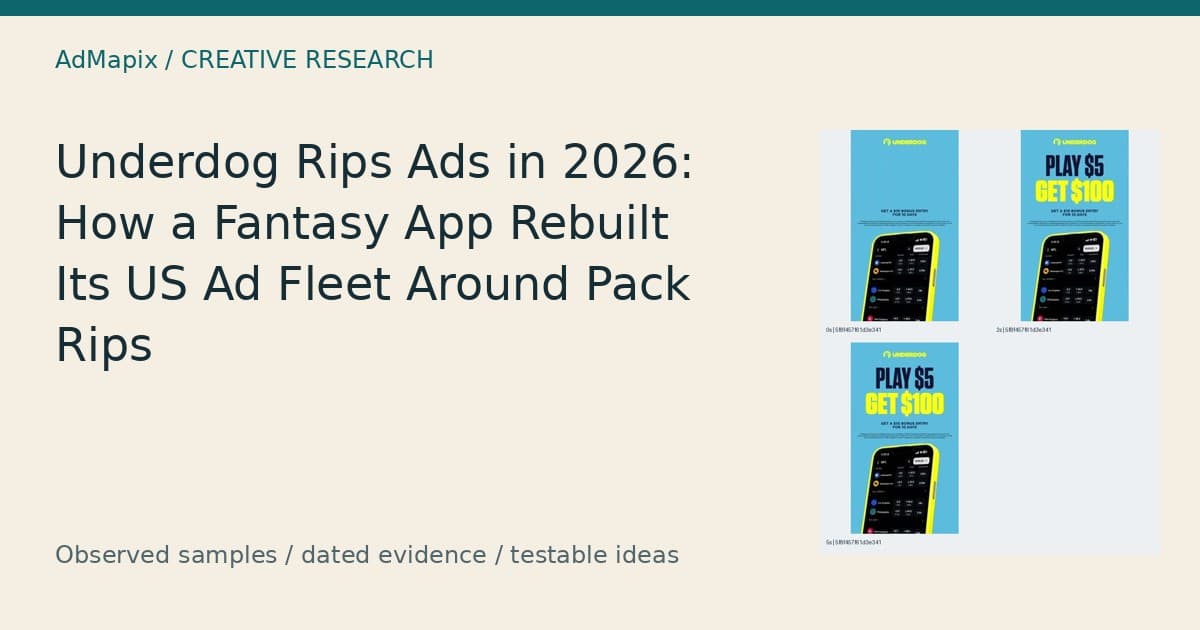
Underdog Rips Ads: Pack Reveals in a Sports-Led Sample
AdMapix Research — prepared with Codex and checked against the dated source sample.
Editorial ownership: Brad at AdMapix. This ownership statement does not imply personal human review.
Last updated: 2026-10-30.
Underdog Rips advertising is visible in this US sample, but pack reveals do not define its leading records. The supplied screenshots include a Pokémon pack-and-card sequence alongside sports interfaces, bonus-entry messaging, and repeated “Keep Your $1,000,000” claims. The largest record by modelled impressions shows “Play $5 Get $100,” not a pack reveal. Meanwhile, 25 of the 30 sampled advertising records were first seen within the measurement window, indicating a recent sample without establishing that Underdog replaced its entire advertising fleet.
For acquisition managers, creative teams, and market researchers, the useful finding is the coexistence of these messages under the verified iOS listing, “Underdog: Sports, Games & Rips.” This article examines the eight supplied contact sheets, the sample’s concentration and first-seen dates, and a separate comparison with Rips by Triumph, Courtyard, and PrizePicks. It reviews advertising evidence, not the app’s pack-opening experience.
Quick Answer
Underdog’s sampled ads include pack imagery, but the leading visible examples emphasize sports and promotional offers.
- The verified US iOS sample contains 30 advertising records and 583,234,248 third-party modelled impressions for 2026-10-01 to 2026-10-30.
- Its largest record represents 38.7% of that sample estimate and shows a sports interface with a bonus-entry offer.
- The supplied pack-reveal example represents 2.6% of the sample estimate. Its frames show packs, graded-card imagery, and displayed dollar values.
- Twenty-five records were first seen within the window. That supports a finding of recent discovery, not a confirmed launch date or complete fleet replacement.
- AdMapix can support further creative research; campaign results and product experience require separate evidence.
What an Underdog Rips Search Can Actually Answer
The advertising sample can explain how Underdog presents packs, sports, and offers, but it cannot provide a consumer review of the Rips feature.
That distinction matters because searches such as “Underdog Rips review,” “Underdog Rips packs,” and “Underdog Rips shipping” ask different questions. A creative strategist wants to know which promise appears first and how the product is represented. Someone evaluating the feature wants current terms, a verified product walkthrough, and evidence about the actual experience. Screenshots of an advertisement answer only part of the first task.
Here, “rips” describes the pack-opening language visible in the advertising and the verified store title. It does not establish that every ad linked to that listing promotes packs. The sample includes a phone displaying sports selections, a filmed spokesperson execution, money-bag imagery, grids of picks, and a pack-and-card sequence. Treating all of those as pack ads would erase the central finding.
The distinction also affects research priorities. A team entering this market should investigate both the pack-specific message and the broader acquisition context around it. The pack example deserves analysis because it explicitly presents the mechanic of interest. The larger sports-related records deserve analysis because they occupy prominent positions in the same bounded sample.
This article belongs to the AdMapix ad strategy teardown series. Its purpose is to turn dated records into specific creative questions while preserving the difference between what an advertisement shows, what a data model estimates, and what remains unknown.
Methodology: Identity, Dates, Country, and Sample Limits
This analysis uses a bounded, impression-sorted US sample tied to one verified iOS listing, with visual observations limited to the supplied timestamped contact sheets.
The subject measurement window is 2026-10-01 to 2026-10-30, with the country filter set to US. The frozen collection was fetched on 2026-10-30 at 17:01:52 UTC. Research began with the query “Underdog”, followed by product attribution to iOS app ID 1514665962, titled “Underdog: Sports, Games & Rips”, with seller Underdog Sports, Inc.
The sample contains three pages of ten records, sorted by descending modelled impressions. Product identity was checked through the listing association rather than accepted from a keyword match. The collection is limited to that verified iOS listing. Although the product information also references an Android package, Android advertising is outside this measurement scope.
An advertising record is an indexed ad instance. It is not necessarily a unique video, a unique campaign, or a unique creative concept. The supplied facts distinguish 30 records from 22 unique video fingerprints, two unique image fingerprints, and six unique playable fingerprints. These categories remain separate throughout the article; they are not added into a single asset total.
All impression figures are third-party model estimates for the stated window. They are not observed delivery, unique people reached, spend, installs, company revenue, profit, or lifetime totals. Record-level figures come from each advertising record’s own impression estimate. Product-search aggregates have an unspecified time scope and are excluded.
The visual evidence consists of eight contact sheets: still images combining selected frames from the associated videos. These are not complete playback records. Observations therefore refer to the pictured frames and their supplied timestamps, not unseen transitions, audio, narration, or later scenes. The eight examples do not provide visual coverage of every sampled record.
There is also a timing inconsistency worth preserving. Image 4 includes a frame labelled 10 seconds, while its associated record reports a nine-second video duration. Its visible content remains available for analysis, but the package does not resolve the exact endpoint timing. We do not use that discrepancy to reconstruct a complete sequence.
The supplied source field has no verified network-name mapping in this package. Consequently, this article does not assign these ads to TikTok, YouTube, Instagram, or another named placement. A vertical layout and a verified App Store destination do not establish the advertising network or the buyer’s identity.
Two supplementary datasets remain separate. The comparison-app advertising snapshot covers 2026-09-30 to 2026-10-29, collected on 2026-10-30. The US store-listing rankings cover 2026-09-29 to 2026-10-28, compared with the previous 30 days. Neither is added to the subject’s advertising total.
The public frozen source package provides the dated batches, request parameters, listing associations, and checksums for reproducibility. AdMapix’s public methodology provides the wider measurement context. Checksums help identify the preserved evidence; they do not validate creative quality or campaign performance.
The Evidence Table: Recent Records and Concentrated Estimates
The sample combines recent first-seen dates with a substantial concentration of modelled impressions in its leading records.
| Measure | Frozen finding | Interpretation boundary |
|---|---|---|
| Advertising records | 30 | Bounded sample, not a complete fleet |
| Records containing video | 24 | Some records share video files |
| Unique video fingerprints | 22 | File identity, not a count of creative concepts |
| Unique image fingerprints | 2 | Separate from video and playable counts |
| Records containing playable references | 6 | Presence does not establish tested interaction |
| Unique playable fingerprints | 6 | Separate interactive-file category |
| Window modelled impressions | 583,234,248 | Third-party estimate for the stated US window |
| Largest record’s share | 38.7% | Share of this sample’s estimate |
| Top five records’ share | 69.8% | Sample concentration, not budget allocation |
| Largest record versus second | 3.3 times | Ratio of modelled record impressions |
| Earliest first-seen date | 2026-09-24 | Earliest among these selected records |
| Latest first-seen date | 2026-10-23 | Does not imply production stopped afterward |
| Records first seen within the window | 25 | Recent indexed records, not necessarily new concepts |
| Records last seen in the final three days | 24 | Recent observation, not continuous-delivery proof |
These measures answer different questions. The impression estimate describes the selected records’ modelled exposure. Fingerprints describe file reuse. First-seen dates describe when records appeared in the source. Last-seen dates describe their latest indexed observation. None substitutes for the others.
For a research team, the combination suggests a practical order of inspection: understand the largest record’s message, compare other prominent records, then examine the pack-specific example and the formats not represented by contact sheets. That order is about allocating research attention. It is not a recommendation to reproduce the largest ad or assume that it generated the strongest business result.
Underdog Revenue: What the Store Ranking Shows
Underdog’s verified iOS listing appears at revenue rank #200, with a reported revenue-estimate change of +18.64% against the previous 30 days, in the supplied US ranking snapshot.
The ranking window is 2026-09-29 to 2026-10-28. These are AdMapix store-listing rankings that rank App Store and Google Play listings together. The table below identifies the specific iOS entries relevant to this comparison.
| Verified iOS listing | App ID | Revenue rank | Reported change versus previous 30 days |
|---|---|---|---|
| Underdog: Sports, Games & Rips | 1514665962 | #200 | +18.64% |
| PrizePicks: Sports and Packs | 1437843273 | #165 | +10.24% |
| Rips by Triumph | 6751921248 | #18 | −6.51% |
| Courtyard: TCG, Watches, Cards | 6748155184 | #68 | −10.63% |
The revenue ranking is based on a third-party estimate of app-store revenue for each listing. The supplied API does not state the unit of its underlying revenue value. This article therefore reports rank and period change, not a dollar amount. The percentage change describes the reported estimate’s movement; it is not a percentage change in the ordinal rank.
Underdog was not in the captured top 300 download ranking. That is a statement about the captured ranking boundary, not an exact rank, an absence of downloads, or a finding about the company’s total audience.
For additional download context, the supplied Rips by Triumph snapshot reports download rank #94 and an estimated 835,976 downloads for that ranking window. Its download change against the previous period was not supplied, so a download-growth comparison is unavailable.
No same-ranking revenue-value ratios are supplied. Dividing rank positions would not produce a revenue ratio, so we do not calculate one. Nor can these listing-level estimates establish company revenue, deposits, trading volume, or the revenue contribution of Rips within Underdog.
The dates also prevent a tempting causal story. The ranking window overlaps several advertising discoveries, including the pack example, but overlap does not establish that those ads caused the reported change. There is no feature-level revenue breakdown, conversion attribution, or controlled experiment in the package.
How Young Is the Sample, and Does It Prove a Fleet Rebuild?
The selected records are recent, but a single top-30 snapshot cannot prove that Underdog rebuilt or replaced its entire US advertising fleet.
The earliest first-seen date is 2026-09-24, the latest is 2026-10-23, and 25 records were first seen during 2026-10-01 to 2026-10-30. The evidence therefore supports describing this as a sample dominated by records first discovered within the measurement window. None of the selected records has a first-seen date earlier than late September.
That is narrower than a fleet-turnover claim. To establish turnover, a researcher needs an earlier population and a later population, a consistent collection method, and a way to distinguish continuing files from newly observed instances. This package supplies the current selection, not a complete preceding fleet against which replacement can be measured.
The difference between records and files matters here. A new advertising record can reference an existing video. Its recent record date does not automatically mean that a new creative concept was produced on that date. Likewise, an older video can remain relevant while appearing in a new combination or associated instance.
There are several possible explanations for a recent sample: new creative production, new indexed instances of existing material, a change in which records rank near the top, or changes in source visibility. These are hypotheses, not established explanations for Underdog. The available data does not identify the cause.
A near-complete turnover would look different in a properly matched comparison. Previously observed assets would largely disappear from the later selected population, newer assets would enter, and repeated observations would help determine whether the apparent exit persisted. Even then, leaving a top-N selection would mean falling outside that selection, not necessarily stopping everywhere.
The source also reports that 24 sampled records were last seen in the final three days of the window. That adds evidence of recent observation for much of the sample. It does not establish uninterrupted delivery or show the activity status of every record at the moment this article is read.
For monitoring purposes, the next useful step is to preserve this snapshot as a baseline. A later collection can ask whether the same fingerprints remain visible, whether pack-related examples become more prominent, and whether the leading sports offer persists. Those are testable follow-up questions. “Underdog rebuilt its fleet around Rips” is not yet a supported conclusion.
Concentration: The Leading Record Is a Sports Offer
The largest record’s visible message is a sports-related bonus offer, which prevents the sample from being described as a pack-led advertising rebuild.
Record 5f8f457f61d3e34133bc26514e400347 has 225,629,767 modelled impressions and accounts for 38.7% of the sample estimate. The supplied facts put it at 3.3 times the second record. The top five records together account for 69.8%.
This is meaningful concentration within the selected population. It means that understanding the largest record materially affects how a reader interprets the sample. A report that leads only with the pack image would accurately identify a visible mechanic while overlooking the message attached to the largest estimate.
The leading record was first seen on 2026-10-09 and last seen on 2026-10-20. Its large window estimate does not prove it remained visible through the end of October. Nor does its earlier last-seen date establish why observations ended. There is no evidence here of budget exhaustion, creative fatigue, a deliberate withdrawal, or a performance decision.
Concentration also should not be translated into spending shares. An impression estimate and a budget allocation are different quantities, and the source supplies no record-level spend. Similarly, a large share does not prove that the creative generated more installs or stronger retention than another example.
The practical research implication is to separate prominence from relevance. The leading offer is prominent in the sample. The pack example is directly relevant to the “Underdog Rips” question. A useful analysis includes both, then states which evidence supports each conclusion.
Image 1: The Largest Record Leads With a Bonus-Entry Claim
Image 1 presents a numerical offer above a sports interface, with smaller text identifying the advertised benefit as bonus entries over time.
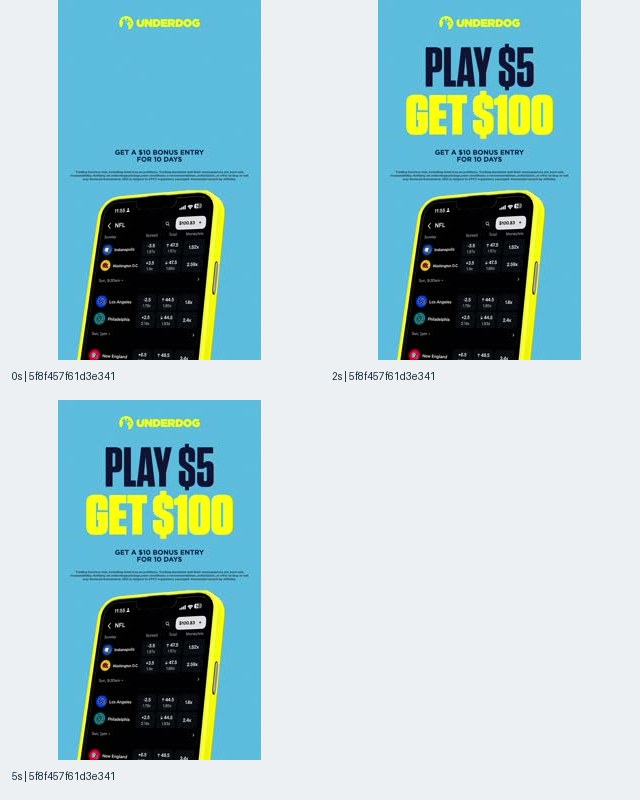
Image 1. Contact sheet for record 5f8f457f61d3e34133bc26514e400347, associated with Underdog’s verified iOS listing. Supplied frames: 0, 2, and 5 seconds. Window modelled impressions: 225,629,767. The screenshot records an advertising claim, not a verified current offer.
At the supplied opening frame, the cyan background, yellow Underdog branding, and tilted phone establish the visual setting. The phone displays a dark sports interface. By the frame labelled 2 seconds, the large headline reads “PLAY $5 GET $100.” The frame labelled 5 seconds preserves that headline and the phone composition.
The smaller line reads “GET A $10 BONUS ENTRY FOR 10 DAYS.” That line changes how the headline should be interpreted. A research note that records only the large dollar figure would omit the visible description of how the advertised benefit is structured. It should not be rewritten as a cash payment or a pack-specific promotion.
The composition creates a clear hierarchy: headline, explanation, and product image. The phone is cropped at the bottom, while the offer occupies the upper portion of the visible layout. The sports rows contribute product context even though their detailed values are not the main message.
For creative teams, the useful reference is the relationship between a short headline and a nearby qualification. A hypothetical test could compare an offer-led opening with an interface-led opening while keeping the underlying offer and destination constant. The test would ask whether viewers understand the advertised action and benefit more accurately, then use the advertiser’s own campaign data to evaluate outcomes.
The source does not support calling this the best-performing ad. It supports calling it the largest record by modelled impressions in the selected window. That wording preserves the evidence while still explaining why the image deserves close attention.
Image 2: A Human Scene Carries the Brand Without Explaining Packs
Image 2 uses a phone close-up and a filmed spokesperson scene to communicate the Underdog brand, without showing a pack in the supplied frames.
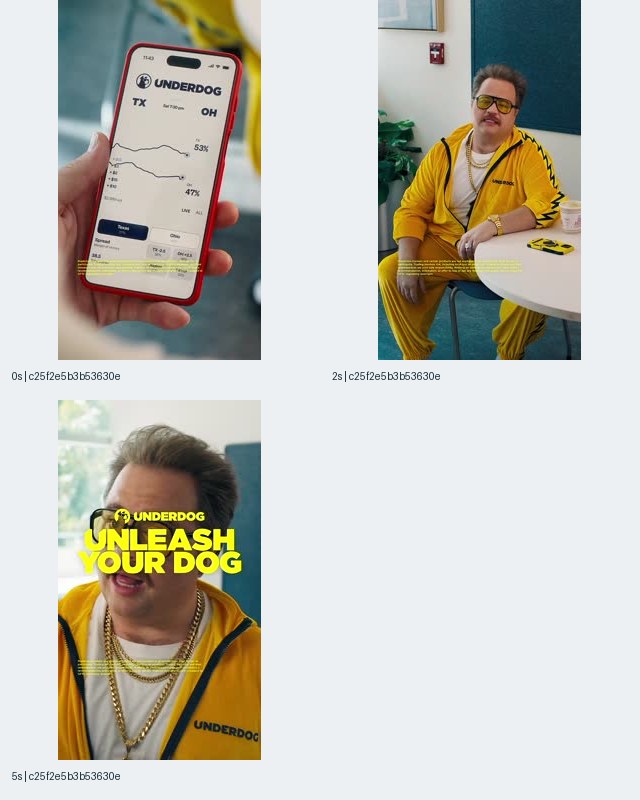
Image 2. Contact sheet for record c25f2e5b3b53630ed6422427a3c610a6, linked to the verified Underdog iOS listing. Supplied frames: 0, 2, and 5 seconds. Window modelled impressions: 67,778,506; sample share: 11.6%.
The first supplied frame shows a phone held in a hand. Its screen displays the Underdog name, the labels “TX” and “OH,” and line-chart graphics. The next supplied frame shows a person wearing yellow clothing and glasses, seated beside a table. The final pictured frame places “UNLEASH YOUR DOG” across a closer view of the person.
The yellow clothing connects the filmed scene with the brand’s yellow visual system. The phone opening provides interface context before the later brand line. Those are observable creative choices. The frames do not establish who the person is, what they say, or whether the execution was distributed through their own account.
This distinction is especially useful when a research brief asks about a recognizable face. Identification should not be inferred from resemblance, and the presence of a person should not automatically become a claim of celebrity endorsement, creator partnership, or customer testimony. None of those relationships is established here.
Compared with Image 1, this execution gives more visual space to a person and setting. The offer card communicates through typography and a product image; this example adds clothing, posture, and a room. A creative team can study those production choices without assuming which approach held attention longer.
A practical hypothetical brief would specify the role of each scene: show the relevant interface, establish a recognizable brand environment, and close with an accurate product message. The team would then check whether viewers can explain the product after seeing the ad. That comprehension question is distinct from measuring clicks or conversions, neither of which is available in this source.
Image 3: The Million-Dollar Claim Leads Into Sports Context
Image 3 pairs a “Keep Your $1,000,000” claim with money-bag imagery and a later sports-field frame, rather than a visible pack-opening scene.
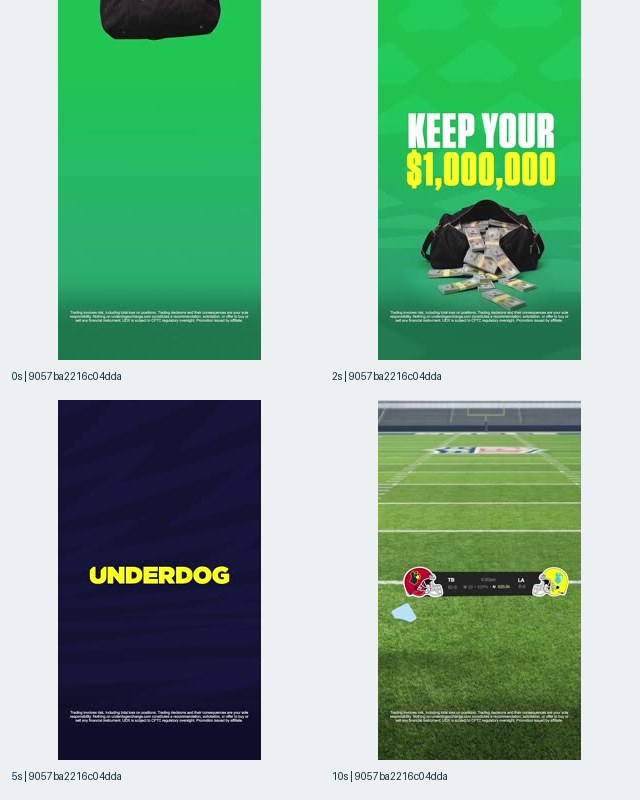
Image 3. Contact sheet for record 9057ba2216c04dda0d89b547db35d3f6. Supplied frames: 0, 2, 5, and 10 seconds. Window modelled impressions: 43,940,401; sample share: 7.5%. The dollar amount is an on-screen advertising claim.
The frame labelled 0 seconds shows part of a dark bag against green. At 2 seconds, the composition includes an open bag, banknote imagery, and the headline “KEEP YOUR $1,000,000.” The frame labelled 5 seconds shows the Underdog name on a dark background. At 10 seconds, a football field appears with a matchup-style interface.
The observed frames connect an outcome-oriented claim to a sports setting. They do not show all the steps of the advertised activity or establish the conditions attached to the headline. The small text is present, but this contact sheet is not an adequate basis for reconstructing every term.
This example helps distinguish theme from mechanic. A bag of money and a large dollar figure signal a promised outcome in the ad. A sports field and matchup display provide category context. Neither is evidence of card packs merely because the associated store title includes “Rips.”
The record reports a 30-second video, while the supplied visual observations stop at 10 seconds. That gap matters: the remaining footage could contain additional explanation, but it has not been observed here. An analyst should leave that portion unknown rather than write a complete narrative from the early frames.
For an original creative brief, the useful question is whether the outcome claim arrives before enough product context. A hypothetical alternative could show the relevant selection screen earlier and retain the same verified offer language. The resulting test would examine comprehension and campaign outcomes separately. Nothing in this contact sheet establishes that either sequence would perform better.
Image 4: An Interface and a Grid Make the Pick Structure Visible
Image 4 moves from brand imagery to a phone interface and a “Play Across 20 Picks” message, making the advertised pick structure more explicit than the money-bag example.
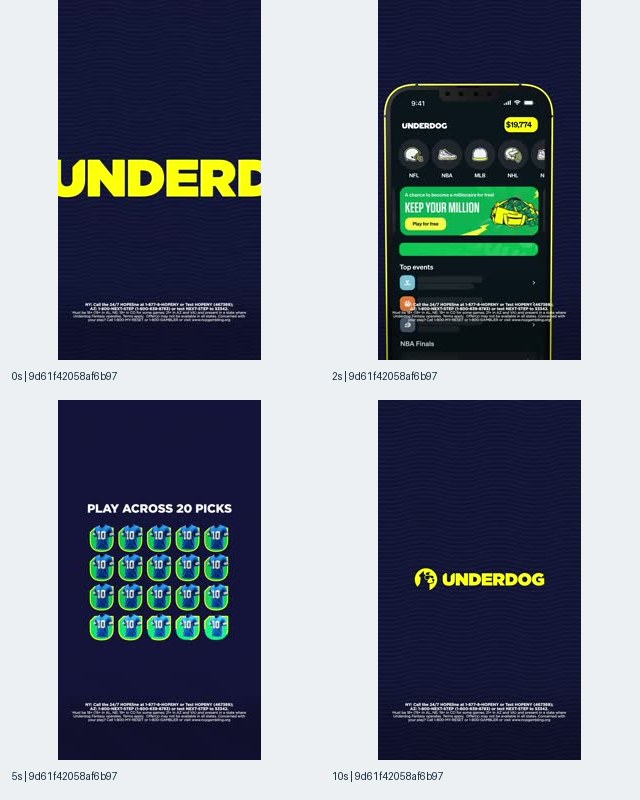
Image 4. Contact sheet for record 9d61f42058af6b97f1a9275bb824b6c5. Window modelled impressions: 42,971,985; sample share: 7.4%. Supplied labels include 0, 2, 5, and 10 seconds, although the record reports a nine-second duration; exact endpoint timing is unresolved.
The opening pictured composition uses oversized yellow lettering on a navy background. Another frame shows a yellow-edged phone with a “KEEP YOUR MILLION” banner, sports-category icons, and event rows. The frame labelled 5 seconds displays “PLAY ACROSS 20 PICKS” above a grid of sports-shirt icons. A later supplied image returns to the Underdog logo.
The grid is a useful explanatory device because it gives the headline a countable visual counterpart. It represents the advertised set of picks more concretely than an isolated numerical headline would. However, it remains an advertising illustration. It does not prove the exact in-app sequence, the user’s available choices, or what happens after selection.
This record was first seen on 2026-09-25, making it part of the sample’s pre-window group. Its presence alongside October records shows that recent discoveries coexist with material observed earlier. That is another reason to avoid describing the entire selected population as a single new launch batch.
The underlying video fingerprint also appears in record 1e6123da686c807c1f3ba5f4b3862a0b, which includes a separate image fingerprint. This is direct evidence that an advertising-record count can exceed the number of distinct videos. It does not establish what the additional image did during an actual placement, so it should not automatically be called a tested end-card variant.
For production planning, the transferable idea is visual enumeration: let a repeated object explain a quantified message. A team applying that idea should use its own product representation and current terms, then check that the objects and headline describe the same thing.
Image 5: Similar Packaging Adds a Different Access Claim
Image 5 resembles Image 4’s visual system but changes the visible proposition to “Free-to-Play Across 20 Picks,” which deserves a separate message tag.
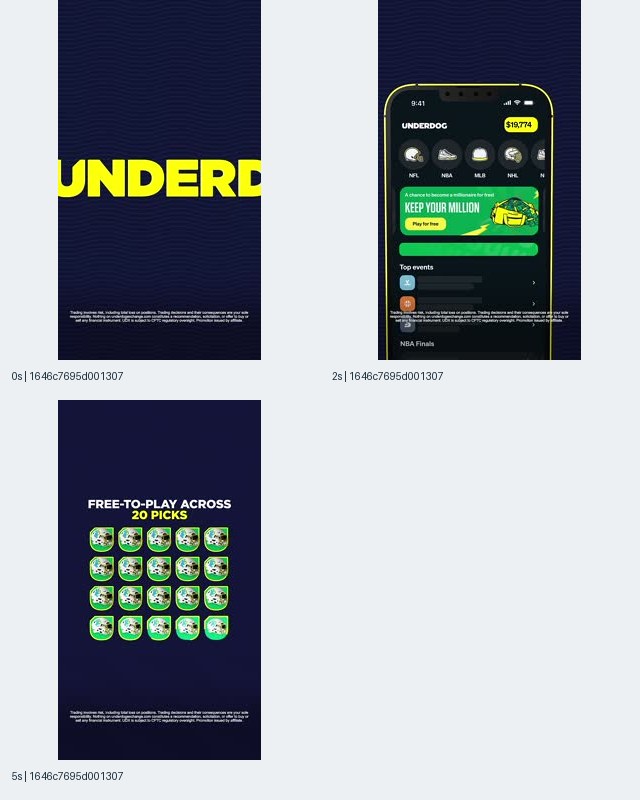
Image 5. Contact sheet for record 1646c7695d001307a59a0ac461e1676f. Supplied frames: 0, 2, and 5 seconds. Window modelled impressions: 26,558,147; sample share: 4.6%. “Free-to-play” is recorded as historical ad wording, not a current access guarantee.
The first pictured frame again uses large yellow Underdog lettering on navy. The phone frame includes the familiar promotional banner. The frame labelled 5 seconds reads “FREE-TO-PLAY ACROSS 20 PICKS,” above a grid of green icons.
The similarity to Image 4 is useful for creative classification. Both use the brand-to-phone-to-grid structure visible in the supplied stills. But the files have different video fingerprints, and the headlines are not identical. An analyst should preserve both the family resemblance and the distinct wording.
That prevents two opposite mistakes. Treating every different file as a completely new concept exaggerates conceptual variety. Treating similar-looking files as identical loses meaningful offer differences. File identity and message identity need separate columns in a research sheet.
The “free-to-play” wording also should not become an “Underdog Rips free pack” finding. The visible claim refers to picks. There is no pack in these supplied frames and no evidence linking this wording to a pack-specific entitlement. The current feature’s eligibility or access terms are outside the screenshot’s scope.
A useful hypothetical test would isolate the headline difference while keeping the explanation and destination aligned. Before deployment, the advertiser would need to establish that each version accurately represents its own offer. The research question would then be whether emphasizing access changes understanding or response, rather than assuming that the word “free” is inherently more effective.
Readers can inspect indexed Underdog creatives in AdMapix to compare the visible sports, offer, and pack messages. The search is a discovery starting point; verify the listing association and measurement dates before treating a result as comparable with this frozen sample.
Image 6: A Shared Money-Bag Motif Ends in a Different Prompt
Image 6 repeats the money-bag and million-dollar motif, then shows “Gotta Take? Pick Your Side!” in the later supplied frame.
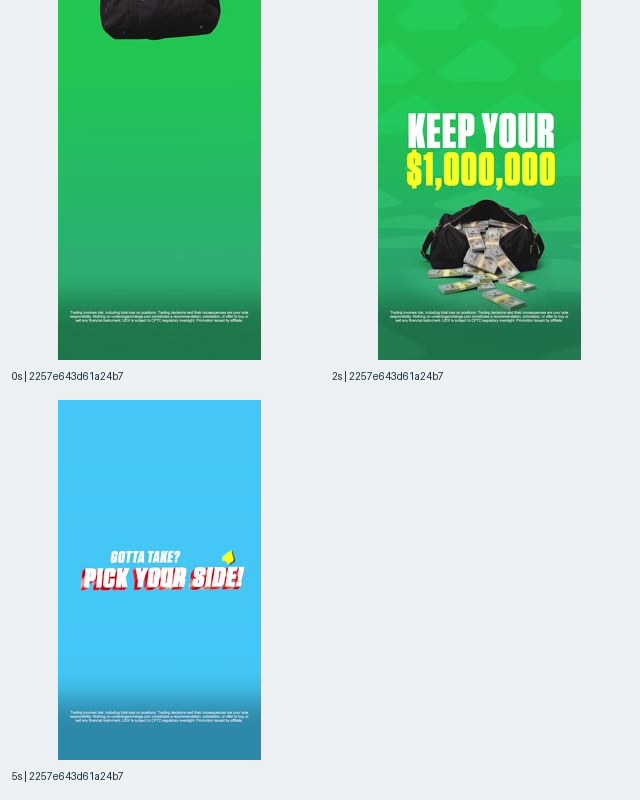
Image 6. Contact sheet for record 2257e643d61a24b716cb8812a5cb09dc. Supplied frames: 0, 2, and 5 seconds. Window modelled impressions: 18,864,132; sample share: 3.2%.
At the supplied opening timestamp, part of the bag appears against green. The 2-second frame shows “KEEP YOUR $1,000,000” above the open bag and banknotes. The 5-second frame changes to cyan with the line “GOTTA TAKE? PICK YOUR SIDE!”
This is a useful contrast with Image 3. The early visual motif is similar, but the later observed frame differs. Image 3 supplies a sports-field view at 10 seconds; Image 6 supplies a direct selection prompt at 5 seconds. Because the observations occur at different timestamps and do not cover complete playback, they should not be treated as a fully controlled sequence comparison.
The visible phrase invites a choice. It does not itself show the selection process. A research note can therefore classify the frame as an action prompt while leaving the underlying interaction unknown. That is more precise than saying the ad demonstrates how the product works.
This example also illustrates how a repeated visual motif can connect executions without proving a shared production template. The same kind of money-bag artwork and headline appears across the supplied images, but the files are distinct. The evidence supports visual similarity; it does not reveal the production pipeline, editing cost, or internal naming system.
For a creative team, the next question is whether a choice-oriented line needs an immediate interface demonstration. A proposed variant could place the selection screen next to the prompt, using only actions the advertiser has verified. That would test message clarity. It would not be justified to predict lower acquisition costs from the competitor screenshot alone.
Image 7: A Phone and Diagonal Color Blocks Carry the Same Claim
Image 7 places the million-dollar message beside a phone, using bright diagonal color blocks to hold the offer and interface in the same composition.
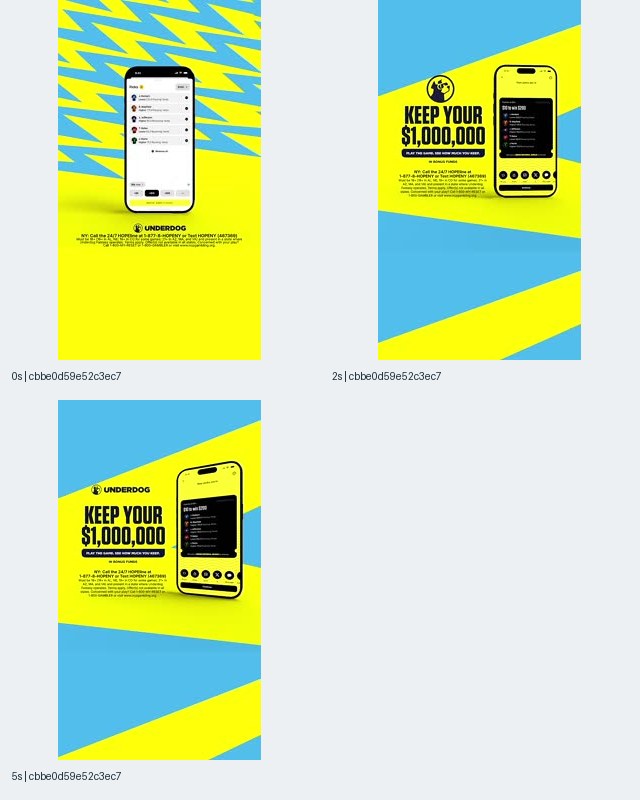
Image 7. Contact sheet for record cbbe0d59e52c3ec772ee5e6085d6e895. Supplied frames: 0, 2, and 5 seconds. Window modelled impressions: 17,402,825; sample share: 3.0%.
The opening supplied frame shows a phone over a bright yellow and cyan background with repeated lightning-like shapes. The next pictured composition places “KEEP YOUR $1,000,000” to the left of a phone, inside a yellow diagonal band. The frame labelled 5 seconds keeps the offer and device together in a related layout.
Compared with Image 3, this execution gives the phone a more consistent role in the supplied observations. The dollar claim is visually paired with an interface rather than relying primarily on the money bag. That difference can be described without saying that one execution provides stronger proof or produces better conversion.
The phone itself is still a representation inside an ad. Its presence helps communicate a digital product, but it is not a hands-on test of the app. Small interface labels should not be expanded into claims about features that the screenshots do not clearly establish.
This sample is particularly useful for layout research. A team can record the relative placement of headline, device, branding, and small print. It can then develop an original composition with its own visual system and check whether the hierarchy remains readable at the intended viewing size.
A hypothetical comparison could hold the offer constant while changing only whether the interface appears beside the headline or after it. The evaluation would ask whether viewers retain both the proposition and the required action. This is a clearer experimental question than “Does yellow work?” because the observed layout contains several interacting elements, and color alone cannot explain the record’s modelled impression estimate.
Image 8: Packs and Graded Cards Make Rips Explicit
Image 8 explicitly shows pack-and-card reveal imagery, establishing that the supplied Underdog advertising examples include Rips-related creative.
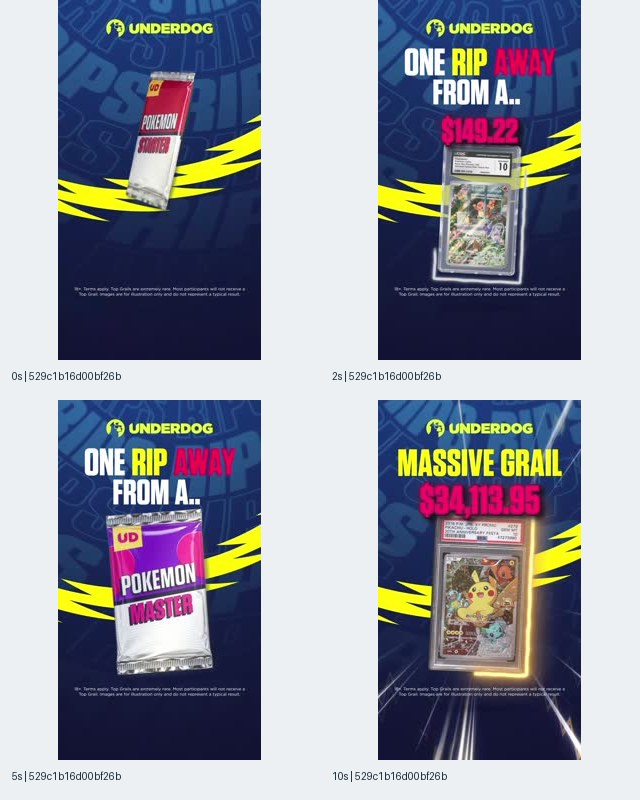
Image 8. Contact sheet for record 529c1b16d00bf26b0214b3eb306cf669, associated with the verified Underdog iOS listing. Supplied frames: 0, 2, 5, and 10 seconds. Window modelled impressions: 15,045,391; sample share: 2.6%. Card values are amounts displayed by the ad, not independently verified valuations.
The opening supplied frame shows a pack labelled “POKEMON STARTER” against a dark blue background with yellow lightning graphics. At 2 seconds, “ONE RIP AWAY FROM A..” appears above a graded-card image and the displayed amount $149.22. At 5 seconds, a “POKEMON MASTER” pack appears under the same anticipation-oriented headline. The 10-second frame shows “MASSIVE GRAIL,” $34,113.95, and another graded-card image.
These frames directly answer the question of whether the sample contains pack-related advertising. It does. They also support a narrower description than a complete product demonstration: the ad juxtaposes packs, card images, and displayed values. The contact sheet does not show a continuous user interaction through every step of opening a pack.
The record was first seen on 2026-10-22 and last seen on 2026-10-29. Those dates identify the source’s observation of this advertising record. They do not establish when the Rips feature launched or when the creative was produced.
The creative’s structure is distinct from the sports-offer examples. It uses the unopened pack as the object of anticipation and a pictured card as the revealed object. The displayed values provide another layer of contrast. Their role in the ad is observable; their accuracy, typicality, and relationship to any actual user result are not established here.
For marketers, the transferable hypothesis is that showing an object before and after a reveal may explain a pack mechanic more directly than a general brand statement. That remains a hypothesis. This record’s 2.6% sample share is neither evidence that the mechanic failed nor a complete estimate of all pack-related advertising associated with Underdog.
What the Ads Establish About Reviews, Packs, Promotions, and Shipping
The supplied frames establish pack-related messaging and historical promotional claims, but they do not establish current pack terms, shipping arrangements, or a complete feature review.
The following distinctions keep research aligned with the evidence rather than with the wording of a search query.
| Reader question | What the sample shows | What remains unverified |
|---|---|---|
| Are packs shown in Underdog ads? | Image 8 shows pack labels and graded-card imagery | Full pack-opening interaction and current assortment |
| What does the pack ad promise? | “One Rip Away” language, “Massive Grail,” and displayed values | Typical outcomes, valuation basis, and complete terms |
| Is there an Underdog Rips promo code? | Image 1 shows a bonus-entry offer | A verified Rips-specific code or current eligibility |
| Is a free pack advertised? | Image 5 says “Free-to-Play Across 20 Picks” | A pack-specific free entitlement |
| What about shipping? | No shipping process appears in the supplied frames | Availability, charges, timing, and conditions |
| Is this a product review? | It is an analysis of advertising records and frames | Hands-on product experience |
The distinction between picks and packs is particularly consequential. A broad promotional claim attached to the same app listing cannot automatically be transferred to a different feature. The bonus-entry language in Image 1 and the free-to-play wording in Image 5 should remain attached to their respective screenshots.
The same principle applies to the values in Image 8. A displayed dollar amount is evidence that the ad uses that amount in its message. It is not an independently established market value, an average result, or a forecast of what a reader would receive.
For a marketing report, unanswered consumer questions are still useful. They identify where an ad may generate follow-up information needs. A team can document those questions and request the relevant current product materials before writing its own message. It should not complete the missing explanation from intuition or from another app’s feature set.
Formats and Reuse: Records Are Not Creative Concepts
Underdog’s sample contains distinct video and playable references, while repeated video fingerprints demonstrate that record count overstates the number of unique videos.
The supplied facts report 24 records containing video, 22 unique video fingerprints, six records containing playable references, six unique playable fingerprints, and two unique image fingerprints. These are different units of analysis. They should remain separate in a spreadsheet, presentation, and production estimate.
Image 4 provides a concrete reuse example: its video fingerprint appears under both record 9d61f42058af6b97f1a9275bb824b6c5 and record 1e6123da686c807c1f3ba5f4b3862a0b. Another shared video fingerprint links records 9db495f113658b59369c4e0d6d29b86f and 5c391c500d2f3bd9bd73053c55aa660b. The latter instances in these pairs also include image references.
Those associations establish file reuse. They do not establish why the records differ, how an image appeared in a placement, or which version generated a better outcome. A report should preserve the association without inventing an end-card experiment.
Conversely, visually similar examples can use different files. Images 4 and 5 share a navy-and-yellow interface presentation, but their fingerprints differ and their visible headlines differ. A fingerprint answers whether the underlying indexed file is the same. A creative-family tag answers whether executions share a recognizable idea. Both are useful, and neither replaces the other.
The six playable references are also limited evidence. A playable is generally an interactive advertising asset, but this article has no recorded interaction test for those references. It therefore does not describe their controls, completion flow, pack mechanics, or effectiveness. The contact sheets analyzed above are video references, not demonstrations of those playable assets.
For production teams, this distinction prevents a false workload estimate. Thirty records do not prove that thirty separate concepts were commissioned. Equally, a smaller unique-file count does not reveal the effort spent on scripting, visual revisions, trafficking, or testing. The source can map file relationships; it cannot reconstruct the advertiser’s production budget.
The Pack-Rip Bracket: Scale, Recency, and Playable Presence
The comparison snapshot places Underdog alongside specialist and adjacent apps, but the one-day window difference limits exact cross-app conclusions.
Rips by Triumph, Courtyard, and PrizePicks were collected on 2026-10-30 for 2026-09-30 to 2026-10-29, using top-30 US records attributable to each verified iOS listing. Underdog’s frozen sample covers 2026-10-01 to 2026-10-30. The table preserves those boundaries rather than presenting a perfectly synchronized ranking.
| App | Advertising measurement window | Modelled impressions across selected 30 records | Top record share | Earliest first seen | Records first seen within its window | Records with playable references |
|---|---|---|---|---|---|---|
| Underdog | 2026-10-01 to 2026-10-30 | 583,234,248 | 38.7% | 2026-09-24 | 25 of 30 | 6 |
| Rips by Triumph | 2026-09-30 to 2026-10-29 | 5,452,524,821 | 25.9% | 2026-04-07 | 3 of 30 | 2 |
| Courtyard | 2026-09-30 to 2026-10-29 | 1,029,155,715 | 14.2% | 2026-02-26 | 20 of 30 | 2 |
| PrizePicks | 2026-09-30 to 2026-10-29 | 289,140,298 | 17.3% | 2026-07-21 | 6 of 30 | 15 |
Within the aligned supplementary snapshot, Rips by Triumph has a larger selected-record impression estimate than Courtyard or PrizePicks. Underdog’s estimate falls numerically between Courtyard and PrizePicks, but its shifted window means that position is contextual rather than a precise same-window comparison. No exposure multiples are calculated across the mismatched windows.
The first-seen profiles also differ. Rips by Triumph’s selected records include an April observation and relatively few first seen within its window. Courtyard combines a February earliest observation with many records first seen within its window. PrizePicks includes a July earliest observation. Underdog’s earliest selected record is from late September, with 25 records first seen in October.
Those patterns describe the selected populations. They do not establish which company produces creative fastest, which app refreshes most efficiently, or which older asset is more profitable. First-seen dates are not production timestamps, and top-30 entry depends partly on the selection method.
Playable presence differs as well, but the bracket supplies record counts rather than matched unique-file counts for every app. It would be inappropriate to compare Underdog’s six unique playable fingerprints with another app’s count of records carrying playables as if the units were identical. The table consistently uses records with playable references.
The earlier Rips by Triumph advertising teardown provides historical context for the specialist app. Its older figures belong to its own dated sample. The October comparison above is a separate observation, and historical format findings should not be carried forward as permanent product characteristics.
What Shared Rips Language Means for a Marketer
The strategic question is how a broader app introduces a pack message alongside established acquisition themes, not whether a title change proves that packs have taken over its advertising.
The verified Underdog title includes “Sports, Games & Rips.” Image 8 makes pack-related advertising concrete. Images 1 through 7 show why that finding needs context: the supplied examples also contain sports interfaces, choice prompts, and promotional claims. The current evidence supports message coexistence.
The shared word “Rips” makes comparison with Rips by Triumph relevant, but it does not establish who originated the mechanic, whether one advertiser copied another, or which app has the larger total business. Store-listing estimates and bounded advertising samples are not a census of company size.
For a specialist marketer, the broader-app scenario creates several research questions. Does the competing message explain the pack mechanic clearly? Does it rely on an existing brand identity? Does the destination maintain the same promise? Does the creative emphasize the unopened object, the reveal, the displayed value, or a wider promotional offer? Each question can be answered with appropriate evidence without speculating about internal strategy.
For a broader-app marketer, the challenge is message separation. An ad about sports picks and an ad about packs may lead to the same listing while setting different expectations. A shared logo does not make the expectations interchangeable. Creative reporting should therefore preserve the advertised mechanic rather than grouping everything under the current store title.
One hypothesis is that a broader app can introduce a new mechanic while retaining familiar visual branding. Image 8’s yellow lightning and dark background make that a plausible question to investigate alongside other examples. The source does not demonstrate recognition, cross-feature adoption, or an advantage from existing users.
The action is to monitor the mechanism-specific message over time. If pack examples become more visible in later matched samples, that would strengthen a finding about changing advertising emphasis. It would still require separate product and business evidence to explain why that change occurred or what it achieved.
A Practical Workflow for Researching the Next Snapshot
A reliable follow-up starts by preserving identity and measurement scope, then separates file changes, message changes, and business questions.
Begin with the verified listing ID rather than the brand name alone. Store the current title as a descriptive field, because titles can change. Record the country, collection date, exact measurement bounds, sort order, and sample ceiling next to every result. This makes later differences interpretable instead of leaving the team to reconstruct the research conditions.
Next, retain record identifiers and file fingerprints separately. The record table should hold each instance’s modelled impression estimate and observation dates. A linked asset table can group repeated video files. A message table can then tag visible concepts such as bonus-entry offer, sports interface, pick grid, money-bag claim, or pack reveal.
This arrangement answers three different questions: whether the indexed instance changed, whether the media file changed, and whether the creative idea changed. Combining those questions into a single “new ad” label makes a refresh report harder to trust.
For visual review, attach only the timestamps actually observed. Record the visible headline exactly, then explain its role in plain language. If a frame is too small to read confidently, mark the wording unresolved. If a video is only partially represented, leave the unseen sequence unclassified. The analyst’s confidence should follow the evidence available for that specific observation.
A working worksheet can use the following structure:
| Field | Example from this article | Why it matters |
|---|---|---|
| Verified listing | iOS 1514665962 | Keeps product identity stable |
| Measurement window | 2026-10-01 to 2026-10-30 | Defines the estimate’s scope |
| Record reference | 529c1b16d00bf26b0214b3eb306cf669 | Connects observations to a specific instance |
| File relationship | Distinct video fingerprint | Separates asset identity from record identity |
| Observed content | Pack labels, graded cards, displayed values | Preserves the actual visual evidence |
| Message classification | Pack-reveal advertising | Supports comparable creative tagging |
| Unknowns | Full interaction, terms, current feature experience | Prevents unsupported product conclusions |
| Next question | Does pack messaging recur in later matched samples? | Turns the finding into a research task |
For a later comparison, choose matching windows across apps before collecting data. Keep the sample size and sorting method consistent. Preserve each snapshot rather than overwriting the previous one. If a record disappears from the selection, describe it as absent from that selection until further evidence supports a stronger claim.
Then compare continuing fingerprints, newly observed fingerprints, repeated messages, and concentration. Do not divide window impressions by the age of an ad. That would mix a window-specific numerator with an unrelated denominator and create a misleading intensity measure.
Finally, separate the report’s recommendations by evidence need. Creative production can proceed from observed structures and verified product facts. Budget changes require the advertiser’s own performance evidence. Feature evaluation requires current product observation. Market-sizing decisions require broader data than a top-30 creative sample.
The deliverable should be a short decision record: what changed, which evidence supports that statement, what remains unknown, and what action would resolve the uncertainty. That is more useful than a large screenshot folder with every example labelled a winner.
Turning the Evidence Into Original Creative Tests
The sample supports hypotheses about message order and product explanation, but every proposed test needs the advertiser’s own verified offer and measurement plan.
The following briefs are proposed experiments, not tests performed for this article. They are designed to isolate a creative question rather than imitate Underdog’s artwork or repeat its historical claims.
Test an offer opening against an interface opening. Image 1 makes the offer highly prominent, while Images 4 and 7 give the interface a clear role. An original test could hold the same truthful offer and destination constant while changing which element appears first. Before evaluating acquisition outcomes, check whether viewers understand the required action and the nature of the benefit. A higher response rate would be difficult to interpret if one version creates a different expectation.
Test a pack object against an explained action. Image 8 shows packs and card imagery but does not provide a complete observed interaction. A team with a verified pack product could compare an object-focused opening with a clearly demonstrated action. Use equivalent production quality and the same underlying proposition. The hypothesis is that explanation may improve understanding; the source does not establish whether that would increase or decrease campaign response.
Test an outcome claim against a process explanation. Images 3 and 6 emphasize an outcome-oriented headline, while Image 4 visualizes a set of picks. An original experiment could compare those information structures using only supported product claims. The aim would be to learn whether the audience needs the process before the outcome makes sense. This is a message-order question, not an invitation to invent a larger prize or more dramatic value.
Test brand continuity across mechanics. The supplied examples use recognizable yellow and dark-blue elements across different messages. A broader-app team could test whether maintaining a consistent brand treatment helps viewers connect a new mechanic to the same product. The comparison should keep the mechanic explanation stable. Recognition and expectation should be measured directly rather than inferred from visual resemblance.
Each brief needs a clear outcome definition before production. For an advertiser running the test, that may include comprehension checks and appropriately instrumented campaign events. The relevant business event depends on the product and should not be substituted with whatever metric is easiest to collect.
Keep the audience, destination, offer, and delivery conditions as comparable as the test design allows. If several elements change together, report the result as a comparison of complete executions rather than attributing it to a single headline or color. Record what changed so that a later team can reuse the learning.
There is no universal sample size or guaranteed testing duration in this article. Those depend on baseline rates, variability, and the decision’s consequences. The AdMapix creative testing framework provides a broader structure for defining hypotheses and interpreting results. Competitor evidence supplies candidate questions; the advertiser’s own experiment supplies the answer.
Common Mistakes This Sample Makes Easy to Spot
The main analytical mistakes come from transferring a fact beyond its original unit, date, or subject.
Calling all thirty records Rips ads. The listing title includes Rips, but the observed examples contain multiple messages. Classify the visible content of each reviewed execution. Leave unreviewed records visually unclassified rather than assigning them a theme from the app name.
Calling the sample a complete fleet. The collection ends after thirty impression-sorted records. It cannot establish the advertiser’s full creative inventory, all networks, or all countries. Any conclusion about prevalence must preserve that selection boundary.
Equating first seen with launch. The pack record’s October first-seen date does not establish the feature’s release date. Likewise, recent records do not prove a coordinated production sprint or the retirement of an earlier fleet.
Converting a displayed amount into a verified benefit. The bonus-entry headline, million-dollar claim, and card values belong to their respective ads. They should not be presented as current terms or independently confirmed outcomes.
Reading concentration as profitability. The largest record has the largest modelled estimate in this sample. Without spend and conversion data, it cannot be labelled the most profitable, most efficient, or best-converting execution.
Treating a phone screen as product testing. An interface pictured inside an ad establishes what the advertisement depicts. It does not establish that the analyst used the feature or verified every action implied by the screen.
Assigning a network from visual style. Vertical framing, bold captions, or a person speaking to camera are not sufficient placement evidence. The missing network mapping remains missing.
Combining incompatible dates. The subject sample, bracket sample, and ranking snapshot use different windows. They can be discussed together with clear labels, but their totals should not be added or converted into unsupported efficiency ratios.
A useful editing rule is to check every conclusion against its noun: record, file, frame, listing, sample, or company. Many exaggerated claims are a valid observation attached to the wrong noun.
When AdMapix Fits This Research Decision
AdMapix fits the task of finding and organizing dated creative evidence, while product reviews and campaign-performance decisions require additional sources.
AdMapix is an ad-intelligence platform, and it is our product. This article demonstrates a specific use: connecting a verified listing to sampled advertising records, separating files from instances, inspecting visible messages, and preserving the measurement window. That workflow helps acquisition and creative teams decide what to investigate or test next.
It is a suitable next step when a team needs to compare sports and pack messaging, revisit the same listing in a later window, or build a traceable competitor brief. It is not a substitute for the advertiser’s own conversion reporting, a current feature walkthrough, or evidence about the complete business behind an app.
Sign up or log in to AdMapix to research live data. Start with the verified Underdog listing and choose explicit dates before comparing it with another app. Live results may differ from this frozen observation.
Commercial terms can change while research remains useful. Consult the live AdMapix pricing page for current access and plan details. This article does not promise a paid-plan trial or a particular refresh interval.
FAQ
The answers below distinguish what the dated sample establishes from questions that require current product or campaign evidence.
Do Underdog Rips ads actually show packs?
Yes. Image 8 shows Pokémon-labelled packs, graded-card imagery, “One Rip Away” wording, and displayed dollar values. That establishes pack-related advertising in the supplied examples. It does not establish the proportion of all Underdog advertising devoted to packs, because the eight contact sheets do not visually cover every sampled record or the complete advertising fleet.
Is this an Underdog Rips review?
This is an advertising analysis, not a hands-on product review. It examines dated records, modelled impression estimates, and selected video frames. The evidence does not include using the app, completing a pack-opening interaction, or checking current feature terms. Readers should not treat an advertised interface or claim as independently verified product experience.
What does the sample show about Underdog revenue?
The supplied US store-listing snapshot places Underdog at revenue rank #200, with a reported estimate change of +18.64% against the previous 30 days, for 2026-09-29 to 2026-10-28. The underlying value’s unit is unspecified. This does not establish company revenue, a dollar total, or the contribution of the Rips feature.
Did Underdog rebuild its advertising fleet around Rips?
The evidence does not establish that conclusion. Twenty-five of thirty selected records were first seen within the subject window, and the earliest selected first-seen date is 2026-09-24. That makes the sample recent. A confirmed rebuild would require a comparable earlier population, while the supplied leading examples still prominently show sports and promotional messages.
Does the sample contain an Underdog Rips free-pack offer?
The supplied frames do not establish a Rips-specific free-pack offer. Image 5 says “Free-to-Play Across 20 Picks,” and Image 1 describes bonus entries. Those claims should remain attached to their respective advertisements. Neither can be converted into a pack entitlement or a current promotion simply because the associated listing includes Rips in its title.
Can these ads explain Underdog Rips shipping?
No shipping process or complete shipping terms appear in the supplied frames. A pictured card does not establish shipping availability, charges, timing, or eligibility. Those questions need current product information. The useful advertising finding is that the pack example emphasizes the reveal and displayed values, while the requested shipping details remain outside the evidence.
Are the impression totals actual delivery or ad spend?
No. They are third-party modelled impression estimates for explicitly defined windows and selected records. They are not observed delivery, spend, unique reach, installs, or profit. Underdog’s 583,234,248 figure belongs to its thirty-record US sample for 2026-10-01 to 2026-10-30 and should not be described as a lifetime or company-wide total.
Which network carried these Underdog ads?
The frozen package does not provide a verified network-name mapping for the sampled source field. This article therefore leaves placement unspecified. The App Store association establishes the reference listing, while the vertical format and creative style establish neither a network nor an ad buyer. A channel-specific conclusion would require additional record-level placement evidence.
Key Takeaways
The supported finding is a recent, concentrated sample where pack advertising appears alongside prominent sports and promotional messages.
- Treat the verified iOS listing as the entity boundary; do not extrapolate to Android or all advertising.
- Describe the 25 recently first-seen records as a sample characteristic, not proof of complete fleet turnover.
- Keep the largest sports-offer record and the pack-reveal example in the same analysis because they answer different research questions.
- Preserve record, file, and message distinctions when tracking reuse and creative change.
- Use the screenshots to develop original hypotheses, then evaluate product claims and campaign outcomes with the appropriate evidence.
About AdMapix Research: AdMapix Research is the research byline of AdMapix, an ad-intelligence platform. Its articles are built from AdMapix data (creative records, modelled impression estimates and US app-store rankings), prepared with Codex from a dated frozen sample and checked by automated evidence review. Brad at AdMapix is the accountable editorial owner; this does not imply personal human review.
Sources
The sources below establish the dated sample, listing identity, measurement context, and research workflow; they do not establish campaign performance or hands-on product experience.
- AdMapix frozen source package, observed 2026-10-30: Public evidence snapshot. Scope: thirty US advertising records associated with iOS 1514665962 for 2026-10-01 to 2026-10-30, supplied contact sheets, collection parameters, listing associations, and reproducible batch checksums.
- Verified App Store identity, captured in the 2026-10-30 source: Underdog: Sports, Games & Rips. Scope: listing ID, title, and seller identity. The live listing may subsequently change.
- AdMapix supplementary comparison, collected 2026-10-30: The dated comparison supplied with this research covers top-thirty US records for the verified Rips by Triumph, Courtyard, and PrizePicks iOS listings during 2026-09-30 to 2026-10-29. It is kept separate from Underdog’s shifted window.
- AdMapix US store-listing rankings, supplied 2026-10-30: Scope: 2026-09-29 to 2026-10-28 against the previous thirty days, captured top 300, with App Store and Google Play listings ranked together. Revenue values are model estimates with an unspecified underlying unit.
- AdMapix research methodology: Measurement definitions and limitations, applied to the observation dated 2026-10-30. Scope: interpretation of indexed advertising evidence and estimated metrics.
- AdMapix product research workflow: Underdog creative search, the discovery route relevant to this 2026-10-30 analysis. Live results are not the frozen sample; verify listing identity, country, dates, and record scope before making a comparison.
Turn these observations into your next creative study
Open the creative library and select samples for your market, network and research question.
Related Articles
Liftoff Playable Ads: Requirements and Vungle Examples
Analyze eight dated US Liftoff (Vungle) video examples, understand the limits of a 30-record sample, and follow separate official playable requirements and testing workflows for Direct, Accelerate, and Vungle Exchange.
Unity Ads Creatives: US Examples and Playable Specs
Analyze eight Unity-filtered US advertising examples, understand the limits of a thirty-record sample, and turn current Unity playable specifications into a practical research, production, and device-testing workflow.
TikTok Ads Downloader: Official Limits and Saving Workflow
Learn what TikTok’s official research tools let you save, how to download eligible files individually in AdMapix, and how to build a traceable swipe file using eight dated US advertising examples.