
Liftoff Playable Ads: Requirements and Vungle Examples
Analyze eight dated US Liftoff (Vungle) video examples, understand the limits of a 30-record sample, and follow separate official playable requirements and testing workflows for Direct, Accelerate, and Vungle Exchange.
Liftoff Playable Ads: Requirements and Vungle Examples
Last updated: 2026-11-02
AdMapix Research — prepared with Codex and checked against the dated source sample. Editorial ownership: Brad at AdMapix. This preparation disclosure does not imply personal human review.
Liftoff playable ads have different requirements depending on whether you use Liftoff Direct, Liftoff Accelerate, or Vungle Exchange. Choose that submission path before building the asset. Our dated US Liftoff (Vungle) research sample contains 30 advertising records and 26 distinct video files, but no indexed playable files. Its visible examples include shopping, casino-style entertainment, and financial-service messages—not a playable performance benchmark.
For user-acquisition managers, creative producers, and playable developers, this guide connects those examples to practical production decisions. It explains what the sampled frames show, which official requirements apply to each buying path, and how to prepare a test without treating competitor visibility as conversion evidence. The distinction matters because current Accelerate documentation and older Adaptive Creative instructions specify different packaging, interaction, and testing behavior.
Quick Answer
Liftoff playable ads require a route-specific build and test process; there is no single checklist that safely covers every Liftoff product.
- Liftoff Direct / Adaptive Creative: follow its packaging and messaging rules, including separate download and completion events. Some instructions date from 2022–2023 and need account-level confirmation.
- Liftoff Accelerate: follow the October 2026 HTML integration and Ads Manager guidance, including deliberate-interaction click handling and automatic upload QA.
- Vungle Exchange: follow the DSP submission guidance for playable ads without video using MRAID 2.0, and test in the Exchange Demo App.
- This advertising sample: 30 US records for 2026-10-03 to 2026-11-01, all containing video, with no indexed playable files. It supports creative analysis, not conclusions about network-wide format adoption or profitability.
Why the Network Is Called Liftoff (Vungle)
Liftoff and Vungle merged, but Vungle remains part of the official product vocabulary and the network label used in this AdMapix research workflow.
Liftoff’s October 1, 2021 merger announcement states that the companies had officially merged. The support article Start Monetizing With Liftoff, updated May 8, 2026, identifies the publisher suite as Liftoff Monetize and the advertiser suite as Liftoff Direct, while saying the Vungle SDK and Vungle Exchange remain unchanged. Liftoff’s Monetize product page also continues to use “Vungle SDK.” These official sources were checked for the supplied source package as of November 2, 2026.
AdMapix’s network filter still uses Vungle. This article therefore uses Liftoff (Vungle) when discussing that research sample. The naming explanation does not establish an exact rebrand date; none is supplied by the cited pages.
Keep the product names distinct when commissioning a playable. A designer may receive a brief saying “Vungle,” while the person uploading the finished work uses Accelerate Ads Manager. Those labels are insufficient to select an integration method. The brief should name the actual submission destination, the relevant official document, and the account contact responsible for resolving conflicts.
For a broader explanation of interactive advertising, the playable ads guide provides the topic foundation. Here, a playable means an interactive advertising asset that responds to user input. A video showing a game interface does not, by itself, establish that the ad is playable.
Methodology: What Was Measured and What Was Observed
This analysis uses a bounded, impression-ranked US network sample and timestamped contact sheets, with official documentation supplying the separate technical requirements.
The advertising data was fetched on 2026-11-02 at 02:13 UTC. The exact measurement window was 2026-10-03 to 2026-11-01, with US selected as the country and Vungle selected as the research network. The keyword query was empty: this was a network-filtered search, not a search for the words “Liftoff playable ads.” The collection covered three pages of ten records each, sorted by descending model-estimated impressions.
The public frozen source package makes the response batches, request parameters, and checksums available for reproduction and inspection. Repeating a live query later may produce different results because the index changes; the frozen package preserves the evidence used here.
Three units matter. An advertising record is a returned instance. A video file is identified by its media fingerprint. A playable file is identified separately. Fingerprint lists were flattened before deduplication, so multiple records sharing a video do not become multiple unique videos. Image fingerprints are also reported separately rather than added to videos as an unexplained “total creative” count.
Product associations follow the linked store IDs in the records. Walmart’s illustrated record links to Android package com.walmart.android and iOS listing 338137227. The SHEIN examples link to com.zzkko; Modo to 6741076536; Intuit Credit Karma to 519817714; and Grant Cash Advance to 6472350114. These associations identify the reported destinations. They do not identify the individual ad buyer, agency, or account operator.
The network attribution comes from the supplied network-filtered evidence and its source mapping. The presence of an Android or iOS listing does not establish a network-wide operating-system distribution. Publisher-app identities, precise placements, targeting settings, and auction paths are not supplied.
Visual analysis is limited to eight contact sheets. Figure 1 contains frames at 0 and 2 seconds. Figures 2–8 contain frames at 0, 2, 5, and 10 seconds. The listed full video durations come from record metadata, not from watching complete videos. No audio, complete playback, playable interaction, app installation, conversion test, or external testing-tool run was performed for this article.
Every impression figure below is a third-party model estimate for the specified window. It is not observed delivery, spend, installs, revenue, profit, or a lifetime total. Product-search impression and spending aggregates are excluded. The sample is selected by estimated impressions and capped at 30 records, so it cannot describe the entire network or every advertiser’s creative portfolio.
Evidence Table: What the US Sample Contains
The sample contains video-bearing records with visible reuse, while the absence of indexed playable files limits what can be said about interactive creative.
| Measure | Frozen sample result | Interpretation |
|---|---|---|
| Advertising records | 30 | Returned instances within the bounded search |
| Records containing video | 30 | Every sampled record includes a video association |
| Distinct video fingerprints | 26 | Deduplicated video files represented by those records |
| Distinct image fingerprints | 3 | Separately associated image files; not three image-only ads |
| Records containing playable files | 0 | No playable association appears in these records |
| Distinct playable fingerprints | 0 | No indexed playable file is available for analysis |
| Model-estimated impressions | 2,911,591,021 | Sum for these records, US, 2026-10-03 to 2026-11-01 |
| Highest-ranked record’s share | 44.6% | Supplied share of this sample’s estimated impressions |
| Top five records’ share | 64.0% | Supplied concentration measure for records, not unique videos |
The highest-ranked record is associated with Walmart. Its estimated impressions are 1,298,336,824, and the next record shares the same video fingerprint. That reuse is immediately relevant to interpretation: the ranking presents separate records, while the underlying visual reference is the same video file.
The sample’s product associations also include Candy Crush Saga, Bingo Cash, Cars.com, and an Adobe website association. Their presence broadens the set of reported destinations, but this article does not invent visual descriptions for records without an attached contact sheet.
The following table connects the illustrated examples to their source records. Durations are metadata values. All estimated impressions use the same US measurement window, 2026-10-03 to 2026-11-01.
| Figure | Reported listing | Record ID | Video duration | Model-estimated impressions |
|---|---|---|---|---|
| 1 | Walmart: Shopping & Savings | 1c836fd5507e86ea90f8a70025e7d1d2 | 5 seconds | 1,298,336,824 |
| 2 | Modo: Play, Win & Rip | 57c2ffe74e7e97b8578bf46586fd5ad9 | 30 seconds | 113,536,513 |
| 3 | SHEIN, Android com.zzkko | 222c99ff56ea512d88269640eade5387 | 14 seconds | 108,647,663 |
| 4 | SHEIN, Android com.zzkko | ee4f919765a7c7e5ea72fe0524bb6a67 | 25 seconds | 98,617,728 |
| 5 | SHEIN, Android com.zzkko | 7e093c0686b3e9375e0585d4f59d21dc | 12 seconds | 84,762,277 |
| 6 | Modo: Play, Win & Rip | 2d531efc7c4d31e8ab5e9d793f33b626 | 29 seconds | 78,450,132 |
| 7 | Intuit Credit Karma | 59225344b682352847ac2292fdce9b59 | 20 seconds | 62,333,215 |
| 8 | Grant Cash Advance | cfa579d016a0a8dafcf6371ab8367b05 | 18 seconds | 58,415,671 |
Use these values to locate and audit the examples. They are not a leaderboard of creative effectiveness. The sample supplies no corresponding conversion outcomes with which to judge the visible approaches.
Length and Orientation: Separate Metadata From the Displayed Frames
The records support a range of video durations, while the contact sheets support only visual descriptions of the illustrated layouts.
The eight illustrated records have metadata durations of 5, 30, 14, 25, 12, 29, 20, and 18 seconds respectively. Elsewhere in the sample, Candy Crush Saga records list 59 seconds, a Grant Cash Advance record lists 43 seconds, and a Cars.com record lists 6 seconds. These values establish that the bounded sample is not confined to one video length. They do not establish an optimum duration or a recommended network benchmark.
The frames in Figures 1–4 and 6–8 have portrait layouts. Figure 5 shows a landscape composition. The overall contact-sheet canvas is simply the editorial arrangement of sampled frames; its dimensions should not be confused with the encoded video dimensions. No technical resolution audit was supplied for these advertising files.
For production planning, distinguish the observed reference from the submission specification. A 14-second shopping video can be a useful reference for presenting product variants, but it does not set the required duration for a new Liftoff submission. Official duration and dimension rules depend on the buying path, which is addressed later.
Likewise, a landscape example does not prove that horizontal creative performs better in a particular placement. It shows how one source asset distributes information across horizontal space. A producer can study that composition, then create an original responsive design and test it in the appropriate environment.
The missing intervals also matter. A contact sheet can show that a message is present at 2 seconds and different at 5 seconds. It cannot establish the exact moment of transition, how long a viewer had to read the copy, whether narration supplied additional context, or whether an animation continued between those frames. Those questions belong in a later full-playback inspection, not in a confident description of this evidence.
Figure 1: Walmart Uses a Sparse Brand Reveal
The Walmart contact sheet shows a pale opening frame and a centered blue wordmark at 2 seconds, supporting a narrow observation about brand presentation.
Figure 1. Source: the Walmart-linked record identified in the evidence table, sampled at 0 and 2 seconds. Metadata lists a 5-second video. The displayed logo is not a verified end card.
The visible composition gives the wordmark substantial empty space. No product image, price, spoken claim, or interactive behavior is established by these frames. For a creative researcher, that makes this a reference for a restrained brand introduction rather than a product demonstration or offer sequence.
A useful production question is whether the viewer can identify the advertiser before additional information appears. This reference suggests a hypothesis: reducing competing visual elements may make brand identification easier. That hypothesis would require a comprehension check or an advertiser-owned experiment. The sample’s high estimated-impression ranking does not validate the hypothesis.
The duplicate record association adds a separate lesson. The same video fingerprint appears in the next-ranked Walmart record, so a researcher collecting both rows should preserve both record references while keeping one video master in the visual library. Otherwise, a briefing deck can make a repeated file look like independent evidence for a recurring creative pattern.
Do not fill the unseen portion of the video with an assumed sale message, shopping interface, or install prompt. Even the 5-second metadata duration does not reveal what appears after the last sampled frame. If a team wants to adapt the structural idea, its brief can specify an original branded introduction followed by a verified product benefit, while clearly marking that continuation as its own design.
The practical value is precision: this example answers “how is the brand presented in the supplied early frames?” It does not answer “what did Walmart’s complete ad say?” or “why did this record receive its estimated exposure?”
Figure 2: Modo Presents a Themed Interface and a Win Display
The Modo example combines an Egyptian-themed title treatment, a slot-style interface, a visible win message, and a bright green effect within the sampled frames.
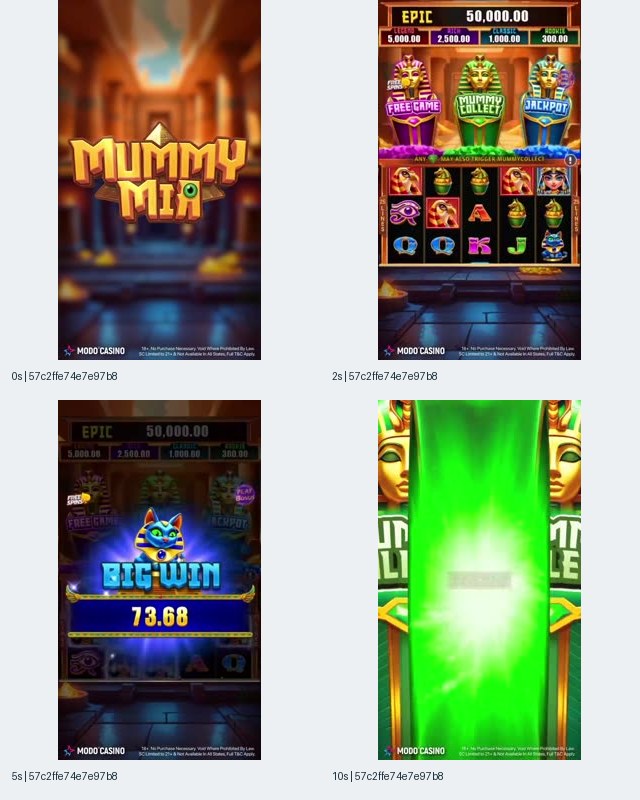
Figure 2. Source: Modo: Play, Win & Rip, iOS listing 6741076536; frames at 0, 2, 5, and 10 seconds from a record listing a 30-second video. The images show advertising presentation, not verified gameplay or payout behavior.
At 0 seconds, a large themed title sits over a temple-like background. At 2 seconds, the sampled image shows reels and prominent feature labels. The 5-second frame emphasizes “BIG WIN,” while the 10-second frame is dominated by a luminous green effect. These are distinct visible states, although the contact sheet does not show the continuous transitions between them.
The creative structure offers a way to separate theme, interface, and result in a research note. Theme establishes a visual setting. The interface suggests the activity being promoted. The win display gives a numerical and emotional emphasis to a result. None of these observations verifies what a real user will receive or how representative the shown outcome is.
For an original game brief, the transferable question is whether the core activity remains understandable when celebratory effects occupy the screen. A hypothesis worth testing is that a recognizable interaction shown before a reward effect could improve understanding of the advertised mechanic. A competing hypothesis is that the effect distracts from that understanding. The supplied evidence settles neither.
This is also an example of why “looks interactive” is an unreliable format label. Reels, buttons, and feature panels can all appear inside a video. The record has a video association and no indexed playable file. There is no evidence here of a viewer tapping a control, changing a state, or receiving feedback from an interactive asset.
When saving this example, tag the visible theme and reward presentation. Leave interaction rules, outcome probabilities, actual app behavior, and conversion performance unverified.
Figure 3: SHEIN Keeps Product Variants Beside a Stable Offer Strip
The SHEIN knitwear example shows product variation within a consistent branded layout, allowing the item and the promotional strip to remain visually connected.
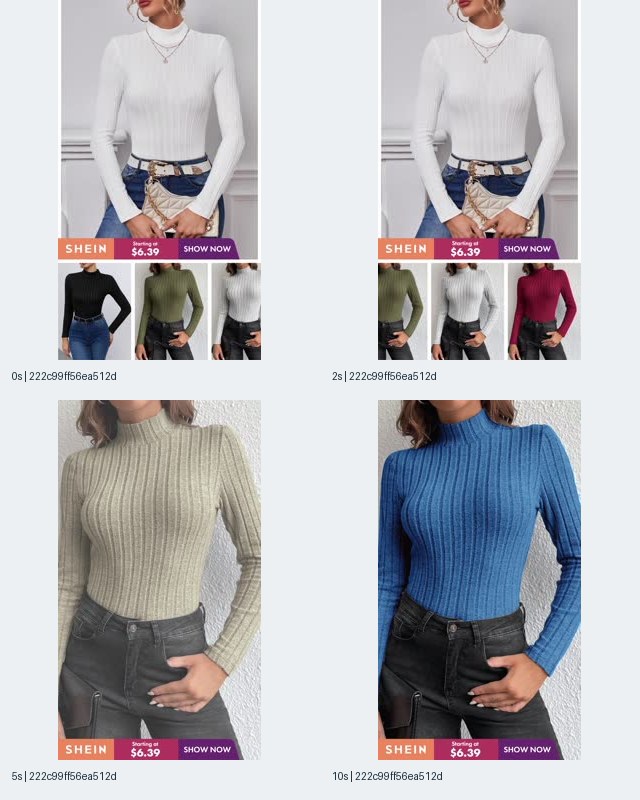
Figure 3. Source: SHEIN’s reported Android listing com.zzkko; frames at 0, 2, 5, and 10 seconds. The record lists a 14-second video. The displayed starting-price copy is historical advertising text, not a verified current offer.
The early frames show a large image of a white ribbed top, with smaller product views below it. Later sampled frames show beige and blue tops in larger views. The lower strip retains the SHEIN brand, starting-price wording, and a shopping prompt. The product changes while the information region stays recognizable.
This makes the example useful for studying information hierarchy. The garment occupies most of the available space; the offer sits in a compact, repeated location. A team can ask whether its own product variation is immediately visible or requires reading labels that may be small on a phone.
A practical hypothesis is that a stable offer location could make changing variants easier to follow. That is a design hypothesis, not a measured advantage in this sample. An original test could hold the garment, offer, and destination constant while changing whether variant views appear in a strip or in successive full-frame views.
The visible starting price should stay attached to its source context. It cannot be copied into a new brief as a current commercial term, and it does not establish stock availability, eligible colors, shipping conditions, or the final checkout amount. Those details would need the advertiser’s current product and offer evidence.
The sample also contains another record sharing this video fingerprint. Its separate record identity does not create a second independently produced video. For a content library, keep the video master and its record associations together, and distinguish those associations from visual variants within the video itself.
That distinction helps a producer avoid confusing three different things: different garments shown in one asset, different assets, and different records referencing the same asset.
Figure 4: SHEIN Uses a Layout Resembling a Shopping Page
The second SHEIN portrait example places modeled outfits inside a shopping-page composition with repeated sale language and a separate product image.
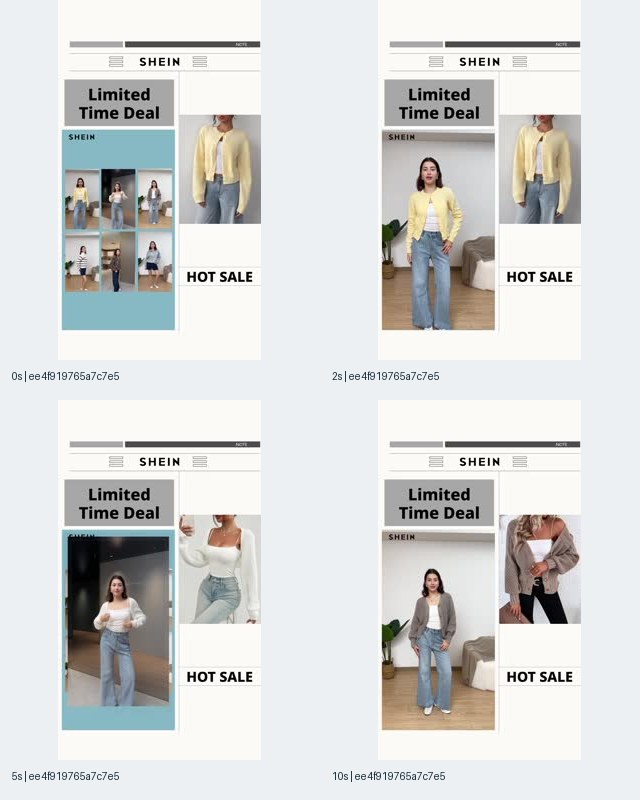
Figure 4. Source: SHEIN’s reported Android listing com.zzkko; frames at 0, 2, 5, and 10 seconds from a record listing a 25-second video. The shopping-page appearance does not establish that the displayed controls are interactive.
The sampled frames retain a header, a “Limited Time Deal” block, and “HOT SALE” text. Within that structure, the larger panel changes from a set of small outfit images to a woman modeling different layers. A separate product photograph occupies another part of the composition.
This reference offers a concrete distinction between showing a product in use and showing a product as a catalog item. The modeled view conveys silhouette and how an outfit sits on a person. The adjacent photograph presents the garment in another framing. The layout lets a creative team consider both jobs without assuming that either view proves fit, fabric quality, or purchase satisfaction.
For production, the useful question is whether each panel adds new information. If both panels merely repeat the same view, the layout may spend screen space without clarifying the product. If one shows movement and the other isolates a detail, the relationship can become a testable communication choice. The current contact sheet does not establish continuous movement, so that second arrangement would be a proposed original execution.
The sale language also needs careful handling. “Limited Time Deal” is an observed claim in the advertisement. The source package does not provide a promotion schedule or verify that a deal remained available on the article’s update date. A new brief should obtain the actual eligibility and timing information before reusing urgency as an angle.
This record was first seen on 2025-11-21 and last seen on 2026-10-31. Those are index observation dates. They do not prove uninterrupted delivery, a successful promotion, or that the same products stayed available throughout that period.
Figure 5: SHEIN Separates Product Grids From Offer Copy in Landscape
The landscape SHEIN example distributes a product grid and first-order messaging across horizontal space, then shows a larger branded shopping prompt in the 10-second sample.
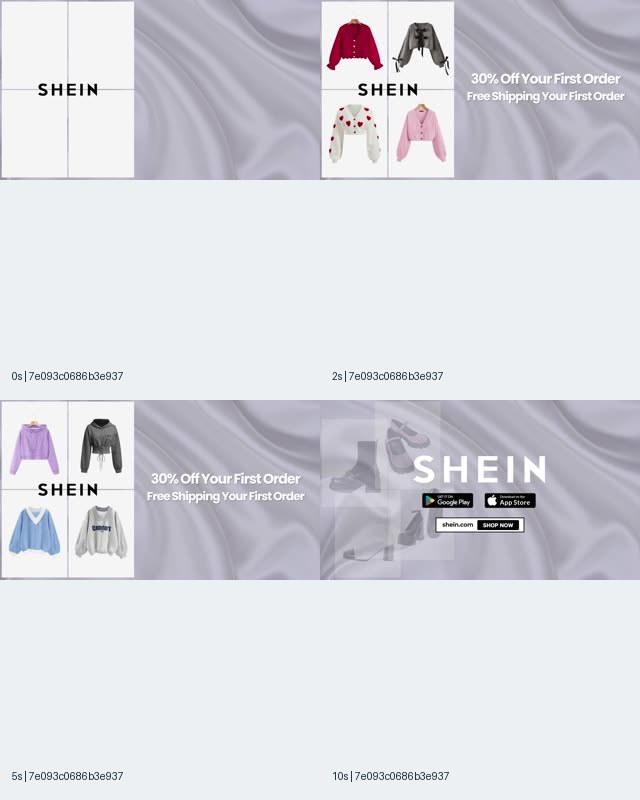
Figure 5. Source: SHEIN’s reported Android listing com.zzkko; frames at 0, 2, 5, and 10 seconds. Metadata lists a 12-second video. The 10-second brand-and-CTA composition is a sampled frame, not a verified final frame or end card.
The 0-second frame shows the SHEIN name across a mostly empty grid against a pale fabric-like background. At 2 seconds, clothing appears in the grid beside first-order discount and shipping copy. The 5-second sample shows another clothing selection within the same overall arrangement. At 10 seconds, a larger wordmark, store badges, and shopping prompt are visible.
The horizontal layout creates separate areas for browsing and reading. A team adapting this structure should consider whether the product images remain large enough to recognize and whether the offer can be understood without inspecting small text. That is a layout evaluation task, not a reason to assume the same arrangement will suit every placement.
The first-order terms are historical ad claims. They do not establish current eligibility or shipping conditions. The visible store badges also do not expand the record’s verified product association: this illustrated record links to the Android listing. Visual distribution cues and reported store linkage should be recorded as separate observations.
A useful original experiment would compare a product-first composition with an offer-first composition while keeping the advertised assortment and verified terms the same. The hypothesis concerns which message a viewer can accurately recall. A subsequent campaign could measure advertiser-owned outcomes, but no such results are present here.
This video fingerprint also appears in another sampled SHEIN record whose first-seen date is earlier. Consequently, the first-seen date of this particular record cannot be treated as the video’s creation date. File reuse and record chronology need separate columns in the research worksheet.
To inspect related indexed references, search SHEIN creatives in AdMapix, then apply the Vungle network and US filters. That brand search is a research starting point; it does not automatically reproduce the empty-keyword network sample used in this article.
Figure 6: Modo Uses Fire Imagery Around a Slot-Style Result
The second Modo example places a slot-style result frame between sampled images dominated by orange flames, making the effect itself a prominent part of the visible creative.
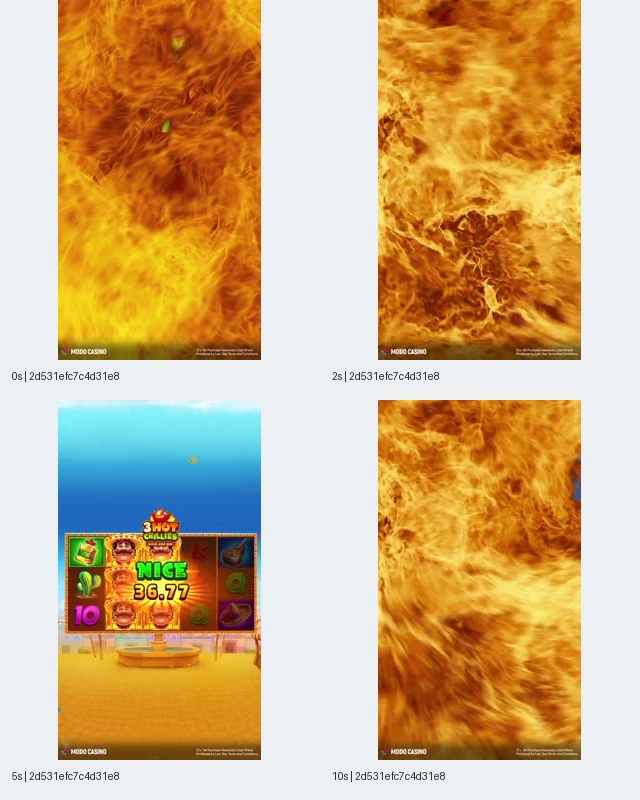
Figure 6. Source: Modo: Play, Win & Rip, iOS listing 6741076536; frames at 0, 2, 5, and 10 seconds. The record lists a 29-second video. The displayed number is part of the advertisement, not verified winnings.
The flame imagery occupies most of the portrait composition in several sampled frames. At 5 seconds, a slot-style display and a result label are visible over a blue and yellow background. A small Modo Casino brand treatment remains near the bottom. The contact sheet does not show whether the flames are transitions, an overlay, or another continuous animation behavior throughout the missing intervals.
For a creative team, the reference raises a specific communication question: how much of the sampled screen is devoted to the product activity, and how much to a surrounding effect? Answering that question qualitatively can guide a brief without inventing frame-by-frame measurements.
A plausible hypothesis is that a visually intense effect could attract attention while delaying recognition of the underlying activity. Another is that the effect reinforces the theme for an already familiar audience. Neither explanation is established by the sample, and the audience’s familiarity is unknown.
An original production test could retain a verified game demonstration while varying the prominence of a thematic effect. Before spending on delivery, ask viewers to describe the action they believe the product offers. If they remember only the effect, the team has a concrete comprehension issue to investigate. That check would be new research, not a conclusion drawn from the source ad’s ranking.
Keep Figure 6 distinct from Figure 2. Both records link to Modo, but their supplied frames show different visual treatments. Figure 2’s green effect should not be described as part of Figure 6, and Figure 6’s flames should not be added to Figure 2’s caption. Brand association does not make separate source assets interchangeable.
Figure 7: Credit Karma Connects a Grass Metaphor With a Financial Overview
The Credit Karma contact sheet links “grow my money” language to a grass setting, then shows a simplified financial overview on a bright green background.
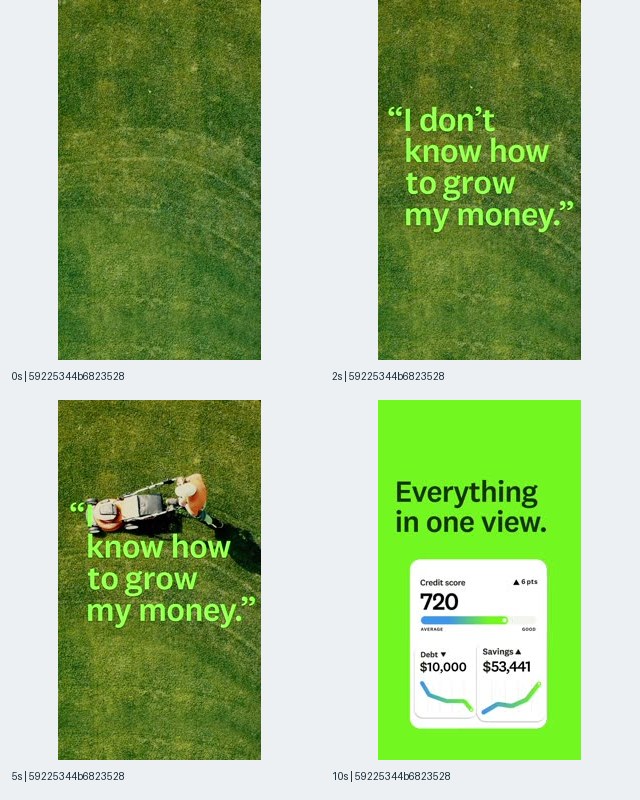
Figure 7. Source: Intuit Credit Karma, iOS listing 519817714; frames at 0, 2, 5, and 10 seconds from a record listing a 20-second video. Dashboard values are visible advertising content, not verified customer outcomes.
The first sampled frame is a grass texture. At 2 seconds, the text “I don’t know how to grow my money” appears over it. At 5 seconds, an overhead view includes a person with a lawn mower alongside the text. At 10 seconds, the composition changes to “Everything in one view” above a card containing credit-score, debt, and savings information.
The visible connection is between a familiar phrase and a literal outdoor setting. The later dashboard introduces a product-oriented explanation: bringing financial information into a single view. The source frames do not prove that using the app grows savings, reduces debt, or improves a credit score.
This distinction is useful when briefing financial-service creative. A metaphor can introduce a concern, but the subsequent product demonstration should describe a supported function. If the product organizes information, a brief should not silently turn that function into a guaranteed financial result.
A testable hypothesis would compare a metaphor-led opening with a direct dashboard-led opening while retaining the same verified feature description. A comprehension check could ask what the app does and what outcome, if any, the viewer believes is promised. That second question helps identify an unintended implication before a campaign test.
The sample does not establish the exact timing of the transition to the dashboard or whether voice-over qualifies the message. It also does not verify that the displayed interface is the current app interface. A producer using the structural lesson should capture fresh, authorized product screens for the new creative.
The transferable idea is the connection between concern and function. The visible account values themselves are not a benchmark or a promise to carry into another advertiser’s campaign.
Figure 8: Grant Cash Advance Pairs Urgency With Visible Conditions
The Grant Cash Advance example uses a washing-machine setting and a phone mockup while displaying eligibility and delivery-fee qualifications alongside its cash-access message.
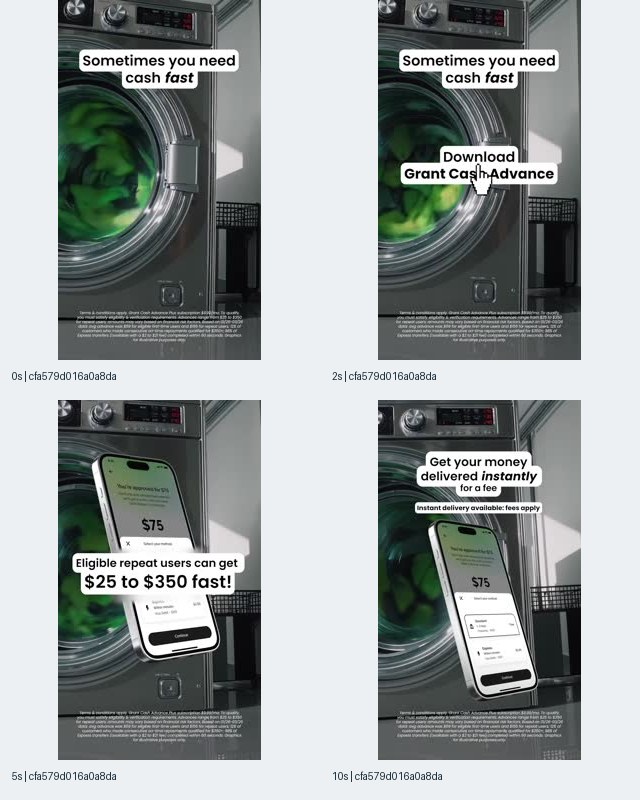
Figure 8. Source: Grant Cash Advance, iOS listing 6472350114; frames at 0, 2, 5, and 10 seconds. Metadata lists an 18-second video. Cash amounts, eligibility wording, and delivery terms are recorded ad claims, not independently verified current product terms.
At 0 seconds, the text says that sometimes cash is needed fast. The background shows a washing machine with green contents. At 2 seconds, a download prompt names Grant Cash Advance. The 5-second frame adds a tilted phone and a statement that eligible repeat users can get $25 to $350. At 10 seconds, the message describes instant delivery for a fee, with an additional fees-apply qualification.
The visible distinctions matter more than the headline alone. “Eligible repeat users” limits who the amount claim concerns. “For a fee” qualifies the delivery message. Removing those phrases from a research summary would change the meaning of the advertisement.
The smaller legal text at the bottom is not sufficiently legible here to reconstruct complete terms. It should be recorded as present but not fully transcribed or treated as reviewed. Nor does the phone mockup establish that a real applicant received the shown amount.
For an original financial-app brief, keep a claim ledger beside the storyboard. Each amount, eligibility condition, delivery statement, and fee description should point to current approved product information. The source example can inform where qualifications are placed, but it cannot supply another product’s terms.
A practical hypothesis is that placing a qualification close to the main claim could improve accurate understanding. Testing that hypothesis requires checking what viewers actually understood, including who qualifies and whether faster delivery costs money. A click-rate increase alone would not answer those questions.
This example also reinforces the difference between a pictured phone interface and an interactive ad. The supplied record contains video and no indexed playable file; the contact sheet does not establish tappable controls.
Reuse and Observation Dates: What They Actually Establish
Repeated video fingerprints establish file reuse across records, while first-seen and last-seen dates establish index observations rather than creative production or continuous campaign activity.
The Walmart pair shares one video fingerprint. The SHEIN knitwear video, shopping-page video, and landscape product-grid video also each appear under another sampled record. This is why the 30 advertising records resolve to 26 distinct video files. The associated image files remain a separate category; their presence does not explain every difference between records.
For a researcher, reuse should change the organization of the evidence. Start with a video-master entry, then attach the records that reference it. Record-level metrics remain attached to their original rows. A creative brief can cite the master once and use the related records to explain reuse without presenting duplicate screenshots as additional independent concepts.
The sample’s earliest first-seen date is 2025-04-14, and its latest is 2026-10-21. Three records were first seen within the measurement window. These facts describe when the index first observed records. They do not establish when an advertiser filmed, edited, approved, or first launched the underlying asset anywhere.
The SHEIN landscape example makes the distinction concrete: its fingerprint appears in records with different first-seen dates. Assigning the later record’s date to the underlying video would discard evidence that the same file was associated with an earlier record.
Similarly, a recent last-seen date is a reason to revisit an example, not proof of current live delivery at the time a reader opens this article. Do not translate a gap in observations into a confirmed pause or retirement without additional evidence.
The workflow consequence is straightforward: save record chronology, media identity, and visual interpretation separately. Avoid dividing estimated impressions by the time since first observation. Such a calculation would mix the defined measurement window with an unrelated age interval and would not produce a defensible daily-performance measure.
End Cards: What This Sample Does Not Show
The contact sheets do not establish a terminal end card or an interactive endcard for any illustrated video.
A brand-and-CTA frame can appear before a video finishes. Figure 5 demonstrates the problem: the source record lists a 12-second video, while the final sampled image is at 10 seconds. The image contains a large brand treatment, store badges, and a shopping prompt, but those features do not prove that the ad ends there. The remaining interval is unseen.
There is a second distinction between a video frame that looks like a closing screen and a separately served interactive endcard. An interactive endcard needs evidence of an associated interactive asset or observed behavior. The current sample provides no indexed playable files and no interaction recordings.
For creative research, use labels that preserve what is known: “CTA visible at 10 seconds,” “brand-focused sampled frame,” or “terminal state not observed.” These labels remain useful when the material moves from an analyst’s notes into a designer’s storyboard.
For a new production, define the intended terminal state explicitly. Specify the message, the permitted action, the completion event where required, and what the surrounding ad environment controls. Then test that behavior in the selected submission path. That proposed design is independent of whether a competitor contact sheet happened to capture a similar-looking screen.
The official documentation below describes playable and endcard capabilities. Those capabilities should not be backfilled into the advertising records. A network’s ability to serve interactive endcards does not prove that one was attached to a particular sampled video.
Liftoff Playable Ad Requirements: Choose the Submission Path First
As of November 2, 2026, official documentation describes three playable submission paths whose packaging, click handling, and validation rules must remain separate.
| Path | Intended workflow | Packaging and size | Interaction method | Official testing route |
|---|---|---|---|---|
| Liftoff Direct / Adaptive Creative | Advertiser creative using the former Vungle advertiser workflow | ZIP submission; main file ad.html or index.html; total size should not exceed 5 MB; no nested directories | Separate parent.postMessage download and complete events | Creative Verifier, dashboard preview, and approval QA |
| Liftoff Accelerate | Interactive creative uploaded through Ads Manager | Single HTML or ZIP with one folder; HTML/ZIP limit 5 MB; relative asset paths | mraid.open preferred, with documented alternatives; deliberate interaction required | Automatic HTML/ZIP QA scan in Ads Manager |
| Vungle Exchange | DSP-submitted programmatic creative | MRAID 2.0 playable without video; playable file-size limit not stated in supplied documentation | mraid.open preferred or window.open; not window.location | Vungle Exchange Demo App |
Sources: Direct Adaptive Creative rules, updated November 24, 2023, and event customization, updated March 24, 2022; Accelerate Interactive Ad Integration, updated October 1, 2026; Exchange HTML and MRAID submission guidance, updated April 8, 2026. All were checked in the supplied official-source review on November 2, 2026.
MRAID is the mobile rich-media interface referenced by these documents. Exchange explicitly names MRAID 2.0; the supplied Adaptive Creative and Accelerate pages do not state a version. Do not promote the Exchange version into a universal Liftoff requirement.
Before development starts, write the selected route on the brief and on the delivery checklist. If an account uses a different product than originally expected, revisit the integration requirements rather than merely renaming the ZIP. The visual concept may be reusable, while the event contract and package structure need a different implementation.
Liftoff Direct: Adaptive Creative Packaging and Events
Liftoff Direct’s Adaptive Creative guidance describes a playable experience with a specific messaging contract, including separate download and completion events.
The official Get Started With Liftoff Creative article, updated September 1, 2022, describes Adaptive Creative as a playable either standalone or with a video. It also says playables are available only to pre-approved advertisers. That pre-approval statement is from 2022; the supplied documentation does not establish whether the same access requirement still applies in 2026. Confirm it for the actual account before committing production resources.
The more recent Understand Adaptive Creative article, updated October 22, 2025, describes a common arrangement as a video asset paired with a playable endcard and says it uses MRAID. It does not state a MRAID version.
As of November 2, 2026, the supplied Dos and Don’ts, updated November 24, 2023, specifies the following route-specific requirements:
- Name the main HTML file
ad.htmlorindex.html, and keep total size at or below the stated 5 MB ceiling. - Support both portrait and landscape layouts, and keep a CTA visible throughout.
- Send a completion event at a clear completion point, or after five or more interactions when there is no clear ending.
- Restrict a full-screen clickable area to the end screen.
- Support remote mute through the
START_MUTEDtoken. - Avoid nested directories, externally hosted assets, tracking links, and external tracking libraries; the document mentions base64 where necessary.
- Do not include a reference to
mraid.js, add a creative-owned close button, or call directly to an app store. - Avoid
vwandvhunits,document.location.reload, and protocol-relative resource prefixes.
The event implementation comes from Customize the Adaptive Creative Experience, updated March 24, 2022: the CTA uses parent.postMessage("download","*"), and completion uses parent.postMessage("complete","*"). This is why copying an Exchange click implementation into a Direct asset without checking the contract is unsafe.
There is a documented difference in completion guidance. Adaptive Creative Asset Requirements, updated September 1, 2022, says both events must be present, should never trigger together, and describes completion usually firing after three or more interactions. The November 2023 page says five or more when there is no clear end. Preserve that difference in the technical brief and resolve it with the receiving team; do not publish a blended interaction threshold as though the pages agree.
App Store on Interaction adds another account-level consideration. The official SDK and ASOI article, updated January 22, 2024, describes aggressive, complete, and off levels. It states that the default CTA event fires after one interaction with a two-second delay. Treat this as documented behavior to confirm in the applicable setup, not permission to improvise an immediate store redirect.
For delivery planning, the approval-process article, updated September 1, 2022, describes a ZIP containing the endcard, Visual QA followed by Full QA on a mobile device, and approval normally taking about one business day. That is dated guidance, not a guaranteed current turnaround.
Liftoff Accelerate: HTML Integration and Upload QA
Liftoff Accelerate’s October 2026 guidance uses an HTML integration and Ads Manager workflow with its own startup, click, and upload rules.
As of November 2, 2026, Interactive Ad Integration, updated October 1, 2026, allows a single HTML file or a ZIP with one folder. If several root HTML files are present, one must be named index.html. File names should be ASCII, and asset references must use relative paths rather than absolute paths or URLs. Liftoff hosts the files on its CDN.
The startup sequence matters. The document says to wait for the MRAID ready event and check mraid.viewable before starting. A producer should therefore distinguish “the file loaded” from “the experience began in a viewable environment” when writing acceptance criteria. A desktop browser preview alone does not establish that this lifecycle behavior works in the receiving environment.
For clicks, the preferred method is mraid.open, with window.open also documented; window.Liftoff.open() is an alternative. The guidance prohibits window.location and requires deliberate user interaction. It also prohibits iframes and creative-owned close buttons. A 50×50-pixel region in each top corner may be covered by the close button, so place essential controls and instructions with that possibility in mind.
Sound should begin only after a user interaction. Responsiveness to both orientations is recommended where possible. That wording differs from Direct’s instruction to work in both orientations, and a requirements table should preserve the distinction rather than silently turning both statements into the same rule.
The integration page gives a 5 MB HTML limit. Managing and Uploading Creatives in Ads Manager, also updated October 1, 2026, specifies 5 MB for HTML/ZIP and describes automatic QA scanning. If no CTR event is detected, the operator clicks the CTA manually. The same page requires disclosure of AI-generated content.
The Creative Guidelines, updated October 1, 2026, describe interactive ads as standalone, interactive endcard, or multi-page experiences. They require a persistent, clear CTA and prohibit fake notifications, system alerts, countdowns, or misrepresentation. Those restrictions should be considered while designing the interaction, not left until upload.
A useful handoff includes a plain description of the intended interaction and its deliberate CTA action. For example, identify which gesture changes the demonstrated product state and which separate gesture opens the destination. That description allows QA to distinguish the promised behavior from an accidental navigation event. It is a recommended production practice, not a claim that this article tested an Accelerate asset.
Vungle Exchange: DSP Playables and Video Use Separate Guidance
Vungle Exchange explicitly supports playable ads without video in MRAID 2.0, while video submissions use the separate VAST guidance.
As of November 2, 2026, the HTML and MRAID Creatives Submission Guidelines, updated April 8, 2026, states that MRAID video is not supported and directs video use to VAST. It prefers mraid.open for clicks, also allows window.open, and prohibits window.location. Custom close buttons are ignored, and the document warns that iframes are likely to cause issues.
The supplied Exchange documentation does not state a playable file-size limit. Neither does it establish a maximum playable duration. Those unknowns should remain open questions for the Exchange integration contact, rather than being filled with Direct’s or Accelerate’s limits.
For video, the Vungle VAST Integration Guide, updated May 14, 2026, specifies up to 180 seconds and a minimum bitrate of 250 kbps. These are VAST video facts, not playable-duration rules.
The practical distinction is the submission responsibility. A DSP team submitting markup needs to validate how that markup renders and handles navigation in the Exchange environment. An advertiser uploading a ZIP through another Liftoff product follows that product’s upload and approval flow. Similar visual content does not remove the difference.
Keep the Exchange build’s integration notes alongside the asset, including the destination behavior and the version actually tested. If a visual concept is adapted from a Direct or Accelerate project, review the wrapper and event behavior before reuse. The network naming connection is not evidence of package portability.
Video Specifications Also Differ by Liftoff Path
Official video limits should be taken from the selected buying path, because the supplied Direct, Accelerate, and Exchange documents specify different constraints.
The Direct Creative Asset Requirements, updated November 21, 2022, describes a Playables creative as video plus a playable endcard. It lists 16:9 or 9:16 video, 1920×1080 or 1280×720 resolution, MP4 or MOV, a recommended duration of 15–30 seconds, and a maximum of 61 seconds. Those are dated Direct instructions checked as of November 2, 2026.
Accelerate’s Creative Guidelines, updated October 1, 2026, lists video limits of 300 MB and 180 seconds, with 1080×1920 or 1920×1080 dimensions and MP4 or MOV files. Exchange’s VAST duration and bitrate requirements are described in the preceding section.
These limits should not be used to infer which product served a sampled ad. The fact that a video has a particular duration does not identify its submission path. Nor can a contact sheet establish file size, codec details, or technical approval.
If supporting image assets are part of an Accelerate submission, the supplied official pages contain a discrepancy: the integration page says 10 MB for images, while the Creative Guidelines page says 1 MB. Both were updated October 1, 2026. Confirm the applicable limit rather than selecting the more convenient number without acknowledgment.
A production brief should therefore have separate fields for reference duration, planned duration, destination specification, and verified export properties. This prevents a common handoff error in which a team copies the length or orientation of a competitor example and assumes that it has also satisfied the technical requirements.
How to Test Liftoff Playable Ads With the Official Tools
The official testing route depends on the submission path, and a successful preview is evidence of checked behavior rather than evidence of campaign performance.
For Direct, Test Your Playable Asset With Our Creative Verifier, updated August 14, 2023, describes installing the Creative Verifier app on a test device, uploading assets, and previewing them within the Liftoff Monetize SDK. The tool flags errors such as a missing index.html or missing download message. The supplied official download destination is the Vungle Creative QA Tool page. These sources were checked as of November 2, 2026; this article did not install or run the tool.
Direct’s creative-building article, updated August 19, 2023, also describes dashboard previews for interacting with playables, checking portrait and landscape on phone and tablet, and testing close and mute buttons, the privacy link, and CTAs. Testing the environment’s close control does not mean adding a prohibited close button inside the asset.
For Accelerate, use the automatic HTML/ZIP QA scan described in the October 1, 2026 Ads Manager upload documentation. Follow the documented manual CTA step when the scan does not detect a CTR event. A producer should preserve the scan result and separately record any manual checks so that an automated pass does not become an unsupported claim about every device or interaction.
For Exchange, Test Creatives With the Vungle Exchange Demo App, updated September 24, 2025, describes rendering DSP ad markup in the Demo App. The key comes from the account manager. This is a different workflow from uploading a Direct endcard into Creative Verifier.
A practical testing sequence is:
- Confirm the receiving path. Record Direct, Accelerate, or Exchange and the applicable dated documentation.
- Freeze the candidate build. Keep an identifiable copy of the package or markup that will actually be checked.
- Check packaging. Inspect the entry file, file structure, asset references, and the relevant size limits.
- Check startup. Verify the route’s readiness and visibility behavior where specified.
- Exercise the interaction. Confirm that the demonstrated activity responds as intended and does not trigger unintended navigation.
- Check CTA and completion separately. Use the route’s event contract, including Direct’s requirement that download and completion do not trigger together.
- Check the surrounding experience. Review orientation, sound, controls, and the destination behavior in the appropriate official environment.
- Save the result and unresolved issues. Record the device, build, date, observed behavior, and any account-level clarification still required.
These steps are recommendations for a future test. No test latency, failure rate, approval rate, or operating cost is established by the supplied evidence. The article’s advertising screenshots are source references, not outputs from the testing tools.
A clear test report should say “CTA opened the intended destination in this recorded test” rather than “the creative is guaranteed to work everywhere.” The narrower statement is both useful and reproducible.
How This Compares With the AppLovin Research Page
The supplied evidence supports a Liftoff (Vungle) sample description, but it does not support a numerical creative-mix comparison with AppLovin.
The published AppLovin advertising research guide addresses creative research, video and playable structure, and the limits of incomplete public evidence. Its supplied inventory entry does not include a matched record set, measurement window, or format counts that can be compared with this sample.
Consequently, this article cannot conclude that Liftoff (Vungle) has more shopping ads, fewer playables, shorter videos, or stronger brand advertising than AppLovin. The current sample shows those particular shopping, entertainment, and financial-service references. It does not establish a relative network profile.
The useful comparison is methodological. For both research tasks, separate network attribution from product identity, records from unique files, and visible creative from unobserved performance. A video-heavy result from one bounded query and an interactive example in another article are not enough to calculate a format preference.
If a team needs a real comparison, collect both networks using the same country, exact measurement dates, sort order, page depth, and asset-count definitions. Preserve each query separately. If the available datasets have different windows, describe them in separate dated sections and avoid combined shares, ratios, or larger-versus-smaller claims.
A matched-window collection would still be a sample comparison rather than a network census. Its output could identify differences among the retrieved records, while leaving overall network composition unresolved.
For the production decision itself, the playable-versus-video testing guide focuses on comparing formats around the same product promise. That is a more actionable question than declaring a format winner from unrelated network snapshots.
A Practical Workflow: From Network Search to an Original Brief
A useful Liftoff (Vungle) research workflow produces a source-linked observation, a clearly labeled hypothesis, and a build plan for the correct submission path.
Start by defining the decision. A shopping team might be deciding how to present color variants. A financial-app team might need to clarify an eligibility condition. A game team might be considering whether to build an interactive demonstration. These are different research tasks, even when the references come from the same network sample.
Set the research scope before collecting examples. Record the country, exact measurement dates, network label, keyword, sorting method, and page limit. For reproducing this article’s sample, use US, Vungle, an empty keyword query, 2026-10-03 to 2026-11-01, and the bounded impression-descending collection described above. A new live investigation should use its own dated scope.
Verify the reported destination. Save the store ID or website association beside each record. A familiar logo can help a person recognize the creative, but it should not replace the identifier in the evidence log. If the destination cannot be established, keep that uncertainty visible rather than assigning the example to an advertiser by appearance alone.
Group repeated files. Create one visual-reference entry per distinct video file, then attach the related advertising records. Keep image and playable associations separate. This avoids both duplicate inspiration slides and misleading claims about how many original assets a team produced.
Describe the visible evidence in plain language. A strong note says, “The sampled frame at 5 seconds shows a large beige knitwear view above a branded offer strip.” A weaker note says, “SHEIN’s winning variant strategy drives conversions.” The first can be audited against Figure 3; the second adds outcomes the source does not supply.
Write a hypothesis that could be wrong. For the knitwear example: “A stable offer position may help viewers follow changing product variants.” Then specify what would count against it, such as viewers confusing the offer with only one displayed variant. This turns the reference into a question the team can actually investigate.
Create an original execution. Use authorized product imagery, accurate interface captures, current commercial terms, and original visual treatment. Preserve the structural idea being tested without copying the source advertiser’s brand, artwork, or unverified claims.
Select the technical path. If the output is a playable, name Direct, Accelerate, or Exchange before development. A video brief and a playable brief can share a product promise, but the interactive version also needs input rules, feedback states, navigation behavior, and technical acceptance criteria.
Separate validation stages. A visual review checks whether the message is understandable. Technical QA checks whether the file behaves correctly in the intended environment. A campaign experiment checks advertiser-owned outcomes. Passing one stage does not establish the results of another.
Return a decision, not just a folder. The final research handoff should identify the proposed asset, the question it tests, the source that inspired it, the claims requiring verification, and the next acceptance step. That output gives creative and buying teams a shared task while keeping the evidence boundary intact.
A Copyable Brief for a Liftoff Creative Test
A production brief becomes actionable when it separates the source observation, the proposed change, the product evidence, and the technical destination.
| Brief field | What to enter | Example based on this sample |
|---|---|---|
| Research question | The communication problem to solve | Can viewers identify the product variant and understand which offer applies? |
| Source reference | Figure, record, and observed timestamps | Figure 3; SHEIN-linked record; sampled frames only |
| Verified observation | A description visible in the reference | Product views change while a branded offer strip remains in a consistent area |
| Hypothesis | The explanation to test | Stable offer placement may make variant changes easier to follow |
| Original execution | Your own product and visual treatment | Authorized garment footage with current, approved offer wording |
| Controlled elements | What should remain comparable | Product assortment, destination, eligibility, and core message |
| Test variable | The deliberate creative change | Variant strip versus successive large product views |
| Technical destination | The actual upload or integration path | The team’s confirmed Liftoff product, not simply “Vungle” |
| Acceptance evidence | What must be checked before delivery | Readability, accurate terms, intended navigation, and route-specific QA |
| Outcome record | Where results will come from | The advertiser’s own measurement and a separately documented test |
For a playable adaptation, add a state description. Explain what the user can do, what changes after that input, what feedback appears, and where the CTA leads. A product-selection interaction, for example, should not be described as present in the source video; it would be a new execution inspired by the visible variant presentation.
Also write a short “not established” field. For this example, the source does not establish conversion lift, the current validity of the displayed offer, or whether users interacted with the ad. Keeping those unknowns on the brief reduces the chance that a speculative rationale becomes a promised result during production.
Before approval, ask a colleague to trace each factual claim back to either the source record, current product evidence, or the selected official specification. Claims without one of those foundations should be revised into hypotheses or removed. This is a recommended review process for the new work; it is not a claim that a named human reviewed this automated article.
Measuring Your Own Test Without Borrowing Competitor Outcomes
Creative research supplies candidate ideas; your own experiment must establish whether an idea improves the outcome your business cares about.
For an initial comprehension check, ask viewers to describe the advertised product, the action they believe they can take, and the conditions attached to the offer. This is particularly relevant to Figure 8, where eligibility and delivery fees are part of the visible message, and Figure 7, where a metaphor could be interpreted more broadly than the displayed feature.
For technical QA, record whether the tested build loads, responds, handles navigation, and follows the selected integration contract. Those results answer engineering questions. They do not establish that the audience wants the product or that an interactive format is commercially preferable.
For a campaign experiment, define the business outcome and measurement conditions before interpreting results. Depending on the product, the relevant outcome may involve a qualified registration, a verified purchase, or an activation event. Keep the offer, destination, audience conditions, and attribution approach comparable where the experiment requires it.
Do not use this sample’s estimated impressions as the denominator for your own conversion rate. The source estimates concern other advertising records in a defined historical window. Combining them with an advertiser’s installs or purchases would mix unrelated measurement systems.
When comparing a playable with a video, include the production and maintenance work in the decision record. An interactive asset can require event integration and additional QA, but this article supplies no measured cost difference. Record the actual work for your team instead of importing a generic multiplier.
Finally, retain unsuccessful hypotheses. If a product-first opening produces clearer understanding than a metaphor-led opening in your own test, that result is useful even when the metaphor appeared in a prominent competitor reference. The purpose of research is to generate a defensible experiment, not to make the source example win by assumption.
Common Mistakes That Change the Meaning of the Evidence
The most consequential errors come from changing the unit, scope, or technical path while keeping the original number or screenshot.
Calling 30 records “30 unique creatives.” The frozen sample contains 26 distinct video files, with image files and playable files counted separately. Preserve those definitions in tables, captions, and summaries.
Turning zero indexed playables into a network capability claim. The sample does not contain playable associations. Official documentation nevertheless describes playable paths. The missing sample format cannot establish that the network does not support or serve it.
Treating a pictured interface as an interactive asset. Slot controls, shopping layouts, and phone screens can be part of a video. Use asset associations or recorded interaction evidence to establish interactivity.
Calling the last sampled frame an end card. A 10-second sample from a longer video does not establish the terminal state. Describe the timestamped frame directly.
Using one Liftoff checklist for every product. Direct’s messaging contract, Accelerate’s integration flow, and Exchange’s DSP rules differ. Keep the receiving path visible throughout the brief and QA report.
Erasing the dates on older official instructions. Direct’s pre-approval statement and normal approval timing come from 2022 documentation. They should not become unconditional promises about account access or turnaround in 2026.
Treating first-seen dates as production dates. A file can appear in several records with different observation dates. Preserve the distinction before discussing reuse or recency.
Combining unrelated measurement windows. An AppLovin figure from another period cannot be inserted into this sample’s table or used to calculate a relative network share. Without a matched source, leave the numerical comparison unanswered.
Copying historical offer language into a current brief. The SHEIN and Grant examples contain commercial claims whose present validity was not tested. New creative needs current approved terms.
Calling a technical preview a performance test. Rendering, click behavior, and completion events are observable technical results. Conversion, retention, and profitability require separate evidence.
When AdMapix Fits This Workflow
AdMapix fits the discovery and evidence-organization stage when a team needs to inspect indexed creative, preserve source context, and develop original test briefs.
AdMapix is an advertising-intelligence product for researching indexed ads. In this workflow, its useful role is to help a researcher move from a network or product query to specific records and visual references. The work still requires checking product associations, dates, asset reuse, and the difference between observed content and a proposed explanation.
Disclosure: AdMapix is our product, so we separate its research role from the evidence it cannot supply. This article does not position AdMapix as an official Liftoff approval tool, a substitute for an SDK preview, or a source of competitors’ private conversion outcomes. It also makes no hourly refresh guarantee.
For live research, sign up or log in to AdMapix, select the Vungle network, set your market and dates, and inspect the records relevant to your actual production question. Save the scope with your findings so the next person can understand what was searched.
Check the live pricing page for current access and commercial terms. Plans and allowances can change, so this evergreen guide does not enumerate them or promise a paid-plan trial.
Use the official Liftoff tools for submission validation and your own measurement for campaign outcomes. AdMapix supplies the research starting point; the final decision should rest on the evidence appropriate to that decision.
FAQ
What are the requirements for Liftoff playable ads?
They depend on the submission path. Direct uses Adaptive Creative packaging and separate download and completion messages. Accelerate uses its HTML integration and Ads Manager upload rules. Vungle Exchange supports playable ads without video in MRAID 2.0. Select the path before development, then use its dated official documentation rather than combining requirements from all three.
Are Liftoff and Vungle the same network name?
Liftoff and Vungle officially merged in 2021, and current official documentation still uses Vungle SDK and Vungle Exchange. AdMapix’s relevant network filter remains labeled Vungle. This article uses Liftoff (Vungle) for that research context, while keeping Direct, Accelerate, and Exchange distinct because their creative submission workflows differ.
Does this sample contain any playable ads?
No indexed playable files or playable-bearing records appear in the 30-record US sample for 2026-10-03 to 2026-11-01. All sampled records contain video associations. That is a finding about a bounded, impression-ranked collection, not proof that the network serves no playables. The official documentation separately establishes playable capabilities and submission paths.
How do I test a Liftoff or Vungle playable?
Use the official tool for the receiving path: Creative Verifier and the documented preview workflow for Direct, automatic HTML/ZIP QA in Accelerate Ads Manager, or the Vungle Exchange Demo App for DSP markup. Check the actual build’s loading, interaction, CTA, and required completion behavior. This article describes those documented tools but did not run them.
Is the playable size limit always 5 MB?
No universal limit is established by the supplied documentation. Direct says total size should not exceed 5 MB, and Accelerate specifies 5 MB for HTML/ZIP. The supplied Vungle Exchange guidance does not state a playable file-size limit. Do not transfer a limit between paths without confirmation, and do not confuse playable limits with separate video or image limits.
Can I compare these ads with AppLovin to choose a format?
You can compare research questions and visible creative structures, but the supplied AppLovin inventory entry does not provide a matched dataset for numerical comparison. This article cannot establish relative playable adoption or video length by network. For a format decision, build comparable original executions around the same product promise and measure them with your own test.
Do estimated impressions or repeated files identify a winning ad?
They identify estimated exposure and file reuse within the source’s scope, not a conversion winner. A repeated file may be worth inspecting, but the sample does not reveal the advertiser’s spend, audience, installs, revenue, or profit. Use it to form a hypothesis, then evaluate that hypothesis with appropriate technical checks and advertiser-owned outcome data.
Key Takeaways
A defensible Liftoff creative brief connects the right source example to the right technical path and leaves performance questions for a real test.
- The dated US sample contains 30 records, 26 distinct video files, and no indexed playable files; it is not a network census.
- The eight contact sheets support specific observations about branding, product variants, effects, metaphors, and qualified offers.
- Direct, Accelerate, and Exchange require separate implementation and testing checklists.
- Sampled timestamps do not establish complete playback, terminal end cards, or interaction behavior.
- Preserve source dates, product IDs, asset reuse, and unknowns when turning a reference into an original production brief.
Sources
The evidence consists of a reproducible advertising snapshot, supplied timestamped images, and official documentation checked on November 2, 2026; each source has a different scope.
- Advertising sample, observed 2026-11-02: Public frozen source package. Includes public batches, request parameters, and checksums for the bounded US Vungle collection covering 2026-10-03 to 2026-11-01. Supports record counts, file associations, metadata, and model-estimated impressions, not campaign outcomes.
- AdMapix methodology, referenced 2026-11-02: Research methodology. Provides the public methodological context for interpreting indexed advertising evidence and its limitations.
- AdMapix product workflow, referenced 2026-11-02: SHEIN creative search. A relevant starting point for inspecting indexed product examples; apply the network, country, and date filters separately. Live results are not the frozen article sample.
- Naming, official sources checked 2026-11-02: Liftoff merger announcement, published October 1, 2021, and Start Monetizing With Liftoff, updated May 8, 2026. Support the naming explanation, not an invented rebrand date.
- Direct requirements, checked 2026-11-02: Adaptive Creative rules, updated November 24, 2023, and asset requirements, updated September 1, 2022. Support the dated packaging and event guidance, including the documented completion-threshold difference.
- Accelerate requirements, checked 2026-11-02: Interactive Ad Integration and Ads Manager uploads, both updated October 1, 2026. Support integration, upload limits, and automatic QA descriptions.
- Exchange requirements, checked 2026-11-02: HTML and MRAID submission guidelines, updated April 8, 2026, and VAST integration, updated May 14, 2026. Support the distinction between MRAID playables and VAST video.
- Official testing instructions, checked 2026-11-02: Creative Verifier, updated August 14, 2023, and Exchange Demo App, updated September 24, 2025. Describe testing workflows; no completed tool test is claimed in this article.
Turn these observations into your next creative study
Open the creative library and select samples for your market, network and research question.
Related Articles
Unity Ads Creatives: US Examples and Playable Specs
Analyze eight Unity-filtered US advertising examples, understand the limits of a thirty-record sample, and turn current Unity playable specifications into a practical research, production, and device-testing workflow.
TikTok Ads Downloader: Official Limits and Saving Workflow
Learn what TikTok’s official research tools let you save, how to download eligible files individually in AdMapix, and how to build a traceable swipe file using eight dated US advertising examples.
Novig Ads and Commercials: What 30 US Records Show
Eight timestamped examples and 30 verified US iOS advertising records reveal Novig’s Notes-style explainers, sports comparisons, offer variants, sampled concentration, and the limits of revenue-ranking evidence.