
Solitaire Cash Ads: Cash Hooks, Presenters, and Creative Reuse
Eight timestamped Solitaire Cash examples and 30 verified US iOS advertising records reveal account claims, presenter formats, gameplay imagery, and creative reuse, with dated portfolio context and clear limits on performance conclusions.
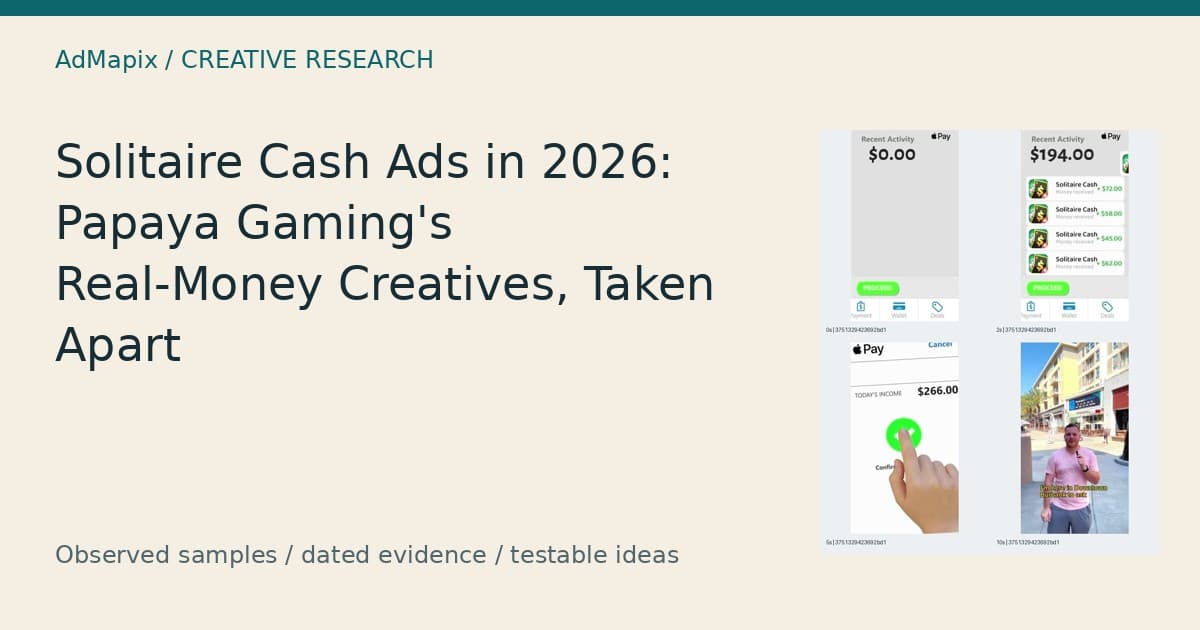
Solitaire Cash Ads: Cash Hooks, Presenters, and Creative Reuse
Last updated: 2026-11-02
AdMapix Research — prepared with Codex and checked against the dated source sample.
Editorial ownership: Brad at AdMapix. This identifies editorial accountability and does not imply personal human review.
Solitaire Cash ads in this sample show account-balance graphics, on-screen cash claims, presenters, solitaire boards, leaderboard imagery, and a relaxation hook. Those approaches coexist: a payment-style opening can precede a presenter, while another creative keeps cards and a changing balance together. The sampled frames cannot identify the people appearing in them, and they do not show the specific “girl on couch” scene that some readers search for.
For user-acquisition managers and creative teams, the useful finding is the combination of recurring visual ideas and older advertising records. A dated US sample linked to the verified Solitaire Cash iOS listing contains 30 records, with 914,902,990 third-party model-estimated impressions for its specified window. This article explains what the eight visual examples show, how reuse and discovery dates change their interpretation, and which observations can become original production briefs.
Quick Answer
The sampled Solitaire Cash ads connect familiar card-game imagery with visible cash claims through several different presentation formats.
- Payment-style screens, presenter footage, gameplay demonstrations, and leaderboard celebrations appear in the supplied contact sheets.
- The 30-record US sample covers 2026-10-03 to 2026-11-01, with records linked to verified iOS listing 1446254576, sold by Papaya Gaming LTD.
- Its leading record represents 25.1% of the sample’s model-estimated impressions; the leading five represent 49.2%. These are sample shares, not market shares.
- Older records remain prominent, but discovery dates do not establish uninterrupted advertising or profitability.
- The pictures document advertising content. They cannot establish personal identities, validate financial claims, or answer legitimacy or legal questions.
AdMapix is an ad-intelligence platform. Here, its records support a dated creative-research exercise rather than a campaign-performance verdict.
What a Creative Team Can Decide From This Sample
This sample can help a team choose which message structures to investigate and test, but it cannot tell the team which execution will convert best.
The decision is more specific than choosing between “cash ads” and “gameplay ads.” The contact sheets show different orders of explanation. Some introduce a financial-looking result before showing a person. Another introduces a person before presenting a card board. A third starts with a request to unwind, placing the game inside a quieter visual environment. Those are different ways to establish the subject and invite attention.
A useful research output therefore records the opening object, the information visible later, and the relationship between them. A balance screen raises a different question from a solitaire board: the former asks the viewer to interpret an apparent outcome, while the latter presents an activity. Whether either approach improves understanding or acquisition remains a hypothesis until tested with a team’s own evidence.
This distinction also keeps the article relevant to operators researching a particular app. The verified listing provides the entity boundary; the screenshots provide creative observations; the impression estimates provide a limited ordering within a dated sample. None replaces the others.
For the wider context of this research format, the AdMapix ad strategy teardown series collects related analyses. Each article’s dates and scope should travel with its findings when examples are brought into a presentation.
Methodology: Verified iOS Identity and a Bounded US Sample
The analysis uses a frozen AdMapix sample fetched on 2026-11-02, with the exact measurement window 2026-10-03 to 2026-11-01, country US, and research query “Solitaire Cash.”
The reference entity is the App Store listing Solitaire Cash: Win Real Money, track ID 1446254576, seller Papaya Gaming LTD, and bundle ID com.papaya.solitairecash. Product discovery supplied the starting reference, but the creative requests used the verified iOS identifier. The broader product grouping contained additional identifiers; those were not adopted as the scope of this article.
The collection covered up to three pages of ten records, requested in descending order of model-estimated impressions. It returned 30 advertising records. This is a bounded sample selected for inspection, not a census of every ad associated with the app. It cannot establish the complete creative inventory, every launch, or the total advertising activity of Papaya Gaming.
Identity verification establishes a relationship to the reference store listing. It does not independently identify the ad buyer, funding entity, production agency, or person responsible for a particular execution. Some individual records also contain additional store associations. Those associations do not expand this article into an Android or all-platform analysis.
The visual evidence consists of eight supplied video contact sheets. Each shows frames at 0, 2, 5, and 10 seconds. We describe those frames only. We did not watch complete videos, listen to their complete audio, operate an interactive ad, play the app, or measure conversion. A scene at ten seconds is simply the last sampled scene in that sheet; it is not necessarily the conclusion of the video.
Impression figures are third-party model estimates for the explicit window. They are not observed delivery, spend, installs, profit, or lifetime totals. We use the supplied record-level estimates and prepared sample statistics without constructing additional ratios or age-adjusted rates. Product-search impression and spend aggregates are excluded because their measurement scope is unsuitable for this comparison.
The supplied records do not provide a verified, human-readable network mapping that supports a placement claim here. We therefore do not label these examples as TikTok, YouTube, Instagram, or another named network. Vertical composition and presenter style do not establish distribution.
The public frozen source package makes the batches, request parameters, and checksums public and reproducible. The AdMapix methodology supplies the accompanying product-level explanation of evidence boundaries.
The Evidence Table: Records, Files, and Estimated Impressions
The sample contains 30 advertising records, while the underlying media counts describe a different layer of the evidence.
| Measure | Supplied result | Correct interpretation |
|---|---|---|
| Advertising records | 30 | Entries returned within the bounded sample |
| Records containing video | 26 | Records with an associated video file |
| Distinct video fingerprints | 25 | Distinct indexed video files, not necessarily distinct concepts |
| Distinct image fingerprints | 1 | A separate image-file count |
| Records containing a playable association | 14 | Records linked to an interactive asset |
| Distinct playable fingerprints | 5 | Distinct indexed playable files |
| Model-estimated impressions | 914,902,990 | Record-level sample total for 2026-10-03 to 2026-11-01 |
| Leading record share | 25.1% | Share of this sample’s estimated impressions |
| Leading five records’ share | 49.2% | Concentration within this sample |
| Leading record versus second | 3.5 times | Supplied comparison of record-level estimates |
| Earliest first-seen date | 2025-06-19 | Earliest discovery date among sampled records |
| Latest first-seen date | 2026-10-14 | Latest discovery date among sampled records |
| Records first seen within the window | 3 | Newly discovered records represented in this sample |
| Records last seen in the final three window days | 19 | A recency observation, not proof of continuous activity |
A record is an advertising entry. A fingerprint identifies an indexed media file. A concept is an analyst’s description of the creative idea. Keeping those layers separate matters because a video can recur in different records, and different video files can share very similar visible content.
The video and playable counts should not be added into a single “creative total.” Some records link both types of media, so such a total would require a separate definition of what counts as one asset. Likewise, the eight contact sheets are eight illustrated examples, not a measurement of the prevalence of every visual format in the 30 records.
The leading record has 229,843,487 model-estimated impressions; the second has 66,157,554. That ordering helps prioritize inspection. It does not prove that the first has a better hook, a stronger presenter, or more efficient acquisition. Those explanations would require campaign conditions and outcome data that are absent here.
Example 1: An Account-Balance Opening Before Presenter Footage
The leading sampled record places account-style financial imagery before the presenter visible at ten seconds.
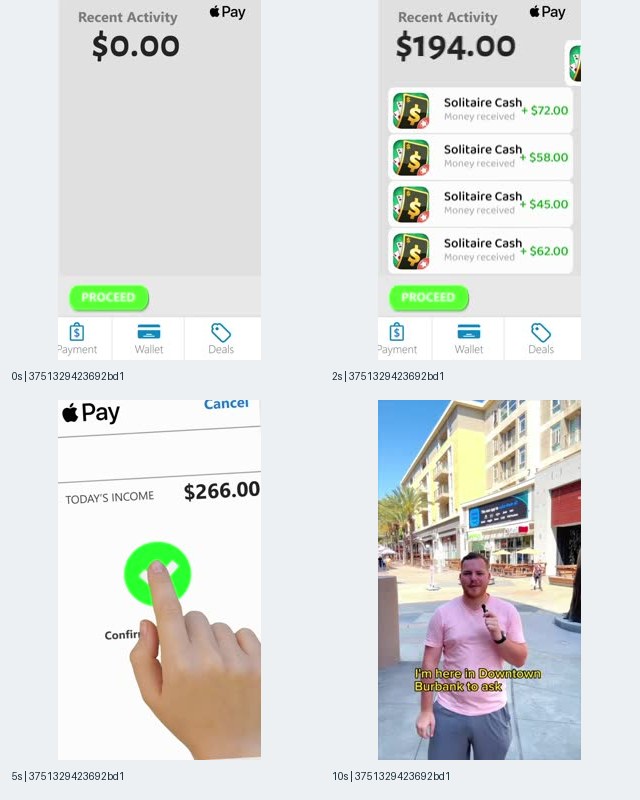
Figure 1. Record 3751329423692bd140b09e0739dfa27b, linked to verified Solitaire Cash iOS listing 1446254576. The contact sheet samples 0, 2, 5, and 10 seconds. Financial amounts and payment branding are elements shown in the ad, not independently verified transactions.
At zero seconds, a light interface displays “Recent Activity” and $0.00. At two seconds, the displayed headline amount is $194.00, with rows carrying the Solitaire Cash name and “Money received” labels. At five seconds, a separate payment-style panel shows “TODAY’S INCOME” and $266.00, with a hand positioned over a green confirmation graphic.
At ten seconds, the scene shows a person in a pink shirt holding a microphone outdoors. The subtitle says, “I’m here in Downtown Burbank to ask.” That subtitle is a statement appearing in the creative; it does not establish the circumstances of filming or what follows. No interview response is visible in the supplied frame.
This sequence is useful because the opening does not depend on immediately recognizing solitaire. The visible financial interface establishes the subject before a human presentation enters the sampled material. A hypothesis for a creative brief is that an outcome-oriented opening might change what viewers expect the presenter to explain. The sample does not test that hypothesis.
The record was first seen on 2026-03-21 and last seen on 2026-10-30. Its estimate is 229,843,487 impressions, representing 25.1% of the sample. These figures justify close inspection, but they cannot validate the depicted amounts or explain why this entry has the largest estimate.
For an original execution, the transferable idea is the information order: introduce a product-relevant result, then explain it through a person or demonstration. The exact payment interface and financial claim require their own substantiation. A team should not treat a competitor screenshot as permission to reproduce either.
Example 2: A Presenter Opening That Introduces a Card Board
The second illustrated record begins with a person addressing the camera and shows presenter footage above a solitaire board at ten seconds.

Figure 2. Record 71ad94be7f33de18e74f21e14bbef14e, linked to the verified Solitaire Cash iOS listing. The four sampled timestamps show a presenter format and a later card-board composition; they do not establish the person’s identity or a complete spoken testimonial.
At zero, two, and five seconds, the sheet shows a person wearing glasses and a black shirt beside a stone wall. The two-second frame includes the words “YOUR TIME” in large outlined lettering. The five-second frame shows “AND.” These fragments are visible, but the missing words between them should not be reconstructed into a quotation.
At ten seconds, a person in a white shirt appears in the upper part of the frame, with a green solitaire board underneath. The overlay reads “SKILL,” and the board includes a progress-style bar with a dollar amount beside it. The frame combines a human presence, a named quality, and a visible game activity without establishing a verified relationship among them.
The useful distinction from Figure 1 is the order of introduction. Here, the person occupies the early sampled frames. A viewer encountering those frames is first given a face and caption fragments rather than an account screen. That is a format observation, not evidence that presenter openings produce more trust or stronger retention.
The record carries 66,157,554 model-estimated impressions and 7.2% of this sample. It was first seen on 2026-05-14 and last seen on 2026-10-30. Its metadata associates it with a playable file, but the contact sheet does not show that interactive asset being operated.
A practical production hypothesis would compare a presenter explanation with an unobstructed board demonstration while keeping the actual product promise consistent. The research question could concern understanding: can viewers describe the activity after the opening? No answer is supplied by the estimated impressions alone.
Example 3: Similar Frames Can Belong to Different Files
The third contact sheet closely resembles Figure 1 at the sampled timestamps, but the records point to different video fingerprints.
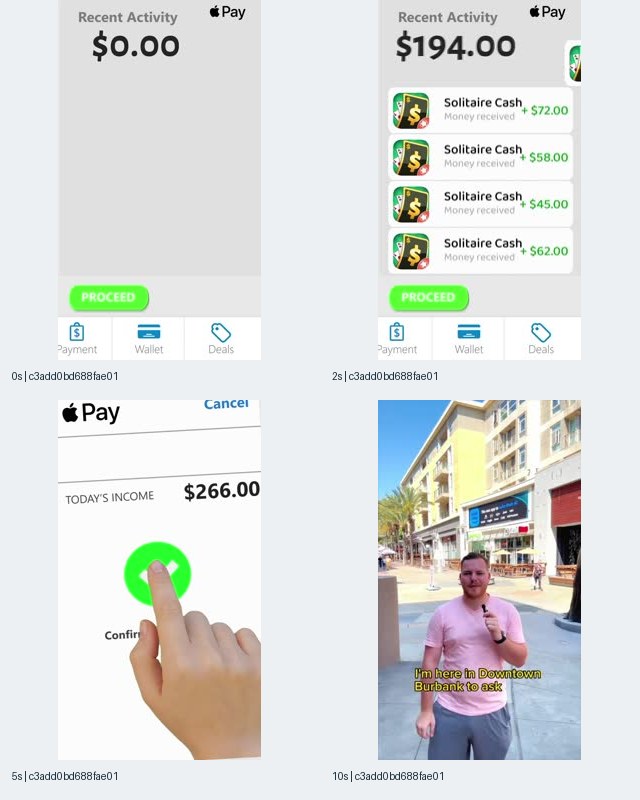
Figure 3. Record c3add0bd688fae012ac023527d42b46d, linked to the verified Solitaire Cash iOS listing. The visible frames resemble Figure 1, but this record has a different indexed video fingerprint. Similar sampled imagery does not establish identical complete videos.
This sheet independently shows a light “Recent Activity” interface at zero seconds, a balance and money-received rows at two seconds, a hand over a green confirmation graphic at five seconds, and an outdoor presenter at ten seconds. The financial amounts visible in this particular sheet include $0.00, $194.00, and $266.00 in their respective panels.
The record was first seen on 2025-08-13 and last seen on 2026-10-31. It carries 48,966,966 model-estimated impressions, or 5.4% of this sample. Those dates and estimates belong to this entry, not to the visually similar entry in Figure 1.
The distinction matters when estimating how much creative variety a library contains. File-level deduplication answers whether the indexed files share a fingerprint. Visual grouping answers whether the inspected material uses a similar idea or execution. The two questions can produce different groupings without either being wrong.
In a research sheet, these examples could share a descriptive tag such as “account screen followed by outdoor presenter.” They should still retain separate record identifiers, media fingerprints, dates, and estimates. A researcher should also preserve the uncertainty: the inspected timestamps do not reveal whether the remaining footage, audio, editing, or graphics differ.
For a production team, this is a reason to specify what “new creative” means before discussing output. A new file can be a small revision, a new combination, or a substantially different concept. This sample establishes file differences and visible similarities, but it does not reveal the production process that created them.
To inspect related indexed examples, search Solitaire Cash creatives in AdMapix, then verify each result’s store association and dates. The live search is a discovery route; it may not reproduce the frozen ordering shown here.
Example 4: A Solitaire Board With a Changing Balance Display
The fourth example keeps the visible card board and balance label inside the same graphic presentation.
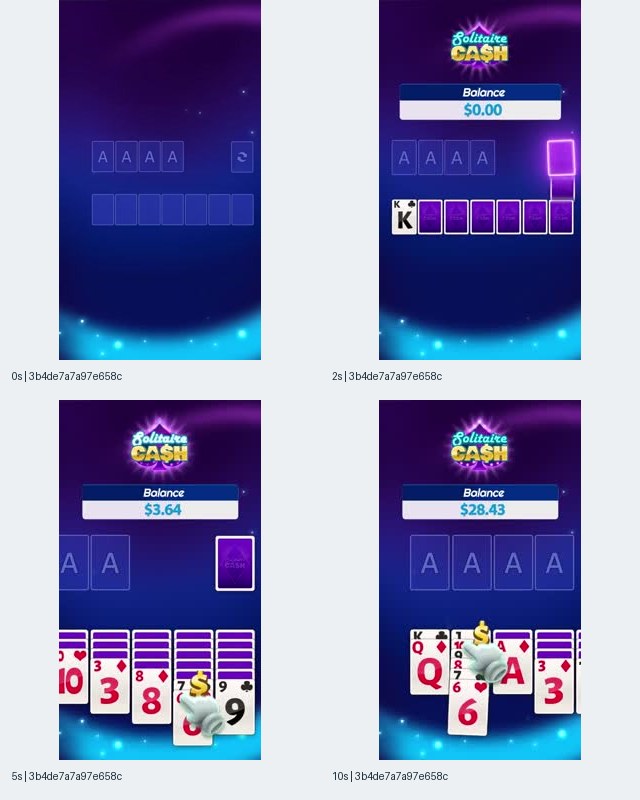
Figure 4. Record 3b4de7a7a97e658cde00018b9c886029, associated with the verified Solitaire Cash iOS listing. Frames at 0, 2, 5, and 10 seconds show board graphics and balance claims. They do not demonstrate a real financial outcome.
The zero-second frame shows empty card positions against a purple and blue background. At two seconds, the Solitaire Cash logo and a “Balance” panel appear above the cards, with $0.00 displayed. The five-second frame shows $3.64, and the ten-second frame shows $28.43. A cartoon hand and a dollar symbol appear near the cards in the later sampled frames.
The visible relationship is spatial: the balance panel sits above the card activity, while the hand graphic draws attention toward the board. That placement presents money and game action together. It does not establish that a particular move caused a real account balance to change, and the missing footage prevents a complete description of the demonstration.
This record has 44,993,288 model-estimated impressions and 4.9% of the sample. It was first seen on 2025-08-24 and last seen on 2026-10-29. Although the record includes an additional store association, the analysis remains bounded to its verified iOS relationship.
The creative question here differs from the presenter examples. How much explanation can a board, a label, and a pointer carry without a person on screen? A team can investigate that question through comprehension testing, using its own verified interface and accurately described results.
For an original brief, separate the action being demonstrated from the claim attached to it. Specify the card state, the intended movement, the visible feedback, and the meaning of every displayed number. That prevents an editor from using a decorative balance counter as if it were evidence of actual product behavior. The competitor example supplies an arrangement to study, not a validated demonstration to copy.
Example 5: A Bank-Style Interface Followed by Dense Explanatory Copy
The fifth example uses a purple bank-style presentation before showing a text-heavy explanation at ten seconds.
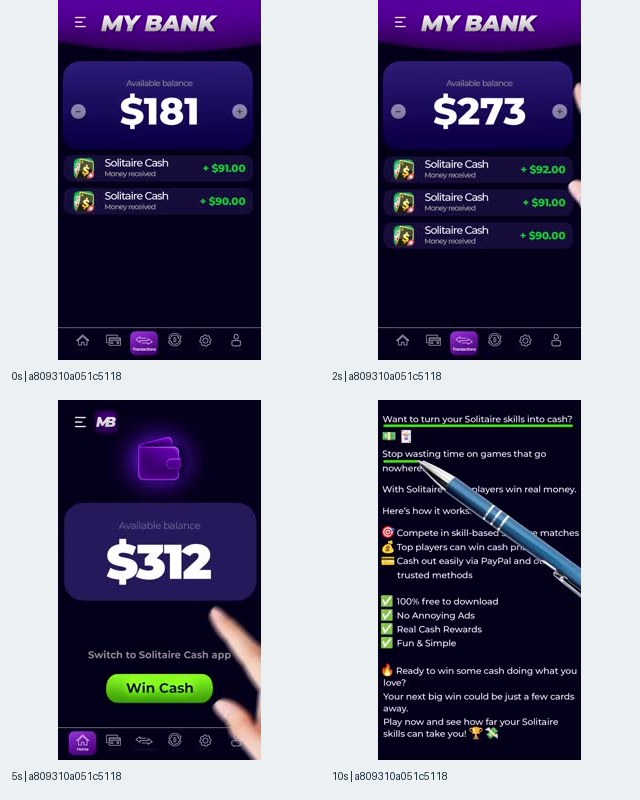
Figure 5. Record a809310a051c511858ade0e121990088, associated with the verified Solitaire Cash iOS listing. “MY BANK,” the displayed balances, and the benefit statements are advertising content shown at the sampled timestamps.
At zero seconds, the frame is headed “MY BANK” and shows $181, with transaction-style rows carrying the Solitaire Cash name. At two seconds, the headline amount is $273. At five seconds, a different arrangement shows $312, the text “Switch to Solitaire Cash app,” and a green “Win Cash” button. A hand is visible near the lower part of that frame.
At ten seconds, a page of explanatory copy occupies the screen, with a pen lying diagonally across it. The top line asks, “Want to turn your Solitaire skills into cash?” Lower lines include claims such as “No Annoying Ads” and “Real Cash Rewards.” We report those as statements in the creative, not as tested app characteristics.
The change in information density is the useful observation. Early sampled frames emphasize a large number and a compact interface. The later sampled frame asks the viewer to read several lines of text. The contact sheet cannot tell us how long that text remains visible, whether a voiceover reads it, or how a viewer responds.
This record was first seen on 2026-04-27 and last seen on 2026-10-30. Its model-estimated impressions are 41,532,118, representing 4.5% of the sample.
For a production brief, this suggests a question about the handoff from visual attraction to explanation. Which statements actually need to appear together? Which require qualifications? Which can be demonstrated through a product action? A useful test would compare clearly defined information arrangements while preserving the same accurate promise. The research should not assume that text density either helps or harms performance simply because it appears in a prominent sampled record.
Example 6: A Green Payment-Style Sequence and Confirmation Claim
The sixth example presents account activity and confirmation imagery without a visible presenter in the supplied frames.
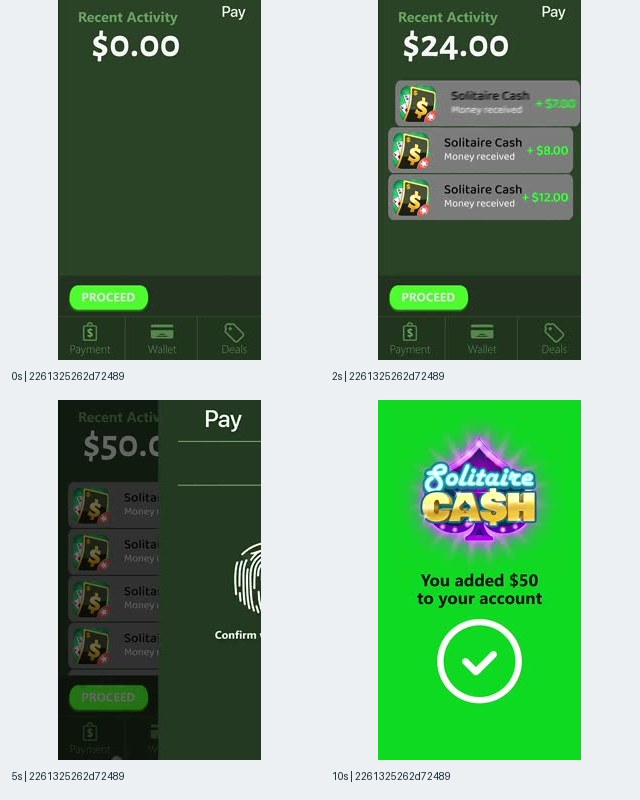
Figure 6. Record 2261325262d724896e6d7f9331974f2c, linked to the verified Solitaire Cash iOS listing. The ten-second frame says “You added $50 to your account.” This is a visible ad claim, not a verified account event or the video’s established ending.
At zero seconds, a dark green interface shows “Recent Activity” and $0.00. At two seconds, the headline figure reads $24.00, with Solitaire Cash transaction-style rows below. At five seconds, a panel labelled “Pay” overlaps the interface and includes a fingerprint-style graphic and confirmation wording.
At ten seconds, the frame has a bright green background, the Solitaire Cash logo, a large check mark, and the statement “You added $50 to your account.” The supplied record lists a longer video duration, so this sampled graphic should not be called an end card merely because it is the last panel in the contact sheet.
The visual progression uses recognizable interface conventions: a list of activity, an authorization-looking panel, and a check-mark confirmation. Those conventions are the observable elements. Their presence does not establish that the depicted process is an actual app flow, that the amounts correspond to real transactions, or that any particular service participates in it.
The record carries 40,307,472 model-estimated impressions and 4.4% of the sample. Its first-seen date is 2026-08-21, and its last-seen date is 2026-10-29. It also has a playable association, whose behavior is not demonstrated by these video frames.
An original test inspired by the structure could examine how clearly a verified action and its genuine confirmation are communicated. The production team would need to document the actual starting state, action, and result. The hypothesis concerns clarity of the sequence; it should not import an unverified financial promise from the reference.
Example 7: A Relaxation Hook With a Scenic Solitaire Board
The seventh example introduces solitaire through a relaxation message and a scenic background rather than an account screen.

Figure 7. Record 88b25a542dc47d1b2c9d46a7d3284840, associated with the verified Solitaire Cash iOS listing. The sampled frames show “Ready to Unwind?”, scenic board imagery, and later leaderboard-related wording. They do not establish the complete narrative or an observed relaxation effect.
The zero-second frame displays “Ready to Unwind?” in yellow lettering over a darkened garden scene. Small text along the bottom says that winnings are based on skill and should not replace income. At two seconds, cards appear over the scenic background, with a timer and score at the top and the caption “This is Solitaire Cash.”
The five-second frame shows a populated card board and the caption “A relaxing solitaire.” At ten seconds, a cartoon hand appears near a card, and the caption reads “to climb the leaderboard.” These are separate sampled text fragments. They show relaxation and competition language within the inspected material without establishing a full transcript.
This record was first seen on 2026-01-01 and last seen on 2026-10-30. It carries 34,558,476 model-estimated impressions and 3.8% of the sample. Its video file also appears in another sampled record, a relationship examined below.
The practical distinction is the opening promise. The visible hook foregrounds an experience, while the board and later caption introduce activity and ranking. A hypothesis is that different opening messages could change which aspect of the product viewers remember. There is no evidence here that one message attracts a particular demographic or produces a particular retention pattern.
The Disney Solitaire creative analysis offers a separate reference for character, card, and collection messaging. That is a qualitative contrast in presentation, not a comparison of impression totals or campaign outcomes across articles.
For an original brief, choose an opening promise that the actual experience can support. If relaxation is the subject, specify the visual and interaction evidence that explains it. Do not use a scenic background alone as proof of an emotional effect.
Example 8: Card Play, a Leaderboard, and a Celebration Graphic
The eighth example places a card board, a leaderboard panel, and a “BIG WIN” graphic within the sampled opening portion of the video.

Figure 8. Record 07540c860dc2c2dd650f940706cc0db4, linked to the verified Solitaire Cash iOS listing. The contact sheet samples 0, 2, 5, and 10 seconds. “HIGH STAKES,” the prize amount, and “BIG WIN” are visible advertising elements, not independently verified outcomes.
At zero seconds, the frame shows a green solitaire board, a progress-style bar, and $135 beside an icon. At two seconds, a panel labelled “LEADERBOARD” and “HIGH STAKES” appears against a bright yellow visual effect. At five seconds, the leaderboard remains visible in a darker frame with a bright effect across part of the panel.
At ten seconds, the frame shows “BIG WIN” against a purple and blue background. The record’s listed video duration is 30 seconds, so the ten-second celebration graphic cannot be treated as the established ending of the ad. The contact sheet also does not reveal the exact transition or explanation between each sampled state.
The record carries 22,103,607 model-estimated impressions and 2.4% of the sample. It was first seen on 2026-07-01 and last seen on 2026-10-30.
The useful creative observation is the arrangement of activity and recognition. Cards establish the game context, the leaderboard introduces relative position, and the celebration graphic supplies a visible result cue. Whether viewers understand the relationship among those elements is an open question.
For a team producing an original ad, the testable issue is the explanation between states. A brief should identify what event moves the viewer from board to ranking, what the ranking represents, and what the final visible message means. If those facts are unavailable, a production team should not fill the gap with a generic celebration and assume the message remains accurate. The sample is valuable precisely because it makes that explanatory gap visible.
What the Sample Establishes About Older and Newer Records
Older discovery dates are prominent among the leading records, but the evidence does not establish uninterrupted run lengths or a complete age-based impression split.
The earliest sampled record was first seen on 2025-06-19 and last seen on 2026-10-30. It is record 28a7efc80d18c73bc89ba456ef0eda1c, which contains a playable association and no associated video. Its window estimate is 60,613,929 impressions, representing 6.6% of the sample. There is no supplied contact sheet for its interactive behavior, so it belongs in the numerical discussion without an invented visual description.
That distinction changes the answer to “How old is the oldest ad?” The evidence supports an observation span bounded by those dates. It does not show that the record was continuously active throughout the interval, and it does not establish when the underlying concept was produced. First discovery, production, campaign launch, and uninterrupted delivery are separate events.
The leading five records all have first-seen dates before the current measurement window. Together, their supplied share is 49.2% of this sample’s model-estimated impressions. That supports the narrower conclusion that prominent current-window estimates are attached to records with earlier discovery histories. It does not supply the total contribution of every older asset, because a complete age-group aggregate has not been provided.
The sample also contains three records first seen within the window:
| Record | First seen | Last seen | Window model-estimated impressions | Supplied sample share |
|---|---|---|---|---|
| c8013af365b5626e2b08582ecda7c4fd | 2026-10-11 | 2026-10-20 | 9,129,274 | 1.0% |
| 0db220e09350dc1e689767a47dee9991 | 2026-10-11 | 2026-10-20 | 7,576,293 | 0.8% |
| aa2a10da5f0e79fb513839fc20a3630a | 2026-10-14 | 2026-10-30 | 7,449,528 | 0.8% |
These rows document newly discovered entries represented in the bounded sample. They do not measure Papaya’s complete launch cadence. An impression-ordered sample can omit new records that have not accumulated enough estimated activity to appear in the selected pages.
Similarly, 19 records were last seen in the final three days of the measurement window. That is a supplied recency statistic. It cannot establish that the other records were deliberately retired or that all 19 remained active after the observation period.
The practical decision is to retain older references in the research backlog while also looking separately for newly discovered material. An older first-seen date is a reason to investigate persistence, not a reason to declare a creative proven or copy it without testing.
Video Reuse and Playable Associations Need Separate Tracking
The sample shows both file reuse and repeated playable associations, so a single row count would overstate what is known about production variety.
The clearest video-reuse example connects record 88b25a542dc47d1b2c9d46a7d3284840, illustrated in Figure 7, with record b4c0cadcab5136f711188e3e34877f23. They share the same indexed video fingerprint but have different playable fingerprints. The latter record was first seen on 2025-12-11, last seen on 2026-10-30, and carries 10,321,353 model-estimated impressions for the current window.
That relationship establishes that the same indexed video file is associated with different interactive files in separate advertising records. It does not establish that the combinations were part of an intentional controlled experiment, that either interactive file appeared at a particular point during playback, or that one combination performed better.
There is a complementary relationship in Figures 1 and 2. Their video fingerprints differ, but their records share a playable fingerprint. That makes the interactive association a separate reusable component of the indexed structure. Again, the contact sheets do not demonstrate its mechanics or placement.
For a creative library, store the record, video file, playable file, and descriptive concept tag in separate fields. A researcher can then ask whether a change concerns the main video, the associated interaction, or only the advertising entry. This is especially useful when a production team is deciding whether to commission new footage or investigate a different combination of existing components.
Figures 1 and 3 show why file tracking alone is insufficient. Their video fingerprints differ, yet their sampled images are closely similar. Conversely, Figure 7’s video file recurs across records with different playable associations. One relationship concerns visible similarity; the other concerns exact indexed file reuse.
Neither relationship reveals the reason for the advertiser’s choices. Possible explanations include creative iteration, packaging, or distribution differences, but those remain hypotheses. The immediate research output should be a map of the associations actually present, with unknown campaign context left unknown.
Actors, Presenters, and the “Girl on Couch” Search
The supplied frames support descriptions of presenter formats, but they cannot establish who appears in the ads.
Figure 1 and Figure 3 show an outdoor presenter holding a microphone. Figure 2 shows a person addressing the camera beside a stone wall, followed by a presenter-and-gameplay composition. Those observations help a creative team distinguish an apparent street-presentation setup from a direct-to-camera setup.
They do not establish names, acting credits, creator relationships, employment, or whether a person is speaking from personal experience. A testimonial-style composition is a production format; it is not proof that the speaker is an actual customer. Even a familiar-looking face should remain unidentified without appropriate evidence.
The specific “Solitaire Cash ad girl on couch” scene is not shown in these eight contact sheets. That is a limit of the supplied visual sample, not a claim that such an ad does or does not exist elsewhere. The same boundary applies to a reader looking for a particular actress, actor, or social-media account.
For a production team, the useful work is to describe the role of the person in the composition. Is the person introducing the topic, explaining a rule, pointing toward a board, or asking a question? Which of those functions is actually visible? Where the answer depends on missing audio or footage, the brief should mark it as unobserved.
This approach still produces actionable direction. A team can specify an original presenter-led explanation, request a clear connection to the real product, and plan the supporting demonstration. It does not need to identify or imitate the person in the reference to learn from the format.
Cash Claims, Interface Labels, and Product Facts
A financial-looking screen in an ad is evidence of a message, not independent evidence of the product behavior it depicts.
That distinction applies throughout the examples. Figure 1 shows “Money received” labels and a “TODAY’S INCOME” amount. Figure 4 places a changing “Balance” panel above cards. Figure 5 uses “MY BANK” and “Win Cash.” Figure 6 states that money was added to an account. Figure 8 shows a leaderboard and a celebration graphic.
The accurate description preserves the speaker and context: the ad shows, the panel says, or the creative claims. It should not silently become “the app provides this result.” The latter would require product evidence beyond a contact sheet.
A useful claim worksheet separates three questions. What exactly is visible? What would a viewer reasonably need explained to understand it? What first-party material would the production team need before using an equivalent statement about its own product? This keeps a creative reference useful without treating it as substantiation.
The same rule applies to apparently simple interface details. A check mark can communicate completion, but the screenshot does not establish what was completed. A leaderboard can communicate relative position, but the frame does not explain every rule behind that position. A dollar amount can be visually legible while its status remains unclear.
Ad data cannot answer whether Solitaire Cash is legitimate or resolve legal questions. This article does not discuss those questions. Its scope is the advertising sample: visible formats, associated records, model-estimated impressions, and the practical limits of interpretation.
For marketers, this boundary improves the brief. It forces the team to identify the actual action and supported promise before writing the hook, rather than allowing an attention-grabbing reference to determine the product claim.
Papaya’s Portfolio Bracket: A Separate Earlier Window
The portfolio bracket describes a separate dated sample and must remain apart from the Solitaire Cash figures analyzed above.
The bracket was pulled on 2026-10-30, using the US measurement window 2026-09-30 to 2026-10-29 and the leading 30 advertising records attributable to each verified iOS listing. All impression figures below are third-party model estimates for that earlier window. The record counts are not counts of unique videos.
| App and verified iOS listing | Seller | Model-estimated impressions in its top-30 sample | Leading record share | Earliest first seen | Records first seen within that window | Records with a playable association |
|---|---|---|---|---|---|---|
| Bingo Cash — 1522266397 | Papaya Gaming LTD | 2,055,379,320 | 34.5% | 2025-06-06 | 7 of 30 | 6 |
| Bubble Cash — 1475514684 | Papaya Gaming LTD | 36,142,375 | 65.1% | 2025-05-09 | 6 of 30 | 13 |
| Solitaire Clash — 1589643727 | Aviagames Inc. | 62,609,289 | 41.0% | 2025-10-19 | 8 of 30 | 13 |
| Rips by Triumph — 6751921248 | Triumph Arcade, LLC | 5,452,524,821 | 25.9% | 2026-04-07 | 3 of 30 | 2 |
Within this earlier bracket, Bingo Cash has a larger sampled impression estimate than Bubble Cash. That is an observation about those two bounded samples in the same window. It does not establish Papaya’s spend allocation, because impression estimates are not spending records and the samples do not cover the publisher’s complete advertising activity.
A possible hypothesis is that the sampled prominence of Bingo Cash reflects a different advertising emphasis within Papaya’s portfolio. Testing that hypothesis would require aligned, repeated observations and appropriate financial evidence. The bracket alone cannot confirm the explanation.
There is no same-window Solitaire Cash total in this bracket. Its newer frozen total therefore cannot be inserted into this table or used to state that Bingo Cash outdelivered it. Doing so would mix measurement periods while giving the appearance of a controlled comparison.
First-seen dates support a narrower historical contrast. Solitaire Cash’s earliest sampled record was discovered on 2025-06-19, while the Rips bracket’s earliest first-seen date is 2026-04-07. That contrasts discovery histories without comparing their impression totals across windows or claiming complete fleet ages.
The Rips by Triumph teardown provides additional dated context. Its historical findings should retain their own measurement period; they should not be treated as current Solitaire Cash benchmarks.
What the Rankings Say About Revenue and Downloads
The supplied ranking snapshot places Solitaire Cash outside the captured top 300 for both revenue and downloads, which does not provide an exact rank or a revenue amount.
That snapshot covers US, 2026-09-29 to 2026-10-28, compared with the previous 30-day period. The ranking system considers App Store and Google Play listings together while keeping the measurements at store-listing level. The relevant Solitaire Cash identity remains iOS listing 1446254576.
“Not in the captured top 300” is the observation. It should not be rewritten as rank 301, zero revenue, weak demand, or an absence of advertising. A limited ranking extract cannot establish those conclusions.
The revenue ranking is based on third-party model estimates of app-store revenue, and the supplied API information does not state the value’s unit. Consequently, it cannot answer “Papaya Gaming revenue” as a company-financial question. It also cannot establish deposits, transaction volume, profit, or other business totals.
No supported period-change figure is supplied for Solitaire Cash’s position outside the captured set. We therefore do not describe it as rising or falling. Likewise, the bracket does not provide a complete rank-and-change comparison suitable for presenting the other apps as a revenue league table here.
The advertising evidence and ranking evidence answer different questions. The former documents selected creative records and their window estimates. The latter documents whether a store listing appeared in a captured ranking set for another dated period. Combining them into a conversion estimate would create a metric that neither source actually measures.
Turn the Findings Into a Practical Research Workflow
A useful workflow preserves identity, dates, media relationships, and uncertainty before turning an observed pattern into a production decision.
Start with the product boundary. Save the verified store identifier, seller name, and title. For this article, that means iOS listing 1446254576 and Papaya Gaming LTD. When a search returns a familiar name with a different association, investigate the listing rather than assuming the name establishes identity. Do not automatically include every identifier in a broader product grouping.
Freeze the research conditions. Record the country, measurement bounds, retrieval date, ordering, and page limit. Keep a stable copy of the source sample so that another researcher can distinguish a changed live result from a mistake in the report. The current example uses US, 2026-10-03 to 2026-11-01, retrieved 2026-11-02, with three pages requested in impression-descending order.
Preserve each advertising record before grouping it. Save its identifier, its own window impression estimate, first-seen and last-seen dates, and media associations. This prevents a shared video from erasing meaningful differences between records. It also prevents nested product-level values from being mistaken for the record’s estimate.
Inspect the actual available media. When the evidence is a contact sheet, write timestamp-specific notes. For Figure 5, the useful note is that the five-second frame shows a balance panel and button, while the ten-second frame shows dense explanatory copy. It is not that the ad concludes with a text screen. The latter would require an established end timestamp.
Tag the message and format separately. A message tag might describe relaxation, skill, an account claim, or competition. A format tag might describe a presenter, a card-board demonstration, or a bank-style graphic. Keeping them separate allows a team to test the same message through different formats without confusing the two variables.
Map reuse at the file level. Identify shared video files and shared playable files. Then add a separate visual-similarity note for examples such as Figures 1 and 3. Exact media reuse and similar composition are different relationships, and both can matter to production planning.
Write the missing evidence beside the observation. A figure with an account label may lack verified product-flow evidence. A presenter frame may lack a transcript. A record with a playable association may lack an observed interaction. These gaps determine the next research task more clearly than a general confidence score.
Convert the observation into a falsifiable hypothesis. For example: an accurately demonstrated card action may help viewers explain the game more clearly than an opening built around an unexplained result graphic. That is a hypothesis for a team’s own materials, not a finding about Solitaire Cash performance.
Assign a decision and an owner. The output should say whether the next step is to gather missing evidence, produce an original variant, inspect a media association, or monitor another dated sample. A research document becomes useful when it specifies the action that the evidence supports and the conditions needed before going further.
A Worked Brief for an Original Presenter-and-Gameplay Test
An original brief should borrow a question from the sample while using the team’s own product, footage, and supported claims.
Consider a team deciding how to explain a solitaire mechanic. Figure 2 supplies a reference for a presenter-and-board composition; Figure 4 supplies a reference for a board-centered composition. The research question is whether a person’s explanation improves understanding of a particular action. The sample provides no answer, so the proposed test remains explicitly hypothetical.
| Brief field | Proposed instruction |
|---|---|
| Objective | Help viewers describe the demonstrated game action accurately |
| Product evidence | Use a documented action from the team’s current product build |
| Reference observation | Presenter footage and card-board graphics coexist in Figure 2; Figure 4 foregrounds the board |
| Hypothesis | A concise presenter explanation may improve comprehension of the same action |
| Presenter version | Show the person explaining the action with a clearly visible board demonstration |
| Board version | Show the same action and equivalent factual explanation without presenter footage |
| Claims | Use only statements supported by the team’s product evidence |
| Elements to hold consistent | Product state, central action, destination, and core message |
| Review task | Ask viewers what happened and what result the ad actually promised |
| Outcome status | Planned test; no results supplied by this article |
The production handoff should include the board’s starting state and the intended action. An editor should not have to infer the mechanic from a competitor screenshot. If a pointer or hand graphic is used, specify what it must make legible and whether it obscures a relevant card or label.
The presenter instruction should describe the communicative job rather than the person in the reference. For example, ask for a clear explanation of the move and its immediate in-game result. Avoid scripting a personal success story unless there is appropriate evidence for that statement. The reference format does not establish a real customer experience.
The review should distinguish recognition from understanding. A viewer may remember a large dollar symbol while misunderstanding what the game action was. Another may describe the action correctly but fail to identify the product. Those are different creative problems and call for different revisions.
If the team proceeds to a campaign test, it needs its own measurement plan, account data, and decision criteria. The public sample supplies neither a conversion benchmark nor an expected lift. A strong research brief makes that separation explicit while still giving production a concrete question to answer.
A Second Brief: Explain the Result Before Adding Celebration
A result-sequence test should establish what changed in the product before asking a celebration graphic to communicate success.
Figure 8 provides the reference question: how clearly do the card board, leaderboard, and “BIG WIN” message connect? Figure 6 provides a different result convention through an activity screen and confirmation graphic. Neither contact sheet supplies a complete explanation of the underlying action.
For an original product, begin by documenting the event that the ad will show. Identify the starting state, the user action, the resulting state, and the exact meaning of the result label. If the result is a game score, call it a score. If it is a rank, explain the ranking context accurately. Do not replace a missing explanation with a more dramatic symbol.
A proposed variant could keep the action and result visible together. Another could show them sequentially with a concise explanatory label. The hypothesis would concern whether the relationship is easier to understand, not whether a brighter celebration automatically increases installs.
The production package should contain the original capture, the approved wording, and a note explaining every overlay. That makes it possible to check whether an animation changes the apparent meaning. A graphic that is harmless as decoration may become misleading when placed directly beside a number or confirmation label.
Review the sequence with questions that match the hypothesis. What action occurred? What changed afterward? Which statement was a product fact and which was a visual flourish? What would the viewer expect after following the call to action? If answers diverge from the documented product behavior, revise the explanation before interpreting the creative as ready for campaign testing.
This brief turns the sampled pattern into a useful production problem without assuming that the reference demonstrates a real transaction, a complete product flow, or a successful acquisition strategy.
How to Build a Report That a Buying Team Can Use
A decision-ready report should connect each observation to a source and a next action without converting estimated prominence into a performance label.
For these examples, the first page could state that the inspected material includes account claims, presenter formats, board demonstrations, and competition imagery. The supporting page would show the record identifiers, dates, and numbered figures. A third part would describe the proposed original tests and the evidence still required to produce them accurately.
The distinction between observation and hypothesis should remain visible in the wording. “Figure 7 opens with ‘Ready to Unwind?’” is an observation. “A relaxation opening may improve recall of the experience promise” is a hypothesis. “Relaxation ads are the best-performing format” is unsupported by this sample.
Use concentration to prioritize attention, not to settle the creative verdict. The leading record’s supplied share makes it a reasonable starting point for inspection. It does not justify allocating the same share of a production budget to an account-screen concept. The team’s product, audience, destination, and available evidence determine whether that concept is relevant.
The report should also preserve the older/newer distinction without inventing a production calendar. The sample contains records first seen before the window and three first seen within it. A useful follow-up asks whether similar patterns remain visible in another aligned sample, rather than declaring that production has stopped or that the advertiser has completed a creative reset.
Finally, list the decision dependencies. A presenter brief may require original footage and an approved explanation. A result graphic may require a documented product event. An interactive comparison may require direct inspection of the associated playable. Naming the dependency makes the research actionable without overstating what has already been established.
Common Mistakes When Reading Solitaire Cash Ads
The main analytical errors come from changing the meaning of the evidence as it moves from a source record into a headline or recommendation.
Calling 30 records “30 unique creatives.” The sample has separate record and media counts. File-level reuse and visually similar files make the distinction consequential for any discussion of production volume.
Treating a large estimate as proof of a strong hook. Estimated prominence identifies what to inspect. It does not isolate the effect of the opening, the presenter, the offer, or the distribution conditions.
Turning first-seen dates into uninterrupted run lengths. Discovery history is not a complete campaign log. Use the actual first-seen and last-seen dates, and avoid describing the interval as continuous delivery.
Dividing window impressions by creative age. The impression numerator belongs to a specific measurement window. A denominator stretching back to discovery would create a different and unsupported measure. This article provides no age-adjusted daily rate.
Adding the earlier portfolio bracket to the newer subject sample. The bracket covers 2026-09-30 to 2026-10-29. The Solitaire Cash sample covers 2026-10-03 to 2026-11-01. Keep their tables and conclusions separate.
Naming a network from the visual style. A vertical frame, bold caption, or presenter does not establish a placement. The supplied evidence does not support a named-network conclusion for these examples.
Calling the ten-second frame an end card. Every sheet uses fixed timestamps. A confirmation graphic or “BIG WIN” image may occur within a longer video. Describe its sampled position accurately.
Completing missing words or identifying people. Caption fragments do not supply a full script, and faces do not supply verified identities. Record the visible text and format without filling those gaps.
Treating an on-screen amount as a business fact. A balance label, prize figure, or bank-style graphic is part of the ad’s message. It does not verify company revenue, player outcomes, or product functionality.
Inferring a full publisher strategy from a bounded sample. The evidence can support specific research questions about Papaya-associated listings. It cannot reconstruct complete spend allocation, every creative launch, or the reasons behind campaign decisions.
When to Use AdMapix for the Next Research Decision
AdMapix fits the next step when the task is to inspect indexed creatives, verify product associations, and build a dated evidence set for an original brief.
Disclosure: AdMapix is our product, so we distinguish its research workflow from claims that the source data cannot support. The examples in this article demonstrate a use of indexed records and supplied media. They do not establish that AdMapix reveals private campaign results or validates the financial statements shown in ads.
For this subject, a sensible handoff is to search the app, confirm the verified listing, inspect the available creative records, and keep the window and retrieval date attached to the findings. When live results differ from this article, use the frozen source package to understand what was observed here rather than assuming either view is a complete historical census.
AdMapix is less suitable as the sole evidence source when the question concerns campaign profitability, individual identities, complete distribution coverage, or company finances. Those questions require different evidence. An advertising library can organize what is visible without resolving every issue connected to the product.
Commercial terms can change while an article remains online. Consult the live AdMapix pricing page for current plans and access conditions rather than relying on a price or credit allowance embedded in this analysis.
Start my Solitaire Cash research in AdMapix — sign up or log in to inspect live data and build a source-backed creative brief. Check the listing, dates, and available evidence before making a production decision.
FAQ
These answers address the main questions that the supplied advertising records and contact sheets can resolve without extending beyond their scope.
What do the sampled Solitaire Cash ads show?
They show account-balance graphics, money-related claims, presenters, solitaire boards, leaderboard imagery, and a relaxation opening. The examples use different information orders: some foreground an apparent result, while others begin with a person or the game. These observations come from frames at 0, 2, 5, and 10 seconds, not complete video playback.
Who are the actors or actresses in Solitaire Cash ads?
The sampled frames cannot establish anyone’s identity. They support descriptions such as an outdoor presenter holding a microphone or a person addressing the camera beside a stone wall. They do not verify names, acting credits, employment, creator relationships, or whether a presentation reflects an actual customer experience. This article therefore does not identify people appearing in the ads.
Does this sample include the Solitaire Cash girl-on-couch ad?
No such scene is shown in the eight supplied contact sheets. That does not establish whether the searched-for ad exists elsewhere or appears in footage outside the sampled timestamps. The supported answer is limited to these images. A separate example would need its own source, verified product association, and direct visual evidence before it could be analyzed.
How many unique Solitaire Cash ads were analyzed?
The bounded sample contains 30 advertising records, with 25 distinct video fingerprints, one distinct image fingerprint, and five distinct playable fingerprints. Those are separate counting units and should not be added into a single asset total. Eight video contact sheets illustrate selected records; they do not show every media file represented in the sample.
Do the older records prove that the ads perform well?
No. An earlier discovery date and a recent last-seen date establish observation history, not profitability or continuous delivery. The leading five records all predate the current window and represent a supplied 49.2% of this sample’s model-estimated impressions. That supports investigating their persistence, but campaign outcomes and the reasons for continued use remain unknown.
Does the sample reveal Papaya Gaming’s advertising spend or revenue?
No. Its impression figures are third-party model estimates for selected records within an explicit window. They are not spend or company revenue. The separate ranking snapshot places the verified Solitaire Cash iOS listing outside the captured top 300 for revenue and downloads, but that observation does not provide an exact rank, a financial amount, or a company-wide conclusion.
Can these ads establish whether Solitaire Cash is legitimate?
No. Advertising records and screenshots cannot answer legitimacy or legal questions, and this article does not discuss those questions. On-screen amounts and confirmation messages are described as claims made in the ads. The analysis is limited to visible creative formats, verified listing associations, dated estimates, file relationships, and practical research decisions supported by that evidence.
How should a small team use these examples?
Choose a specific communication question, such as whether a presenter helps explain a card action, and build an original brief using the team’s own product evidence. Keep the reference observation separate from the hypothesis and define what a test would measure. AdMapix can support creative discovery; current access and commercial conditions are listed on its live pricing page.
Key Takeaways
The useful outcome of this analysis is a set of traceable creative questions, supported by a bounded sample and clear measurement limits.
- The supplied Solitaire Cash frames combine account claims, presenters, gameplay, competition, and relaxation through different opening structures.
- The US sample covers 2026-10-03 to 2026-11-01 and links 30 advertising records to verified iOS listing 1446254576.
- Record counts, video files, playable files, and visually similar concepts describe different things; track them separately.
- Older discovery histories are prominent, but neither longevity nor model-estimated impressions establish campaign success.
- Keep the earlier portfolio bracket separate, preserve every claim’s source, and turn observed structures into original tests using verified product facts.
About AdMapix Research: AdMapix Research is the research byline of AdMapix, an ad-intelligence platform. Its articles are built from AdMapix data (creative records, modelled impression estimates and US app-store rankings), prepared with Codex from a dated frozen sample and checked by automated evidence review. Brad at AdMapix is the accountable editorial owner; this does not imply personal human review.
Sources
The sources below identify the dated evidence, product identity, research workflow, and measurement boundaries used in this article.
- Frozen AdMapix source package — fetched 2026-11-02. Public sample, request batches, parameters, and checksums. Scope: US, verified iOS listing 1446254576, 2026-10-03 to 2026-11-01, 30 advertising records, supplied media relationships, and timestamped visual examples. The package also preserves the separate dated comparison context used above.
- Verified App Store reference — captured in the 2026-11-02 source sample. Solitaire Cash: Win Real Money, listing 1446254576. Used for store identity and seller attribution, not as verification of the advertising claims.
- AdMapix creative-search workflow — source observation dated 2026-11-02. Solitaire Cash creative search. A live discovery route for related indexed records; present-day results may differ from the frozen sample.
- AdMapix methodology — applied to the 2026-11-02 observation. Measurement and source boundaries. Relevant to model estimates, sample scope, media counting, and the distinction between visible advertising and private outcomes.
- Separate comparison bracket — captured 2026-10-30. US window 2026-09-30 to 2026-10-29, leading 30 records per verified iOS listing. Its estimates remain separate from the newer Solitaire Cash sample.
- Separate US ranking snapshot — captured in the 2026-10-30 research context. Window 2026-09-29 to 2026-10-28, compared with the previous 30 days, captured top 300 across store listings. Used only for the stated absence of the verified Solitaire Cash listing from that captured set.
AdMapix’s contribution here is the dated research sample, associated creative evidence, and reproducible workflow. Impression values remain third-party model estimates; the article reports no measured conversion, spend, profit, or complete campaign coverage.
Turn these observations into your next creative study
Open the creative library and select samples for your market, network and research question.
Related Articles
Underdog Rips Ads: Pack Reveals in a Sports-Led Sample
Eight Underdog advertising contact sheets show pack reveals alongside prominent sports offers, while a dated US iOS sample reveals recent records, concentrated modelled impressions, and clear limits on claims about fleet turnover, revenue, and product experience.
Liftoff Playable Ads: Requirements and Vungle Examples
Analyze eight dated US Liftoff (Vungle) video examples, understand the limits of a 30-record sample, and follow separate official playable requirements and testing workflows for Direct, Accelerate, and Vungle Exchange.
Unity Ads Creatives: US Examples and Playable Specs
Analyze eight Unity-filtered US advertising examples, understand the limits of a thirty-record sample, and turn current Unity playable specifications into a practical research, production, and device-testing workflow.