
Disney Solitaire Ads: Characters, Cards, and Video Reuse
Eight dated Disney Solitaire advertising examples reveal character introductions, card objectives, collection and reward messaging, plus video reuse across a bounded US sample, with practical briefs and clear evidence limits.
Disney Solitaire Ads: Characters, Cards, and Video Reuse
Disney Solitaire ads in this dated US sample combine familiar Disney characters with several different product promises: playing cards, completing scenes, collecting rewards, and solving a small visual puzzle. Lumiere introduces a world, Judy Hopps introduces a case, and a collection board places character imagery above a changing solitaire layout. For mobile game acquisition and creative teams, the useful finding is the variety of ways these ads connect character recognition to an action or reward. The records also reveal substantial reuse: 30 advertising records contain nine distinct video files, with some videos associated with different playable files. This teardown explains those relationships and turns the visible examples into practical production decisions without treating repetition as proof of performance.
This article concerns advertising used to attract players to Disney Solitaire. It does not investigate rewarded ads inside the game, coin eligibility, or messages saying that no ads are available.
Last updated: 2026-10-20.
AdMapix Research — prepared with Codex and checked against the dated source sample. Editorial ownership: Brad at AdMapix. This disclosure does not imply personal human review. AdMapix is our product.
Quick Answer
Disney Solitaire advertising in this sample uses characters and settings to establish interest, then connects that interest to cards, collection, scene completion, or another visible challenge.
- The bounded US sample covers 2026-09-21 to 2026-10-20 and contains 30 advertising records, nine distinct video files, and 11 distinct playable files.
- The eight illustrated examples show different creative approaches, including character introductions, a detective objective, a domestic live-action scene, track connection, collection progress, transformation, and reward imagery.
- Identical video files recur across records, while two different files share a similar Lumiere opening. These are different kinds of reuse.
- The contact sheets establish what appears at their labeled timestamps. They do not establish conversion, profitability, complete playback, or whether every advertised interaction is available in the app.
The Decision: How Much Character Story Should Precede the Cards?
The central creative decision is how to connect a recognizable character to a clear reason to play a card game. A character can establish the setting immediately, but the ad still needs to communicate what the viewer will do or receive. The examples here offer several different answers to that problem rather than a single formula that every team should copy.
In the Lumiere examples, the opening emphasizes the character and the Disney Solitaire logo. The illustrated Judy Hopps example moves from a character close-up to a case-solving instruction and a card board. The collection example presents cards and character collection together from the first captured frame. The Cinderella example shows a scene changing and reaching a completion state, without a card board appearing in the supplied timestamps.
These differences matter when writing a production brief. “Use the IP more” is too vague to tell an animator, editor, or designer what to make. A usable brief specifies whether the character introduces the world, assigns an objective, reacts to progress, represents a reward, or supports the final installation invitation.
The same distinction helps teams without licensed characters. The transferable idea is the relationship between an appealing world and a visible player action. An original character, recognizable product setting, or established in-game companion can perform a similar storytelling role, provided the creative accurately represents the team's own product.
Disney Solitaire also provides a timely research subject because the supplied AdMapix US App Store free Games chart snapshot places it at #18 on 2026-10-11, compared with outside the captured top-100 window on 2026-09-11. That snapshot was pulled on 2026-10-13. It supplies market context; it does not explain why the rank changed or attribute the change to these ads.
Methodology: What the Dated Sample Actually Covers
This analysis uses a bounded, product-verified US advertising sample collected on 2026-10-20, with an explicit measurement window of 2026-09-21 to 2026-10-20. The research query was Disney Solitaire, and the advertising retrieval was restricted to the verified iOS product ID 6475757306. The verified store seller is SuperPlay LTD. Product identity comes from that identifier, rather than a matching title or character image.
The retrieval collected up to three pages of ten records, sorted by descending estimated impressions. All 30 supplied records link to the verified iOS listing. Some also list an Android association, but this research scope remains the verified iOS reference. The results do not establish Android coverage, exclusive iOS delivery, or the complete advertising activity of the product across all platforms.
An advertising record is an indexed instance. A media file can recur in several instances, including instances associated with different playable files. We therefore keep record counts, video files, image files, and playable files separate. The supplied fingerprint counts identify nine distinct videos, four distinct image files, and 11 distinct playable files. Those categories should not be added into a single asset total without defining what that total means.
The visual analysis uses eight supplied contact sheets. Each contains frames labeled 0, 2, 5, and 10 seconds. A contact sheet is a layout of selected video frames, not a continuous viewing session. Statements about visual content refer to those timestamps. Video duration comes from the associated record metadata; it does not mean the entire video was reviewed. Audio, exact transition timing, interactions between sampled frames, and later scenes remain outside this visual evidence.
The records carry a source code, but the supplied material does not map it to a verified advertising network. Accordingly, these examples are described as AdMapix-indexed advertising associated with the verified listing, without assigning them to Meta, TikTok, AppLovin, or another network. Portrait or landscape composition is observable; network attribution is not established by aspect ratio.
Every impression figure below is a third-party model estimate for the specified measurement window. It is not observed delivery, spend, installs, profit, or a lifetime total. Product-search aggregates have an unspecified time scope and are excluded. No daily intensity calculation divides window impressions by the age of an ad.
The public frozen source package provides the dated batches, request parameters, and checksums needed to reproduce the sample accounting. It preserves this research basis even if a later live search returns different results. This was an analysis of supplied records and images, not an app playtest or an external tool test.
Evidence Table: Records, Files, and Illustrated Examples
The sample contains fewer distinct videos than advertising records, so its creative variety must be evaluated at both the file level and the visible concept level. A record count describes how the source organizes indexed instances. A file count describes distinct media fingerprints. Neither automatically counts original ideas, production projects, or campaigns.
| Measurement | Result in the dated US sample | Interpretation |
|---|---|---|
| Advertising records | 30 | Bounded sample, not a complete fleet |
| Records containing video | 24 | Several records share a video file |
| Distinct video files | 9 | Deduplicated video fingerprints |
| Distinct image files | 4 | Separate from the editorial contact sheets |
| Records containing a playable | 20 | Includes records that also contain video |
| Distinct playable files | 11 | Deduplicated playable fingerprints |
| Playable records without video | 6 | Derived from the supplied record associations |
| Records containing both video and playable | 14 | Overlap between the format categories |
| Illustrated video examples | 8 | Selected contact sheets, not all nine videos |
The six playable records without video and the 14 records containing both formats explain why adding 24 video records to 20 playable records would produce a misleading total. The categories overlap. Similarly, the four image fingerprints in the source are not the eight contact sheets reproduced in this article: the latter are editorial viewing aids assembled from video frames.
| Figure | Visible approach | Recorded video duration | Window impression estimate for the illustrated record |
|---|---|---|---|
| 1 | Lumiere introduction, followed by a Lion King setting | 60 seconds | 20,002,853 |
| 2 | Judy Hopps, case objective, and cards | 60 seconds | 3,208,654 |
| 3 | Domestic live action and branded installation screen | 13 seconds | 1,207,494 |
| 4 | Joy and Sadness beside a track puzzle | 30 seconds | 743,280 |
| 5 | Collection board above solitaire cards | 45 seconds | 646,780 |
| 6 | Cinderella scene transformation and completion | 15 seconds | 632,611 |
| 7 | Scrooge McDuck, coins, and a card sequence | 15 seconds | 437,348 |
| 8 | Lumiere introduction, followed by colorful objects | 35 seconds | 368,832 |
These estimates identify the illustrated records within the sampling window. They are not a ranking of creative quality, and the figures do not isolate the effect of the opening, the associated playable, the audience, or the placement.
Figure 1: Lumiere Introduces the World Before a Card Mechanic Appears
The first Lumiere example establishes Disney Solitaire through a character and a setting before any card mechanic appears in the supplied frames. At the opening timestamp, Lumiere occupies the foreground beneath a large game logo. The later sampled frames retain the character before the ten-second frame shows a Lion King setting with Simba, Pumbaa, and Timon. The visible progression emphasizes the breadth of the fictional world.
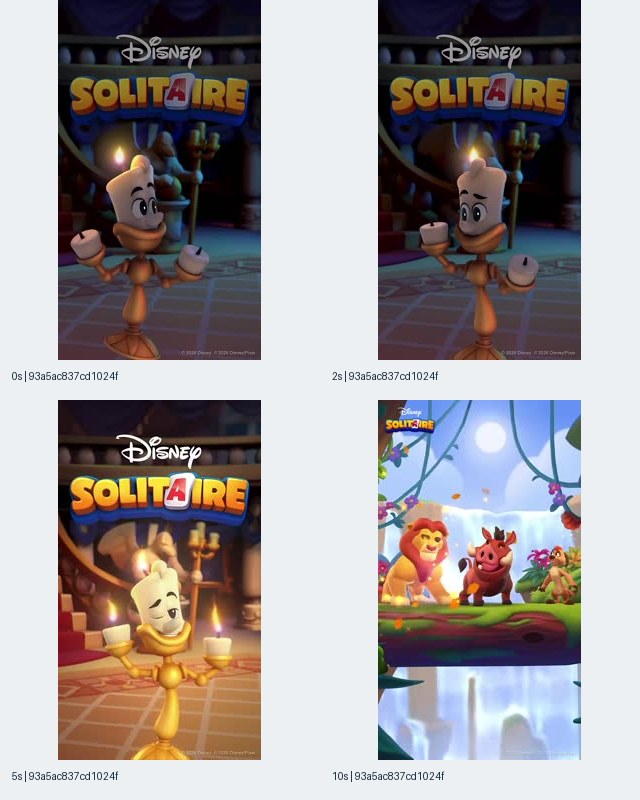
Figure 1 — AdMapix-indexed record 93a5ac837cd1024fe5e94feaf38c39c3, associated with Disney Solitaire iOS 6475757306. Selected frames at 0, 2, 5, and 10 seconds; recorded duration: 60 seconds. These screenshots are creative evidence, not performance proof.
The logo performs a useful identifying role because the sampled opening could otherwise be interpreted as character entertainment. It names the game while the image supplies atmosphere. Lumiere's face and candlelight offer a clear focal point, while the room behind him provides a recognizable context. At five seconds, the brighter character presentation changes the visual emphasis without requiring a written explanation in the frame.
The Lion King frame introduces another setting rather than extending the same room. That observation supports a limited reading: this file presents more than one Disney world within the captured portion. It does not establish the complete sequence of worlds, the order of later gameplay, or how a player unlocks the depicted scene.
A production hypothesis follows from this structure: a recognizable character introduction may help viewers understand the game's entertainment theme before a mechanic is explained. That hypothesis remains untested here. Another possible outcome is that viewers remember the character but fail to understand the game. A team borrowing the structure should therefore evaluate both recognition and product comprehension.
For an original brief, specify the connection that the next scene must make. If the opening features a companion character, the subsequent shot could show that companion beside a real card action, then show the verified result of completing that action. This would preserve the character's role while making the product relationship explicit.
The source also gives this example a second use in research: its exact video file recurs across several advertising records. That makes it a suitable reference for studying association changes without pretending that each repeated row represents a new animated production. The full reuse pattern is examined later in the article.
Figure 2: Judy Hopps Connects a Character to a Task
The Judy Hopps example connects character recognition to an explicit objective and a visible card board within the captured timestamps. The opening frame presents Judy directly. At two seconds, the composition includes the instruction “HELP SOLVE THE CASE”, outlined objects on a board, and cards below. By five seconds, face-up card values are visible, while the ten-second frame contains a glowing effect over the board.
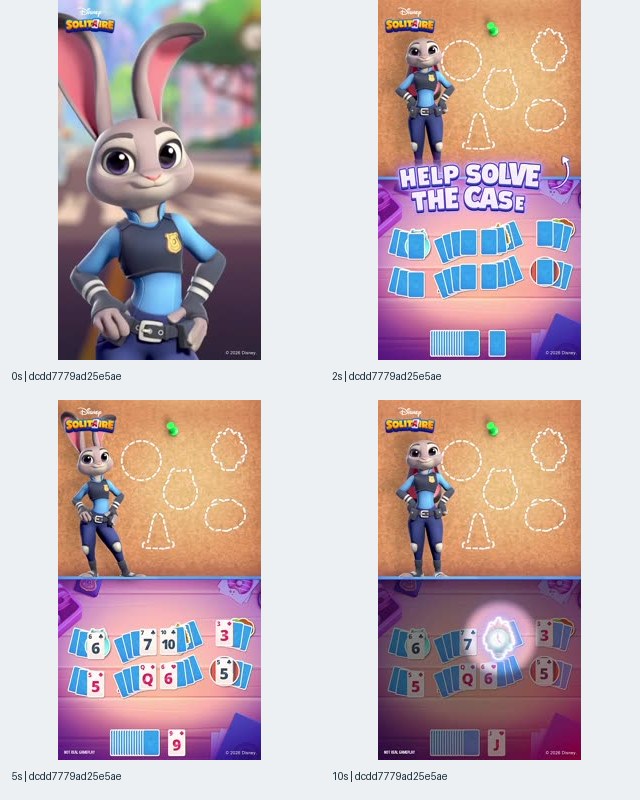
Figure 2 — AdMapix-indexed record dcdd7779ad25e5ae40036a0b5451adba, associated with Disney Solitaire iOS 6475757306. Frames at 0, 2, 5, and 10 seconds show a character introduction, a case objective, and changing card imagery. Recorded duration: 60 seconds.
The visual hierarchy gives the character, objective, and cards separate jobs. Judy identifies the story context. The instruction tells the viewer what the activity is meant to accomplish. The lower board supplies a recognizable game interface. This is a more explicit connection between story and card play than the illustrated Lumiere sequence, although the exact relationship between individual card moves and the outlined objects remains unverified.
The division of the screen is especially useful for a creative brief. A designer can preserve the objective in one region while showing progress in another. That structure avoids requiring a full scene change every time the ad needs to remind the viewer why the cards matter. It also gives the editor a concrete continuity check: the objective should remain understandable when the card state changes.
However, the contact sheet does not establish a complete tutorial. It does not show every move, explain all card rules, or prove what triggers the glowing effect. Calling it a demonstrated case-solving mechanic would overstate the evidence. The defensible description is a case-solving message presented alongside a changing solitaire board.
An original test could compare an objective-led opening with a character-only opening while keeping the subsequent card demonstration and ending consistent. The hypothesis would be that the explicit objective improves understanding of the relationship between card play and progression. The team would need its own comprehension checks and campaign data to evaluate that possibility.
The wording also offers a copy lesson. “Help solve the case” gives the character a reason to be present. For another game, the equivalent instruction should name a real player objective. Decorative character placement alone does not tell a viewer why completing a card sequence matters.
Figure 3: A Domestic Scene Provides a Different Entry Point
The live-action example introduces Disney Solitaire through a domestic scene rather than an animated character close-up. The supplied frames show people in a living room, a man looking toward a child, and the man holding a phone. At ten seconds, the image has changed to a branded installation screen with a game logo, a “PLAY NOW” button, store badges, and phone displays featuring Disney scenes.
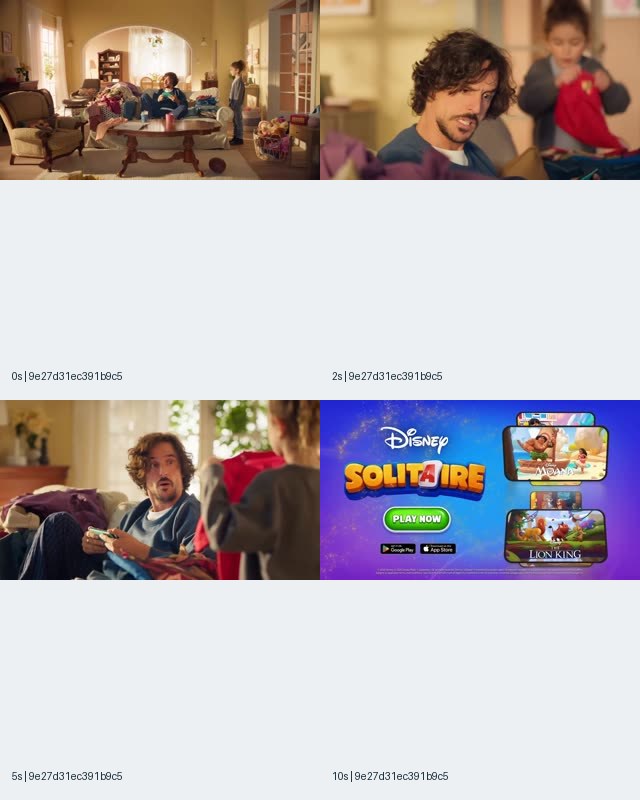
Figure 3 — AdMapix-indexed record 9e27d31ec391b9c5d5cbf3d280525c91, associated with Disney Solitaire iOS 6475757306. Selected frames at 0, 2, 5, and 10 seconds. Recorded duration: 13 seconds; dialogue and the full performance were not reviewed.
The human setting changes what a creative team can analyze. The useful questions concern situation, expression, device presence, and the transition to the product. They do not concern the credibility of an endorsement, because the supplied frames do not identify the performer or establish what he says. A recognizable-looking face is not sufficient evidence for naming a celebrity or describing a testimonial.
Likewise, the presence of children in a scene does not establish audience targeting. It is a visible casting and setting choice. The source does not disclose who received the ad, what age restrictions were applied, or how the advertiser segmented viewers. A research report should keep those distinctions intact.
A separate supplied record shares this exact video file and contains the title “Free Your Mind. Play Now!” and the description “Play classic Solitaire with Disney & Pixar characters pure fun”. That record is 3c210e657a4bb2b0352a59c92ed545fc. The copy supplies a relaxation-oriented message associated with the shared file, but it should not be treated as a transcript of the illustrated scene or assumed to accompany every instance.
For production planning, this example suggests a hypothesis about context: showing a person encountering the game in an everyday setting may communicate a different reason to play than showing the game world immediately. To investigate that idea, write an original situation that can be understood visually, then make the product visible before the viewer has to infer what is being advertised.
The ten-second screen is also a useful reference for organizing the final invitation. The logo names the product, the phone displays show possible destinations, and the button states the action. Those visible functions can be studied independently of any claim that the screen increased installs.
Figure 4: A Track Puzzle Makes the Immediate Objective Visible
The Joy and Sadness example presents a track-connection objective with an explicit reward message, rather than showing solitaire cards in the captured frames. The instruction “CONNECT THE TRACKS WIN REWARDS!” appears above a small board. Joy stands behind it, Sadness appears in later frames, and a bright marker and celebratory effects draw attention to the track arrangement.
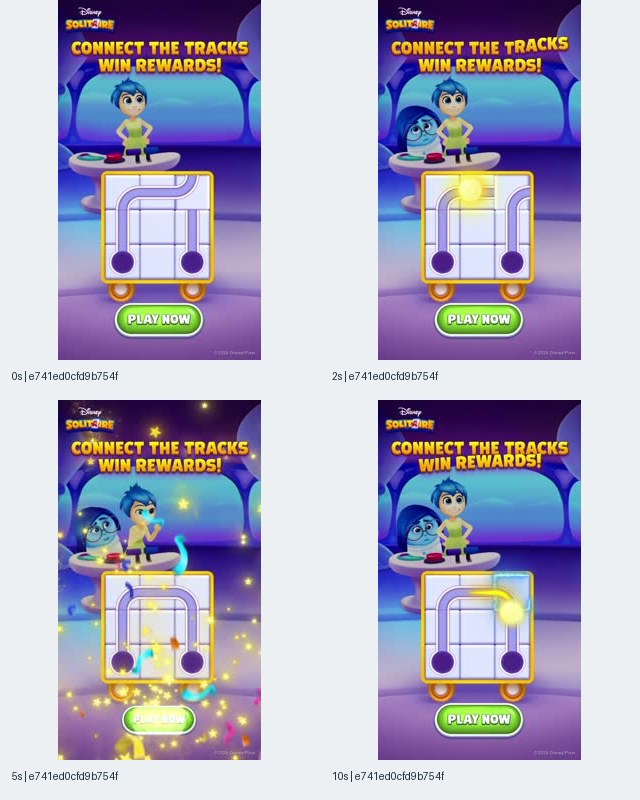
Figure 4 — AdMapix-indexed record e741ed0cfd9b754f80fc48f66e13d1a9, associated with Disney Solitaire iOS 6475757306. Frames at 0, 2, 5, and 10 seconds show a track puzzle presentation. Recorded duration: 30 seconds. The contact sheet does not establish interactivity or in-app availability.
The visible board offers a localized problem: connect the path between clearly separated endpoints. A viewer can inspect the arrangement without first understanding card ranks or a larger game economy. The accompanying characters remain present, but the board and instruction carry the immediate task.
That combination is relevant to teams deciding how much explanation a creative requires. A compact puzzle can place the objective and the obstacle in the same image. The creative hypothesis is that this makes the task easier to understand quickly. The supplied evidence does not measure whether viewers understood it, interacted with it, or installed the app afterward.
This example also requires a careful distinction between a video depicting a puzzle and a playable ad. The illustrated record includes a video file and an image file but no playable file. The visible puzzle should therefore be described as a puzzle presentation in a video, not as an interaction the researcher completed. Other records in the broader sample contain playable associations, but that does not change the format evidence for this record.
The same caution applies to product fidelity. The screenshots alone cannot determine whether this track puzzle is a permanent feature, a temporary activity, an advertising abstraction, or another part of the experience. That question would require app evidence. Its absence does not justify calling the ad deceptive, nor does the branding verify the depicted interaction.
For a practical adaptation, choose a small challenge that actually exists in your product. Show its starting state, the action the player takes, and the resulting state. If the challenge is ancillary to the main game, make that relationship clear in the brief and the eventual creative. The lesson worth testing is task clarity, not permission to substitute an unrelated mechanic.
Figure 5: Cards and Collection Share the Screen
The collection example displays the solitaire board and a character collection interface together, making both the immediate activity and a possible progression goal visible. The upper portion contains illustrated collection slots and a progress indicator. The lower portion contains card layouts, a draw pile, and a face-up card. Tinker Bell appears near a chest at the bottom of the composition.
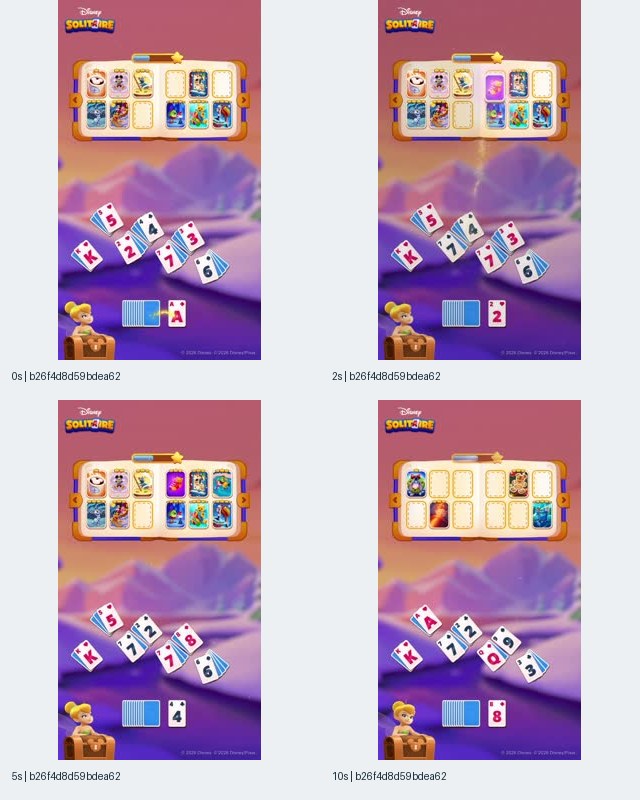
Figure 5 — AdMapix-indexed record b26f4d8d59bdea62812c652c27df2712, associated with Disney Solitaire iOS 6475757306. Selected frames at 0, 2, 5, and 10 seconds show cards and collection imagery. Recorded duration: 45 seconds.
This composition gives a strategist more information about the advertised relationship between play and progression than a character portrait alone. Cards identify an activity. Filled and empty collection slots identify an incomplete set. The progress indicator adds another visual cue that something can advance. Across the sampled frames, both the card arrangement and the collection display change.
The evidence does not establish the exact conversion between those changes. It would be inaccurate to say that a particular card move awards a particular collectible unless a continuous sequence or product documentation demonstrates that link. The useful observation is simultaneous presentation: the creative places card play and collection progress in the same visual system.
For a production team, simultaneous presentation creates a design problem as well as an opportunity. The viewer must be able to distinguish the current task from the longer-term goal. A dense upper collection board can compete with the card values below. The brief should therefore define which region deserves attention at each moment and what movement is allowed elsewhere.
One original test hypothesis would compare the same real card action with and without a visible progression panel. The question is whether the panel helps viewers explain why they would continue playing. The panel should depict an actual progression system, and the test should preserve the card action so that the interpretation is not confounded by a different level or outcome.
This is also a useful example for annotating screenshots. Instead of tagging the entire ad “Disney,” use separate labels for collection slots, progress indicator, card board, companion character, and reward object. Those labels make it possible to find references for a specific production problem later.
To inspect related indexed examples, search Disney Solitaire creatives in AdMapix. Treat the name query as a discovery step, then confirm the product association before extending the comparison. Live results may differ from this frozen sample.
Figure 6: Cinderella Makes Scene Completion the Payoff
The Cinderella example presents a visible scene transformation and a completion message within a short recorded video. The opening frames show Cinderella in a simpler outfit beside the Fairy Godmother in a colorful setting containing a carriage. At five seconds, Cinderella appears in a blue gown beneath “SCENE COMPLETE”. At ten seconds, the image shows a Disney Solitaire installation screen.
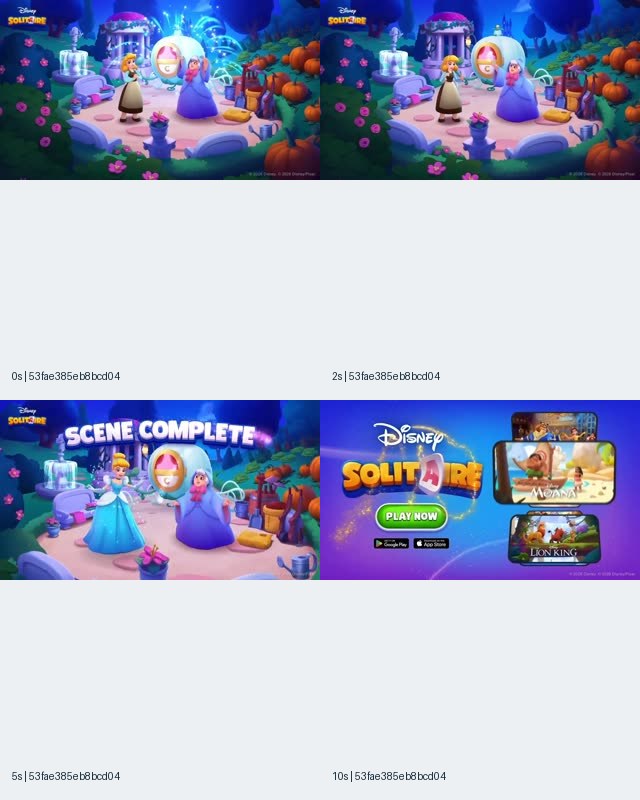
Figure 6 — AdMapix-indexed record 53fae385eb8bcd0440ae268ad7132dd9, associated with Disney Solitaire iOS 6475757306. Selected frames at 0, 2, 5, and 10 seconds. Recorded duration: 15 seconds. No solitaire board appears in these supplied frames.
The completion text resolves the visible transformation into a game-related result. Without that label, the frames might primarily communicate a familiar story moment. With it, the creative presents the scene as something that has reached a completed state. This is an observable messaging choice, although the screenshots do not establish the player actions required to reach it.
The carriage, characters, and garden-like setting provide continuity between the earlier and later frames. That continuity makes the change easier to compare. A creative team studying transformation ads should record which elements stay stable as carefully as the element that changes. Otherwise, a dramatic edit may produce spectacle without making the achievement understandable.
A hypothesis suggested by this example is that a scene-completion payoff may help explain progression to viewers who are less interested in a detailed card demonstration. The opposite possibility also deserves testing: viewers may understand the reward scene but remain unsure that the advertised product is a solitaire game. The game logo names the category, yet naming and demonstrating are different communication tasks.
An original production brief could connect a genuine card objective to a genuine scene update. Show the scene before completion, show the relevant card action, and return to a comparable view of the updated scene. That proposed sequence is an adaptation for testing, not a claim about unobserved footage in this source video.
The example also informs ending design. Its captured installation screen resembles the product-world presentation in Figure 3, with multiple scene previews and a prominent action button. A common visual destination may help organize different creative openings, but these frames alone do not prove that the two endings are identical files or that they produced equivalent results.
Figure 7: Scrooge McDuck Frames a Reward Promise
The Scrooge McDuck example pairs a character associated with wealth with visible coins, reward copy, and a later card sequence. The opening frame shows a vault-like space filled with gold coins. At two seconds, Scrooge appears above “COME BACK FOR ENDLESS REWARDS”. At five seconds, the captured image shows cards and coins, and the ten-second frame displays “THE VICTORY”.
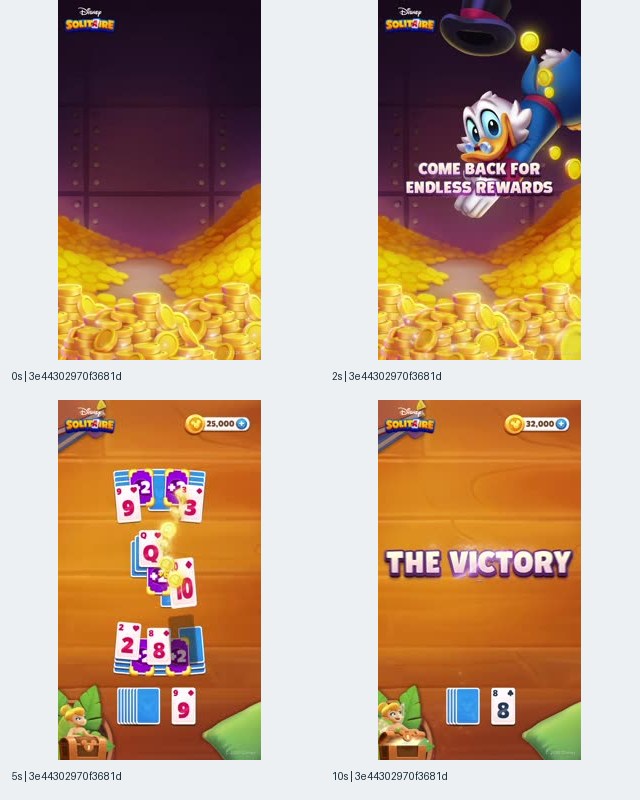
Figure 7 — AdMapix-indexed record 3e44302970f3681dff664cfffd5a9722, associated with Disney Solitaire iOS 6475757306. Selected frames at 0, 2, 5, and 10 seconds; recorded duration: 15 seconds. Reward language is quoted as advertising copy, not verified as an entitlement.
The character and reward imagery reinforce the same visible theme. Scrooge is not merely placed beside an unrelated board: the vault and coins provide a setting consistent with the wording. The later card frame then brings the advertised game activity into that reward presentation.
The phrase “come back” is useful to record because it addresses return behavior. It does not reveal the actual targeting configuration. An ad containing return-oriented language could be observed without knowing whether the audience consisted of existing players, new prospects, or a mixture. The research supports a messaging label, not a retargeting classification.
Likewise, “endless rewards” remains an advertiser's claim. The sample does not verify reward frequency, eligibility, limits, monetary value, or whether any reward depends on watching ads inside the game. The visible coin counters belong to the creative scene. They should not be converted into a promise about what a new player will receive.
For a team developing its own reward-led creative, the practical task is to connect every reward statement to a current product rule. The brief should identify the action that earns the reward, the reward's form, and any condition needed to understand the claim. An editor should not have to infer those rules from a decorative chest or animated coin shower.
A testable hypothesis here is that a reward theme consistent with a character's role may make the message easier to explain. That can be examined with original characters and actual product rewards. The team would still need to distinguish message comprehension from willingness to install, and both from the value of the users eventually acquired.
Figure 8: A Familiar Opening Leads to Different Later Imagery
The second Lumiere example shares a visibly similar opening with Figure 1 but leads to different imagery at the ten-second timestamp. Lumiere and the large Disney Solitaire logo appear in the earlier captured frames. At ten seconds, the image contains colorful gem-like pieces and bars in a game-like scene, rather than the Lion King setting shown in Figure 1.
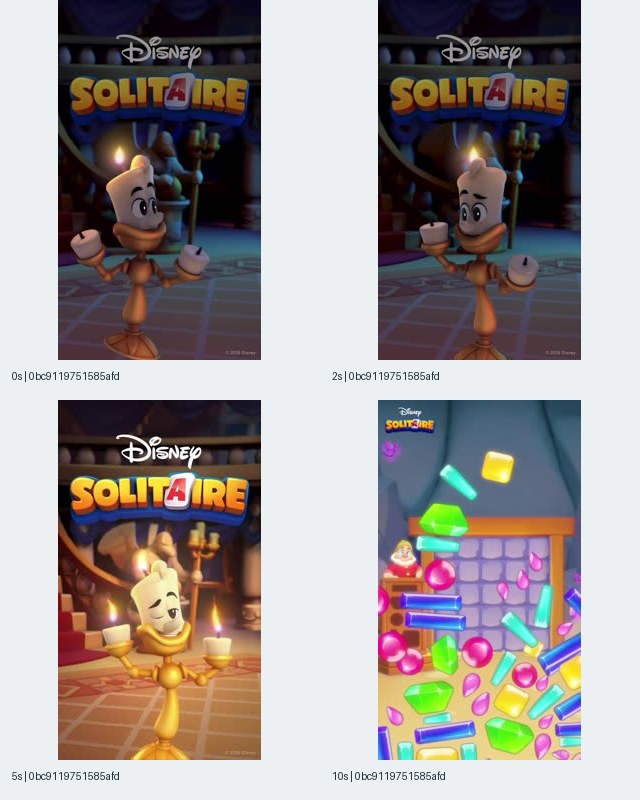
Figure 8 — AdMapix-indexed record 0bc9119751585afd4e22eea36d8f5709, associated with Disney Solitaire iOS 6475757306. Frames at 0, 2, 5, and 10 seconds. Recorded duration: 35 seconds. This is a different video fingerprint from Figure 1 despite the similar opening.
This comparison reveals why visual grouping and file deduplication answer different questions. A file fingerprint can establish that two records reference the same indexed file. It cannot group all edits that reuse an opening. Conversely, an analyst can identify a similar opening across contact sheets without concluding that the entire videos are identical.
For this pair, both levels matter. Figure 1 belongs to a 60-second file, while Figure 8 belongs to a 35-second file. Their video fingerprints differ, and their ten-second frames differ. The evidence therefore supports describing them as separate files with a shared-looking opening approach. It does not establish the production history, which version came first, or whether one was made by cutting down the other.
The later colorful objects also need a careful label. The frame supports describing their appearance and placement. It does not provide enough evidence to identify the complete rules of a puzzle, claim that the viewer can manipulate the pieces, or verify how this scene relates to the installed game. A specific mechanic name would require additional observation.
A useful production lesson is to give the opening and the subsequent product demonstration separate version identifiers. That lets a team ask whether an opening can support different genuine game promises without losing track of what changed. It also prevents a reporting system from treating every export as a wholly new idea.
A proposed test could hold an original character opening constant while comparing a card demonstration with a verified progression demonstration. The outcome should be evaluated against the intended question: which continuation makes the product clearer and attracts suitable players? The source estimates for Figures 1 and 8 cannot answer that question because the records are not a controlled experiment.
Hook Types: Classify the Promise, Not Just the Character
A useful hook taxonomy describes what the opening asks the viewer to notice or expect. Character names alone are insufficient because the same character can introduce different continuations, while different characters can serve the same objective or reward function. The eight examples support a practical classification based on visible communication roles.
| Hook or framing approach | Evidence in this sample | Question for an original brief |
|---|---|---|
| Character introduction | Lumiere beneath a large game logo | What product action follows recognition? |
| Assigned objective | Judy Hopps beside case-solving copy | Can the viewer connect the objective to the cards? |
| Everyday situation | Living-room scene with a phone | Is the use occasion understandable without invented dialogue? |
| Compact visual challenge | Track board and connection instruction | Is the depicted challenge available in the product? |
| Collection progress | Illustrated slots above a card board | Which visible action advances the collection? |
| Transformation payoff | Cinderella and Scene Complete text | What must the player do to reach the result? |
| Reward promise | Coins, Scrooge, and return-oriented copy | What reward conditions must be communicated? |
The categories are analytical labels for the visible examples, not claims about the advertiser's campaign naming. Several can coexist in one creative. Figure 2 combines character introduction, an objective, and card imagery; Figure 7 combines reward framing with cards and a victory message.
For a research library, keep a primary label for the first visible promise and a secondary label for the later product connection. This preserves distinctions that a broad “gameplay” label would erase. It also makes the next research question more precise: the team can search for objective-to-card transitions rather than collecting more screenshots of the same character.
Do not turn this taxonomy into a frequency claim about all Disney Solitaire advertising. The illustrated examples were selected from a bounded sample, and one of the nine video files has no accompanying contact sheet here. The taxonomy explains observed approaches. It does not measure their prevalence across the full product, networks, markets, or creative history.
Video Length: The Sample Contains Several Durations, Not an Optimum
The distinct video files in this sample have recorded durations ranging from 13 to 60 seconds, but those durations do not identify an optimal length. A repeated 60-second file contributes several records without contributing several different duration choices. Length analysis therefore needs file-level deduplication before any interpretation.
| Recorded duration | Distinct video files | Relationship to the illustrated examples |
|---|---|---|
| 13 seconds | 1 | Domestic live action |
| 15 seconds | 2 | Cinderella and Scrooge examples |
| 30 seconds | 2 | Track example plus a file without an attached contact sheet |
| 35 seconds | 1 | Second Lumiere example |
| 45 seconds | 1 | Collection and cards |
| 60 seconds | 2 | First Lumiere example and Judy Hopps |
These differences suggest production questions rather than a duration prescription. A short file may present a situation and an installation invitation. A longer file may have room for additional scenes or demonstrations, but the supplied contact sheets do not show those later portions. It would be speculative to reconstruct them from the duration alone.
The same distinction applies to hook timing. The Judy objective is visible at the two-second sample, but its exact first appearance is unknown. The Cinderella completion message is visible at five seconds, but the transformation could occur between sampled frames. Describe what is present at the observation points instead of claiming frame-accurate onset times.
For an original length test, preserve the same product promise and record what is removed from the shorter edit. If a short edit removes the mechanic while a long edit retains it, the test compares information as well as duration. That may still be a useful business comparison, but it should be named accurately.
A practical edit review asks whether the shortened version retains product identification, a truthful action or outcome, and an understandable invitation. Those are proposed review criteria. The source does not provide completion rates, watch-time curves, or conversion results with which to establish that any duration in this sample performed better.
Reuse: One Video Can Support Several Indexed Associations
The clearest structural reuse finding is that the Figure 1 video appears in nine supplied records, each associated with a different playable file. The Judy Hopps video appears in four records, also with different playable associations. These relationships establish recombination within the sample, without proving why the advertiser used it or which combination produced better results.
The nine records sharing the Figure 1 video include the illustrated record beginning 93a5ac, alongside records beginning d529fb, dd2be9, 50d913, 588ba7, f1289b, 1cf6ef, 25285b, and 4f7a2b. Their common video fingerprint identifies the same file. Their distinct playable fingerprints identify different associated playable files. This is more specific evidence than merely noticing repeated character imagery.
The four Judy records begin dcdd77, 12044e, d7f715, and c9b54c. They share one video file and associate it with four playable files. Those playable associations also overlap with files appearing elsewhere in the sample, demonstrating that video and playable counts describe interconnected components.
The track-puzzle video illustrates another relationship. It appears in four records with different associated image fingerprints and no playable file recorded in those instances. The image content itself is not analyzed here because the attached visual evidence consists of video contact sheets. The defensible finding is the association difference, not a claim about the design of unseen static images.
Finally, the live-action video appears in two records, one of which carries the supplied relaxation-oriented copy. This establishes a shared video with different record information. It does not establish that every field difference corresponds to a deliberate creative experiment.
For production operations, separate three kinds of change: a new video file, a new associated component, and a new concept. Figure 8 is a different file with a similar opening. The nine Figure 1 instances are repeated references to the same file. An entirely different hook, such as the domestic scene, adds a different visible approach. Conflating these categories makes a production report difficult to interpret.
A practical hypothesis is that component reuse can let a team investigate different continuations or invitations without rebuilding every opening. The source does not establish production savings, campaign efficiency, or a controlled test program. To evaluate that hypothesis internally, a team would need its own production time records and campaign measurements.
The associated playable files were not executed for this article. Their existence and reuse are supported by the records; their loading behavior, interaction rules, responsiveness, and contribution to outcomes remain unknown.
Seasonal Framing: October Dates Do Not Establish a Halloween Campaign
The attached contact sheets do not show an explicit Halloween campaign message, even though the measurement window runs into October. There is no visible Halloween headline, dated holiday offer, or unambiguous event label in the selected timestamps. That is a limited visual finding, not a claim that Disney Solitaire ran no seasonal advertising elsewhere.
The Cinderella scene includes pumpkins, but they appear within a Cinderella setting containing the Fairy Godmother and a carriage. Pumpkins alone are insufficient to classify the creative as Halloween-themed. The relevant question is whether the ad gives the object a seasonal meaning through surrounding copy, costumes, event labels, or another clear cue.
Several illustrated records also have first-observed dates preceding the measurement window. For example, the Cinderella record was first observed on 2026-07-11, and the collection record on 2026-09-01. These dates support caution about calling them newly launched October concepts. A first-observed timestamp is still a source observation, not a verified production date or proof of uninterrupted delivery.
For a seasonal research worksheet, use separate fields for observation date and seasonal evidence. Enter the exact visible phrase or object supporting the classification. If the classification depends only on the month of retrieval, leave it unresolved. This prevents an October reporting exercise from converting evergreen fairy-tale imagery into an invented holiday strategy.
A team planning seasonal variants can still use these examples to ask a useful question: does the seasonal element clarify the product objective, or merely decorate it? That is a proposed planning question. The present sample does not answer whether seasonal framing would improve this game's acquisition results.
Comparing Other Solitaire and Tile Teardowns Without Mixing Measurements
The published Solitaire Associations Journey and Vita Mahjong teardowns are useful companion research, but their historical figures cannot serve as direct benchmarks for this Disney Solitaire sample. The current material provides their published summaries and destinations, not a matched collection of screenshots and raw records for the same measurement window. A defensible comparison therefore focuses on research questions and units.
The Solitaire Associations Journey teardown offers a related solitaire reference. For a new comparison, examine how each product connects a card action to a larger objective, and distinguish video records from playable records. This Disney Solitaire sample supplies visible examples of case-solving language, collection imagery, and scene completion. It does not provide enough corresponding visual evidence to declare those elements absent from Solitaire Associations Journey.
The Vita Mahjong teardown offers an adjacent casual card-and-tile research destination. Its relevance is the opportunity to compare how a familiar game activity is explained and how repeated media are counted. A new matched sample would be needed to quantify differences in current file reuse or creative composition.
| Comparison question | Disney Solitaire evidence available here | Evidence needed from the comparison title |
|---|---|---|
| How early is the core activity visible? | Cards visible in selected Judy, collection, and Scrooge frames | Equivalent timestamped visual observations |
| What gives the activity meaning? | Case objective, collection, scene completion, rewards | Documented objectives and outcomes in that title's ads |
| How much exact-file reuse appears? | Shared video fingerprints across records | Deduplicated records from a declared window |
| How do playable files relate to video? | Both standalone and video-associated records | Equivalent format and association accounting |
| Which approach performs better? | No outcome evidence supplied | Appropriate owned campaign and product measurements |
This comparison keeps the creative question useful without turning older estimates into a current league table. The broader AdMapix ad strategy teardown series provides the topic hub. Read each case with its own date, product identity, counting method, and limitations intact.
A Practical Workflow: Turn These Examples Into a Production Decision
A useful research workflow ends with a specific production question and an evidence-backed brief. It should preserve the source record, distinguish observations from hypotheses, and identify what the team still needs to verify. The Disney Solitaire sample demonstrates why saving screenshots alone is insufficient: similar openings, repeated files, and different associated components can otherwise become indistinguishable.
Start by defining the decision. A suitable question for a casual card game might be: “Should the next original creative introduce the character first, or show a card objective immediately?” That question identifies a controllable production choice. “What is Disney Solitaire's secret?” does not identify an observable variable or a deliverable.
Next, lock the product and research scope. Record the store identifier, country, exact measurement dates, retrieval date, and sampling limit. In this example, the relevant identity is iOS 6475757306 and the seller is SuperPlay LTD. Keep any additional linked listing as an association rather than silently expanding the analysis to another platform.
Then separate files from instances. Group exact video fingerprints, retain the associated playable and image relationships, and select visual references that answer the question. For an opening-order brief, Figures 1, 2, and 5 are more useful together than several records that all contain the exact Figure 1 file.
Annotate each selected reference in plain language. “Judy appears at zero seconds; case instruction and cards are visible at two seconds” is an observation. “The instruction may make the card objective easier to understand” is a hypothesis. Keeping both sentences is useful; merging them into “this hook improves comprehension” removes the evidence boundary.
Before writing the script, confirm the corresponding product facts for your own game. Which card action is real? What reward follows it? Is the collection screen current? Can the player reach the depicted scene through the advertised activity? These checks require your own product materials or an appropriate app review, neither of which was supplied for this teardown.
Use the resulting evidence to write a narrow production brief:
| Brief field | Example for an original casual card game |
|---|---|
| Decision | Character introduction versus immediate card objective |
| Source observation | Figure 2 places an objective and cards together in a captured early frame |
| Hypothesis | An explicit objective may improve understanding of why the player clears cards |
| Product fact to verify | The depicted card action advances the named objective |
| Creative change | Change the opening emphasis while retaining the same demonstrated action |
| Elements to hold consistent | Product identity, board state, reward, ending, and offer |
| Evidence to collect | Viewer explanations and appropriate owned campaign outcomes |
| Result status | Proposed test; no outcome supplied by the reference sample |
Finally, define the decision rule before reviewing results. The team might require a version to communicate both the game activity and the progression goal clearly before considering campaign expansion. The exact performance threshold should come from the team's economics and measurement plan, not from a competitor's indexed impression estimate.
Preserve the original observation even if the hypothesis fails. A failed test does not invalidate the fact that Figure 2 showed an objective beside cards. It changes what your team knows about applying that structure to its own product and audience. That distinction makes the research library reusable rather than a collection of retrospectively labeled winners.
Original Briefs: Three Ways to Test the Character-to-Gameplay Connection
The most useful adaptations from this sample test a relationship between character, action, and outcome using a team's own product. The following briefs are proposed experiments, not reconstructions of unseen Disney Solitaire footage or claims that a particular pattern will improve acquisition. Each isolates a different uncertainty raised by the observed examples.
Brief A: Give the character a visible job. Use an original companion from the team's game. In one version, the companion introduces the world before the same card demonstration begins. In the comparison version, the companion immediately indicates the real objective beside the board. Keep the demonstrated card sequence, resulting reward, and final invitation consistent.
The hypothesis is that assigning the companion a concrete role helps viewers explain why they are playing. The production handoff should include the objective's exact wording, the board state, and the verified result. Reject an edit if the companion appears to award a benefit that the product does not provide. The initial learning question is comprehension; acquisition outcomes require a separate, appropriately measured campaign comparison.
Brief B: Show progression alongside the cards. Take inspiration from Figure 5's simultaneous presentation, using the team's own collection or progression system. One version shows the card action in a clean board view. Another displays the same action with a visible progression panel. The panel should change only in a way supported by the real product.
The hypothesis is that the extra context makes continued play more understandable. The production risk is competing attention: small collectible images or progress effects could obscure card values. A review should therefore ask viewers to describe both the move and the outcome. If they can explain only the collection but not the activity, the team has learned about an information tradeoff rather than automatically found a better ad.
Brief C: Compare the destination after a consistent opening. Use an original character introduction, then create separate continuations showing a real card sequence and a real scene-completion sequence. Figure 1 and Figure 8 motivate this question because their similar openings lead to different later imagery, but they do not constitute a controlled comparison.
The hypothesis is that different continuations attract different expectations about the game. The team should explicitly record those expected differences. If both versions promise the same installed product, the landing experience should support both promises. Avoid making the scene-focused version imply that card play is absent when it is central to the product.
Across all three briefs, separate the creative deliverable from the measurement deliverable. The editor supplies traceable versions, while the analyst records what changed, how the test was delivered, and which outcomes were observed. Neither role should use the source's estimated impressions as a substitute for the team's own results.
Production Review: Make the Promise Survive the Edit
A production review should verify that the opening, demonstration, payoff, and installation invitation describe the same product experience. The Disney Solitaire examples show why this matters: a character introduction, a track puzzle, a collection board, and a transformation scene can each create different expectations even when the same game name appears.
Review the opening for identity and intent. Can a viewer identify the product category from the visible material, or only the entertainment theme? A logo can name a game, while a board can demonstrate an activity. Decide deliberately which task each element performs rather than assuming one automatically replaces the other.
Review the middle for continuity. If an objective appears above a card board, the shown progress should support the relationship the creative implies. If the ad presents a before-and-after scene, retain enough common visual context to make the change understandable. If the creative introduces another kind of puzzle, verify its relationship to the installed experience before release.
Review the ending for consistency. A final screen can broaden the world through multiple scene previews, as the captured screens in Figures 3 and 6 do. For an original ad, those previews should still belong to the product being promoted, and the invitation should not add an unsupported reward or access promise.
Also review the creative without relying on inferred audio. The attached contact sheets cannot establish spoken explanations, and a production team may encounter viewers who miss them. This does not mean every ad must carry a full written tutorial. It means the team should know which claims depend on speech and which remain understandable through the image sequence.
The resulting review record should distinguish an unclear message from an inaccurate one. An unclear card-to-collection connection may need better staging. An unsupported reward promise needs a factual correction. Those are different revisions, and treating them separately makes the handoff to production more precise.
Common Mistakes When Reading Disney Solitaire Advertising
The most consequential mistakes arise when researchers promote a visible pattern into an unsupported claim about the product or campaign. These examples are useful precisely because they support detailed creative observations while leaving outcomes and delivery settings unresolved.
Calling 30 records 30 original videos. The supplied records contain nine distinct video files. A report using record count as production output would exaggerate video variety and conceal repeated associations.
Treating a similar opening as an identical file. Figures 1 and 8 share a similar Lumiere introduction but have different fingerprints, durations, and ten-second imagery. Keep concept similarity separate from exact-file identity.
Calling every depicted puzzle a playable. Figure 4 shows a puzzle inside a video record without a playable association. A screenshot of a game board does not demonstrate that the ad accepts input.
Inferring audience targeting from the scene. A child in a living room does not establish child targeting. “Come back” does not establish a retargeting audience. Both are visible creative features whose delivery context remains unknown.
Using pumpkins as automatic Halloween evidence. The Cinderella context offers another explanation for those objects. Seasonal classification needs explicit contextual support.
Treating a rank change as an advertising result. The supplied chart snapshots provide market context, but no attribution analysis links the movement to these creatives.
Turning estimated impressions into a profitability claim. Window estimates do not supply cost, installs, retention, or revenue. They cannot identify a profitable opening or calculate return on ad spend.
Assuming a missing detail is absent from the whole campaign. No explicit Halloween message appears in the attached timestamps. That does not establish the absence of seasonal messaging in unobserved footage, other records, other networks, or other markets.
Each mistake changes the decision a reader might make. Correcting the unit or scope is therefore part of creative analysis, not an administrative footnote.
When AdMapix Fits This Research Workflow
AdMapix fits teams that need to discover indexed creative references, verify their product associations, and organize evidence for a production decision. It is an advertising intelligence product: in this workflow, its role is to supply research material and a traceable search context. It does not replace the team's own campaign analytics or a product review needed to verify gameplay claims.
The practical handoff is a short list of questions. Which opening introduces the product clearly? Which exact files recur? What associated components differ? Which promised actions require verification in the app? Those questions produce a more useful research session than asking the database to identify a competitor's most profitable creative.
For live research, sign up or log in to AdMapix, search the product, and confirm the listing identity before comparing new results with this dated sample. Start with one production decision and preserve the query, market, and observation date in the resulting brief.
Consult the live pricing page for current commercial terms. This article does not preserve plan prices or credit quotas because they can change while research remains useful. It also makes no paid-trial promise.
If the question concerns why in-game reward ads are unavailable, what a particular player is eligible to receive, or whether an acquisition campaign is profitable, this creative sample does not provide the necessary evidence. Use the relevant product support, app observations, or owned measurement data for those decisions.
FAQ
What do Disney Solitaire ads emphasize?
The illustrated examples emphasize several relationships between Disney characters and the game: character introductions, a case objective, card play, collection progress, scene completion, and rewards. The sample does not support a single universal formula. Its useful lesson is to identify what role the character performs and how the creative connects that role to a visible action or outcome.
Are these the ads players watch to earn coins inside the game?
This article analyzes advertising associated with acquiring players for Disney Solitaire. It does not test the game's rewarded-ad system or explain individual reward eligibility. The Scrooge example contains reward language, but that language does not establish that watching an ad inside the app grants coins, nor does it explain a player's “no available ads” message.
How many different Disney Solitaire ads were analyzed?
The bounded sample contains 30 advertising records, including 24 records with video and 20 with playable associations. File deduplication identifies nine distinct videos and 11 distinct playable files. Eight video contact sheets are illustrated. These counts describe different units, and none should be presented as the total number of ads the product runs across all markets or networks.
What video lengths appear in the sample?
The recorded video durations range from 13 to 60 seconds, with distinct files at 13, 15, 30, 35, 45, and 60 seconds. These are metadata values, not a performance recommendation. The visual analysis only covers frames at zero, two, five, and ten seconds, so it does not reconstruct the complete contents of the longer videos.
Does the sample show Halloween advertising?
The attached contact sheets do not show an explicit Halloween message in the observed timestamps. Pumpkins appear in a Cinderella setting, which is insufficient on its own to establish holiday framing. The conclusion is limited to these images: it does not rule out seasonal material in other records, later footage, different markets, or subsequent advertising activity.
Does repeated use prove that a video performs well?
No. Repeated fingerprints establish that the same file appears across indexed records. They may motivate a hypothesis about reusable production components, but the source does not provide the conversions, costs, retention, or revenue needed to evaluate performance. Different playable associations also mean that a record's estimate cannot isolate the contribution of its video opening.
How should another game team use these examples?
Use the examples to define an original testable relationship, such as character introduction versus immediate objective, or card play with versus without progression context. Verify the corresponding feature in your own product, keep the comparison conditions explicit, and measure results with your own data. Preserve source observations separately from hypotheses so the brief remains useful even if the test fails.
Key Takeaways
The actionable finding is a set of different character-to-product connections, supported by a small number of reused media files within a bounded sample.
- Define the character's job. Introduce the world, assign an objective, support collection, or represent a payoff; avoid leaving the relationship unspecified.
- Count files and records separately. Thirty indexed records contain nine distinct video files, and playable associations create additional combinations.
- Describe only the observed sequence. The contact sheets show selected timestamps, while duration metadata describes the complete file length.
- Treat reuse and seasonal interpretations as research questions. Neither repetition nor an October observation date establishes performance or a holiday campaign.
- Build original tests around verified product behavior. Use the references to improve the precision of a brief, then evaluate the result with appropriate owned evidence.
Sources
The sources below define the dated research scope, product identity, and practical search workflow; they do not supply private campaign outcomes.
- Public frozen Disney Solitaire source package — collected 2026-10-20; US measurement window 2026-09-21 to 2026-10-20; verified iOS reference 6475757306; 30 bounded advertising records. Public batches, request parameters, and checksums support reproducible accounting. Figures 1–8 use the supplied timestamped contact sheets associated with the records identified in their captions.
- Disney Solitaire US App Store listing — identity reference supplied with the 2026-10-20 source sample: Disney Solitaire, iOS 6475757306, seller SuperPlay LTD. Listing identity does not establish the ad buyer or delivery network.
- AdMapix US App Store free Games chart snapshot — 2026-10-11 compared with 2026-09-11, pulled 2026-10-13 and supplied for this article. Disney Solitaire was #18 on the later date and outside the captured top-100 window on the earlier date. This is chart context, not attribution evidence.
- AdMapix Disney Solitaire search — relevant live discovery workflow for extending the research observed on 2026-10-20. Confirm product identity and record new dates before comparing later results.
- AdMapix methodology — public reference for interpreting the indexed evidence used in this 2026-10-20 analysis. Impression figures here remain third-party model estimates for the explicit window; product aggregates, spend, conversion, profitability, and complete-fleet claims are excluded.
- AdMapix pricing — current commercial reference. Product boundaries supplied for this draft were reviewed on 2026-08-13; current plan terms should be checked on the live page.
Turn these observations into your next creative study
Open the creative library and select samples for your market, network and research question.
Related Articles
Rotate Rings Game Ads: Hooks, Video Reuse, and Playables
A verified US iOS sample connects 30 Rotate Rings advertising records to 13 video files and 10 playable files, with eight timestamped visual analyses and practical workflows for original creative tests.
Magic Sort Ads Explained: Sorting Hooks, Tall Bottles, and Video Reuse
Eight dated Magic Sort advertising examples reveal sorting hooks, unusual receiving containers, hand guidance, and video reuse, while separating verified iOS identity from unproven gameplay and performance claims.
TikTok Shop Ads: Home-Product Demonstration Ideas
Use eight dated home-product advertising references to plan measured-fit shots, honest setup demonstrations, clear result sequences, and original creative tests without assuming Shop attribution or campaign performance.