
Rotate Rings Game Ads: Hooks, Video Reuse, and Playables
A verified US iOS sample connects 30 Rotate Rings advertising records to 13 video files and 10 playable files, with eight timestamped visual analyses and practical workflows for original creative tests.
Rotate Rings Game Ads: Hooks, Video Reuse, and Playables
Rotate Rings game ads in this dated US sample show colorful ring puzzles through tabletop challenges, close-up pointer demonstrations, a cinematic helicopter scene, and a cleaning reveal. Several examples place the puzzle in the opening frame; that establishes immediate puzzle visibility, not verified footage of someone playing the installed app. The clearest structural finding is reuse: 30 advertising records contain 13 distinct video files and 10 distinct playable files. Some videos recur with different playable associations, while visually similar videos can have different file fingerprints. For mobile game user acquisition and creative teams, the useful question is which parts of this system deserve an original test—not whether repetition or a large estimated impression count proves that an ad converts.
Last updated: 2026-10-18.
AdMapix Research — prepared with Codex and checked against the dated source sample. Editorial ownership: Brad at AdMapix. This disclosure does not imply personal human review. AdMapix is our product.
Quick Answer
The sampled Rotate Rings ads make the ring puzzle recognizable early, then vary the surrounding presentation and associated interactive assets.
- The US measurement window is 2026-09-19 to 2026-10-18, with a verified iOS reference of 6793924927.
- The bounded sample contains 30 ad records, 25 records with video, 13 distinct video files, and 10 distinct playable files.
- The supplied images show tabletop demonstrations, an “IQ = ?” prompt, an “IQ 168” overlay, a helicopter setting, a mop reveal, and an explicit “Untie all the rings” instruction.
- Two video files each appear in five sampled records, paired with different playable files.
- These observations support a practical analysis of creative structure and reuse. They do not establish spend, conversions, profitability, targeting, or the complete advertising operation.
What a Creative Team Can Decide From This Sample
This sample can help a team choose what to inspect, brief, and test, but it cannot choose a winning campaign on the team’s behalf. Its value is the connection between visible puzzle presentations and the underlying relationships among records, videos, and playables. A folder of screenshots would show several people and colorful rings. The record structure adds a different insight: some apparent variety comes from reusing a video with a different interactive asset, while other similarity exists across separately fingerprinted videos.
For a creative lead, that distinction changes the production question. A new face, background, or pointer may require a new video export without creating a new persuasive idea. A different playable association may create a new advertising record without requiring another video. Counting either change as an entirely new concept makes production reports less useful.
For a buyer, the sample helps identify candidates for closer inspection. It does not reveal which audience saw a specific presentation, how delivery was allocated, or whether a playable improved the result. Those questions require campaign and event data.
For a product marketer, the immediate issue is expectation matching. The ads present a tactile ring puzzle and, in some examples, a challenge about intelligence. The research task is to separate the visible mechanic from the extra promise attached to it. A brief can reproduce the clarity of an action without reproducing an unsupported intelligence claim.
This article belongs to the AdMapix ad strategy teardown series. Its scope is deliberately narrower than a reconstruction of the game’s complete launch: it examines the supplied September–October sample and the eight timestamped visual examples attached to it.
Methodology: Dates, Country, Product Identity, and Sample Limits
The analysis uses a frozen AdMapix sample fetched on 2026-10-18 at 16:41:47 UTC, with explicit measurement bounds of 2026-09-19 to 2026-10-18 and a US country filter. The research query was “Rotate Rings.” Creative retrieval was restricted to the verified iOS product ID 6793924927, rather than treating every name match as evidence about the same game.
The verified App Store reference identifies Rotate Rings with seller HURELAX PTE. LTD. AdMapix’s company record names Nebula Studio. Those are separate source labels; this article does not infer a corporate relationship between them. The verified bundle identifier is com.nebula.rotaterings.ios. An Android identifier also appears in some returned associations, but this research scope remains the verified iOS listing. Shared associations do not authorize an Android analysis or an operating-system allocation of the record-level estimates.
Retrieval requested three pages of ten rows, sorted by descending estimated impressions. The resulting 30 records are a bounded sample, not a complete inventory. Requesting an impression sort also does not turn the page boundaries into a permanent ranking: the frozen responses are the evidence used here, and the order of selected illustrations is editorial rather than a performance leaderboard.
An advertising record is an indexed instance with its own identifier and associated media. A video fingerprint is a file identifier used to recognize reuse across records. A playable is an interactive advertising asset; its presence in the data does not demonstrate that an interaction was executed during this analysis. Media identifiers were treated as arrays, with their individual entries counted and deduplicated separately.
Visual observations are limited to the supplied contact sheets. Each presents frames labelled 0, 2, 5, and 10 seconds. No full playback, sound inspection, app play session, or playable interaction is documented here. Video durations mentioned below come from the supplied record metadata, not from watching the complete videos.
The records share a source code, but the supplied evidence does not map that code to a verified network name. Accordingly, this article makes no Meta, TikTok, AppLovin, Unity, or other network-specific claim. Portrait dimensions and a familiar creative style are insufficient to identify a serving platform.
All impression values in the source are third-party model estimates for the specified window. They are not observed delivery, spend, installations, profit, or lifetime totals. Product-search aggregates with unclear time scope are excluded. No daily rate is calculated by dividing impressions by the time since a record was first seen.
The public frozen source package makes the captured batches, request parameters, and checksums publicly available for reproduction of this analysis. Checksums establish which captured material supports the article; they do not validate campaign performance or the accuracy of a model estimate.
The Evidence Table: Records, Files, and Associations
The sample contains more advertising records than distinct video files, so a record count would overstate video variety if presented as a creative count. The useful inventory separates records containing a format, distinct files of that format, and records containing only a playable. These quantities answer different production questions and should remain separate in a report.
| Measure | Frozen sample result | What it establishes |
|---|---|---|
| Advertising records | 30 | Size of the returned sample |
| Records containing video | 25 | Records with a video association |
| Distinct video files | 13 | File-level video variety after deduplication |
| Records containing a playable | 27 | Records with a playable association |
| Distinct playable files | 10 | File-level interactive asset variety |
| Records with both video and playable | 22 | Observed combinations of both formats |
| Records with playable and no video | 5 | Pure-playable records in this sample |
| Records with video and no playable | 3 | Video records without a captured playable association |
| Distinct image fingerprints | 0 | No separate image assets recorded in this sample |
| Supplied visual examples | 8 | Contact sheets available for visual analysis |
The overlap explains why the format columns cannot be added together as independent records. A record containing both a video and a playable contributes to both format-presence counts. Likewise, adding video files and playable files into a single “creative total” would hide the difference between a video, an interactive asset, and a combination using both.
The absence of separate image fingerprints does not conflict with the images in this article. The illustrations are contact sheets extracted from video references, not evidence of standalone image advertising. It also does not show that Rotate Rings has never used image ads outside this sample.
The eight illustrated videos are not the complete set of thirteen video files. The remaining files support the inventory and reuse analysis through their recorded identifiers, but this article does not invent visual descriptions for files without supplied previews.
The practical reporting output is therefore an inventory with parallel columns: record, video file, playable file, visible concept, and observation coverage. That structure lets a team discuss production variety without confusing an additional media association with a new idea.
How Quickly the Ads Show the Puzzle
The puzzle is visible at the opening timestamp in seven of the eight supplied contact sheets; the cleaning example first shows recognizable rings at the two-second timestamp. This is a statement about the selected images, not a measured gameplay-start distribution across all thirteen videos. It also separates a visible puzzle object from a demonstrated game action and from verified app footage.
| Sample | Opening observation | Later sampled evidence | Safe timing conclusion |
|---|---|---|---|
| 1 | Rings arranged on a tabletop board | A finger at a blue ring at 5 seconds | Puzzle visible at 0 seconds; action cue visible at 5 seconds |
| 2 | Rings and a wooden pointer under “IQ = ?” | Different board states at later timestamps | Puzzle demonstration presentation visible at 0 seconds |
| 3 | Rings and a white pointer under “IQ = ?” | Changed ring arrangement in later frames | Puzzle demonstration presentation visible at 0 seconds |
| 4 | A hand holding connected rings | Helicopter, face close-up, and “IQ 168” scene | Puzzle object visible at 0 seconds; app gameplay not established |
| 5 | A finger above a tabletop ring board | Blue-ring close-up at 5 seconds | Puzzle and action cue present in the opening frame |
| 6 | Tabletop ring board | Finger close-up and “IQ 168” scene | Puzzle visible at 0 seconds |
| 7 | Mop over a dark floor area | Rings at 2 seconds; pointer and puzzle at 5 seconds | Rings visible by the sampled 2-second frame |
| 8 | Ring board, white pointer, and task instruction | Changed board states at later timestamps | Puzzle and explicit objective visible at 0 seconds |
A useful timing audit asks three questions separately: when the puzzle becomes recognizable, when an action is suggested, and when an outcome becomes understandable. The contact sheets answer the first question more securely than the other two.
For example, a finger touching a ring suggests an intended interaction, but still images do not establish the full movement, input response, or continuity of the solve. A different arrangement later in the sheet shows a changed state without proving exactly how the transition occurred. Teams should preserve that distinction when converting the table into a storyboard.
Sample 1: A Tabletop Puzzle Before the Personality Reveal
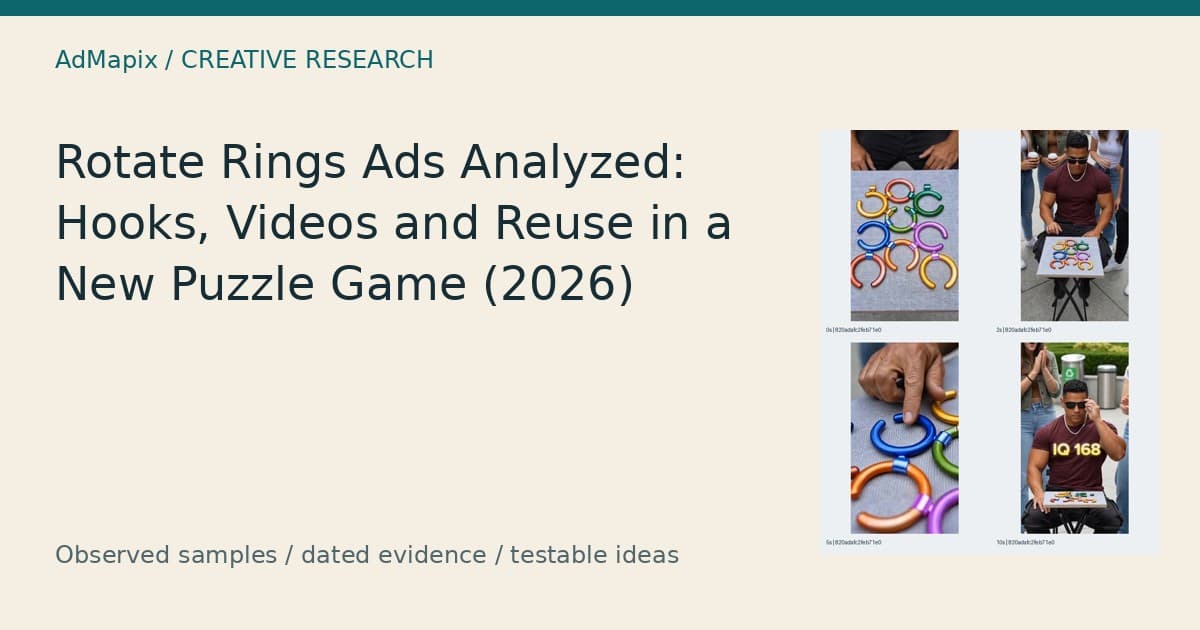
Sample 1 establishes the colorful puzzle before showing the surrounding participant scene. At the opening timestamp, the board occupies most of the visible area and the person’s upper body is cropped out. At two seconds, the wider composition shows a seated man in a burgundy shirt and people standing around him. The five-second frame returns to a finger positioned at the blue ring; the ten-second frame shows an “IQ 168” overlay.
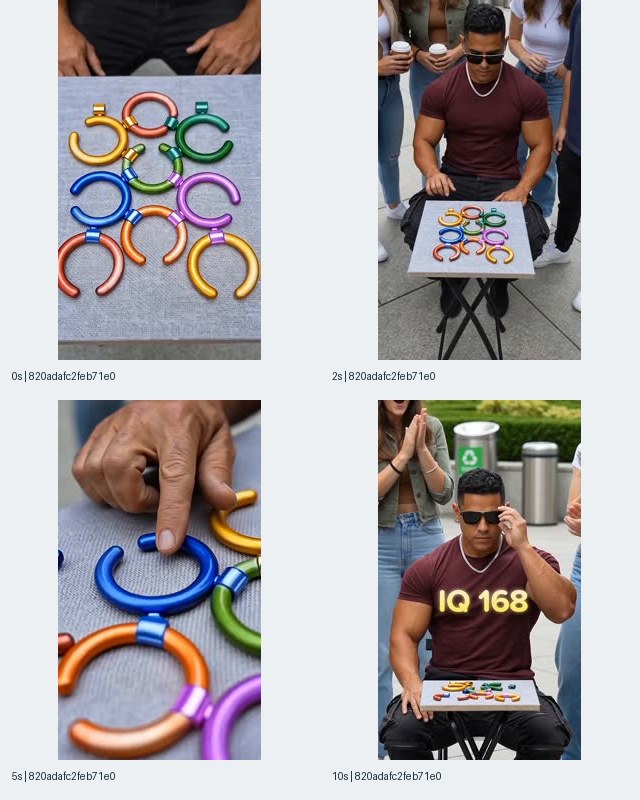
Image 1. Rotate Rings iOS-linked record 820adafc2feb71e026f09bfa7ab9a100. Supplied contact sheet at 0, 2, 5, and 10 seconds; the record lists a 31-second video. The overlay is advertising content, not a verified intelligence measurement.
The visible structure gives the puzzle an independent introduction. The viewer can recognize bright, open-ended rings and their connections before needing to interpret a character, setting, or social reaction. The wider shot then places that object in a public challenge setting. That sequencing is a concrete observation; whether it improves attention is a hypothesis requiring a test.
The close-up is especially useful for briefing because it narrows the intended action. “Show the game” is a vague production instruction. “Keep the target ring large enough that the finger and the ring opening remain visible” is actionable. In an original execution, the team could preserve the board-first introduction while using its own puzzle layout, participant, environment, and verified interaction.
The “IQ 168” overlay changes the meaning of the scene. It adds an intelligence association to what could otherwise be a simple dexterity or spatial puzzle demonstration. The supplied material does not establish an intelligence assessment, an improvement in cognitive ability, or a relationship between completing the puzzle and a numerical IQ score.
A responsible test brief would separate these components. One hypothesis could be that a close view of the target ring makes the intended action easier to understand. Another could examine a participant reaction. Neither requires the unsupported score. This separation also helps the team identify which element it actually wants to learn from.
Sample 2: A Wooden Pointer and an Unanswered IQ Prompt
Sample 2 keeps the puzzle and pointer in view while an “IQ = ?” banner supplies the challenge framing. The opening image already contains the board, the green ring near its top, and a wooden pointer held by a hand. Later sampled frames show a different configuration, including the absence of some upper rings. The record metadata lists a 54-second video, although only the supplied timestamps are examined here.
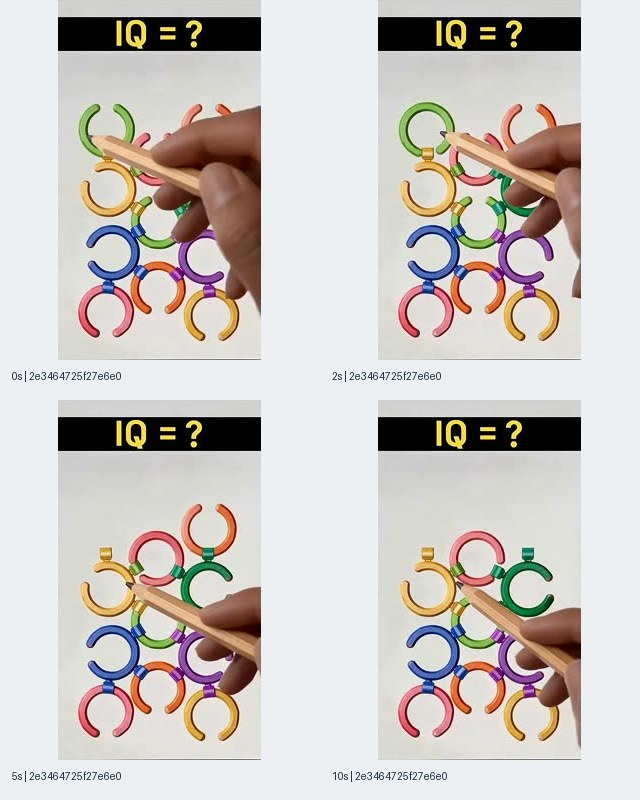
Image 2. Rotate Rings iOS-linked record 2e3464725f27e6e01ea7f381c54f461e. Frames at 0, 2, 5, and 10 seconds show a wooden pointer and changing puzzle states. The source lists a 54-second video; the contact sheet does not show its complete sequence.
This presentation concentrates attention on the task rather than a surrounding scene. The pointer serves as a visual guide to the part of the board being considered. Its position may help a viewer follow the intended sequence, but the stills cannot establish whether the pointer remains readable during motion or whether the whole solution is coherent.
There is also a useful distinction between the headline and the instruction. “IQ = ?” creates an unanswered question, yet it does not directly explain what the viewer must do with the rings. The action has to be inferred from the board and pointer. That makes the example a candidate for an original comparison with an explicit task sentence.
For production, the key inspection points are pointer contrast, hand occlusion, and the visibility of the ring opening. A large hand can make the scene feel tactile while covering the connection the viewer needs to understand. A pointer that blends into the background can indicate movement without clearly indicating the target.
This file appears in five sampled records with five different playable associations. That gives the team a structural reason to inspect it beyond its visible hook. It is one repeated video file supporting multiple captured combinations, not five independently produced video concepts. No supplied result shows whether the longer duration or any particular association improved conversion.
Sample 3: Similar Puzzle Structure, Different Demonstration Surface
Sample 3 resembles Sample 2 in its board composition and “IQ = ?” prompt, but the visible pointer is white and the video has a different fingerprint. Its recorded duration is 21 seconds. The combination of visual similarity and different file identity is useful because it exposes a common reporting error: distinct videos do not necessarily represent distinct creative concepts.
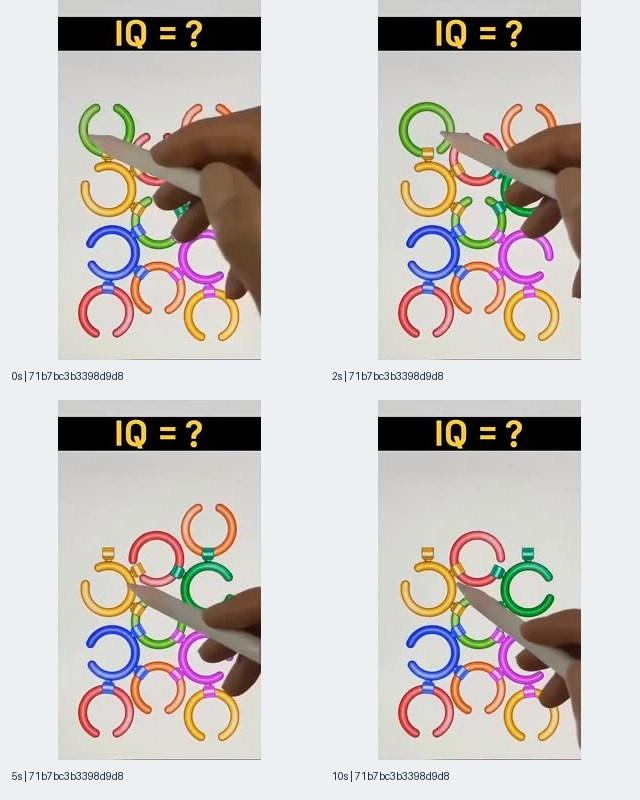
Image 3. Rotate Rings iOS-linked record 71b7bc3b3398d9d89f5cee9d0405c417. Supplied frames at 0, 2, 5, and 10 seconds; the record lists a 21-second video. Similarity to Image 2 is a visual observation, not proof of an editing relationship.
The source supports two separate statements. At the file level, this is different from Sample 2. At the concept level, both use a close puzzle demonstration, a hand-held pointer, and an unresolved intelligence prompt. Neither statement cancels the other. A useful creative database needs room for both.
The duration difference should not be treated as evidence that one version was deliberately shortened from the other. The sample does not provide editing history, production dates, or the complete videos needed to compare every sequence. It establishes different recorded files with different listed durations and related visible treatments.
For a team planning its own variation, the pointer is a manageable production variable. A white pointer can be evaluated for contrast against the board and rings; a wooden one can be evaluated against the same criteria. The question is whether the intended target and permitted motion remain clear. Calling one “more natural” or “more effective” would require viewer or campaign evidence.
A proposed test should keep the puzzle layout, action, text, and framing stable if pointer treatment is the variable of interest. Changing all those elements while also changing duration would make the result hard to interpret. These two source examples suggest useful dimensions to isolate, but they are not themselves a documented controlled experiment.
To inspect relevant indexed examples alongside these observations, search Rotate Rings creatives in AdMapix. Use the name to discover candidates, then confirm the linked product ID before adding them to the same research set.
Sample 4: The Ring Puzzle as a Cinematic Prop
Sample 4 places the rings inside a cinematic character scene rather than maintaining a continuous close view of the puzzle. A hand holds connected rings at the opening timestamp. The two-second frame shows a man beside a helicopter, the five-second frame is a face close-up, and the ten-second frame shows another scene with an “IQ 168” overlay. The puzzle is introduced immediately, but a playable action is not established by these frames.
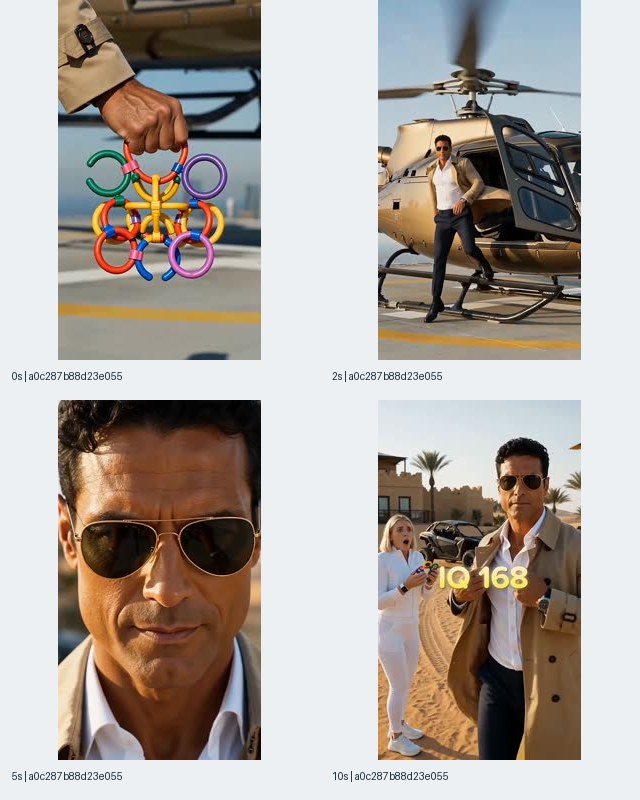
Image 4. Rotate Rings iOS-linked record a0c287b88d23e055efaa283632c7211a. Contact sheet at 0, 2, 5, and 10 seconds from a video listed as 32 seconds. The images establish the visible setting and overlay, not an endorsement or verified intelligence result.
The ring object is the bridge between the opening and the broader scene. It gives the ad a recognizable product motif before the composition shifts toward a person and an aspirational setting. A possible hypothesis is that this presentation attracts interest through character and spectacle. The evidence does not show whether that interest transfers to understanding the puzzle or installing the app.
For an original brief, the important question is the connection between the scene and the action. If a person holds a puzzle, does the viewer understand what can be moved? If the camera moves away from the object, what visual element preserves the task? A memorable setting can occupy the frame without explaining either point.
The sampled face does not establish the person’s identity, the production method, or a commercial endorsement. Those details are unnecessary to understand the creative structure and should not be supplied by resemblance or guesswork.
This video file appears in two sampled records with different playable associations. The source therefore supports a repeatable scene asset at the file level. It does not show two independent cinematic concepts, the cost of producing the scene, or which version performed better. A team can study the product-to-scene transition while keeping all of those business questions open.
Sample 5: A New Participant Within the Tabletop Challenge Pattern
Sample 5 uses a tabletop ring puzzle, a seated participant in a yellow jacket, a close view of a finger at the blue ring, and an “IQ 168” overlay. Its visible structure is related to Sample 1, but its video fingerprint is different. This is a concrete example of changing the presentation around a recognizable puzzle demonstration without necessarily changing the central creative idea.
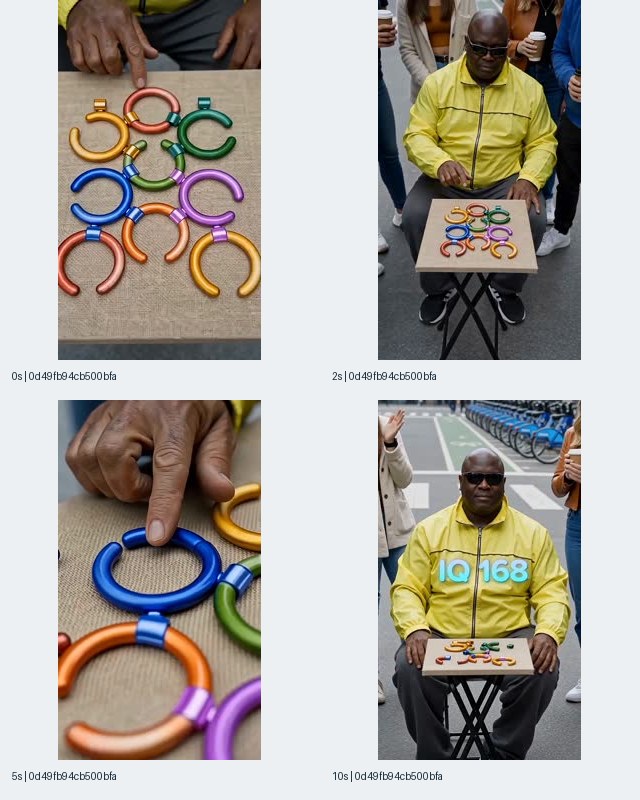
Image 5. Rotate Rings iOS-linked record 0d49fb94cb500bfaf0000fac58e744f9. Supplied frames at 0, 2, 5, and 10 seconds; recorded video duration is 32 seconds. The contact sheet supports comparison of staging, not an inference about audience targeting.
The opening includes a finger above the board, so the puzzle and an action cue arrive together. The wider frame then establishes the seated participant and surrounding people. The later close-up returns attention to the ring. That alternation between an object and a participant is a useful storyboard pattern to recognize, even though the intervals between supplied frames remain unobserved.
A creative taxonomy could group Samples 1 and 5 under a tabletop challenge family while retaining separate entries for the participant treatment and file identity. This avoids two opposite mistakes: treating them as unrelated concepts because the people differ, or collapsing them into one file because the staging looks similar.
The participant’s appearance does not disclose the ad’s intended audience. The sample contains no targeting settings. A report can say that the visible participant changed; it cannot turn that observation into a demographic targeting strategy.
For production, the board’s relationship to the person is the useful variable. Does the wider shot preserve enough puzzle detail to maintain continuity? Does the close-up make the next action legible? Does the reaction appear to respond to the demonstrated task? Those are review questions that a team can answer on its own finished footage.
The source file appears in two sampled records with different playable associations. That supports a combination-level reuse observation. It does not prove that changing the participant or the associated playable created a better result.
Sample 6: Similar Contact Sheets Can Still Represent Different Files
Sample 6 looks very similar to Sample 1 at the supplied timestamps, yet the source records assign the videos different fingerprints. Both show the tabletop puzzle, a seated man in burgundy, a finger close-up, and an “IQ 168” overlay. Both are listed as 31-second videos. The evidence supports visual similarity across the sampled frames and file-level difference; it does not identify the reason for that difference.
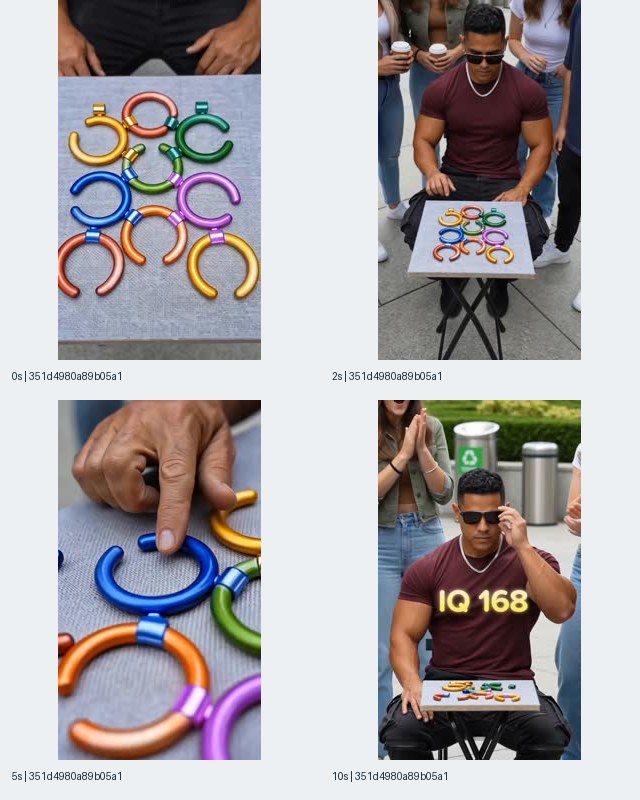
Image 6. Rotate Rings iOS-linked record 351d4980a89b05a118365023d79723c0. Contact sheet at 0, 2, 5, and 10 seconds. This record has a different video fingerprint from Image 1 and no captured playable association.
This pair is the clearest reason not to let either thumbnails or fingerprints do every analytical job. Fingerprints answer whether the index identifies the same file. A visual family tag answers whether examples share a recognizable presentation. Neither method alone establishes the full editing history or the number of original concepts produced.
Possible explanations for different files include changes outside the previewed interval or technical differences in the media, but those remain hypotheses. The supplied material does not establish a changed soundtrack, a revised ending, a new export setting, or a different call to action. A careful report leaves the explanation unresolved.
The record-level distinction is also operationally relevant. Sample 1’s record includes a playable association. Sample 6’s record does not. The safe statement is that the captured configurations differ. It would be too strong to claim that Sample 6 has no call to action or could never lead to an interactive experience; neither conclusion follows from a missing association in this record.
For a production tracker, this case calls for separate fields for file identity, visual family, and captured format combination. The team can then answer three questions without forcing them into one count: how many files exist, how many ideas they appear to express, and how many combinations the sample records. That distinction is particularly useful when stakeholders ask whether a growing record count means the team is producing more original creative.
Sample 7: A Cleaning Reveal Before the Pointer Demonstration
Sample 7 introduces a cleaning scene before the ring puzzle becomes visible in the supplied frames. At zero seconds, a mop is positioned over a dark floor area. At two seconds, colorful rings appear beneath or beside the mop. The five- and ten-second frames show a pointer over a brightly colored ring arrangement against a purple-toned background. This is the selected example with a clear visual reveal before the close puzzle presentation.
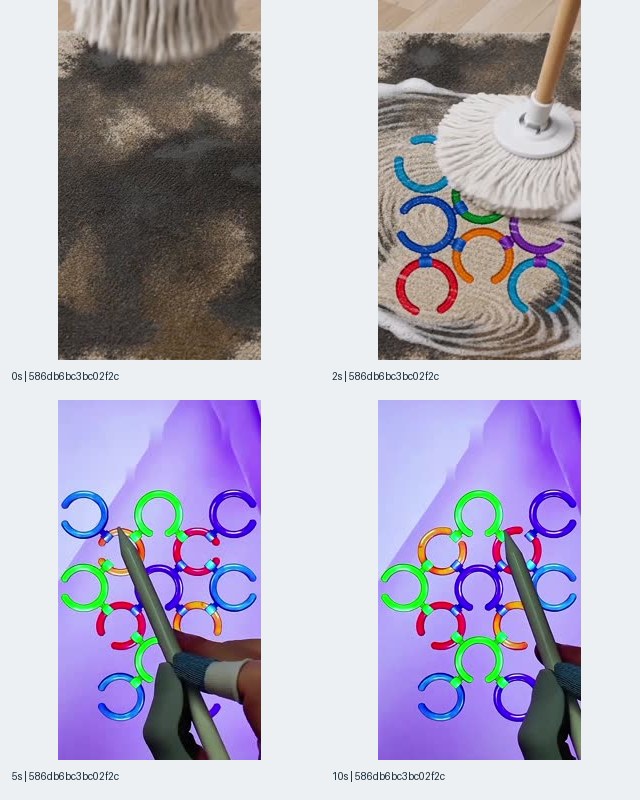
Image 7. Rotate Rings iOS-linked record 586db6bc3bc02f2c357c2b3305a0f94a. Frames at 0, 2, 5, and 10 seconds from a video listed as 49 seconds. Rings are visible at the sampled two-second point; the exact reveal onset is not measured.
The creative question differs from the tabletop examples. Here, the opening asks the viewer to interpret an unexpected surface change before following the puzzle. A plausible hypothesis is that the reveal creates curiosity. Another is that it delays understanding of the actual task. The source does not resolve that tradeoff.
The transition matters as much as the cleaning image itself. The later puzzle uses a visibly different presentation from the floor scene. A team evaluating an original version should inspect whether the ring arrangement, colors, and implied action create a clear connection across that change. Otherwise, the opener can become a separate visual event with a weak connection to the advertised experience.
The contact sheet does not prove a continuous transformation from floor to playable board. It shows sampled states. That distinction prevents a storyboard description from quietly becoming a claim about an observed transition.
This file occurs in two sampled records with different playable associations. It therefore combines a distinct visible hook with evidence of file reuse. A proposed test could hold the later puzzle demonstration constant while comparing an immediate board opening with an original reveal opening. Such a test should measure whether viewers understand the game as well as whether they continue watching. The supplied sample itself contains neither measurement.
Sample 8: An Explicit Task Replaces the IQ Question
Sample 8 gives the viewer a direct objective: “Untie all the rings.” The text appears above a colorful puzzle on a light blue background, with a white pointer already visible in the opening frame. Its central distinction is instructional clarity. Unlike the “IQ = ?” examples, the headline names the task rather than asking the viewer to interpret an intelligence challenge.
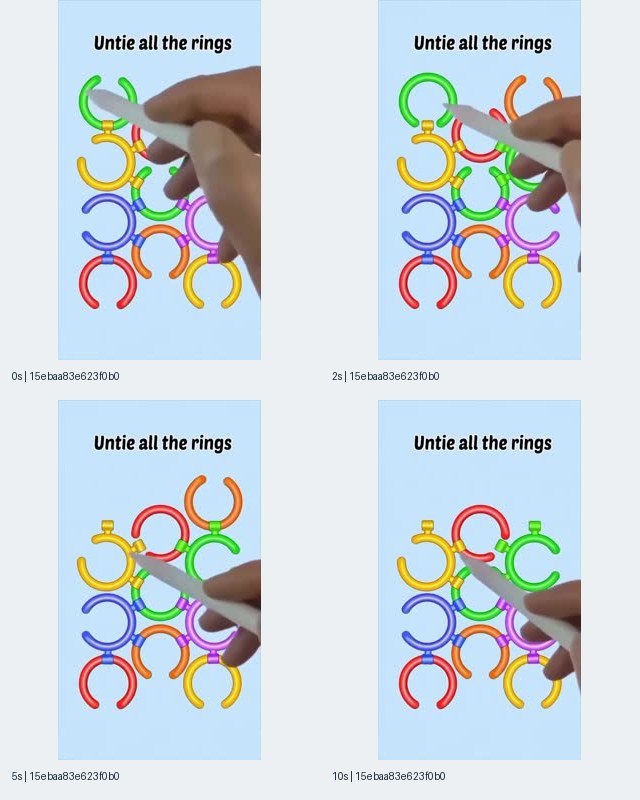
Image 8. Rotate Rings iOS-linked record 15ebaa83e623f0b021e8bb14df59b4c7. Supplied timestamps are 0, 2, 5, and 10 seconds; recorded duration is 22 seconds. No playable association is captured on this record.
The instruction helps define what success is supposed to look like. It does not, by itself, explain every movement rule. The pointer and changing board states still carry that burden. For an original execution, the useful design question is whether the text, target ring, permitted movement, and resulting change all point toward the same objective.
This example also shows why a hook taxonomy should include the promise, not just the visual format. Samples 2, 3, and 8 all present close puzzle demonstrations with a pointer. Their framing differs: an unanswered intelligence prompt versus an explicit completion task. A report that tags all three only as “gameplay” would miss that distinction.
The sample does not establish that an instruction outperforms a challenge. It supplies a contrast worth testing. A team could create its own matched versions with identical board states and action sequences, changing only the headline. Comprehension checks could then ask what the viewer thinks the task is before any paid test begins.
The wording should also match the installed experience. If the app requires rotation, sequence planning, or another specific operation, the original demonstration should make that operation visible. This analysis has not played the app, so it cannot certify that the advertised interaction matches a current build. That verification belongs in the team’s production acceptance process rather than being assumed from the app name.
How Much Reuse Is Visible Behind the Records?
Two video files each appear in five sampled records, providing direct evidence that record growth can come from recombining existing media. Several other files appear twice. This is a stronger, more specific finding than saying that the game “scales creative aggressively”: the sample shows repeated files and changing associations, while the rate of production and the business effect remain unknown.
| Video reference | Sampled records using the same video file | Playable relationship visible in those records |
|---|---|---|
| Sample 1 tabletop video | 5 | Five different playable files |
| Sample 2 wooden-pointer video | 5 | Five different playable files |
| Sample 4 helicopter video | 2 | Two different playable files |
| Sample 5 yellow-jacket video | 2 | Two different playable files |
| Sample 7 cleaning-reveal video | 2 | Two different playable files |
| Unillustrated 23-second video | 2 | Two different playable files |
| Remaining video files | One record each | Associations vary by record |
The Sample 1 file occurs in records beginning 820adafc, c1004c84, 49ef51f3, 9012e80c, and 27500606. The Sample 2 file occurs in records beginning 2e346472, 7c30b6a9, 621f9b01, 77a13cc1, and f794ca3d. These identifiers make the two five-record groups checkable in the public source package without relying on thumbnail resemblance.
There are several levels of reuse here. Exact file reuse is established by a shared fingerprint. Visual family reuse is an interpretation of the supplied frames, such as the related tabletop scenes in Samples 1, 5, and 6. Message reuse includes the repeated intelligence framing. These levels should be labelled separately because they imply different production work.
A new playable association can expand the number of captured combinations without increasing the number of video files. A new video file can retain almost the same visible hook. A new hook can require a different opening while retaining a familiar demonstration later. The source supports observing these distinctions; it does not provide the advertiser’s internal production taxonomy.
For a creative manager, the practical lesson is to report output in layers. Record volume describes the indexed combinations. File volume describes media variety. Concept families describe the ideas a researcher can distinguish from inspected content. Production cost, turnaround time, and conversion results require their own records.
This also changes how “scaling” should be discussed. The sample demonstrates reuse and variation within a bounded selection. It does not measure a rising production curve, an expanding team, a budget increase, or successful scaling of a campaign. Those stronger claims would require repeated comparable snapshots or private operating data.
What the Playable Associations Reveal—and What They Leave Open
Playable associations are common in the sample, but their presence does not document the interactive experience. Of the 30 records, 27 contain a playable association; 22 contain both a video and a playable, and five contain a playable without a video. The distinct playable-file count is ten. These figures establish format relationships, not verified loading behavior, interaction quality, or conversion contribution.
One playable file is associated with eleven sampled records, including a pure-playable record and ten different video files. Its identifier begins c3ab26d3 in the public source package. This is useful evidence of an asset shared across different captured presentations. It does not show that the playable appears at the same point in every experience or that every association represents an identical user journey.
The five pure-playable records are also important because the supplied visual examples are all video contact sheets. A researcher relying only on those images would miss a format category present in the underlying sample. Conversely, the presence of a playable identifier does not license a description of its controls, level design, difficulty, or completion screen.
An inspection brief for those assets should therefore remain explicit about the missing work. Open the accessible interactive asset in an appropriate review environment, record the first visible state, document the permitted input, and capture the response to that input. Check whether the promised objective can be understood without relying on the preceding video. Those are proposed steps, not tests completed for this article.
For a video-plus-playable combination, the most useful continuity questions are concrete. Does the first interactive state resemble the puzzle the video introduced? Is the target ring or action familiar? Does the interactive instruction preserve the same objective? Is any new rule introduced without explanation?
A team should record the answers at the combination level. If the same video is paired with different playable files, the transition may differ even though the opening video does not. That is why a single score attached only to the video can conceal an important part of the eventual experience.
The sample offers no interaction logs or conversion outcomes. It cannot establish that playables are superior to video, that a frequently associated file is the best one, or that a pure-playable record should receive more budget. Its contribution is to identify what needs inspection before those decisions are made.
First-Seen Dates Show a Discovery Pattern, Not the Complete Launch
The sampled records have first-seen dates from 2026-09-20 through 2026-10-08, with clusters on September 20 and October 1. This describes when the indexed records in the returned sample were first observed. It does not identify the day production began, the first paid impression, or the complete creative activity following the app’s August release.
| First-seen date | Records in this sample |
|---|---|
| 2026-09-20 | 9 |
| 2026-09-21 | 1 |
| 2026-09-22 | 1 |
| 2026-09-26 | 1 |
| 2026-09-27 | 2 |
| 2026-09-29 | 2 |
| 2026-09-30 | 2 |
| 2026-10-01 | 6 |
| 2026-10-02 | 3 |
| 2026-10-03 | 1 |
| 2026-10-05 | 1 |
| 2026-10-08 | 1 |
The dated editorial brief identifies the App Store release date as 2026-08-05. It also reports the game at #6 on the US App Store free Games chart on 2026-10-11, compared with being outside the captured top-100 window on 2026-09-11. The earlier snapshot does not mean the game was exactly number 100. Those chart observations supply context for studying a recently released game; they do not attribute the chart movement to these ads.
The date clusters are compatible with several explanations. They may reflect new combinations appearing, broader discovery of existing material, or other indexing and advertising activity. The evidence does not distinguish those causes. Calling the clusters production sprints or coordinated launches would therefore be a hypothesis.
The record history gives a more concrete example of why dates need interpretation. The wooden-pointer video appears in records first seen on October 1, 2, 3, 5, and 8, with different playable associations. That establishes staggered discovery of combinations using the same file. It does not establish five separate video-production events.
Similarly, the latest first-seen date in this bounded sample is not evidence that creative production stopped afterward. Later records may fall outside the returned pages, and the sample selection is not a complete chronological feed. The useful monitoring task is to compare consistent future captures while preserving their scope, rather than treating the latest row here as the end of the advertiser’s activity.
What Can Be Compared With Smash Fest and Bus Traffic Fever?
The supported comparison with earlier launch-related teardowns concerns analytical structure, not a ranking of launch effectiveness. The supplied published summary for Smash Fest describes a playable-only sample. The Bus Traffic Fever summary describes a mixture of videos and playables and emphasizes the difference between advertising records and underlying files. Rotate Rings adds a current example of visible video families combined with recurring playable associations.
The Smash Fest teardown is useful for asking whether an interactive format can be the main object of research rather than an attachment to a video analysis. Rotate Rings cannot be described as following that same format pattern: its supplied sample includes both videos and pure-playable records. The comparison stops at the documented format distinction.
The Bus Traffic Fever teardown is useful for the record-versus-file distinction and the need to verify store identities. In the Rotate Rings sample, the five-record video groups make that distinction directly visible. Neither case supports assuming that a name, a record count, and a production count are interchangeable.
The earlier published summaries are contextual references, not a freshly harmonized dataset. This article does not place their estimates beside Rotate Rings estimates, calculate relative efficiency, or compare discovery rates across unlike windows. It also does not import causal claims from older titles into the present analysis.
For a genre-level creative vocabulary, the published puzzle game ad examples guide provides an additional reference. Apply that vocabulary to inspected evidence: explicit task, pointer guidance, participant scene, reveal, and claimed intelligence framing. Avoid turning a familiar genre label into proof that a particular hook works.
The useful cross-case question is therefore practical: which layer deserves attention in the next brief—video concept, exact file reuse, interactive asset, or the transition between them? That question can be answered without manufacturing a shared performance benchmark.
A Practical Workflow for Turning the Sample Into a Research Sheet
A useful research sheet preserves identity, media relationships, and observation limits before it introduces creative interpretation. The goal is to make every proposed test traceable to an actual example while keeping the original work distinguishable from the source. The Rotate Rings sample provides a concrete way to build that sheet.
Start with the product reference. Record the verified iOS ID, the App Store seller, the separately reported company label, the country, and both measurement dates. Keep the Android identifier out of the analytical scope unless a separate verification and sampling task is completed. This prevents a later teammate from expanding the scope simply because a familiar name appears in an association.
Next, give each advertising record its own row. Preserve the record identifier, first-seen timestamp, video identifier, playable identifier, and available duration. Do not replace the identifiers with a thumbnail filename or a descriptive title. A description is useful for humans, but it cannot reliably establish whether two records share a file.
Create a second view grouped by video file. This immediately exposes the two five-record groups and the smaller repeated groups. Keep a list of associated playable files beside each video. The result is a reusable map of combinations, rather than a gallery that makes the same file appear novel each time.
Then annotate only the visual evidence actually supplied. For Sample 7, an observation might read: “Mop at opening timestamp; rings visible at two seconds; pointer over purple-background puzzle at five seconds.” Keep the proposed meaning in another column: “Hypothesis: a reveal may create curiosity before the task is understood.” That separation makes the report easier to challenge and improve.
| Research-sheet field | Example entry from this analysis | Why it belongs |
|---|---|---|
| Product reference | iOS 6793924927 | Anchors attribution |
| Record reference | 586db6bc3bc02f2c357c2b3305a0f94a | Preserves traceability |
| Visual family | Cleaning reveal followed by puzzle demonstration | Supports concept grouping |
| Observation coverage | Frames at 0, 2, 5, and 10 seconds | Defines what was inspected |
| Visible objective | Not explicit in the selected opening frame | Avoids filling gaps |
| Exact-file reuse | Same video appears in another sampled record | Separates files from instances |
| Hypothesis | Reveal may affect curiosity and comprehension differently | Creates a testable question |
| Missing evidence | Full transition, audio, interaction, conversion | Defines the next inspection task |
| Proposed original treatment | Own reveal scene connected to a verified puzzle action | Guides production without copying |
Before briefing, compare the proposed treatment with the real product. A researcher should identify the app build, the relevant interaction, and the evidence that the advertised action is available. This article supplies no app play session, so that check remains part of the reader’s workflow.
Finally, select a decision for each row: inspect further, use as a structural reference, develop an original test, or set aside. “Interesting” is not a sufficient handoff. A production team needs to know which component is worth exploring, which claim should be removed, and which missing observation could change the brief.
The finished sheet should allow another person to reconstruct the reasoning without guessing. They should be able to move from the proposed test to the hypothesis, from the hypothesis to the timestamped observation, and from that observation to the correct product-linked record.
Original Creative Briefs Suggested by the Evidence
The most useful briefs from this sample isolate a specific communication problem rather than reproduce an entire reference ad. The following are proposed original concepts, not descriptions of ads already tested. Each starts with a visible pattern in the sample and translates it into a production task that can be checked against the team’s own product.
Brief A: Make the first action unmistakable. Use an original puzzle layout with the target ring large enough to inspect. Begin with the board visible, then show one permitted action and its result. Keep the instruction focused on the task. The hypothesis is that a clear target and visible state change help viewers understand what they would do in the app.
The acceptance criteria are concrete: the input cue does not cover the important connection; the movement follows the product’s actual rules; and the resulting state remains visible long enough to inspect. The brief should specify the source build used for verification. It should not carry forward an intelligence score merely because such a score appears in the references.
Brief B: Compare task instruction with a neutral challenge. Build matched versions around the same original board and action sequence. One version states the task directly. Another asks a challenge question that the product can honestly support. The hypothesis is that the wording changes understanding or willingness to attempt the puzzle.
The production boundary matters. Keep the pointer, board, outcome, and presentation stable so the headline remains the main difference. Do not compare a cinematic scene against a flat demonstration and then attribute the result to wording. The reference contrast between “IQ = ?” and “Untie all the rings” suggests the question; it does not prescribe an unsupported IQ claim.
Brief C: Test a reveal that preserves the puzzle connection. Create an original reveal treatment in which the same puzzle remains recognizable before and after the reveal. The hypothesis is that a reveal can add curiosity without obscuring the task. Its main production challenge is continuity, not visual novelty alone.
Review the transition without audio first to see whether the object and action remain understandable. Then assess the complete version with its intended sound. Record those as new inspection results if the team performs them. Neither check was conducted on the source videos for this article.
Brief D: Inspect the video-to-playable handoff. Use one original video with different original interactive introductions that preserve the same game promise. The hypothesis is that a clearer handoff reduces confusion when passive viewing becomes an interactive task. This brief is informed by the repeated video files with different playable associations, not by a recorded conversion result.
The deliverables should include a combination map and a capture of each first interactive state. Reviewers should be able to identify which video leads to which playable and what changes between the alternatives. Without that map, a team may know that several combinations exist while being unable to explain what each one tests.
How to Evaluate Those Briefs Without Inventing a Winner
Evaluation should begin with whether the creative communicates the intended game action and continue with properly scoped campaign results. The source sample supplies neither viewer-comprehension measurements nor conversion data. It can generate hypotheses, but the evidence required to accept or reject them must come from the team’s own review and testing process.
Before media testing, ask someone unfamiliar with the brief to describe the objective and the expected input. Record their answer rather than converting an impression of clarity into a pass. If the viewer describes a different action from the one the product supports, the brief has an expectation problem even if the artwork looks polished.
Inspect continuity as a separate issue. A tabletop object, a digital puzzle view, and an interactive asset may use related imagery while implying different controls. The review should identify where the viewer learns the actual operation. A character reaction or score overlay cannot substitute for that explanation.
For a paid comparison, define the changed variable, the relevant campaign conditions, the primary outcome, and the guardrail before interpreting results. If the team wants to test an opening reveal, keep the later demonstration and destination consistent where feasible. If it wants to test a playable introduction, preserve the video and document the interactive difference.
The outcome should match the question. Viewing behavior may help assess attention, while downstream events are needed to understand whether the acquired users engage with the promised experience. A strong opening result does not by itself establish a commercially useful install. Conversely, an unclear result should not be forced into a winner narrative because one version resembles a frequently repeated competitor file.
Record uncertainty and practical differences alongside the result. Production effort, technical failures, and incomplete measurement can affect the decision even when a headline metric appears favorable. Those quantities are unknown for the Rotate Rings references and should be measured only for the team’s own work.
The learning record should end with a specific decision: retain the clearer instruction, revise the handoff, investigate the reveal further, or stop the treatment. That is a more durable output than adding another “winning hook” label to an external example whose performance remains unobserved.
Common Mistakes This Sample Makes Easy to Spot
The main mistakes are counting at the wrong level and allowing visual observations to become claims about business results. Rotate Rings provides concrete examples of both. A reliable teardown keeps the underlying evidence intact even when a more dramatic headline would be easier to write.
| Mistake | Why it fails here | Better reporting choice |
|---|---|---|
| Calling the sample “30 videos” | Only 25 records contain video, resolving to 13 files | Report records and files separately |
| Calling 13 files “13 original concepts” | Some supplied previews are visibly similar | Add a separate concept-family annotation |
| Treating every playable association as a new video | The same video appears with different playable files | Report combinations explicitly |
| Describing the whole video from a contact sheet | Only selected timestamps are supplied | Tie each observation to its visible timestamp |
| Calling “IQ 168” a measured result | It is text inside the advertising image | Describe it as an advertising overlay |
| Assigning a network from visual style | No verified network mapping is supplied | Leave the network unresolved |
| Treating first-seen as production date | Discovery does not establish creation or first delivery | Use “first observed” |
| Using chart movement to prove ad effectiveness | No causal or conversion evidence connects them | Keep chart context separate |
A further mistake is using a missing association as proof of absence. Sample 6 has no captured playable association, but that does not establish every aspect of its eventual destination. The sample has no separate image fingerprints, but that does not establish that the game never uses image ads.
The same restraint applies to frequency. A file appearing in five records is a clear reuse finding. It is not evidence of five successful tests, five audiences, or five times the production effort. Likewise, being observed again at a later date does not prove uninterrupted delivery or profitable longevity.
These corrections do not make the research less actionable. They direct action toward the actual uncertainty: inspect the transition, verify the product promise, group the shared file, or run a controlled test.
When AdMapix Fits the Next Step
AdMapix fits the discovery and evidence-organization stage when a team needs to find indexed creatives, inspect product associations, and turn visible examples into a research shortlist. It is an advertising intelligence product, and this article demonstrates a bounded use of its captured records. The appropriate handoff is to current research, with the product ID and questions already defined.
For this task, the next session should focus on the verified Rotate Rings listing, exact-file reuse, and the missing interactive inspections. Keep any new capture separate from the frozen article sample. A live result may contain different records or estimates because it represents a different observation date or measurement window.
AdMapix does not replace the advertiser’s own conversion reporting, an app play session, or a controlled experiment. If the decision is whether to increase budget, the external creative references should inform hypotheses while account evidence determines the commercial judgment.
Sign up or log in to AdMapix to investigate current creatives. Bring the verified product ID and a specific question, such as whether the same video appears with a different interactive introduction. For commercial terms, consult the live pricing page; this evergreen analysis does not freeze plan prices or credit allowances.
FAQ
What do Rotate Rings game ads show in this sample?
The supplied contact sheets show colorful connected rings in tabletop challenges, pointer-led demonstrations, a helicopter scene, and a cleaning reveal. Visible text includes “IQ = ?,” “IQ 168,” and “Untie all the rings.” These descriptions concern eight selected video references linked to the verified iOS product, not every ad the game has used.
How quickly do the ads get to gameplay?
Seven supplied contact sheets show a puzzle object or board at the opening timestamp. The cleaning example shows recognizable rings at two seconds. That establishes puzzle visibility at sampled moments. It does not establish exact gameplay onset, continuous interaction, or whether the footage matches the installed app, which was not played for this analysis.
Why are there 30 records but only 13 video files?
An advertising record can reuse a video already associated with another record. In this sample, two video files each occur in five records with different playable associations. Some records contain no video at all. The counts describe different units: indexed instances, video files, and interactive files should not be merged into one creative total.
Do the repeated files prove that those ads perform well?
No. Repetition establishes that a file appears in multiple sampled records. The evidence does not supply spend, conversions, retention, profit, or test assignments. Repeated files are useful inspection candidates because their associations can be compared, but a performance conclusion requires appropriate campaign evidence that is not present here.
Are the IQ claims verified by the game or this research?
No verification of an intelligence assessment is supplied. “IQ 168” and “IQ = ?” are visible advertising text. This article records their role in the creative framing without accepting them as measurements or product benefits. A team building an original ad should use claims it can substantiate and separately verify the advertised interaction.
Does the sample cover Android or a particular ad network?
The retrieval scope is the verified iOS listing, 6793924927, with a US filter. Some records also include an Android association, but this analysis does not extrapolate to Android. The supplied source code lacks a verified network mapping, so the article does not assign the examples to a named advertising network.
How should a small creative team use this teardown?
Start with one communication question, such as whether viewers understand the first action or the transition into an interactive puzzle. Use the source examples to identify a structural reference, create an original treatment, and verify it against the actual product. Preserve file and combination identities so additional records are not mistaken for additional concepts.
Key Takeaways
The useful finding is a combination of early puzzle visibility, related creative families, and exact-file reuse within a bounded sample.
- Count separately: 30 records contain 13 distinct video files and 10 distinct playable files; these are different measures.
- Describe the visible evidence: opening puzzle visibility is not proof of complete gameplay fidelity.
- Inspect combinations: two video files each appear with five different playable associations.
- Treat dates as observations: first-seen clusters do not reconstruct production schedules or prove successful scaling.
- Turn patterns into original tests: isolate the instruction, pointer, reveal, or interactive handoff, then use appropriate product and campaign evidence to evaluate it.
Sources
The sources below support the dated sample, identity checks, contextual comparisons, and research workflow; their scopes should remain separate.
- AdMapix frozen source package, observed 2026-10-18: public captured evidence and reproduction details. Contains the captured batches, request parameters, checksums, product associations, and the US creative sample for 2026-09-19 to 2026-10-18. This is the source of the record, file, association, and first-seen counts.
- Verified App Store reference, captured in the 2026-10-18 source sample: Rotate Rings, iOS 6793924927. Supports the product reference and seller identity; it does not identify the ad buyer or establish creative performance.
- AdMapix editorial research dated 2026-10-13: the supplied US App Store free Games snapshots compare 2026-10-11 with 2026-09-11 and provide the release-date context. Chart position is used as context only, without attributing movement to advertising.
- AdMapix methodology and search workflow, referenced for the 2026-10-18 analysis: public methodology and Rotate Rings creative search. These explain the research surface and provide an entry to current indexed examples; a live search is not a reproduction of the frozen result by itself.
- Earlier published teardown context, available in the supplied 2026-10-18 inventory: the Smash Fest and Bus Traffic Fever articles linked above are used for qualitative format and counting comparisons. Their datasets were not rerun or combined with this sample.
The eight numbered images are source-specific advertising contact sheets with observations limited to their labelled timestamps. They are visual evidence of creative presentation, not proof of campaign performance.
Turn these observations into your next creative study
Open the creative library and select samples for your market, network and research question.
Related Articles
Magic Sort Ads Explained: Sorting Hooks, Tall Bottles, and Video Reuse
Eight dated Magic Sort advertising examples reveal sorting hooks, unusual receiving containers, hand guidance, and video reuse, while separating verified iOS identity from unproven gameplay and performance claims.
TikTok Shop Ads: Home-Product Demonstration Ideas
Use eight dated home-product advertising references to plan measured-fit shots, honest setup demonstrations, clear result sequences, and original creative tests without assuming Shop attribution or campaign performance.
Competitor Price Analysis: Compare Offers and Proof
Use eight dated advertising examples to distinguish discounts, coupons, bundles, shipping, and incomplete trial claims, then build a traceable offer comparison and original testing brief.