
Best Minea Alternatives in 2026: 7 Tools Compared for Ad & Creative Intelligence
A 2026 guide to the best Minea alternatives — when product research isn't enough, a 7-tool comparison with pricing and coverage, the product-research vs creative-intelligence distinction, a migration plan, and an honest read on when AdMapix fits and when Minea is still right.
By the AdMapix Research Team — Updated August 25, 2026
Best Minea Alternatives in 2026: 7 Tools Compared for Ad & Creative Intelligence
A Minea alternative makes sense when your daily job moves past finding winning dropshipping products and into understanding why creatives win, how competitors structure video, and how angles change across markets. Minea is built around ecommerce product discovery and ad examples — a deliberately narrow, useful lane. This 2026 guide is for dropshippers, DTC marketers, and agencies who already use an ad-spy tool but keep hitting the same wall: the tool shows them what is trending, not why it converts or how to brief the next test. Below is a workflow-first way to decide, a seven-tool comparison with pricing and coverage, a migration plan, and a clear read on where AdMapix fits and where it does not.
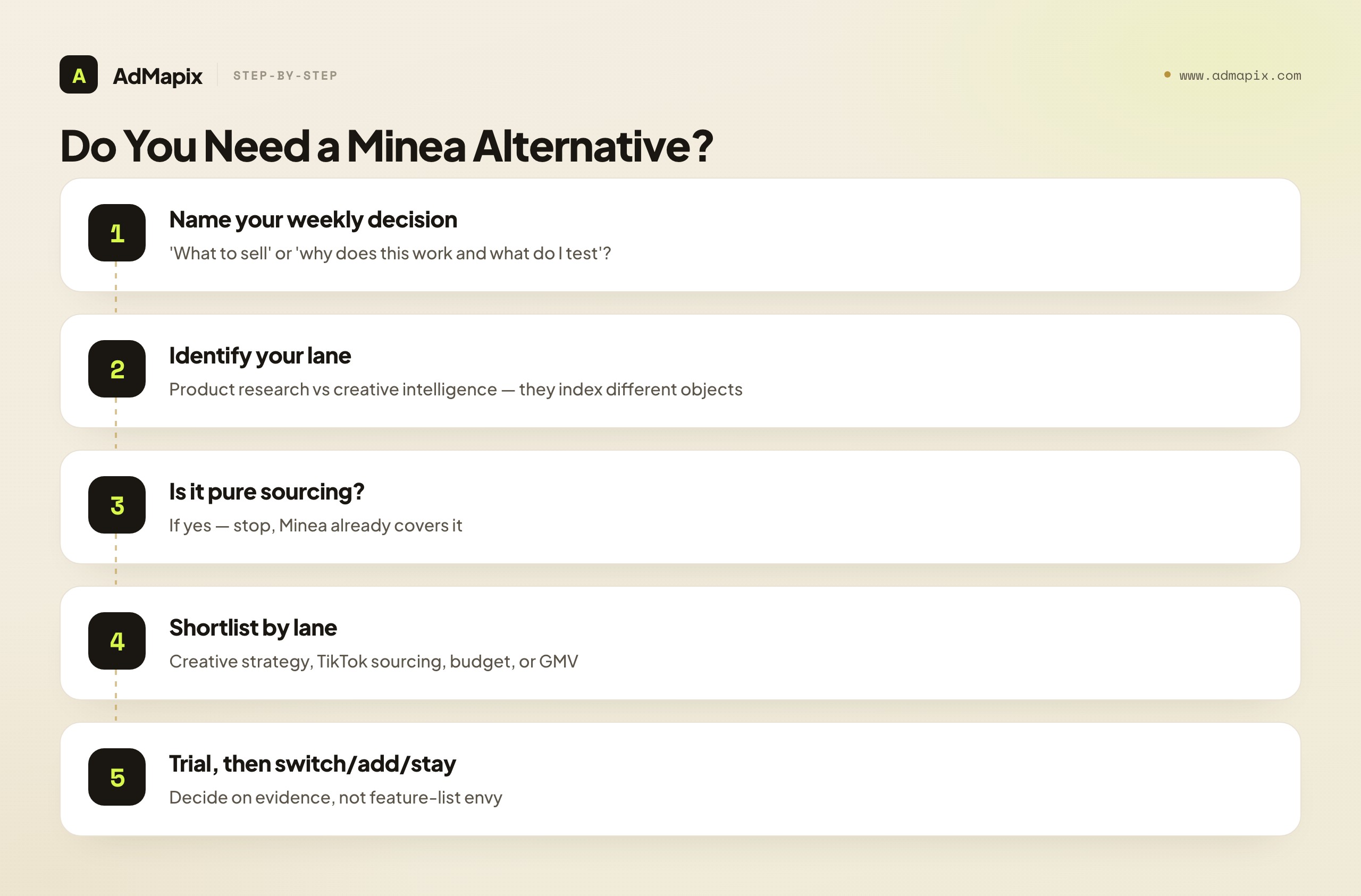
The honest framing up front: Minea is good at product research, and most people searching for an alternative don't have a Minea quality problem — they have a layer problem. Their job shifted from "what should I sell" to "why does this ad work and what do I test next," and those are answered by different tools that index different things. So the real question isn't "what beats Minea," it's "has my job moved from the product-research lane into the creative-intelligence lane — and if so, which tool lives there." This guide answers that.
TL;DR — Choosing a Minea Alternative
- Minea is strongest when ecommerce product discovery and ad examples are the daily job. Switch or add a tool when the job becomes creative strategy.
- Choose by the weekly decision your team must make, not by advertised database size.
- If you research apps, games, SaaS, or brand campaigns rather than Shopify SKUs, a product-research tool is the wrong layer entirely.
- The distinction that decides everything: product research answers "what to sell"; creative intelligence answers "why does this ad work and what do I test." They index different objects.
- The main alternatives split into product-research peers (PiPiAds, Dropispy), broad ad libraries (BigSpy, AdSpy), and creative-intelligence / reporting layers (AdMapix).
- AdMapix fits teams needing cross-network creative search, video breakdowns, saved evidence, and repeatable reports — not teams whose whole job is sourcing the next dropship SKU.
What Minea Does Well, and Where It Stops
Minea is an ad-spy and ecommerce product-research tool: its core job is surfacing trending products with the ads selling them, so dropshippers can copy a proven offer fast. That is genuinely useful for one workflow, and you should not replace it if product sourcing is your bottleneck. The wall appears when your question changes. Product research answers "what should I sell?" Creative intelligence answers "why does this ad work, and what do I test next?" Those are different tools because they index different things: a product catalog versus a creative library you can break down by hook, format, and market.
Define the terms once, because conflating them is the root of most mis-purchases:
- Ad spy means seeing competitors' live or recent ads — the raw observation.
- Product research means matching those ads to sellable SKUs and order signals — the sourcing layer Minea excels at.
- Creative intelligence means analyzing the ad itself — the structure, hook, offer, and how it varies by platform and country — so it becomes a brief, not a screenshot.
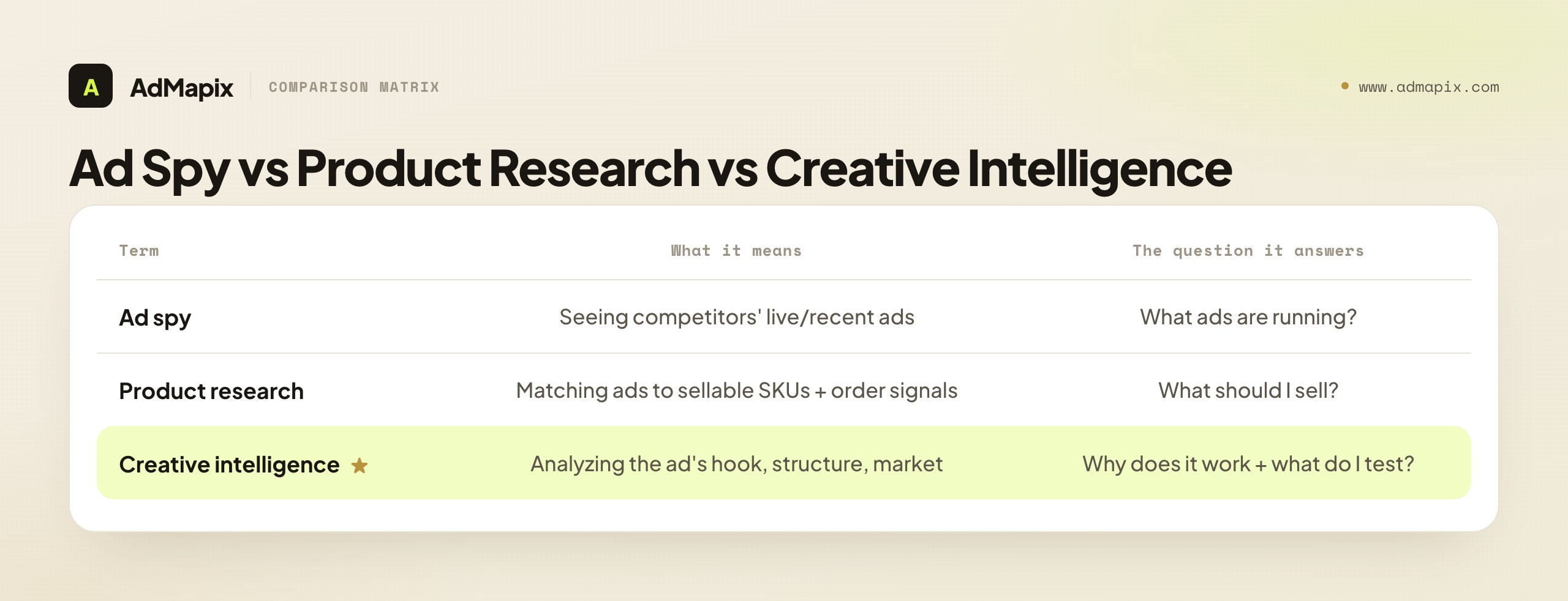
Minea sits firmly in the first two. The moment your job is the third — turning a competitor's video into a teardown you can hand a creative team — you've crossed into a layer Minea wasn't built for. That crossing is the single most reliable signal that it's time for an alternative (or a complementary tool), and it's worth being precise about which side of the line your weekly work actually lives on.
When You've Outgrown Product Research
Here are the specific signals that your job has moved from the product-research lane into the creative-intelligence lane. The more that apply, the stronger the case for an alternative.
You're asking "why" more than "what." When your team's recurring question shifted from "what product should we test" to "why is this competitor's ad winning and what's the hook," you've left product research behind. Minea is great at the first question and not built for the second.
Your channels expanded beyond ecommerce feeds. Minea's center of gravity is Meta and TikTok ecommerce ads tied to products. If you now research YouTube, app and game networks, SaaS, or brand campaigns, you're indexing the wrong object — those aren't dropship SKUs, and a product-research tool has no natural place to put them.
You need video structure, not thumbnails. If your creative team needs the first-3-second hook, the proof moment, and the pacing broken down — not just a playable thumbnail and a product link — you need creative-intelligence depth that product-research tools don't provide.
You owe reports, not shortlists. A product shortlist is Minea's natural output. If your deliverable is a recurring competitor report or a creative brief for a client or stakeholder, you need a tool whose output is evidence and reporting, not a list of SKUs.
You research across markets. If you compare the same angle across countries — how a hook is localized for the US versus Germany versus Japan — you need cross-market creative comparison that product feeds rarely structure cleanly.
If one of these applies, you may just need to add a layer. If three or more apply, your daily job has fully moved lanes, and a product-research tool is now the wrong primary tool no matter how good it is at sourcing.
How to Compare Minea Alternatives
Compare on the workflow output you need each week, not on library size. A smaller, better-filtered tool that produces a usable brief beats a huge database that buries you in irrelevant results. Use this framework.
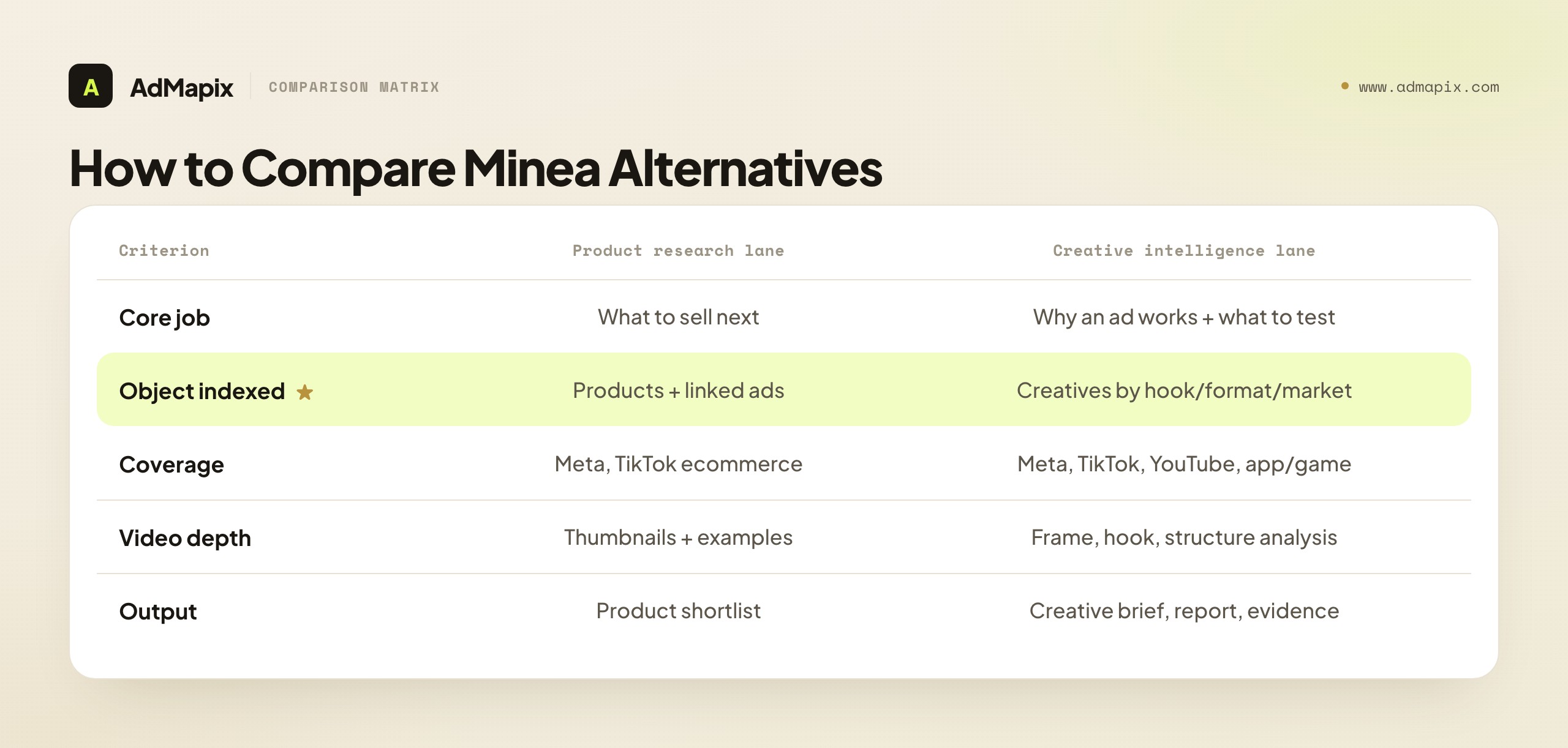
| Criterion | What to check | Product research lane | Creative intelligence lane |
|---|---|---|---|
| Core job | What the weekly decision is | What to sell next | Why an ad works and what to test |
| Object indexed | What the tool actually stores | Products + linked ads | Creatives, by hook/format/market |
| Platform coverage | Your real paid channels | Meta, TikTok ecommerce focus | Meta, TikTok, YouTube, app/game, regions |
| Video depth | Whether you can break down video | Thumbnails and examples | Frame, hook, and structure analysis |
| Output | What you hand off | Product shortlist | Creative brief, report, saved evidence |
| Pricing fit | Price vs. actual usage | Per research volume | Per research volume |
The most common buying mistake is comparing database size before asking whether results are relevant to the next brief. Bigger is not better if you can't filter it down to a decision. Run the same three to five competitor brands (or product categories) through any candidate, in the same window, and watch which one gets you to an action — a product test or a creative brief — fastest. That speed-to-decision, not archive size, is the real comparison.
The Minea Alternatives, Compared
No single tool is "best" — each lives in a different lane. Here's the honest positioning of the main options a Minea user will weigh. Treat it as a map, not an endorsement; verify current features and pricing on each vendor's page, since plans shift quarterly.
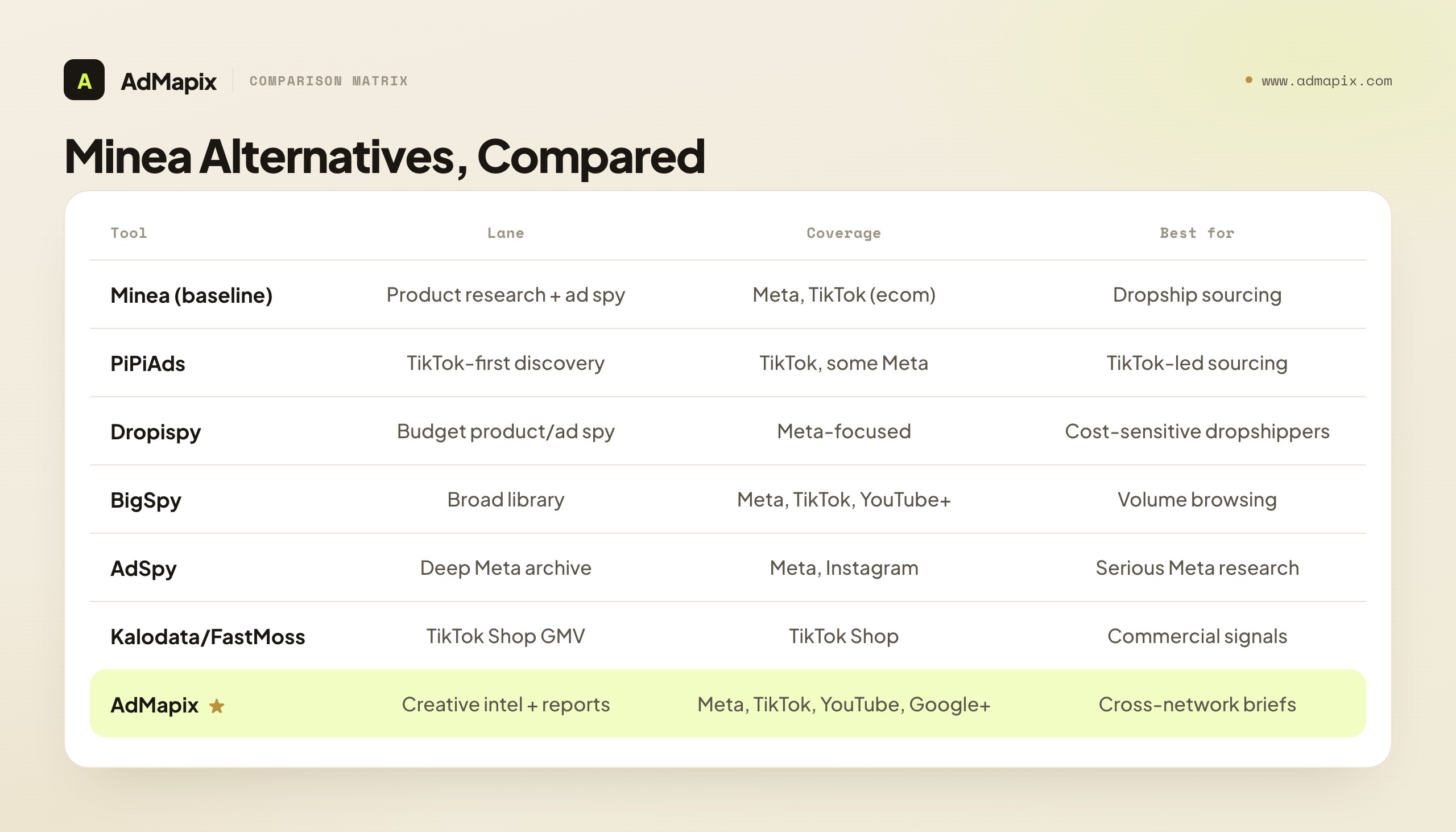
| Tool | Lane | Platform coverage | Pricing posture | Best for |
|---|---|---|---|---|
| Minea (baseline) | Product research + ad spy | Meta, TikTok (ecommerce) | Free tier + paid | Dropship / product sourcing |
| PiPiAds | TikTok-first ad discovery | TikTok, some Meta | Paid, credit-based | TikTok-led product/creative |
| Dropispy | Budget product/ad spy | Meta-focused | Low-cost tiers | Cost-sensitive dropshippers |
| BigSpy | Broad multi-platform library | Meta, TikTok, YouTube+ | Lower-cost tiers | Volume browsing across channels |
| AdSpy | Deep Meta/Instagram archive | Meta, Instagram | Higher flat monthly | Serious Meta creative research |
| Kalodata / FastMoss | TikTok Shop GMV analytics | TikTok Shop | Paid, GMV-focused | Commercial/sales signals |
| AdMapix | Creative intelligence + reports | Meta, TikTok, YouTube, Google+ | Public plans | Cross-network briefs + reporting |
Reading notes. PiPiAds is the natural peer if your product research is TikTok-led — it goes deeper on TikTok discovery, though it shares Minea's product-first orientation (see our PiPiAds alternative guide for that lane in detail). Dropispy is the budget option: cheaper, Meta-focused, fine for cost-sensitive dropshippers who just need basic ad/product spy. BigSpy trades depth for a large cheap library across channels. AdSpy is the Meta specialist with a deep archive at a higher price. Kalodata and FastMoss aren't product-research replacements at all — they're TikTok Shop GMV tools, a complementary commercial lens. AdMapix is the creative-intelligence and reporting layer — the fit when you've crossed from "what to sell" into "why does this ad work and how do I report it."
For the full field beyond the Minea-specific lens, our best ad spy tools 2026 comparison ranks everything, and best ad intelligence tools focuses on the creative-intelligence end of the market specifically.
PiPiAds — the TikTok-led sourcing peer
If your product research leans TikTok rather than Meta, PiPiAds is the natural Minea peer. It shares Minea's product-first orientation — surfacing trending products with the ads selling them — but goes deeper on TikTok and TikTok Shop specifically. The decision between them is mostly channel: Minea's center of gravity spans Meta and TikTok ecommerce, while PiPiAds is TikTok-first. If TikTok is where you find and validate winning products, PiPiAds' depth there often beats Minea's broader-but-shallower TikTok coverage. The catch is the same as Minea's: it's a sourcing/discovery tool, so the moment your job crosses into "why does this creative win and how do I report it," PiPiAds hits the same wall. Our PiPiAds alternative guide covers that crossing in detail.
Dropispy — the budget option
Dropispy is the cost-sensitive dropshipper's entry point: cheaper than Minea, Meta-focused, covering the basics of ad and product spy without the broader feature set. If your only need is occasional product/ad spy on a tight budget and you don't require deep filtering, cross-platform reach, or any creative-intelligence depth, Dropispy does the core job at a lower price. The trade-off is exactly what you'd expect — narrower channel coverage, lighter filtering, and no real teardown or reporting layer. It's a fine starting tool for a new dropshipper and a poor fit the moment your research matures.
BigSpy — breadth on a budget
BigSpy is the volume play: a large multi-platform library spanning Meta, TikTok, YouTube and more, at a low price. For a Minea user whose driver is "I want to browse more ads across more channels cheaply," it delivers breadth Minea's ecommerce focus doesn't. But breadth isn't depth — BigSpy runs lighter on structured video analysis, saved-evidence workflows, and reporting than tools built for those jobs, and it doesn't have Minea's product-research orientation. It's a browsing tool, not a sourcing tool and not a creative-intelligence tool. Our BigSpy alternatives guide details where that breadth-over-depth trade bites.
AdSpy — deep Meta creative research
AdSpy is the Meta specialist: one of the largest Facebook and Instagram ad archives, with powerful filtering, at a higher flat monthly price. For a Minea user who has shifted from product sourcing into serious Meta creative research — studying why winning Facebook ads work, at depth, in one channel — AdSpy is the specialist answer. It's Meta-only, so it solves a channel focus need, not a cross-network one. If your creative research lives mostly on Meta and you want archive depth, it fits; if you need TikTok, YouTube, and Meta together, you're back to running multiple specialists or using a cross-network layer.
Kalodata & FastMoss — a different job entirely
These are frequently listed as Minea alternatives, but they answer a different question. Both are TikTok Shop analytics tools: they read product GMV, creator sales velocity, and video/LIVE performance — commercial signals, not creative ones. For a TikTok Shop seller, the strongest setup often pairs a discovery tool (Minea or PiPiAds, for "what's selling") with a GMV tool (Kalodata or FastMoss, for "is it actually selling"), because a viral-looking ad and a product with real, rising GMV across creators are two different signals. Don't replace Minea with Kalodata expecting a product/ad library; add it expecting a sales-validation lens.
AdMapix — the creative-intelligence and reporting layer
AdMapix lives in the lane Minea doesn't: rather than sourcing products, it consolidates competitor creative across networks (Meta, TikTok, YouTube, Google and more) into one search, breaks down video structure hook-by-hook, saves evidence with context, and packages findings into shareable reports. It's the fit once your job crosses from "what to sell" into "why does this creative win and how do I report it." The honest boundary: it has no product catalog and won't tell you which SKU to dropship — for sourcing, Minea is more direct. More on exactly where it fits below.
Pricing: What You're Actually Paying For
Price is the most-asked and least-useful comparison axis, because the headline number says little about cost per decision. Here's how the tiers break down across this field.
| Pricing posture | Tools | What you get | Right when |
|---|---|---|---|
| Free / freemium | Minea (free tier), Meta Ad Library, TikTok Creative Center | Baseline product/ad discovery | Trialing, solo, ecommerce-only |
| Budget paid | Dropispy, BigSpy | Basic spy or broad browsing, light workflow | Cost-sensitive, volume browsing |
| Specialist mid-tier | Minea (paid), PiPiAds, Kalodata, FastMoss | Deep sourcing or GMV signals | One clear lane |
| Higher-cost specialist | AdSpy | Deep Meta archive + filtering | Serious Meta creative research |
| Creative intel / workflow | AdMapix | Cross-network search, evidence, reports | Crossed into creative strategy |
Two pricing traps recur. First, buying on headline price instead of cost-per-decision — a cheap tool that never produces a brief or a validated product is infinitely expensive, while a pricier tool that consistently changes your weekly decisions is the bargain. Second, paying twice for the same lane — stacking two product-research tools that surface the same SKUs, instead of pairing complementary lanes (sourcing + creative intelligence, or discovery + GMV). Always confirm current pricing on each vendor's page, since credit systems and renewal terms shift quarterly in this category.
Match the Tool to Your Lane
The comparison table tells you what each tool does; this 2×2 tells you which one you need, on the two axes that actually decide it — whether your job is sourcing or creative strategy, and whether you're single-channel or cross-channel.
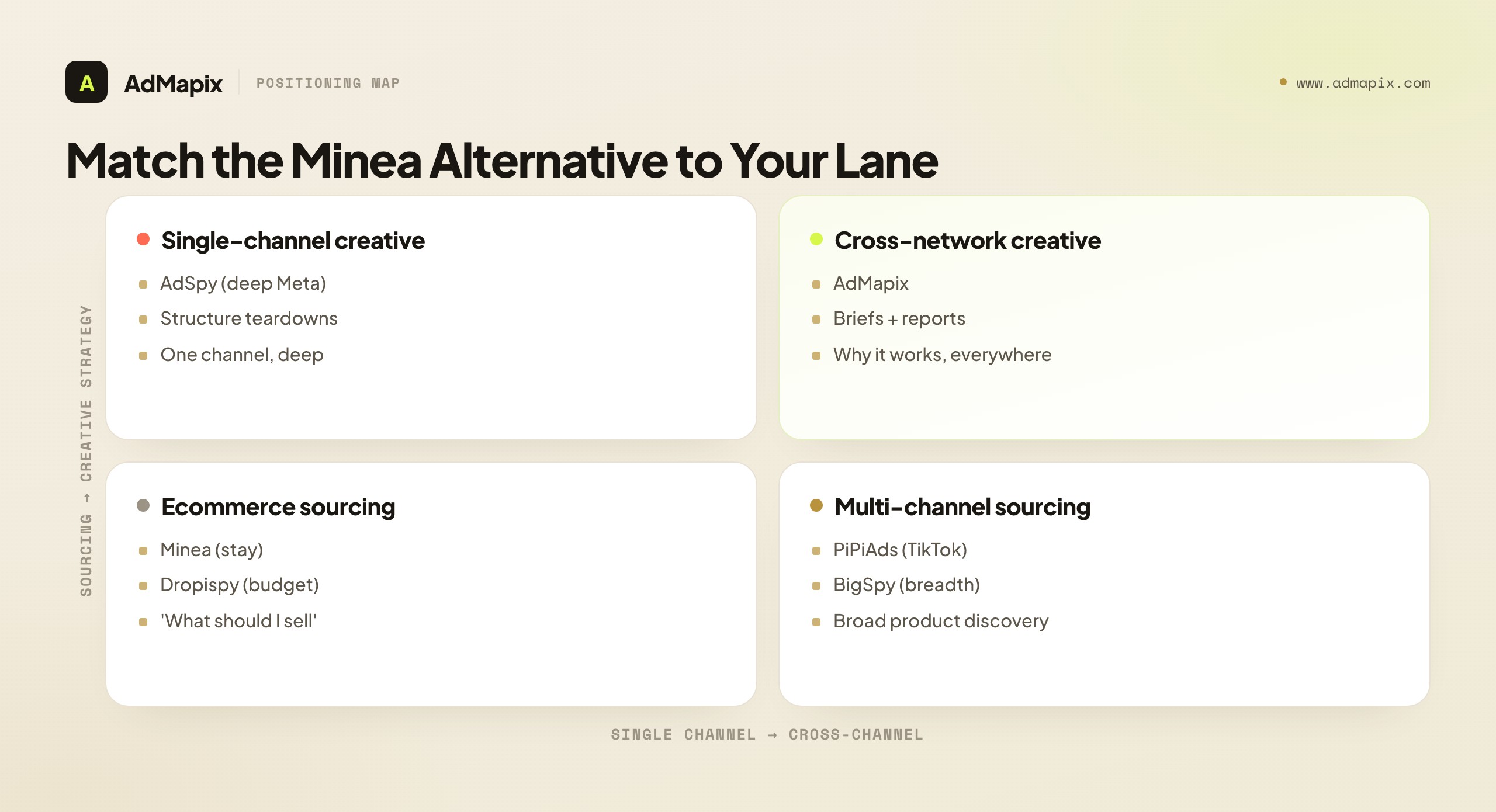
The read: if you're sourcing-focused and ecommerce-channel, Minea (or Dropispy on a budget) is the right lane — stay. If you're sourcing-focused but TikTok-led, PiPiAds goes deeper. If you're creative-strategy-focused but single-channel, a deep specialist like AdSpy (Meta) fits. And if you're creative-strategy-focused and cross-channel, a creative-intelligence layer like AdMapix is the fit, because the job is no longer finding products — it's understanding and reporting creative across networks. Plot yourself honestly on the two axes and the seven-tool list collapses to one or two.
Minea vs AdMapix: A Direct Comparison
Since most readers weighing a creative-intelligence move are comparing Minea to a cross-network option, here's the honest side-by-side. This isn't "AdMapix wins everything" — they live in different lanes, and the table shows exactly where each leads.
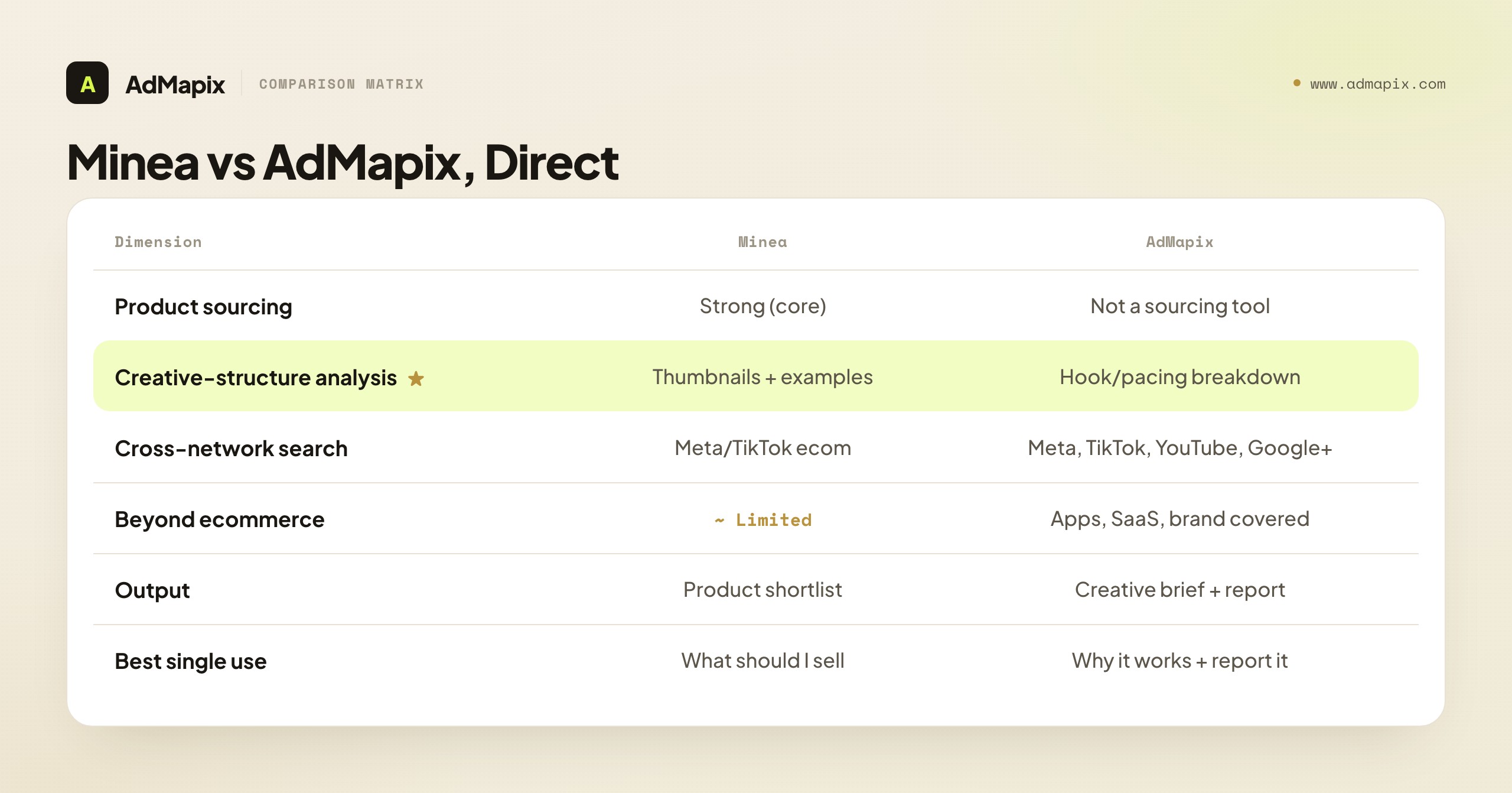
| Dimension | Minea | AdMapix |
|---|---|---|
| Product sourcing | Strong — its core lane | Not a product-sourcing tool |
| Creative-structure analysis | Thumbnails + examples | Hook/pacing breakdowns |
| Cross-network search | Meta/TikTok ecommerce | Meta, TikTok, YouTube, Google+ |
| Beyond ecommerce (apps/SaaS) | Limited | Covered |
| Country/market comparison | Basic | Cross-market, cross-platform |
| Output | Product shortlist | Creative brief + report |
| Best single use | "What should I sell next" | "Why does this ad work + report it" |
The honest takeaway: if your daily job is sourcing the next product to dropship, Minea does that directly and AdMapix is the wrong tool — we'd tell you to stay. AdMapix earns its place only when the job becomes "understand why this creative wins, across channels, and turn it into a brief or report." That's a different lane, and forcing one tool to do both jobs is how teams end up frustrated with whichever they bought.
The Realistic Setup: One Tool or Two?
As with most "alternative" decisions, the answer is often not a clean replacement — it's a specialist plus a layer:
- A product-led dropshipper expanding into serious creative testing might keep Minea for sourcing and add a creative-intelligence layer for the teardown-and-brief job. Sourcing from one, creative strategy from the other.
- A TikTok-led seller might pair PiPiAds (TikTok discovery) with a GMV tool (Kalodata/FastMoss) for commercial validation.
- An agency might keep a product tool for ecommerce clients and add a cross-network reporting layer for everything else.
Buy for your sharpest bottleneck first; add the second tool only when a distinct, separate need is costing real hours. The waste pattern is stacking two product-research tools that surface the same SKUs; the leverage pattern is pairing complementary lanes — sourcing with creative intelligence, or discovery with GMV. The test is whether the second tool answers a question the first genuinely can't.
The Right Pick by Team Type
The framework so far is abstract; here's the concrete read by the kind of team actually making this decision, because the lane that matters shifts with what you do.
Dropshipper / product-led seller. Your job is finding products that sell, so sourcing is your lane and Minea (or Dropispy on a budget, PiPiAds if TikTok-led) is the right home base. The upgrade trigger isn't dissatisfaction with sourcing — it's the day you start running serious creative tests and need to understand why the winning ad works, not just which product it sells. At that point you add a creative-intelligence layer alongside Minea rather than replacing it. The mistake here is buying a cross-network reporting tool when your real, current need is still "what should I sell."
DTC brand marketer. You've moved past pure dropshipping into building a brand, which means creative strategy is increasingly the job — testing angles, understanding hooks, localizing across markets. This is the profile most likely to feel Minea's product-research ceiling, because brand creative isn't a dropship SKU. A creative-intelligence tool that breaks down video structure and compares angles across markets usually beats a product feed here. Our competitor ad analysis framework systematizes that creative work.
Agency / freelancer. Your bottleneck is rarely finding products — it's turning research into client-ready, repeatable deliverables across multiple accounts, channels, and verticals (some clients aren't even ecommerce). Screenshotting a product feed doesn't scale to ten clients, and a dropship-focused tool can't index a SaaS or app client's ads at all. This is where the creative-intelligence and reporting layer matters most, and where its report output earns its price directly in billable hours.
Solo operator / small brand. Your constraint is time and budget. If sourcing is your whole job, stay on Minea's free tier or a budget tool and put your energy into testing, not tooling. Don't add a creative-intelligence subscription on principle — add it only when the "why does this work" question is genuinely costing you hours you don't have.
In-house performance team. You sit between the dropshipper and the agency: a defined product line (so pure sourcing matters less than for a dropshipper) and a real, recurring creative-testing program across multiple channels. Your bottleneck is creative velocity — finding the next angle to test and understanding why competitors' winners work — far more than finding products you've already chosen. This profile usually feels Minea's product-research ceiling fastest, because the job is almost entirely creative strategy. A cross-network creative-intelligence tool that shows competitor creative everywhere, breaks down the hooks, and feeds your test backlog typically beats a product feed here. If you also report up to leadership, the saved-evidence and reporting layer earns its place twice — once for the creative work and once for the weekly stakeholder read. The trap for this team is keeping a product tool out of habit when their job has fully moved into the creative lane; audit whether you're still using the sourcing features at all before renewing.
A Repeatable Competitor Research Workflow
Whichever tool you land on, the workflow matters more than the tool — a great tool with no process still produces a folder of screenshots (or a list of SKUs you never test). Here's the repeatable loop that turns any of these tools into decisions.
- Name the decision first. Product selection, creative brief, or client report — different jobs need different evidence. Don't open the tool until you know what choice it's informing.
- Use a fixed competitor / category set. Search the same 5–10 real brands or product categories every week, in the same window, so results are comparable across weeks and tools.
- Save evidence with context. Keep the source ad, the product or media, the hook, the offer, the market, and one line on why it matters. Context is what makes evidence reusable months later.
- Run the teardown, not just the screenshot. For creative work, capture the video structure — the first-3-second hook, the proof moment, the CTA — not just a thumbnail. For sourcing, capture the offer and order signals. The structure is what you can adapt.
- Convert each pattern into an action. Every saved item should map to a product test, a creative brief, a landing-page test, or a client note. Research that doesn't produce an action is sightseeing.
- Diff over time. The highest-value output is the change — a competitor's new hook, a new product, a new market. A weekly diff against last week is where the actionable intelligence lives.
This loop is tool-agnostic on purpose. The reason to pick one tool over another is how much manual labor it removes from steps 3–6. For a sourcing job, that's how fast you get to a validated product; for a creative job, it's how fast you get to a brief. Match the tool to which of those your loop actually runs.
Two Worked Examples: Staying vs Crossing Lanes
Abstract frameworks are easy to nod along to and hard to apply, so here are two composite walkthroughs (anonymized from 2026 accounts) showing the decision in motion — one team that should stay on Minea, one that should cross lanes.
Example 1 — the seller who should stay. A solo dropshipper runs a single-niche store on Meta and TikTok, testing 3–5 new products a week. Their entire weekly question is "what should I sell next," and Minea's winning-products feed plus linked ads answers it directly: they find a trending product, see the ad selling it, validate the offer, and launch a test. They considered "upgrading" to a cross-network tool after seeing an ad for one, but running the actual decision through the framework, their lane is pure sourcing, their channels are exactly Minea's center of gravity, and their deliverable is a product to test — not a report. The disciplined call was to stay, keep the free or entry tier, and put the saved subscription money into ad spend. The lesson: a tool ad is not a reason to switch; a changed job is.
Example 2 — the brand that should cross. A former dropshipper turned its best product into a real DTC brand. Eighteen months in, the recurring question stopped being "what to sell" — they have their hero SKU — and became "why is this competitor's ad out-converting ours, and what angle do we test next." They'd also expanded to YouTube and were planning a Meta brand campaign. Three of the five crossing signals applied: they were asking "why" not "what," their channels spanned beyond ecommerce feeds, and they needed video-structure teardowns to brief their creative team. They didn't cancel Minea outright — they kept it for the occasional new-product test — but they added a creative-intelligence layer for the now-dominant creative work, running both in parallel for a month before settling the split. The lesson: crossing lanes usually means adding a layer for the new dominant job, not abandoning the old tool entirely.
The two examples bookend the whole decision. Most readers are somewhere between them, and the framework's job is to tell you which way you're trending — toward staying in the sourcing lane, or crossing into creative strategy. Run your real weekly decision through it honestly and the answer is usually obvious, even when the marketing for a dozen tools is trying to make it feel complicated.
Common Mistakes When Choosing a Minea Alternative
- Comparing on database size. The biggest archive is worthless if results aren't relevant to your next brief or product test. Compare on output, not ad count.
- Mis-buying across lanes. Buying a creative-intelligence tool when you need sourcing (or vice versa) is the single most common mistake. Name your lane first.
- Treating GMV tools as product/ad spy. Kalodata and FastMoss are commercial-signal tools, not product-research replacements. Add them for validation, don't swap Minea for them.
- Replacing when you should add. If sourcing is still valuable, a sourcing-tool-plus-creative-layer setup beats a forced clean switch. Don't throw away coverage you still use.
- Cancelling before validating. Cancel-then-switch leaves a coverage gap with no fallback. Always run parallel first.
- Ignoring the workflow. A tool is only as good as the saved searches, teardowns, and reports you build on it. The best tool with no loop loses to a lesser tool with a disciplined one.
How to Migrate or Add a Tool Without Losing Research
If you decide to switch or layer in a tool, migrate deliberately so you keep the research equity you've built.
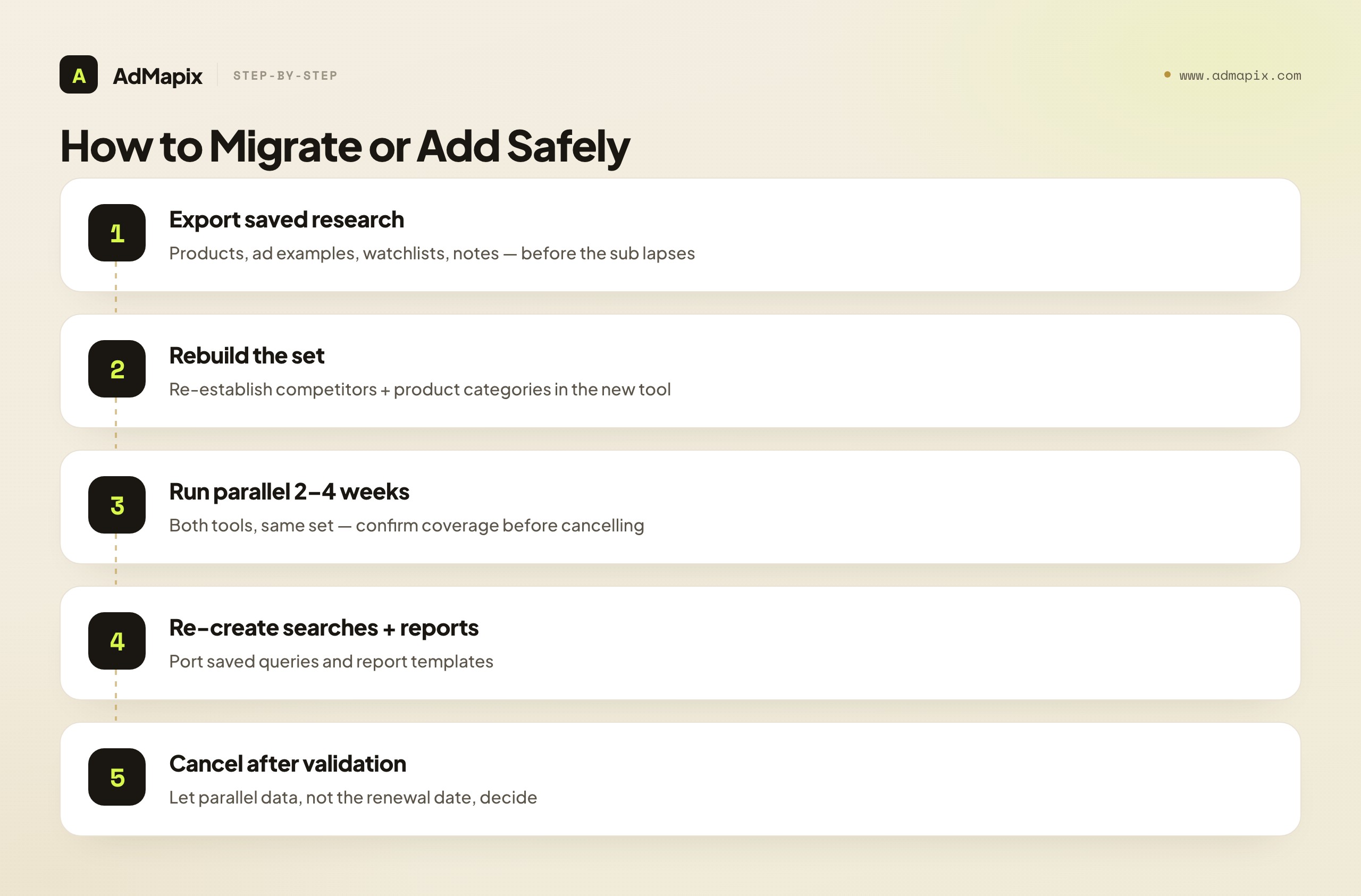
Step 1 — Export your saved research. Pull saved products, ad examples, watchlists, and notes from Minea before any subscription lapses. Even a manual export of your tracked products and best swipe-file ads preserves months of accumulated knowledge.
Step 2 — Rebuild your competitor / category set. Re-establish your fixed list of competitors and product categories in the new tool first. This backbone is what makes weekly research repeatable, and getting it in place early means your cadence resumes immediately.
Step 3 — Run a parallel period. For two to four weeks, run both tools on the same set. This confirms the new tool covers what you relied on Minea for before you cancel, and surfaces any gap — a market, a refresh frequency, a missing product signal — while you still have a fallback.
Step 4 — Re-create saved searches and report templates. Port the recurring searches and report structures that made your old workflow fast. The tool is only as good as the saved workflow on top of it.
Step 5 — Cancel only after coverage is validated. Once the parallel period confirms coverage, cancel the old tool. If it reveals the new tool doesn't fully cover the sourcing you still need, the answer may be to keep both (sourcing tool + creative layer) rather than force a clean switch. Let the data, not the renewal date, decide.
The parallel period is what keeps the move reversible until you're certain. Cancel-then-switch is how teams discover a coverage gap with no fallback and resubscribe at a worse price.
When Minea Is Still the Right Call
Intellectual honesty requires the reverse case: plenty of teams should not leave Minea. Keep it if:
- Product sourcing is genuinely your bottleneck. If your daily job is finding the next winning SKU to test, Minea's product-first index is exactly the right layer, and creative-intelligence breadth is a feature you'd pay for and underuse.
- You're ecommerce-channel and ecommerce-only. If you live on Meta and TikTok ecommerce ads tied to products, Minea's center of gravity matches yours.
- Your output is a product shortlist. If you don't owe anyone cross-network creative reports, the shortlist is the deliverable, and that's Minea's natural output.
- Budget is tight and it earns its keep. Don't add a creative-intelligence subscription on principle — add it only when the "why does this work" job is costing more in manual hours than the tool costs in dollars.
The strongest reason to switch is your job changing lanes — from sourcing to creative strategy — not dissatisfaction with sourcing. If you're still in the sourcing lane, staying is the disciplined call.
How AdMapix Fits (and When It Doesn't)
AdMapix fits when you've crossed from product research into creative intelligence: you need cross-network creative search, hook-by-hook video breakdowns, saved evidence, and repeatable competitor reports. It's best for DTC teams and agencies who need to understand and report why creatives win across Meta, TikTok, YouTube, and Google — not just find the next product. It is not the right pick if product sourcing is your whole job, where Minea (or PiPiAds for TikTok-led sourcing) is more direct.
In practice the fit looks like this: run your competitor set through Search AdMapix for cross-network creative discovery, store evidence with context in Media, break down winning hooks with Video Analysis, and package findings into a report. The honest boundary: AdMapix has no product catalog and won't tell you which SKU to dropship — that's the product-research lane, and a sourcing tool does it better. If your job is "why does this creative win and how do I report it," that's the fit; if it's "what should I sell next," keep your sourcing tool. Compare seats on pricing when the creative-and-reporting workload starts costing real hours.
For the analysis discipline behind the tool, our competitor ad analysis framework lays out the 5-dimension scoring system, and find winning products via Facebook Ads Library covers the product-discovery side that overlaps with Minea's core use case.
To make the fit concrete, here are two scenarios where AdMapix is clearly the right move beyond Minea — and one where it isn't. Right call #1: a DTC brand that's done dropshipping and now competes on creative needs to understand why a rival's hook is winning across TikTok and Meta and brief a better one; cross-network search plus hook-by-hook video analysis is exactly that job, and Minea's product feed can't do it. Right call #2: an agency with ecommerce and SaaS clients needs one tool that can research and report on creative across verticals and channels; a dropship-focused product tool can't even index the SaaS clients' ads, while a cross-network creative-intelligence layer covers them all and exports the report. Not the right call: a dropshipper whose entire weekly job is "find the next winning product to test" — for them Minea (or its free tier) is faster and more direct, and AdMapix's creative breadth would be capacity they pay for and never use. The discipline cuts both ways: we'd rather a pure sourcer keep Minea than pay us for a lane they're not in yet.
A Decision SOP: Switch, Add, or Stay
To make this concrete, here's the decision sequence we'd run.
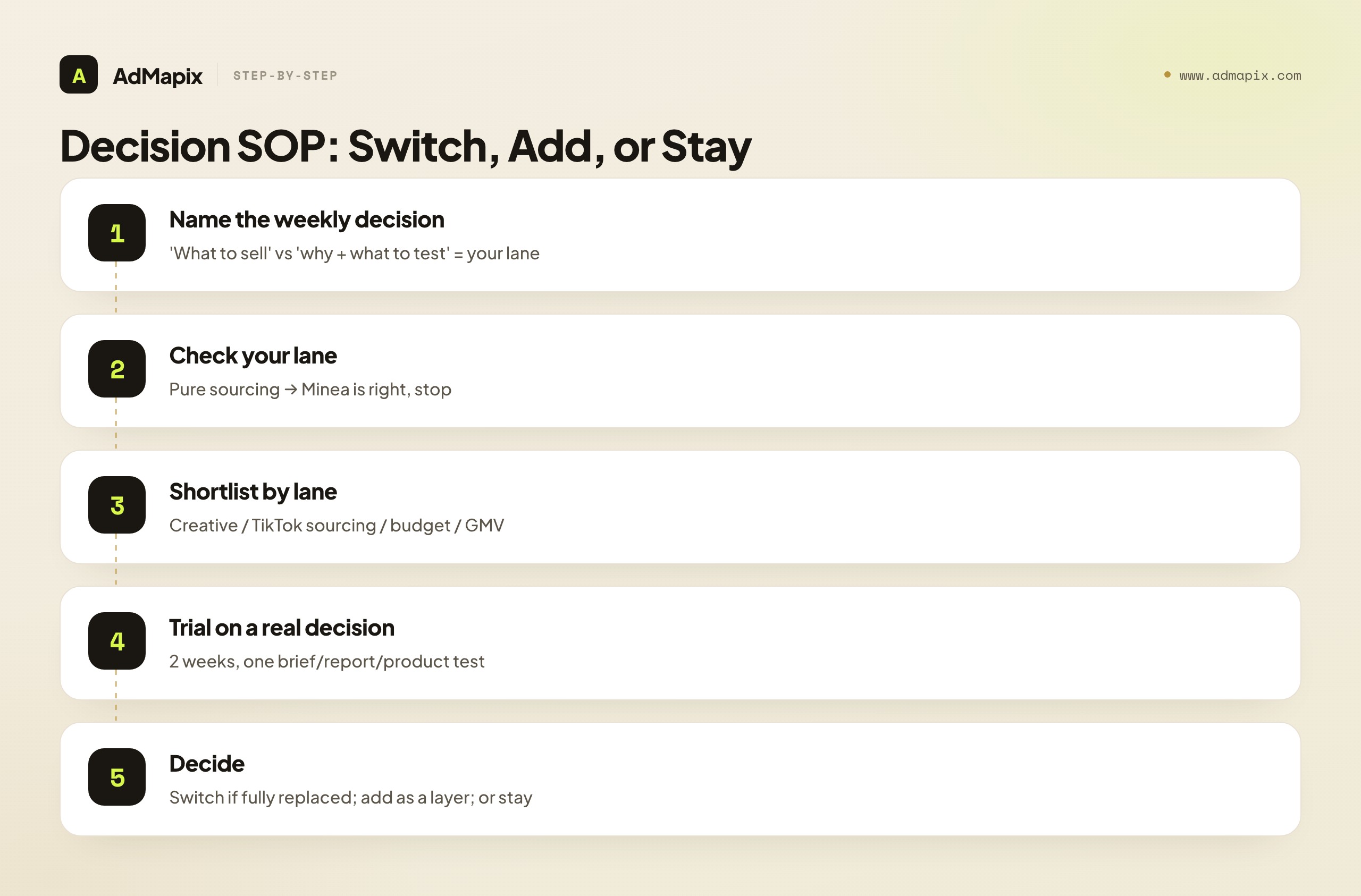
- Name your weekly decision. "What to sell" or "why does this work and what do I test" — the answer tells you your lane immediately.
- Check your lane. If it's pure product sourcing, Minea (or a sourcing peer) is right — stop.
- Shortlist by lane, not brand. Creative strategy → AdMapix/AdSpy; TikTok sourcing → PiPiAds; budget sourcing → Dropispy; GMV → Kalodata/FastMoss.
- Trial against a real decision. Run your set through the top candidate for two weeks; produce one real brief, report, or product test.
- Run parallel before cancelling. Keep Minea live during the trial; cancel only after coverage is confirmed.
- Decide: switch, add, or stay. Switch if the new tool fully replaces Minea for your job; add it as a layer if you still need sourcing; stay if nothing beat your current workflow.
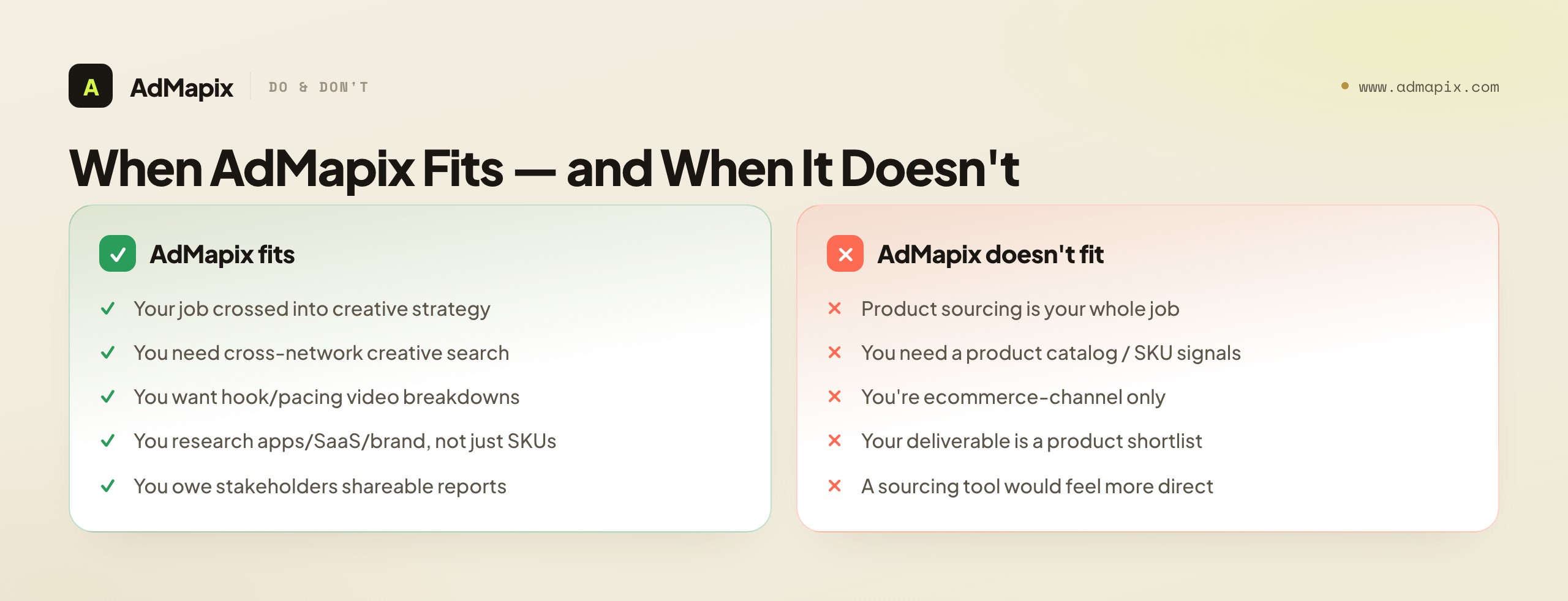
The sequence keeps the decision evidence-based rather than driven by feature-list envy. Your lane and your trial decide it — not the size of anyone's database.
What Changed in 2026 (and Why It Affects Your Choice)
The product-research and ad-intelligence landscape shifted enough in 2026 that the right Minea alternative today isn't the one you'd have picked two years ago. Three changes matter for this decision.
Dropshipping margins compressed, raising the value of creative over product. As more sellers chase the same trending products, the edge moved from finding the product to out-creating the competition on the same product. That shifts value from pure product research toward creative intelligence — understanding why an ad converts and how to brief a better one. The teams winning in 2026 aren't the ones who found the product first; they're the ones who made the better creative for it. That structural shift is why so many Minea users are crossing lanes.
Cross-platform creative convergence made single-lane tools leakier. The same winning angle now jumps between TikTok, Reels, and Shorts within days, so studying only ecommerce feeds on Meta and TikTok increasingly means missing where an angle started or where it's headed. Brand and DTC creative lives across networks now, which is the structural reason channel coverage has become a real constraint for ecommerce-centric tools.
TikTok Shop GMV data matured into its own category. Kalodata and FastMoss turned TikTok Shop GMV and creator-sales signals into a distinct, mature layer separate from product discovery. That's why "Minea alternative" now splits cleanly into three jobs — product sourcing, commercial/GMV validation, and creative intelligence — where it used to be one fuzzy "ecommerce ad spy" bucket. Knowing which of the three you need is the biggest clarifier in this decision.
The throughline: in 2026, match the tool to a specific lane matters more than ever, because the category specialized. The generalist "ecommerce ad spy tool" is giving way to sourcing tools, GMV tools, and creative-intelligence layers — and the right alternative is the one that matches the specific job your work moved into.
Red Flags When Evaluating a Minea Alternative
A short field guide to the warning signs that a candidate tool will disappoint, so you catch them during the trial rather than after you've paid.
- No clear freshness signal. If you can't tell how recent the products or ads are, treat the data as potentially stale — fatal for fast-moving trends and dropship windows.
- Database size as the headline pitch. When a tool leads with "millions of ads" rather than what you can do with them, it's usually compensating for a thin workflow. Output beats archive.
- No saved-evidence or export path. If you can't save products or ads with context or export a report, every insight has to be rebuilt manually each week.
- Lane mismatch hidden by marketing. A product-research tool dressed up as "creative intelligence," or vice versa, will disappoint the moment your real job appears. Test against your actual weekly decision, not the feature list.
- Thumbnail-only "video analysis." If the video feature is just a playable clip and a product link, it's not a teardown. Creative teams need structure, not a player.
- Opaque pricing. Hidden renewal terms, unclear credit systems, or "contact us" pricing on a self-serve tool are monthly friction. Pricing transparency is itself a quality signal.
Catch these during a two-week parallel run and you avoid the most common post-purchase regrets in this category. Every one of them is visible if you're looking for it before you cancel your current tool.
The way to make a trial actually surface these is to test against a real decision, not the demo. Pick one decision you're genuinely stuck on this week — a product to validate or a creative angle to test next — and try to reach a defensible answer using only the trial tool, timing how long it takes and noting where you had to leave the tool and rebuild work by hand. A demo shows you the tool's best case; a trial against a stuck decision shows you its median case, which is what you'll live with month after month. If the trial tool didn't get you to the decision faster and more defensibly than your current setup, it fails the only test that matters, regardless of how impressive its library looks. Run that disciplined trial and the red flags above stop being abstract warnings and become concrete, observed facts you can act on before you spend a dollar.
Platform & Lane Coverage at a Glance
Because crossing lanes is the core reason to leave Minea, here's a snapshot of how many major ad channels each tool meaningfully covers — the single chart that explains most switching decisions.
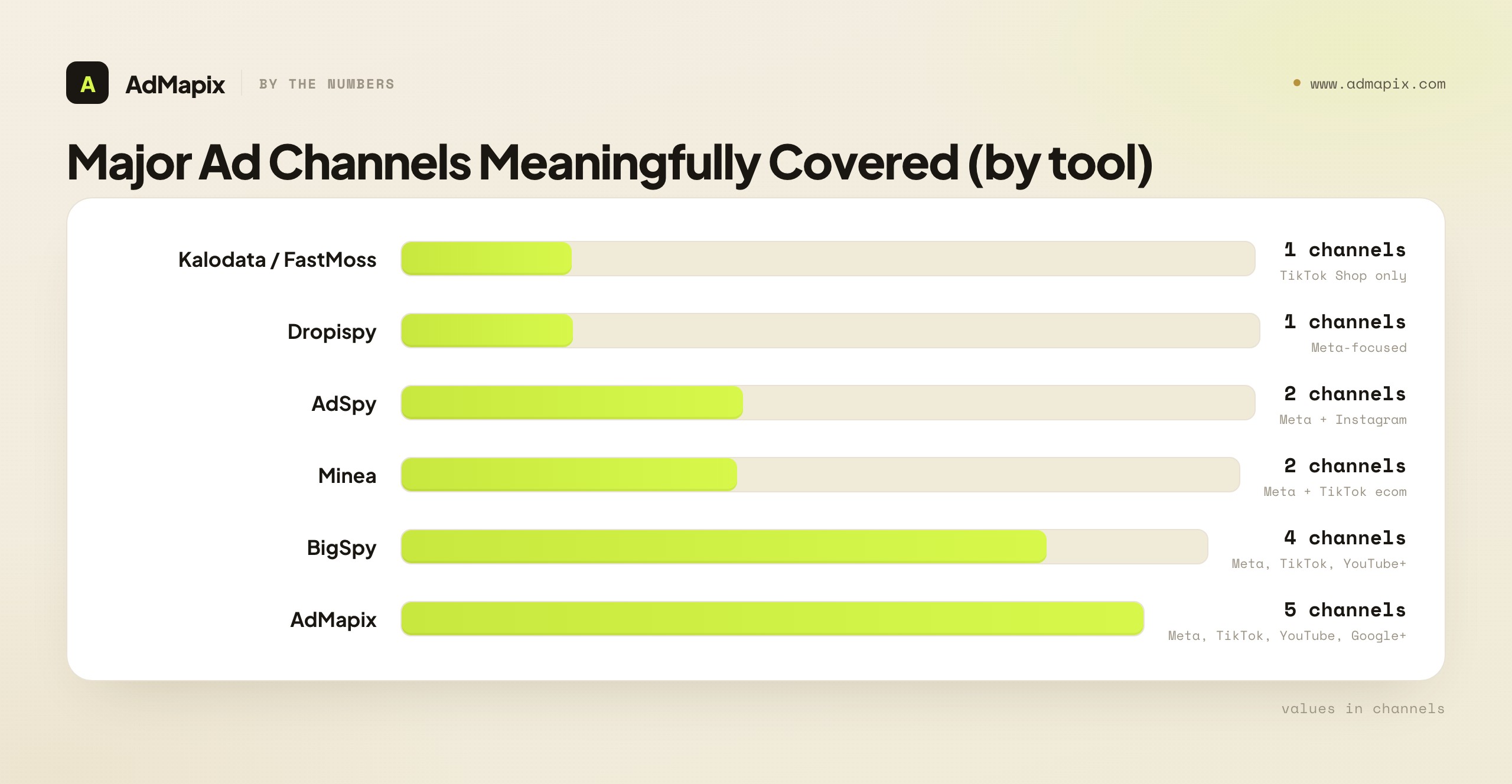
The pattern: product-research tools (Minea, Dropispy) concentrate on ecommerce channels; broad libraries (BigSpy) and creative-intelligence layers (AdMapix) span more networks. Neither is better in the abstract — concentration wins when you're ecommerce-only, breadth wins when your creative lives across networks. Your channel mix, more than any feature, predicts which side of the trade you want.
FAQ
What is the best Minea alternative in 2026?
There's no single best — it depends on which job Minea stopped covering for you. If you still need product sourcing but TikTok-led, PiPiAds goes deeper; on a budget, Dropispy. If your job crossed into creative strategy, AdMapix (cross-network, reporting) or AdSpy (deep Meta) fits. For TikTok Shop GMV signals, Kalodata or FastMoss. Define your weekly decision first — "what to sell" versus "why does this work" — and the right tool follows from your lane, not from database size. The single most useful thing you can do before shopping is write down the exact decision your tool needs to inform this week; that one sentence eliminates most of the seven options immediately and turns a vague "find a Minea alternative" into a precise, answerable choice.
Why do people look for a Minea alternative?
Almost always because their job changed lanes, not because Minea is weak at sourcing. Minea answers "what should I sell." When the recurring question becomes "why is this ad winning and what do I test next," when channels expand beyond ecommerce feeds, when a creative team needs video structure instead of thumbnails, or when the deliverable becomes a report instead of a product shortlist — that's the wall, and it points toward a creative-intelligence tool.
Is there a free Minea alternative?
Partly. Minea itself has a free tier, and the official free libraries (Meta Ad Library, TikTok Creative Center) cover baseline ad discovery at no cost. Dropispy offers low-cost entry tiers. But free and budget tools stop short of structured video analysis, cross-network consolidation, saved evidence with context, and shareable reports — the creative-intelligence work that paid layers exist for. Start free for sourcing; add a paid layer when the "why" job outgrows manual effort.
What's the difference between product research and creative intelligence?
Product research answers "what should I sell?" — it indexes products and matches them to the ads selling them, which is Minea's lane. Creative intelligence answers "why does this ad work and what do I test next?" — it indexes creatives by hook, format, and market so an ad becomes a brief rather than a screenshot. They're different tools because they store different objects. Most "Minea alternative" searches are really someone crossing from the first lane into the second.
Should I replace Minea or add a second tool?
Often add, not replace. If product sourcing is still valuable to you, the realistic setup is a sourcing tool plus a creative-intelligence layer — keep Minea for "what to sell" and add a tool for "why does this work and how do I report it." Only do a clean replacement when a single alternative fully covers everything you used Minea for. Stacking two product-research tools is waste; pairing sourcing with creative intelligence is leverage.
How does AdMapix compare to Minea?
They live in different lanes. Minea is product research — strong at "what should I sell next," with a product catalog and linked ads. AdMapix is creative intelligence and reporting — strong at "why does this creative win across channels and how do I package it into a report," with cross-network search and video breakdowns but no product catalog. If your job is sourcing, Minea is more direct. If it's understanding and reporting creative, AdMapix fits the lane Minea doesn't serve.
Can a Minea alternative research apps, games, or SaaS?
Minea itself is ecommerce-centric, so apps, games, and SaaS sit outside its natural index. If you research those, you need a tool that indexes creatives broadly rather than products — a creative-intelligence or broad-library tool covers app, game, and SaaS ads, while a dropship-focused product tool has no natural place to put them. This is one of the clearest signals that a product-research tool is the wrong layer for your job.
Do I need video analysis or are ad examples enough?
It depends on your role. For sourcing, an ad example and a product link may be enough to validate an offer. For creative strategists who need to understand why a winning video works — the hook in the first two seconds, the proof moment, the pacing — examples aren't a teardown. If your team produces creative briefs from competitor videos, hook-by-hook analysis is the difference between copying a thumbnail and adapting a structure.
How do I migrate off Minea without losing my research?
Migrate in parallel, don't cancel-then-switch. Export your saved products, ad examples, and notes first; rebuild your competitor and category set in the new tool; then run both side by side for two to four weeks on the same set. The parallel period confirms coverage before you cancel and surfaces any gap while you still have a fallback. Cancel only after coverage is validated — let the parallel data, not the renewal date, decide.
When should I just keep Minea?
Keep it when product sourcing is genuinely your bottleneck, you're ecommerce-channel and ecommerce-only, your deliverable is a product shortlist, and you don't owe anyone cross-network creative reports. The strongest reason to switch is your job changing lanes from sourcing to creative strategy — not dissatisfaction with sourcing. If you're still in the sourcing lane, staying is the disciplined, correct call, and adding a creative-intelligence subscription would solve a problem you don't yet have.
Is Dropispy a good Minea alternative?
Dropispy is the budget option — cheaper than Minea, Meta-focused, covering basic ad and product spy. It's a reasonable alternative for cost-sensitive dropshippers whose only need is occasional product/ad spy without deep filtering, cross-platform reach, or any creative-intelligence depth. It's a fine starting tool for a new dropshipper and a poor fit once your research matures — at that point you'd want either Minea's broader product features or a creative-intelligence layer, depending on which lane your job moved into. Match it to early-stage, budget-constrained sourcing, not to a growing operation.
Can I use free tools instead of a Minea alternative?
For baseline discovery, partly. The Meta Ad Library and TikTok Creative Center are free and useful for seeing live ads, and Minea itself has a free tier. But free tools stop short of the structured product signals, saved evidence with context, video teardowns, cross-network consolidation, and shareable reports that paid tools exist for. The honest rule: start free for sourcing or early research, and add a paid tool only when the manual work — re-searching every week, rebuilding evidence, stitching channels by hand — costs more in hours than the subscription costs in dollars.
What's the best Minea alternative for an agency?
For agencies, the deciding criterion is almost always Output, not database size — research has to become client-ready, repeatable deliverables across multiple accounts, channels, and often verticals. A dropship-focused product tool can't even index a SaaS or app client's ads, and screenshotting feeds doesn't scale to ten clients. That points toward a cross-network creative-intelligence and reporting layer that covers every client's channels and exports reports directly. Keep a product tool only for the specifically ecommerce-sourcing clients; for everything else, the reporting layer earns its price in billable hours saved.
Bottom Line
A Minea alternative is genuinely worth the switching cost only when your job has crossed from product research into creative intelligence — that is, from "what should I sell" to "why does this ad work and what do I test next." Minea is strong at sourcing, and switching away from it while sourcing is still your genuine bottleneck is a step backward, not forward — the crossing into creative strategy, not dissatisfaction, is the real trigger.
Name your weekly decision, identify your lane, shortlist by that lane rather than by brand, trial against a real decision, and run parallel before you cancel. For TikTok-led sourcing, look at PiPiAds; for budget sourcing, Dropispy; for deep Meta creative, AdSpy; for TikTok Shop GMV, Kalodata or FastMoss; and for cross-network creative intelligence and reporting, AdMapix. If sourcing is still your whole job, keep Minea — the disciplined move is matching the tool to the lane, not chasing the biggest database. And whichever tool you land on, the disciplined weekly loop around it — fixed competitor set, evidence with context, teardowns, and a diff over time — matters more than the tool itself. In 2026, with margins compressing and creative deciding more of the outcome than the product, the teams that win are the ones who knew which lane they were in and built a real loop around the right tool for it — not the ones with the largest ad database. Name your lane, run one honest trial against a real decision, and let that evidence — not a competitor's recommendation or a tool's marketing — make the call.
Sources
- Meta Ad Library — official free archive of live Meta ads
- TikTok Creative Center — official free TikTok ad and trend discovery
- Google Ads Transparency Center — public cross-format competitor ad research
- Minea — ecommerce product research and ad spy
- PiPiAds — TikTok and Facebook ad intelligence for ecommerce
Related reading
- Best KaloData alternatives in 2026 — TikTok Shop analytics vs ad intelligence, compared by job
- Best FastMoss alternatives in 2026 — the TikTok commerce data side of the same decision
- Minea vs BigSpy — head-to-head if you are only weighing those two
- Minea ad spy review — our full review of what Minea itself does well
Turn these observations into your next creative study
Open the creative library and select samples for your market, network and research question.
Related Articles

Atria vs Foreplay: Which Creative Workflow Fits Your Team in 2026?
A workflow-first comparison of Atria and Foreplay. Atria centers on AI-assisted concept and script ideation; Foreplay centers on the swipe file — saving, tagging, sharing, and presenting ad references. Name your slowest weekly task, pick the tool that fits, and see where a discovery-and-evidence layer like AdMapix fits alongside either.

PPC Management Software for Agencies: How to Build a Lean Stack That Earns Its Seat in 2026
A buyer's framework for PPC management software for agencies. PPC software is not one product but a stack covering five jobs — campaign operations, reporting, quality assurance, creative research, and client communication. This guide shows how to buy by job not by logo, compares the tool categories, covers pricing models, the mistakes that inflate your tool budget, an evaluation scorecard, and where competitive creative research fits.
Ad Creative Analysis Tools 2026: AI Features & Comparison
Compare five creative analysis tools by their inputs, outputs, account connections and buying conditions, with an AdMapix research workflow.