
Best BigSpy Alternatives in 2026: Choose by Workflow
An evidence-based guide to BigSpy alternatives for Meta depth, app-market data, TikTok product research, PPC, display, native, and creative collection—with a migration checklist. Reviewed August 13, 2026.
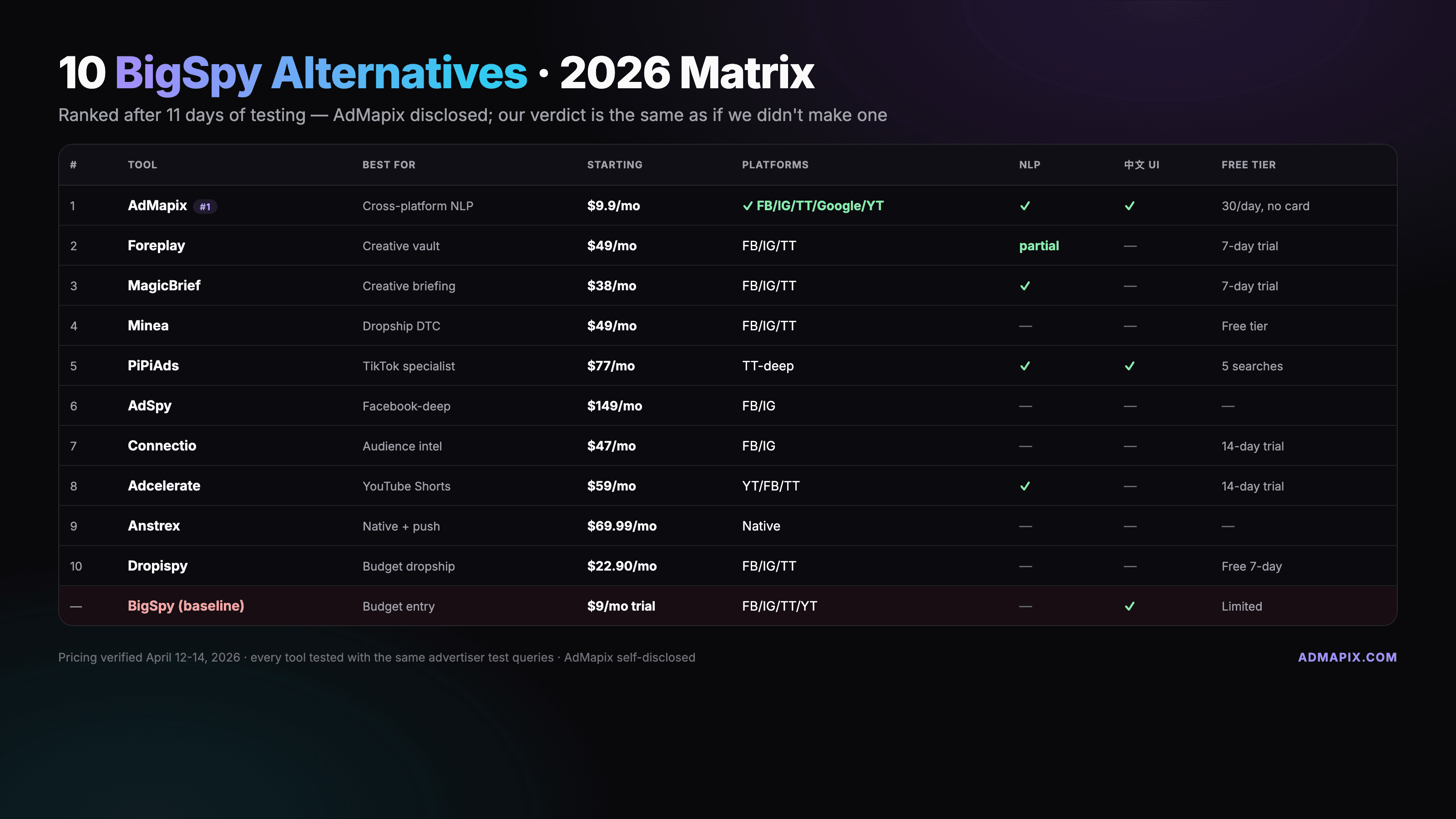
By the AdMapix Research Team · Reviewed August 13, 2026
Disclosure: AdMapix is one of the alternatives below and is our product. This guide uses current public BigSpy documentation and recommends staying with BigSpy when its discovery and Swipe File workflow already fits the job.
Quick answer
BigSpy is no longer accurately described as a cheap keyword-only database with a basic favorites list. Its current public product documents descriptive Feature Search, Visual Search, saved filters, multiple deduplication modes, and a Swipe File with browser capture, boards, tags, ratings, and downloads.
Look for an alternative only when the bottleneck is outside that workflow:
| Your bottleneck | Best alternatives to test |
|---|---|
| Deep Facebook/Instagram fields, comments, affiliate filters | AdSpy |
| Creative evidence plus app rankings, downloads, or revenue data | AdMapix |
| TikTok-first product and shop research | PiPiAds plus TikTok Creative Center |
| Dedicated creative collection and briefing | Foreplay or MagicBrief |
| Google competitor keywords and ad history | SpyFu or Semrush |
| Display publisher and placement intelligence | Adbeat |
| Native and push advertising | Anstrex |
| Free verification of known advertisers | Official Meta, TikTok, and Google libraries |
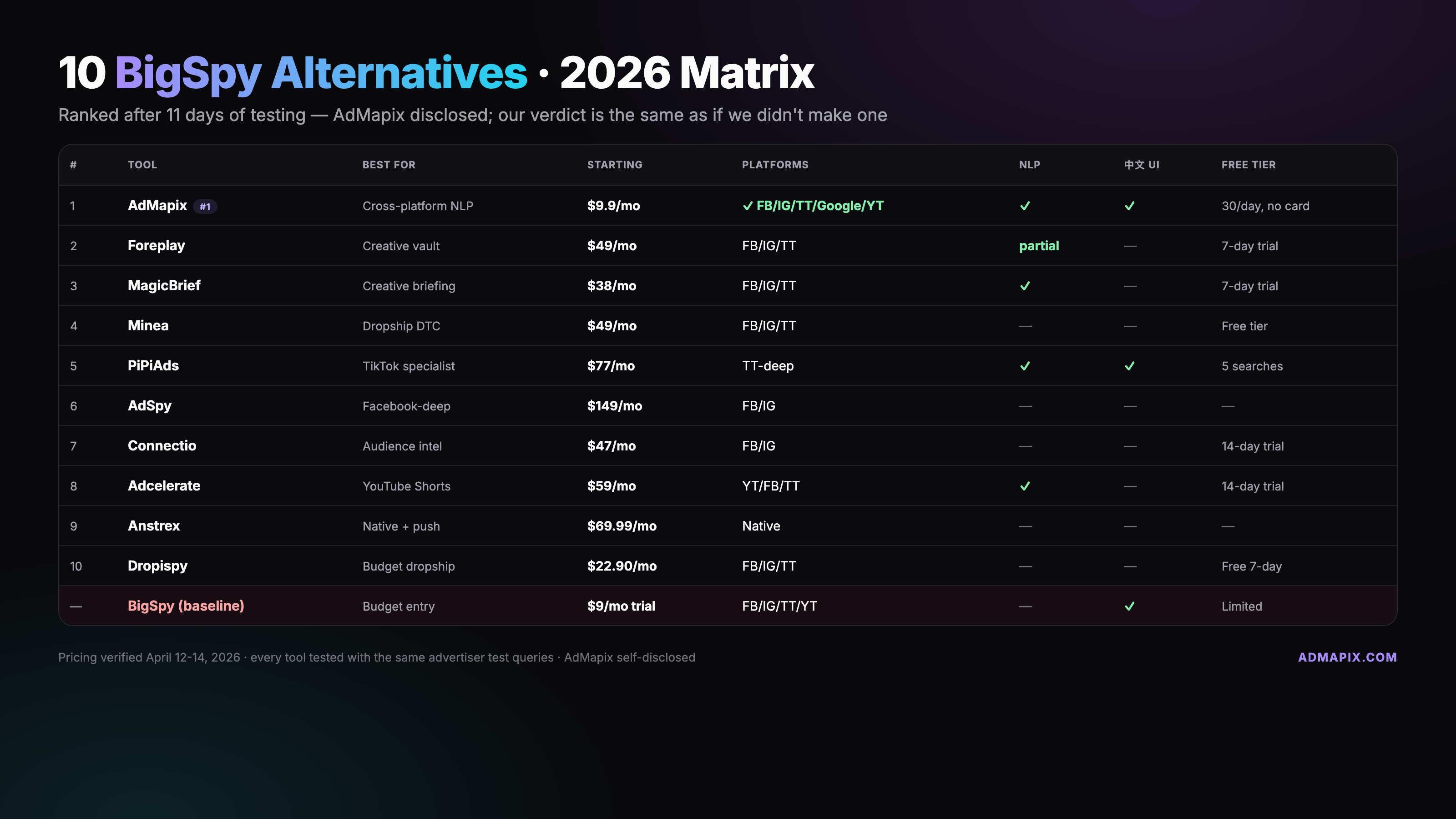
What BigSpy currently offers
BigSpy's homepage reviewed August 13, 2026 shows Free at $0, Pro at $149 per month, and custom annual VIP pricing. Its FAQ lists a $1 three-day Pro trial. The vendor reports 1B+ ad creative data points across 10 channels, 71 countries, and 23 languages and says materials are updated daily.
Current search documentation matters more than old comparison copy. BigSpy's Ad Library guide documents:
- Ad Info Search for text and business information;
- Feature Search for descriptions of visual content, people, scenes, actions, and styles;
- Visual Search from an image, video, or URL;
- network, country, time, format, engagement, and other filters;
- relevance, similarity, latest, last-seen, running-days, popularity, and engagement sorting;
- ad, creative, and advertiser deduplication.
Its Swipe File guide documents a Chrome extension, cloud boards, tags, ratings, filters, sorting, creative details, and downloads. For broad discovery plus collection, BigSpy may already be the correct choice.
Reasons to switch that are still valid
A switch can make sense for one of four reasons:
- You need a specialized field BigSpy is not built around. Examples include advert-comment search, app download estimates, paid-search keyword history, or native publisher placements.
- Your deliverable is different. A creative board, structured API response, client report, and keyword-history export are different outputs.
- The plan does not unlock the source or industry you need. BigSpy notes that network and industry access varies by plan.
- Your team cannot reproduce decisions. If analysts save attractive ads without source dates, query criteria, or evidence notes, changing tools may be less important than changing the process.
Reasons that are no longer reliable include claims that BigSpy lacks descriptive discovery, cannot search visually, or has no organized Swipe File.
The best BigSpy alternatives by workflow
1. AdSpy: Meta depth and comment-oriented research
AdSpy is the clearest alternative when the job is deep Facebook and Instagram research. Its official product page currently advertises $149 per month and documents searches across ad text, advertiser, URL, comments, affiliate network, affiliate ID, offer ID, and landing-page technology.
Choose AdSpy when comment text, affiliate fields, or Meta-specific filters are central to the decision. Stay on BigSpy when multi-network discovery, descriptive search, visual similarity, and the Swipe File are used more often.
2. AdMapix: creative plus app and market intelligence
AdMapix is the most relevant alternative when a creative question must connect to app rankings, downloads, revenue, or market metadata. The Free plan includes 30 lifetime credits. Starter, Pro, and Enterprise cost $19.90, $49.90, and $89.90 per month.
The July 10, 2026 public snapshot records 91,350,717 searchable creative combinations, 174 country or territory filter labels, and 231 media labels. The definitions matter: combinations are not unique assets, record types can overlap, and media labels are not automatically ad networks.
The Agent Skill returns structured raw data for creatives, apps, rankings, downloads, revenue, and market metadata. Hosted Web Deep Research is a separate research-and-report workflow.
Choose AdMapix when the output is a structured dataset or an app/market research report. Stay on BigSpy when the output is mainly a shared creative collection. AdMapix publishes no verified hourly refresh SLA, so freshness should be tested with known recent records.
3. PiPiAds: TikTok-first product research
PiPiAds is a specialist alternative when TikTok ads, products, and shop-oriented fields dominate the research. Pair it with TikTok Creative Center as the first-party validation layer.
Choose PiPiAds when TikTok-specific depth matters more than multi-network browsing. Stay on BigSpy when you need to compare creative patterns across several networks in one discovery workflow.
4. Foreplay: dedicated creative collection
Foreplay should be evaluated when the main job is collecting, organizing, sharing, and briefing creative references. It competes most directly with the workflow after discovery rather than with app or market datasets.
Compare it directly with BigSpy's current Swipe File. Test browser capture, board structure, tags, team handoff, source preservation, and export—not screenshots of the dashboard.
5. MagicBrief: creative strategy and briefing
MagicBrief belongs on the shortlist when saved references need to become briefs and production instructions. It is a workflow alternative, not necessarily a broader ad database.
Test the full path from finding an ad to producing a usable brief. If researchers still copy everything into another system, the nominal feature list is not solving the operational problem.
6. SpyFu or Semrush: Google PPC research
SpyFu is useful for competitor paid keywords, domains, ad history, and copy research. Semrush makes more sense when paid-search research needs to live beside SEO and broader domain intelligence.
Neither is a direct replacement for social creative discovery. Use Google Ads Transparency Center to validate a known advertiser's current public ads.
7. Adbeat: display intelligence
Adbeat is a specialist alternative for display creatives, publishers, and placements. It belongs in the evaluation when the buying question concerns display inventory rather than social feeds.
Test the exact countries, devices, publishers, and traffic types your team buys. Modeled spend remains an estimate, not a billing record.
8. Anstrex: native and push intelligence
Anstrex is a more relevant alternative for native and push ecosystems. Use it when publisher, network, device, or landing-page research in those formats matters more than BigSpy's social and app-oriented discovery.
9. Official ad libraries: free validation
The official libraries are not full workflow replacements, but they should remain in every research stack:
- Meta Ad Library for known pages and active public ads;
- TikTok Creative Center for TikTok first-party discovery and trends;
- Google Ads Transparency Center for known Google advertisers.
Use paid tools to discover patterns and official tools to validate specific public evidence.
Comparison matrix
| Product | Primary job | Discovery mode | Typical output | Key evidence caveat |
|---|---|---|---|---|
| BigSpy | Broad creative discovery | Structured, descriptive, visual | Swipe File and creative set | Vendor scores and estimates are not ROAS |
| AdSpy | Meta depth | Structured Meta fields | Filtered evidence set | Social engagement is not profit |
| AdMapix | Creative + app/market research | Structured indexed fields | Raw data or research report | Coverage units require definitions |
| PiPiAds | TikTok product research | TikTok-specific discovery | Product and creative shortlist | Validate with first-party TikTok data |
| Foreplay | Creative collection | Capture and organization | Shared swipe file | Preserve source links and dates |
| MagicBrief | Creative briefing | Reference-to-brief workflow | Creative brief | Quality depends on source evidence |
| SpyFu/Semrush | Search competitor research | Domain and keyword queries | PPC/keyword history | Not a social creative library |
| Adbeat | Display placements | Display filters | Publisher/placement set | Spend is modeled |
| Anstrex | Native and push | Network/format filters | Native/push research set | Test exact inventory coverage |
Seven-step migration checklist
1. Define the reason for leaving
Write one measurable sentence: “We need comment search,” “We need app download estimates,” or “We need a brief delivered in 20 minutes.” If the reason is vague, do not migrate yet.
2. Export and document current work
Before changing a subscription, preserve source URLs, board names, tags, ratings, saved filters, search terms, dates, and the reason each creative matters. Media files without provenance are weak evidence.
3. Map workflows, not feature names
“Board,” “collection,” “favorite,” and “project” may represent different objects. Map each current step to an output in the new product: discovery, validation, saving, annotation, sharing, export, and reporting.
4. Build a fixed benchmark set
Create ten known advertisers, five recent ads, five older ads, three markets, and three research prompts. Include easy and hard examples. This becomes the same test for every candidate.
5. Run both products in parallel
For at least one real weekly cycle, measure result relevance, missing fields, evidence clarity, time to deliverable, and reviewer confidence. Ignore database totals unless units and dates are comparable.
6. Rebuild governance
Define who owns saved boards, how source dates are recorded, when estimates need caveats, how corrections are made, and how access is removed when a teammate leaves.
7. Cancel only after verification
Confirm that exports open, links resolve, shared deliverables remain accessible, the replacement covers the required plan/source, and renewal is disabled. Keep a rollback window when possible.
When to supplement instead of replace
Two tools can be rational when they serve distinct layers:
- BigSpy for broad discovery plus AdSpy for Meta comments and affiliate fields;
- BigSpy for creative collection plus AdMapix for app/market research and reporting;
- BigSpy for cross-network browsing plus PiPiAds for TikTok-specific product depth;
- a paid discovery tool plus official libraries for first-party verification.
Avoid stacking two products that produce the same evidence and same deliverable. The second subscription should answer a question the first cannot.
FAQ
Is BigSpy still worth using in 2026?
Yes, when broad creative discovery, descriptive and visual search, and a cloud Swipe File match the workflow. Its current product is more capable than many older comparison pages describe.
Does BigSpy support descriptive search?
Yes. BigSpy documents Feature Search for descriptions of content, people, scenes, actions, and styles. Its AI Search guide also describes Chinese and English input.
Does BigSpy have a proper Swipe File?
Yes. The current guide includes browser capture, boards, tags, ratings, filters, sorting, and downloads.
Which alternative is best for Meta?
AdSpy is the clearest specialist when comment, affiliate, and other Meta-specific fields are central. Official Meta Ad Library remains the first-party validation source.
Which alternative is best for app intelligence?
AdMapix is the relevant option when creative records need to connect to apps, rankings, downloads, revenue, and market metadata.
Which alternative is best for TikTok?
PiPiAds is a specialist candidate for TikTok product research. Use TikTok Creative Center for first-party validation. BigSpy remains useful when TikTok must be compared with other networks.
Can a migration preserve every saved item?
Not automatically. Products use different object models and export formats. Preserve URLs, metadata, notes, media rights, and source dates before cancellation, then test a representative sample.
Sources
- BigSpy official homepage
- BigSpy FAQ
- BigSpy Ad Library guide
- BigSpy Swipe File guide
- BigSpy AI Search guide
- AdSpy official site
- AdMapix pricing
- AdMapix methodology
- Direct AdMapix vs BigSpy comparison
This guide is rechecked after material product or pricing changes and at least monthly while it targets a commercial comparison query.
Related reading
- Best Minea alternatives in 2026 — 7 tools compared for ad & creative intelligence
Turn these observations into your next creative study
Open the creative library and select samples for your market, network and research question.
Related Articles

Advertising Optimization Best Practices for Global Growth
A practical playbook on creative workflows, A/B testing, benchmarking, and budget allocation to improve ad performance across regions and platforms.
Ad Optimization Best Practices for 2026: A Practical Playbook
A data-driven guide to creative workflows, A/B testing, benchmarking, and budget allocation frameworks for optimizing digital ad performance.
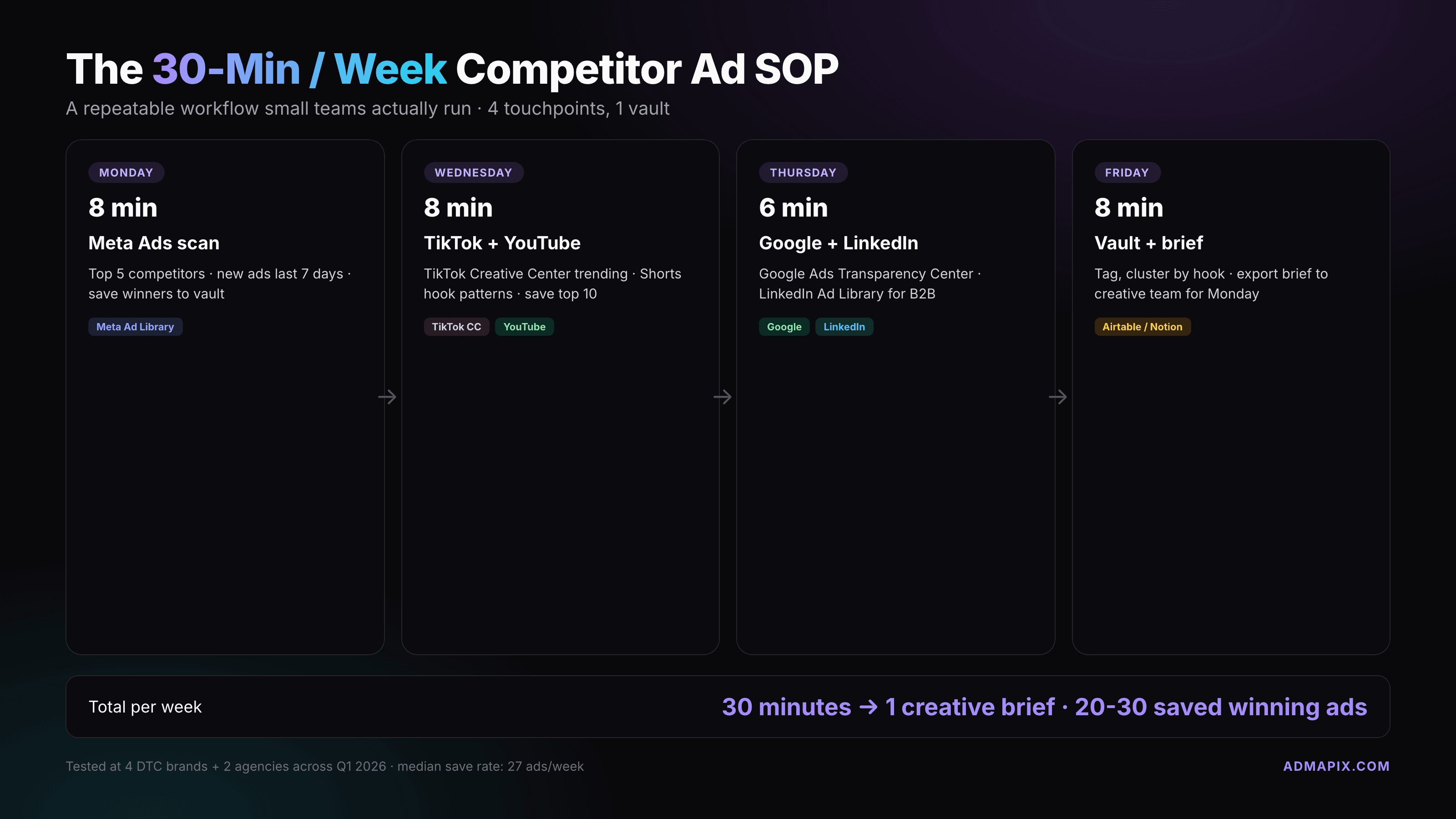
How to Spy on Competitors' Ads in 2026 (30-Min/Week Workflow)
A tactical 2026 guide to spying on competitor ads across Meta, TikTok, Google, YouTube, and LinkedIn — with a repeatable 30-minute weekly SOP, a Notion/Airtable schema, and an honest free-vs-paid breakdown.