
AppTweak Alternative: How to Choose Between an ASO Platform and Ad Creative Intelligence in 2026
A decision-first guide to picking an AppTweak alternative. Separate ASO, keyword, and Apple Search Ads work from competitor ad creative and video intelligence, with comparison tables, a buying framework, and an honest map of what public ad data can prove.
AppTweak Alternative: How to Choose Between an ASO Platform and Ad Creative Intelligence in 2026
Updated June 21, 2026.
Most people typing "AppTweak alternative" into a search bar are solving one of two very different jobs, and the wrong tool will not fix the other one. If your bottleneck is store visibility, keyword rankings, metadata, store conversion, or Apple Search Ads, you want another app store optimization (ASO) platform. If your bottleneck is seeing what competitors are running in paid social, breaking down their video hooks, and turning that into a creative brief, you want ad creative intelligence. Those are separate categories with separate data, separate workflows, and separate buyers. This guide is for ASO managers, user acquisition (UA) teams, mobile growth leads, agencies, and founders who want to pick the right layer instead of collecting a longer vendor shortlist. AdMapix is one option mentioned below, and it lives on the creative-intelligence side, not the ASO side — we will be explicit about that line throughout.
TL;DR
- AppTweak is an ASO and mobile market intelligence platform. A true like-for-like alternative is another ASO suite, not a creative ad database. Start there if your job is keywords, metadata, ranking, market intelligence, or Apple Search Ads.
- "AppTweak alternative" is really two searches. Roughly half the people searching it want a cheaper or different ASO tool; the other half have ASO handled and actually need competitor ad creative evidence. Diagnose which one you are before you shortlist anything.
- ASO tools answer "how do we get found and convert in the store?" Creative intelligence tools answer "what ads are competitors running off-store, and what should we test next?" Neither replaces the other.
- Pick ad creative intelligence (such as AdMapix) when the gap is finding competitor ads across networks, analyzing video hooks, and producing creative test briefs — not keyword research.
- Public ad data proves intent, not performance. No public tool (AdMapix included) can see a competitor's spend, conversion rate, or ROAS. Treat competitor ads as hypotheses you validate with your own numbers.
- Most growth teams run both layers, because store discoverability and creative testing are different problems with different evidence. The point of this guide is to help you buy the layer that actually moves your stuck metric.
Why "AppTweak Alternative" Is Actually Two Different Searches
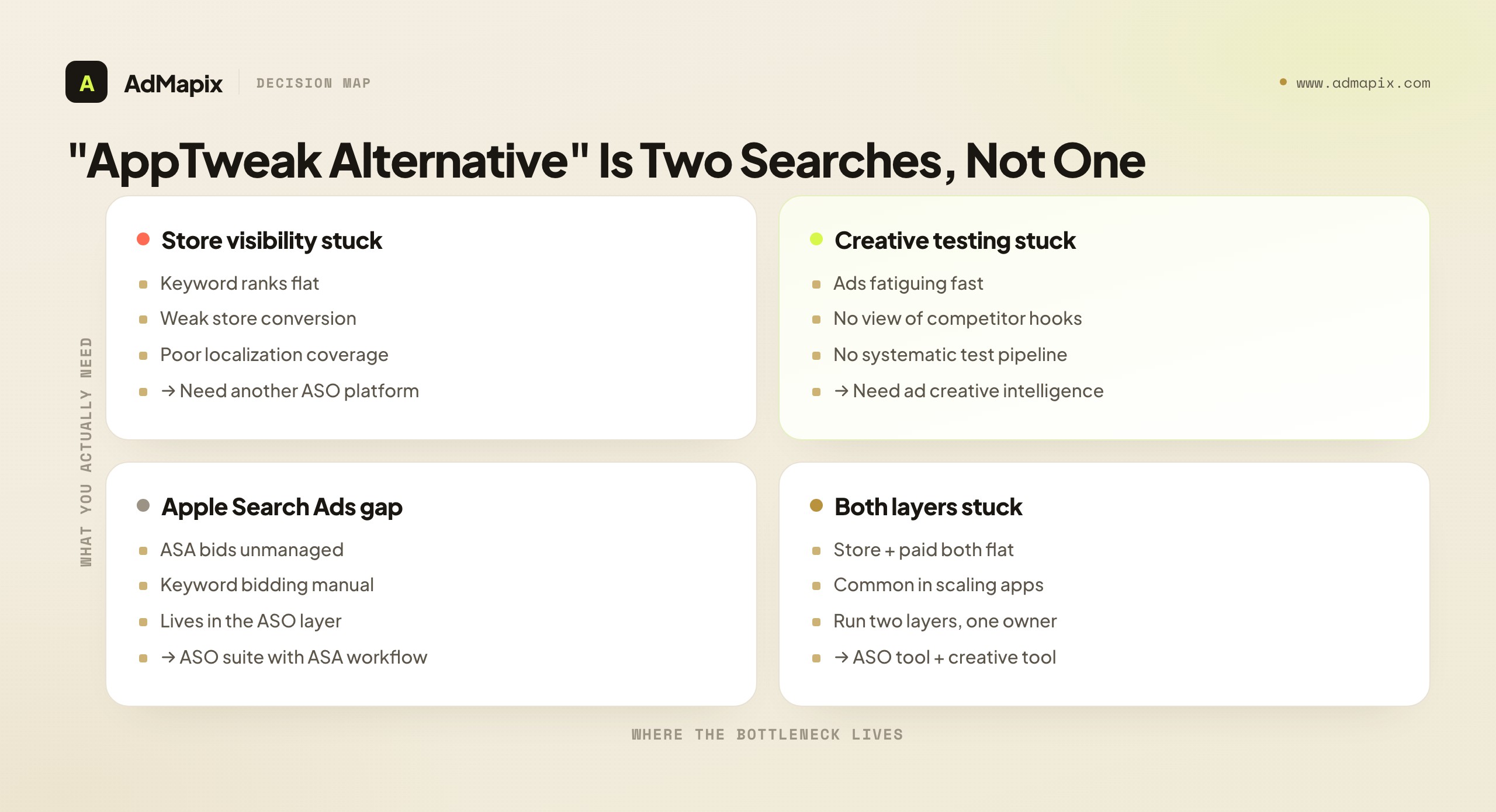
AppTweak is an ASO platform first. That single fact reshapes the whole question, because it means "alternative" splits cleanly into two non-interchangeable categories, and the right answer depends entirely on which category you are standing in.
AppTweak's product surface covers keyword research, app store optimization, ranking and market intelligence, an ad intelligence layer, and Apple Search Ads management. A team replacing it because they want the same job done — keyword discovery, metadata optimization, rank tracking, category intelligence, and ASA bidding — needs a comparable ASO suite. Nothing else will substitute, because nothing else indexes the App Store and Google Play the way an ASO platform does. If that is you, the rest of this guide will still help you think clearly, but your shortlist is "other ASO platforms," and you should weigh them on keyword database depth, ranking accuracy, country coverage, ASA workflow quality, and price.
But a large share of people searching "AppTweak alternative" are not in that situation at all. They already have ASO handled — maybe with AppTweak itself, maybe with a competitor, maybe with a lighter in-house process — and the metric that is actually stuck is paid social performance. They are losing on creative. Their ads fatigue, their hooks stop converting, and they have no systematic way to see what competitors are testing. For that person, buying another ASO tool is a category error. It will not move the number, because the number lives in the ad auction, not the store search box. What they need is creative intelligence: the ability to search competitor ads across networks, save the strongest examples, break down the videos, and turn patterns into briefs.
The mistake that wastes the most money is comparing a keyword tool against a creative tool as if they were the same product on one ranked list. They are not. They answer different questions, draw on different data, and serve different seats on the growth team. The fastest way to avoid a wrong purchase is to refuse to make a single "best AppTweak alternative" list at all, and instead ask one diagnostic question first: is my bottleneck store visibility or creative testing? Everything downstream follows from that answer.
This guide is opinionated about that split on purpose. We have watched teams spend months trialing ASO platforms when their real problem was that nobody on the team could answer "what is our top competitor running on TikTok right now," and we have watched the reverse — creative-obsessed teams whose installs were actually capped by a weak first screenshot and poor keyword coverage. The tool is downstream of the diagnosis. Get the diagnosis right and the shortlist almost writes itself.
There is a structural reason the two searches get conflated, and it is worth naming because once you see it you stop falling for it. App marketing as a discipline grew up bundling everything that touches the App Store under one umbrella, so an ASO platform, a paid-UA dashboard, a creative library, and an attribution tool all got filed under "app growth tools." Vendors then expanded sideways into each other's territory — the ASO suite bolted on an ad-intelligence tab, the analytics tool added keyword features, the creative tool started indexing app ads — and the category boundaries blurred in the marketing even though the underlying data and depth did not. The result is that two people with genuinely different problems both land on the same "AppTweak alternative" search, read the same listicles, and walk away more confused than when they started, because the listicle author also failed to separate the jobs. The fix is not a better listicle. It is a better question, asked before you read anyone's recommendations.
The cost of getting this wrong is not just wasted subscription money, though that is real. The bigger cost is opportunity cost and team trust. A UA lead who is handed an ASO platform to "fix creative" will conclude, correctly, that the tool does not help — and may then become skeptical of the whole idea of competitive intelligence, when the real failure was buying the wrong layer. An ASO manager handed a creative tool to "find better keywords" will hit the same wall from the other side. Both walk away thinking "these tools don't work," when in fact the tools work fine for the jobs they were built for. Diagnosing the layer first is how you avoid poisoning the well for an entire category of useful work.
ASO vs Ad Creative Intelligence: What Each Layer Actually Does
The cleanest way to choose is to map your specific decision to a layer before you compare any vendors. The two layers overlap in vocabulary — both talk about "intelligence," "competitors," and "data" — but they sit on opposite sides of a hard line. ASO and store intelligence is about being found and converting inside the store. Ad creative intelligence is about what runs outside the store, in feeds and video placements, and how you respond with your own creative.
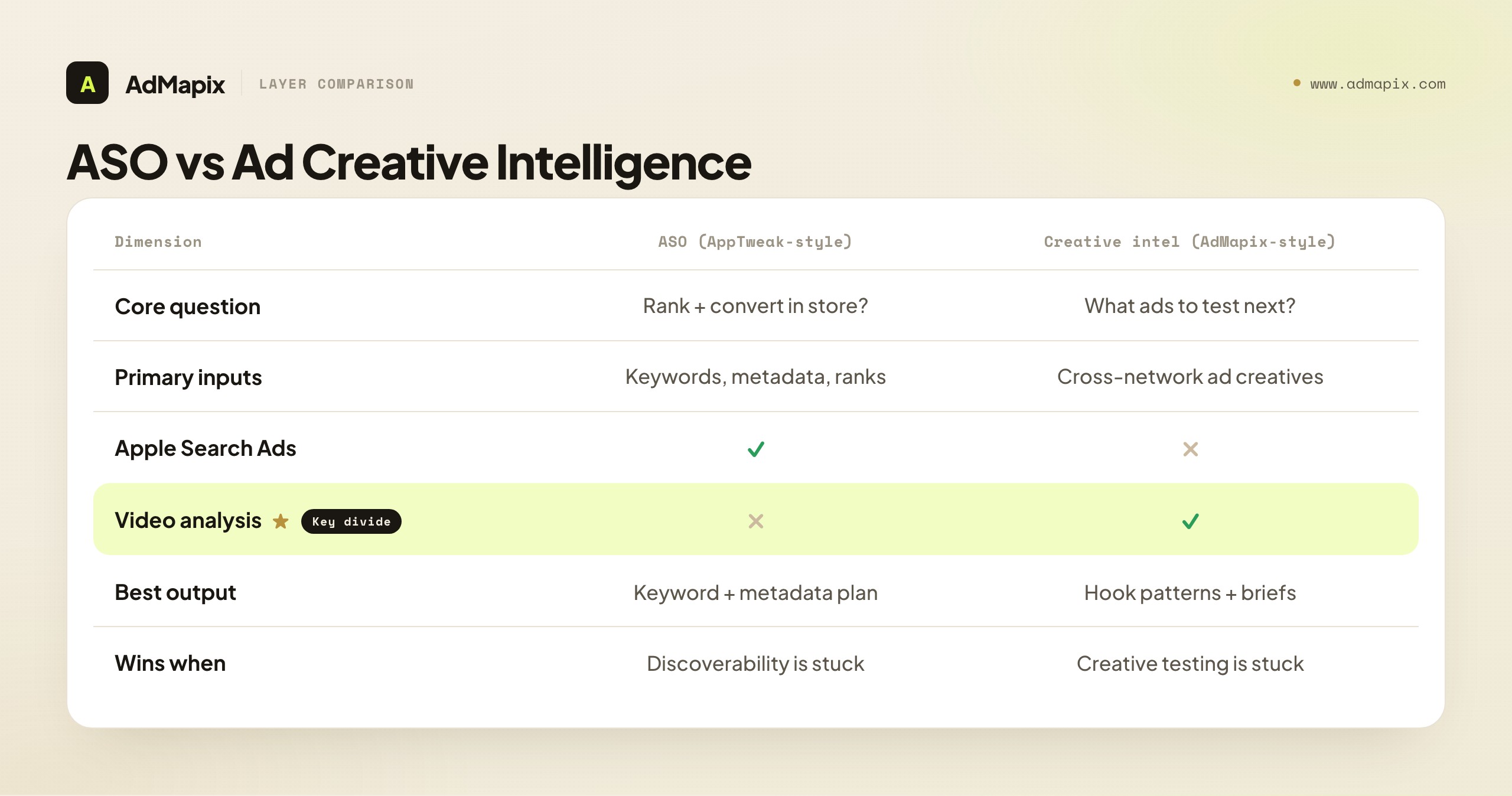
Use the table below to see which side of the line your problem sits on. Read it row by row and tally where your real questions land.
| Dimension | ASO / store intelligence (AppTweak-style) | Ad creative intelligence (AdMapix-style) |
|---|---|---|
| Core question | How do we rank and convert in the store? | What creatives are competitors running, and what should we test? |
| Primary inputs | Keywords, metadata, category ranks, reviews, ASA bids | Cross-network ad creatives, images, videos, hooks |
| Apple Search Ads | Yes — keyword bidding and ASA workflows | No — this is not an ASA management tool |
| Best output | Keyword plan, metadata changes, ASA strategy | Hook patterns, saved creative evidence, creative briefs, reports |
| Video analysis | Not the focus | Breaks down hooks, pacing, and first-screen structure |
| Unit of work | A keyword, a listing, a country, a bid | A creative, an angle, a test brief |
| Who owns it | ASO manager, growth marketer | UA lead, creative strategist, paid-social team |
| When it wins | Organic discoverability is the bottleneck | Paid-social creative testing is the bottleneck |
If most of your rows land in the left column, stay with an ASO platform and shortlist AppTweak alternatives in that category — and weight your evaluation toward keyword depth, ranking accuracy, and ASA workflow. If your rows land on the right, an ASO tool will not move your number no matter how good it is; you need creative intelligence, and a longer keyword database is irrelevant to you.
A common and honest middle case: your rows are split. You genuinely have store-visibility work and creative-testing work, and both are bottlenecked. That is normal for a scaling app, and the answer is not to find one tool that does both adequately — it is to run both layers deliberately, with a clear handoff between them. We will come back to that stack at the end. For now, the discipline is to stop pretending one tool category can answer both questions well.
It is worth saying plainly what neither layer does. ASO tools do not tell you which ad hook is exhausting your audience. Creative tools do not tell you which keyword to bid on or how to rewrite your subtitle. When a vendor's marketing implies a single product covers both jobs equally, treat that as a flag to dig deeper, because depth in one almost always means shallowness in the other.
To make the line concrete, here is the same competitive question asked from each layer, so you can feel how different the work is. From the ASO layer, the question "how do we beat this competitor" becomes: which keywords are they ranking for that we are not, what does their title and subtitle emphasize, how is their first screenshot framed, which countries are they strong in, and where is their store conversion likely leaking? The output is a metadata and keyword plan, plus maybe an ASA bid adjustment. From the creative layer, the same "how do we beat this competitor" becomes: what hooks are they running in paid social right now, how many variants of each, which formats (static, UGC-style video, carousel) dominate their spend, what offer framing repeats, and which of those angles do we not yet have in our own test backlog? The output is a creative brief and a prioritized test list. Same competitor, same strategic intent, two completely different research processes producing two completely different deliverables. A tool that is genuinely good at one of these is, almost by construction, a generalist at the other — and a generalist tool is exactly what you do not want when the whole game is depth and speed in a single job.
One more nuance that trips up experienced marketers: the two layers also fail differently, and the failure tells you which layer you are actually in. ASO work fails slowly and structurally — you do not get found, your funnel is quietly under-fed, and the symptom is flat organic installs over weeks. Creative work fails fast and visibly — a winning ad fatigues, CPMs climb, CPA spikes in days, and you scramble for the next hook. If your pain is the slow, structural kind, you are almost certainly in the ASO layer. If your pain is the fast, visible kind, you are in the creative layer. The tempo of the problem is one of the most reliable diagnostics there is, and it costs nothing to read.
Who Should Choose What: Match the Tool to the Seat
The bottleneck differs by seat, so the right pick differs by role. The table below is a starting point, not a rule — confirm it against your own diagnosis — but it captures the pattern we see most often when teams get the choice right.
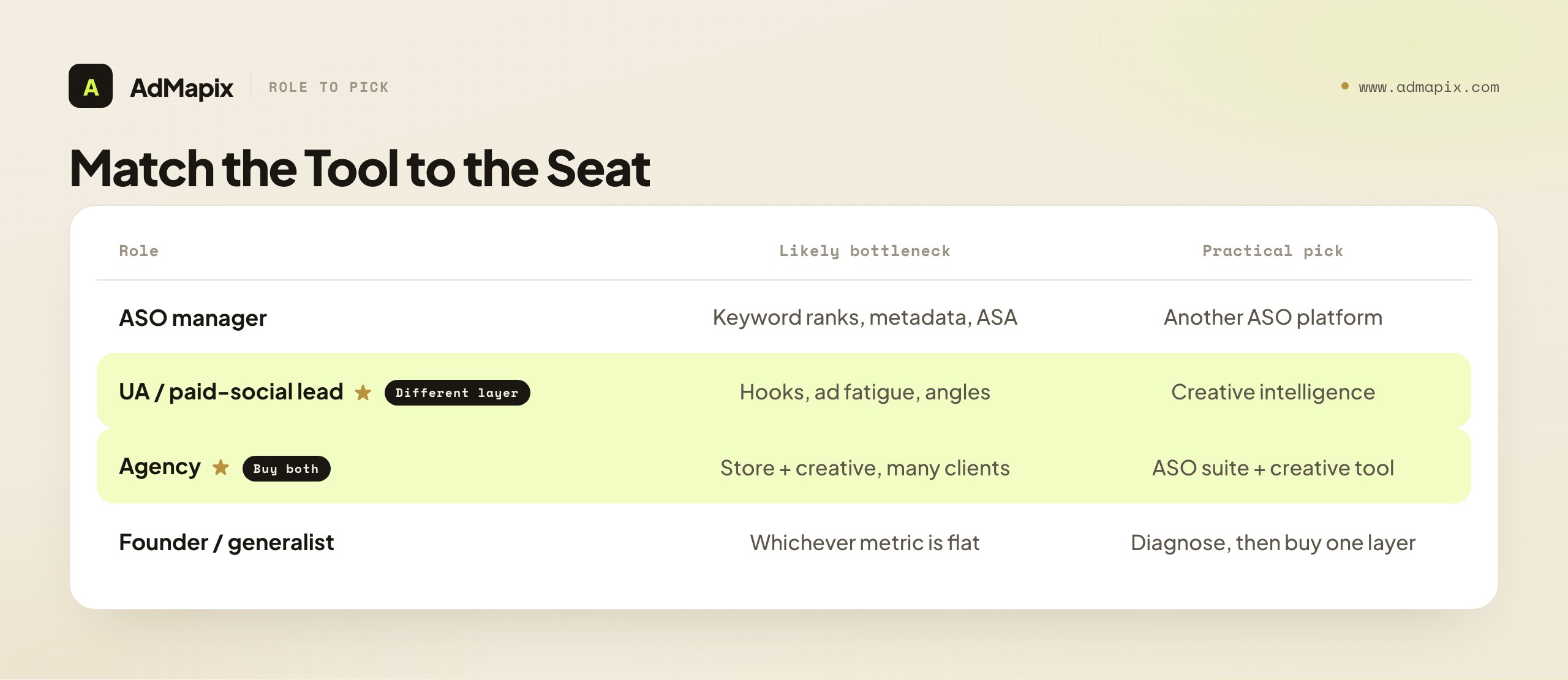
| Role | Likely bottleneck | Practical pick |
|---|---|---|
| ASO manager | Keyword ranks, metadata, store conversion, ASA | Another ASO platform (AppTweak-class) |
| UA / paid-social lead | Creative angles, video hooks, ad fatigue | Ad creative intelligence such as AdMapix |
| Creative strategist | Reference library, hook teardowns, brief inputs | Creative intelligence + a saved evidence workflow |
| Growth lead / generalist | Unsure which lever is stuck | Diagnose first; do not buy by feature count |
| Agency | Both store and creative deliverables for clients | ASO suite plus a creative research tool |
| Founder / solo | Whatever metric is currently flat | Identify the flat metric, then buy that layer only |
A few notes on the rows that trip people up.
The ASO manager almost always wants an ASO platform, full stop. If you own keyword rankings and store conversion, your AppTweak alternative is another keyword-and-ranking tool, and the creative layer is someone else's job. Do not let a slick ad-intelligence demo distract you from the fact that your KPIs live in the store.
The UA or paid-social lead is the opposite. Your KPIs live in the ad auction. Cost per install, cost per action, and ROAS are decided by creative far more than by your store listing once traffic arrives. Your AppTweak alternative is not an ASO tool at all — it is creative intelligence that lets you see competitor ads, analyze hooks, and brief tests faster.
The agency is the genuinely two-layer case, and the only role where "buy both" is usually the right first answer rather than a fallback. Agencies owe clients both store deliverables and creative deliverables, often for many brands at once, so the consolidation logic that applies to a single in-house team breaks down. We have written more about that workflow in our guide to building an agency ad intelligence tool, and the short version is that the process is the product: same fields, same cadence, same defensible report, for every client.
The founder or generalist has the most to gain from discipline here, because they feel every flat metric personally and are tempted to buy the tool with the longest feature list. Resist that. Find the one metric that is actually stuck, decide which layer it lives in, and buy that layer only. You can always add the other later when its bottleneck becomes the binding one.
The creative strategist sits slightly apart from the UA lead and deserves its own note, because the strategist's job is not to manage spend but to manufacture the raw material — the angles, hooks, and concepts that the UA team then tests. For a strategist, an ASO platform is essentially irrelevant; their bottleneck is reference and inspiration that is current, organized, and tied to a brief. They live in the creative layer almost by definition. The thing a strategist most often lacks is not ideas but a system for capturing competitor evidence so it does not evaporate. They see a clever competitor hook on a Tuesday, mean to save it, and by the time the brief is due it is gone. A creative-intelligence layer with a real saved-evidence workflow — not just a search box but a place to keep and tag the strongest examples — is worth more to a strategist than to almost anyone else on the team, because it turns scattered noticing into a durable, searchable library that compounds.
The pattern across all of these roles is the same: the right tool is the one that matches the seat's actual KPI, and the seat's KPI tells you the layer. When a role's KPI lives in the store search results, that role wants an ASO platform. When a role's KPI lives in the ad auction, that role wants creative intelligence. Buying against the KPI rather than against the feature list is the single best heuristic in this entire decision, and it works even when the marketing on both products is doing its best to blur the line.
How to Test an AppTweak Alternative Without Wasting a Month
Tool evaluations go wrong when they turn into feature-checklist beauty contests. A longer feature list is not a better tool; it is often a more diffuse one. The way to evaluate fast is to define the job first, then time how long each candidate takes to do that job end to end. Score time-to-decision, not feature count.
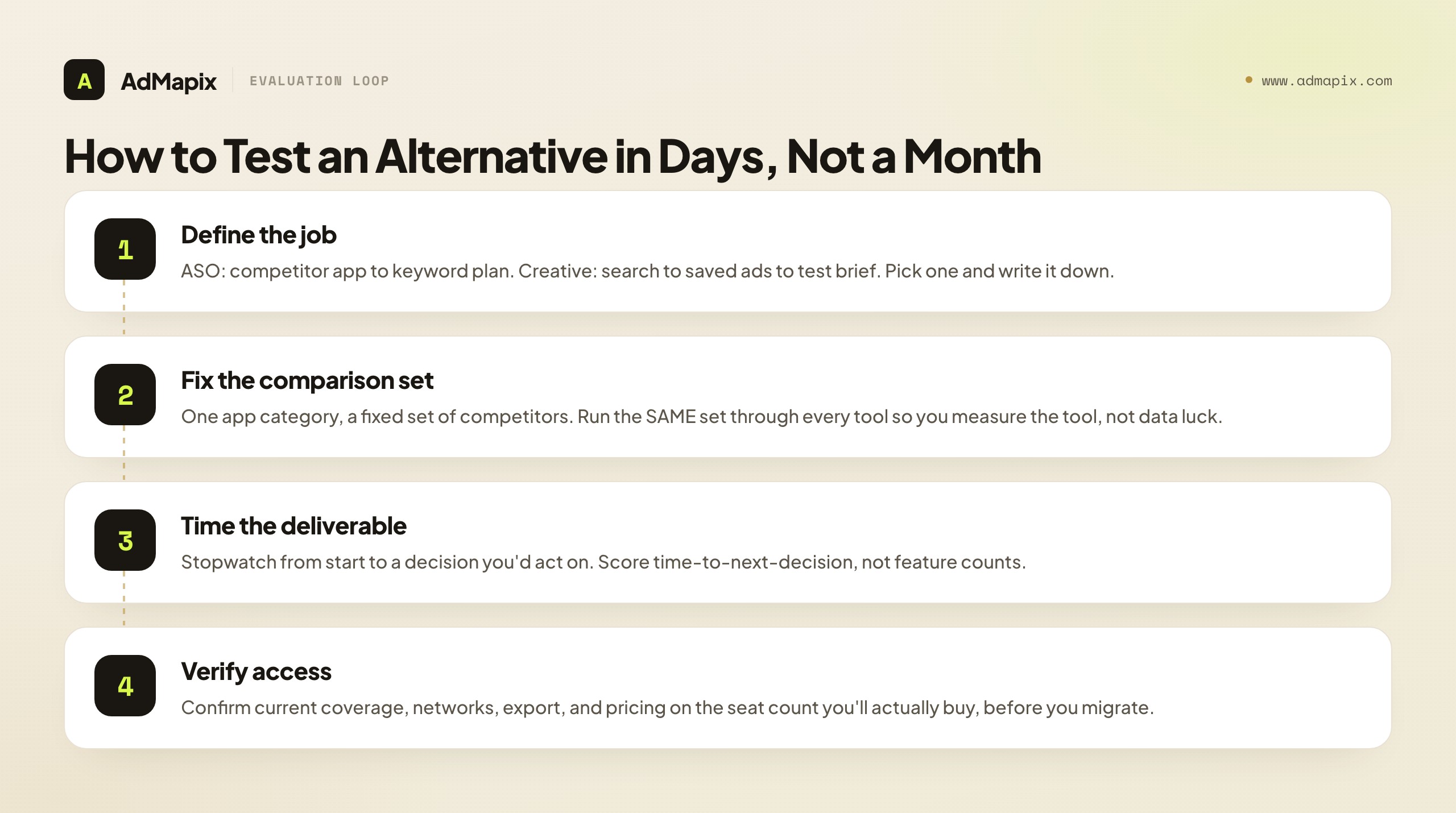
Here is a tight evaluation loop that works whether you are testing ASO platforms or creative-intelligence tools. Pick one app category you know well, assemble a fixed comparison set of competitors, and run that exact set through every candidate.
For an ASO platform evaluation, the job is: starting from a competitor app and a target country, how quickly can you produce a defensible keyword plan and a metadata recommendation? Compare keyword database coverage for your category and country, ranking-data accuracy against your own known positions, how the tool handles localization across the markets you actually sell in, and the quality of the Apple Search Ads workflow if ASA is in scope. The deliverable you are timing is "from competitor app to keyword plan I would act on." If a tool has 50 features but takes three days to get you there, it loses to one with 20 features that gets you there in an afternoon.
For a creative intelligence evaluation, the job is different: starting from a competitor or a keyword, how quickly can you go from search, to a saved set of the strongest ads, to a usable creative test brief? Compare how fast search surfaces relevant competitor ads across the networks you care about, whether you can save and organize the evidence rather than re-finding it every week, whether the tool breaks down video — the first three seconds, pacing, offer framing — and how cleanly findings package into something a strategist or client can act on. The deliverable you are timing is "from search to test brief."
In both cases, run the same comparison set through every tool so you are measuring the tool, not the data luck of a different sample. And score against time-to-next-decision, because that is the only metric that compounds. A tool that shaves a day off every weekly research cycle is worth far more over a year than one with a marginally larger database that you query the same way regardless.
One more practical step that teams skip and regret: verify current access before you commit. Coverage, export paths, login requirements, and pricing change, sometimes quietly. Confirm the current plan actually includes the countries, networks, and export formats you need, on the seat count you will buy, before you migrate a workflow onto it.
A few evaluation traps are worth calling out explicitly, because they pass a casual trial but burn you in month two. The first is the demo data trap: vendor demos are tuned to look great on a hand-picked category and country, usually US English in a popular vertical. Always run your trial on your category and your primary market, even if it is smaller or messier, because that is where you will live. The second is the single-query trap: you run one search, it looks good, you buy. But the value of these tools is in the repeated weekly query, so test the workflow at least three times across different competitors and see whether it stays fast and useful or whether the first impressive result was lucky. The third is the export trap: the data inside the tool looks complete until you try to get it out into a deck, a sheet, or a shared brief, and discover the export is locked to a higher tier or strips the fields you actually needed. Test the full round trip — search, save, export, share — not just the search box.
The last trap is the most human: the champion trap, where one enthusiastic person on the team drives the trial, loves the tool because they have learned its quirks, and the team buys it — only for adoption to collapse when that person is the only one who can actually get value from it. Guard against this by having at least two people who will use the tool run the same job during the trial. If only the champion can make it sing, you are buying a tool for one seat and pretending it is a team tool. The strongest signal in any evaluation is a second, less-invested team member independently reaching a useful decision quickly. That is what predicts adoption after the trial ends and the novelty wears off.
What Public Ad Data Can and Cannot Prove
This section matters more than any feature comparison, because misreading public ad data is the single most expensive mistake in this whole category — and it applies to AppTweak's ad intelligence layer, to AdMapix, and to every other creative-intelligence tool on the market equally.
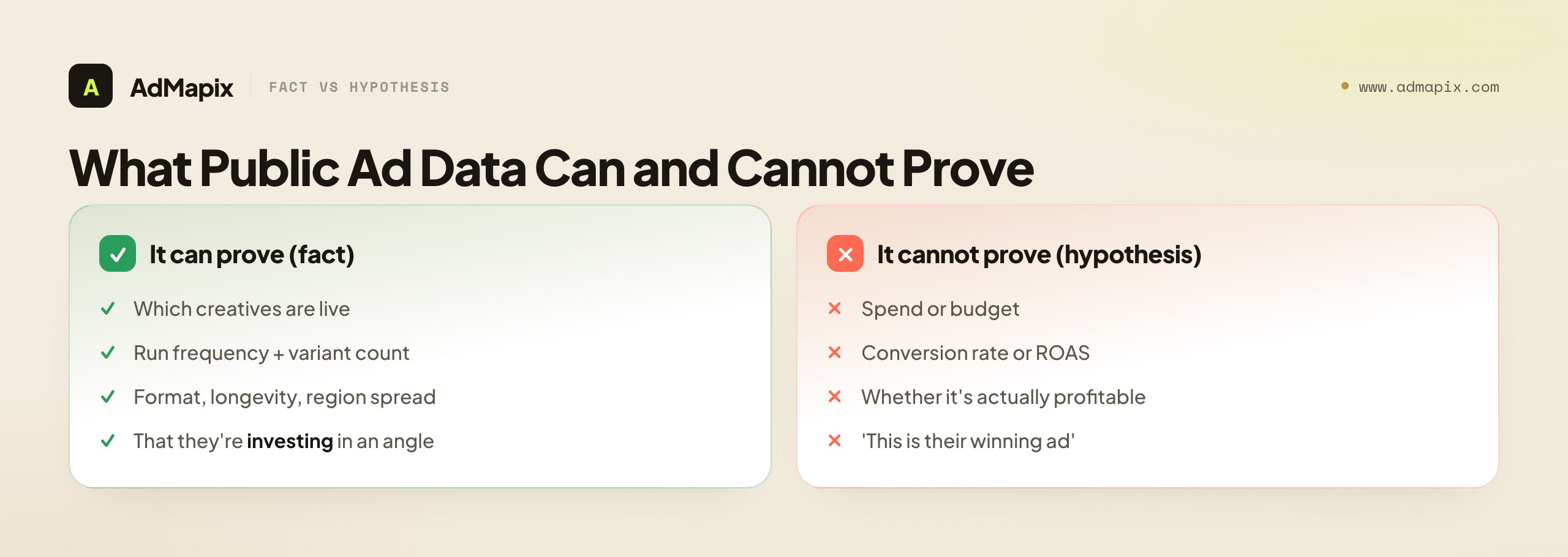
Competitor ads are evidence of intent, not proof of performance. When you find a competitor running a specific video hook or offer framing across many variants, sustained over weeks, that is a strong signal that they are investing in it and almost certainly iterating on it. Smart teams do not run the same creative concept fifteen ways for a month unless it is earning its place. So the inference "they think this is working" is reasonable.
But that is the only inference the data supports. The public data does not tell you their spend. It does not tell you their conversion rate. It does not tell you their ROAS, their payback window, or whether the campaign is actually profitable. It is entirely possible — and it happens constantly — for a competitor to run a creative heavily because of internal politics, a misread dashboard, a brand mandate, or simple inertia, while it quietly loses money. No public creative tool, AdMapix included, can see a competitor's internal performance data. Anyone who claims their tool surfaces "winning ads" from public data alone is overselling what the data can structurally support, because the win condition lives in a database you cannot access.
The practical implication is a clean two-step. Use creative intelligence to generate testable angles and to eliminate blind spots — to make sure you are not the last team in your category to notice a format shift. Then validate every promising angle with your own campaign data and business metrics. The competitor ad is the hypothesis; your test is the proof. Teams that keep that line crisp get the full value of creative intelligence without the trap. Teams that blur it end up copying a competitor's expensive mistake with conviction.
This is also the honesty test you should apply to any vendor, ours included. Ask them point-blank: "Can your tool tell me how a competitor's specific ad actually performed?" The correct answer is no, with an explanation of what it can tell you — run frequency, variant count, format, longevity, cross-network spread. If you hear "yes, we show you their winners," you are being sold a story the data cannot back. We cover the broader version of this in our competitive analysis for paid advertising guide, because it generalizes far beyond app marketing.
It helps to understand why the inference from run frequency to "this is working" is reasonable but not certain, because the gap is exactly where teams trip. The logic rests on an assumption about competitor rationality: a competent advertiser will kill losers and scale winners, so a creative that has survived for weeks and been varied many times has probably passed their internal performance bar. That assumption holds often enough to be useful — it is the basis of nearly all creative intelligence. But it breaks in specific, predictable ways. Brand campaigns run on a calendar, not on ROAS, so a heavily-run brand creative tells you about a marketing commitment, not a performance result. Large advertisers have slack in their budgets and tolerate underperforming creatives longer than a lean startup would. Some teams genuinely are not optimizing well, and you would be copying their mistake. And agencies sometimes keep a creative live to justify a retainer rather than because it converts. The signal is real, but it is probabilistic, and the probability is not 100 percent. That is precisely why your own test is non-negotiable: it converts a probabilistic competitor signal into a definite answer for your audience, with your offer, at your price point.
There is also an asymmetry worth exploiting. Public ad data is far better at telling you what not to miss than at telling you what to copy. If three of your four main competitors have all shifted to a particular video format or offer framing in the last month, that is a near-certain signal you should at least test that direction, regardless of whether you can see their exact numbers — the convergence itself is the evidence, and convergence is much harder to fake than a single advertiser's choices. Use the data defensively first (am I missing a shift the whole category has made?) and offensively second (which specific angle should I borrow?). The defensive read is more reliable and is where a lot of the underrated value of creative intelligence actually lives. A team that is never the last to notice a format shift has a durable edge, even if it can never see a single competitor's ROAS.
Common Mistakes When Replacing AppTweak
The failure modes in this decision are predictable, which is good news — predictable mistakes are avoidable. Here are the ones that cost teams the most, with the fix for each.
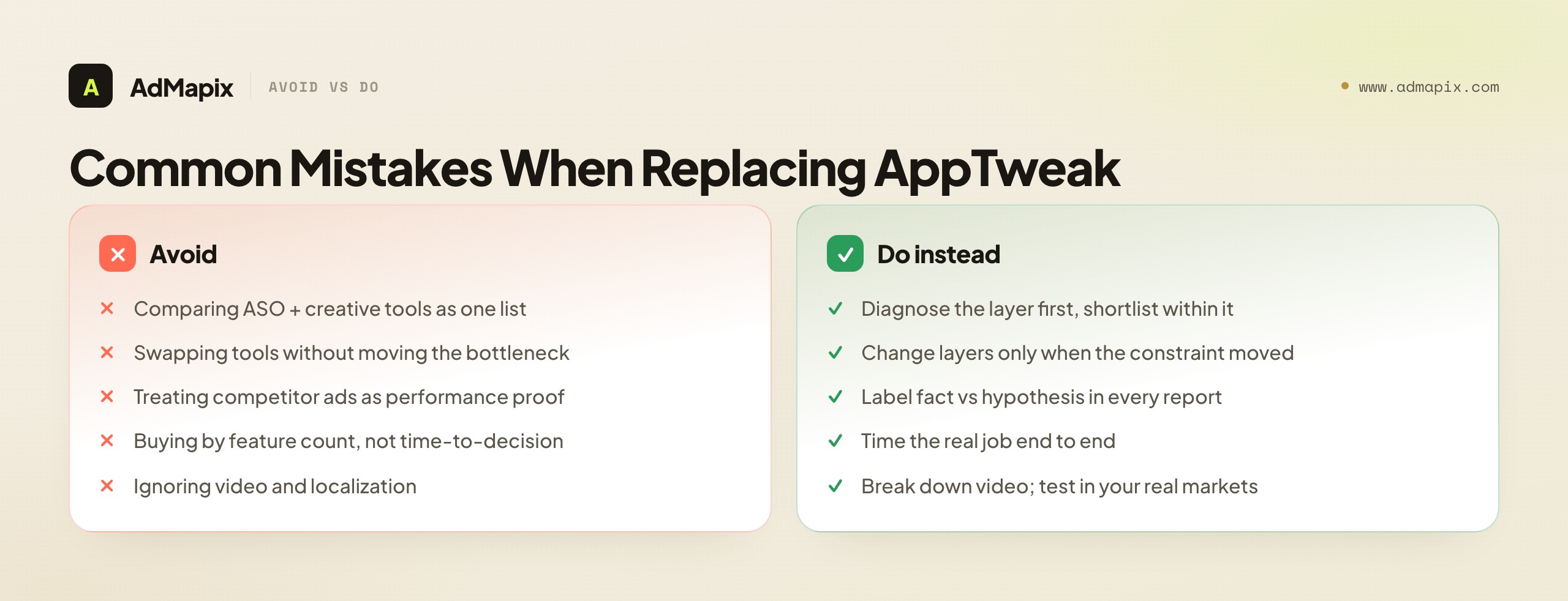
Comparing ASO tools against creative tools as one list. This is the root mistake, and most of the others descend from it. The two categories solve different jobs; a single ranked "best AppTweak alternatives" list quietly hides that and steers you toward the wrong purchase. The fix is the diagnosis at the top of this guide: decide your layer first, then shortlist within that layer only.
Swapping tools without moving the bottleneck. Switching from AppTweak to another ASO platform feels like progress, but if your stuck metric was creative performance, you have just spent a migration's worth of effort on the wrong axis. Only change layers when the binding constraint has actually moved — from store visibility to creative testing, or back. If the bottleneck has not moved, a new tool in the same category rarely changes the outcome.
Treating competitor ads as performance proof. Covered in depth above, but it belongs on every mistake list: repeated creatives suggest investment, not validated ROAS. Your own data validates. Build the fact-versus-hypothesis distinction into your process so it survives staff turnover and client pressure.
Ignoring video. For paid social, the first three seconds, the pacing, and the offer framing often decide your next test more than any keyword ever will. A creative tool that only shows you static ad thumbnails leaves the most important signal on the table. If video is where your competitors compete, your intelligence layer needs to break video down, not just collect it.
Buying for feature count instead of time-to-decision. A bigger feature list is a worse proxy for value than almost anything else. The tool that gets you from question to defensible decision fastest, repeatedly, wins on a one-year view even if it has fewer boxes ticked. Time the job, not the spec sheet.
Skipping the access check. Coverage, export paths, login requirements, and pricing change. The plan that had what you needed last quarter may not today. Verify the current plan before you migrate a team onto it or sign an annual contract.
Forgetting localization. If you sell in multiple countries, both layers get harder. ASO keyword data and ranking accuracy vary enormously by market, and competitor creative differs by region too. Evaluate tools in the markets you actually operate in, not just the US English default that every demo defaults to.
Letting the migration become a research black hole. Switching tools — especially within the ASO layer — has a hidden cost: the historical context, saved searches, tags, and tracked competitor lists you built up in the old tool do not come with you. Teams underestimate this and then spend the first month of the new tool rebuilding state they already had, which feels like the new tool is slow when really they are just re-entering setup. Before you switch, inventory what state you actually rely on (tracked apps, saved keyword sets, competitor lists, tags) and budget the time to recreate it, or you will blame the new tool for a cost you brought with you.
Optimizing the tool instead of the decision. The subtlest mistake of all is falling in love with the tool as an artifact — perfecting your tags, your saved searches, your dashboards — while the number of actual decisions the tool drives stays flat. A research tool that produces beautiful organized data and zero changed actions is a hobby, not a growth lever. Tie every research cycle to a decision. If a month of diligent tool use did not change a single keyword bid, metadata field, or creative test, the problem is not the tool; it is that the output never reached a decision.
When (and When Not) to Use AdMapix
We will be precise about where AdMapix fits, because the whole point of this guide is to keep the layers honest. AdMapix is ad creative intelligence. It is the right tool when ASO is already handled and your real gap is competitor ad creative evidence: searching ads across networks, saving the strongest examples, breaking down videos, and turning patterns into reports and briefs. It is built for UA teams, creative strategists, and agencies who brief and ship paid-social tests on a cadence.
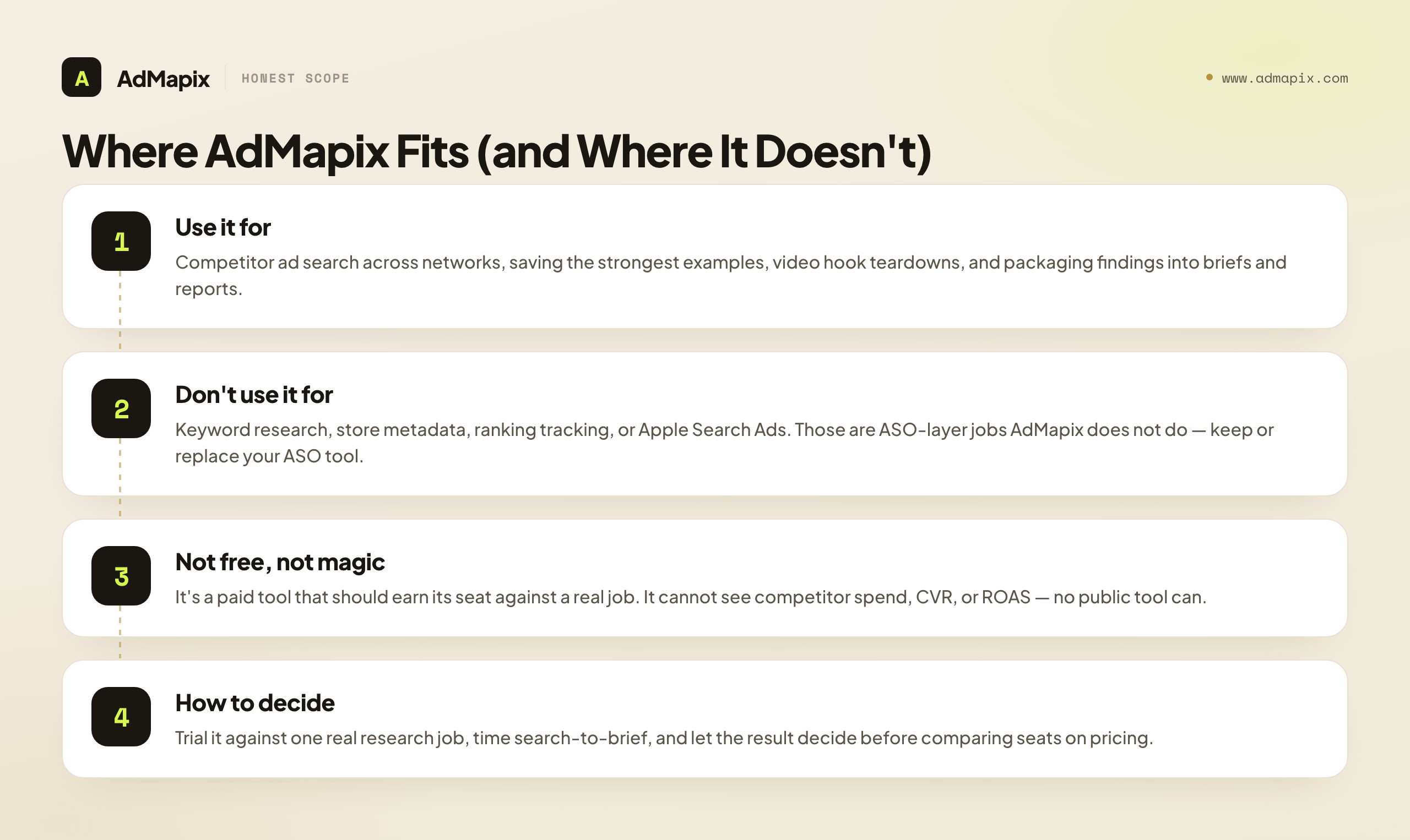
It is not the right tool for keyword research, store metadata, ranking tracking, or Apple Search Ads management. For those jobs, keep or replace your ASO platform — AdMapix does not do them and we are not going to pretend it does. We are also not going to call it "free"; it is a paid product, and like every tool in this space it should earn its seat against the job it actually does. If your only bottleneck is store visibility, AdMapix is not your AppTweak alternative, and we would rather tell you that than sell you a mismatch.
Where it earns its place is the creative-research loop. A practical stack keeps your ASO tool for what it does best, then uses Search AdMapix for cross-network creative discovery, Media to save the evidence worth keeping so you are not re-finding the same competitor ads every week, Video Analysis to break down hooks and first-screen structure, and Reports to package findings for the team or the client. When a competitor set needs weekly review, run it once in Search AdMapix, save the best examples in Media, and let that saved set become the recurring brief — the research becomes a repeatable deliverable instead of a one-off scramble.
A concrete picture of the workflow helps more than a feature list. Say you cover a set of five competitors in a single app vertical. On Monday morning you run that set in Search AdMapix, scan what is newly live across networks, and pull the handful of creatives that are genuinely new or newly dominant — not everything, just the signal. You drop those into Media under that competitor set, so the evidence persists and next week you are comparing against a baseline rather than starting blank. For the two or three videos that look most consequential, you run Video Analysis to break down the opening seconds, the pacing, and the offer framing, because that is where the testable idea actually lives. Then you write a short brief in Reports: here is what changed this week, here is the evidence, here is the one angle we will test and the metric we will judge it by. The whole loop is an hour or two, it produces a decision rather than a folder of screenshots, and because the evidence is saved it compounds — month three is far richer than week one because you can see trajectories, not just snapshots. That is what "earns its seat" looks like in practice: a repeatable hour that reliably ends in a test.
If you are weighing this against other tools in the same creative-intelligence category rather than against AppTweak, that is the right comparison to make, and we have neighboring guides for two other ASO-adjacent tools whose searchers face the same ASO-vs-creative split: the Appfigures alternative guide (Appfigures leans toward app analytics, downloads, and revenue estimates) and the MobileAction alternative guide (MobileAction leans toward ASO intelligence and ad intelligence for mobile). All three tools are different, and the cross-cutting lesson is identical: separate the store-data job from the creative-evidence job, and buy each layer for the job it actually does.
Once the creative workflow earns its place — once it is shaving real time off your weekly research and producing briefs your team acts on — compare seats on Pricing or create an account from Login. Until then, trial it against a real job, time it, and let the result decide.
Building a Two-Layer Stack That Actually Works
For the many teams whose honest answer is "we need both," the goal is not to find one tool that does store and creative work adequately. It is to run two specialized layers with a clean handoff, so each does what it is best at and nothing falls between them.
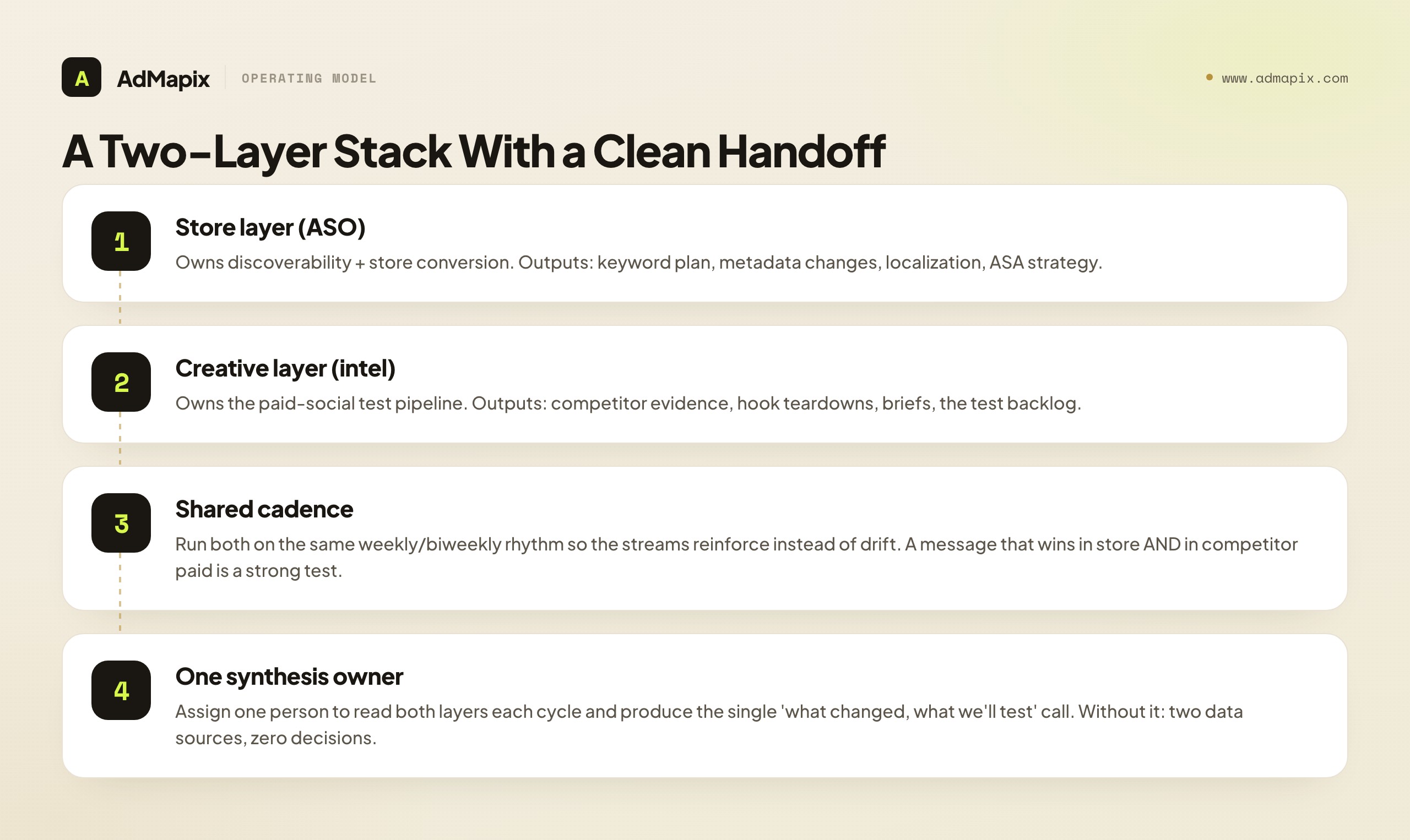
The store layer — your AppTweak-class ASO platform — owns discoverability and store conversion. Its outputs are a keyword plan, metadata changes, localization decisions, and an Apple Search Ads strategy. Its job is to make sure that when demand exists, your app shows up and converts the browse into an install. This layer is upstream of paid social in one sense (it shapes the destination) and parallel to it in another (organic and paid run side by side).
The creative layer — your ad creative intelligence tool — owns the paid-social testing pipeline. Its outputs are competitor ad evidence, hook teardowns, creative briefs, and the test backlog. Its job is to keep your paid creative ahead of fatigue by feeding a steady stream of validated-by-you angles into production.
The handoff that makes this work is shared context and a shared cadence. The store layer tells you which messages and value props convert browsers in your category; the creative layer tells you which of those messages competitors are amplifying in paid and how they are framing them in video. Run both on the same review rhythm — weekly or biweekly — and the two streams reinforce each other instead of drifting. A message that wins in store conversion and shows up heavily in competitor paid creative is a strong test candidate. A competitor angle that has no analog in your store positioning is a flag to investigate either the angle or your positioning.
The mistake to avoid is letting the two layers become two disconnected tabs nobody synthesizes. Assign one owner to the synthesis — the person who, each cycle, reads both layers and produces the single "here is what changed and here is what we will test" recommendation. Without that owner, you have two expensive data sources and no decisions. With it, you have a compounding intelligence advantage that neither layer could produce alone. We dig into the broader discipline of turning competitor signals into decisions in our ad tracking and competitive research guide.
It also helps to picture the two layers across a real growth cycle, because that is where the handoff stops being abstract. Suppose your ASO layer surfaces that a competitor has just re-worked their store listing around a new value proposition — say, shifting from "fastest" to "most trusted" — and their category rank is climbing. On its own that is an interesting store-side observation. Now your creative layer adds context: that same competitor has flooded paid social with UGC-style video built entirely around trust and social proof, dozens of variants, sustained for three weeks. Suddenly the two signals tell a coherent story — a coordinated repositioning around trust, executed across both store and paid — that neither layer could have told alone. That synthesis is the actual product of a two-layer stack: not two data feeds, but a single narrative about what a competitor is doing and, by extension, what gap or opportunity it implies for you. The store signal tells you the destination they are optimizing; the creative signal tells you the message they are spending to amplify. Together they are a strategy you can respond to.
The organizational shape that supports this matters too. In small teams, the synthesis owner is often the founder or head of growth, and the two layers might be two browser tabs and a shared doc — which is fine, as long as someone is explicitly responsible for reading both and writing the recommendation. In larger teams, the ASO manager and the UA lead each own their layer, and the synthesis happens in a short recurring meeting where they trade the one headline each from their side and jointly decide the next test. What does not work is leaving synthesis to chance, assuming that because both people see their own data, the connected insight will somehow emerge. It will not. Connected insight is a job, and like every job, it needs an owner and a cadence. Name them, and the two-layer stack pays off; leave it implicit, and you have paid for two tools to produce two reports nobody reconciles.
A Practical Decision Path
If you remember nothing else, remember the order of operations. The tool is the last decision, not the first.
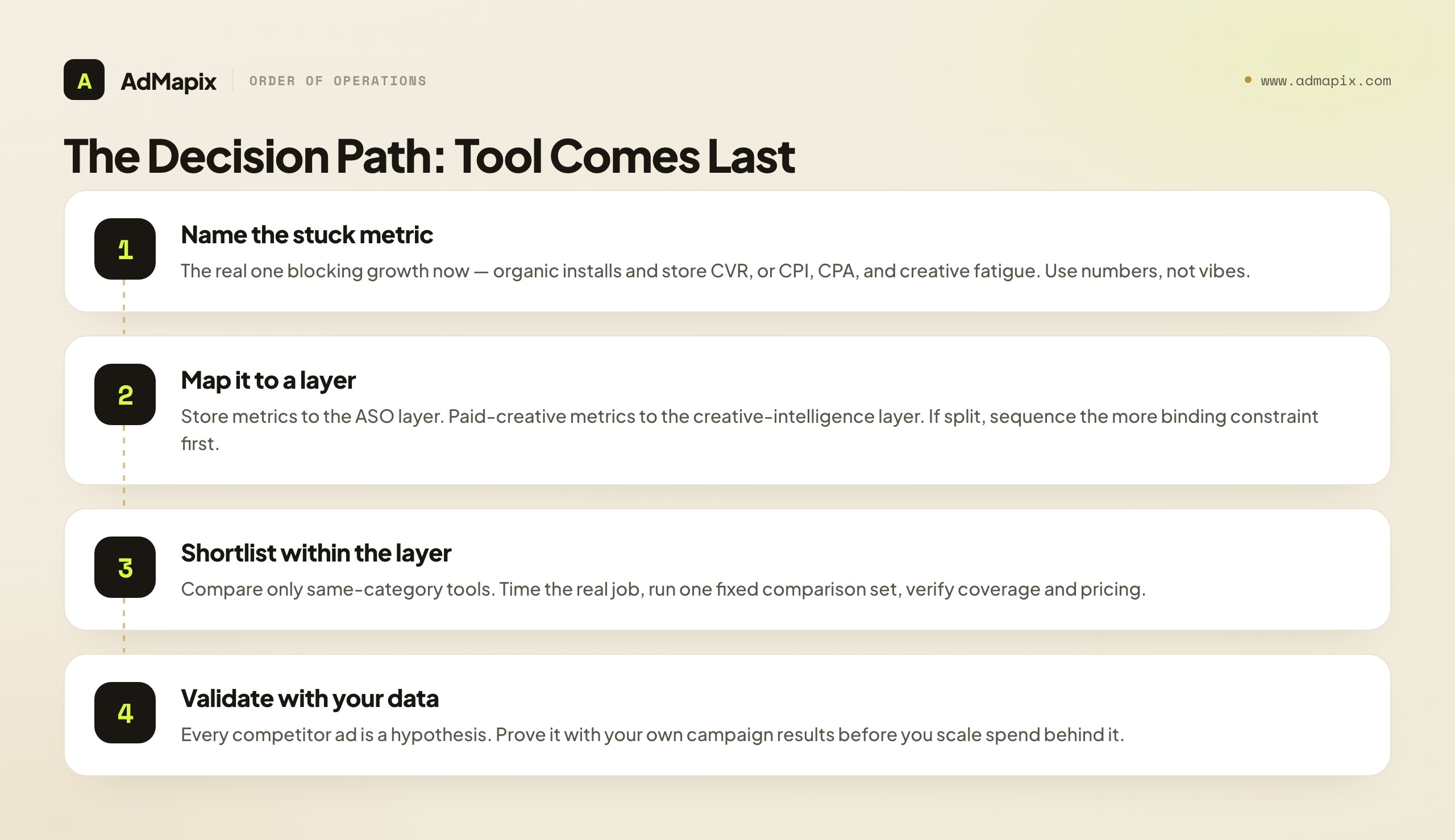
Start by naming the metric that is actually stuck. Not the metric you wish were better — the one whose flatness is blocking your growth right now. Is it organic installs, store conversion rate, or keyword visibility? Or is it cost per install, cost per action, or creative fatigue in paid? Be honest, and use real numbers, not vibes.
Then map that metric to its layer. Store-side metrics live in the ASO layer; paid-creative metrics live in the creative-intelligence layer. If your stuck metric is genuinely split across both, you are a two-layer team and you should plan for both — but even then, sequence them: start with whichever layer's metric is the more binding constraint this quarter.
Next, shortlist within that layer only, and evaluate by timing the real job — keyword-plan-to-action for ASO, search-to-test-brief for creative. Run the same comparison set through every candidate, verify current coverage and pricing, and score time-to-decision.
Finally, treat every competitor ad as a hypothesis, not a verdict, and validate with your own data. That one discipline protects you from the most expensive mistake in the category, regardless of which tool you choose.
Do that, and "AppTweak alternative" stops being a confusing single search and becomes two clear, answerable questions — each with a tool category that genuinely fits.
The deeper point underneath all of this is that tooling decisions are downstream of a clear-eyed read of your own constraints, and the teams that win are the ones who do that diagnosis honestly before they ever open a vendor's pricing page. Most wasted SaaS spend in app marketing is not the result of buying a bad tool — it is the result of buying a perfectly good tool for the wrong job, because nobody slowed down to name the constraint first. Spend the hour on the diagnosis. It is the cheapest, highest-leverage hour in the whole process, and it makes every dollar you spend afterward land where it actually moves a number.
FAQ
What is the best AppTweak alternative?
There is no single best one, because it depends on the job. If you need ASO, keyword research, market intelligence, or Apple Search Ads, your alternatives are other ASO platforms, and you should compare them on keyword depth, ranking accuracy, country coverage, and ASA workflow. If you need competitor ad creative research and video analysis, a creative intelligence tool such as AdMapix fits a different layer entirely. Diagnose which job you are doing before you shortlist anything — that decision matters far more than any feature comparison.
Can AdMapix replace AppTweak?
No. AdMapix does not do keyword research, store metadata optimization, ranking tracking, or Apple Search Ads. It covers cross-network ad creative search, saved media, video analysis, tagging, and reports. It complements an ASO tool rather than replacing it. If your bottleneck is store visibility, keep or replace your ASO platform; AdMapix is the wrong layer for that job and we would rather say so than sell you a mismatch.
Should app teams use both an ASO tool and a creative tool?
Usually yes, if both store visibility and creative testing are live problems for you. They are separate problems with separate evidence. Many teams keep an ASO platform for discoverability and store conversion, then add creative intelligence to research competitor ads and brief paid-social tests. The key is to assign one owner to synthesize both layers into decisions each cycle, otherwise you end up with two data sources and no actions.
How should I test an AppTweak alternative?
Pick one app category you know well, assemble a fixed comparison set of competitors, and run that exact set through each candidate. For ASO, time how fast you go from a competitor app to a keyword plan and metadata recommendation you would actually act on, and compare keyword coverage and ranking accuracy. For creative work, time how fast you go from search to a saved set of strong ads to a usable test brief. Score time-to-next-decision, not feature counts.
Does competitor ad data show how well an ad performed?
No. Public ad data shows what is running and how often it is varied, which signals investment and iteration. It does not reveal spend, conversion rate, or ROAS. A competitor can run a creative heavily and still lose money on it. Use the data to form hypotheses about what to test, then validate performance with your own campaign and business metrics. Any tool claiming to show competitor "winners" from public data alone is overselling what the data can support.
Is AppTweak an ASO tool or an ad intelligence tool?
AppTweak is primarily an ASO and mobile market intelligence platform — keyword research, app store optimization, ranking and market intelligence, and Apple Search Ads — with an ad intelligence layer added on top. Because its center of gravity is ASO, a like-for-like alternative is another ASO suite. If you specifically want deep, video-level ad creative intelligence, that is a different product category, and you should evaluate it on its own terms rather than as an AppTweak feature.
What is the difference between ASO and ad creative intelligence?
ASO is about being found and converting inside the App Store and Google Play: keywords, metadata, ranking, reviews, and store conversion. Ad creative intelligence is about what runs outside the store, in social feeds and video placements: which competitor ads are live, what hooks and offers they use, and what you should test in response. ASO answers "how do we get found and convert in the store"; creative intelligence answers "what should our next ad test be." Different data, different workflow, different owner.
Do I need an Apple Search Ads tool as well?
If Apple Search Ads is a meaningful channel for you, that capability typically comes from your ASO platform, not from a creative-intelligence tool. ASA is keyword-bid management inside Apple's search results, which is squarely ASO-layer work. A creative-intelligence tool like AdMapix does not manage ASA bids. When evaluating an AppTweak alternative on the ASO side, weight the quality of its ASA workflow heavily if that channel matters to your spend.
How is AppTweak different from Appfigures or MobileAction?
All three are app-marketing tools but with different centers of gravity. AppTweak leans toward ASO and market intelligence with Apple Search Ads. Appfigures leans toward app analytics, downloads, and revenue estimates. MobileAction leans toward ASO intelligence plus ad intelligence for mobile. Because they overlap, searchers for each face the same ASO-versus-creative split this guide describes. See our Appfigures alternative and MobileAction alternative guides for the tool-specific versions.
How often should I review competitor ad creative?
A weekly or biweekly cadence works for most teams, matched to the rhythm of your creative production. The goal is not to watch competitors constantly but to catch format shifts and new angles early enough to test them before they are exhausted. Save the strongest evidence so each review builds on the last instead of starting from scratch, and end every review with a concrete test recommendation. Cadence plus a saved evidence base is what turns ad-watching into a compounding advantage rather than busywork.
Key Takeaways
- Decide whether your bottleneck is store visibility (ASO) or creative testing before you shortlist any tool. The diagnosis matters more than any feature comparison.
- For keyword, metadata, ranking, market intelligence, and Apple Search Ads work, compare other ASO platforms — not creative databases.
- For competitor ads, video hooks, and creative briefs, use creative intelligence such as AdMapix. It complements an ASO tool; it does not replace one.
- Treat competitor ads as hypotheses. Public data proves intent, not performance — validate with your own numbers.
- Evaluate by timing the real job (keyword-plan-to-action, or search-to-test-brief) and verify current coverage and pricing before you migrate.
- If you need both layers, run them deliberately with one owner synthesizing them into decisions each cycle.
Sources
Official pages checked as of June 21, 2026. Pricing, product names, and availability can change, so verify the current plan before purchase or migration.
- AppTweak — positions itself as an ASO and app growth platform covering app store optimization, market intelligence, ad intelligence, and Apple Search Ads.
- AppTweak app store optimization overview — focuses on keyword research, app store optimization, organic growth, and app visibility.
- AppTweak ASO blog: what is app store optimization — explains why app store optimization matters for discoverability and conversion.
- Apple Search Ads — Apple's own description of how Search Ads place apps in App Store search results.
Disclosure: AdMapix is our product. We include it where the job is competitor ad creative research and video analysis, and we separate that clearly from the ASO workflows it does not cover. We do not describe it as free, and we do not claim it can see competitor performance data, because no public tool can.
Turn these observations into your next creative study
Open the creative library and select samples for your market, network and research question.
Related Articles
MobileAction Alternative: How to Choose Between an Apple Search Ads / ASO Tool and Creative Research in 2026
A decision-first guide to picking a MobileAction alternative. Separate Apple Search Ads bidding, keyword discovery, and app-store intelligence from competitor ad creative and video research, with comparison tables and a buying framework.
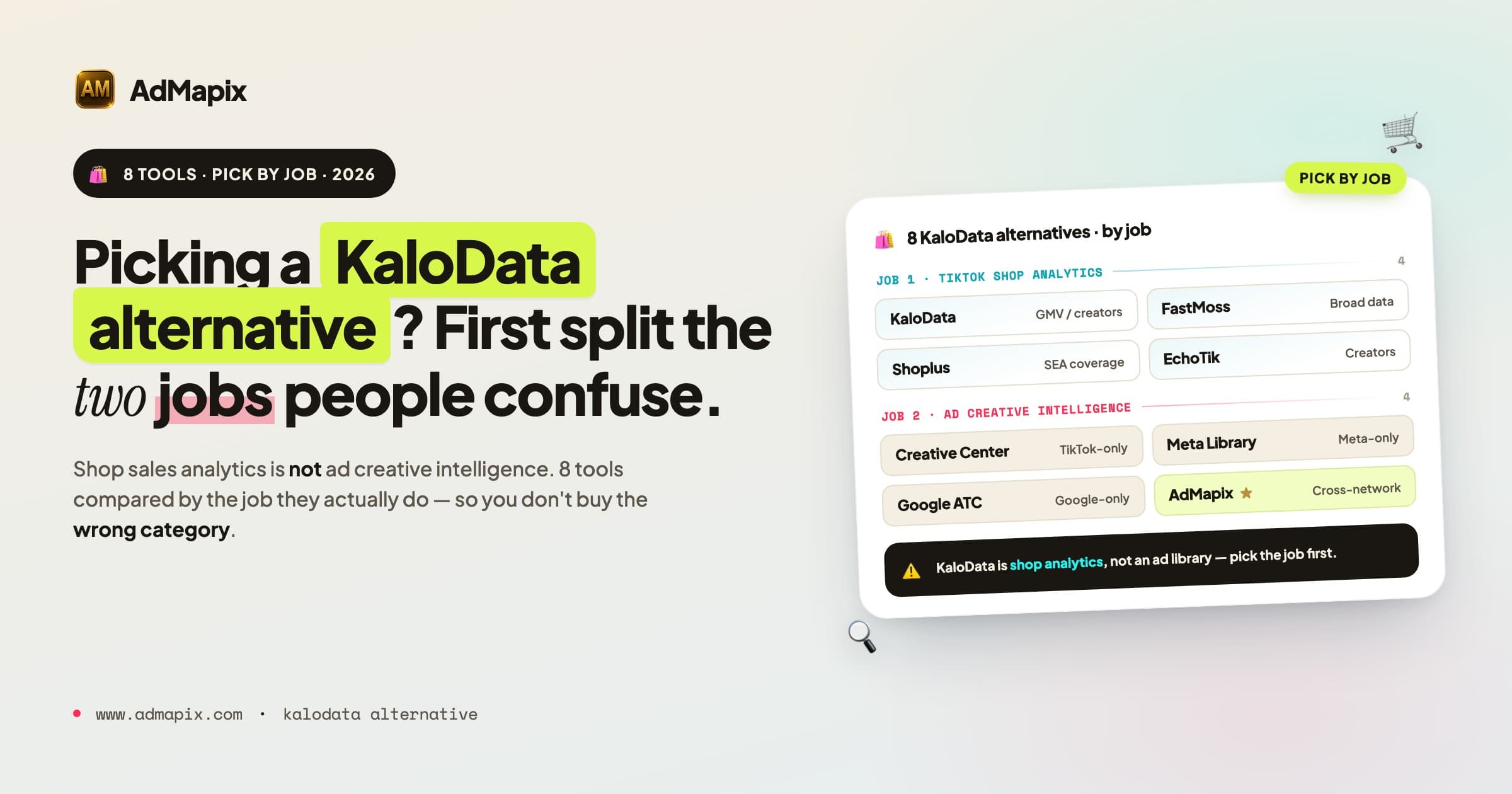
Best KaloData Alternatives in 2026: FastMoss, Shoplus, EchoTik & AdMapix Compared
A 2026 guide to the best KaloData alternatives: how to pick by job, a side-by-side comparison of TikTok Shop analytics and competitor ad-intelligence tools, pricing context, migration tips, and where AdMapix fits.
SwipeKit Alternative in 2026: 7 Tools Compared (Swipe Files, Video & Reporting)
A 2026 guide to choosing a SwipeKit alternative — why ad-saving isn't the bottleneck, a 7-tool comparison with pricing and coverage, the saving-vs-acting distinction, a migration plan, and an honest read on when AdMapix fits and when SwipeKit is still right.