
MobileAction Alternative: How to Choose Between an Apple Search Ads / ASO Tool and Creative Research in 2026
A decision-first guide to picking a MobileAction alternative. Separate Apple Search Ads bidding, keyword discovery, and app-store intelligence from competitor ad creative and video research, with comparison tables and a buying framework.
MobileAction Alternative: How to Choose Between an Apple Search Ads / ASO Tool and Creative Research in 2026
Updated June 21, 2026.
Most people searching for a MobileAction alternative are really asking one of two different questions: "what replaces my Apple Search Ads and ASO workflow?" or "where do I research competitor ad creatives?" Those are different jobs, and the right tool depends entirely on which one you have. MobileAction is built around app-store keywords, Apple Ads bidding, and app intelligence. If your bottleneck is creative — competitor video, hooks, ad formats, and turning what you see into a brief — a keyword-and-bid tool will not fix it, and no amount of switching ASO vendors will change that. This guide is for Apple Search Ads managers, ASO teams, UA leads, agencies, and founders deciding what to buy next, and it will keep the two jobs strictly separate so you buy the layer that actually moves your stuck number.
TL;DR
- MobileAction is an app-store intelligence platform centered on ASO and Apple Search Ads. A true like-for-like alternative is another ASO / Apple Ads tool — keyword discovery, bid optimization, rankings, store-level competitor tracking — not a creative ad library.
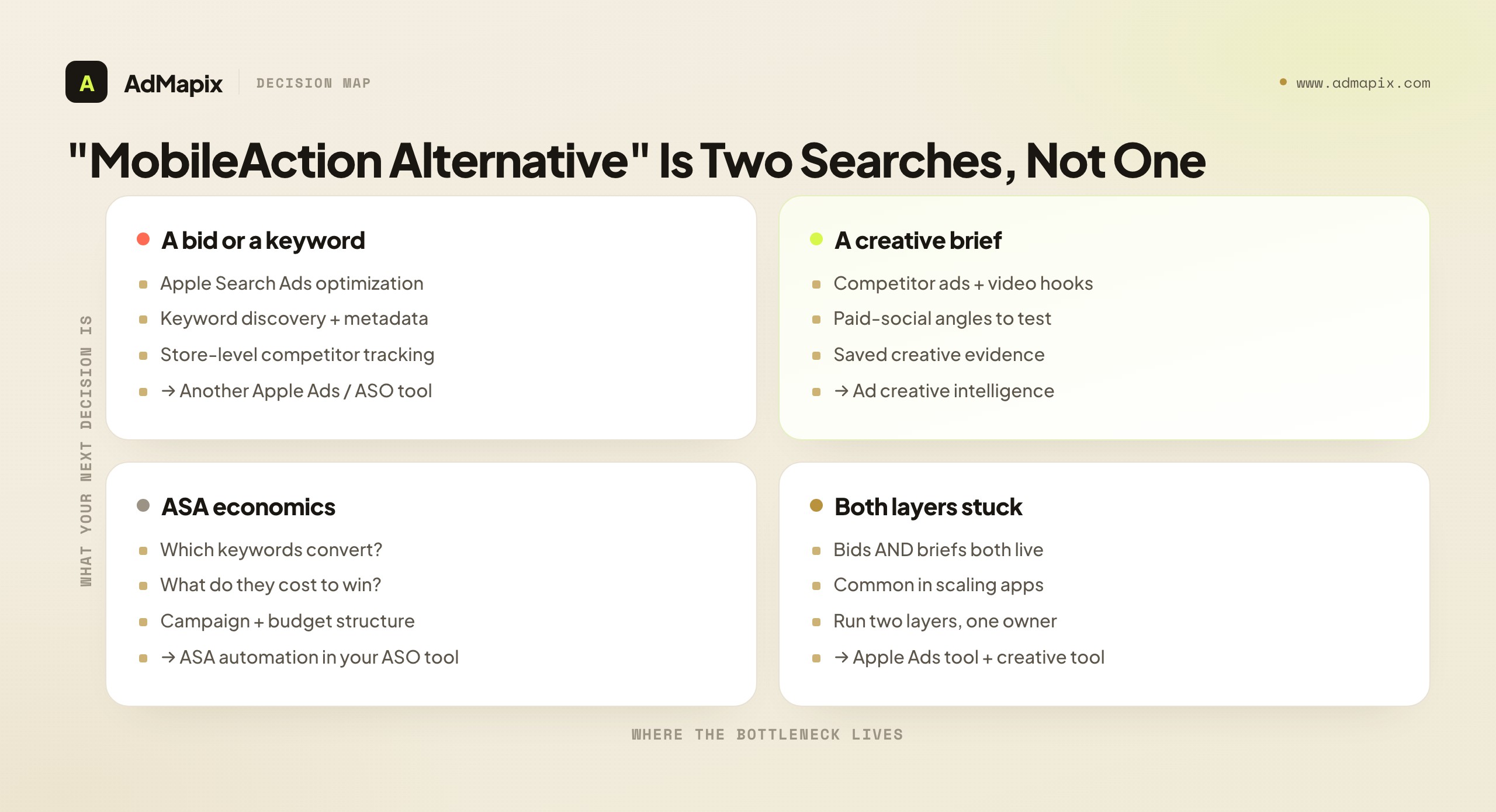
- "MobileAction alternative" is really two searches. One is "replace my Apple Ads + ASO workflow." The other is "where do I research competitor ad creatives?" Different data, different teams.
- Pick an Apple Ads / ASO alternative when your next decision is a keyword or a bid — campaign optimization, keyword discovery, metadata, or store-level competitor tracking.
- Pick ad creative intelligence (such as AdMapix) when your next decision is a creative brief — competitor ads, paid-social video, hook patterns, and saved creative evidence.
- Apple Search Ads is a bidding discipline, not a creative one. ASA decides which keywords you bid on and how much; it says nothing about which paid-social video hook to test. Those are different problems.
- AdMapix complements, not replaces. It does not bid on Apple Search Ads or rank app-store keywords. It searches cross-network ad creatives, saves media, and analyzes video — and it cannot see a competitor's spend or ad performance, because no public tool can.
What MobileAction Actually Does (and Where It Stops)
MobileAction is an app-store intelligence platform centered on ASO and Apple Search Ads, not a competitor ad-creative library. Its core is keyword discovery, Apple Ads campaign optimization and bidding, app rankings, and store-level competitor tracking. That is the right toolbox when your growth motion runs through the App Store and Apple's search results — when the levers you actually pull are which keywords to target, how much to bid on them, how to structure ASA campaigns, and how to tune your metadata so the store sends you more qualified traffic.
Where it stops is creative evidence outside the store. If you need to see the actual videos a competitor is running on paid social, the hook in their first three seconds, the formats they repeat, or a saved set of examples to brief a designer, that is a different data layer entirely. A keyword-and-bid tool is not designed to answer "what creative should we test next?" — and swapping one ASO vendor for another will not change that, because the answer does not live in keyword data at all. It lives in the ad creatives, in feeds and video placements, which an ASA tool never indexes.
It is worth being explicit that this is not a knock on MobileAction. Within its lane it does exactly what it should, and for a team whose growth genuinely runs through App Store search, it can be the most important tool they own. The point is narrower and more useful: a tool that is excellent at keyword discovery and ASA bidding is, almost by construction, not also a deep creative-intelligence platform, because those require different data pipelines, different indexing, and different product depth. Expecting one vendor to be world-class at both is expecting a specialist to also be a different specialist. The honest read is to use MobileAction-class tools for what they are great at and to recognize the boundary rather than fight it.
This is the heart of the confusion. Apple Search Ads and ad creative both involve "ads," so it is natural to assume one tool covers both. But ASA is a bidding discipline — keyword auctions inside Apple's own search results, where the creative is essentially your existing store listing. Paid-social advertising on TikTok, Meta, and the rest is a creative discipline — where the video hook, the pacing, and the offer framing decide everything, and the keyword is irrelevant. MobileAction is excellent at the first and silent on the second. When your problem is the second, you do not need a better ASA tool; you need a creative-intelligence tool sitting next to it.
It is worth being precise about what "Apple Search Ads" actually is, because the name misleads people into thinking it is a creative channel. ASA places your app at the top of relevant App Store search results. The "creative" is, in most cases, your existing app icon, title, and screenshots — the same assets your ASO work already governs. So optimizing ASA is overwhelmingly about targeting and economics: which keywords convert, what they cost, how to structure match types and campaigns, and how to allocate budget across them. It is a spreadsheet-and-auction discipline, not a video-and-hook discipline. That is why a MobileAction-class tool is the right home for it, and why a creative tool has nothing useful to say about it — and equally, why MobileAction has nothing useful to say about the TikTok video that is actually driving your competitor's installs.
There is a structural reason this confusion is so common, and naming it helps you stop falling for it. App marketing as a field grew up bundling everything that touches the App Store under one umbrella — "app growth tools" — so ASO suites, Apple Ads managers, app-analytics platforms, and creative libraries all got filed in the same mental drawer and the same comparison articles. Vendors then expanded sideways into each other's territory: the ASA tool bolted on a thin ad-intelligence tab, the creative tool started indexing app ads, the analytics tool added keyword features. The marketing boundaries blurred even though the underlying depth did not. The result is that two people with genuinely different problems both search "MobileAction alternative," read the same listicle, and walk away more confused, because the listicle author also failed to separate the jobs. The fix is not a better listicle — it is a better question, asked before you read anyone's ranking.
The cost of getting this wrong is more than a wasted subscription. Hand an ASA manager who needs creative evidence a different keyword tool, and they will conclude — correctly — that it does not solve their problem, and may then distrust the whole idea of competitive tooling, when the real failure was buying the wrong layer. Hand a UA creative lead an ASA bidding tool to "find better hooks," and they hit the same wall from the other side. Both walk away thinking "these tools don't work," when in fact each tool works fine for the job it was built for. The diagnosis is what protects you from poisoning the well for a whole category of genuinely useful work, and it costs nothing but a few minutes of honesty about which decision is actually blocking you.
Match the Alternative to the Job
Choose the replacement that matches your next decision, not the vendor that sounds broadest. The broadest-sounding tool is rarely the one that does your specific job best — breadth usually means a generalist where you needed a specialist. The table below maps the common jobs to the tool category that actually moves them.
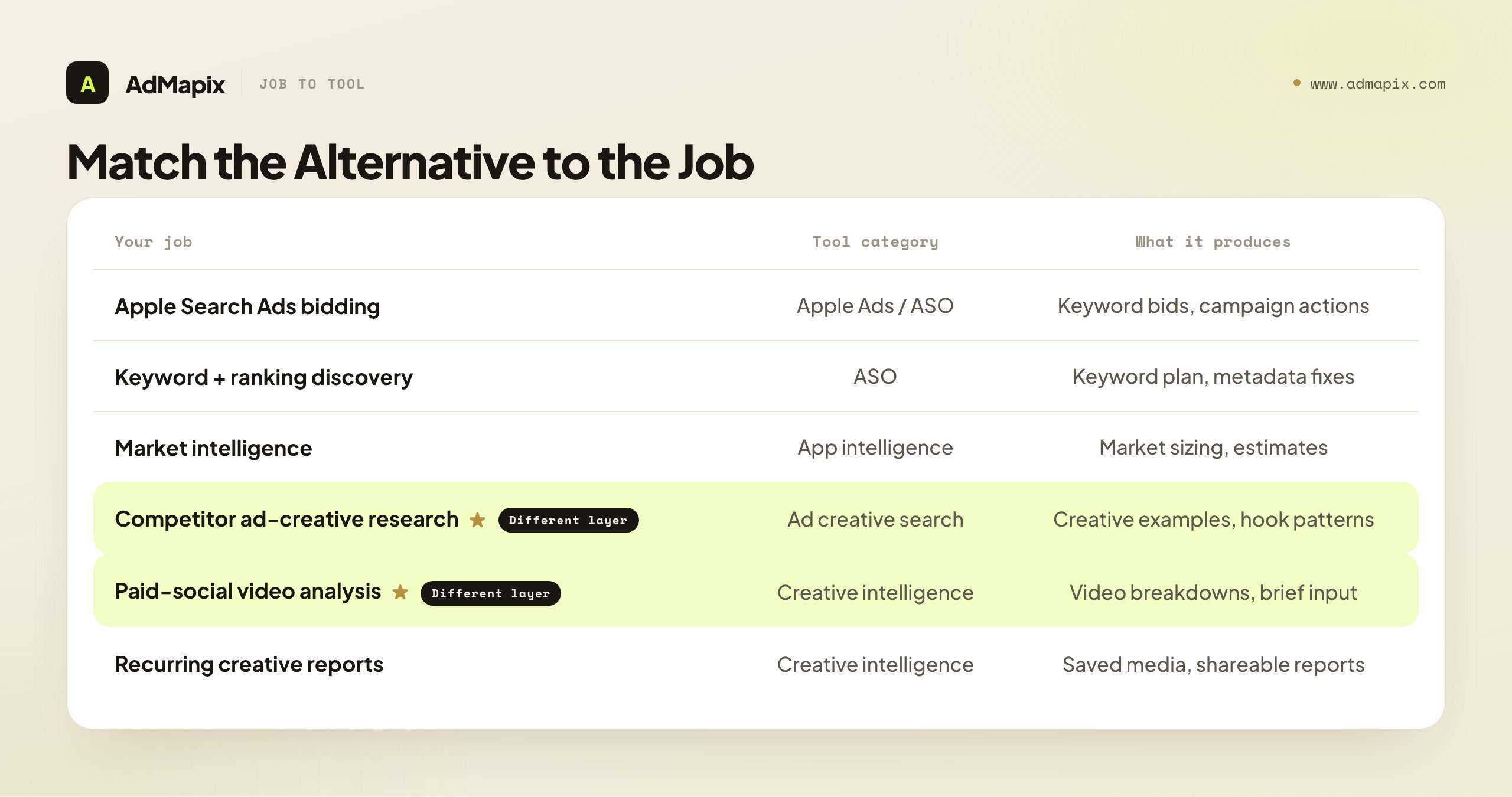
| Your job | Tool category | What it produces |
|---|---|---|
| Apple Search Ads bidding and optimization | Apple Ads / ASO | Keyword bids, campaign actions |
| App-store keyword and ranking discovery | ASO | Keyword plan, metadata fixes |
| App market intelligence (downloads, revenue) | App intelligence | Market sizing, competitor estimates |
| Store-level competitor tracking | ASO / app intelligence | Rank movements, keyword overlap |
| Competitor ad-creative research | Ad creative search | Creative examples, hook patterns |
| Paid-social video analysis | Creative intelligence | Video breakdowns, brief input |
| Recurring competitor creative reports | Creative intelligence | Saved media, shareable reports |
The split is simple: Apple Ads and ASO tools produce keyword and campaign actions; creative tools produce evidence for the next ad test. If your next decision is a bid or a keyword, stay in the first group and shortlist MobileAction alternatives there. If your next decision is a creative brief, you need the second group, and a longer keyword database is irrelevant to you.
The discipline this table enforces is to lead with the decision rather than the tool. It is tempting to start from "which tool is most comprehensive" and work backward, but that path almost always lands you on a broad tool that is mediocre at your specific job. Start instead from "what is the single next decision I am trying to make better" — a bid adjustment, a keyword choice, a metadata change, or a creative test — and the table points you to exactly one column. That is the column to shortlist within. Everything else is a distraction dressed up as thoroughness.
The roles on a real team map cleanly onto these columns, and the role usually tells you the tool before any feature comparison does. The Apple Search Ads manager and the ASO specialist live in the left columns — their KPIs are cost per acquisition from search, keyword rank, and store conversion, all of which are moved by bids, keywords, and metadata. The UA lead, the creative strategist, and the performance marketer who buys paid social live in the right columns — their KPIs are cost per install and ROAS from social, which are moved overwhelmingly by creative once traffic is flowing. When an ASA manager reaches for a creative tool, or a creative lead reaches for an ASA tool, it is almost always because the org only bought one tool and that was the one it had. The fix is not to force one tool to do both jobs; it is to recognize that the two seats need two layers and to budget accordingly. Buying against the seat's actual KPI, rather than against the longest feature list, is the single most reliable heuristic in this entire decision.
A second discipline the table encourages is honesty about the tempo of your problem, which is another fast diagnostic. ASA and ASO problems tend to fail slowly and structurally — your keyword visibility erodes, your search funnel is quietly under-fed, your costs creep up over weeks. Creative problems fail fast and visibly — a winning ad fatigues, CPMs climb, CPA spikes in days, and you scramble for the next hook. If your pain is the slow, structural kind, you are almost certainly in the left columns. If it is the fast, visible kind, you are in the right columns. The speed at which your problem is biting is one of the cheapest and most reliable signals about which layer you actually need.
When the Real Gap Is Creative, Not Keywords
Here is the situation a lot of people are actually in when they search "MobileAction alternative," even if they would not phrase it this way. Their ASA and ASO are running fine. They can bid, they can find keywords, they can track store rankings. What they cannot do — and what is genuinely blocking growth — is see what competitors are running in their paid-social ads and turn that into a creative they can test. They are losing on creative, and another keyword tool will not fix it, because the problem was never in the keywords.
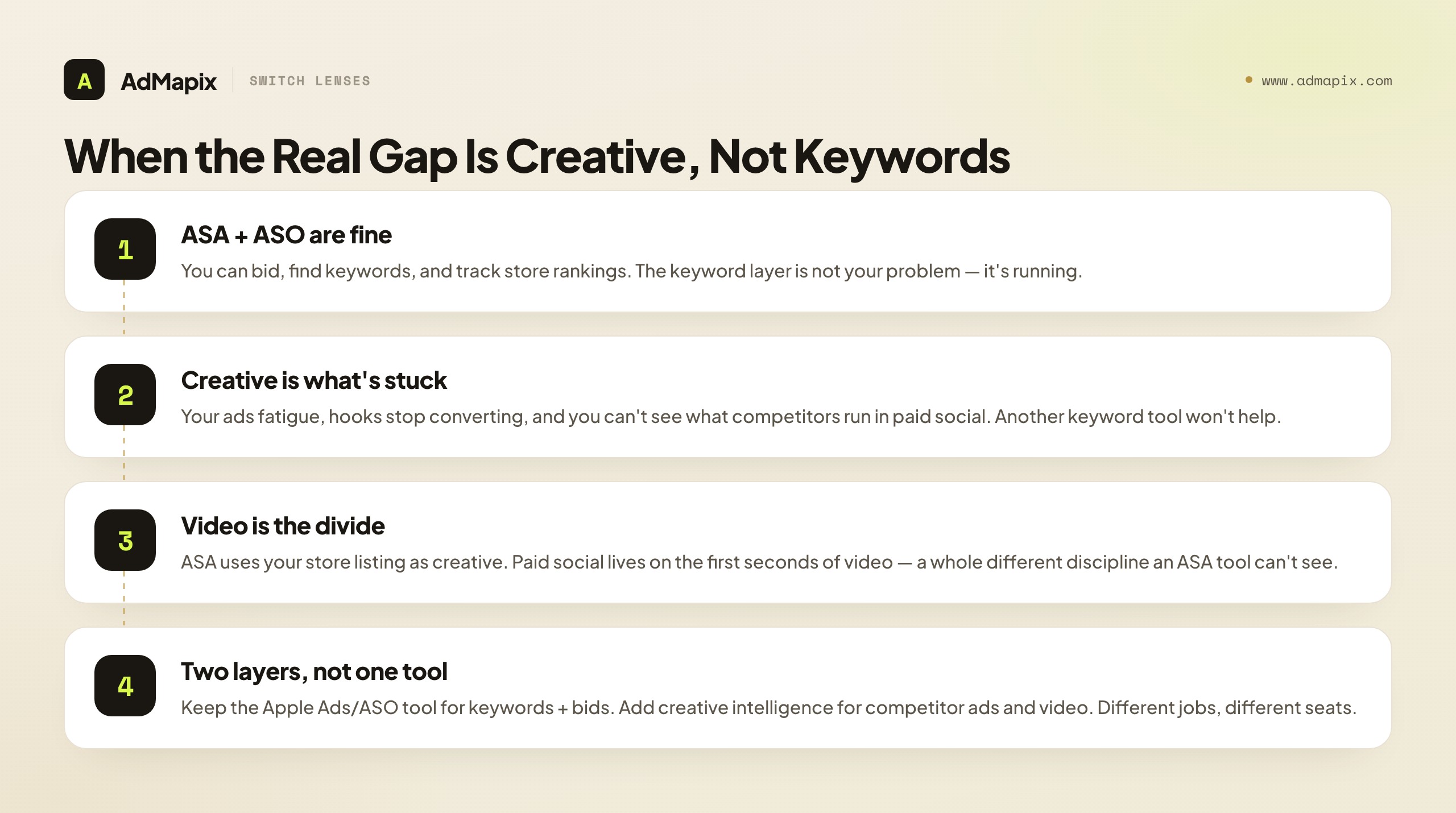
This is the moment to switch lenses completely. If your bottleneck is creative — your own ads fatigue, your hooks stop converting, you have no systematic way to see what is working in your category's paid social — then your "MobileAction alternative" is not an Apple Ads or ASO tool at all. It is ad creative intelligence: the ability to search competitor ads across networks, save the strongest examples, break down the videos, and turn patterns into briefs. An ASA tool and a creative-intelligence tool are not competing for the same budget line; they answer different questions for different seats.
The contrast is sharpest around video, and video is where mobile growth is increasingly won. Paid-social creative lives and dies on the first few seconds — the hook, the pacing, the offer framing. An Apple Search Ads tool has nothing to say about any of that, because ASA does not use that kind of creative; your "ad" in ASA is your store listing. A creative-intelligence tool that breaks video down is the only thing that turns "we need fresh creative" into "here is the specific hook three competitors are running, here is the format, here is the angle we should test next." That translation — from a vague sense that creative is stale to a concrete, testable brief — is the whole job, and it is a job no keyword-and-bid tool can do.
The seats that feel this gap most acutely are the UA lead and the creative strategist, whose entire output depends on a steady supply of fresh, evidence-backed angles. For them, an ASA tool is not a lesser solution to their problem; it is a solution to a different problem. What they most often lack is not ideas but a system for capturing competitor creative evidence before it evaporates — a place to search, save, tag, and revisit the strongest examples so that scattered noticing becomes a durable library. That system is the creative layer, and it is worth more to these seats than any keyword feature, because it is the raw material their job is built on.
A concrete example makes the gap unmistakable. Suppose your store-side competitor tracking shows a rival climbing the rankings in your category over six weeks, and their branded-search volume is clearly up. Your ASA tool can show you the symptom — the climb — but it cannot tell you the cause, because the cause is usually off-store. Are they bidding harder? Did they improve their listing? Or — most often in mobile growth — did a paid-social creative find a hook and start scaling, lifting both installs and branded search? The store data cannot distinguish these, because all of them produce the same upward curve. The only way to open that box is to look at what the rival is actually running in their ads, which is a different tool entirely. When you do, and you find a single UGC-style testimonial video running in forty variants across networks for the whole six-week window, the story snaps into focus and, crucially, becomes testable for you. The ranking climb was the symptom; the creative was the cause you can act on.
If you recognize yourself here, the cleanest mental model is two layers, not one tool. Keep your Apple Ads and ASO tool for keywords, bids, and store visibility. Add a creative-intelligence layer for the competitor-ad and video work. We map the same split for two neighboring tools whose searchers hit the identical wall: the AppTweak alternative guide (AppTweak leans toward broad ASO and Apple Search Ads) and the Appfigures alternative guide (Appfigures leans toward app analytics, downloads, and revenue estimates). All three are different tools, but the cross-cutting lesson repeats: separate the store-and-bidding job from the creative-evidence job, and buy each layer for what it actually does.
How to Choose an Apple Ads / ASO Alternative
If you stay in the Apple Ads and ASO lane, compare on the levers you actually pull, not on the breadth of the catalog. The tools in this category differ most in keyword data quality, ASA automation depth, store and country coverage, competitor tracking, export, and pricing clarity. Use a fixed checklist so two vendors are judged on the same evidence rather than on whichever demo was slicker.
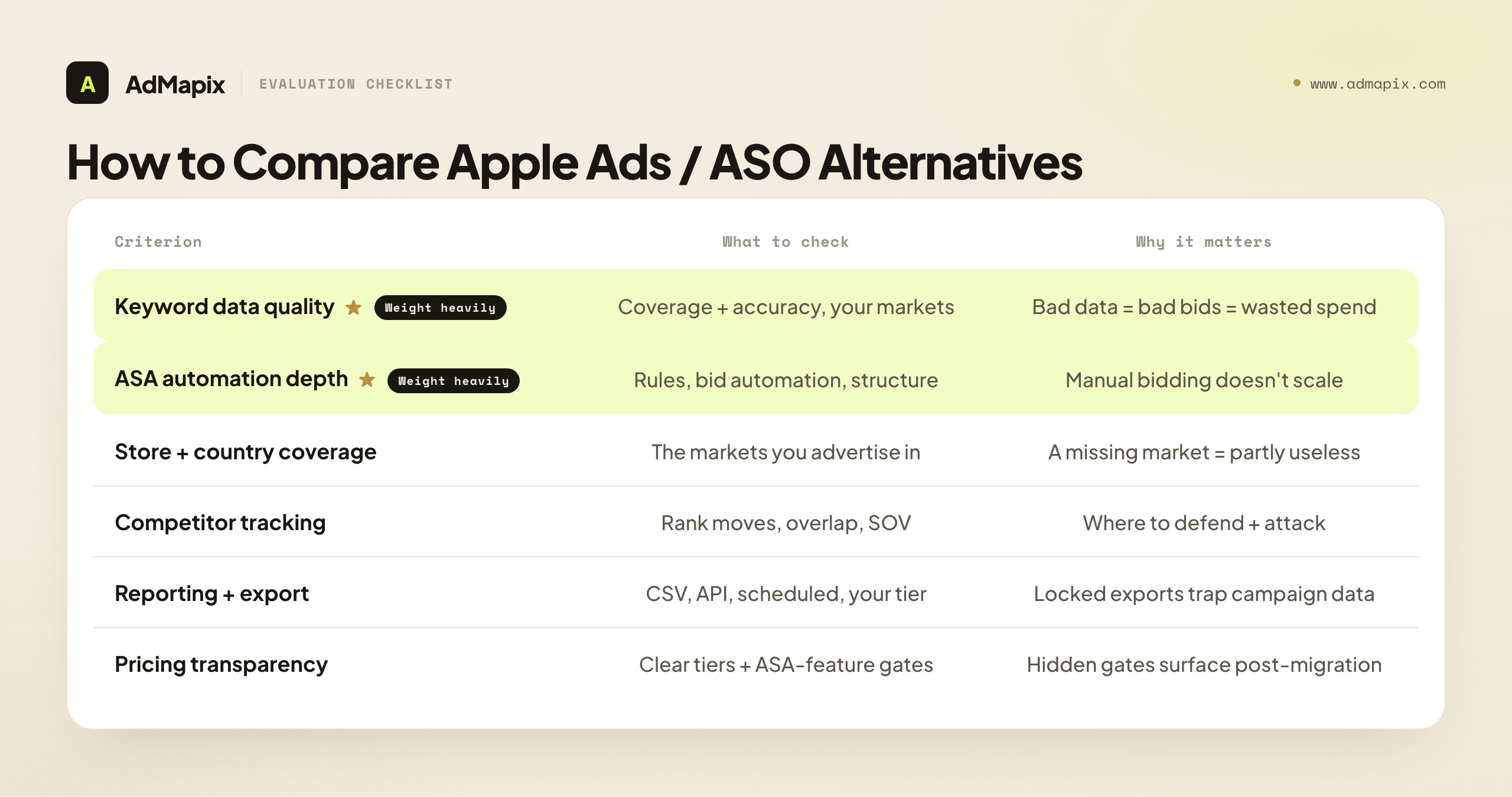
| Criterion | What to check | Why it matters |
|---|---|---|
| Keyword data quality | Coverage and accuracy for your category and countries | Bad keyword data means bad bids and wasted spend |
| ASA automation depth | Rules, bid automation, campaign structure support | Manual bidding does not scale past a few campaigns |
| Store and country coverage | The markets and stores you actually advertise in | A missing market makes the tool partly useless to you |
| Competitor tracking | Rank movements, keyword overlap, share-of-voice | Tells you where to defend and where to attack |
| Reporting and export | CSV, API, scheduled reports on your tier | Locked exports trap your campaign data |
| Integrations | Connection to Apple Ads, attribution, your stack | Friction here slows every weekly workflow |
| Pricing transparency | Clear tiers and what each unlocks | Hidden ASA-feature gates surface after migration |
The way to use this is to weight the rows that map to your real workflow. A team running ASA at scale should weight automation depth and keyword data quality above everything, because those rows directly determine spend efficiency. A smaller team might weight coverage and pricing transparency more. An agency managing many accounts should weight reporting, export, and multi-account support. Score the rows that move your number, not all of them equally.
The evaluation method matters as much as the checklist. The temptation is to run the broadest tool through a quick demo, be impressed, and buy. The better method is to define the workflow you actually run — a weekly ASA bid review, a monthly keyword expansion, a quarterly competitor audit — and then time how long each candidate takes to complete that workflow end to end on your real campaigns and your real markets. A tool with fifty features that takes three hours to get your weekly bid review done loses to one with twenty features that gets you there in forty minutes, because the bid review is the job and everything else is noise. Score time-to-decision, not feature count, and you will consistently pick the tool that fits the way your team actually works rather than the one that demos best.
One more cost teams underestimate when switching ASA/ASO tools: migrating state. Your current tool holds tracked keywords, saved competitor lists, campaign structures, automation rules, and historical reports built up over months. None of that comes with you automatically, and ASA campaign structure in particular is laborious to recreate. Before you switch, inventory the state you genuinely rely on and budget the time to rebuild it, or the first month will feel slow and you will wrongly blame the new platform for a cost you carried over. The smoothest migrations are the ones where someone explicitly listed "rebuild these campaigns, these tracked keywords, and these automation rules" as a task, rather than discovering the gap piecemeal mid-workflow.
And verify current coverage and pricing before you migrate. ASA features, the markets included on a tier, automation limits, and prices all change, and the plan that fit last quarter may not today. Confirm the live plan includes the stores, regions, automation, and export you need on the seat count you will actually buy, because discovering a gap after you have moved a campaign workflow onto a new tool is an expensive surprise. The evaluation traps that bite hardest in this category are the demo-data trap (vendors demo on a popular category in a major market where their data is best — test on yours), the single-campaign trap (one campaign looks great; run several before you trust it), and the automation-tier trap (the bid automation you saw in the demo turns out to be a higher-tier feature than the one you priced).
What Public Ad Data Can and Cannot Prove
This is the most important section in the guide, because misreading public ad data is the costliest mistake in the whole category — and it applies to MobileAction's competitor tracking, to AdMapix, and to every other tool that surfaces public signals. The discipline is the same everywhere: know the difference between evidence and proof.
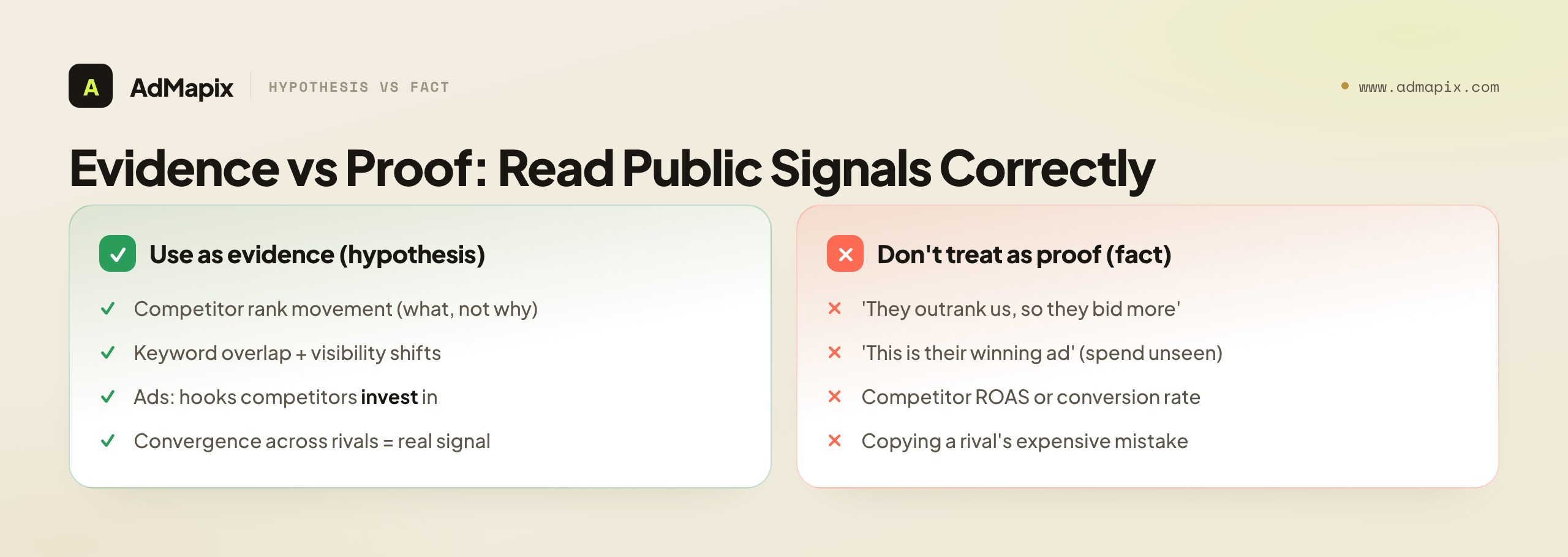
On the store side, MobileAction-class tools surface competitor rank movements, keyword overlap, and visibility shifts. These are real, observable signals — a competitor climbing for a keyword is a fact you can see — but the cause is an inference. A competitor rising on a keyword might mean they are bidding harder, optimizing metadata, running paid-social that lifts branded search, or simply riding a seasonal wave. The rank movement is evidence; the explanation is a hypothesis you should hold loosely until you have more signal.
On the creative side, the inference is even more tempting and even more dangerous. When you find a competitor running a specific video hook across many variants, sustained over weeks, that is strong evidence they are investing in it and likely iterating. It is not proof of performance. The public data does not reveal their spend, conversion rate, ROAS, or whether the campaign is actually profitable. A competitor can run a creative heavily for reasons that have nothing to do with it converting — brand calendars, internal politics, a misread dashboard, plain inertia. No public tool, AdMapix included, can see a competitor's internal performance data. Anyone claiming a tool surfaces "winning ads" from public data alone is overselling what the data can structurally support.
The unifying practice is to use public data to form hypotheses, then validate with data you own. A competitor rank movement suggests where to look in your ASA and ASO; your own campaign results confirm what actually shifts your numbers. A competitor ad suggests an angle to test; your own paid-social results confirm whether it works for your audience. Keep that line crisp — evidence in, proof from your own numbers — and you get nearly all the value of both layers while avoiding the expensive mistakes. There is also a defensive asymmetry worth exploiting: public ad data is far better at telling you what not to miss than what to copy. If several competitors all shift to the same video format in a month, that convergence is near-certain reason to test that direction, regardless of whether you can see their exact results. We go deeper on this discipline in our competitive analysis for paid advertising guide.
It is worth understanding why the inference from a heavily-run creative to "this is working" is reasonable but not certain, because the gap is exactly where teams trip. The logic rests on competitor rationality: a competent advertiser kills losers and scales winners, so a creative that has survived for weeks and been varied many times has probably passed their internal performance bar. That holds often enough to be the basis of nearly all creative intelligence. But it breaks in predictable ways. Brand campaigns run on a calendar, not on ROAS, so a heavily-run brand creative signals a commitment, not a result. Large advertisers tolerate underperforming creatives longer than a lean startup would. Some teams genuinely are not optimizing well, and you would be copying their mistake. The signal is real, but it is probabilistic — which is precisely why your own test is non-negotiable: it converts a probabilistic competitor signal into a definite answer for your audience, your offer, and your price point.
This is also the honesty test to apply to any vendor in either layer, ours included. To an ASA/ASO vendor: "How current is your keyword and rank data, and how accurate is it for my category in my markets?" A good answer is specific and candid about where coverage thins. To a creative-intelligence vendor: "Can your tool tell me how a competitor's specific ad actually performed?" The correct answer is no, with an explanation of what it can show — run frequency, variant count, format, longevity, cross-network spread. If an ASA vendor implies their data is perfectly comprehensive everywhere, or a creative vendor claims to surface "winning ads" from public data, you are being sold a story the data cannot back, and that alone is reason to keep looking.
Common Mistakes When Replacing MobileAction
The failure modes here are predictable, which is good news — predictable mistakes are avoidable once you can name them. Here are the ones that cost teams the most, with the fix for each, ordered roughly from most to least common.
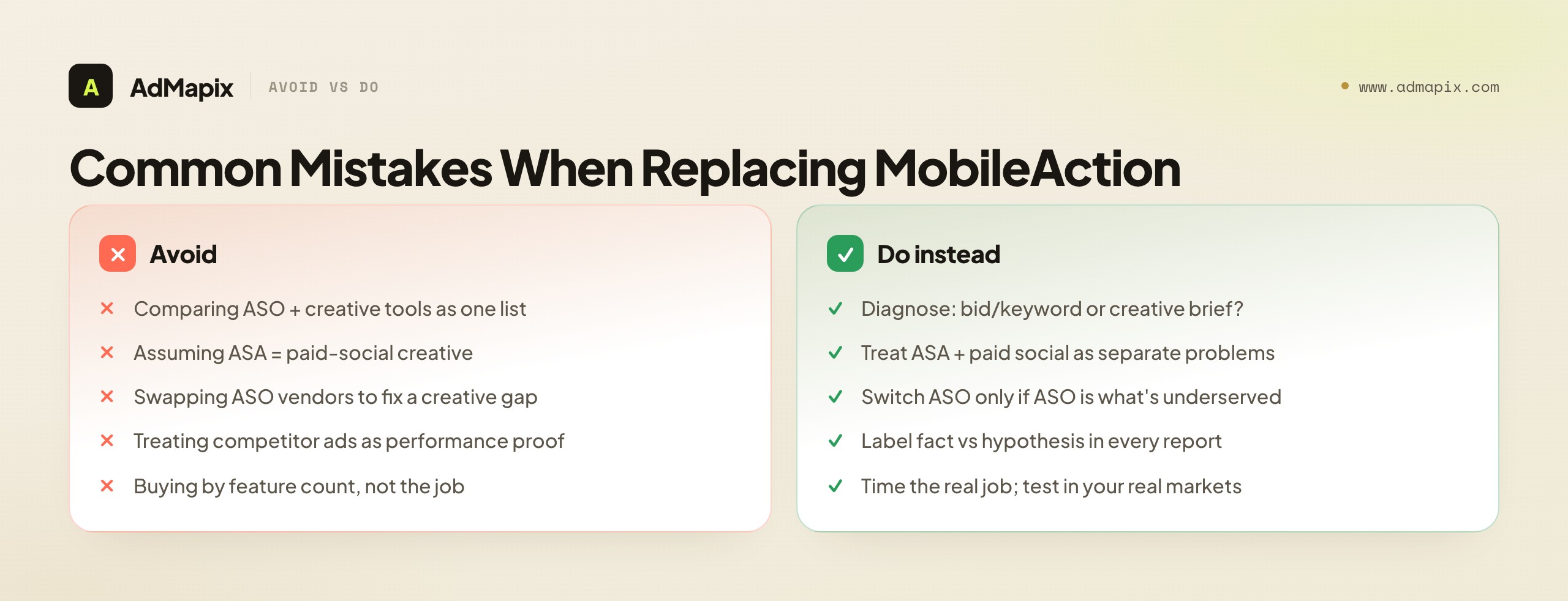
Comparing Apple Ads / ASO tools against creative tools as one list. This is the root mistake, and most of the others descend from it. The two categories solve different jobs; a single "best MobileAction alternatives" list hides that and steers you to the wrong purchase. Diagnose your layer first — bid-and-keyword or creative-brief — then shortlist within that layer only.
Assuming Apple Search Ads and paid-social creative are the same problem. They both say "ads," but ASA is a keyword-bidding discipline using your store listing as creative, while paid social is a video-and-hook discipline. A tool that is great at one is, almost by construction, not built for the other. Treat them as separate problems with separate tools.
Swapping ASO vendors to fix a creative gap. If your stuck metric is creative fatigue, moving from MobileAction to another ASO tool feels like progress but changes nothing, because you stayed in the wrong layer. Only switch within the ASO layer if your ASO/ASA job is the one that is actually underserved.
Treating competitor ads as performance proof. Repeated creatives suggest investment, not validated ROAS. Your own data validates. Build the fact-versus-hypothesis distinction into your reporting so it survives staff turnover and stakeholder pressure.
Buying for feature count instead of the job. A longer feature list is a weak proxy for value. The tool that gets you from question to a decision you would act on — fastest, repeatedly — wins on a one-year view even with fewer boxes ticked. Time the real job (a bid decision, or a creative brief), not the spec sheet.
Ignoring the markets and stores you actually advertise in. ASA availability, keyword data, and competitor creative all vary by country and store. Evaluate any alternative in your primary markets, not the US English default that every demo opens with.
Optimizing the tool instead of the decision. Perfecting dashboards, tracking ever more keywords, or saving ever more competitor ads feels productive, but if the number of decisions the tool drives stays flat, it is a hobby, not a growth lever. Tie every cycle to a decision — a bid change, a keyword, a metadata edit, or a creative test.
When (and When Not) to Use AdMapix
We will be precise about where AdMapix fits, because the whole point of this guide is to keep the layers honest. AdMapix is ad creative intelligence. It is the right tool when your Apple Ads and ASO are already handled and your real gap is competitor ad creative evidence: searching ads across networks, saving the strongest examples, breaking down videos, and turning patterns into reports and briefs. It is built for UA teams, creative strategists, and agencies who brief and ship paid-social tests on a cadence.
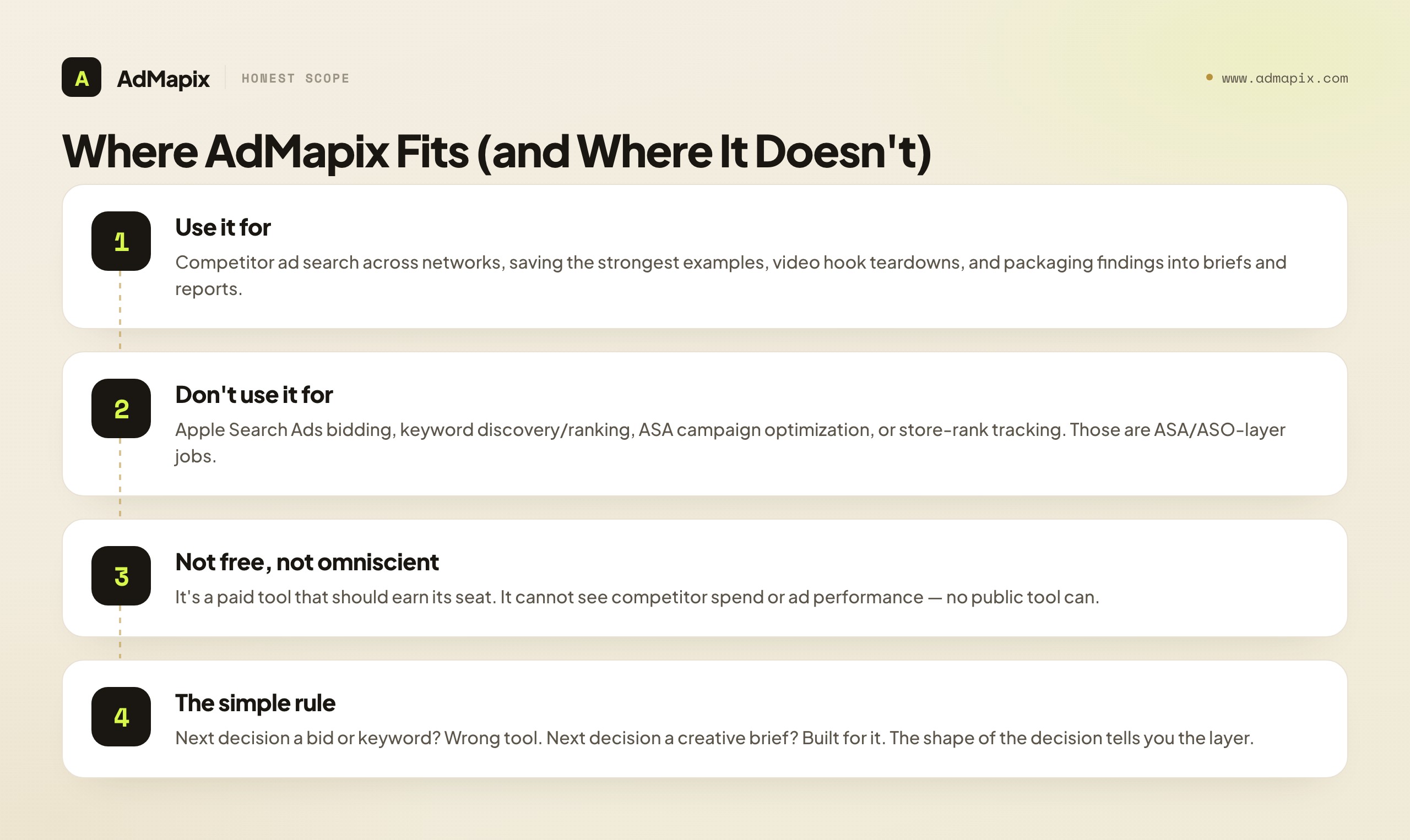
It is not an Apple Ads or ASO tool. AdMapix does not bid on Apple Search Ads, does not discover or rank app-store keywords, does not optimize ASA campaigns, and does not track store-level rankings. For those jobs, keep or replace your MobileAction-style tool — AdMapix does not do them and we are not going to pretend it does. It also cannot see a competitor's spend or ad performance, because no public tool can. And we are not going to call it "free"; it is a paid product that should earn its seat against the job it actually does. If your only bottleneck is Apple Search Ads and ASO, AdMapix is not your MobileAction alternative, and we would rather tell you that than sell you a mismatch. A simple rule keeps the line clear: if your next decision is a bid or a keyword, that is the ASA/ASO layer and AdMapix is the wrong tool; if your next decision is a creative brief, that is the creative layer and AdMapix is built for it.
Where it earns its place is the creative-research loop. A practical stack keeps your Apple Ads and ASO tool for keywords, bids, and store visibility, then uses Search AdMapix for cross-network creative discovery, Media to save the evidence worth keeping so you are not re-finding the same competitor ads every week, Video Analysis to break down hooks and first-screen structure, and Reports to package findings for the team or the client. A concrete weekly loop: take the competitor set you already track for store rankings, run it once in Search AdMapix to see what they are actually running in paid social, save the strongest creatives in Media, break the two or three most consequential videos down in Video Analysis, and write a short brief in Reports naming the one angle you will test and the metric you will judge it by. That loop turns store-level competitor awareness into a testable creative decision — the exact handoff an ASA tool alone can never complete.
The reason this handoff is worth building deliberately is that it closes a loop your ASA tool opens but cannot finish. Store-side tracking raises the question — "why is this competitor pulling ahead in search?" — and then goes silent, because the answer is usually off-store. The creative layer supplies that answer and, more importantly, converts it into something you can do on Monday. Without the creative layer, every interesting store signal dead-ends in curiosity or a reflexive bid increase; with it, the same signal becomes a specific creative test. That conversion — from "they're climbing, bid harder" to "they're climbing because of this angle, so match the bid and test the angle" — is the entire economic justification for the second layer, and it is why a team that has outgrown pure ASA so often finds the missing piece was never a better keyword tool but a creative-intelligence tool sitting next to it.
Once the creative workflow earns its place — once it is shaving real time off your weekly research and producing briefs your team acts on — compare seats on Pricing or create an account from Login. Until then, trial it against a real research job, time it, and let the result decide. We also cover the broader discipline of turning competitor signals into recurring decisions in our ad tracking and competitive research guide.
Building a Two-Layer Stack That Actually Works
For the many teams whose honest answer is "we need both," the goal is not to find one tool that does Apple Ads, ASO, and creative work adequately. It is to run two specialized layers with a clean handoff, so each does what it is best at and nothing falls between them.
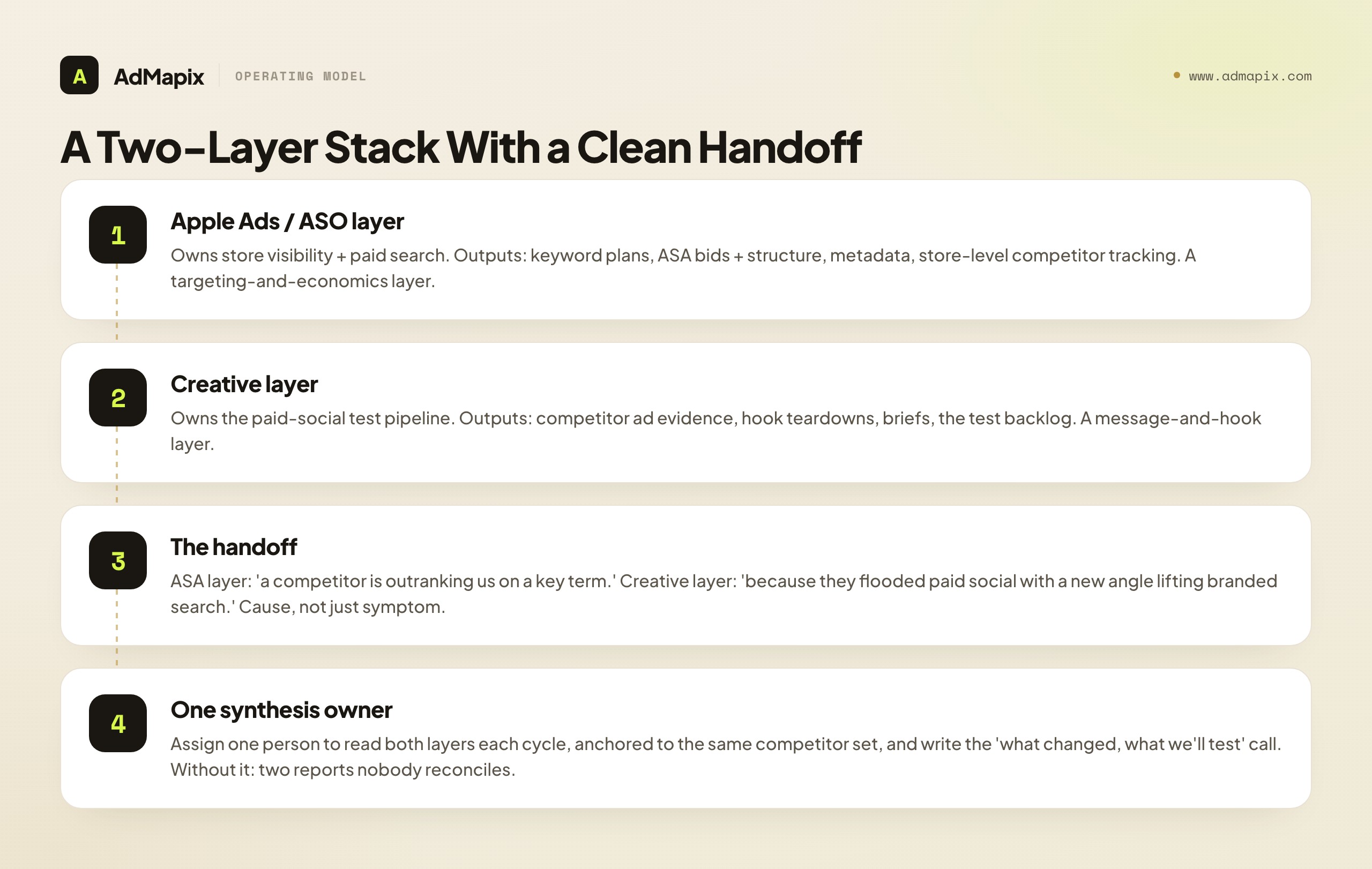
The Apple Ads and ASO layer — your MobileAction-class tool — owns store visibility and paid search. Its outputs are keyword plans, ASA bids and campaign structure, metadata recommendations, and store-level competitor tracking. Its job is to make sure that when demand exists in the store, your app shows up in organic and paid search and converts the browse into an install. This is a targeting-and-economics layer: which keywords, what bids, what metadata.
The creative layer — your ad creative intelligence tool — owns the paid-social testing pipeline. Its outputs are competitor ad evidence, hook teardowns, creative briefs, and the test backlog. Its job is to keep your paid-social creative ahead of fatigue by feeding a steady stream of validated-by-you angles into production. This is a message-and-hook layer: which angle, what video, what offer framing.
The handoff is where the value compounds. The ASA/ASO layer might surface that a competitor is suddenly outranking you on a high-intent keyword. On its own, that is a defensive signal — bid harder, fix metadata. But the creative layer can add the missing context: that same competitor has flooded paid social with a new video angle that is lifting their branded search, which is why they are climbing the keyword. Now you understand the cause, not just the symptom, and your response is sharper — match the bid and test the angle, rather than just bidding into a creative-driven wave you do not understand. The ASA layer tells you what changed in the store; the creative layer tells you what is driving it off-store; the synthesis is a strategy.
The organizational discipline that makes this work is a single synthesis owner. In a small team that is often the founder or head of growth reading both layers and writing the recommendation. In a larger team it is the ASA manager and the UA lead trading one headline each in a short recurring meeting and jointly deciding the next move. What does not work is leaving the connection to chance — assuming that because the ASA manager sees rankings and the UA lead sees creatives, the joined-up insight will emerge on its own. It will not. Connected insight is a job; give it an owner and a cadence, anchor both layers to the same competitor set and the same review rhythm, and the two-layer stack pays off. Leave it implicit, and you have two tools producing two reports nobody reconciles.
There is one more failure mode specific to two-layer stacks worth guarding against: optimizing each layer in isolation until they drift apart. The ASA layer starts tracking a sprawling list of keywords and competitors "just in case"; the creative layer accumulates saved ads nobody revisits. Both feel productive and neither drives decisions. The antidote is to anchor both layers to the same competitor set and the same cadence. Track the keywords and competitors you will actually act on, save the creatives you will actually reference, and review both on the same weekly or biweekly rhythm so the signals line up in time. When a ranking move and a creative shift point at the same competitor in the same week, that alignment is the highest-confidence input you will get — and you only see it if both layers are watching the same set on the same clock. A stack disciplined about scope and cadence produces sharp, aligned decisions; one that lets each layer wander produces two growing piles of data and a vague feeling of being well-informed while nothing changes.
Picture the payoff across a real cycle. Your ASA layer flags that a competitor jumped three positions on a high-value keyword this week and your impression share on it dropped. On its own, the reflex is to bid up — and you might, reactively, into a wave you do not understand. But the creative layer, anchored to the same competitor, shows that the rival simultaneously launched a fresh video angle across paid social that is plainly lifting their branded and category search. Now the same week's two signals tell one coherent story: this competitor is not just outbidding you, they are running a creative engine that is feeding their search demand. Your response upgrades from "bid harder and hope" to "match the bid to defend the keyword and test their angle to compete on the demand-generation front they just opened." That is a strategy, not a reflex, and it is only available to a team whose two layers are wired together and read by one person.
A Practical Decision Path
If you remember nothing else, remember the order of operations. The tool is the last decision, not the first.
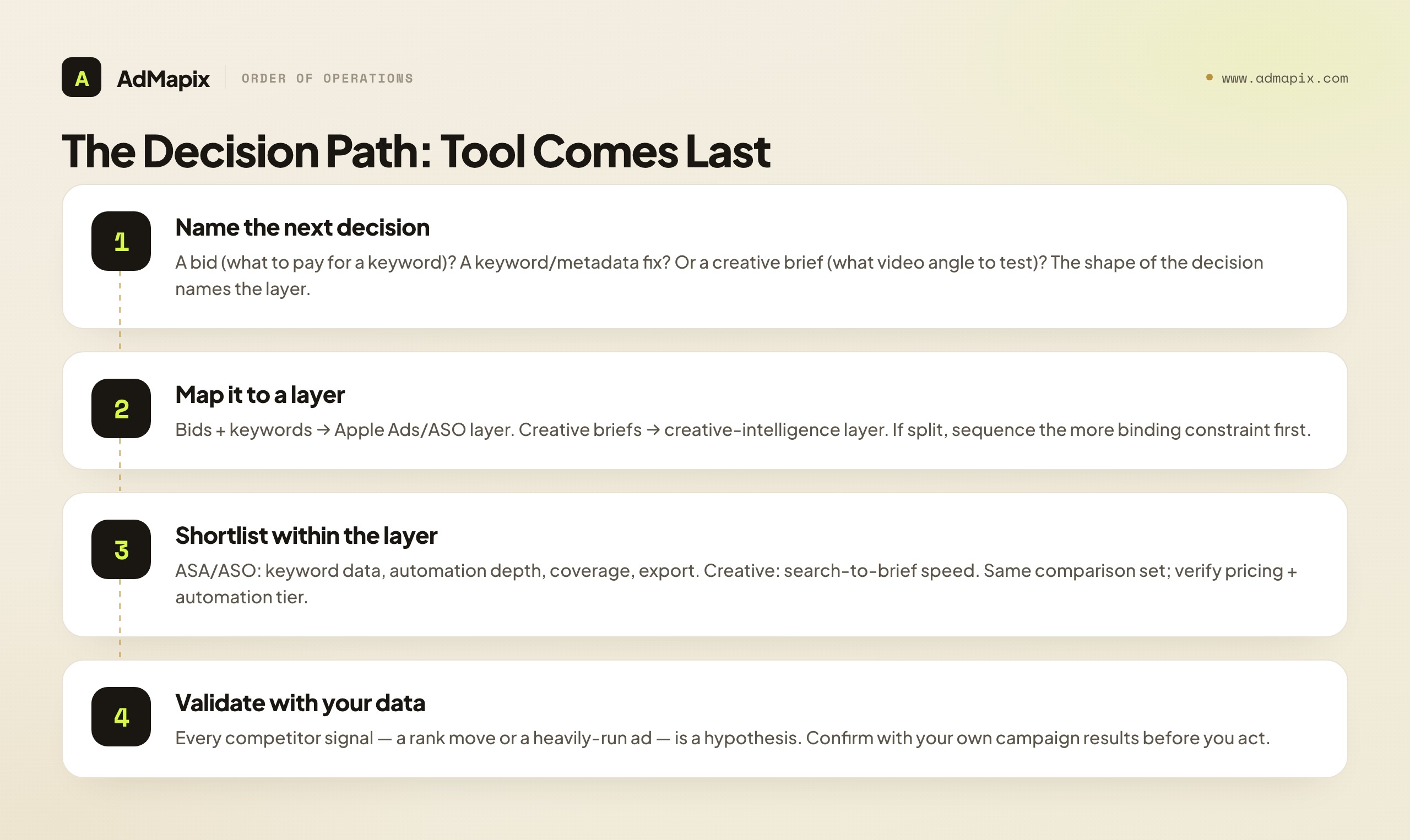
Start by naming the single next decision you are trying to make better. Is it a bid — how much to pay for a keyword in Apple Search Ads? A keyword — which terms to target or which metadata to fix? Those live in the Apple Ads and ASO layer. Or is it a creative brief — what video angle or hook to test next in paid social? That lives in the creative-intelligence layer. The shape of your next decision tells you the layer faster than any feature comparison can.
Then map that decision to its layer, and if your needs are genuinely split across both — bids and briefs — accept that you are a two-layer team. Plan for both, but sequence them: start with whichever layer's decision is the more binding constraint this quarter. A useful habit before any trial is to write the single sentence the trial must answer — "Can this get me to a confident weekly ASA bid decision in under thirty minutes?" or "Can this take me from a competitor name to a usable creative brief in fifteen?" A trial with a written success sentence ends in a clear yes or no; a trial without one ends in a vague impression and a purchase you half-regret. The sentence is free and it makes every later judgment crisper, because you stop asking "is this a good tool" in the abstract and start asking "did it do the one job I needed."
Next, shortlist within that layer only. For Apple Ads and ASO, compare keyword data quality, ASA automation depth, coverage, competitor tracking, and export against your real workflow. For creative, time how fast you go from search to a saved set of strong ads to a usable test brief. In both cases, run the same comparison set through every candidate, verify current coverage and pricing, and score time-to-decision rather than feature count.
Finally, treat every competitor signal — a rank movement or a heavily-run ad — as a hypothesis, not a verdict, and validate with data you own. That single discipline protects you from the most expensive mistakes in the category, regardless of which tools you choose. Do that, and "MobileAction alternative" stops being one confusing search and becomes two clear, answerable questions, each with a tool category that genuinely fits. The few minutes you spend naming the decision before you open a pricing page are the cheapest, highest-leverage minutes in the whole process — they make every dollar you spend afterward land where it actually moves a number, whether that number lives in the App Store search results or in the paid-social auction. Most wasted spend in app marketing is not a bad tool; it is a perfectly good tool bought for the wrong job because nobody named the constraint first. Name the constraint first, and the rest of the decision — which layer, which shortlist, which tool — gets dramatically easier and far cheaper to get right.
FAQ
What is the best MobileAction alternative?
There is no single best one, because it depends on the job. If your next decision is an Apple Search Ads bid, a keyword, or a metadata fix, your alternatives are other Apple Ads and ASO tools, and you should compare them on keyword data quality, ASA automation depth, coverage, and pricing. If your next decision is a creative brief, a creative-intelligence tool such as AdMapix fits a different layer entirely. Diagnose which decision you are trying to make before you shortlist — that matters far more than any feature comparison.
Can AdMapix replace MobileAction?
No. AdMapix does not bid on Apple Search Ads, discover or rank app-store keywords, optimize ASA campaigns, or track store rankings. It covers cross-network ad creative search, saved media, video analysis, tagging, and reports. It complements an Apple Ads and ASO tool rather than replacing it. If your bottleneck is ASA and ASO, keep or replace your MobileAction-style tool; AdMapix is the wrong layer for that job, and we would rather say so than sell you a mismatch.
Is Apple Search Ads a creative channel or a bidding channel?
Apple Search Ads is overwhelmingly a bidding channel. It places your app at the top of relevant App Store search results, and the "creative" in most cases is your existing app icon, title, and screenshots — the assets your ASO work already governs. So optimizing ASA is about targeting and economics: which keywords convert, what they cost, and how to structure campaigns and budget. That is why a MobileAction-class tool handles it, and why a creative-intelligence tool has nothing to add to ASA bidding.
Should app teams use both an ASO tool and a creative tool?
Usually yes, if both store visibility and creative testing are live problems. They are separate problems with separate evidence. Many teams keep an Apple Ads and ASO tool for keywords, bids, and store visibility, then add creative intelligence to research competitor ads and brief paid-social tests. The key is to assign one owner to synthesize both layers into decisions each cycle, anchored to the same competitor set, otherwise you have two data sources and no actions.
Does competitor ad data show how well an ad performed?
No. Public ad data shows what is running and how often it is varied, which signals investment and iteration. It does not reveal spend, conversion rate, or ROAS. A competitor can run a creative heavily and still lose money on it. Use the data to form hypotheses about what to test, then validate performance with your own campaign and business metrics. Any tool claiming to show competitor "winners" from public data alone is overselling what the data can support.
What is the difference between ASO/Apple Ads tools and ad creative intelligence?
ASO and Apple Ads tools answer targeting-and-economics questions: which keywords to target, how much to bid, how to structure ASA campaigns, and how to optimize store metadata and rankings. Ad creative intelligence answers advertising-creative questions: which competitor ads are live, what hooks and offers they use, and what you should test next in paid social. One is a keyword-and-bid lens; the other is a video-and-hook lens. Different data, different workflow, different owner — and neither replaces the other.
Do I still need a separate ASO tool if I run Apple Search Ads?
ASA and broader ASO are tightly linked — better organic keyword rankings and metadata often lower your ASA costs, and ASA data feeds keyword discovery — so most teams want them in the same tool or the same layer. A MobileAction-class platform typically covers both. Whether you need additional depth depends on how large and sophisticated your keyword operation is. Either way, that is all the store-and-bidding layer; it is separate from the creative-intelligence layer that handles competitor ads.
How is MobileAction different from AppTweak or Appfigures?
All three are app-marketing tools with different centers of gravity. MobileAction leans toward Apple Search Ads bidding plus ASO and app intelligence. AppTweak leans toward broad ASO and Apple Search Ads. Appfigures leans toward app analytics, downloads, and revenue estimates. Because they overlap, searchers for each face the same store-versus-creative split this guide describes. See our AppTweak alternative and Appfigures alternative guides for the tool-specific versions.
How do I evaluate an Apple Search Ads tool specifically?
Lead with the levers that drive ASA spend efficiency: keyword data quality and coverage for your categories and countries, and the depth of bid automation and campaign-structure support, since manual bidding does not scale. Then check integrations with Apple Ads and your attribution stack, competitor tracking, and export. Crucially, run a real campaign workflow during the trial in your own markets, time how fast you get to a confident bid decision, and confirm the automation you need is on the tier you priced.
How often should I review competitor ad creative?
A weekly or biweekly cadence works for most teams, matched to your creative production rhythm. The goal is to catch format shifts and new angles early enough to test them before they are exhausted, not to watch competitors constantly. Save the strongest evidence so each review builds on the last instead of starting from scratch, and end every review with a concrete test recommendation. Cadence plus a saved evidence base is what turns ad-watching into a compounding advantage rather than busywork.
Key Takeaways
- Decide whether your next decision is a bid/keyword (Apple Ads / ASO) or a creative brief (ad intelligence) before you shortlist any tool.
- For Apple Search Ads bidding, keyword discovery, metadata, and store-level competitor tracking, compare other ASO / Apple Ads tools — not creative databases.
- For competitor ads, video hooks, and creative briefs, use creative intelligence such as AdMapix. It complements an ASA/ASO tool; it does not replace one.
- Apple Search Ads is a bidding discipline using your store listing as creative — it is not the same problem as paid-social video creative.
- Treat competitor signals (rank movements and heavily-run ads) as hypotheses, and validate with your own campaign data.
- If you need both layers, run them deliberately with one owner synthesizing them into decisions each cycle, anchored to the same competitor set.
Sources
Official pages checked as of June 21, 2026. Pricing, product names, and availability can change, so verify the current plan before purchase or migration.
- MobileAction — positions itself as an app-store intelligence platform covering ASO, Apple Search Ads, ad intelligence, and market data.
- MobileAction Apple Search Ads — describes its Apple Ads campaign management, keyword bidding, and automation features.
- MobileAction ASO intelligence — focuses on keyword tracking, app-store optimization, and store-level competitor tracking.
- Apple Search Ads — Apple's own description of how Search Ads place apps in App Store search results.
Disclosure: AdMapix is our product. We include it where the job is competitor ad creative research and video analysis, and we separate that clearly from the Apple Search Ads and ASO workflows it does not cover. We do not describe it as free, and we do not claim it can see competitor spend or ad performance, because no public tool can.
Turn these observations into your next creative study
Open the creative library and select samples for your market, network and research question.
Related Articles
Best KaloData Alternatives in 2026: FastMoss, Shoplus, EchoTik & AdMapix Compared
A 2026 guide to the best KaloData alternatives: how to pick by job, a side-by-side comparison of TikTok Shop analytics and competitor ad-intelligence tools, pricing context, migration tips, and where AdMapix fits.
SwipeKit Alternative in 2026: 7 Tools Compared (Swipe Files, Video & Reporting)
A 2026 guide to choosing a SwipeKit alternative — why ad-saving isn't the bottleneck, a 7-tool comparison with pricing and coverage, the saving-vs-acting distinction, a migration plan, and an honest read on when AdMapix fits and when SwipeKit is still right.
SocialPeta Alternative in 2026: 7 Tools Compared (Without Overbuying)
A 2026 guide to choosing a SocialPeta alternative — why teams overbuy mobile ad intelligence, a 7-tool comparison with pricing and coverage, the creative-vs-market-data distinction, a migration plan, and an honest read on when AdMapix fits and when SocialPeta is still right.