
Mobile Game User Acquisition in 2026: The Complete UA, Creative & Marketing Playbook
A 7,000-word 2026 mobile game user acquisition playbook: UA channels, creative testing, CPI/ROAS math, competitor ad research, soft launch, and a 30/60/90-day scaling system for indie and mobile teams.
By the AdMapix Research Desk - Updated April 16, 2026
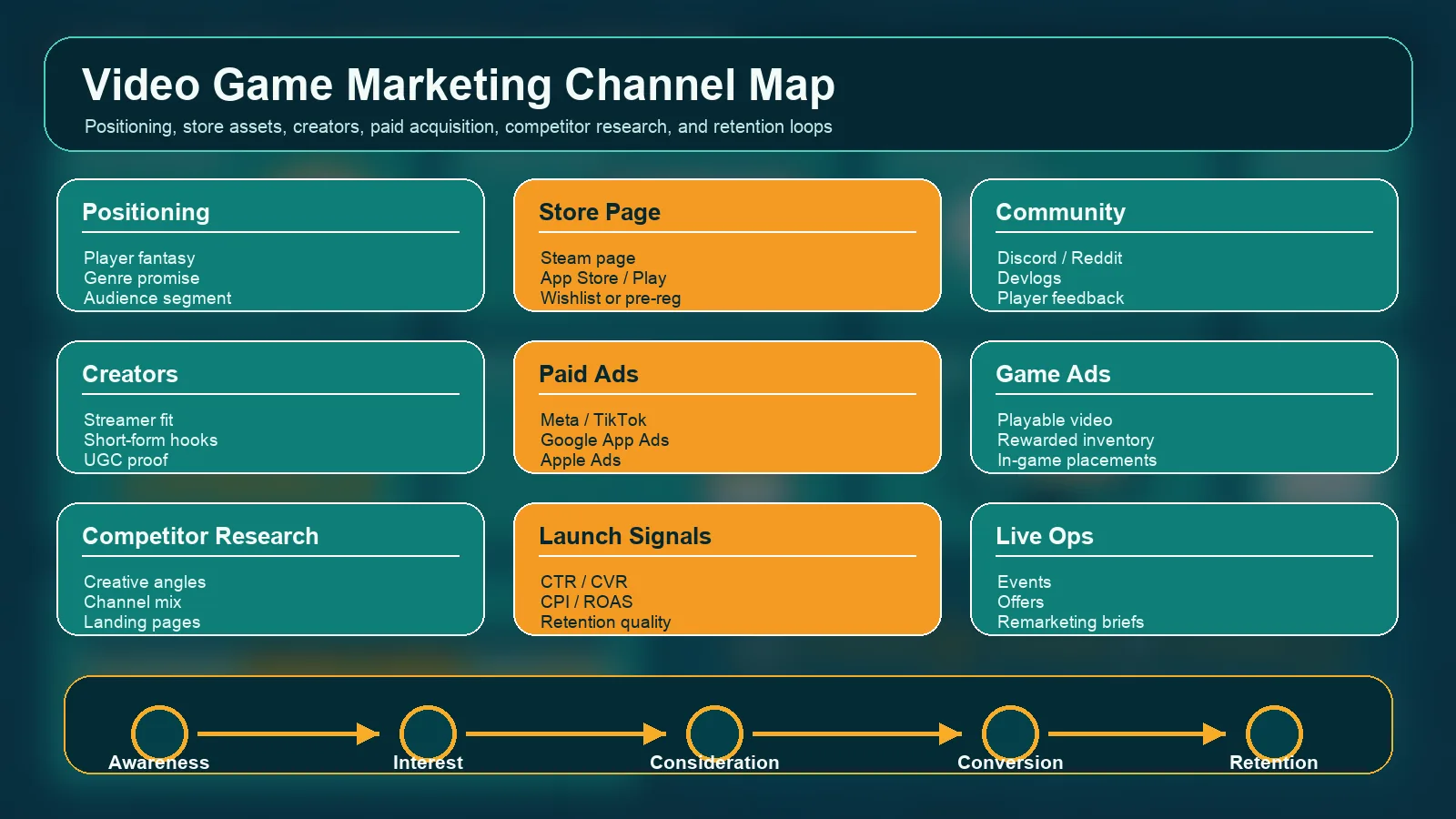
Mobile game user acquisition is the engine that turns a finished build into a profitable, growing player base. Everything else in video game marketing - positioning, store pages, creators, community - exists to feed and sharpen that engine. If your creative testing, channel mix, and ROAS math are wrong, no trailer or press beat will save the launch. If they are right, a single winning hook can fund the next twelve months of development.
This guide is written for UA managers, growth leads, indie founders, mobile publishers, and creative strategists who need a practical, end-to-end system to acquire players in 2026 - not a brand-theory lecture. It covers the full user acquisition stack for mobile games (with PC and console context where it matters): positioning that survives a 6-second ad, the channel map, creative testing as a science, CPI/ROAS/LTV math, competitor ad research, soft launch, and a 30/60/90-day scaling plan.
If you want the broader strategic playbooks, read our mobile game marketing strategy. For ad formats and examples, use the mobile game ads guide. For the general paid-acquisition framework across app verticals, see paid user acquisition. For monetization that decides how much you can afford to spend, read mobile game monetization.
The short version: do not start by asking where to spend. Start by defining why a specific player should install in the first six seconds of an ad - then build a channel and creative system that proves it, measures it, and scales only what pays back.
TL;DR - Mobile Game User Acquisition in 2026
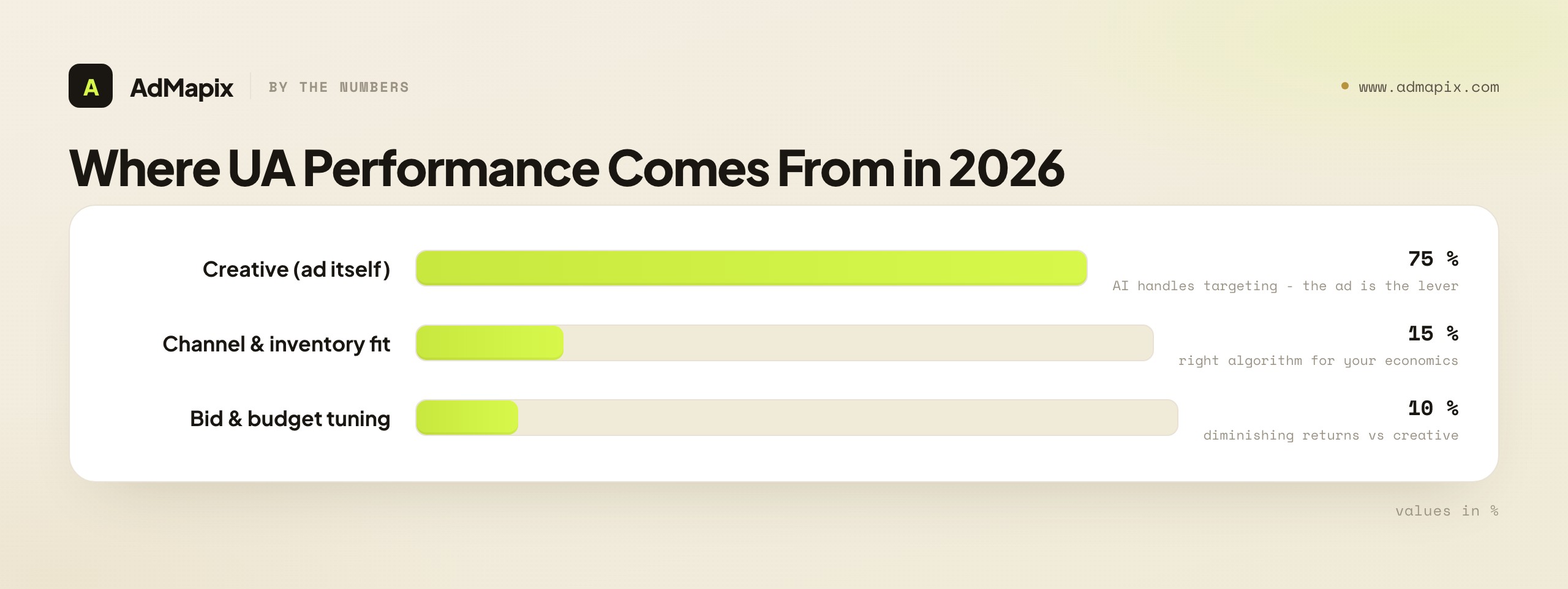
- UA is a creative problem before it is a media-buying problem. In 2026, with broad-targeting AI campaigns (Google App Campaigns, Meta Advantage+, Applovin AXON) doing the audience work, your creative is your targeting. 70-80% of performance variance comes from the ad, not the bid.
- Test creative in structured batches, not as one-off assets. Tag every ad by player fantasy, hook type, and proof type. Read CTR, IPM (installs per mille), CPI, store CVR, and D7 retention together - a cheap install that churns is a loss.
- The math that governs scale is LTV > CPI, paid back inside your payback window. Know your D7/D30 ROAS targets before you spend, not after.
- Soft launch is your cheapest insurance. A 2-4 week soft launch in 2-3 representative markets surfaces retention and monetization problems while installs still cost cents.
- Competitor ad research is the fastest way to cut blind spend. The hooks already winning in your genre tell you what to beat, and the underused player fantasies tell you where the gaps are.
- Channels each need one job. Don't ask Google App Campaigns, Meta, TikTok, Apple Ads, and in-app networks to all do awareness, conversion, and retention at once. Match the channel to the job and the signal.
Why "User Acquisition," Not Just "Marketing"
Video game marketing used to be framed as a launch campaign: trailer, press beat, store page, creator outreach, paid media, launch-day push. That still exists. But for mobile games - and increasingly for free-to-play PC titles - the durable competitive advantage is a repeatable user acquisition machine that runs every day, not just at launch.
User acquisition (UA) is the discipline of profitably and predictably acquiring new players through paid and organic channels, measured against lifetime value. The word "profitably" is doing the heavy lifting. Anyone can buy installs. The skill is buying installs that retain, monetize, and pay back faster than the cash burns.
Here is how the two framings differ in practice:
| Dimension | "Game marketing" framing | "User acquisition" framing |
|---|---|---|
| Core question | "How do we make people aware of the game?" | "How do we profitably acquire players who retain and monetize?" |
| Primary metric | Reach, impressions, sentiment | CPI, ROAS, LTV, payback window |
| Cadence | Campaign bursts around beats | Daily testing and optimization loop |
| Creative role | Brand assets and trailers | Performance hypotheses tested at volume |
| Success signal | Buzz, wishlists, press | Profitable, scalable install volume |
| Risk if wrong | Weak launch week | Burning cash on churning users every day |
Both matter. A game with zero awareness has no top of funnel; a game with awareness but broken UA economics dies slowly. This guide treats UA as the spine and folds the broader marketing work (positioning, store, creators, community) into the parts of the funnel where they actually move the needle.
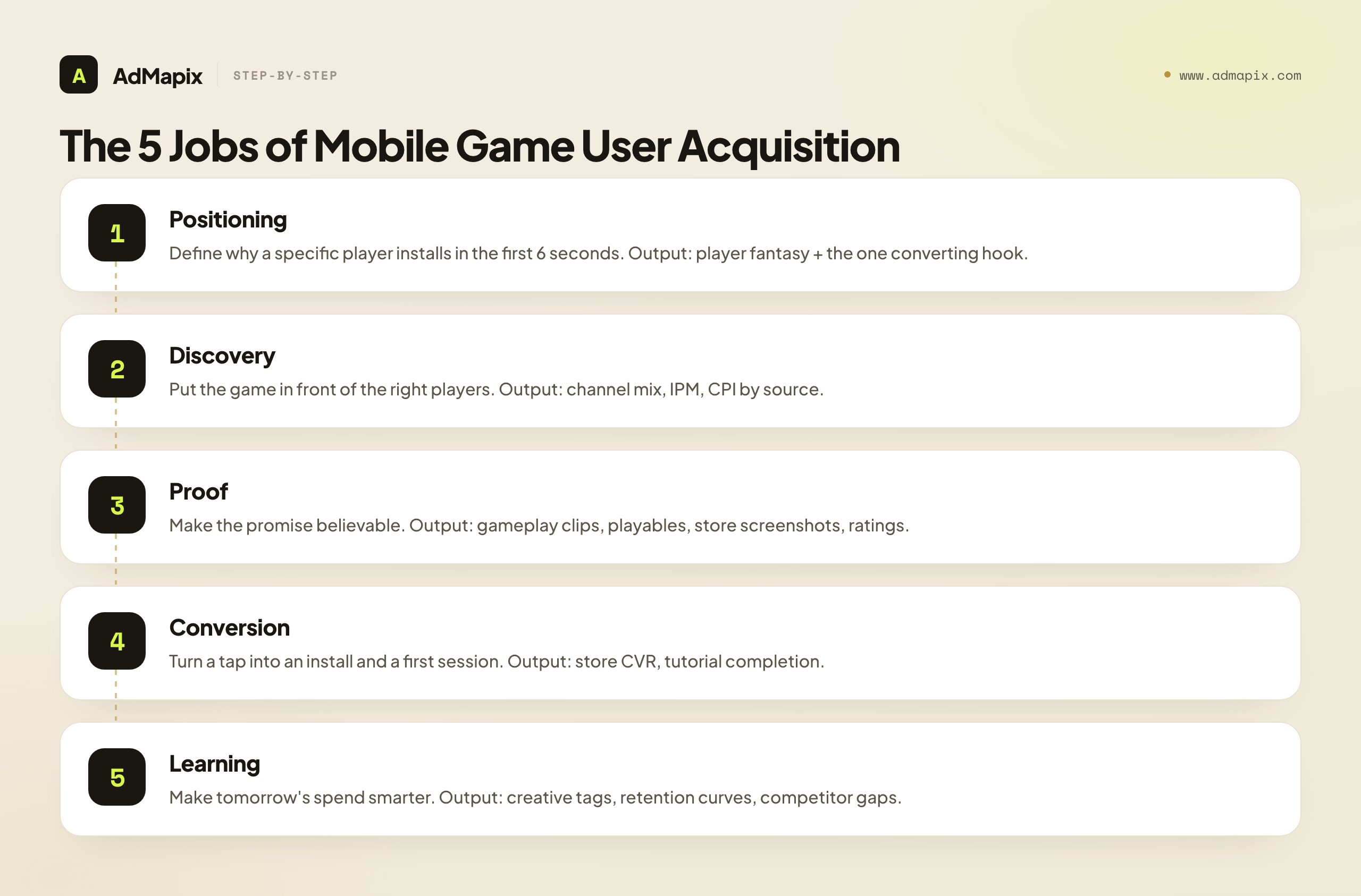
Modern Mobile Game UA: The Five Jobs
Modern user acquisition has five jobs. Each maps to a stage of the funnel and a measurable output. If any one is weak, the others compensate by spending more money for the same result.
| Job | What it answers | Output / metric |
|---|---|---|
| Positioning | Why should this player install in 6 seconds? | Player fantasy, genre promise, the one hook that converts |
| Discovery | Where can the right players first see the game? | Channel mix, IPM, CPI by source |
| Proof | What makes the promise believable enough to install? | Gameplay clips, playables, store screenshots, reviews, ratings |
| Conversion | What turns a tap into an install and a first session? | Store CVR, install rate, tutorial completion |
| Learning | What makes tomorrow's spend smarter? | Creative tags, source quality, retention curves, competitor gaps |
The search intent behind mobile game UA is overwhelmingly practical. Teams want to know which channels to use, what creative to produce, how to compute CPI and ROAS, how to read retention, how to soft launch, and how to avoid lighting money on fire. The rest of this guide answers each of those in execution-ready detail.
Start With Positioning Before You Spend a Dollar
Channels and budgets amplify positioning. They never fix weak positioning. A blurry promise just means you pay more per install for players who churn faster - the worst possible combination.
Before choosing TikTok, Google App Campaigns, Meta Advantage+, Apple Search Ads, Applovin, Unity, Discord, or creators, write a one-page positioning brief. This is the single highest-leverage hour in the entire UA process.
| Question | Weak answer | Useful answer |
|---|---|---|
| Who is the primary player? | "Gamers" | "Cozy management players who like low-pressure optimization on a commute" |
| What is the player fantasy? | "It's fun" | Build, master, escape, collect, compete, relax, explore, survive, dominate, create |
| What is the visible proof? | "Great gameplay" | The exact 3-second moment that makes the promise believable on a 6-inch screen |
| What is different from alternatives? | "Better graphics" | A specific mechanic, tone, pacing, or social loop competitors don't have |
| What should the player do next? | "Download it" | Install, complete the tutorial, hit the first reward, return on Day 2 |
The positioning brief is not branding fluff - it is the input to your first creative batch. Every hook you test is a hypothesis about which version of the fantasy converts. Without the brief, your "tests" are just random ads.
Concrete examples of how positioning sharpens the hook that UA actually buys:
| Game type | Weak positioning (expensive to acquire) | Stronger positioning (cheaper, retains better) |
|---|---|---|
| Cozy sim | "A relaxing farming game" | "A tiny island planner where every crop reshapes your village" |
| Roguelike | "Fast action combat" | "A 12-minute run where one bad upgrade ruins a perfect build" |
| Puzzle | "Fun brain game" | "A one-move logic challenge players argue about the solution to" |
| 4X / strategy | "Build your empire" | "A map-control game where alliances flip a server overnight" |
| Narrative | "Story-rich adventure" | "A mystery where every clue rewrites how you read the last scene" |
| Merge / hybrid-casual | "Addictive merge game" | "Merge to rebuild a town, then defend it in a 30-second raid" |
This step also keeps your content ecosystem clean. A user acquisition page should own UA, creative testing, and ROAS. A mobile game marketing strategy page owns the broader playbooks. A mobile game ads guide owns formats and examples. Keep each page's search intent distinct so they rank for their own queries instead of cannibalizing each other.
The 2026 Channel Map for Game UA
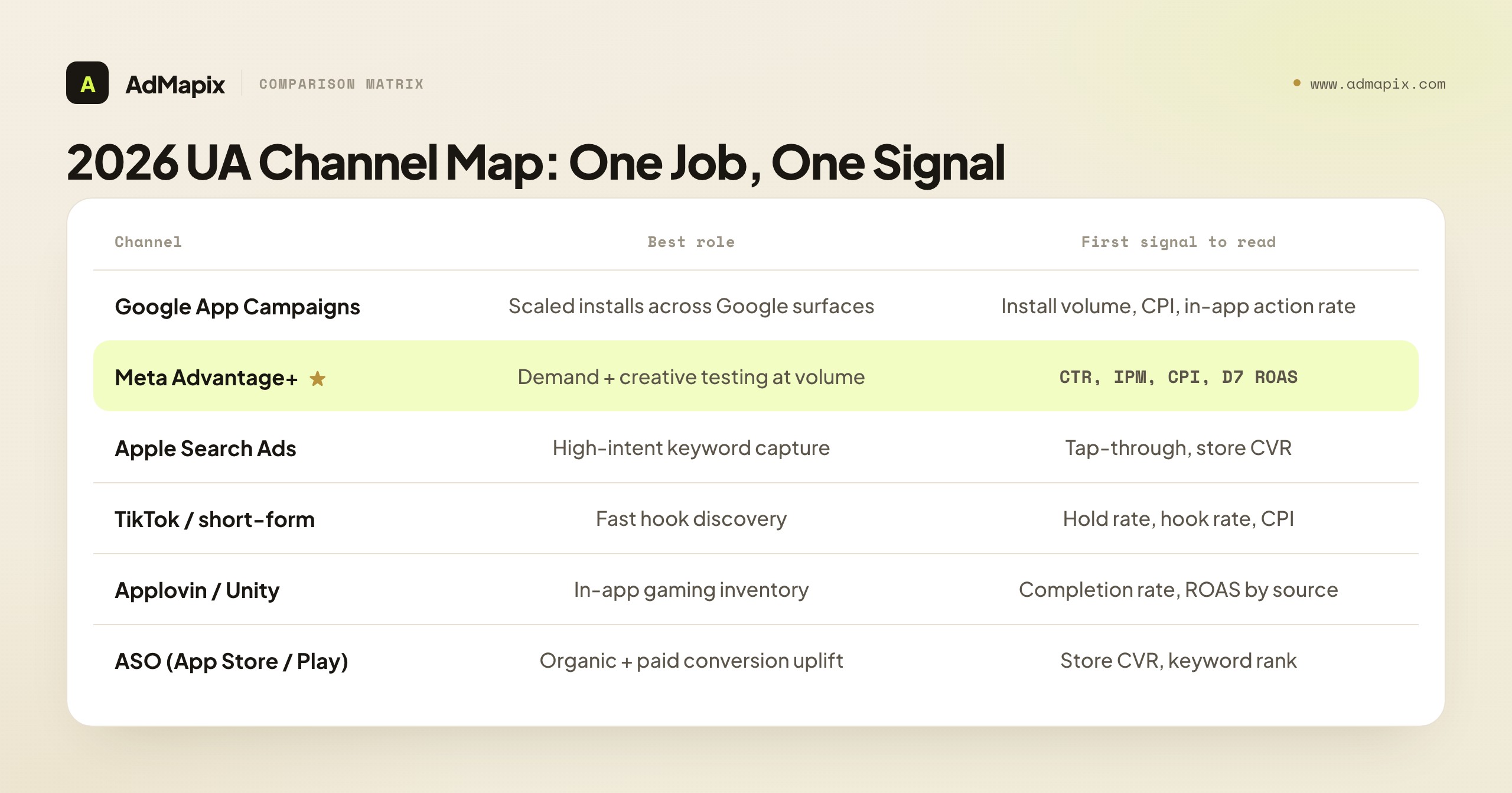
Paid advertising is only one part of user acquisition. The stronger plan combines automated paid UA, store conversion (ASO), organic short-form, creator proof, and competitor research - each doing one job and feeding one signal.
| Channel | Best role | What to prepare | First signal to read |
|---|---|---|---|
| Google App Campaigns (AC) | Scaled mobile installs across Search, Play, YouTube, Display | Text, image, video, HTML5 playables, in-app event signals | Install volume, CPI, in-app action rate |
| Meta Advantage+ App Campaigns | Demand creation + high-volume creative testing | Creative batches, event signals (SKAN/AEM), hook variants | CTR, IPM, CPI, D7 ROAS |
| Apple Search Ads | High-intent App Store keyword capture | Keyword groups, Custom Product Pages, screenshot match | Tap-through rate, store CVR, low-intent waste |
| TikTok Ads / short-form | Fast hook discovery, viral creative | Native UGC-style clips, sound-first edits, gameplay moments | Hold rate, hook rate, saves, CPI |
| Applovin / Unity / IronSource | In-app gaming inventory, rewarded + interstitial | Playables, rewarded video, fast-action gameplay proof | Completion rate, install quality, ROAS by source |
| App Store + Google Play (ASO) | Organic discovery + paid conversion uplift | Icon, screenshots, preview video, title/subtitle, ratings | Store CVR, keyword rank, organic install lift |
| Creators / influencers | Trust translation, top-of-funnel proof | Creator brief, playable build, talking points, codes | Watch quality, comments, assisted install lift |
| Community (Discord/Reddit) | Retention, feedback, early-access trust | Devlogs, patch notes, playtests, events | Join rate, sentiment, return reasons |
| Competitor ad research | Cut blind spend before it happens | Swipe file, hook tags, store-match checks | Better briefs, fewer wasted test cycles |
Official platform surfaces are where you actually build campaigns. Google App Campaigns automate install delivery across Google's inventory. Apple Search Ads capture App Store intent at the moment of search. TikTok Creative Center is the best free way to study short-form creative patterns by vertical. Meta's app advertising docs cover Advantage+ App Campaigns and event setup. For attribution mechanics on iOS, read Apple's SKAdNetwork documentation.
The practical rule: each channel needs one job and one primary signal. Don't ask every channel to create awareness, explain the game, convert the install, and validate retention simultaneously. That is how budgets evaporate with nothing learned.
How Channel Selection Actually Works in 2026
The biggest 2026 shift: manual audience targeting is mostly gone. Google App Campaigns, Meta Advantage+, and Applovin AXON all run on broad-targeting AI that finds your players from your creative and event signals. You no longer pick interests and lookalikes the way you did in 2020 - you feed the algorithm good creative, clean conversion signals, and a sane budget, and it optimizes.
That changes how you choose channels. The decision is less "which audience lives here" and more "which channel's algorithm and inventory fit my game's economics and creative style."
| If your game is... | Lead channels | Why |
|---|---|---|
| Hybrid-casual / casual with fast IPM | Applovin, Unity, Meta, TikTok | High-volume creative testing, cheap installs, rewarded inventory |
| Mid-core / strategy / RPG (high LTV) | Google AC, Meta, Apple Search Ads | Intent capture + AI finds high-value players; LTV supports higher CPI |
| Puzzle / cozy / broad appeal | TikTok, Meta, Apple Search Ads | Short-form virality + branded-search capture |
| Premium / paid PC indie | Steam, creators, YouTube, Reddit | Wishlist + community-led; paid UA economics rarely work |
| Web3 / niche | Discord, X, targeted creators, community | Trust-led; paid app channels often restrict the category |
Two non-negotiables before scaling any channel:
- Conversion signal hygiene. On iOS, configure SKAN/AEM conversion values to capture meaningful post-install events (tutorial complete, first purchase, D1 return), not just installs. The algorithm optimizes toward whatever you tell it to. If you only send "install," you get cheap installs that don't pay.
- Single-channel proof before multi-channel scale. Prove unit economics on one channel with one strong creative set before spreading budget across five. Diversify to de-risk a proven winner, not to search blindly for one.
Mobile Game UA vs PC and Console Marketing
Mobile UA and PC/console marketing share a foundation - clear positioning, real proof, disciplined measurement - but the operating rhythm and economics are different enough that copying one playbook onto the other is a common, expensive mistake.
| Area | Mobile game UA | PC / console marketing |
|---|---|---|
| Primary action | Install, tutorial complete, first purchase, D-return | Wishlist, demo, purchase, platform follow |
| Store surface | App Store, Google Play | Steam, Epic, console stores, itch.io |
| Paid learning speed | Fast - daily creative tests, event-driven | Slow - tied to beats, festivals, creator coverage |
| Creative volume | High - dozens of variants, weekly refresh | Low - few assets, trailer and capsule quality dominate |
| Dominant economics | LTV vs CPI, ROAS, payback window | Units sold, wishlist-to-sale conversion, review score |
| Retention signal | D1/D7/D30, tutorial completion, monetization events | Playtime, refund rate, review sentiment |
| Community role | Useful, often secondary to paid UA at scale | Often central, especially indie / early access |
This matters because advice gets mixed online. A Steam-first indie game should not copy a mobile UA creative-testing calendar without adapting it to wishlists, demos, Steam Next Fest, and creator timing. A free-to-play mobile game should not rely only on trailers and community posts if it needs scalable, profitable install volume.
For hybrid teams shipping on both, build one positioning core and two execution tracks:
| Core asset | Mobile UA execution | PC / console execution |
|---|---|---|
| Player promise | First 3 seconds of ad + store screenshots | Trailer opening, capsule art, demo hook |
| Gameplay proof | Playables, short UGC, app preview video | Trailer, demo, streamer build, store screenshots |
| Conversion action | Install, tutorial complete, first purchase | Wishlist, demo download, purchase |
| Learning signal | CPI, IPM, CVR, retention, ROAS | Wishlist velocity, demo completion, reviews, creator response |
Creative Testing Is the Real UA Skill
In 2026, with AI bidding doing the audience work, your creative is your targeting and your single biggest performance lever. Industry estimates consistently put 70-80% of UA performance variance on the creative, not the bid or the channel. A team that ships ten thoughtful creative concepts a week will outperform a team with double the budget and three stale videos.
The mistake most teams make is treating creatives as assets to be produced, instead of experiments to be run. A trailer, a UGC clip, a playable, and a paid social video are not just files - they are hypotheses about why a player might install.
Step 1: Tag every creative before you launch it
Tagging is what turns a pile of winning and losing ads into a learning system. Without tags, you know that an ad won; with tags, you know why, and you can produce three more like it.
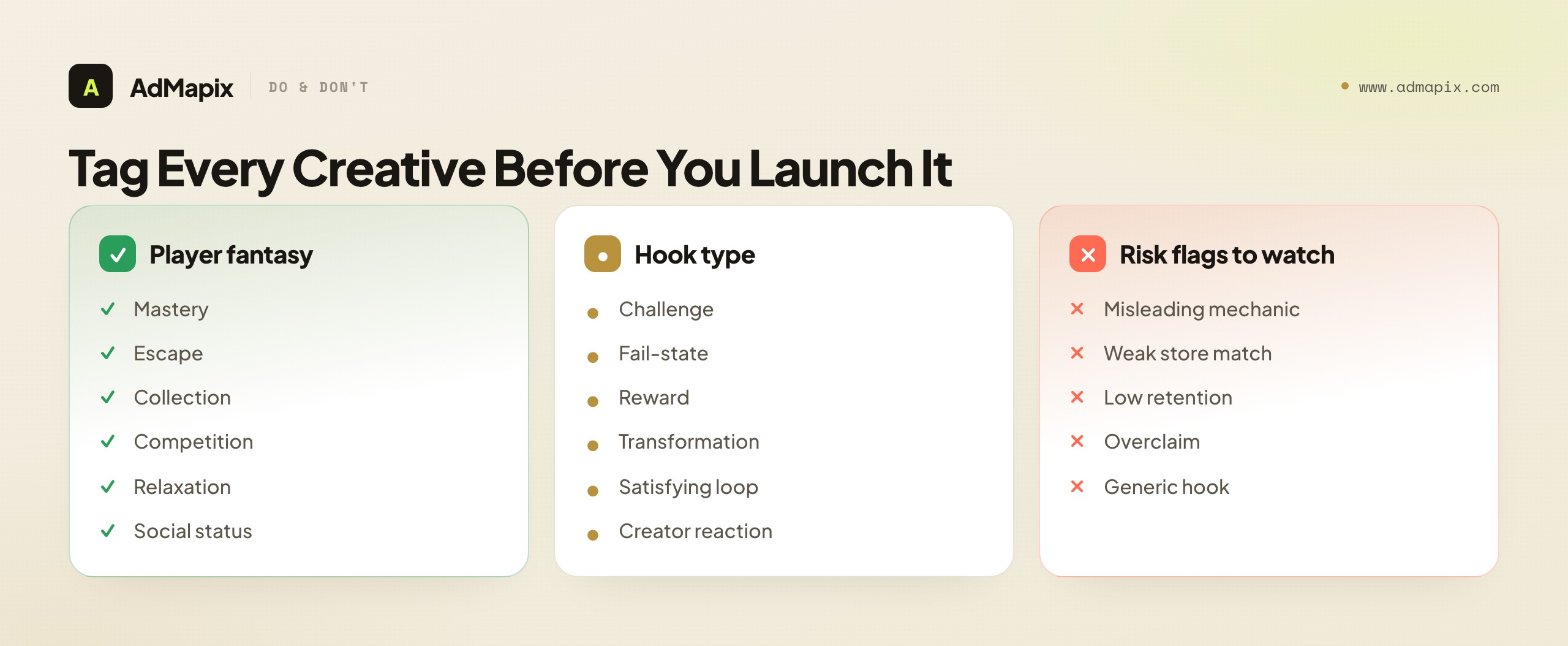
| Tag dimension | Example values |
|---|---|
| Player fantasy | Mastery, escape, collection, competition, relaxation, humor, survival, social status |
| Hook type | Challenge, fail-state ("you won't last 10 seconds"), reward, transformation, story, satisfying loop, creator reaction |
| Proof type | Real gameplay, playable, store asset, creator footage, review screenshot, live-event clip |
| Format | UGC video, gameplay capture, playable ad, motion graphic, static, carousel |
| Channel | TikTok, Meta, Google AC, Apple Search Ads, Applovin, YouTube, creator |
| Risk flag | Misleading mechanic, weak store match, low retention, overclaim, generic hook |
The "risk flag" column matters more than teams admit. A misleading hook can win on CTR and CPI while quietly poisoning retention and inviting policy strikes - see fake mobile game ads for why deceptive creative is a long-term loss even when it looks like a short-term win.
Step 2: Test in structured batches
Random one-off creatives teach you nothing transferable. Structured batches isolate one variable so the winner tells you something reusable.
- Pick one player fantasy from the positioning brief (e.g., "mastery").
- Build 3-5 hook directions around it (challenge, fail-state, transformation, satisfying loop, creator reaction).
- Produce lightweight variants first - rough edits, not polished hero films. Polish the proven winners.
- Match each ad to the right store page or Custom Product Page so the post-tap promise holds.
- Read the full funnel together - CTR, IPM, CPI, store CVR, D1/D7 retention, early ROAS.
- Turn winners into the next brief, not just the next budget line. A winning hook is a concept to iterate, not a single video to scale until it fatigues.
Step 3: Read the right metrics in the right order
This is where most teams go wrong - they optimize for the cheapest install and ignore whether that install pays back.
| Metric | What it tells you | Trap to avoid |
|---|---|---|
| Hook rate (3-sec view %) | Did the opening stop the scroll? | A great hook with a weak game still churns |
| CTR | Did the ad earn the tap? | High CTR + low CVR = misleading creative |
| IPM (installs per 1,000 impressions) | Combined creative + store strength | Channel-dependent; compare like-for-like |
| CPI | Cost to acquire one install | Cheap CPI means nothing if retention is bad |
| Store CVR | Did the store page close the promise? | Often the bottleneck, not the ad |
| D1 / D7 retention | Did the install become a player? | The earliest true quality signal |
| Early ROAS (D3/D7) | Is the spend paying back? | The only metric that authorizes scale |
The order matters: a creative that wins on CPI but loses on D7 retention is a losing creative. Always read cost metrics and quality metrics together. The cheapest install is frequently the most expensive mistake.
Creative concepts that consistently work in mobile game ads
These are the recurring, evergreen concept families worth keeping in rotation. Mix proven formats with one or two experimental swings each batch.
| Concept | Why it works | Best for |
|---|---|---|
| "Satisfying loop" capture | Pure dopamine; needs no explanation | Hyper-casual, merge, puzzle, idle |
| Fail-state / "you won't last" hook | Provokes a "I can do better" install | Roguelike, runner, skill games |
| First-attempt vs later-attempt | Shows progression and mastery payoff | Builders, strategy, skill games |
| Real-gameplay UGC reaction | Authentic, hard for players to dismiss | Most genres; cheapest to produce at volume |
| Playable ad ("try before install") | Pre-qualifies intent, lifts retention | Casual, puzzle, hybrid-casual |
| One-decision tension | "Which would you pick?" engagement bait | Strategy, narrative, deckbuilder |
The UA Math: CPI, LTV, ROAS, and Payback
This is the section most "game marketing" guides skip, and it is the one that decides whether your UA machine makes money or loses it. You do not need a finance degree - you need four numbers and one inequality.
The core inequality
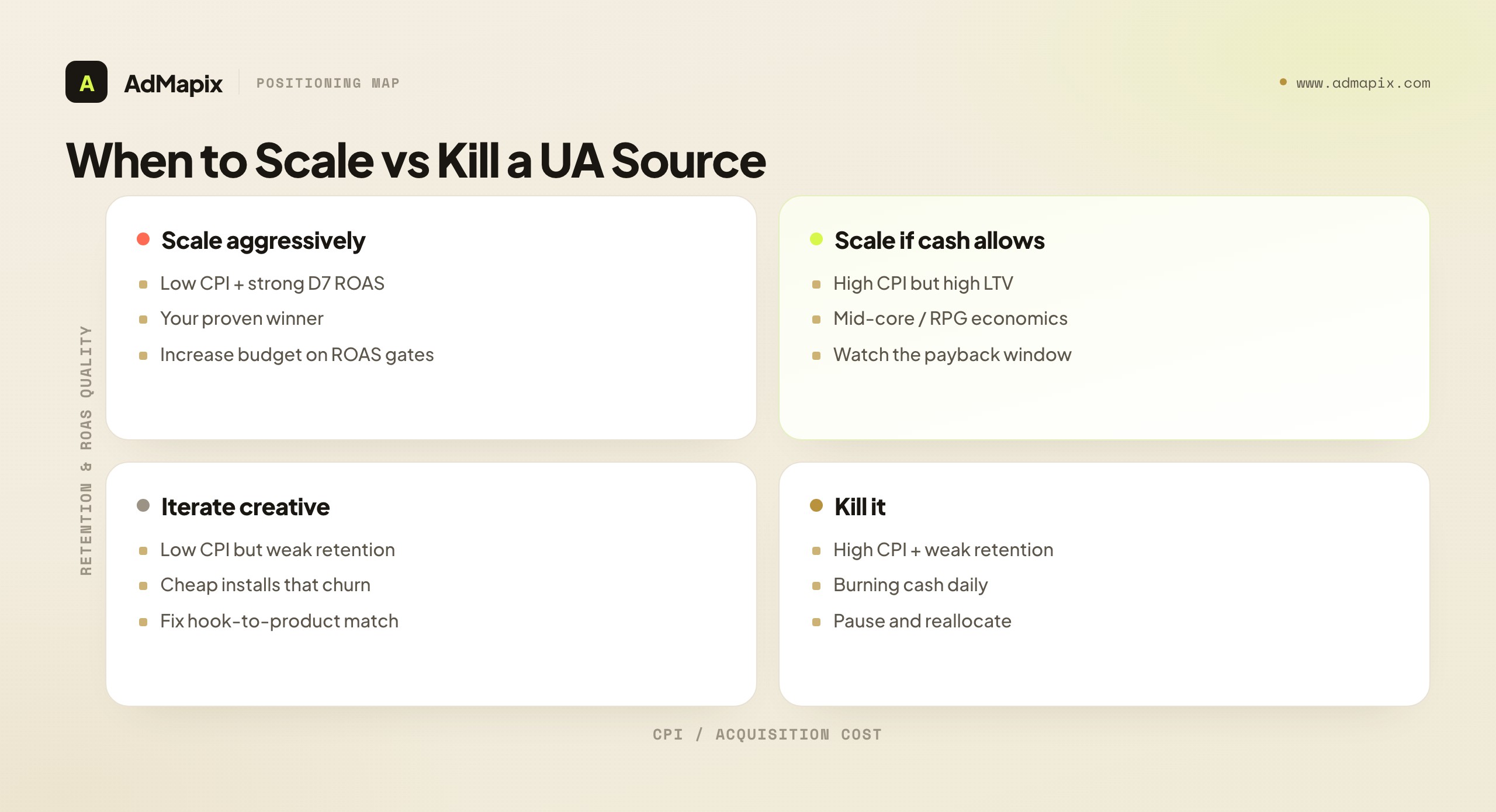
A player is profitable when LTV > CPI, and the campaign is scalable when that payback happens inside your payback window.
Everything else is detail in service of that line. Let's define the terms.
| Term | Definition | How to think about it |
|---|---|---|
| CPI (Cost Per Install) | Ad spend / installs | Your acquisition cost per player |
| CPA / eCPA | Cost per a deeper action (purchase, tutorial complete) | More honest than CPI for high-LTV games |
| LTV (Lifetime Value) | Total revenue (IAP + ads) per player over their lifetime | The ceiling on what you can pay to acquire them |
| ROAS | Revenue / ad spend, measured at D7/D30 | The day-to-day scale signal |
| Payback window | Days until cumulative revenue per cohort = CPI | How long your cash is tied up before it returns |
A worked example
Say you run a hybrid-casual puzzle game.
- CPI = $1.20 (blended across channels)
- D30 LTV = $1.05
- D90 LTV = $1.65
At D30 you are underwater (LTV $1.05 < CPI $1.20). A naive read says "stop." But your D90 LTV is $1.65 - the cohort turns profitable around D45-D60. So the real question is your payback window: can your cash flow tolerate ~50-day payback? A well-funded studio scales; a bootstrapped indie with three months of runway cannot, and should either lower CPI (better creative, cheaper channels) or raise early LTV (better D1-D7 monetization) before scaling.
This is why monetization and UA are the same conversation. You cannot set a CPI target without an LTV model, and you cannot model LTV without a monetization design. Read mobile game monetization alongside this guide - the two halves only work together.
Setting your CPI bid target
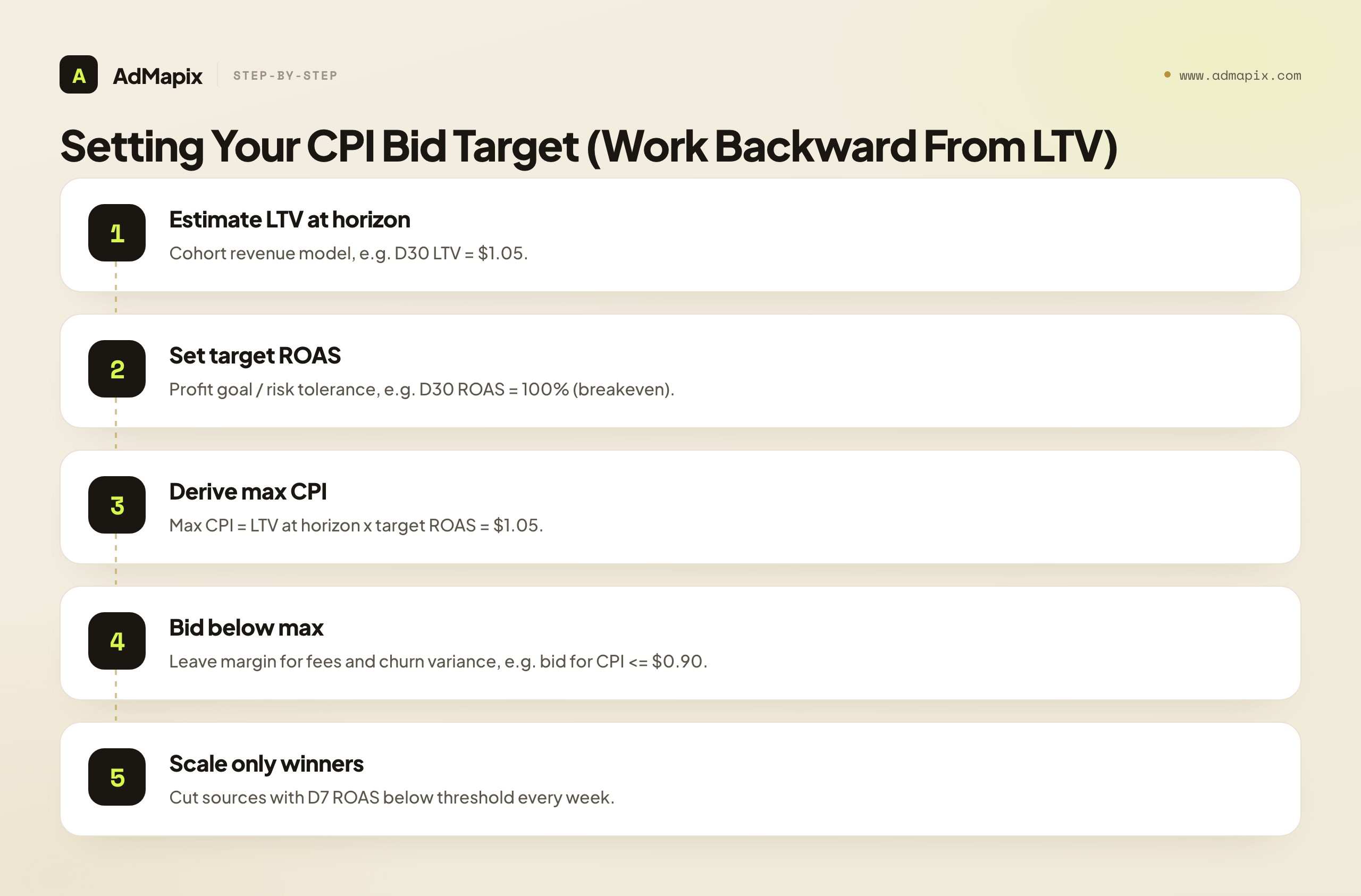
Work backward from LTV and your acceptable payback window:
| Step | Formula / action | Example |
|---|---|---|
| 1. Estimate LTV at your payback horizon | Cohort revenue model | D30 LTV = $1.05 |
| 2. Set target ROAS for that horizon | Profit goal / risk tolerance | Target D30 ROAS = 100% (breakeven) |
| 3. Derive max CPI | Max CPI = LTV at horizon × target ROAS | Max CPI = $1.05 |
| 4. Bid below max, leave margin | Account for fees, churn variance | Bid for CPI ≤ $0.90 |
| 5. Scale only sources beating the target | Cut underperformers weekly | Pause sources with D7 ROAS < threshold |
The metrics dashboard every UA team needs
You cannot scale what you cannot see. At minimum, track these by source and by creative, refreshed daily:
| Metric group | Specific metrics |
|---|---|
| Cost | CPI, CPM, CPA (key in-app event) |
| Volume | Installs, impressions, spend |
| Creative | Hook rate, CTR, IPM |
| Quality | D1 / D7 / D30 retention, tutorial completion |
| Revenue | ARPDAU, D7 / D30 ROAS, payback day |
| Attribution | SKAN/AEM conversion values, organic uplift |
A common beginner mistake: optimizing the whole account to blended CPI. Always segment by source and creative. A $0.80 blended CPI can hide one source bleeding money at $2.50 and one printing money at $0.40. The blend lies; the segments tell the truth.
Soft Launch: Your Cheapest Insurance
Soft launch is the single most under-used tool by indie and first-time mobile teams. It is a limited release in 2-3 representative markets before global launch, designed to surface retention, monetization, and onboarding problems while installs still cost cents instead of dollars.
The logic is simple: fixing a broken D1 retention curve costs almost nothing in a soft-launch market and is catastrophic to discover after a global UA push.
| Soft launch element | What to test | Pass/fail signal |
|---|---|---|
| Market choice | English-speaking, lower-CPI proxies for your target | Canada, Australia, New Zealand, Philippines, Nordics |
| Duration | Long enough to read D7+ retention | Typically 2-6 weeks per iteration |
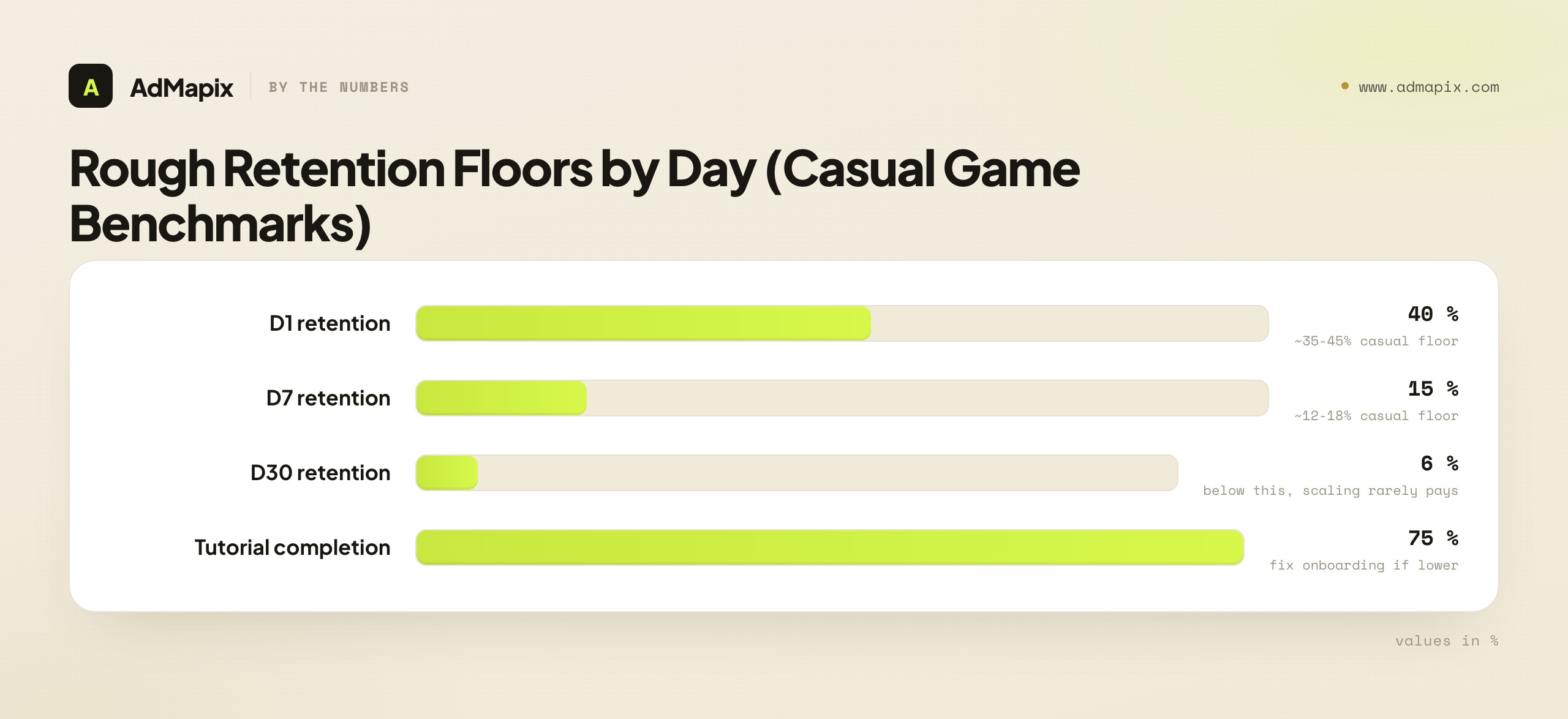
| Retention | D1 / D7 / D30 against genre benchmarks | Casual D1 ~35-45%, D7 ~12-18% as rough floors |
| Monetization | ARPDAU, conversion to payer, ad ARPDAU | Trending toward LTV model assumptions |
| Onboarding | Tutorial completion, first-session length | Drop-off points to fix before scaling |
| CPI feasibility | Can you hit your target CPI at small scale? | Early read on UA viability |
The decision after soft launch is binary and disciplined: iterate, or kill. If retention and early ROAS trend toward your model, scale the UA machine into global launch. If they don't, fix the product or the onboarding first - because pouring paid UA onto a leaky funnel just buys churned users faster. Many of the most profitable studios kill more soft-launch builds than they ship. That discipline is the point.
ASO: The Conversion Layer Under Every Install
Every paid and organic install passes through your store listing. ASO (App Store Optimization) is the conversion layer that decides how many of those taps become installs - and a 5-point CVR improvement effectively lowers your CPI across every channel at once. It is the highest-ROI work in UA that has nothing to do with ad spend.
| Store element | Optimize for | Impact |
|---|---|---|
| App icon | Stops the scroll in search results | High - first thing seen, A/B test relentlessly |
| Screenshots (first 2-3) | Prove the player fantasy instantly | Very high - most users decide here |
| App preview video | Show the satisfying loop in motion | High for casual / visual games |
| Title + subtitle | Keyword rank + value proposition | High - drives organic discovery |
| Ratings + reviews | Trust and social proof | High - low ratings tank CVR |
| Custom Product Pages (iOS) / store listing experiments | Match the ad's promise per campaign | High - keeps post-tap promise intact |
The most under-used ASO lever in 2026 is Custom Product Pages (Apple) and store listing experiments (Google): create a store page variant that matches each ad concept's promise. If your ad sells "base-building," the player should land on a screenshot set that shows base-building first - not your generic featured page. Promise-to-page continuity is one of the cheapest CVR wins available.
Creators and Community: Proof, Not Reach
Creators and community don't usually scale installs the way paid UA does - but they do something paid channels can't: they provide authentic proof that lowers acquisition cost everywhere else. A genuine creator reaction or a thriving Discord makes your paid creative more believable and your organic word-of-mouth real.
The rule for creators in games: don't hand them a script that could sell any app. Players detect generic sponsorship instantly. Give creators a build, a constraint, and permission to react honestly.
| Creator prompt | Best for |
|---|---|
| "Try to beat this level without the obvious upgrade." | Puzzle, RPG, roguelike, strategy |
| "Show the exact moment the game clicked for you." | Indie demos, narrative, simulation |
| "Compare your first run with your fifth run." | Skill games, builders, management |
| "Explain the one decision that changed the run." | Strategy, roguelike, deckbuilder |
For community, the same authenticity rule applies. A devlog that says "we added features" is noise. A devlog that explains what changed in the player's experience and why it matters builds the trust that makes every other channel cheaper. Discord, Reddit, and playtest loops are where early-access and indie games convert curiosity into committed players.
Competitor Ad Research: How to Cut Blind Spend
Competitor research is not copying. It is reducing blind spend - knowing what hooks already convert in your genre before you waste a test cycle rediscovering them, and finding the underused player fantasies where a fresh angle can win cheaply.
The genres with the most aggressive UA - casual, hybrid-casual, RPG, 4X strategy - already have hundreds of creatives in market. That public creative library is free intelligence. The teams that mine it systematically brief better, test faster, and waste less.
The research workflow
Run this before every major UA push and refresh it monthly:
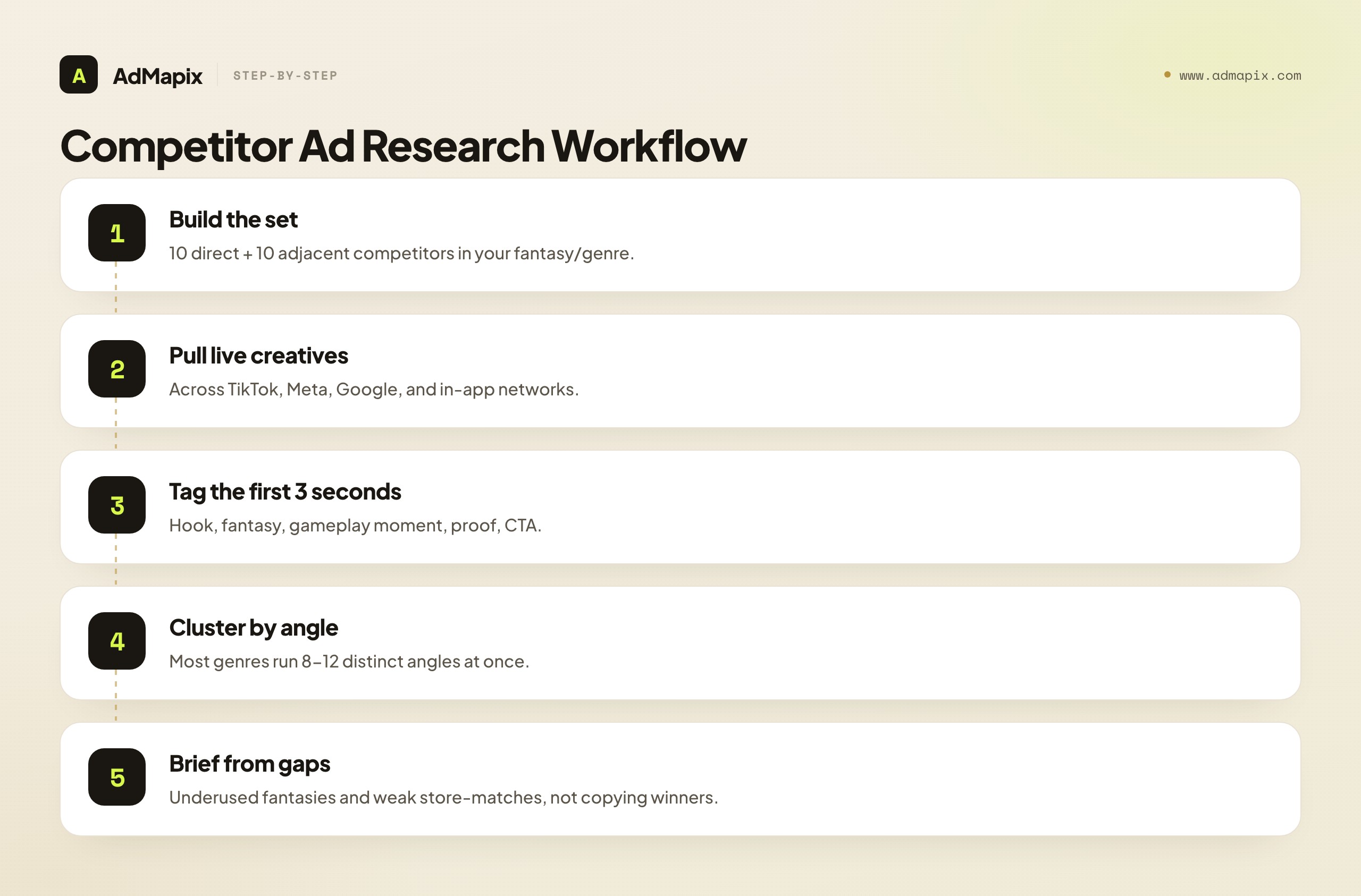
- Pick 10 direct competitors and 10 adjacent ones (same fantasy, different genre).
- Pull their live ad creatives from ad libraries and creative intelligence tools across TikTok, Meta, Google, and in-app networks.
- Tag the first 3 seconds of each: hook, fantasy, gameplay moment, proof, CTA.
- Cross-check ad promise against store page and first session - where do they over-claim?
- Cluster by angle. Most genres have 8-12 distinct ad angles in active rotation at any time.
- Find the gaps: overused claims (saturated), underused fantasies (opportunity), weak store-match (where you can win on continuity).
- Brief from gaps, not from copying winners. Build an original take on an underserved angle.
Turn findings into a decision table
Research is worthless until it changes a decision. The output of every competitor review should look like this:
| Finding | UA decision |
|---|---|
| Every competitor uses the same fail-state hook | Test an underused fantasy: collection, mastery, social status |
| Competitors over-rely on cinematic trailers | Test raw gameplay UGC and creator reactions - usually cheaper IPM |
| Store pages don't match their ads | Build Custom Product Pages with tight promise-to-page continuity |
| A rival just 3x'd their active creative count | They found a winner - dissect their newest ads immediately |
| TikTok hooks are repetitive across the genre | Ship a new creator-challenge or satisfying-loop format |
| Paid ads attract weak retention (visible in reviews) | Tighten your own ad promise to protect retention |
This is exactly where a creative intelligence layer earns its keep. Use AdMapix reports to organize competitor creative patterns across networks - one search bar instead of tab-hopping across five free libraries - then connect the findings to a creative brief and channel plan. For continuous monitoring of competitor creative velocity, see pricing. When you need format-level depth on what's actually running, the mobile game ads guide breaks down each ad type with examples.
A note on honest creative
The temptation to copy the "fake gameplay" ads that flood casual genres is real - they get clicks. But misleading creative wins CTR while destroying retention and inviting platform strikes. We unpack the mechanics and the long-term cost in fake mobile game ads. The durable play is honest creative that still hooks - harder to make, far cheaper to scale.
Market To Gamers Without Sounding Fake
Players detect generic marketing faster than any other audience. The safest way to sound real is to show product evidence instead of marketing adjectives. This applies to ad copy, store text, creator briefs, and community posts alike.
| Generic claim (expensive, low trust) | Better proof (cheaper, converts) |
|---|---|
| "Epic adventure" | A specific world rule, boss, build, or decision |
| "Endless fun" | A repeatable loop with visible progression |
| "Strategic gameplay" | A concrete tradeoff or a wrong choice |
| "Stunning graphics" | A before/after scene, biome transition, or animation detail |
| "Join millions" | Real community proof, creator reactions, reviews, event participation |
The pattern is always the same: replace the adjective with the specific moment that earns it. "Strategic" is a claim; "your alliance can flip the server overnight" is proof. Proof converts at a lower cost because it does the believing for the player.
Common UA Mistakes That Burn Budget
Most wasted UA spend traces back to a handful of repeatable errors. Audit your account against this list before scaling anything.
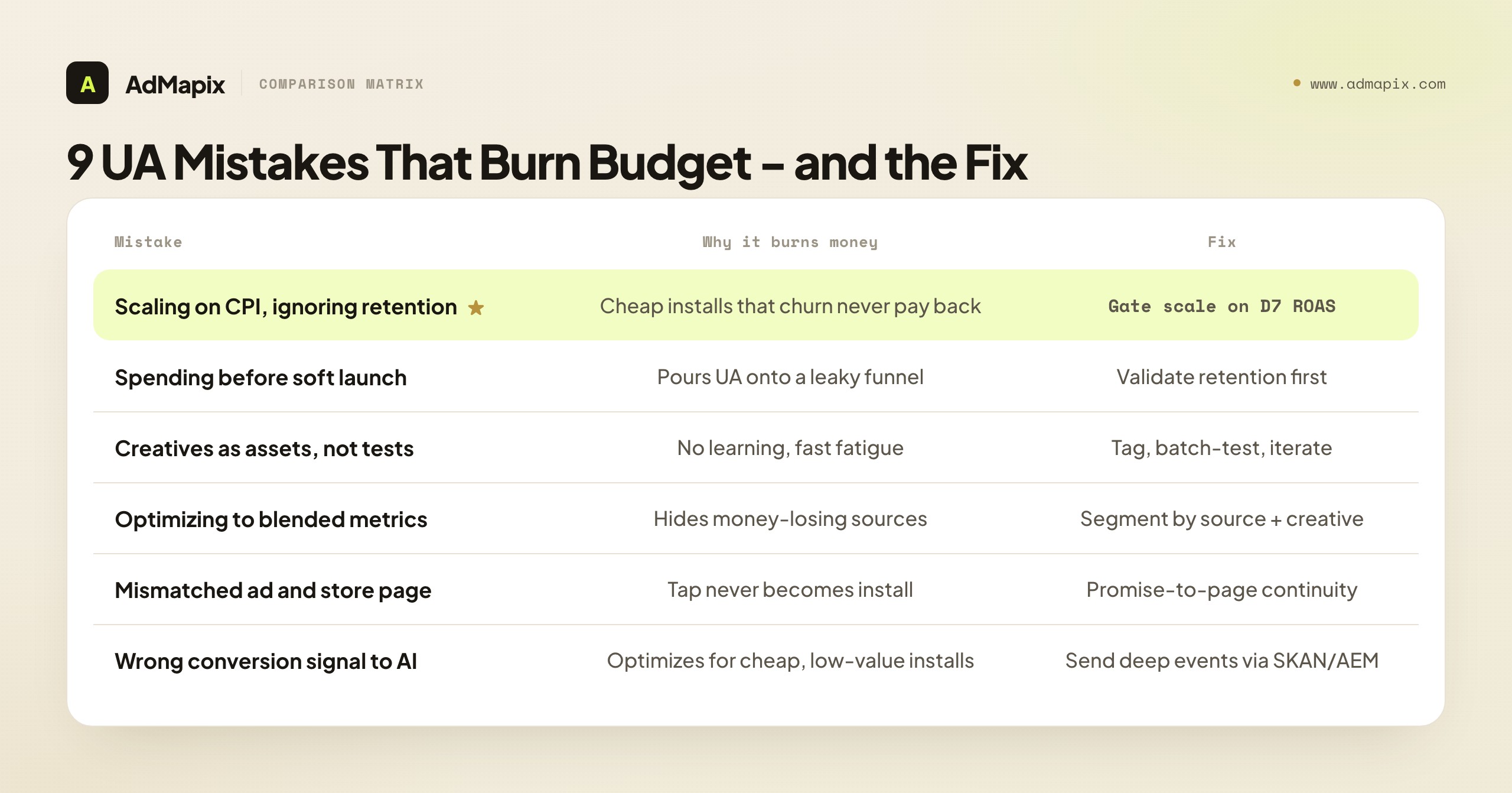
| Mistake | Why it burns money | Fix |
|---|---|---|
| Scaling on CPI, ignoring retention | Cheap installs that churn never pay back | Gate scale on D7 ROAS, not CPI |
| Spending before soft launch | Pours UA onto a leaky funnel | Validate retention/monetization first |
| Treating creatives as assets, not tests | No learning, fast fatigue | Tag, batch-test, iterate winners |
| One creative, scaled to fatigue | Performance collapses, no backup | Keep a fresh-concept pipeline running |
| Optimizing to blended metrics | Hides money-losing sources | Segment by source and creative |
| Mismatched ad and store page | Tap doesn't become install | Promise-to-page continuity, CPPs |
| Wrong conversion signal to the algorithm | AI optimizes for cheap, low-value installs | Send deep in-app events via SKAN/AEM |
| Copying competitor ads verbatim | You arrive saturated and late | Brief from gaps, not from winners |
| Ignoring organic uplift | Over-credits paid, mis-allocates budget | Measure paid + organic lift together |
30 / 60 / 90-Day Mobile Game UA Plan
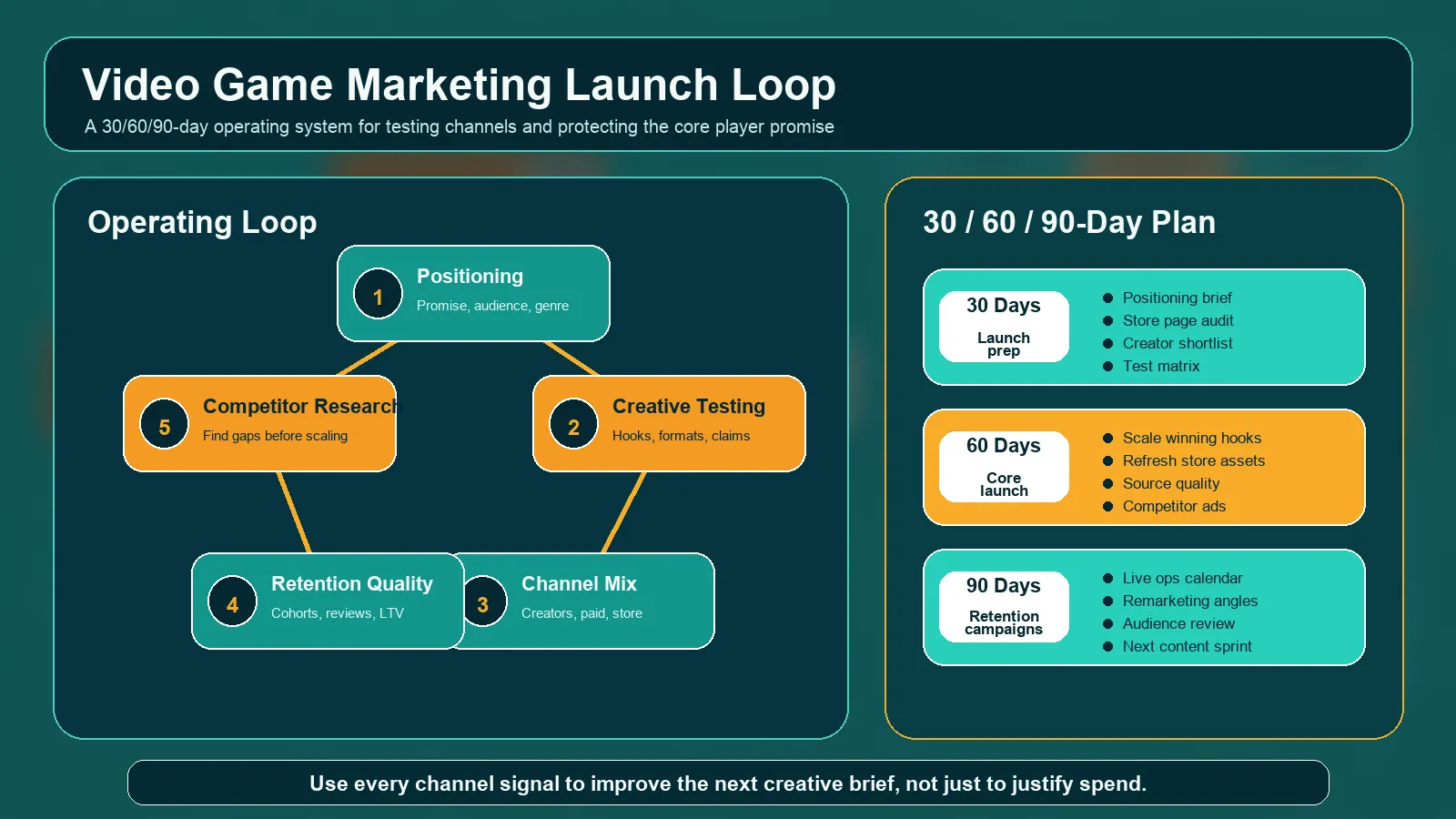
Use the launch loop to keep channel tests connected to positioning, creative briefs, and source quality.
A user acquisition program is a loop, not a launch. Here is a concrete 90-day sequence to stand one up from scratch.
First 30 Days: Foundation and Validation
Sharpen the promise, validate the product, and prepare testable assets. Do not scale anything yet.
| Task | Output |
|---|---|
| Positioning brief | Primary player, fantasy, proof, the converting hook |
| Store / ASO audit | Icon, screenshots, preview video, keywords, CVR baseline |
| Soft launch setup | 2-3 markets, retention + monetization instrumentation |
| Competitor swipe file | 30-50 tagged creatives, clustered by angle |
| Creative test matrix | 1-2 fantasies, 3-5 hooks, lightweight variants |
| Measurement plan | SKAN/AEM values, cohort retention, ROAS dashboard |
A poor positioning brief or an unvalidated retention curve makes every later test expensive. This month is insurance, not delay.
Days 31-60: Channel and Creative Proof
Prove unit economics on one channel with one strong creative set before spreading budget.
| Task | Output |
|---|---|
| Launch single-channel paid tests | CPI, IPM, store CVR, early ROAS by creative |
| Run creator tests | Watch quality, comments, assisted install lift |
| Iterate winning creative concepts | New variants of proven hooks, not new budget on stale ones |
| Refresh ASO / Custom Product Pages | Promise-to-page continuity per concept |
| Read source quality | D1/D7 retention and ROAS by source, not blended |
This is where teams scale too early. A cheap install, a viral clip, or a wishlist spike is encouraging - but not proof. The only thing that authorizes scale is a source that pays back inside your window.
Days 61-90: Scale and Retain
Connect UA to live signals and scale only what the math allows.
| Task | Output |
|---|---|
| Scale proven channel + creatives | Budget increases gated on D7 ROAS thresholds |
| Diversify to a second channel | De-risk a proven winner, don't blind-search |
| Build retargeting / re-engagement | Lapsed players, unfinished tutorial, event rewards |
| Segment cohorts | New, payers, lapsed, high-value lookalike signal |
| Plan live-ops beats | Events, updates, creator reasons to return |
| Re-run competitor research | New hooks, store updates, rivals scaling creative |
UA does not end at launch. For mobile games, live-ops and paid UA feed each other indefinitely; for PC/console, reviews, patches, and creator coverage shape the long tail. The loop just keeps running - test, measure, scale what pays, kill what doesn't.
Budget and Prioritization
There is no universal answer to "how much should a game spend on UA?" A premium indie title, a free-to-play mobile game, and a publisher-backed launch have completely different economics. Use a prioritization rule keyed to what you have, not a fixed number.
| If you have... | Prioritize |
|---|---|
| Very small budget | Positioning, ASO, organic short-form, creator outreach, competitor research |
| Modest test budget | Single-channel paid tests, soft launch, CPP experiments, creator tests |
| Scalable mobile budget | Creative pipeline, paid UA, ASO, deep event signals, retention-quality reporting |
| Publisher support | Trailer + PR beats, creator program, platform features, paid amplification |
| Live game | Live-ops calendar, cohort segmentation, creative refresh, competitor monitoring |
The two most dangerous budget mistakes are timeless: spending before the promise is testable, and treating early awareness as proof of product-market fit. Good UA connects every dollar of spend to a unit of learning and a measurable payback - not just to reach.
FAQ
What is mobile game user acquisition?
Mobile game user acquisition (UA) is the discipline of profitably and predictably acquiring new players through paid and organic channels, measured against lifetime value. It spans positioning, creative testing, channel selection (Google App Campaigns, Meta, TikTok, Apple Search Ads, in-app networks), store conversion (ASO), and the CPI/ROAS/LTV math that decides what is safe to scale. The goal is not cheap installs - it is profitable installs that retain and pay back.
How much does it cost to acquire a game player (CPI) in 2026?
CPI varies enormously by genre, geo, platform, and channel. Hyper-casual and casual games often run well under $1 in lower-cost markets; mid-core, strategy, and RPG titles routinely pay several dollars or more because their LTV supports it. The right CPI is never a benchmark you copy - it's derived from your own LTV model and payback window. Set max CPI = your LTV at your payback horizon × your target ROAS, then bid below it with margin.
What is the difference between video game marketing and user acquisition?
Video game marketing is the broad discipline: positioning, store pages, PR, creators, community, content, and paid media. User acquisition is the performance engine inside it - the daily, measured, ROAS-governed work of buying and earning installs that retain and monetize. Marketing builds awareness and trust; UA converts that into profitable, scalable player volume. This guide treats UA as the spine and folds marketing into the funnel stages where it lowers acquisition cost.
Which channels work best for mobile game UA?
It depends on genre and economics. Hybrid-casual and casual games lean on Applovin, Unity, Meta, and TikTok for high-volume cheap installs. Mid-core and high-LTV games favor Google App Campaigns, Meta, and Apple Search Ads, where AI finds high-value players and intent capture matters. Premium PC indie games rarely make paid app UA work and rely on Steam, creators, YouTube, and community instead. Prove unit economics on one channel before diversifying.
How do I test game ad creative effectively?
Tag every creative by player fantasy, hook type, proof type, and format. Test in structured batches that isolate one variable (e.g., five hook directions for one fantasy). Produce lightweight variants first and polish only proven winners. Read the full funnel together - hook rate, CTR, IPM, CPI, store CVR, and D7 retention - never CPI alone. Turn winning concepts into the next brief, and keep a fresh-concept pipeline running so you're never reliant on a single fatiguing ad.
What is ROAS and what should I target for a mobile game?
ROAS (Return On Ad Spend) is revenue divided by ad spend, measured at a fixed horizon like D7 or D30. Your target depends on your payback window and cash position: a well-funded studio might accept D30 ROAS below 100% if D90 LTV makes the cohort profitable later; a bootstrapped indie usually needs faster payback and a higher early-ROAS bar. Always set the target before you spend, gate scaling decisions on it, and segment by source and creative rather than reading a blended number.
Do I need a soft launch for my mobile game?
For almost every free-to-play mobile game, yes. A 2-6 week soft launch in 2-3 representative markets (Canada, Australia, New Zealand, the Philippines, the Nordics) surfaces retention, monetization, and onboarding problems while installs still cost cents. The decision after soft launch is binary: iterate the build, or kill it. Pouring global UA onto a leaky funnel just buys churned users faster. Premium PC/console games use the analogous demos, playtests, and festivals instead.
How do I research competitor game ads?
Pull live competitor creatives from ad libraries and cross-network creative intelligence tools, then tag the first three seconds of each - hook, player fantasy, gameplay moment, proof, CTA. Cluster by angle (most genres run 8-12 distinct angles at once), then find the gaps: overused claims to avoid, underused fantasies to exploit, and weak ad-to-store matches you can beat on continuity. Brief from gaps, not from copying winners. Tools like AdMapix reports consolidate this across TikTok, Meta, Google, and in-app networks in one place.
How do I market to gamers without sounding fake?
Show product evidence instead of marketing adjectives. Replace "epic adventure" with a specific world rule; replace "strategic gameplay" with a concrete tradeoff. Give creators a build and a constraint instead of a generic script. Use real gameplay, playables, store screenshots, reviews, and honest community proof. Players install on believable specifics, not on claims that could describe any game - and honest creative is far cheaper to scale because retention holds.
Should I use AI for game UA in 2026?
You already are - Google App Campaigns, Meta Advantage+, and Applovin AXON all run on broad-targeting AI that handles audience selection from your creative and event signals. Your job shifted from manual audience targeting to feeding the algorithm strong creative, clean conversion signals (deep in-app events via SKAN/AEM), and disciplined budgets. AI also accelerates creative production - more variants, faster - but the strategy, positioning, and the decision of what to scale remain human work governed by the ROAS math.
Related Reading
- Mobile game marketing strategy: 12 playbooks that still work in 2026 - the broader strategic companion
- Paid user acquisition: strategy, channels, and creative testing - the general paid-acquisition framework across app verticals
- Mobile game ads guide: formats, examples, and competitor research - format-level depth on what's running
- Mobile game monetization: ads, IAP, and hybrid revenue models - the LTV half of the UA equation
- In-game advertising: what brands and game studios need to know - in-environment placements and rewarded inventory
- Fake mobile game ads: why they work and what marketers can learn - the trust and compliance risk in deceptive creative
Authoritative Sources
- Google App Campaigns (About App campaigns) - https://support.google.com/google-ads/answer/6247380
- Apple Search Ads - https://searchads.apple.com/
- Apple SKAdNetwork documentation - https://developer.apple.com/documentation/storekit/skadnetwork
- TikTok Creative Center - https://ads.tiktok.com/business/creativecenter
- Meta for Business (app advertising) - https://www.facebook.com/business/help/
- Steamworks marketing documentation - https://partner.steamgames.com/doc/marketing
Bottom Line
Mobile game user acquisition works when every channel, creative, and dollar reinforces the same player promise and pays back inside a window your cash can tolerate. Positioning explains why a player should install in six seconds. Creative testing finds the hooks that travel. The CPI/LTV/ROAS math decides what is safe to scale. Soft launch protects you from scaling a leaky funnel. ASO quietly lowers your cost on every channel at once. Competitor research keeps you from rediscovering what your genre already knows. And retention is the final judge of whether any of it was real.
If your team needs a repeatable way to inspect game ads, organize competitor creative patterns across networks, and turn findings into UA briefs, start with AdMapix reports - and see pricing for continuous competitor creative monitoring.
Turn these observations into your next creative study
Open the creative library and select samples for your market, network and research question.
Related Articles
Mobile Game Monetization: Ads, IAP, and Hybrid Revenue Models
A practical 2026 guide to mobile game monetization, covering ad revenue, IAP, hybrid models, rewarded ads, interstitials, player experience, and competitor research.
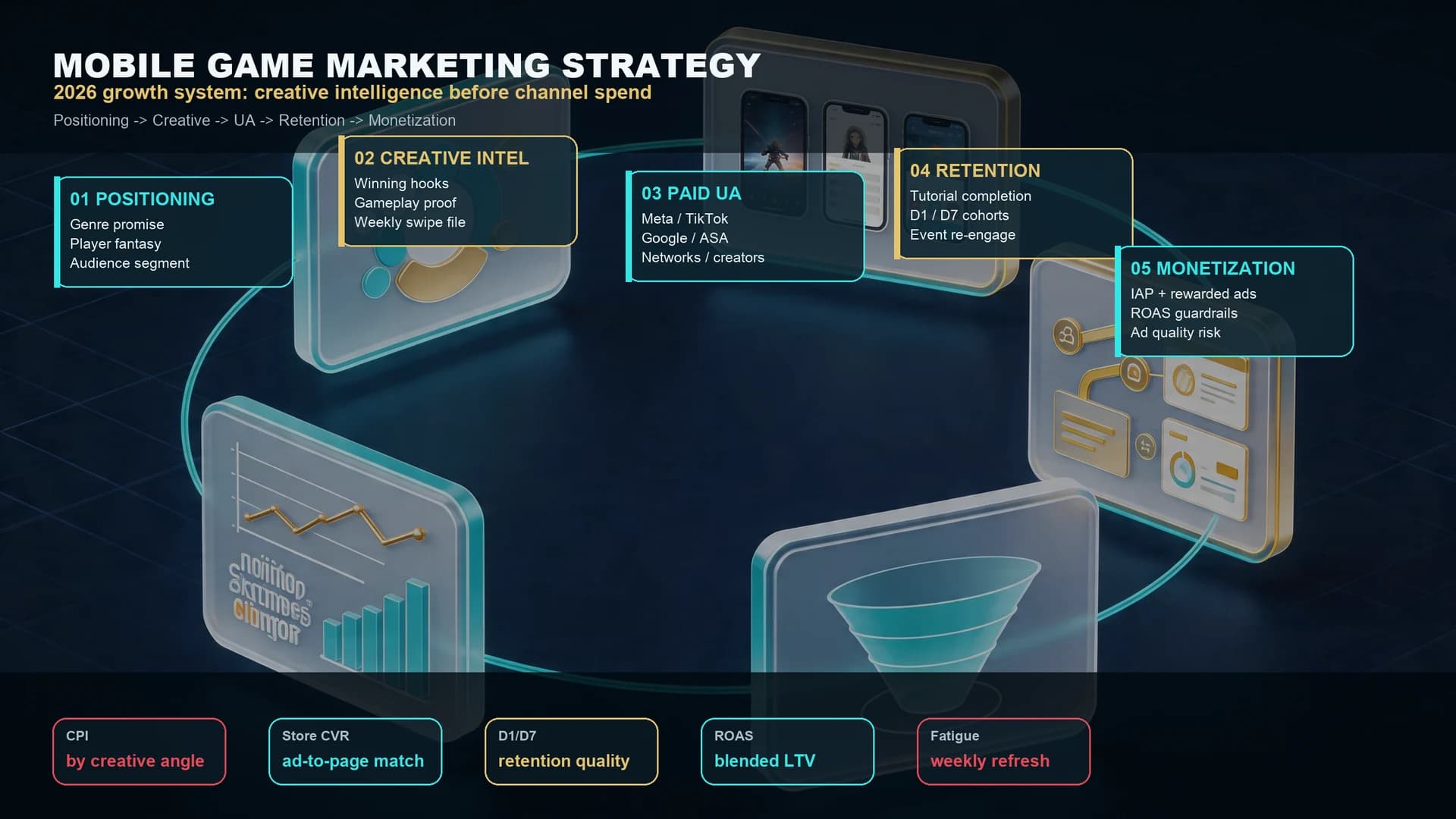
Mobile Game Marketing Strategy: A 12-Step UA & Creative Playbook (2026)
A practical mobile game marketing strategy guide for 2026 covering creative intelligence, paid UA, soft launch KPIs, ASO, retention loops, and competitor ad research.
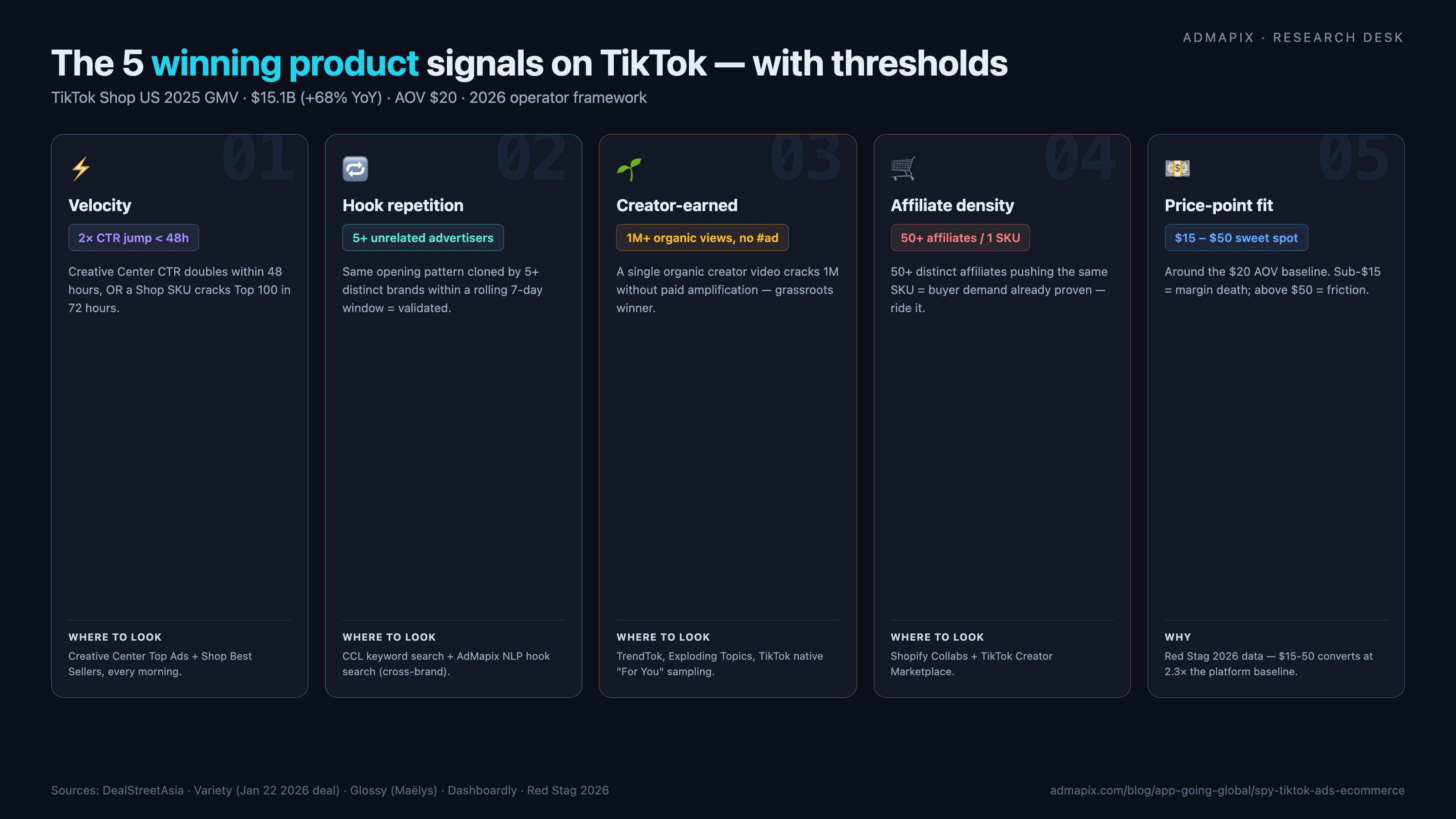
TikTok Ad Spy for E-commerce: The Operator Manual (Post Jan-2026 Deal Update)
TikTok Shop closed 2025 at $15.1B US GMV (+68% YoY) and the Oracle-led US joint venture closed January 22, 2026. This operator manual covers five winning-product signals we test against every Monday, a seven-step creative extraction workflow, a tool stack with 2026 prices, a security callout, and the Maëlys $108.5M case study — for operators who want a repeatable loop, not a listicle.