
Whatnot Ads in 2026: 30M Sampled Impressions and Live-Shopping Hooks
A dated US analysis of Whatnot ads covering 30 verified iOS records, live-shopping hooks, candy and collectible examples, format reuse, rankings, and a separately scoped Rips–Courtyard bracket.
Whatnot Ads in 2026: 30M Sampled Impressions and Live-Shopping Hooks
AdMapix Research — prepared with Codex and checked against the dated source sample.
Last updated: 2026-11-09
From 2026-10-11 to 2026-11-09, the frozen US Whatnot sample contains 30 advertising records and 30,049,136 modelled impressions, with the leading record accounting for 45.9% of the sampled total. The frames show a clear creative language: live shopping, boxes opened on camera, low-price candy and food hauls, reaction-style hooks from unidentified people, and collectible products presented as events. This article is for UA managers, creative strategists, growth teams, and market researchers studying Whatnot ads or Whatnot revenue. It helps you decide whether the visible evidence supports a marketplace acquisition hypothesis, how to brief new live-commerce creatives, and where the comparison with pack-rip apps such as Rips by Triumph and Courtyard stops being fair.
Quick Answer
- The dated US Whatnot sample is concentrated: 30 records resolve to 19 distinct videos and 10 distinct playable files, while the top record contributes 45.9% of modelled impressions.
- The sampled ads repeatedly use unboxing, price anchors, category discovery, and presenter-style energy. The contact sheets show candy, coffee, baked goods, trading-card-style collectibles, and a mobile shopping interface.
- Whatnot ranked #42 for US downloads in the 2026-09-29 to 2026-10-28 ranking window, with 1,313,274 downloads and a -9.00% change from the previous 30 days. It was not in the captured top 300 for revenue; that ranking cannot represent marketplace sales that do not pass through app-store billing.
- The sample does not verify YouTube, TikTok, Instagram, or any other placement. It also cannot show spend, installs, conversion, profit, targeting, or whether a creative is a business winner.
- The supplied Rips and Courtyard bracket comes from a separate 2026-10-30 pull. Use it as dated context, not as a ratio against Whatnot’s frozen window.
What This Sample Says About Scale
The useful conclusion is a split between app-store momentum and observable creative delivery: Whatnot can rank ahead of Rips by Triumph on downloads while its measured creative sample answers a different question about indexed ad records. The download ranking covers store listings together, while the creative pull is a bounded, verified-iOS sample. Neither source is a complete marketing-mix ledger.
In the US downloads ranking for 2026-09-29 to 2026-10-28, Whatnot: Shop, Sell, Connect was #42 with 1,313,274 downloads, down 9.00% versus the previous 30 days. Rips by Triumph was #94 with 835,976 downloads; its previous-period change was not captured. The supplied same-ranking-window comparison gives Whatnot at about 1.57× Rips’ downloads. That ratio is a ranking observation, not an advertising conversion rate.
The creative evidence is dated differently. Whatnot’s frozen sample covers 2026-10-11 to 2026-11-09 and reports 30,049,136 modelled impressions across the sampled records. The separate bracket pulled on 2026-10-30 covers top-30 US creatives for a 30-day period ending 2026-10-29 and reports 5,452,524,821 modelled impressions for Rips by Triumph and 1,029,155,715 for Courtyard. The supplied preview therefore shows Whatnot’s 30,049,136 sampled impressions far below Rips’ 5,452,524,821, alongside Whatnot’s #42 versus Rips’ #94 downloads and the supplied 1.57× ratio. Those are separate pulls and windows, so this is a scale-paradox observation, not an efficiency or whole-fleet conclusion; this article does not divide the totals or rank the fleets against one another.
What can be said is narrower and more actionable. Store downloads and indexed creative impressions are different signals. Whatnot’s business also includes marketplace activity that is not app-store billing, so an app-store revenue ranking is structurally incomplete for the company. A low or high visible creative total in one bounded pull cannot establish that Whatnot advertises less or more across every channel, country, device, or time period. The scale paradox is a measurement-design problem before it is a media-buying conclusion.
For a live view of indexed Whatnot creatives, search Whatnot in AdMapix. You can use the results to inspect new records as they appear and keep your own window definitions consistent.
Methodology and Evidence Limits
This article uses a verified-product creative search for the US iOS listing Whatnot: Shop, Sell, Connect, product ID 1488269261, seller Whatnot Inc. The query was Whatnot, sorted by impression descending, with up to three pages of ten records. The exact measurement window is 2026-10-11 to 2026-11-09. The frozen source package was fetched on 2026-11-09 and records the request parameters, batches, and checksums in a reproducible public snapshot.
What this sample can show
- Which records were indexed for the verified iOS listing during the stated window.
- Top-level modelled impression estimates attached to those records.
- Distinct video and playable fingerprints after flattening the source arrays.
- First-seen and last-seen dates supplied for the records.
- Visible creative structure in the eight timestamped contact sheets.
What this sample cannot show
- Observed delivery, spend, installs, revenue, profit, return on ad spend, or conversion.
- The full Whatnot advertising fleet, every creative, Android coverage, or global coverage.
- The identity or role of any person shown in a frame.
- The placement network. The source field does not verify YouTube, TikTok, Instagram, Meta, or another named channel.
- Whether a long-lived record is still receiving meaningful delivery, or whether repetition caused performance.
The 30 records are ad instances. They are not 30 unique videos. Fingerprint deduplication finds 19 unique video files, 10 unique playable files, and no unique static-image files. Twenty-nine records contain video and 16 contain a playable association. The 30,049,136 figure is the supplied sum of top-level record impressions for this bounded pull; it is a third-party model estimate for the explicit window, not a lifetime total.
| Evidence field | Frozen Whatnot value | How to read it |
|---|---|---|
| Verified listing | iOS ID 1488269261 | Identity is tied to the store ID and seller Whatnot Inc. |
| Measurement window | 2026-10-11 to 2026-11-09 | All frozen-sample impression statements use this window. |
| Sample records | 30 | Rows or ad instances, not unique media assets. |
| Unique videos | 19 | Fingerprint-deduplicated video files. |
| Unique playables | 10 | Fingerprint-deduplicated playable files. |
| Records with video | 29 | One sampled record has no video fingerprint. |
| Records with playable | 16 | A playable association appears in these records. |
| Modelled impressions | 30,049,136 | Third-party estimate for the stated window. |
| Top-record share | 45.9% | Supplied share of the sampled total. |
| Top-five share | 81.8% | Supplied concentration measure. |
| Top record versus second | 2.7× | Supplied comparison between the first and second records. |
| Earliest first seen | 2025-08-19 | First-seen history for the indexed record, not proof of uninterrupted delivery. |
| Records first seen in window | 2 | New-to-window records in this bounded sample. |
| Records last seen in final three days | 8 | A freshness signal in the index, not a delivery or performance metric. |
Whatnot’s US App-Store Position
Whatnot’s US store position shows meaningful download reach without providing a company-revenue number. The ranking is a third-party model estimate for one store listing, and Whatnot’s marketplace sales are not app-store billing, so the absence of a captured revenue rank should not be read as zero revenue or weak commerce activity.
For the 30-day US ranking from 2026-09-29 to 2026-10-28, Whatnot: Shop, Sell, Connect ranked #42 for downloads at 1,313,274, with a -9.00% change against the prior 30-day period. It was not in the captured top 300 for revenue. “Not in the captured top 300” is a coverage statement, not a rank.
Rips by Triumph ranked #18 for revenue and #94 for downloads in that same ranking window. The snapshot does not include Rips’ previous-period change. Courtyard ranked #68 for revenue; its previous-period change was not captured. These revenue positions refer to app-store revenue estimates for the listed apps. They do not measure Whatnot marketplace gross merchandise value, seller fees, deposits, trading volume, or company profit.
The practical reading for growth teams is to keep two dashboards separate. One dashboard tracks store-level acquisition and ranking movement. Another tracks creative evidence by verified product ID, measurement window, format, and first-seen history. Joining them by app name and calling the result an ad-to-revenue relationship would create a number the evidence does not contain.
What the Sampled Whatnot Ads Show
The sampled Whatnot creatives sell the idea of discovery through visible activity: boxes are already present or being opened, a category appears, and a price or reaction creates a reason to keep watching. The frames show product scenes and on-screen copy; they do not establish what the app technically enables or what a viewer ultimately purchased.
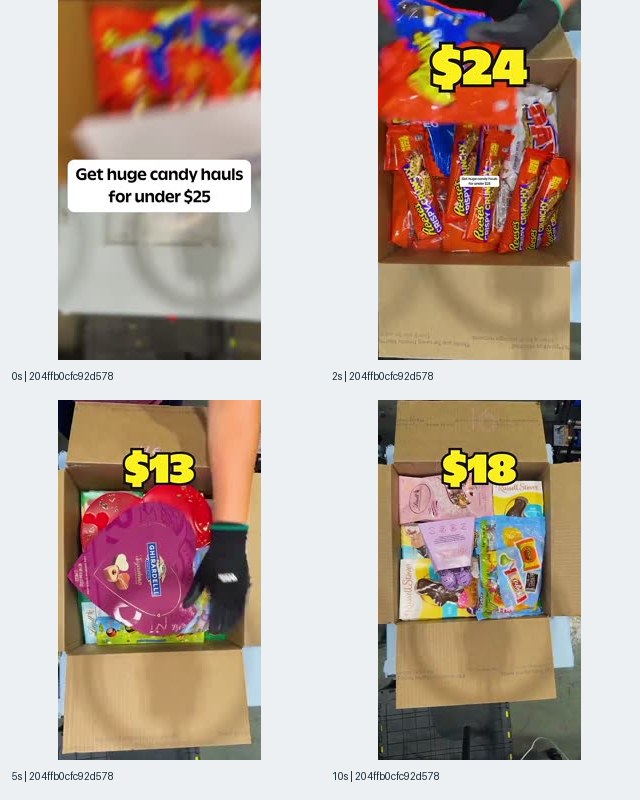
Figure 1. The first record’s 0, 2, 5, and 10-second frames show the text “Get huge candy hauls for under $25,” a $24 overlay, and boxed candy assortments. The contact sheet records sampled timestamps only.
The highest-impression record in the frozen sample is represented by this candy-haul contact sheet. A short price message appears before the viewer sees several filled boxes. The creative uses a simple sequence: curiosity, a specific low price, then quantity. It is a visible price-and-volume hook, not proof that every viewer could obtain the same haul or that the offer remained available after the observed capture.
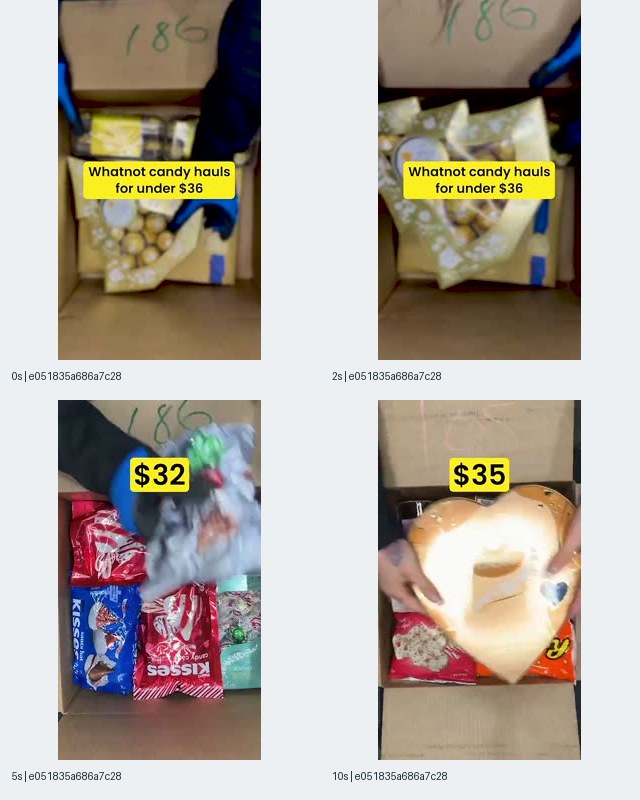
Figure 2. The second record’s sampled frames show the copy “Whatnot candy hauls for under $36,” a $32 label, a $35 label, and open boxes containing packaged products. The frames do not establish offer terms beyond what is visible.
A second candy example varies the amount while preserving the same information architecture. The price sits high in the frame, the box is the proof object, and the product count does the visual work. For a creative team, the reusable idea is the pairing of a concrete threshold with a physical reveal. The testable hypothesis is that price-plus-quantity may stop the scroll for bargain-oriented shoppers; the sample does not show click-through or purchase behavior.
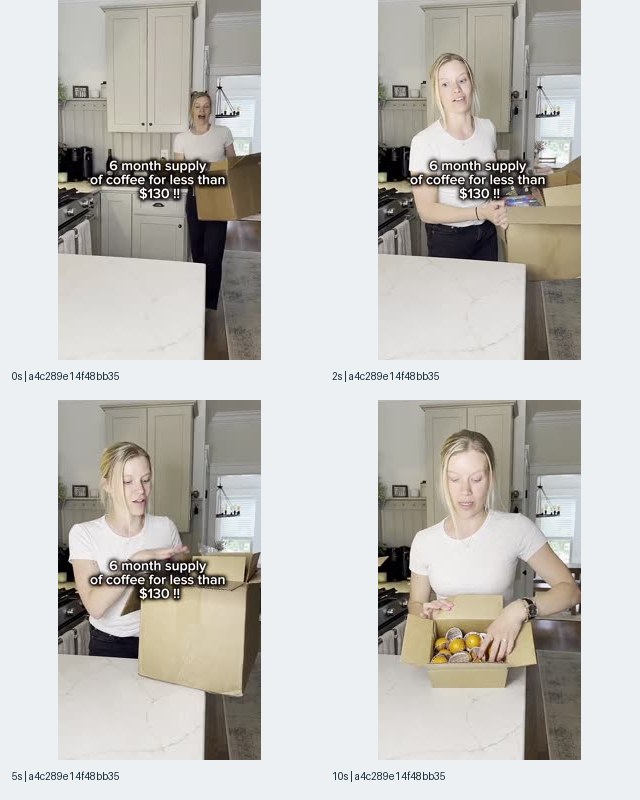
Figure 3. A contact sheet shows a person in a kitchen holding a box, opening it, and revealing coffee products beneath the text “6 month supply of coffee for less than $130!!” No identity is assigned to the person in the frame.
The coffee example shifts from candy volume to duration. “Six month supply” is a time-based anchor, while the box opening supplies a visual transition from claim to product. The copy is a claim made in the ad. It is not independent evidence of quantity, price, subscription terms, or availability. Teams borrowing the structure should verify the number and period on their own landing page before production.
Price Hooks, Unboxing, and Category Discovery
The strongest visible pattern across the contact sheets is a category-first unboxing story: the ad names or implies a product category, then makes the box, bowl, or package the central object. This approach gives a live-commerce marketplace a tangible opening even when the viewer has never seen the seller or stream before.
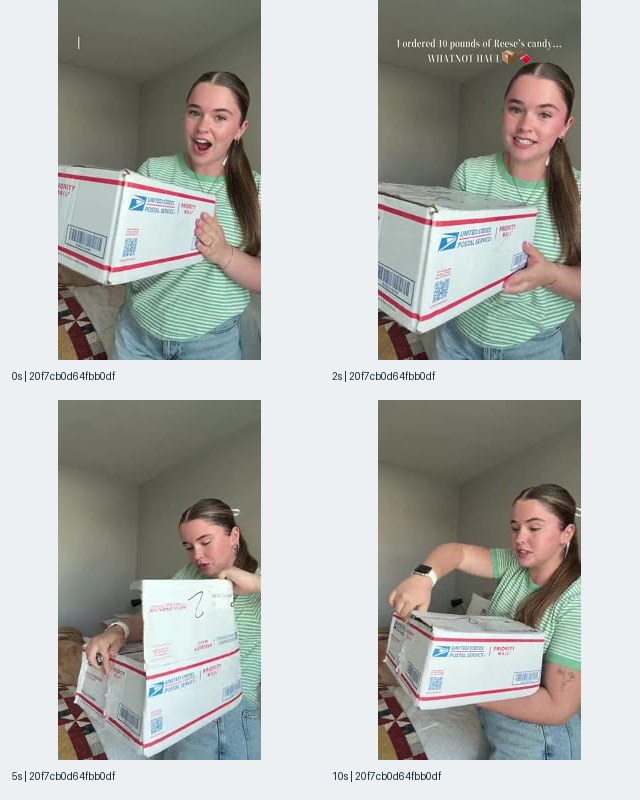
Figure 4. The sampled frames show a postal box being opened and candy packaging being lifted out. On-screen text references ordering pounds of candy; the contact sheet does not verify the person’s identity or the final quantity delivered.
This frame set makes the package itself the testimonial. The viewer sees hands, cardboard, branded packaging, and a reaction-ready reveal. The brand printed on packaging can be visible in the frame, but the contact sheet does not establish a broader partnership or official endorsement. For a brief, capture the exact wording and keep any product-brand reference tied to the frame where it appears.
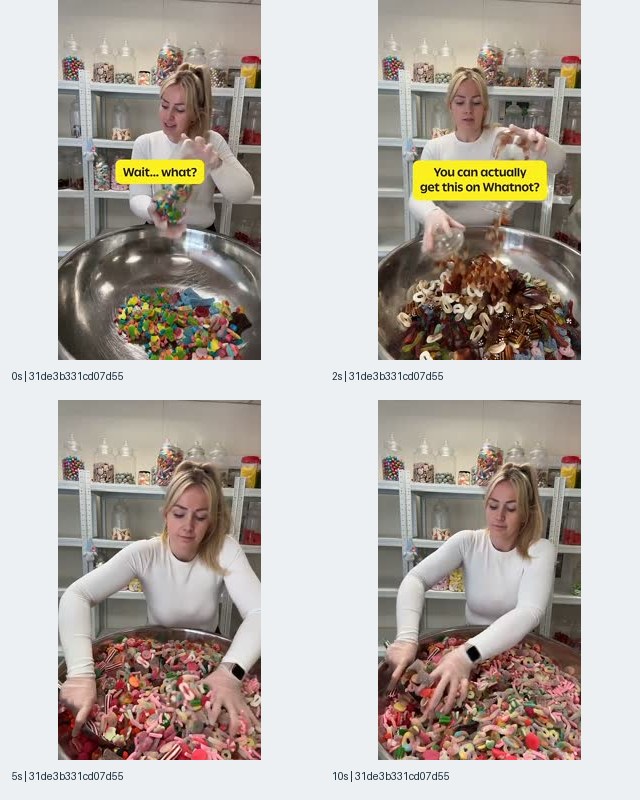
Figure 5. The frames show colorful candy being poured into a metal bowl, followed by the text “Wait... what?” and “You can actually get this on Whatnot?” The scene is an observed visual question, not proof of availability for every market.
The fifth example uses disbelief as the hook. The question is placed over an unusual assortment, then the product fills the frame. This is a useful distinction for creative review: the ad’s question is an attention device, while the underlying availability statement still requires verification. A safe adaptation would preserve the visual surprise and replace the claim with a checked category, seller, and date.
Live-Selling Energy and Visible Categories
The sampled frames show live-selling energy through people in the frame, bowls, boxes, overlays, and varied categories across sampled records, but they do not verify a particular distribution channel. Whatnot’s visible categories in this package include candy, coffee, baked goods, food products, and collectibles; the evidence does not support a complete category map.
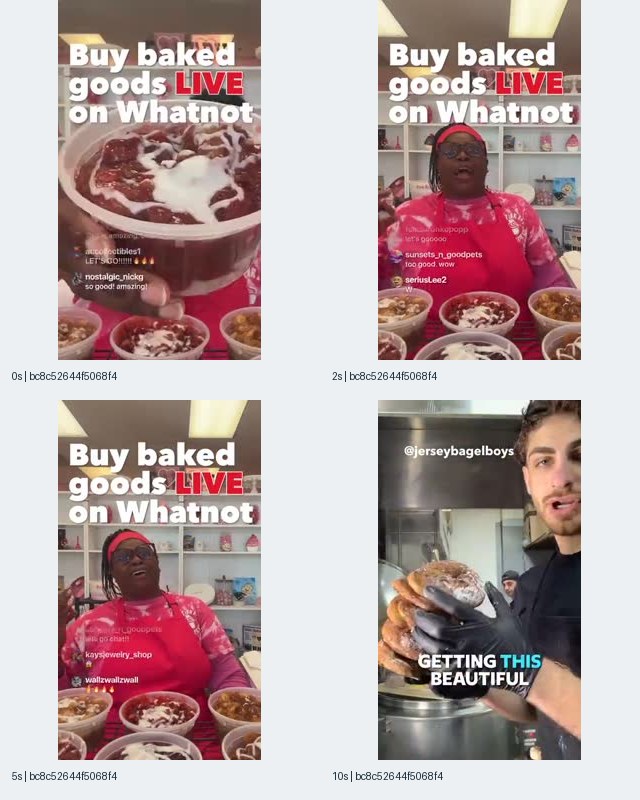
Figure 6. The contact sheet shows bowls of baked goods, the text “Buy baked goods LIVE on Whatnot,” and a later frame of a person holding baked items. The channel and identity of the person are not verified by the sample.
The baked-goods creative is the clearest live-commerce statement in the set. It combines a category label with a human presenter and a tabletop spread. The phrase “LIVE” is part of the ad’s visible copy. It does not prove where the ad ran, how the live event was scheduled, or whether the viewer could buy at the moment of exposure.
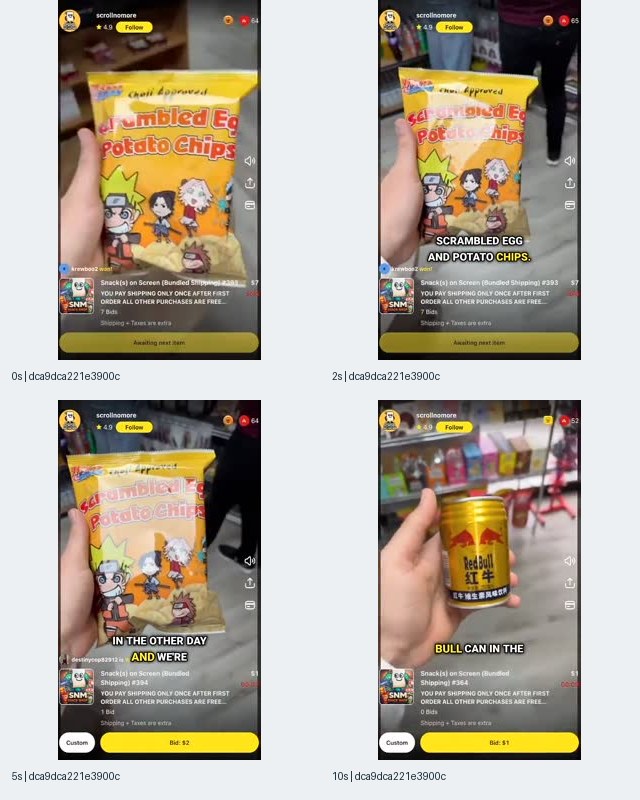
Figure 7. The frames show a mobile shopping interface with the text “SCRAMBLED EGG AND POTATO CHIPS,” followed by a small canned drink product. The interface is visible evidence; its capabilities and placement are not established.
This record is useful because it shows a more direct product-card treatment. The app-like screen occupies most of the frame, with category language and a small product reveal. Since the sample does not include a verified network label, calling this a TikTok, Instagram, or YouTube ad would exceed the evidence. Treat the interface as a creative reference, then validate the destination and buying path in your own account.
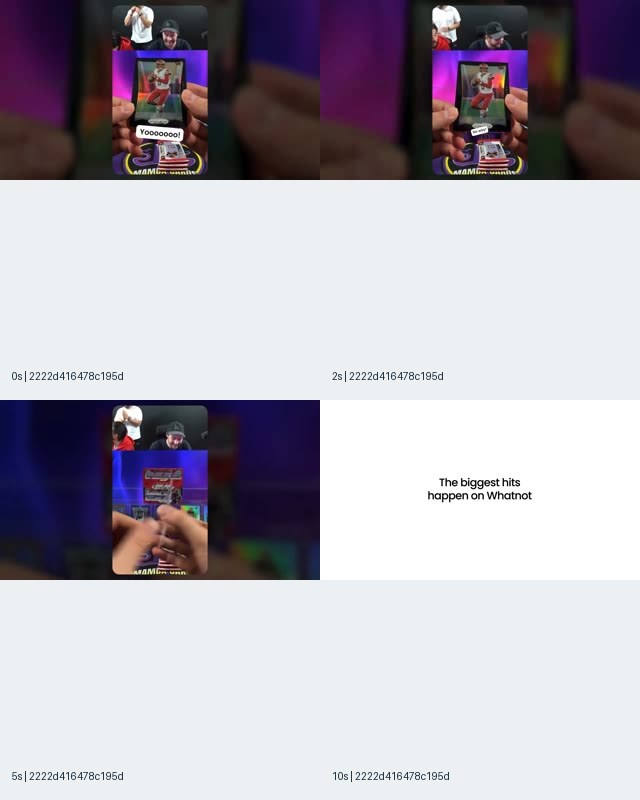
Figure 8. The contact sheet shows a vertical phone-within-phone presentation, a collectible product pack, and the text “The biggest hits happen on Whatnot.” The frames do not identify the people shown or verify a specific card brand.
The collectible example uses nested-screen framing and a superlative claim. “The biggest hits happen on Whatnot” is an on-screen advertising statement, not an independently measured outcome. Because the visible pack is not enough to establish a product partnership or prize probability, a responsible teardown records the words, object, and timestamp while leaving performance and fairness questions unanswered.
Format Mix and Creative Reuse
Whatnot’s sampled format mix is hybrid: video carries almost every record, while playable associations appear in just over half of the rows. Deduplication shows why record count and asset count must stay separate when a team estimates production breadth.
The frozen sample contains 30 records, 29 with video, and 16 with playable associations. After flattening fingerprint arrays, those rows resolve to 19 unique videos and 10 unique playable files. There are no unique static-image files. A single video can therefore appear under multiple records, sometimes with different playable files or metadata. The sample supports a reuse observation; it does not show why the reuse occurred or whether it improved results.
The top record illustrates concentration. Its supplied modelled impression estimate is 13,782,657 and its share is 45.9%. The second record is supplied at 5,104,359 and 17.0%, with a supplied top-record-versus-second comparison of 2.7×. The top five together represent 81.8% of the sampled total. These are window estimates for indexed records, not spend-weighted reach or proof of a hero creative’s profitability.
The history fields also require careful wording. The earliest first-seen date in the sample is 2025-08-19, while the latest first-seen date is 2026-10-17. Two records were first seen inside the measurement window, and eight records were last seen in the final three days. Those dates describe what the index observed. They do not prove that an asset ran continuously, that it was served on a given platform, or that longevity caused performance.
For creative operations, the useful output is a matrix rather than a single count:
| Dimension | What to record | What the Whatnot sample supplies |
|---|---|---|
| Record | Individual indexed ad instance | 30 |
| Video master | Fingerprint-deduplicated video | 19 |
| Playable master | Fingerprint-deduplicated playable | 10 |
| Reuse | Same fingerprint across records | Present; exact production reason unknown |
| Concentration | Supplied impression shares | Top record 45.9%; top five 81.8% |
| Freshness | First- and last-seen dates | Two first seen in window; eight last seen in final three days |
The Collectibles Bracket: Whatnot, Rips, and Courtyard
The collectibles bracket is most useful as a role comparison: Whatnot’s sample shows marketplace and category discovery, while Rips by Triumph and Courtyard provide separately dated examples of pack-rip and collectible-app acquisition. The bracket cannot establish which product buys users more efficiently or which fleet is larger across the same period.
The Rips and Courtyard figures below come from a separate AdMapix pull made on 2026-10-30. Its 30-day creative window is 2026-09-30 to 2026-10-29, with the top 30 US creatives per verified iOS listing. They are kept apart from the frozen Whatnot window.
| App | US ranking context, 2026-09-29 to 2026-10-28 | Separate top-30 creative pull | Visible fleet signal |
|---|---|---|---|
| Whatnot: Shop, Sell, Connect | Downloads #42; 1,313,274; -9.00% | Frozen window 2026-10-11 to 2026-11-09: 30 records and 30,049,136 modelled impressions | Live-shopping boxes, price anchors, food, candy, and collectibles |
| Rips by Triumph | Revenue #18; change not captured. Downloads #94; 835,976; change not captured | Window 2026-09-30 to 2026-10-29: 5,452,524,821 modelled impressions across top 30; top creative share 25.9%; oldest first seen 2026-04-07; 3 first seen in the last 30 days; 2 records with playable | Pack-rip app context with a high-volume sampled creative pull |
| Courtyard | Revenue #68; change not captured | Window 2026-09-30 to 2026-10-29: 1,029,155,715 modelled impressions across top 30; top creative share 14.2%; oldest first seen 2026-02-26; 20 first seen in the last 30 days; 2 records with playable | A more recently refreshed collectible-app sample in this bracket |
Whatnot’s creative language is marketplace-led: the viewer sees a product category, a reaction-style hook from an unidentified person, and a physical reveal. Rips and Courtyard are useful comparison points for teams deciding whether their own collectible product should lead with the pack, the host, the category, or the app interaction. The separate windows prevent a clean ratio, share comparison, or “winner” claim across fleets.
For the full pack-rip context, read the Rips by Triumph ad strategy teardown. For the broader series and its measurement conventions, see AdMapix’s ad strategy teardown hub.
What “Whatnot Ads Are Annoying” and “YouTube” Queries Can Answer
The frozen evidence can explain why some viewers may experience repetition or intensity, but it cannot prove that Whatnot ads are annoying and it cannot verify YouTube placement. The data shows concentration and repeated creative fingerprints; annoyance is a user judgment that requires user-level exposure or survey evidence.
A top-record share of 45.9% and a top-five share of 81.8% mean that the sampled estimate is concentrated among a small set of records. That can support a hypothesis about repeated exposure for some audiences, especially if the same inventory is served frequently. It cannot establish frequency, reach, audience overlap, or the emotional response of viewers. A team investigating the “annoying” query should pair creative-index evidence with its own frequency, feedback, and brand-lift data.
The same boundary applies to “Whatnot ads YouTube.” The supplied source does not verify a YouTube label, URL, channel, or placement for these records. The contact sheets show vertical and mobile-style framing, but format appearance is not network attribution. A responsible article therefore says the sample did not establish YouTube, then gives the reader a workflow for checking channel labels in their own account or a verified library.
The sample also does not identify the people in frames. Describe the person or presenter shown opening a box. Do not assign a name based on appearance, text on a card, or a social-style interface. A person’s presence is a creative observation, not proof of endorsement or creator status.
A Practical Workflow for UA and Creative Teams
A useful Whatnot research workflow turns each visible frame into a dated hypothesis with a clear next test. The goal is to preserve the evidence boundary while making the output practical for production, media, and growth decisions.
Step 1: Lock identity before collecting examples
Search the verified store ID and seller, then record the country and exact measurement window. Keep the iOS listing separate from Android until a second identity audit is supplied. Do not merge records because the name looks similar, and do not use a product-search aggregate as a substitute for creative-level evidence.
Step 2: Separate records from assets
Create one row per indexed record, then flatten video and playable fingerprint arrays into separate asset tables. Keep these fields visible: record ID, top-level impression estimate, first seen, last seen, video fingerprint, playable fingerprint, and source URL. This prevents a reused video from being counted as a new production each time it appears.
Step 3: Tag the visible hook
Use tags that describe what is on screen: price threshold, quantity, duration, box reveal, presenter or reaction-style hook, product category, reaction, interface, or collectible pack. Add the exact text when it is legible. Mark claims as claims. For example, “six month supply” and “biggest hits” should be preserved as ad wording, with no conversion into verified product facts.
Step 4: Build a matched brief
For each pattern, write one control and one variant. A control might open with a price overlay and product box. A variant might keep the same category but replace price with a reaction-style hook from the person on screen. Hold the landing destination, audience, and test window constant so the creative variable remains interpretable.
Step 5: Validate the promise before launch
Check the product quantity, price, inventory, delivery terms, and availability in the destination experience. If a frame names a brand, confirm that your own rights and product relationship support the reference. If the creative says LIVE, document the event timing and the path a viewer will follow.
Step 6: Measure your own account
Use first-party metrics for hold rate, click-through, install or purchase events, frequency, and downstream value. The public sample can suggest what to test; it cannot replace your attribution or incrementality design. Keep the public impression estimate in a research column, separate from your campaign delivery.
Step 7: Refresh on a fixed cadence
Re-run the same product ID, country, sort order, and window length. Record the fetch date. Compare qualitative changes such as new category hooks, fresh first-seen batches, or a different playable association. Do not claim that an asset is a winner because it remains indexed, and do not compare windows without preserving their dates.
If you want to inspect this workflow as new records appear, use AdMapix search for your team’s next review cycle.
Common Mistakes in Whatnot Ad Research
Most errors in this topic come from mixing evidence units or treating a ranking estimate as a business account. Avoiding a few predictable mistakes keeps the teardown useful.
Counting records as unique creatives
Thirty rows do not mean thirty videos. This sample has 19 unique video files and 10 unique playable files. Always report the units separately.
Treating modelled impressions as observed delivery
The 30,049,136 figure is a third-party model estimate for 2026-10-11 to 2026-11-09. It is not spend, reach, installs, or lifetime delivery. Do not divide it by creative age to create a daily rate.
Calling a sampled frame a YouTube ad
A vertical frame or phone-within-phone layout does not identify a network. Name YouTube, TikTok, Instagram, or another channel only when the evidence verifies it.
Calling the top record a winner
Concentration tells you how the sampled estimate is distributed. It does not reveal creative quality, conversion, or profitability. Write “top record” and “concentrated estimate,” then form a test hypothesis.
Mixing the bracket into the frozen table
Rips and Courtyard use a separate pull dated 2026-10-30 with a 2026-09-30 to 2026-10-29 creative window. Keep their totals, shares, and first-seen fields in their own table and label the vintage.
Reconstructing company revenue from a store rank
Whatnot’s missing top-300 store revenue rank says nothing about marketplace GMV or company profit. Rips and Courtyard revenue ranks are app-store listing estimates, not business financial statements.
Naming people or assuming endorsements
Describe what a person does in the frame. The contact sheets do not establish identity, creator status, or endorsement contracts.
When AdMapix Fits This Research
AdMapix fits teams that need a searchable, dated creative evidence layer across product IDs, records, fingerprints, and visual examples. It is useful when a UA manager wants to revisit the same competitor window, when a creative team needs source-linked references, or when an agency must explain why a report contains 30 records but fewer unique assets.
It is not a substitute for your ad account, attribution platform, user research, commercial due diligence, or channel-specific placement verification. The product can help you find and organize indexed creative evidence; it cannot turn public estimates into private spend, conversion, targeting, or profitability data.
Disclosure: AdMapix is our product, so we include it as the practical handoff and separate its product workflow from the limits of the public source sample. Pricing and commercial terms can change; use the live AdMapix pricing page for current information. To inspect the current search surface, use AdMapix search.
If this Whatnot teardown gives your team a testable hook, sign up or log in at /login to access live data, then use AdMapix search to inspect the indexed evidence and build a dated brief around your own market and product.
About AdMapix Research: AdMapix Research is the research byline of AdMapix, an ad-intelligence platform. Its articles are built from AdMapix data (creative records, modelled impression estimates and US app-store rankings), prepared with Codex from a dated frozen sample and checked by automated evidence review.
FAQ
How many Whatnot ads were in the frozen US sample?
The frozen pull contains 30 indexed advertising records for the verified iOS listing Whatnot: Shop, Sell, Connect, measured from 2026-10-11 to 2026-11-09. Those are records, not unique media files. Fingerprint deduplication finds 19 distinct videos and 10 distinct playables, with no unique static-image files.
What did the Whatnot ads visibly show?
The eight contact sheets show candy hauls with price overlays, a coffee box, packaged candy, mixed candy in a bowl, baked goods with live-shopping copy, a mobile shopping interface, and a collectible product pack. These are observations from sampled timestamps at 0, 2, 5, and 10 seconds; they are not claims about the full videos or every Whatnot campaign.
Did the sample verify Whatnot ads on YouTube?
No. The frozen evidence does not verify YouTube, TikTok, Instagram, Meta, or another named network for these records. A vertical layout or phone-style frame is not enough to identify placement. Channel attribution should come from a verified source label or your own account-level evidence.
Is Whatnot’s 30,049,136 figure company revenue or observed ad delivery?
No. It is the supplied third-party modelled impression total for the sampled records and the explicit 2026-10-11 to 2026-11-09 window. It is not observed delivery, spend, installs, company revenue, marketplace GMV, profit, or a lifetime total.
Why was Whatnot not ranked for revenue?
Whatnot was not in the captured top 300 for US app-store revenue in the 2026-09-29 to 2026-10-28 ranking window. Marketplace sales do not necessarily pass through app-store billing, so that ranking cannot represent the company’s full commerce activity. “Not in the captured top 300” is not a zero-revenue claim.
How does Whatnot compare with Rips by Triumph and Courtyard?
The supplied bracket provides separate top-30 creative pulls for Rips and Courtyard from a 2026-09-30 to 2026-10-29 window, pulled on 2026-10-30. Rips’ top 30 carry 5,452,524,821 modelled impressions and Courtyard’s carry 1,029,155,715. These figures stay separate from Whatnot’s frozen window, so they should not be converted into a cross-window ratio or efficiency verdict.
Does a concentrated Whatnot sample mean the top ad is a winner?
No. The top record has a supplied 45.9% share and the top five have 81.8% of the sampled estimate. That describes concentration in the indexed pull. It does not prove conversion, retention, profitability, or user preference. Use concentration to choose a creative for closer review, then validate it with first-party testing.
Can teams use these frames to make new Whatnot-style ads?
They can use the visible structures as hypotheses: price plus quantity, a box reveal, a category-first opening, a reaction from a person on screen, or a collectible pack close-up. They should verify their own claims, inventory, rights, landing path, and event timing. The frames do not grant permission to copy a specific asset or imply a relationship with a brand shown on packaging.
Key Takeaways
- Whatnot’s frozen US sample covers 30 records and 30,049,136 modelled impressions from 2026-10-11 to 2026-11-09.
- The sample is concentrated, with 45.9% in the top record and 81.8% across the top five.
- Nineteen distinct videos and ten distinct playables sit behind the 30 records, so rows and assets must be reported separately.
- Visible hooks center on live-shopping energy, price anchors, quantity, unboxing, food and candy categories, and collectibles.
- Whatnot ranked #42 for US downloads at 1,313,274 with a -9.00% change in the 2026-09-29 to 2026-10-28 window; the ranking does not represent marketplace revenue.
- The Rips and Courtyard bracket is separately dated. Keep its figures apart from the frozen Whatnot sample and avoid cross-window ratios.
- The sample did not verify YouTube or another named network, and it cannot establish conversion, spend, profit, targeting, or the identity of people in frames.
Sources
- Public source snapshot: frozen Whatnot evidence package — fetched 2026-11-09; verified US iOS listing 1488269261; creative window 2026-10-11 to 2026-11-09. The package publishes request parameters, batches, and SHA-256 checksums.
- AdMapix methodology — product and evidence-scope reference, accessed for this dated article.
- AdMapix search for Whatnot — workflow route for inspecting indexed creatives.
- AdMapix pricing — live commercial-information route; terms may change.
- Rips by Triumph ad strategy teardown — related pack-rip analysis with its own dated measurement window.
- Ad strategy teardowns hub — topic parent and related methodology context.
The Rips and Courtyard bracket figures are from an AdMapix pull made on 2026-10-30 for the US, covering 2026-09-30 to 2026-10-29 and the top 30 creatives per verified iOS listing. They are cited as a separate data vintage and are not added to the frozen Whatnot totals.
Turn these observations into your next creative study
Open the creative library and select samples for your market, network and research question.
Related Articles
Polymarket Ads in 2026: 84.6M Modeled Impressions, 23 Videos, Sports-Led Hooks
A dated US iOS analysis of Polymarket ads covering 30 records, 23 videos, sports-led hooks, impression concentration, timing, and the Kalshi ranking caveat.
Freecash Ads in 2026: 2.77B Estimated Impressions and 16 Videos
A dated US analysis of Freecash ads: 30 verified iOS records, 2.77B modelled window impressions, 16 videos, 12 playables, visible earning claims, revenue-rank limits, and a separate Fetch–Cash Giraffe bracket.
ReelShort Ads & Revenue Rank 2026: Hooks, Reuse, and US Evidence
A dated analysis of 30 US ReelShort advertising records and eight visual examples, covering serial hooks, video reuse, playable associations, sample concentration, and separately scoped revenue rankings.