
ReelShort Ads & Revenue Rank 2026: Hooks, Reuse, and US Evidence
A dated analysis of 30 US ReelShort advertising records and eight visual examples, covering serial hooks, video reuse, playable associations, sample concentration, and separately scoped revenue rankings.
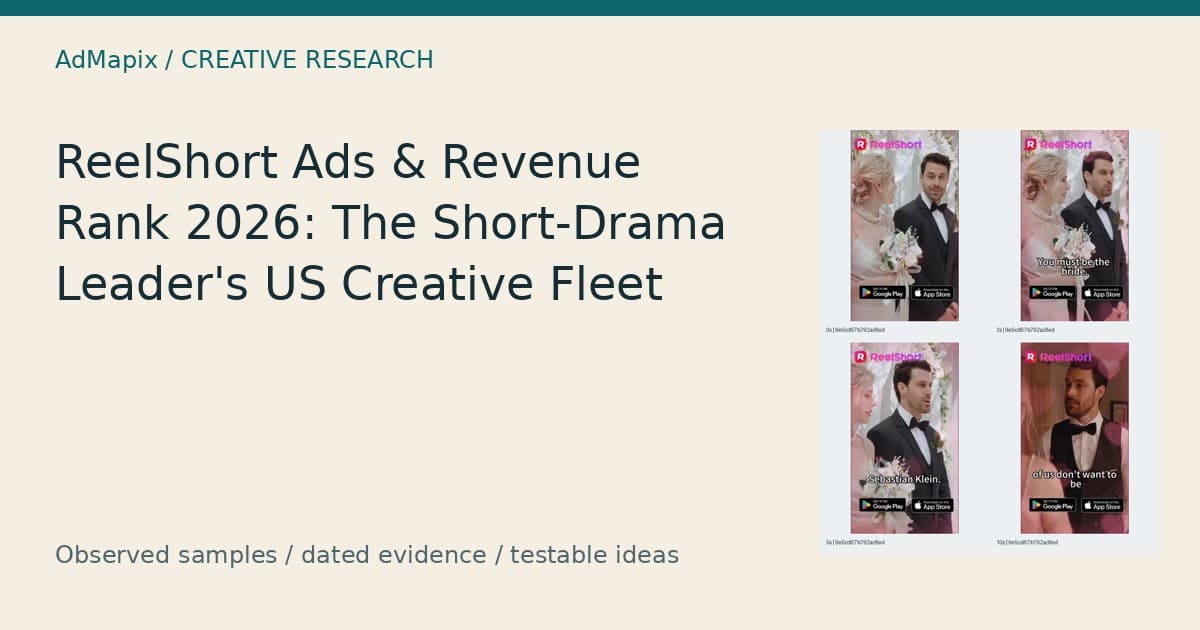
ReelShort Ads & Revenue Rank 2026: Hooks, Reuse, and US Evidence
Last updated: 2026-11-02
AdMapix Research — prepared with Codex and checked against the dated source sample.
Editorial ownership: Brad at AdMapix. This automated draft does not imply personal human review.
ReelShort ads in this US sample use wedding encounters, relationship ultimatums, supernatural imagery, physical vulnerability, and unresolved danger to introduce a story quickly. The advertising structure is equally revealing: 30 records contain 14 distinct video files, while a record carrying a playable-classified asset accounts for 52.8% of the sample’s modelled impressions. That leading record has no video attached, so the visible drama scenes cannot explain its prominence. For acquisition managers, creative teams, and short-drama operators, this analysis separates what the pictures show from what the records establish. It also places ReelShort beside other short-drama apps in a separately dated US ranking, without turning store-listing estimates into company revenue or creative longevity into proof of profitability.
Quick Answer
ReelShort’s sampled advertising combines recognizable dramatic situations with repeated video assets and playable-classified components. The useful finding is the relationship between those layers, rather than a claim that any particular scene caused commercial success.
- The US measurement window is 2026-10-04 to 2026-11-02. Its 30 sampled records carry 90,068,199 third-party modelled impressions.
- The leading record accounts for 52.8% of that sample; the leading five account for 82.1%. These are record-level shares, not video-level shares.
- There are 25 records with video, 14 distinct video fingerprints, 15 records with playable associations, and 7 distinct playable fingerprints.
- Eight contact sheets reveal creative choices at 0, 2, 5, and 10 seconds. They do not establish complete plots, endings, conversion rates, or placement on TikTok or YouTube.
- The revenue evidence supports a dated store-listing comparison. It does not answer ReelShort’s annual company revenue, advertising spend, or profit.
What This Research Helps a Short-Drama Team Decide
This sample helps a team decide which creative structures to investigate and how to organize asset research before commissioning new work. It does not provide a budget allocation formula. A wedding scene, a catalog presentation, and a divorce confrontation may all promote the same app while asking the viewer to resolve different questions. Treating them as interchangeable “drama ads” loses the distinction that makes a production brief useful.
ReelShort is the short-drama app identified here through its verified iOS listing, 1636235979, published by New Leaf Publishing, Inc. AdMapix is an advertising-intelligence platform used to search and examine advertising records. An advertising record is an indexed instance that can link to a video, image, playable-classified component, or a combination of those assets. It is not automatically a new creative concept.
For a creative strategist, the immediate task is to identify the promise that survives a brief viewing: a relationship decision, an unexpected identity, a threatened character, or access to a collection of stories. For a media buyer, the task is to distinguish that promise from its packaging and from the estimate attached to a particular record. For a market researcher, the task is to keep store rankings separate from advertising observations.
That separation matters when preparing the next production cycle. A team could mistakenly commission a remake of the wedding scene because it assumes the most visible screenshot represents the sample’s largest record. It does not. The largest record has no attached video, and the wedding video appears across other records with different component associations.
This article belongs to the AdMapix ad strategy teardown series. Its contribution is a bounded account of ReelShort’s sampled records, their asset relationships, and the specific pictures available for inspection.
Methodology: Exact Window, Product Identity, and Sample Limits
The analysis uses a frozen US sample fetched on 2026-11-02, with an explicit measurement window of 2026-10-04 to 2026-11-02. Research began with the query ReelShort, but inclusion was tied to the verified iOS product ID 1636235979, rather than a matching product name. The request retrieved up to three pages of ten records, ordered by modelled impressions descending. The resulting 30 records are a bounded sample, not a complete advertising fleet.
The public frozen source package contains the dated batches, request parameters, record details, and checksums supporting reproducible inspection. Reproduction means being able to inspect how this particular sample was assembled. It does not guarantee that a later live search will return identical estimates or ordering.
The product identity is corroborated by the supplied US App Store listing. Some sampled records also contain an Android association. Those associations do not expand this article into an Android analysis: selection and reporting remain scoped to the verified iOS reference. Matching the listing also does not establish the identity of the organization purchasing an individual placement.
All impression figures below are third-party model estimates for the stated window. They are not observed delivery, unique people reached, advertising spend, installs, conversions, or lifetime totals. Record-level figures come from each record’s own impression estimate. Product-search aggregates and values nested within linked-app information are excluded because their scope is not interchangeable with the selected record’s measurement.
Asset counts follow distinct video, image, and playable fingerprints. A fingerprint identifies an indexed file; it does not establish that two different files contain different story concepts. Conversely, repeated fingerprints establish file reuse even when advertising descriptions or associated components differ. These categories remain separate throughout the article.
Visual analysis is restricted to eight supplied contact sheets. Each contains frames sampled at 0, 2, 5, and 10 seconds. We did not watch complete videos, test playable interactions, install ReelShort, inspect its current catalog, or measure any campaign outcome. Duration values come from record metadata, not from complete playback. The 10-second frame is the last sampled frame, not necessarily an ending or an end card.
The commercial comparison uses a separate ranking snapshot captured on 2026-10-30, covering 2026-09-29 to 2026-10-28 against the preceding 30 days. A separate DramaBox advertising observation covers 2026-09-30 to 2026-10-29. Those observations retain their own dates and are not combined with ReelShort’s newer advertising estimates.
Finally, the sample does not provide a verified mapping to a named advertising network. Its source is AdMapix’s supplied advertising index. The visible ReelShort logo, store badges, portrait composition, and numeric source classification do not independently identify TikTok, YouTube, or another placement.
Evidence Table: What the Frozen Sample Establishes
The frozen sample establishes concentrated record-level estimates, repeated video files, and playable associations, while leaving spend and effectiveness unknown. The table below keeps those measurement units separate. It is a description of the selected US records for 2026-10-04 to 2026-11-02, not an inventory of everything ReelShort advertised during that period.
| Evidence item | Supplied finding | Interpretation boundary |
|---|---|---|
| Sampled advertising records | 30 | Records are not unique assets or concepts |
| Modelled impression total | 90,068,199 | Third-party estimate for this sample and window |
| Leading record’s share | 52.8% | Record concentration, not video concentration |
| Leading five records’ share | 82.1% | Applies only to the selected records |
| Leading record relative to second | 6.5× | Supplied estimate comparison, not effectiveness |
| Records carrying video | 25 | A video may appear in multiple records |
| Distinct video fingerprints | 14 | Indexed video files, not necessarily distinct stories |
| Distinct image fingerprints | 2 | Separate from the editorial contact sheets |
| Records carrying playable associations | 15 | Association does not establish tested interaction |
| Playable-only records with no video fingerprint | 5 | Subset of the 15 records, not a distinct-file count: dc0addf2586c, 16afed0d12e3, 0ddf6220cd17, 8f260e21530a, 77ac0dbec33f |
| Distinct playable fingerprints | 7 | Components can recur across different records |
| Earliest record first seen | 2025-06-12 | Observation date, not verified production or launch date |
| Latest record first seen | 2026-10-27 | Latest first observation inside this sample |
| Records first seen within the window | 5 | Does not measure total creative production |
| Records last seen in the final three days | 11 | Recent observation does not prove uninterrupted delivery |
The image-fingerprint count deserves attention because this article displays eight images. Those eight images are editorial contact sheets extracted from sampled videos. They are not the two underlying image files counted in the advertising records. Counting the illustrations in this article would therefore answer a different question from counting indexed image assets.
The same discipline applies to the playable column. A record containing both video and a playable association appears in both relevant record categories. Adding those categories would produce a misleading “total creative” number. The useful report preserves each count, then examines the relationships between the components.
ReelShort Revenue in 2026: What the US Rankings Actually Show
The supplied ranking evidence describes ReelShort’s relative position for one store listing during a specific period; it does not provide a defensible dollar figure for annual or monthly company revenue. These are AdMapix US store-listing rankings based on third-party estimates, with App Store and Google Play listings ranked together. The captured ranking covered the top 300 listings.
The following table uses the 2026-09-29 to 2026-10-28 ranking window, captured on 2026-10-30. Changes compare the reported underlying metric with the previous 30 days. They should not be read as percentages by which the numerical rank moved.
| Verified iOS listing | Revenue rank; reported revenue change | Download rank; reported download change | Reported window downloads |
|---|---|---|---|
| ReelShort — 1636235979 | #174; −6.30% | #72; −48.63% | 1,019,150 |
| DramaBox — 6445905219 | #166; −0.82% | #67; −15.74% | 1,037,019 |
| Pocket Saga — 6478151552 | #187; −6.90% | #106; −5.20% | 773,087 |
| PineDrama — 6754134922 | #234; −4.75% | #10; −37.10% | 2,369,708 |
The supplied same-ranking comparison places DramaBox’s modelled app-store revenue at 1.1× ReelShort’s for that ranking period. No corresponding revenue ratios for Pocket Saga or PineDrama were supplied, so none are calculated here. Numerical rank positions cannot be converted into revenue multiples: the commercial distance between neighboring ranks is not established by their positions.
This table is useful because it answers a narrower question than “How much does ReelShort make?” It shows where the selected listing sat relative to the other listed apps in that dated ranking, and how the reported metric changed against the preceding period. It does not reveal company revenue across stores, countries, websites, or other commercial arrangements.
The revenue value’s unit is not stated by the supplied API evidence. Consequently, this article reports rank, change, and the supplied same-ranking ratio without inventing a currency value. It also does not infer profit from revenue rank. Production costs, acquisition costs, payment arrangements, and other operating expenses are absent.
The advertising and ranking windows differ. ReelShort’s sampled impression total cannot be divided by its ranking-period downloads to estimate impressions per install, nor can the revenue change be attributed to the sampled creative structure. Even an aligned window would still require a valid attribution method before advertising records could explain commercial outcomes.
For operators, the practical use is to create separate research questions. The ranking table informs market monitoring. The advertising sample informs creative inspection. A relationship between them remains a hypothesis until evidence connects the relevant users, campaigns, costs, and outcomes.
Concentration: The Leading Record Is Not a Drama Video
The leading record accounts for 47,570,779 modelled impressions, or 52.8% of the sample, and contains a playable-classified asset without an attached video. This corrects a tempting reading of the preview: one record does carry more than half of the sampled estimate, but describing it as the dominant drama video would be inaccurate. None of the eight contact sheets depicts that standalone record.
| Record, abbreviated for reference | Modelled impressions | Supplied sample share | Recorded asset association |
|---|---|---|---|
| dc0addf2586c | 47,570,779 | 52.8% | Playable-classified asset; no video |
| 16afed0d12e3 | 7,304,989 | 8.1% | Playable-classified asset; no video |
| 9e5cd67b792a | 7,162,503 | 8.0% | Wedding video plus playable association |
| 98ca862a5c74 | 6,821,646 | 7.6% | Wheelchair scene video plus playable association |
| 2e1b03821ba0 | 5,055,872 | 5.6% | Same wheelchair scene video; no playable association |
These figures all belong to 2026-10-04 to 2026-11-02. The supplied summary puts the leading five records at 82.1% and the leading record at 6.5× the second record’s estimate. Those facts describe a concentrated sample. They do not reveal the share of the advertiser’s total budget, the share of its complete US activity, or the return from any component.
The leading record was first seen on 2025-09-28 and last seen on 2026-11-02. Its playable fingerprint also appears alongside the wedding video in record 9e5cd67b792a. This is a useful connection: the component exists both in a record without video and in a record associated with an observed video file. It does not establish the viewer’s exact sequence of exposure or whether the component appeared after the video.
Calling it a “hero” can be convenient shorthand, provided the term means the leading sampled record. It should not imply a winning interaction, a profitable campaign, or a specific story. Without an inspected playable capture, even the content of that component remains outside this visual analysis.
The production implication is to investigate component relationships before copying a scene. A team that looks only at video thumbnails could miss the most prominent record entirely. A team that looks only at impression ordering could miss the visual vocabulary used by the associated videos. Both views are needed to formulate a useful research question, and neither substitutes for campaign measurement.
Reuse: How 30 Records Relate to 14 Video Files
The sample’s 30 records resolve to 14 distinct video fingerprints, showing that record variety exceeds file variety. There are also 7 distinct playable fingerprints, with 15 records carrying playable associations. These are separate facts about the same selected records. They do not mean ReelShort produced 30 videos, seven fully tested interactive experiences, or a known number of unique story concepts.
The wedding video provides the clearest example of reuse. Figure 1 belongs to record 9e5cd67b792a, but the same video fingerprint appears in other records, including 1e04cad2cd14 and the older 1b0c1caa8ba3. Their associations differ: some link the video to playable-classified components, while the older record has no playable association. The observed relationship is reuse of a file across records, rather than evidence of repeated production.
The wheelchair scene offers a particularly clean research pair. Record 98ca862a5c74 links its video to a playable component, while 2e1b03821ba0 links the same video without that association. The raw records establish the shared file. Their impression estimates do not establish that adding the component improved results, because allocation, audience, timing, and other campaign conditions are not supplied.
A similar relationship appears for the supernatural video in Figure 3 and the relationship-choice video in Figure 4. Each illustrated record carries a playable association, while another sampled record links the same video without one. This makes an asset map more informative than a gallery of seemingly separate ads.
The catalog montage in Figure 5 is reused across records with different description text. That is a different kind of variation: the observed video file stays the same while the attached written description changes. The description therefore needs its own field in a research worksheet. It should not be treated as a reliable transcript of the visible footage.
For production planning, distinguish a new story, a new edit of an existing story, a new description attached to an existing file, and a new component pairing. Each represents a different work requirement. A fingerprint identifies file reuse; a human or automated visual comparison with suitable evidence would still be needed to classify different files into story families.
The source’s playable classification is also narrower than a demonstrated user experience. This article did not open those components or test any interaction. Their presence supports reporting association and reuse. It does not support claims about tap choices, game mechanics, navigation, or the reason a viewer might install.
Longevity and Freshness: What the Dates Can Support
The oldest sampled record was first seen on 2025-06-12 and last seen on 2026-11-02, confirming that the sample includes an observation history reaching back to mid-2025. That record, 1b0c1caa8ba3, carries the same wedding video file represented in Figure 1. Its long observation span is evidence of persistence in the index, not proof of continuous delivery or commercial success.
The distinction matters because first seen is an observation date. It is not necessarily the date the video was produced, the campaign launched, or the underlying show became available. Last seen is also an observation date. A gap between those bounds can contain periods the supplied record does not describe.
The sample also includes newer observations. Its latest first-seen date is 2026-10-27, and 5 records were first seen inside the measurement window. Separately, 11 records were last seen during the window’s final three days. These supplied counts show that older and newer records coexist in the selection. They do not establish the total production rate or the proportion of every ReelShort campaign still active.
For a short-drama service, an older acquisition asset can plausibly remain useful while the content catalog changes. That is a hypothesis about the role of familiar dramatic situations: a wedding misunderstanding or relationship rupture might introduce the service without depending on the newest release. The sample does not verify ReelShort’s release schedule, its audience strategy, or the business reason for retaining the video.
An alternative hypothesis is operational reuse: an existing file remains attached to different advertising records or components because it is available for those combinations. Another is selective visibility: the impression-sorted sample may favor records with longer observation histories. None of these explanations can be selected as the answer from the supplied data alone.
The practical response is to keep an older asset as a research reference while checking its current promise. Does the promoted story remain available? Does the offer still match the destination? Does the edit still make sense to a new viewer? Those are questions for a team’s own product and campaign review, not conclusions established by the competitor sample.
Do not divide the window’s impressions by the time since first seen. That would mix a bounded estimate with a different time basis and create an apparent daily rate unsupported by the evidence.
Figure 1: A Wedding Encounter Introduces a Relationship Question
The wedding example establishes a recognizable social situation before the sampled subtitles supply much explanation. A woman in a wedding dress holds a bouquet beside a man in a dark tuxedo. Floral decorations, formal clothing, and the bouquet provide immediate context. The later sampled frame changes to a closer view of another male figure wearing a white shirt, dark vest, and bow tie. The contact sheet supports that visible change, but not the missing exchanges between frames.
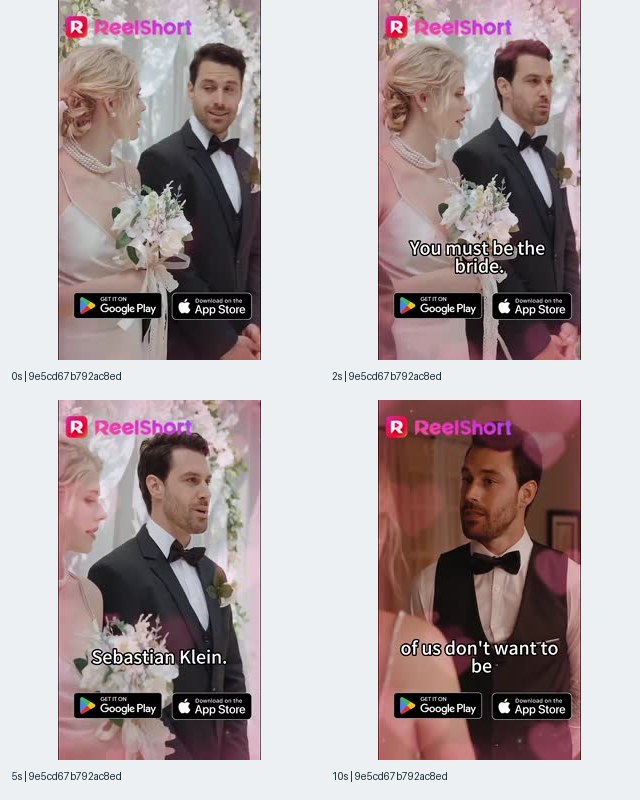
Figure 1. Contact sheet for record 9e5cd67b792ac8ed91452811ed5f4ca1, associated with verified ReelShort iOS listing 1636235979. Frames: 0, 2, 5, and 10 seconds; recorded video duration: 59 seconds. The record carries 7,162,503 modelled impressions for 2026-10-04 to 2026-11-02. The images are creative evidence, not performance proof.
The 2-second subtitle, “You must be the bride,” turns the setting into a conversational question. It suggests an introduction rather than merely displaying a wedding tableau. The story’s full relationship structure is not available in these frames, so assigning hidden identities or describing a later reveal would go beyond the evidence.
ReelShort branding occupies the upper portion, while store badges sit lower in the frame. This gives the sampled scene both a narrative layer and an app-promotion layer. The viewer can recognize a drama excerpt while also seeing a destination cue. Whether either layer receives attention or changes response is unmeasured.
The useful creative hypothesis is that familiar ceremonial context can reduce the amount of exposition needed before a relationship question becomes understandable. A team could investigate that hypothesis using its own licensed story and an opening that remains coherent without prior knowledge. The test should vary how the relationship is introduced, while preserving the same destination and access promise.
This video’s reuse is part of its research value. It appears in records with different component associations and in the oldest sampled record. That makes it worth examining as a durable reference, but the visible wedding scene should never be credited with the leading standalone playable record’s estimate.
Figure 2: Physical Detail Creates an Unresolved Moment
The wheelchair example focuses the sampled opening on an act of assistance, using body position and close-ups to create an unresolved interaction. At 0 seconds, a shirtless man sits in a wheelchair while a woman leans toward him. The subtitle reads, “Let me help you.” Later sampled frames show hands near an arm and wheelchair, a hand on a knee, and the woman’s face. Those details are visible; a diagnosis or explanation of the character’s condition is not.

Figure 2. Contact sheet for record 98ca862a5c74d58bb444d6e188c8023e, associated with verified ReelShort iOS listing 1636235979. Frames: 0, 2, 5, and 10 seconds; recorded duration: 41 seconds. Its 2026-10-04 to 2026-11-02 modelled impression estimate is 6,821,646.
The title treatment in the upper corner and the red “FREE” ribbon add another information layer. A lower banner says “Free for a limited time.” These are claims made by the captured advertisement. They do not establish current access terms, which episodes were included, or whether payment would be required elsewhere in the product.
The visual sequence offers a useful production distinction: a close-up can withhold context as well as reveal detail. The hand and knee frames narrow attention to the immediate interaction, while the later face provides a visible reaction. Because only fixed timestamps are available, we cannot state the exact number or timing of cuts, nor describe how music or dialogue shaped the moment.
A testable hypothesis is that an understandable physical action can create curiosity before the audience receives a full explanation of the relationship. To test that idea, a team would need its own scene with a clear, truthful continuation. An ambiguous opening that leads to an unrelated story would test a different proposition.
The shared video appears elsewhere in the sample without the playable association attached to this illustrated record. That relationship supports a packaging investigation. It does not support declaring either configuration more effective, and the image cannot reveal what the associated playable component actually does.
Figure 3: Supernatural Imagery Makes the Genre Explicit
The supernatural example uses a wedding dress, a large spectral wolf, blue light, and glowing eyes to make a fantasy setting visible within the sampled frames. The opening frame shows the lower portion of a dress and footwear. At 2 seconds, a woman in white stands beneath a large wolf-like apparition in an ornate interior. The later frames show a luminous female figure and a close-up of a man with glowing amber eyes.

Figure 3. Contact sheet for record 4d3aacdd7434b67cd0dc7dcfc5fb61b3, associated with verified ReelShort iOS listing 1636235979. Frames: 0, 2, 5, and 10 seconds; recorded duration: 12 seconds. The record’s modelled impressions are 678,704 for 2026-10-04 to 2026-11-02.
The sampled text moves from “I hereby announce” to “that my future husband...” and then “the Lycan Prince!” The wording links ceremonial imagery with a supernatural relationship premise. It does not establish the complete narrative, and the ellipsis should remain an ellipsis rather than an invitation to supply missing dialogue.
The images have a stylized visual treatment, but that is not evidence of a particular production tool. No tool-test provenance is supplied. Calling these frames AI-generated, naming a model, or treating them as outputs from an experiment would therefore be unsupported.
The recorded duration is short, yet the sheet still shows only selected moments. In particular, the 10-second close-up is not an established ending. The distinction matters when briefing a similar concept: a viewer’s last exposure, a call to action, and a final story beat might all occur outside the supplied images.
A reasonable hypothesis is that explicit genre imagery can help viewers recognize the kind of story being promoted before they understand the characters. A production team could test genre recognition with its own artwork and narrative, checking whether viewers identify the intended premise without relying on a long explanation. That would be a new test, not a result demonstrated here.
The “Free for a Limited Time” treatment is again an advertising claim. Any adaptation should use only the team’s verified access terms, independently of the historical wording visible in this reference.
Figure 4: A Relationship Choice Supplies a Clear Narrative Task
The relationship-choice example gives the viewer a concrete decision to understand: a woman’s subtitle says she has to choose one of the brothers, followed by a statement about marrying in eight weeks. The sampled images place her between men dressed in white, show a man in a rust-colored shirt at a doorway, and return to a group arrangement. The sheet establishes those visual contrasts without revealing the ultimate choice.
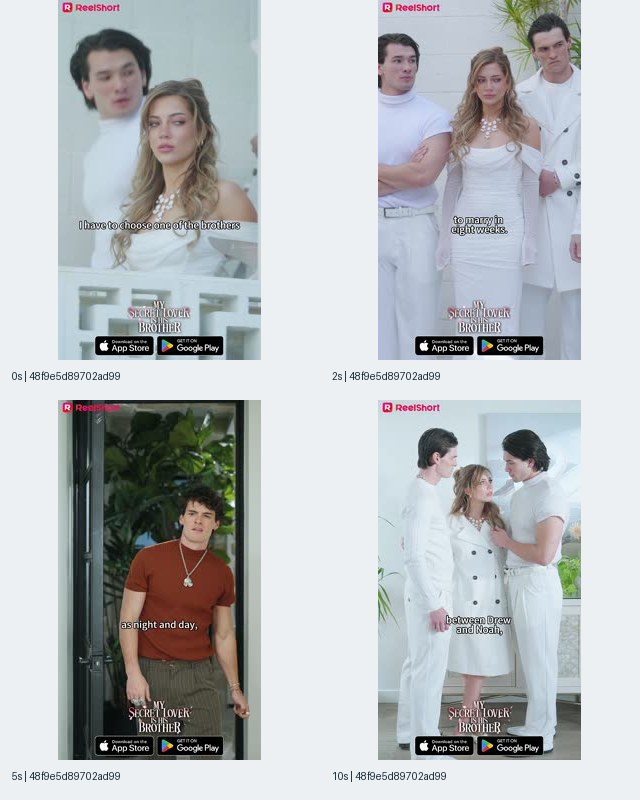
Figure 4. Contact sheet for record 48f9e5d89702ad9936d8ea7adf13f56c, associated with verified ReelShort iOS listing 1636235979. Frames: 0, 2, 5, and 10 seconds; recorded duration: 14 seconds. Its window estimate is 500,270 modelled impressions for 2026-10-04 to 2026-11-02.
The visible deadline gives the relationship choice a constraint. That is a feature of the advertised story, not a promotion expiry. Keeping those categories separate matters: a narrative deadline creates stakes inside fiction, while a commercial deadline makes a claim about the viewer’s opportunity to access a product.
Costume and composition also contribute information. The white clothing links several figures visually, while the doorway frame introduces a different color and arrangement. It is reasonable to describe that contrast. It would be speculative to assign personalities, moral roles, or audience segments from clothing alone.
A series-title graphic and store badges remain visible near the bottom. Those elements help connect a story premise to an app destination in the captured frames. The sheet does not establish whether the title was available in the app at the time of writing, whether the landing destination opened that title directly, or whether viewers completed that journey.
The practical hypothesis is that a defined choice can make an unfamiliar drama easier to summarize. A team could ask viewers to explain the central decision after seeing its own opening. If they cannot identify what the character must decide, adding more characters may be less useful than clarifying the choice.
For a live comparison, inspect indexed ReelShort creatives in AdMapix, then verify the linked store identity and selected dates. The search is a discovery starting point; the frozen figures in this article remain tied to the dated product-filtered sample.
Figure 5: A Catalog Montage Promotes Breadth Alongside Drama
The catalog montage differs from the surrounding examples because its sampled frames combine dramatic imagery with posters, promotional text, and a browsing-style interface. The opening shows formally dressed figures behind a poster overlay. Another frame shows a young man with headphones around his neck behind a different poster. The 5-second frame places promotional artwork over an eye close-up, while the 10-second frame shows a presenter in front of a list of titles.
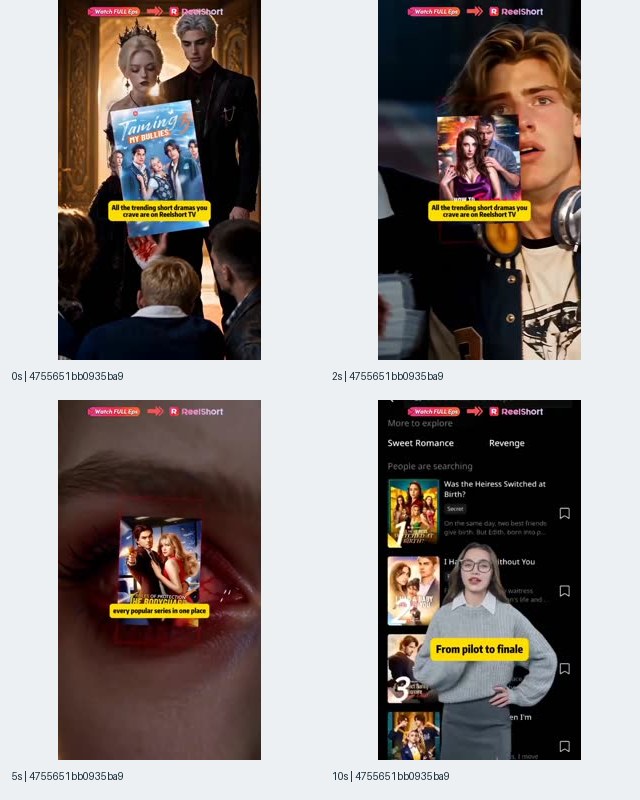
Figure 5. Contact sheet for record 4755651bb0935ba929f7f1459b049941, associated with verified ReelShort iOS listing 1636235979. Frames: 0, 2, 5, and 10 seconds; recorded duration: 29 seconds. The record carries 235,348 modelled impressions for 2026-10-04 to 2026-11-02.
The yellow captions include “every popular series in one place” and “From pilot to finale.” These are promotional claims shown in the ad. The interface depiction does not independently verify catalog completeness, current availability, search behavior, or access to every episode. A picture of an interface is evidence of a presentation choice, not a product test.
The top strip also points toward watching full episodes. Together, these elements shift the sampled message from a single unresolved encounter toward a collection-level promise. That distinction is useful for briefing: a story excerpt asks the viewer to care about a particular unresolved situation, whereas a catalog presentation asks the viewer to value access to multiple stories.
The same video fingerprint appears in other sampled records with different descriptions. One attached description discusses a half-vampire character; another refers to triplets. Those written descriptions should not be used to invent events between the sampled frames. Their relationship to the shared montage is an observation about advertising packaging, not proof that every visible scene belongs to one continuous plot.
A testable hypothesis is that a catalog presentation could help communicate the app-level proposition to viewers who are not yet attached to a specific story. A team could compare understanding of the service promise using its own catalog and a matched destination. It should not assume that broader messaging converts better, nor use an unverified completeness claim merely because the reference does.
Figure 6: A Divorce Statement Creates Immediate Conflict
The first divorce example begins with a direct relationship statement: “Then let’s get a divorce.” The sampled images alternate between a dark-haired man and a woman wearing a robe, then return to the man with further dialogue. The opening supplies conflict immediately, while the reaction frame makes the disagreement visible. The contact sheet does not establish the earlier conversation or the eventual resolution.
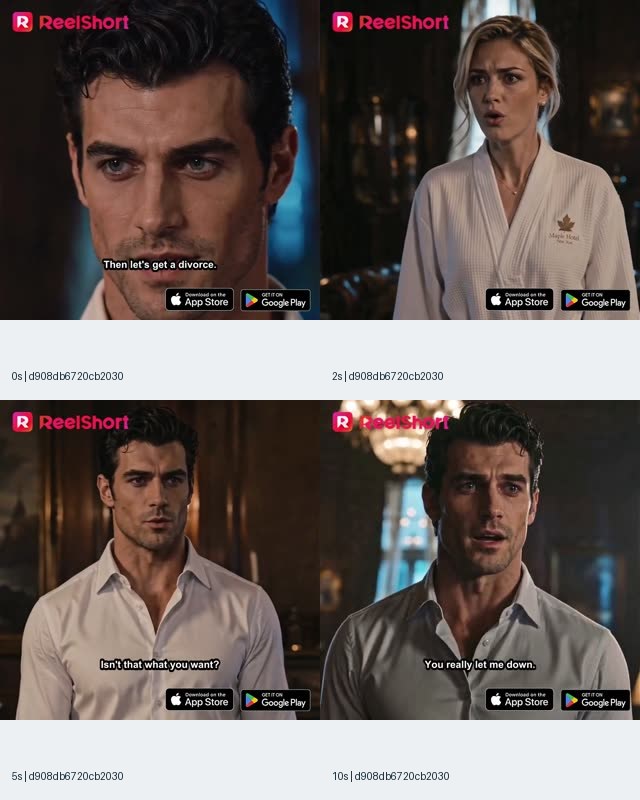
Figure 6. Contact sheet for record d908db6720cb2030f944bc0788b38113, associated with verified ReelShort iOS listing 1636235979. Frames: 0, 2, 5, and 10 seconds; recorded duration: 14 seconds. Its estimate is 161,740 modelled impressions for 2026-10-04 to 2026-11-02.
The later sampled subtitles include “Isn’t that what you want?” and “You really let me down.” These lines maintain the relationship dispute across the inspected moments. They do not tell us which character is truthful, what prompted the disagreement, or whether the conversation reverses later.
The frames shown here have a different composition from the narrow portrait examples. That visual difference is relevant to a production reference, but it is not enough to identify a placement. Aspect ratio and layout can be adapted or reused across distribution contexts. No named network is verified for this record in the supplied package.
Branding and store badges remain present while the scene carries the emotional content. The creative question for a team is whether an opening line can be understood without setup. An accusation or ultimatum may be immediately legible, but the test must also check whether viewers understand that they are being invited to watch a fictional drama through an app.
A useful original experiment would vary the first statement while holding the characters, destination, and access terms constant. The hypothesis would concern comprehension or interest in the story, with campaign outcomes measured separately in the team’s own environment. Nothing in this sample establishes that direct divorce language is a superior acquisition hook.
This record also contains an image association in addition to its video. That metadata should remain distinct from the contact sheet, which represents selected frames from the video rather than the separate image file.
Figure 7: The Same Theme Can Carry a Different Point of View
The second divorce example introduces the conflict through a question and a counterclaim rather than the statement seen in Figure 6. A woman asks, “You want to divorce me?” The sampled sequence then shows a man in a white shirt, returns to the woman with “If anyone should ask for a divorce,” and shows the man again. The sheet leaves the sentence and dispute unresolved within the available observations.
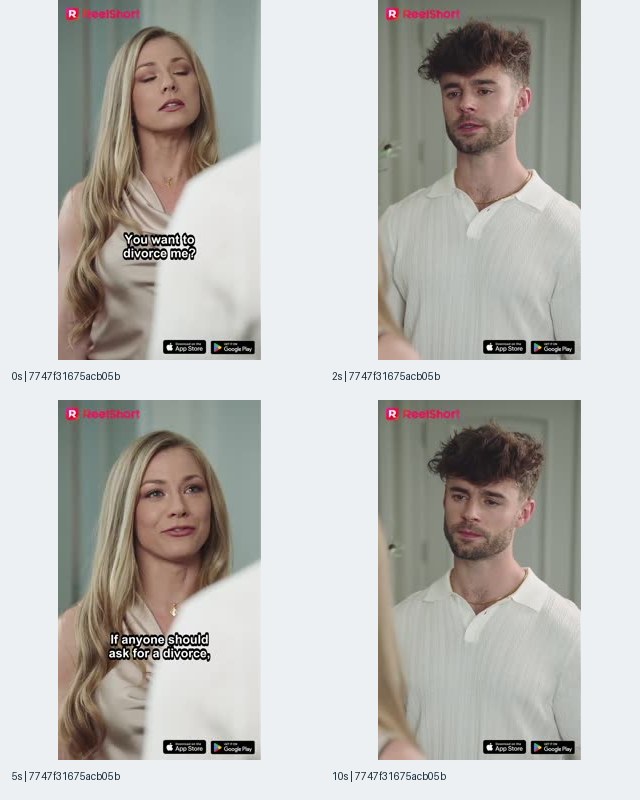
Figure 7. Contact sheet for record 7747f31675acb05bc824e071f0aeedf6, associated with verified ReelShort iOS listing 1636235979. Frames: 0, 2, 5, and 10 seconds; recorded duration: 13 seconds. The record’s estimate is 51,112 modelled impressions for 2026-10-04 to 2026-11-02.
This example illustrates why a theme tag alone is insufficient. Both Figures 6 and 7 can be labeled “divorce conflict,” but their openings assign different speaking positions. One begins with a proposed action. The other begins with a challenge to that action and then a competing claim. Those distinctions can become separate briefing variables without requiring an invented explanation of the characters’ motives.
The visible setting is relatively restrained: pale clothing, an interior background, and alternating character views. The sampled story information therefore depends heavily on subtitles and facial expression. We cannot assess the voice performance or sound design from these still images, and should not describe a music build, pause, or delivery style as though it were heard.
A reasonable hypothesis is that the opening point of view changes which character the audience initially follows. Testing that hypothesis requires more than comparing the impression estimates of these unrelated records. A team would need its own matched variants and a method for measuring viewer understanding or response.
For reference organization, save the theme, the opening speaker’s role, the visible statement, and the unresolved question separately. That makes it possible to search for “relationship counterclaim” rather than collecting every scene that happens to mention divorce. The result is a more precise production conversation, with less pressure to imitate a specific line or performance.
The sample cannot establish who appears in the footage. No actor, creator, or celebrity identity is assigned here.
Figure 8: Visible Danger Establishes Stakes Before Explanation
The danger example uses restraint and threatening props to establish an urgent situation in the sampled frames. At 0 seconds, a woman in a light dress has her arms bound overhead in a rough interior, with another figure nearby. The 2-second frame moves closer to her face and raised arms. Later frames show a woman holding a roll of tape and a man holding a metal bat.
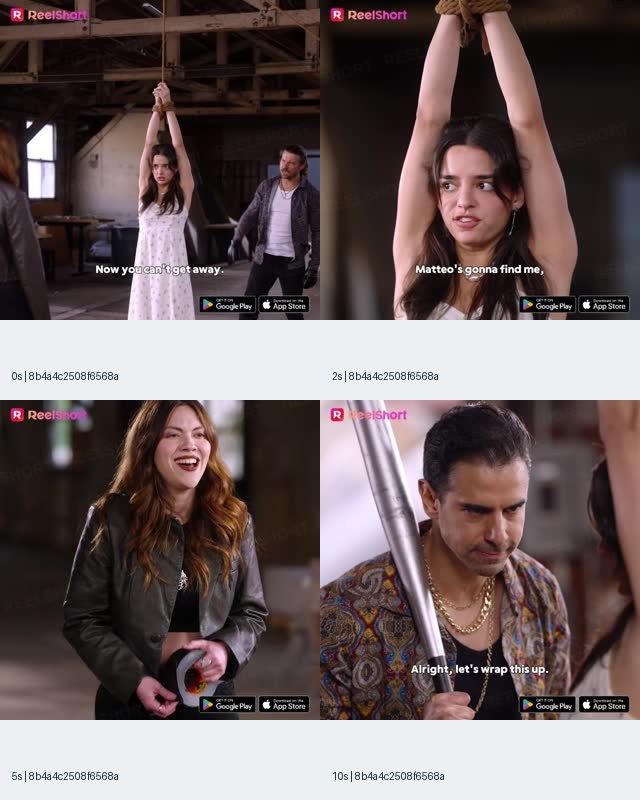
Figure 8. Contact sheet for record 8b4a4c2508f6568ad440b4cc2564be71, associated with verified ReelShort iOS listing 1636235979. Frames: 0, 2, 5, and 10 seconds; recorded duration: 29 seconds. The window estimate is 51,112 modelled impressions for 2026-10-04 to 2026-11-02.
The opening subtitle says, “Now you can’t get away.” The later sampled wording includes “Alright, let’s wrap this up.” Those lines reinforce the visible threat. They do not establish what happens after the sampled moment, whether anyone arrives, or whether the threatened character escapes. The 10-second bat frame is not evidence of the video’s ending.
Unlike the wedding scene, this example does not need a relationship explanation to make the immediate stakes legible. Restraint and a threatening object provide situational information before the larger plot is known. That is an observation about the displayed scene, not a claim that such imagery produces better advertising results.
The useful hypothesis for a creative team is broader than reproducing danger: an opening can make a character’s immediate problem visible before explaining the backstory. A production brief could apply that principle to a different, original situation whose stakes are understandable from the frame. The reference should support a structural decision, not dictate the same objects or scene.
The estimate attached to this record is an indexed window figure, not a measure of emotional impact. It cannot show whether viewers found the scene compelling, upsetting, confusing, or irrelevant. Those responses would require separate evidence.
This final visual example also demonstrates the limits of assembling a narrative from a contact sheet. Selected views can establish that several figures and objects appear. They cannot establish every action, the timing of each cut, or the causal relationship between all intervening events.
What the Sample Shows About Length, Subtitles, and Scene Changes
The illustrated videos have different recorded durations, while their contact sheets reveal only a common set of early timestamps. That combination is useful for comparing information visible near the opening, but it cannot establish an ideal ad length or a complete editing rhythm. Duration metadata and observed narrative content answer different questions and should be reported separately.
| Figure | Visible reference | Recorded duration | Available visual observations |
|---|---|---|---|
| 1 | Wedding encounter | 59 seconds | Frames at 0, 2, 5, and 10 seconds |
| 2 | Assistance beside a wheelchair | 41 seconds | Frames at 0, 2, 5, and 10 seconds |
| 3 | Supernatural relationship premise | 12 seconds | Frames at 0, 2, 5, and 10 seconds |
| 4 | Relationship choice | 14 seconds | Frames at 0, 2, 5, and 10 seconds |
| 5 | Catalog montage | 29 seconds | Frames at 0, 2, 5, and 10 seconds |
| 6 | Divorce statement | 14 seconds | Frames at 0, 2, 5, and 10 seconds |
| 7 | Divorce question and counterclaim | 13 seconds | Frames at 0, 2, 5, and 10 seconds |
| 8 | Visible threat | 29 seconds | Frames at 0, 2, 5, and 10 seconds |
Other records supply different durations, including an 88-second video in record 4c616912aa23 and a 10-second video in record d6beacc6b36f. Neither has a supplied contact sheet here, so their narrative structures are not analyzed. Their metadata prevents treating the illustrated examples as the complete duration inventory.
Subtitles perform several visible jobs. They state an immediate relationship problem, provide a deadline inside the story, connect fantasy imagery to a premise, or communicate a collection-level claim. Those jobs should be distinguished in a creative brief. A subtitle that explains what a character wants is not interchangeable with an offer banner describing access.
The contact sheets also show changes in framing and setting. Some move between faces, some isolate physical details, and the montage moves among promotional compositions. Fixed samples cannot reveal how many cuts occur between observations. Consequently, this article does not calculate cuts per second or claim that one example has a faster editing pace.
For production, a useful review asks whether each visible text layer has a clear purpose. Story dialogue, title identification, branding, access claims, and store cues compete for space. The hypothesis to test is whether a particular arrangement preserves comprehension, not whether copying the reference’s visual density will reproduce an unknown result.
Why ReelShort Ads Keep Popping Up: What This Sample Cannot Diagnose
This sample shows indexed ReelShort advertising associated with the verified listing, but it cannot explain why a particular person repeatedly sees an ad. The research concerns ReelShort as the promoted advertiser in an in-app advertising context. It does not measure advertising shown inside ReelShort, a user’s personal feed, or the frequency experienced by an individual device or account.
Repeated exposure could have several possible explanations, including repeated inventory opportunities, audience overlap, or delivery decisions. Those are general hypotheses, not findings about ReelShort’s targeting. The frozen package contains no user-level exposure history, targeting configuration, frequency setting, or campaign allocation capable of choosing between them.
The same boundary applies to searches for “ReelShort ads on TikTok” and “ReelShort ads on YouTube.” Neither placement is verified for the illustrated records. A vertical video, a ReelShort logo, a store badge, or a familiar scene does not identify where a particular impression occurred. The record’s numeric source classification is not accompanied by a verified network mapping in the supplied evidence.
If a team needs a channel-specific answer, it should collect a record that explicitly identifies the placement or network, preserve the observation date, and connect that evidence to the exact creative version. A screenshot of an ad seen in a specific app can document that occurrence when the surrounding context is preserved. It still would not establish the advertiser’s complete distribution strategy.
For a viewer trying to describe a recurring ad, the most useful details are the visible opening, exact on-screen wording, date, and the app or website where it appeared. Those details can help distinguish a wedding encounter from a divorce confrontation without guessing at actor identities or campaign names.
For an operator, the important distinction is between repetition of an asset in the index and repeated exposure to a person. The first is observable here through file fingerprints. The second requires delivery data that this sample does not contain. Treating the former as proof of retargeting would turn a useful creative observation into an unsupported targeting claim.
Comparing DramaBox and PineDrama Without Mixing Windows
DramaBox and PineDrama provide relevant short-drama research contexts, but their advertising figures cannot be merged with this ReelShort sample unless scope and dates are aligned. The commercial ranking comparison above already uses one common ranking period. The advertising observations have different dates, and must remain separate from that ranking and from each other.
A separate preview captured on 2026-10-30 reported 76,209 modelled US impressions across the selected top 30 advertising records attributable to DramaBox’s verified iOS listing for 2026-09-30 to 2026-10-29. That is a standalone observation about that listing and window. It is not placed in the same impression table as ReelShort’s 2026-10-04 to 2026-11-02 sample, and no ratio or larger-versus-smaller conclusion is drawn between them.
The observation also says nothing about DramaBox’s Android or web advertising. A small visible slice for one store reference cannot establish a small business, limited overall acquisition, or reliance on another channel. Those would require additional evidence.
The published DramaBox advertising teardown and PineDrama advertising teardown are useful companion reading for their respective research contexts. Their historical numerical claims are not imported into this analysis. The article inventory supplies their published destinations, but does not provide a newly verified common-window advertising comparison for all three apps.
A useful qualitative comparison asks the same questions of each source: does the opening promote one story or the catalog, does the record reuse a video, what accompanying text appears, and what remains unknown about the component sequence? Those questions can travel across articles without pretending that differently dated totals are directly comparable.
For a future quantitative comparison, preserve a common country, measurement window, store scope, sampling rule, and unit of analysis. Then report the resulting bounded samples as bounded samples. Alignment improves comparability; it does not convert a selected set of records into complete market coverage or reveal private campaign economics.
A Practical Workflow: Turn These Observations Into an Original Brief
The practical output of this research should be an original creative brief with a documented hypothesis and a clear evidence boundary. Start with the decision the team needs to make: whether to clarify a relationship premise, introduce a genre sooner, explain catalog breadth, or inspect component packaging. A folder of references becomes useful only when each example supports a specific production question.
Begin by locking identity and scope. Record the app-store ID, country, exact measurement dates, retrieval date, and selection rule. For this article, the identity is ReelShort iOS 1636235979 and the window is 2026-10-04 to 2026-11-02. A later refresh should keep its own retrieval date and measurements rather than silently replacing figures inside an older worksheet.
Next, create separate entries for records and assets. Each record entry should point to its linked video and any playable association. The asset entry should preserve the file identity and the known duration. This lets a researcher see that the wedding file recurs without counting each appearance as newly produced footage. It also prevents a shared playable component from being mistaken for a different interaction every time it appears.
Then write the visual observation before the interpretation. For Figure 4, a defensible observation is that the subtitles present a relationship choice and a deadline, while the frames show different character arrangements. A hypothesis is that the explicit decision makes the premise easier to understand. “This hook converts well” is neither an observation nor a supported conclusion.
A working worksheet can use the following structure:
| Brief field | Example drawn from this research process |
|---|---|
| Reference | Figure 4 and its associated record |
| Observed structure | A relationship choice with a stated story deadline |
| Evidence boundary | Fixed frames only; complete plot and outcome unknown |
| Original production task | Introduce a decision from the team’s own licensed story |
| Hypothesis | A clear choice improves understanding of the opening premise |
| Variable to change | How explicitly the opening states that choice |
| Conditions to preserve | Same story, access promise, destination, and measurement setup |
| Evidence to collect | Viewer comprehension and the team’s own campaign outcomes |
| Decision rule | Retain, revise, or reject based on the predefined test criteria |
The production handoff should specify what the audience must understand, rather than instructing an editor to copy a competitor’s shot. For example: establish who faces the decision, what is at stake, and what remains unresolved. The team can achieve that with different staging, dialogue, costumes, and visual treatment appropriate to its own content.
Offer verification belongs in the same handoff. If the reference contains “Free for a limited time,” do not transfer that language automatically. Identify the team’s actual access conditions and use wording that matches them. If the destination opens a catalog rather than the advertised story, make that transition deliberate and inspect it separately.
Before launching, review the complete original asset. This article’s contact sheets are suitable for bounded reference analysis, but a production team controls its own full video and can inspect every transition, subtitle, and destination cue. Check that the opening remains understandable, the text does not contradict the scene, and the actual final frame supports the intended next action.
Finally, measure the new test with the team’s own data. Keep the outcome definition and evaluation window attached to the result. A change in comprehension, viewing behavior, or acquisition quality would be evidence about that test under its recorded conditions. It would not retroactively prove why ReelShort used the reference creative.
How to Evaluate Component Reuse Without Inventing a Test Result
Component reuse should be evaluated as a separate question from story selection because the sample shows the same video linked to different record configurations. The wheelchair scene is a useful starting point: one illustrated record has a playable association and another record with the same video does not. That relationship suggests an investigation, but it is not a completed comparison of user experience or campaign effectiveness.
A team planning its own experiment should first inspect what its component actually does. Does it present a continuation cue, offer information, navigation, or another interaction? Those are questions about the team’s implementation. The supplied ReelShort records do not answer them for the indexed playable assets, so the production brief should not assume a branching story or a particular tap mechanic.
Define the sequence explicitly. A video file and an associated component in the same record do not prove whether a viewer encountered them in a particular order. For the team’s own test, document the intended transition, when it becomes available, and what happens after interaction. This creates something reviewable and measurable instead of relying on a database label.
The comparison should preserve the story promise. If one variant changes both the component and the promoted story, a different outcome would be difficult to interpret. Likewise, changing the access claim or destination alongside the packaging would introduce additional explanations. The useful question is narrow enough that the team knows what it would learn from either result.
Separate technical acceptance from commercial evaluation. A component can load, display text, and open a destination correctly while still failing to help the audience understand the offer. Conversely, a clear interface can be associated with weak campaign outcomes for reasons outside the creative. Logging those dimensions separately prevents “working” from becoming an ambiguous verdict.
No such experiment was performed for this article. The contribution here is the evidence that file reuse and component variation exist in the selected records, plus a method for turning that observation into a new test. The result, cost, latency, failure rate, and commercial value of that future test remain unknown.
Common Mistakes When Reading ReelShort Advertising Data
The most consequential mistakes come from changing the meaning of a number or image while carrying it into a conclusion. The frozen sample is useful precisely because its dates, product identity, and asset relationships are explicit. Preserve those definitions when summarizing it for a client, production team, or investor.
Calling 30 records 30 unique creatives. The sample contains 14 distinct video files, and some records carry no video. Use “records” for the sample count and report file counts separately. A creative concept count would require an additional classification method.
Calling the leading record the winning video. The leading record has a playable-classified asset without an attached video. Its 52.8% share cannot be assigned to the wedding contact sheet or used to infer a preferred scene.
Treating first seen as a production date. The oldest observation establishes that a record was seen by 2025-06-12. It does not establish when filming, editing, or campaign launch occurred. A long observation span also does not prove continuous delivery.
Treating sampled frames as complete playback. The images show 0, 2, 5, and 10 seconds. Do not invent unseen dialogue, plot resolutions, music, or an ending. Duration metadata does not fill those visual gaps.
Converting source labels into network claims. Neither portrait framing nor a numeric classification verifies TikTok or YouTube placement. A network claim needs evidence tied to the record.
Promoting historical ad copy into current product facts. “Free” and “From pilot to finale” are visible promotional statements. They do not prove present access terms, catalog completeness, or the behavior of the app.
Combining incompatible windows. Keep the ReelShort advertising window, the ranking period, and the separate DramaBox preview distinct. No impression-to-download ratio or advertising comparison should be manufactured from those different scopes.
Equating persistence with return. Repeated files and old records help prioritize research. They cannot disclose acquisition costs, retention, revenue attribution, or profit. Those conclusions require measurements this sample does not contain.
When AdMapix Fits This Research Workflow
AdMapix fits teams that need to move from an advertiser query to dated creative evidence, then organize records, asset reuse, and visual references into a test brief. In this article, its value is concrete: the sample connects product identity, record estimates, first- and last-seen observations, and file relationships. Those connections make it possible to distinguish a recurring video from a newly observed advertising record.
Disclosure: AdMapix is our product, so we separate its research role from claims the public evidence cannot support. This analysis does not demonstrate that AdMapix can reveal a competitor’s private targeting, exact spend, conversion rate, or complete advertising activity. It also does not imply a verified refresh-time guarantee or universal coverage of every channel.
The workflow is most useful for an acquisition manager preparing competitor research, a creative team selecting structural references, or an agency assembling a dated evidence report. It is insufficient on its own for validating company revenue, deciding whether a specific ad is profitable, or explaining an individual user’s repeated exposure.
Use the article’s examples to decide what to inspect next, then sign up or log in to AdMapix for live research. Verify the store listing and date filters before carrying any new result into a brief. Live results can change and should retain their own retrieval date.
Commercial terms can also change. Consult the current AdMapix pricing page for the available options rather than relying on an evergreen article for plan prices or credit allowances. This article makes no paid-trial promise.
FAQ
The answers below address what the dated evidence can establish about ReelShort ads, creative reuse, revenue, and channel questions. They retain the same distinction between inspected frames, record metadata, and unmeasured outcomes used throughout the article.
What do ReelShort ads in this sample actually show?
The eight contact sheets show wedding encounters, assistance beside a wheelchair, supernatural relationship imagery, a choice between potential partners, a catalog montage, divorce disputes, and visible danger. Each sheet contains frames at 0, 2, 5, and 10 seconds. These observations establish selected visual and textual choices, but not complete plots, audio treatment, endings, or advertising effectiveness.
Why do ReelShort ads keep popping up for me?
This sample cannot diagnose an individual’s repeated exposure. It contains advertising records and modelled impression estimates, without personal delivery histories, targeting settings, or frequency controls. Reused video files show repetition within the indexed sample, which is different from repetition to one viewer. Identifying the app or website where an ad appeared would document that occurrence, but would still not explain the advertiser’s full delivery strategy.
Are these ReelShort ads verified as TikTok or YouTube placements?
No named TikTok or YouTube placement is verified for these records in the supplied package. The source is AdMapix’s dated advertising index, and the available source classification has no verified network mapping here. Branding, store badges, and a vertical layout are creative features, not placement evidence. A channel-specific claim needs a record or capture that explicitly establishes the relevant distribution context.
Does the leading record prove that playable ads work best?
No. The leading record carries a playable-classified asset without video and accounts for 52.8% of this sample’s modelled impressions. That establishes record-level concentration. It does not establish what the component does, whether viewers interacted with it, or whether it produced better acquisition outcomes. No playable was tested for this article, and the sample contains no conversion or profitability measurements.
How many unique ReelShort videos are in the sample?
The 30 sampled records contain 14 distinct video fingerprints, with video attached to 25 records. There are separately seven distinct playable fingerprints and two distinct image fingerprints. These categories should not be added into a single creative total. A unique file is also not necessarily a unique story concept, because different edits can draw on the same underlying narrative.
Can this article tell me ReelShort’s 2026 revenue?
It cannot establish annual company revenue or a currency amount. The supplied US ranking period, 2026-09-29 to 2026-10-28, places ReelShort’s selected listing at revenue rank #174 with a reported −6.30% change. DramaBox is #166 with −0.82%, and its supplied same-ranking revenue estimate is 1.1× ReelShort’s. These are store-listing estimates, not company accounts, advertising revenue, or profit.
Does a record first seen in 2025 prove the ad stayed profitable?
No. The oldest sampled record was first seen on 2025-06-12 and last seen on 2026-11-02. Those dates establish an observation span, not uninterrupted delivery or positive returns. The same wedding video file appears across other records, making it a useful reuse reference. Explaining its persistence would require campaign, audience, cost, and outcome evidence that is not supplied here.
How should a small creative team use these examples?
Choose a narrow production question, such as whether the opening clearly states a character’s decision. Save the relevant figure, its record identity, and the observation limits. Write an original brief using your own story and verified access terms, then test the specific hypothesis with your own measurement. Avoid copying a scene or assuming the competitor’s indexed estimate predicts your result.
Key Takeaways
The strongest actionable finding is that ReelShort’s sampled advertising has both a narrative layer and a reusable asset structure, and those layers need separate analysis.
- Report 30 records, 14 video files, and 7 playable files as separate units; do not substitute one for another.
- The record carrying 52.8% of sampled modelled impressions has no attached video, so its prominence cannot be explained by the eight illustrated scenes.
- Use the contact sheets to study visible premises, subtitles, and composition, while reserving claims about full edits and endings for complete playback evidence.
- Keep store rankings, advertising windows, and platform identity distinct. None establishes spend, targeting, conversion, or company profit.
- Turn a specific observation into an original brief and a measured hypothesis before making a production or budget decision.
Sources
The sources below support the dated product identity, sample construction, ranking context, and research workflow; their scope should travel with every reused finding.
- AdMapix frozen source package, fetched 2026-11-02: Public sample, request batches, parameters, and checksums. Main scope: US, verified ReelShort iOS listing 1636235979, 30 impression-sorted records, 2026-10-04 to 2026-11-02. Includes the record basis for the eight timestamped contact sheets.
- Verified product identity supplied with the 2026-11-02 sample: ReelShort — Stream Drama & TV on the US App Store. Used to identify listing 1636235979 and seller New Leaf Publishing, Inc.; not used as evidence of campaign performance.
- AdMapix ranking snapshot, captured 2026-10-30: The supplied source context records US store-listing ranks for 2026-09-29 to 2026-10-28, changes against the preceding 30 days, and the DramaBox-to-ReelShort revenue ratio. It also preserves the separately dated DramaBox advertising preview for 2026-09-30 to 2026-10-29.
- AdMapix methodology and live workflow: Measurement methodology and ReelShort creative search. Linked for interpreting and repeating the research workflow; this article’s observations remain fixed to 2026-11-02 and its specified sample. Current product facts were supplied with a review date of 2026-08-13; commercial terms are deferred to the live pricing page.
About AdMapix Research: AdMapix Research is the research byline of AdMapix, an ad-intelligence platform. Its articles are built from AdMapix data (creative records, modelled impression estimates and US app-store rankings), prepared with Codex from a dated frozen sample and checked by automated evidence review. Brad at AdMapix is the accountable editorial owner; this does not imply personal human review.
Turn these observations into your next creative study
Open the creative library and select samples for your market, network and research question.
Related Articles
Kalshi Ads in 2026: What 30 US Records Reveal
A dated analysis of 30 verified US Kalshi advertising records and eight visual examples, covering creative variety, modelled exposure, discovery dates, revenue-ranking limits, and a separately dated Polymarket–Novig comparison.
Solitaire Cash Ads: Cash Hooks, Presenters, and Creative Reuse
Eight timestamped Solitaire Cash examples and 30 verified US iOS advertising records reveal account claims, presenter formats, gameplay imagery, and creative reuse, with dated portfolio context and clear limits on performance conclusions.
Underdog Rips Ads: Pack Reveals in a Sports-Led Sample
Eight Underdog advertising contact sheets show pack reveals alongside prominent sports offers, while a dated US iOS sample reveals recent records, concentrated modelled impressions, and clear limits on claims about fleet turnover, revenue, and product experience.