
Freecash Ads in 2026: 2.77B Estimated Impressions and 16 Videos
A dated US analysis of Freecash ads: 30 verified iOS records, 2.77B modelled window impressions, 16 videos, 12 playables, visible earning claims, revenue-rank limits, and a separate Fetch–Cash Giraffe bracket.
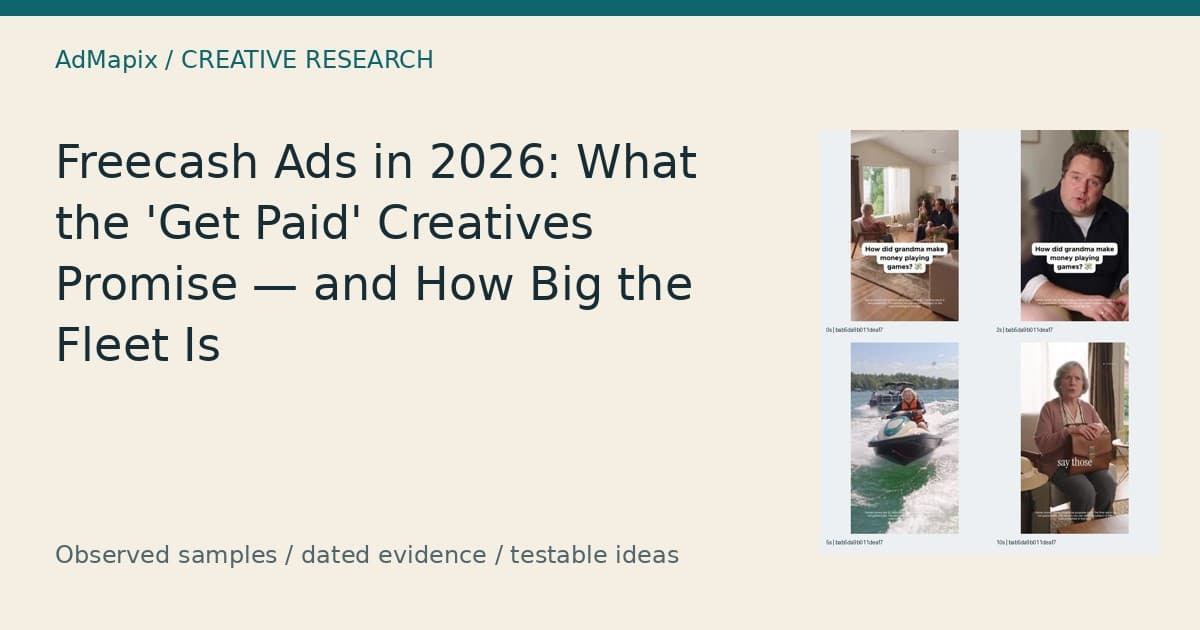
Freecash Ads in 2026: 2.77B Estimated Impressions and 16 Videos
AdMapix Research — prepared with Codex and checked against the dated source sample.
Last updated: 2026-11-09
Freecash ads in the US sample make visible earning and balance/payment claims, including payment notifications and small-balance scenarios. The supplied frames did not show an offer wall or an offer-completion sequence. The 30-record window from 2026-10-10 to 2026-11-08 carries 2,766,284,840 modelled impressions, 16 unique videos and 12 unique playables for the verified iOS listing. Those ads cannot establish whether Freecash is legitimate or whether anyone is paid; they show what the advertising says, how the fleet is assembled, and where the app sits in US store rankings.
Quick Answer
- The frozen US sample contains 30 impression-ranked records tied to Freecash’s verified iOS listing (track ID 1673567402, Almedia Ops UK LTD).
- It contains 16 unique video fingerprints, 12 unique playable fingerprints, and 16 records with a playable association. A record is a delivery entry, so 30 records do not mean 30 different assets.
- The sample’s modelled impression total is 2,766,284,840. The top record contributes 18.0% and the top five contribute 64.8%, showing a concentrated but multi-asset fleet.
- The contact sheets show narrative scenes, balance and payment screens, restaurant and fuel imagery, and a presenter. No offer wall or gameplay interface is visible in the supplied timestamps; playable or offer-oriented associations remain metadata-based research hypotheses.
- In the separate US ranking window of 2026-09-29 to 2026-10-28, Freecash’s verified iOS listing ranked #28 for downloads (1,482,162, down 1.19%) and #117 for revenue (up 7.44%). The revenue figure is a third-party app-store model estimate for one listing, not company revenue.
What Freecash Ads Promise
Freecash’s sampled ads frame earning as an everyday story rather than a technical product demonstration. The visible promise is a balance or payment outcome presented through everyday scenes, such as a small balance or a payment notification. The supplied timestamps do not show an offer wall or an offer-completion sequence; any offer-oriented interpretation remains a metadata-based research hypothesis. Some frames use explicit balances or payment notifications; others use dialogue between family members or partners to make the claim feel familiar. Each is an on-screen claim made by the ad. The sample does not verify offer terms, eligibility, payout timing, or user outcome.
The strongest repeated message is a transformation from a small or empty balance to a larger amount. In the animated grocery-store example, a phone shows “Bank Balance: $0.33,” followed later by a PayPal notification reading “$53.78 from Freecash.” The frame is useful evidence of the claim the creative chooses to make. It does not prove that a specific user received that payment, that the amount is typical, or that the same flow exists for every market.
A second message uses social proof through dialogue. One skit asks, “How did grandma make money playing games?” and moves between a living-room conversation, a man reacting, a woman riding a personal watercraft, and the woman holding a bag while saying “say those.” The humor turns a reward claim into a family anecdote. The visible sequence is a creative device; it does not identify the people or establish that the story is a real testimonial.
A third mode is the direct-to-camera or first-person explanation. One contact sheet shows a man saying “SORRY BABE NO MORE TREATS,” followed by a woman answering “SURE BABE NO PROBLEM,” then a woman in workout clothing saying “SO NO SEPHORA NO RESTOCK THIS WEEK.” These lines make the reward proposition legible through a spending decision. The sample does not identify the speakers, the channel, or the product experience behind the dialogue.
A fourth mode puts the viewer inside a visible interface. The restaurant sequence shows a person eating oysters with captions such as “OKAY WAIT,” “NICE RESTAURANT RIGHT NOW,” “YOU HAD $5 IN,” and “HERE WE GO AGAIN.” The driving sequence shows an animated driver, a phone balance of $0.33, and a fuel pump. These scenes suggest that small balances can support ordinary purchases, but the frames do not establish whether the app supports a particular payment method or whether the visual is a dramatization.
If you are building a trust-sensitive rewards-app brief, save the exact claim, frame timestamp, and surrounding context together. You can search Freecash creatives in AdMapix to inspect indexed variants and record how the wording changes over time. If you need a live workspace for your own competitor set, log in to AdMapix and keep each claim tied to its source record.
Methodology and Evidence Limits
The figures in this article come from a frozen AdMapix evidence package fetched on 2026-11-09. The creative query used the verified product ID 1673567402, country US, content type creative, impression-descending order, and up to three pages of ten records. The exact measurement window was 2026-10-10 to 2026-11-08. The public, reproducible source package is the dated evidence snapshot, which includes request parameters, hashes, records, and checks.
What this sample can and cannot show
- It can show which records were returned for the verified iOS listing, their top-level modelled impression estimates, first-seen dates, last observations, and linked media fingerprints.
- It can show visible wording and objects in the eight supplied timestamped contact sheets.
- It cannot show the complete advertising fleet, Android coverage, the buyer behind a placement, spend, installs, conversion, retention, profit, payout reliability, or legitimacy.
- Impression values are third-party model estimates for the stated window. They are not observed delivery, lifetime totals, or company revenue.
- The contact sheets show frames sampled at 0, 2, 5, and 10 seconds. They are evidence of those frames only; the last sampled frame is not an end card unless an end timestamp is supplied.
- A record count is not an asset count. Fingerprints are arrays that were flattened before deduplication; the resulting video and playable totals are separate measures.
This is a verified-product sample rather than a name-match audit. Identity comes from the iOS product ID and seller information. The sample should not be relabelled as Android coverage or as every ad Freecash ran in the US.
Evidence at a Glance
The table below keeps the unit of each number explicit. It reports facts supplied in the frozen evidence rather than recomputing shares.
| Measure | Frozen US sample | What it means |
|---|---|---|
| Measurement window | 2026-10-10 to 2026-11-08 | Explicit creative-query dates |
| Verified listing | iOS track ID 1673567402 | Freecash - Get Paid Real Money, Almedia Ops UK LTD |
| Sample records | 30 | Delivery records returned in three pages |
| Modelled impression total | 2,766,284,840 | Third-party estimate for the window |
| Unique videos | 16 | Distinct video fingerprints |
| Records with video | 21 | Records carrying a video fingerprint |
| Unique playables | 12 | Distinct playable fingerprints |
| Records with playable | 16 | Records carrying a playable fingerprint |
| Unique images | 1 | Distinct image fingerprint in the sample |
| Top-record share | 18.0% | Supplied share of the sample total |
| Top-five share | 64.8% | Supplied share of the sample total |
| Top record vs. second | 1.1× | Supplied comparison of the two largest records |
| Earliest first seen | 2025-09-11 | Oldest first-seen date among returned records |
| Latest first seen | 2026-11-04 | Newest first-seen date among returned records |
| Records first seen in window | 8 | Records whose first observation falls in the window |
| Records last seen in final three days | 28 | A recency signal in the returned sample, not a full-fleet survival rate |
The top record has 497,830,032 modelled impressions and was first seen on 2026-10-10. The next two records were first seen on 2026-04-08 and 2026-02-26, respectively. The ranking therefore mixes recently observed entries with older records that remain visible in the index. The data does not support calling any one record a permanent winner or interpreting longevity as proof of performance.
What Eight Sampled Creatives Show
The eight supplied contact sheets make the message architecture easier to see. Each image is a four-frame view at fixed timestamps. Captions below describe only the visible frames and keep the record identity attached to the example.
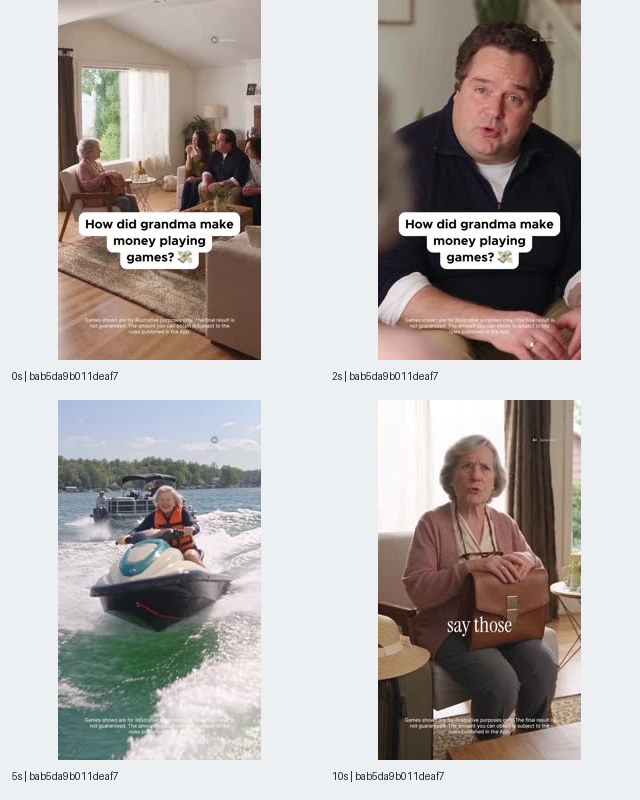
Figure 1 — Record bab5da9b011deaf7eadf9a355649a3e0. The sampled frames show a living-room conversation, a reaction shot, a woman riding a personal watercraft, and the on-screen question “How did grandma make money playing games?” The contact sheet records 0, 2, 5 and 10 seconds only.
This is a classic narrative wrapper around a reward claim. The opening question creates curiosity, while the later outdoor frame supplies an aspirational payoff. For a creative team, the useful observation is the sequence: question, reaction, lifestyle image, then explicit wording. The evidence does not establish whether the people are customers, actors, or creators, and it does not identify a network.

Figure 2 — Record c1b26a01abcf1e34af7b857466701471. A tabletop device appears beside a group in a living room; later frames keep the group and device in view. The frames are timestamped 0, 2, 5 and 10 seconds, so they should be read as selected observations rather than a complete playback.
The second example uses a shared-viewing setup. The device is the visual anchor, and the people’s reactions provide context without requiring a long explanation. A production brief could test a similar “watch someone discover the offer” structure, but the contact sheet alone cannot tell us what the device does or whether it is an actual Freecash interface.
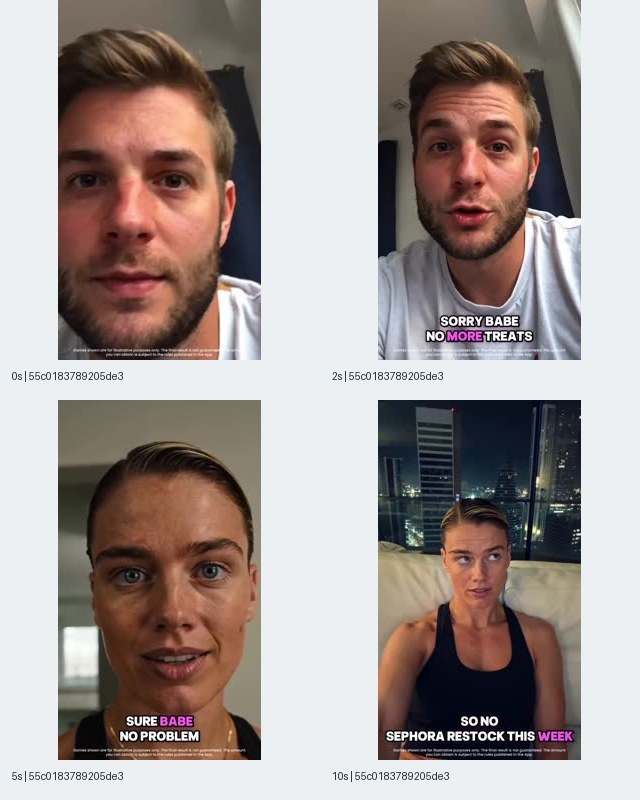
Figure 3 — Record 55c0183789205de34a6dcc12a601c4dc. The sampled frames show a man saying “SORRY BABE NO MORE TREATS,” a woman answering “SURE BABE NO PROBLEM,” and a woman in workout clothing with the caption “SO NO SEPHORA NO RESTOCK THIS WEEK.” These are the visible dialogue and captions at 0, 2, 5 and 10 seconds.
This creative turns a spending restriction into a recurring couple joke. The “SORRY BABE,” “SURE BABE,” and Sephora lines are visible dialogue and captions, not evidence of a verified payout or user outcome. Teams reviewing the idea should preserve the exact wording and avoid rewriting it as a general earnings promise.
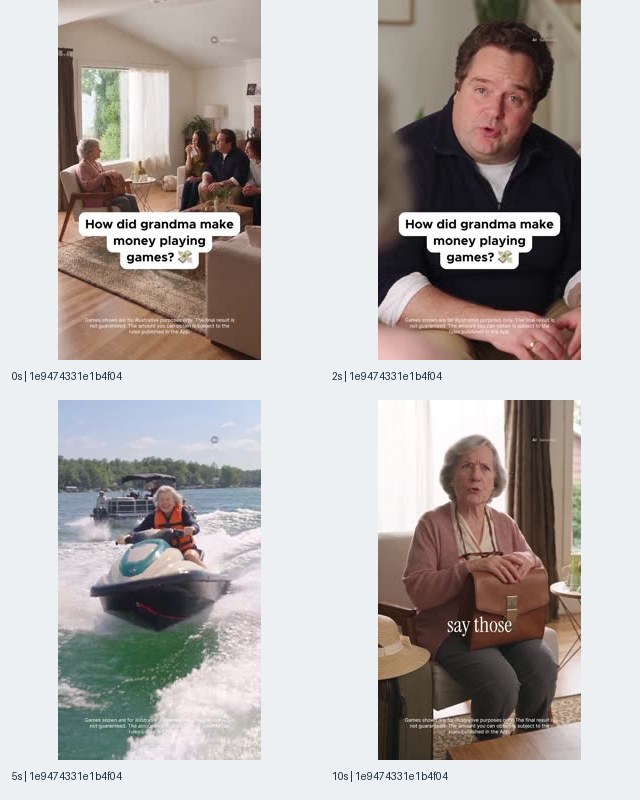
Figure 4 — Record 1e9474331e1b4f0442dc8d0e3c3e2a73. The sequence repeats the family-and-lifestyle setup and includes a seated woman holding a bag with the words “say those.” These are observations from the four supplied timestamps.
The close relationship between Figures 1 and 4 is useful when thinking about reuse. They share a recognizable premise and visual vocabulary, but this article does not infer that they are the same file or that a particular version performed better. Asset identity comes from fingerprints; creative similarity is a visual observation.
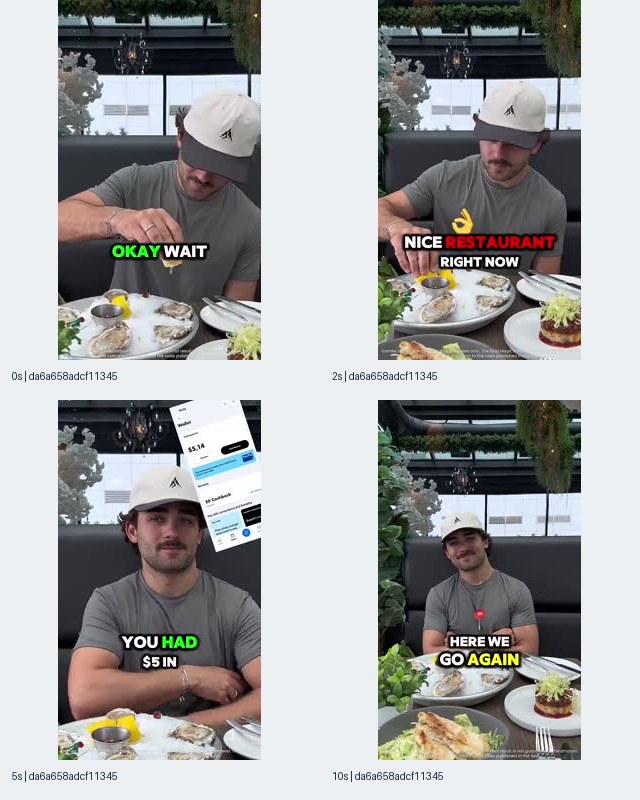
Figure 5 — Record da6a658adcf11345136e207ea42995d8. The diner handles food at a restaurant table; captions visible in the sampled frames include “OKAY WAIT,” “NICE RESTAURANT RIGHT NOW,” “YOU HAD $5 IN,” and “HERE WE GO AGAIN.”
This version makes the reward story tactile: the viewer sees a meal, not a dashboard. That can make the promise easy to understand in a feed, but it also increases the need for claim review. The image cannot prove that a $5 balance purchased the meal or that the scene reflects ordinary user results.
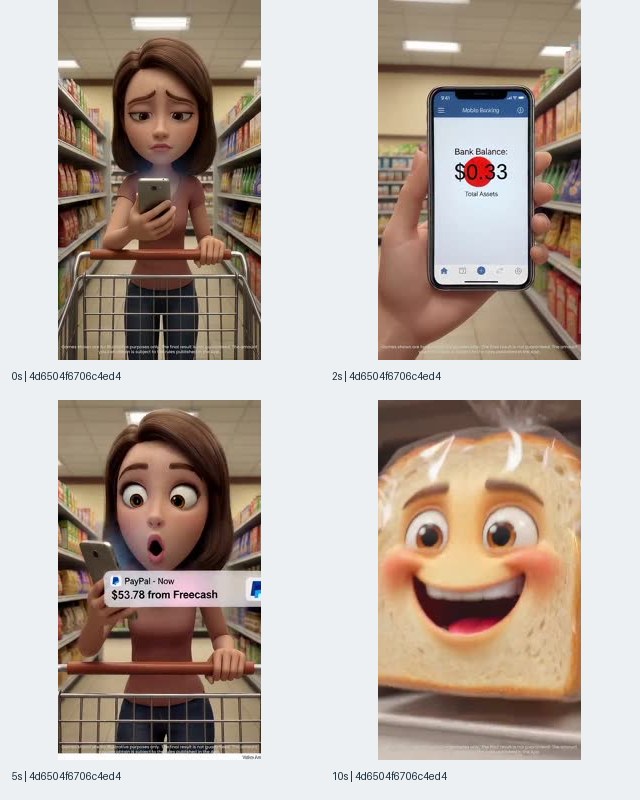
Figure 6 — Record 4d6504f6706c4ed435272c54bb0b4c8a. The animated sequence shows a shopper, “Bank Balance: $0.33,” a PayPal notification reading “$53.78 from Freecash,” and a smiling food character. The payment text is an on-screen ad claim.
Animation lets the ad display a before-and-after balance without asking a real presenter to explain it. The important capture fields are the exact amounts, the payment service name, and the timestamp. The sample does not establish whether the notification is simulated, typical, or available in every country.
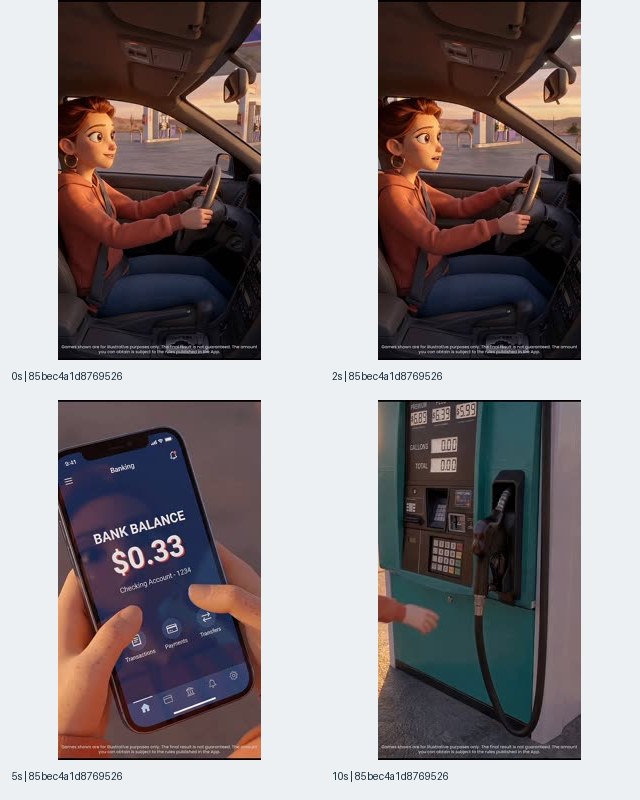
Figure 7 — Record 85bec4a1d8769526a25b136de7387a12. The frames show an animated driver, a phone with a $0.33 balance, a “BANK BALANCE $0.33” screen, and a fuel pump. The contact sheet covers only 0, 2, 5 and 10 seconds.
The driving concept extends the same balance narrative into transport costs. It is a strong example of how Freecash’s sampled creative makes a small number feel relevant to a familiar expense. It remains a creative scenario, not evidence of a completed fuel purchase.
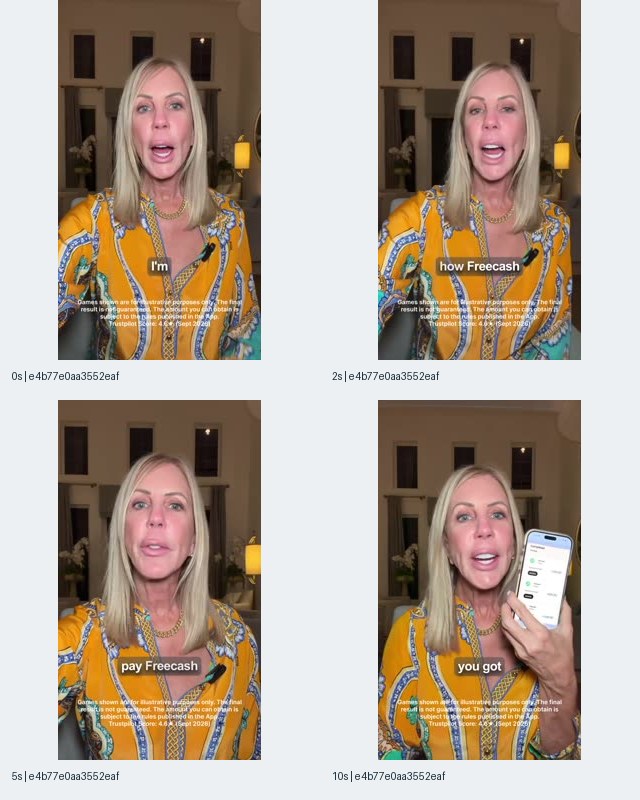
Figure 8 — Record e4b77e0aa3552eaf1ee7811a2bcc8bab. A woman speaks directly to camera, then holds up a phone while visible captions include “I’m,” “how Freecash,” “pay Freecash,” and “you got.” The supplied frames do not provide enough text to complete those phrases.
The presenter format can feel more personal than animation, but the incomplete wording is itself a data constraint. Ad descriptions and captions can be truncated. A report should quote the visible text exactly and mark the missing context rather than filling it in from memory.
Want to track new Freecash variants as they enter the index? Log in to AdMapix to save records, compare fingerprints, and attach your own claim-review notes to each creative.
Fleet Structure: Concentration, Age, and Reuse
Freecash’s sampled fleet is concentrated at the top but not dependent on one single file. The top record accounts for 18.0% of modelled impressions, while the top five account for 64.8%. The largest record is only 1.1 times the second-largest, so the top of the sample is a cluster of major entries rather than one overwhelming hero asset. Those supplied shares describe this bounded sample and should not be treated as the full account’s concentration.
The fingerprint counts show a mixed production system. Twenty-one of the 30 records carry a video fingerprint, resolving to 16 unique videos. Sixteen records carry playable fingerprints, resolving to 12 unique playables. Some records can carry both, so the categories should not be added into a single asset total. One unique image fingerprint appears in the returned records.
The first-seen range runs from 2025-09-11 to 2026-11-04. Eight records were first seen during the 2026-10-10 to 2026-11-08 measurement window. Twenty-eight records have a last observation in the final three days of the evidence pull. These dates describe index observations, not confirmed launch, retirement, or continuous delivery. A record may be absent from a later query for reasons the public sample does not reveal.
For a UA manager, the practical read is a portfolio with both durable and newly observed components. The older first-seen dates show that the account can retain assets in the index for many months, while the eight in-window first observations show active additions in the sampled slice. The evidence does not establish a weekly launch cadence or prove that older assets outperformed newer ones.
Video reuse is present at the fingerprint level: 21 records resolve to 16 unique videos, which means some video files appear in more than one record. The evidence does not provide a causal explanation for the reuse. It could reflect copy, playable, store, or placement variants, but the frozen package does not verify those relationships. Treat reuse as a production signal to investigate, not as proof of a winning formula.
Freecash Revenue Ranking: What It Means
The ranking snapshot places Freecash’s verified iOS listing at #117 for US revenue, up 7.44% from the previous 30-day period, and at #28 for downloads with 1,482,162 downloads, down 1.19%. The ranking window is 2026-09-29 to 2026-10-28, and the captured ranking covers store listings together across the App Store and Google Play. The figures are third-party model estimates at the listing level.
The revenue rank does not state a currency unit and does not represent Freecash’s company revenue, advertiser-funded offer volume, deposits, gross merchandise value, profit, or lifetime earnings. Rewards apps can be funded largely by advertisers and offer partners, so an app-store billing estimate may capture only a slice of the business model. A higher or lower rank cannot settle whether the service is legitimate or whether users receive the amounts shown in ads.
The clean way to use the ranking is as market context. It says that this one iOS listing was visible in the US top 300 during the stated period, with revenue rank improving while download rank moved slightly down. It does not connect the ranking movement to a particular creative, channel, or campaign. The creative sample and the ranking snapshot come from different windows and should remain separate in analysis.
When a stakeholder asks “What is Freecash revenue?”, answer with the rank, date range, and scope first. Then explain the app-store-billing caveat. Do not convert the rank into a dollar figure, annualize it, or describe it as the company’s earnings.
The Rewards-App Bracket: Three Ways to Buy Installs
The separate rewards bracket was pulled on 2026-10-30 for the top 30 US creatives per verified iOS listing, covering 2026-09-30 to 2026-10-29. These figures must stay apart from Freecash’s frozen 2026-10-10 to 2026-11-08 creative sample and from the 2026-09-29 to 2026-10-28 ranking window.
| App and verified listing | Top-30 modelled impressions | Top-creative share | Oldest first seen | Unique videos | Records with playable |
|---|---|---|---|---|---|
| Fetch: Earn Rewards Every Day (Fetch Rewards, LLC) | 23,099,303,963 | 3.9% | 2026-06-24 | 16 | 0 |
| Cash Giraffe (GR Apps GmbH, iOS 6740522980) | 23,273,672 | 54.3% | 2025-04-17 | 5 | 25 |
Fetch represents a diversified video-led route in this bracket. Its top 30 include 16 unique videos and no records with playable associations. The three largest records are each reported at roughly 0.89 billion impressions in the bracket brief. That pattern suggests several large video bets rather than one dominant interactive unit, but the sample cannot show which creative drove installs or why.
Cash Giraffe represents a playable-heavy route. Twenty-five of its top-30 records carry playables, only five unique videos appear, and the top creative contributes 54.3% of the sampled impressions. The concentration is a descriptive property of that bracket window. It is not a performance verdict and should not be compared with Freecash by dividing totals across different pulls.
Freecash sits between those visible approaches in the frozen sample: it has both videos and playables, with 21 records carrying video and 16 carrying playable associations. That mixed structure gives a rewards-app team at least three creative directions to investigate: social proof and lifestyle scenes, animated balance demonstrations, and a metadata-based hypothesis about interactive or offer-oriented experiences. The supplied contact sheets do not show an offer wall, visible gameplay, or a tested interaction. The frozen evidence does not identify the ad networks used by any of these records, so no platform-specific coverage conclusion is safe.
The bracket is useful when deciding what to inspect next. A video-led competitor calls for hook, presenter, and claim tagging. A playable-heavy competitor calls for interaction-flow capture and device QA. A concentrated fleet calls for version tracking around the dominant fingerprint. Each is a hypothesis for research, not a claim about efficiency.
A Practical Freecash Ads Workflow for UA Teams
A useful workflow turns each visible claim into a traceable test question. Start with identity: use the verified iOS listing and seller, then record whether the observation is attached to a video, playable, or both. This prevents a name search from mixing Freecash with similarly titled products or with Android records outside the evidence scope.
Next, capture the first four seconds and the exact claim. For the family skit, the question is the opening line and the lifestyle payoff. For the animated balance ads, capture both amounts and the payment-service label. For the presenter example, preserve the partial transcript and mark missing words. Do not rewrite truncated captions into a stronger promise.
Then tag the creative by mechanism:
- Narrative proof: family or couple dialogue that makes earning sound socially normal.
- Lifestyle payoff: a meal, shopping item, fuel pump, or leisure scene connected to a balance.
- Balance or payment display: a balance or payment notification shown as visual evidence; the supplied frames do not show an offer wall.
- Presenter explanation: a person speaking directly to camera with a phone or caption.
- Interactive hypothesis: a record with a playable or offer-oriented fingerprint; the association suggests a research lead, but the supplied frames do not establish visible interaction, a functional end card, or tested gameplay.
After tagging, write one falsifiable hypothesis per variant. For example: “A 15-second opening that shows the balance before the lifestyle scene will improve qualified click-through versus the dialogue opening.” The hypothesis is yours; the contact sheet only supplies the observed structure. Keep the claim review separate from the performance metric so a lift cannot be mistaken for proof that the advertised payout is typical.
Finally, connect the creative test to your own first-party measurement. The public index can help you decide what to make and what to monitor. Your ad account, attribution setup, cohort data, and compliance review must determine whether a new variant is safe to scale. AdMapix’s methodology page explains the distinction between indexed evidence and private campaign metrics.
A simple weekly record can include: verified product ID, record ID, first-seen date, top-level modelled impressions for the stated window, video fingerprint, playable fingerprint, opening hook, visible claim, proof object, CTA wording, and test hypothesis. This preserves the difference between a delivery record and an asset, which is the main source of counting errors in competitor reports.
Common Mistakes When Reading Freecash Ads
The most expensive mistake is treating an ad claim as a product guarantee. “$53.78 from Freecash” is what the animated frame displays. It is not evidence of an average payout, a guaranteed amount, or a completed transaction. Keep the language “the ad shows” or “the ad claims” until first-party documentation supports more.
A second mistake is calling 2,766,284,840 a lifetime total. It is a modelled estimate for the explicit 2026-10-10 to 2026-11-08 window. A later pull can change because the window and index change. Do not divide it by asset age or convert it into a daily rate based on first-seen dates.
A third mistake is reporting 30 records as 30 creatives. Fingerprint deduplication yields 16 unique videos and 12 unique playables. Records can share a video, a playable, or both. Keep the three measures separate in tables and briefs.
A fourth mistake is mixing the bracket and the frozen sample. Fetch and Cash Giraffe belong to the 2026-09-30 to 2026-10-29 bracket pulled on 2026-10-30. Freecash’s own fleet figures belong to 2026-10-10 to 2026-11-08. Do not calculate shares, ratios, or “larger than” conclusions across those windows.
A fifth mistake is assigning a platform from visual style. A vertical frame, a presenter, or a phone screen does not prove TikTok, Meta, YouTube, or any other placement. The evidence package does not verify a source network for these records, so describe the creative without naming a channel.
A sixth mistake is trying to answer legitimacy with advertising volume. A large impression estimate, a high download rank, or a visible payment notification cannot establish legality, fairness, payout reliability, or user satisfaction. Those are separate questions requiring different evidence.
When to Use AdMapix
AdMapix is useful when a UA or creative team needs to connect searchable records, dated observations, media fingerprints, and repeatable briefs. The Freecash sample demonstrates the workflow: verify the listing, inspect the top records, deduplicate videos and playables, save timestamped frames, and separate visible claims from unmeasured outcomes.
It is less suitable as a substitute for your own conversion, retention, payout, or profit data. Use your ad account and product analytics for those decisions. Use the public index to generate and prioritize creative hypotheses, monitor new records, and keep competitor references organized.
Disclosure: AdMapix is our product, so this article describes its research workflow and links to its live product surfaces. Commercial terms can change; see the live pricing page rather than relying on a static article. To apply the workflow to your own rewards-app or game set, log in to AdMapix and create a dated search collection.
About AdMapix Research: AdMapix Research is the research byline of AdMapix, an ad-intelligence platform. Its articles are built from AdMapix data (creative records, modelled impression estimates and US app-store rankings), prepared with Codex from a dated frozen sample and checked by automated evidence review.
FAQ
Can Freecash ads prove that Freecash is legit?
No. Ads can show claims, scenes, balances, and interfaces, but they cannot establish legitimacy, legal compliance, payout reliability, or typical user results. The frozen sample shows what Freecash’s verified iOS listing was associated with in the US window; it does not test the app or verify a transaction.
What do Freecash ads show people doing?
The supplied frames show family conversations, couple dialogue, restaurant food, an animated shopper, a driver, bank-balance screens, a PayPal notification, and a direct-to-camera presenter. These are creative scenes and on-screen claims. They do not prove that the depicted activities are required, available to every user, or connected to a completed payout.
How many Freecash creatives were measured?
The frozen query returned 30 delivery records. After fingerprint deduplication, those records contained 16 unique videos and 12 unique playables. Sixteen records carried playable associations and 21 carried video associations. Because records can reuse assets, the record count must not be reported as the number of unique creatives.
What is Freecash revenue in 2026?
In the US ranking snapshot for 2026-09-29 to 2026-10-28, the verified iOS listing ranked #117 for revenue, up 7.44% versus the previous period. That is a third-party model estimate for app-store billing at listing level, with no published unit in the evidence. It is not company revenue, advertiser funding, profit, or payout volume.
Does Freecash advertise on TikTok or Meta?
The supplied evidence does not verify a source network for the sampled records. Vertical framing, presenter scenes, captions, or animated interfaces are not enough to identify a placement. Report the visible creative and its verified listing; name a network only when the record provides that evidence.
How does Freecash compare with Fetch and Cash Giraffe?
In the separately dated 2026-09-30 to 2026-10-29 bracket, Fetch’s top 30 contained 16 unique videos and no playable records, while Cash Giraffe’s top 30 contained five unique videos and 25 playable records. Freecash’s frozen sample contains both formats. The windows and samples are separate, so these observations describe different buying approaches rather than a performance ranking.
Can I use the impression total to estimate Freecash’s ad budget?
No. The impression figure is a third-party model estimate for a specified window. Without verified CPMs, placements, spend, or delivery logs, it cannot be converted into budget, installs, revenue, or return on ad spend. Use it to compare records inside the same dated sample and to prioritize creative review.
How should a team monitor Freecash creative changes?
Save the verified listing, query dates, record IDs, first-seen dates, fingerprints, exact visible claims, and timestamped frames. Re-run the same query with explicit dates, compare new fingerprints with prior ones, and keep each window in its own report. Use your own attribution and compliance data for performance or claim decisions.
Key Takeaways
- Freecash’s sampled US ads make “get paid” concrete through balances, payment notifications, everyday spending scenes, and social dialogue.
- The 2026-10-10 to 2026-11-08 sample contains 30 records, 2,766,284,840 modelled impressions, 16 unique videos, and 12 unique playables.
- Concentration is meaningful but bounded: the top record is 18.0% and the top five are 64.8% of this sample’s modelled impressions.
- Freecash ranked #28 for US downloads and #117 for revenue in the separately dated 2026-09-29 to 2026-10-28 ranking snapshot; the revenue rank is an app-store model estimate, not company revenue.
- Fetch’s video-led bracket and Cash Giraffe’s playable-heavy bracket show different ways rewards apps can buy installs. They do not establish which format performs better.
- The practical next step is to turn each visible claim into a dated, fingerprinted hypothesis and validate it with first-party measurement.
Sources
- Public frozen source snapshot, fetched 2026-11-09; US verified iOS listing 1673567402; creative window 2026-10-10 to 2026-11-08; bounded three-page, 30-record sample.
- AdMapix methodology, consulted for the distinction between indexed creative evidence, modelled impressions, and unobserved campaign outcomes.
- AdMapix search workflow, the live route for inspecting currently indexed Freecash creative records.
- US app-store ranking snapshot in the editorial evidence package, 2026-09-29 to 2026-10-28; listing-level download and revenue ranks for the verified Freecash iOS listing.
- Rewards-app bracket pulled 2026-10-30 for 2026-09-30 to 2026-10-29; top 30 US creatives per verified iOS listing for Fetch and Cash Giraffe.
- Rips by Triumph: 6B Impressions, 134-Day Fleet, a dated comparison on how another money-mechanic app frames reward promises.
- Ad strategy teardowns hub, the published series index for related creative-fleet analyses.
Turn these observations into your next creative study
Open the creative library and select samples for your market, network and research question.
Related Articles
ReelShort Ads & Revenue Rank 2026: Hooks, Reuse, and US Evidence
A dated analysis of 30 US ReelShort advertising records and eight visual examples, covering serial hooks, video reuse, playable associations, sample concentration, and separately scoped revenue rankings.
Kalshi Ads in 2026: What 30 US Records Reveal
A dated analysis of 30 verified US Kalshi advertising records and eight visual examples, covering creative variety, modelled exposure, discovery dates, revenue-ranking limits, and a separately dated Polymarket–Novig comparison.
Solitaire Cash Ads: Cash Hooks, Presenters, and Creative Reuse
Eight timestamped Solitaire Cash examples and 30 verified US iOS advertising records reveal account claims, presenter formats, gameplay imagery, and creative reuse, with dated portfolio context and clear limits on performance conclusions.