
SocialPeta vs Sensor Tower in 2026: Ad Creative Intelligence or Full App Market Intelligence?
A 2026 decision guide for choosing between SocialPeta and Sensor Tower: ad creative analysis vs app and market intelligence with downloads, revenue, and usage estimates. A job-by-job comparison, what each platform's data can and can't prove, pricing and access realities, when to run both, and where AdMapix fits as a cross-network creative-evidence layer.
By the AdMapix Research Desk — Updated June 21, 2026
SocialPeta vs Sensor Tower in 2026: Ad Creative Intelligence or Full App Market Intelligence?
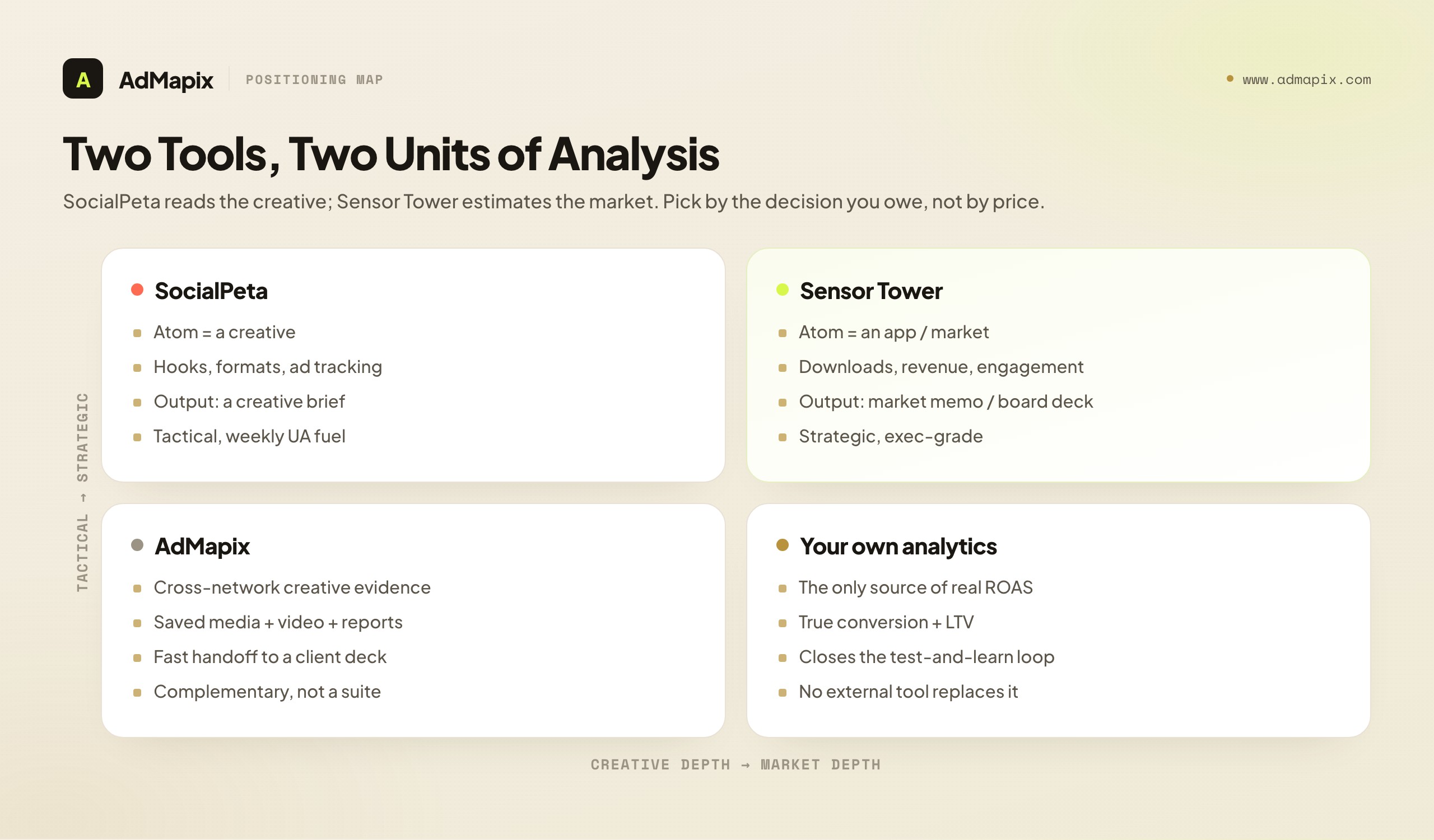
SocialPeta and Sensor Tower keep showing up on the same shortlist, and that is exactly why teams overpay for one or the other. They are not really competitors. SocialPeta is a creative-first ad intelligence tool: it indexes ad creatives at scale and helps you read what advertisers are actually running. Sensor Tower is a market-first intelligence suite: it estimates how apps perform across downloads, revenue, and usage, then bolts an advertising module on top of that foundation. The shared word "intelligence" hides the real difference — the unit of analysis. SocialPeta's atom is a creative. Sensor Tower's atom is an app, a publisher, or a whole market. Get that one distinction right and most of the decision makes itself.
This guide is for app marketers, user-acquisition (UA) managers, mobile and game studios, creative strategists, product and strategy leads, agencies, and founders who have to defend a tool budget. It gives you a decision framework keyed to the job you owe next week, a job-by-job comparison instead of a feature-count contest, the hard limits of what either platform's public data can and cannot prove, pricing-and-access realities (both are demo-led, and Sensor Tower is quote-only), when running both genuinely makes sense, and where AdMapix fits if your real gap is fast cross-network creative evidence packaged into shareable reports.
The principle, stated up front so nothing downstream surprises you: don't ask "which tool is better" — ask "which decision do I owe next week." A creative brief points to SocialPeta (or a creative-evidence layer). A market-sizing, revenue, or board-reporting bet points to Sensor Tower. Forcing one platform to do the other's job is the single most common — and most expensive — mistake in this entire category. If you are weighing other pairings, see our SocialPeta alternative breakdown, the closely related SocialPeta vs AppMagic comparison, and the wider landscape in best ad spy tools 2026 and marketing intelligence tools.
TL;DR — SocialPeta vs Sensor Tower in 2026
- They answer different questions. SocialPeta = ad creative intelligence (hooks, formats, creative tracking across a large multi-country ad database). Sensor Tower = app and market intelligence (downloads, revenue, engagement, ratings, store dynamics) with advertising layered on top.
- The unit of analysis decides the tool. If your atom is a creative you study and iterate from, that's SocialPeta. If your atom is an app, publisher, or market you size, rank, and trend, that's Sensor Tower.
- Choose by the decision you owe next week. "What hook do we test?" → SocialPeta. "How big is this category, who's winning on revenue, and is it growing?" → Sensor Tower.
- Both estimate; neither measures competitor internals. You can read creatives and modeled downloads/revenue; you cannot confirm a rival's true ad spend, real return on ad spend (ROAS), audited revenue, or targeting and bids.
- Pricing is demo-led, and Sensor Tower is quote-only. SocialPeta publishes more public-facing positioning; Sensor Tower's enterprise plans are custom-quoted, so you cannot compare list prices without a sales conversation.
- Running both is reasonable when both jobs are live — Sensor Tower for market and revenue modeling, SocialPeta for creative analysis. If one job clearly dominates, buy for that one first and trial the other.
- AdMapix is a complementary creative-evidence layer, not a market-intelligence suite. It is fast for cross-network creative discovery and shareable reports; it cannot see competitor spend, ROAS, or targeting either.
Why People Compare These Two At All
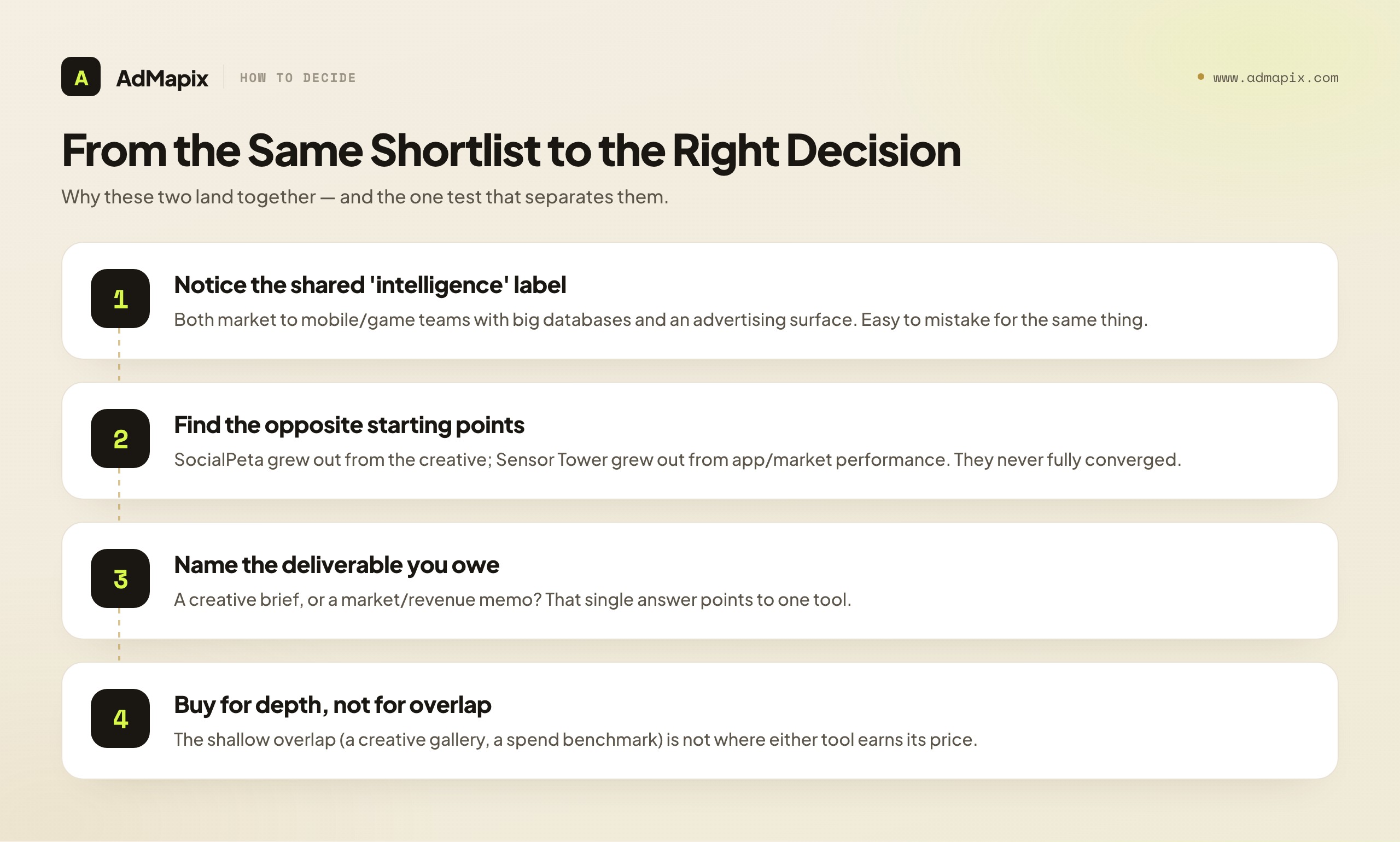
It is worth pausing on why SocialPeta and Sensor Tower land on the same evaluation, because the reason explains most of the confusion. Both platforms market themselves with the language of "intelligence," both are pitched to mobile and game teams, both maintain large databases that update over time, and both include something that touches advertising. A UA manager reading two marketing sites in a hurry can easily conclude that they are two flavors of the same thing — one perhaps cheaper, one perhaps more "enterprise" — and that the only real decision is budget.
That framing is wrong, and it is expensive. The two tools were built from opposite starting points and never fully converged. SocialPeta started from the creative and grew outward into market signals. Sensor Tower started from app and market performance and grew outward into advertising. Where they overlap — a creative gallery here, a channel-mix benchmark there — the overlap is shallow relative to each tool's core. So the moment you treat them as interchangeable, you are almost guaranteed to buy one for a job it only does at the edges, while paying for a deep capability you will barely touch.
The fix is not a longer feature spreadsheet. It is naming the decision you owe. Throughout this guide, every comparison reduces to one test: which platform improves the specific call you have to make this week — a creative brief, or a market bet?
What Each Tool Actually Does
SocialPeta is an ad creative intelligence platform. Sensor Tower is a full app and market intelligence suite that includes an advertising module. That sentence is the whole comparison in miniature, but it is worth unpacking both sides honestly, because the marketing copy on each site blurs the boundary.
SocialPeta: built around the creative. SocialPeta positions itself as an AI-powered ad creative analysis platform with real-time ad tracking, creative analysis, market signals, an AI copilot, and a large multi-country creative database spanning mobile, web, and game advertising across many networks. Its center of gravity is the creative itself: which formats are running, which hooks repeat, how long a given creative stays live, and how mobile and game advertisers structure their ads. The native question SocialPeta answers is "what should the next ad test look like?" When that is your weekly bottleneck, SocialPeta speaks the language fluently. You search by advertiser, category, network, country, format, and time window; you surface the creatives that are running and the ones that have stayed live long enough to be worth studying; and you turn what you see into a creative brief.
SocialPeta does carry some market-flavored signals — top advertiser lists, category trends, a sense of who is spending aggressively — but those are read as context for the creative, not as audited market truth. Treat them as a way to decide which advertisers and categories to study, not as a substitute for a downloads-and-revenue model.
Sensor Tower: built around the app and the market. Sensor Tower sells digital market intelligence across mobile apps, advertising, audiences, web, and gaming. Its strength is estimating market shape: how many times an app is downloaded, how much revenue it is modeled to earn, how engaged its users are, how its store ratings and reviews trend, and how categories grow or shrink over time. This is the data that goes into a board deck, an investment memo, a market-entry decision, or a competitive landscape review. When your question is "how big is this market, who is winning on revenue, and is the category growing," Sensor Tower is built for exactly that.
Sensor Tower's App Advertising Insights module then layers advertising on top of the market foundation: competitor ad-spend benchmarks (modeled, not measured), channel and network mix, impression and share-of-voice trends, and a creative gallery so you can eyeball the ads behind the spend estimates. The crucial nuance is the order of operations. Advertising lives inside a broader market picture rather than standing alone. That makes Sensor Tower excellent for the question "where does competitor advertising sit within the overall market," and only adequate for the question "give me the deepest possible creative library to brief from." For the latter, a creative-first tool wins.
The one-line summary. If you remember nothing else: SocialPeta tells you what the ads look like; Sensor Tower tells you how the apps and markets behind those ads are performing. Both are estimates. Both are useful. They are useful for different jobs.
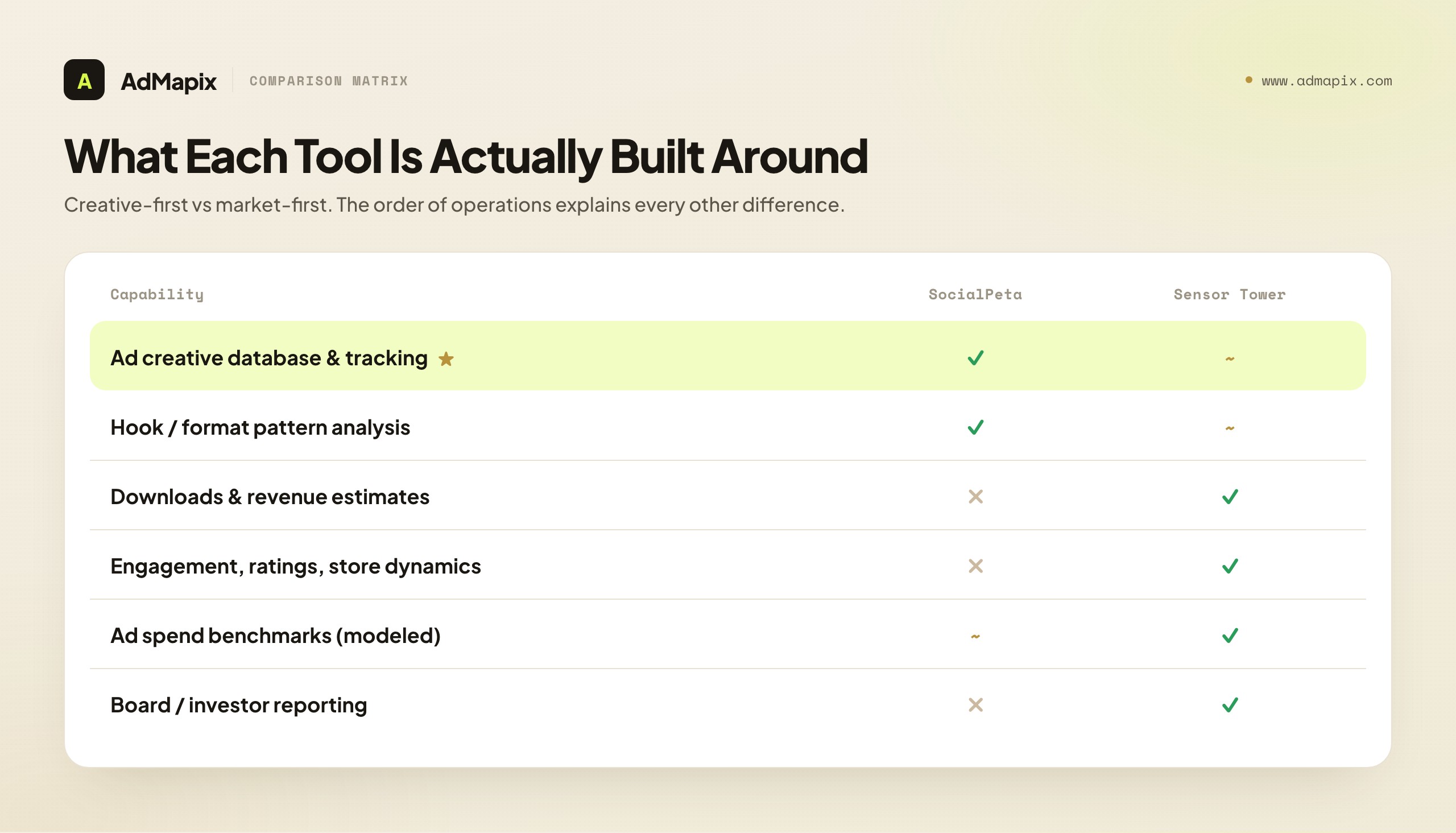
Side-by-Side: Match the Tool to the Job
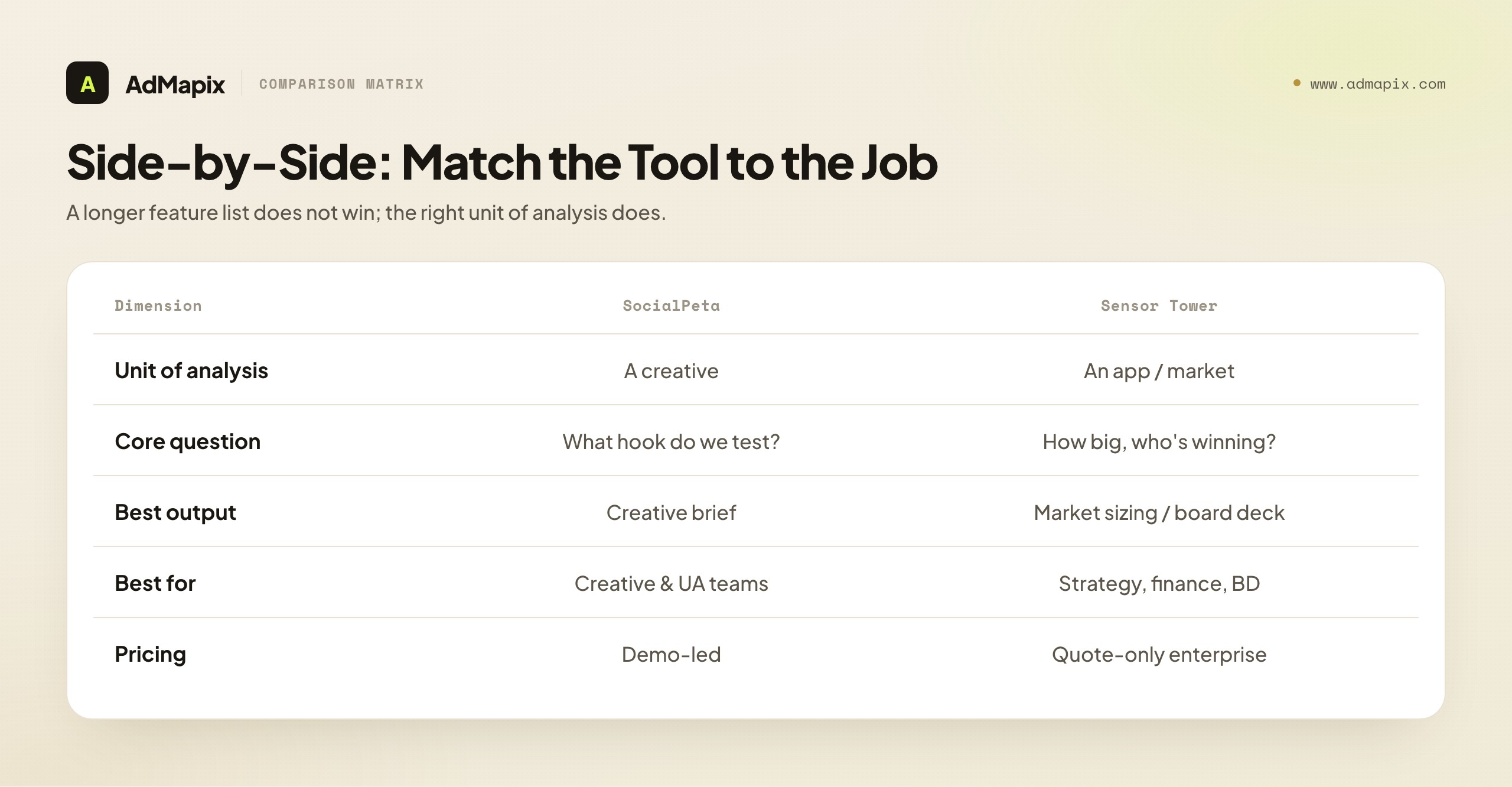
Use the table below to match each platform to the work it does best, rather than to a count of checkbox features. A longer feature list does not make a tool better for your decision; the right unit of analysis does.
| Dimension | SocialPeta | Sensor Tower |
|---|---|---|
| Category | Ad creative intelligence | Full app + market intelligence (with ad module) |
| Unit of analysis | A creative (ad) | An app / publisher / market |
| Core question it answers | "What hook should we test?" | "How big is this market, who's winning on revenue?" |
| Headline capability | Creative tracking, hook/format patterns, AI-assisted creative analysis | Downloads, revenue, engagement, ratings, store and category dynamics |
| Advertising data | Core product — the whole point | A module layered on market data |
| Downloads / revenue estimates | Not the focus | Core strength |
| Ad-spend benchmarking | Limited / contextual | App Advertising Insights (modeled benchmarks) |
| Best output | Creative brief, hook list, ad test ideas | Market sizing, competitor benchmarks, board reporting |
| Best for | Creative strategists, UA creative testing | Strategy, finance, BD, category research, exec reporting |
| Data shape | Multi-country ad creative database | App / publisher / market metrics over time |
| Pricing | Demo-led; more public positioning | Demo-led; quote-only / custom enterprise |
The pattern is consistent across every row: SocialPeta wins where the deliverable is a creative, Sensor Tower wins where the deliverable is a number about a market or app. Where they appear to overlap — both have an advertising surface and a creative gallery — the depth is asymmetric. SocialPeta's creative depth is deeper than Sensor Tower's; Sensor Tower's market depth is in a different league from SocialPeta's. Buy for the depth you actually need.
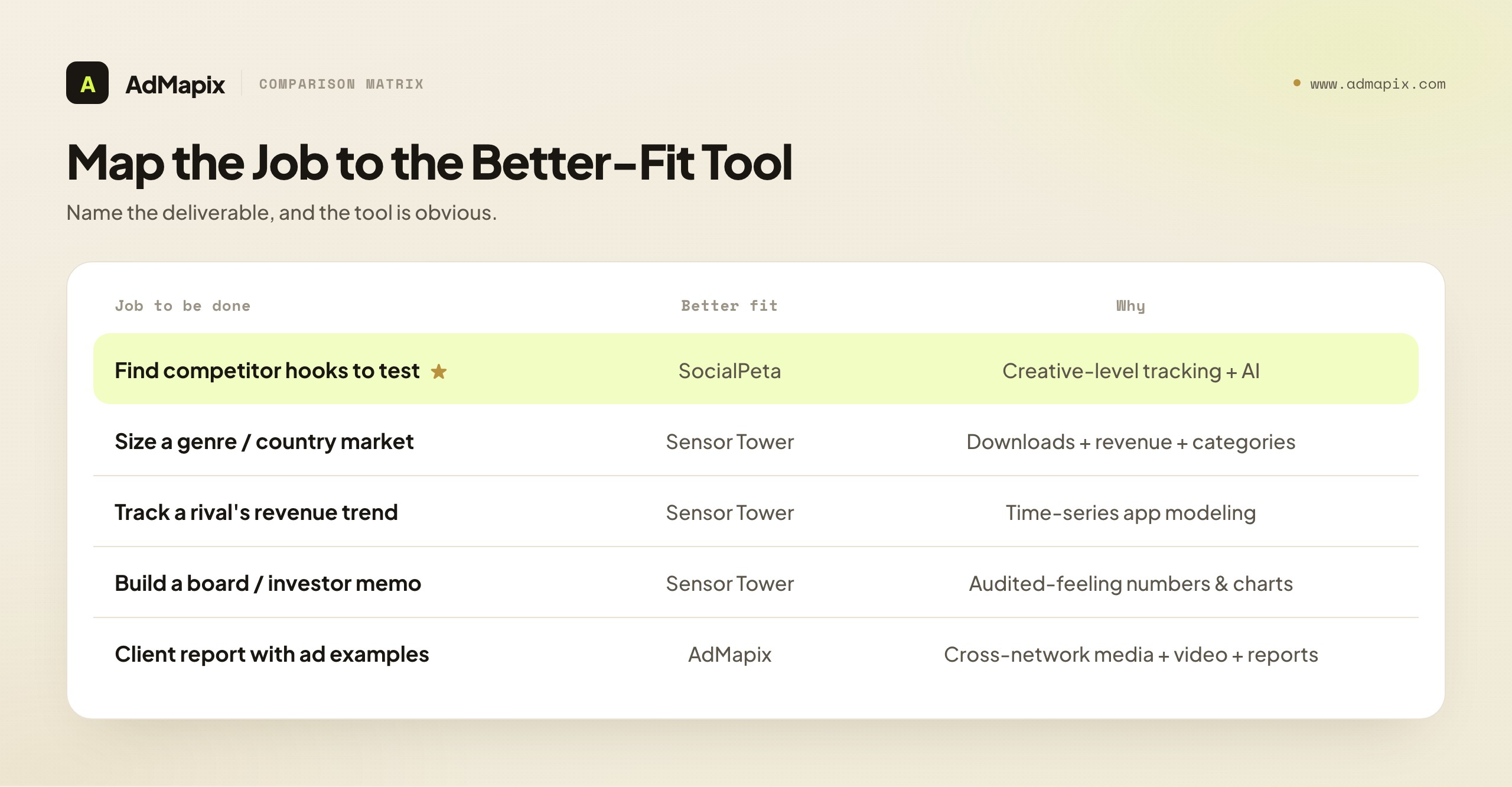
Comparison by Job, Not by Feature Count
Features are a trap. Both vendors list plenty, and a feature grid mostly measures marketing effort, not fit. The comparison that matters is which platform improves your next decision. Below, the common jobs in a mobile or game UA and strategy workflow, mapped to the better-fit tool — with AdMapix called out only where its specific shape (cross-network creative evidence plus shareable reports) is the genuine best fit.
Job: "Find the competitor ad hooks we should test next." This is a pure creative-discovery job. You want to see live and recently live creatives, read the hook structure, spot the formats that keep reappearing, and convert that into a brief. SocialPeta is built for this; its creative-level tracking and AI-assisted analysis are the native fit. Sensor Tower's creative gallery exists but is thinner and oriented around explaining spend estimates rather than seeding a brief.
Job: "Size a genre, country, or category before we commit." This is a market-modeling job. You need download and revenue estimates, category dynamics, and a sense of who is growing. Sensor Tower owns this. SocialPeta has no real market-sizing model; its top-advertiser signals are context, not a market estimate.
Job: "Track a rival's revenue and engagement trend over the last year." Time-series modeling of app performance is squarely Sensor Tower territory. SocialPeta cannot answer this at all.
Job: "Build a board deck or investor memo on the category." The deliverable here is audited-feeling numbers and clean trend charts about apps and markets. Sensor Tower's data and exports are designed for it. A creative database does not produce a market memo.
Job: "Package competitor ad examples — including video — into a client-ready report." This is where AdMapix fits. The deliverable is creative evidence assembled across networks, saved media (including video), and a shareable report, not a market estimate. AdMapix is built to make that handoff fast.
Job: "Understand where competitor advertising sits within total market spend." This is the rare job that genuinely wants Sensor Tower's advertising module specifically, because the value is in seeing ad spend as a share of the larger market picture. SocialPeta can show you the creatives; Sensor Tower frames them inside the market.
The lesson repeats: name the deliverable, and the tool is obvious. A creative deliverable → SocialPeta (or AdMapix for evidence and reports). A market or revenue deliverable → Sensor Tower.
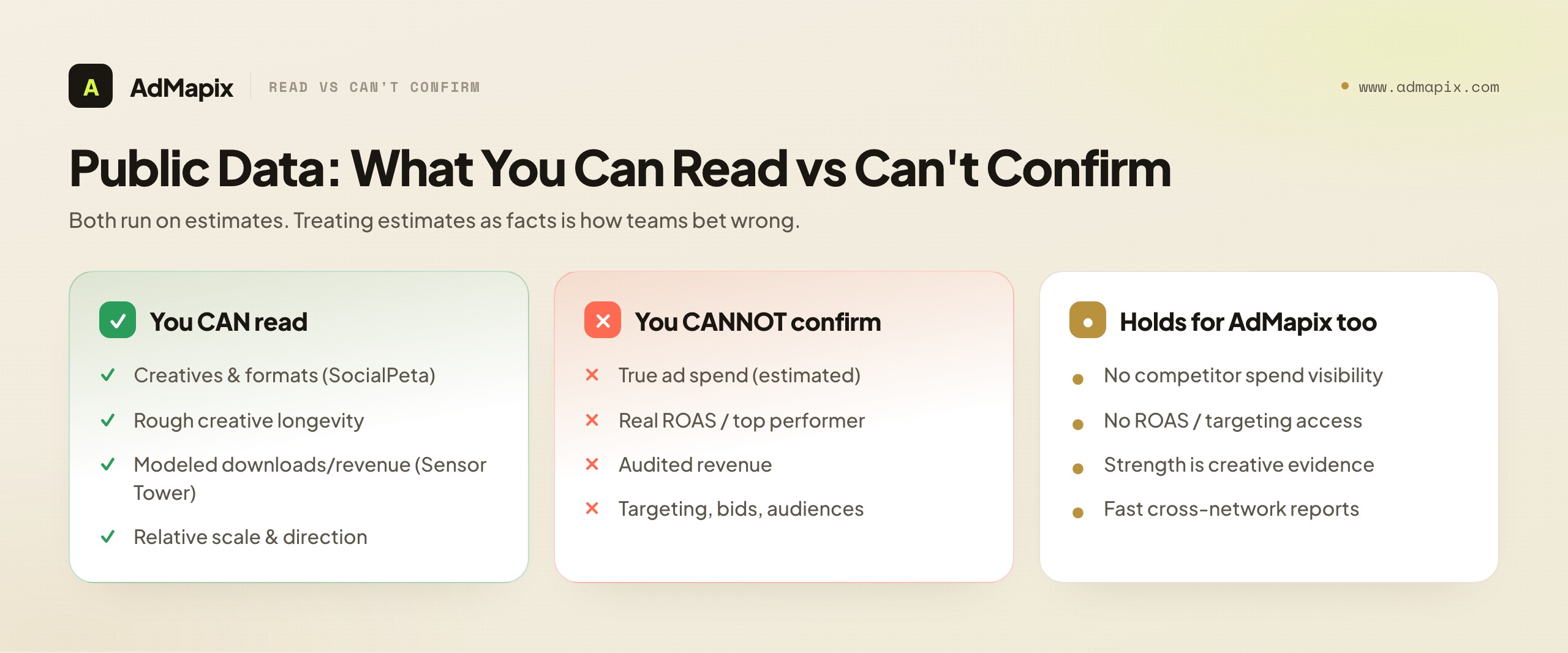
What Neither Tool Can Prove (The Honesty Section)
This is the section most comparison posts skip, and it is the most important one for protecting a budget. Both SocialPeta and Sensor Tower run on modeled, observed data — creatives crawled at scale, downloads and revenue estimated from signals and panels. Neither has a pipe into a competitor's ad account or finance system. So there is a clear line between what you can read and what you can only guess at, and treating estimates as facts is how teams make confident, wrong bets.
What you genuinely CAN read:
- The creatives a competitor is running, their formats, and roughly how long they have stayed live (SocialPeta's strength).
- Modeled downloads, revenue, engagement, and ratings trends for apps and categories (Sensor Tower's strength).
- Relative scale and direction — who is bigger, who is growing, which way a category is trending.
- Modeled advertising benchmarks and channel mix as a directional read (Sensor Tower's ad module).
What you genuinely CANNOT confirm from either:
- A competitor's true ad spend — both ad-spend numbers are estimates, sometimes off by a wide margin in thin categories or small geos.
- A competitor's real ROAS or which creative is actually their top performer by conversion. You see what is running and what stays live; staying live is a proxy for "working," not proof.
- Audited revenue. Modeled revenue is directionally useful and frequently wrong on the absolute number, especially for apps with significant off-store or web monetization.
- Targeting, bids, audiences, and budgets. None of that is visible to any external tool.
Once you internalize this, the buying logic clarifies. You are not paying for truth; you are paying for the best available estimate, fast, in the shape your job needs. SocialPeta gives you the best creative read. Sensor Tower gives you the best market estimate. AdMapix gives you the fastest cross-network creative evidence — and it is just as bound by these limits: AdMapix cannot see competitor spend, ROAS, or targeting either. Anyone selling you certainty in this category is overselling.
Pricing and Access: Both Demo-Led, Sensor Tower Quote-Only
Neither tool is a swipe-your-card, self-serve purchase, and that matters for how you plan an evaluation. Budget time for a sales conversation, and verify scope before you sign.
SocialPeta publishes more public-facing positioning and tiering language than Sensor Tower, but the meaningful plans are still demo-led: the real coverage, freshness, and seat terms are confirmed in a sales conversation, not read off a pricing page. Expect to ask explicitly which networks and countries are covered for your advertisers, how fresh the creative index is in those geos, and what export and seat limits apply.
Sensor Tower is quote-only at the enterprise level. You cannot compare list prices without a demo and a custom quote, and the price scales with modules (apps, advertising, audiences, web, gaming), data scope, and seats. This is normal for enterprise market-intelligence suites, but it means two things: you cannot price-shop it on a page, and the all-in cost for a full multi-module deployment can be substantial — which is precisely why buying it for a creative job you could solve with a creative-first tool is so wasteful.
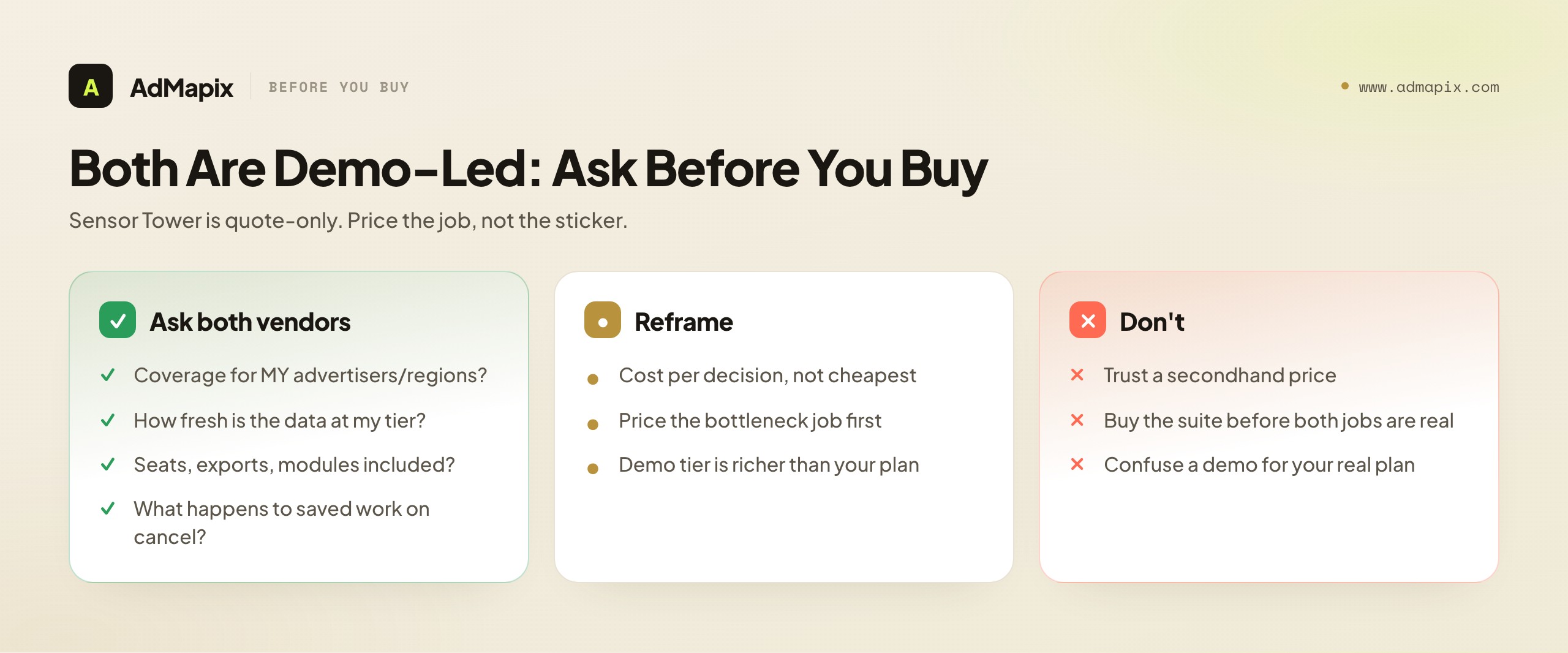
The reframe that saves money: price the job, not the platform. Compute cost per decision you owe, not "cheapest sticker." If your only recurring bottleneck is creative discovery, an enterprise market suite is the wrong line item — you would use a sliver of it. If your recurring bottleneck is market sizing and revenue trends, a creative-first tool literally cannot do the job, and a cheap price on it is irrelevant. And never, ever trust a secondhand price you read in a forum or an old blog; both vendors quote per-account, and stale numbers will mislead you.
How to Run a Fair Trial (On Your Real Titles)
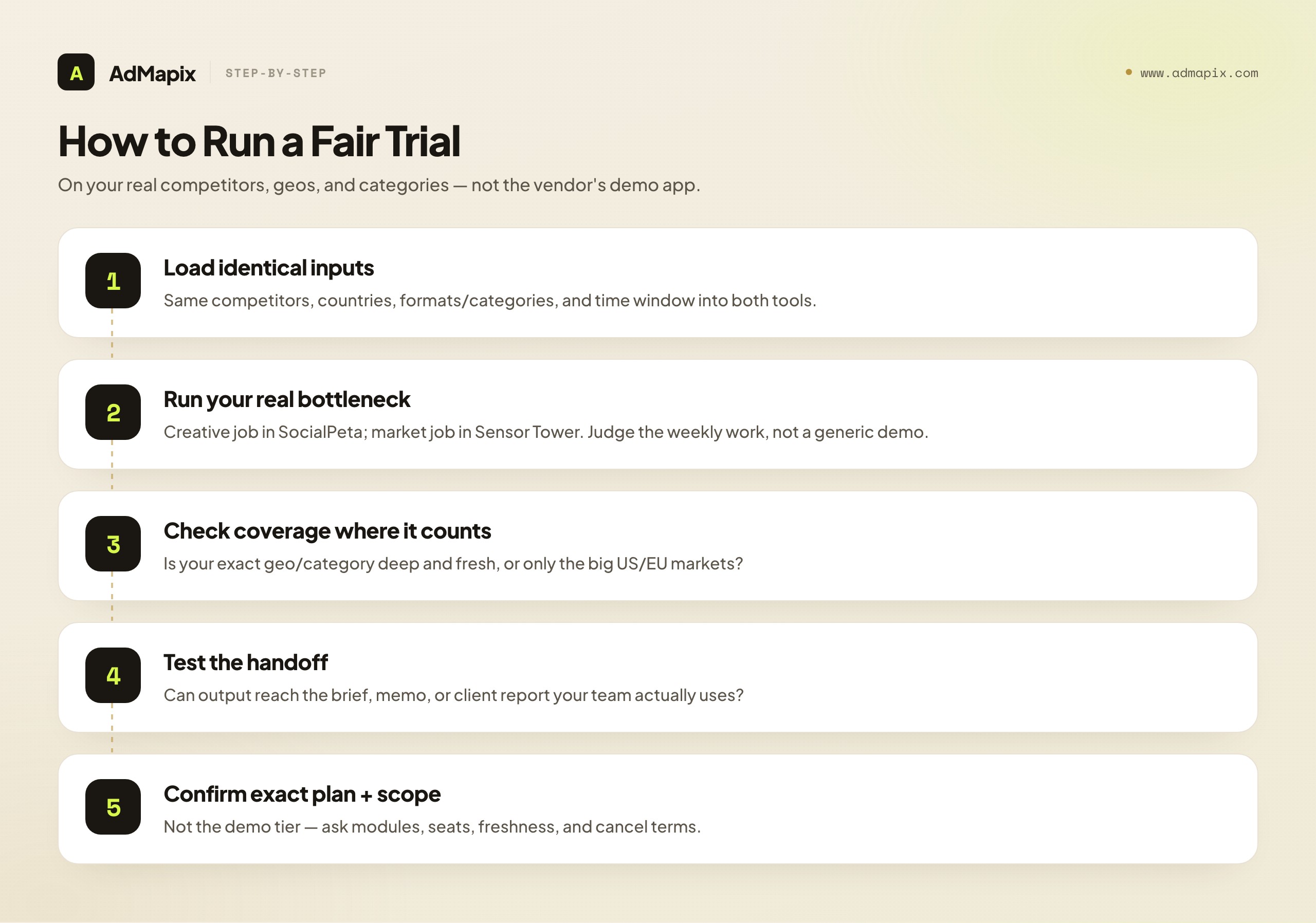
A demo on the vendor's hand-picked example app proves nothing. The only evaluation that protects you is one run on your competitors, your geos, and your categories. Here is the procedure that consistently separates a tool that fits from one that merely impresses.
1. Load identical inputs into both. Same five-to-ten real competitors, the same countries, the same formats or app categories, the same time window. Symmetry is the whole point — you are testing the tools, not the inputs.
2. Run your actual bottleneck, not a generic demo. If your real job is creative discovery, do the full creative job in SocialPeta: find hooks, study formats, build a brief. If your real job is market sizing, do the full market job in Sensor Tower: estimate downloads and revenue, pull the trend, model the category. Judge each tool on the job you will actually run weekly.
3. Check coverage where it counts. Is your exact geography and category populated, deep, and fresh — or only the big US and Western-Europe markets? Coverage thins out fast in smaller regions and niche categories, and that is exactly where a comparison post cannot help you; you have to look.
4. Test the handoff. Can the output actually reach the artifact your team uses — the creative brief, the market memo, the client report? A tool that produces insight you cannot get out of it cleanly is a tool that will quietly die in your stack.
5. Confirm the exact plan and data scope — not the demo tier. The demo environment is often richer than the plan you can afford. Ask which modules and geos are included at your price, how fresh the data is at that tier, how many seats you get, and what happens to your saved work if you cancel.
Run that five-step trial and the decision stops being a marketing-copy debate and becomes an evidence-based call.
When To Run Both, and Where AdMapix Fits
Plenty of teams legitimately need both — but only when both jobs are genuinely recurring. If you pick markets to enter, track competitor revenue, AND brief new creatives every week, then Sensor Tower (market and revenue modeling) plus SocialPeta (creative analysis) is a coherent, complementary stack: one sizes the opportunity, the other shapes the ad. The mistake is buying both before both jobs are real. If one job dominates today, buy for it first, trial the other, and add the second tool when the second job actually shows up on your calendar.
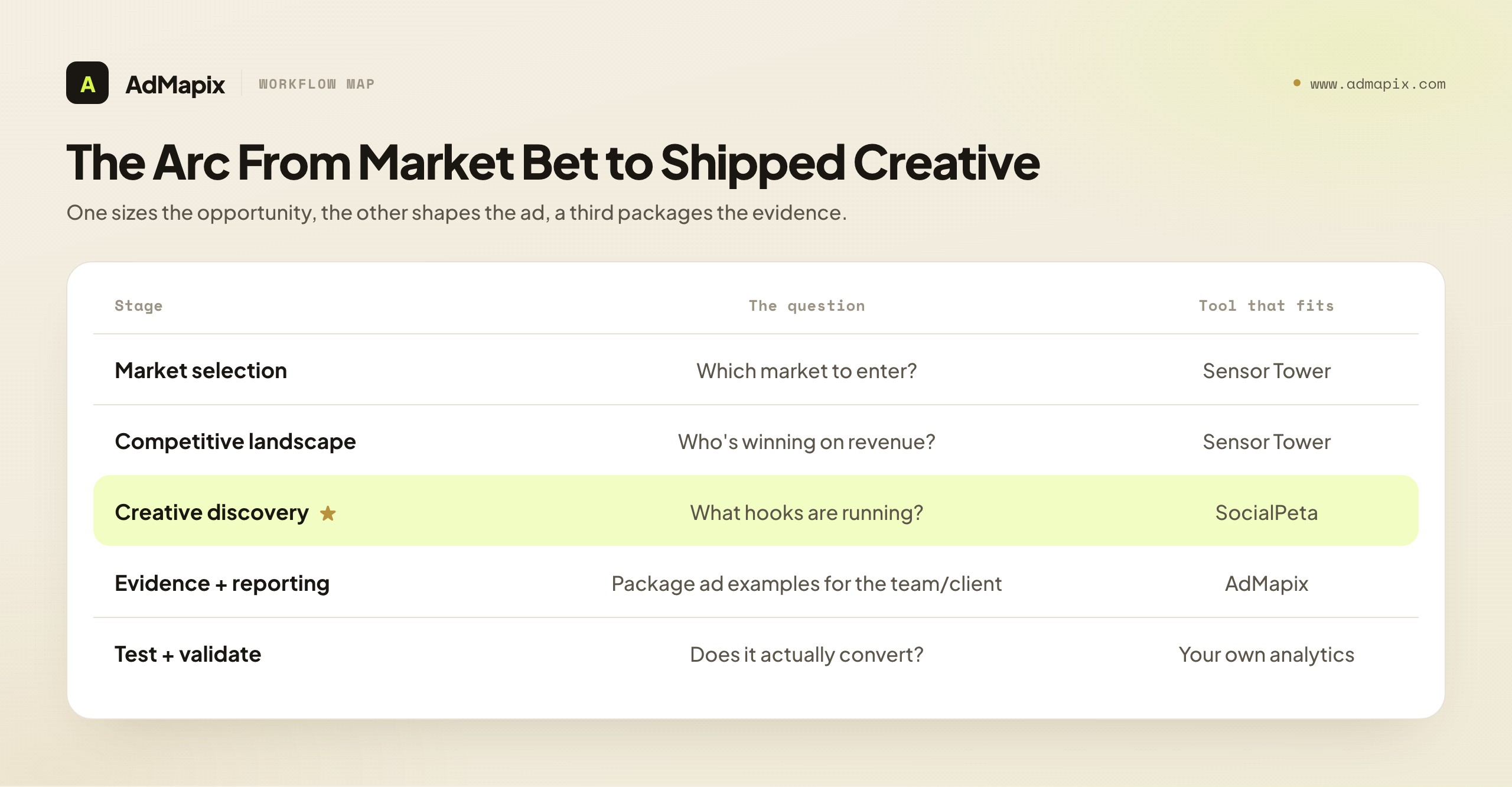
Think of the workflow as an arc from market bet to shipped creative. Market selection ("which market do we enter?") and competitive landscape ("who is winning on revenue?") are Sensor Tower jobs. Creative discovery ("what hooks are competitors running, what do we test?") is a SocialPeta job. Evidence and reporting ("package the competitor ad examples — including video — for the team or client") is where AdMapix slots in. And test and validate ("does it actually convert?") is your own analytics — no external tool can close that loop for you.
That is the honest place for AdMapix in this comparison. AdMapix is not a Sensor Tower replacement: it does not estimate downloads, model revenue, or size markets, and it is not an enterprise market-intelligence suite. AdMapix is a complementary cross-network ad-creative-intelligence layer — it is fast for discovering creatives across networks, saving the media (including video), and assembling a shareable report your team or client can actually use. It overlaps with SocialPeta on the creative-evidence job, and it is the better fit specifically when your gap is speed to cross-network evidence and a clean report rather than a single-network deep dive. And to be explicit one more time: AdMapix cannot see competitor ad spend, ROAS, or targeting — nobody outside the advertiser's account can. Use it for what it is good at: turning scattered competitor creatives into organized, reportable evidence quickly.
A useful way to think about the three-tool relationship is by time horizon and audience. Sensor Tower's output is slow-moving and exec-facing — the market sizing and revenue trends that inform quarterly strategy, market-entry decisions, and board conversations. Its data doesn't change week to week, and its consumers are strategy, finance, and leadership. The creative tools are fast-moving and practitioner-facing — the hooks and formats that change weekly and feed the UA and creative teams shipping tests. Within that fast lane, the split between a single-network creative suite and a cross-network evidence layer comes down to whether your friction is discovery depth or reporting speed. A team that lives in one network and needs to go deep weights the suite; a team that pulls competitor ads from everywhere and has to package them for a client by Friday weights the evidence layer. Neither is "better"; they relieve different frictions in the same fast lane.
This time-horizon framing also clarifies the most common real-world stack. A growth org doing serious work usually has a strategic market view (refreshed monthly or quarterly, from a market suite) and a tactical creative loop (run weekly, from a creative tool or evidence layer), with the org's own analytics underneath both as the source of performance truth. The two intelligence tools rarely compete for the same budget line because they serve different rhythms and different people. The moment you see them as occupying different time horizons rather than fighting over the same job, the "vs." in "SocialPeta vs Sensor Tower" mostly dissolves — and you're left choosing the right tool for each horizon rather than forcing one tool to span both.
A Buyer's Checklist: Test Each Tool On the Job It Owns
Before you commit a budget line, run the platform against the specific job you are buying it for — not the feature grid, and not the polished demo. Use the checklist below.
For the creative job (SocialPeta or a creative-evidence layer like AdMapix):
- Coverage of your networks and regions, not just the headline markets.
- Creative freshness — how recently was the index updated for your advertisers?
- Hook and format searchability — can you filter to the patterns you care about?
- Video deconstruction and export — can you get the creative out into a brief or report?
For the market job (Sensor Tower):
- Estimate quality — run a known app you have ground truth on and see how close the model lands.
- Classification and category depth in your vertical, not just top-grossing games.
- Trend freshness — are downloads and revenue current enough to act on?
- Export to your deck or memo without manual re-keying.
The meta-rules that override every feature comparison:
- Test on your real titles and competitors; a curated demo proves nothing.
- Judge the job, not the feature grid — a longer list is not a better fit.
- Compute cost per decision, and price the bottleneck job first.
- Remember the ceiling: every tool here estimates; none confirm spend, ROAS, or targeting.
Run this and the SocialPeta-vs-Sensor-Tower question dissolves into the only question that ever mattered: which decision do you owe next week, and which platform makes that one decision better.
Five Expensive Mistakes Teams Make Choosing Between These Tools
Before the decision tree, it's worth naming the specific ways teams get this choice wrong, because the comparison is only useful if it steers you clear of the predictable traps. Every one of these is a real pattern we see repeatedly, and every one is avoidable once you've named it.
Mistake 1 — Deciding on price. The most common error: treating the two as interchangeable and picking the cheaper one. But they're built around different units of analysis, so "cheaper" is meaningless if the cheaper tool can't do your actual job. A bargain price on a creative tool is irrelevant when your job is market sizing, and a discount on a market suite is no comfort when you barely use four of its six modules. Price the job, not the platform — and compute cost per decision you actually owe.
Mistake 2 — Buying the suite for the sliver. Teams routinely buy a full, expensive market-intelligence suite because it also has a creative gallery, then use that sliver for a creative job a dedicated creative tool would do better and cheaper. You end up paying enterprise prices for a capability you touch at the edges while the deep market modeling — the thing you actually paid for — gathers dust. Buy the suite only when the market job is the real, recurring need.
Mistake 3 — Trusting the demo tier. Vendor demos run on hand-picked example apps in well-covered markets, and the demo environment is frequently richer than the plan you can afford. A tool that dazzles on the vendor's curated US gaming example may be thin and stale in your actual geo and category. Always trial on your real titles, competitors, and regions before you sign, and confirm the data scope of the plan you'd buy, not the demo.
Mistake 4 — Mistaking estimates for facts. Both tools model their headline numbers — ad spend, downloads, revenue — and those models can be off by a wide margin in thin categories or small geos. Teams that build hard plans on a modeled spend figure or a modeled revenue number as if it were audited truth make confident, wrong bets. Treat every number as a directional estimate, validate against ground truth where you have it, and never let a single modeled figure carry a decision it can't bear.
Mistake 5 — Shopping for certainty that doesn't exist. Some teams keep evaluating tools, convinced the next one will finally reveal a competitor's true spend, real ROAS, or exact targeting. It won't, because that data lives inside the advertiser's account and is invisible to every external tool. Endless tool-shopping for impossible certainty wastes weeks. Accept the ceiling — estimates plus your own analytics — and choose the tool that best serves the job within that honest limit.
The thread connecting all five is impatience with the real, unglamorous answer: name your job, accept the data ceiling, trial on your own titles, and price per decision. Skip that discipline and you'll overpay for the wrong capability or chase a certainty no vendor can sell. Do it and the choice becomes almost mechanical — which is exactly what the decision tree below makes it.
A Decision Tree You Can Run in Two Minutes
If you want the entire comparison compressed into something you can act on without re-reading the guide, walk this short decision tree. It encodes everything above into a sequence of questions that terminates in a tool — and it deliberately refuses to let "which is better" be a valid question, because it isn't.
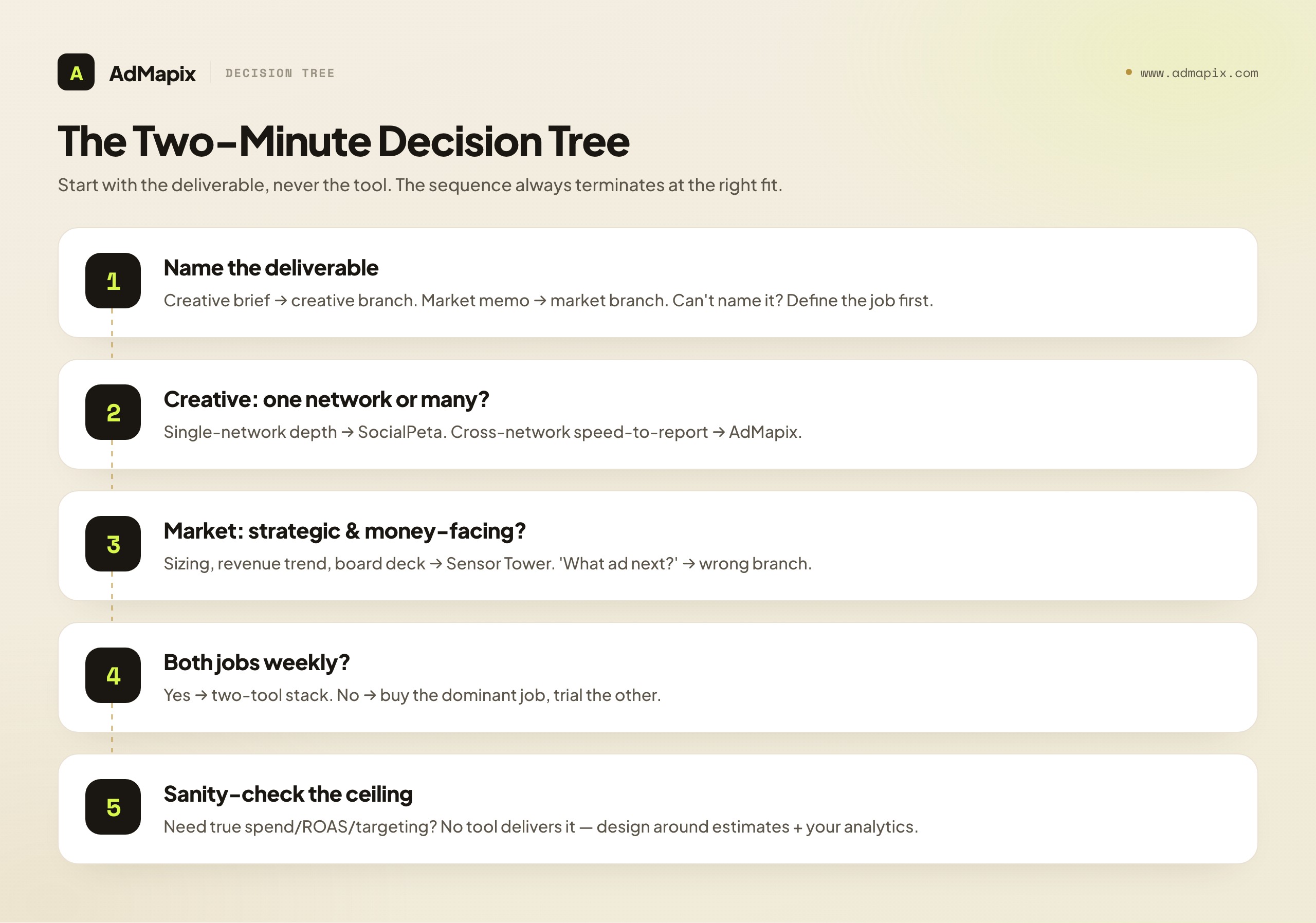
Start with the deliverable, not the tool. Ask: what artifact do I owe, and to whom? If the artifact is a creative brief, a hook list, or ad test ideas, you are in creative-tool territory — proceed down the SocialPeta / creative-evidence branch. If the artifact is a market sizing, a revenue trend, a competitive landscape, or a board/investor memo, you are in market-tool territory — proceed down the Sensor Tower branch. If you can't name the artifact, stop: you are not ready to buy a tool, you are ready to define a job.
On the creative branch, ask: one network or many? If your weekly job is a deep dive on a single network's creatives with rich hook/format searchability, SocialPeta's creative-first depth is the native fit. If your job is fast cross-network evidence assembled into a shareable report — pulling competitor ads, including video, from across networks into a client-ready artifact quickly — that's the AdMapix shape. The two overlap on "creative evidence" but differ on whether you need single-network depth or cross-network speed-to-report. Many teams discover their real bottleneck is the reporting handoff, not the discovery, which points to the evidence-and-report layer.
On the market branch, ask: is the decision strategic and money-facing? If you're sizing a market to enter, tracking a rival's revenue trajectory, or building a deck that finance or the board will read, Sensor Tower's modeled downloads/revenue and exec-grade exports are built for it, and no creative tool substitutes. If you only think you need market data but the real question is still "what should the next ad look like," you've wandered onto the wrong branch — go back to the creative side.
Then ask: are BOTH branches recurring weekly? Only if both the creative job and the market job are genuinely live every week does a two-tool stack (Sensor Tower for market, SocialPeta or AdMapix for creative) make sense. If one branch dominates, buy for it, trial the other, and add the second tool when its job actually appears on your calendar — not in anticipation of a job you don't yet have.
Finally, sanity-check the ceiling. Whatever branch you land on, remind yourself what no tool on either side can deliver: a competitor's true spend, real ROAS, audited revenue, or targeting. If your decision requires one of those certainties, no purchase here will give it to you — that data lives inside the advertiser's account and your own analytics, and the honest move is to design your decision around estimates plus your own test data, not to keep shopping for a tool that promises certainty. Anyone promising it is overselling.
The tree's whole purpose is to convert an emotional, feature-driven, price-anchored debate into a mechanical sequence that always terminates at the tool matching your actual deliverable. Run it honestly and you will almost never end up buying the wrong tool — the most expensive outcome in this category.
A Concrete Creative Workflow (What the SocialPeta / Evidence Side Looks Like in Practice)
To make the creative branch tangible, here is what a competent weekly creative-intelligence workflow actually looks like, regardless of whether you run it in SocialPeta, an evidence layer like AdMapix, or both. The tool matters less than the discipline; a great tool run without a workflow still produces a screenshot folder nobody opens.
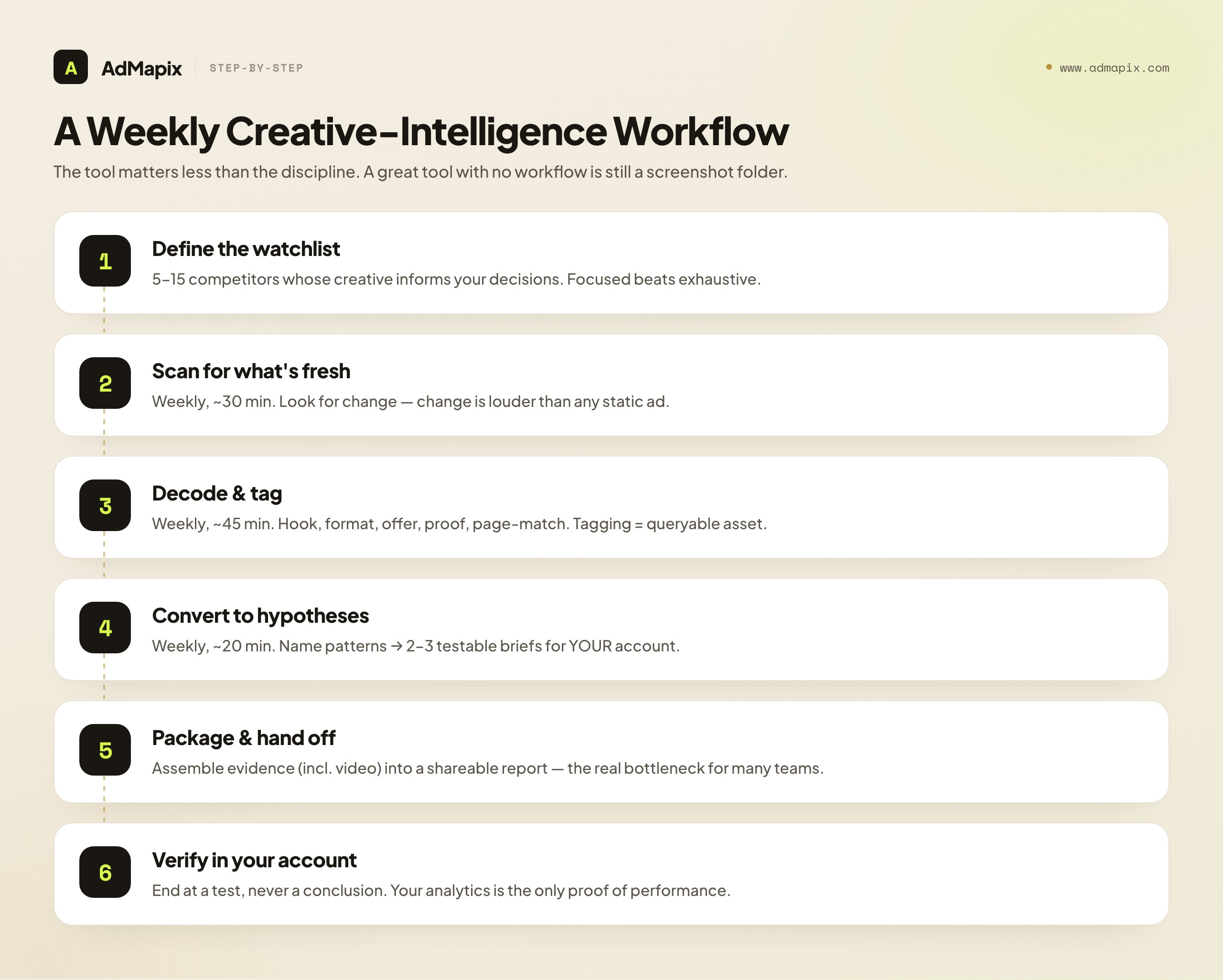
Define the watchlist (once, then maintain). Name the five to fifteen competitors and category leaders whose creative actually informs your decisions. Resist the urge to watch everyone; a focused watchlist is what makes the weekly scan fast and the patterns legible. Add and prune it as your competitive set shifts.
Scan for what's fresh (weekly, ~30 minutes). Pull the new and recently refreshed creatives from your watchlist across the networks and geos you care about. You're looking for change: a competitor swapping all their hooks to a new archetype, a new format appearing, an offer shifting. Change is a louder signal than any single static ad, which is why the longitudinal view beats the snapshot.
Decode and tag (weekly, ~45 minutes). Tear down a representative batch using a consistent rubric — hook type, format, offer logic, proof style, and (where you can see it) landing-page match. Tag everything so it's searchable later. This is the step that separates intelligence from hoarding: an untagged creative library is a museum; a tagged one is a queryable asset that gets more valuable as it grows. For the exact teardown method, the discipline mirrors a structured ad-creative scorecard — score the dimensions, find the weakest link, end with a hypothesis.
Convert to hypotheses (weekly, ~20 minutes). Read across the tagged batch and name the patterns: which hooks recur among leaders, which offers cluster, which gaps nobody's exploiting. Turn the sharpest two or three into testable creative briefs for your account. This is where the creative tool earns its price — not in the looking, but in the converting of what you saw into what you'll test.
Package and hand off (as needed). When you need to brief a team or update a client, assemble the evidence — the competitor creatives, including video, plus your read — into a clean, shareable artifact. This handoff is precisely where a cross-network evidence-and-report layer shines, because the bottleneck for many teams isn't finding the ads, it's packaging them fast enough to be useful while they're still current.
Verify in your own account (always). The creative workflow ends pointed at a test, never at a conclusion about a competitor. You take the hypothesis the teardown produced, ship it as a clean one-variable experiment, and let your analytics decide whether it works — because that's the only place creative performance is ever proven. A competitor's long-running ad was a hypothesis generator, not an answer key.
The reason to spell this out in a SocialPeta-vs-Sensor-Tower guide is that the creative tool is only one input to this workflow, and choosing it well means choosing the one that best serves whichever step is your real bottleneck. If your bottleneck is single-network discovery depth, weight that. If it's the packaging-and-handoff step, weight cross-network speed-to-report. The workflow tells you which capability to prioritize; the comparison earlier in this guide tells you which tool delivers it.
The Wider Alternatives Landscape (Context for the Two-Way Choice)
SocialPeta and Sensor Tower don't exist in a vacuum, and a smart buyer holds the two-way comparison inside the broader category so the decision isn't artificially narrowed. The market splits along the same fault line that defines this whole guide — creative-first tools versus market-first suites — with a few hybrids and evidence-layers in between.
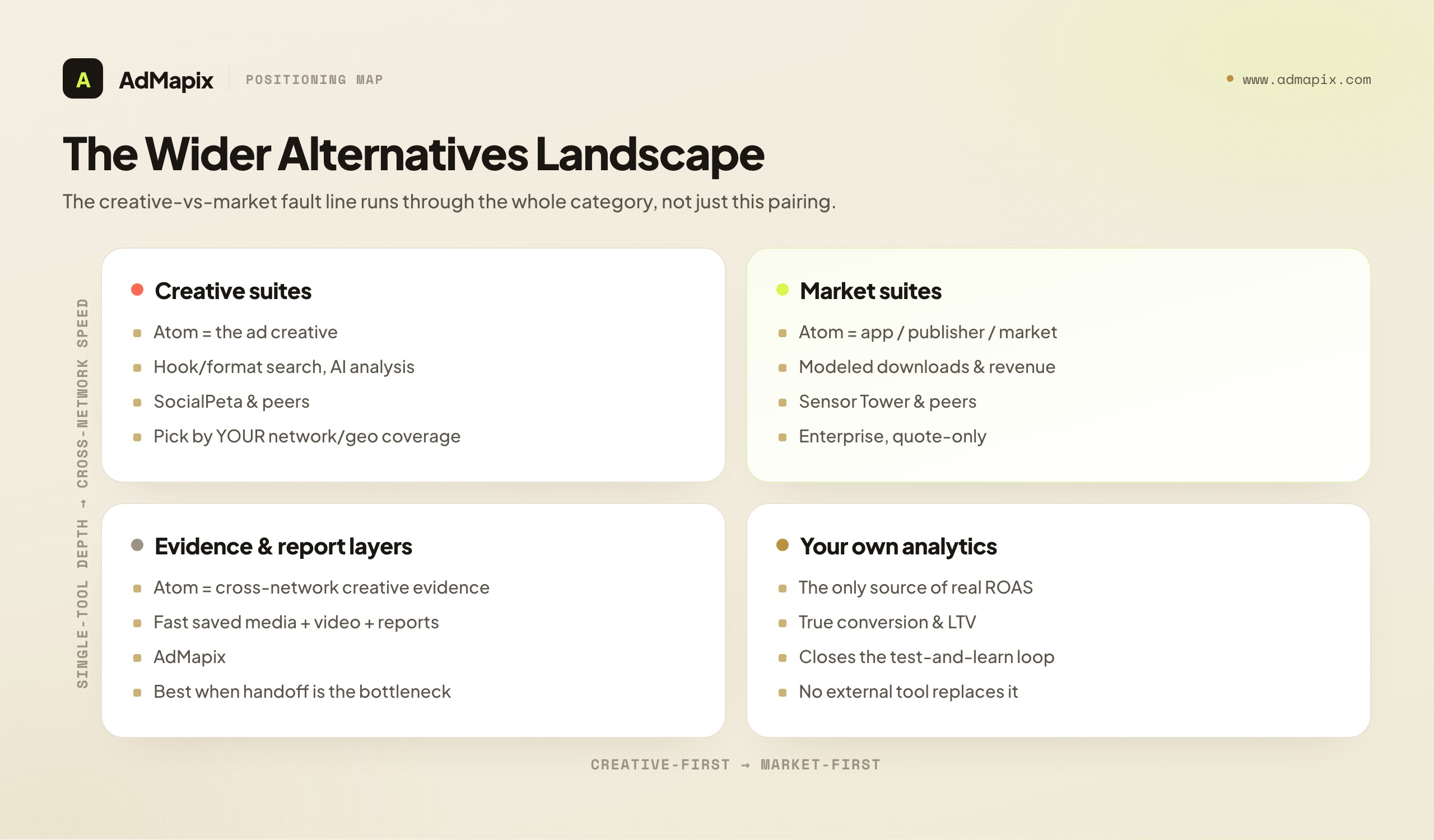
On the creative-first side sit tools whose atom is the ad creative: large ad-creative databases with hook and format search, creative tracking, and increasingly AI-assisted analysis. SocialPeta is a prominent example, and there are several alternatives with different network and regional strengths. The right one depends entirely on coverage of your networks and geos and on whether your bottleneck is discovery depth or reporting speed. For a structured look at this side, our best ad spy tools 2026 round-up and the SocialPeta alternative breakdown map the options, and the closely related SocialPeta vs AppMagic comparison covers an adjacent pairing.
On the market-first side sit the app-and-market intelligence suites whose atom is the app, publisher, or market: modeled downloads, revenue, engagement, and category dynamics, usually with an advertising module bolted on. Sensor Tower is a leading example, and its peers compete on estimate accuracy, category depth, and module breadth. These are enterprise, quote-only purchases, and the buying logic is the same as for Sensor Tower itself — price the market job, test estimate quality on apps you have ground truth for, and don't buy a full multi-module suite for a creative job a creative tool would solve. The broader marketing intelligence tools guide situates these suites in context.
Between the two sit evidence-and-report layers like AdMapix, which are not trying to be either a deep single-network creative suite or a full market-intelligence platform. Their value is speed: turning scattered cross-network competitor creatives — including video — into organized, shareable evidence fast. They're complementary to both sides, and they're the right primary choice specifically when your recurring pain is the reporting handoff rather than market modeling or single-network depth. The honest caveat applies here as everywhere: an evidence layer surfaces creative evidence, not competitor performance, so it can't see spend, ROAS, or targeting either.
Holding the full landscape in view does two things. It stops you from over-anchoring on the two best-marketed names when a better-fitting alternative exists for your specific coverage needs, and it reinforces the guide's core lesson at category scale: the creative-vs-market fault line runs through the entire space, not just this one pairing, so the deliverable-first decision logic works no matter how many tools you're weighing. Name the job, locate it on the creative-or-market split, then choose the tool with the best coverage and handoff for that job. The number of options is large; the decision logic is small.
One last practical note before the FAQ: whatever you choose, revisit the choice on a cadence rather than treating it as permanent. Coverage, freshness, pricing, and module breadth all shift over time, your own competitive set and bottleneck shift too, and a tool that was the right fit a year ago may not be today. A light annual re-evaluation — re-run the fair trial on your current real titles, re-confirm coverage in your current geos, re-check whether your dominant job is still the one you bought for — keeps your stack matched to your actual needs instead of to a decision you made under different conditions. The discipline that picks the right tool the first time is the same discipline that keeps it right: name the job, trial on your titles, price per decision, and accept the data ceiling. Run that loop annually and you'll never wake up paying for the wrong capability.
FAQ
Is SocialPeta a competitor to Sensor Tower?
Not really. SocialPeta is an ad creative intelligence tool — its job is to help you read and brief from competitor ad creatives. Sensor Tower is a full app and market intelligence suite — its job is to estimate downloads, revenue, engagement, and category dynamics, with advertising added as a module. They overlap only at the edges (both touch advertising), so they are better understood as complementary tools for different jobs than as head-to-head rivals.
Which one should I buy if I only have budget for one?
Decide by the job you owe most often. If your recurring bottleneck is "what creative do we test next," buy SocialPeta (or pair a creative-evidence layer for reporting). If your recurring bottleneck is "how big is this market and who is winning on revenue," buy Sensor Tower. Buying the wrong one for your dominant job is the most expensive mistake in this category, because you will pay for deep capability you barely touch.
Can Sensor Tower replace SocialPeta for creative work?
Partly, but not deeply. Sensor Tower's App Advertising Insights module includes a creative gallery, so you can see some of the ads behind its spend estimates. But that gallery is oriented around explaining spend, not around seeding a creative brief, and its creative depth and searchability are thinner than a creative-first tool's. If creative discovery is a core, weekly job, a dedicated creative tool will serve you better.
Can SocialPeta replace Sensor Tower for market sizing?
No. SocialPeta has no real download-and-revenue model and no market-sizing engine. Its top-advertiser and category signals are useful context for deciding which advertisers to study, but they are not market estimates and cannot stand in for Sensor Tower's modeled downloads, revenue, and category trends.
Do either of these tools show a competitor's true ad spend?
No. Both ad-spend figures are estimates derived from observed signals, and they can be off by a wide margin — especially in small geographies or thin categories. Treat any spend number from either tool as a directional model, not a fact. No external tool can read a competitor's actual ad budget.
Can I see a competitor's real ROAS or true top-performing creative?
No external tool can. You can see which creatives are running and roughly how long they stay live, and longevity is a reasonable proxy for "this is working." But it is a proxy, not proof. Real ROAS, true conversion-level performance, and the genuine top performer live inside the advertiser's own account and are never visible to SocialPeta, Sensor Tower, or AdMapix.
How much do SocialPeta and Sensor Tower cost?
Both are demo-led, and Sensor Tower is quote-only at the enterprise level — you cannot compare list prices without a sales conversation and a custom quote, and the price scales with modules, data scope, and seats. SocialPeta publishes more public positioning, but its real terms are also confirmed in a demo. Never trust a secondhand price from a forum or an old post; both vendors quote per account, so stale numbers will mislead you. Price the job, not the sticker.
When does it make sense to run both tools?
When both jobs are genuinely recurring. If you size markets, track competitor revenue, AND brief new creatives every week, Sensor Tower (market/revenue) plus SocialPeta (creative) is a coherent, complementary stack. If one job dominates, buy for that one first, trial the other, and add the second tool only when the second job actually appears on your weekly calendar — not before.
Where does AdMapix fit between these two?
AdMapix is a complementary cross-network ad-creative-intelligence layer, not a market-intelligence suite. It overlaps with SocialPeta on the creative-evidence job and is the better fit specifically when your gap is speed to cross-network creative evidence and a clean, shareable report rather than a single-network deep dive or a market estimate. It does not size markets or estimate revenue like Sensor Tower, and — like every tool here — it cannot see competitor spend, ROAS, or targeting.
What is the single biggest mistake teams make choosing between these tools?
Treating them as interchangeable and deciding on price alone. They are built around different units of analysis — a creative versus an app or market — so "cheaper" is meaningless if the cheaper tool cannot do your actual job. The fix is to name the deliverable you owe next week (a creative brief or a market memo), match the tool to that deliverable, and run a fair trial on your real titles before you sign anything.
Sources
Turn these observations into your next creative study
Open the creative library and select samples for your market, network and research question.
Related Articles
PowerAdSpy vs BigSpy in 2026: Filters, Coverage, Pricing, and Which Ad Spy Tool Fits Your Team
A 2026 head-to-head of PowerAdSpy vs BigSpy — how they differ on platform coverage, filter depth, data freshness, pricing tiers, and use-case fit, with a buy-without-guessing test, what public ad data can and cannot prove, and where a cross-network creative-intelligence layer fits.
Anstrex Alternative in 2026: 7 Tools Compared (Native, Push, Social & Pricing)
A 2026 guide to choosing an Anstrex alternative — why native/push buyers switch, a 7-tool comparison with pricing and coverage, the specialist-vs-cross-network distinction, a migration plan, and an honest read on when AdMapix fits and when Anstrex is still right.
AdPlexity vs Anstrex in 2026: Native & Push Ad Intelligence Compared
A 2026 head-to-head of AdPlexity vs Anstrex — breadth across affiliate traffic sources versus native and push depth with a landing-page ripper, compared on product model, network coverage, the prelander workflow, pricing, and use-case fit, with a test-before-you-buy method and the honest limits of what spy data can prove.