
Best FastMoss Alternatives in 2026: KaloData, Shoplus, EchoTik & AdMapix Compared
A decision-first guide to the best FastMoss alternatives in 2026: compare TikTok Shop commerce data tools (KaloData, Shoplus, EchoTik) against ad creative intelligence tools, with full comparison tables, role-based picks, a migration checklist, and an honest FAQ.
By the AdMapix research team. Updated June 21, 2026. Disclosure: AdMapix is our product — see the note at the end of this guide.
Best FastMoss Alternatives in 2026: KaloData, Shoplus, EchoTik & AdMapix Compared
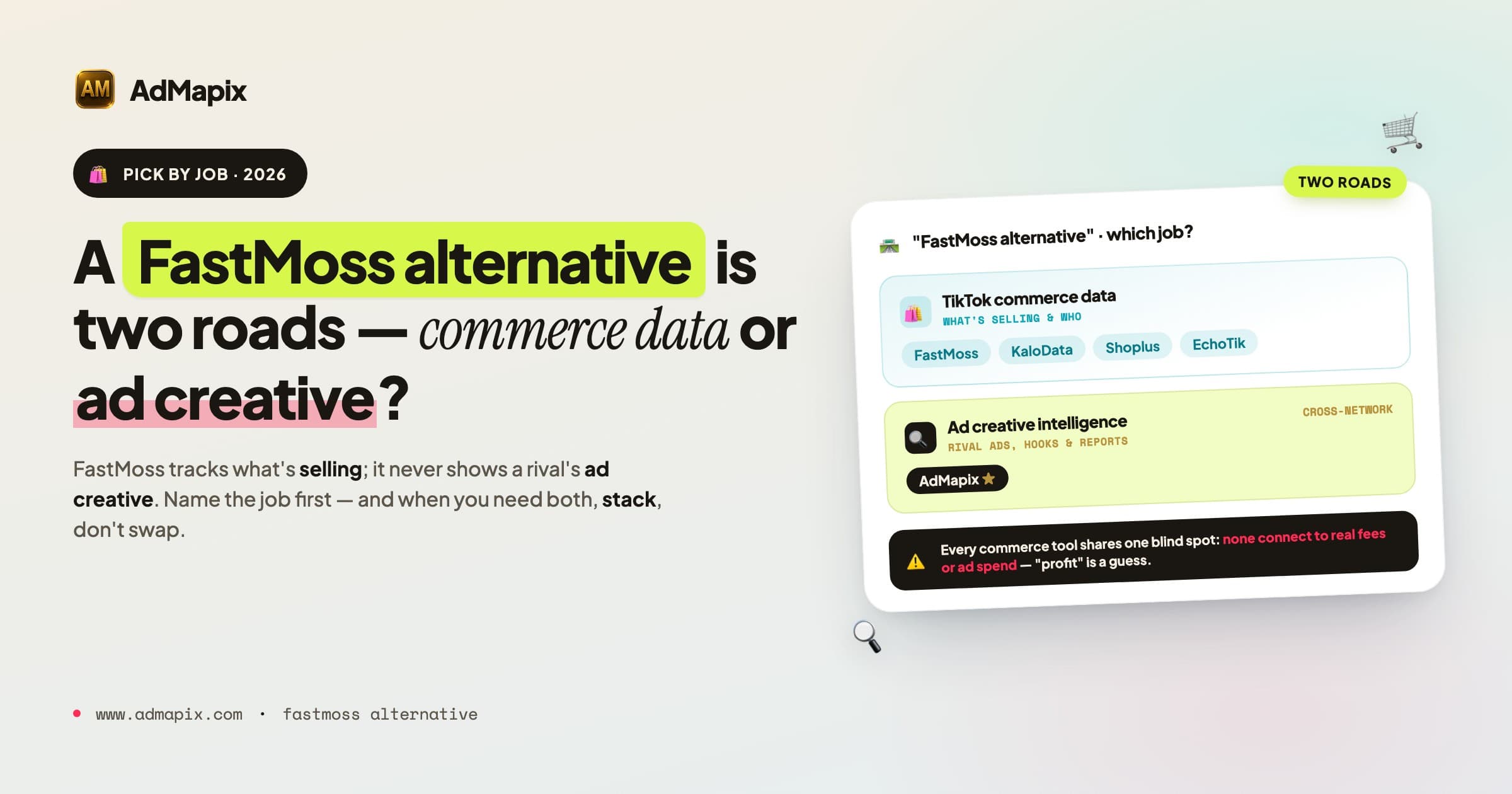
The right FastMoss alternative depends on which job you are actually trying to do — not on which tool sounds the broadest or ranks highest on a listicle. FastMoss is a TikTok ecommerce data platform: it tracks products, shops, creators, LIVE sessions, short videos, and hashtags. If that is the decision in front of you, you want another TikTok commerce tool, and this guide will help you compare them properly.
But here is the twist that trips up most searches: a large share of people looking for a "FastMoss alternative" actually have a different problem. They need to see competitor ad creatives, study paid-social video, and turn what they find into repeatable reports. That is a creative intelligence job — a different category entirely — and swapping one TikTok Shop tracker for another will never solve it.
This guide is built for TikTok Shop sellers, ecommerce operators, agencies, affiliates, paid-social teams, and founders. Instead of a generic "top 10" ranking, it gives you a decision framework: name the job first, then pick the category, then compare tools within that category on the dimensions that actually matter. We will compare the real TikTok commerce alternatives (KaloData, Shoplus, EchoTik and more), explain where ad creative intelligence fits, and be honest about what public data can and cannot prove.
TL;DR — choosing a FastMoss alternative in 2026
- Name the job first. FastMoss answers "what is selling on TikTok Shop and who is selling it." If your real question is "what ads are competitors running," that is a different category — don't buy a commerce tool to solve a creative problem.
- For TikTok commerce data, the closest like-for-like alternatives are KaloData (cleaner UI, 500-day history, lower entry price), Shoplus (simpler, has a free tier), and EchoTik (budget entry, Chrome extension). Compare on coverage, freshness, history, and price.
- For ad creative + video + reports, you want a creative intelligence layer (cross-network ad search, saved media, video breakdowns). AdMapix sits here.
- The two are layers, not rivals. Commerce data finds the opportunity; creative intelligence tells you how to advertise around it. Serious teams stack one of each.
- No market-intelligence tool sees your real numbers. None of these connect to your store's fees, ad spend, or refunds — so any "profit" they imply is a guess. Treat every signal as a hypothesis, then validate with your own campaign data.
What FastMoss actually is (so you can replace it correctly)
You cannot choose a good alternative until you know precisely which FastMoss modules you rely on. FastMoss is a TikTok Shop data analytics platform used by millions of sellers, brands, and creators, with a database spanning roughly 220 million creators across 15+ countries and 120 million products and shops. Its strength is breadth across the TikTok commerce ecosystem.
Here is what FastMoss covers, module by module — map your own usage against this before you shop for a replacement.
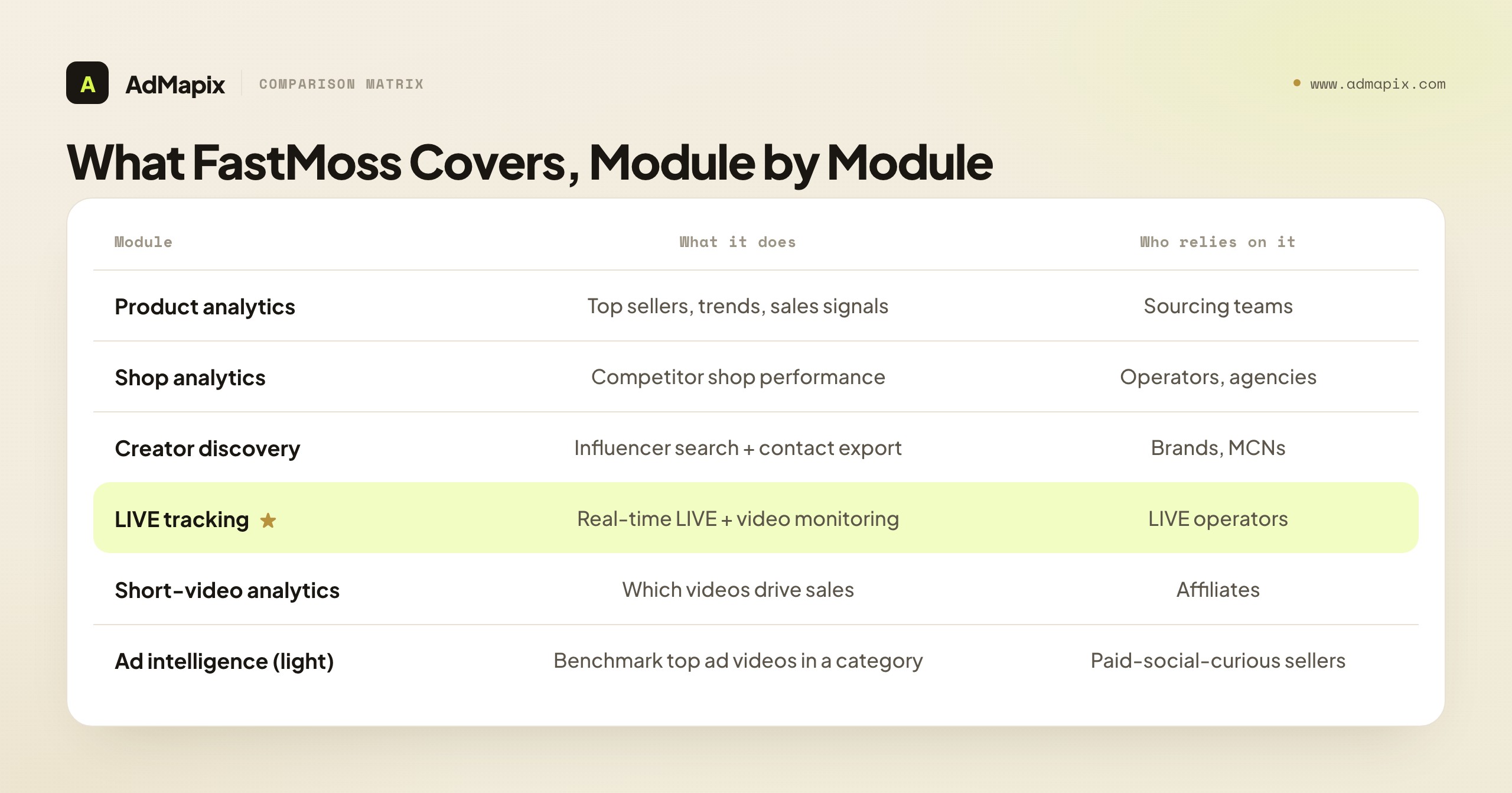
| FastMoss module | What it does | Who relies on it most |
|---|---|---|
| Product analytics | Top-selling products, trends, sales signals on TikTok Shop | Product researchers, sourcing teams |
| Shop analytics | Competitor shop performance and ranking | Operators, agencies |
| Creator discovery | Influencer search + contact export (up to ~6,000/day), region/engagement filters | Brands, MCNs, outreach teams |
| LIVE tracking | Real-time LIVE session and video monitoring | LIVE shopping operators |
| Short-video analytics | Which videos drive product sales | Affiliates, creative teams |
| Hashtag insights | Trending hashtags tied to commerce | Organic growth teams |
| FastMossAI | Auto-transcribe videos, rewrite scripts, AI product reviews | Solo sellers, content teams |
| Ad intelligence (light) | Benchmark top-selling ad videos in a category | Paid-social-curious sellers |
Notice the pattern: seven of those eight modules are about commerce — what sells and who sells it. The eighth (ad intelligence) is deliberately light. That single line is exactly where the "FastMoss alternative" search splits into two roads.
What people actually mean by "FastMoss alternative"
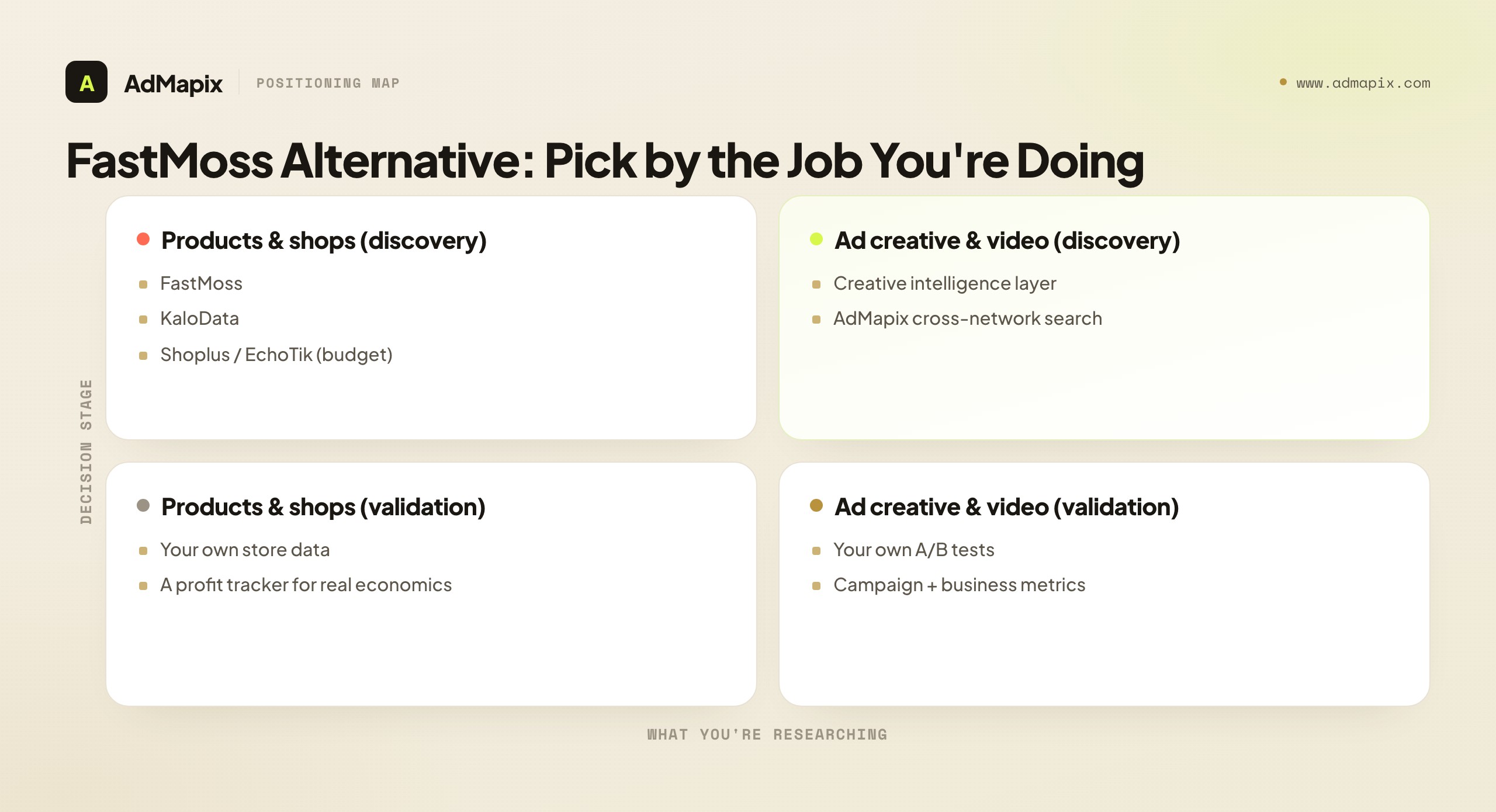
Most searches for a FastMoss alternative come from one of two unmet needs, and naming yours first saves you from buying the wrong category. FastMoss answers "what is selling, who is selling it, and how it performs in TikTok Shop." It does not tell you what a competitor's paid ad creative looks like across networks, or how a winning video is structured second by second.
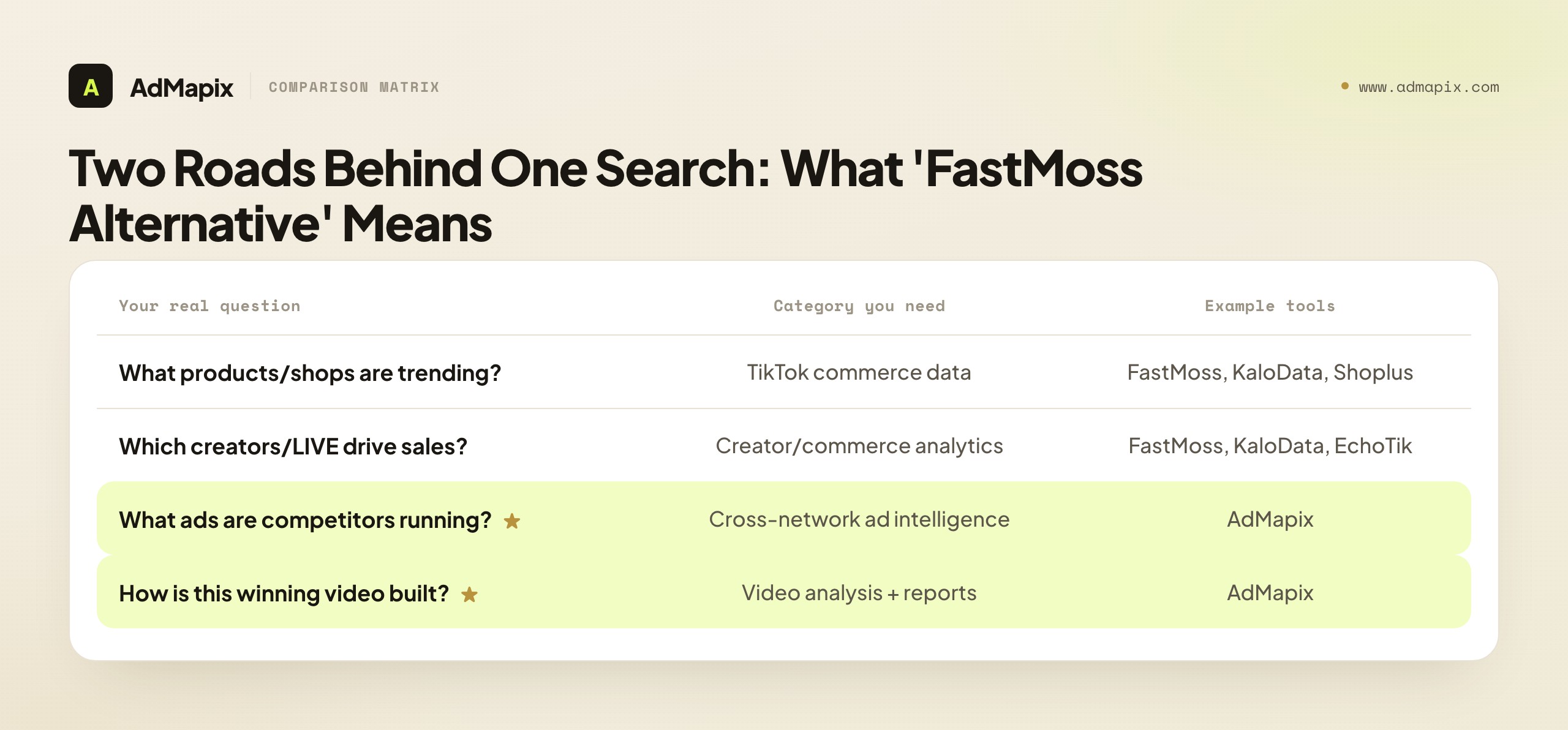
| If your real question is… | You need | Category | Example tools |
|---|---|---|---|
| What products and shops are trending on TikTok? | TikTok commerce data | Commerce analytics | FastMoss, KaloData, Shoplus |
| Which creators and LIVE sessions drive sales? | Creator/commerce analytics | Commerce analytics | FastMoss, KaloData, EchoTik |
| What ad creatives are competitors running, and where? | Cross-network ad intelligence | Creative intelligence | AdMapix |
| How is this winning video built, and what should we test? | Video analysis + creative reports | Creative intelligence | AdMapix |
If only the top two rows describe your week, you are choosing within the TikTok commerce category — jump to the next section. If the bottom two rows are your real bottleneck, no commerce tracker will help, and you should read the creative-intelligence section. If both describe your week, you are not choosing one tool over the other — you are stacking a commerce tool with a creative tool. That stacking decision is the single most important takeaway in this guide.
TikTok commerce alternatives to FastMoss, compared
If product, shop, creator, and LIVE data is the decision, the closest alternatives stay inside the TikTok commerce category. Below is the head-to-head that actually matters in 2026. Prices move constantly, so treat the figures as directional and verify on each vendor's site before you buy.
The big two: FastMoss vs KaloData
KaloData is the other dominant TikTok Shop analytics platform and the most common FastMoss comparison. It was launched by a team of former TikTok global e-commerce members who helped build TikTok Shop — which shows up in how cleanly its product research is structured. Here is the honest side-by-side.
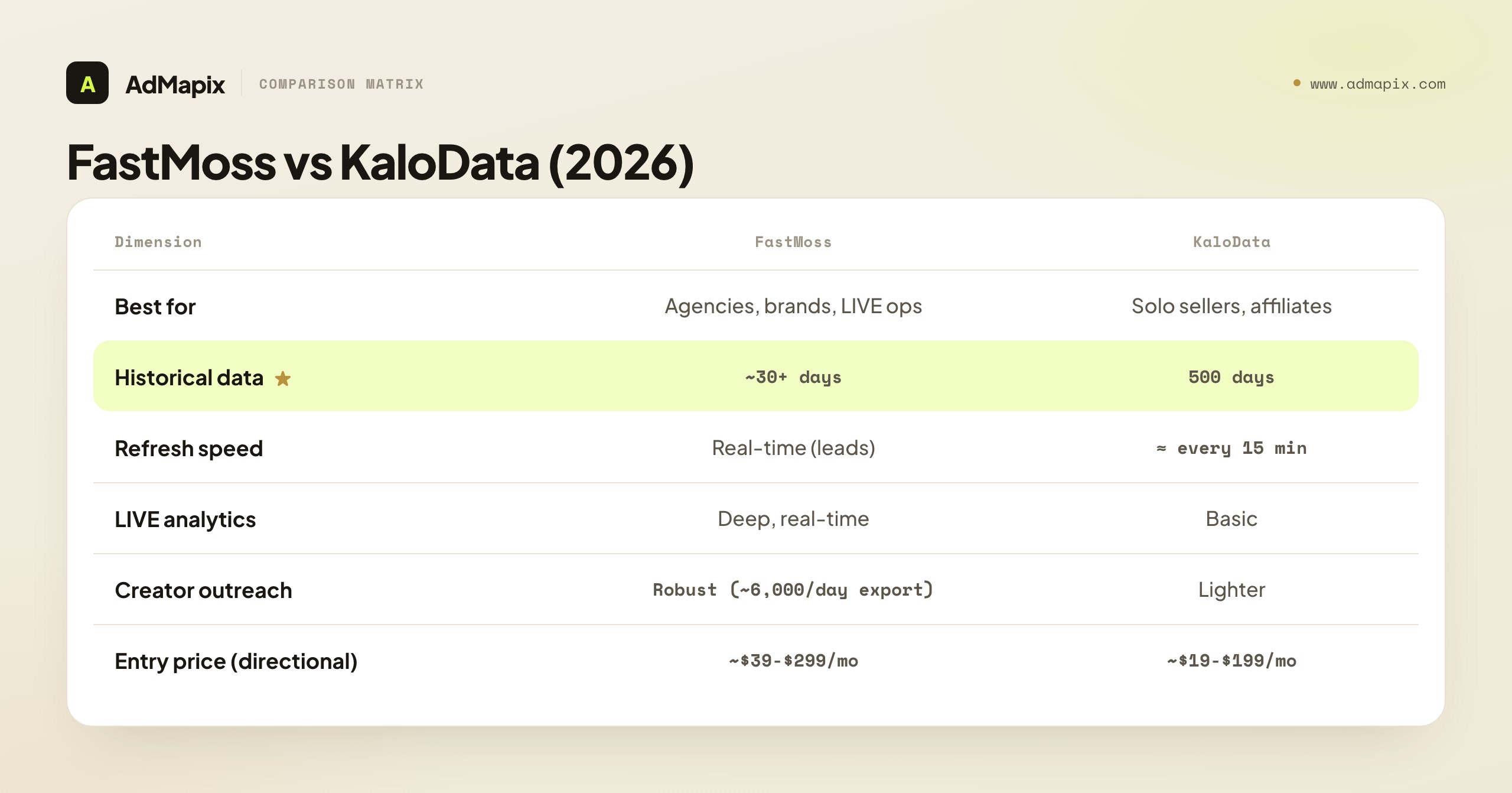
| Dimension | FastMoss | KaloData |
|---|---|---|
| Best for | Agencies, brands, MCNs, LIVE operators | Solo sellers, affiliates, budget-conscious researchers |
| Market coverage | Broader (15+ markets, more granular categories) | Strong, slightly narrower |
| Historical data | ~30+ days standard | 500 days with transparent methodology |
| Refresh speed | Real-time updates (leads here) | Frequent (≈ every 15 min) |
| LIVE analytics | Deep, real-time | Basic |
| Creator outreach | Robust (contact export ~6,000/day) | Lighter |
| AI tools | FastMossAI (transcribe, rewrite, reviews) | Lighter |
| UI / workflow | Feature-dense | Cleaner, hover-preview product research |
| Entry price (directional) | ~$39–$299/mo (intro ~$29 first month) | ~$19–$199/mo |
| Trial | 7-day (auto-renew); 3-day limited on request | No-credit-card trial commonly available |
The clean way to decide between them: choose KaloData if you are budget-conscious, early in product research, want a clean UI, or need deep historical/seasonal data. Choose FastMoss if you need deeper creator analytics and outreach, real-time LIVE coverage, AI content tools, or you run an agency managing multiple shops across many markets. If FastMoss is the encyclopedia of TikTok Shop data, KaloData is the daily newspaper — and your job decides which you need.
The budget and niche commerce alternatives
Beyond the big two, several tools fill specific gaps. If FastMoss's price or depth is the problem, one of these may be the better fit.
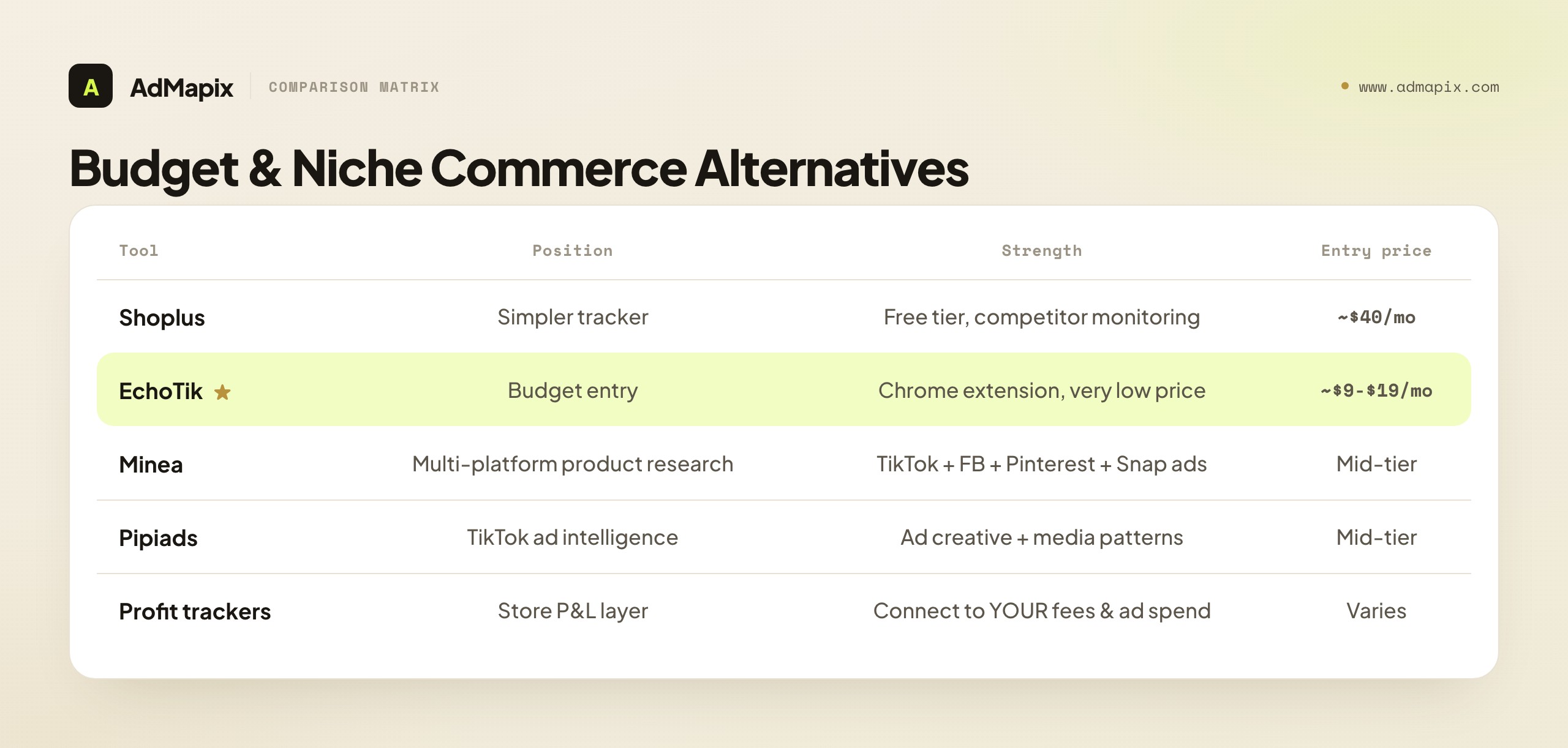
| Tool | Category position | Strengths | Watch-outs | Entry price (directional) |
|---|---|---|---|---|
| Shoplus | Simpler commerce tracker | Product tracking + competitor monitoring, free tier | Less data depth than FastMoss | ~$40/mo (free tier available) |
| EchoTik | Budget entry point | Chrome extension, very low price | Lighter dataset | ~$9–$19/mo |
| Minea | Multi-platform product research | Covers TikTok, Facebook, Pinterest, Snapchat ads | Less TikTok-Shop-specific depth | Mid-tier |
| Pipiads | TikTok ad intelligence | Strong on ad creative + media patterns | Not an organic shop-sales tracker | Mid-tier |
| Profit trackers (Kixmon, Dashboardly) | Store P&L layer | Connect to your fees, ad spend, refunds | Not market discovery tools | Varies |
Two of these deserve special attention because they are not really FastMoss replacements — they are different layers people mistake for one. Pipiads and Minea lean toward ad-creative research, which overlaps with the creative intelligence category below, not commerce analytics. And profit trackers solve a problem neither FastMoss nor KaloData touches, which we cover next.
The honest gap every commerce tool shares
Here is the line no vendor advertises loudly: FastMoss, KaloData, Shoplus, and EchoTik are market-intelligence tools. They tell you what is selling across TikTok Shop. None of them connect to your store's actual fees, ad spend, or refunds. That means any "profit" figure you derive from them is, structurally, a guess. This is not a knock on the tools — it is a category boundary. If your real need is knowing your own unit economics, the right alternative is not a different research tool at all; it is a profit-tracking platform (like Kixmon or Dashboardly) layered alongside whichever research tool you pick.
Do not switch commerce tools to fix a profit-visibility problem, and do not switch commerce tools to fix a creative problem either. Match the tool to the actual bottleneck.
Tool deep dives: the budget and niche alternatives up close
The comparison table is the fast answer; this is the context behind it. Each of these tools earns its place by being narrower than FastMoss, not broader — and that focus is exactly why one of them might suit you better.
Shoplus positions itself as the approachable commerce tracker. It does the core jobs — trending product discovery, shop and creator tracking, competitor monitoring — with a gentler learning curve and a usable free tier, which makes it a sensible first stop for a solo seller who finds FastMoss's density overwhelming. The trade-off is depth: its historical windows and category granularity are shallower, so once your research questions get specific ("show me every variant of this product across these five markets over 90 days"), you will feel the ceiling.
EchoTik competes almost entirely on price. A Chrome-extension-first workflow and an entry tier that can run a fraction of FastMoss's cost make it attractive for someone who just wants to spot-check a product or creator without committing to a research platform. Treat it as a lightweight lookup tool rather than a research system; the dataset is thinner and the analytics basic, but for "is this product actually selling or just viral," it answers the question cheaply.
Minea is the multi-platform option, and the important nuance is that it is really an ad research tool that happens to cover TikTok, not a TikTok Shop sales tracker. If your question spans Facebook, Pinterest, and Snapchat creatives as well as TikTok, Minea's breadth is the draw. But if you specifically need TikTok Shop product, GMV, and creator data, a focused commerce tool will out-resolve it on that one platform.
Pipiads sits in the same "looks adjacent, solves a different job" bucket. It is a TikTok ad intelligence tool — strong on ad-creative patterns and media-buying signals — not an organic shop-sales tracker. People land on it from "FastMoss alternative" searches and then discover it answers the creative question, not the commerce one. That is a feature if creative is your bottleneck and a mismatch if it is not.
The pattern across all four: they are deliberately smaller than FastMoss. The skill is matching that smaller shape to your actual question instead of defaulting to the biggest dataset.
Pricing reality: match the tier to the job
Tool pricing in this category moves constantly and tiers gate features in ways the headline number hides, so the useful exercise is not "which is cheapest" but "what is the cheapest tier that does my job." A few principles travel well regardless of current list prices:
- Entry tiers are research-throttled, not just seat-limited. The cheapest plan usually caps history depth, export volume, market coverage, or refresh frequency — the exact dimensions that matter for serious research. Read the tier's limits, not its price.
- Pay for history only if you use seasonality. A 500-day window is a real advantage for trend and seasonal analysis and irrelevant if you only care about what is hot this week. Do not buy the long-history tier to answer short-history questions.
- Creator-outreach volume is a real cost line. If sourcing affiliates is the job, contact-export caps (and how aggressively they are throttled) can matter more than the dataset itself.
- A two-tool stack is often cheaper than one maxed-out tool. A mid-tier commerce tracker plus a separate creative-intelligence tool frequently costs less — and covers more of the actual workflow — than pushing one platform to its top tier to cover a job it was never built for.
The honest budgeting move is to write down the three questions you ask most weeks, then buy the lowest tier that answers all three. Upgrade when a real question hits a wall, not preemptively.
How to run a 14-day side-by-side trial before you commit
Do not pick a FastMoss alternative from a feature table alone — run a structured two-week bake-off using your own real research questions. This is the single best way to avoid buying the wrong category.
Days 1–3 — define the test. Write down the five questions you actually need answered every week (for example: what is trending in my category, which creators drive this product, what creative angle are rivals running). These become your scoring rubric. Pick two candidate tools — usually one commerce tracker and, if creative is in your five, one creative-intelligence tool.
Days 4–8 — research-depth test. Run the same product and creator queries through each tool. Score each on four things: can it answer the question at all, how many clicks to the answer, how deep does the history go, and is the data fresh enough to trust. Note where each tool hits a ceiling — that ceiling is what you would actually be living with day to day.
Days 9–12 — workflow test. Stop testing data and test output. Can you get from a question to a shareable answer — a brief, a shortlist, a report — without copy-pasting into a spreadsheet? The tool that produces a decision fastest, not the one with the most raw data, usually wins the daily-use battle.
Days 13–14 — decide and document. Tally the rubric. If one tool wins all five questions, buy it. If the wins split between a commerce tool and a creative tool, that is the signal you need both layers — which is the correct answer more often than people expect, because the two categories solve different jobs. Cancel the loser before any trial auto-renews; several of these trials auto-charge, so set a reminder.
Where creative intelligence fits (and why it is a different tool)
Use a creative intelligence tool when the next decision is about ads and video, not about products and sales. This is the road the second half of "FastMoss alternative" searches are actually on.
An ad creative intelligence platform lets you:
- Search the ad creatives competitors are actually running — across networks, not just TikTok.
- Save the strongest examples as evidence you can reference and share.
- Break down how a winning video is structured — the hook, pacing, offer framing, first-screen layout.
- Package patterns into a report for a client, a creative brief, or your own team.
This is a fundamentally different job from "which product is trending," and it is the part FastMoss-style commerce tools are not built for. FastMoss's ad-intelligence module is deliberately light (benchmarking top ad videos in a category); it is not a cross-network creative search-and-report workspace.
AdMapix is a cross-network ad creative search platform. In practice that means you can search competitor ads across networks, save the best media for reference, run video analysis on winning creatives, tag them, and turn the result into a report. It is the evidence-and-reporting layer for paid social — not a shop-sales tracker. Where it fits in the stack:
| Job | AdMapix surface |
|---|---|
| Find competitor creatives across networks | Search AdMapix |
| Save the strongest examples as evidence | Media |
| Break down winning videos shot by shot | Video Analysis |
| Package patterns into a client/team report | Reports |
If your week is only TikTok Shop product, sales, and creator analytics, you do not need this layer — a commerce tool's job is enough, and AdMapix does not track shop-level sales. The two categories are complementary, not competitive.
Commerce data and creative intelligence are layers, not rivals
This is the mental model that makes the whole decision simple. The two categories answer two different questions in sequence:
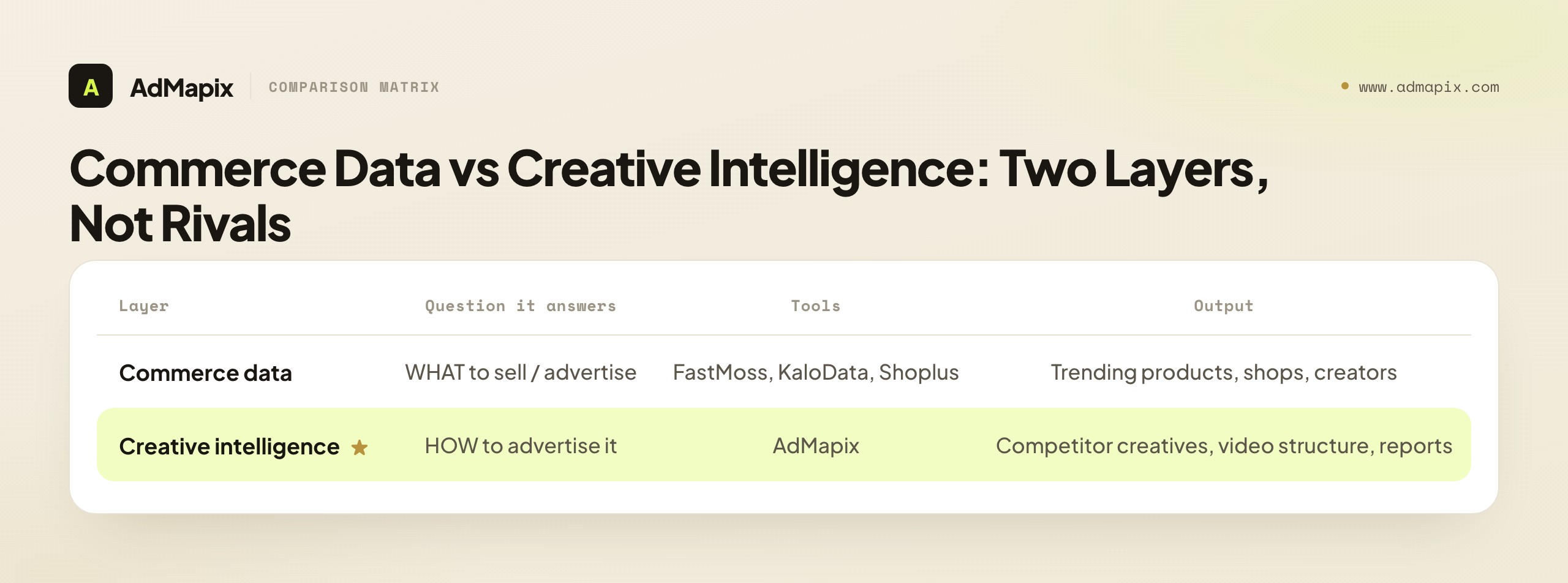
| Layer | Question it answers | Tools | Output |
|---|---|---|---|
| Commerce data | What should we sell / advertise? | FastMoss, KaloData, Shoplus, EchoTik | Trending products, shops, creators, demand signals |
| Creative intelligence | How should we advertise it? | AdMapix | Competitor ad creatives, video structure, creative reports |
Commerce data finds the opportunity. Creative intelligence tells you how to advertise around it. A team running TikTok Shop seriously usually needs both — they use a commerce tool to spot a trending product or creator, then a creative tool to study the competitor ads and videos around that exact opportunity and build an original campaign. Forcing one tool to do both jobs is the most common (and most expensive) mistake in this category.
A decision framework: pick by the job, not the brand
Put the two ideas together and the choice resolves into a short decision tree. Walk it top to bottom.
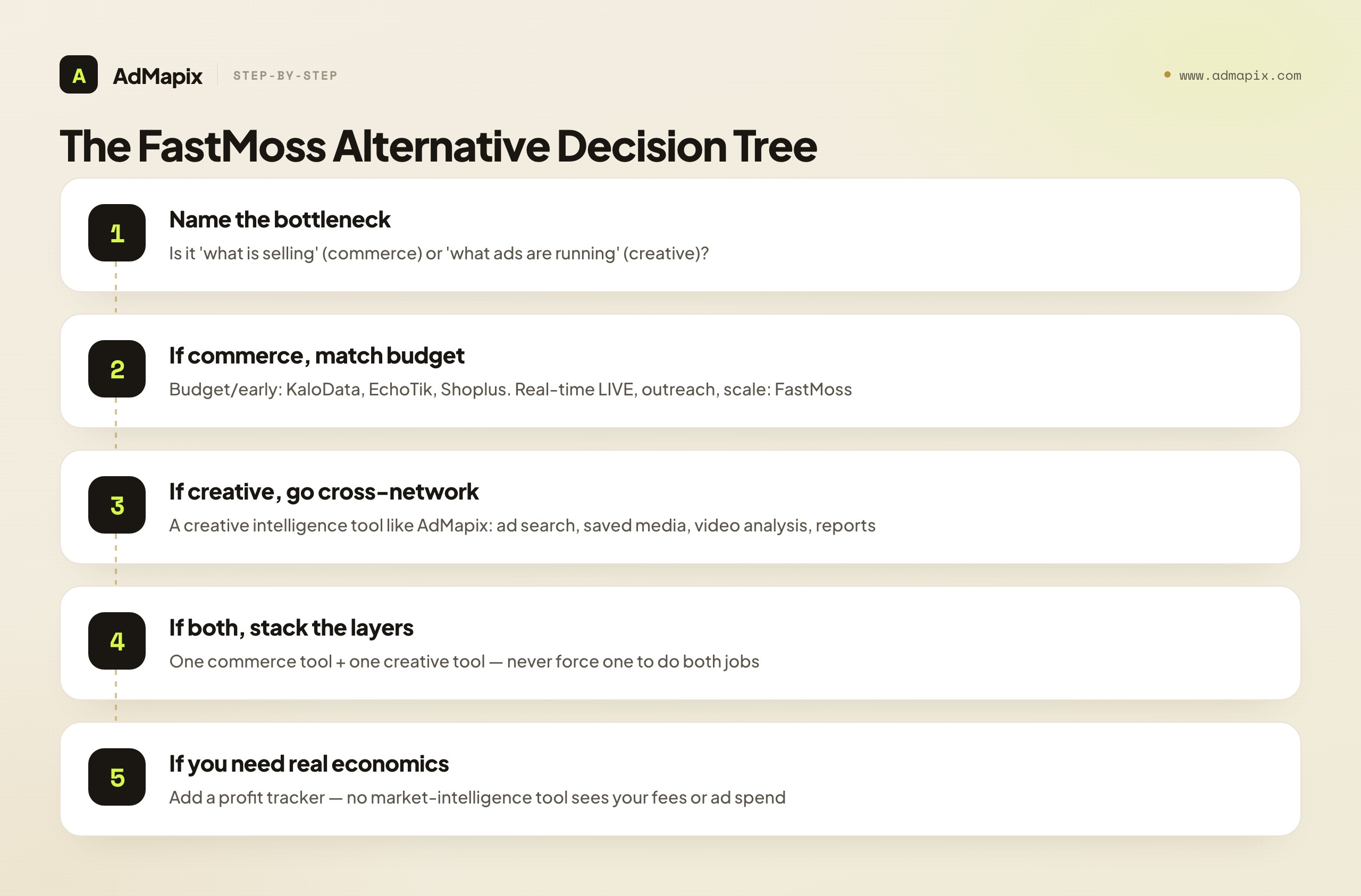
- Is your bottleneck "what is selling / who is selling it" on TikTok Shop? → You need commerce data. Go to step 2.
- Budget-conscious or early in research? → KaloData (clean UI, history, lower price) or EchoTik / Shoplus (cheapest entry). Need real-time LIVE, creator outreach, AI tools, multi-market at scale? → FastMoss.
- Is your bottleneck "what ads are competitors running / how is this video built"? → You need creative intelligence. → A cross-network ad search + report tool like AdMapix.
- Do you do both product and ad work every week? → Stack one commerce tool with one creative tool. Do not force either to do the other's job.
- Do you actually need your own profit/unit economics? → Add a profit tracker — no market-intelligence tool provides this.
The framework's whole point: the "best FastMoss alternative" is undefined until you name the job. Once named, the category is obvious and the tool comparison becomes a short, honest checklist.
Who should choose what
Match the tool to the team's primary weekly job, then add the second layer only when the bottleneck is real.
| Team or role | Start with | Add when |
|---|---|---|
| Product research / sourcing | TikTok commerce data (FastMoss, KaloData) | You need to see how to advertise the product |
| Creative strategist / paid social | AdMapix creative intelligence | You need to validate which products are worth advertising |
| Agency | Both: commerce for the opportunity, AdMapix for the brief + client report | Almost always, if you advise on product and ads |
| Affiliate / TikTok Shop seller | Commerce data first (KaloData/EchoTik for price) | Your ads/videos stop converting and you need fresh angles |
| LIVE shopping operator | FastMoss (deep real-time LIVE) | You start running paid amplification |
| Founder | Whichever validates the riskier assumption first | The second assumption becomes the bottleneck |
What public data can and cannot prove
Public ad and commerce data is strong for evidence and hypotheses, and weak as performance proof. Be honest about that line — it is what separates disciplined operators from people who chase ghosts.
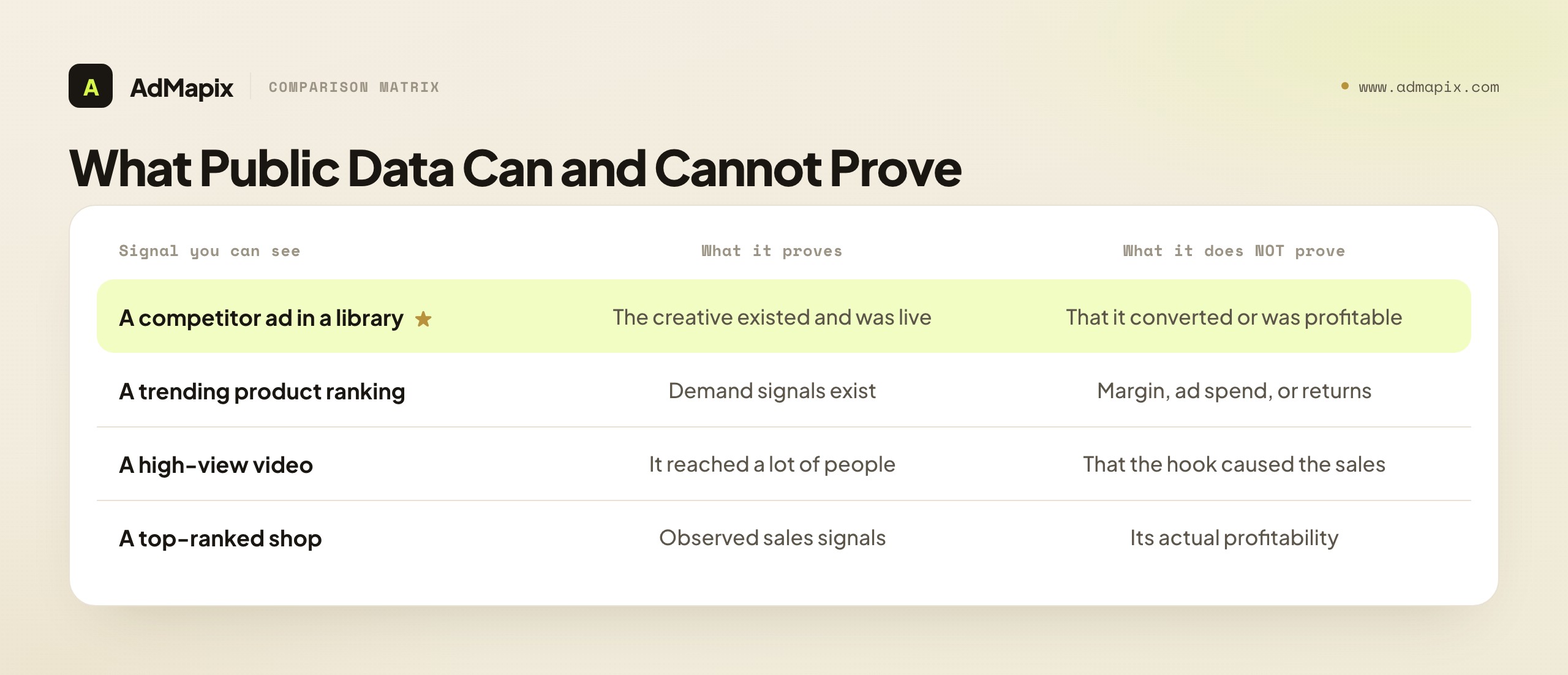
| Signal you can see | What it proves | What it does NOT prove |
|---|---|---|
| A competitor ad in a library | The creative existed and was live | That it converted or was profitable |
| A trending product ranking | Demand signals exist | The seller's margin, ad spend, or return |
| A high-view video | It reached a lot of people | That the hook caused the sales |
| A top-ranked shop | Observed sales signals | Its actual profitability |
The reliable use of all of this data is the same: form a testable hypothesis, then validate it with your own campaign and business metrics. An ad you find proves a competitor ran that creative; your own A/B test proves whether a version of it works for you. A trending product proves demand; your own funnel proves whether you can sell it profitably. Treat both commerce and creative data as inputs to a test, never as a verdict.
A migration checklist before you switch
Switching tools has a cost — re-learning a UI, rebuilding saved searches, retraining a team. Run this checklist before you migrate so you switch once, correctly.
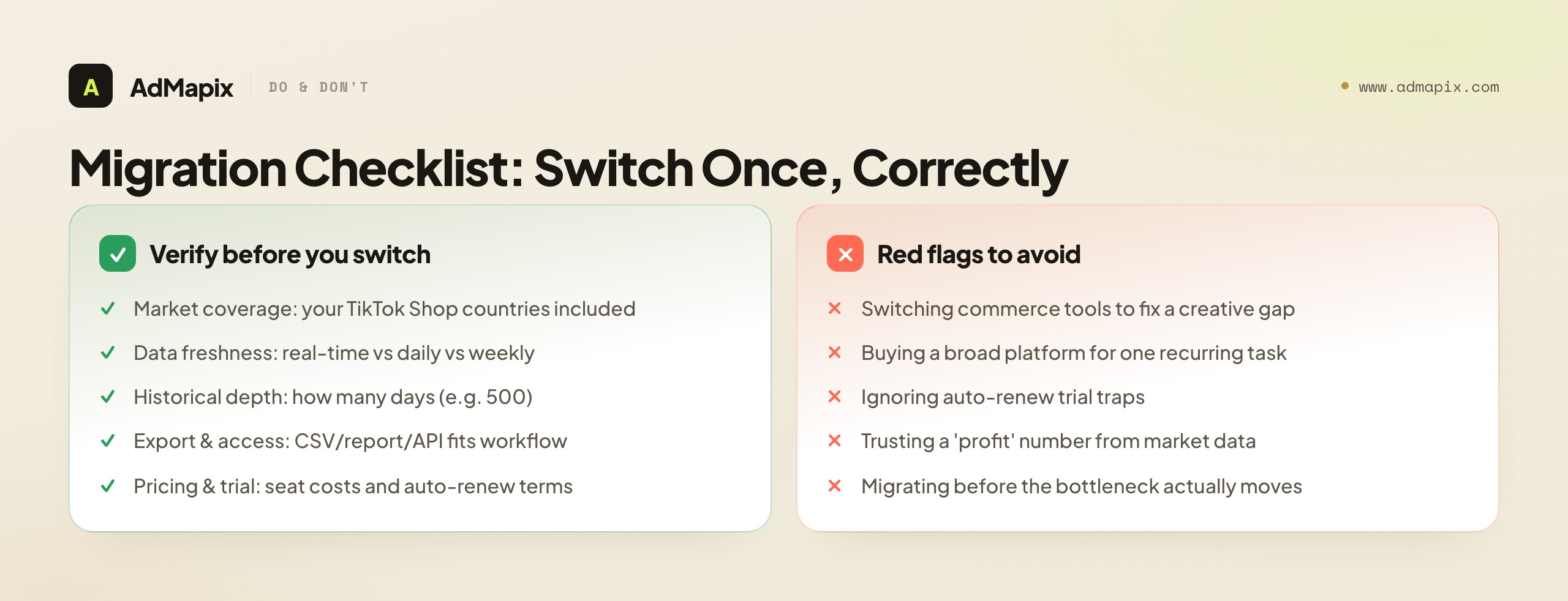
| Check | Why it matters | How to verify |
|---|---|---|
| Market coverage | Your TikTok Shop markets must be included and complete | Confirm each country you sell in is covered |
| Data freshness | Stale data leads to late product calls | Ask the refresh cadence (real-time vs daily vs weekly) |
| Historical depth | Seasonal/trend analysis needs history | Check how many days of history you get (e.g., KaloData's 500) |
| Creator & LIVE depth | Only matters if those are your job | Test-track the specific sellers/streams you care about |
| Export & access | Output must fit your reporting | Confirm CSV/report/API paths match your workflow |
| Pricing transparency | Hidden seat/limit costs blow budgets | Get plan limits and seat costs in writing before buying |
| Trial terms | Auto-renew traps are common | Note trial length and whether it auto-charges |
The cardinal rule of switching: only change layers when the actual bottleneck moves. If you cannot see the competitor's ads, a different TikTok Shop tracker will not fix it — that data lives in ad libraries and creative intelligence platforms, not in commerce analytics.
Three worked scenarios
Scenario 1 — Solo TikTok Shop seller on a budget
The job is product discovery; the constraint is price. FastMoss's $39–$299 range is more than this seller needs. The right alternative is KaloData (cleaner research, 500-day history, $19 entry) or EchoTik ($9–$19, Chrome extension) for the cheapest start. They do not need the creative-intelligence layer yet — until their videos stop converting, at which point a creative tool becomes the new bottleneck.
Scenario 2 — Agency briefing a client on TikTok ads
The job is both: find the opportunity and produce a creative brief plus a client-ready report. A commerce tool alone leaves the agency unable to show competitor ad creatives; a creative tool alone leaves them unable to justify which products to advertise. The right answer is a stack: a commerce tool (FastMoss or KaloData) for the opportunity, plus AdMapix for cross-network competitor creatives, saved media evidence, video breakdowns, and the packaged report. This is the textbook two-layer case.
Scenario 3 — Paid-social buyer whose ads stopped converting
The job is not finding a new product — it is finding fresh creative angles. Swapping FastMoss for KaloData would change nothing, because the bottleneck moved to creative. The right alternative is the creative intelligence layer: search competitor ads in Search AdMapix, save the strongest in Media, break down the winners in Video Analysis, and turn the pattern into a brief. The lesson: when the bottleneck moves, change the layer, not just the brand.
Common mistakes
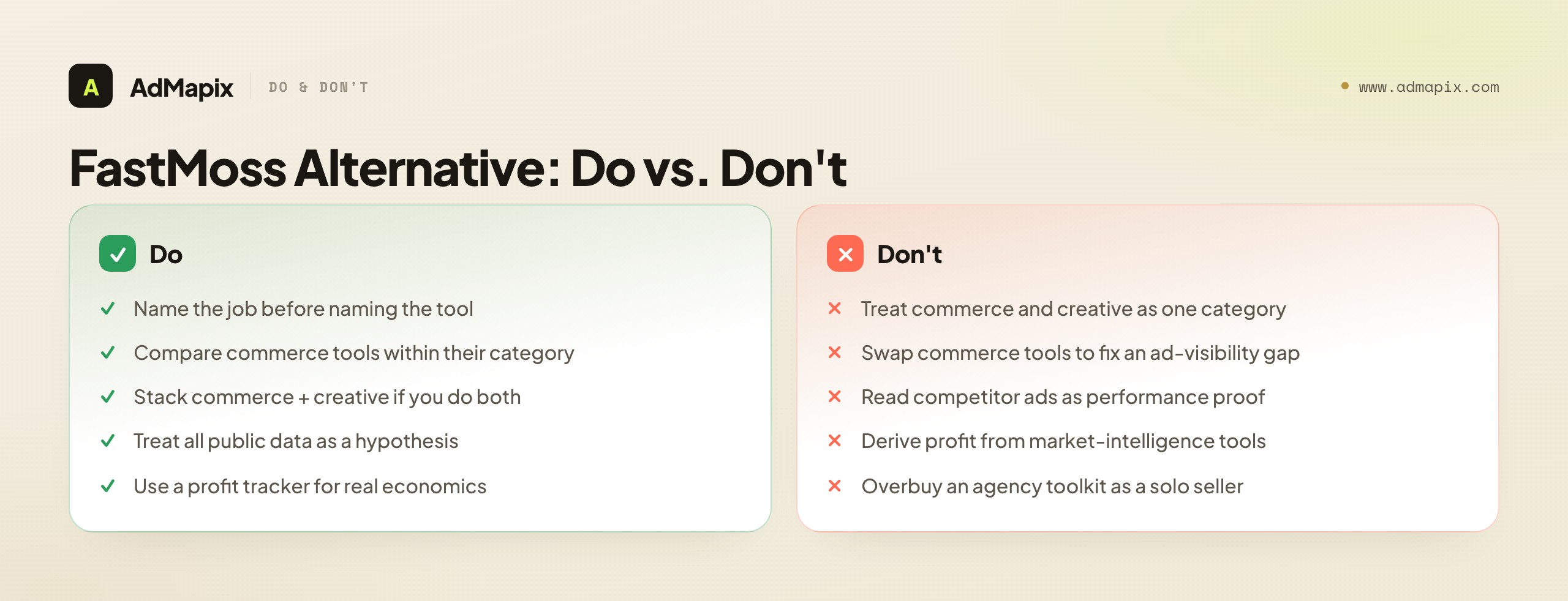
- Treating commerce and creative tools as one category. "What is selling" and "how to advertise it" are different questions answered by different products.
- Replacing a data tool with a creative tool (or vice versa) without changing the decision. Only switch layers when the actual bottleneck moves.
- Reading competitor ads as performance proof. Ads create hypotheses; your campaign data and business metrics validate them.
- Deriving "profit" from market-intelligence tools. None of them see your fees, ad spend, or refunds — that number is a guess. Use a profit tracker for real economics.
- Ignoring video structure. For paid social, the hook, pacing, offer framing, and first-screen layout often decide the next test more than the product itself.
- Skipping access checks. Country coverage, data freshness, export paths, and pricing change often — verify before you migrate.
- Overbuying. A solo seller rarely needs FastMoss's full agency toolkit; a creative buyer rarely needs a commerce platform at all.
When to use AdMapix
Use AdMapix when the problem you cannot solve with a TikTok commerce tool is competitor ad creative, video evidence, and recurring reports. It is for creative strategists, paid-social buyers, agencies, and founders who need to see what competitors are running across networks and turn it into a brief. It is not for teams whose only need is TikTok Shop product, sales, or creator analytics — that is a commerce tool's job, and AdMapix does not track shop-level sales.
A practical stack keeps your commerce tool for product discovery, then uses Search AdMapix to find competitor creatives across networks, Media to save the strongest examples as evidence, Video Analysis to break down winning videos, and Reports to package patterns for a client or your own team. If one competitor set needs weekly review, run it once in Search AdMapix and keep the best examples in Media. When that starts saving real briefing time, create an account from Login or compare seats on Pricing.
A buyer's checklist: how to evaluate any FastMoss alternative
Whatever shortlist you end up with, run every candidate through the same eight criteria. Score them on the dimensions that actually change your decisions, not the ones that look impressive in a demo.
1. Market coverage. Confirm the tool covers the specific TikTok Shop markets you sell in or source from. A platform with brilliant US data is useless if your business is in Southeast Asia. Coverage breadth and per-market depth are different things — check both.
2. Historical depth. Ask how far back the data goes and whether the methodology is transparent. A long window (KaloData's ~500 days, for example) matters enormously for seasonal and trend analysis and not at all if you only chase this week's movers. Buy depth only if you will use it.
3. Data freshness. How often does the dataset refresh? Real-time or near-real-time (FastMoss leads here) matters for fast-moving categories and LIVE; a daily refresh is fine for slower research. Stale data quietly corrupts decisions, so treat freshness as a first-class criterion.
4. Creator and affiliate data. If sourcing creators is part of the job, check the depth of creator analytics and — critically — the contact-export limits. Outreach volume caps can be the real constraint long before the dataset is.
5. LIVE analytics. If LIVE shopping is central, test the depth and latency of LIVE session tracking specifically. This is where tools diverge most sharply, and a category-leading product tracker can still have basic LIVE coverage.
6. Export and integration. Can you get data out — CSV, API, or a clean shareable view — without manual scraping? A tool that traps insight inside its own UI multiplies your workflow cost, especially if you report to clients or a team.
7. Pricing model and tier gating. Map the cheapest tier that does your job, and read exactly what the entry plan throttles (history, exports, markets, refresh). The headline price is rarely the price of the plan you will actually need.
8. Trial terms. Check trial length, whether a credit card is required, and — most importantly — auto-renewal behavior. Several tools auto-charge at trial end; set a cancellation reminder the day you start.
Score each candidate one to five on every criterion, weighting the two or three that map to your real bottleneck. The tool with the highest weighted score, not the highest total, is your answer — and if the winner on commerce criteria differs from the winner on creative criteria, that split is telling you to run a two-layer stack rather than compromise on one tool.
A repeatable weekly research workflow with your new tool
Picking the right alternative is half the job; the other half is building a routine that turns the subscription into decisions instead of dashboards. Most sellers churn off these tools not because the data is bad but because they never wired it into a weekly habit. Here is a cadence that works regardless of which commerce tracker you land on.
Monday — scan for movement (20 minutes). Open your saved category and competitor watchlists and sort by week-over-week growth, not absolute GMV. You are looking for products and shops that are accelerating, because rising momentum is a better signal than a high lifetime number that may already be past its peak. Flag anything that jumped a tier and note whether the lift looks organic or ad-driven — a spike with no creative refresh usually means a paid push.
Tuesday — validate the shortlist (30 minutes). For each flagged product, confirm the signal holds up: check that the trend is multi-day rather than a one-day blip, that the shop shows consistent fulfillment signals, and that the price and margin leave room for paid acquisition. This is where a tool's history depth pays off — 30 days of data hides seasonality that 500 days exposes.
Wednesday — study the creative (30 minutes). Commerce data tells you what is selling; it rarely tells you why. Pull the actual ad creatives and organic videos driving the winners and break down the hook, the offer, and the proof. This is the step where a dedicated creative-intelligence layer earns its place next to the commerce tracker — the two answer different questions.
Thursday — turn findings into a test brief (20 minutes). Convert the week's strongest signal into one concrete action: a product to source, an angle to test, or a creator to approach. A finding that never becomes a brief is just trivia.
Friday — log and review (10 minutes). Record what you flagged, what you acted on, and what you will check next week. Over a quarter that log becomes your own proprietary dataset — the one thing no tool can sell you.
The whole loop is under two hours a week. Tools that cannot support this rhythm — because exports are locked, history is shallow, or the UI buries the trend view — are the wrong tools no matter how polished the marketing looks.
Red flags that should disqualify a FastMoss alternative
Not every alternative deserves your money, and a few warning signs reliably predict regret. Treat any of these as a near-automatic disqualifier during your trial.
Opaque data sourcing. If the tool will not explain, even at a high level, where its numbers come from — panel, public storefront scraping, platform APIs, or modeling — assume the worst. Every estimate is an estimate, but vendors who hide the methodology are usually hiding how thin it is.
Suspiciously precise GMV. A tool that reports a shop earned exactly "$1,284,326" is selling false confidence. Honest tools present ranges or clearly labeled estimates, because no third party can see a competitor's real revenue to the dollar. Precision without a confidence interval is a marketing choice, not an accuracy one.
Stale or frozen data. During the trial, track one product you already know well for a few days. If the numbers never move, the "live" data is a cached snapshot. Refresh frequency is the single most-faked feature in this category.
Locked exports. If you cannot get your own research out as CSV on the entry tier, you do not own your workflow — the tool does. That becomes a painful switching cost later and is a deliberate lock-in tactic.
"AI" that is a thin wrapper. Be skeptical of features branded as AI that just restate the dashboard in sentences. Useful automation saves you a real step; decorative AI inflates the price without changing what you can do.
Aggressive auto-renewal. A tool that requires a card for a "free" trial and auto-charges at a high annual rate the moment it ends is optimizing for accidental revenue, not your success. Set a cancellation reminder the day you start, and weight trial terms heavily in your decision.
None of these are about features the tool lacks; they are about trust. A cheaper tool that is honest about its limits will serve you better than an expensive one that obscures them.
Free and freemium FastMoss alternatives: what you actually get
"Free FastMoss alternative" is one of the most common searches in this category, and the honest answer is that free tiers exist but they are lead generation, not a workspace. Knowing exactly what they gate saves you a frustrating week.
Most commerce trackers — KaloData, Shoplus, EchoTik — offer a free plan or a limited trial that lets you see that a product is trending without seeing the detail you need to act. Typical free-tier limits are a handful of lookups per day, blurred or capped GMV and revenue figures, no or shallow historical trend (often just the last seven days), one market only, and no exports. You can confirm a product exists and is moving; you cannot size the opportunity, judge durability, or pull the data into your own analysis. That gap is deliberate — the free tier is designed to show you the wall, then sell you the door.
For genuinely zero-budget research, the strongest free surfaces are not these tools at all but the platforms themselves: TikTok's own Creative Center for trending content and hashtags, the TikTok Shop storefronts and bestseller lists, and manual creator and product browsing. They take more time and give you no estimates, but they are first-party and free forever. A realistic path for a new seller is to start on platform-native free surfaces, add a cheap paid tier once manual checking eats more than a few hours a week, and only move up to FastMoss-class pricing when LIVE analytics, scaled outreach, or multi-market coverage become the actual bottleneck.
The trap to avoid is treating a free tier as a long-term solution. If a tool is genuinely central to your weekly workflow, a blurred-number free plan will cost you more in missed signals than the entry subscription costs in dollars.
FAQ
What is the best FastMoss alternative in 2026?
There is no single best one, because it depends on the job. If you need TikTok commerce data (products, shops, creators, LIVE), KaloData is the closest like-for-like alternative — cleaner UI, 500-day history, and a lower entry price — with Shoplus and EchoTik as cheaper, lighter options. If you actually need competitor ad creatives, video analysis, and reports, the right alternative is a creative intelligence tool such as AdMapix, not another commerce tracker.
Is KaloData better than FastMoss?
For most solo sellers and affiliates, KaloData is the better starting point: cleaner product research, deeper historical data (around 500 days), and lower entry pricing. FastMoss is better for agencies, brands, and LIVE operators that need real-time LIVE analytics, creator outreach at scale, AI content tools, and broad multi-market coverage. They serve the same category but tilt toward different users, so pick by your role and budget.
Can AdMapix replace FastMoss?
Not for commerce analytics. AdMapix replaces or supports the creative intelligence layer — cross-network ad search, saved media, video analysis, and reports. It does not track TikTok Shop product sales, shop revenue, or creator commission data, so if those are your core need, keep a commerce tool. Many teams run both: FastMoss (or KaloData) for the "what," AdMapix for the "how to advertise it."
Should I use FastMoss and a creative tool together?
Often yes. A common workflow is to use commerce data to find a trending product or creator, then use AdMapix to study the competitor ads and videos around that same opportunity. Commerce data finds the "what"; creative intelligence answers the "how to advertise it." Agencies almost always need both layers.
What is the cheapest FastMoss alternative?
For TikTok commerce data on a tight budget, EchoTik (roughly $9–$19/month, with a Chrome extension) is typically the most accessible entry point, followed by Shoplus (around $40/month with a free tier) and KaloData (entry around $19/month). The cheapest option that fits your markets and freshness needs is the one to pick — verify coverage before you commit.
Does FastMoss show competitor ad creatives?
Only lightly. FastMoss can benchmark top-selling ad videos within a product category, but it is not a cross-network ad creative search-and-report workspace. If your job is studying what competitors are running across networks, saving evidence, and producing creative reports, that is a creative intelligence tool's job (such as AdMapix), not a commerce platform's.
Can these tools tell me a competitor's profit or ad spend?
No. FastMoss, KaloData, Shoplus, and EchoTik are market-intelligence tools — they show observed sales and demand signals across TikTok Shop, but none connect to a store's actual fees, ad spend, or refunds. Any "profit" figure derived from them is a guess. For real unit economics you need a profit-tracking tool connected to your own store data.
Is KaloData or FastMoss better for LIVE shopping?
FastMoss. It offers deep, real-time LIVE session and video tracking, which makes it the stronger pick for LIVE shopping operators. KaloData's LIVE insights are comparatively basic. If LIVE commerce is central to your operation, FastMoss's edge here is meaningful.
What should I avoid when switching FastMoss alternatives?
Avoid buying a broad commerce platform when your only recurring task is creative research and reporting, and avoid swapping commerce tools to fix an ad-visibility gap. Match the tool to the bottleneck. Before migrating, verify market coverage, data freshness, historical depth, export paths, and pricing — and watch trial auto-renew terms.
Do I need TikTok commerce data and ad creative intelligence at the same time?
Only if you do both product and ad work weekly. If you just research products, a commerce tool is enough. If you just build ads, a creative intelligence tool is enough. If you do both — most agencies and many growing brands — stack one of each rather than forcing a single tool to cover two different jobs.
Is there a free FastMoss alternative?
Partly. Shoplus offers a usable free tier for basic product and competitor tracking, and TikTok Creative Center is genuinely free for trend, hashtag, and top-ad discovery (though it is not a shop-sales tracker). EchoTik's low entry price is close to free for spot checks. There is no full-featured free replacement for FastMoss's depth — free tiers are for sampling, not serious recurring research.
Is FastMoss worth it in 2026?
For agencies, brands, MCNs, and LIVE operators who need real-time data, broad market coverage, scaled creator outreach, and AI content tools, FastMoss earns its price. For solo sellers and affiliates doing lighter product research, a cheaper tool like KaloData, Shoplus, or EchoTik usually delivers the needed answers for less. "Worth it" is a function of how many of FastMoss's advanced features you will actually use every week.
How accurate are FastMoss and KaloData GMV figures?
Treat them as directional, not exact. Both platforms model GMV from observed signals rather than reading a shop's real sales ledger, so the figures are good for ranking and trend-spotting and unreliable as precise revenue. Cross-check anything important against a second source, and never present a modeled GMV as a competitor's actual revenue.
Which FastMoss alternative is best for agencies?
Agencies usually need two layers. On commerce, FastMoss itself or KaloData (for cleaner multi-client research) covers product and creator work, with multi-market coverage and export as the deciding factors. On creative, a cross-network ad-intelligence tool like AdMapix handles the competitor-ad research and client-ready reporting that commerce tools do not. The agency answer is almost never a single tool.
Can I move my research from FastMoss to another tool easily?
Mostly, because the research lives in your process, not the platform. Export any saved shortlists or watchlists you can, rebuild your recurring queries in the new tool during a trial, and confirm it covers the same markets and history before you cancel FastMoss. The main risk is losing saved lists, so recreate them before the old subscription lapses.
Key takeaways
- Name the job first. Commerce data and ad creative intelligence are different categories; the right FastMoss alternative depends on which you need.
- For TikTok Shop product, shop, creator, and LIVE data, compare commerce tools — KaloData (history + clean UI), Shoplus and EchoTik (budget) — on coverage, freshness, history, and price.
- For competitor ads, video structure, and reports, use a creative intelligence layer such as AdMapix instead of another commerce tracker.
- No market-intelligence tool sees your real numbers. Treat all public ad and commerce data as hypotheses, then validate with your own campaign and business metrics.
- If you do both product and ad work, stack a commerce tool with AdMapix rather than forcing one to do both.
Sources
- FastMoss official site — TikTok Shop data analytics platform covering products, shops, creators, LIVE, video, and hashtags.
- FastMoss pricing — current plan tiers and trial terms.
- KaloData App Store listing — TikTok ecommerce data analysis platform for creators, products, livestream, and short-video insights.
- FastMoss LinkedIn product page — describes the platform's influencer, product, shop, ad, LIVE, video, and hashtag coverage.
Sources checked as of June 21, 2026. Pricing, product names, market coverage, and access rules change frequently, so verify the current plan before you purchase or migrate. Disclosure: AdMapix is our product; its data scope is cross-network ad creative search, saved media, video analysis, tagging, and reports — not TikTok Shop sales analytics.
Related reading
- Best Minea alternatives in 2026 — 7 tools compared for ad & creative intelligence
Turn these observations into your next creative study
Open the creative library and select samples for your market, network and research question.
Related Articles
Appfigures Alternative: How to Choose Between App Analytics and Ad Creative Intelligence in 2026
A decision-first guide to picking an Appfigures alternative. Separate owned-app analytics, download and revenue estimates, and ASO reporting from competitor ad creative and video intelligence, with comparison tables and a buying framework.
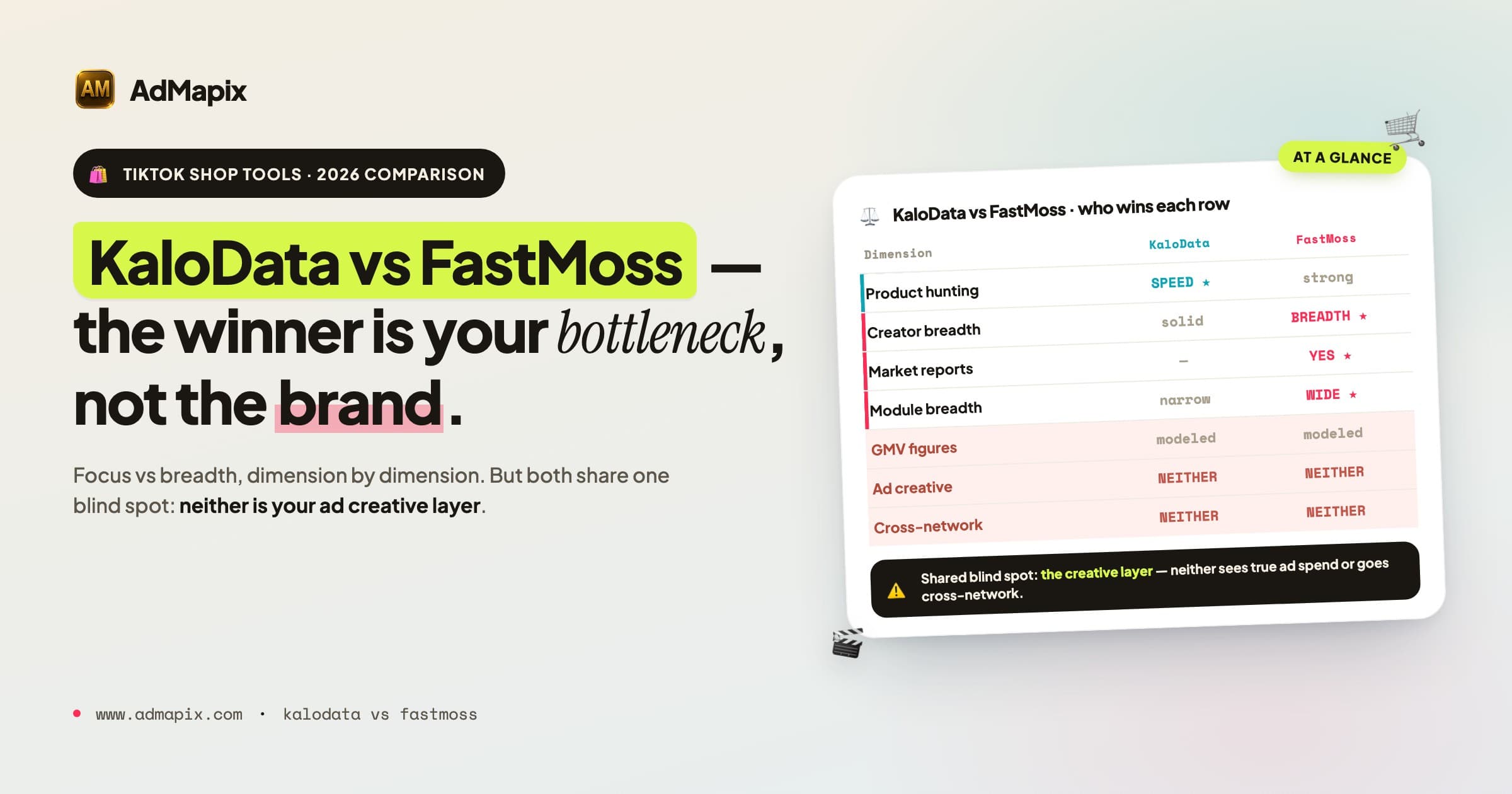
KaloData vs FastMoss in 2026: Which TikTok Shop Tool Is Better? (Full Comparison)
A decision-first KaloData vs FastMoss comparison for 2026: GMV estimation, creator data, market coverage, pricing, shared blind spots, who each tool fits, and where cross-network ad intelligence like AdMapix fills the gap.
AppTweak Alternative: How to Choose Between an ASO Platform and Ad Creative Intelligence in 2026
A decision-first guide to picking an AppTweak alternative. Separate ASO, keyword, and Apple Search Ads work from competitor ad creative and video intelligence, with comparison tables, a buying framework, and an honest map of what public ad data can prove.