
Whiteout Survival Ad Strategy 2026: Two Evergreen Playables and a Video Factory
Whiteout Survival's US Top 10 combines two billion-impression playables with one 85-second video reused across seven ad entries. This teardown explains the two-speed system and the fresh video batch that appeared on August 14.

Whiteout Survival Ad Strategy 2026: Two Evergreen Playables and a Video Factory
Whiteout Survival does not choose between an evergreen winner and a high-output creative pipeline. It runs both. In the AdMapix US index, the game's two largest playable entries account for an estimated 2.85 billion impressions, while one 85-second video asset appears under seven separate ad entries. On August 14, 2026, a new group of short and mid-length videos also surfaced within a four-hour window.
The result is a two-speed system: interactive assets carry memory and scale for hundreds of days; video production keeps generating new entry points. This teardown is for mobile-game UA and creative teams deciding how to balance durable formats with continuous testing.
Quick Answer
- Whiteout Survival's US Top 10 contained an estimated 3.90 billion impressions in the August 14 AdMapix snapshot.
- Two playable entries contributed 73.1% of that total and remained observable after 389 and 486 indexed days.
- A single 85-second video fingerprint was reused across seven entries and contributed another estimated 953.4 million impressions.
- The durable core is concentrated, but the production edge is active: ten newly observed entries appeared on August 14, mostly videos.
- These are third-party model estimates and index observations, not Century Games' official spend or platform-reported delivery.
How We Measured the Fleet
We searched Whiteout Survival creatives associated with the US market, using the one-year window ending August 14, 2026, and sorted the result by AdMapix model-estimated impressions. We analyzed the first ten entries, then ran a second search sorted by first-observed time to inspect the newest cohort.
Three rules keep the interpretation honest:
- An ad entry is not always a unique asset. We group repeated
videoFpandplayHtmlFpfingerprints before describing production volume. - First and last observed timestamps describe the public index, not the advertiser's internal campaign calendar.
- Estimated impressions help compare entries inside this snapshot; they are not official billing data and do not prove ROAS.
The Top 10 in One Table
| Rank | Format | Indexed days | Est. impressions | Share of Top 10 | Last observed |
|---|---|---|---|---|---|
| 1 | Playable A | 389 | 1.481B | 38.0% | Aug 14, 2026 |
| 2 | Playable B | 486 | 1.370B | 35.1% | Aug 14, 2026 |
| 3 | 85s video | 339 | 746.2M | 19.1% | Jul 9, 2026 |
| 4 | Playable C | 422 | 95.7M | 2.5% | Oct 24, 2025 |
| 5–10 | Same 85s video | 267–368 | 207.1M combined | 5.3% | Jul 7–8, 2026 |
The first surprise is concentration: two interactive assets own nearly three quarters of the visible Top 10. The second is deduplication. Rows 3 and 5–10 look like seven creatives in an entry-level export, but their video fingerprint is identical. They are seven wrappers around one underlying asset.
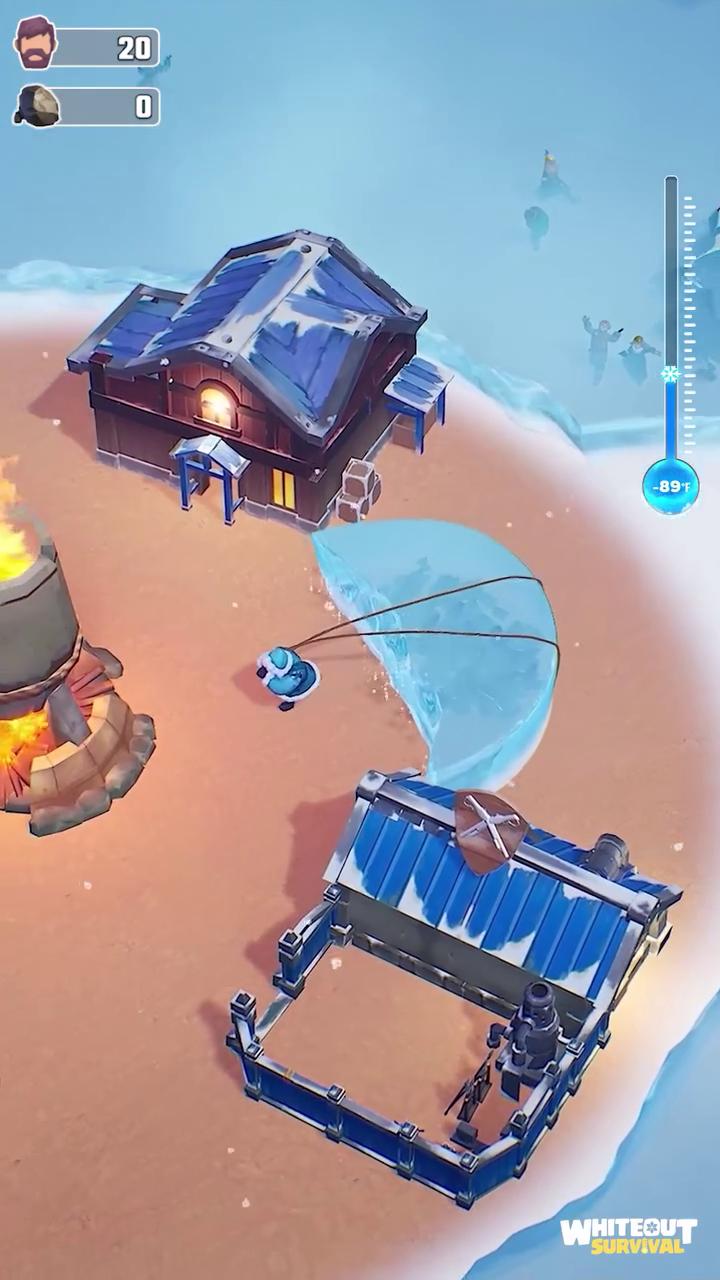 One 85-second video fingerprint appears under seven Top-10 entries. Counting entries as assets would overstate production sevenfold.
The Evergreen Core: Two Playables, 2.85 Billion Impressions
Whiteout Survival's two leading playable entries were first observed on April 5 and July 22, 2025. Both were still observable on August 14, 2026. Their indexed lifespans—486 and 389 days—place them far beyond the launch-batch behavior seen in Smash Fest!, where playable cohorts were replaced on a much shorter clock.
The operational lesson is not simply “playables last longer.” A format does not guarantee lifespan. These two assets survived because the advertiser kept them in service and because their mechanics could continue qualifying users before install. A durable playable can do three jobs at once: demonstrate the loop, filter for interaction intent, and carry a familiar concept across campaign generations.
Their concentration also creates risk. If two assets represent 73.1% of the Top-10 estimate, a platform-policy change, technical compatibility problem, or audience saturation event could remove a large share of the visible engine at once. That helps explain the second speed of the system.
The Video Layer: One Asset, Seven Wrappers
The 85-second video produced an estimated 953.4 million impressions across seven separate entries. Each entry can carry a different campaign document, delivery context, or targeting wrapper even when the underlying video remains unchanged.
This is why creative intelligence needs fingerprints, not screenshots. A screenshot board would show seven cards and imply a broad portfolio. Fingerprint grouping shows one proven long-form asset being redeployed repeatedly.
The tactic has clear advantages:
- It preserves a validated narrative while changing campaign packaging.
- It separates media-buying experiments from production experiments.
- It lets the advertiser relaunch or redistribute an asset without editing the master video.
- It creates more delivery surfaces while keeping the creative message stable.
But it also limits learning. Seven wrappers around one video can test placement and campaign structure; they cannot reveal whether seven different narratives would outperform it.
August 14: The Factory Speed Becomes Visible
The newest-first search found ten entries first observed on August 14 between 02:23 and 06:13 UTC. Most were videos, with durations concentrated around 54–64 seconds; the early records carried too little delivery to call any of them winners.
That distinction matters. A fresh entry is evidence of production and trafficking, not performance. The correct follow-up is to re-run the cohort before publication and measure which fingerprints continue accumulating observations, which disappear, and whether several entries share the same underlying asset.
If the cohort persists, it will show Whiteout Survival running a classic barbell:
- Durable core: a small number of interactive assets retained for hundreds of days.
- Exploration edge: regular video batches searching for the next scalable narrative.
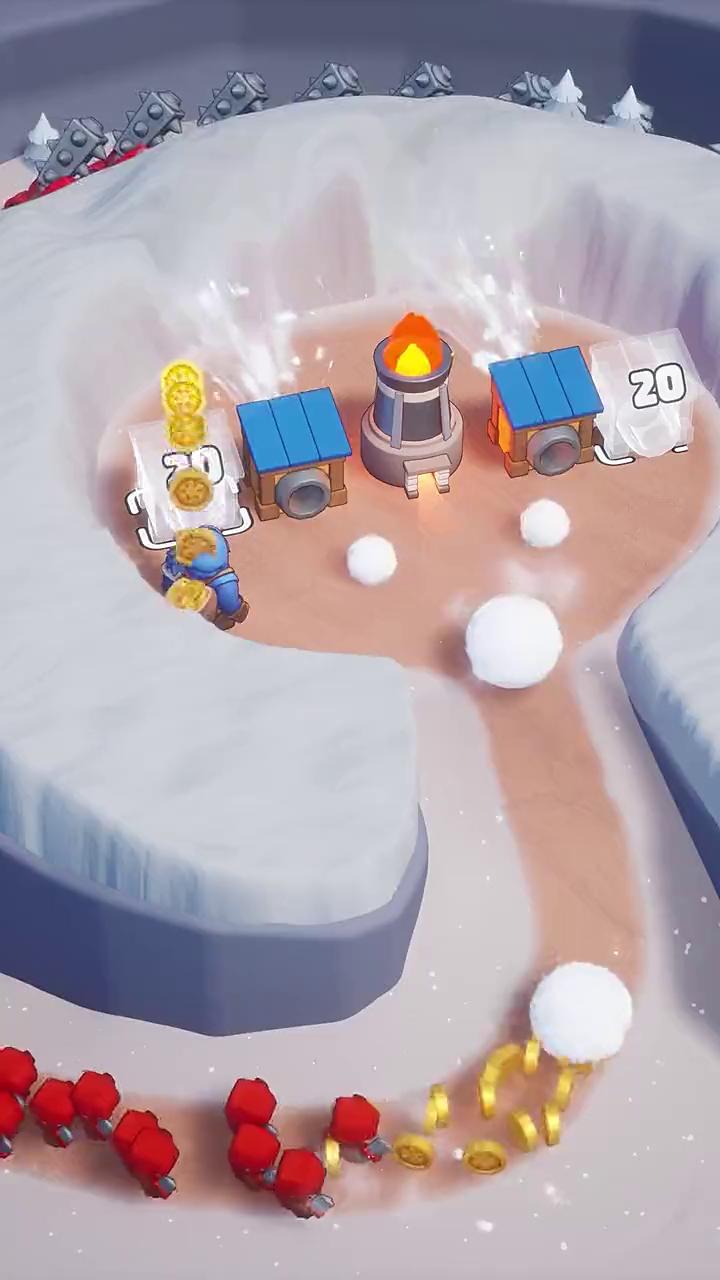 A newly observed 55-second entry from the August 14 cohort. Initial observations are a production signal, not proof of performance.
What Mobile Game Teams Can Copy
The useful pattern is portfolio design, not the literal Whiteout Survival assets.
| Layer | Objective | What to measure | Kill condition |
|---|---|---|---|
| Evergreen core | Preserve proven acquisition mechanics | Lifespan, delivery continuity, qualified install rate | Technical decay or sustained efficiency loss |
| Campaign wrappers | Test delivery without rebuilding creative | Placement mix, audience, geography, campaign objective | No incremental reach or learning |
| Exploration edge | Discover new hooks and narratives | Early retention, CTR, CVR, creative-level CPI | Fails pre-committed threshold |
Do not force the two layers onto the same clock. An evergreen playable should not be retired because a weekly production calendar says it is old. A new video should not be promoted because it is fresh. Grade each layer by its job.
Common Misreads
- “Ten entries means ten assets.” Whiteout Survival's Top 10 reduces to four unique underlying fingerprints: three playables and one video.
- “The biggest estimate proves the best ROAS.” Delivery scale is visible; profitability is not.
- “A 486-day playable never changed.” The index fingerprints the asset, not every campaign setting around it.
- “New on August 14 means launched globally that day.” It means first observed in the queried index scope.
- “Video lost to playable.” The portfolio uses the formats for different jobs; the data does not provide a controlled causal test.
FAQ
What is Whiteout Survival's main ad format?
Its US Top 10 by estimated impressions is led by playables, but the broader operating model includes a high-output video layer. The most accurate description is not “playable-only”; it is an evergreen interactive core plus ongoing video exploration.
How many unique assets are in the Top 10?
Four unique fingerprints appear in this snapshot: three playable fingerprints and one video fingerprint. The video is repeated across seven entries.
Does AdMapix show Whiteout Survival's official spend?
No. AdMapix provides third-party model estimates and public index observations. They are useful for relative creative research, not for claiming official spend, revenue, or ROAS.
Should every mobile game build a playable?
No. A playable is useful when a short interaction can represent the product loop and qualify intent. Games whose value depends on story, collection, or long progression may need video to communicate context before interaction.
Key Takeaways
- Whiteout Survival combines concentration and production rather than choosing one.
- Two playable entries dominate the visible scale, while one long-form video is redeployed across seven wrappers.
- Asset fingerprints prevent a sevenfold overcount of video production.
- The August 14 cohort should be judged later; it currently proves activity, not success.
- The transferable lesson is to separate evergreen, wrapper-testing, and exploration layers.
Sources and Data Notes
- AdMapix creative index, Whiteout Survival, US market, one-year window ending August 14, 2026; Top 10 sorted by model-estimated impressions.
- AdMapix newest-first creative search, Whiteout Survival, US market, July 15–August 14, 2026.
- Related methodology: Ad Strategy Teardowns series.
All figures are third-party model estimates for research reference only. Re-pull the data before publication because active creative fleets change daily.
Continue researching Whiteout Survival
Find matching apps, verify the developer and store, then inspect recent creatives.
Related Articles
Royal Kingdom Ad Strategy 2026: One Long Video, Three Playable End Cards
Royal Kingdom's US Top 10 pairs long-form video with playable end cards. One 117-second video fingerprint appears with three playable variants and carries 61.9% of the visible Top-10 scale.
82-0.com Ad Strategy 2026: The Smallest Measurable Ad Fleet on the US Top 120, Eight Videos, and a Perfect 5×5 Copy Matrix
Vaulty Studios' 82-0.com sits at US download rank 117 with 704,287 downloads and +5.48% growth — the only riser in this batch — on a measured lifetime impression total of 12,216,712. Its top 15 US creatives carry 1,011,728 impressions across 375 placements in the 30 days to 2026-08-19. Behind 552 recorded creatives sit exactly eight source videos and a fully-filled 5×5 headline-by-body copy matrix. Not one playable exists anywhere in the fleet.
Arrows – Puzzle Escape Ad Strategy 2026: Downloads Fell 34.65% and One 214-Day Playable Is Carrying the Account
A creative-level teardown of Lessmore GmbH's US user acquisition for Arrows – Puzzle Escape during a 34.65% download decline. Fifteen measurable creatives account for 295,780,992 impressions in a rolling 30-day window, all fifteen were still live on 2026-08-19, and production has been stopped for 64 days. One playable first seen 2026-01-17 carries 49.5% of current delivery on its own, and a 345-day asset still out-delivers most of the fleet.