
Ad Analytics vs Ad Intelligence: Metrics, Workflows, and Tools
Learn what ad analytics means, which metrics matter, how it differs from ad intelligence, and how growth teams combine both workflows.
Ad analytics measures your campaigns; ad intelligence explains the market context around them.
By the AdMapix Research Desk - Updated April 16, 2026
Ad analytics is the practice of measuring paid campaign performance so a team can understand what happened, why it happened, and what to change next. It covers metrics such as spend, impressions, clicks, CTR, conversions, CPA, ROAS, LTV, incrementality, and campaign pacing.
Ad intelligence is different. It looks outward at competitor ads, creative patterns, search results, landing pages, offers, platform libraries, and market signals. A strong growth team uses both: ad intelligence to create smarter hypotheses, and ad analytics to validate whether those hypotheses work in your own account.
If you need the category definition first, read our advertising intelligence guide. If you are comparing tools, use our ad intelligence tools guide. This page focuses on ad analytics, ad analysis, advertising analysis, and the operating model that connects first-party performance data with external intelligence.
What Ad Analytics Means
Ad analytics answers internal performance questions:
| Question | Ad analytics output |
|---|---|
| How much did we spend? | Spend, pacing, budget burn, forecast variance |
| Did users engage? | Impressions, reach, clicks, CTR, video views, engagement rate |
| Did users convert? | Leads, purchases, trials, app installs, CVR, CPA |
| Was the spend efficient? | ROAS, CAC, payback, LTV:CAC, margin-adjusted return |
| Which segment performed best? | Campaign, ad group, keyword, creative, audience, placement, geo, device |
| What should change next? | Budget shift, creative test, bid change, landing-page fix, offer test |
At its best, ad analytics is not a dashboard full of numbers. It is a decision system. Every metric should connect to a business decision.
Ad Analytics Vs Ad Intelligence
The terms are often mixed together, but they answer different questions.
| Area | Ad analytics | Ad intelligence |
|---|---|---|
| Primary view | Your own account performance | Market and competitor activity |
| Main question | What happened in our campaigns? | What is happening around us? |
| Data source | Platform data, analytics events, CRM, attribution, revenue data | Public ads, ad libraries, SERPs, competitor landing pages, creative patterns |
| Typical metrics | Spend, CTR, CVR, CPA, ROAS, LTV, incrementality | Creative volume, message repetition, channel mix, offer changes, competitor visibility |
| Best use | Optimization, reporting, budget allocation, diagnosis | Hypothesis generation, competitor monitoring, creative strategy, positioning |
| Risk | Optimizing only past data and missing market shifts | Copying competitors without validating performance |
The two workflows should not compete. They should form a loop:
- Use ad intelligence to see what competitors and the market are testing.
- Turn those observations into original campaign hypotheses.
- Use ad analytics to validate whether your own tests work.
- Feed the result back into the next intelligence review.
For example, competitor research may show that several brands are pushing "free audit" messaging. Ad analytics may show that your own audit landing page converts poorly. The right move is not "copy the competitors." The right move is to test whether the audit offer works after improving message match, proof, and lead quality controls.
Core Ad Analytics Metrics
Useful ad analysis starts with the right metric layer.
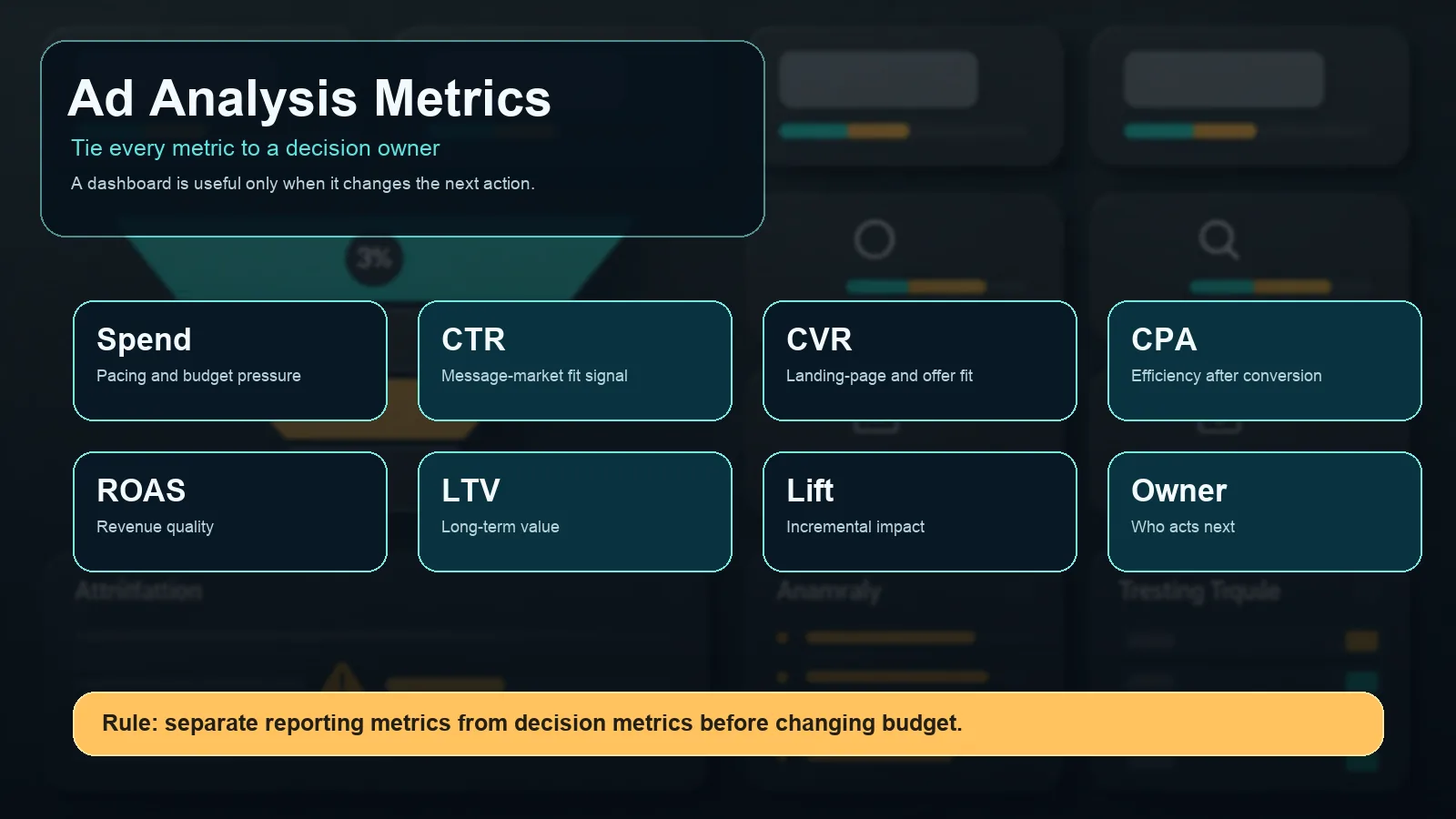
A useful ad analysis dashboard ties every metric to a decision owner and next action.
| Metric | What it tells you | Common misuse |
|---|---|---|
| Spend | Budget consumed and pacing | Treating high spend as success |
| Impressions | Exposure and available reach | Ignoring whether the audience was qualified |
| Clicks | Traffic volume | Optimizing clicks when conversion quality is weak |
| CTR | Message-market fit at the ad level | Comparing CTR across channels without context |
| CPC | Cost of traffic | Reducing CPC while hurting lead quality |
| CVR | Landing page and offer fit | Ignoring attribution window and conversion lag |
| CPA | Cost per conversion | Treating every conversion as equal |
| ROAS | Revenue return on ad spend | Ignoring margin, refunds, and payback timing |
| LTV | Long-term customer value | Using optimistic LTV to justify bad acquisition |
| Incrementality | Whether ads caused outcomes that would not have happened anyway | Assuming platform attribution equals incremental impact |
Google's own conversion measurement documentation emphasizes connecting ads to conversions and business outcomes, not only clicks. Google Analytics also provides advertising reporting surfaces for connecting paid traffic to downstream behavior. Those are useful starting points, but every business still needs its own quality checks.
Channel-Specific Ad Analysis
Different channels need different analysis habits.
Search Ads
Search analysis starts with intent.
| Metric | What to inspect |
|---|---|
| Impression share | Are you losing visibility because of budget, rank, or competition? |
| Search terms | Are paid queries matching the intent you expected? |
| CTR by query group | Is the ad message aligned with commercial intent? |
| CVR by landing page | Does the page prove the promise made in the ad? |
| CPA by keyword | Are expensive terms producing qualified conversions? |
Pair search ad analytics with search ads intelligence. Internal data tells you which keywords work for you. External search intelligence tells you which competitors and messages are visible around those keywords.
Paid Social
Paid social analysis starts with creative and audience fatigue.
| Metric | What to inspect |
|---|---|
| Hook-level CTR | Which opening idea earns attention? |
| Thumb-stop or view rate | Does the creative hold attention long enough? |
| Frequency | Are users seeing the same ad too often? |
| CVR by creative concept | Which message translates into action? |
| CPA by audience and creative | Is a creative working broadly or only in one segment? |
Social ad analytics without creative intelligence can become circular. You see a winner, refresh it until performance drops, and then guess. Competitor creative intelligence helps expand the idea space before fatigue hits.
Display, YouTube, And Programmatic
Upper-funnel channels need more discipline because last-click conversion data can understate value or overstate waste.
Track:
| Area | Useful check |
|---|---|
| Reach quality | Are placements or audiences relevant? |
| Viewability and completion | Did users actually have a chance to see the message? |
| Assisted conversions | Does exposure support downstream search, direct, or branded demand? |
| Incrementality | Does spend create outcomes beyond what would have happened anyway? |
| Creative sequencing | Does the message progress logically across funnel stages? |
The key is to define the decision before reading the dashboard. Are you deciding whether to cut spend, refresh creative, change placement exclusions, or run a lift test?
How Ad Intelligence Data Improves Ad Analytics
Ad intelligence data improves analytics by giving context to performance changes.
| Analytics symptom | Intelligence question |
|---|---|
| CTR dropped | Did competitors change offers or dominate the SERP? |
| CPA rose | Did auction pressure increase, or did the landing page lose message match? |
| ROAS declined | Did competitors introduce discounts or bundles? |
| Creative fatigue increased | Are competitors refreshing hooks faster? |
| Brand CPC rose | Are competitors bidding on brand terms? |
| Conversion quality fell | Did the campaign start attracting a different intent segment? |
Without market context, teams often overfit internal data. They pause campaigns too early, copy last month's winner, or blame the wrong metric. External intelligence does not replace analytics. It helps explain what to test next.
Tool Categories
Ad analysis tools fall into several categories.
| Tool category | Best use | Limitation |
|---|---|---|
| Platform dashboards | Native metrics, delivery, conversion reporting | Channel-specific and often attribution-biased |
| Analytics platforms | Site/app behavior, user journeys, paid traffic performance | Requires clean tagging and event governance |
| BI dashboards | Cross-channel reporting and finance alignment | Can become slow and overbuilt |
| Attribution tools | Multi-touch, incrementality, media mix, lift testing | Methodology can be complex and assumptions-heavy |
| Ad intelligence tools | Competitor ads, creative patterns, landing pages, market signals | External data must be interpreted before action |
| Reporting workflows | Executive summaries, action briefs, weekly decision logs | Only useful if tied to owners and decisions |
Use the category that matches the decision. If the question is "Which ad set should we pause?", use platform and analytics data. If the question is "Why are competitors suddenly outranking us?", use ad intelligence. If the question is "What should leadership know?", use a reporting workflow that combines both.
For paid search competitor context, Semrush Advertising Research is one example of a tool category that can support advertising analysis with keyword, domain, and ad copy context. Treat that data as external context, not a replacement for your own ad analytics.
AdMapix is built for the intelligence and reporting side: competitor ad research, pattern analysis, and report-ready outputs. Use AdMapix reports when your analytics dashboard shows what happened but your team needs market context for what to test next. Review pricing if you need recurring monitoring.
Common Ad Analysis Mistakes
Avoid these mistakes:
| Mistake | Why it creates bad decisions |
|---|---|
| Optimizing only CTR | High CTR can still produce low-quality traffic. |
| Treating CPA as the whole truth | CPA ignores revenue quality, refunds, retention, and payback. |
| Mixing channels without context | Search, social, display, and video do not respond to the same metrics. |
| Ignoring conversion lag | Some campaigns look weak before conversions mature. |
| Trusting platform attribution blindly | Platform-reported conversions may not equal incremental outcomes. |
| Looking only at your account | Market changes can explain performance shifts. |
| Copying competitors from intelligence tools | Competitor ads are hypotheses, not proof. |
The fix is to separate reporting metrics from decision metrics. A reporting metric tells you what happened. A decision metric tells you what to change.
Practical Operating Model
Use a weekly operating model:
| Step | Output |
|---|---|
| 1. Read campaign analytics | Performance summary by channel, objective, and owner |
| 2. Identify anomalies | Spend, CTR, CVR, CPA, ROAS, or quality movement |
| 3. Check market context | Competitor ads, search visibility, offers, landing pages |
| 4. Write hypotheses | What could explain the movement? |
| 5. Prioritize tests | Copy, creative, landing page, bid, audience, offer, or budget action |
| 6. Assign owner | One person owns the next action |
| 7. Review result | Analytics validates or rejects the hypothesis |
Keep the final output short:
| Section | Example |
|---|---|
| What changed | CPA increased 18% on comparison queries. |
| Evidence | Search visibility dropped; two competitors launched comparison pages. |
| Hypothesis | Our page proof is weaker for high-intent comparison traffic. |
| Action | Test comparison landing page and stronger sitelinks. |
| Owner | PPC lead + landing-page owner. |
| Review date | Next weekly growth review. |
This format is more useful than a 30-page dashboard export.
FAQ
What is ad analytics?
Ad analytics is the measurement and analysis of paid advertising performance using metrics such as spend, impressions, clicks, CTR, conversions, CPA, ROAS, LTV, incrementality, and campaign pacing.
What is the difference between ad analytics and ad intelligence?
Ad analytics focuses on your own campaign performance. Ad intelligence focuses on external market and competitor signals such as public ads, landing pages, search results, creative patterns, and offers. Strong teams use both.
Which ad analytics metrics matter most?
The most important metrics depend on the decision. Spend, CTR, CVR, CPA, ROAS, LTV, and incrementality are common, but every metric should be tied to an owner and next action.
What are ad analysis tools?
Ad analysis tools include platform dashboards, analytics tools, BI dashboards, attribution tools, ad intelligence platforms, and reporting workflows. The right tool depends on whether you need optimization, diagnosis, market context, or executive reporting.
How do you analyze advertising performance?
Start with the campaign objective, segment metrics by channel and intent, identify anomalies, check conversion quality, review landing-page fit, compare market context, write hypotheses, and turn the analysis into a measurable test.
How can competitor ad intelligence improve ad analytics?
Competitor ad intelligence helps explain performance changes by showing market movement: new offers, changing ad messages, increased search visibility, creative refreshes, and landing-page changes. It gives analytics teams better hypotheses to test.
Conclusion
Ad analytics and ad intelligence are strongest when they work together. Analytics tells you what happened inside your account. Intelligence helps explain what the market is doing around you. The combination creates better hypotheses, better tests, and better budget decisions.
If your team already has dashboards but still struggles to decide what to test next, use AdMapix reports to add competitor context to your analytics workflow.
Turn these observations into your next creative study
Open the creative library and select samples for your market, network and research question.
Related Articles
Ad Spend Monitoring: Track Your Own Pacing and Competitor Budget Signals
How to monitor ad spend on both sides: a pacing, alert and weekly-check routine for your own accounts, then a signal model, estimation scorecard and dashboard for competitor budget movement without pretending public data shows exact spend.
Search Ads Intelligence: Find Competitor Google Ads, Keywords & Landing Pages
Learn how to find competitor Google Ads, map keyword themes, inspect landing pages, compare ad copy and CTAs, and turn PPC search intelligence into campaign tests.
Advertising Intelligence: What It Is and How Growth Teams Use It
A practical 2026 guide to advertising intelligence, including data sources, competitor ad workflows, use cases, quality checks, and how growth teams turn signals into decisions.