
Data.ai Alternative for App Growth and Ad Creative Research
Data.ai alternative guide for app growth teams comparing app intelligence tools, ad creative research workflows, and user acquisition planning.

Data.ai Alternative for App Growth and Ad Creative Research
By the AdMapix Research Desk · Updated June 19, 2026
Data.ai, formerly App Annie, is one of the best-known names in mobile app intelligence. Teams use it to understand app categories, downloads, revenue estimates, rankings, market movement, publisher performance, and competitor app trends.
The search for a data.ai alternative usually starts when that broad market intelligence is not the whole job. A user acquisition team may not only need to know which apps are growing. It also needs to know which ads those apps are running, which hooks are repeated, which landing or store pages support the campaign, and what to test next.
That distinction matters even more now. Sensor Tower officially announced that data.ai joined Sensor Tower, combining data.ai's App Annie history with Sensor Tower's broader digital and mobile intelligence stack. So the current question is rarely "Is data.ai still useful?" It is more practical: do you need enterprise app intelligence, faster ad creative research, or both?
This guide compares data.ai, data.ai competitors, app intelligence tools, and AdMapix as a focused workflow for app user acquisition research. If you want the broader platform comparison first, read the Sensor Tower alternative guide.
Quick Answer
- A data.ai alternative search is usually a workflow split: you still want app market data, but you also need to see the actual competitor ads behind the rankings.
- data.ai (now part of Sensor Tower) is strong for downloads, revenue estimates, rankings, and category sizing - keep it for market and executive questions.
- Add an ad intelligence workflow like AdMapix when the weekly job is competitor creatives, hooks, landing pages, and the next UA test.
- App market metrics tell you which app is winning; they don't show the creatives doing the winning - that gap is what an ad-creative workflow fills.
What Data.ai Is Used For Now
Data.ai built its reputation as App Annie, a source for mobile market data and app store intelligence. After the Sensor Tower acquisition, the data.ai question sits inside a larger Sensor Tower ecosystem.
For buyers, that means data.ai is not just a standalone app analytics name. It is part of a broader market intelligence stack that can support app performance research, category analysis, competitive benchmarking, investor research, gaming market reads, and digital advertising intelligence.
App growth teams usually evaluate data.ai for questions like these:
| Question | Why it matters |
|---|---|
| Which apps are growing in my category? | Helps define category momentum and competitor priority |
| Which publishers dominate downloads or revenue? | Helps benchmark realistic growth expectations |
| Which markets are shifting? | Supports localization, market expansion, and launch timing |
| Which rankings or categories matter? | Helps ASO, competitive tracking, and board reporting |
| Which competitors are worth watching? | Turns a large market into a focused watchlist |
Those are important questions. But they are not the same as creative questions.
A UA lead also needs to ask:
| Creative question | Why app intelligence alone may not answer it |
|---|---|
| Which hook is the competitor using this week? | Market rankings do not show the message angle |
| Which ad format is repeated? | Downloads do not reveal video, search, display, or playable patterns |
| Which landing page supports the ad? | App market data often stops before the click path |
| Which idea should our team test next? | Insight must become a creative brief |
| Did the campaign change recently? | Weekly motion matters more than a static dashboard |
This is why many searches for "data.ai competitors" are really searches for a workflow split. The team may still value app intelligence tools, but it also needs ad intelligence.
App Intelligence vs Ad Intelligence
The biggest mistake in choosing a data.ai alternative is comparing tools only by brand awareness. Start with the job.
| Job | Best fit |
|---|---|
| Estimate app downloads, revenue, usage, and category movement | App intelligence tools |
| Benchmark publishers, markets, app rankings, and game categories | App intelligence tools |
| Track competitor ads, messaging, hooks, formats, and landing pages | Ad intelligence tools |
| Build a weekly creative testing backlog | Ad creative research workflow |
| Support investor, strategy, or enterprise market reports | Broad market intelligence platform |
| Support UA execution and creative iteration | Focused ad intelligence workflow |
Sensor Tower's Ad Intelligence page describes paid user acquisition strategy, competitor channel strategies, top-performing creatives, audience behavior, and creative implementation. That shows why the category boundary is not always clean. Enterprise platforms can cover both market and ad intelligence, but the operating experience can still be different.
For example, an executive strategy team might want a quarterly view of app market share. A UA manager might need a Monday morning brief that says:
| This week's finding | What the team should do |
|---|---|
| Three competitors shifted from feature-led copy to outcome-led hooks | Test two outcome-led first lines |
| A top app is using short video with app store proof | Build a proof-first variant for Meta and TikTok |
| Search ads emphasize category terms instead of competitor names | Add category landing page tests |
| Landing pages repeat pricing or trial language | Test offer clarity before changing bid strategy |
The first use case is intelligence. The second is execution. A good data.ai alternative article must separate them.
When Data.ai or Sensor Tower Is Still the Better Fit
Data.ai and Sensor Tower remain strong fits when the team needs broad market confidence.
Choose data.ai or Sensor Tower-style app intelligence when:
| Signal | Why it points to app intelligence |
|---|---|
| You need download and revenue estimates across many apps | This is a core app market intelligence job |
| Leadership asks for category sizing | Broad benchmarks are more useful than ad screenshots |
| You operate across many geographies | Regional app and market coverage matters |
| You need investor, corporate strategy, or M&A context | Market data is the decision foundation |
| You need one vendor for multiple intelligence modules | Enterprise coverage can simplify procurement |
| Your team has analysts who can translate data into actions | Bigger platforms reward dedicated research time |
In those cases, do not replace app intelligence with a lightweight ad spy tool. You will lose the market layer that helps explain why a competitor matters.
The right question is whether your team has a second workflow for creative execution. If the answer is no, data.ai may explain the market but still leave the UA team manually collecting ads, screenshots, and landing-page examples.
When a Focused Data.ai Alternative Makes More Sense
A focused data.ai alternative makes sense when the weekly output is not a market report. It is a creative decision.
Look for a focused ad intelligence workflow when:
| Signal | What it means |
|---|---|
| Your team asks "what should we test next?" more than "how big is the category?" | The bottleneck is creative learning |
| Competitor ads matter more than app store ranks | You need message and format visibility |
| The landing page or store page changes the interpretation | You need the full click path |
| You publish weekly competitor updates | The workflow needs speed and narrative |
| You are a small app team without a research department | Lightweight action beats heavy dashboards |
| Paid UA costs are rising | Better creative research can reduce wasted tests |
For this use case, AdMapix is not trying to be a full data.ai replacement. It is a practical layer for competitor ad research, creative teardown, landing-page context, and report-driven app user acquisition planning.
See the broader ad spy tools by channel guide if your team is still deciding whether it needs search, social, native, video, or mobile ad coverage first.
Want the ads behind the rankings? An AdMapix search returns a competitor app's active creatives - image, video, and playable - with the app, format, and first-seen date attached, ready for a UA brief.
Data.ai Competitors and Alternatives by Use Case
The best data.ai competitors depend on the question you are answering. Use this table before comparing feature lists.
| Use case | What to compare |
|---|---|
| App market intelligence | Sensor Tower/data.ai, AppTweak, MobileAction, Appfigures, Similarweb app intelligence, ASO suites |
| Enterprise digital intelligence | Sensor Tower, Similarweb, MediaRadar, market and audience intelligence platforms |
| Ad creative intelligence | AdMapix, Sensor Tower Ad Intelligence, ad libraries, channel-specific spy tools |
| ASO and keyword research | AppTweak, MobileAction, App Radar, Appfigures, store console data |
| Lightweight UA research | AdMapix reports, public ad libraries, Google Ads Transparency Center, Meta Ads Library, TikTok Creative Center |
| Agency reporting | A mix of app intelligence, ad intelligence, and internal client reporting templates |
Here is the practical buying logic:
| If your team needs... | Start with... |
|---|---|
| Market size, download estimates, revenue estimates | App intelligence tools |
| Creative examples and competitor messaging | Ad intelligence tools |
| ASO keyword opportunity | ASO-specific tools |
| Paid UA campaign ideas | Ad creative research and landing-page review |
| Executive market reporting | Enterprise app or digital intelligence |
| Weekly creative testing inputs | AdMapix-style reports and swipe-file workflows |
This also explains why "app annie alternative" searches can be misleading. Some searchers want the old App Annie market data job. Others want something faster and more tactical because their current growth problem is not category sizing.
A Practical App User Acquisition Workflow
An app user acquisition team can use app intelligence and ad intelligence together. The workflow should move from market signal to creative action.
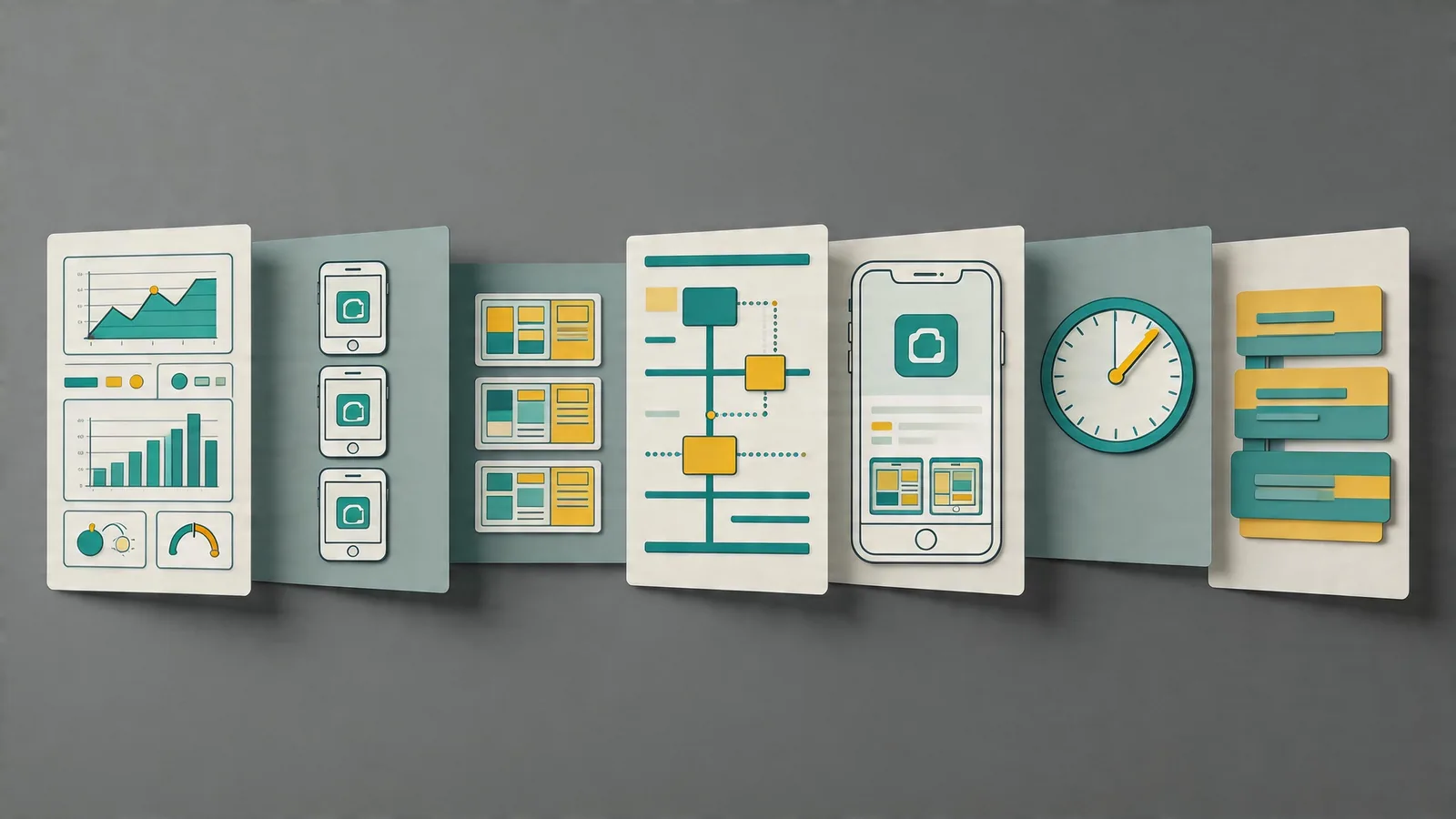
A practical app growth workflow connects market signals to competitor creatives, store context, and the next UA test brief.
Use this six-step process:
| Step | Output |
|---|---|
| 1. Build the competitor watchlist | 10 to 30 apps based on category, audience, monetization, and growth pattern |
| 2. Rank competitors by relevance | Separate market leaders, fast movers, direct substitutes, and creative references |
| 3. Capture active ads | Save search, social, native, video, and mobile examples where relevant |
| 4. Add landing or store context | Record the destination page, app store promise, offer, and conversion path |
| 5. Score creative patterns | Tag hook, visual format, proof, CTA, offer, claim, and audience angle |
| 6. Convert findings into tests | Write a brief for the next creative, copy, offer, or landing-page experiment |
This workflow is useful even if your team owns a broad app intelligence subscription. The subscription tells you which competitors matter. The ad intelligence workflow tells you what they are doing in market.
For every competitor ad, capture this:
| Field | Example |
|---|---|
| Competitor | App name, publisher, country, category |
| Channel | Google, YouTube, Meta, TikTok, native, app network |
| Hook | Problem, promise, comparison, social proof, urgency, feature, outcome |
| Visual proof | Product UI, testimonial, gameplay, dashboard, offer, creator face |
| Landing match | Strong, partial, weak, missing |
| Store match | App store screenshots and subtitle support the same promise or not |
| Risk | Claim too aggressive, copied idea, poor audience match, weak proof |
| Test idea | Original variant your team can produce |
That last row is the reason to do the work. Competitor research is not a screenshot folder. It should become a decision queue.
What a Ranking Won't Tell You About the Creative
App rankings tell you who is winning; they don't tell you what the winning ads look like. Disclosure: AdMapix is our product, and this is a first-party query against our own index, not a market estimate.
In June 2026, an AdMapix search for shopping app returned creatives indexed the same day we ran it. Of the top 20 results:
- 18 of 20 were static image and only 5 were video, with no playable demos - the opposite of the video-heavy mix you see in games.
- Taobao dominated the set, running the same hero creative as several near-identical variants.
- Each result carried its app, developer, and first-seen date.
That single format split - shopping apps leaning on static image, games leaning on video and playables - is a creative-strategy signal a downloads chart can't show. data.ai tells you the shopping category is growing; AdMapix tells you what its ads actually look like this week, which is what a UA team briefs against. Run the same shopping app search to reproduce it.
Data.ai vs AdMapix
Use this comparison to avoid buying the wrong category.
| Need | data.ai / Sensor Tower fit | AdMapix fit |
|---|---|---|
| App downloads and revenue estimates | Strong fit | Not the primary job |
| App category and publisher benchmarking | Strong fit | Supports only through research context |
| Competitor ad examples | Depends on module and access | Core workflow |
| Landing-page and store-page context | May need manual review | Core workflow |
| Weekly creative report | Analyst-dependent | Designed for recurring reports |
| Next-test backlog | Needs interpretation | Direct output of the workflow |
| Small team speed | Can be heavy depending on setup | Lightweight and action-oriented |
| Enterprise procurement | Stronger fit | Better for faster tactical adoption |
AdMapix is a good data.ai alternative only if your job is ad creative research and app user acquisition planning. It is not the right replacement if you need a full market data platform for downloads, revenue, and large-scale app economy reporting.
The cleanest answer is often:
| Team stage | Suggested setup |
|---|---|
| Early app team | Public app store data, public ad libraries, AdMapix reports, internal test sheet |
| Scaling UA team | App intelligence for category context plus AdMapix for creative workflow |
| Enterprise portfolio | Sensor Tower/data.ai for market intelligence plus a dedicated ad research workflow |
| Agency | Market tool for strategy, AdMapix-style reports for client-facing execution |
Decision Checklist
Before choosing a data.ai alternative, answer these questions in order:
- Do we need market estimates or creative examples?
- Do we need quarterly strategy reports or weekly UA briefs?
- Do we care more about app rankings or current ad hooks?
- Do we need store keyword research or ad message research?
- Do we have analysts who can interpret a broad platform?
- Do we need a simple workflow that outputs next-test ideas?
- Will leadership judge the tool by dashboards or by campaign improvements?
If the answers point to category sizing, market estimates, and enterprise reporting, prioritize app intelligence tools. If the answers point to hooks, ads, landing pages, and test briefs, prioritize an ad intelligence workflow.
Common Mistakes
Mistake 1: Treating all data.ai competitors as the same category. App market intelligence, ASO keyword tools, ad spy tools, and media intelligence platforms solve different jobs.
Mistake 2: Replacing market data when the real problem is creative execution. If your team already knows the target competitors but cannot produce better ads, you need a creative workflow.
Mistake 3: Buying a broad platform without a reporting cadence. Large datasets create value only when someone turns them into decisions.
Mistake 4: Copying competitor ads directly. Use competitor research to understand patterns, not to duplicate protected creative.
Mistake 5: Ignoring the store or landing page. App user acquisition is not only the ad. The destination must support the promise.
FAQ
Is data.ai the same as App Annie?
Data.ai was the renamed brand of App Annie. In 2024, Sensor Tower announced that it acquired data.ai, so current evaluation should treat data.ai as part of the Sensor Tower ecosystem rather than only as the old App Annie product.
Was data.ai acquired by Sensor Tower?
Yes. Sensor Tower's official announcement says it acquired data.ai, formerly known as App Annie. For current product and pricing questions, check Sensor Tower's official pages or sales flow.
What is the best data.ai alternative for ad creative research?
If the job is ad creative research, competitor ad tracking, landing-page context, and weekly UA test planning, AdMapix is a focused option. If the job is app downloads, revenue estimates, and market sizing, compare broader app intelligence tools.
Do app user acquisition teams need both app intelligence and ad intelligence?
Often yes. App intelligence helps identify which competitors and markets matter. Ad intelligence helps understand which messages, creatives, offers, and landing pages those competitors are using.
Can AdMapix replace data.ai?
AdMapix can replace part of the workflow only when the need is competitor ad research and creative planning. It should not be positioned as a full replacement for data.ai or Sensor Tower if the team needs app market estimates, revenue data, rankings, or enterprise market intelligence.
What should small app teams use before buying enterprise app intelligence?
Start with public app store research, Meta Ads Library, Google Ads Transparency Center, TikTok Creative Center, and a structured report workflow. Add AdMapix if you need faster recurring competitor ad research. Add enterprise app intelligence when market estimates and portfolio-level reporting become necessary.
Key Takeaways
- A "data.ai alternative" is usually a workflow split, not a replacement - keep market data, add creative research.
- data.ai is now part of Sensor Tower; evaluate it inside that broader app and digital intelligence stack.
- Treat downloads, revenue, and rankings as market context, not creative direction.
- Ad-format mix varies sharply by category - shopping leans on static image, games lean on video and playables - a signal only creative-level data shows.
- For weekly competitor creatives, landing-page context, and next UA tests, an AdMapix-style workflow is the faster layer on top of app intelligence.
Conclusion
The right data.ai alternative depends on the decision you need to make. If you need app market size, download estimates, revenue benchmarks, rankings, and executive market reporting, stay close to app intelligence tools such as Sensor Tower/data.ai and related ASO platforms.
If your growth problem is different, use a different workflow. A UA team that needs better ad hooks, competitor creative examples, landing-page context, and next-test briefs should not evaluate tools only by market-data depth. It should evaluate how quickly the tool turns competitor movement into original tests.
Browse AdMapix reports if you want to build that weekly creative intelligence loop, or compare AdMapix pricing if your team needs a lighter workflow before committing to a larger enterprise intelligence stack.
Sources
- data.ai joins Sensor Tower and Sensor Tower Ad Intelligence - official positioning (accessed June 2026).
- First-party data: AdMapix creative index, "shopping app" query, June 2026. Format and freshness figures are reproducible by running the same search.
Turn these observations into your next creative study
Open the creative library and select samples for your market, network and research question.
Related Articles
MediaRadar Alternative for Competitive Ad Tracking
MediaRadar alternative guide for teams that need competitive ad tracking, creative analysis, and faster campaign monitoring workflows.
Adbeat Alternative: Native and Display Ad Intelligence Compared
Adbeat alternative guide for native and display ad research: compare data coverage, workflows, pricing, and creative analysis depth.
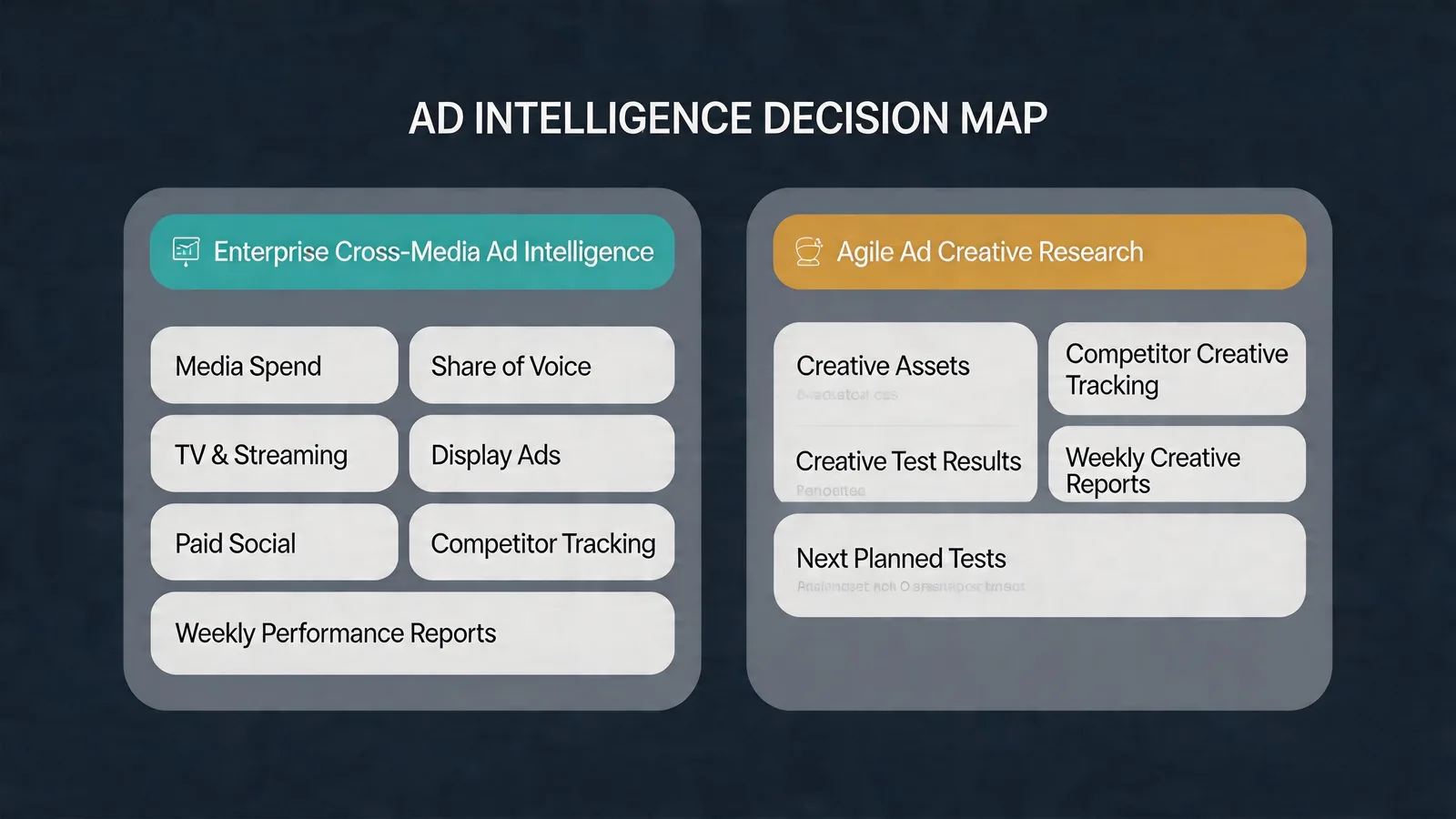
Vivvix Alternative: Ad Intelligence for Faster Creative Research
Compare Vivvix with faster ad intelligence workflows for growth teams, agencies, and app marketers that need creative examples and competitor tracking.