
Snapchat Ad Spy Tool in 2026: How to Research Competitor Snap Ads Without a Library
The 2026 guide to researching competitor Snapchat ads: why there's no commercial ad library, the four official Snap surfaces, what public data can and can't prove, reading vertical creative by format, a workflow, and turning Snap Ad patterns into testable briefs.
By the AdMapix Research Desk — Updated June 21, 2026
Snapchat Ad Spy Tool in 2026: How to Research Competitor Snap Ads Without a Library
Snapchat does not have a Meta-style commercial ad library, so a "Snapchat ad spy tool" is really a research workflow: you stitch together Snap's official format docs, public success stories, the political ads library, and any creative you observe in the app, then organize it into evidence you can act on. There's no "search any advertiser and see their live Snap Ads" surface — Snap's only transparency library is scoped to political and advocacy advertising. That single fact is why spying on Snapchat looks fundamentally different from spying on Meta, and why most teams hit a wall the moment they go looking for a library that doesn't exist.
This guide is for performance marketers, creative teams, mobile app advertisers, DTC brands, and agencies who need to study competitor Snap Ads but keep hitting that wall. It covers exactly which official Snap surfaces exist and what each can and can't prove, why Snapchat's vertical full-screen sound-on environment changes what you read, a workflow that respects Snap's limits, how to read each Snap Ad format, and how to convert vertical-video patterns into testable briefs. We'll be honest throughout: public Snap data proves format and creative structure, never spend, ROAS, or targeting for commercial advertisers.
The core principle, up front: on Snapchat, the visible signal is the creative — the hook, the format, the platform-native craft — and that's exactly the signal you can read without spend data. Treat what you can see as a creative hypothesis, never as proof a campaign worked, and let your own tests decide what converts.
For the broader cross-network method, see our mobile app ad spy tool guide and spy on ads across all platforms; for the social-video sibling, TikTok Shop ad spy tools; and for the full landscape, best ad spy tools 2026.
TL;DR — Researching Snapchat Ads in 2026
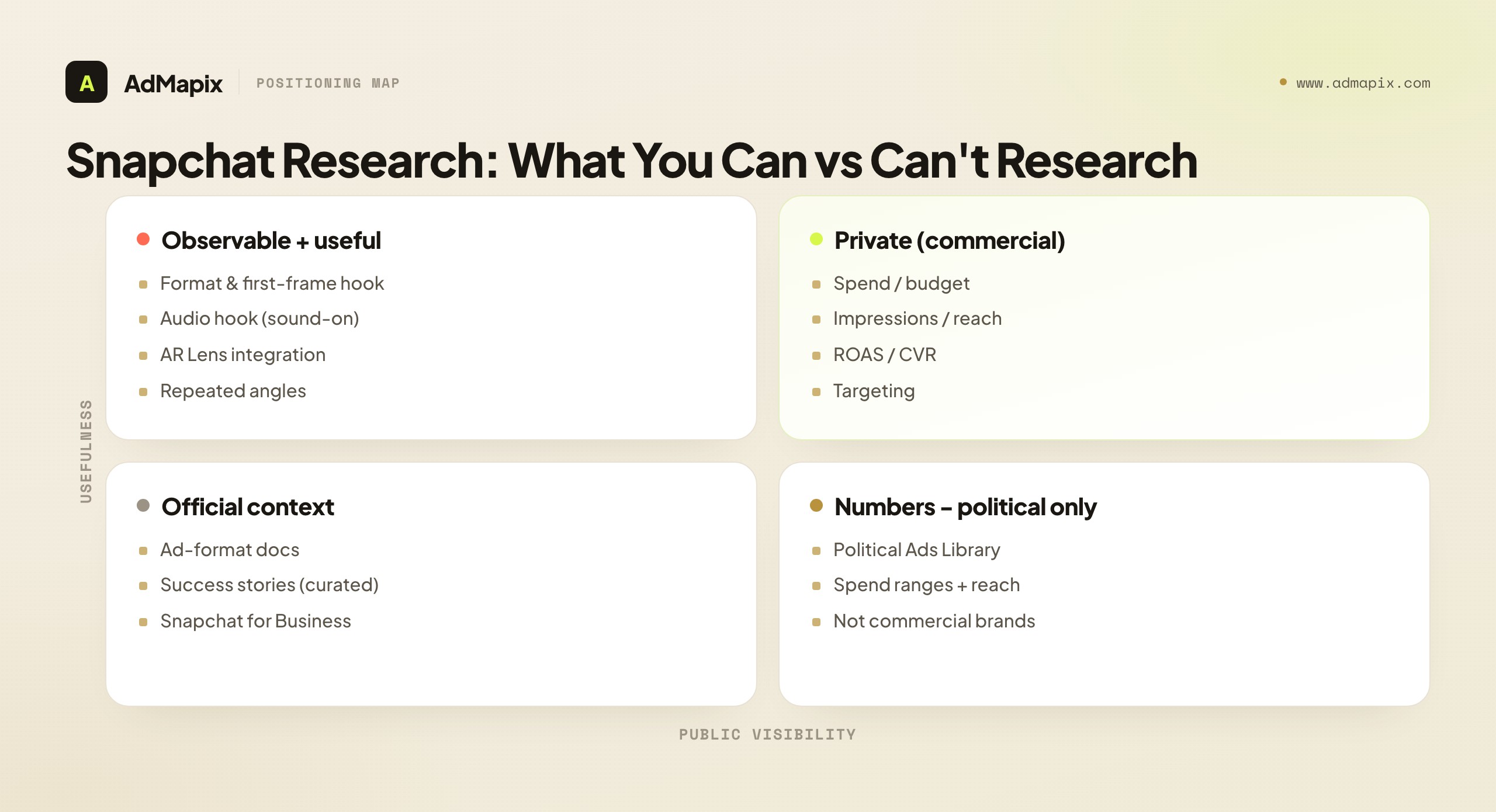
- Snapchat has no public commercial ad library. Snap's only transparency tool is the Political and Advocacy Ads Library — for a DTC brand or app advertiser, it returns nothing. There's no Meta-style "search any advertiser."
- Four official Snap surfaces exist, and only one is a transparency library: the Political Ads Library (political only), Snapchat for Business, the Ad Formats docs, and Success Stories. Know which is which before you expect data.
- Public Snap data proves creative, not metrics. You can read format, first-frame hook, pacing, CTA, and landing intent. You cannot read spend, impressions, ROAS, or targeting for commercial advertisers.
- Snapchat is vertical, full-screen, sound-on, fast-skip. Judge Snap creative by mobile-native rules, not horizontal-feed instincts — the first second is everything.
- The workflow is a 5-step loop: start from the right official surface, define a tight competitor set, capture evidence with context, tag repeatable patterns, and convert findings into a test.
- No third-party tool has Snap-verified commercial spend. Any "Snapchat spend" figure for a commercial brand is an estimate, not a Snap-published number — label it as such.
Why Snapchat Spying Is Different: No Commercial Library
The fact that reframes everything: Snapchat publishes no searchable library of every commercial advertiser's live ads. Meta spoiled marketers with its Ad Library — type any brand, see every active ad. Snapchat has no equivalent for commercial advertisers. Its one Snap-run transparency tool, the Political and Advocacy Ads Library, is limited by design to political and advocacy advertising; for a skincare brand, a mobile game, or a DTC startup, it returns nothing useful.
That changes the research question from "look up their ads" to "assemble evidence from the surfaces that do exist, plus what you can observe." It's a stitching job, not a search. And the discipline of capturing context yourself matters even more here than on Meta, because Snapchat gives you no impression range, no start date, no advertiser-level rollup — just the creative, if and when you observe it.
| Question you might ask | Answerable for Snapchat (commercial)? |
|---|---|
| "Show me every Snap Ad competitor X is running" | No — no commercial library exists |
| "What's competitor X's Snapchat spend or ROAS?" | No — private; estimates only |
| "What's their targeting?" | No — not published |
| "What Snap Ad formats and hooks fit my category?" | Yes — from format docs, success stories, observation |
| "What creative angle should I test on Snap?" | Yes — that's the whole point |
The upside is that the thing you can read — the creative — is also the thing that most decides Snap Ad performance. Snapchat is a full-screen, vertical, sound-on, fast-skip environment, so whether the first second earns attention and whether the creative is shot for mobile-native consumption is exactly the signal you can study without any spend data. The absence of a library isn't a dead end; it's a filter that rewards teams disciplined enough to build evidence from the surfaces that exist.
What Snapchat's Four Official Surfaces Actually Show
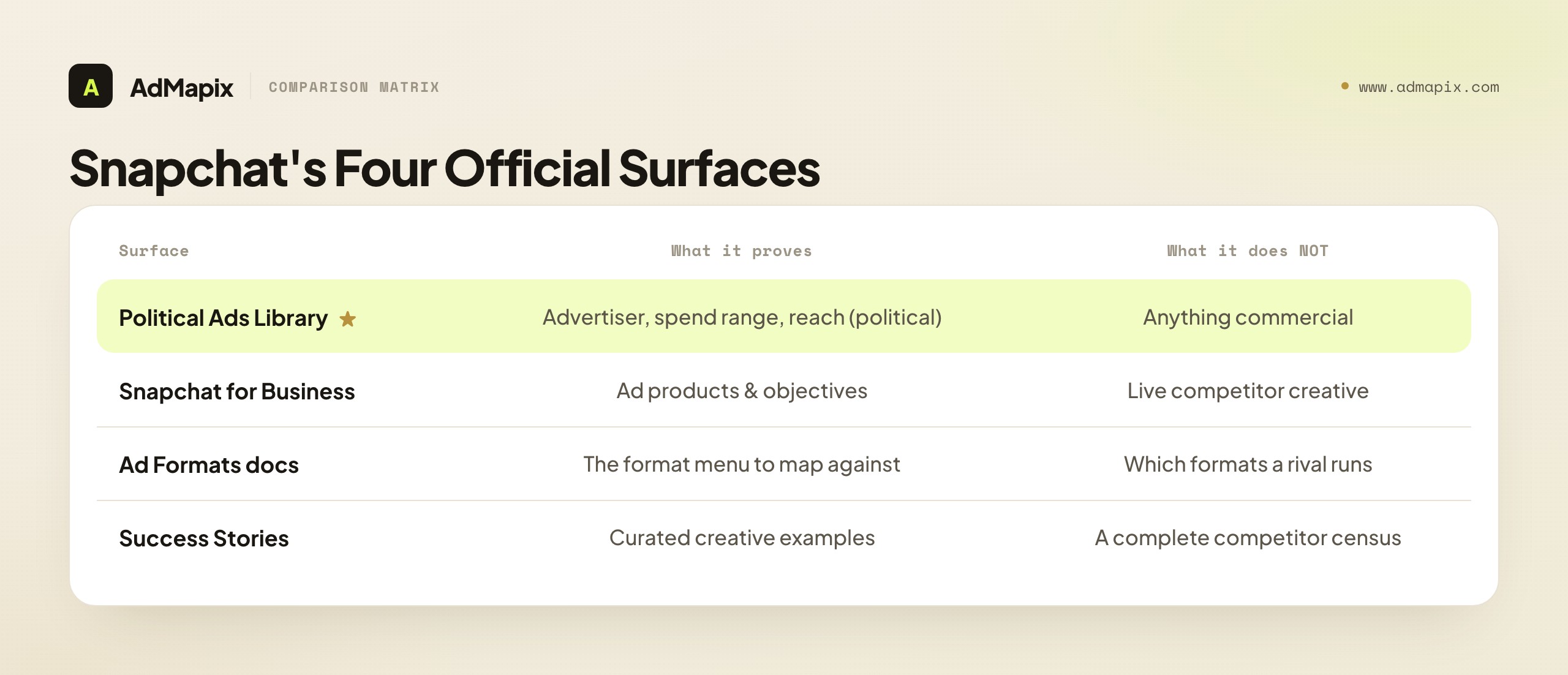
Snapchat exposes four official surfaces useful for research, and none is a universal commercial ad search. Knowing which is which prevents you from expecting Meta-style data that simply isn't published.
| Official surface | What it covers | What it proves | What it does NOT prove |
|---|---|---|---|
| Snap Political Ads Library | Political and advocacy advertising on Snapchat | Advertiser, spend ranges, reach — political/advocacy only | Anything about commercial brands or product advertisers |
| Snapchat for Business | Snap Ads Manager, campaign goals, resources, reporting | Official ad products, objectives, how the platform sells | Specific competitor campaigns or live creative |
| Snapchat Ad Formats | Sponsored Snaps, Single Image/Video, Story Ads, Collection Ads, Commercials, AR Lenses/Filters | The exact format menu to map competitors against | Which formats a given competitor is currently running |
| Snapchat Success Stories | Official, curated campaign examples by industry | Real creative examples Snap chose to showcase | An unbiased or complete view of competitor activity |
Two of these deserve a closer note. The Political Ads Library is the only Snap-run transparency tool, and by design it's limited to political and advocacy advertising — it discloses advertiser, spend ranges, and reach, but only for that category. If you run a commercial brand, it's irrelevant to your competitors; if you do political/advocacy work, it's genuinely useful and worth a dedicated workflow. The Success Stories surface is the closest thing to a commercial creative reference, but read it with eyes open: it's curated by Snap to showcase wins, so it's a biased, incomplete view — excellent for understanding what platform-native excellence looks like, useless as a complete competitor census. Use the format docs to build your competitor-mapping template, and the success stories to calibrate what "good" looks like in your category.
What Public Snapchat Data Can and Cannot Prove
Public Snapchat evidence is strong for creative structure and weak for media metrics, so judge it accordingly. A Sponsored Snap or Story Ad you observe tells you the format, the first-frame hook, the pacing, the CTA, and the landing intent. It does not tell you the budget behind it, how many people saw it, who it was targeted to, or whether it converted.
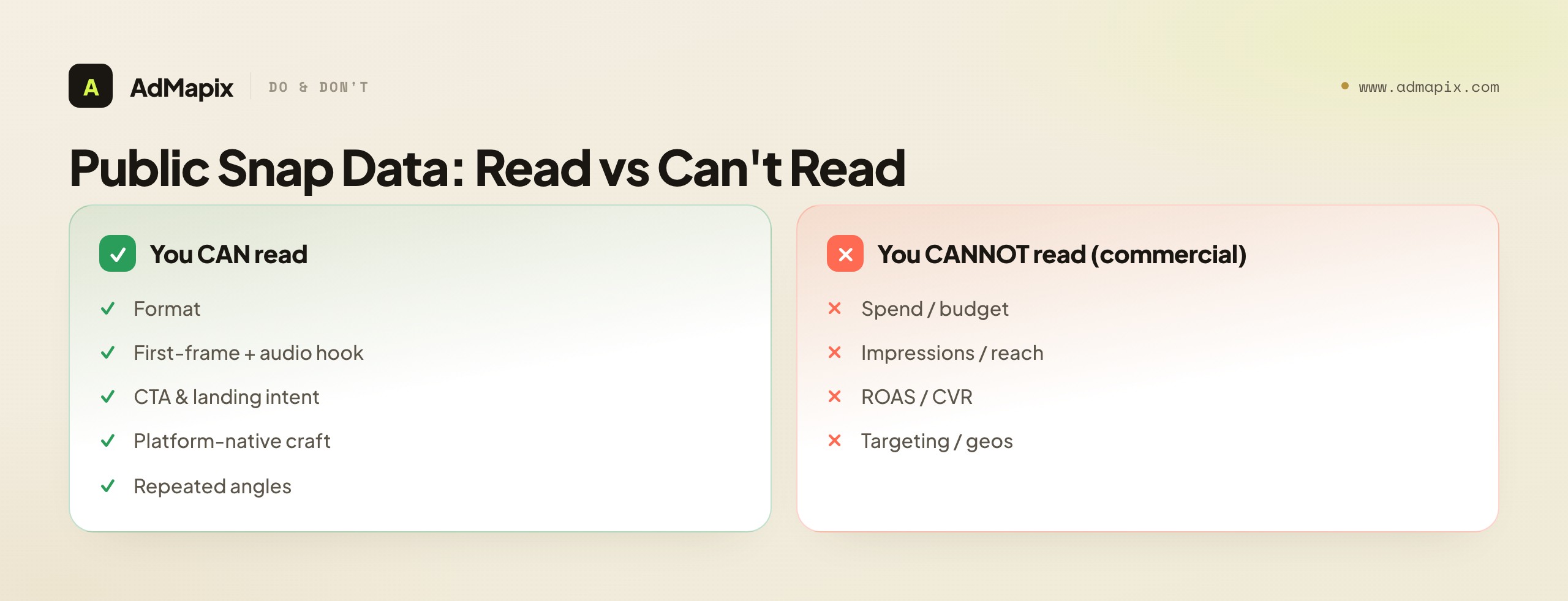
| You CAN read from public Snap creative | You CANNOT read (commercial) |
|---|---|
| Format (Sponsored Snap, Story, Collection, Commercial, AR Lens) | Campaign budget or spend |
| First-frame hook and pacing | Impressions or reach |
| CTA and landing-page intent | ROAS, CPI, or conversion rate |
| Platform-native craft (vertical, sound-on fit) | Audience targeting or geos |
| Repeated angles across what you observe | True frequency or rotation weight |
This matters because Snapchat is a full-screen, vertical, sound-on, fast-skip environment. The visible signal — does the first second earn attention, is the creative shot for mobile-native consumption, does the AR Lens or Commercial feel platform-aware — is exactly the signal you can read without spend data. Treat what you can see as a creative hypothesis, never as proof a campaign worked. And label every spend or performance figure that isn't from the Political Ads Library as an estimate, because for commercial advertisers no Snap-verified number exists. Overclaiming spend is the fastest way to make a Snap research deck indefensible.
How Snapchat's Format and Environment Change What You Read
Snapchat isn't a horizontal feed, and applying feed-ad instincts to Snap creative is a common, expensive mistake. Three environmental facts change how you read a Snap Ad:
- Full-screen and vertical. A Snap Ad owns the entire screen — there's no surrounding feed to compete with, but also nowhere to hide a weak opening. The composition assumes a thumb-height, single-focus view, so creative shot for a horizontal or square feed often reads wrong.
- Sound-on by default. Unlike much of the muted-autoplay web, Snapchat users frequently have sound on, so audio — a hook line, a sound effect, music — is part of the creative, not an afterthought. When you study a Snap Ad, the audio hook matters as much as the visual.
- Fast-skip. Users tap through quickly, so the first second is decisive. A Snap Ad that doesn't earn attention immediately is gone. This makes the opening the single most important thing to read in any Snap creative.
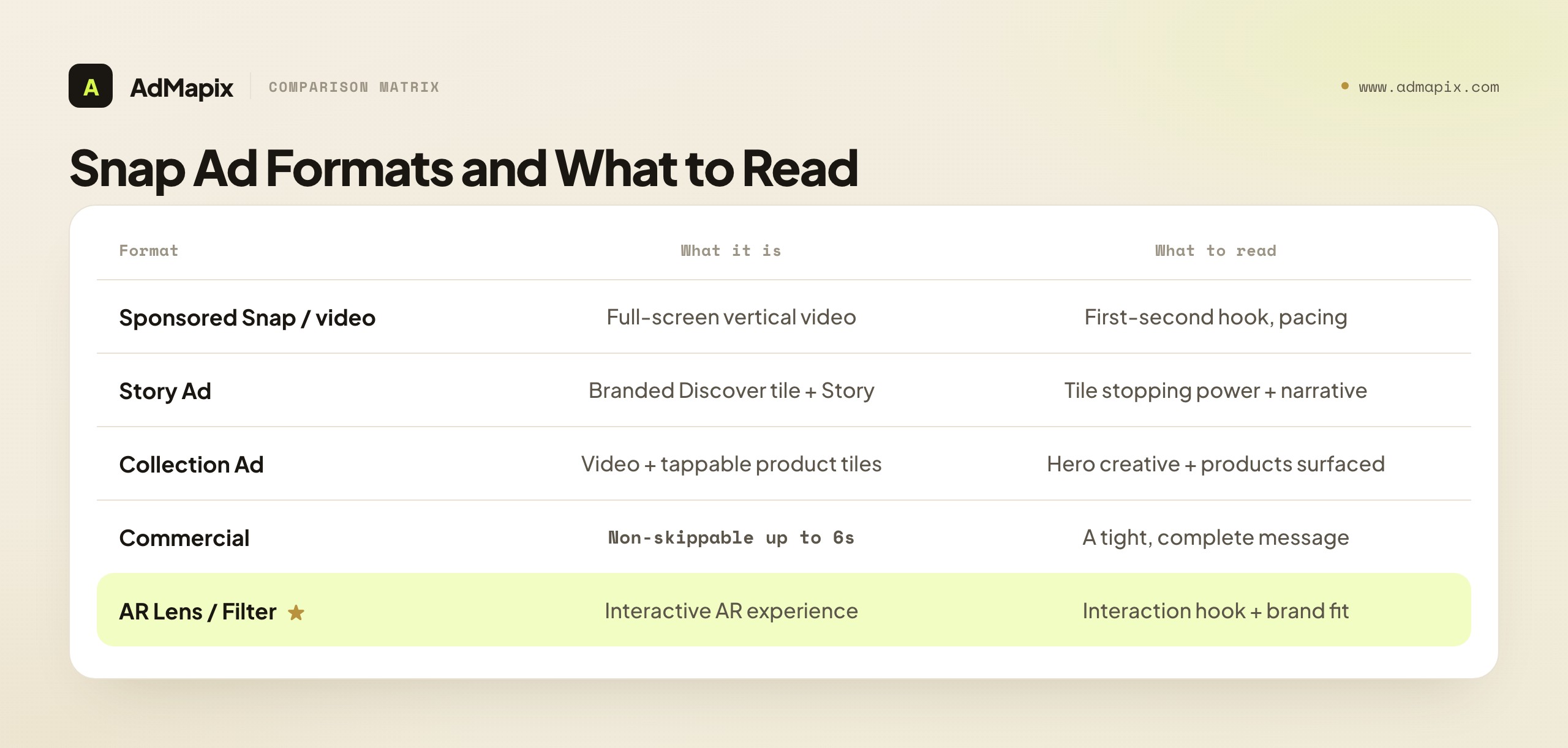
Then there's the format menu itself, which is wider and more Snap-specific than a typical feed. When you study a competitor's Snap creative, read it against the format it's using:
| Snap Ad format | What it is | What to read |
|---|---|---|
| Sponsored Snap / Single Video | Full-screen vertical video between Snaps | First-second hook, pacing, CTA timing |
| Story Ad | A branded tile in Discover opening to a Story | The tile's stopping power + the Story's narrative |
| Collection Ad | Video/image with tappable product tiles | The hero creative + which products are surfaced |
| Commercial | Non-skippable (up to 6s) premium video | A tight, complete message in a fixed window |
| AR Lens / Filter | Interactive augmented-reality experience | The interaction hook and brand integration |
The AR Lens is uniquely Snap — no other major network leans on branded AR the way Snapchat does — so a competitor investing in Lenses is making a platform-native bet worth studying closely. Reading a Collection Ad's product tiles or a Commercial's 6-second discipline against the right format rules is what turns "I saw a Snap Ad" into a real creative read.
Using the Political Ads Library (When It's Actually Relevant)
For most readers the Political Ads Library is a footnote — but if your work touches political, electoral, or advocacy advertising, it's the one Snap surface that does give you real numbers, and it's worth knowing how to use. Unlike the commercial side, the Snap Political Ads Library discloses the advertiser, spend ranges, and reach for political and advocacy ads running on Snapchat.
How to get value from it when it applies:
- Search by advertiser or organization to see their political/advocacy Snap Ads, the spend range, and the reach Snap reports.
- Read spend as a range, not a precise figure — Snap publishes bands, so treat them as directional for relative comparison, not exact budgets.
- Use it for the obvious use cases: journalism, electoral monitoring, advocacy competitive research, and regulatory/compliance work. For these, it's genuinely the right tool.
The crucial caveat: none of this extends to commercial brands. A DTC or app advertiser will not appear in the Political Ads Library, and there is no commercial equivalent. So if your research is commercial, acknowledge the library exists, note it's not for you, and move to the format-and-observation method. Confusing the two — expecting commercial data from a political-only library — is a common early misstep.
A Workflow That Respects Snap's Limits
The reliable approach is to separate discovery, evidence, and action so you never confuse "I saw it" with "it works." Each step outputs something concrete.
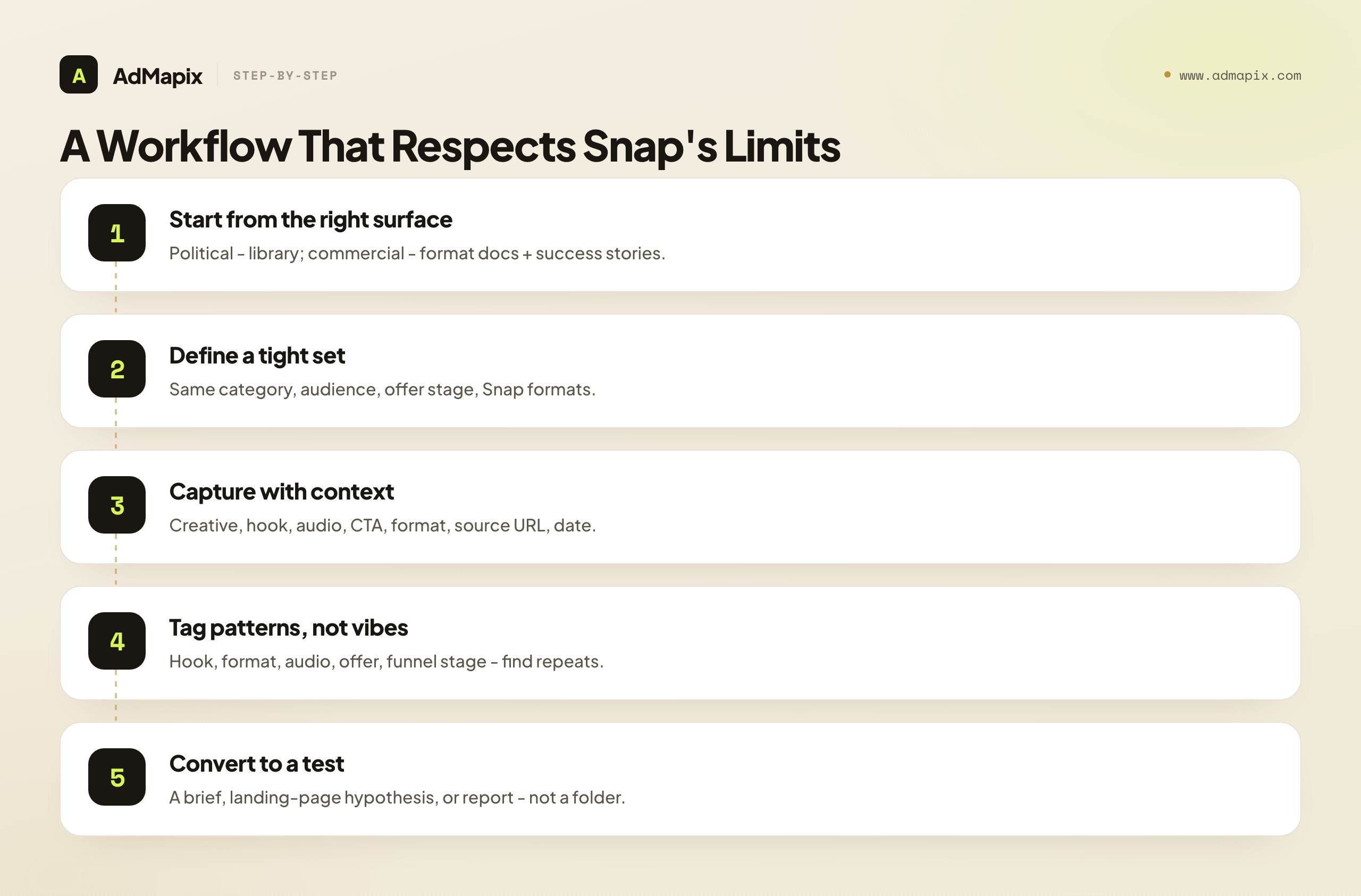
Step 1: Start from the official surface that matches your goal
Political research goes to the Political Ads Library; commercial research starts from the ad-format docs and success stories, because those are the only Snap-published commercial examples. Starting from the wrong surface wastes the session — and on Snapchat, picking the surface is the first real decision.
Step 2: Define a tight competitor set
Lock the same product category, audience, offer stage, and Snapchat formats. Comparing a Collection Ad to a Commercial across unrelated verticals teaches you nothing. The tighter the set, the more meaningful the patterns.
Step 3: Capture evidence with context, every time
Save the creative, the hook, the CTA, the format, the landing-page intent, the source URL, and one line on why it matters. A screenshot with no source or date isn't evidence — and on Snapchat, where nothing is timestamped for you, your own provenance is the only record.
Step 4: Tag patterns, not vibes
Use repeatable dimensions: hook type, format, vertical-video structure, audio hook, offer, objection handled, and funnel stage. Patterns that repeat across competitors are the testable ones; a single clever Snap Ad is an anecdote.
Step 5: Convert findings into a test
Each saved pattern should become a creative brief, a landing-page hypothesis, or a client report — not a folder you never reopen. Research that never ships a test produces zero results. For the broader competitor-to-test discipline, see paid ads competitor research.
A Worked Example: From Snap Creatives to a Test
Here's the whole workflow on a real decision. A DTC skincare brand running Snap Ads sees a competitor gaining share and wants to know which creative angle to test next — and their "research" is a folder of competitor screenshots nobody acts on, plus a teammate insisting "let's check their Snapchat spend."
Pick the surface + set. The marketer first corrects the framing: there's no commercial Snap library, so the competitor's spend is unobservable — the research question is creative, not financial. She starts from Snap's ad-format docs (to map formats) and success stories (to calibrate category-native excellence), and locks the set: DTC skincare, US, problem-aware audience, video + AR Lens formats.
Capture + context. Over two weeks she captures the competitor creatives she observes in-app plus relevant success-story examples, logging for each: format, first-second hook, audio hook, CTA, landing intent, source, date. A pattern emerges: the competitor's strongest Snap creatives open on a close-up "problem reveal" (irritated skin) with a sound-on voiceover naming the pain in the first second, then cut to a fast before/after — and several lean on a branded AR Lens that lets the user "try" the result. Her own Snap creatives open on packaging and a logo.
Tag + decide. She keeps observation ("problem-reveal hook, sound-on, AR Lens, repeated across the competitor's creatives") apart from inference ("seems to be working" — labeled a guess), and marks spend unknown. The repeated pattern plus the platform-native AR bet make "problem-reveal sound-on hook" a strong hypothesis, not an anecdote.
Brief + validate. Her brief isolates the opener: "close-up problem-reveal with a sound-on voiceover in seconds 0–1, vs our current packaging open, in vertical full-screen, 7-day test, kill if 15% under control." She also queues an AR Lens concept as a second test. She ships it, and the problem-reveal opener lifts swipe-up rate and CVR. The competitor creatives didn't tell her what to copy — the repeated, platform-native pattern told her what to test, and her own funnel confirmed it.
The lesson: accepting "no commercial library" killed the spend dead end; reading Snap's vertical, sound-on, format-rich environment surfaced what a feed-ad instinct would have missed; and her own data proved the win.
It's worth naming what she didn't do, because it's where most Snap research goes wrong. She didn't waste a session hunting for a "competitor Snapchat spend" number that doesn't exist for commercial brands — she reframed the question as creative the moment she recognized the constraint. She didn't read the Snap creatives by horizontal-feed instincts — she weighted the audio hook and the vertical, sound-on craft as heavily as the visuals, which is what surfaced the voiceover pattern. She didn't fixate on the single creative she'd seen most — she acted on the opener that repeated across the competitor's strongest creatives and matched a category success-story pattern. And she didn't present "they're winning with this" as a fact — she framed it as a labeled hypothesis and let her 7-day test be the judge. Each of those is a discipline this guide has named, and together they're the difference between Snap research that compounds into wins and research that produces a folder of admired-but-unactioned screenshots. On Snapchat especially, where the data is scarce and the environment is unusual, the discipline matters more than the tooling — and it's exactly what the teams who win on Snap apply, week after week.
Snapchat's Audience: Why It Shapes Creative Research
You can't read a competitor's targeting on Snapchat, but you don't have to guess about the platform's broad audience character — and that character should shape how you read every Snap creative. Snapchat skews younger and more visual than most networks, with a user base heavily weighted toward Gen Z and younger millennials who engage through camera-first, ephemeral, playful interactions. That context changes which creative patterns are likely to work, and therefore which competitor patterns are worth taking seriously.
Three implications for your research:
- Authenticity beats polish. A Snap audience generally responds to creative that feels native and real over creative that feels like a broadcast TV spot. When you read a competitor's Snap Ad, weight whether it feels Snap-native — shot for the camera, casual, fast — more than whether it's highly produced. A polished-but-generic competitor ad is a weaker signal than a rough-but-native one that fits the platform.
- Playfulness and AR resonate. The same audience character is why AR Lenses and interactive, playful formats perform on Snap. A competitor leaning into Lenses or camera-native interaction is reading the audience correctly, which makes their pattern more credible.
- Speed and the first second. A young, fast-skip audience makes the opening even more decisive than the medium already demands. Competitor creatives that earn attention in the first half-second are the ones whose hook structure is worth dissecting.
None of this lets you infer a specific competitor's targeting — that's private. But reading competitor creative against the known platform audience sharpens your judgment about which patterns are likely durable versus which are mismatched to Snap's users. A competitor running stiff, slow, horizontal-feeling creative on Snap is probably not the one to learn from, regardless of their apparent growth; a competitor running fast, native, AR-aware creative is reading the platform right, and their patterns deserve more weight in your test backlog.
Cross-Network Context: Snap Rarely Runs Alone
A crucial reframe: most brands advertising on Snapchat are advertising across several networks at once — Snap, TikTok, Meta, and often more. That fact is both a research challenge and an opportunity, and it's why Snapchat research is usually strongest when it's not Snapchat-only.
The challenge: because there's no Snap commercial library, the richest context for a competitor's Snap strategy often comes from seeing what they run elsewhere. If you can see a competitor's Meta or TikTok creative (where more is observable), you can infer a lot about the creative system they're likely adapting to Snap — the hooks, offers, and angles they believe in, reshaped for Snap's vertical, sound-on, AR-friendly environment. Reading Snap in isolation throws away that cross-network context.
The opportunity: the same brand frequently adapts one core concept across networks, and watching that adaptation teaches you how to localize a winning angle to Snap specifically. A hook a competitor runs as a polished video on Meta might appear on Snap as a faster, sound-on, AR-augmented cut — and seeing both tells you how the angle should be reshaped for Snap-native consumption. This is exactly the kind of read a cross-network tool surfaces and a Snap-only manual process can't.
| Single-network (Snap-only) research | Cross-network research |
|---|---|
| No commercial library to anchor on | Anchor on what the rival runs on Meta/TikTok |
| See a Snap creative with no context | See how the concept adapts across networks |
| Miss the brand's broader creative system | Read the full system, then the Snap-specific cut |
| Slow, fragmentary | One workspace, fuller picture |
The practical takeaway: treat Snapchat research as one input into a cross-network read, not a standalone task. The brands you compete with on Snap are the same ones you compete with on TikTok and Meta, and the most useful Snap intelligence often comes from connecting what little is observable on Snap to the richer evidence available on networks that do publish more. For the multi-network method, see spy on ads across all platforms.
Snapchat Ad Research Tools, Compared
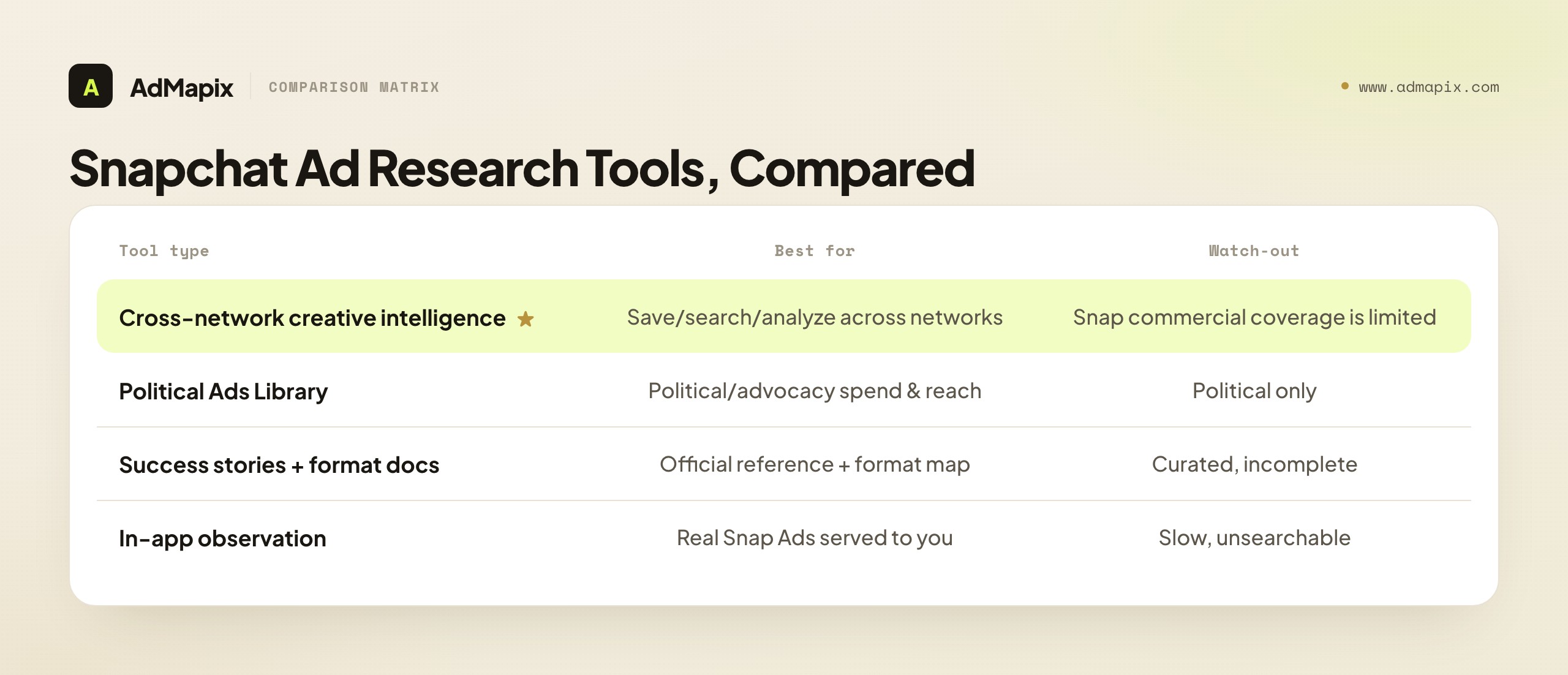
There's no "Snapchat commercial ad library" with a search bar, so tools split by how they help you capture and analyze the creative you can observe across networks.
| Tool type | Best for | Watch-out |
|---|---|---|
| Cross-network creative intelligence (e.g., AdMapix) | Saving, searching, analyzing & reporting creative across networks | Snapchat commercial coverage is limited everywhere — verify in a trial |
| Snap Political Ads Library | Political/advocacy spend and reach | Political only — nothing for commercial brands |
| Snap success stories + format docs | Official creative reference + format map | Curated and incomplete; not a competitor census |
| In-app observation | Real Snap Ads served to you | Slow, unsearchable, only what's targeted to you |
The honest framing: no tool gives you a commercial Snapchat ad library, because Snap publishes none. What good cross-network tools give you is a way to save, search, and analyze the Snap (and other-network) creatives you observe, plus the cross-platform view showing how a competitor adapts a concept across Snap, TikTok, Meta, and more. Because the same DTC or app advertiser usually runs across several networks, that cross-network read is often where Snapchat research gets its real context. Judge any tool on its actual Snap coverage and its cross-network breadth in a trial. For the full landscape, see best ad spy tools 2026 and marketing intelligence tools.
A Repeatable Weekly Research Loop
Snapchat creative research compounds as a habit. Here's a lightweight weekly loop that takes under an hour and builds a real asset over time.
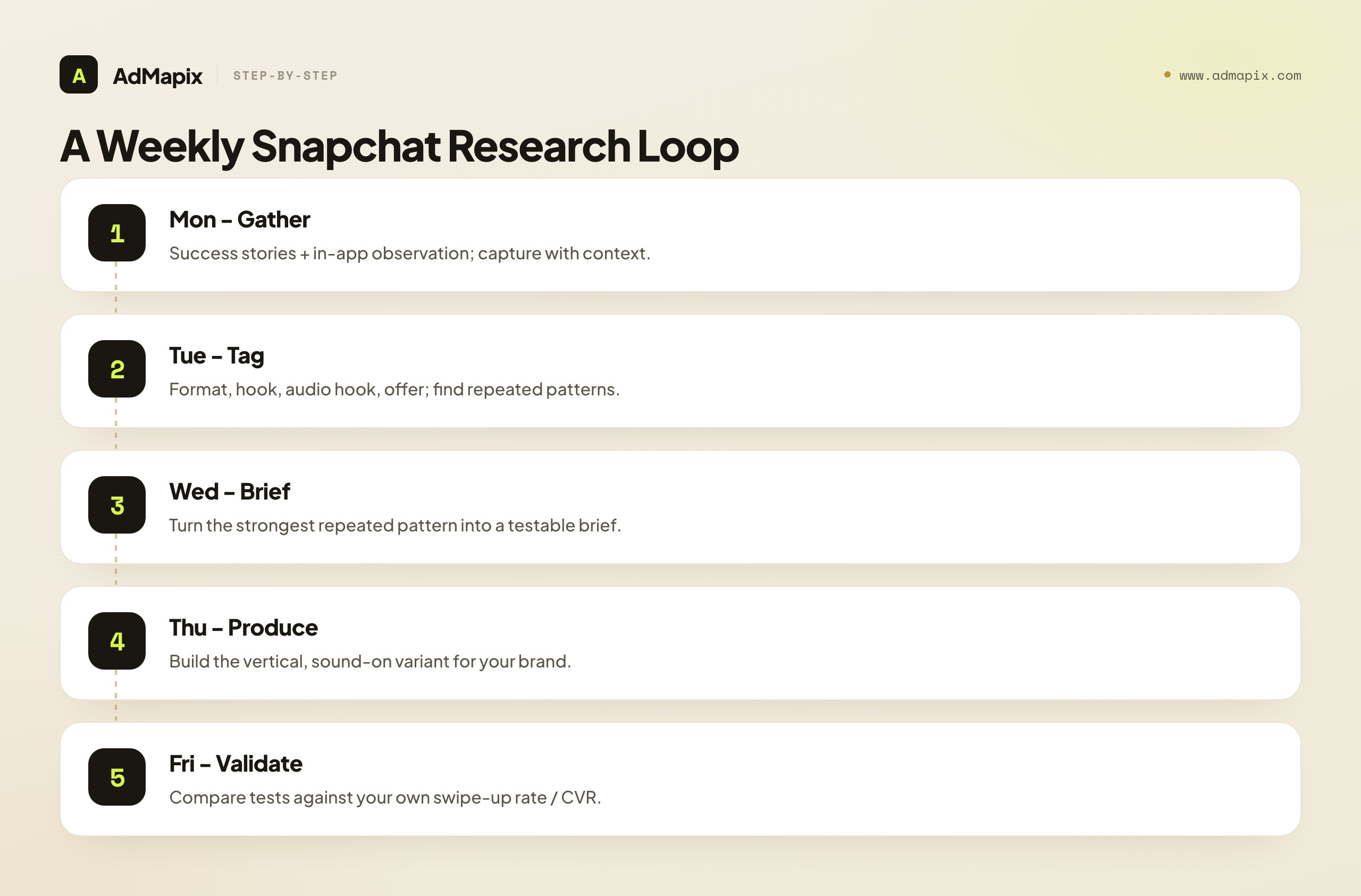
| Day / step | Action | Output |
|---|---|---|
| Monday — gather | Check success stories, observe competitor Snap creatives in-app, capture with context | Fresh, dated evidence |
| Tuesday — tag | Tag by format, hook, audio hook, offer; find repeated patterns | Updated pattern library |
| Wednesday — brief | Turn the strongest repeated pattern into a testable creative brief | A ready-to-produce concept |
| Thursday — produce | Build the vertical, sound-on variant adapted to your brand | A test-ready creative |
| Friday — validate | Compare last week's tests against your own swipe-up rate / CVR | Promote, kill, or iterate |
Three rules keep it honest: capture context every time (Snapchat timestamps nothing for you); judge by Snap's rules (vertical, sound-on, fast-skip — not feed instincts); and always end on your own data (a repeated creative is a hypothesis; only your test proves it). A team running this loop for a quarter builds a dated, searchable history of Snap-native creative in their category — an asset no single audit matches. For the cross-platform version, see how to spy on competitors' ads in 2026.
How Research Differs by Industry on Snapchat
Snapchat skews young and visual, so the creative emphasis shifts by category. Pointing your research at the wrong dimension wastes cycles.
| Category | What the Snap Ad must prove | Snap-native lean | Research focus |
|---|---|---|---|
| DTC beauty / skincare | A believable, fast visible result | Problem-reveal video + AR try-on Lens | Hook + AR integration |
| Mobile games | The core loop is fun in 3 seconds | Vertical gameplay video, playables | Hook + mechanic reveal |
| Fashion / apparel | The product worn, the vibe | UGC-style video, Collection Ad | Authenticity + product tiles |
| Food / QSR | Crave-ability, the offer | Fast video, AR Lens, Commercial | Appetite appeal + offer framing |
| Apps / subscriptions | One clear outcome | UGC video + value framing | The "aha" + CTA |
Two cross-category rules. First, Snapchat's AR Lens is a uniquely platform-native format — beauty, food, and entertainment brands that invest in branded Lenses are making a Snap-specific bet worth studying, because no other major network leans on AR the same way. Second, sound-on is non-negotiable — across every category, the audio hook is part of the creative, so always read the sound, not just the visuals. Match your research focus to your category's deciding dimension and Snapchat's native strengths.
Getting Started: Your First Snapchat Research Sweep
If this is your first structured Snapchat research session, here's the minimum viable version you can run today.
First, fix the expectation: there's no commercial Snap library, so your research is a stitching job from format docs, success stories, and in-app observation — not a search. If your work is political/advocacy, the Political Ads Library is your starting surface instead.
Second, map the format menu. Spend ten minutes with Snap's ad-format docs so you can tag every competitor creative against the right format (Sponsored Snap, Story, Collection, Commercial, AR Lens).
Third, pick one category and 3–5 competitors, then gather a starting sample: scan Snap's success stories for your industry, observe competitor creatives in-app, and capture each with format, first-second hook, audio hook, CTA, source, and date. Label everything observed / inferred / unknown from the start.
Fourth, find one repeated pattern — the clearest thing multiple competitors (or multiple success-story examples) independently do that you don't. Act on what repeats, not the single creative you saw most. That's your first test.
Fifth, write one brief and ship one test in vertical, sound-on format, isolating one variable, with a metric and kill condition set before production. One shipped, validated test beats a research doc that never becomes a creative.
Then repeat weekly. The first sweep is the hardest — you're building the format-mapping muscle and the evidence library from scratch. By week three the loop takes under an hour and the library does the heavy lifting, showing not just what's working but how Snap-native angles are moving over time.
Why Creative Is the Lever on Snapchat
On Snap's Ads Manager, as on every modern self-optimizing platform, the algorithm does much of the audience work — you feed it creative and conversion signals, and it finds the users that creative converts. The audience-targeting lever still exists on Snap, but creative quality increasingly dominates outcomes, especially in a fast-skip, full-screen environment where a weak opening simply gets tapped past. What remains squarely in human hands is the creative, the format choice, and the offer.
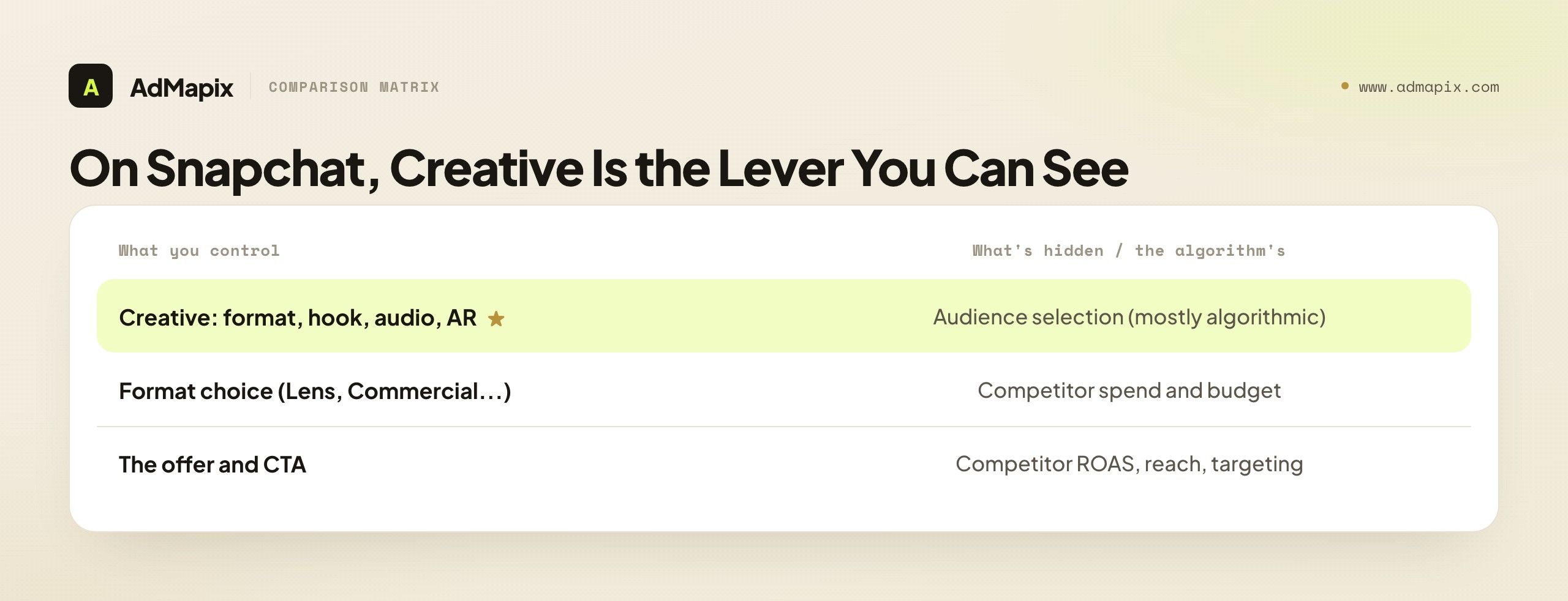
That makes creative research the highest-leverage competitive work available on Snapchat — and conveniently, the creative is also the only thing you can observe, since commercial spend and targeting are private. So the constraint and the opportunity align: the one lever you can study from the outside (creative) is also the one that most decides Snap Ad performance. Studying competitor Snap creative isn't a consolation prize for lacking spend data; it's research into the biggest determinant of success on the platform.
| What you control on Snap | What the platform / privacy hides |
|---|---|
| Creative (format, hook, audio, AR) | Audience selection (largely the algorithm's job) |
| Format choice (Lens, Commercial, etc.) | Competitor spend and budget |
| The offer and CTA | Competitor ROAS, reach, targeting |
The practical upshot: the "no commercial library" limitation stings less than it first appears, because the most valuable Snap intelligence was always the creative, and that's exactly what disciplined observation surfaces. A team that systematically reads Snap-native creative — vertical, sound-on, AR-aware — is studying the lever that wins, while a team fixated on unobtainable spend numbers is mourning data that wouldn't change their next creative anyway.
Building a Snap Creative Pattern Library
The concrete output of good Snapchat research is a pattern library: a tagged, searchable collection of Snap-native creative angles, each captured with format and context, organized so it directly feeds production. Because Snapchat gives you no library of its own, the one you build is your competitive asset — and the discipline of building it is what separates teams that compound a Snap creative edge from teams that re-screenshot the same ads every quarter.
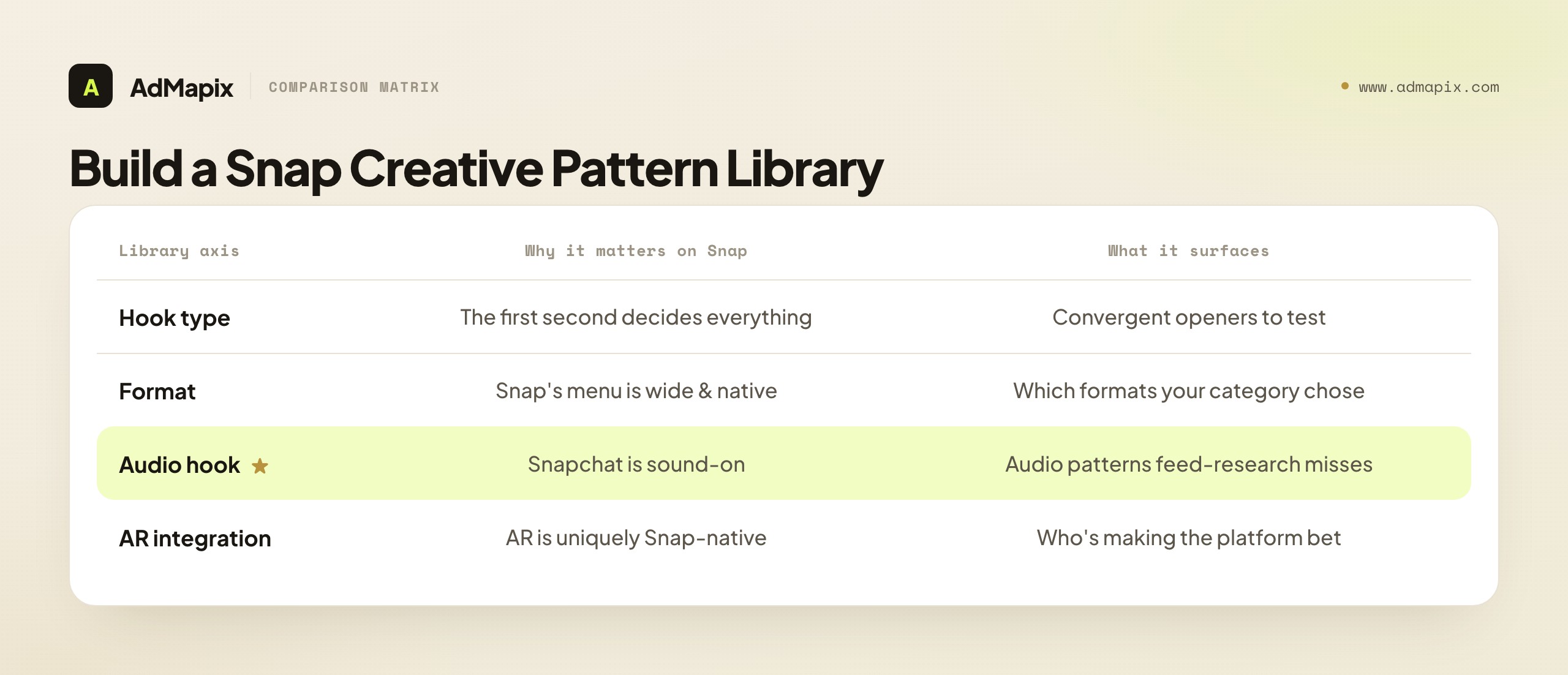
Organize the library by the dimensions you'll brief from. The most useful axes on Snapchat are:
- Hook type (problem-reveal, transformation, social proof, curiosity, satisfying moment) — so you can pull "every problem-reveal hook in skincare."
- Format (Sponsored Snap, Story, Collection, Commercial, AR Lens) — so you can see which formats your category leans on, the Snap equivalent of a format-mix map.
- Audio hook (voiceover, sound effect, music, trending sound) — uniquely important on sound-on Snap, and a dimension most teams forget to tag.
- AR integration (none, branded Lens, try-on) — to track the platform-native AR bets in your category.
- Offer and funnel stage — to align angle to intent.
| Library axis | Why it matters on Snap | What it surfaces |
|---|---|---|
| Hook type | The first second decides everything | Convergent opening patterns to test |
| Format | Snap's menu is wide and native | Which formats your category has chosen |
| Audio hook | Snapchat is sound-on | The audio patterns feed-research misses |
| AR integration | AR is uniquely Snap-native | Who's making the platform-specific bet |
Rebuild and add to the library each weekly loop, and over a quarter it reveals movement — which hooks, formats, and AR bets are rising or fading in your category. That lifecycle read is what a one-off audit misses. The pattern library is also what makes a Snap research deck defensible: instead of "I saw some Snap Ads," you get "the skincare category has converged on problem-reveal sound-on openers and AR try-on Lenses over the last two months, and we're invested in neither" — a sentence that funds a test plan.
Snap Research at Scale: Agencies and Multi-Brand Teams
Everything above scales differently when you research Snapchat for several brands or clients at once, and a few adjustments keep a multi-account workflow from collapsing into a screenshot pile.
The core change is structure for reuse by category and format, not by client. An agency running Snap research for six DTC clients needs the pattern library tagged so a hook-and-format insight found for Client A's skincare brand is instantly findable when Client B in beauty launches — because Snap creative patterns transfer by category and format, not by account. Tag category and Snap-format first, client second; the problem-reveal-plus-AR-Lens pattern converging across beauty advertisers is relevant to every beauty client at once.
The second adjustment is making the research a billable deliverable. A recurring per-client Snap creative-intelligence report — the category's hook patterns, format mix, AR bets, success-story benchmarks, and the specific tests you briefed — is proof of work that renews retainers and aligns the client on Snap-native direction. Crucially, the report should state plainly that commercial spend is unobservable, so the client never expects a "competitor Snap budget" line you can't honestly deliver. A folder of screenshots is invisible labor; a dated, structured Snap pattern report is a deliverable.
The third is separating shared category intelligence from account-specific reads. A category-wide Snap pattern applies to every client in that vertical; a specific competitor a single client tracks is account-bound. Keep the shared layer reusable and the account layer scoped. At multi-brand scale, manual screenshotting plus in-app observation across Snap and other networks for many clients simply doesn't hold together by hand — which is where a tool that makes captured creative searchable, cross-network, and reportable becomes the only way the workflow survives more than a couple of accounts.
How to Brief a Snap Test From Your Research
The step most teams skip is turning a captured pattern into a brief a producer can shoot. A pattern in a library isn't a deliverable; a brief is. Here's how to write one that survives production and respects Snap's environment.
State the hypothesis as a testable claim. Not "competitors use problem-reveal hooks" but "a close-up problem-reveal with a sound-on voiceover in seconds 0–1 will lift swipe-up rate versus our current packaging open." Name the change, the expected effect, and the metric.
Specify the structure, format, and audio — not the asset. Snap-specific: describe the opening beat, the format (Sponsored Snap, AR Lens, etc.), and the audio hook, because sound is part of the creative on Snapchat. Adapt the competitor's structure to your own brand and footage — never reuse their creative. The reusable intelligence is the skeleton, the format choice, and the audio approach.
Set the success metric and kill condition before production. "Beat control on swipe-up rate over a 7-day test; kill if 15% under control." Writing the kill condition before you're invested removes sunk-cost emotion from the decision.
Cite the repetition evidence and confidence. "This problem-reveal sound-on opener repeats across the competitor's strongest Snap creatives and matches a category success-story pattern — medium-high confidence." This makes the bet evidence-backed and the result interpretable.
Shoot for Snap's environment. The brief must specify vertical, full-screen, sound-on — a repurposed horizontal or square asset will underperform, no matter how good the underlying angle. A brief built this way is the bridge between Snap research and shipped, validated creative; without it, even excellent research dead-ends in a document.
What Snap's Transparency Gap Means for Researchers
Snapchat's lack of a commercial ad library isn't an oversight — it reflects a real difference in how transparency obligations and product priorities have played out across platforms, and understanding that helps you set realistic expectations. Meta built its Ad Library partly under regulatory pressure (notably the EU Digital Services Act and post-2016 political scrutiny), and that obligation expanded into a broad commercial archive. Snap built a political ads library to meet the political-transparency bar, but never extended it to commercial advertising. The practical consequence for researchers: don't wait for a Snap commercial library to appear, and don't assume a third-party tool has somehow obtained data Snap itself doesn't publish.
This has three durable implications. First, the gap is structural, not temporary — plan your Snap research method around evidence assembly permanently, not as a stopgap until a library launches. Second, any tool claiming Snap-verified commercial spend is, at best, modeling and labeling it loosely — there's no public source to verify against, so treat such figures as estimates and demand to know the methodology. Third, the teams that build a disciplined Snap evidence practice now hold an advantage precisely because the data is hard to get: when competitor intelligence is scarce, the few teams who do the patient observation-and-pattern work read their Snap competitive landscape more accurately than everyone waiting for a lookup that isn't coming.
There's a quiet upside here, too. Because Snap creative is harder to research than Meta creative, fewer competitors do it well — which means the marginal value of doing it properly is higher on Snapchat than on a platform where everyone can pull the same library. A team that maps formats, observes consistently, captures context, and tags patterns builds something genuinely scarce: a real read on Snap-native creative trends in their category. The transparency gap, in other words, is a barrier that protects the teams disciplined enough to cross it.
The honest framing to carry into any Snap research, client conversation, or tool evaluation: Snapchat shows you creative and political spend, never commercial spend — and the right response isn't frustration, it's a method built around what is observable, executed consistently enough to compound into an edge.
Common Mistakes
- Expecting a Meta-style commercial library. Snapchat's only transparency library is political/advocacy; there's no all-advertisers commercial search. Plan for evidence assembly, not a lookup.
- Treating visible creative as performance proof. Seeing an ad proves it ran, not that it spent well or converted.
- Judging Snap creative by feed-ad rules. It's full-screen, vertical, and sound-on; horizontal-feed instincts mislead you, especially on the audio hook.
- Confusing the political library with commercial data. The Political Ads Library covers political/advocacy only — a commercial brand won't appear in it.
- Ignoring the AR Lens. Branded AR is uniquely Snap-native; a competitor investing in Lenses is making a platform bet you should study, not skip.
- Saving screenshots without context. Without URL, date, advertiser, and format, the asset is unusable later — and Snapchat timestamps nothing for you.
- Stopping at collection. Research that never becomes a test, brief, or report is wasted effort.
When to Use AdMapix
AdMapix is the layer you add after official discovery, when scattered screenshots need to become searchable, comparable evidence. It's for performance and creative teams who research Snapchat (and other networks) often enough that ad-hoc folders stop scaling. It's not for someone who needs verified spend or targeting data on a specific commercial competitor — no public tool can provide that for commercial Snapchat advertisers, because Snap doesn't publish it.
In practice: widen discovery across networks with Search, keep the strongest examples searchable in Media, break down vertical creative with Video Analysis, and turn observed patterns into team-ready outputs in Reports. Compare seats and workflow access on Pricing, and create an account from Login when the research becomes weekly work that's eating your briefing time. We're honest about the boundary because a tool claiming Snap-verified commercial spend would be inventing numbers Snap itself doesn't publish.
FAQ
Does Snapchat have an ad library like Meta?
Not for commercial ads. Snap runs a Political and Advocacy Ads Library that discloses advertiser, spend ranges, and reach for political/advocacy ads only. There's no public, searchable library of every commercial brand's live Snapchat ads, which is why commercial research relies on format docs, success stories, and observed creative — a stitching workflow, not a lookup.
How do I research a competitor's Snapchat ads without a library?
Map their likely formats using Snapchat's ad-format docs, check whether they appear in Snap's official success stories, observe their creative in-app, and save each example with its hook, format, audio hook, CTA, and source. Then tag the recurring patterns so you can turn them into test ideas rather than one-off screenshots. The discipline is to capture context yourself, since Snapchat provides none automatically.
Can I see how much a competitor spends on Snapchat?
Only for political and advocacy advertisers, and only within the ranges the Political Ads Library publishes. For commercial brands, spend, impressions, ROAS, and targeting aren't publicly available, so any "spend" claim from a third-party tool is an estimate, not a Snap-verified figure. Label commercial spend figures as estimates, always.
What's the Snap Political Ads Library actually for?
It discloses the advertiser, spend ranges, and reach for political and advocacy ads on Snapchat — useful for journalism, electoral monitoring, advocacy competitive research, and compliance work. It's the one Snap surface with real numbers, but it covers political/advocacy only. Commercial brands don't appear in it, so it's irrelevant to most DTC and app competitor research.
What should I capture when I find a competitor Snap Ad?
Capture the creative itself, the first-frame and audio hook, the format (Sponsored Snap, Story, Collection, Commercial, AR Lens/Filter), the CTA, the landing-page intent, the source URL, and the date. That context is what lets you compare ads later and convert them into briefs — and on Snapchat, where nothing is timestamped, it's the only record that survives.
How is researching Snapchat ads different from TikTok or Meta?
Meta has a full commercial ad library and TikTok a partial Creative Center; Snapchat has neither for commercial ads — only the political library. So Snap research shifts entirely to format-mapping, success-story reference, and in-app observation. Snapchat's vertical, full-screen, sound-on, AR-heavy environment also changes how you read creative, making the audio hook and AR integration signals you'd weight less on other networks.
Why does the AR Lens matter so much on Snapchat?
Branded AR Lenses and Filters are a uniquely Snap-native format — no other major network leans on interactive AR the way Snapchat does. A competitor investing in Lenses is making a platform-specific bet, often to let users "try" a product or interact with the brand, which is a strong creative signal worth studying. For beauty, food, and entertainment especially, the Lens is where Snap-native creative innovation concentrates.
Is scraping Snapchat ads allowed?
Don't scrape in ways that violate Snap's terms. Use official surfaces — the Political Ads Library, ad-format docs, and success stories — plus creative you legitimately observe in-app. The goal is source-backed evidence you can defend, not a bulk dump that breaks platform rules. Manual, source-backed research is both safer and more defensible than scraping.
How often should I run Snapchat creative research?
A weekly 30–60 minute loop suits most teams that advertise on Snap: gather new creatives and success-story examples, tag patterns, brief a test, and validate last week's results. Lower-cadence advertisers might do a focused monthly dive on 3–5 competitors. Match the cadence to how fast you ship new Snap creative.
Where does AdMapix fit in Snapchat research?
AdMapix fits after official discovery, turning scattered screenshots into searchable, comparable evidence across networks. Use it to save Snap (and other-network) creatives, analyze vertical-video structure, tag patterns, and compile reports. It doesn't provide Snap-verified commercial spend or targeting — that data isn't public — but it organizes the creative evidence you gather into a repeatable, cross-network workflow.
Related Reading
- Mobile app ad spy tool — the broader cross-network app method
- Spy on ads across all platforms — the cross-network playbook
- TikTok Shop ad spy tools — the social-video sibling
- Facebook Ads Library complete guide — what a full commercial library looks like
- Best ad spy tools 2026 — the full tool landscape
- Paid ads competitor research — the broader competitor workflow
Sources
Official sources checked as of June 21, 2026. Snap's official surfaces and ad products change, so confirm the current source path before building a workflow on it.
- Snap Political Ads Library — Snap's transparency library for political and advocacy advertising on Snapchat.
- Snapchat for Business — official entry point for Snap Ads Manager, campaign goals, resources, and reporting.
- Snapchat Ad Formats — the full menu: Sponsored Snaps, Single Image/Video Ads, Story Ads, Collection Ads, Commercials, and AR Lenses/Filters.
- Snapchat Success Stories — official, curated campaign examples by industry, useful for creative benchmarking.
Bottom Line
A Snapchat ad spy tool isn't a library lookup, because Snapchat publishes no commercial ad library — only a Political and Advocacy Ads Library scoped to that category. The right research is a stitching discipline: start from the official surface that matches your goal, map competitors against Snap's format menu, capture observed creative with strict context, separate what you can prove (format, hook, AR integration) from what you can't (spend, ROAS, targeting), and turn repeated patterns into vertical, sound-on test briefs.
You can't see commercial spend; you can read the creative — and on Snapchat's full-screen, vertical, sound-on, AR-rich environment, that creative is the lever that most decides outcomes. Pick the surface, capture with context, read by Snap's rules, trust repeated patterns over any single creative, and validate with your own funnel. That's how Snapchat ad research becomes a creative pipeline instead of a screenshot graveyard.
And remember the upside hidden in the constraint: because Snap creative is harder to research than Meta's, fewer competitors do it well — so the team that builds a disciplined Snap evidence practice holds an edge precisely because the data is scarce. Don't wait for a commercial library that isn't coming; build the method now around what's observable — formats, hooks, audio, AR, repeated patterns — and connect it to the cross-network picture where your competitors run alongside Snap. Run the weekly loop, capture context Snapchat won't capture for you, judge by Snap's vertical sound-on rules, and let your own funnel be the final judge. The transparency gap isn't a wall that stops your research; it's a filter that rewards the few teams patient enough to do the evidence work properly, week after week, while everyone else gives up at the missing library.
When manual screenshotting across networks stops scaling, start with AdMapix Search, keep examples searchable in Media, and break down structure in Video Analysis — built for exactly this job, across the networks where a commercial library may never exist.
Turn these observations into your next creative study
Open the creative library and select samples for your market, network and research question.
Related Articles
Reddit Ads Library in 2026: The Ads Inspiration Library, Reddit Ad Examples, and Competitor Research
A complete 2026 guide to the Reddit Ads Library — why the closest official surface is Reddit's Ads Inspiration Library rather than a Meta-style transparency database, exactly what it shows and hides, how to find and read Reddit ad examples, how to judge community fit, a full competitor-analysis workflow, how it compares to other ad libraries, the honest limits of public ad data, and where a cross-network creative-intelligence layer like AdMapix fits.
LinkedIn Ads Competitor Analysis: A Complete B2B Workflow for Reading, Tagging, and Out-Positioning Rival Campaigns
A flagship 2026 guide to LinkedIn ads competitor analysis for B2B teams. How to use the LinkedIn Ad Library, read competitor ads as messaging and offer hypotheses, tag every creative on six dimensions, run offer and format analysis, build recurring competitor reports, and turn it all into briefs and tests — with an honest account of what LinkedIn's public data can and cannot prove, and where AdMapix fits as a creative-evidence layer.
Pinterest Ads Library in 2026: The Ads Repository, Its Limits, and How to Research Promoted Pins
A complete 2026 guide to the Pinterest Ads Library — why it is really the DSA-driven Ads Repository, why access is EU-focused, exactly what it shows and hides, how to research promoted Pins when the repository is region-locked, how to read Pinterest creative by Pin format and category, the third-party spy methods that fill the gaps, the honest limits of public ad data, and where a cross-network creative-intelligence layer like AdMapix fits.