PiPiAds vs BigSpy in 2026: TikTok-First Depth or Broad Ad Library Coverage?
A 2026 head-to-head of PiPiAds vs BigSpy — TikTok and TikTok Shop depth versus broad multi-platform ad-library breadth, compared on coverage, product signals, pricing, and use-case fit, with a test-before-you-buy method, what public ad data can and cannot prove, and where a cross-network evidence layer fits.
By the AdMapix Research Team — Updated June 21, 2026
PiPiAds vs BigSpy in 2026: TikTok-First Depth or Broad Ad Library Coverage?
PiPiAds vs BigSpy is a depth-versus-breadth decision, and the two tools are barely competing for the same job. Pick PiPiAds when TikTok and TikTok Shop are the channels driving your next product test or creative brief — it goes deep on a narrow surface, mapping ads to products, stores, and landing pages where TikTok commerce actually happens. Pick BigSpy when you need to browse many platforms and niches quickly for inspiration — it goes wide across Meta, TikTok, YouTube, and more, optimized for casting a broad net rather than drilling into one channel. This 2026 guide is for TikTok advertisers, ecommerce operators, dropshippers, media buyers, app marketers, and agencies who want to choose based on the weekly decision a tool unlocks, not on which database claims more ads. Below you get a decision framework, a feature-by-feature breakdown, how they differ on TikTok signals and multi-platform reach and price, a test-before-you-buy method, the honest limits of what either can prove, and where a cross-network evidence layer fits once research has to become a report.
TL;DR — PiPiAds vs BigSpy in One Screen
- PiPiAds is the stronger first test for TikTok. When TikTok-first creative discovery and TikTok Shop product signals drive the brief, its ad-to-product mapping is where it earns its keep.
- BigSpy is the stronger first test for breadth. When you need fast, broad browsing across Meta, TikTok, YouTube, and other surfaces, its wide, cheap net fits better than a single-channel specialist.
- Database size is a weak tie-breaker. The better tool is the one that gets your team from an example to a testable hypothesis faster — TikTok product test or cross-platform creative brief.
- They solve different jobs, not bigger-or-smaller versions of one. A TikTok Shop seller and a multi-platform creative scout should not start in the same place.
- Neither proves performance. No public tool exposes a competitor's real spend, ROAS, conversion rate, or margin; engagement counts are estimates, not your unit economics.
- A cross-network evidence layer (such as AdMapix) fits above either when you need cross-platform search, saved media, video breakdowns, and competitor evidence you can put in a report.
What You Are Actually Choosing Between
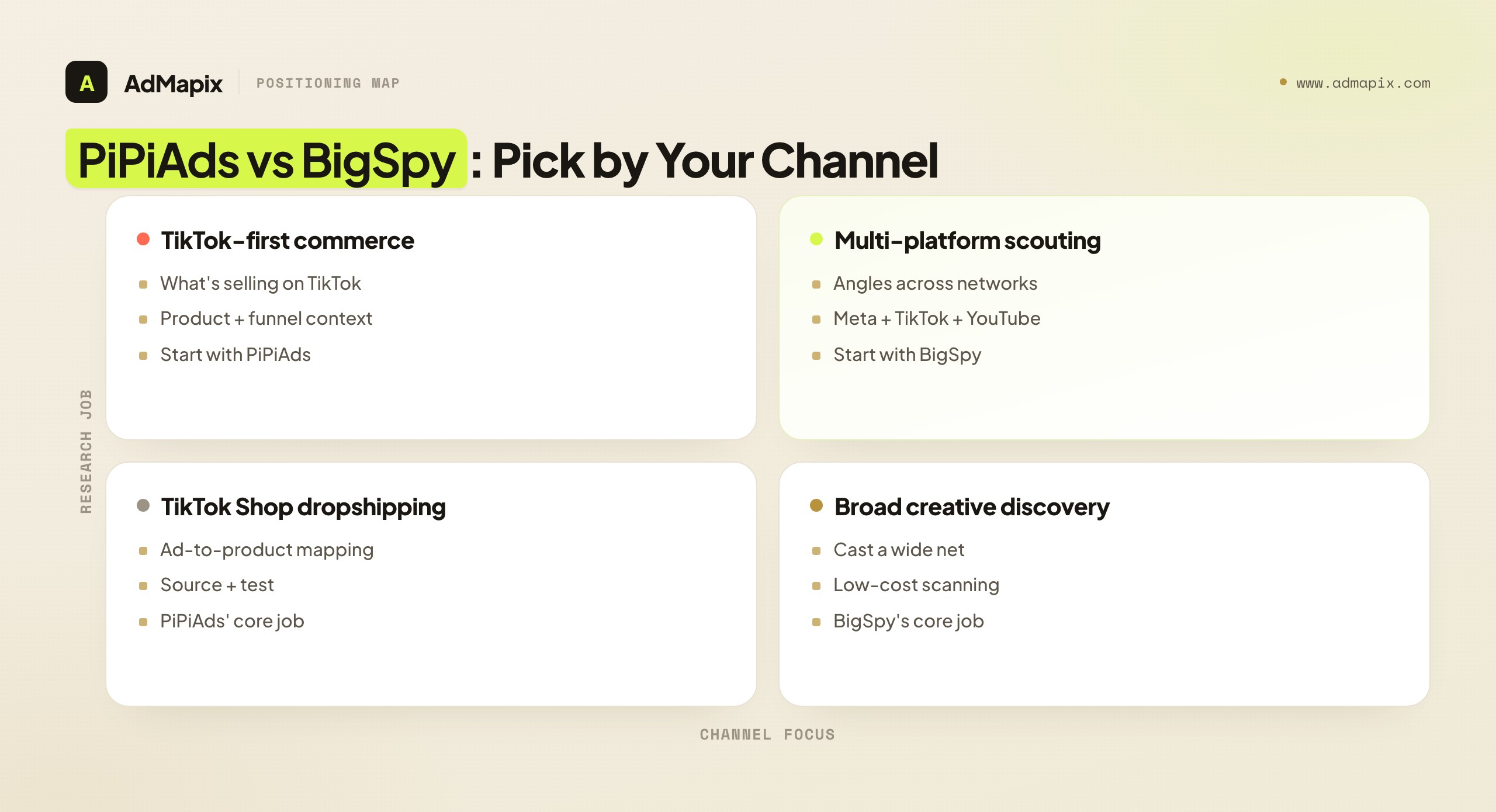
The core difference is depth versus breadth, and that single distinction explains most of the decision. PiPiAds concentrates on the TikTok ecosystem (with Facebook coverage alongside), going deep on the channel where its product-and-commerce workflows bite. BigSpy spreads coverage across many ad platforms and niches, going wide with a browse-and-track style. One is a specialist; the other is a generalist. Choosing between them is less about quality and more about whether your acquisition lives on one channel or many.
PiPiAds is built around the TikTok ecosystem. It surfaces TikTok ad creatives, links them to the products and landing pages behind them, and leans into use cases like TikTok Shop dropshipping, app and game promotion, and product discovery. If your acquisition strategy lives on TikTok, the product-to-ad mapping is the entire reason to pay — it answers "what is selling on TikTok right now, and how is it being advertised?" in a way a breadth-first tool cannot.
BigSpy is built around scale and variety. It indexes ads across multiple networks and frames the workflow around niche search, ad tracking, and audience context. If your team's job is to gather many reference angles across platforms before committing to a direction, that breadth is the point — you cast a wide net and see how a brand advertises everywhere, not just on one surface.
Neither approach is universally "better." A TikTok Shop seller who buys BigSpy for its size may find the TikTok product signals shallow; an agency that buys PiPiAds expecting broad Meta and YouTube coverage may find the surface too narrow. The decision hinges entirely on one question: is the channel that moves your numbers TikTok specifically, or many platforms at once? Answer that and the comparison mostly resolves; everything below is the detail that confirms it.
There is a useful mental model here. PiPiAds is a depth gauge dropped into one well; BigSpy is a wide survey across many fields. A depth gauge tells you exactly what is happening in the well you care about and nothing about the next field over. A wide survey tells you the lay of the whole landscape but not what is at the bottom of any single well. If TikTok is your well, you want the gauge. If you are surveying where to dig, you want the survey. Buying the gauge when you need the survey — or the survey when you need the gauge — is the only real way to get this decision wrong.
This matters more for these two tools than for a typical software comparison, because they are not two versions of the same product. With most "X vs Y" decisions, both options do roughly the same job and you choose on quality, price, or polish. PiPiAds and BigSpy do different jobs — one drills TikTok commerce, the other surveys many platforms — so "which is better" is the wrong question. The honest version is "which job dominates my week?" A team that internalizes this buys correctly; a team that asks "which ad spy tool is best" gets an answer that may be true and useless, because best-for-TikTok-commerce and best-for-multi-platform-scouting are different titles. The whole comparison hinges on refusing to flatten two jobs into one ranking.
A quick self-diagnostic: notice the noun you reach for when you describe your bottleneck. If you say "I need to find what's selling on TikTok," you are describing PiPiAds's job. If you say "I need to find ads or angles across platforms," you are describing BigSpy's job. The phrasing you naturally use reveals the channel and unit of value you actually care about, and it points to the right tool faster than any feature comparison.
What PiPiAds Is Best At
PiPiAds is strongest when TikTok is the channel driving your acquisition, and its defining feature is ad-to-product mapping — connecting a TikTok creative to the product it sells, the store running it, and the landing page it points to. For a TikTok Shop seller or dropshipper, that mapping is the whole game: it turns "here is an interesting TikTok ad" into "here is a product with demand, the store proving it, and the funnel selling it." A creative with no product context is nearly useless to a TikTok commerce operator; PiPiAds keeps the context attached.
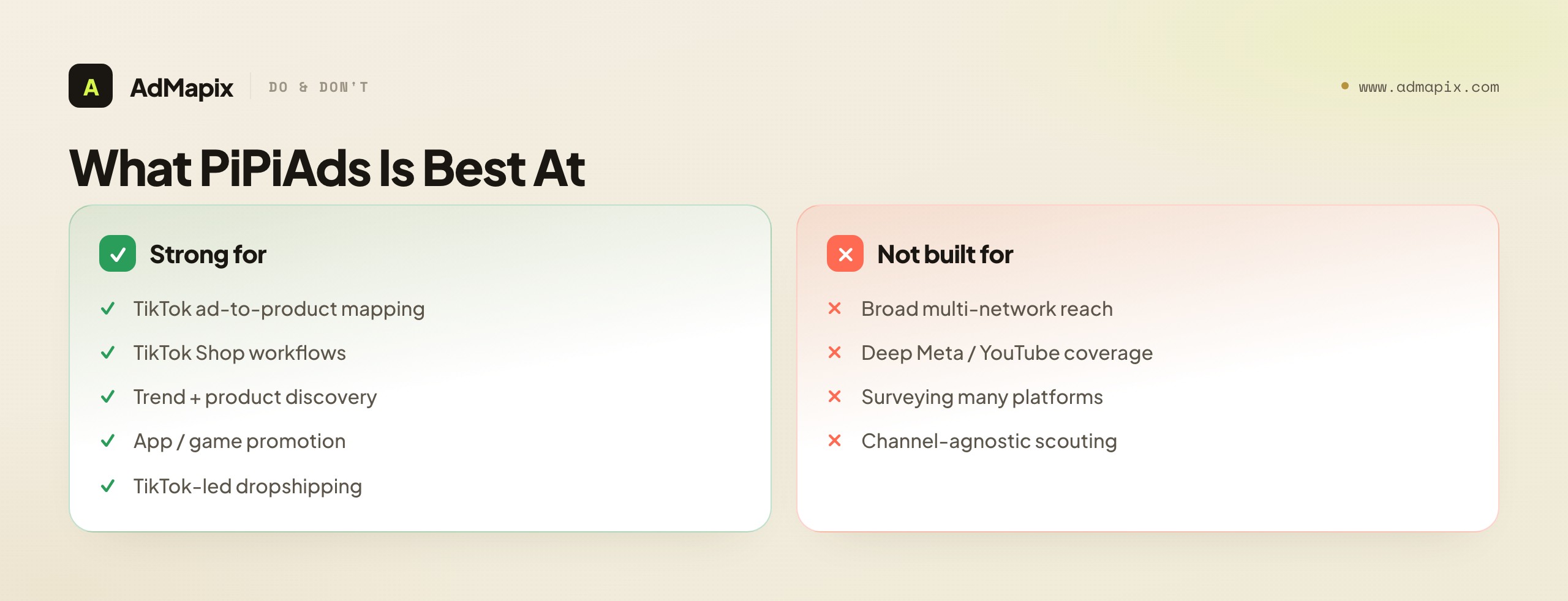
The TikTok-first design shows up in concrete strengths. Trend and product discovery surfaces what is gaining traction on TikTok specifically, which is a sourcing and creative shortlist tuned to the platform's fast-moving culture. TikTok Shop workflows connect ads to the commerce layer where a growing share of TikTok GMV now flows. And app and game promotion coverage serves the UA teams whose installs come heavily from TikTok. Across all of these, the common thread is depth on one ecosystem rather than a thin layer across many.
Best fit: TikTok-led ecommerce, dropshipping, and app/game teams whose acquisition lives on TikTok and whose research output is a TikTok product test or a TikTok creative brief. If your weekly question is "what is winning on TikTok right now and how do I test it," PiPiAds is built for that finish line. The tighter the loop between "I found a TikTok product" and "I can source and test it," the more PiPiAds's ad-to-product design pays off — it is built to keep you inside that loop rather than bouncing you out to separate sourcing and research tools.
Where it falls short: PiPiAds is less useful when the brief spans many networks. If your competitors run heavily on Meta, Google, and YouTube and TikTok is only one slice, PiPiAds's narrower surface will leave gaps a breadth-first tool would fill. It trades reach for depth, which is exactly the right trade for a TikTok-first team and the wrong one for a multi-platform scout.
A specific failure mode worth naming: buying PiPiAds as a general ad spy tool and being disappointed by its non-TikTok coverage. A team whose acquisition is split across Meta, Google, and TikTok that picks PiPiAds expecting it to cover everything will find the Meta and YouTube surfaces thinner than a generalist's, not because PiPiAds is weak but because they bought a TikTok specialist for a multi-platform job. The depth that makes PiPiAds excellent on TikTok is the same focus that makes it narrower elsewhere. Recognize the mismatch before you blame the tool — and conversely, a TikTok Shop seller who tries to run their whole sourcing operation out of a general library will be equally frustrated, because the product-and-funnel context they need on TikTok simply is not there.
Worth emphasizing for TikTok-led teams: PiPiAds's value compounds when TikTok is a recurring acquisition channel, not an experiment. A team launching a new TikTok product test every week gets far more from the trend feed and ad-to-product mapping than a team dabbling in TikTok once a quarter. If TikTok decisions are frequent, the product-attached depth is the difference between a fast, confident sourcing call and an afternoon of reverse-engineering what an ad sells. If TikTok is a rare side experiment, a free general library plus manual checks may cover you, and PiPiAds's pricing is harder to justify. Frequency of the TikTok decision, not just its existence, should drive whether PiPiAds earns a permanent seat.
What BigSpy Is Best At
BigSpy is strongest when you need breadth: a large ad library you can search across multiple platforms to find creative inspiration and track competitors. It leans into niche search, top-ad tracking, and audience signals such as country, time, and gender preferences attached to ads. If your weekly question is "what creatives are working across my space, on every platform, right now," BigSpy's wide net is the right instrument — and its low entry price keeps broad scanning affordable.
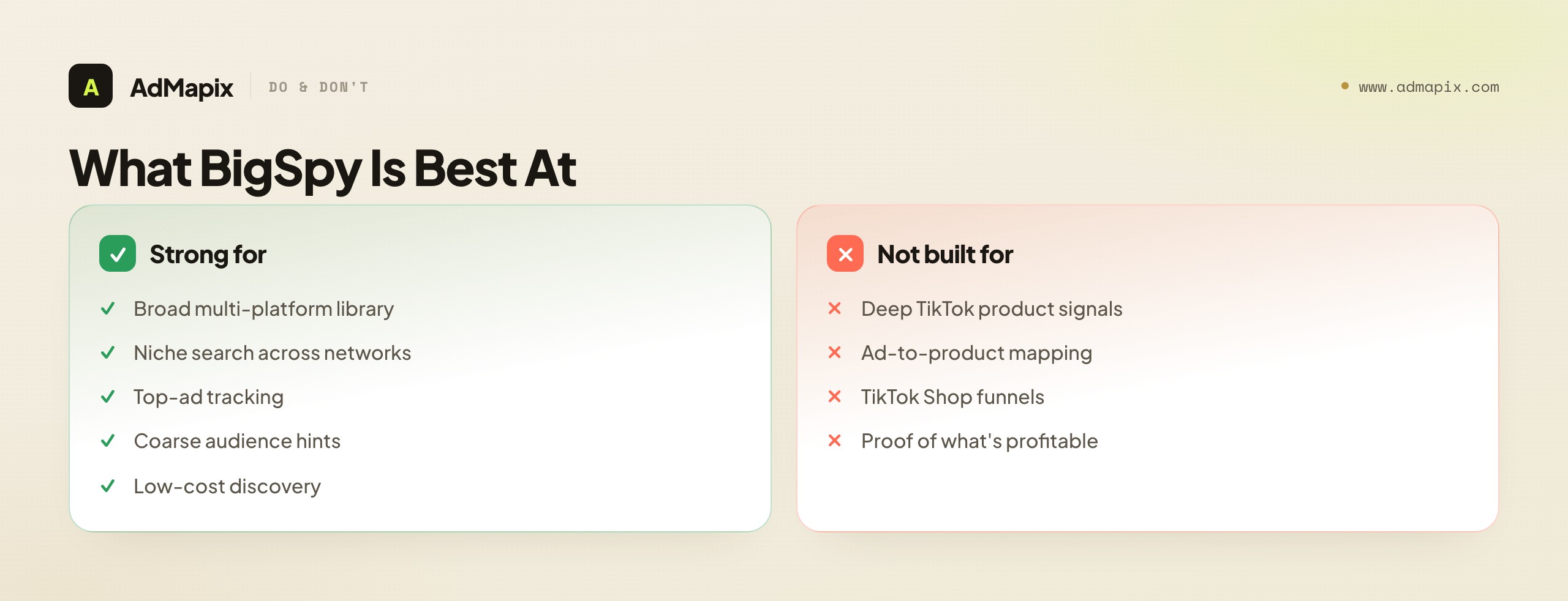
The breadth-first design has concrete strengths. Cross-platform coverage lets you study how a competitor advertises on Meta, TikTok, and YouTube in one place, rather than juggling specialist tools per channel. Niche search scans a whole category for trending angles across networks, which is how creative strategists spot the hook that is suddenly everywhere. And the audience tags give a coarse starting read on who a competitor seems to be targeting. For a media buyer or strategist whose job is producing a steady stream of cross-platform angles, that wide, cheap net is exactly right.
Best fit: media buyers, creative strategists, and agencies who want broad multi-platform browsing and competitor tracking as a recurring habit. If your weekly output is "three new creative angles across the platforms we run," BigSpy's breadth feeds that finish line. It is especially suited to teams that produce creative volume — agencies and performance shops shipping many tests a week — because the wide net keeps the idea pipeline full and the low entry cost keeps it affordable even at high search volume.
Where it falls short: less depth on TikTok product and shop signals. BigSpy will show you TikTok ads, but it will not map them to products, stores, and TikTok Shop funnels the way PiPiAds does — so for a TikTok commerce seller, the very signal that matters most is the one BigSpy is thinnest on. Its breadth is a strength for scanning and a weakness for drilling, which is the inverse of PiPiAds. Treat BigSpy's audience tags as hypotheses too: they are inferred from public data, not pulled from a competitor's account, and never confirm results.
Side-by-Side Comparison
Use this table to map each tool to the decision it supports. Read it by the decision a row changes, not by counting features.
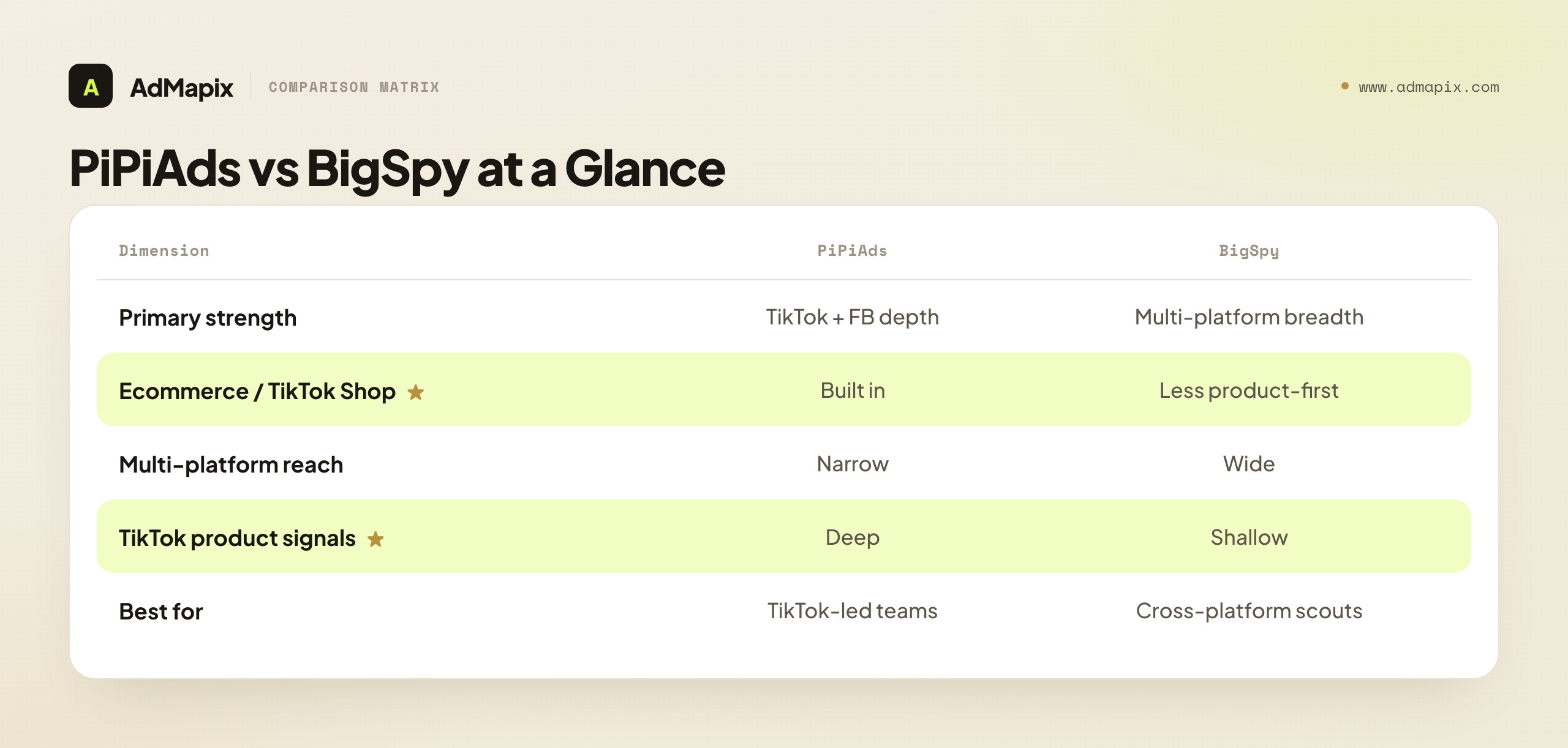
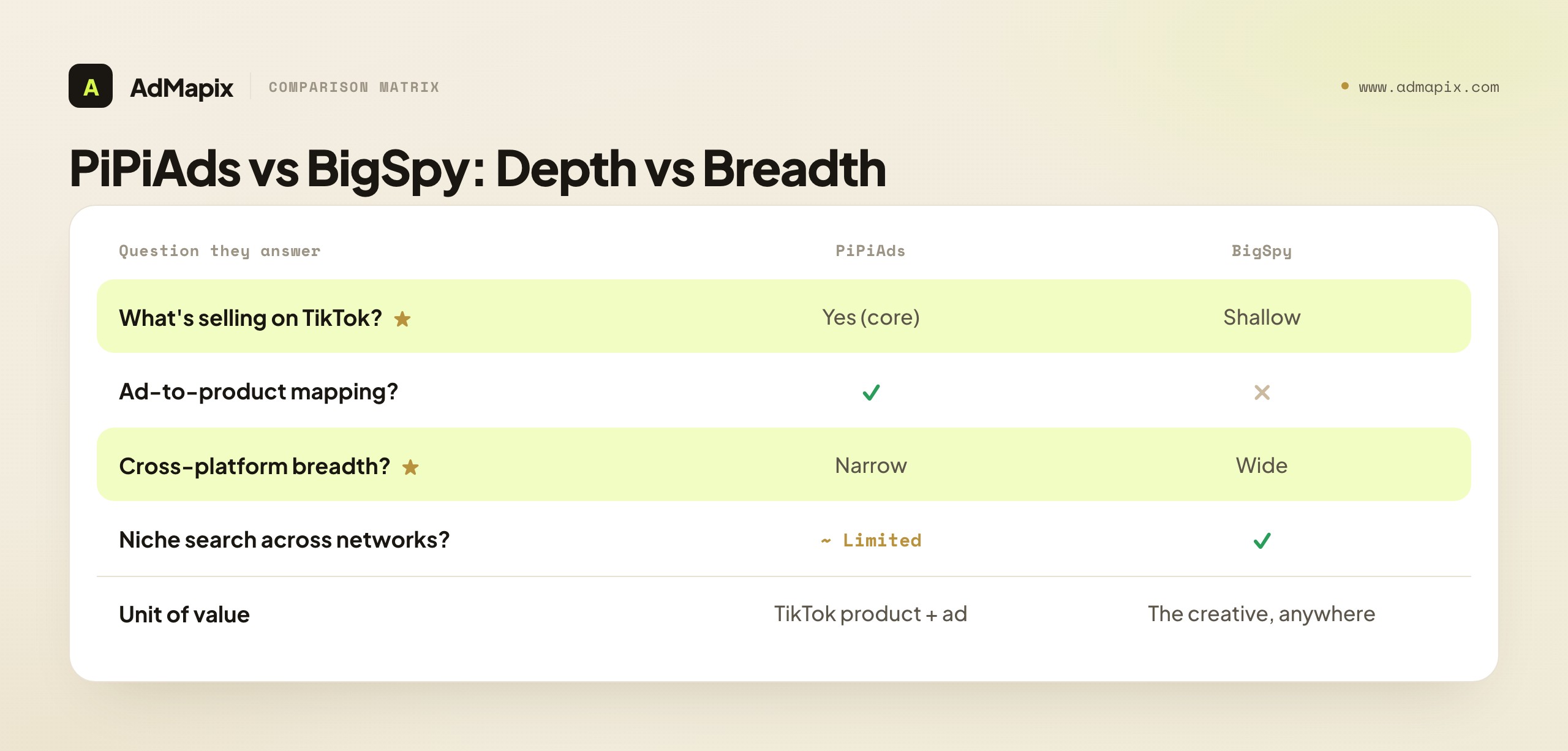
| Dimension | PiPiAds | BigSpy |
|---|---|---|
| Primary strength | Depth on TikTok and Facebook ad intelligence | Breadth across many ad platforms and niches |
| Best discovery mode | Trend and product discovery, ad-to-product mapping | Niche search, browsing, and ad tracking |
| Ecommerce / TikTok Shop | Product and landing-page workflows built in | Inspires angles but is less product-research-first |
| Multi-platform reach | Narrower, TikTok/Facebook-centric | Wider, spans Meta, TikTok, YouTube, and more |
| TikTok product signals | Deep (a core feature) | Shallow |
| Who it suits | TikTok-led ecommerce, dropshipping, app/game teams | Teams gathering broad cross-platform references |
| Where it falls short | Less useful when the brief spans many networks | Less depth on TikTok product and shop signals |
Pricing, plan names, credit rules, and free-tier limits change, so verify them on each official pricing page before you buy. The one row that should drive your decision is "multi-platform reach" versus "TikTok product signals" — those two lines, matched against where your acquisition actually happens, settle the choice faster than anything else in the table.
Read the table by your channel first and your output second. If TikTok is where your sales come from, the "TikTok product signals: deep" row alone justifies PiPiAds, almost regardless of the other rows — that single capability is the one that moves a TikTok commerce business. If your sales come from many platforms, the "multi-platform reach: wide" row alone justifies BigSpy, because no amount of TikTok depth helps you read a competitor running primarily on Meta and YouTube. The other rows are tie-breakers and texture; those two are the decision. A common error is to weigh every row equally and end up paralyzed — when in reality one row, matched to your channel, should dominate the rest.
TikTok Depth in Detail: Why It Matters for Commerce
The phrase "TikTok depth" is abstract until you see what it buys a commerce operator, so it is worth unpacking — because this is the single dimension where PiPiAds and BigSpy diverge most.
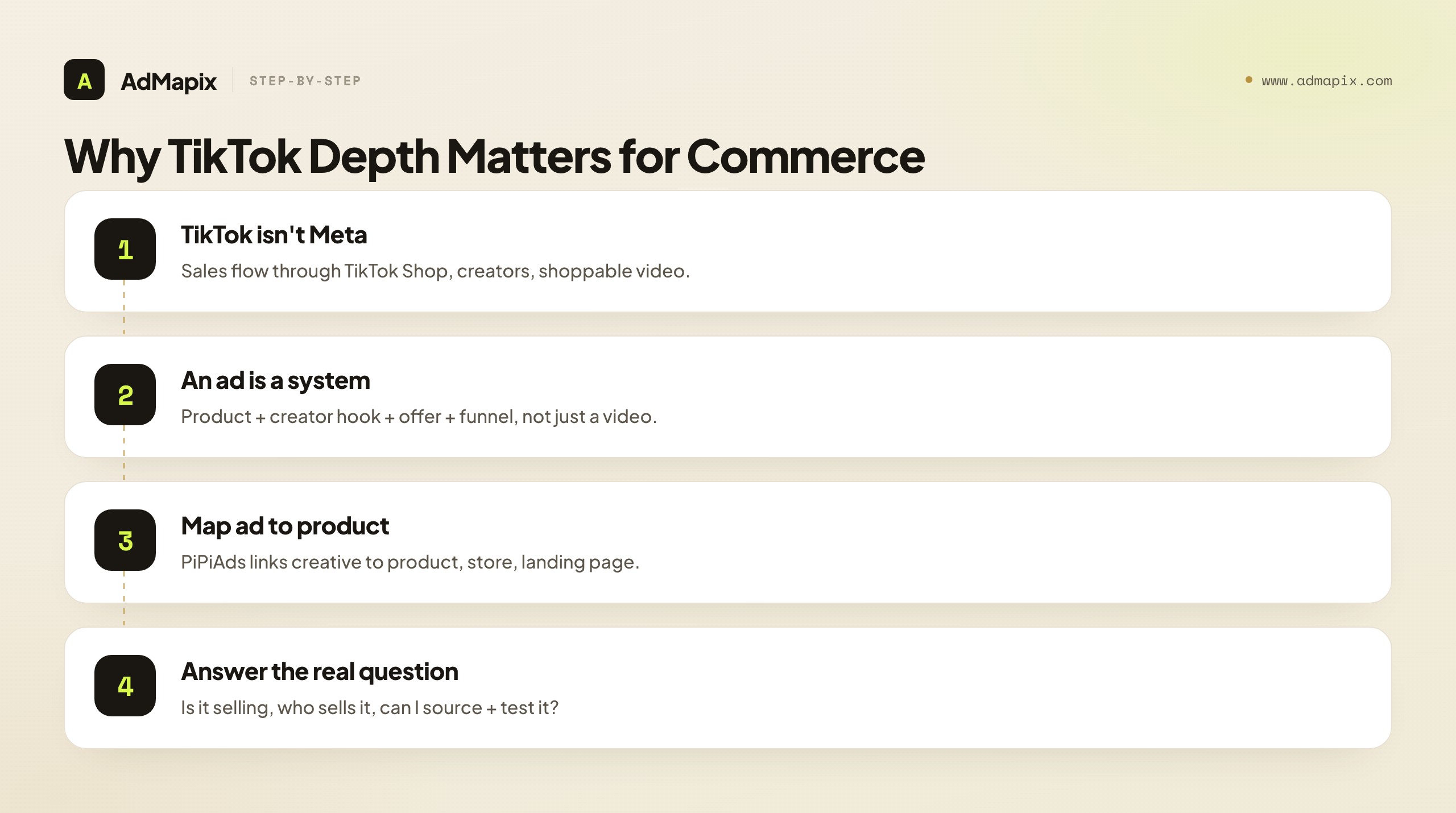
TikTok commerce is not Meta commerce. A growing share of TikTok sales flow through TikTok Shop, affiliate creators, and shoppable video, which means a TikTok ad is rarely just a creative — it is one node in a product-creator-offer-funnel system. Reading a TikTok competitor well means reading that whole system: which product they push, which creator-style hook they use, which offer anchors the sale, and which path leads to checkout. A tool that shows you only the video, divorced from the product and funnel, shows you half the picture on TikTok specifically.
This is where PiPiAds's ad-to-product mapping earns its keep. By connecting a TikTok ad to its product, its store, and its landing page, it lets a TikTok Shop seller answer the questions that actually matter for commerce: is this product selling, who is selling it, how is the offer framed, and could I source and test it? BigSpy can show you the same TikTok ad, but without the product-and-funnel context attached, leaving the seller to reverse-engineer what the ad is even selling. For a TikTok-first commerce team, that missing context is the difference between a fast sourcing decision and an afternoon of detective work.
The honest flip side: if you are not a TikTok commerce operator — if TikTok is one channel among several and you care about creative angles rather than product sourcing — this depth may be more than you need, and BigSpy's breadth across platforms serves you better. Depth on TikTok is a superpower for a TikTok Shop seller and overhead for a multi-platform brand scout. Match the depth to whether TikTok commerce is your core job or a side channel.
A concrete example makes the depth difference tangible. Imagine both tools surface the same TikTok ad for a portable neck fan. In PiPiAds, the surrounding context is "this product is trending on TikTok, here is the store selling it, here is the price and the landing page, here is how the offer is framed." You walk away knowing whether to source and test the product. In BigSpy, the surrounding context is "this video ad is running on TikTok and Meta, in these countries, skewing toward this audience, and here are similar ads from other advertisers." You walk away knowing how to advertise a neck fan, if you already sell one. Same ad, two completely different takeaways — because each tool wraps the ad in the context its job needs. For a TikTok Shop seller, the PiPiAds takeaway is the one that moves the business; for a multi-platform creative strategist, the BigSpy takeaway is.
This is also why "TikTok depth" is not a feature you can bolt onto a breadth-first tool by adding a TikTok filter. The depth comes from the data model — from indexing the product, store, and funnel alongside the creative, not just the creative. A breadth-first library that adds a "TikTok" checkbox still shows you the video without the commerce context, because the context was never captured. That is why a TikTok Shop seller genuinely needs a TikTok-first tool and cannot simulate it by filtering a general library to TikTok: the missing data is structural, not a filter away.
Multi-Platform Reach in Detail: Why Breadth Wins for Scouts
The inverse dimension is breadth, and it is where BigSpy's design pays off — for the teams whose job is surveying, not drilling.
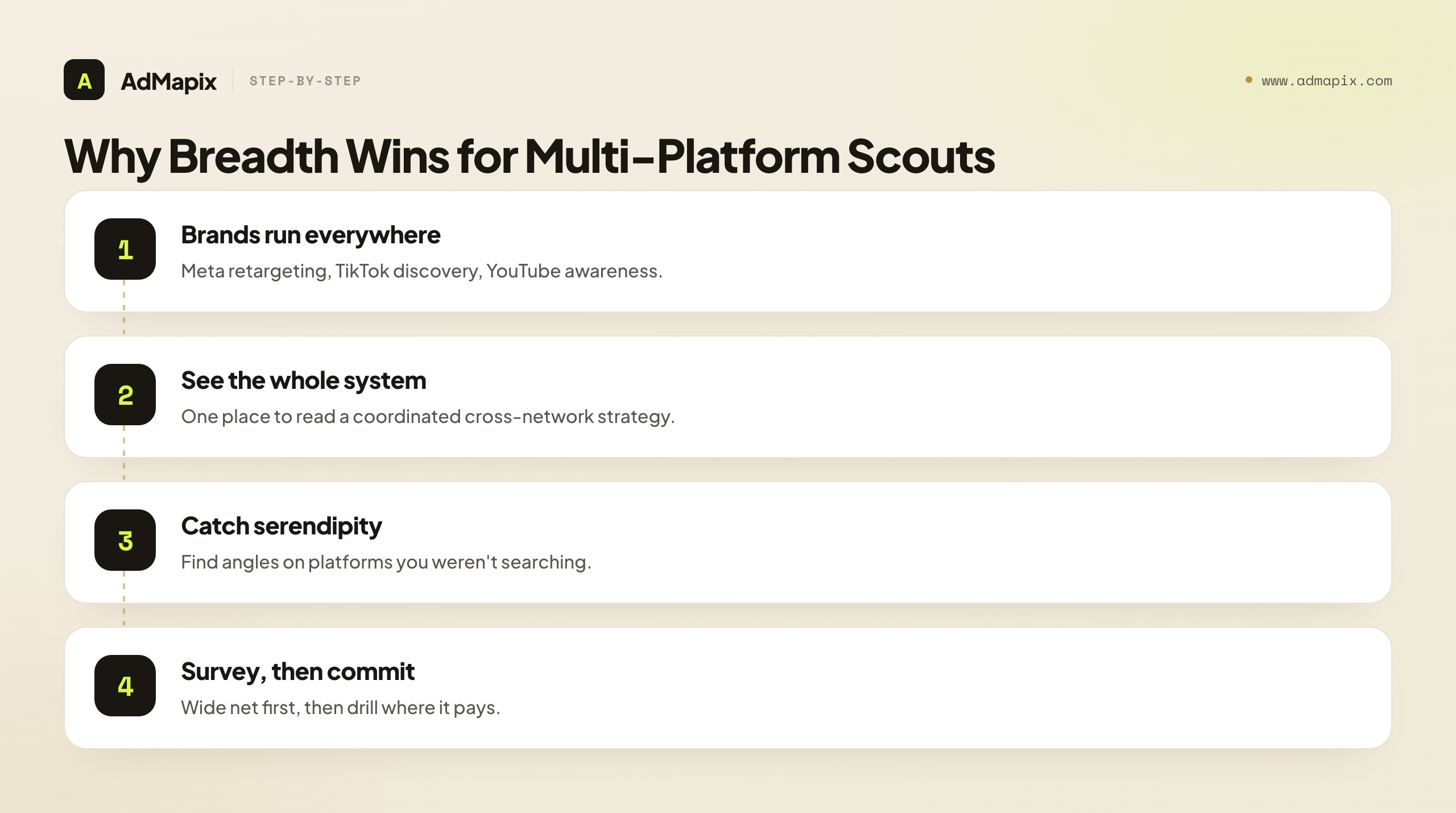
A multi-platform brand rarely lives on one network. A DTC competitor might run Meta for retargeting, TikTok for discovery, and YouTube for awareness, and understanding their whole paid strategy means seeing all three at once. A specialist tool that goes deep on TikTok shows you one slice and leaves you blind to the rest. BigSpy's breadth is built for exactly this: load a competitor and see how they advertise across networks in one place, which is the only way to read a brand that treats its platforms as one coordinated system.
Breadth also wins for exploration. When you do not yet know which channel a competitor favors, or which platform a trend is starting on, a wide net surfaces the answer where a narrow one would miss it. Creative strategists prize this serendipity — the angle you find on a platform you were not specifically searching is often the most valuable, precisely because your competitors searching only their main channel will miss it. A specialist tool, by design, filters that serendipity out.
The honest flip side, again: breadth costs depth. BigSpy's wide coverage means shallower per-platform signals, so on TikTok commerce specifically it cannot match PiPiAds's product mapping. If your job is to survey many fields, that trade is correct. If your job is to drill one well — TikTok Shop — the breadth is wasted and the missing depth hurts. The tools are mirror images: each is strong exactly where the other is weak, which is why "which is better" has no answer without "for what channel?"
There is a discipline that makes BigSpy's breadth pay rather than overwhelm. The same wide net that surfaces serendipitous angles also surfaces a lot of noise — saturated creatives, low-quality ads, brand campaigns that tell you nothing about performance. A disciplined BigSpy user filters and reads for patterns (the same hook across many advertisers, the same offer recurring) rather than getting lost in volume. An undisciplined user scrolls for an hour, saves twenty unrelated ads, and produces no decision. Breadth rewards a clear research question and punishes aimless browsing, so before each BigSpy session, write the one question you are answering. Without it, the breadth that is BigSpy's strength becomes a time sink. This is the cost of generality: the tool gives you everything, and it is on you to know what you came for.
It is worth being precise about BigSpy's audience signals too, since they appear in its breadth pitch. The country, time, and gender preferences attached to ads are inferred from public data, not pulled from a competitor's account. They are a reasonable starting hypothesis — "this brand seems to skew younger in these markets" — but they are not the competitor's actual targeting, and certainly not their results. Treat them as a lead to test in your own account, never as a targeting blueprint to copy. A breadth-first tool gives you more of these coarse signals across more platforms, which is useful for forming hypotheses fast, as long as you remember they are hypotheses.
Pricing: Two Different Shapes
Price reflects the two tools' different audiences, and comparing headline numbers without matching to your channel will mislead you.
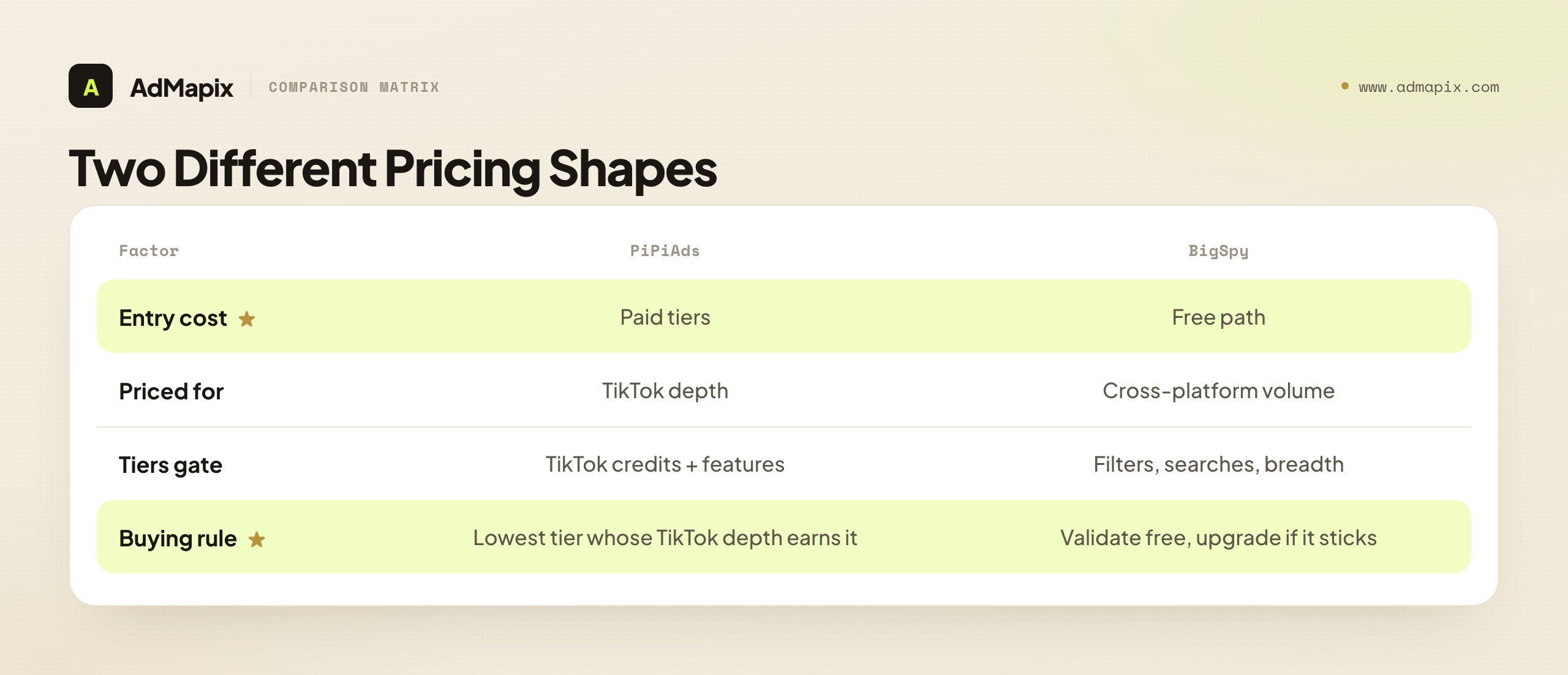
BigSpy's ladder starts free. It offers a free entry path plus paid plans, making its starting cost the lowest and letting you validate result quality before spending. The free tier gates filters, searches, and breadth, so it is a validation tool more than a permanent workflow — plan to upgrade if it earns a recurring place. The low entry price suits the high-volume, price-sensitive creative-discovery audience BigSpy courts.
PiPiAds is priced around TikTok depth. It publishes paid tiers (with credit and feature limits) built around TikTok ad and product research rather than raw multi-platform volume. Because PiPiAds is a specialist, its pricing reflects the value of the deep TikTok signals it provides — for a TikTok Shop seller, even a higher tier can be cheap against the margin one good sourced product returns. The buying rule mirrors the others in this category: pay for the lowest tier whose TikTok features map to decisions you actually make weekly.
| Pricing factor | PiPiAds | BigSpy |
|---|---|---|
| Entry cost | Paid tiers | Free path available |
| Priced for | TikTok-first product + ad research | Volume cross-platform discovery |
| What tiers gate | TikTok credits, product/shop features | Filters, searches, platform breadth |
| Buying rule | Lowest tier whose TikTok depth earns it | Validate free, upgrade if it sticks |
| Annual discount | Typically yes | Typically yes |
The honest framing: the two prices are not directly comparable because you are buying different things. BigSpy's free tier looks cheaper, but for a TikTok Shop seller a free multi-platform browser that lacks deep TikTok product signals is not cheap — it is missing the signal that matters most, at any price. Compare cost per useful output for your channel, not cost per month. Always verify the live pricing pages before buying, because plan names, credits, and discounts change in this category, and prefer validating on a monthly plan before locking into an annual discount — committing annually before you know your real usage is the most common way teams overpay.
A practical way to think about value here: estimate how many useful outputs each tool produces for you per month and divide the price by that. If PiPiAds gets a TikTok dropshipper to four sourceable, validated product candidates a month, the per-decision cost of even a higher tier is trivial against the margin one good TikTok product returns. If BigSpy's free tier gets a strategist to a dozen cross-platform angles a month, its per-output cost is effectively zero. The error is comparing monthly sticker prices directly as if the two tools produced the same kind of output — they do not, so the sticker comparison is meaningless. A tool is expensive only relative to the value of the decisions it speeds up, and for the wrong channel, even a free tool is infinitely expensive because it never produces the output you needed.
Watch the credit structure too, not just the headline tier price. TikTok-research tools often meter usage in credits or searches, so a low PiPiAds tier can run out mid-month if your sourcing volume is high. Map your actual weekly TikTok-research volume to the tier limits before committing, and treat the first month as paid validation rather than the start of a year-long contract. The teams that overpay almost always did so by committing to a high annual tier before running the simple side-by-side test that would have told them what they actually needed.
How to Test PiPiAds vs BigSpy Before You Buy
A feature list tells you what a tool can do; a side-by-side run on your real channel tells you what it does for you. This test takes an afternoon and beats any review.
- Name your channel and finish line. Is your acquisition TikTok-first, ending in a TikTok product test? Or multi-platform, ending in a cross-network creative brief? Write it down before opening either tool — the answer largely predicts the winner.
- Fix the inputs. Use the same three to five competitors or products, the same countries, and the same time window in both tools. Otherwise you are comparing the care you put into each search, not the tools.
- Run your actual job in each. For TikTok commerce, see which tool gets you to a sourceable product with store and funnel context faster. For multi-platform scouting, see which gives you a fuller cross-network picture faster.
- Inspect the evidence, not the count. For PiPiAds, judge the quality and freshness of TikTok product mapping. For BigSpy, judge cross-platform coverage and the relevance of what the breadth surfaces. A bigger number that is thin in your channel loses to a smaller one that is dense.
- Validate outside the tool. Whatever you find — a TikTok product or a creative angle — is a hypothesis. Confirm with your own ad account, store analytics, and margins before committing budget or inventory.
The reason this test is decisive: the two tools are optimized for different channels, so the "winner" depends entirely on yours. A TikTok-first job will rightly prefer PiPiAds; a multi-platform job will rightly prefer BigSpy; and the only way to know which dominates your week is to run your real work through both and watch which produces an output you would actually act on.
One practical tip while testing: time yourself honestly, and judge the output you would hand to a colleague, not the feeling of which interface is nicer. A tool can have a slicker dashboard and still get you to a worse decision slower, while a plainer one gets you to a sourceable product or a testable angle faster. The dashboard is not the deliverable. Score each tool on the single question that matters — did running my real job in it produce something I would actually act on, and how long did it take — and the prettier-but-slower option loses every time. This is also why a free trial or the free tier matters more than any review: thirty minutes of your own competitors in each tool tells you more than a thousand words of comparison, because it surfaces exactly how each tool behaves on your channel, with your products, which no generic test can replicate.
What Public Ad Data Can and Cannot Prove
Be clear about the ceiling of any ad spy tool: it shows you what competitors are running, not whether those ads work. Both PiPiAds and BigSpy surface creatives, formats, and sometimes engagement proxies, but none of that confirms profitability — and this applies identically to every tool in the category.
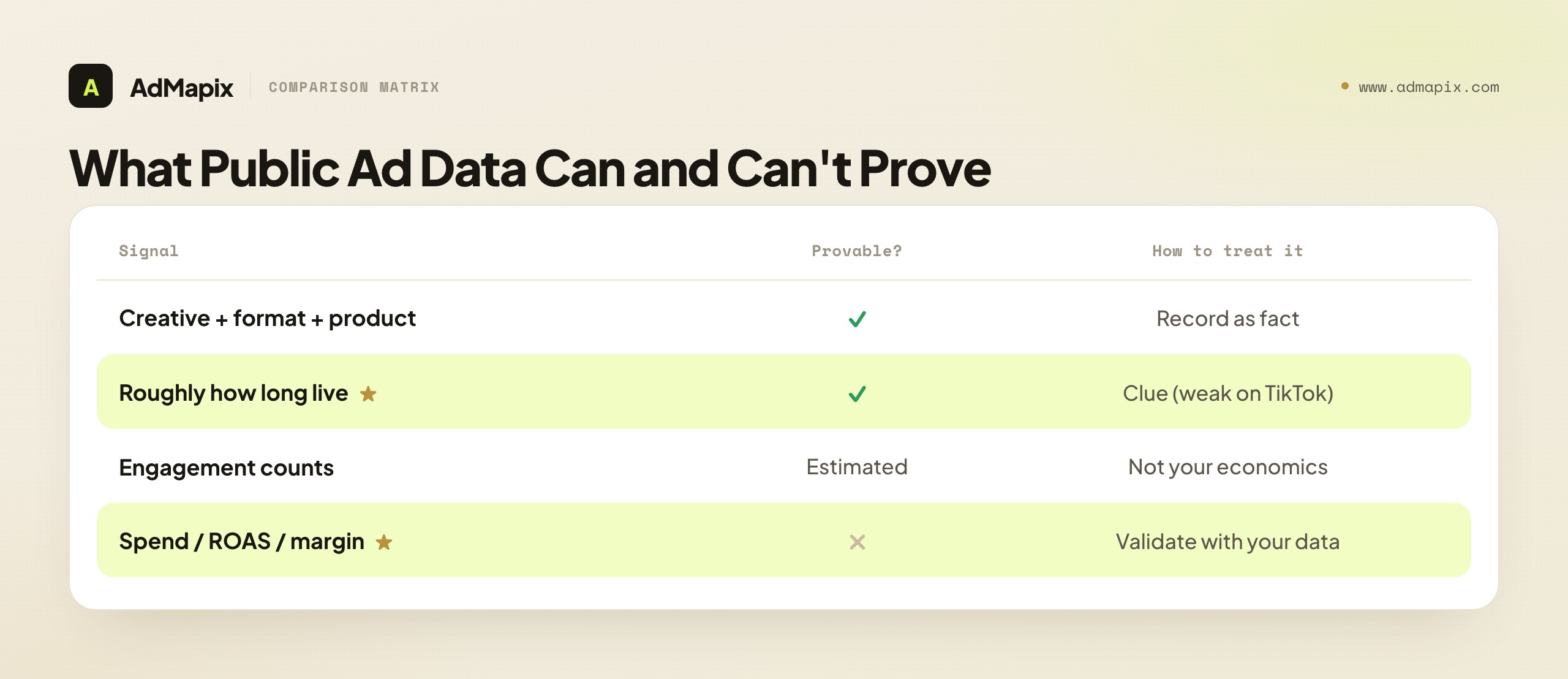
What public data can prove: that a creative is live, what format and hook it uses, roughly how long it has been running, and which products or pages it points to. A long-running ad is a reasonable signal of a working angle, because advertisers rarely keep obvious losers live — though on TikTok specifically, creative fatigues fast, so a "long-running" TikTok ad is a weaker signal than a long-running Meta one, and you should weight repetition across creators and recency over raw run-days.
What it cannot prove: actual spend, return on ad spend, conversion rate, or margin. Engagement metrics shown in these tools are estimates or platform-reported counts, not your unit economics. A TikTok product that looks like it is "winning" might be winning for a seller with a supplier relationship or an ad account you cannot replicate — and lose money for everyone who copies it late. Treat every competitor ad and every winning-product signal as a hypothesis to test, never as proof to copy.
The only thing that validates a hypothesis is your own ad account, store, and product data. Use these tools to find patterns worth testing; use your own numbers to decide whether the pattern works for you. Tool choice does not change this rule — PiPiAds's TikTok depth and BigSpy's cross-platform breadth both produce evidence of activity, never evidence of profit. The team that remembers this researches well with either; the team that forgets it scales a competitor's "winner" that was never winning, or sources a hot TikTok product that loses money on its economics.
This limit lands especially hard on the TikTok product side, and it is worth spelling out because it is the costliest misread for TikTok commerce teams. A "winning product" or a viral TikTok ad tells you a product is getting attention — many ads, growing stores, repeated creator posts. It does not tell you the product is profitable for you, because your margin depends on your sourcing cost, your fulfillment, your ad efficiency, and your timing — none of which the tool can see. Plenty of products that look like TikTok winners are winning for an early seller with a supplier edge or a creator network you cannot replicate, and lose money for everyone who copies them once they are loudly viral. The honest read of a TikTok winning-product signal is "here is a product with demand worth testing at small scale," never "here is a guaranteed winner to stock deeply." The teams that lose money on TikTok product research read attention as profit and order inventory before testing; the ones who succeed treat every signal as a small, cheap test against their own economics first — and they move early, because by the time a TikTok product is obviously winning, the easy margin is usually gone.
Common Mistakes When Choosing Between PiPiAds and BigSpy
Most regret in this decision traces back to a few avoidable errors.
- Choosing on database size alone. A bigger library is worthless if its search does not answer the decision in front of you. Pick the tool that fits your channel, not the one with the bigger number.
- Treating competitor ads as proof. Live ads and engagement counts create hypotheses; only your owned metrics and business outcomes validate them.
- Ignoring channel fit. TikTok-first, Meta-first, ecommerce-first, and app-first workflows need different tools, and buying against your channel wastes the subscription. Buying BigSpy for deep TikTok commerce, or PiPiAds for multi-platform scouting, is the classic mismatch.
- Reading TikTok longevity like Meta longevity. TikTok creative fatigues in days; a long-running TikTok ad is a weaker winner-signal than a long-running Meta ad. Weight recency and creator repetition.
- Relying on screenshots for reporting. Loose screenshots do not scale when a client or stakeholder needs repeatable, sourced evidence. Neither tool is a strong reporting instrument on its own.
- Copying creatives or products outright. Use examples to understand patterns, then do the brand, legal, margin, and differentiation work yourself. A copied TikTok product on worse economics loses money even if it was a winner for someone else.
- Committing annually before validating. Both tools offer annual discounts that look attractive until you are locked into a tool whose channel focus turns out not to match your job. Validate monthly first, then commit.
The two errors that cost the most are the first two on this list, and they share a root: confusing a signal of activity with proof of profit. A bigger database and a busier trend feed both feel like more certainty, but neither adds a single data point about whether something is profitable for you. The discipline that prevents both mistakes is the same: treat the tool as a generator of hypotheses, and reserve the word "winner" for things your own data has confirmed. Teams that hold that line research well with either PiPiAds or BigSpy; teams that drop it lose money regardless of which they bought, because the failure was never the tool — it was reading activity as outcome, which no tool can fix.
There is a TikTok-specific version of this trap worth flagging separately, because it catches even disciplined operators. TikTok's culture rewards speed, and a product can go from unknown to saturated in days. A trend feed that shows a product "taking off" is, by the time you see it loudly, often already crowded — the early sellers with supplier relationships and creator networks have moved, and the easy margin is gone. The discipline here is to weight early, quieter signals over loud, obvious ones, and to move on a small test fast rather than waiting for certainty that, on TikTok, arrives only after the opportunity has. PiPiAds's depth helps you spot the earlier signal; BigSpy's breadth helps you confirm a trend is cross-platform rather than a TikTok flash. Either way, the operator's edge on TikTok is speed-with-discipline: test early, test cheap, and let your own numbers — not the feed's excitement — decide whether to scale. The team that waits for a TikTok product to be unambiguously winning before testing it is, by definition, late.
When a Cross-Network Evidence Layer Helps
Once research is no longer browsing but building evidence — when the same competitors and products need weekly review and the findings have to travel to a team or client — a gap opens that neither PiPiAds nor BigSpy is built to close: turning scattered discovery into searchable, saved, reportable evidence across networks.
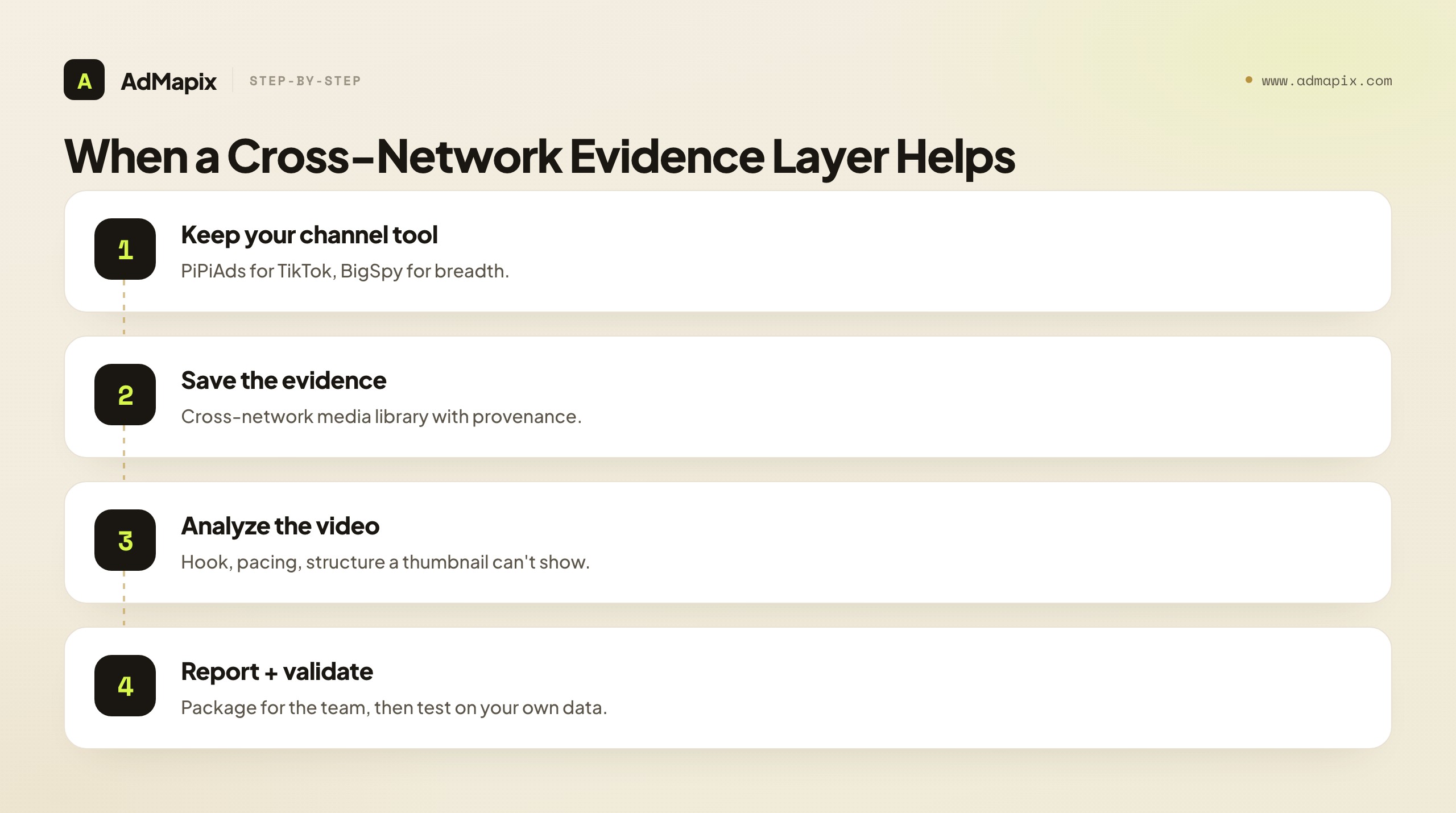
This is where a cross-network evidence layer like AdMapix fits — not as a replacement for either tool's strongest workflow, but as the piece that makes discovery repeatable and shareable. It is built for creative strategists, agencies, and ecommerce teams who need a competitor evidence layer that survives past a single session: search ad creatives across networks with Search, save the examples that matter in Media, break down video structure and hooks with Video Analysis that a static thumbnail cannot show, and turn patterns into a Report you can hand to a client or team. A practical stack pairs the channel-specific tool with a reporting layer rather than forcing one tool to do everything — PiPiAds for TikTok depth, BigSpy for cross-platform breadth, and the evidence layer where weekly review and reporting live. Compare access on Pricing once the process becomes repeatable, or sign in to try it on your own competitor set.
It is honestly not the right pick if you only need quick one-off TikTok product discovery — start with PiPiAds — or fast cross-platform browsing for inspiration, which BigSpy fits better. A cross-network evidence layer earns its place specifically when observed creatives have to become structured, shareable evidence for a recurring workflow, not a one-off look. The clearest way to see where it sits: PiPiAds answers "what's winning on TikTok?", BigSpy answers "what's running across platforms?", and an evidence layer answers "what did we learn, and what are we testing because of it?" — three different questions, and the third is the one that compounds into better creative over time.
For a TikTok-led team, the natural stack is PiPiAds to find the winning TikTok product and creative, then an evidence layer to break the video down and report on how to test it. For a multi-platform team, the stack is BigSpy to discover angles across networks, then the evidence layer to turn them into briefs that travel to the team. In both cases the discovery tool finds the raw material and the evidence layer turns it into a decision. Choosing PiPiAds vs BigSpy settles only the discovery front of that pipeline; the reporting back of it is a separate, complementary choice — and it is usually the back of the pipeline, not a deeper database, that is missing when competitor research keeps stalling at "we found some interesting ads" and never reaches "so we tested X and it worked."
For the broader landscape beyond these two tools, our guide to the best ad spy tools of 2026 compares the whole field by price, coverage, and use case. If TikTok is your focus, the best TikTok ad spy tools guide goes deeper on the TikTok-specific field, and TikTok Shop ad spy tools covers the commerce angle. The related Minea vs PiPiAds and PiPiAds alternatives breakdowns cover the adjacent product-research comparisons, and if you have decided BigSpy is not the right shape, BigSpy alternatives covers the migration paths.
FAQ
Is PiPiAds or BigSpy better for TikTok?
PiPiAds is usually the stronger first test for TikTok-first research. It maps ads to products and landing pages and is built around the TikTok Shop and dropshipping workflow, so it answers "what is selling on TikTok right now and how is it being advertised" more directly than BigSpy's broad browse. BigSpy will show you TikTok ads, but without the deep product-and-funnel context that TikTok commerce decisions need.
Is BigSpy broader than PiPiAds?
Yes. BigSpy is positioned around multi-platform ad intelligence and niche search across Meta, TikTok, YouTube, and other surfaces. PiPiAds is more concentrated on TikTok and Facebook ad intelligence and ecommerce signals, so it trades reach for depth. If your competitors run across many networks, BigSpy's breadth fits; if they live on TikTok, PiPiAds's depth fits.
What is the main difference between PiPiAds and BigSpy?
Depth versus breadth. PiPiAds is a TikTok specialist that maps ads to products, stores, and TikTok Shop funnels for commerce-led teams. BigSpy is a multi-platform generalist that indexes ads across many networks for broad creative discovery. PiPiAds is a depth gauge in one well; BigSpy is a wide survey across many fields.
Which tool is better for TikTok Shop dropshipping?
PiPiAds, for most dropshippers. Its ad-to-product mapping, TikTok Shop workflows, and product discovery are built for exactly the dropshipper's question of what to sell on TikTok and how it is being advertised. BigSpy can supplement the cross-platform creative side, but for the TikTok sourcing decision itself, PiPiAds's product-attached depth fits the workflow better.
Which tool is better for agencies?
It depends on the agency's clients. An agency running TikTok-heavy commerce clients leans PiPiAds; one running multi-platform brands leans BigSpy. Often the deciding factor is not the spy tool itself but the reporting layer on top of it, since both tools leave the agency to assemble client-ready evidence manually — which is where a cross-network evidence layer with saved media and reports helps.
How should I compare their pricing?
Check both official pricing pages live before deciding, because plan names, credit limits, discounts, and free-tier rules change frequently. BigSpy starts cheaper with a free path; PiPiAds is priced around TikTok depth. But compare cost per useful output for your channel, not headline price — a free multi-platform browser is not cheap if it lacks the TikTok product signals your job needs.
Do PiPiAds or BigSpy show real ad spend or ROAS?
No. They show live creatives, formats, and sometimes engagement estimates, but not real spend, ROAS, conversion rate, or margin. Engagement counts are estimates or platform-reported numbers, not your unit economics. Use them to form hypotheses, then validate with your own ad account and store data before scaling budget or inventory.
How do I read TikTok ad longevity correctly?
Carefully. TikTok creative fatigues fast, so a long-running TikTok ad is a weaker winner-signal than a long-running Meta ad — longevity on TikTok can mean a neglected affiliate post as easily as a scaled winner. Weight repetition across creators and recency over raw run-days, and treat any single long-running ad as one signal among several, not as proof of profit.
Can a tool like AdMapix replace PiPiAds and BigSpy?
Not always, but it can replace or supplement the discovery and reporting layer when cross-network search, video analysis, and reportable evidence matter most. Many teams keep a channel-specific tool — PiPiAds for TikTok depth or BigSpy for breadth — for its strongest workflow, and use a cross-network evidence layer as the analysis and reporting layer on top. It does not claim to show the spend or ROAS no public tool can.
Should I run both PiPiAds and BigSpy at once?
Usually only if you genuinely do both jobs — deep TikTok commerce research and broad multi-platform scouting — every week. For most teams, one channel dominates, and running both doubles cost for overlapping value. Diagnose whether your acquisition is TikTok-first or multi-platform, buy for that, and add the second tool only if a specific recurring gap justifies it.
Key Takeaways
- Choose PiPiAds for TikTok and TikTok Shop depth; choose BigSpy for broad cross-platform browsing. They are a depth-gauge-versus-wide-survey choice, not a bigger-database choice.
- Decide by the weekly job a tool unlocks, not by which database is largest. Your channel and finish line settle the winner.
- Treat every competitor ad and winning-product signal as a hypothesis, and validate with your own account, store, and product data before scaling.
- Read TikTok longevity carefully — fast fatigue makes a long-running TikTok ad a weaker winner-signal than on Meta; weight recency and creator repetition.
- Add a cross-network evidence layer when discovery has to become saved media, video breakdowns, and reportable evidence — the gap both tools leave once research turns into a weekly deliverable.
Authoritative Sources
- PiPiAds — positions itself as an AI-powered TikTok and Facebook ad spy and ad library for ecommerce, TikTok Shop, apps, games, and arbitrage use cases (as checked June 2026).
- PiPiAds pricing — public pricing page; verify plan names, discounts, and credit rules live before buying.
- BigSpy — emphasizes niche search, ad tracking, audience analysis, and multi-platform competitor ad research (as checked June 2026).
- BigSpy pricing — public pricing page; verify current free and paid plan limits before comparing cost.
Vendor positioning and pricing details above are as of June 21, 2026; check the official pages for the latest terms. Disclosure: AdMapix is our own product, and its data scope covers cross-network ad creative search, saved media, video analysis, tagging, and reports — separated from claims sourced to each vendor's own pages.
See what competitors are really running
Search 6M+ ad creatives, landing pages, and weekly spend across 200+ countries. No credit card, no commitment.
Related Articles
Semrush Ad Intelligence Alternative in 2026: PPC Research or Creative Evidence?
A 2026 decision framework for choosing a Semrush ad intelligence alternative — when PPC keyword and spend research wins, when competitor creative and video evidence wins, how AdClarity fits, a fair-trial method, and how to build a two-layer stack.

Moat Alternative in 2026: Ad Verification vs. Creative Intelligence
A complete 2026 buyer's guide to choosing a Moat alternative — why teams look past Oracle Moat, what Moat actually does (viewability, invalid traffic, brand safety), the critical split between the ad-verification layer and the creative-intelligence layer, a layered comparison across coverage and fit, who should choose which, a practical migration plan, the honest limits of public creative data, and where a creative-research tool like AdMapix fits.
Pathmatics Alternative in 2026: Ad Spend Intelligence vs. Creative Workflow
A complete 2026 buyer's guide to choosing a Pathmatics alternative — why teams look past Pathmatics (now Sensor Tower), what it actually measures, a layered comparison of spend-intelligence suites versus creative-workflow tools across coverage, data type, price, and fit, who should choose which, a practical migration plan, the honest limits of estimated spend, and where a lighter cross-network creative tool like AdMapix fits.