Minea vs BigSpy in 2026: Ecommerce Product Research or Broad Ad Library?
A 2026 head-to-head of Minea vs BigSpy — product-and-sourcing research versus broad cross-platform ad discovery, compared on coverage, signals, pricing, and use-case fit, with a test-before-you-buy method, what public ad data can and cannot prove, and where a creative-evidence layer fits.
By the AdMapix Research Team — Updated June 21, 2026
Minea vs BigSpy in 2026: Ecommerce Product Research or Broad Ad Library?
Minea vs BigSpy is not a contest between two ad libraries of different sizes — it is a choice between two fundamentally different research jobs. Pick Minea if your research ends in a product or sourcing decision: it is built around ecommerce product discovery, daily winning products, and the shops and suppliers behind the ads. Pick BigSpy if your research ends in creative inspiration across many platforms: it is built around a large, multi-platform ad library you scan to study hooks, track competitors, and pull angles. The two tools barely overlap in purpose, which is exactly why comparing them on "which has more ads" misses the point entirely. This 2026 guide is for ecommerce operators, dropshippers, media buyers, agencies, and founders deciding between the two. It explains what each is genuinely good at, how they differ on coverage and signals and price, how to test them before you pay, what public ad data can and cannot prove, and where a cross-network creative-evidence layer fits once browsing stops being enough.
TL;DR — Minea vs BigSpy in One Screen
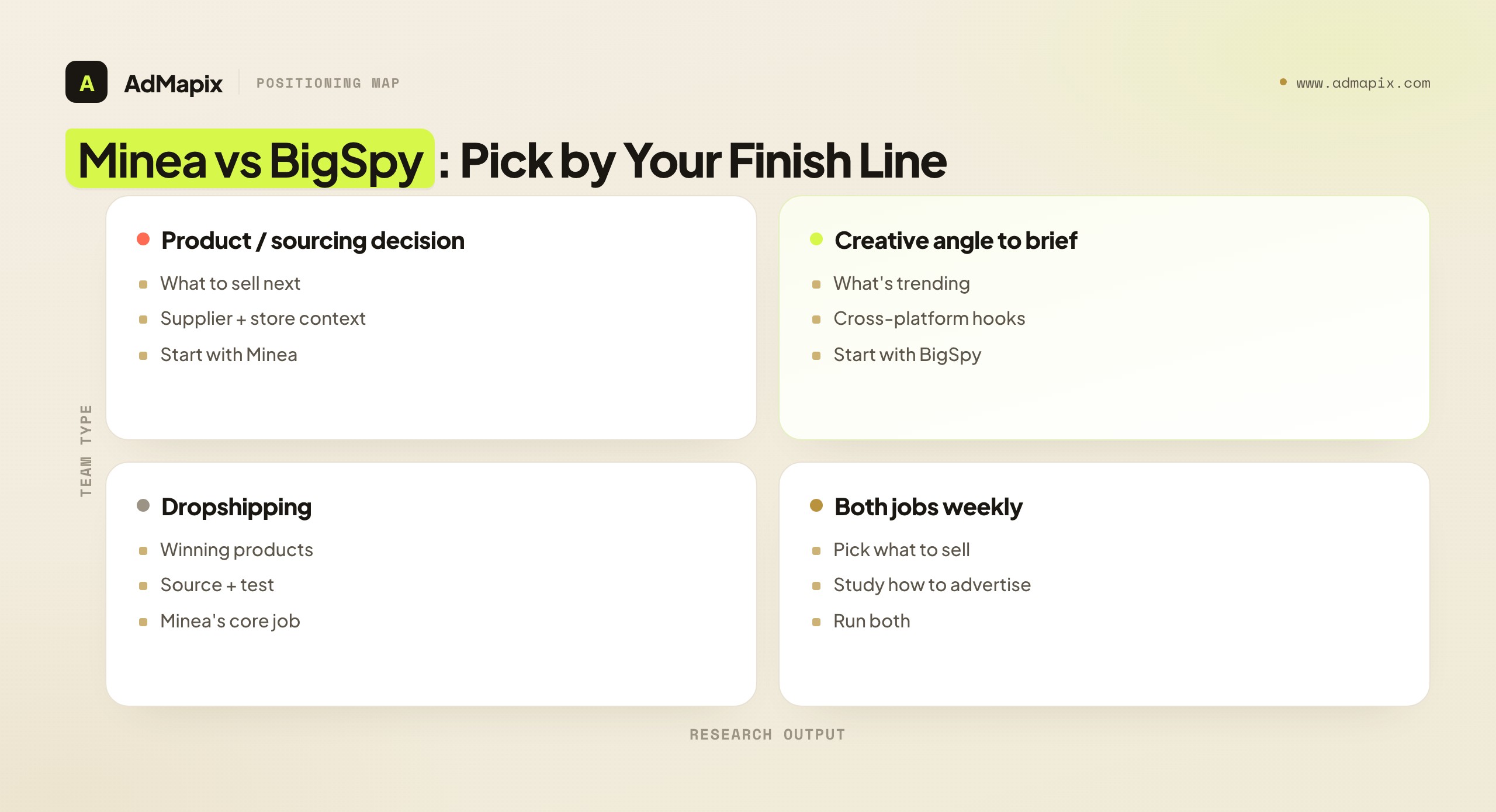
- Minea fits product-led teams. When product, supplier, and store context drive your next decision — "what should we sell or source next?" — Minea keeps that context attached to the creative instead of leaving you with an orphaned ad.
- BigSpy fits creative-discovery teams. When you need broad creative browsing across Meta, TikTok, YouTube, and more — "what's working across my space right now?" — BigSpy's wide, cheap net is the better fit.
- A bigger database does not win on its own. The right tool is the one that gets you from an ad to a product test, creative brief, or client recommendation faster.
- They are complements as often as competitors. Many teams use Minea to decide what to sell and BigSpy to study how others advertise it — different stages of the same workflow.
- Neither proves performance. No public tool exposes a competitor's true spend, ROAS, margin, or conversion rate. Every finding is a hypothesis to validate with your own store and account data.
- A creative-evidence layer (such as AdMapix) is worth adding when you need searchable cross-network creatives, video breakdowns, saved media, and shareable reports rather than only a feed to scroll.
What You Are Actually Choosing Between
The single most important thing to understand before comparing features: Minea and BigSpy answer different questions. BigSpy answers "what creatives are running across platforms?" Minea answers "what product is selling, who is selling it, and where can I source it?" Those are not two versions of the same tool — they are two different tools that happen to both touch ads.
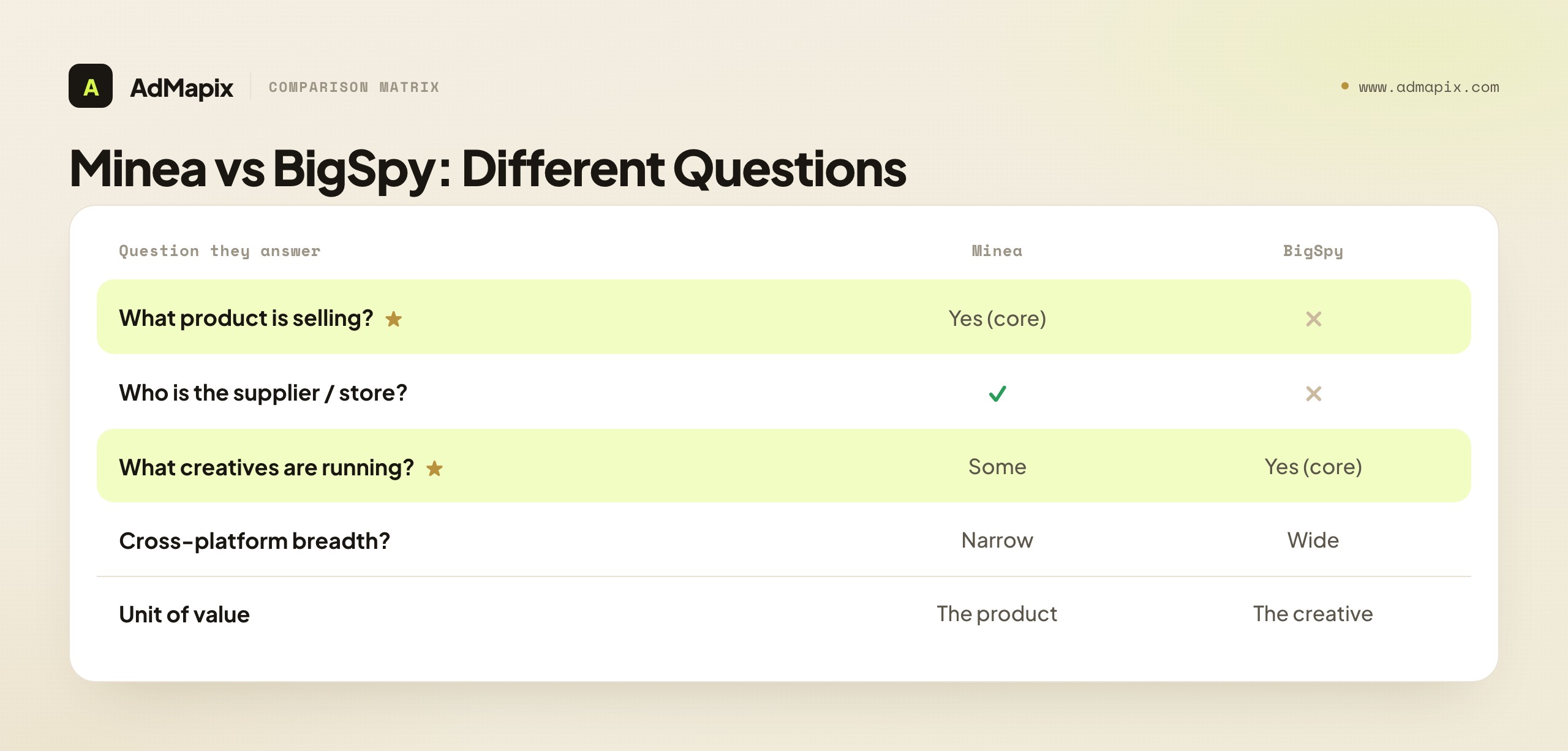
BigSpy is a general-purpose ad spy library: it indexes a large volume of ads across many networks so you can search by niche, track top ads, and study creative inspiration. The unit of value is the creative. Minea is an ecommerce product-research tool with ad-spy features layered on: it surfaces daily winning products, ties ads to the shops and suppliers behind them, and filters by signals dropshippers and DTC operators care about. The unit of value is the product.
This difference cascades through everything. It changes what each tool indexes, what it filters by, who it is priced for, and — most importantly — what you walk away with. A BigSpy session ends with a shortlist of creative angles to test. A Minea session ends with a product to source or a store to study. If you confuse the two, you will buy the wrong tool and be quietly frustrated that it does not do the job you actually needed — not because it is bad, but because it was never built for your job.
So the first question is not "which is better" but "which job am I doing most weeks?" If your bottleneck is what to sell, that is Minea's job. If your bottleneck is how to advertise what you already sell, that is closer to BigSpy's job. Answer that honestly and the comparison mostly resolves itself; everything below is the detail that confirms it.
It is worth being explicit about why this matters more for these two tools than for many software comparisons. With most "X vs Y" decisions, the two products do roughly the same job and you are choosing on quality, price, or fit — a faster car versus a roomier one, but both are cars. Minea and BigSpy are not both cars. One is closer to a sourcing scout and the other to a creative library. Choosing between them on "which is better" is like asking whether a microscope or a telescope is the better instrument — the honest answer is "for what?" A team that internalizes this asks the right question (which job dominates my week) and buys correctly; a team that asks "which ad spy tool is best" gets a recommendation that may be perfectly true and perfectly useless for their actual finish line. The whole comparison hinges on refusing to flatten two different jobs into one ranking.
A useful tell: notice which word you reach for when you describe your bottleneck. If you say "I need to find products," you are describing Minea's job. If you say "I need to find ads or angles or creatives," you are describing BigSpy's job. The noun you naturally use is a reliable signal of which tool fits, because it reveals the unit of value you actually care about.
What Minea Is Best At
Minea is strongest when your research ends in choosing or sourcing a product, not just admiring an ad. As an ecommerce-focused tool, it surfaces daily winning products, ties ads back to the shops and suppliers behind them, and lets you filter by the signals that matter to product-led operators. If your weekly question is "what should we sell or source next," Minea keeps the product context attached to the creative instead of leaving you holding an orphaned ad you cannot trace to a product.
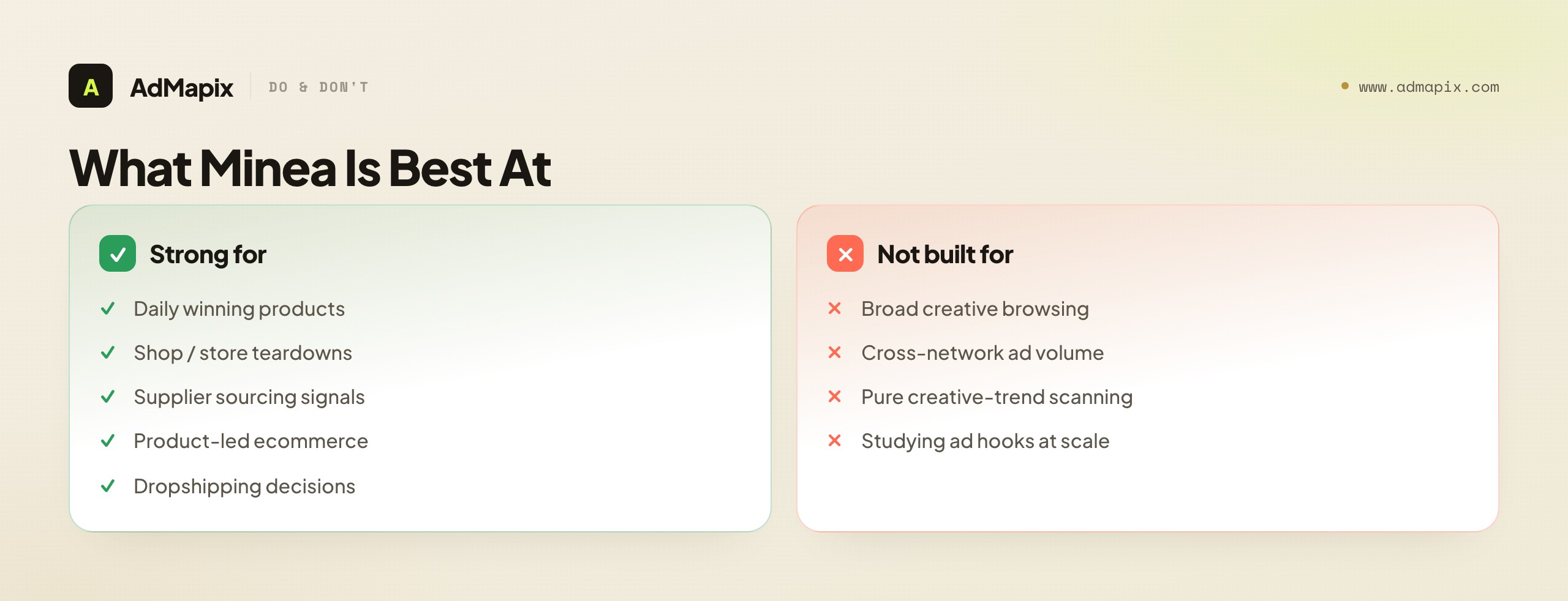
The product-centric design shows up in concrete ways. A "winning products" feed surfaces items gaining traction, which is a sourcing shortlist, not just a creative gallery. Shop-level research lets you study the store behind an ad — its product range, its offers, its positioning — which is the difference between copying one creative and understanding a competitor's whole product strategy. And supplier signals connect the product to where you might source it, closing the loop from "this is selling" to "here is how I could sell it too." For a dropshipper or DTC operator, that end-to-end product context is the entire value proposition.
Best fit: product-led ecommerce and dropshipping teams whose research output is a product decision, a supplier shortlist, or a store teardown. If the last step of your research is "add this product to the test catalog" or "source a sample," Minea is built for your finish line. The tighter the loop between "I found a product" and "I can source and test it," the more Minea's product-attached design pays off — it is built to keep you inside that loop rather than bouncing you out to separate sourcing tools.
Where it falls short: Minea is not designed to be a broad, cross-platform creative-browsing tool. If you want sheer ad volume across many niches and networks to study creative trends, that is not its core job, and you will find its creative breadth narrower than a volume-first library. It is a product tool with ad features, not an ad library with product features — and that ordering matters.
There is a specific failure mode worth naming: using Minea as if it were a creative-trend scanner. A creative strategist who buys Minea hoping to scan a hundred hooks a night across every platform will be underwhelmed, not because Minea is weak, but because they bought a sourcing tool for a scanning job. The product-attached design that makes Minea excellent for "what should I sell" is the same design that makes it narrower for "what hooks are trending everywhere." Recognize the mismatch before you blame the tool. Conversely, the dropshipper who tries to source products out of a pure creative library will be equally frustrated — the product context they need simply is not attached. The lesson cuts both ways: each tool excels at its finish line and disappoints at the other's, and the only mistake is asking a tool to do the job it was never built for.
Worth emphasizing for product-led teams: Minea's value compounds when sourcing is a recurring need. A team that picks a new product to test every week gets far more from a winning-products feed and supplier trail than a team that sources once a quarter. If product decisions are frequent, the product-attached context Minea keeps is the difference between a fast, confident sourcing call and an afternoon of reverse-engineering what an ad is even selling. If product decisions are rare, a free creative library plus manual store checks may cover you, and Minea's tiered pricing is harder to justify. Frequency of the sourcing decision, not just its existence, should drive whether Minea earns a permanent seat.
What BigSpy Is Best At
BigSpy is strongest when you need breadth: a large ad library you can search across multiple platforms to find creative inspiration and track what competitors are running. It leans into niche search, top-ad tracking, and audience signals such as country, time, and gender preferences attached to ads. If your weekly question is "what creatives are working across my space right now," BigSpy gives you a wide net to pull from at a low price.
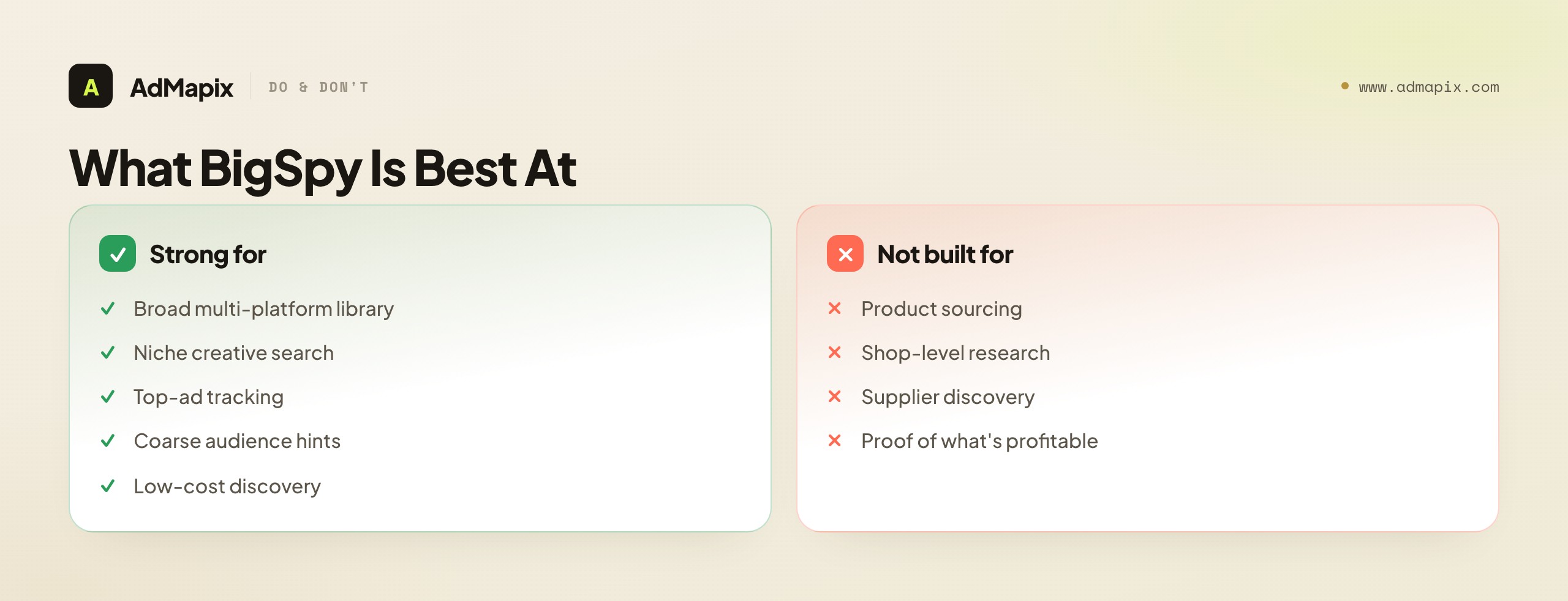
The breadth-first design has its own concrete strengths. Cross-platform coverage means you can study how a competitor advertises on Meta, TikTok, and YouTube in one place rather than juggling tools. Niche search lets you scan a whole category for trending angles, which is how creative strategists find the hook that is suddenly everywhere. And the audience tags — country, time, gender preference — give a coarse read on who a competitor seems to be targeting, useful as a starting hypothesis. For a media buyer or creative strategist whose job is producing a steady stream of fresh angles, that wide, cheap net is exactly the right instrument.
Best fit: creative strategists and media buyers who want broad multi-platform browsing and competitor ad tracking as a recurring habit. If the last step of your research is "brief three new creative angles," BigSpy's breadth feeds that finish line. It is especially suited to teams that produce creative volume — agencies and performance shops shipping many tests a week — because the wide net keeps the idea pipeline full and the low entry cost keeps it affordable even at high search volume.
Where it falls short: ad volume and audience tags are inspiration, not proof. BigSpy does not replace product sourcing or shop-level research, and the audience signals it shows still need validating against your own account and store data. It will tell you what creatives exist; it will not tell you which product to sell or where to source it. For a product-led team, that is the wrong finish line, and no amount of creative breadth compensates for the missing product, store, and supplier context a sourcing decision actually requires.
BigSpy's breadth has a subtle double edge worth understanding. The same wide net that surfaces serendipitous angles also surfaces a lot of noise — saturated creatives, low-quality ads, and brand campaigns that tell you nothing about performance. A disciplined BigSpy user filters aggressively and reads for patterns (the same hook across many advertisers) rather than getting lost in volume. An undisciplined user drowns: they scroll for an hour, save twenty ads, and produce no decision. The tool rewards a clear research question and punishes aimless browsing. So BigSpy's value depends heavily on the user bringing discipline the tool does not enforce — which is true of most discovery tools, but especially of a high-volume one. Before each session, write the one question you are answering; without it, BigSpy's breadth becomes a time sink rather than an advantage.
It is also worth being precise about BigSpy's audience signals, since they are a headline feature. The country, time, and gender preferences attached to ads are inferred from public data, not pulled from a competitor's account. They are a reasonable starting hypothesis — "this competitor seems to skew toward a younger audience in these markets" — but they are not the competitor's actual targeting settings, and they are certainly not their results. Treat them as a lead to test in your own account, never as a targeting blueprint to copy. The team that builds an audience strategy on inferred public tags, without validating against its own data, is building on sand.
Minea vs BigSpy at a Glance
Use this table to match the tool to the decision you actually make each week. Read it by your output, not by feature count.
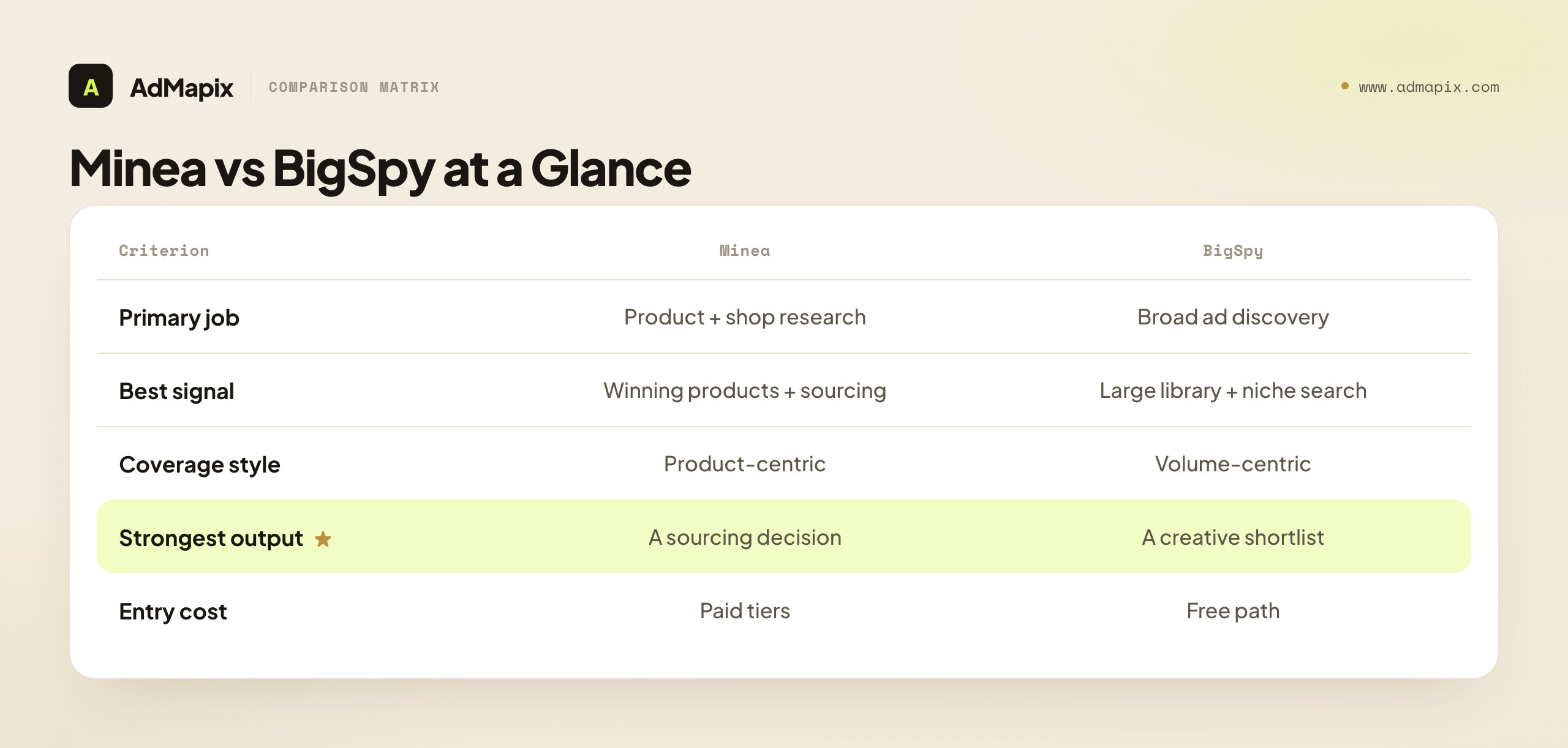
| Criterion | Minea | BigSpy |
|---|---|---|
| Primary job | Ecommerce product and shop research | Broad multi-platform ad discovery |
| Unit of value | The product | The creative |
| Best signal | Daily winning products, supplier and store context | Large ad library, niche search, top-ad tracking |
| Coverage style | Product-centric, ecommerce-first | Volume-centric, cross-platform |
| Audience context | Lighter; focused on product fit | Country, time, and gender preferences on ads |
| Strongest output | A product or sourcing decision | A creative inspiration shortlist |
| Weakest spot | Not built for broad cross-network browsing | Not built for product sourcing or shop research |
| Pricing shape | Starter / Premium / Business tiers | Free path plus paid plans |
The useful question is not which library holds more ads. It is which tool moves your team from evidence to a better product test, creative brief, media decision, or client recommendation. A tool that holds ten times more ads but cannot get you to your specific finish line is the more expensive tool, however cheap its subscription. Read the table by scanning down the "strongest output" and "weakest spot" rows first — those two lines, matched against your own weekly finish line, settle the decision faster than any other row in the comparison.
Coverage and Signals: Product Depth vs Creative Breadth
The deepest difference between the two tools is what they let you see attached to an ad — and this is where the product-vs-creative split becomes operational.
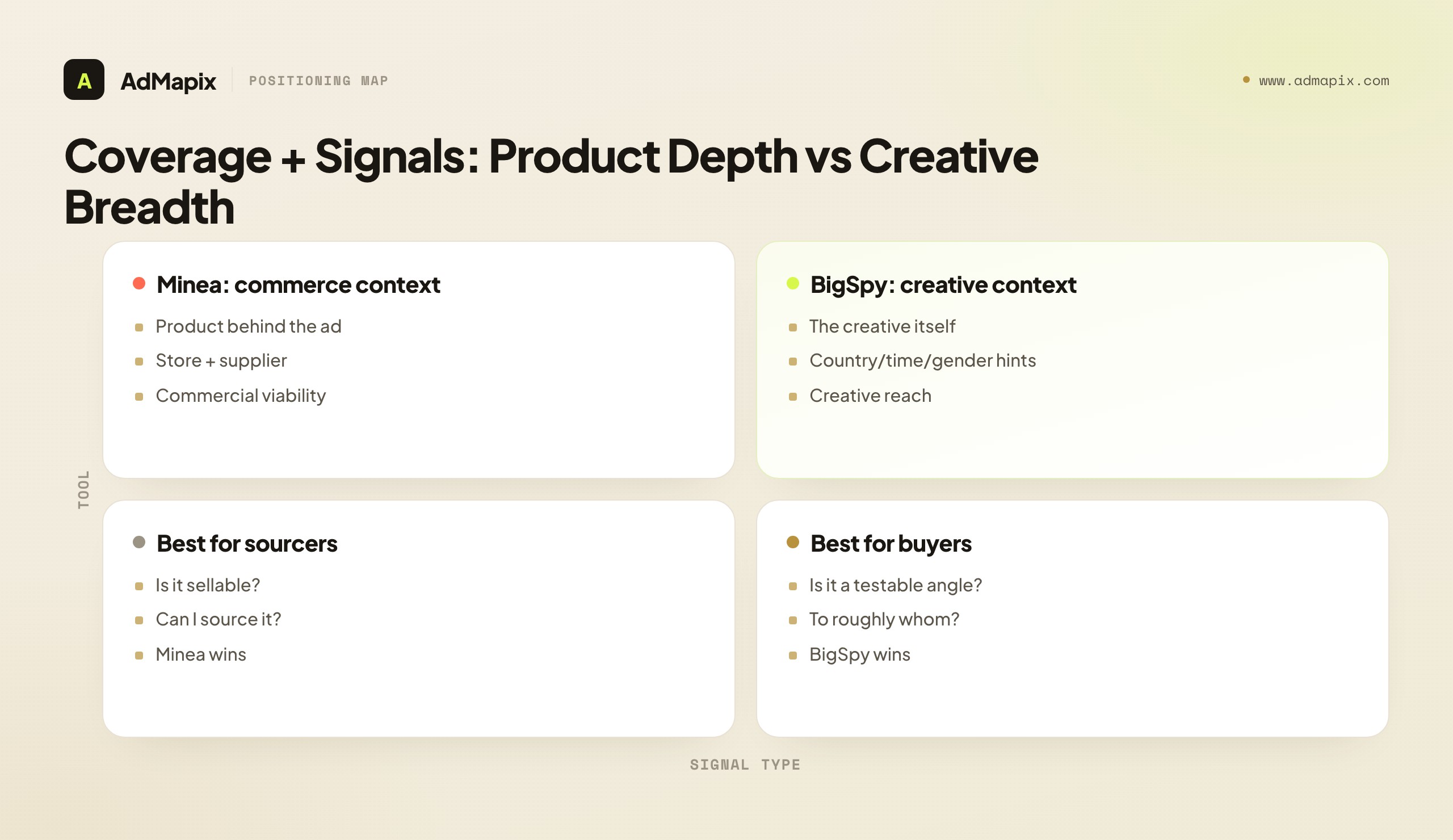
Minea attaches product and commerce context. When you find an ad in Minea, the valuable thing is not the creative alone — it is the product behind it, the store running it, and the sourcing trail. That context is what turns "nice ad" into "sellable product." For a dropshipper, an ad with no product context is nearly useless; for a creative strategist, the product context may be noise they do not need. The signal Minea optimizes for is commercial viability: is this product selling, who is selling it, and can I sell it too?
BigSpy attaches creative and audience context. When you find an ad in BigSpy, the valuable thing is the creative itself plus coarse audience tags — country, timing, gender preference. That context is what turns "an ad" into "a testable angle for a specific audience." For a media buyer, those audience hints are a useful starting hypothesis; for a product sourcer, they may not bear on the sourcing decision at all. The signal BigSpy optimizes for is creative reach: what is running, where, and to roughly whom.
A concrete way to feel the difference: imagine both tools surface the same ad for a portable blender. In Minea, the surrounding context is "this product is trending, here is the store selling it, here is the price and range, here is a sourcing path." You walk away knowing whether to test the product. In BigSpy, the surrounding context is "this video ad is running on TikTok and Meta, in these countries, skewing toward this audience, and here are five similar ads from other advertisers." You walk away knowing how to advertise a blender, if you already sell one. Same ad, two completely different takeaways — because each tool wraps the ad in the context its job needs. The blender example makes the abstract point concrete: you are not choosing between two views of the same data; you are choosing which kind of context gets attached to what you find, and that kind should match the decision you have to make.
Neither set of signals is "more complete" — they are complete for different jobs. The mistake is judging Minea by BigSpy's creative-breadth yardstick (it will look narrow) or judging BigSpy by Minea's product-depth yardstick (it will look shallow). Each is deep where its job demands and light where its job does not. Match the signal type to your finish line: commercial viability points to Minea, creative reach points to BigSpy. And remember that the audience tags on either tool are coarse hints to validate, never precise targeting data you can trust on faith.
A Concrete Workflow in Each Tool
Abstract tables only get you so far; the difference becomes vivid when you watch the same operator run two different jobs. Picture a DTC founder with two questions this week: "what product should we test next?" and "how should we advertise the product we already have?"
Question one, in Minea. The founder opens the winning-products feed, filters to their category and target market, and scans for items gaining traction. For each promising product, they open the store behind it — studying the offer, the price point, the range — and check the supplier trail to see whether they could source a sample. Within an afternoon they have a sourcing shortlist: three products with traction signals, the stores proving demand, and a path to source each. The output is a product decision, and Minea kept every piece of product context attached so the founder never had to reverse-engineer "what is this ad even selling?" That is Minea's job done well.
Question two, in BigSpy. The same founder switches tools and searches their niche across Meta and TikTok, filtering to video and to their target country. They scroll a wide set of competitor and adjacent-brand creatives, saving the hooks that catch attention, noting which angles repeat across advertisers. Within an hour they have a creative shortlist: four hook patterns worth testing, with the audience hints BigSpy attaches as starting hypotheses. The output is a creative brief, and BigSpy's breadth surfaced angles a narrower tool would have filtered out. That is BigSpy's job done well.
Notice that the same founder used both tools, for two different questions, and got two different — equally valuable — outputs. This is why the "Minea vs BigSpy" framing can mislead: for a founder who does both jobs, it is often "Minea and BigSpy," each for the question it answers. The "vs" only sharpens into a real either/or when a team does predominantly one job. A pure dropshipper sourcing products lives in Minea; a pure creative strategist briefing angles lives in BigSpy; the mixed operator above benefits from both. Diagnose which of these three you are, and the decision follows.
How to Test Minea vs BigSpy Before You Buy
A feature list tells you what a tool can do; a side-by-side run on your real work tells you what it does for you. This test takes an afternoon and beats any review.
- Name the finish line. Is this week's research output a product to source, or a creative angle to brief? Write it down before you open either tool — the answer largely predicts the winner.
- Fix the inputs. Use the same three to five competitors or product categories, the same countries, and the same time window in both tools. Otherwise you are comparing the care you put into each search, not the tools.
- Run your actual job in each. For a sourcing job, see which tool gets you to a product shortlist with usable supplier/store context faster. For a creative job, see which gets you to a testable angle shortlist faster.
- Inspect the evidence, not the count. A winning-products feed full of saturated items is worse than a smaller list of fresh, sourceable ones. A huge ad library full of stale creatives is worse than fewer fresh, on-target ones. Judge quality for your job, not raw volume.
- Validate outside the tool. Whatever you find — a product or an angle — is a hypothesis. Confirm with your own store analytics, margins, and ad-account data before you commit inventory or budget.
The reason this test is decisive: the two tools are optimized for different finish lines, so the "winner" depends entirely on your finish line. A sourcing job will rightly prefer Minea; a creative job will rightly prefer BigSpy; and the only way to know which dominates your week is to run your real work through both and watch which produces an output you would actually act on.
One practical tip while testing: time yourself honestly, and judge the output you would hand to a colleague, not the feeling of which interface is nicer. A tool can have a slicker dashboard and still get you to a worse decision slower, while a plainer one gets you to a sourceable product or a testable angle faster. The dashboard is not the deliverable. Score each tool on the single question that matters — did running my real job in it produce something I would actually act on, and how long did it take — and the prettier-but-slower option loses every time. This is also why a free trial or the free tier matters more than any review: thirty minutes of your own competitors and products in each tool tells you more than a thousand words of comparison, because it surfaces exactly how each tool behaves on your niche, with your finish line, which no generic test can replicate.
A note on what to ignore during the test: resist being swayed by the headline database or winning-products counts each tool advertises. A bigger number feels like more certainty, but it is irrelevant if the extra volume is in niches you do not operate in or products you cannot source. What matters is density in your corner — whether the tool returns fresh, relevant, actionable results for the specific category, market, and finish line you actually work in. A smaller index that is dense where you operate beats a vast one that is thin there, every time. Judge local relevance, not global scale, and the test will point you to the tool that actually moves your week.
Pricing: Two Different Shapes
Price reflects the two tools' different audiences, and comparing headline numbers without matching tiers to your job will mislead you.
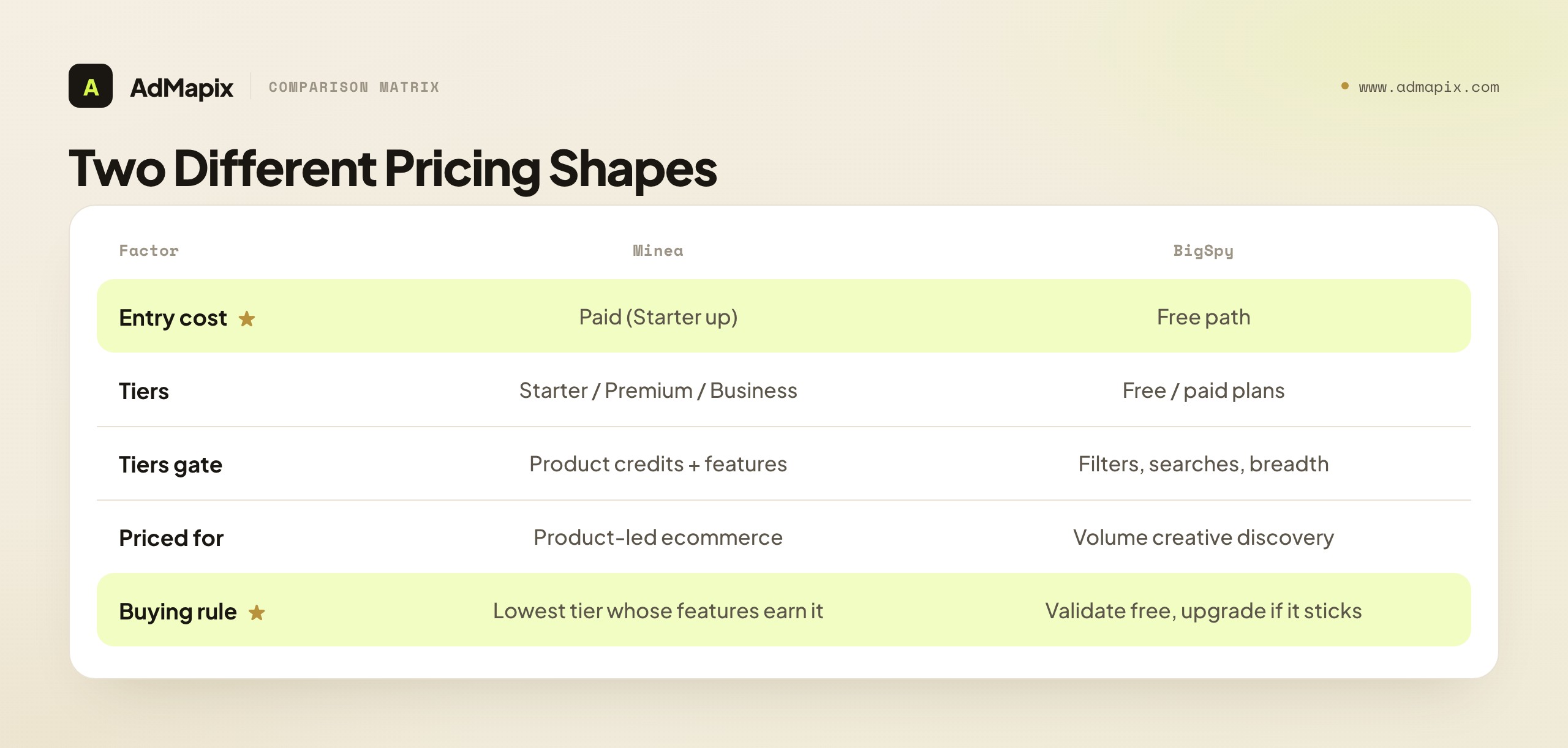
BigSpy's ladder starts free. It offers a free entry path plus paid plans, which makes its starting cost the lowest and lets you validate result quality before spending. The free tier gates filters, searches, and breadth, so it is a validation tool more than a permanent workflow — plan to upgrade if BigSpy earns a recurring place. The low entry price suits the high-volume, price-sensitive creative-discovery audience it courts.
Minea's ladder is tiered around product features. It publishes Starter, Premium, and Business tiers, with credits and feature limits that scale with how much product research you do. Because Minea is a product tool, its pricing is built around research depth — winning-product feeds, shop research, supplier access — rather than raw ad volume. The buying rule mirrors PowerAdSpy's logic: pay for the lowest tier whose product features map to decisions you actually make weekly.
| Pricing factor | Minea | BigSpy |
|---|---|---|
| Entry cost | Paid tiers (Starter up) | Free path available |
| Tier structure | Starter / Premium / Business | Free / paid plans |
| What tiers gate | Product credits, shop/supplier features | Filters, searches, platform breadth |
| Priced for | Product-led ecommerce research | Volume creative discovery |
| Buying rule | Lowest tier whose product features earn it | Validate free, upgrade if it sticks |
The honest framing: the two prices are not directly comparable because you are buying different things. BigSpy's free tier looks cheaper, but if your job is product sourcing, a free ad-browsing tool that cannot source a product is not cheap — it is useless for your finish line, at any price. Compare cost per useful output for your job, not cost per month. Always verify the live pricing pages before buying, because plan tiers, credits, and discounts change in this category, and a feature on a lower tier last quarter can move up without notice.
A practical way to think about value-for-money here: estimate how many useful outputs each tool produces for you per month, and divide the price by that. If Minea gets a dropshipper to four sourceable, validated product candidates a month, the per-decision cost of even its higher tiers can be trivial against the margin one good product returns. If BigSpy's free tier gets a creative strategist to a dozen testable angles a month, its per-output cost is effectively zero. The error is comparing the monthly sticker prices directly, as if the two tools produced the same kind of output — they do not, so the sticker comparison is meaningless. A tool is expensive only relative to the value of the decisions it speeds up, and for the wrong job, even a free tool is infinitely expensive because it never produces the output you needed.
One more nuance: watch the credit and limit structure, not just the headline tier price. Product-research tools like Minea often meter usage in credits or searches, so a low tier can run out mid-month if your sourcing volume is high. Map your actual weekly volume to the tier limits before committing, and prefer validating on a monthly plan before locking into an annual discount — committing annually before you know your real usage is the most common way teams overpay in this category.
Who Should Choose What
Match the tool to the team and the job, not to the marketing copy. Product-led operators and creative strategists should not start in the same place.
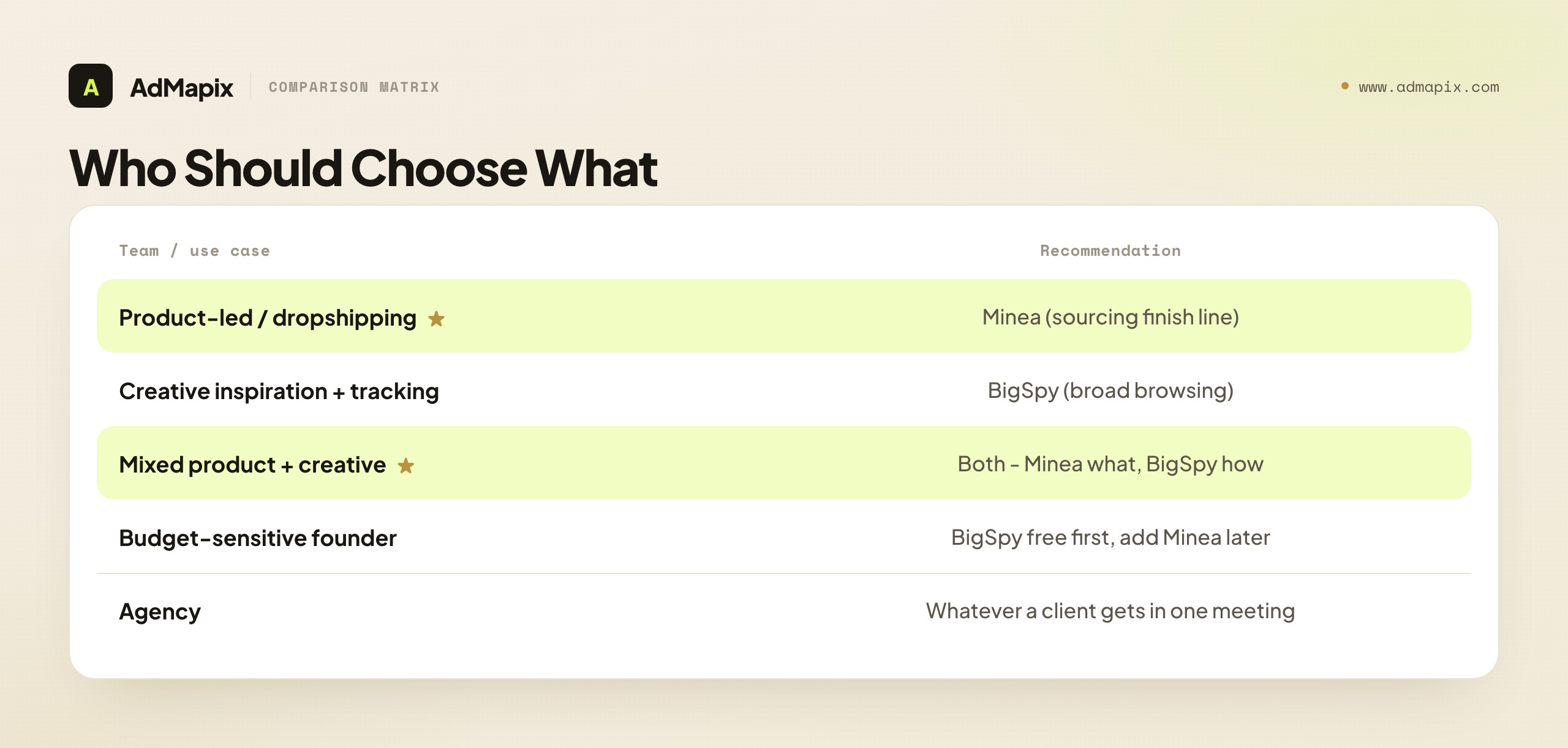
| Team or use case | Practical recommendation |
|---|---|
| Product-led ecommerce / dropshipping | Start with Minea when research ends in sourcing or product selection. |
| Creative inspiration and competitor tracking | Start with BigSpy when the job is broad creative browsing across platforms. |
| Mixed: sources products AND tests creative | Consider both — Minea to pick what to sell, BigSpy to study how to advertise it. |
| Performance creative team | Add a creative-evidence layer when video structure, hooks, and country differences matter. |
| Agency | Pick whatever produces evidence a client understands in one review meeting. |
| Budget-sensitive founder validating a niche | BigSpy's free tier first; add Minea once product sourcing becomes the bottleneck. |
A clean self-diagnosis: finish the sentence "my research is done when I have ___." If the blank is "a product to source" or "a store strategy to copy," that is Minea. If the blank is "a creative angle to brief" or "a competitor's ad library mapped," that is BigSpy. If you genuinely fill it both ways every week, you are one of the teams that benefits from running both — Minea for the what, BigSpy for the how. The sentence test cuts through marketing copy faster than any feature list, because it forces you to name the real output you actually need rather than the features that merely sound impressive.
What Public Ad Data Can and Cannot Prove
Neither tool can tell you a competitor's true spend, ROAS, or profit, so treat every finding as a hypothesis. This is the single most misread point in ad-spy research, and it applies identically to Minea, BigSpy, and every other tool in the category.
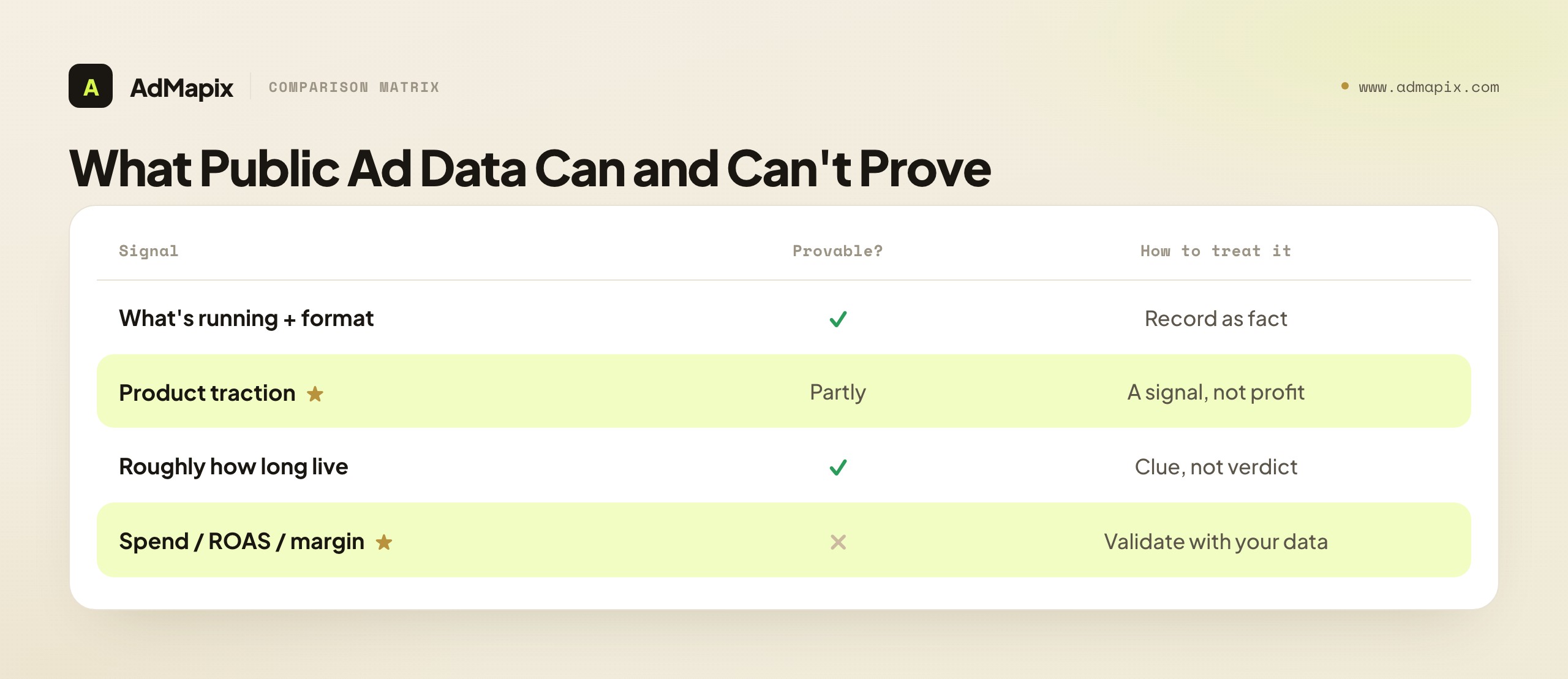
Ad libraries and spy tools show what is running, roughly how long it has run, and sometimes coarse audience or product hints. They do not expose budget, conversion rate, or margin. A creative that appears "everywhere" may be a winner that is scaling — or it may simply be a brand with deep pockets testing in public, or a forgotten campaign nobody paused. On the product side, a "winning product" feed shows traction signals, but traction is not the same as profitable for you — your margins, your fulfillment, and your ad costs decide that, and none of them are visible in the tool.
The honest workflow that follows: use these tools to find patterns worth testing, and use your own ad account, store analytics, and CRM to decide whether the pattern actually works for you. Treat the creative, the product, and the repetition as facts; treat "this is making them money" or "this product is profitable" as hypotheses. Validate every inference against your own numbers before you scale anything. Tool choice does not change this rule — Minea's product depth and BigSpy's creative breadth both produce evidence of activity, never evidence of profit. The team that remembers this researches well with either tool; the team that forgets it sources a "winning" product that loses money, or scales a competitor's creative that was never winning.
This limit lands differently on the product side than the creative side, and it is worth spelling out because it is the costliest misread for ecommerce teams. A "winning product" signal tells you a product is getting attention — many ads, growing stores, repeated appearance. It does not tell you the product is profitable for you, because your margin depends on your sourcing cost, your fulfillment, your ad efficiency, and your market — none of which the tool can see. Plenty of "winning products" are winning for a seller with a supplier relationship or an ad account you cannot replicate, and lose money for everyone who copies them late. The honest read of a winning-products feed is "here are products with demand worth testing at small scale," never "here are guaranteed winners to stock deeply." The teams that lose money on product research are the ones who read traction as profit and order inventory before testing; the ones who succeed treat every winning-product signal as a small, cheap test against their own economics first.
The same caution applies to the longevity signal both tools surface. An ad or product that has been visible for a long time might be a durable winner — or a brand spending to stay visible, or a campaign nobody paused. Longevity is one signal among several; an ad that is long-running and iterated and repeated across stores is a strong hypothesis, while one that is merely old is not. Read longevity as a clue, never a verdict, on both the creative and the product side.
Common Mistakes When Choosing Between Minea and BigSpy
Most regret in this decision traces back to a few avoidable errors.
- Buying for database size only. A bigger library is useless if your searches do not answer your next decision. Minea's smaller, product-attached index can beat BigSpy's larger one for a sourcing job, and vice versa for a creative job.
- Confusing inspiration with proof. Competitor ads and winning-product feeds generate hypotheses; your own metrics and business outcomes validate them. A traction signal is not a profit guarantee.
- Ignoring channel and niche fit. TikTok-first, Meta-first, ecommerce-first, and agency workflows need different tooling. Match the tool to where your competitors and products actually live.
- Picking the creative tool for a product job (or vice versa). Using BigSpy to source products or Minea to study cross-platform creative trends is using a tool against its grain — it will work badly and you will blame the tool.
- Forgetting exports and reports. Screenshots do not scale when clients or stakeholders need repeatable evidence. Neither tool is a strong reporting instrument on its own.
- Copying creatives or products directly. Read examples for patterns; do not skip the brand, legal, margin, and differentiation work. A copied product on worse economics loses money even if it was a winner for someone else.
- Chasing saturated winners late. By the time a product is loudly "winning" across a feed, the early margin is often gone and the market is crowded. The feed shows you what already worked, not what is about to; treat late-stage winners with caution and look for the earlier, quieter signals.
- Committing annually before validating. Both tools offer annual discounts that look attractive until you are locked into a tool whose finish line turns out not to match your job. Validate monthly first, then commit.
The two errors that cost the most are the first two on this list, and they share a root: confusing a signal of activity with proof of profit. A bigger database and a busier winning-products feed both feel like more certainty, but neither adds a single data point about whether something is profitable for you. The discipline that prevents both mistakes is the same: treat the tool as a generator of hypotheses, and reserve the word "winner" for things your own data has confirmed. Teams that hold that line research well with either Minea or BigSpy; teams that drop it lose money regardless of which they bought, because the failure was never the tool — it was reading activity as outcome.
When a Creative-Evidence Layer Helps
Once browsing an ad feed or a product list is no longer enough — when the same competitors and products need weekly review and the findings have to travel to a team — a gap opens that neither Minea nor BigSpy is built to close: turning scattered discovery into searchable, saved, reportable creative evidence across networks.
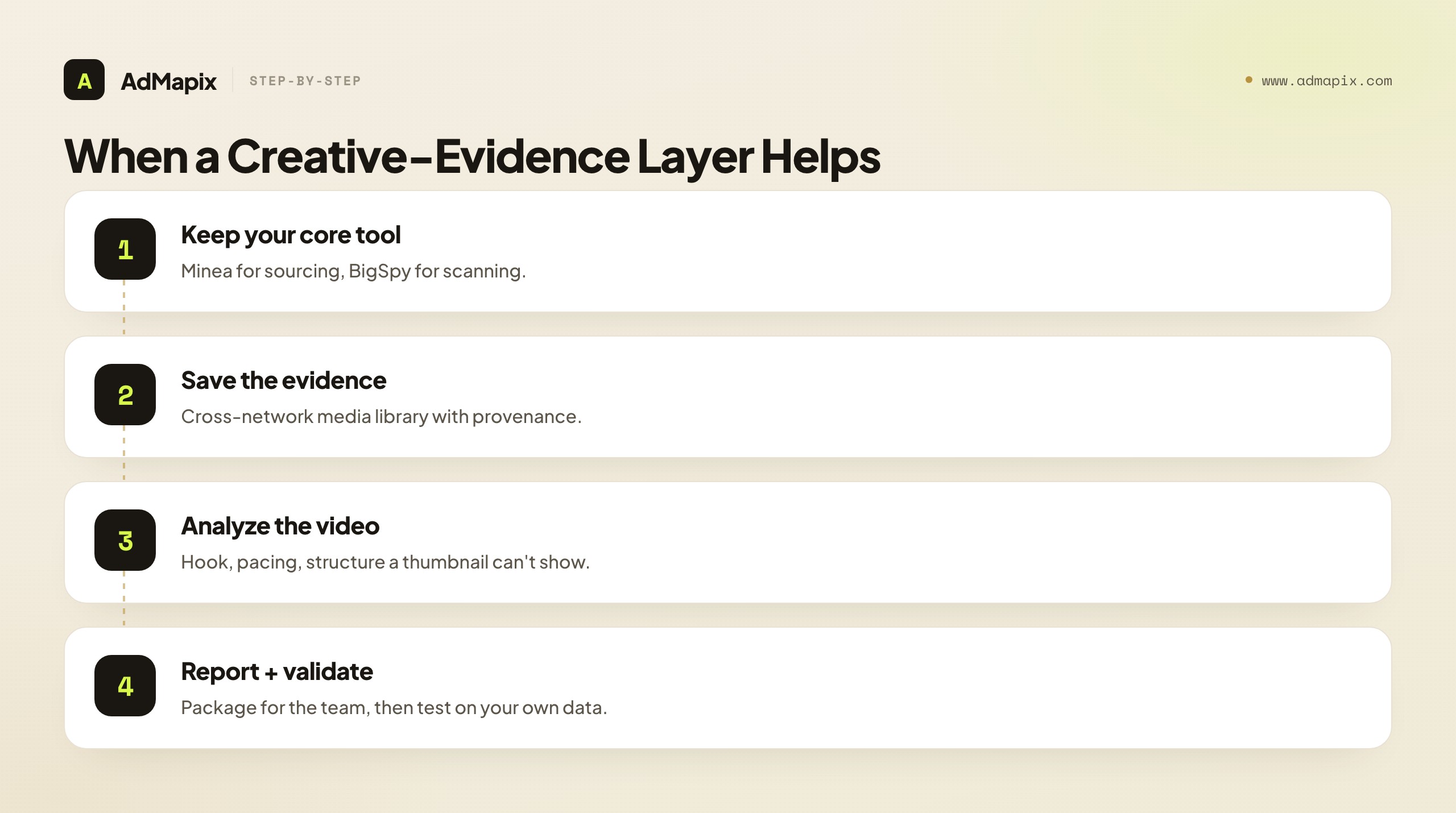
This is where a cross-network creative-evidence layer like AdMapix fits — not as a replacement for either tool's strongest workflow, but as the piece that makes discovery repeatable and shareable. It is built for performance creative teams, agencies, and operators who need to search competitor ad creatives across networks with Search, save the relevant media in Media, break down video structure and hooks with Video Analysis that a static thumbnail cannot show, tag what matters, and turn it all into a Report before the next test. A practical stack stays simple: keep the product-specific tool (Minea) for sourcing and the broad library (BigSpy) for creative scanning, then add a creative-evidence layer where weekly review and reporting live. Compare access on Pricing once the process becomes repeatable, or log in to run your first cross-network competitor search.
It is honestly not the right pick if your only need is dropshipping product sourcing — Minea fits that better — or a single broad ad feed to casually scroll, which BigSpy fits better. A creative-evidence layer earns its place specifically when observed creatives have to become structured, shareable evidence for a recurring workflow, not a one-off look.
The clearest way to see where this layer sits is by the question it answers. Minea answers "what should we sell?" BigSpy answers "what creatives are running?" A creative-evidence layer answers "what did we learn from the creatives, and what are we testing because of it?" Those are three different questions, and a team that only ever answers the first two accumulates products and screenshots; a team that answers the third builds a research habit that compounds into better creative over time. For a product-led team, the natural stack is Minea to choose the product, then a creative-evidence layer to study and report on how to advertise it — and for a creative-led team, BigSpy to discover angles, then the evidence layer to break them down and turn them into briefs that travel. In both cases the discovery tool finds the raw material and the evidence layer turns it into a decision. Choosing Minea vs BigSpy settles only the discovery front of that pipeline; the reporting back of it is a separate, complementary choice.
For the broader landscape beyond these two tools, our guide to the best ad spy tools of 2026 compares the whole field by price, coverage, and use case. If you have decided BigSpy is not the right shape, the BigSpy alternatives guide covers the migration paths, and the related Minea vs PiPiAds and PiPiAds vs BigSpy breakdowns cover the adjacent product-and-TikTok comparisons. If Minea is the one you are unsure about, Minea alternatives covers what else fits its product-research niche.
FAQ
Is Minea or BigSpy better for ecommerce?
Minea is usually better for ecommerce when product and shop context are central, because it ties ads to the products, stores, and suppliers behind them and surfaces daily winning products. BigSpy is better when broad creative discovery across platforms matters more than product-level research. Many teams use Minea to pick what to sell and BigSpy to study how others advertise it — they solve different halves of the workflow.
Is BigSpy enough for product research?
BigSpy can surface ad inspiration and show which creatives competitors run, but it is not built for product sourcing or shop-level decisions. For deciding what to sell and where to source it, an ecommerce-specific tool like Minea fits the workflow far better because it keeps the product, store, and supplier context attached to the creative. Use BigSpy for creative angles, not for the sourcing decision itself.
Which one is cheaper, Minea or BigSpy?
BigSpy starts cheaper because it has a free entry path, while Minea publishes paid Starter, Premium, and Business tiers. But the prices are not directly comparable — they buy different things. A free ad-browsing tool is not cheap if your job is product sourcing it cannot do. Compare cost against the weekly research decision each tool actually speeds up, and verify the live pricing pages before buying, since tiers and credits change.
What is the main difference between Minea and BigSpy?
The unit of value. Minea is built around the product — winning products, stores, suppliers — for teams whose research ends in a sourcing decision. BigSpy is built around the creative — a broad, cross-platform ad library — for teams whose research ends in a creative angle. Minea is a product tool with ad features; BigSpy is an ad library with product-agnostic breadth.
Can I use one tool instead of both?
Often yes, if your work leans clearly one way. If almost every task ends in a product or sourcing decision, Minea alone may be enough; if it ends in creative inspiration, BigSpy alone may be enough. Teams that do both product research and creative testing tend to get real value from running them side by side — Minea for the product, BigSpy for the advertising study.
Is Minea good for dropshipping specifically?
Yes — dropshipping is close to Minea's core use case. Its winning-product feed, store research, and supplier signals map directly to the dropshipper's central question of what to sell and where to source it. BigSpy can supplement the creative side once the product is chosen, but for the sourcing decision itself, Minea's product-attached data fits the dropshipping workflow better.
How do I test Minea and BigSpy before buying?
Run the same three to five competitors, the same countries, and the same time windows in each, and judge by your finish line. For a product job, score which tool gets you to a sourceable product shortlist faster; for a creative job, score which gets you to a testable angle faster. Time-to-output for your specific job beats raw ad counts or product-feed size.
Do Minea or BigSpy show competitor ad spend or ROAS?
No. Neither exposes a competitor's true spend, ROAS, conversion rate, or margin — those numbers are private. They show what is running, roughly how long, and coarse audience or product hints. Treat traction signals and long-running ads as hypotheses, and validate with your own store analytics, ad account, and margins before committing budget or inventory.
Are the audience signals in BigSpy reliable?
They are useful starting hints, not precise targeting data. BigSpy's country, time, and gender signals give a coarse read on who a competitor seems to reach, which is a reasonable hypothesis to test. But they are inferred from public data, not pulled from the competitor's account, so confirm any audience assumption against your own campaign results before you build a strategy on it.
Where does a tool like AdMapix fit alongside Minea and BigSpy?
A cross-network creative-evidence layer like AdMapix fits when you need searchable competitor creatives across networks, plus video analysis, saved media, tagging, and reports — rather than only browsing an ad feed or a product list. It complements Minea and BigSpy by turning observed creatives into structured, shareable evidence for your next test or client report. It is not a product-sourcing tool and does not claim to show the spend or ROAS no public tool can.
Key Takeaways
- Choose Minea when the next action is product selection or sourcing; choose BigSpy when it is broad cross-platform creative discovery. They answer different questions, not bigger-or-smaller versions of one.
- Judge each tool by the weekly decision it speeds up, not by the size of its ad library or product feed. Your finish line decides the winner.
- They are often complements: Minea for what to sell, BigSpy for how to advertise it. Many mixed teams run both.
- Treat every spy-tool finding as a hypothesis — traction and longevity are not profit — and validate with your own account, store, and CRM data.
- Add a cross-network creative-evidence layer when discovery has to become saved evidence, video breakdowns, and recurring reports — the gap both tools leave once research turns into a weekly deliverable.
Authoritative Sources
- Minea — ecommerce product discovery, ad-spy workflows, daily winning products, and supplier/store research (as checked June 2026).
- Minea pricing — Starter, Premium, and Business tiers; verify credits and feature limits before purchase.
- BigSpy — niche search, ad tracking, audience analysis, and multi-platform competitor ad research (as checked June 2026).
- BigSpy pricing — free and paid plans; verify current limits before comparing cost.
Pricing and feature details as of June 21, 2026; check each vendor's site for the latest plans. Disclosure: AdMapix is our own product, and its data scope covers cross-network ad creative search, saved media, video analysis, tagging, and reports — separated from claims sourced to each vendor's own pages.
See what competitors are really running
Search 6M+ ad creatives, landing pages, and weekly spend across 200+ countries. No credit card, no commitment.
Related Articles
Semrush Ad Intelligence Alternative in 2026: PPC Research or Creative Evidence?
A 2026 decision framework for choosing a Semrush ad intelligence alternative — when PPC keyword and spend research wins, when competitor creative and video evidence wins, how AdClarity fits, a fair-trial method, and how to build a two-layer stack.

Moat Alternative in 2026: Ad Verification vs. Creative Intelligence
A complete 2026 buyer's guide to choosing a Moat alternative — why teams look past Oracle Moat, what Moat actually does (viewability, invalid traffic, brand safety), the critical split between the ad-verification layer and the creative-intelligence layer, a layered comparison across coverage and fit, who should choose which, a practical migration plan, the honest limits of public creative data, and where a creative-research tool like AdMapix fits.
Pathmatics Alternative in 2026: Ad Spend Intelligence vs. Creative Workflow
A complete 2026 buyer's guide to choosing a Pathmatics alternative — why teams look past Pathmatics (now Sensor Tower), what it actually measures, a layered comparison of spend-intelligence suites versus creative-workflow tools across coverage, data type, price, and fit, who should choose which, a practical migration plan, the honest limits of estimated spend, and where a lighter cross-network creative tool like AdMapix fits.