
Analyze global real estate agents' ad creative and messaging trends over the last 90 days, focusing on the persuasion strategies and formats they use to convince people to buy
Global Real Estate Advertising: Video-First Formats, Trust-Led Messaging, and Hyper-Local Persuasion
Over the 90 days to 1 November 2026, nine leading real-estate advertisers generated 1.88 billion measured ad impressions across app inventory, with the top three accounting for 73.5% of that total. Video and image formats split almost evenly overall — but execution is sharply market-specific: German portals run video-only, Australia's Domain runs image-only, and Realtor.com moved from near-zero video share to 83% video share in October. Messaging is built around friction removal (79% of copy-bearing creatives), trust signals (48%), urgency (33%) and investment logic (21%). The market is highly concentrated: among the 300 largest keyword-matched real-estate products, the top 10 advertisers capture 97.7% of impressions, leaving independent agents with a listing-level, image-led playbook.
Key Findings
- Realtor.com is the dominant ad voice, with 932.6 million impressions in 90 days — 49.5% of the nine-advertiser sample and roughly 4x its nearest competitor.
- Video is winning the format war, but not uniformly. Video represented 49.8% of format-attributed impressions; however, video share ranged from 100% at ImmoScout24 and 98% at Centaline to effectively 0% at Domain.
- The biggest creative shift of the quarter was Realtor.com's October video ramp, from 0.2% video share in late September to 82.7% in the final week, accompanied by a doubling of weekly impressions.
- Persuasion is operational, not aspirational. The most common message sells speed and convenience — instant alerts, saved searches, one-click enquiries — rather than "dream homes."
- Trust is the conversion layer. Verified listings, named agents, valuation tools and transaction data appear in nearly half of all copy-bearing creatives, and in 88% of Redfin's.
- Meta Audience Network is the default buying channel at 53% of measured impressions, but challenger networks dominate individual markets: Moloco powers 94% of ImmoScout24's delivery, Vungle 78% of Housing.com's.
1. Market Scale and Advertiser Concentration
The nine advertisers analysed span the US, Germany, UAE, India, Australia and Hong Kong. Together they recorded 1,882.8 million impressions between 3 August and 1 November 2026. Realtor.com alone accounted for 932.6 million, nearly half the sample; immowelt (237.5 million) and ImmoScout24 (214.2 million) form a German second tier.
| Advertiser | Parent company | Primary market | 90-day impressions | Share | Format mix (image / video) |
|---|---|---|---|---|---|
| Realtor.com | Move, Inc. | US | 932.6M | 49.5% | 68% / 32% |
| immowelt | AVIV Germany GmbH | DE | 237.5M | 12.6% | 16% / 84% |
| ImmoScout24 | ImmobilienScout GmbH | DE | 214.2M | 11.4% | 0% / 100% |
| Property Finder | Propertyfinder FZ-LLC | AE | 148.7M | 7.9% | 69% / 31% |
| Redfin | Redfin | US | 118.6M | 6.3% | 59% / 41% |
| Bayut | Bayut Web Publishing FZ LLC | AE | 117.0M | 6.2% | 42% / 58% |
| Housing.com | Locon Solutions Pvt. Ltd. | IN | 68.1M | 3.6% | 14% / 86% |
| Domain | Domain Holdings Australia | AU | 45.5M | 2.4% | 100% / 0% |
| Centaline | Centaline Property Agency | HK | 0.7M | 0.04% | 2% / 98% |
| Total | — | — | 1,882.8M | 100% | 50% / 50% |
The distribution of ad voice is extremely top-heavy.
Concentration extends beyond this leader set. A keyword search for "real estate" returned 1,297 products; across the 300 largest, cumulative impressions reached 60.1 billion, but the top 10 products — a mix of portals, property-search apps and property-themed games — accounted for 97.7% of that total. The top 20 reached 98.9%, and only 82 companies owned the 300 products. In practical terms, mass reach in real estate is bought from a handful of portal brands; the long tail of independent agents competes for local, listing-level attention.
Download data reinforces the scale gap. Six advertisers reported installs in the window:
| Advertiser | 90-day downloads |
|---|---|
| Realtor.com | 741,558 |
| ImmoScout24 | 645,965 |
| Redfin | 513,264 |
| immowelt | 418,546 |
| Bayut | 366,776 |
| Property Finder | 221,691 |
Realtor.com paired the largest install base with the heaviest impression volume, while Redfin and ImmoScout24 generated comparable installs on far fewer impressions — a sign of more performance-oriented buying. The ratio is directional rather than causal, because app installs are not exclusively ad-driven.
2. Creative Format Trends: The 90-Day Video Repricing
Across the nine advertisers, video and image were effectively tied: 970.7 million video impressions (49.8%) versus 977.6 million image impressions (50.2%). That aggregate hides a wide spread in strategy.
Three format regimes emerge:
- Video-native markets: ImmoScout24 (100%), Centaline (98%), Housing.com (86%) and immowelt (84%).
- Mixed markets: Bayut (58% video), Redfin (41%), Realtor.com (32%) and Property Finder (31%).
- Image-native markets: Domain, at effectively 0% video, with a 45.5 million-impression image-only strategy.
The most important movement happened inside the quarter. Realtor.com's weekly video share was 0.2% in late September and climbed to 78.9% in the week of 5 October, finishing at 82.7% in the last week. Property Finder followed a similar, later pattern, reaching 95.1% video share in the final week. Redfin moved the other way: after running 60–88% video through August, its video share collapsed to near zero from the week of 7 September onward.
Weekly impression totals show that Realtor.com's video pivot coincided with a demand surge rather than a simple substitution: the company fell from 156.0 million impressions in the week of 10 August to 39.1 million in the week of 21 September, then rebuilt to 136.4 million in the week of 19 October as video took over. ImmoScout24 ran a more volatile always-on pattern, including a 57.3 million spike in the week of 12 October.
Video Is Not One Format
Average video length varied by more than 6x across markets. Centaline's 75-second average reflects virtual-tour and property-walkthrough creative; German advertisers favoured 29–30 second explainers; US and UAE advertisers ran 11–15 second spots, and Realtor.com's highest-volume assets were 5-second videos.
Creative supply also diverged from creative delivery. Among the 80 most-impressioned creatives active in the window, Housing.com's sample was 100% image, and Redfin's was 68% image — consistent with its September pullback from video. Realtor.com's sample was 42 videos and 38 images, while immowelt's was 80 videos out of 80. Housing.com is the clearest case of a split personality: 86% of its delivered impressions were video, but its newest high-impression creative library was entirely image-based, suggesting video inventory is used for reach while image assets support always-on listing promotion.
3. Messaging and Persuasion Strategies
The messaging analysis covers 624 creatives with captured copy across the nine advertisers. Copy was coded into seven non-exclusive themes; because a single ad can use several appeals, shares sum to more than 100%.
| Strategy | Share of copy sample | Typical phrasing (English paraphrase) | Strongest adopters |
|---|---|---|---|
| Search efficiency | 79% | "Save your search and get alerts"; "Enquire in seconds"; "Browse the latest listings" | Property Finder 100%, immowelt 97%, Domain 95% |
| Trust & expert guidance | 48% | "Verified listings"; "Trusted broker"; "Book with a named agent" | Domain 99%, Redfin 88%, Bayut 79% |
| Rent vs buy | 38% | "Daily new rentals"; "Homes for sale"; "Find your next home" | immowelt 71%, Bayut 68%, Property Finder 62% |
| Urgency & live inventory | 33% | "Good homes go fast"; "Before it's gone"; "New listings daily" | Domain 80%, Housing.com 74%, immowelt 40% |
| Location & community | 23% | Neighbourhood names, schools, metro access, amenities | Housing.com 82%, Bayut 60% |
| Investment & value | 21% | "High appreciation potential"; "It's not too late to invest" | Bayut 59%, Housing.com 59%, Centaline 21% |
| Aspiration & lifestyle | 19% | "Your dream home"; "Modern living"; "Luxury villas" | Housing.com 88%, Centaline 17%, Realtor.com 16% |
3.1 Remove Friction, Then Sell the Alert
The dominant appeal is not luxury or lifestyle — it is effort reduction. Four out of five copy-bearing creatives mention searching, browsing, downloading, saving or being notified. Property Finder makes the mechanic explicit: "Good homes go fast. Get instant alerts when new listings hit the market." Domain closes with "Enquire now in just a few seconds!" immowelt's German-language copy promises daily new rentals and a saved search that triggers notifications. ImmoScout24 promotes push notifications for new listings and a free property valuation.
This is a behavioural persuasion strategy: rather than arguing that a property is desirable, the ads lower the cost of the next step and create a recurring reason to return. The creative is designed to win the notification permission, not the purchase.
3.2 Trust Is the Conversion Layer
Trust signals appear in 48% of copy-bearing creatives and are the leading appeal for Domain (99%), Redfin (88%) and Bayut (79%). The execution differs:
- Verification: Property Finder runs "Verified Real Estate Listings" and promotes access to historical transaction data.
- Proprietary tools: Bayut brands its trust products — TruBroker for agent credibility and TruEstimate for instant property valuation.
- Named-agent endorsement: Redfin's copy is almost entirely agent-led: "Book a same-day tour with Redfin agent [name] before the home you love is gone." The named agent supplies accountability; the same-day tour removes friction; the closing clause supplies scarcity.
- Institutional assurance: ImmoScout24 advertises a credit-report check that can be reused across rental applications, turning a bureaucratic hurdle into a product benefit.
- Data authority: Centaline promotes AI-assisted search, VR viewings and transaction analytics as reasons to trust its listing inventory.
3.3 Manufacture Urgency With Market Timing
Urgency appears in 33% of copy, led by Domain (80%) and Housing.com (74%). The strongest example is Realtor.com's data-driven urgency: "Market timing feels unknown, so you wait. Fall data says the best window to buy is now." This is a more sophisticated appeal than generic "act now" copy because it substitutes a quantified reason for the urgency. Property Finder's "Good homes go fast" and Redfin's "before the home you love is gone" use scarcity of inventory; Domain uses recency, repeatedly pushing "our latest listings."
3.4 Aspiration Sells in Emerging Markets, Not Everywhere
Only 19% of copy uses dream-home or lifestyle language overall, but the concentration is extreme: 88% of Housing.com's copy sample uses aspiration, versus 17% at Centaline and 16% at Realtor.com. Housing.com combines "Make Your Dream Home a Reality" with modern homes, prime locations, amenities and appreciation potential. Bayut runs "Live in luxury" and "Buy your dream villa in Dubai." In the US and German samples, aspiration is largely replaced by utility, speed and trust.
3.5 Investment Logic Is a Regional Speciality
Investment and value language appears in 21% of copy overall but in 59% of Bayut's and Housing.com's samples. Bayut tells users "It's not too late to invest in property"; Housing.com lists "high appreciation potential" as a bullet benefit alongside schools and metro access. Property Finder and Centaline lean on transaction data and price history rather than explicit yield claims. This is a rational-reassurance strategy aimed at buyers who need a financial justification, not just an emotional one.
3.6 Hyper-Local Specificity
Location appears in 23% of copy, but in 82% of Housing.com's and 60% of Bayut's. Housing.com names Tricity, Bengaluru, Noida and Patna; Bayut names Business Bay and Dubai communities; Domain names Victoria and New South Wales. The copy behaves like a local classified ad wrapped in a national brand. For advertisers, this is the clearest signal that real-estate creative cannot be centralised at the country level without losing relevance.
3.7 Germany Runs a Rental-First Playbook
Rent-versus-buy language appears in 38% of copy overall, but 71% of immowelt's sample is rental-focused, and ImmoScout24 pairs rental search with tenant screening. German creative is longer (29–30 seconds), video-native and utility-led: daily listings, saved searches, notifications, affordability checks. The US and UAE samples are more balanced between buying and renting, while Housing.com is almost entirely buy-side.
3.8 Independent Agents: Listing-Level Images, Local Price Anchors
The long tail tells a different story. Independent-agent advertisers such as Sibcy Cline and Pearsons Estate Agents used image-only creative in the sample, with copy built around specific inventory: "2 bed / 3 bath for $299,900," "New Build Homes For Sale," "open house this weekend," and "West Wellow, £650,000" with a four-bedroom bungalow description. These ads anchor a precise price, location and property type, then invite an immediate viewing or auction attendance. They do not attempt brand-building or broad lifestyle positioning.
Measured app-ad impressions for these small advertisers were negligible or not reported, so their performance cannot be benchmarked here. Qualitatively, however, they confirm a two-tier market: portals buy mass reach and brand trust; individual agents buy local, listing-specific attention.
4. Channel Mix and Geographic Concentration
Meta Audience Network is the backbone of real-estate app advertising, delivering 1,002 million impressions (53.2%) across the nine advertisers. InMobi (270 million), Moloco (248 million) and Admob (245 million) form a second tier, followed by Vungle (86 million).
The aggregate conceals sharply different network strategies:
| Advertiser | Leading platform | Impressions | Second platform | Impressions |
|---|---|---|---|---|
| Realtor.com | Meta Audience Network | 664.2M | InMobi | 267.4M |
| immowelt | Admob | 132.4M | Meta Audience Network | 48.8M |
| ImmoScout24 | Moloco | 200.5M | Meta Audience Network | 10.9M |
| Property Finder | Meta Audience Network | 104.0M | Admob | 40.9M |
| Redfin | Meta Audience Network | 69.5M | Moloco | 47.6M |
| Bayut | Admob | 67.5M | Meta Audience Network | 49.5M |
| Housing.com | Vungle | 53.3M | Meta Audience Network | 9.5M |
| Domain | Meta Audience Network | 45.5M | — | — |
| Centaline | Admob | 0.7M | — | — |
Three buying models are visible. US brand-led buyers (Realtor.com, Redfin) anchor on Meta with InMobi or Moloco as a performance layer. German video buyers diverge: ImmoScout24 is almost entirely Moloco (94% of its delivery), while immowelt uses Admob plus Meta and Vungle. Emerging-market performance buyers lean on specialised networks: Vungle supplies 78% of Housing.com's impressions, and Admob is Bayut's largest source.
Geography is even more concentrated than channel. Real-estate advertising is fundamentally domestic:
| Advertiser | Primary market | Share | Notable secondary markets |
|---|---|---|---|
| Realtor.com | United States | 100% | Singapore, Brazil, Canada (<1%) |
| immowelt | Germany | 99% | UK, Italy, Spain (<1%) |
| ImmoScout24 | Germany | 92% | France 4%, Netherlands 2% |
| Property Finder | UAE | 79% | Egypt 12%, Saudi Arabia 3%, US 3% |
| Redfin | United States | 99% | Canada, Malaysia, Mexico (<1%) |
| Bayut | UAE | 90% | Japan 2%, India 2%, US 1% |
| Housing.com | India | 96% | Japan 2%, US 1% |
| Domain | Australia | 99% | US 1% |
Property Finder is the only true cross-border buyer in the sample, with 21% of impressions outside the UAE, concentrated in Egypt and Saudi Arabia. The others run 90–100% domestic delivery. This is why the creative is language-native and market-native: German rental copy in Germany, Arabic and English in the UAE, English in the US, Australia and India. Cross-border creative reuse is the exception, not the rule.
5. Top Performing Creatives
The creatives below were active during the 90-day window and ranked by measured impressions. Several are long-running evergreen assets rather than new launches, which is itself a finding: in real estate, the winning creative is often the one that has been iterated and kept in market, not the newest asset.
1. Realtor.com — 5-second evergreen video

Video (5s) · 176,312,361 impressions · 471 days live · First seen 2025-07-18 · Last seen 2026-10-31
The highest-volume asset in the sample and the clearest example of short-form, always-on brand video at scale. Its longevity and impression volume make it the benchmark for the category.
2. ImmoScout24 — 24-second explainer video
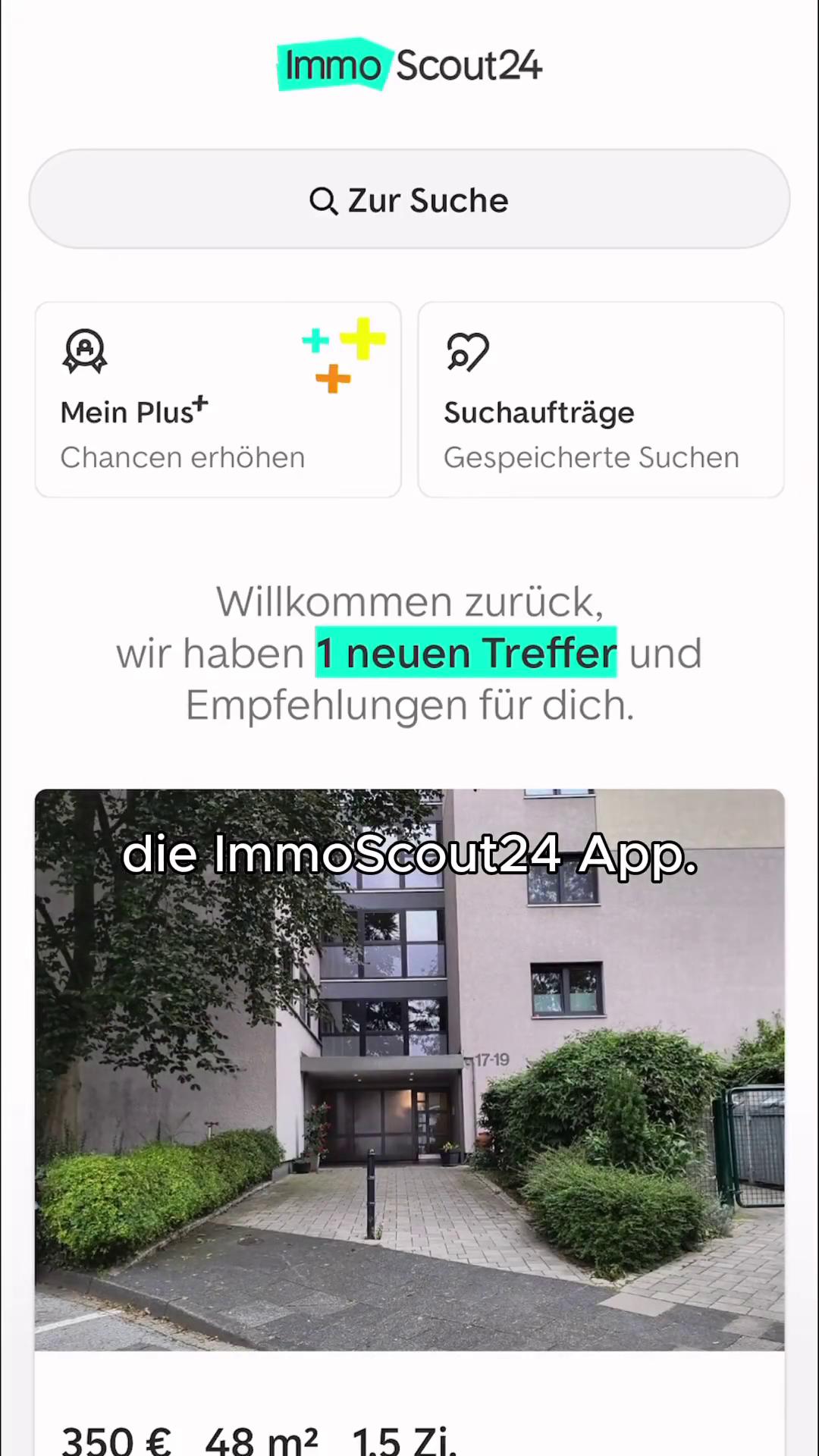
Video (24s) · 53,894,793 impressions · 290 days live · First seen 2026-01-15 · Last seen 2026-10-31
A long-running German explainer, consistent with ImmoScout24's video-only delivery and its utility-led messaging around search, valuation and tenant screening.
3. Redfin — 6-second burst video

Video (6s) · 26,861,469 impressions · 8 days live · First seen 2026-08-30 · Last seen 2026-09-06
A concentrated burst — 3.4 million impressions per day — that coincided with Redfin's video-heavy August before its September pivot back to image. It demonstrates how a short flight can deliver reach without a long always-on commitment.
4. immowelt — 31-second rental video
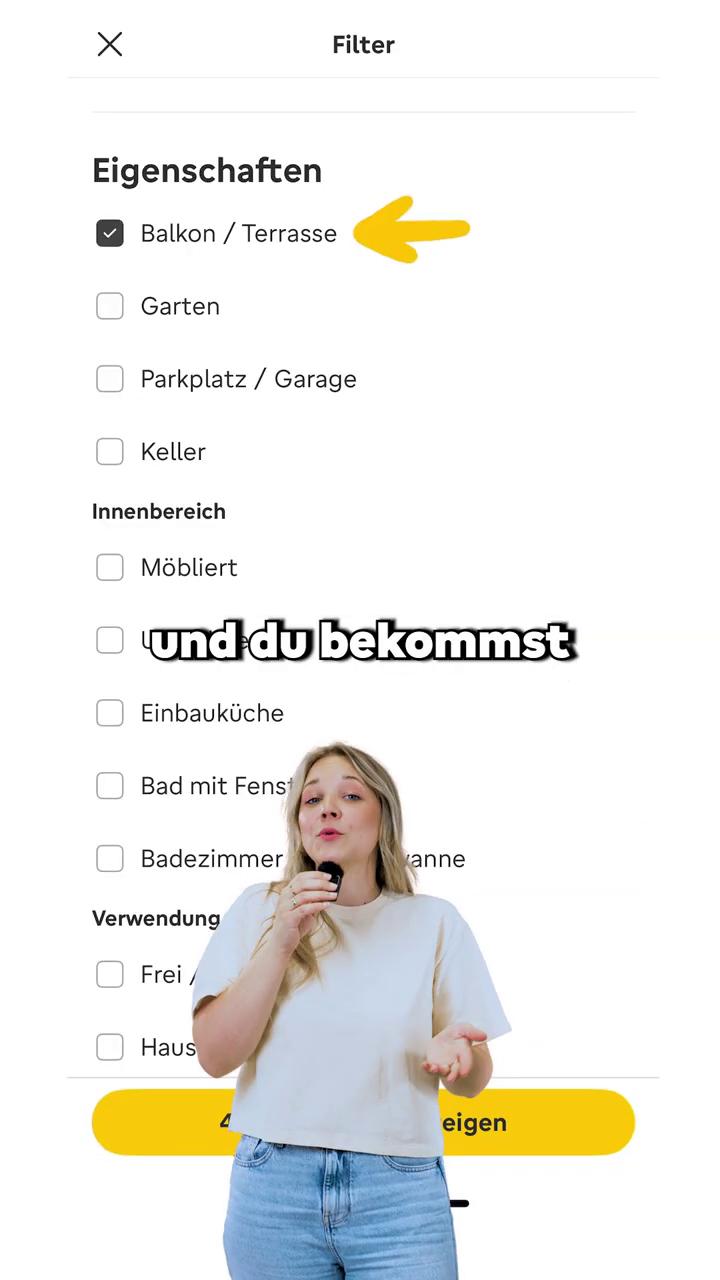
Video (31s) · 20,533,265 impressions · 400 days live · First seen 2025-09-04 · Last seen 2026-10-08
A durable rental-focused asset that supports immowelt's daily-listings and saved-search proposition. Its length matches the German market's preference for 30-second explanatory creative.
5. Property Finder — 11-second urgency video
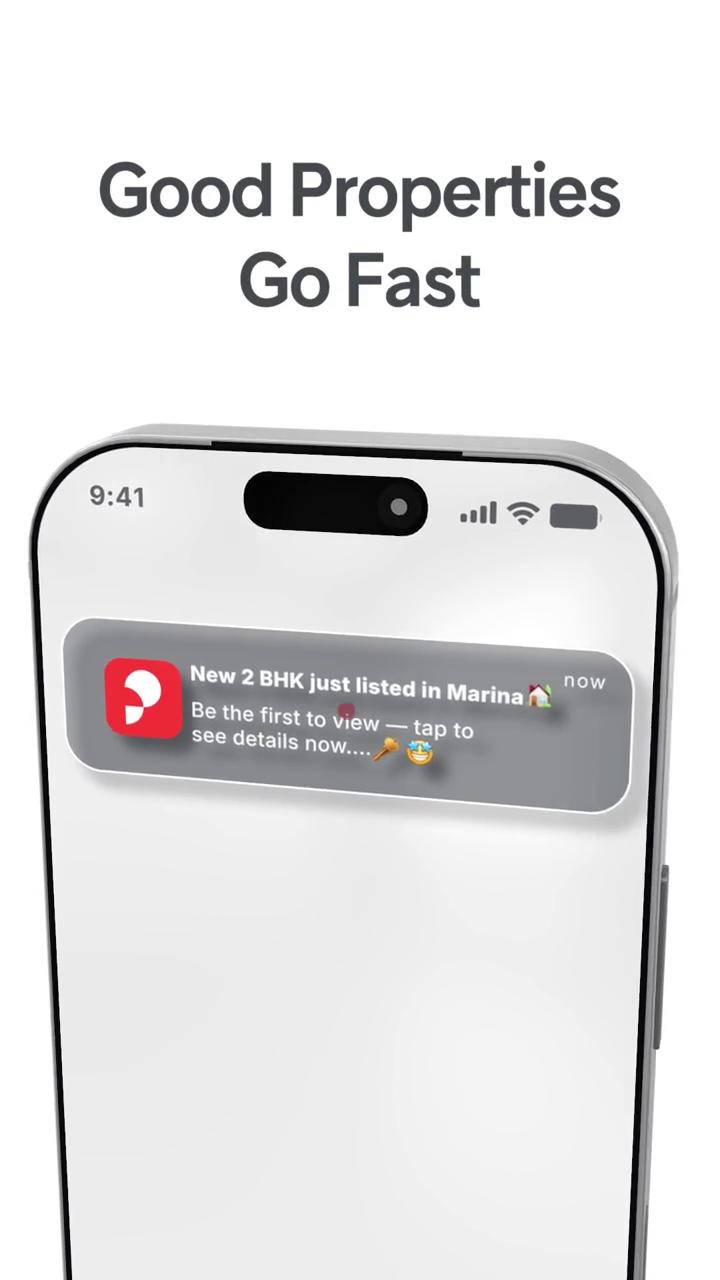
Video (11s) · 2,150,883 impressions · 11 days live · First seen 2026-10-21 · Last seen 2026-10-31
Copy: "Good homes go fast. Get instant alerts when new listings hit the market." A compact example of the dominant persuasion stack: scarcity, speed and a notification mechanic in a single sentence.
| Rank | Advertiser | Format | Impressions | Show / Find | First seen | Last seen | Creative |
|---|---|---|---|---|---|---|---|
| 6 | Bayut | Image | 969,866 | 1,666 / 39 | 2026-09-24 | 2026-10-31 | View — "Every property search is a journey." |
| 7 | Realtor.com | Image | 355,468 | 41 / 2 | 2026-09-06 | 2026-10-24 | View — "A home gym? A dog park? A plunge pool? Find your must-haves." |
| 8 | Centaline | Video | 322,175 | 172 / 17 | 2026-05-03 | 2026-09-03 | Watch — AI search, VR viewings and transaction analytics |
| 9 | Domain | Image | 136,634 | 16 / 1 | 2026-09-14 | 2026-09-21 | View — "Take a look at our latest listings. Enquire now in just a few seconds!" |
| 10 | Housing.com | Image | 98,967 | 193 / 2 | 2026-10-15 | 2026-10-23 | View — dream homes, amenities and appreciation potential |
6. Implications for Advertisers
1. Match format to market, not to a global playbook. Video-first works in Germany and Hong Kong, but Australia's Domain proves image-only can carry a national portal. The US market repriced toward video in October, while Redfin moved the opposite way. Format should be set per market and revisited monthly, not fixed annually.
2. Treat video length as a strategic variable. Five-second video can deliver 176 million impressions for Realtor.com; 30-second video supports German explainer propositions; 75-second video suits virtual tours in Hong Kong. The right question is not "video or image" but "which job is this asset doing?"
3. Lead with friction removal, then add proof. The most common and most scalable message is still speed: instant alerts, saved searches, one-click enquiries. Pair it with a trust asset — verified listings, a named agent, a valuation tool or transaction data — because trust is the second-most-used appeal and the leading one for Redfin and Domain.
4. Use data to justify urgency. "Fall data says the best window to buy is now" is more defensible than generic scarcity talk. Advertisers with proprietary inventory, pricing or transaction data should turn it into a copy asset.
5. Localise down to the neighbourhood. With 90–100% domestic delivery and location language in 82% of Housing.com's copy, national creative without local proof points wastes the channel's targeting capability. Build modular creative: national brand frame, local listing and price overlay.
6. For independent agents, compete on specificity. The long tail cannot match portal reach. Its viable playbook is listing-level imagery, exact price and specification, open-house or auction calls to action, and hyper-local search terms — the same approach seen among Sibcy Cline and Pearsons creatives.
7. Methodology and Data Notes
This analysis covers 3 August to 1 November 2026. The core sample comprises nine leading real-estate advertisers selected from keyword searches for "real estate," "realtor," "property," "apartment" and "housing." For each advertiser, the analysis uses 90-day impression, country, platform and format distributions; daily video and image impression series; and up to 80 of the highest-impression creatives active in the window, for 720 creatives in total, of which 624 contained captured copy.
Definitions and limitations:
- Impressions are measured ad impressions on app inventory. They are not a census of all real-estate advertising, which also includes search, social feed, display and offline media.
- Format-attributed impressions can differ slightly from total trend impressions because of how the platform allocates inventory across dimensions. Shares are calculated within each attribution set.
- Creative-level impressions are as reported for each creative and may include activity outside the 90-day window for long-running assets. Dates shown are first and last observation dates.
- Copy coding is keyword-based and multi-label; a creative may count under several themes. Shares describe prevalence, not causal effectiveness.
- Independent-agent coverage is sparse: several small advertisers had creatives but no measurable impression data. Their treatment is qualitative.
- Centaline recorded only 0.7 million impressions across 63 active days and is excluded from geographic comparisons because its measured country distribution appears inconsistent with its Hong Kong brand footprint.
Powered by AdMapix — Ad Intelligence Platform
Data source: AdMapix advertising intelligence platform and public information; some metrics are estimates and are provided for reference only.
See what competitors are really running
Search 200M+ ads across 170+ market labels. New accounts include 30 lifetime Free credits.