
Ad Optimization Best Practices for 2026: A Practical Playbook
A data-driven guide to creative workflows, A/B testing, benchmarking, and budget allocation frameworks for optimizing digital ad performance.
Advertising optimization in 2026 is less about “secret hacks” and more about disciplined execution: reliable creative workflows, rigorous testing, clear benchmarks, and intelligent budget allocation. This playbook distills proven best practices for digital advertisers and mobile app marketers scaling across channels and regions. It’s grounded in market signals, but designed to be practical—so you can apply it immediately.
1) Start with a Creative Production Workflow That Scales
Creative is still the biggest lever in performance. In AdMapix analyses, creative changes explain 45–60% of CPA variance in mobile app campaigns, even when targeting and bids remain constant. The challenge isn’t knowing that creative matters—it’s building a workflow that produces enough variation and learning cycles without burning your team.
A. A Workflow That Balances Speed and Quality
A scalable workflow needs to balance throughput with feedback quality. Here’s a step-by-step framework used by high-performing teams:
- Brief: Translate performance goals into creative hypotheses (e.g., “Faster onboarding claim will reduce CPA by 10% in LATAM”).
- Concepts: Generate 5–8 concept routes (message + hook + visual style).
- Production: Build modular assets (backgrounds, CTAs, copy variants) for rapid recombination.
- QA: Validate specs, brand safety, and localization accuracy.
- Launch: Stage rollouts with a test budget and clear success thresholds.
- Analyze: Tag assets and log learning outcomes in a reusable library.
- Iterate: Turn winning concepts into “families” with localized variations.
Actionable tip: Keep a “creative taxonomy” that tags each asset by message, CTA, format, and visual style. This makes testing and optimization far faster.
B. Production Output Targets by Scale
Creative output targets should grow with spend. Underproducing is a common cause of performance plateaus.
| Monthly Spend Tier | Recommended New Creatives/Month | Formats to Prioritize | Rationale |
|---|---|---|---|
| <$50K | 8–15 | 1:1 static, 9:16 video | Establish baseline learnings |
| $50K–$250K | 20–40 | 9:16 video, 4:5 static, UGC | Prevent fatigue across placements |
| $250K–$1M | 40–80 | 9:16 video, 1:1, playable, carousel | Maintain test velocity at scale |
| >$1M | 80–150 | Multi-language, dynamic, UGC | Regional and placement-specific optimization |
Why it works: On average, creative fatigue can increase CPA by 15–25% after 14–21 days without fresh variation.
C. Build a Creative “Family” Strategy
Rather than a few one-off ads, create families of assets around a winning concept:
- Message variations: Benefit-led vs. feature-led headlines
- Audience variations: New users vs. lapsed users
- Visual variations: Product demo vs. lifestyle imagery
- Offer variations: Free trial vs. limited-time discount
Actionable tip: When a creative wins, spin 4–6 variations within 7 days to maintain momentum before fatigue sets in.
2) A/B Testing Strategies That Actually Produce Learnings
Many advertisers test too much, too quickly, and end up with noisy results. The goal is not just to find “winners,” but to build repeatable insights.
A. A Structured A/B Testing Process
Use a consistent process so results are comparable across campaigns:
- Hypothesis: “Using a 3-second hook with outcome-first copy will increase CTR by 10%.”
- Control: Current best-performing creative or landing page.
- Variables: Change only one variable at a time (hook, CTA, visual).
- Sample size: Ensure enough impressions for statistical confidence.
- Decision rules: Define “win” thresholds before launch.
- Documentation: Record the learning regardless of outcome.
Actionable tip: For most mobile app campaigns, aim for 95% confidence and at least 1,000–2,000 clicks per variant before deciding.
B. Prioritize Tests by Impact
You can’t test everything at once. Use an ICE framework (Impact, Confidence, Effort):
- Impact: How big could the lift be?
- Confidence: How likely is the hypothesis to be correct?
- Effort: How much time or cost is required?
Score each test from 1–10, then prioritize the highest combined score.
C. Testing Matrix by Funnel Stage
Different stages require different metrics. Don’t optimize top-of-funnel creatives based only on ROAS.
| Funnel Stage | Primary Metric | Secondary Metric | Recommended Tests |
|---|---|---|---|
| Awareness | CTR | View-through rate | Hook, visual style, format |
| Consideration | CVR | Landing page time | Benefit framing, proof points |
| Conversion | CPA / ROAS | LTV | Offer structure, onboarding flow |
| Retention | LTV | Churn rate | Post-install messaging, push copy |
Actionable tip: Run separate test lanes for awareness and conversion. Blending them tends to produce inconsistent results.
3) Benchmarking Performance: Know What “Good” Looks Like
Benchmarking prevents overreaction to normal fluctuations. It also helps set realistic goals by region, platform, and category.
A. Illustrative Benchmarks for 2026
Below are typical performance ranges from AdMapix observed campaigns in 2025–2026. Use them as directional guidance, not rigid targets.
| Region | Avg. CTR (Video) | Avg. CVR | Median CPA (Gaming) | Median CPA (Non-Gaming) |
|---|---|---|---|---|
| North America | 1.2% | 3.5% | $6.80 | $9.40 |
| Western Europe | 1.0% | 3.2% | $5.90 | $8.20 |
| LATAM | 1.6% | 4.0% | $2.80 | $4.10 |
| Southeast Asia | 1.8% | 4.5% | $1.90 | $3.20 |
| MENA | 1.4% | 3.8% | $3.40 | $5.10 |
Key insight: CPAs in LATAM and SEA are 45–70% lower than North America, but LTV can be 30–50% lower as well. Your benchmark should include both cost and value.
B. Platform-Specific Benchmarks
Performance also shifts by platform. For example, short-form video placements often deliver lower CPA, but higher volatility.
| Platform | Avg. CTR | Avg. CPM | CPA Volatility | Best-Use Case |
|---|---|---|---|---|
| Meta (IG/FB) | 1.1% | $9–$14 | Medium | Balanced performance and scale |
| TikTok | 1.8% | $6–$10 | High | Top-of-funnel testing and UGC |
| Google UAC | 0.9% | $7–$12 | Low | Stable acquisition volume |
| Snapchat | 1.5% | $5–$9 | High | Younger audiences, gaming |
Actionable tip: Establish platform-specific KPI ranges instead of one universal target. It keeps teams focused on what each channel does best.
C. Build a Benchmarking Dashboard
A simple dashboard should include:
- Baseline KPIs by region and platform
- Creative performance quartiles (top 25%, median, bottom 25%)
- Time-to-fatigue metrics (days to performance drop)
- A/B test win rates by hypothesis type
Actionable tip: Review benchmarks monthly and reset targets quarterly to reflect market shifts (e.g., seasonal CPM changes).
4) Budget Allocation Frameworks That Protect Efficiency
Budget allocation is where optimization meets strategy. The best frameworks balance experimentation with predictable performance.
A. The 70/20/10 Budget Model
A widely used model allocates spend across proven and exploratory efforts:
- 70% Core: Your most stable, highest-ROI campaigns
- 20% Growth: New creatives, audiences, or platforms with early signals
- 10% Experimental: High-risk, high-reward ideas
Actionable tip: If your test win rate falls below 20%, reduce experimental spend and refine hypotheses.
B. Regional Allocation by LTV-to-CPA Ratio
Instead of only allocating by CPA, use an LTV-to-CPA ratio to compare value across regions. A ratio above 2.0 typically indicates good scaling potential.
| Region | Avg. CPA | Avg. 90-Day LTV | LTV/CPA Ratio | Scale Recommendation |
|---|---|---|---|---|
| North America | $8.80 | $22.00 | 2.5 | Scale carefully |
| Western Europe | $7.60 | $18.50 | 2.4 | Moderate scale |
| LATAM | $3.20 | $6.20 | 1.9 | Optimize before scaling |
| Southeast Asia | $2.40 | $5.50 | 2.3 | Scale with creative testing |
| MENA | $4.10 | $9.00 | 2.2 | Moderate scale |
Actionable tip: Use value-based bidding or ROAS targets in regions with higher LTV/CPA ratios to capture full upside.
C. Incrementality-Based Allocation
When multiple channels show good results, use incrementality testing to confirm where conversions are truly incremental.
Simple framework:
- Choose a stable region.
- Run a geo holdout or time-based holdout for one channel.
- Compare incremental lift in installs or revenue.
- Reallocate 10–20% of budget toward channels with higher incremental lift.
Actionable tip: Even a small holdout (5–10% of traffic) can reveal whether a channel is driving true lift or just capturing existing demand.
5) Building a Performance Feedback Loop
Optimization is a loop, not a one-time event. The best teams build continuous feedback systems that align creative, media, and product.
A. Weekly Performance Review Template
A disciplined review cadence keeps teams aligned:
- Monday: Top 5 creatives by CPA and ROAS
- Tuesday: Creative fatigue flags and pause list
- Wednesday: New test designs and hypothesis pipeline
- Thursday: Landing page and funnel conversion checks
- Friday: Budget reallocation and next-week plan
Actionable tip: Keep each review focused on one primary question—for example, “Which creative theme improved CVR this week?”
B. Connect Creative Metrics to Product Outcomes
Creative performance is more meaningful when linked to downstream outcomes. A creative that improves CTR but reduces retention can hurt long-term ROI.
Track:
- D7 and D30 retention by creative theme
- ARPU by acquisition channel
- First-session completion rate
Actionable tip: If a creative produces high installs but low retention, treat it as a top-of-funnel asset, not a core scaling creative.
6) Common Optimization Pitfalls (and How to Avoid Them)
Even experienced teams fall into predictable traps:
- Over-optimizing to short-term CPA: This often sacrifices LTV and retention.
- Testing too many variables at once: Leads to unclear learnings.
- Ignoring creative fatigue: Performance drops are misread as algorithm issues.
- Uniform benchmarks across regions: Masks real opportunities.
- Scaling without validation: Wins in one region don’t automatically translate.
Actionable tip: Maintain a “learning log” where each test’s outcome is recorded with a clear next step. It prevents repeated mistakes.
7) A 30-Day Optimization Sprint Plan
If you need a fast reset, this structured sprint can stabilize performance quickly.
Week 1: Audit and Baseline
- Audit top 20 creatives and identify fatigue
- Establish benchmarks by region and platform
- Define 3–5 high-impact test hypotheses
Week 2: Launch Test Pods
- Produce 10–15 new creatives per core concept
- Launch A/B tests with strict variables
- Monitor early signals but don’t overreact
Week 3: Scale Winners
- Expand top-performing creative families
- Increase budget in regions with high LTV/CPA
- Retire bottom-quartile creatives
Week 4: Consolidate Learnings
- Summarize test results in a learning log
- Update benchmarks and creative taxonomy
- Plan next sprint based on confirmed insights
Actionable tip: Even a single sprint can improve CPA by 10–20% if it replaces stale creative and clarifies budget priorities.
8) How to Use AdMapix Insights in Optimization
AdMapix users often see faster optimization cycles by benchmarking and creative intelligence. Here are practical ways to apply that data:
- Competitive creative analysis: Identify which formats and messages competitors are scaling.
- Trend detection: Spot emerging creative patterns in new regions.
- Fatigue tracking: Monitor how long competitor creatives stay active.
- Localization inspiration: See how top brands adapt messaging by market.
Actionable tip: Build a monthly competitor review where you add 5–10 new insights into your creative roadmap.
Key Takeaways
- Scale creative production to match spend; underproduction is a top driver of performance plateaus.
- Test with discipline—one variable at a time, clear hypotheses, and pre-defined success thresholds.
- Benchmark by region and platform, not by a single global KPI.
- Allocate budget using LTV/CPA ratios and incrementality checks to protect efficiency.
- Build a continuous feedback loop connecting creative metrics to downstream product outcomes.
If you want a faster path to optimization, pair these practices with creative intelligence tools that reveal what’s working across your category and regions. Consistent, structured execution will beat “one-off” tactics every time.
Turn these observations into your next creative study
Open the creative library and select samples for your market, network and research question.
Related Articles
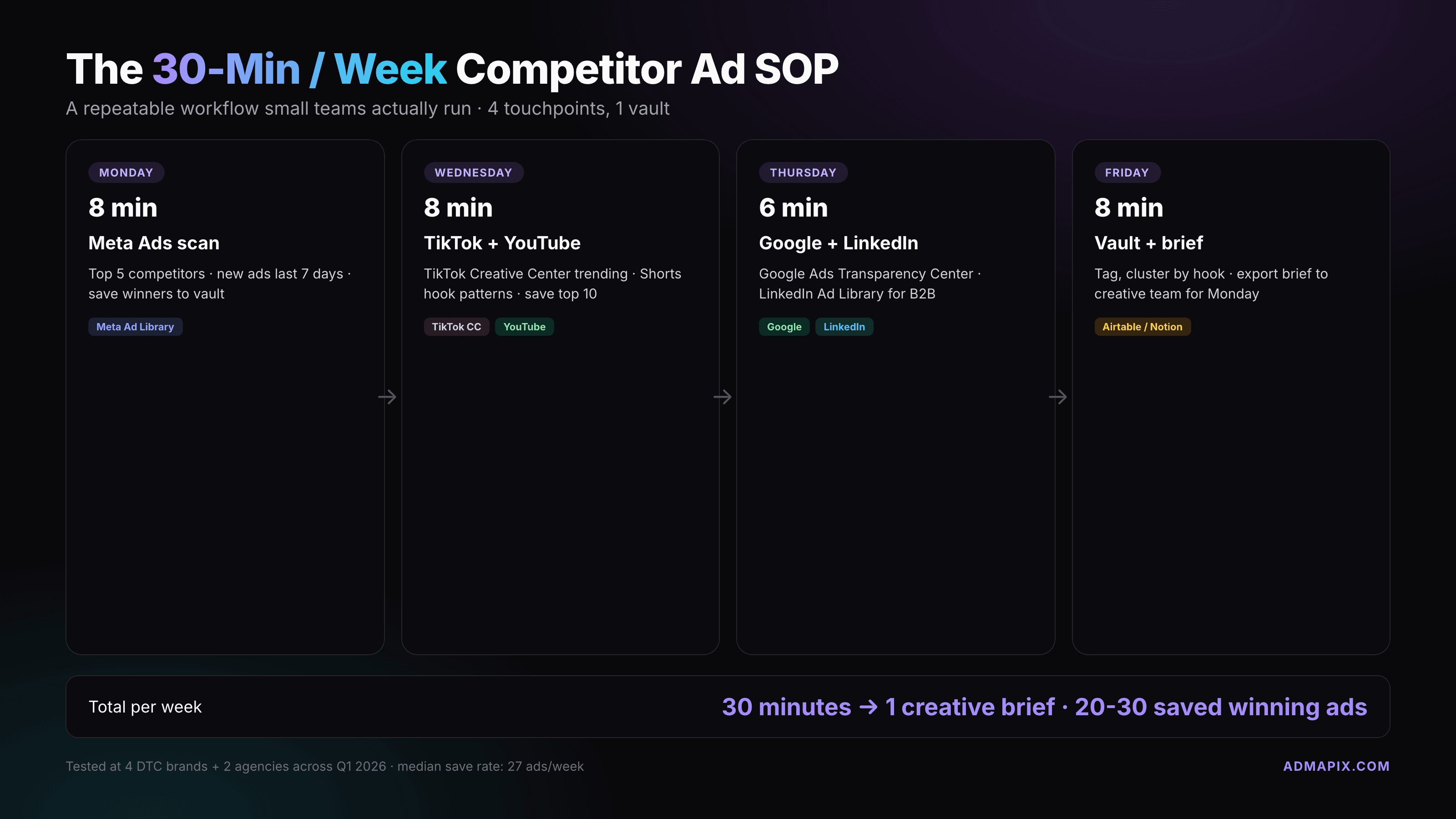
How to Spy on Competitors' Ads in 2026 (30-Min/Week Workflow)
A tactical 2026 guide to spying on competitor ads across Meta, TikTok, Google, YouTube, and LinkedIn — with a repeatable 30-minute weekly SOP, a Notion/Airtable schema, and an honest free-vs-paid breakdown.
Best Ad Spy Tools 2026: Free & Paid Picks for PPC & Social
Compare free and paid ad spy tools by budget, PPC or social coverage, affiliate research fields and creative workflow, with dated pricing sources.
Bidding on Competitor Keywords in Google Ads (2026): Rules, Brand Bidding, Detection & Defense
Separate keyword selection, visible trademark use and auction evidence. A practical workflow for competitor tests, brand monitoring and proportionate responses.