SaaS Ad Spy Tools in 2026: Reading Competitor Messaging, Offers & Demo Paths
A 2026 guide to SaaS ad spy research — how to read competitor messaging, proof, and demo paths from public LinkedIn and Google ads without faking spend, the five-layer message map, the PLG-vs-sales-led funnel read, the trial-vs-demo offer ladder, category-creation vs differentiation positioning, pricing-transparency signals, SaaS-category nuances for horizontal, vertical, and dev tools, a worked teardown, and a workflow that turns competitor ads into a message map and test backlog.
SaaS Ad Spy Tools in 2026: Reading Competitor Messaging, Offers & Demo Paths
By the AdMapix Research Team — Updated June 21, 2026
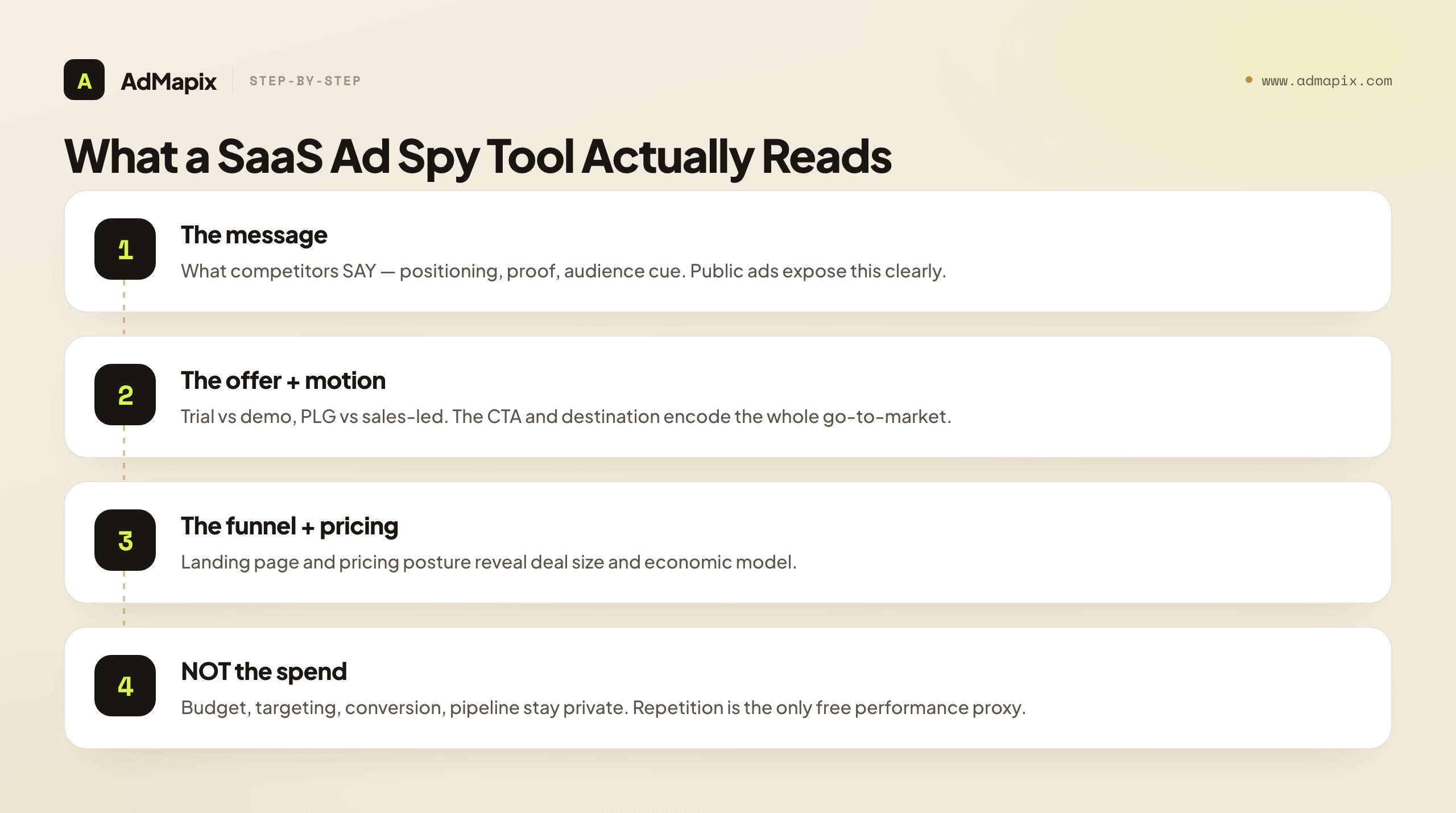
A SaaS ad spy tool is most useful for reading what competitors say and offer, not for guessing what they spend. Public ad libraries expose the message, the proof, the audience cue, the offer, and the demo or trial path. They do not expose budget, targeting, conversion rate, or pipeline. In 2026, with B2B SaaS buying committees larger and self-serve and sales-led motions blurring together, the team that decodes how competitors position, package, and route their funnel ships sharper messaging while everyone else guesses. This guide is for SaaS marketers, founders, product marketers, demand-gen teams, and agencies who want to turn competitor ads into a message map, an offer map, and a test backlog — not a folder of screenshots. It's the SaaS-specific companion to our B2B ad creative examples guide and LinkedIn ads competitor research playbook: it assumes the universal frameworks and goes deep on what's unique to SaaS — the PLG-vs-sales-led read, the trial-vs-demo offer ladder, and category positioning.
We've torn down thousands of SaaS creatives across horizontal tools, vertical software, and developer products, and the SaaS-specific edge is consistent: the teams who win read the positioning and funnel behind a competitor's ad — are they creating a category or differentiating in one, routing to a trial or a demo, selling to a user or a buyer — not just the creative in isolation. The ad is the message; the funnel and positioning behind it are the strategy. This guide shows you how to read both.
TL;DR — SaaS Ad Spy Research in One Screen
- A SaaS ad spy tool tells you what competitors are saying and offering, not what they're spending or how well it converts. Treat each saved ad as evidence of a choice (this audience, this hook, this offer, this demo path), not proof of results.
- The five-layer read decodes any SaaS ad: audience cue, message angle, offer path, format, and destination. The same five layers make competitor ads comparable.
- The funnel motion is the SaaS-specific signal. Whether a competitor routes to a self-serve trial or a sales demo reveals their entire go-to-market — PLG vs. sales-led — before you read a word of copy.
- The offer is a ladder. Guide → webinar → trial → demo maps to audience warmth, and where a competitor leads tells you their motion and confidence.
- Positioning is a bet you can read. Category-creation messaging ("a new way to X") versus differentiation messaging ("better than [incumbent]") reveals where a competitor thinks they sit in the market.
- Pricing transparency is a signal. Public pricing vs. "contact sales" vs. hidden pricing encodes deal size and motion — and shows up in the ad and landing page.
- Public data proves structure, never economics. You can read the message, offer, format, and funnel; you cannot read spend, targeting, conversion rate, or pipeline. Repetition is the one reliable free signal.
What SaaS Ad Spying Can and Cannot Prove
Public ad research proves intent and positioning; it cannot prove performance. When you see a competitor's LinkedIn carousel or a Google Search ad, you're seeing a deliberate decision about who they want to reach and what they want to say. You're not seeing whether that ad is winning.
This distinction matters because SaaS teams routinely overread ad libraries. "They're running this ad heavily" is an assumption; ad libraries show that an ad is active, not that it's scaled. Keep the boundary explicit, especially in client work.
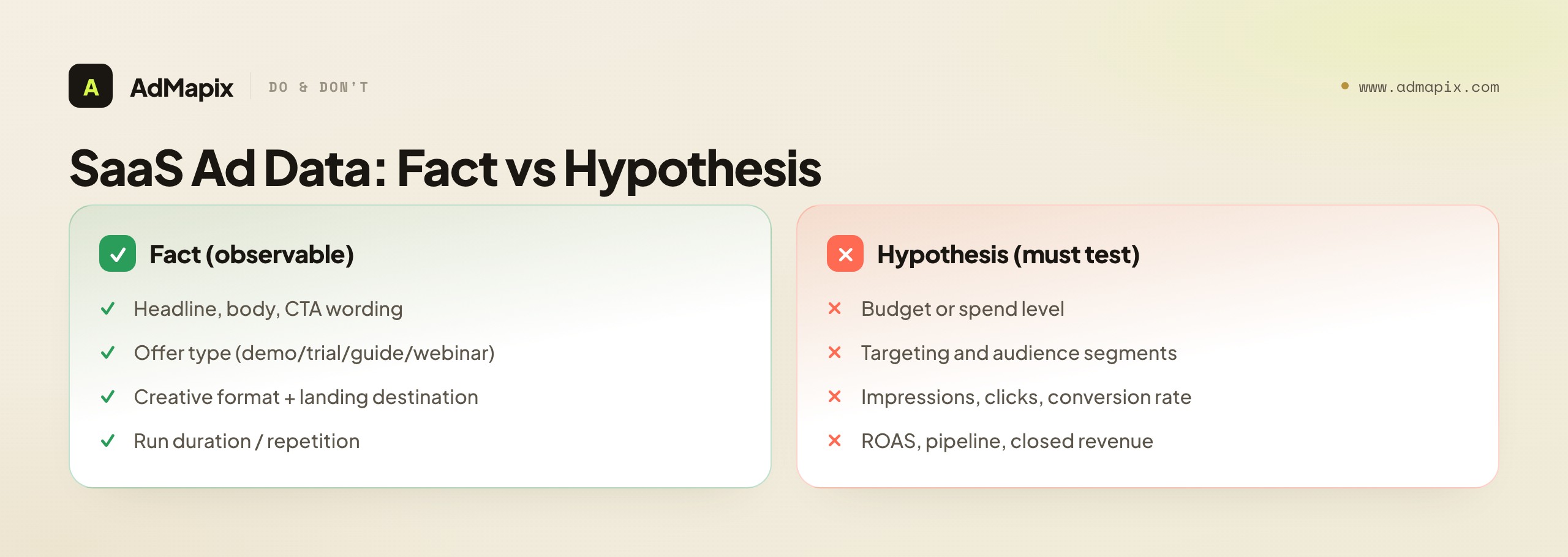
| What public ads reliably show | What public ads do NOT show |
|---|---|
| Headline, body copy, and CTA wording | Budget or spend level |
| Offer type (demo, trial, guide, webinar) | Targeting and audience segments |
| Creative format (single image, video, document) | Impressions, clicks, conversion rate |
| Landing page or lead-form destination | ROAS, pipeline, closed revenue |
| How long an ad has been running (on some platforms) | Whether the ad is profitable |
The one reliable inference public data supports is repetition: a creative or offer a competitor has run continuously for weeks, or relaunched across formats, is more likely to be working than a one-off, because SaaS teams rarely keep funding losers. But longevity is a hypothesis, not a verdict — the only performance data you can trust is your own pipeline.
Where the Public Data Comes From
Most B2B SaaS ad research starts on two surfaces — LinkedIn and Google — and each shows creative and format with different coverage and different blind spots. Knowing what each surface gives you keeps your research grounded.
LinkedIn is where most B2B SaaS demand-gen lives, so its ad formats map closely to SaaS funnels. Google's transparency surface is broader (Search, YouTube, Discover) but shows verified-advertiser creatives without the rich format taxonomy LinkedIn documents.
| Source | Strongest for | Format detail | Caveat |
|---|---|---|---|
| LinkedIn Ad Library | B2B audience and offer reading | High (named formats) | Coverage depends on what each company runs |
| Google Ads Transparency Center | Cross-surface creative discovery | Medium | Shows active ads from verified advertisers, not spend |
The complete SaaS picture comes from reading both together, because they catch the buyer at different moments. LinkedIn is demand creation against a professional identity — the top and middle of a long funnel, where positioning and category messaging live. Google Search is demand capture against an active query — the high-intent bottom, where the offer and the brand defense live. A competitor's LinkedIn creative shows how they shape demand; their Google creative shows how they capture it and defend their brand. For the deep dives on each surface, see our LinkedIn ads competitor research and Google Ads competitor analysis guides; this guide focuses on what's distinctly SaaS across both.
Read the Message Layer, Not Just the Ad
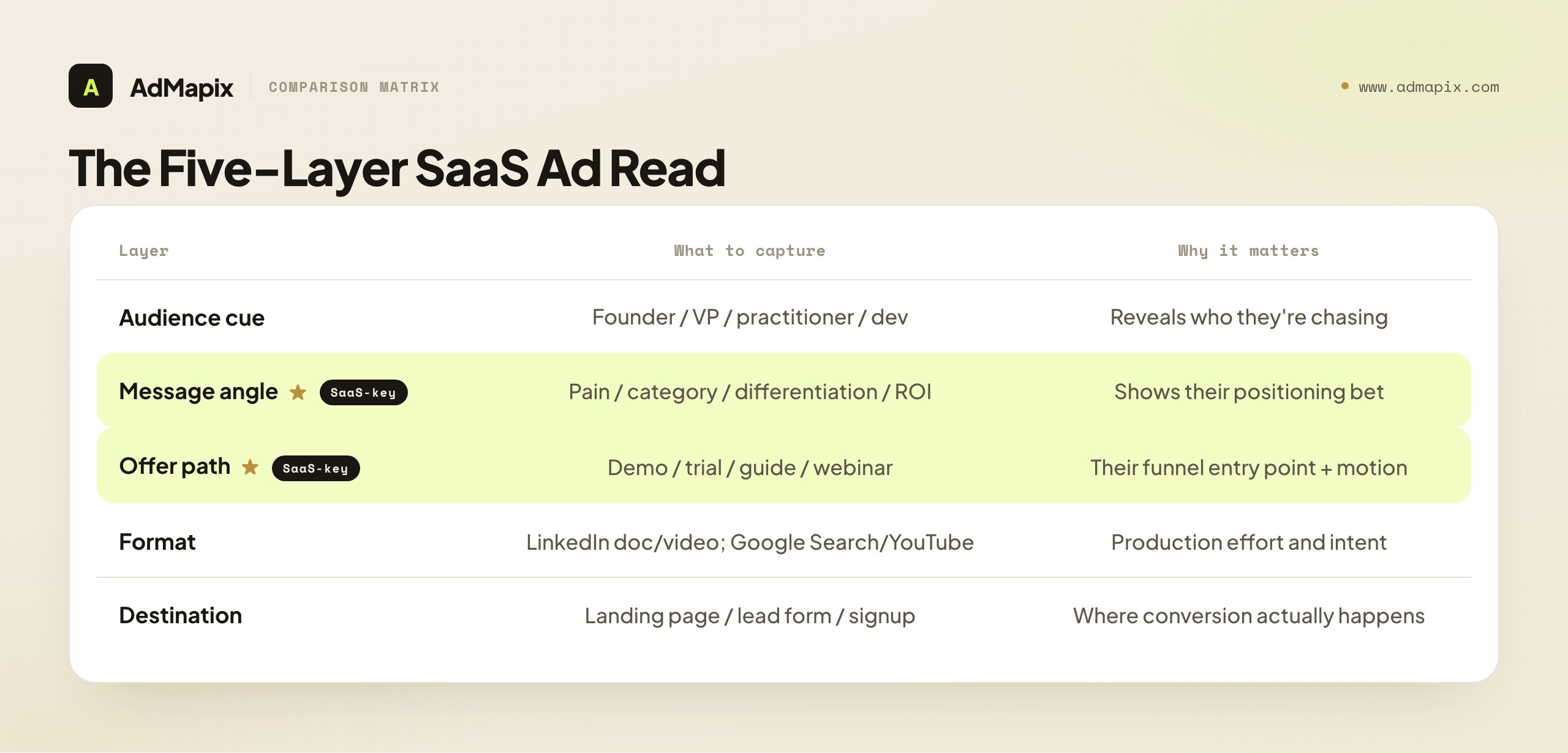
The point of spying is to decode the choices behind a competitor's ad, not to admire the design. For each saved creative, separate five layers so the evidence becomes comparable across competitors.
| Research layer | What to capture | Why it matters |
|---|---|---|
| Audience cue | Founder, VP, practitioner, enterprise buyer, developer | Reveals who they're chasing |
| Message angle | Pain point, category claim, differentiation, proof, ROI | Shows their positioning bet |
| Offer path | Demo, trial, guide, webinar, report, calculator | Tells you their funnel entry point |
| Format | LinkedIn document, video, single image; Google Search/YouTube | Hints at production effort and intent |
| Destination | Landing page, lead form, store page | Where the conversion work actually happens |
When the same angle or offer repeats across several competitors, that's a market pattern worth a test. When one competitor's landing page contradicts its ad's promise, that's a gap worth exploiting. The five layers are the SaaS-tuned version of the universal capture frameworks — the rest of this guide deepens the two layers that are most distinctly SaaS: the offer path (the funnel motion) and the message angle (the positioning bet).
The Funnel Motion: Reading PLG vs. Sales-Led From the Ad
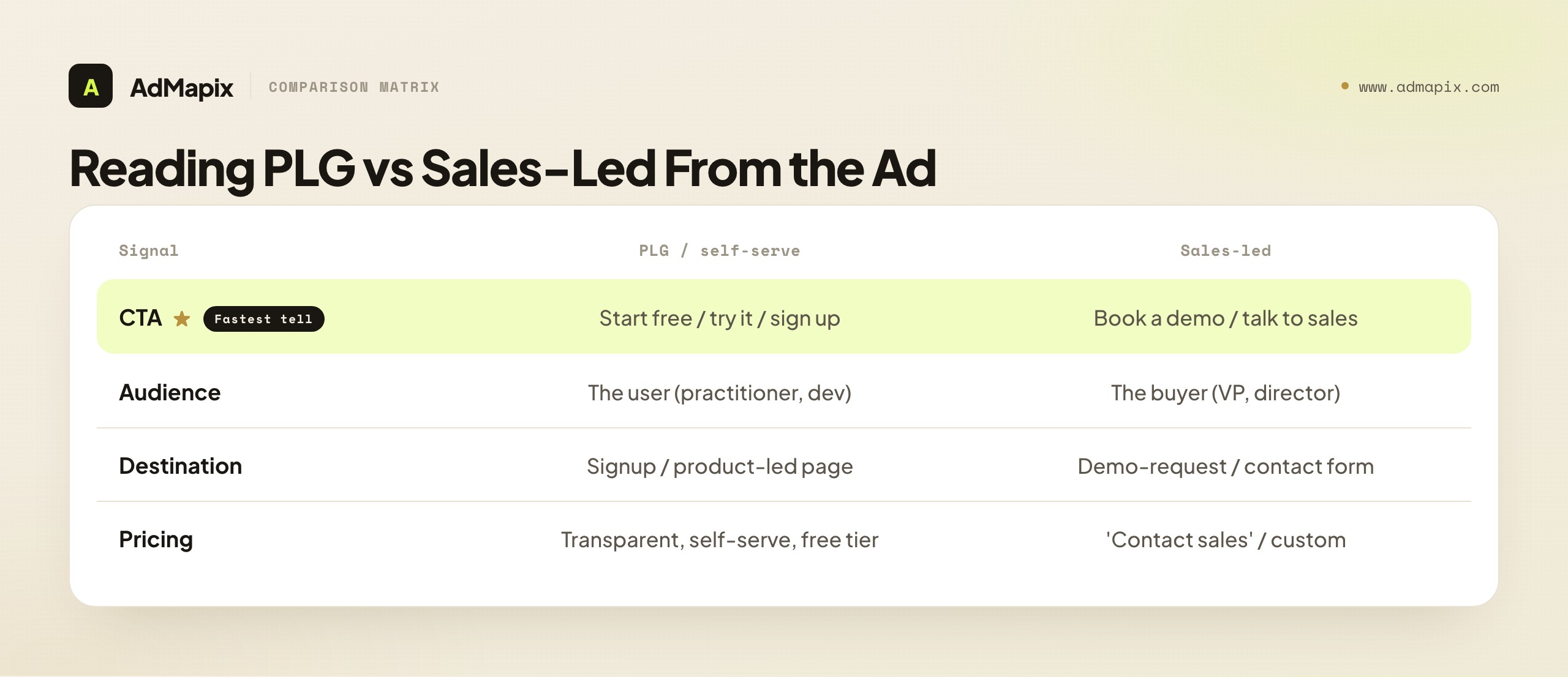
The single most revealing SaaS-specific read is the funnel motion — whether a competitor routes to a self-serve trial or a sales demo — because that one choice exposes their entire go-to-market before you read a word of copy. Product-led growth (PLG) and sales-led motions look different in the ad, the offer, and the destination, and recognizing which one a competitor runs tells you how they make money and where they're vulnerable.
The signals that distinguish the two motions:
- The CTA and offer. "Start free," "try it free," "sign up" signal a PLG, self-serve motion. "Book a demo," "talk to sales," "request a quote" signal a sales-led motion. The CTA is the fastest motion tell.
- The audience cue. PLG ads usually speak to the user (the practitioner, the developer, the individual contributor who'll adopt the product). Sales-led ads speak to the buyer (the VP, the director, the budget holder). Who the copy addresses reveals the motion.
- The destination. A PLG ad lands on a signup page or a product-led landing page optimized for self-serve conversion. A sales-led ad lands on a demo-request form or a "contact us" page. The destination confirms the motion the CTA suggested.
- The pricing posture. PLG products usually show transparent, self-serve pricing (often with a free tier); sales-led products hide pricing behind "contact sales." Pricing visibility is a strong motion signal you can read from the landing page.
The strategic value: knowing a competitor's motion tells you how to compete. A PLG competitor wins on product experience and frictionless onboarding, so you compete on a better free experience or a sharper activation flow — and you can read whether their self-serve funnel leaks (a confusing signup, a weak free tier). A sales-led competitor wins on relationship and enterprise trust, so you compete on a faster, lower-friction path for buyers who don't want to talk to sales yet. Many SaaS companies run a hybrid motion — PLG for the bottom of the market, sales-led for enterprise — and spotting both motions in a competitor's ad mix tells you they've segmented their go-to-market by deal size, which is a sophistication signal worth noting.
A practical way to confirm a hybrid motion is to watch which audiences get which CTA. If a competitor's practitioner-targeted ads say "start free" while their VP- and director-targeted ads say "book a demo," they're explicitly running two motions against two buyer tiers — and that split is a precise read of how they've drawn the line between self-serve and sales-assisted in their own funnel. Knowing exactly where a competitor switches from PLG to sales-led tells you which deals they fight for with a sales team and which they let the product close on its own, and the boundary between those two is often where a challenger can win — by offering a smoother self-serve path higher up-market than the incumbent dares to, or a more consultative touch lower down than they bother with.
The SaaS Offer Ladder: Trial vs. Demo and Everything Between
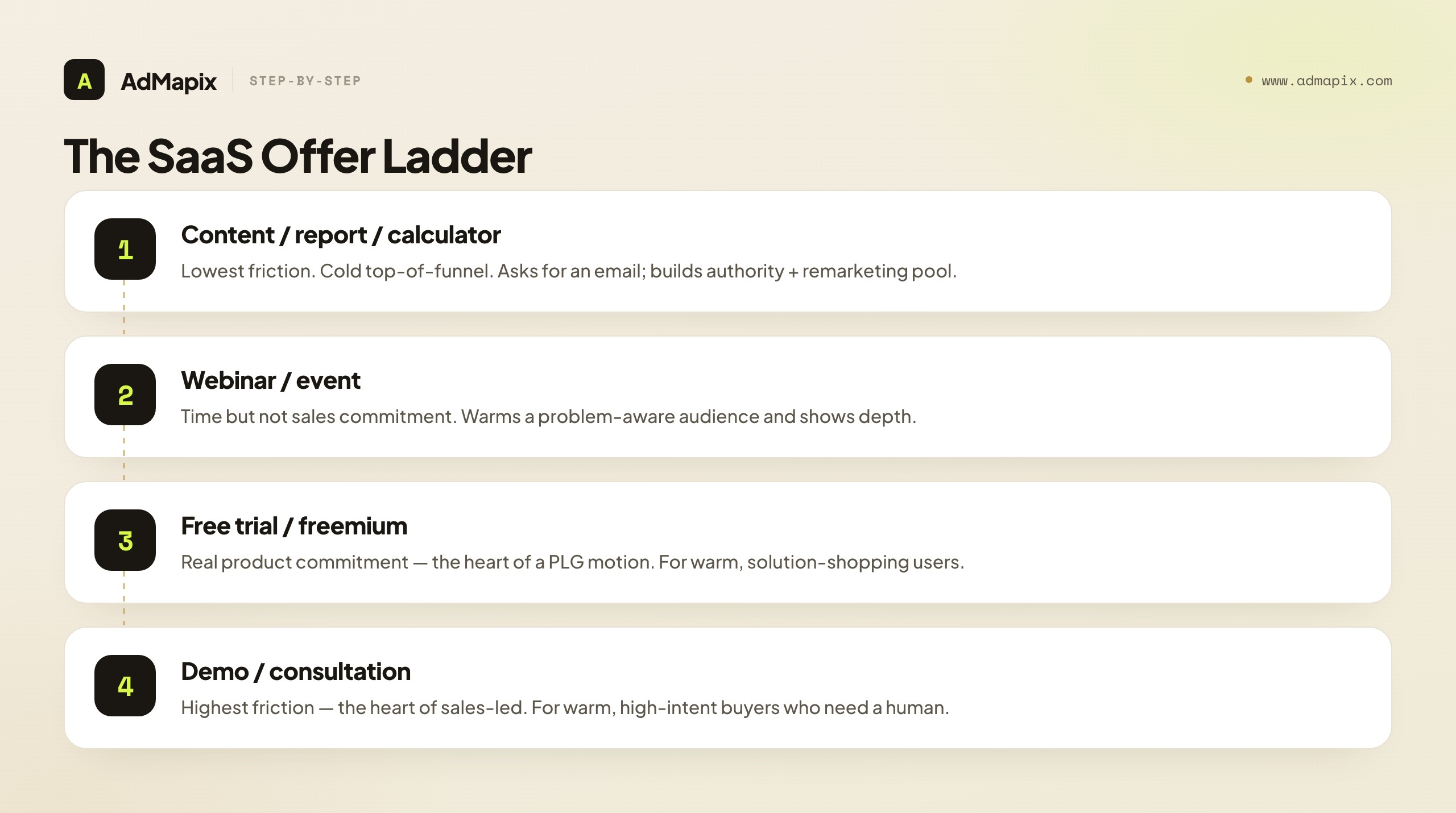
The SaaS offer is a ladder from lowest to highest commitment, and where a competitor leads on the ladder tells you their motion, their audience warmth, and their confidence. Reading the offer ladder turns "what are they offering?" into a strategic read of their whole funnel entry.
The SaaS offer ladder, lowest to highest friction:
- Content / report / benchmark (lowest friction). A guide, an industry report, an ROI calculator. Asks only for attention or an email. Ideal for cold, top-of-funnel audiences who don't know the competitor yet; builds authority and a remarketing pool.
- Webinar / event. A time commitment but not a sales commitment. Warms a problem-aware audience and demonstrates expertise at depth.
- Free trial / freemium. A real product commitment, the heart of a PLG motion. Fits warm, solution-shopping audiences ready to evaluate hands-on.
- Demo / consultation (highest friction). A direct sales conversation, the heart of a sales-led motion. Belongs to warm, high-intent audiences who need a human to close the gap.
The strategic read: match the rung to the motion and the audience. A competitor leading cold audiences straight to a "book a demo" CTA is either running a confident sales-led motion or making a laddering mistake (asking strangers for a high-commitment step) — and distinguishing the two is where the opportunity lives. A competitor who ladders well (report to cold, trial to warm, demo to retargeting) is running a mature funnel; one that leads every audience to the same heavy ask is leaving the top of the funnel on the table, a gap you can take with a lower-friction entry point. The offer ladder for SaaS is the same logic as the B2B offer ladder in our B2B ad creative examples guide, tuned for the trial-vs-demo decision that defines SaaS go-to-market.
There's also a read in whether a competitor runs multiple rungs simultaneously. A sophisticated SaaS funnel offers different entry points to different audience temperatures at once — a benchmark report ad for cold prospects, a webinar for the problem-aware, a free-trial push for the solution-shopping, and a demo offer for retargeting. When you see a competitor running this full spread in their ad mix, you're looking at a mature, well-resourced funnel that has segmented its acquisition by stage — and the spread itself is a signal of both budget and go-to-market maturity. Conversely, a competitor running only one rung (all demo offers, or all gated reports) has a thinner or less-segmented funnel, which is an opening: you can capture the audiences they're not serving at the stages they've left uncovered. The shape of a competitor's offer-ladder coverage — full spread versus single rung — is one of the clearest reads of how seriously and completely they've built their funnel, and it comes free from cataloging their offers across their ad mix. Map the ladder coverage for each competitor, and the gaps in their funnels become your entry points.
Positioning: Category Creation vs. Differentiation
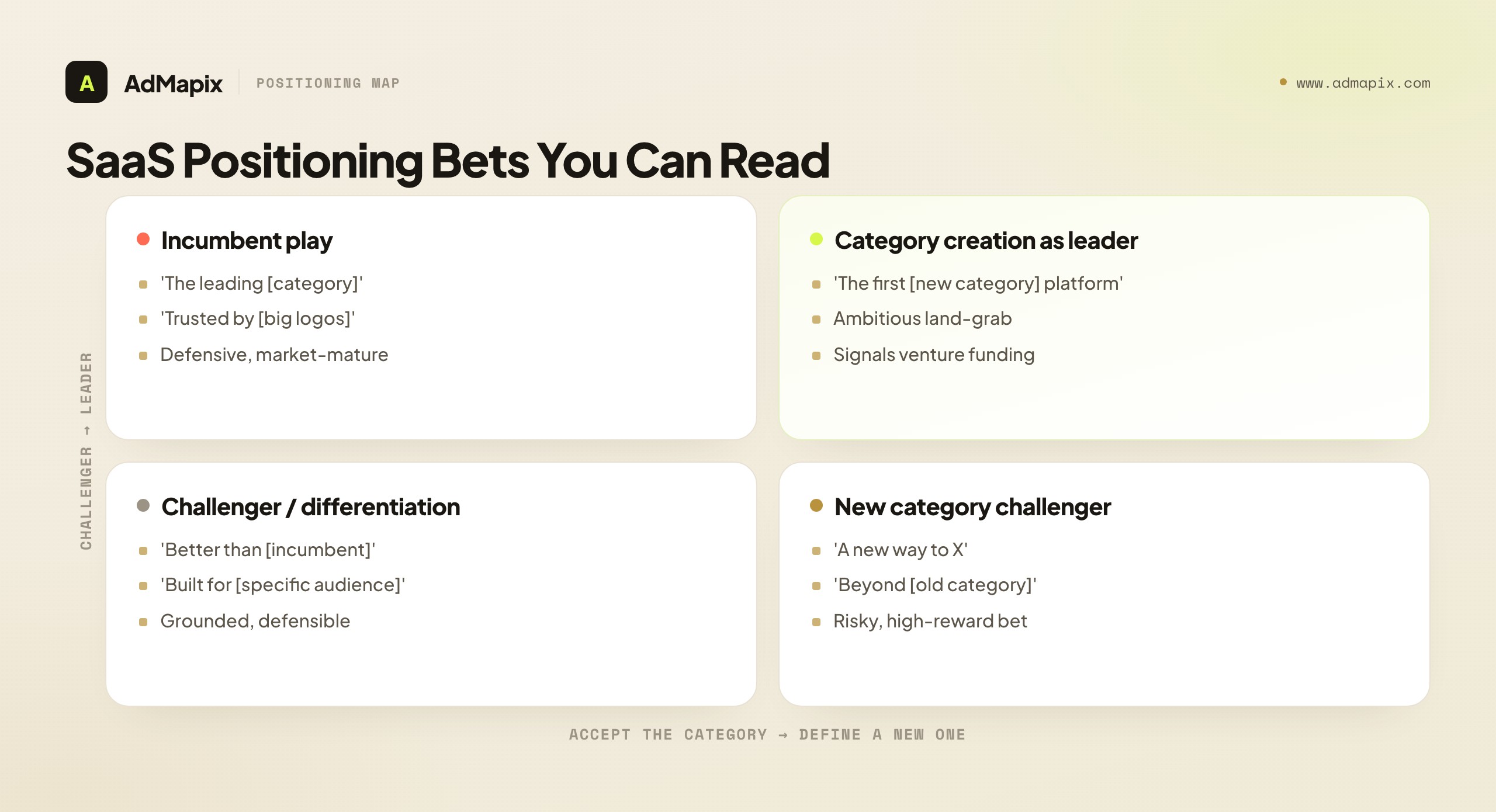
A SaaS ad's message angle encodes a positioning bet, and reading whether a competitor is creating a category or differentiating within one tells you where they think they sit in the market — and where the openings are. This is a distinctly SaaS read because SaaS markets are defined by positioning wars more than product specs.
The positioning bets you can read in the message:
- Category creation. "A new way to X," "the first [new category] platform," "beyond [old category]." The competitor is trying to define a new market and own it, positioning themselves as the leader of something rather than a better version of something. This is an ambitious, expensive bet that signals venture funding and a land-grab strategy.
- Differentiation within a category. "The [category] built for [specific audience]," "better than [incumbent]," "the [category] that actually [does X]." The competitor accepts the existing category and competes on being the best fit for a segment or the best on a dimension. A more grounded, defensible position.
- The incumbent / category leader play. "The leading [category]," "trusted by [big logos]." The competitor is claiming the default position, which signals market maturity and a defensive posture against challengers.
- The challenger play. "Tired of [incumbent]?," "the [incumbent] alternative." Directly attacks a leader, which signals a competitor going after dissatisfied users of an established tool.
The strategic synthesis: read the positioning bet across your competitors and map where the category clusters. If everyone is running differentiation-within-the-category, a category-creation play might be an opening (or a sign the category is too mature for it); if a challenger is attacking the incumbent, there may be room to position as the calmer, more credible alternative. Positioning gaps are where SaaS messaging wins are found — and the ad library is where you read the positioning landscape before you place your own bet.
Pricing Transparency as a Signal
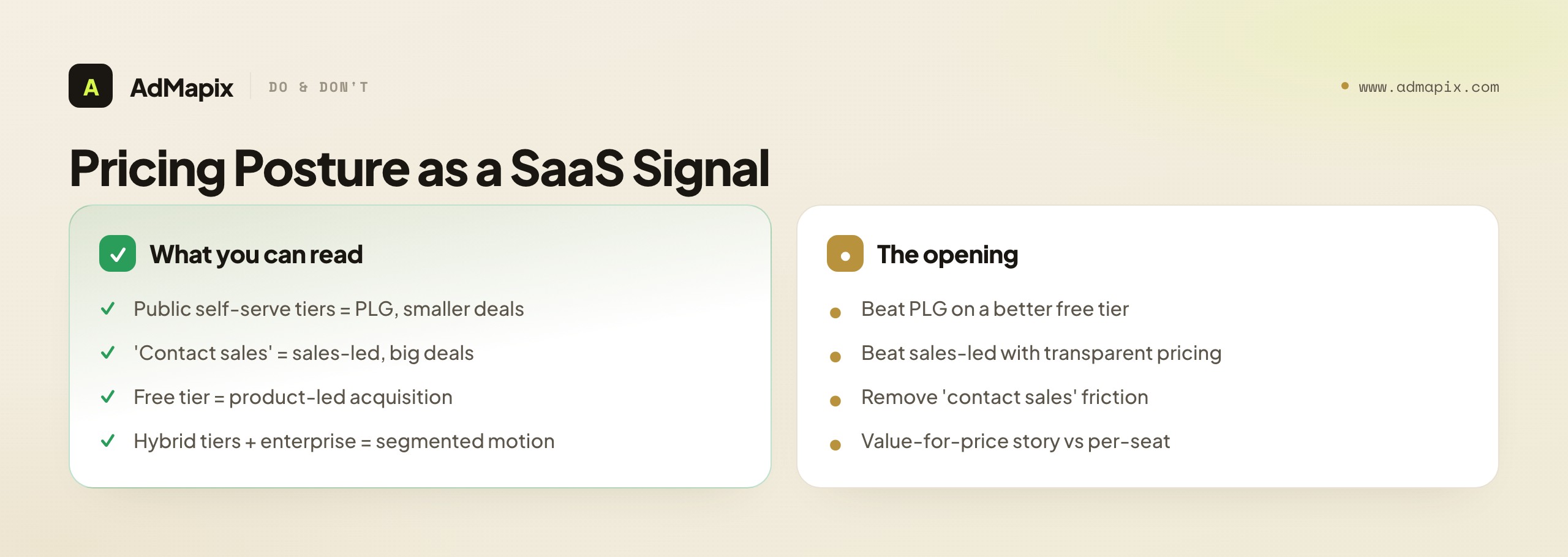
How a SaaS competitor handles pricing — public, "contact sales," or hidden — is a readable signal of their deal size, motion, and target segment, and it shows up in both the ad and the landing page. Pricing posture is one of the cleanest economic reads available in SaaS research.
What the pricing posture reveals:
- Public, self-serve pricing. A visible pricing page with tiers (often including a free or low-cost entry) signals a PLG or product-led motion targeting smaller deals where buyers self-serve. The transparency itself is a conversion lever for price-sensitive, self-evaluating buyers.
- "Contact sales" / custom pricing. Hidden pricing behind a sales conversation signals larger, negotiated deals and a sales-led motion. It also signals a competitor unwilling to anchor on a number, usually because deals are bespoke and high-value.
- Hybrid (public tiers + "contact sales" for enterprise). The most common mature-SaaS pattern — transparent self-serve pricing for the bottom of the market, custom enterprise pricing for the top. Spotting this confirms a segmented, hybrid motion.
The strategic read: a competitor's pricing posture, visible from their landing page, tells you their deal size and motion before you study a single performance metric. A PLG competitor with transparent pricing is beatable on a better free tier or a clearer value-for-price story; a sales-led competitor hiding pricing may be vulnerable to a transparent-pricing challenger that removes the friction of "contact sales" for buyers who just want to know the cost. When you tear down a SaaS competitor, always note the pricing posture — it's a free, high-signal read on their entire economic model.
SaaS Categories: Horizontal, Vertical, and Dev Tools
The five-layer read is universal, but the patterns shift by SaaS category, so reading a competitor through their category tells you which messaging, proof, and offers to expect. SaaS spans distinct types, each with its own ad conventions.
| Category | Typical audience | Dominant proof | Common motion | Messaging emphasis |
|---|---|---|---|---|
| Horizontal SaaS | Broad role (sales, marketing, HR) | Logos, metrics, integrations | Hybrid PLG + sales | Differentiation, breadth |
| Vertical SaaS | Industry-specific role | Industry case studies, compliance | Sales-led | "Built for [industry]" |
| Dev tools / infra | Developers, engineers | Docs, adoption, technical proof | PLG / free tier | Practitioner-first, no fluff |
| Security | IT, security buyers | Certifications, analyst (Gartner) | Sales-led | Risk, rigor, compliance |
| SMB SaaS | Founders, small teams | Ease, price, quick wins | PLG / self-serve | Simplicity, speed-to-value |
The reads that matter: horizontal SaaS competes in crowded categories where differentiation and breadth dominate the messaging. Vertical SaaS leans on "built for [your industry]" and industry-specific proof, because fit is the whole pitch. Dev tools invert the usual B2B polish — the audience distrusts marketing gloss, so the winning creative is documentation-led, technically precise, and offers a free tier rather than a sales call. Security is the most proof-gated (certifications and analyst validation are table stakes). SMB SaaS wins on simplicity, price transparency, and speed-to-value. When you tear down a SaaS competitor, read the category first — a dev-tools ad that works because of its adoption numbers and docs teaches you nothing transferable if you're in vertical SaaS, where industry case studies carry the credibility.
There's a further split worth reading: B2B versus prosumer SaaS. Pure B2B SaaS sells to organizations through committees, so its ads address buyers, lean on ROI and risk-reduction proof, and route to demos or trials gated by qualification. Prosumer SaaS (design tools, note-taking apps, individual-productivity software bought by individuals who may later expand into teams) sells more like a consumer product — its ads address the individual user, lead with the product experience and the "wow," route to a frictionless free signup, and rely on bottom-up adoption that later turns into team and enterprise deals. The two require different reads: a prosumer SaaS competitor's ad is closer to a consumer DTC ad (impulse, product-led, experience-first) than to a B2B demand-gen ad, so reading it through a B2B lens misleads you. When you research a SaaS competitor, place them on the B2B-to-prosumer spectrum first, because it changes everything downstream — the audience cue, the proof that lands, the offer ladder, and the motion. A prosumer tool's "just start using it" PLG motion and a pure-B2B tool's "book a demo with our sales team" motion are opposite ends of the same spectrum, and the same creative tactic that wins on one end falls flat on the other.
Reading SaaS Creative by Funnel Stage
SaaS buying is a long, multi-touch journey, so a competitor runs different creative for different funnel stages — and reading which stage an ad targets tells you where in the funnel the competitor is investing and where they're exposed. A SaaS ad aimed at a cold, unaware prospect looks nothing like one aimed at a warm, comparison-shopping buyer, and recognizing the stage is what lets you map a competitor's whole funnel from their ad mix.
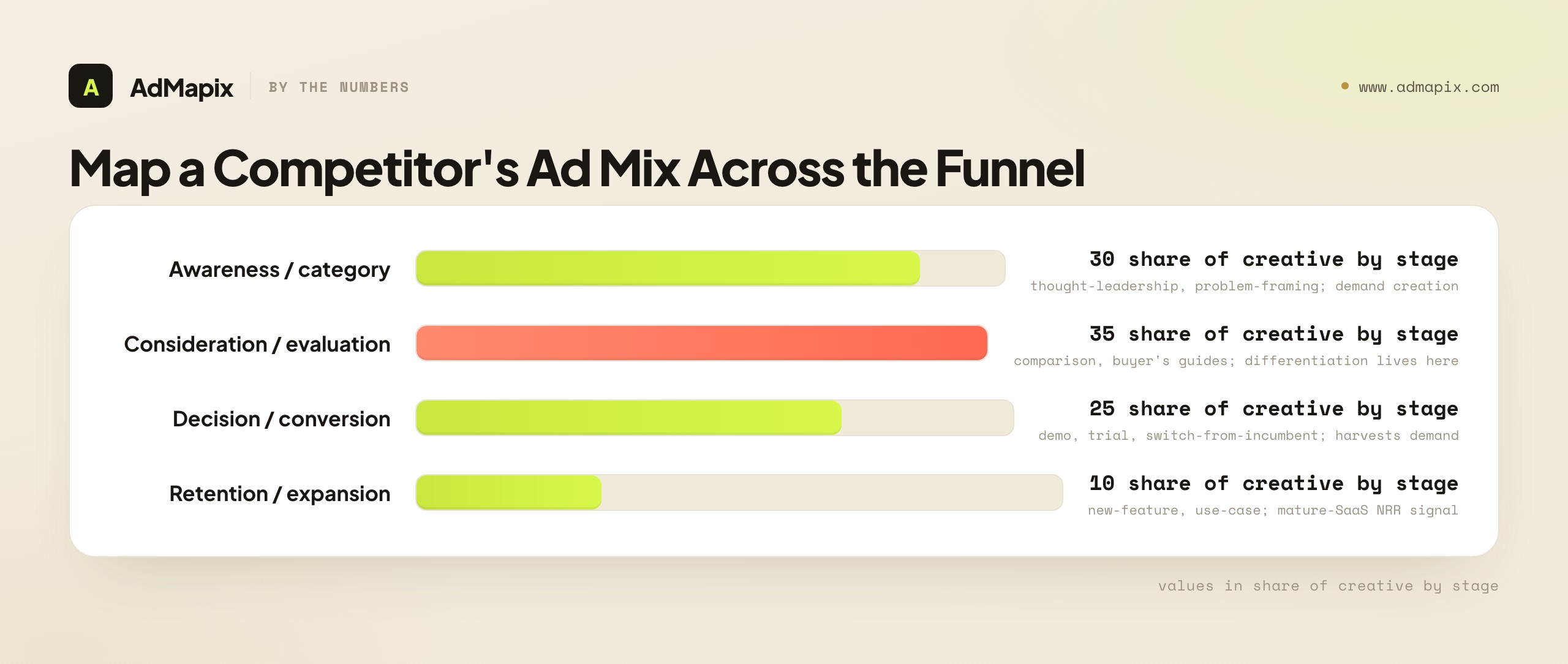
The funnel stages and how their creative reads:
- Awareness / category education. Top-of-funnel creative that teaches a concept or names a problem the prospect didn't know had a solution — thought-leadership documents, "the state of [category]" reports, problem-framing video. The offer is low-friction (a guide, a report). A competitor heavy on awareness creative is investing in category and demand creation, usually a well-funded play.
- Consideration / evaluation. Mid-funnel creative for the problem-aware prospect comparing options — comparison content, "[category] buyer's guide," feature-and-proof messaging, webinars. The offer steps up (webinar, trial). This is where differentiation messaging concentrates, because the prospect is actively choosing.
- Decision / conversion. Bottom-funnel creative for the in-market buyer — demo offers, free-trial pushes, "switch from [incumbent]" messaging, ROI calculators, urgency. The offer is high-commitment (demo, trial, "talk to sales"). A competitor heavy here is harvesting existing demand rather than creating it.
- Retention / expansion. Often overlooked, but SaaS competitors run ads to existing-customer-adjacent audiences for upsell and expansion — new-feature announcements, use-case expansion. Spotting these tells you the competitor is investing in net-revenue-retention, a mature-SaaS signal.
The strategic read: map a competitor's ad mix across the funnel stages, because the distribution reveals their strategy. A competitor running heavy awareness and consideration creative is building a category and a pipeline for the long game; one running almost entirely decision-stage demo pushes is harvesting demand someone else created, which can mean they're efficient or that they're not investing in their own future pipeline — a potential opening. A competitor with a gap at one stage (lots of awareness, no decision-stage conversion creative; or all bottom-funnel, no top-of-funnel demand creation) has a hole in their funnel you can exploit by being present where they're absent. The funnel-stage map is one of the most strategic reads in SaaS research, and it comes free from the ad library.
SaaS Proof: What Actually Overcomes the Skeptical Buyer
SaaS buyers are skeptical and risk-averse because they have to defend the purchase internally and live with the switching cost, so the proof a competitor leads with reveals which objection they've decided matters most. Reading the proof type — and whether it fits the audience — is a high-signal SaaS read.
The SaaS proof taxonomy, soft to hard:
- Customer logos. The fastest credibility signal. The composition encodes the ICP — a wall of enterprise logos signals up-market targeting; a "join 5,000+ teams" counter signals SMB volume.
- Named metrics and ROI. "Cut onboarding time 60%," "3x pipeline." Specific, outcome-led proof, especially persuasive to the buyer who thinks in numbers and has to justify the spend.
- Case studies. A named customer, a situation, a result — the strongest narrative proof, because the buyer sees themselves in the story. Carries extra weight when the named customer resembles the prospect.
- Integrations and ecosystem. "Works with your stack," integration logos. A SaaS-specific proof type — buyers fear a tool that won't fit their existing tools, so integration proof handles the "will this work with what we have" objection.
- Analyst and third-party validation. A Gartner, Forrester, or G2 reference. Borrowed rigor that matters most in enterprise and security evaluations.
- Security and compliance. SOC 2, ISO, GDPR, HIPAA. For enterprise and regulated buyers, the absence of this proof ends the evaluation regardless of everything else.
The strategic read: check whether the proof type matches the audience and category the competitor is targeting. An enterprise-targeted SaaS ad leaning only on a "5,000+ teams" counter is under-proven for the up-market buyer (who wants enterprise logos and analyst validation); a dev-tools ad leaning on polished case studies instead of adoption numbers and docs is mismatched for its gloss-averse audience; a security product without compliance proof is missing the one thing its buyer requires. Proof-audience mismatches are common and exploitable — when a competitor's proof doesn't fit the buyer they're chasing, you can win that buyer with the proof type they actually trust.
A Worked Teardown: One SaaS Competitor, End to End
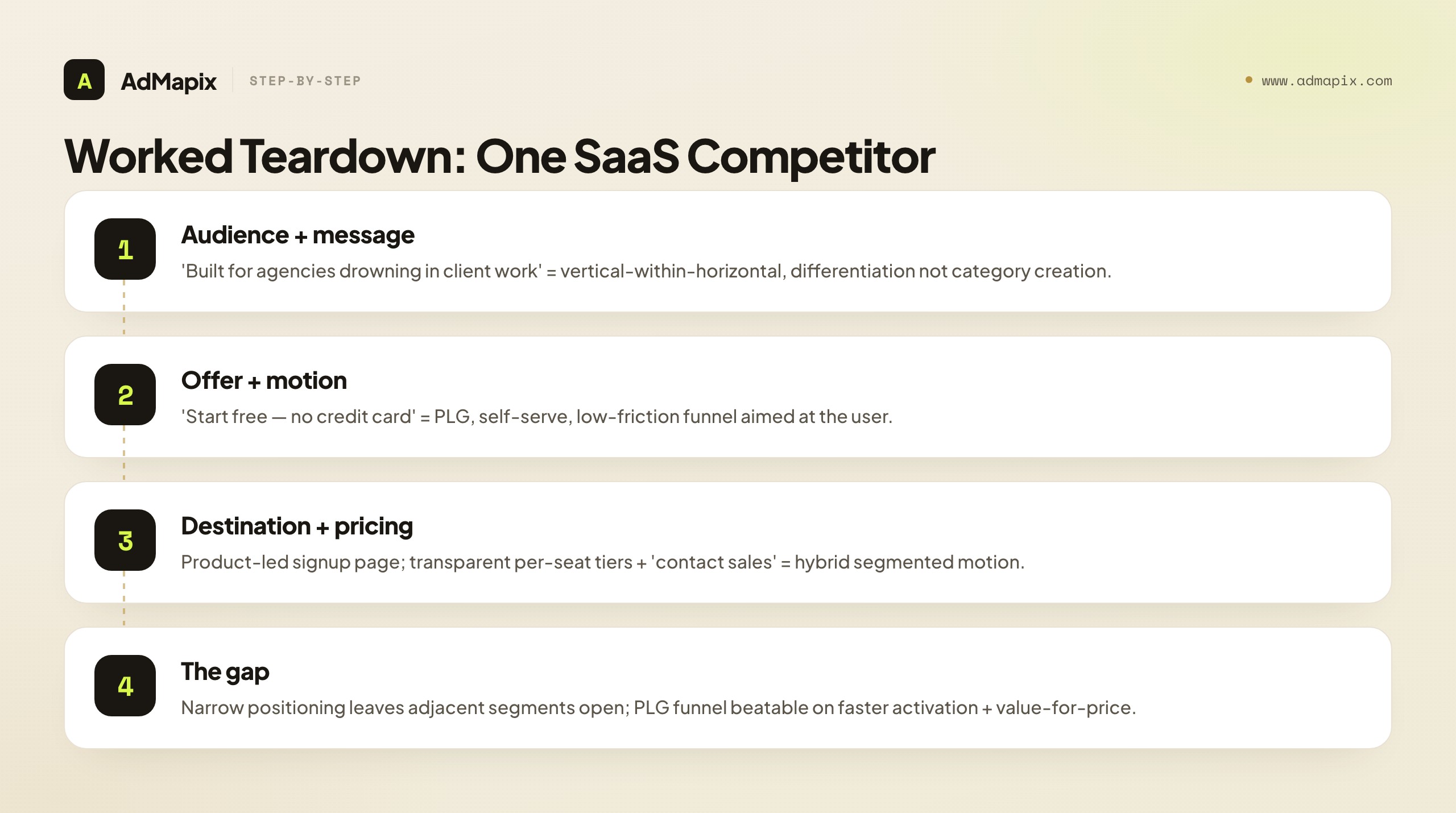
Principles stick when applied, so here's how a single SaaS competitor reads through the full method. Say you sell a project-management tool and you find a rival's ad running widely on LinkedIn.
Audience and message. The headline reads "The project tool built for agencies drowning in client work." You tag the audience cue (agencies — a vertical-within-horizontal play, addressing the practitioner who feels the pain) and the message angle (differentiation-within-category: not "a new way to manage projects" but "the [category] built for [specific audience]"). The positioning bet is clear — they're not creating a category, they're owning a segment.
Offer and motion. The CTA is "Start free — no credit card." You tag the offer (free trial, the heart of a PLG motion) and the motion (product-led, self-serve). The "no credit card" detail confirms a low-friction PLG funnel aimed at getting agencies into the product fast.
Destination and pricing. You click through. The ad lands on a product-led landing page with a prominent signup, and the pricing page shows transparent per-seat tiers plus a "contact sales" option for larger agencies. You tag the pricing posture: hybrid (self-serve tiers + enterprise sales), confirming a segmented motion — PLG for small agencies, sales-led for big ones.
The synthesis and the gap. You now have a complete read: a vertical-within-horizontal positioning bet (agencies), a PLG motion with a hybrid enterprise upsell, transparent pricing, and a differentiation-not-category-creation message. The gap to exploit: their positioning is narrow (agencies), which leaves adjacent segments (in-house marketing teams, consultancies) less defended — and their PLG funnel means you could compete on a faster activation or a clearer free-to-paid path. Three hypotheses fall out: test a positioning that owns an adjacent under-defended segment, test a lower-friction free experience against their signup flow, and test transparent value-for-price messaging against their per-seat pricing. None required a private number — you read audience, message, offer, motion, destination, and pricing, and turned the positioning landscape into a test.
A Repeatable SaaS Research Workflow
Start from the decision you need to make, then collect only the evidence that informs it. Spying without a target decision produces a gallery; spying toward a decision produces a brief.
- Define the decision. Messaging refresh, new offer, landing-page test, positioning bet, or a client recommendation. The decision sets what you capture.
- Pull from the right surface. LinkedIn for B2B audience, positioning, and offer reading; Google's transparency center for cross-surface and high-intent capture discovery.
- Capture with context. Save the source URL, date, format, audience cue, message angle, offer, motion (PLG vs. sales-led), destination, and pricing posture — not just a screenshot.
- Tag consistently. Reuse the same tags for audience, hook, proof, CTA, format, motion, and positioning so patterns surface across competitors.
- Split fact from hypothesis. Record what the ad shows versus what you're inferring about its performance.
- Ship a decision artifact. Convert the pattern into a message map, an offer map, a positioning map, a creative brief, or a test backlog.
The SaaS-specific discipline layered on the universal workflow is steps 3 and 4 — capturing the motion and the positioning bet alongside the creative, because those two reads are what make SaaS research strategic rather than cosmetic. A message map that records each competitor's motion and positioning tells you the shape of the category, not just the look of the ads — and that map is the decision artifact worth building.
Common SaaS Ad Spy Mistakes
- Copying creative without copying context. A competitor's ad reflects their audience, motion, and economics, not yours. Treat it as a hypothesis to test, not a template to clone.
- Overclaiming hidden data. Public ads don't reveal spend, targeting, conversion rate, or pipeline. Stating otherwise breaks trust in client reports.
- Missing the motion. Reading a SaaS ad without identifying PLG vs. sales-led misses the single most important strategic signal — the whole go-to-market is encoded in the CTA and destination.
- Ignoring positioning. A SaaS ad is a positioning bet; reading the copy without asking "category creation or differentiation?" misses the strategic layer.
- Saving ads with no notes. An asset without a source URL, date, format, and reason-for-saving is unsearchable later.
- Ignoring the destination and pricing. The landing page, demo flow, and pricing posture carry more of the conversion work and economic signal than the ad itself.
- Stopping at collection. Research that never becomes a message map, brief, or test backlog produces no decision and no value.
The SaaS Creative Lifecycle and Refresh Cadence
SaaS creative fatigues more slowly than consumer creative but in a distinct way, and reading a competitor's refresh behavior tells you about their pipeline and budget. Because SaaS audiences are smaller and more defined — a finite set of roles at a finite set of companies — frequency builds fast against a tight ICP, so the same person sees a competitor's ad often. But SaaS buyers also need repetition to absorb a considered claim across a long buying cycle, so a competitor isn't necessarily fatigued just because a creative has run a while.
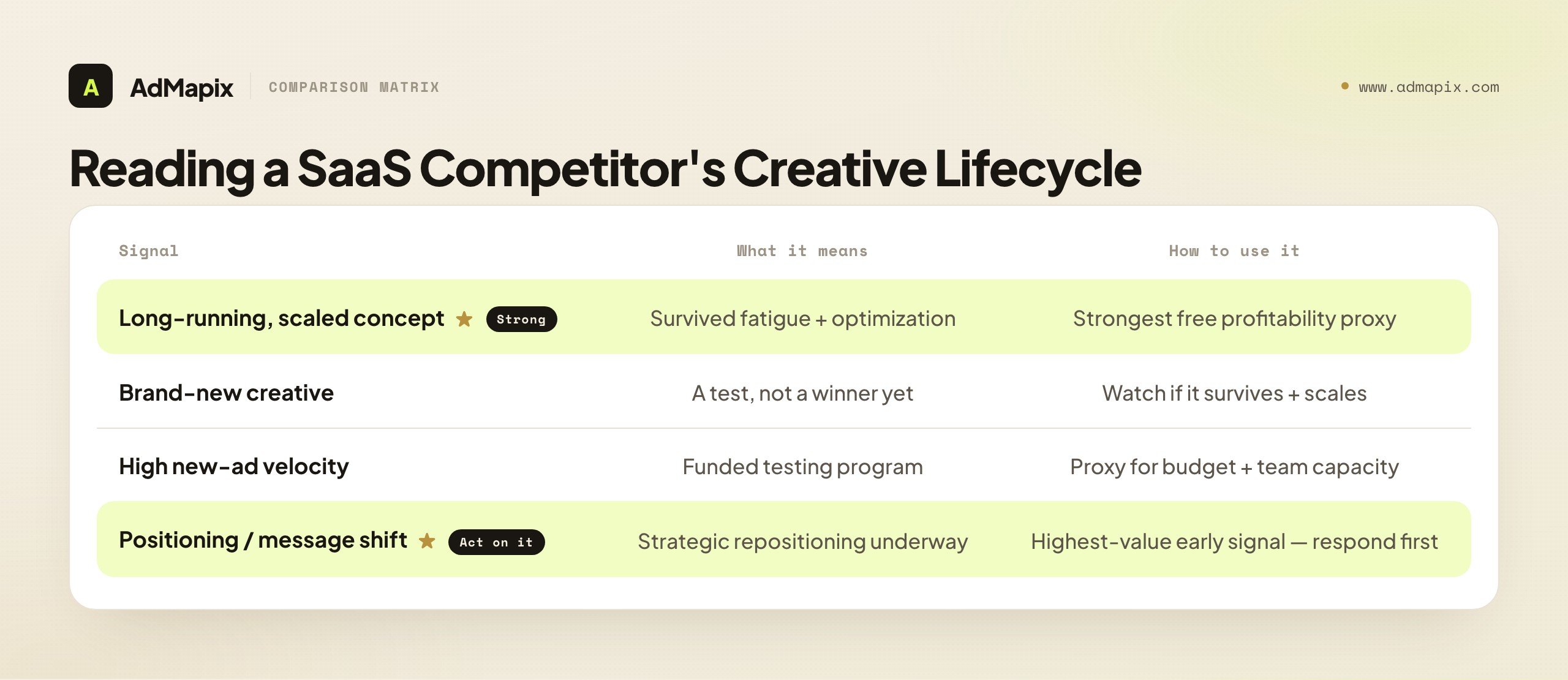
The reads that matter for SaaS research:
- A long-running competitor concept is a strong signal. A creative scaled and live for weeks against a tight B2B audience has survived both fatigue and optimization — the closest thing to a free profitability proxy in SaaS, where the buying cycle rewards consistent messaging.
- A brand-new creative is a test, not a winner. Don't chase a concept that launched yesterday; watch whether it survives and scales. SaaS messaging tests play out over weeks, not days.
- New-ad velocity reveals the pipeline. A competitor shipping fresh creative weekly is running a funded testing program; one running the same handful of ads for months has either found durable winners or isn't investing in creative. Velocity is a readable proxy for budget and team capacity.
- A positioning or messaging shift is the highest-value signal. When a competitor pivots their core message — from feature-led to outcome-led, from differentiation to category creation, from one audience to another — across multiple new creatives, they're telling you about a strategic repositioning before it hits their website or sales deck. That early read is where SaaS competitive intelligence justifies itself.
When you track a SaaS competitor over time, log the launch and disappearance of their creatives and any positioning or motion shifts, because the shape of the time series — not any single snapshot — is where the intelligence lives. The ad libraries keep no archive of dead ads, so your own time-series log is the only record that a competitor's messaging and positioning evolved. A SaaS team watching a competitor's message shift in real time can respond to a repositioning before the rest of the market notices it.
Building a SaaS Message Map
A folder of saved SaaS competitor ads is where good research goes to die. The asset that compounds is a message map — a structured view of how every competitor positions, packages, and routes their funnel — built from a swipe library where every entry is scored on the five layers plus the SaaS-specific motion and positioning reads. The message map is what turns scattered ads into a readable picture of the whole category's positioning landscape.
Every entry should capture: source URL, date, and advertiser; the audience cue; the message angle and positioning bet (category creation / differentiation / incumbent / challenger); the offer and its rung on the ladder; the funnel motion (PLG / sales-led / hybrid); the funnel stage (awareness / consideration / decision); the proof type; the destination and pricing posture; whether the concept repeats; and a status (untested → briefed → tested → result). The fields that make this a SaaS message map rather than a generic swipe file are the positioning bet, the motion, and the pricing posture — together they tell you not just what a competitor's ad looks like but where they sit in the market and how they make money.
The payoff scales with the set. Once your message map holds twenty or thirty competitors scored this way, you can answer questions no screenshot folder can: where the category clusters on positioning (and where the openings are), which motions dominate (and whether a different motion is an opening), which proof types are table stakes versus differentiators, and which funnel stages competitors are over- and under-investing in. That positioning landscape is the strategic return on a disciplined message map — and it's the artifact that actually informs your own positioning, packaging, and funnel bets, which is what SaaS research is for.
A Weekly SaaS Research Workflow and Tooling
The whole SaaS research system runs in well under an hour a week, and the cadence is what compounds an edge over teams that research only before a campaign or a board meeting. SaaS positioning and messaging shift over weeks, so weekly is the right resolution — frequent enough to catch a competitor's repositioning, not so frequent that you're reacting to noise.
A workable weekly loop: on Monday, scan your top competitors' active ads on LinkedIn and the Google Transparency Center for new creative, offer changes, and positioning shifts. Midweek, click through to landing pages and read the destination, pricing posture, and funnel motion behind any new ads. On Friday, synthesize the week's deltas, pick the single most meaningful pattern or shift, and convert it into one decision artifact — a message-map update, a positioning hypothesis, or a creative test. The discipline that makes it strategic is logging the motion and positioning alongside the creative, so the loop builds a living map of the category rather than a pile of screenshots.
On tooling: you don't need to buy anything to start. The free foundation — the LinkedIn Ad Library, the Google Ads Transparency Center, and a spreadsheet for your message map — covers most of what a single SaaS team needs, and the most valuable reads (the motion, positioning, and pricing-posture analysis) cost nothing and require no tool. A paid cross-network tool earns its place when manual collection stops scaling: tracking more than a handful of competitors across LinkedIn and Google, needing searchable creative history (because the libraries keep no archive of dead ads), or briefing stakeholders without re-doing the research. For the broader landscape, see marketing intelligence tools and the best ad spy tools in 2026 roundup. The trap is buying a tool to skip the methodology — no tool reads the motion, maps the positioning, or writes the message map for you; that's the analysis, and it's the whole edge.
SaaS Competitive Messaging Wars: Reading the Battlefield
SaaS categories are defined by competitive messaging wars more than by product specs, so a complete read includes the competitive layer — how rivals attack, defend, and position against each other — because that battlefield is where your own positioning has to survive. SaaS competitors don't just advertise into a vacuum; they advertise against named or implied rivals, and reading the war tells you the dynamics you'll be entering.
The competitive signals to read across a SaaS category:
- Direct comparison and "alternative" messaging. "The [incumbent] alternative," "switch from [competitor]," "[us] vs. [them]" ads are direct attacks. A challenger running heavy comparison creative against a leader is betting on the leader's dissatisfied users — and tells you the leader has an exploitable weakness the challenger has identified. If you're the leader, this is your signal to defend; if you're a third player, the challenger has done the work of surfacing the leader's vulnerability for you.
- Brand-defense on Google. A competitor bidding on their own brand terms (and on competitors' brand terms) is running brand defense and conquest. You can read this on the Google Transparency Center — a competitor whose brand-defense suddenly intensifies is anticipating an attack, often because they're about to ship a repositioning or because a challenger is gaining. Our Google Ads competitor analysis guide covers reading this surface.
- Category-language ownership. When one competitor consistently uses a specific framing or category term across all their creative, they're trying to own that language — and if it spreads to competitors' ads, they've succeeded in defining the category's vocabulary, which is a powerful positioning win. Watch whose language the category adopts.
- The silent gap. Sometimes the most valuable read is what no competitor is saying — an audience nobody addresses, a benefit nobody claims, a proof type nobody uses. In a crowded SaaS category, the unoccupied position is often the opportunity, and the ad library is where you see the whole battlefield at once and spot the empty ground.
The strategic synthesis: map the competitive messaging war across your category, because your positioning has to win in the context of how rivals are already attacking and defending. Entering with a message that's already saturated puts you in a war you didn't start and can't differentiate in; entering on the silent gap — the position no one occupies — gives you clear air. Reading the battlefield, not just individual ads, is what turns SaaS ad research from creative inspiration into positioning strategy. The teams that win the messaging war are the ones who read it before they enter it.
Turning SaaS Research Into Positioning Decisions
SaaS ad research only pays off when it changes a decision, and the decisions it should change are the big ones — positioning, packaging, messaging, and funnel motion — not just the next creative. The final discipline is connecting the research loop to the strategic decisions it's uniquely suited to inform, so the message map becomes an input to strategy rather than a nice-to-have artifact.
The decisions SaaS ad research should drive:
- Positioning. The message map shows where the category clusters and where the gaps are, which is the single most important input to your own positioning bet. If every competitor is differentiating within the category and no one's creating a new one, that tells you something; if a challenger is successfully attacking the leader, that tells you something else. Your positioning should be chosen against the landscape the research reveals, not in a vacuum.
- Packaging and motion. Reading competitors' motions (PLG vs. sales-led vs. hybrid) and offer ladders informs how you package and route your own funnel. If the category is moving toward PLG and you're sales-led-only, the research is telling you where the market is heading; if everyone's PLG and enterprise buyers are underserved, that's an opening.
- Messaging and proof. The proof types and message angles competitors lead with show you what the category's buyers respond to and what's become table stakes versus a differentiator. Your messaging should clear the table-stakes bar and differentiate on the open dimension.
- Pricing strategy. The pricing postures across the category (transparent vs. "contact sales") inform your own pricing-transparency decision, which is itself a positioning and motion choice.
The process that connects research to these decisions is the message map maintained over time, reviewed not just weekly for creative deltas but quarterly for strategic shifts — is the category's positioning landscape changing, are motions converging or diverging, is a new entrant attacking a position you hold? For agencies and multi-product SaaS teams, the same message-map discipline runs per client or per product line, with the strategic review feeding the positioning and packaging decisions that matter most. The teams that compound an edge aren't the ones with the most saved ads; they're the ones who turn a living message map into sharper positioning, packaging, and messaging bets than competitors who treat ad research as a creative-inspiration exercise. That strategic use — research as an input to positioning, not just creative — is what separates SaaS ad research that moves the business from research that fills a folder.
When to Use AdMapix
AdMapix fits SaaS teams that run competitor ad research often enough that tabs and screenshots stop scaling. Use Search AdMapix to find ad creatives across networks, Media to save and organize the examples you keep, Video Analysis to break down pacing and hooks in video ads, and Reports to turn tagged evidence into a shareable deliverable. Pricing compares access for solo marketers, in-house teams, and agencies, and you can log in once the report loop becomes part of your cadence.
It's a good fit if you need recurring, searchable creative evidence and structured reports. It's not the right tool if you only need a one-off look at a single competitor, or if you expect it to surface spend, targeting, or conversion data, because no public-data tool can prove those. AdMapix sits in the cross-network creative-intelligence slot: it removes the manual collection so your time goes to the motion read, the positioning read, and the message map that actually sharpen SaaS marketing.
FAQ
What is a SaaS ad spy tool?
A SaaS ad spy tool helps you study competitor messaging, proof, audience cues, offers, and demo or trial paths from public ads. It reads creative choices on surfaces like LinkedIn and Google. It does not, and cannot, reveal a competitor's spend, targeting, conversion rate, or pipeline — those live in their private dashboards.
Can ad spying reveal competitor spend or performance?
No. Public ad libraries show active creatives, formats, offers, and landing paths. They don't expose budget, impressions, clicks, conversion rate, ROAS, or revenue. Anything you say about performance is an inference, so label it as one in any report. The one legitimate signal is repetition — a concept run for weeks is likely working, but that's a hypothesis to test.
How do I tell if a competitor runs PLG or sales-led from their ad?
Read the CTA, the audience, and the destination. "Start free / try it free / sign up" plus copy aimed at the user (practitioner, developer) landing on a signup page signals product-led growth. "Book a demo / talk to sales" plus copy aimed at the buyer (VP, director) landing on a demo-request form signals sales-led. Transparent self-serve pricing confirms PLG; "contact sales" confirms sales-led. Many mature SaaS companies run a hybrid of both.
What's the SaaS offer ladder, and why does it matter?
SaaS offers run from lowest to highest commitment: content/report → webinar → free trial → demo/consultation. Where a competitor leads on the ladder reveals their motion and the audience warmth they're targeting. A competitor leading cold audiences straight to a demo is either confidently sales-led or making a laddering mistake — and a competitor who leads every audience to the same heavy ask is leaving the top of the funnel open, a gap you can take with a lower-friction offer.
How do I read a SaaS competitor's positioning from their ad?
Look at the message angle. "A new way to X" or "the first [category] platform" is category creation (an ambitious land-grab bet). "The [category] built for [audience]" or "better than [incumbent]" is differentiation within a category. "The leading [category], trusted by [logos]" is an incumbent play, and "tired of [incumbent]?" is a challenger play. Mapping these across competitors shows you where the category clusters and where the positioning openings are.
Where should B2B SaaS teams look for competitor ads?
Start with LinkedIn, where most B2B SaaS demand-gen runs and ad formats map to funnel stages, and the Google Ads Transparency Center for ads across Search, YouTube, and Discover. LinkedIn shows demand creation and positioning; Google shows demand capture and brand defense. Combine both for fuller coverage, since each surface fills the other's gaps.
Does SaaS ad research differ by category?
Yes. Horizontal SaaS competes on differentiation and breadth; vertical SaaS leans on "built for [industry]" and industry proof; dev tools invert the usual polish with documentation-led, free-tier creative for a gloss-averse audience; security is the most proof-gated (certifications, analyst validation); and SMB SaaS wins on simplicity, price transparency, and speed-to-value. Read the category first so you weight the right signals.
What should each saved ad example include?
Capture the source URL, the date, the platform and format, the audience cue, the message angle, the offer, the motion (PLG vs. sales-led), the landing destination, the pricing posture, and the test or recommendation it suggests. A screenshot alone isn't searchable or comparable later, which defeats the point of building a research library.
How is ad spying different from copying competitors?
Spying decodes the choices behind an ad — the audience, motion, positioning, and offer — so you can form your own hypothesis. Copying clones the surface and assumes their economics are yours. A competitor's audience, price point, motion, and funnel are invisible in the ad, so a cloned creative carries hidden assumptions you can't verify. Borrow the structure, test it on your own funnel.
How do I turn SaaS competitor ads into something I can use?
Run the five-layer read plus the SaaS-specific motion and positioning reads, map them across your competitor set to see where the category clusters, look for positioning gaps and funnel leaks you can exploit, then ship a message map or test backlog with a metric. The competitor ads generate the hypotheses; your own pipeline and test data make the decision — those are the only performance numbers you can trust.
Related Reading
- B2B Ad Creative Examples: Formats, Offers & Proof — the broader B2B creative framework this SaaS guide builds on.
- LinkedIn Ads Competitor Research: The Complete B2B Playbook — the deep dive on the primary SaaS research surface.
- Google Ads Competitor Analysis: 6 Ways to Find What Rivals Run — the demand-capture half of the SaaS motion.
- Competitor Ad Analysis Framework: The 5-Dimension System — the scoring model SaaS research plugs into.
- Ad Hook Examples: 7 First-3-Second Patterns — the opener craft behind SaaS video and Search creative.
- Marketing Intelligence Tools: The 2026 Stack — where ad research fits the wider SaaS competitive-intelligence stack.
Sources
- LinkedIn Ads — positions its advertising around B2B marketing, targeting, campaign creation, and measurement.
- LinkedIn Ads Guide — documents ad formats including Single Image, Video, Carousel, Document Ads, Lead Gen Forms, Sponsored Messaging, Text, and Dynamic Ads.
- Google Ads Transparency Center — lets users find active ads published through Google across Search, YouTube, and Discover.
- Google Ads Transparency Center launch — describes it as a searchable hub of ads from verified advertisers, including region, last date, and ad format.
Official source pages checked as of June 21, 2026. Platform docs, ad formats, and product pages change, so verify the current URLs before using a claim in client work. AdMapix surfaces public ad creatives across networks; it does not expose advertiser spend, targeting, or conversion data, which remain private.
See what competitors are really running
Search 6M+ ad creatives, landing pages, and weekly spend across 200+ countries. No credit card, no commitment.
Related Articles
Ad Hook Examples in 2026: 7 First-3-Second Patterns (with UGC Breakdowns)
A complete 2026 library of ad hook examples organized into seven repeatable patterns — problem, proof, objection, comparison, curiosity, offer, and transformation — with UGC hook breakdowns, platform-by-platform differences for TikTok, Meta, and YouTube, an industry-by-industry hook map, a hook-testing workflow that ships variants, the metrics that actually grade a hook, and a worked teardown that turns a competitor opener into a running test.
Outbrain Ad Spy Tool in 2026: Native Ad Research for the Open Web
How to research Outbrain native ads from public evidence in 2026 — what a spy tool can and cannot prove, how to decode headline-and-thumbnail hooks, advertorial landing paths, retargeting trails, and how to turn patterns into testable native campaigns.
Agency Ad Intelligence Tools in 2026: Turning Competitor Research Into Client Reports
A 2026 guide to ad intelligence for agencies — how to standardize competitor research across a client portfolio, the fixed capture field list and weekly workflow that survive staff turnover, how to structure a recurring client report, white-label and deliverable considerations, using competitor research to win new business and prove retainer value, the cross-client pattern advantage only agencies have, team roles and scaling, packaging research as a billable service, and the public-data.