Puzzle Game Ad Examples: Hooks, Mechanics, and Test Ideas for 2026 UA
A practitioner's library of puzzle game ad examples for 2026: the recurring pin-pull, fail-state, and satisfying-solve hooks; a five-axis tagging framework to turn a folder of competitor creatives into a test backlog; the mechanic-match gap that drives cheap clicks and day-1 churn; playable structure; and the honest line between what a public ad proves and what it never can.
Updated June 21, 2026 — written and reviewed by the AdMapix Research team.
Puzzle Game Ad Examples: Hooks, Mechanics, and Test Ideas for 2026 UA
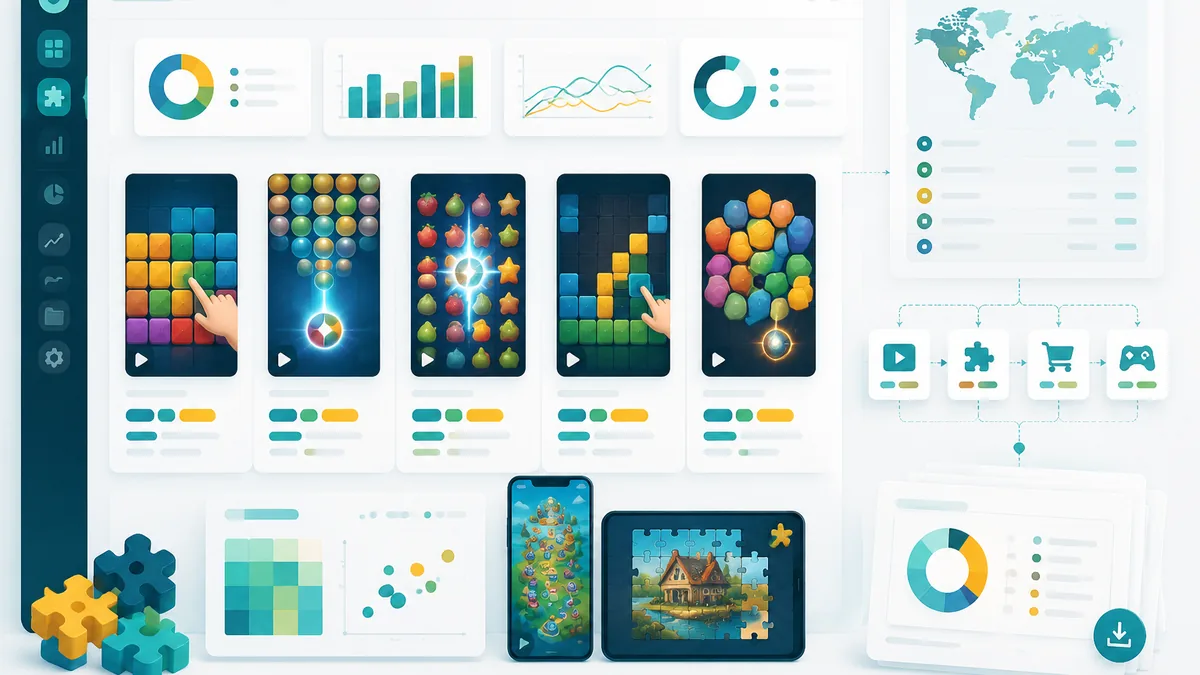
Puzzle game ad examples are most useful when you read them as patterns, not screenshots. Almost every high-performing puzzle creative does one of a few things: it opens with an impossible-looking choice, shows a fail state to provoke "I could do better," demonstrates a single satisfying mechanic, or promises a reward reveal. If you have spent any time browsing competitor creatives for match-3, merge, water-sort, or pin-pull titles, you already feel the repetition — the same wrong moves, the same near-misses, the same dopamine payoffs, recycled across dozens of advertisers. That repetition is not laziness. It is the closest thing to a public signal you will ever get that a structure is converting, because advertisers do not keep spending behind creative shapes that die.
This guide is for puzzle and casual game user-acquisition (UA) managers, creative producers, and indie developers who want to study competitor creatives and turn them into test briefs instead of inspiration folders. We will build a tagging framework, catalog the recurring hooks with concrete puzzle game ad examples, walk through how playables extend the same tension into an interactive demo, and — most importantly — draw a hard line between what a public ad can prove (creative structure) and what it can never prove (spend, installs, retention, return on ad spend). If you want the broader mobile context first, start with our mobile game ads guide and the companion playable ads guide; for the discipline of running tests once you have ideas, see the creative testing framework.
TL;DR — How to Read Puzzle Game Ad Examples
- The most repeated puzzle hooks are the wrong-move fail state, the "pull the pin / save the character" impossible choice, and the slow-build satisfying-solve loop. Everything else is a variation on creating tension you want to relieve.
- Tag every example on five axes — hook, core mechanic, playable cue, reward signal, and mechanic match — so a folder of 50 ads becomes a comparable dataset instead of a mood board.
- A public ad proves creative structure (hook, format, offer, mechanic shown) but never proves spend, install volume, retention, or ROAS. Treat recurrence as a soft signal, not a verdict.
- Puzzle creatives often show mechanics the game does not actually contain. Track that gap: it lifts click-through rate but usually punishes day-1 retention, and it is the single most important thing to copy carefully, not blindly.
- Playables are the same hook made interactive — a 10-to-30-second demo that lets the player feel one solve before the store page loads. Reverse-engineer them the same way you read videos.
- Your own analytics is the only source of truth. Competitor evidence narrows the test space; it does not pick the winner. Ship variants, measure CTR, install rate, and D1, and let your funnel decide.
What Puzzle Game Creatives Are Actually Selling
Puzzle game ads sell a feeling of competence, not the full game. The dominant pattern across pin-pull, water-sort, match-3, merge, and connect-the-line creatives is identical at the level of psychology: create mild tension, let the viewer mentally solve it, then deliver a small payoff. That is why so many ads lead with a near-fail or a deliberately wrong move — the viewer wants to correct it. The creative is engineering the same itch that the game itself sells, compressed into the first few seconds of a video, where the only goal is to make a thumb stop scrolling.
This matters because the hook does almost all of the heavy lifting in the first one to three seconds. A puzzle ad rarely needs to explain rules; it needs to make you feel that solving it is easy and that the version on screen is doing it wrong. Watch a hundred examples in a row and you stop seeing "ads" and start seeing a small set of tension structures: the trapped character, the rising water, the one obvious move the on-screen "player" keeps missing, the board that is one swap away from a satisfying cascade. Once you read examples this way, you stop collecting pretty creatives and start collecting reusable tension structures you can rebuild for your own game.
There is a second layer worth naming. Puzzle ads sell low cognitive cost. The genre's entire promise is "you can do this, right now, with no learning curve," and the best creatives prove that promise visually within a second or two. This is why over-explaining kills puzzle ads — a tutorial overlay, a wall of text, or a slow reveal of rules signals effort, and effort is exactly the feeling a casual puzzle player is trying to avoid. The creatives that win make the solution look obvious and the failure look avoidable. When you brief your own ads, the test is brutally simple: can a stranger understand what to do, and feel they could do it better, before the first second is up?
A third, often-missed layer is agency. The most magnetic puzzle creatives do not just show a solution — they invite the viewer to participate in it, even passively. A fail-state ad works because the viewer is silently issuing the correct move; a near-miss works because the viewer is willing the play to succeed; a satisfying-solve loop works because the viewer is anticipating the next clear before it lands. This is why puzzle, more than almost any other genre, converts so well into playables: the participation the video implies, the playable makes literal. When you study examples, ask not only "what is the tension?" but "what is the viewer doing in their head?" The answer tells you whether the creative is merely watched or actively played-along-with — and the second category almost always outperforms the first.
It is also worth being precise about who these ads are for. The casual-puzzle audience skews broad — wide age range, wide region, often a high share of incidental or lapsed gamers rather than dedicated ones. That breadth is why the genre rewards universal, language-light hooks: a trapped character, an overflowing container, and a board one move from order need no translation. It is also why puzzle creatives travel across markets better than most, and why the same structure can be re-skinned for a dozen geos with only cosmetic changes. The flip side is fatigue: a hook that works everywhere also gets copied everywhere, so the half-life of a winning structure in puzzle is shorter than in narrower genres. Reading examples is therefore not a one-time exercise but a standing habit, which is exactly what the weekly cadence later in this guide is built to support.
A Framework for Tagging Each Example
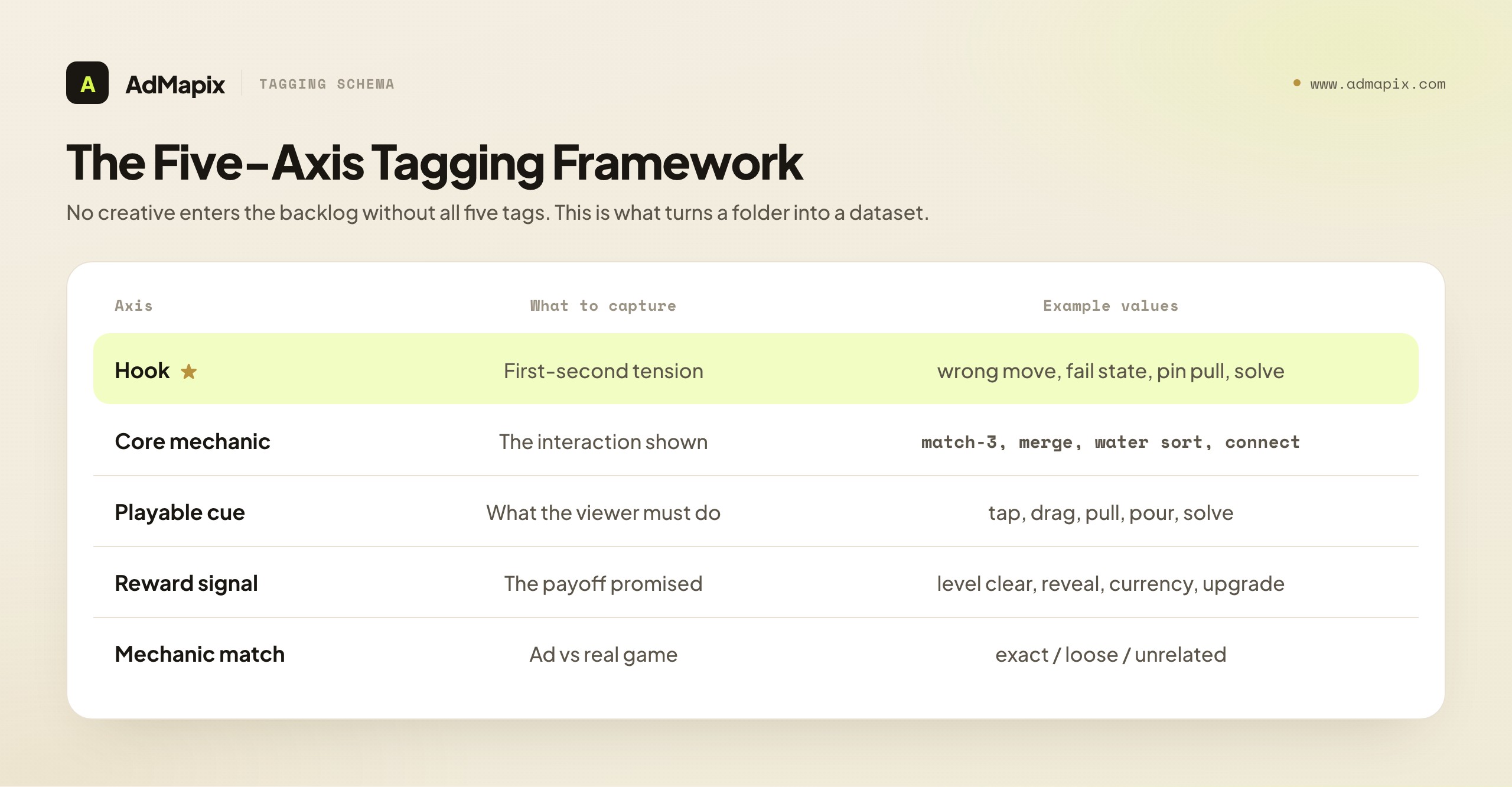
Tag every saved creative on five axes so a folder of 50 ads becomes a comparable dataset instead of a mood board. The point is to surface which combinations repeat across competitors — repetition is the closest public signal you get to "this is working." A single brilliant ad you saw once tells you very little; the same hook running under eight different advertisers, in three countries, for two months, tells you a great deal. The framework below is the spine of every other section in this guide.
| Axis | What to capture | Example values |
|---|---|---|
| Hook | The first-second tension | wrong move, fail state, near miss, impossible choice, satisfying solve, reward tease |
| Core mechanic | The interaction shown | match-3, merge, water sort, pin pull, connect line, sort/organize, decorate, number/logic |
| Playable cue | What the viewer is told to do | tap, drag, choose, pull, pour, solve, unlock, collect |
| Reward signal | The payoff promised | level clear, currency, room/character reveal, collection complete, upgrade |
| Mechanic match | Does the ad match the real game? | exact, loosely related, unrelated ("fake ad") |
The last row is the one most teams skip, and it is the most strategically loaded. Pin-pull and "save the character" ads famously appear for games that are really match-3 or idle-merge titles. Tracking the mechanic-match gap tells you whether a competitor is buying cheap clicks at the cost of retention — a trade you may or may not want to make. We have a dedicated breakdown of that practice in fake mobile game ads, because it is widespread enough in this genre to deserve its own treatment.
Tag consistently and the data starts answering questions you could not answer by eyeballing: Which hook appears under the most distinct advertisers? Which mechanic is being advertised with a different mechanic most often? Which reward signal pairs with which hook? You do not need a fancy tool to start — a spreadsheet with one row per creative and one column per axis is enough. What matters is discipline: tag the same way every time, and never let a creative into the folder without all five tags filled in.
The Recurring Hooks, With Concrete Examples
Below are the hook archetypes you will see again and again. For each, we name what it is, why it works psychologically, the puzzle subgenres that lean on it, and the failure mode to avoid when you rebuild it.
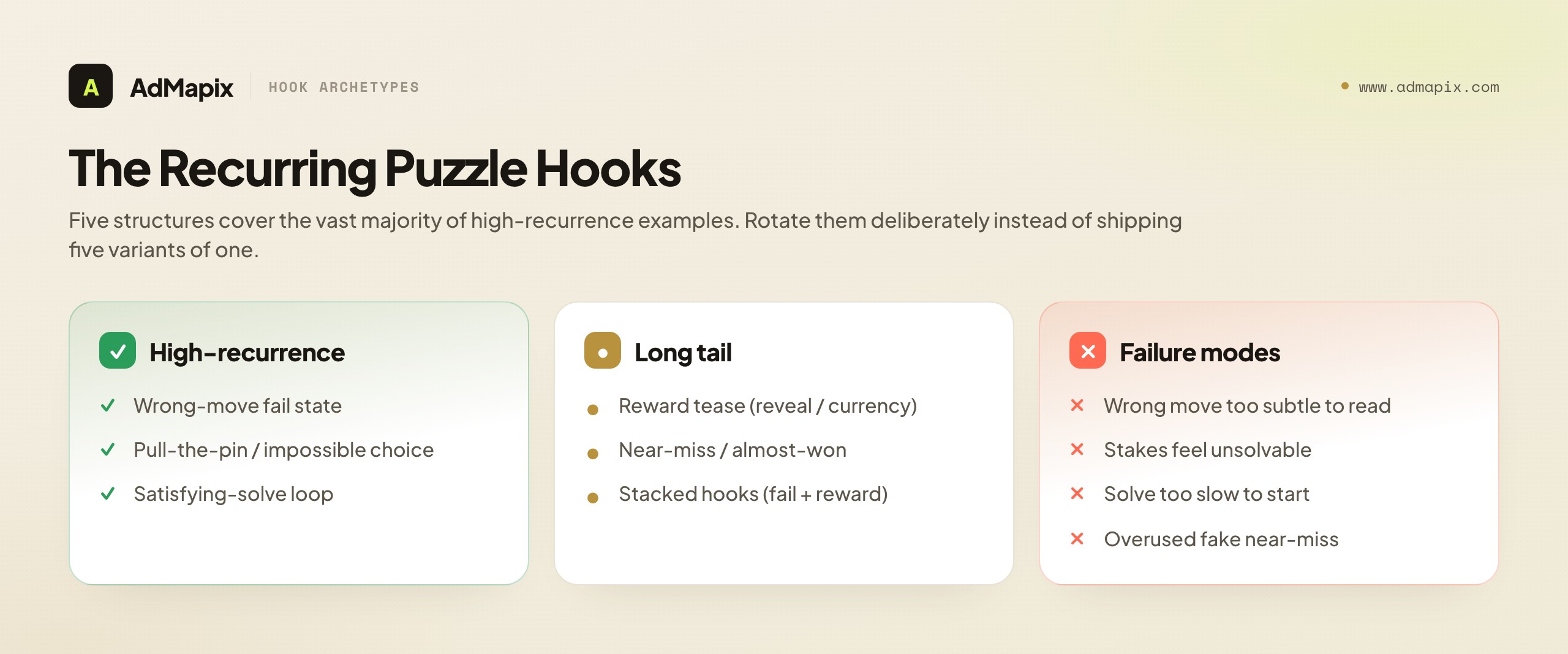
1. The wrong-move fail state. The on-screen "player" makes an obviously bad move and loses — the water overflows, the character falls, the board jams. The viewer's instinct is "I would never do that," and that micro-frustration is the hook. It works because correcting someone else's mistake is more compelling than performing your own success. You see it constantly in pull-the-pin, water-sort, and "save the X" creatives. The failure mode: if the "wrong" move is too subtle, the viewer does not register it as wrong and the tension never lands. Make the mistake unmistakable.
2. The impossible choice / pull-the-pin. A character is trapped between lava and water, or behind a wall, and you must pull pins (or pour, or connect) in the right order to save them. The hook is a small, legible problem with high stakes and an obvious-but-wrong first instinct. It is the single most copied structure in casual puzzle UA, which is exactly why so many of these ads do not match the real game — the pull-the-pin mechanic is a fantastic ad even when the game is something else. The failure mode: stakes that feel cartoonish or unsolvable make the viewer disengage rather than lean in.
3. The satisfying-solve loop. No failure, no stakes — just a clean, escalating sequence of solves that build to a cascade, a full collection, or a room transformation. This is the ASMR end of the genre, and it sells the feeling of flow. It works for match-3, merge, and sort/organize titles where the core loop is genuinely pleasant to watch. The failure mode: if the solve is too slow to start, the viewer scrolls before the payoff. Front-load one small satisfying moment in the first second, then escalate.
4. The reward tease. The ad foregrounds the payoff — a character reveal, a decorated room, a rare item, a currency dump — and frames the puzzle as the gate to it. This pulls a different motivation (collection, progression, customization) than pure problem-solving. Common in decorate/design-meta puzzle hybrids and merge games with a home-renovation or story layer. The failure mode: a reward that looks generic or that the viewer cannot imagine wanting.
5. The near-miss / almost-won. A tighter cousin of the fail state: the on-screen play gets agonizingly close to a win and then loses by one move. It manufactures "so close" tension that begs for a redo. The failure mode: overuse — audiences are increasingly wise to the fake near-miss, so it has to feel earned.
These five cover the vast majority of high-recurrence puzzle game ad examples. When you tag a new creative, you can almost always place it in one of these buckets, sometimes two (a fail state and a reward tease is a common stack). The value of naming them is that you can deliberately rotate hooks in your own testing instead of accidentally shipping five variants of the same one.
Hook Frequency: What Repetition Actually Tells You
Here is the discipline that separates analysts from collectors. When you have tagged a few dozen examples, count the hooks. A rough frequency distribution — built from publicly browsable creatives across casual-puzzle advertisers — usually looks something like the chart below: pull-the-pin and fail-state hooks dominate, the satisfying-solve loop is a strong second tier, and reward teases and near-misses fill out the long tail. Your own count will differ by subgenre and region, and that is the point: you are building your distribution, not borrowing ours.
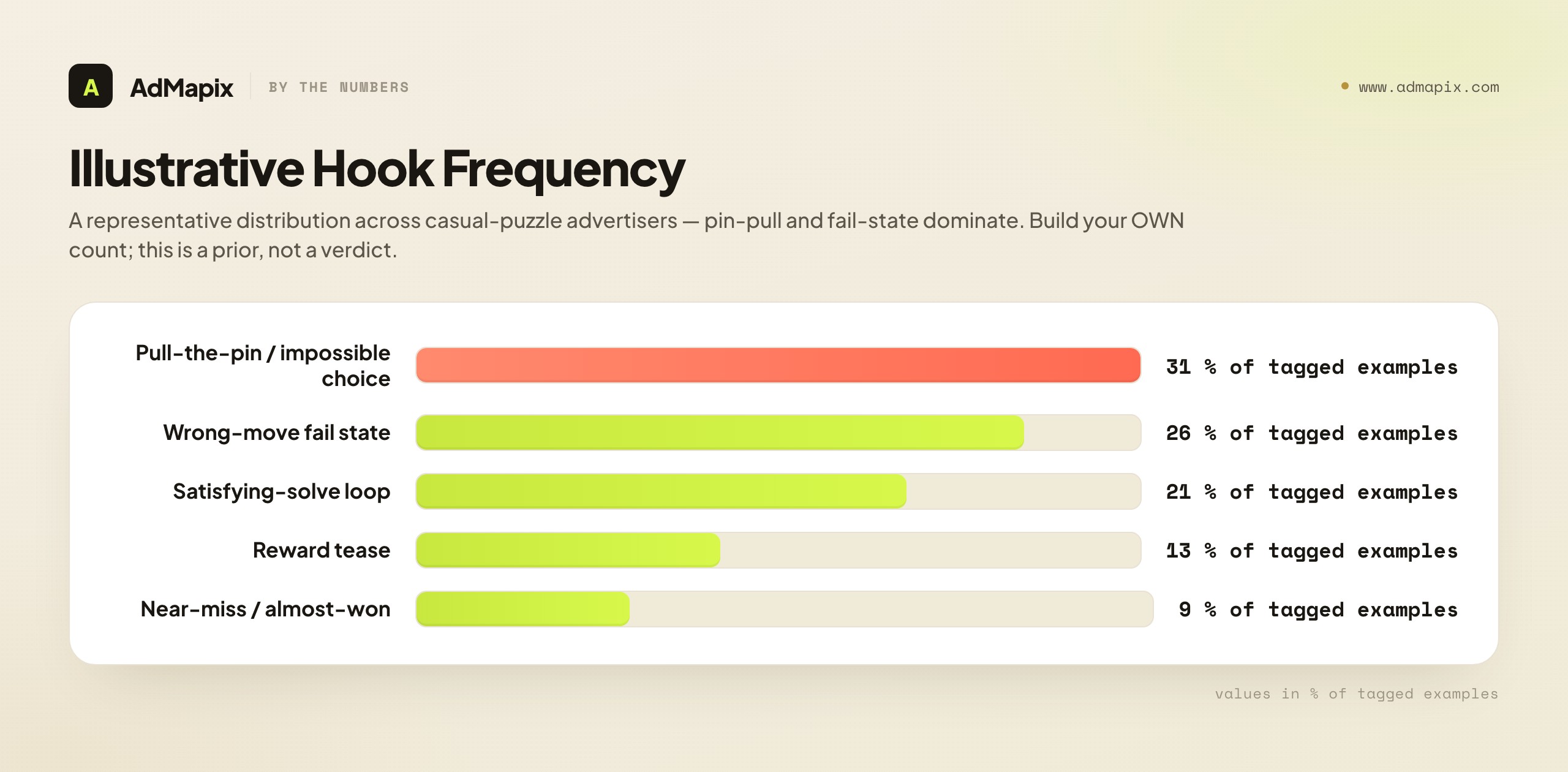
What this counting does and does not tell you is the crux of the whole exercise. A high-frequency hook means many advertisers have independently arrived at the same structure, and most of them keep running it long enough that it is unlikely to be a fluke. That is a genuine soft signal. What it does not tell you is the magnitude of success — you cannot see whether the pin-pull ad is doing 10x the volume of the satisfying-solve ad, or just running because it is cheap to produce. It also does not tell you fit: a hook that wins for a pin-pull game may flop for your match-3 title if you bolt it on without owning the mechanic.
So treat frequency as a prior, not a posterior. It tells you where to start testing, weighted by how many independent advertisers have validated a structure. It does not tell you what will win for you. The only instrument that measures that is your own funnel, which is why every honest read of competitor creatives ends in a test, not a decision.
The Mechanic-Match Gap (and the Retention Tax)
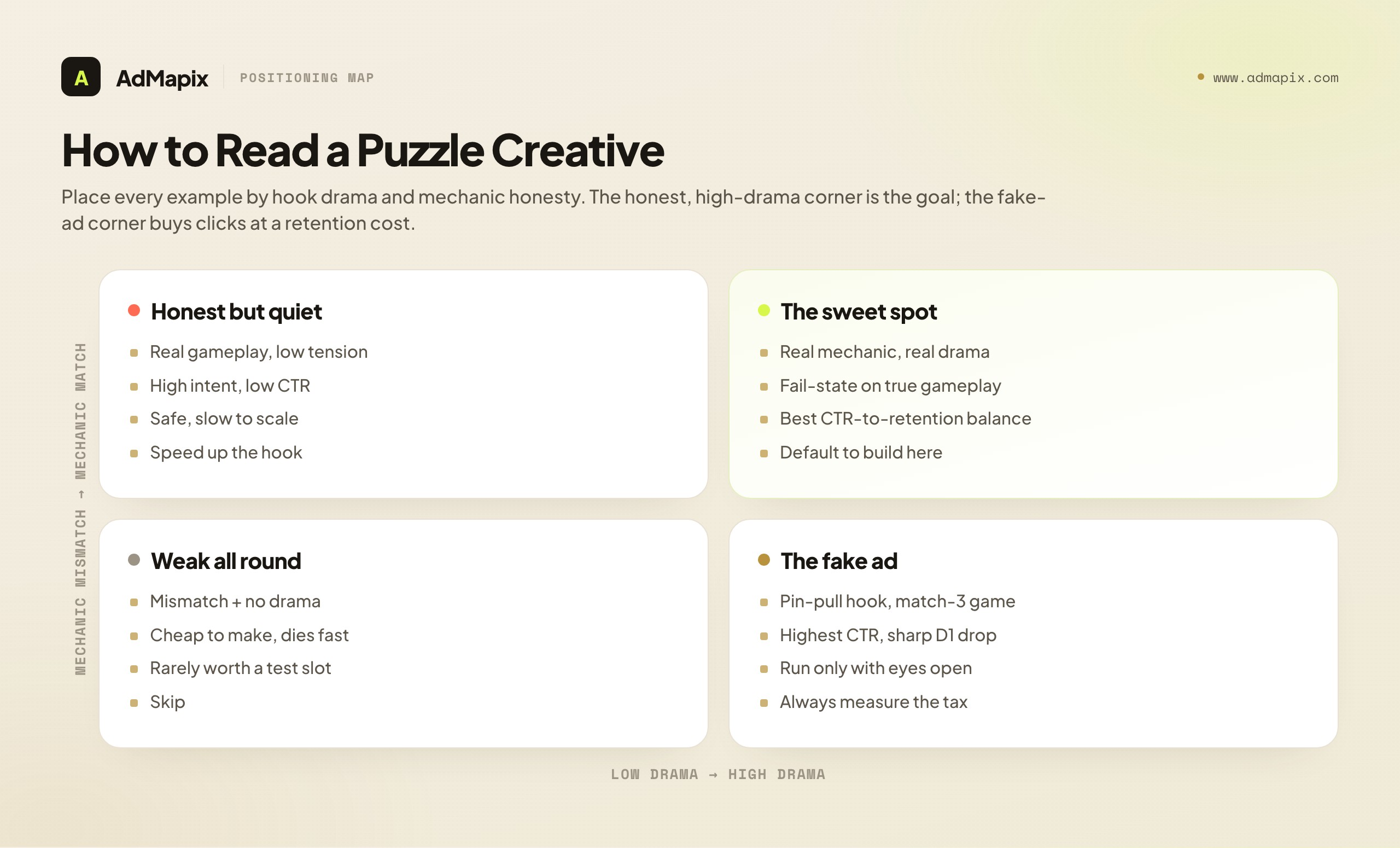
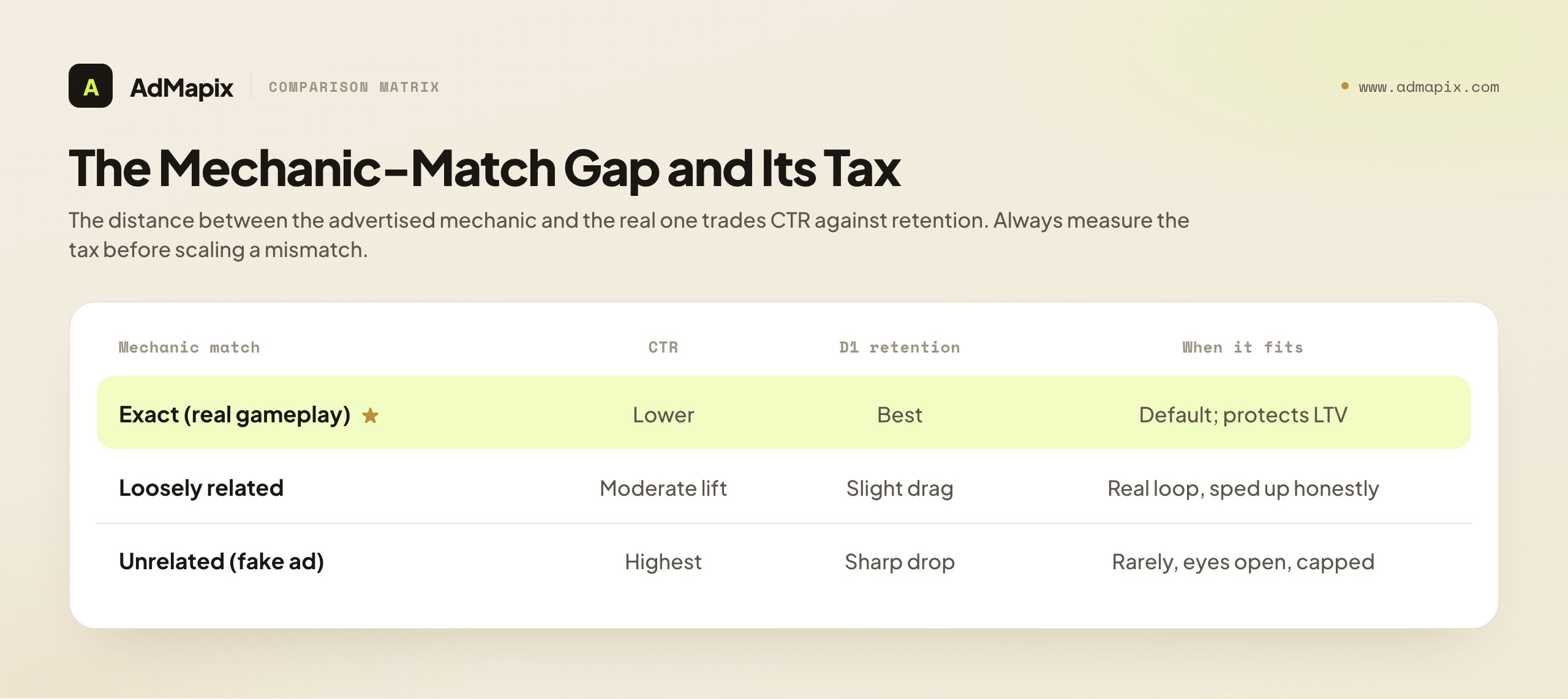
The mechanic-match gap is the distance between the mechanic the ad shows and the mechanic the game actually has. It runs on a spectrum: exact (the ad shows real gameplay), loosely related (the ad shows a stylized or idealized version of the real loop), and unrelated (the famous "fake ad" — pull-the-pin in the ad, match-3 in the game). This gap is the most consequential thing you will track, because it directly trades click-through rate against retention.
Why does the gap exist at all? Because some mechanics are simply better ads than they are games, and vice versa. Pull-the-pin is dramatic, legible, and high-stakes in five seconds — a brilliant hook. Match-3 is a genuinely sticky, monetizable long-term loop — a brilliant game. The temptation is obvious: advertise with the pin, retain with the match. It works at the top of the funnel and bleaks at the bottom. Players who installed expecting pin-pull and got match-3 churn faster on day one, which means you pay for installs that never become players.
| Mechanic match | CTR effect (typical) | D1 retention effect | When it can make sense |
|---|---|---|---|
| Exact (real gameplay) | Lower CTR, higher intent | Best retention, qualified users | Default for sustainable UA; protects LTV |
| Loosely related (idealized loop) | Moderate lift | Slight drag | When the real loop is real but slow to show; speed it up honestly |
| Unrelated ("fake ad") | Highest CTR | Sharp D1 drop, low quality | Rarely — only with eyes open, capped budget, and a measured retention hit |
The practical guidance is not "never use a fake ad." It is: measure the tax. If you decide to run a mechanic-mismatched creative, you must compare its day-1 and day-7 retention against your exact-gameplay control, not just its CTR. Many teams discover the mismatched ad's cheap installs cost more per retained player than the honest ad's expensive installs. Some discover the opposite for a specific geo or season. The only way to know is to run both and look past the click. For a deeper treatment of how this dynamic plays out across the genre, see fake mobile game ads.
One regulatory note worth keeping in view: stores have tightened their stance on ads that misrepresent gameplay. Apple's App Store Review Guidelines and Google's Play developer policies both address misleading marketing, and a creative that promises a mechanic the app does not contain can become more than a retention problem — it can become a compliance one. That is another reason the "eyes open" framing matters: a mismatched creative is a budget decision and a brand-and-policy decision, and both belong in the conversation before you scale it.
Reading a Puzzle Video Frame by Frame
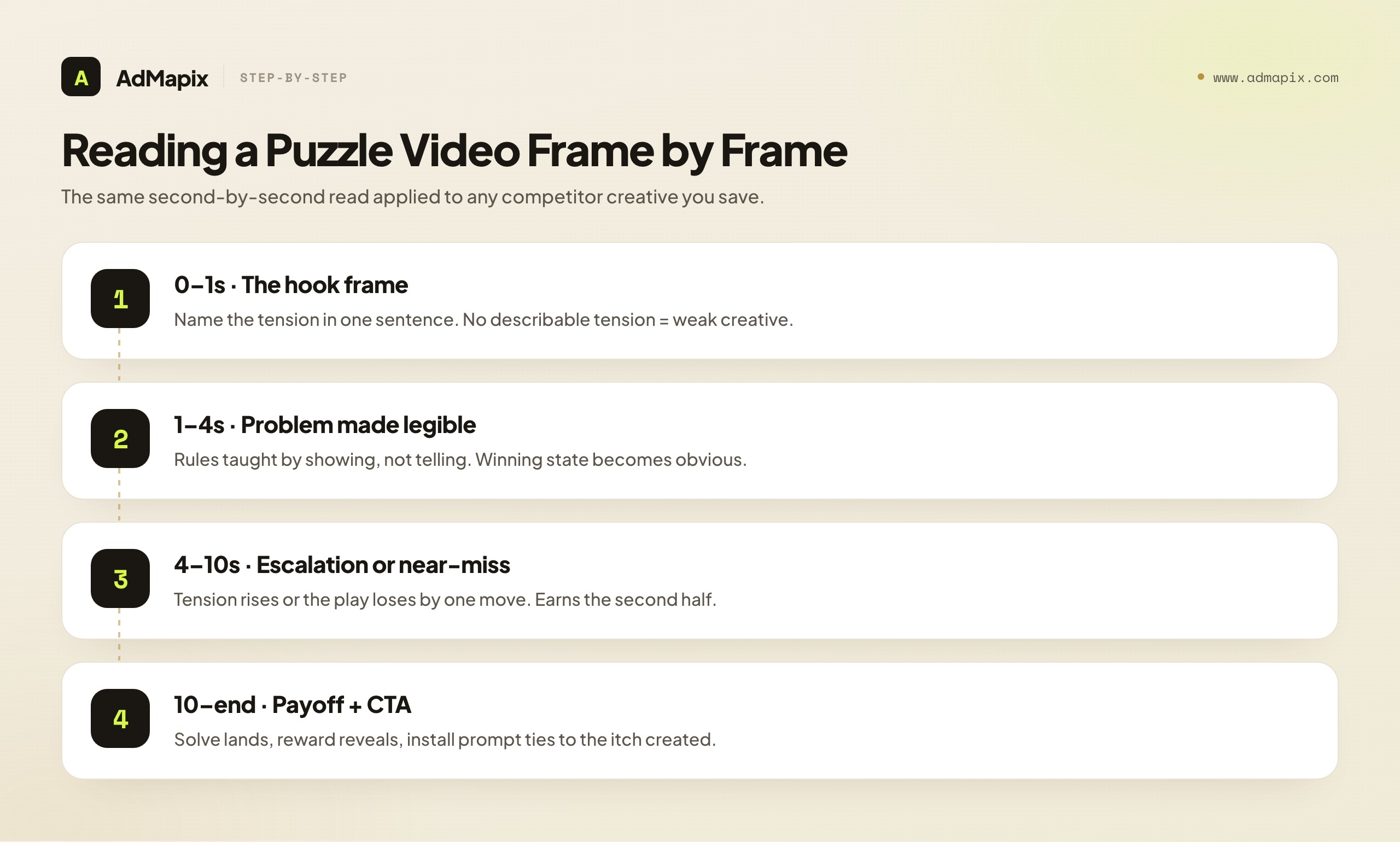
Studying examples well is a learnable skill. Here is the second-by-second read we use on a typical 15-to-30-second puzzle video, which you can apply to any competitor creative you save.
0–1s (the hook frame). This is everything. Pause on the first frame and the first second. What tension is established — a trapped character, an overflowing container, a board one move from a cascade? Is there a wrong move already in motion? If you cannot describe the tension in one sentence, the creative is weak, and a weak hook is the most common reason a puzzle ad fails regardless of what follows.
1–4s (the problem made legible). The ad clarifies the rules of the tension without a tutorial. The viewer should now understand what "winning" looks like and feel that the on-screen play is doing it wrong or slowly. Watch how the creative teaches by showing, not telling.
4–10s (escalation or the fake near-miss). Tension rises — more pins, more water, a bigger cascade — or the play gets agonizingly close and loses. This is where the creative earns the second-half attention. Note whether the escalation feels honest to the mechanic or staged for drama.
10–end (payoff + call to action). The solve lands (or, in a fail-state ad, the viewer is invited to "do it right"), the reward reveals, and the install prompt appears. Note the reward signal and how directly the CTA ties to the tension. The best puzzle ads make the install feel like the natural way to relieve the itch they created.
Run this read on every saved example and log it against your five-axis tags. Within a few dozen creatives you will have an opinionated map of what your competitors believe works — and, just as useful, a list of structures nobody in your niche is running, which is where the cheapest wins often hide.
Subgenre Patterns: Match-3, Merge, Sort, and Pin-Pull
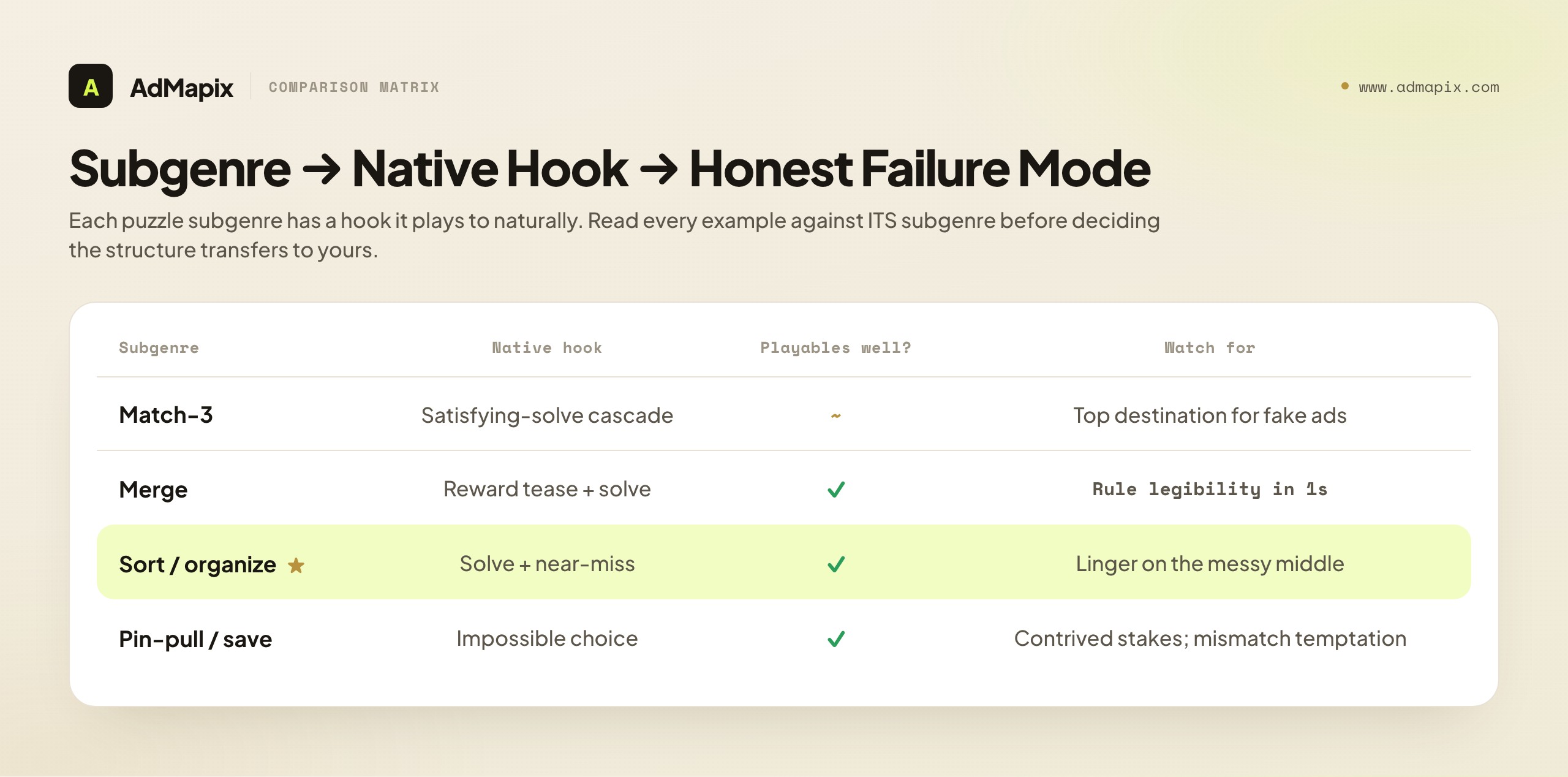
Puzzle is not one genre but a cluster of them, and each subgenre has its own native hook and its own honest failure mode. Reading examples without respecting these differences leads to a common mistake: copying a hook that fits a neighbor's mechanic but not yours. Here is how the recurring structures map onto the four subgenres you will study most.
Match-3. The native hook is the satisfying-solve loop — one swap triggering a cascade of clears, often escalating into a board-clearing chain. The genre's strength as an ad is the visual payoff of the cascade; its weakness is that a single swap can look small and slow in the first second. The best match-3 examples solve this by opening mid-cascade or by foregrounding a near-complete objective ("clear 3 more to win") so the tension is immediate. Match-3 is also the most common destination for fake ads — pin-pull and renovation hooks routinely route to match-3 cores — which means match-3 advertisers face the strongest temptation to mismatch and the steepest retention tax when they do.
Merge. Merge games (combine two of a thing to make a better thing) advertise well with the reward-tease and satisfying-solve hooks stacked together: you watch small items combine into bigger, rarer, more valuable ones, and the progression itself is the payoff. The native failure mode is legibility — a viewer who does not already understand "merge two to make one" can be confused in the first second. Strong merge examples teach the rule instantly by showing one obvious combine before escalating. Merge titles with a story or renovation meta also borrow heavily from the reward-tease, gating a room or character behind the merge loop.
Sort / organize (water sort, ball sort, nuts-and-bolts). These are pure satisfying-solve and near-miss territory. The pleasure is order from chaos, and the tension is a board that looks one wrong pour from being stuck. The native failure mode is that a fully solved board is less compelling than a nearly-solved one — so the best sort examples linger on the messy middle and the agonizing last move, not the clean finish. Sort games also playable extremely well, because the act of pouring or sorting is satisfying to do, not just watch.
Pin-pull / save-the-character. This is the drama subgenre: high stakes, an obvious-but-wrong first instinct, and a trapped character whose fate depends on pulling pins in order. Its native hook is the impossible choice, and it is the strongest pure ad mechanic in casual puzzle — which is precisely why it is so often advertised for games that are not pin-pull at all. If you actually make a pin-pull game, you have an enviable advertising position: your real gameplay is the best hook. If you do not, copying it means accepting the mechanic-match gap. Either way, the genre's failure mode is contrived stakes — a trap so absurd the viewer disengages rather than worries.
The takeaway is to read every example against its own subgenre's native hook before deciding whether the structure transfers to yours. A satisfying-solve loop that is native to sort may need to be re-engineered to work for pin-pull, and vice versa. The five-axis tags make this explicit: when the hook and the core mechanic are a natural pair (solve + sort, impossible-choice + pin-pull), the creative is playing to its strength; when they are mismatched (impossible-choice + match-3), you are looking at a deliberate gap to scrutinize.
Format, Length, and the First-Frame Test
Hook structure is the soul of a puzzle ad, but format and length are the body, and they vary enough to deserve their own read. Across networks you will see the same core hooks delivered in several wrappers: short vertical video (the dominant social-feed format), square video, longer "story" cuts that add a narrative or character layer, and the playable, which we treat separately below. The hook is portable across formats; what changes is how much room you have to escalate and how the first frame has to behave.
The single most important format constraint is the first-frame test. On most feeds, a meaningful share of viewers see only the opening frame before deciding to scroll. That means a puzzle ad whose tension only becomes clear at second three has effectively wasted its budget on those viewers. The strongest examples are legible as a still image — the trapped character, the overflowing container, the board one move from a cascade all read instantly even with the sound off and the video paused. When you tag examples, it is worth adding an informal note on whether the creative passes the first-frame test, because it is one of the most copyable and one of the most ignored levers in the genre.
Length follows from the hook. A pure satisfying-solve loop can run longer because the pleasure compounds; a fail-state or near-miss hook usually wants to be short and punchy, resolving the tension before the viewer's patience runs out. Reward-tease ads often front-load the reward, then show just enough puzzle to make it feel earned. None of this is a rule — it is a set of priors you confirm by tagging length alongside hook and watching which combinations recur. The discipline is the same as everywhere in this guide: observe the distribution, form a prior, test against your own funnel.
A Worked Example: From Cold Folder to Shipped Test
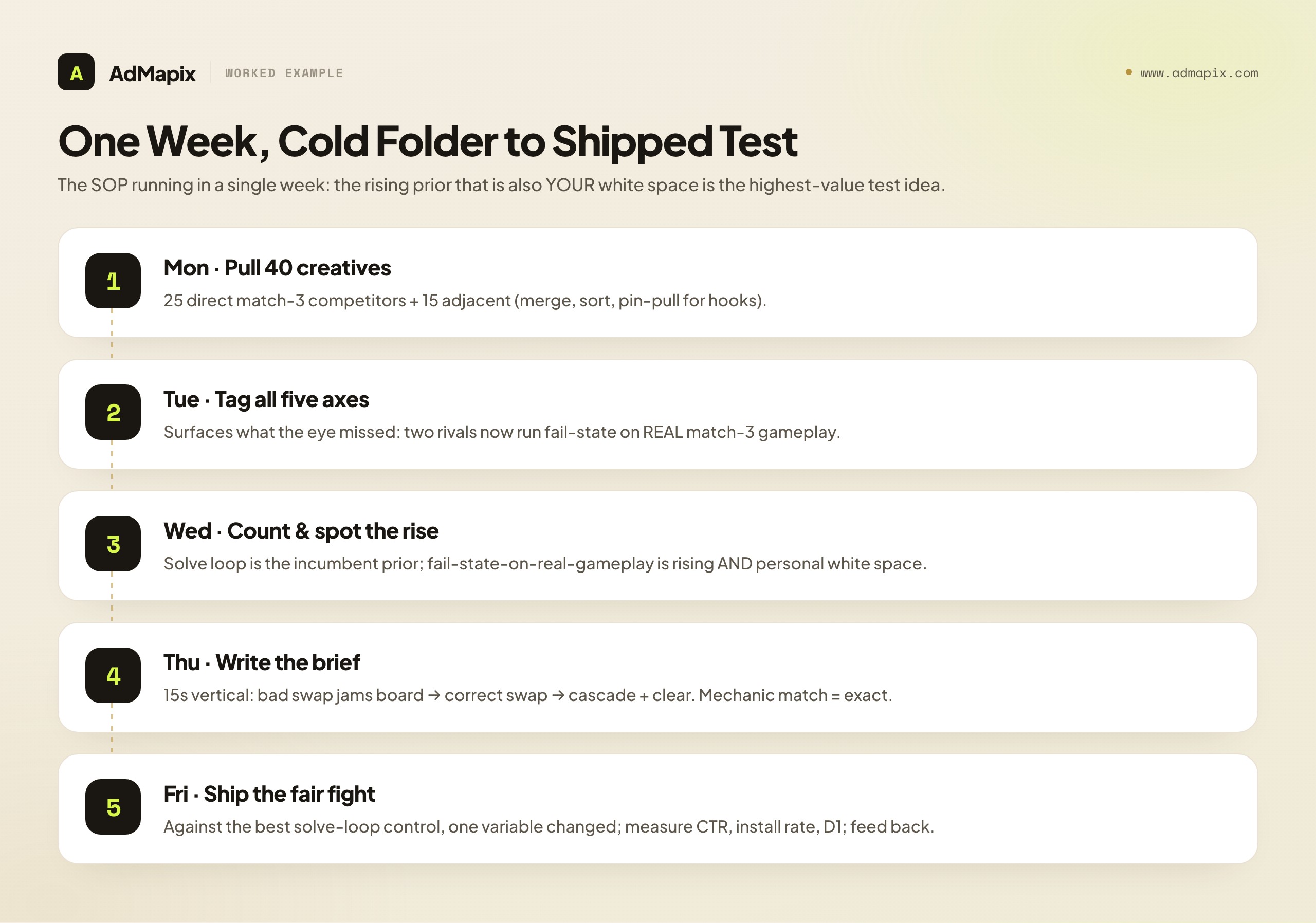
To make the SOP concrete, here is an end-to-end walkthrough of how a small puzzle studio might go from a blank folder to a shipped, measured test in one week — the kind of loop the cadence section formalizes.
On Monday, the team pulls 40 creatives: 25 from direct match-3 competitors and 15 from adjacent subgenres (merge, sort, and a couple of pin-pull titles deliberately included for their hooks). On Tuesday they tag all 40 on the five axes. The tagging surfaces something the eye missed: across the match-3 competitors, the satisfying-solve hook dominates, but two competitors have quietly started running fail-state creatives on real match-3 gameplay — opening on an obviously bad swap that jams the board — and those creatives have been live for several weeks.
On Wednesday they count. The satisfying-solve loop is the incumbent prior (most creatives, most advertisers), but the fail-state-on-real-gameplay structure is the rising one, recurring under multiple advertisers and persisting over time. Crucially, it is also white space for this studio — they have never tested a fail-state hook on their own genuine gameplay. That combination — a rising prior that is also personal white space — is the highest-value kind of test idea.
On Thursday they write a brief: a 15-second vertical video opening on a deliberately bad swap that jams the board ("the wrong move"), a beat of frustration, then a cut to the correct swap triggering a satisfying cascade and the level-clear reward, ending on the install prompt. The mechanic-match decision is exact — real gameplay throughout — so there is no retention tax to fear. They build it with their own art, not a copy of any competitor's.
On Friday (of the following week, once the asset is produced) they ship it against their best-performing satisfying-solve control, change only the hook, and measure CTR, install rate, and D1. The result feeds back into the tags: if the fail-state hook wins on CTR and holds D1, it becomes a new prior to scale and a structure to test in other formats; if it wins CTR but drags D1, that is a signal the frustration framing is attracting the wrong players, and the brief needs adjustment. Either way, the studio learns something its competitors' visible ads could never have told it — because the only place that answer lives is its own funnel.
Playables: The Same Hook, Made Interactive
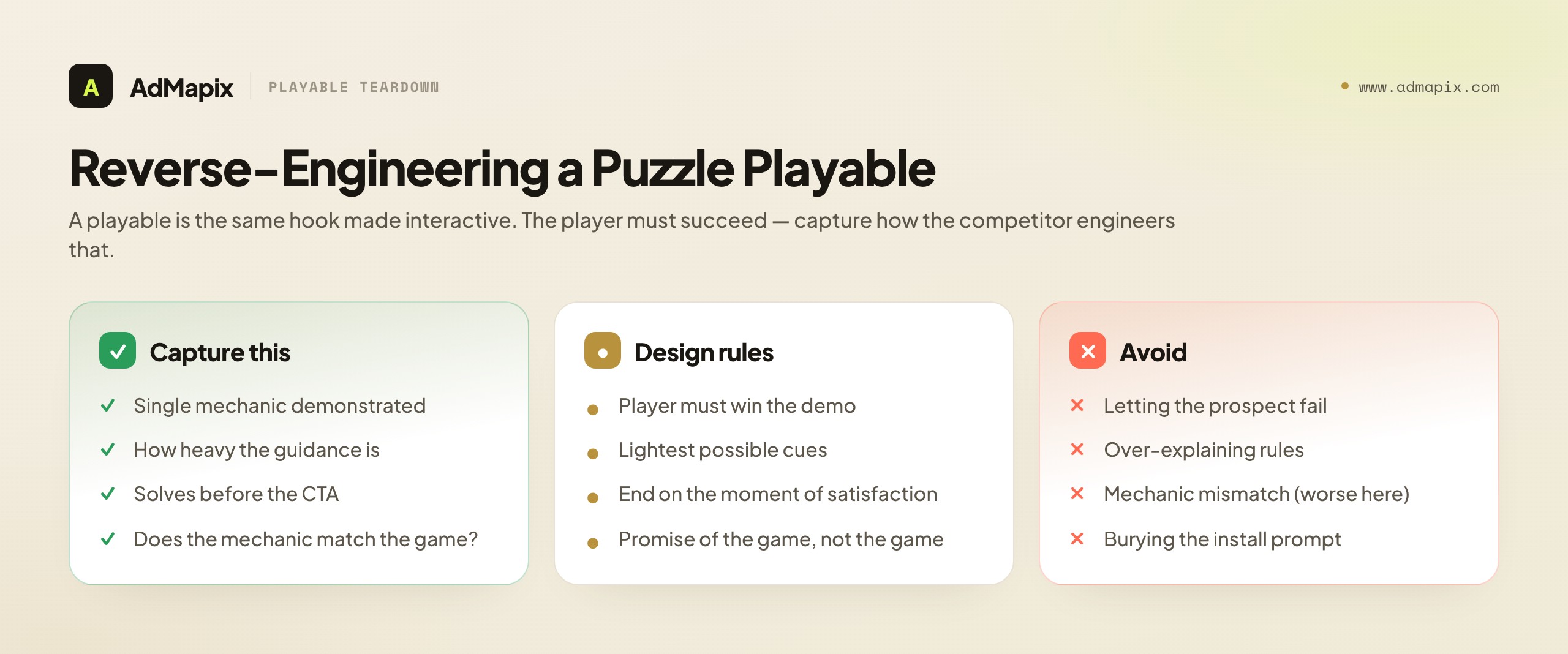
A playable ad is the same tension structure turned into a 10-to-30-second interactive demo — the player taps, drags, pulls, or pours through one or two solves before the store page loads. Puzzle is the single best-fit genre for playables, because the core loop is short, legible, and satisfying to do, not just to watch. A playable lets a prospect feel one solve, which is a far stronger qualifier than a video: people who complete the playable have already demonstrated the exact behavior your game depends on.
The structure of a good puzzle playable mirrors the video read above, with one critical difference: the player must succeed. A playable that lets the prospect fail at the demo is a playable that teaches them they are bad at your game, which is the opposite of what you want. So the design pattern is: present a simplified, winnable version of one mechanic, guide the player to the solve with the lightest possible cues (a finger hint, a glow on the right move), deliver the payoff, then end on the install prompt at the moment of satisfaction. The playable is not the game; it is the promise of the game, made tangible.
When you reverse-engineer a competitor's playable, capture: which single mechanic it demonstrates, how heavily it guides the player (heavy hand-holding suggests they optimize for completion, light guidance for qualification), whether it lets the player fail, how many solves before the CTA, and whether the demonstrated mechanic matches the real game (the mechanic-match gap applies to playables too, and is even more jarring there because the player physically did the thing). We cover the full methodology in our dedicated playable ads guide and a library of patterns in playable ad examples.
From Examples to a Test Backlog: The SOP
Inspiration is worthless until it becomes a queued test. Here is the standard operating procedure to convert a folder of puzzle game ad examples into a prioritized creative backlog you can actually ship against. The SOP below is the spine; the worked example above shows it running in a single week.
Step 1 — Collect with intent. Save 30–50 competitor creatives across your subgenre and adjacent ones. Cast slightly wider than your exact mechanic; pull-the-pin patterns from a different game type are often the most stealable for a match-3 title precisely because nobody else in your lane is using them.
Step 2 — Tag all five axes. No creative enters the backlog without hook, mechanic, playable cue, reward signal, and mechanic match. Consistency here is what makes Step 3 possible.
Step 3 — Count and cluster. Build your hook-frequency distribution. Identify the high-recurrence structures (your priors) and the white space (structures nobody in your niche runs). Note any mechanic-match patterns you might or might not want to copy.
Step 4 — Write briefs, not copies. For each test, write a one-paragraph brief: the hook, the mechanic to show, the playable cue, the reward, and the explicit mechanic-match decision (exact, loosely related, or — eyes open — unrelated). Do not pixel-copy a competitor; rebuild the structure with your own art and your own honest mechanic decision.
Step 5 — Prioritize by prior × fit × cost. Rank briefs by how strongly the prior is validated (recurrence), how well the hook fits your real game (mechanic fit), and how cheap it is to produce. High-recurrence, high-fit, low-cost tests go first.
Step 6 — Ship in fair fights. Run each new concept against a stable control, change one variable at a time where you can, and judge on the metric that matters for the funnel stage — CTR for the hook, install rate for the offer, D1/D7 for quality. Then feed the winners and losers back into your tagging so your priors improve. The mechanics of running these fights well are in the creative testing framework.
What Public Ads Prove — and What They Never Can
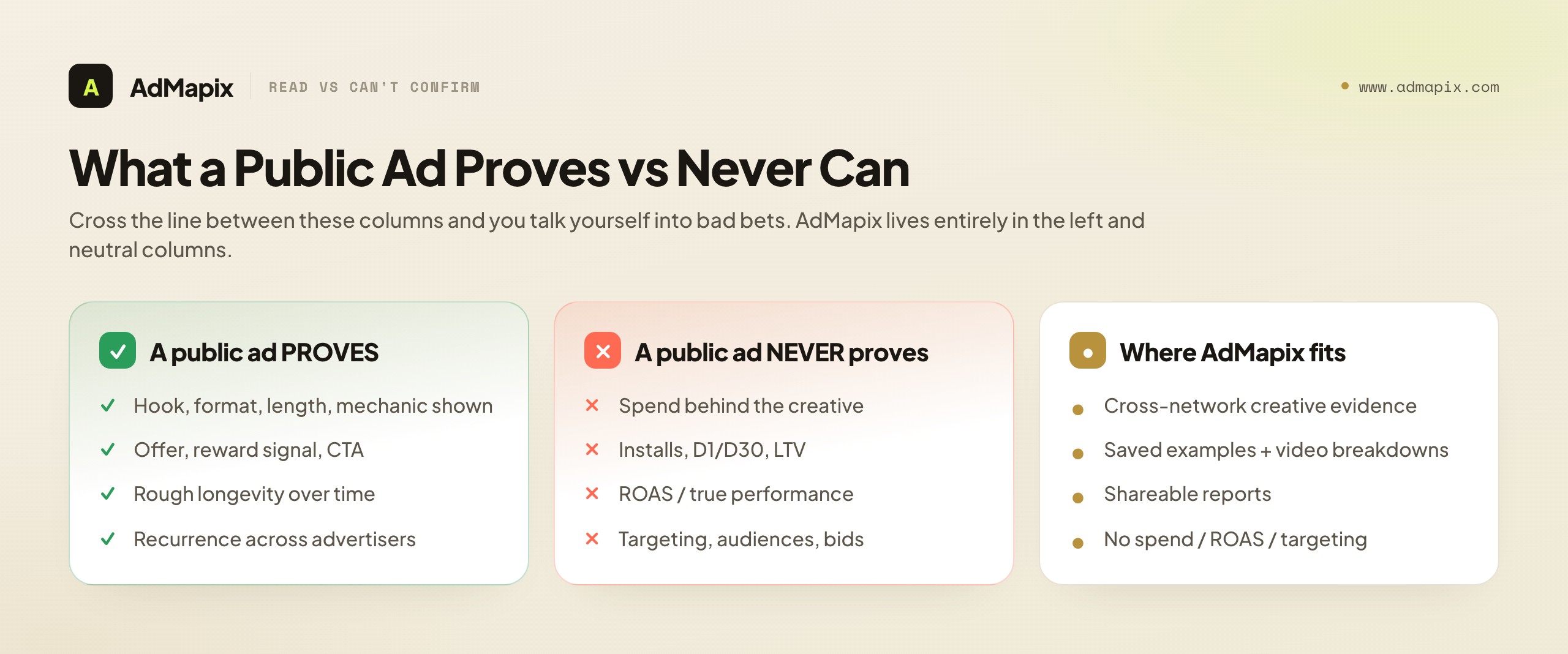
This is the honesty section, and it is non-negotiable. Reading puzzle game ad examples tells you a great deal about creative structure and almost nothing about results. Be precise about the boundary, because crossing it is how teams talk themselves into bad bets.
What a public ad genuinely proves: the creative exists; its hook, format, length, and mechanic shown; the offer and reward signal; the call to action; and — if you observe it over time across an ad library — rough longevity, which is a weak proxy for "the advertiser has not killed it yet." Counting recurrence across many advertisers adds a second weak signal: independent convergence on a structure.
What a public ad never proves: how much the advertiser spent behind it; how many installs it drove; the install rate, day-1 or day-30 retention, or lifetime value of the users it brought in; the return on ad spend; the targeting, audiences, or bids used; or whether it was the advertiser's best, worst, or median creative. None of that is visible from the outside, by anyone, using any tool. A creative that ran for three months might be a quiet winner — or a fire-and-forget asset nobody bothered to pause.
This is exactly where a creative-evidence layer like AdMapix fits, and where it must be described honestly. AdMapix is searchable, cross-network ad-creative evidence — saved examples, video breakdowns, and recurring reports — so you can find and study puzzle creatives across networks without opening five ad libraries by hand. It is fast for discovery and for packaging examples into a shareable report. It cannot show you competitor spend, install volume, retention, ROAS, or targeting, because that data is not public — and any tool that claims otherwise is selling you a model dressed as a fact. Use the evidence to narrow your test space; use your own analytics to pick the winner. For the wider toolkit and where each tool's data ends, see the advertising intelligence guide and the ad creative database.
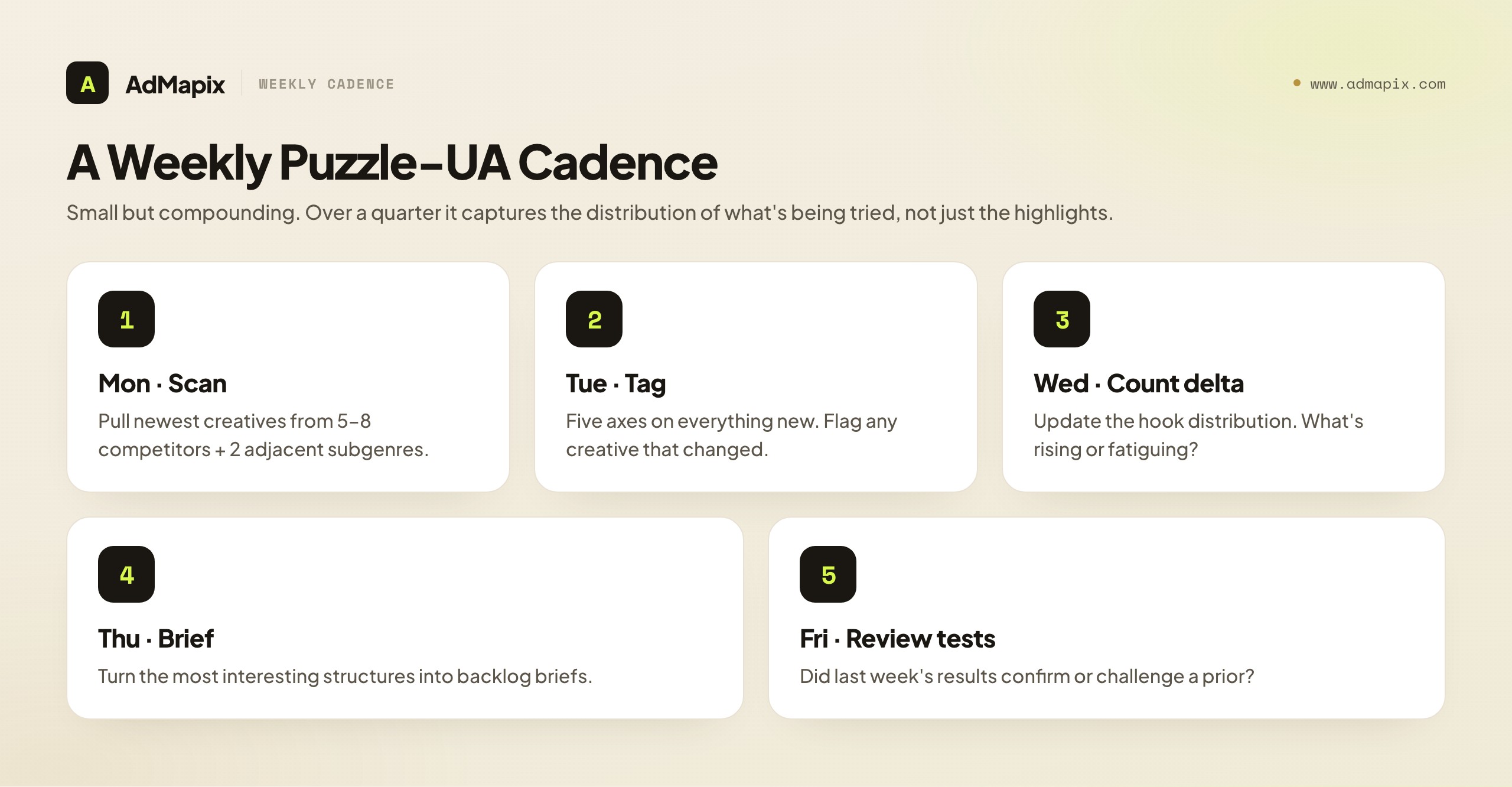
A Weekly Cadence for Staying Current
Puzzle UA moves fast — hooks fatigue, new mechanics trend, and a structure that was fresh in spring can be everywhere by summer. A light weekly cadence keeps your example library and your priors current without turning into a full-time job.
Monday — scan. Spend 20 minutes pulling the newest creatives from your top 5–8 competitors and two adjacent subgenres. Save anything with an unfamiliar hook, mechanic, or reward signal.
Tuesday — tag. Apply the five-axis tags to everything new. Flag any creative that has changed — a competitor swapping a fail-state hook for a satisfying-solve loop is a signal worth noting.
Wednesday — count the delta. Update your hook-frequency distribution. What is rising? What is disappearing? A hook collapsing across several advertisers often means it has fatigued — useful to know before you build a test around it.
Thursday — brief. Turn the most interesting new structures into briefs and slot them into the backlog at the right priority.
Friday — review your own tests. Close the loop: which of last week's shipped tests won or lost, and does the result confirm or challenge a prior? Update your tagging notes accordingly.
The discipline is small but compounding. Over a quarter, a team running this cadence builds a tagged, counted, opinion-bearing library that no single brilliant idea can match — because it captures the distribution of what is being tried, not just the highlights.
Common Mistakes When Studying Puzzle Creatives
A few errors show up so often they deserve a checklist of their own. Most of them come from treating examples as answers rather than evidence.
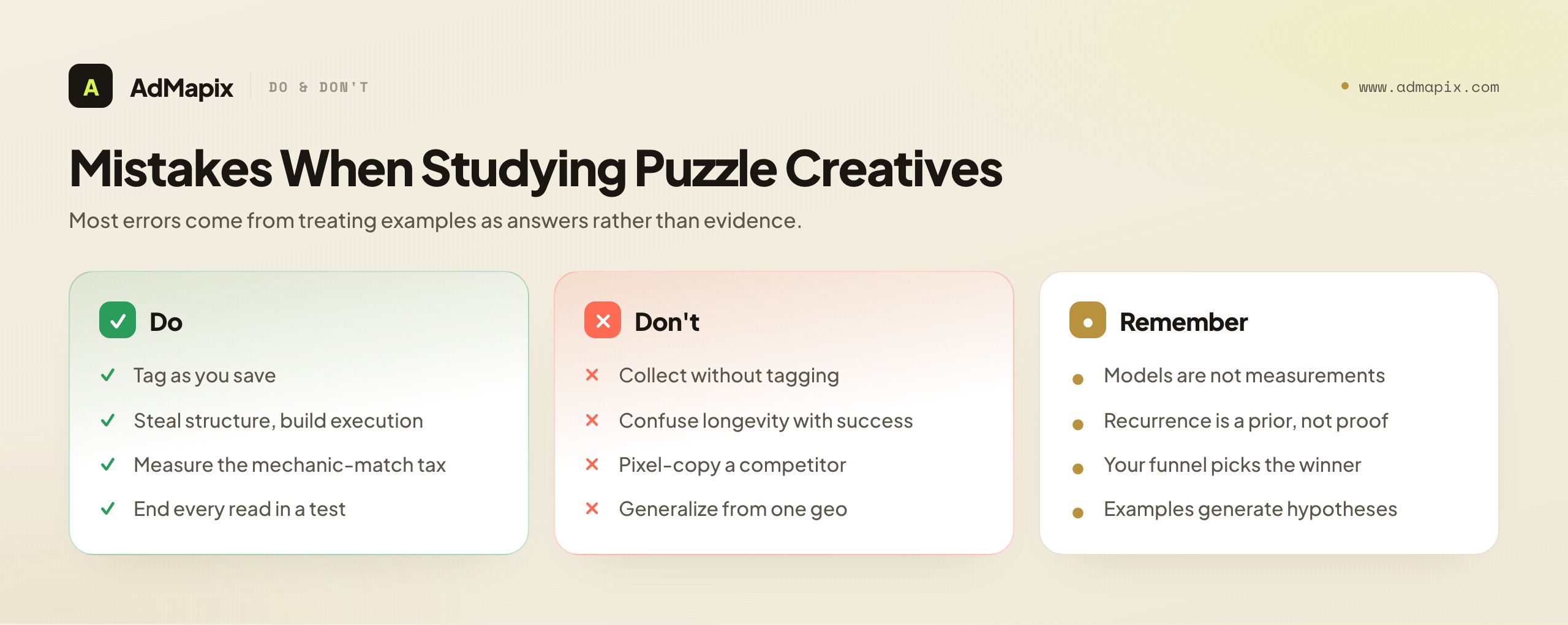
Collecting without tagging. A folder of 200 creatives you never tagged is a graveyard, not a dataset. Tag as you save or do not save.
Confusing longevity with success. "It has been running for months" is a weak signal, not proof. Plenty of long-running ads are just unmanaged.
Pixel-copying a competitor. Cloning art and copy gets you a worse version of someone else's ad and a possible legal headache. Steal the structure, build the execution.
Ignoring the mechanic-match gap. Copying a pin-pull hook onto your match-3 game without measuring the retention tax is how you burn budget on installs that churn by day one.
Reading one geo and generalizing. Hooks fatigue at different speeds in different markets. A US distribution does not predict a Japan or Brazil one.
Mistaking models for measurements. Any "spend" or "ROAS" number attached to a competitor's creative is an estimate at best. Never put a competitor's modeled spend in a deck as if it were fact.
Skipping the test. The most expensive mistake of all: deciding from the example folder instead of from your funnel. Examples generate hypotheses. Tests generate truth.
How AdMapix Fits a Puzzle UA Workflow
To be concrete about the role of a creative-evidence layer in this specific workflow: AdMapix helps with the discovery and packaging half of the loop, not the measurement half. You can search cross-network for puzzle creatives by keyword and pattern, study saved examples and video breakdowns without juggling separate ad libraries, and assemble the strongest examples into a shareable report for your team or a client. That collapses the most tedious part of the SOP — collecting across networks by hand — into a search.
What it does not do, and what no external tool can, is tell you which of those creatives actually won. The mechanic-match decision, the retention tax, the prior-versus-fit judgment, and the final pick all still depend on your own briefs and your own analytics. The honest mental model is: AdMapix (and tools like it) make Steps 1–3 of the SOP fast and cross-network; your creative team owns Step 4; your test program and funnel own Steps 5–6. If you keep that division clear, you get the speed of a creative-intelligence layer without the trap of mistaking its evidence for outcomes. For neighboring use cases, the ad creative intelligence workflow for mobile UA teams and the mobile game ad spy tool overview are the natural next reads.
The cross-network angle deserves one more beat, because it is where the discovery half of the workflow most often breaks down for puzzle teams. Puzzle UA does not live on one platform. The same advertiser frequently runs distinct creatives on social feeds, on video and rewarded-video networks inside other games, and on the open web — and the hook that dominates one surface may be near-absent on another. A team that only ever browses one ad library is reading a slice of the distribution and mistaking it for the whole. To check a competitor honestly you would otherwise need to open several official ad libraries — Meta's Ad Library, the Google Ads Transparency Center, TikTok's Commercial Content Library — one at a time, with no shared search and no consistent tagging. Collapsing that into a single cross-network search is the concrete value a creative-evidence layer adds; the tagging, the priors, and the test are still yours to build on top of it.
Finally, a word on reporting. Much of the value of a tagged puzzle-creative library is not just internal direction but communication — showing a producer, a studio lead, or an external client the landscape of what is being tried and why a given test was prioritized. A folder of screenshots makes a weak case; a tagged, counted, annotated set of examples with a clear "here is the rising structure, here is our white space, here is the test" narrative makes a strong one. This is the second place a creative-evidence layer earns its keep: packaging the examples you have studied into something shareable, so the analysis you did once persuades the people who decide whether the test ships.
FAQ
What are the most common puzzle game ad hooks?
The three you will see most are the wrong-move fail state (the on-screen play makes an obvious mistake and loses), the pull-the-pin / impossible-choice structure (save a trapped character by acting in the right order), and the satisfying-solve loop (a clean, escalating sequence of solves with no failure). Reward teases and fake near-misses round out the long tail. Tag and count your own examples to build the real distribution for your subgenre and region.
Why do so many puzzle ads not match the actual game?
Because some mechanics are better ads than they are games. Pull-the-pin is dramatic and legible in five seconds; match-3 is a sticky, monetizable long-term loop. Advertisers are tempted to advertise with the dramatic mechanic and retain with the sticky one. This "mechanic-match gap" lifts click-through rate but usually drags day-1 retention, so the cheap installs can cost more per retained player. See our fake mobile game ads breakdown for the full dynamic.
How do I turn competitor ad examples into actual tests?
Collect 30–50 creatives, tag each on five axes (hook, mechanic, playable cue, reward signal, mechanic match), count the hooks to find high-recurrence priors and white space, write one-paragraph briefs that rebuild the structure with your own art and an explicit mechanic-match decision, prioritize by prior × fit × cost, and ship each against a stable control. Judge on the metric that matches the funnel stage — CTR for the hook, install rate for the offer, D1/D7 for quality.
Can I see how much a competitor spent on a puzzle ad?
No. Spend, install volume, retention, lifetime value, ROAS, and targeting are not public for any advertiser, and no external tool can show them — anything labeled "competitor spend" is a model, not a measurement. What a public ad genuinely proves is creative structure (hook, format, mechanic shown, offer, CTA) and, observed over time, rough longevity. Use that evidence to narrow your test space and your own analytics to pick the winner.
Are playables worth it for puzzle games?
Puzzle is arguably the best-fit genre for playables, because the core loop is short, legible, and satisfying to do. A playable lets a prospect feel one solve before installing, which qualifies users better than a video. The design rule is that the player must succeed — guide them to a winnable solve with light cues, deliver the payoff, then prompt the install at the moment of satisfaction. Our playable ads guide covers the full method.
How often should I review competitor puzzle creatives?
A light weekly cadence works well: scan new creatives Monday, tag them Tuesday, update your hook-frequency count Wednesday, write briefs Thursday, and review your own test results Friday. The goal is to keep your priors current — hooks fatigue and new mechanics trend faster in puzzle than in most genres — without turning analysis into a full-time job.
Does a long-running ad mean it is a winner?
Not reliably. Longevity is a weak proxy: it suggests the advertiser has not killed the creative, but plenty of long-running ads are simply unmanaged, not high-performing. A stronger (still soft) signal is independent recurrence — the same structure running under many distinct advertisers, in multiple markets, over time. Even then, treat it as a prior to test, never as proof.
What's the difference between studying ads and copying them?
Studying ads means extracting the reusable structure — the hook, the tension, the reward logic — and rebuilding it with your own art, copy, and an honest mechanic decision. Copying means cloning a competitor's specific creative, which gets you a worse version of their ad and a possible legal and brand-safety problem. Steal patterns, never pixels.
Where does AdMapix help in this process?
AdMapix is a cross-network creative-evidence layer: it makes the discovery-and-packaging half of the workflow fast — searching puzzle creatives across networks, studying saved examples and video breakdowns, and assembling them into a shareable report — without opening multiple ad libraries by hand. It does not (and cannot) show competitor spend, installs, retention, or ROAS. Use it to narrow your test space; use your own funnel to decide. See the ad creative database for more.
Related reading: Build on this with the mobile game ads guide, the playable ads guide and playable ad examples, the creative testing framework, the honest take in fake mobile game ads, and the broader advertising intelligence guide, ad creative database, and mobile game ad spy tool overviews.
See what competitors are really running
Search 6M+ ad creatives, landing pages, and weekly spend across 200+ countries. No credit card, no commitment.
Related Articles
Playable Ad Analysis for Mobile Games: A Practical Method
A practical method for playable ad analysis in mobile games: how to reverse-engineer a competitor's playable by the job it is built to do, decode its structure beat by beat, infer which concepts are likely working, turn observations into testable briefs, and stay honest about what a public playable proves (structure and intent) versus what it never can (spend, installs, retention, ROAS).
Best Mobile Game Ad Formats Across Platforms: A 2026 UA Playbook
A platform-by-platform guide to the best mobile game ad formats in 2026: which formats do the heavy lifting on Meta, Google, TikTok, AppLovin, and Unity; why the right format depends on platform, genre, and funnel stage; a format-selection framework; a creative-testing cadence; and the honest limits of what competitor ads can and cannot tell you about which format wins.
Meta Ads Library vs Ad Intelligence Tools for Game UA (2026): Which to Use, When, and Why
A definitive 2026 comparison of the Meta Ads Library vs dedicated ad intelligence tools for mobile game user acquisition — where the free transparency library genuinely helps, the structural limits that create blind spots for game UA creative research, a side-by-side capability matrix, the exact decision criteria for when to add a paid intelligence layer, and an honest account of what neither can show.