Pinterest Ads Library in 2026: The Ads Repository, Its Limits, and How to Research Promoted Pins
A complete 2026 guide to the Pinterest Ads Library — why it is really the DSA-driven Ads Repository, why access is EU-focused, exactly what it shows and hides, how to research promoted Pins when the repository is region-locked, how to read Pinterest creative by Pin format and category, the third-party spy methods that fill the gaps, the honest limits of public ad data, and where a cross-network creative-intelligence layer like AdMapix fits.
Pinterest Ads Library in 2026: The Ads Repository, Its Limits, and How to Research Promoted Pins
By the AdMapix Research Team — Updated June 21, 2026
Pinterest does not run a global "Ads Library" the way Meta does. What people search for as the "Pinterest Ads Library" is officially the Pinterest Ads Repository — a transparency surface Pinterest built to satisfy the EU Digital Services Act, which means access is currently EU-focused rather than worldwide. That single fact reshapes how you research Pinterest advertisers: if you are inside the EU you have a genuine, if minimal, source of record; if you are outside it, the official repository may not be available to you at all, and you need another path. This guide is the complete 2026 reference for both situations — where the official repository lives, exactly what it does and does not expose, where regional limits bite, how to research promoted Pins when the repository is region-locked, and how to turn whatever you can see into a repeatable competitor workflow.
This is written for ecommerce and DTC marketers, Pinterest advertisers, agencies, and creative strategists who want to study what brands are actually running on Pinterest — without pretending a public transparency record reveals a private performance report. Because Pinterest's repository is both region-locked and deliberately thin, getting real value out of Pinterest ad research means understanding precisely what the official surface gives you, what it withholds, and which third-party methods responsibly fill the gaps. We cover all three.
TL;DR — The Pinterest Ads Library in One Screen
- There is no global Pinterest Ads Library. What people call the "Pinterest Ads Library" is the Pinterest Ads Repository, a DSA compliance tool, and its access is currently EU-focused — coverage and availability vary by region.
- It is a transparency surface, not a performance dashboard. It can show advertiser/payer identity, the creative as served, and a rough run window. It does not show spend, conversions, granular reach, or targeting.
- A repository proves an ad was shown, not that it worked. Visibility is not performance — the most common error in Pinterest competitor research.
- If you're outside the EU, you need a workaround. Research promoted Pins through in-app exposure, brand profile review, and third-party ad-intelligence tools rather than the region-locked repository.
- Pinterest creative reads differently. It is a visual-discovery, high-intent shopping platform, so Pin format (Idea, standard, video, collection), the visual hook, and the offer carry more signal than copy.
- Third-party tools fill the gaps the repository leaves: cross-network coverage, history, video breakdown, saved evidence, and access outside the EU. The repository is the official source check; a tool like AdMapix is the recurring research layer.
- Public ad data proves exposure, never outcome. Build a candidate list from what you can see, then validate every borrowed idea against your own testing and offer logic before spending.
Why the Pinterest "Ads Library" Is Really a DSA Repository
The Pinterest Ads Repository exists because of EU regulation, not because Pinterest built a global research product. The EU Digital Services Act requires large online platforms to publish a public, searchable record of the ads they serve, including who paid and roughly when ads ran. Pinterest's repository is that compliance artifact. That single origin explains almost all of its quirks: the regional scoping, the focus on advertiser identity over creative performance, and the absence of the marketing-style filters you would expect from a dedicated competitor-research tool.

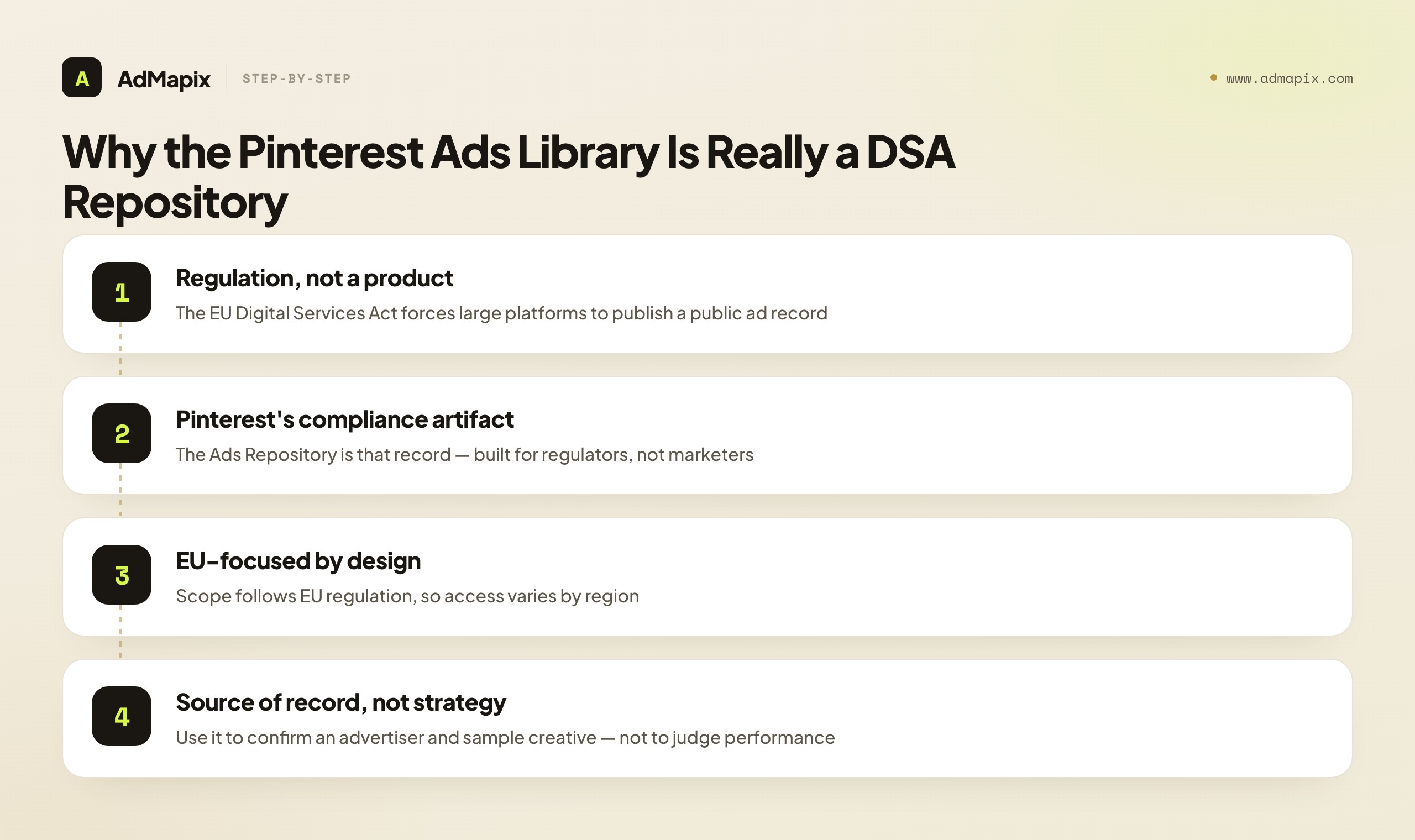
Practically, this means you should treat the repository as an official source of record — a place to confirm that a brand advertises on Pinterest and to see representative creatives — rather than as a competitive-intelligence platform. The mental model that keeps you out of trouble: the repository was designed to make advertisers accountable to regulators, not to make competitors legible to marketers. Those are different goals, and they produce a tool that answers "who paid for this ad, and did it run" cleanly while answering "is this ad working, and should I copy it" not at all.
If you are outside the EU, the repository may not be available to you at all, and you will need another path to study Pinterest advertisers — which is exactly why the back half of this guide covers researching promoted Pins without it. But even inside the EU, the repository is a starting point, not a finish line. It confirms existence and shows creative; everything else — why an ad runs, whether it converts, what to test — you build yourself.
What the Repository Shows vs. What It Doesn't
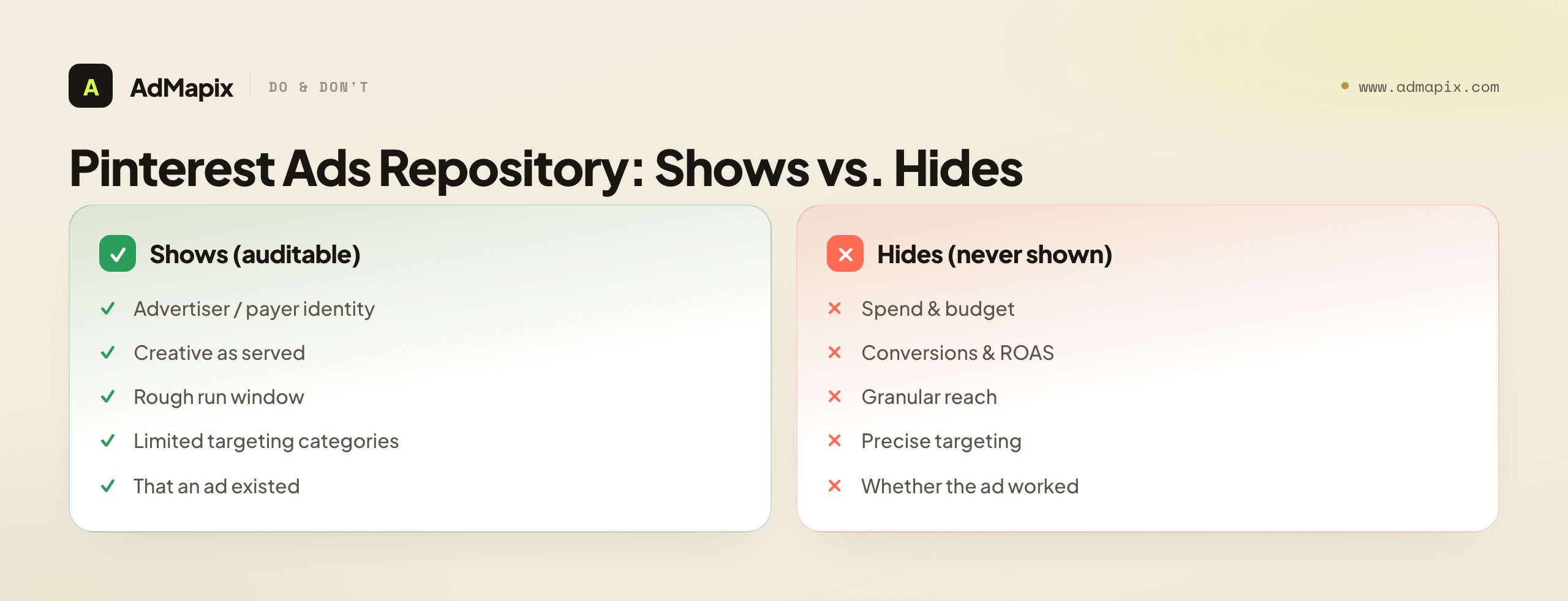
The repository surfaces advertiser identity and creative context, but it deliberately stops short of performance data. DSA transparency is about accountability — who paid for an ad and that it ran — not about helping marketers reverse-engineer winning campaigns. Knowing the boundary precisely keeps you from drawing conclusions the data cannot support.

| Area | Typically available | Not available |
|---|---|---|
| Advertiser / payer identity | Yes — DSA requires disclosure of who paid | — |
| Creative assets (image / video) | Yes — you can view the ad as served | — |
| Rough run dates / period | Yes — transparency records include timing | Exact daily flighting |
| Targeting categories (broad) | Limited, where DSA requires | Precise audience definition |
| Spend | — | Not disclosed; no campaign budget |
| Impressions / reach detail | Limited or aggregate at best | Granular per-ad reach |
| Conversions / results | — | Never — transparency tools do not measure outcomes |
| Marketing filters (hook, offer, funnel) | — | Not a feature; this is a compliance log, not a research UI |
The core limit, stated plainly: a repository proves an ad was shown, not that it worked. Visibility is not performance. Every field in the "available" column is an auditable fact you can put in a brief; every field in the "not available" column is something you must either infer and label as an inference, or obtain from a source other than the repository. Build that distinction into your process and the repository becomes a reliable tool used within its limits; ignore it and you will confidently brief campaigns off data that was never there.
It is worth walking each available field through how you actually use it. Advertiser identity confirms the real paying entity, which matters more than it sounds — it lets you distinguish a brand's own ads from a reseller's, a regional subsidiary's, or an agency running on the brand's behalf, and it is the one thing the DSA guarantees with certainty. The creative as served is your richest element: it carries the visual hook, the Pin format, the offer if shown, and the brand system, all of which you read for strategy. The rough run window is the closest thing to a performance proxy the repository offers — not because it measures anything, but because a creative that ran across a long window is more likely to have been earning its place than one that flickered and vanished. The limited targeting categories, where DSA requires them, give you a coarse confirmation of broad parameter types, useful only as a soft check on what you inferred from the creative.
And it is just as worth being explicit about the missing fields, because the temptation to fill them in from imagination is strong. There is no spend figure, so any euro amount you attach to a competitor's Pinterest activity is invented. There is no conversion or results data, so "this ad clearly worked" is always an inference, never a reading. There is no granular reach, so you cannot size an audience. And there are no marketing-style filters — no "show me all the discount-offer Pins in home decor" — because the repository is a compliance log, not a research UI. Accepting these absences up front is what separates a researcher who uses the repository well from one who quietly fabricates the half the tool never provided.
What Public Ad Data Can and Cannot Prove
This is the section to read twice, because it applies to every public ad-transparency surface, not just Pinterest's. Public ad data proves existence and identity, never effectiveness. The repository can confirm that a specific advertiser ran a specific creative during a window. It cannot tell you the budget behind it, how it converted, who it targeted, or whether the brand kept running it because it performed or simply forgot to pause it.
Treating "this ad is visible" as "this ad is a winner" is the most common analytical error in competitor research, and it is expensive: you scale a "proven" angle that was only ever a guess. The disciplined alternative is to use the repository (and any spy method) to build a candidate list of creatives and advertisers, then use your own testing, landing-page logic, and offer analysis to judge what is worth borrowing.
This matters even more on Pinterest than on platforms with richer transparency, precisely because Pinterest gives you so little. On Meta you can at least lean on impressions ranges and EU spend bands to separate a tested winner from a draft; on Pinterest you have neither, so the gap between "I saw this ad" and "this ad works" is wider and the temptation to fill it with assumption is stronger. The thinner the data, the more disciplined your inference labeling has to be — because there is less to anchor you and more room to fool yourself. A researcher who internalizes that the Pinterest repository is a creative sample, not a performance signal, will consistently out-decide one who treats every visible Pin as a validated play, simply by refusing to act on evidence the surface never actually provided.
There is one soft signal worth mining honestly: repetition and longevity. If a brand runs the same Pin angle across many creatives, or keeps a creative live across a long window, that consistency suggests the angle is working for them — brands rarely keep funding a loser. But "suggests" is the operative word. Repetition is the strongest public signal available on Pinterest, and it is still only a hypothesis to validate with your own product, margin, and test. Treat it as a strong lead, never as a confirmed result, and write it into your brief as the inference it is.
This honesty also protects you in the room where research becomes decisions. The fastest way to lose credibility with a marketing lead is to present "this competitor ad is visible in the repository" as "this competitor is winning with this ad," then watch a copied angle flop. The disciplined alternative is to label every claim by its evidence grade: fact ("Rival ran this creative from March to June, per the repository"), inference ("the long run window suggests it converts"), and hypothesis ("worth testing an adapted version against our own offer"). A stakeholder can act confidently on a fact, weigh an inference, and fund a test off a hypothesis — but only if you have kept the three distinct. Blur them and you are selling a guess as a finding, which is both the most common and the most costly mistake in Pinterest competitor research.
How to Research Pinterest Advertisers Step by Step (Inside the EU)
Start from the official source, then build the context the repository itself will not give you. The repository answers "does this brand advertise here and what did the ad look like"; your workflow has to answer "why, and what should I test."

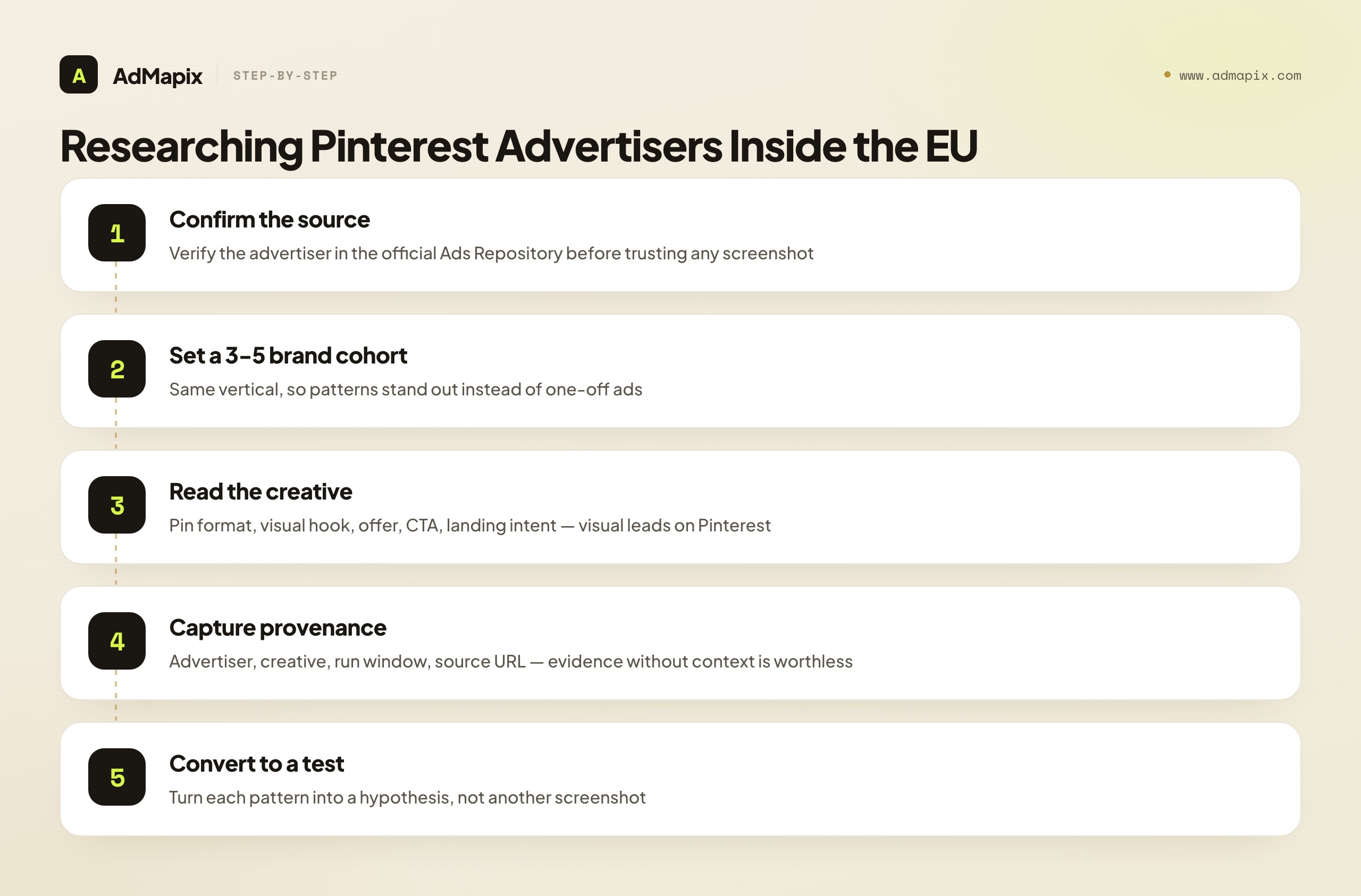
- Confirm the source. Open the official Pinterest Ads Repository and verify the advertiser exists there before trusting any third-party screenshot. The repository is your source of truth; everything else is corroboration.
- Pin down one competitor set. Pick three to five brands in the same vertical so comparisons stay apples-to-apples. A single advertiser's ads look like noise; a category reveals the shared playbook and the open gaps.
- Read the creative, not just the brand. For each ad note the visual format (Idea Pin, standard Pin, video, collection), the visual hook, the offer, the CTA, and the landing intent. On Pinterest the visual carries more signal than the copy — read it accordingly.
- Record source context. Save the advertiser name, the creative, the rough run window, and the source URL. Evidence without provenance is worthless later — an image with no advertiser, date, or URL cannot be defended in a brief three weeks on.
- Cluster by message and offer. Group ads by promise (aspiration, savings, seasonal, how-to), by product category, and by offer (discount, bundle, free shipping, new arrival). The clusters are your competitive map.
- Convert to a test idea. Translate each pattern into a hypothesis: a visual hook to try, an offer to match, a format to produce. Research that never becomes a brief is just a screenshot folder.
How to Research Promoted Pins When the Repository Is Region-Locked
If you are outside the EU — or you need broader coverage than the repository's thin records provide — the official surface is not enough, and you research promoted Pins through other public, legitimate means. This is where the "Pinterest ad spy" question really lives: not in a magic database, but in disciplined observation of what Pinterest shows publicly.

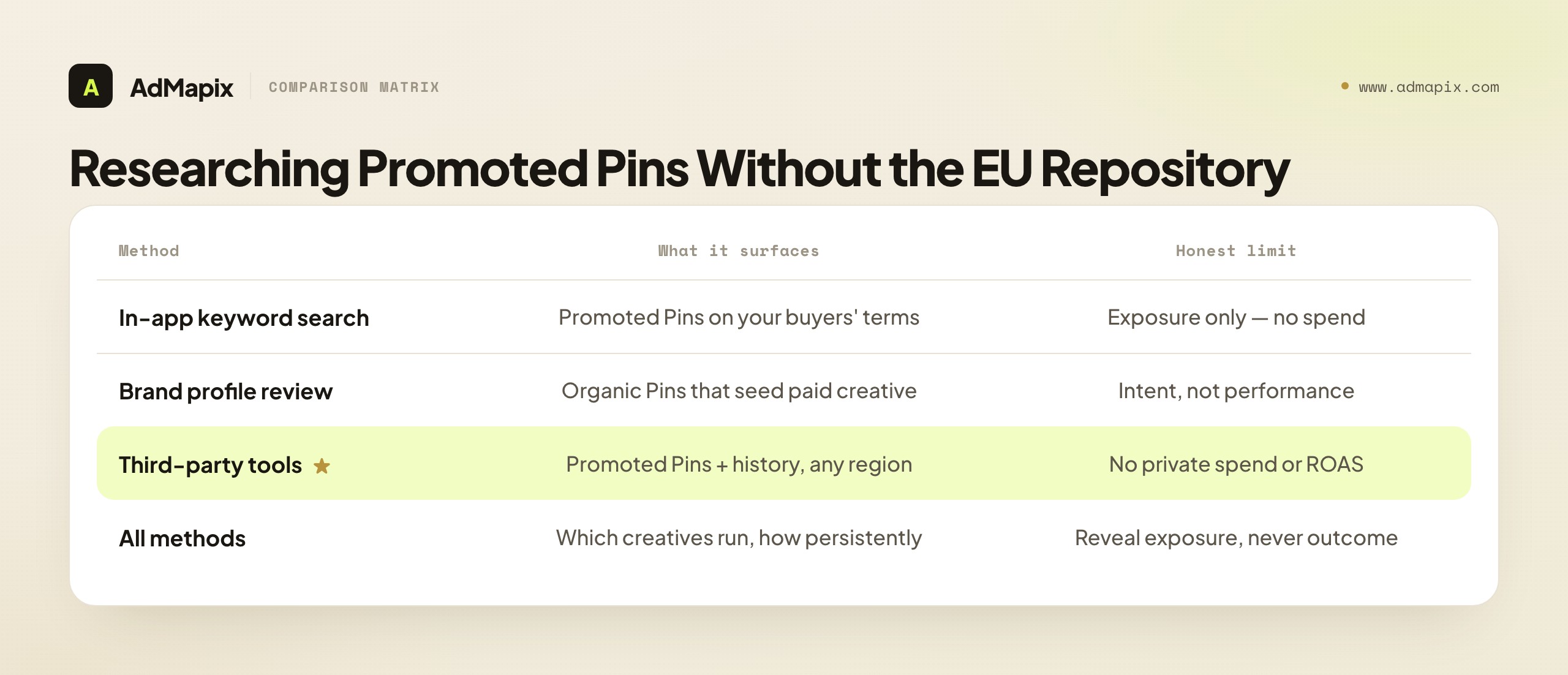
Before the methods, one framing that keeps non-EU research honest: when you cannot reach the official repository, you lose your source of truth and your confirmation of advertiser identity, and you should lower your confidence accordingly. The repository, where it exists, certifies that a given entity paid for a given ad; without it, you are inferring that a promoted Pin belongs to the brand you think it does, which is usually safe but not guaranteed. Note that uncertainty in your records — "advertiser inferred from in-feed promoted Pin, not repository-confirmed" — so a later brief does not overstate what you actually verified. Honesty about the gap is what keeps region-locked research credible rather than speculative.
In-app exposure. Promoted Pins are labeled in the Pinterest feed and search results. Browsing your target categories on a clean account surfaces the promoted creatives competitors are actively running — and because Pinterest is a search-and-discovery platform, searching the keywords your buyers search is a reliable way to make competitor ads appear. Log the advertiser, the creative, the keyword that surfaced it, and the date.
Brand profile and Pin review. A brand's Pinterest profile shows the Pins it is investing in organically, which often overlap with or seed its paid creative. Reviewing a competitor's most-saved and most-recent Pins tells you which visual angles they believe in, which is a useful complement to the promoted creatives you catch in-feed.
Third-party ad-intelligence tools. Cross-network ad-intelligence platforms catalog promoted Pins alongside ads from other networks, give you history the repository lacks, and work regardless of your region. They are the most scalable way to research Pinterest advertisers at volume — with the honest caveat below about what no tool can show.
The honest limit on every method. None of these — in-app, profile review, or third-party tools — reveals spend, conversions, targeting, or ROAS. They reveal exposure: which creatives a competitor is running, on which themes, and how persistently. That is genuinely useful for creative and offer research, and it is all that public Pinterest ad research, by any method, can responsibly claim. Any "Pinterest ad spy tool" promising exact competitor spend is selling a model-based guess dressed as a fact.
Setting up clean in-app reconnaissance
The in-app method deserves a little more rigor, because done carelessly it produces a distorted picture. Pinterest personalizes the feed and search results aggressively based on your account history, so if you research from your own logged-in, heavily-trained account, you will see the ads Pinterest thinks you want — not a representative sample of what competitors are running to your buyers. The fix is to research from a clean or purpose-built account that mirrors your target buyer's interests rather than your own browsing history.
Concretely: build a research account, follow a handful of boards and topics your actual buyer would, and search the exact keywords your buyers use rather than industry jargon. A home-decor buyer searches "small bedroom ideas," not "home decor DTC competitor"; the promoted Pins that surface on the former are the ones competing for your customer. Note the keyword alongside every promoted Pin you capture, because the keyword is itself a signal — it tells you which discovery terms a competitor is willing to pay to appear on, which is the closest thing to a targeting read you can get without account access.
A second discipline: rotate the seasonal and intent terms you search over the weeks, because Pinterest is a planning platform and the promoted creative shifts with the calendar. The wedding-planning terms that surface heavy competitor activity in winter go quiet by late spring; the holiday-decor terms light up months before the holiday itself. Searching a static keyword list once tells you about one moment; rotating it across the season tells you about a competitor's calendar — which, in planning-heavy categories, is often the single most valuable thing to learn.
Where in-app reconnaissance stops and tools take over
In-app observation is excellent for a handful of competitors and a few keywords, but it does not scale and it keeps no history. You cannot manually search fifty buyer keywords every week, you cannot see what a competitor ran three months ago, and you cannot easily compare a Pinterest creative against the same advertiser's Meta or Google ads. The moment your research crosses from "watch three rivals on five keywords" into "monitor a category across many advertisers and keep a record over time," the manual method breaks and a cross-network tool becomes the efficient path. The handoff point is the same one that recurs throughout competitor research: manual works until you need scale, history, and consolidation, and then it doesn't.
Reading Pinterest Creative: Why Pin Format and Visuals Lead
Pinterest is not Meta and it is not LinkedIn. It is a visual-discovery and shopping-intent platform where users actively search for ideas to act on later, which changes what carries signal in an ad. On Pinterest, the visual and the Pin format frequently tell you more about a competitor's strategy than the copy does — the opposite of LinkedIn, where words lead.

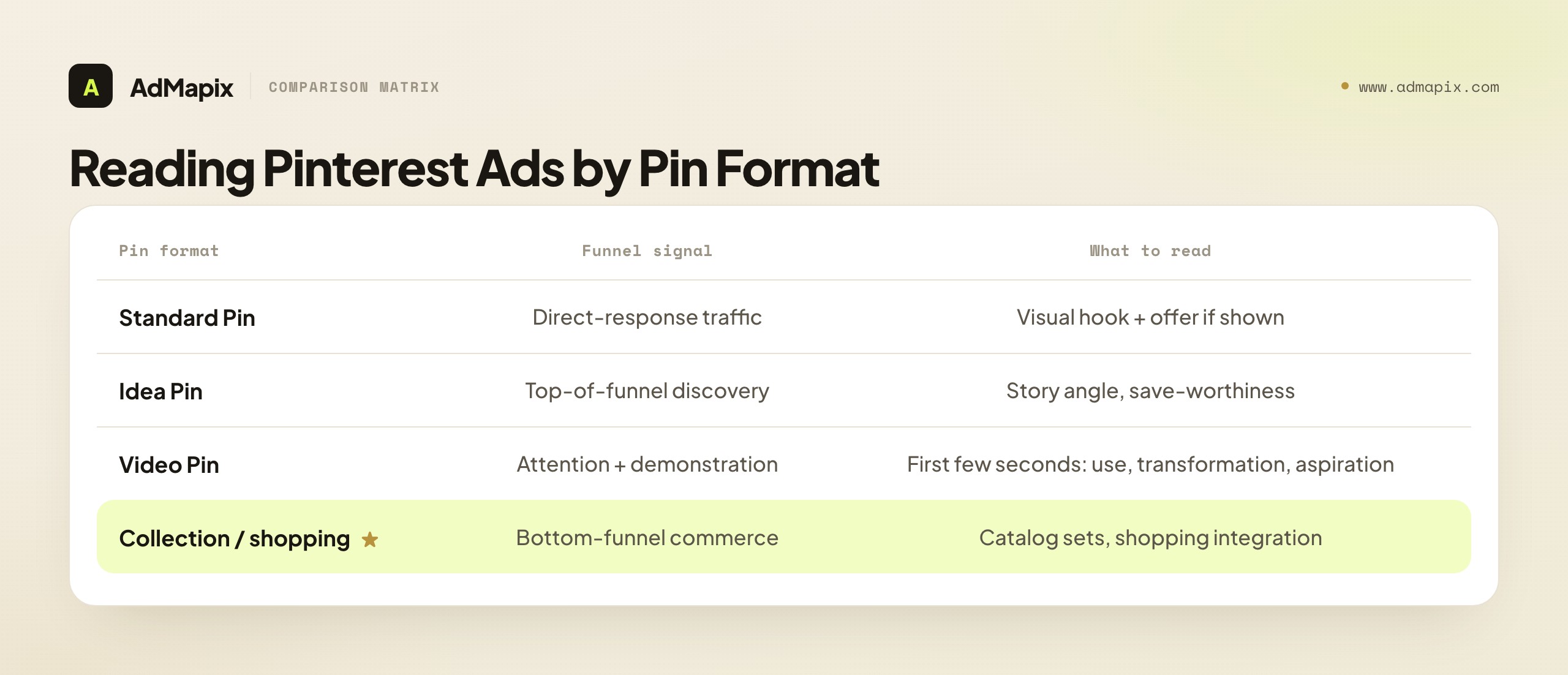
Standard Pins. A single image driving to a product or landing page. Read the visual hook — lifestyle staging vs. product-on-white vs. text-overlay — and the offer if shown. A library full of standard Pins signals a direct-response, traffic-driving motion.
Idea Pins. Multi-page, story-style creative built for engagement and saves rather than an immediate click-out. A brand leaning on Idea Pins is usually investing in top-of-funnel discovery and brand affinity, not this-click conversion.
Video Pins. Motion creative for demonstration and attention. As with any video ad, the first few seconds encode the audience and angle — read whether it leads with product use, transformation, or aspiration. Video is more expensive to produce, so a steady stream of fresh video signals a real content budget.
Collection and shopping Pins. Formats that pull multiple products into one creative or tie directly into Pinterest's shopping surfaces. Their presence signals a competitor running a catalog-driven, commerce-first motion — often the highest-intent, bottom-of-funnel play on the platform.
The strategic read comes from the mix. A competitor heavy on Idea Pins and video is playing the discovery and brand game; one heavy on collection and shopping Pins is harvesting commerce intent. Tally the format distribution across a competitor's visible ads and you have a free read of where in the funnel they are concentrating their Pinterest spend — a read the repository's flat record never spells out for you.
Reading Pinterest Ads by Product Category
The signals worth weighting are not uniform across products, and Pinterest's audience skews toward planning-heavy, visual categories. Adjust what you look for accordingly.
Home, decor, and DIY. Pinterest's heartland. Aspiration and "how-to" lead; the visual staging and the project payoff matter more than price. Weight the lifestyle visual and the save-worthiness of the creative, not just the offer. Seasonality is strong here — read the run window against the calendar.
Fashion and beauty. Look, transformation, and shoppability dominate. Before/after and styling visuals carry weight; collection and shopping Pins signal a commerce-first motion. Weight the visual hook and whether the creative ties into Pinterest's shopping surfaces.
Food and recipes. Highly save-driven and discovery-led. Idea Pins and step-style creative are common; the read is whether a competitor is building affinity (recipes, ideas) or driving a direct product purchase. Weight format choice as the funnel tell.
Weddings, events, and seasonal. Planning-intent categories where Pinterest excels. The run window relative to the season is the dominant signal — a competitor ramping creative three months before a seasonal peak is telegraphing their calendar. Weight timing heavily.
The meta-point: your capture template stays the same — format, visual hook, offer, run window, source — but your weighting shifts by category. Knowing that timing dominates seasonal categories while save-worthiness dominates home and decor is what turns a generic teardown into a brief that fits the product you are about to test.
How the Pinterest Ads Repository Compares to Other Libraries
A competitor researching honestly should know how Pinterest's repository stacks up against the other major transparency surfaces — because the differences tell you which platform to lean on for which question, and just how thin the Pinterest record is by comparison.

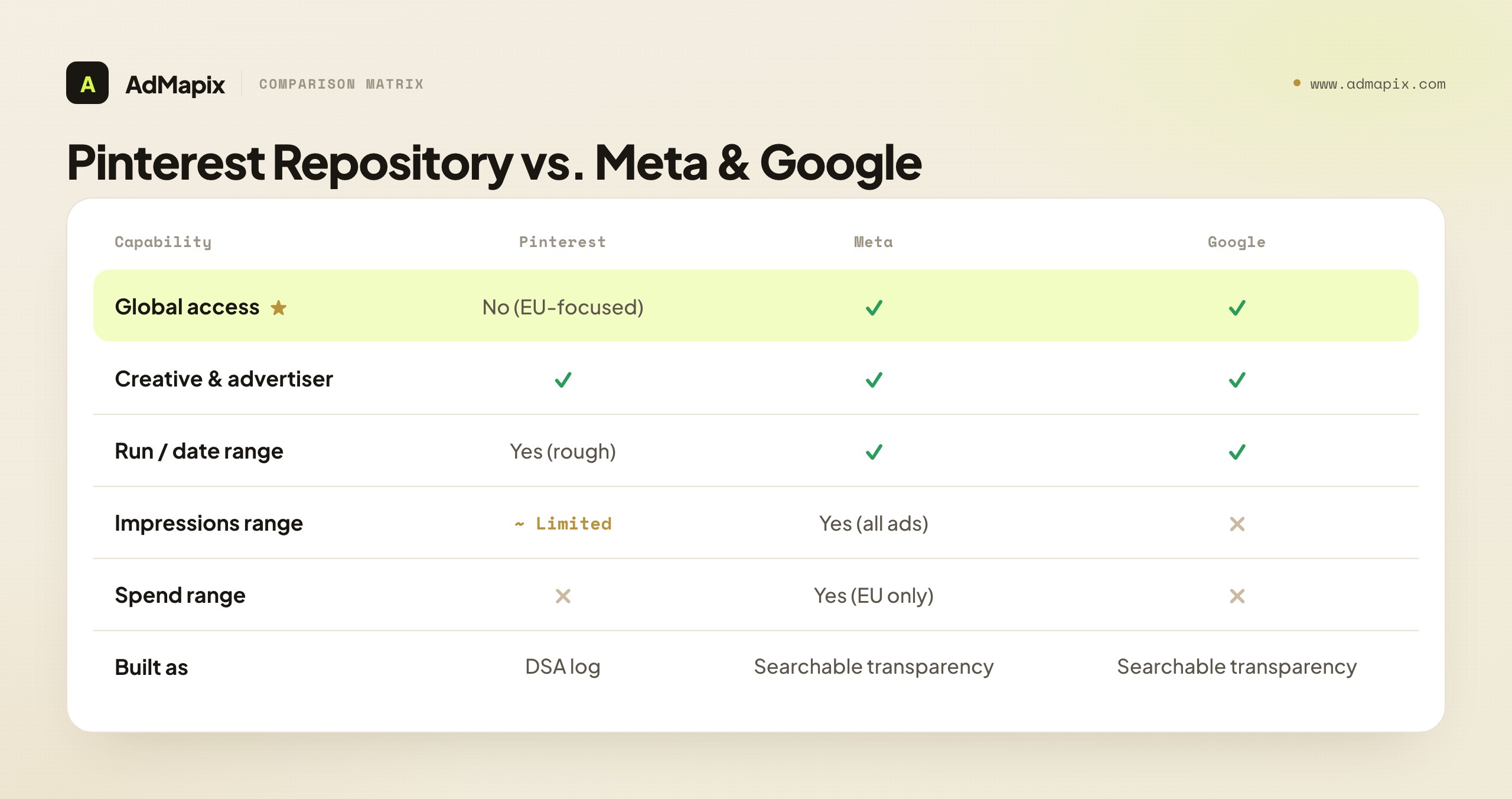
| Capability | Pinterest Ads Repository | Meta Ad Library | Google Ads Transparency Center |
|---|---|---|---|
| Global access | No (EU-focused) | Yes | Yes |
| Login required | No | No | No |
| Creative & advertiser | Yes | Yes | Yes |
| Run / date range | Yes (rough) | Yes | Yes |
| Impressions range | Limited/aggregate | Yes (all ads) | No |
| Spend range | No | Yes (EU only) | No |
| Marketing-style search/filters | No | Partial | Partial |
| Built as | DSA compliance log | Transparency + searchable | Transparency + searchable |
The summary: Pinterest's repository is the narrowest and most region-locked of the major surfaces. Meta's library is global, exposes impressions ranges on every ad, and adds EU spend bands; Google's covers format, region, and date globally. Pinterest's is EU-only and built as a compliance log rather than a research product. That does not make it useless — for confirming an EU advertiser and sampling its creative, it is the authoritative source — but it does mean Pinterest competitor research leans harder on in-app observation and third-party tools than research on any other major platform. Plan for that asymmetry rather than being surprised by it.
There is a practical consequence worth internalizing for cross-network teams. Because Pinterest's surface is the thinnest, it is usually the worst platform on which to start a competitor investigation and one of the best on which to finish one. Start where the data is richest — Meta, where you can read impressions and EU spend bands to size a competitor's magnitude and identify their proven winners — then carry that read into Pinterest to see how the same brand adapts its winning angles to a visual-discovery, planning-intent audience. A DTC advertiser rarely invents a separate strategy per channel; more often they take a core offer and re-skin it for each platform's native format. Reading Meta first tells you the offer and the proven hook; reading Pinterest second tells you how they translate it into Idea Pins and seasonal staging. Using the thin Pinterest surface as the second lens, not the first, is how you extract maximum signal from minimum data.
Third-Party Tools That Fill the Repository's Gaps
The official repository leaves real holes — no global access, no history beyond its thin records, no cross-network view, no video breakdown, no saved evidence, no marketing filters. A category of third-party tools exists to fill exactly those gaps, and knowing what each adds (and what none can do) keeps your expectations honest.

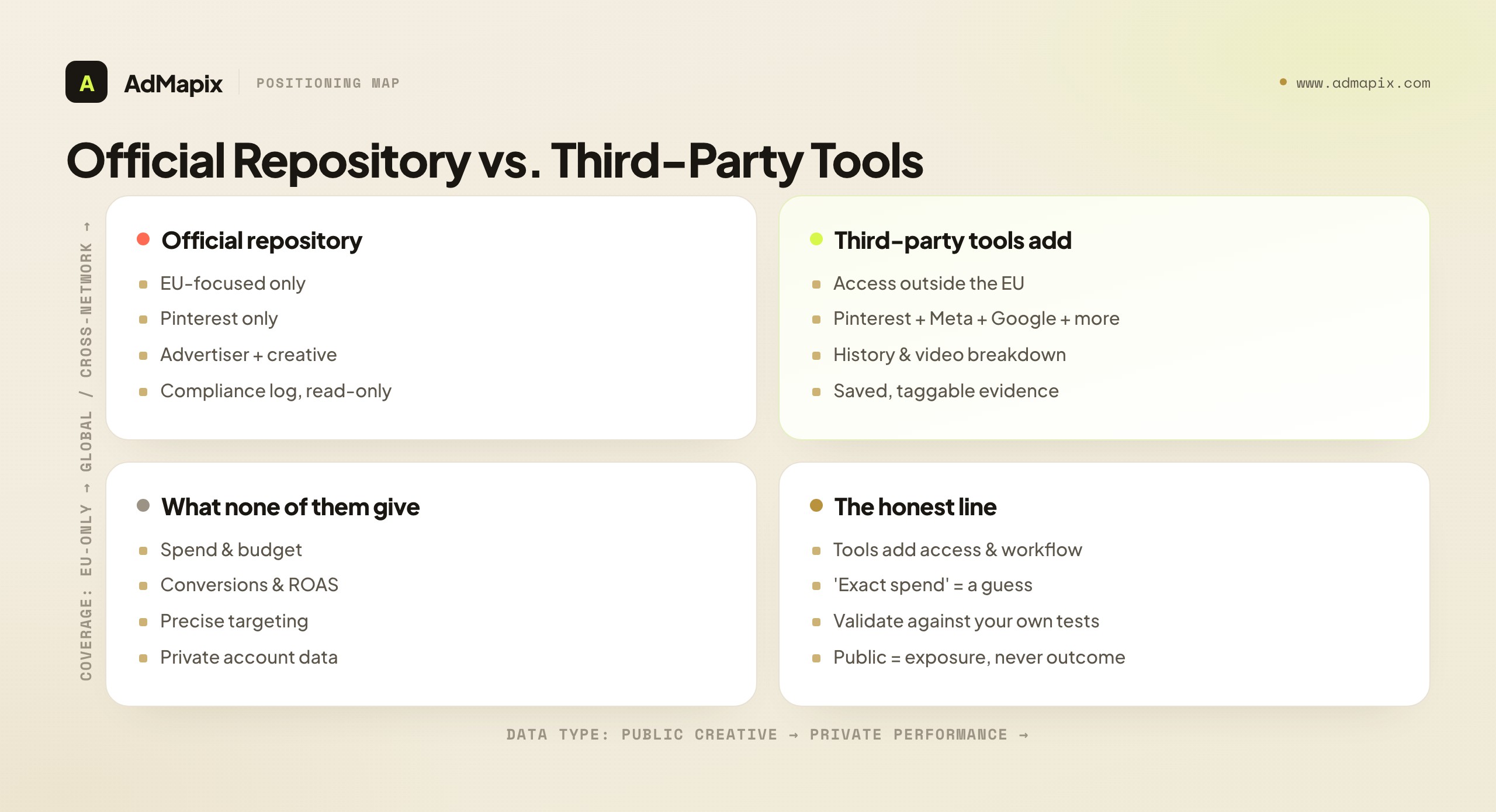
What third-party tools genuinely add:
- Access outside the EU. Because the official repository is region-locked, third-party tools are often the only way for non-EU teams to study Pinterest advertisers at all.
- History. The repository keeps a thin, compliance-oriented record. Tools that snapshot promoted Pins over time let you see how a brand's creative evolved across months.
- Cross-network consolidation. Pinterest is one slice of a DTC advertiser's motion; a cross-network tool puts Pinterest alongside Meta, Google, TikTok, and more in one searchable workspace.
- Video and creative breakdown. On video Pins, the hook and pacing carry the strategy, and a static thumbnail can't show them. Tools that analyze the video surface what a screenshot hides.
- Saved, taggable, reportable evidence. A research library you can search, tag by offer or format, and turn into a shareable report compounds; a folder of screenshots rots.
What no third-party tool can do: unlock the private data. None can see spend, conversions, targeting, or ROAS for Pinterest ads, because that lives in accounts no one outside the advertiser can reach. The structural value of a third-party layer is access, history, consolidation, breakdown, and workflow — not magical visibility into private numbers. Any "Pinterest ad spy tool" claiming to reveal exact competitor spend is overstating what is possible, and you should treat that output as a guess.
Common Mistakes With Pinterest Ad Research
Most wasted research traces back to a handful of repeatable errors. Naming them is the cheapest way to avoid them.

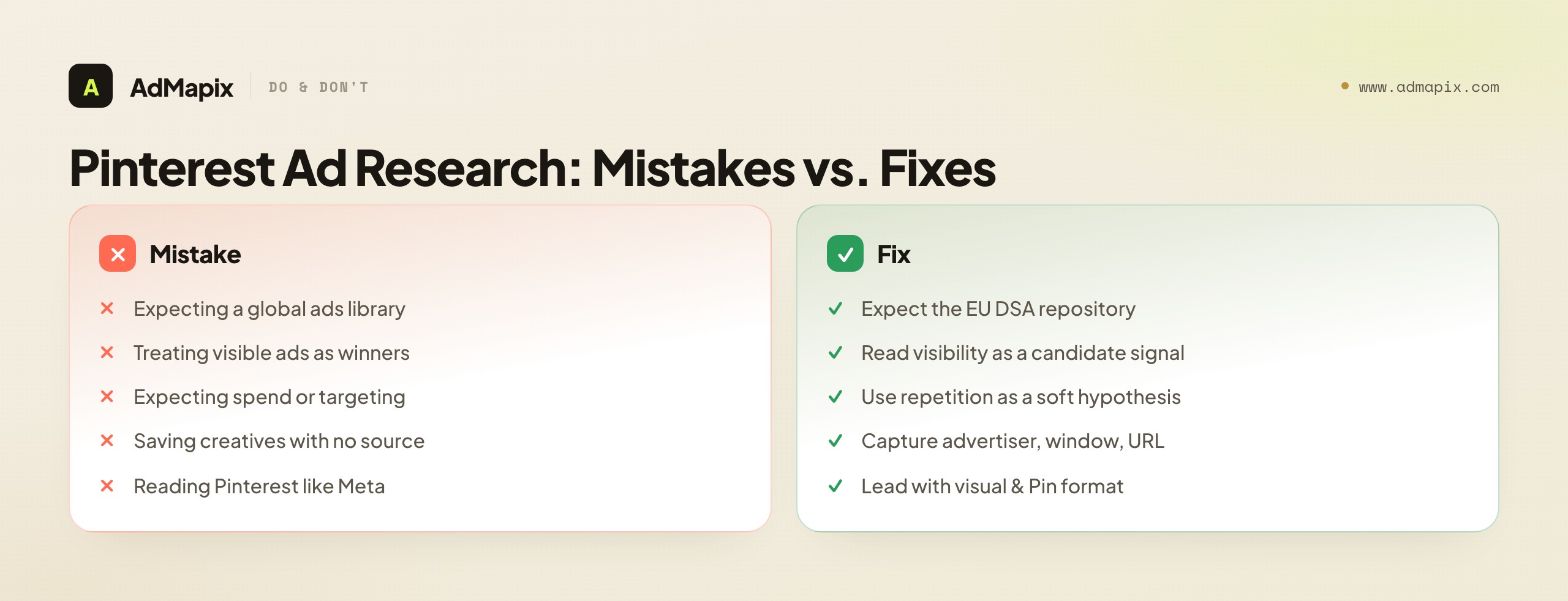
- Assuming there is a global Pinterest Ads Library. There isn't — it is an EU DSA repository, and access depends on your region. Plan your method around that reality.
- Treating visible ads as proven winners. The repository shows that an ad ran, not that it converted. Read visibility as a candidate signal, never as performance proof.
- Expecting spend or targeting data. DSA transparency discloses the payer, not the budget or the audience. No public Pinterest surface exposes spend.
- Saving creatives without source context. Drop the advertiser, run window, and URL and your evidence can't be defended in a brief or a client report.
- Relying on unofficial scrapers without a fallback. Unofficial endpoints break or get blocked; always keep the official repository (where available) as your source of truth.
- Reading Pinterest like Meta. Pinterest is visual-discovery and shopping-intent — weight the visual and the Pin format, not the copy, and account for its planning-heavy seasonality.
- Stopping at collection. If findings never become a test plan or report, the research produced nothing. End every session with a hypothesis.
A Repeatable Weekly Pinterest Research Loop
A one-time look is competitive guessing. A standing loop is competitive intelligence. Here is a concrete weekly rhythm a DTC or ecommerce team can run, blending the official repository (where available) with in-app and third-party methods.

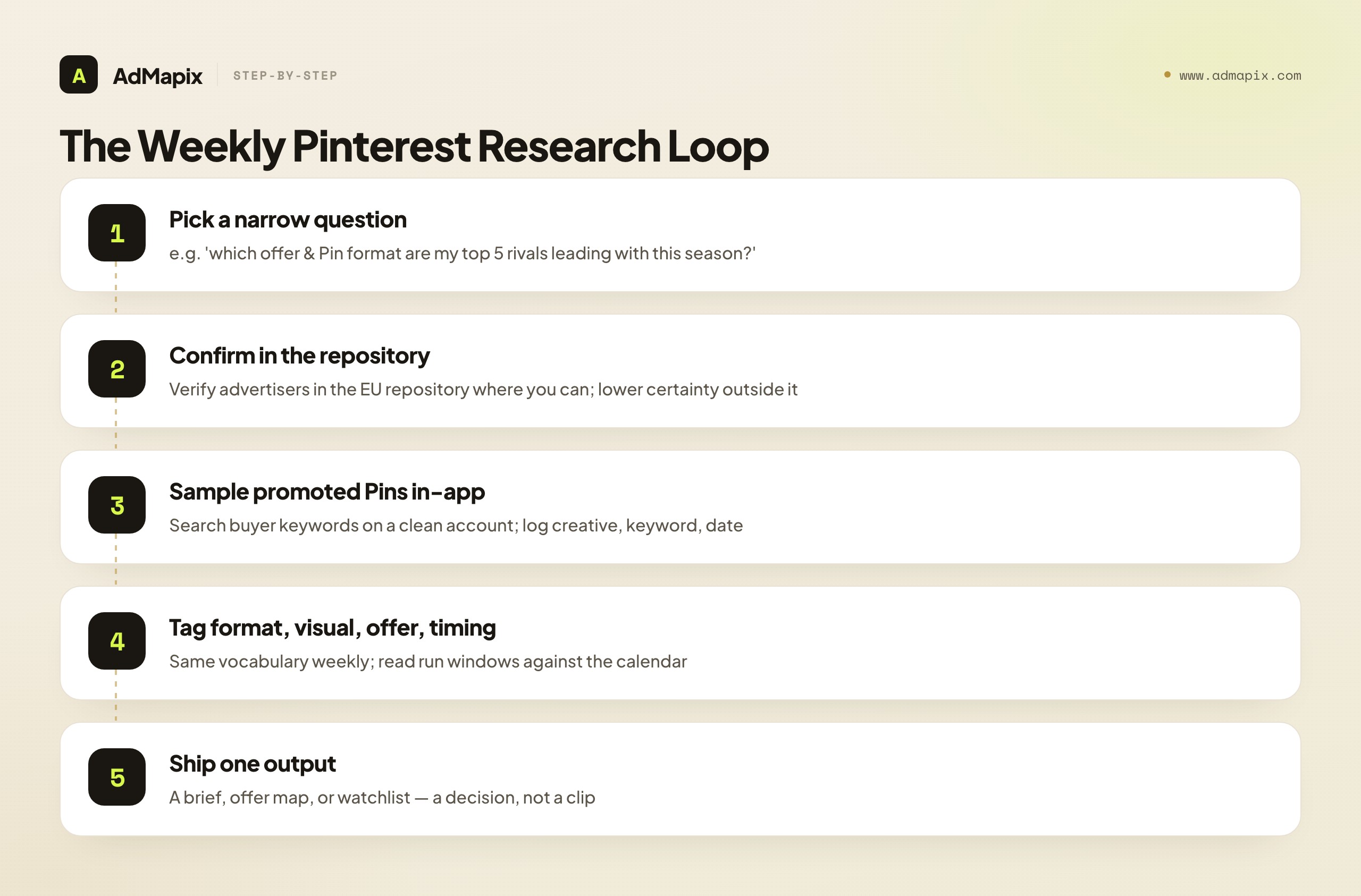
- Pick one narrow question. Not "what are competitors doing on Pinterest," but "in home decor, which offer and Pin format are my top five rivals leading with this season?" A question you can answer in a session is worth asking.
- Confirm advertisers in the repository where you can. Inside the EU, verify each competitor in the official Ads Repository as your source of truth. Outside it, note that you are relying on in-app and third-party evidence and lower your certainty accordingly.
- Sample promoted Pins in-app. Search your buyers' keywords on a clean account and log the promoted creatives that surface, with the keyword and date.
- Read format, visual, and offer. Tag each ad by Pin format, visual hook, offer, and run window — the same vocabulary every week, so you can sort and count.
- Mine repetition and timing. Flag the angles that repeat across creatives or persist across the window, and read run windows against the seasonal calendar.
- Ship one output. End with a creative brief, an offer map, or a watchlist update — a decision, not a clip. If the session does not change a test plan, tighten the question.
Run that loop weekly and three things compound: you build a longitudinal read of how a category's visuals, offers, and timing shift, you train yourself to separate facts from inferences, and you keep a steady stream of testable hypotheses flowing into your own Pinterest campaigns.
A Worked Walkthrough: Researching One Pinterest Advertiser
Principles land harder applied. Here is a composite walkthrough of researching one competitor — a mid-market home-decor DTC brand, call it "Rival Decor" — that you study because it shares your buyer and your seasonal calendar.
Confirm and sample. Inside the EU you open the Ads Repository, confirm Rival Decor advertises on Pinterest, and view its representative creatives. Outside the EU you instead search your category keywords in-app on a clean account and log the promoted Pins that surface. Either way, you start from verified existence and real creatives, not a third-party screenshot.
Read the format mix. Rival Decor's visible ads skew toward Idea Pins and video, with a handful of collection Pins. That distribution tells a coherent story before you read a single caption: they are playing the discovery and brand-affinity game at the top of the funnel, with a smaller commerce-first collection layer at the bottom. They are not running a pure direct-response motion — they are building saves and seasonal demand.
Read the visuals and cluster. The Idea Pins all stage products in aspirational room scenes ("refresh your space for autumn"); the collection Pins pull seasonal product sets with a visible discount. The clusters draw the map: their positioning leads with seasonal aspiration, their offer is a discount surfaced only at the commerce layer, and their visual system is lifestyle-staged rather than product-on-white.
Read the timing. This is the decisive read for a seasonal category. Their video and Idea Pin volume ramped sharply about ten weeks before the autumn peak. That run-window-against-calendar pattern telegraphs their seasonal playbook: build discovery and saves early, then convert with collection Pins and a discount as the season lands.
Ship one output. You write a one-paragraph brief: "Rival Decor runs a seasonal Pinterest motion — top-of-funnel Idea Pins and video staging aspirational autumn scenes, ramping ~10 weeks pre-peak, converting via collection Pins with a discount at the bottom. Hypothesis to test: an aspirational seasonal Idea Pin series for our own ICP, launched early in the season, against our current product-on-white standard Pins." That brief — built from public, legitimate observation, every inference labeled — is the difference between research and a screenshot pile. None of it required a number Pinterest hides.
Design the test so the result is interpretable. The cardinal rule is to vary one element at a time. Rival Decor's apparent winning system pairs an aspirational-staging visual with an early-season launch and a bottom-funnel discount — but if you launch a test that changes your visual style, your timing, and your offer all at once, a win or loss tells you nothing about which lever moved it. Test the aspirational-staging Idea Pin against your current standard Pin first, holding timing and offer constant; then, separately, test the early-season launch timing against your usual cadence. And set the success bar against your economics, not Rival Decor's apparent momentum: a discount that drives their conversions can erode all of your margin if your cost structure is thinner. The competitor's public creative tells you what is possible in the category; only your own numbers tell you what is profitable for you.
When to Use AdMapix
Use AdMapix when the Pinterest Ads Repository is too narrow, too regional, or too read-only for ongoing creative work — and you want one place to research, save, analyze, and report across networks. AdMapix is a cross-network ad creative search and intelligence tool: you can find competitor creatives, save the strongest examples as media, break down videos, tag patterns, and turn findings into shareable reports.

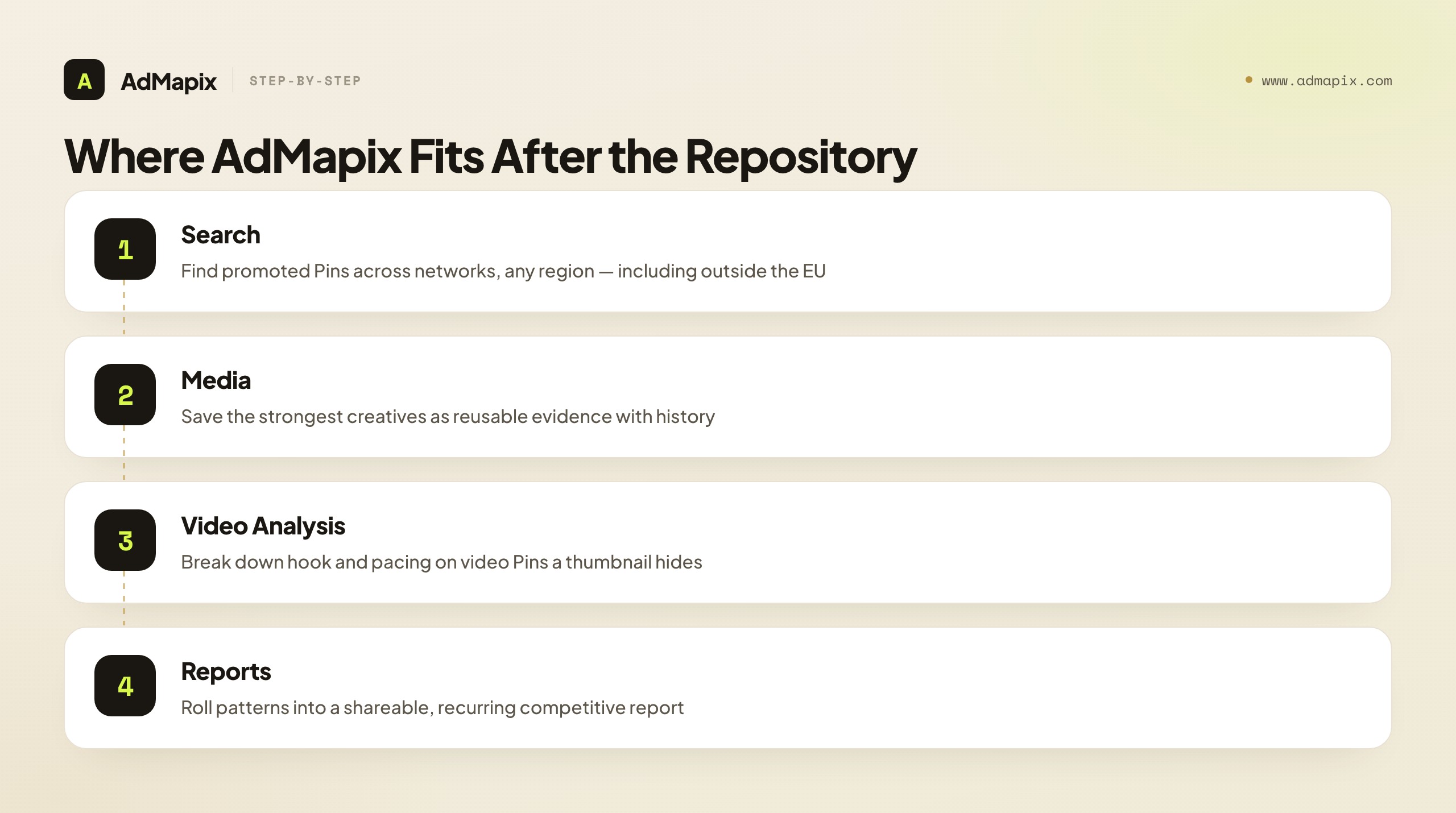
It directly fills the gaps the official repository leaves: access outside the EU (so non-EU teams can study Pinterest advertisers at all), history (so a brand's creative evolution is captured, not lost to a thin compliance record), cross-network consolidation (Pinterest alongside Meta, Google, TikTok, and more in one workspace), video and creative breakdown (so the hook and pacing of a video Pin are captured, not just a thumbnail), and saved, taggable, reportable evidence (so research compounds instead of rotting). The cross-network angle matters because a DTC advertiser rarely runs Pinterest in isolation, and seeing the coordinated motion across networks tells you more than any single-platform record.
This is for ecommerce and DTC teams, agencies, and creative strategists who study competitors weekly and need that work to compound. It is not for someone who just needs a one-time, official DSA disclosure check on a single advertiser — for that, the repository alone is enough. And it does not claim to reveal private spend, conversions, or targeting that no public tool can honestly show. A practical flow: run a competitor set in Search AdMapix, store the best creatives in Media, break down the videos in Video Analysis, and package the patterns into Reports. When the workflow saves real briefing time, create an account from Login or compare seats on Pricing.
Putting It Together: The Repository as a Source Check, Not a Strategy
The whole guide reduces to a simple frame: the Pinterest Ads Repository is a region-locked source of record that does one job well — it confirms, for EU advertisers, who paid for an ad and what it looked like. That is genuinely valuable as a starting check. But because it is EU-only and built as a compliance log rather than a research product, Pinterest competitor research depends more than any other platform on in-app observation and third-party tools to do the actual intelligence work.
So treat the repository as your source check, read Pinterest creative the way the platform demands — visual-first, format-aware, season-conscious — mine repetition and timing for soft signal, and label every performance claim as the inference it is. When you need access outside the EU, history, cross-network coverage, video breakdown, or a reportable evidence trail, layer a tool on top. And whatever any method suggests, validate it against your own testing and offer logic before it touches a budget line. Do that consistently and Pinterest stops being the platform with "no ads library" and becomes a research surface you can read as well as any other — within its honest limits.
FAQ
Does Pinterest have a public ads library?
Not a global one. Pinterest operates an Ads Repository built to meet the EU Digital Services Act, so it functions like an ads library but its availability is EU-focused rather than worldwide. Outside the EU you may not be able to access it, and you will need other methods — in-app observation of promoted Pins, brand-profile review, and third-party ad-intelligence tools — to study Pinterest advertisers.
What can I see in the Pinterest Ads Repository?
You can typically see the advertiser or payer identity, the creative as it was served, and a rough run period. You cannot see spend, conversions, granular impressions, or precise targeting. It is a transparency record, so it proves an ad existed — not that it performed. Read it as a source check and a creative sample, not a performance dashboard.
Why is access limited to the EU?
Because the repository is a Digital Services Act compliance product. The DSA requires large platforms to publish a public record of the ads they run for EU users. Pinterest built the repository to satisfy that obligation, which is why its scope follows EU regulation rather than global marketing demand. There is no equivalent global Pinterest ads library at this time.
How do I research Pinterest ads if I'm outside the EU?
Use public, legitimate methods other than the region-locked repository: browse your buyers' keywords on a clean Pinterest account to surface labeled promoted Pins, review competitors' Pinterest profiles and most-saved Pins, and use cross-network ad-intelligence tools that catalog promoted Pins regardless of region. All of these reveal which creatives competitors run and how persistently — but none reveal spend, conversions, or targeting.
Is there a Pinterest ad spy tool that shows competitor spend?
No honest one. Neither the official repository nor any third-party tool can show a competitor's actual Pinterest ad spend, because that data lives in an account you cannot access. The strongest public signal is repetition and run-window longevity — a persistent angle is probably working — but that is an inference, not a spend figure. Any tool promising exact Pinterest spend is selling a model-based guess.
How is the Pinterest repository different from the Meta Ad Library?
The Meta Ad Library is global, requires no login, shows an impressions range on every ad worldwide, and adds EU spend bands and reach. Pinterest's repository is EU-focused, built as a DSA compliance log, and exposes advertiser, creative, and a rough run window without spend or performance. Meta's is a richer, global research surface; Pinterest's is a narrower, region-locked source of record.
What should I capture from each Pinterest ad I research?
Capture the advertiser, the creative, the Pin format (Idea, standard, video, collection), the visual hook, the offer, the rough run window, and the source URL — plus, for in-app finds, the keyword that surfaced the promoted Pin. Provenance is what makes an example comparable next month and defensible in a brief. Tag by format, offer, and category so a folder becomes a sortable dataset.
How should I read Pinterest creative differently from other platforms?
Lead with the visual and the Pin format rather than the copy, because Pinterest is a visual-discovery and shopping-intent platform. Read the format mix as a funnel signal (Idea Pins and video for discovery; collection and shopping Pins for commerce), weight save-worthiness in home and decor, and read run windows against the seasonal calendar in planning-heavy categories like weddings, holidays, and home.
Can I use the repository for competitor analysis?
Partly. It is good for confirming an advertiser runs on Pinterest and for collecting representative creatives within the EU. It is not enough for performance analysis, spend estimates, cross-network coverage, or a repeatable reporting workflow, because it discloses identity and creative context, not results. Pair it with in-app observation and a dedicated tool for ongoing competitive intelligence.
Where does AdMapix fit alongside the repository?
AdMapix fits after the source check. Use the repository (where available) to confirm and sample what a brand is officially running, then use AdMapix to search across networks, save creatives, analyze videos, tag patterns, and produce recurring reports — and to study Pinterest advertisers at all when you are outside the EU. The repository is the official first look; AdMapix is the recurring research layer the compliance log was never designed to be. It does not claim to reveal private spend or performance.
Key Takeaways
- Search "Pinterest Ads Library" but expect the Ads Repository — a DSA transparency tool that is EU-focused, not a global research database.
- Read it as proof an ad ran, never proof an ad won — it exposes advertiser, creative, and a rough run window, never spend, conversions, or targeting.
- Outside the EU, research promoted Pins through in-app keyword search, brand-profile review, and third-party tools — all of which reveal exposure, not performance.
- Read Pinterest creative visual-first and format-aware, and read run windows against the seasonal calendar in planning-heavy categories.
- Capture advertiser, creative, Pin format, offer, run window, and source URL together, and validate every borrowed idea against your own testing before spending.
Related Reading
- Facebook Ads Library 2026: Official URL, Filters & Competitor Ads Guide — the equivalent deep dive for Meta's far more data-rich, global library.
- LinkedIn Ads Library in 2026: How to Find Competitor Ads and What It Shows — the B2B counterpart, with the same transparency-vs-performance boundary.
- Ad Spy Tools by Channel: Meta, TikTok, Google, YouTube, Native — how the transparency surfaces and tools compare across platforms.
- Competitor Ad Analysis in 2026: The 5-Dimension Framework, Templates & SOP — a general structure for turning rival ads into testable briefs.
- How to Spy on Competitors' Ads in 2026 (30-Min/Week Workflow) — the cross-channel weekly workflow Pinterest research plugs into.
Sources
Official sources checked as of June 21, 2026. Platform transparency products, API access, and regional availability can change, so verify the current access path before building a workflow.
- Pinterest Ads Repository — Pinterest's public ad-transparency surface.
- Pinterest Ads — the official entry point for Pinterest advertising and business-account campaigns.
- Pinterest Business Community: Ads Repository note — states the repository is currently available for EU countries and was introduced for the EU Digital Services Act.
- Pinterest Digital Services Act help — explains Pinterest's EU transparency and accountability obligations.
- EU Digital Services Act overview — the regulation behind Pinterest's ad repository.
See what competitors are really running
Search 6M+ ad creatives, landing pages, and weekly spend across 200+ countries. No credit card, no commitment.
Related Articles
Ad Hook Examples in 2026: 7 First-3-Second Patterns (with UGC Breakdowns)
A complete 2026 library of ad hook examples organized into seven repeatable patterns — problem, proof, objection, comparison, curiosity, offer, and transformation — with UGC hook breakdowns, platform-by-platform differences for TikTok, Meta, and YouTube, an industry-by-industry hook map, a hook-testing workflow that ships variants, the metrics that actually grade a hook, and a worked teardown that turns a competitor opener into a running test.
Outbrain Ad Spy Tool in 2026: Native Ad Research for the Open Web
How to research Outbrain native ads from public evidence in 2026 — what a spy tool can and cannot prove, how to decode headline-and-thumbnail hooks, advertorial landing paths, retargeting trails, and how to turn patterns into testable native campaigns.
Agency Ad Intelligence Tools in 2026: Turning Competitor Research Into Client Reports
A 2026 guide to ad intelligence for agencies — how to standardize competitor research across a client portfolio, the fixed capture field list and weekly workflow that survive staff turnover, how to structure a recurring client report, white-label and deliverable considerations, using competitor research to win new business and prove retainer value, the cross-client pattern advantage only agencies have, team roles and scaling, packaging research as a billable service, and the public-data.