Paid Social Intelligence Tools (2026): Build a Five-Layer Stack That Improves Decisions
A practical 2026 guide to paid social intelligence tools — the five-layer stack (official libraries, search, creative, reporting, decision) that turns competitor ads into briefs, tests, and budget moves; what public ad data can and cannot prove; how to judge each tool by the decision it improves this week; and a repeatable weekly workflow across Meta, TikTok, and Google.
Paid Social Intelligence Tools (2026): Build a Five-Layer Stack That Improves Decisions
Updated June 21, 2026 — written and reviewed by the AdMapix Research team.
Paid social intelligence tools are software that helps teams study competitor ads, creative patterns, and platform activity across paid social channels like Meta, TikTok, and Google. The trap almost every team falls into is shopping for the tool with the largest database, as if more ads automatically meant more insight. It does not. The best paid social intelligence stack is not the one with the most creatives indexed — it is the one that reliably gets you from "here is a competitor ad" to "here is the brief, the test, or the budget move we are making this week." This guide is for paid social teams, agencies, DTC and app marketers, and founders who want a repeatable competitor-intelligence workflow rather than another folder of screenshots nobody revisits. Read it alongside our best ad intelligence tools overview, the advertising intelligence guide, and the competitor ad analysis framework — together they map the wider discipline this stack sits inside.
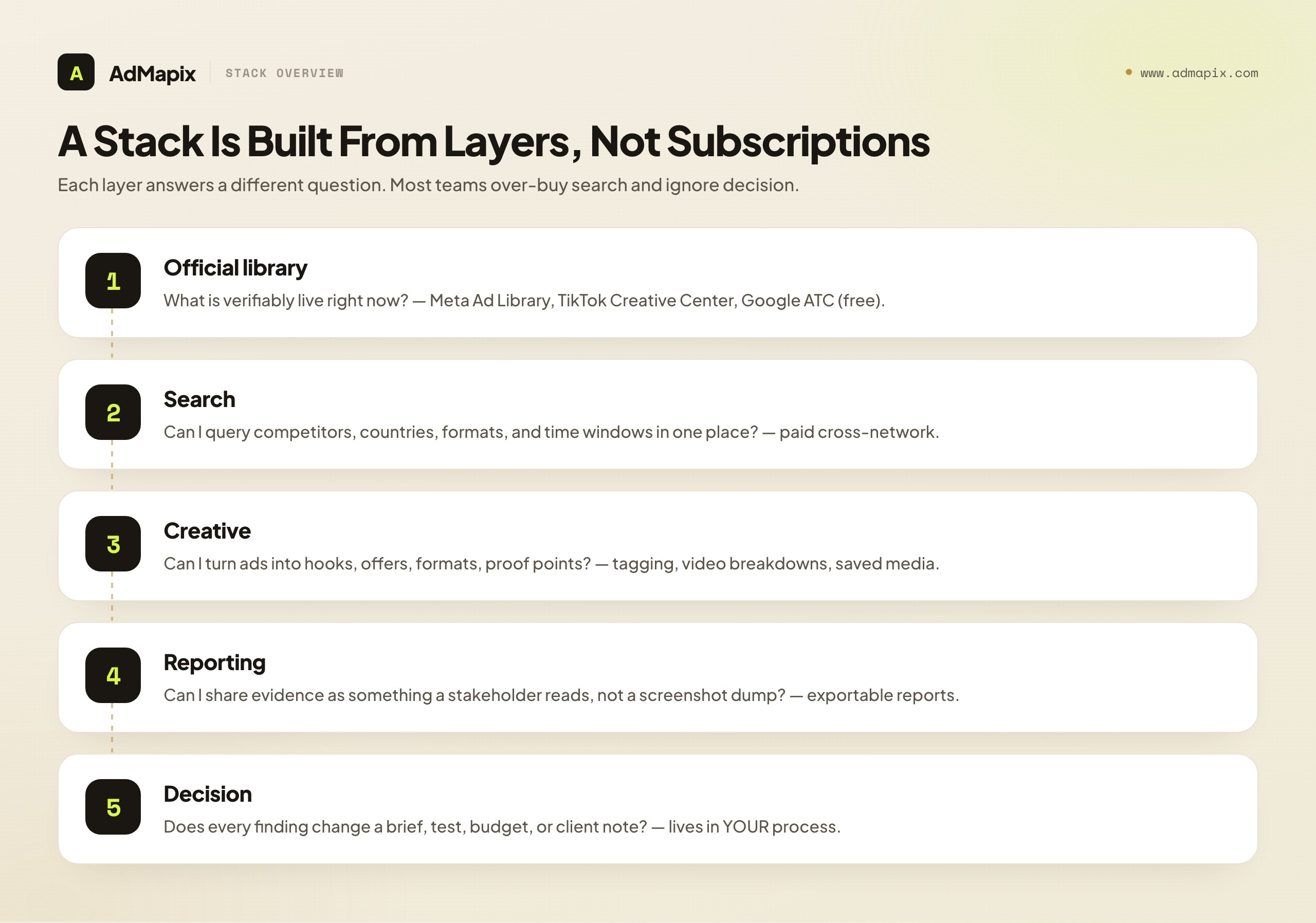
The organizing idea of this entire guide is that a paid social intelligence stack is built from layers, not subscriptions. Each layer answers a different question, and the single most common, most expensive mistake teams make is over-buying on the search layer — the one that finds ads — while completely neglecting the decision layer, the one that turns a finding into an action. A team can have the deepest ad database in the world and still ship nothing, because evidence that does not change a decision is just expensive browsing. We will walk through all five layers, show you what public ad data can and cannot prove, and give you a weekly workflow that makes the stack compound instead of gather dust. One honesty note up front, applied throughout: AdMapix is our product, and it lives in this stack as the cross-network evidence layer — searchable ad creatives, saved media, video analysis, recurring reports. It does not, and cannot, show competitor spend, ROAS, impressions, or targeting, because that data is not public. We will say so wherever it matters.
TL;DR — The Paid Social Intelligence Stack in One Screen
- A stack is built from layers, not subscriptions. The five layers are official libraries, search, creative, reporting, and decision — each answers a different question, and most teams over-buy on search while ignoring decision.
- Start with the free official ad libraries — Meta Ad Library, TikTok Creative Center, Google Ads Transparency Center — to confirm what is verifiably live, then add paid tools only where manual review breaks down.
- Judge every tool by the decision it improves this week — a brief, a test, a budget move, a client note — not by the size of its database. If a layer does not change a decision, it is a cost, not an asset.
- Public ad data shows what advertisers chose to run, not whether it worked. Competitor ads are hypotheses; longevity is a soft proxy for "probably profitable," never a guarantee.
- No paid social intelligence tool shows competitor spend, ROAS, CPA, or targeting — that data is not public. Any "spend estimate" is a model, not a fact. Validate every pattern in your own analytics.
- AdMapix fits the cross-network evidence layer: search ads across markets, save media, analyze video creatives, and turn patterns into reports. It does not show spend or performance.
- Run the stack as a weekly loop, not an ad-hoc lookup — that is the difference between a discipline that compounds and a drawer of half-used subscriptions.
- Shape the stack to your channel mix: Meta has the deepest free verification layer, TikTok's Creative Center surfaces trends early (so the weekly cadence matters more), and Google's Ads Transparency Center connects a competitor's YouTube footprint to the rest — no single library is the whole picture.
- The highest-ROI fix is rarely a new subscription. Most teams over-pay to find ads and under-invest in deciding; a free, disciplined decision-layer ritual usually beats a bigger search tool. Run the one-hour audit quarterly and make one concrete change each time.
What Public Ad Data Can and Cannot Prove
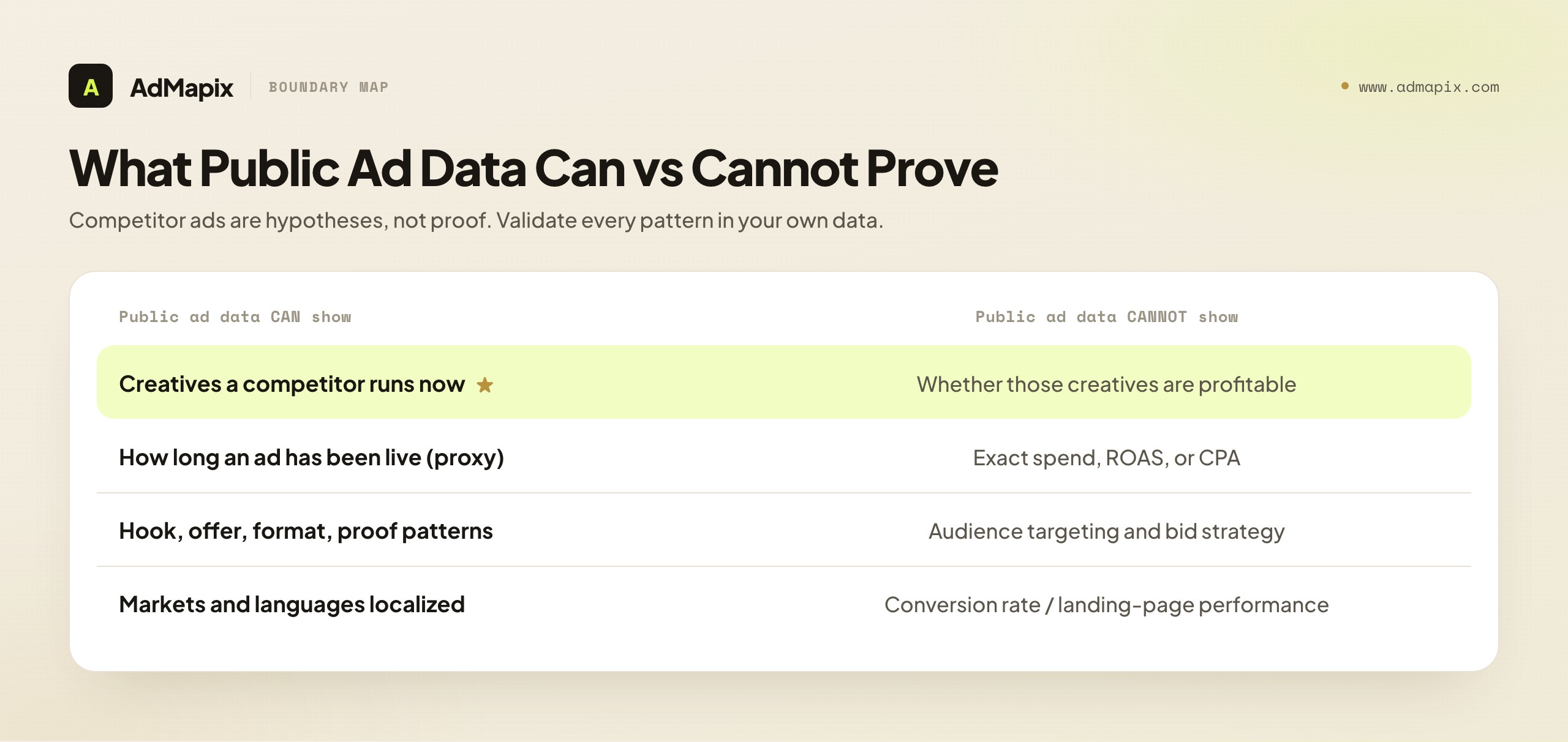
Before you buy a single tool, internalize the boundary that defines this entire category, because building on the wrong side of it is how teams waste budget. Competitor ads are hypotheses, not proof of performance. Public intelligence tools show you what an advertiser chose to run and, in some libraries, roughly how long it has been active. That is genuinely enough to spot a repeating hook, a new offer, or a format shift — real, actionable signal. It is not enough to know whether the ad actually converted, and no tool can change that, because the data simply is not public.
Here is the line, drawn precisely. Public ad data can show you which creatives a competitor is currently running, how long an ad has been live (longevity as a soft proxy for performance), the hook/offer/format/proof-point patterns across their creatives, and which markets and languages an advertiser localizes for. That is a rich, useful picture of a competitor's creative strategy. Public ad data cannot show you whether those creatives are profitable, the exact spend, ROAS, or CPA, the audience targeting and bid strategy, or the conversion rate and landing-page performance. Those are private numbers that live inside the advertiser's own ad account and analytics, and nothing on a public transparency surface exposes them.
The practical rule that follows is the one experienced operators run on: an ad that has been live for several weeks is a stronger signal than one that launched yesterday, because advertisers tend to kill losers fast and keep winners running. So longevity is a useful proxy — but it is a proxy, not a guarantee. A long-running ad could be a brand-awareness play, a poorly-managed account, or an ad sustained by factors you cannot see. Treat longevity as a tie-breaker among candidates, never as a verdict, and validate every pattern against your own ad, store, and CRM data before you scale spend behind it.
This boundary is also why we are blunt about AdMapix's own limits. AdMapix shows cross-network creative evidence — the ads, their formats, their longevity, structured video breakdowns — and it cannot show you a competitor's spend, ROAS, or targeting, because that is not public. Any tool in this category that implies it can reveal a competitor's true spend is selling a model as if it were a measurement. Read the label on every number; if it is an estimate, treat it as a hypothesis, and confirm the truth in your own analytics.
The Five Layers of a Paid Social Intelligence Stack
A good stack stacks layers, and each layer answers a distinct question. The reason this framing matters so much is that it stops you buying five tools for one job and ignoring four jobs entirely. Walk down the layers and locate, honestly, where your own process breaks.
Layer 1 — Official library: "What is verifiably live right now?" This layer is free and authoritative, and it is where every workflow should start. The Meta Ad Library, the TikTok Creative Center, and the Google Ads Transparency Center are the platforms' own surfaces showing what advertisers are running. For confirming whether a specific competitor is live with a specific creative, this is ground truth, and you should never pay for what these give you for free.
Layer 2 — Search: "Can I query competitors, countries, formats, and time windows in one place?" The official libraries are excellent at verification and poor at proactive, cross-network discovery. The search layer — paid cross-network tools like AdMapix — solves the problem the free libraries cannot: querying across Meta, TikTok, and beyond at once, by competitor, market, format, and time window. You add this layer when manual library-hopping breaks down, which it does fast once you watch more than a handful of competitors across more than one network.
Layer 3 — Creative: "Can I turn ads into hooks, offers, formats, and proof points?" Finding an ad is not the same as understanding it. The creative layer turns a raw ad into a structured breakdown — tagged by hook, offer, format, and proof point, with video analysis and saved media boards. This is the layer that makes an ad briefable: instead of "here is a competitor video," you get "here is the problem-first hook, the demonstration, the proof stack, and the CTA," which is what your team actually needs to engineer their own version.
Layer 4 — Reporting: "Can I share evidence as something a stakeholder reads, not a screenshot dump?" Intelligence that lives only in your head or a folder of screenshots does not travel. The reporting layer turns saved evidence into exportable reports a client or executive will actually read and trust. For agencies especially, this layer is the deliverable, and the gap between "I can see this" and "I can hand this over" is the manual-assembly tax that eats Friday afternoons.
Layer 5 — Decision: "Does every finding change a brief, test, budget, or client note?" This is the layer teams forget, and it is the one that determines whether the whole stack pays back. The decision layer lives in your process, not in a tool: it is the discipline of insisting every finding ties to an action this week. If a piece of evidence does not change a brief, a test, a budget allocation, or a client note, it should not have been gathered. This layer is where intelligence becomes ROI.
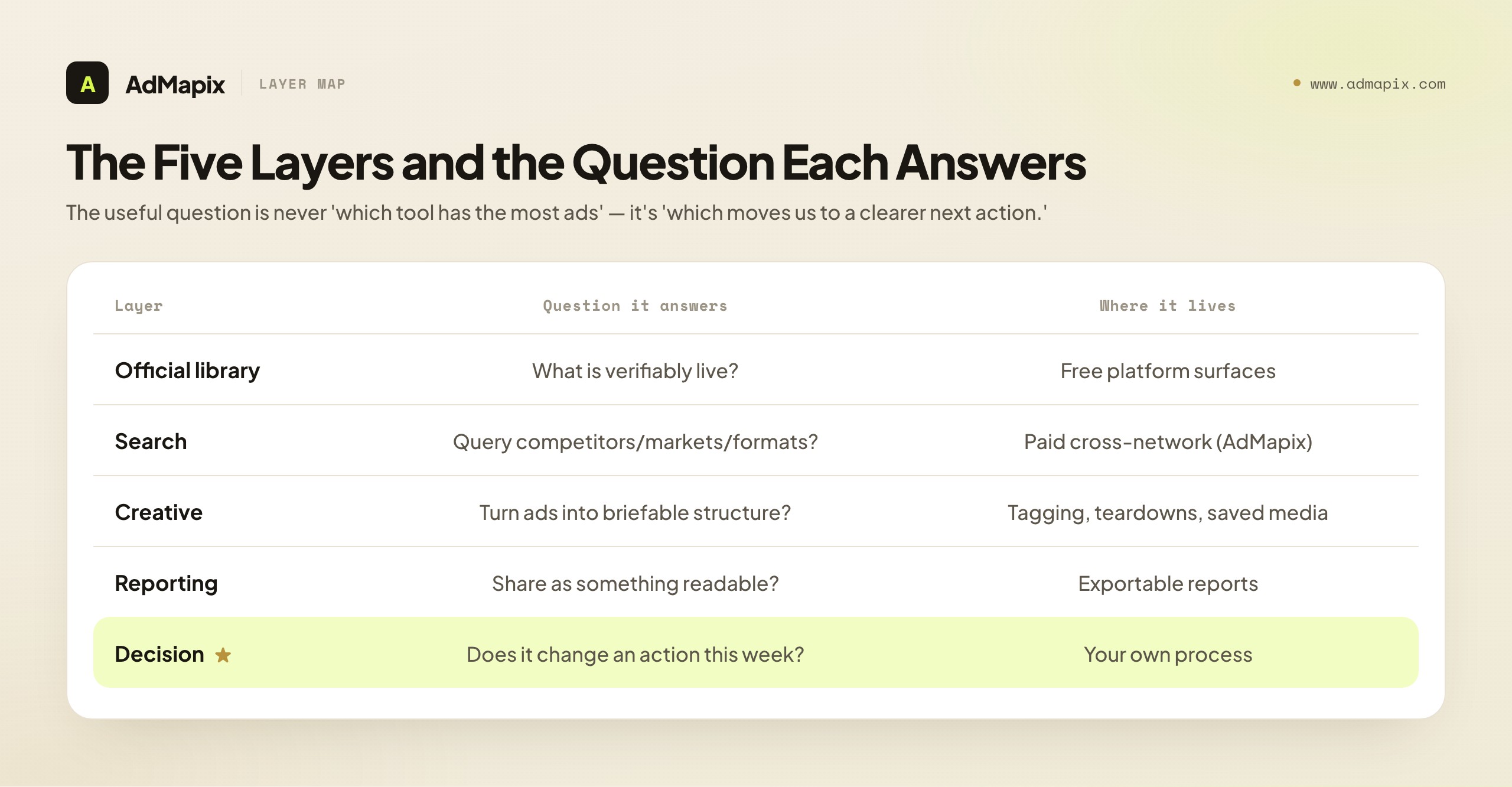
The useful question, at every layer, is never "which tool has the most ads." It is "which tool moves us from evidence to a clearer next action." Most teams over-invest in layers 2 and 3 — the finding and the analyzing — and under-invest in layers 1, 4, and 5 — the free verification, the shareable reporting, and the disciplined decision. A balanced stack respects all five, and the cheapest improvement for most teams is not a bigger search tool but a stronger decision layer.
Where Teams Over-Buy and Under-Use
If you audit how paid social teams actually spend on intelligence, a clear pattern emerges: the money clusters in the wrong layers. Understanding this misallocation will save you more than any single tool recommendation.
Over-buying the search layer. The search layer is the most heavily marketed — vendors compete on database size because it is the easiest number to put on a billboard. So teams buy the deepest index they can afford, then use a fraction of it. The fix is to right-size search to the competitors and networks you genuinely watch, and redirect the saved budget toward the layers that actually move decisions. A mid-tier search tool feeding a strong decision process beats a top-tier index feeding nothing.
Under-using the free official layer. Because the official libraries are free and unglamorous, teams skip them and pay a search tool to do verification the platforms do for free. That is backwards. Start every investigation in the official library to confirm what is live, and reserve the paid search layer for the proactive, cross-network discovery the free surfaces cannot do. Using the free layer first is not a cost-cutting hack; it is the correct sequence.
Neglecting the creative layer's depth. Teams that do buy a creative layer often use it shallowly — saving ads without tagging or tearing them down — which turns an analysis tool into an expensive bookmark folder. The value of the creative layer is realized only when you actually extract the hook, offer, format, and proof structure into something briefable. A saved ad you never analyzed is evidence you never used.
Skipping reporting entirely. Smaller teams and in-house marketers often skip reporting because "we know what we found." Then the knowledge stays trapped in one person's head, and when that person is out or moves on, the intelligence evaporates. Even a lightweight recurring report turns ephemeral knowledge into a durable asset the whole team and any stakeholder can use.
Having no decision layer at all. The deepest under-investment is the decision layer, because it is the one you cannot buy. Most teams have no ritual that forces every finding into an action, so findings accumulate without ever changing what gets shipped. The fix costs nothing but discipline: a weekly review where each piece of evidence must name the brief, test, budget move, or client note it changes — or be discarded.
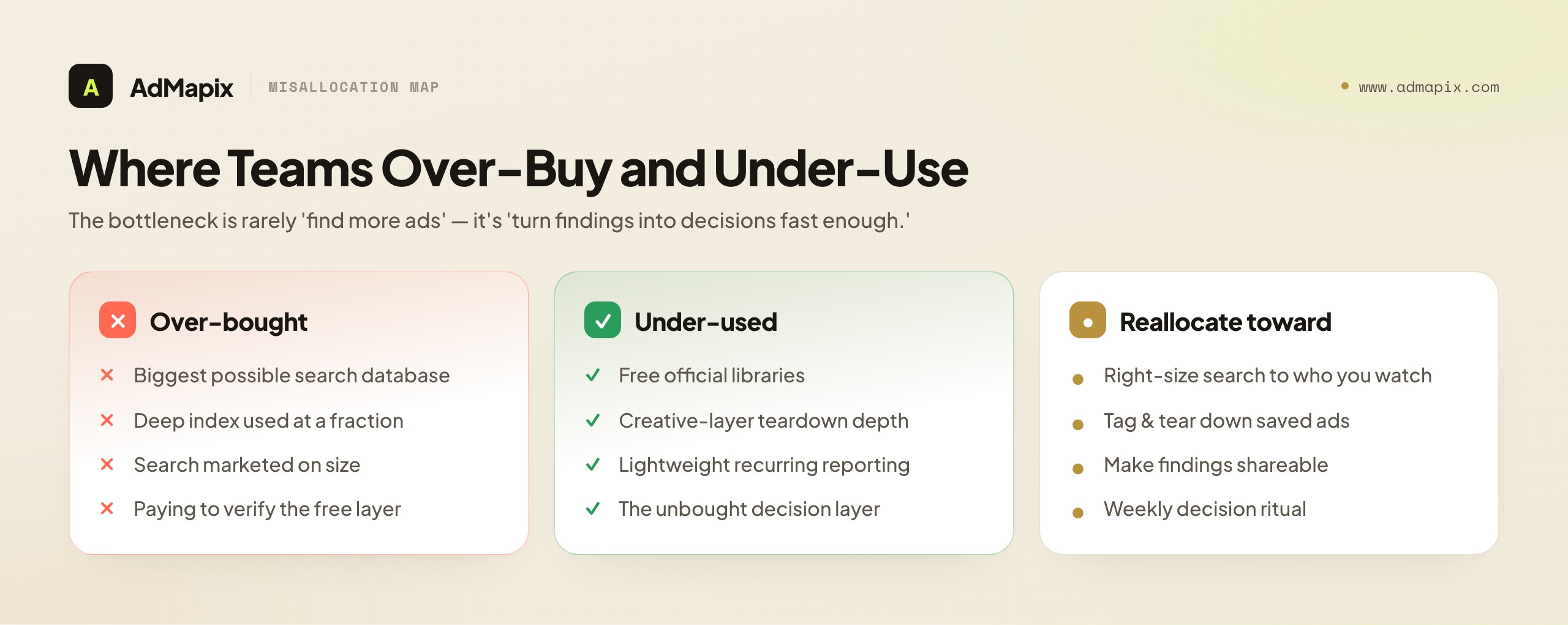
The meta-lesson is that the bottleneck is almost never "we cannot find enough competitor ads." It is "we cannot turn what we find into decisions fast enough." Spend accordingly: lighter on finding, heavier on deciding.
A Weekly Paid Social Intelligence Workflow
A stack is only as valuable as the routine you run it inside. Ad-hoc lookups — "let me check what this competitor is doing" once a month — produce ad-hoc value. A weekly loop produces compounding value, because patterns emerge over time and the decision layer stays warm. Here is a workflow that runs all five layers in roughly an hour a week.
Step 1 — Verify in the official libraries (10 minutes). Open the Meta Ad Library, TikTok Creative Center, and Google Ads Transparency Center for your top competitors. Confirm what is verifiably live right now. This is your ground truth and your free starting point; everything downstream builds on it.
Step 2 — Search across networks for movement (15 minutes). In your search layer, query your competitors, markets, and formats with a time window of the last week or two. You are hunting for change: a new offer, a new hook, a format shift, a new market. The official libraries told you what is live; the search layer tells you what is new, across networks, in one place.
Step 3 — Tear down the movers (15 minutes). Take the two or three most significant new creatives and run them through the creative layer. Tag and break each down: hook (first 1.5 seconds), offer, format, proof stack, CTA. Save them to a dated board. You are turning raw ads into briefable structure — the input your team needs to act.
Step 4 — Report the pattern (10 minutes). Summarize the week's findings into your recurring report: what changed, what pattern is emerging, what it might mean. Keep it short and shareable — a stakeholder should grasp it in two minutes. This turns ephemeral observation into a durable, communicable asset.
Step 5 — Force the decision (10 minutes). The non-negotiable step. For each finding, name the action it drives this week: a brief to write, a test to launch, a budget to shift, a client note to send. If a finding drives no action, drop it. End the loop with a short list of concrete next moves — that list, not the report, is the real output.
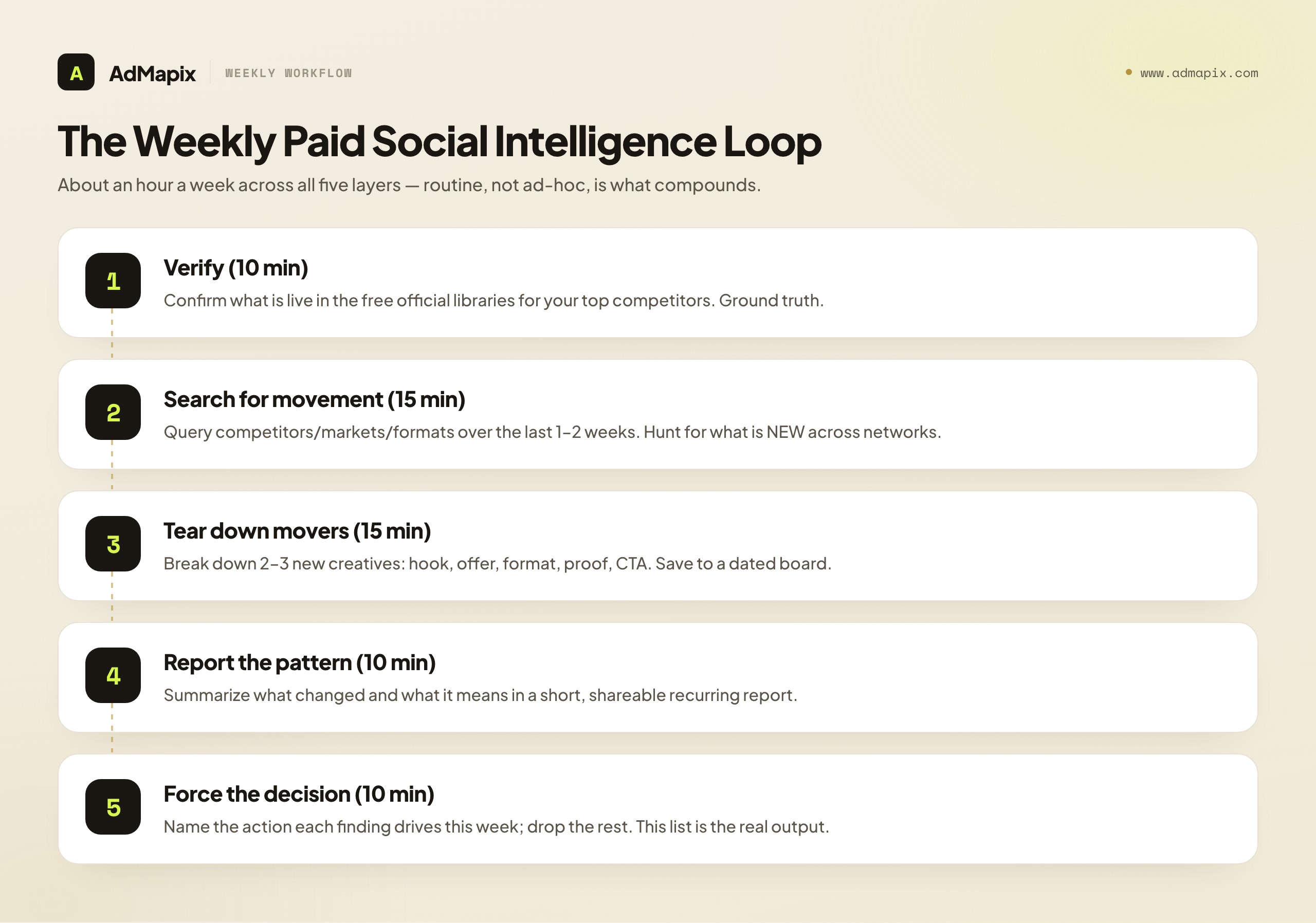
Run this loop every week and three things happen: patterns become visible that a one-off lookup would miss, the decision layer stays disciplined, and the intelligence compounds into a genuine competitive advantage. Skip the loop and run lookups ad hoc, and even the best stack degrades into a drawer of unused subscriptions. The routine, not the tooling, is what separates teams that win with intelligence from teams that merely pay for it.
Building the Stack by Stage: Solo, Team, Agency
The right stack depends on your decision volume, not your ambition. Buying an agency-grade stack as a solo operator wastes money on idle layers; running a lean stack as an agency drowns you in manual assembly. Here is how the five layers scale across three realistic stages.
Solo operator or small DTC brand. Your decision volume is low and your bottleneck is almost always discovery — knowing what to test. The minimum viable stack is the free official libraries plus one paid search-and-creative layer, with reporting and the decision layer run by hand in a simple doc. Put your single paid dollar into the cross-network search-and-evidence layer that solves discovery, and do verification (free) and decisions (manual) yourself. At this scale, one well-chosen tool beats a stack that would sit idle.
In-house growth team. You run multiple channels and refresh creative weekly, which gives you the volume to justify a real stack. The fit is the free official layer, a paid search layer, a paid creative layer with proper tagging and teardown, and a lightweight reporting layer — with the decision layer formalized as a weekly ritual. At this stage the handoffs between layers matter more than any single layer's depth, because you are running the weekly loop and friction at the seams is the real tax. Invest in clean handoffs and a disciplined decision review.
Agency. You owe clients recurring competitive reports and a steady creative pipeline, so you need the fullest stack with one emphasis the others can skip: reporting depth. The agency deliverable is the report, so your search-and-creative layers must produce saved, exportable evidence, and your reporting layer must turn it into a client-trusted narrative. The agency is also most exposed to the honesty risk: when a client asks "what is the competitor spending?", you must be disciplined enough to say "that is not public — here is the creative evidence, and here is what our tests showed," rather than passing off a modeled number as fact. That honesty is a differentiator, not a weakness.
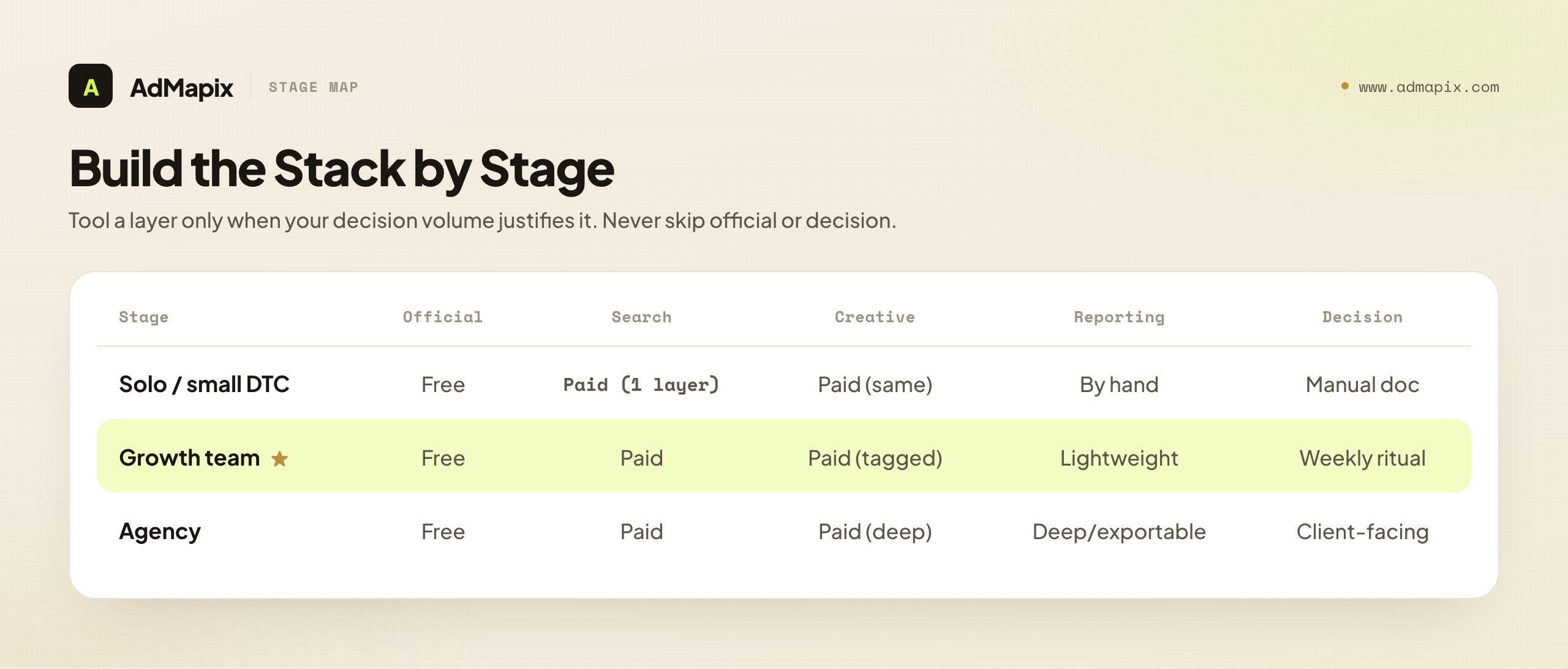
Across all three stages the principle is constant: tool a layer only when your decision volume justifies it, prioritize clean handoffs over feature depth, and never skip the free official layer or the unbought decision layer. Fit the stack to your volume, and revisit it as you grow — the stack that fit you as a solo will throttle you as a team, and the team stack will not satisfy an agency's clients.
The Honest Limits Every Paid Social Intelligence Tool Shares
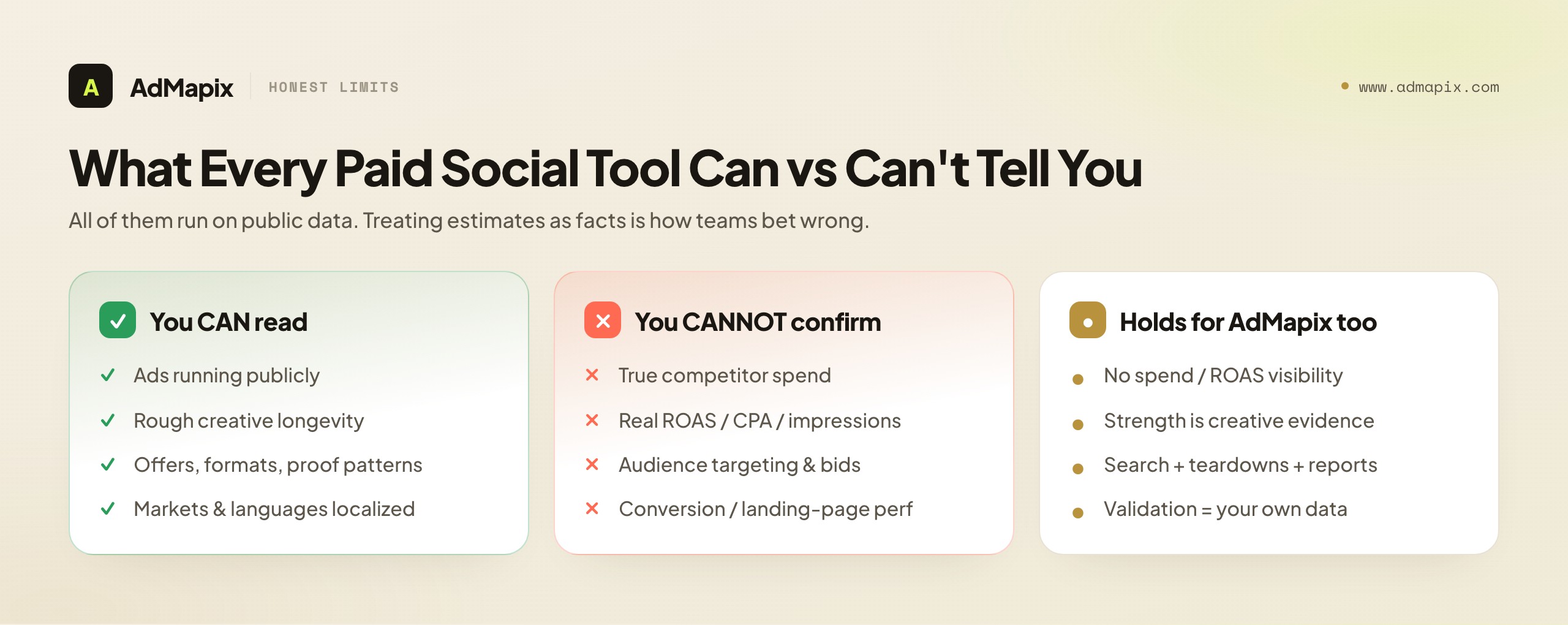
This section is non-negotiable, because it is where buyers get burned. Every paid social intelligence tool — AdMapix included — runs on public data. That boundary defines what any of them can truthfully tell you, and no feature set changes it.
What they can genuinely show: the ads advertisers are running publicly across paid social, rough creative longevity, formats, offers, and the markets an advertiser localizes for — plus, for creative-layer tools, a structured teardown of how an ad is built. That is real, useful evidence, and it is enough to drive sharp hypotheses about competitor creative strategy.
What none of them can confirm: a competitor's true ad spend, real ROAS or CPA, actual impressions, or audience targeting and bids. Those numbers live inside the advertiser's private ad account and analytics, and no public surface exposes them. Public transparency tools like the Meta Ad Library and Google's Ads Transparency Center, and broader rules like the European Union's Digital Services Act ad transparency framework, have expanded what is publicly visible about ads — the creative evidence — but they do not, and are not designed to, expose private performance. When a tool shows a "spend" figure, it is almost always a model, a hypothesis dressed as a fact.
This applies to AdMapix without exception, and we state it directly: AdMapix is searchable cross-network creative evidence — saved ad examples, video breakdowns, and recurring reports. It cannot show you a competitor's spend, ROAS, impressions, or targeting, and we will never imply it can. The deepest limit of all, true for every tool here: even perfect evidence cannot tell you what converts for you. That answer lives only in your own ad, store, and CRM data after your own test. Every paid social intelligence tool is an input to a hypothesis, never the proof of a result — treat anyone who claims otherwise with deep skepticism.
Internalizing this boundary is not a downgrade of what these tools offer; it is what lets you use them well. A team that understands competitor ads as hypotheses runs faster and more confidently than one that mistakes them for facts, because it spends its energy on clean tests rather than on chasing modeled numbers that were never real. The boundary is the discipline, and the discipline is the edge.
Common Mistakes With Paid Social Intelligence Tools
A handful of recurring mistakes account for most wasted spend and disappointment. Name them to avoid them.
Mistake 1 — Buying the biggest database. Database size is the easiest number to market and the least predictive of value. A bigger index you barely use loses to a smaller one wired into a disciplined decision loop. Buy for the decisions improved, not the ads indexed.
Mistake 2 — Skipping the free official layer. Paying a search tool to verify what is live is paying for what the platforms give away. Start free, in the official libraries, and reserve paid tools for proactive cross-network discovery.
Mistake 3 — Treating longevity as proof. A long-running ad is probably a winner, but longevity is a proxy, not a guarantee. Use it to prioritize candidates; never scale budget on it without validating in your own data.
Mistake 4 — Confusing evidence with results. Competitor ads show what an advertiser chose to run, not what worked. The only proof of what works for you is your own analytics after your own test. Keep the two worlds distinct.
Mistake 5 — Running lookups instead of a loop. Ad-hoc checks produce ad-hoc value. The weekly loop is what makes patterns visible and intelligence compound. Routine beats tooling.
Mistake 6 — Having no decision layer. The most common and most expensive mistake: gathering evidence that never changes an action. If a finding does not drive a brief, test, budget move, or client note, it was never intelligence — just browsing.
Avoid these six and your stack stays lean, honest, and ROI-positive — evidence that consistently becomes decisions.
Platform by Platform: What Each Channel's Intelligence Looks Like
Paid social is not one channel; it is several, and the intelligence picture differs meaningfully across Meta, TikTok, and Google. A stack that treats all three identically misses what each surface uniquely offers and where each goes dark. Here is the channel-by-channel reality, because your stack should be shaped by where you actually buy.
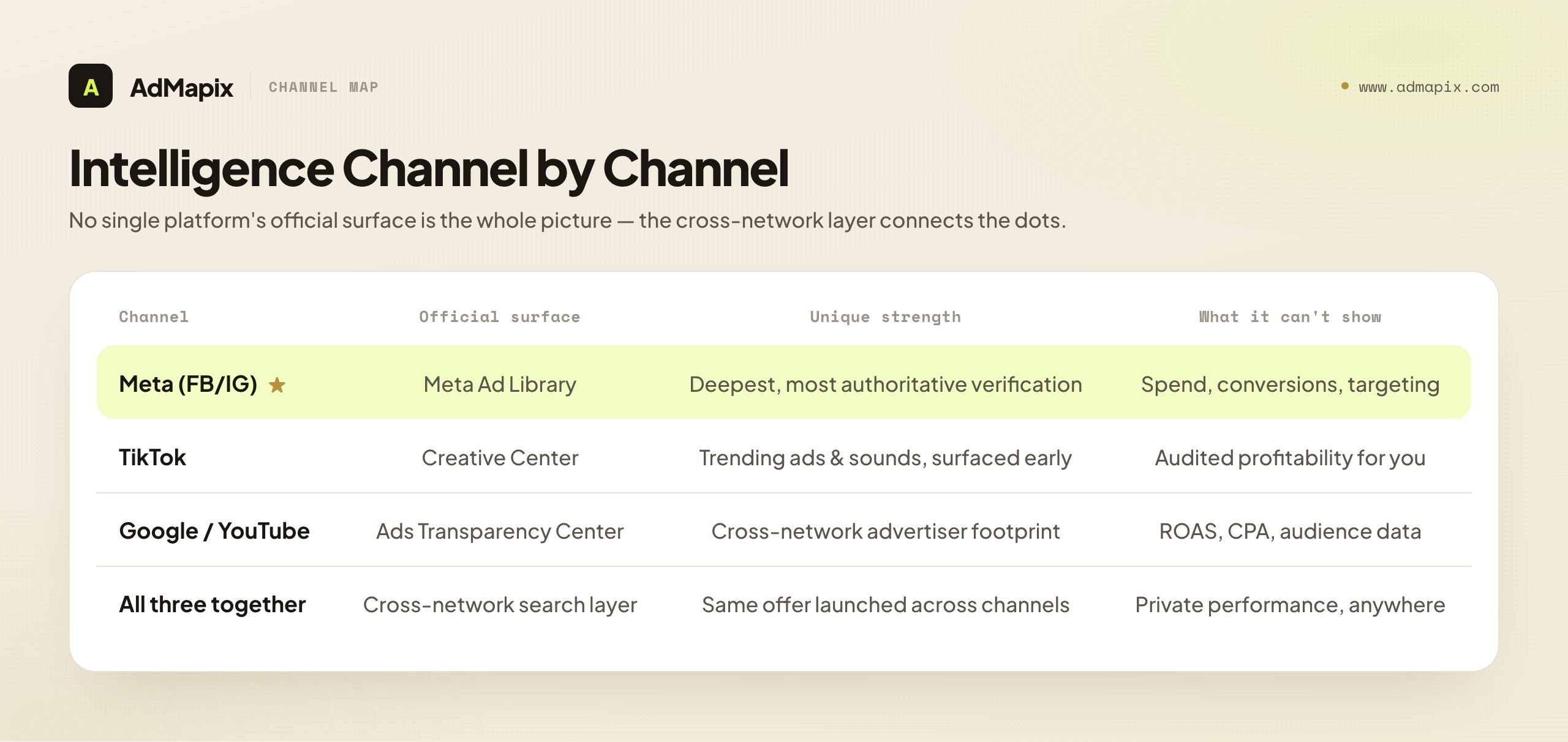
Meta (Facebook and Instagram). This is the deepest, most mature intelligence surface, anchored by the official Meta Ad Library, which shows ads currently running across Facebook and Instagram and, for ads about social issues, elections, or politics, additional disclosures. For paid social intelligence purposes, Meta is the channel where the official free layer is strongest — you can verify a competitor's live creatives directly and authoritatively. What it does not give you is performance: you see the creative and rough activity, never the spend or the conversions. Your search and creative layers add the cross-network querying and structured teardown the library lacks, but the verification ground truth is excellent and free. For most DTC and ecommerce teams, Meta is where the intelligence loop earns the most, because it is where the creatives and the buying both concentrate.
TikTok. TikTok's intelligence picture is shaped by the TikTok Creative Center, which surfaces top-performing and trending ads and creative trends in a way no other platform packages quite so deliberately. The Creative Center is genuinely useful for spotting format and sound trends early, which matters enormously on a platform where creative formats turn over fast. The caveat is the same as everywhere: trending and top-performing are attention signals, surfaced by the platform's own framing, not audited profitability for your account. TikTok creative also moves faster than Meta, so the weekly loop matters more here — a monthly cadence will miss trends that peak and fade inside two weeks. Your creative layer's teardown is especially valuable on TikTok, where the difference between a winning and losing execution of the same trend is often in the first second.
Google (and YouTube). Google's Ads Transparency Center is the official surface, showing ads an advertiser has run across Google's networks, including Search and YouTube. For paid social teams, YouTube is the relevant slice — video creative intelligence that overlaps with the social-video skills your team already has. Google's transparency surface is broad but its framing is verification-oriented, like Meta's: you confirm what an advertiser ran, not what it earned. The cross-network search layer matters here for connecting a competitor's YouTube creative strategy to their Meta and TikTok activity, which is exactly the kind of pattern a single official library cannot reveal.
The cross-channel lesson is that no single platform's official surface gives you the whole picture, and that is precisely the gap the paid search-and-creative layers fill. Each free library is a window into one room; the cross-network layer is the floor plan that shows how the rooms connect, which is where the genuinely strategic signals live. You start in each platform's free library for verification, then use the cross-network layer to connect the dots across channels — seeing that a competitor launched the same offer on Meta, TikTok, and YouTube in the same week, which is a far stronger signal than any one library shows in isolation. Shape your stack to your channel mix: a Meta-heavy DTC brand and a TikTok-first app will weight the layers differently, and both are correct for their own buying.
Turning Evidence Into a Brief: The Decision Layer in Practice
The decision layer is the one you cannot buy and the one that determines whether the whole stack pays back, so it deserves a concrete, worked treatment rather than an abstract instruction to "tie findings to actions." Here is what the decision layer actually looks like when a finding becomes a brief.
Suppose your weekly loop surfaces that three competitors in your category have, within two weeks, all shifted to a problem-first video hook — opening on a relatable pain rather than a product benefit. The official libraries confirm the creatives are live; the search layer shows the timing clustered; the creative layer's teardown shows the shared structure. That is a strong pattern. The decision layer's job is to convert it into a specific, testable action this week, and the discipline is in the specificity.
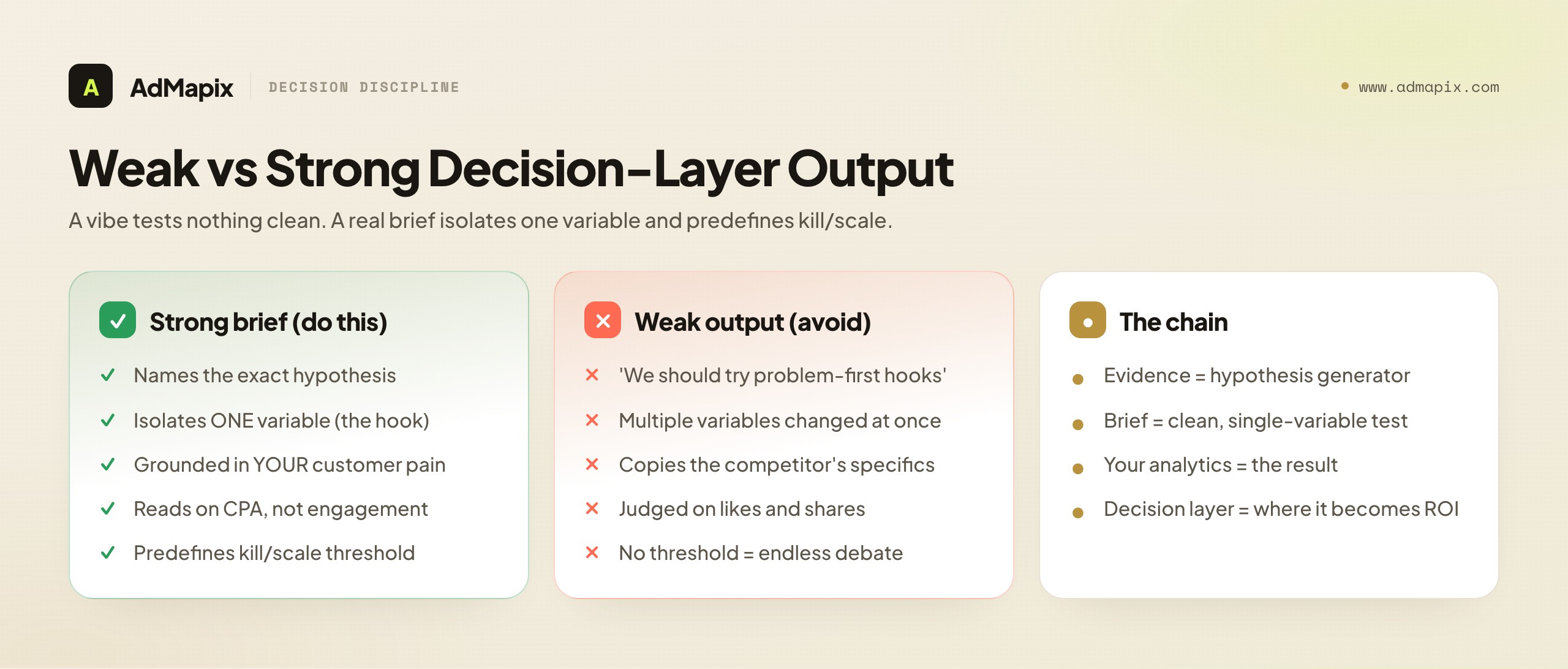
A weak decision-layer output is "we should try problem-first hooks." That is a vibe, not a brief, and it will produce a vague creative that tests nothing clean. A strong decision-layer output names the exact hypothesis, the exact creative to build, and the exact way you will read the result. It looks like: "Hypothesis — a problem-first hook will lower our cost per acquisition versus our current benefit-first opener. Brief — produce one fifteen-second video opening on [the specific pain our customers name most], holding the product reveal to the three-second mark, then our existing demonstration and guarantee CTA unchanged so the hook is the only variable. Read — run against our current top creative as control; decision threshold is a meaningful CPA improvement over two weeks of statistically meaningful spend; scale if it clears, kill if it does not."
Notice what that output does. It isolates a single variable so the test is clean. It grounds the creative in your real customer pain, not the competitor's, so you are testing the structure you observed, not copying their specifics. It names the metric that matters — CPA, a conversion outcome from your own analytics — not engagement, which is attention, not profit. And it predefines the kill/scale rule so the result drives a decision instead of a debate. That is the decision layer working: a public-data pattern, validated through a clean test, turned into a budget move grounded in your own performance data.
The recurring discipline of the whole guide lives here. The competitor evidence was a hypothesis generator — a good one, surfacing a pattern faster than you would have spotted it alone. But the evidence proved nothing about your account. The brief turned the hypothesis into a clean test, and your analytics turned the test into a result. Every layer played its part, and the decision layer — the unbought one — is where the intelligence finally became ROI. A stack without this layer is a very expensive way to admire your competitors.
Measuring Whether Your Intelligence Stack Pays Back
A stack is a recurring cost, so the honest question is whether it earns its keep. Most teams never measure this, which is how unused subscriptions survive for years. Here is a lightweight accountability practice that keeps your stack honest and your renewals evidence-based.
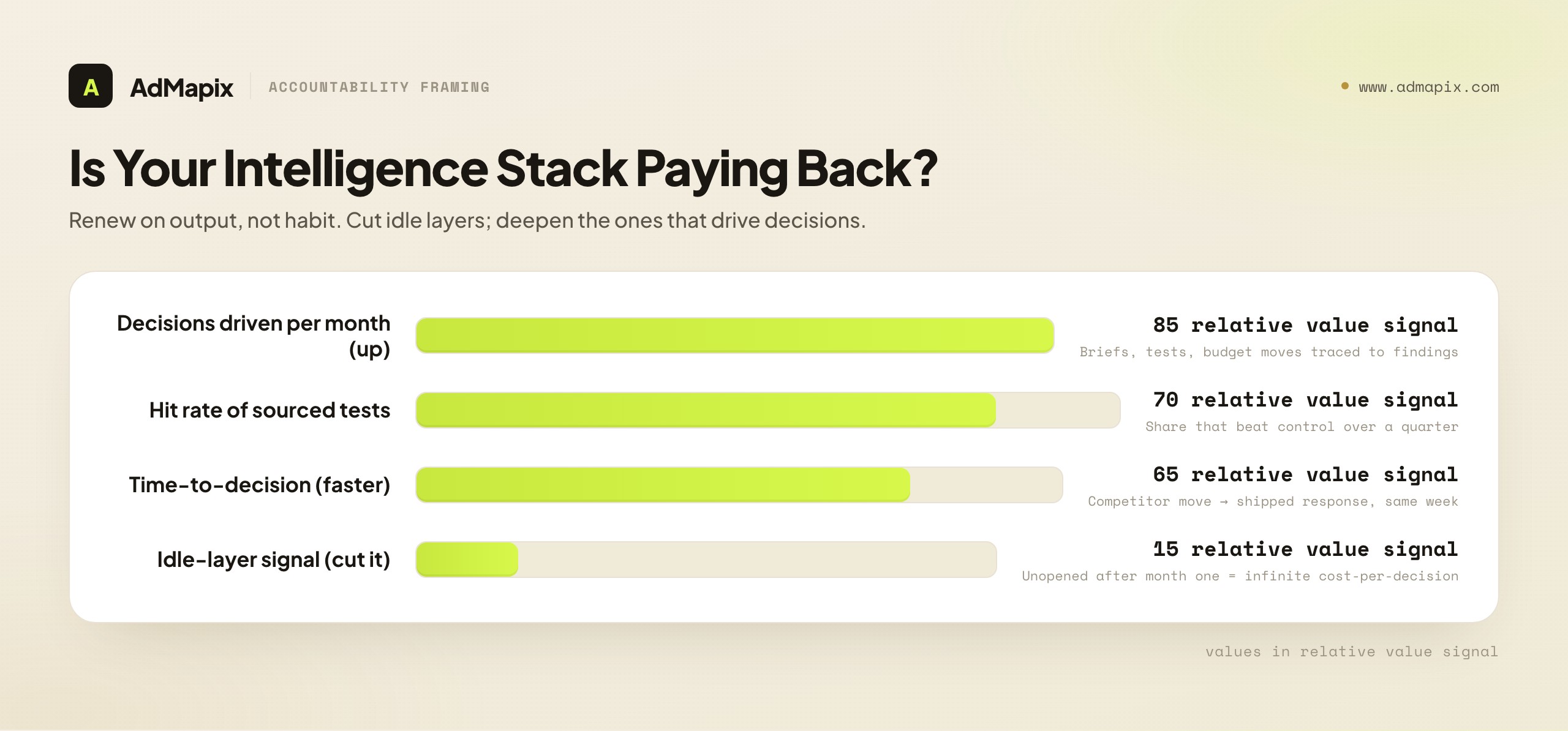
Count decisions driven per month. The clearest output of the whole stack is decisions — briefs written, tests launched, budget moves made, client notes sent — that trace back to a finding from your intelligence loop. Count them before and after you added a tool or layer. If the number did not move, the layer is not doing the job you bought it for, however deep its database or polished its interface. Decisions into the workflow are the only honest measure of an intelligence stack.
Track the hit rate of intelligence-sourced tests. Of the tests that originated from your competitor intelligence, what fraction beat your control over a quarter? Single-week signal is noisy, but a quarter reveals a pattern. If intelligence-sourced tests win no more often than your gut-driven ones, the stack is improving your speed, not your hypothesis quality — which may still be worth it, but you should know which value you are buying and price the stack accordingly.
Measure time-to-decision. Even at flat decision volume, the stack may earn its place by cutting the time from "competitor did something" to "we shipped a response" — from weeks of ad-hoc noticing to a same-week reaction through the weekly loop. Speed of response is a real competitive edge in fast-moving channels like TikTok. Log a few cycles honestly and see whether the loop compresses your reaction time.
Watch the idle-layer signal. The loudest accountability signal is usage. If a layer goes unopened after the first month, no feature list will save it. A search tool nobody queries, a reporting layer nobody exports, a creative layer where ads are saved but never torn down — each has a cost-per-decision approaching infinity. Pull the usage data quarterly, cut the idle layers, and redirect the spend to the bottleneck that is genuinely stuck.
Run this review every quarter and your stack stays lean and honest. Layers that demonstrably drive more decisions, faster, with a better hit rate, you keep and deepen. Layers that coast on the comfort of "we might need it," you cut. Renewing on output rather than on habit is the discipline that separates a deliberate intelligence operation from a drawer of subscriptions nobody can quite justify but nobody quite cancels.
How Paid Social Intelligence Fits the Rest of Your Growth Stack
Paid social intelligence does not live in isolation; it sits inside a wider growth operation, and its value multiplies or evaporates depending on how cleanly it connects to the systems around it. Drawing those connections explicitly helps you see where the intelligence stack genuinely moves the needle and where it is just another silo.
Upstream of the intelligence stack sits strategy and positioning — the decisions about who you serve, what you sell, and what you stand for. Competitor intelligence informs this, but does not replace it. Watching three competitors converge on a problem-first hook is a signal about tactics; it should not stampede you into abandoning a differentiated position just because the category is moving. The most common strategic error is letting competitor intelligence pull you toward the mean — copying what everyone is doing until your brand is indistinguishable. Use the intelligence to understand the category's tactical moves, then deliberately decide where to follow the pattern and where to break it. Intelligence that erodes your differentiation is intelligence used badly.
Parallel to the intelligence stack sits creative production — the team or partners who actually make the ads. The intelligence stack's output, the brief, is production's input, so the handoff between them is a critical seam. A teardown that production cannot execute from is a broken handoff; a brief that specifies hook, pacing, proof, and CTA precisely is a clean one. The whole reason the creative layer exists is to make production faster and sharper, so measure the seam: are briefs landing as launchable creatives, or is production reinterpreting them from scratch? If the latter, your creative layer is producing analysis production cannot use, and the fix is in the brief specificity, not a bigger intelligence tool.
Downstream sits measurement and analytics — your ad platform data, your store data, your CRM. This is where every hypothesis the intelligence stack generates goes to be proven or killed, and it is the only place the truth about your performance lives. The connection here is the most important in the entire growth stack, because it closes the loop: competitor intelligence generates a hypothesis, production builds the test, and analytics delivers the verdict, which feeds the next round of intelligence. A team with a strong intelligence stack and weak analytics is generating hypotheses it cannot validate — fast cars with no brakes. Invest in the analytics connection as seriously as the intelligence one, because intelligence without validation is just expensive speculation.
The systems view reframes the whole purchase. You are not buying a paid social intelligence tool to admire competitors; you are buying a hypothesis engine that must connect cleanly to strategy above it, production beside it, and analytics below it. Evaluate any tool not just on what it does in isolation but on how cleanly it plugs into those three neighbors. A tool that produces beautiful teardowns production cannot use, or hypotheses analytics cannot validate, is a silo no matter how good it looks alone.
The One-Hour Audit: Is Your Current Setup Right?
Before you buy or cut anything, run this one-hour audit of your existing paid social intelligence setup. It will tell you precisely where to invest and where you are wasting money, grounded in your own situation rather than a generic recommendation.
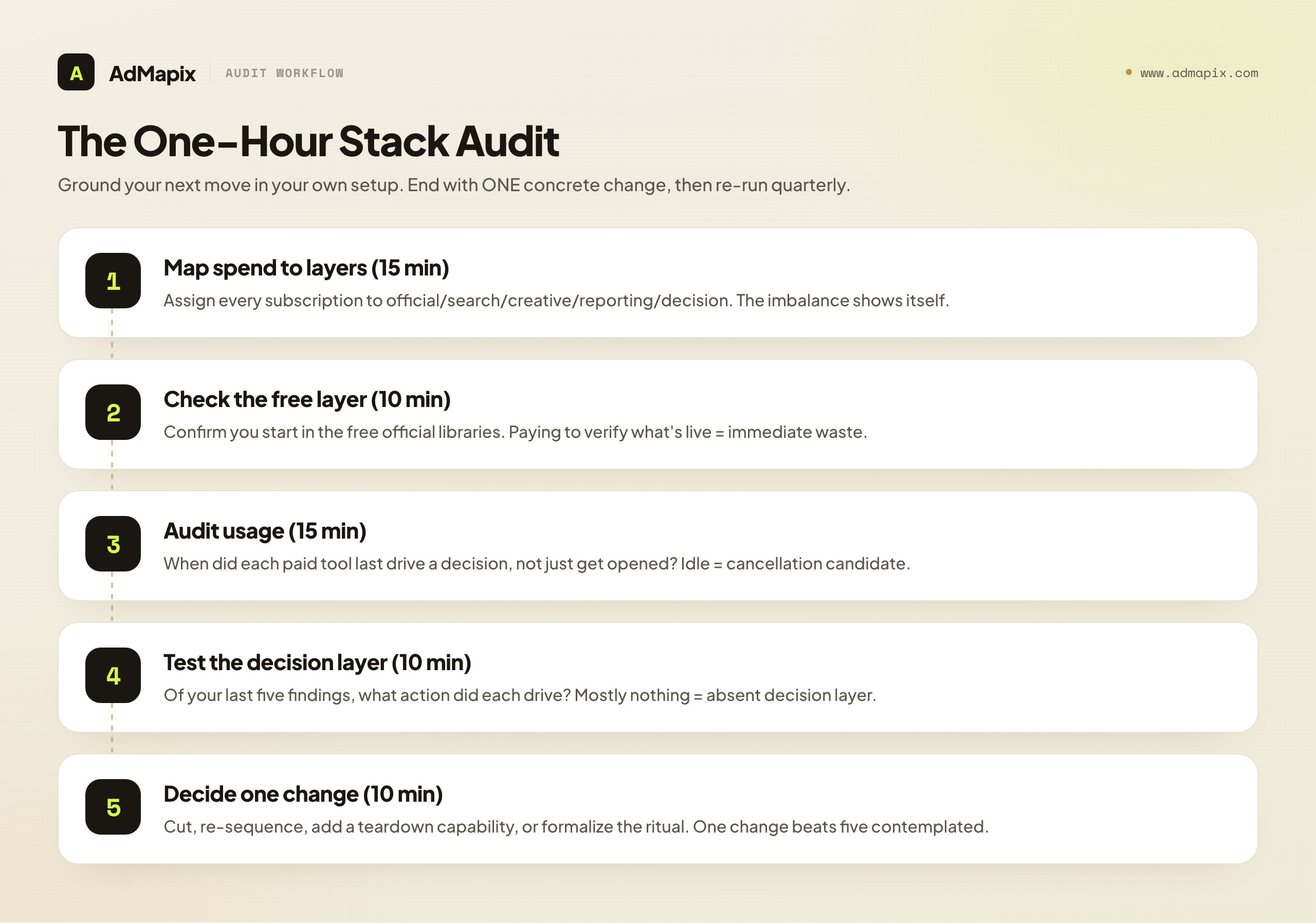
Map your spend to the five layers (15 minutes). List every intelligence tool and subscription you currently pay for, and assign each to a layer: official, search, creative, reporting, decision. You will almost certainly find the spend clustered in search, with little or nothing in decision (which is unbuyable but should show up as a documented ritual). The map alone usually reveals the imbalance.
Check the free layer is doing its job (10 minutes). Confirm your team actually starts in the free official libraries before reaching for paid search. If you are paying a search tool to verify what is live — work the Meta Ad Library, TikTok Creative Center, and Google Ads Transparency Center do for free — you have found immediate waste. Fix the sequence first; it costs nothing.
Audit usage of each paid layer (15 minutes). For each paid tool, find out when it was last genuinely used to drive a decision, not just opened. A tool nobody has used to change a brief, test, or budget in a month is a cancellation candidate. Be honest here — "we might need it" is how idle subscriptions survive.
Test the decision layer (10 minutes). Look at your last five competitor findings and ask, for each, what action it drove. If most drove nothing, your decision layer is absent regardless of how good your tools are. The fix is free: institute the weekly ritual where every finding must name its action or be discarded.
Decide one change (10 minutes). End the audit with a single concrete change: cut an idle layer, fix the free-layer sequence, add a missing creative-teardown capability, or formalize the decision ritual. One change implemented beats five changes contemplated. Re-run the audit next quarter and make the next one change.
This audit, run quarterly, keeps your stack continuously aligned to your real bottleneck. Most teams who run it for the first time discover the same thing: they are over-paying for finding ads and under-investing in deciding what to do with them — and the highest-ROI change is almost never a new subscription, but a stronger, free, decision-layer ritual that turns the evidence they already have into the decisions they are currently failing to make.
FAQ
What are paid social intelligence tools?
They are software tools that help teams study competitor ads, creative patterns, and platform activity across paid social channels like Meta, TikTok, and Google. They span five layers: official ad libraries (free verification of what is live), search (cross-network querying), creative (turning ads into briefable hooks, offers, and proof points), reporting (shareable evidence), and decision (tying every finding to an action). The point of the category is not to collect competitor ads but to turn them into briefs, tests, budget moves, and client notes — the best stack is the one that improves decisions, not the one with the largest database.
How do I choose paid social intelligence tools?
Judge each tool by the decision it improves this week, not by the size of its database. Start with the free official libraries to confirm what is live, then add paid tools only where manual review breaks down — typically once you watch more than a few competitors across more than one network. For each candidate, ask which layer it serves and whether it hands off cleanly to the next: does it produce briefable creative teardowns, shareable reports, and findings that change actions? A mid-tier tool wired into a disciplined decision loop beats a top-tier index feeding nothing.
Can paid social intelligence tools show competitor ad spend or ROAS?
No. Competitor ad spend, ROAS, CPA, real impressions, and audience targeting are not public — they live inside the advertiser's private ad account and analytics. No tool, AdMapix included, can truthfully show them. Some tools present modeled spend estimates generated from public signals; read the label, because an estimate is a hypothesis dressed as a fact. Public transparency surfaces like the Meta Ad Library and Google's Ads Transparency Center expose the creative evidence — the ads themselves — not private performance. Use any modeled number as directional signal at most, and validate what works in your own data.
What does AdMapix do in a paid social intelligence stack?
AdMapix fits the cross-network evidence layer — the search and creative layers of the stack. It lets you search ads across markets and networks, save media to boards, analyze video creatives into structured breakdowns, and turn patterns into recurring reports. The AI it uses extracts and organizes creative evidence; it does not predict performance. Crucially, AdMapix does not show competitor spend, ROAS, impressions, or targeting, because that data is not public, and it will never imply it does. It is the searchable evidence base you build briefs and reports on — an input to your decisions, not a results oracle.
What can public ad data actually prove?
It can prove which creatives a competitor is currently running, roughly how long an ad has been live (longevity as a soft proxy for performance), the hook/offer/format/proof-point patterns across their creatives, and which markets and languages they localize for. That is a rich picture of a competitor's creative strategy. It cannot prove whether those creatives are profitable, the exact spend, ROAS, or CPA, the audience targeting and bids, or the conversion rate and landing-page performance — those are private. The practical rule: competitor ads are hypotheses to validate in your own data, never proof of performance.
How is longevity useful if it is not proof?
Longevity is a soft proxy: advertisers tend to kill losing ads fast and keep winning ones running, so an ad live for several weeks is a stronger signal than one launched yesterday. That makes longevity a useful tie-breaker when you are choosing which competitor patterns to test first. But it is not a guarantee — a long-running ad could be a brand-awareness play, a poorly-managed account, or sustained by factors you cannot see, and you never see what it earned. Use longevity to prioritize candidates, then validate the actual pattern in your own analytics before scaling spend.
Which layer do most teams get wrong?
Two layers. Teams over-buy on the search layer — chasing the biggest database because it is the easiest thing vendors market — and under-invest in the decision layer, the discipline of tying every finding to an action. The result is the deepest ad index feeding a process that ships nothing. The cheapest, highest-leverage improvement for most teams is not a bigger search tool but a stronger decision layer: a weekly ritual where each finding must name the brief, test, budget move, or client note it changes, or be discarded.
How often should I run competitor intelligence?
Weekly, as a loop, not ad hoc. Ad-hoc lookups produce ad-hoc value; a weekly routine makes patterns visible over time and keeps the decision layer warm. A workable loop takes about an hour: verify in the free official libraries, search across networks for what is new, tear down the two or three biggest movers, summarize the pattern in a short recurring report, and force each finding into a concrete next action. Run weekly and intelligence compounds into a real advantage; run occasionally and even the best stack degrades into unused subscriptions.
Do I need all five layers from the start?
No. Tool a layer only when your decision volume justifies it. A solo operator needs the free official libraries plus one paid search-and-creative layer, with reporting and decisions handled by hand. A growth team adds a dedicated creative layer and a lightweight reporting layer, with the decision layer formalized as a weekly ritual. An agency needs the fullest stack with deep, exportable reporting because the report is the deliverable. The free official layer and the unbought decision layer are the two that nobody should ever skip, at any stage — they cost nothing and carry disproportionate value.
Related Reading
To turn this stack into a working routine, read it next to our best ad intelligence tools overview and the advertising intelligence guide for the wider discipline. Use the competitor ad analysis framework to run the weekly loop, the ad creative database to build the searchable evidence layer, and the creative testing framework to close the validation loop in your own analytics — the only place the truth about your performance lives.
See what competitors are really running
Search 6M+ ad creatives, landing pages, and weekly spend across 200+ countries. No credit card, no commitment.
Related Articles
Playable Ad Analysis for Mobile Games: A Practical Method
A practical method for playable ad analysis in mobile games: how to reverse-engineer a competitor's playable by the job it is built to do, decode its structure beat by beat, infer which concepts are likely working, turn observations into testable briefs, and stay honest about what a public playable proves (structure and intent) versus what it never can (spend, installs, retention, ROAS).
Best Mobile Game Ad Formats Across Platforms: A 2026 UA Playbook
A platform-by-platform guide to the best mobile game ad formats in 2026: which formats do the heavy lifting on Meta, Google, TikTok, AppLovin, and Unity; why the right format depends on platform, genre, and funnel stage; a format-selection framework; a creative-testing cadence; and the honest limits of what competitor ads can and cannot tell you about which format wins.
Meta Ads Library vs Ad Intelligence Tools for Game UA (2026): Which to Use, When, and Why
A definitive 2026 comparison of the Meta Ads Library vs dedicated ad intelligence tools for mobile game user acquisition — where the free transparency library genuinely helps, the structural limits that create blind spots for game UA creative research, a side-by-side capability matrix, the exact decision criteria for when to add a paid intelligence layer, and an honest account of what neither can show.