Mintegral Ad Intelligence: How to Run Creative Research on a Mobile-UA Network That Has No Public Ad Library
A complete 2026 guide to Mintegral ad intelligence for mobile UA and game creative teams. What Mintegral is, why it has no public ad library, what observed video and playable ads can and cannot prove, and a repeatable workflow for turning scattered in-app creatives into briefs you can test — plus where AdMapix fits as a cross-network creative-evidence layer.

Mintegral Ad Intelligence: How to Run Creative Research on a Mobile-UA Network That Has No Public Ad Library
Updated June 21, 2026 — written and reviewed by the AdMapix Research team.
If you searched for Mintegral ad intelligence, you are almost certainly trying to do one of two things: understand what creatives competitors are running through Mintegral's mobile user-acquisition (UA) network, or figure out how to build creatives that perform well on it. Both are legitimate. But the first thing you need to internalize is that Mintegral does not work like Meta or TikTok when it comes to ad transparency. There is no public Mintegral ad library where you can type a competitor's name and pull every creative they have ever shipped. Mintegral is a mobile advertising and monetization network — most of its inventory is interstitial video, rewarded video, and playable ads served inside other games and apps — so its creatives surface in the wild, not in a queryable archive. That single fact reshapes the entire research workflow, and most teams get it wrong because they expect a search box that does not exist.
This guide treats Mintegral ad intelligence as what it actually is: a creative research discipline, not a spend-lookup tool. We will define what Mintegral is and how its inventory works, explain exactly why a public ad library is structurally absent, walk through what observed creatives can and cannot prove (this is where most analysts over-claim), and give you a repeatable, eight-step workflow for converting scattered in-app ads into a testable creative brief. We will be honest throughout about where evidence ends and inference begins.
The reason this matters so much in practice is that the gap between "what people expect from competitor research" and "what is actually obtainable on a programmatic mobile network" is enormous, and that gap is where money and credibility get wasted. A marketer who arrives expecting a Meta-style library will either give up too early ("there's no data") or, worse, buy a tool that promises competitor spend figures it cannot truly source and then build strategy on fiction. The whole point of this guide is to reset the expectation to something true and then make that true thing genuinely powerful. Observation done with discipline beats database lookups done carelessly — and on Mintegral, disciplined observation is the only honest game in town. If you are researching other mobile-UA networks, this pairs naturally with our breakdowns of ironSource ad intelligence, Moloco ad intelligence, the AppLovin ads spy tool landscape, and the broader advertising intelligence guide. For the underlying method, the competitor ad analysis framework is the backbone everything here sits on.
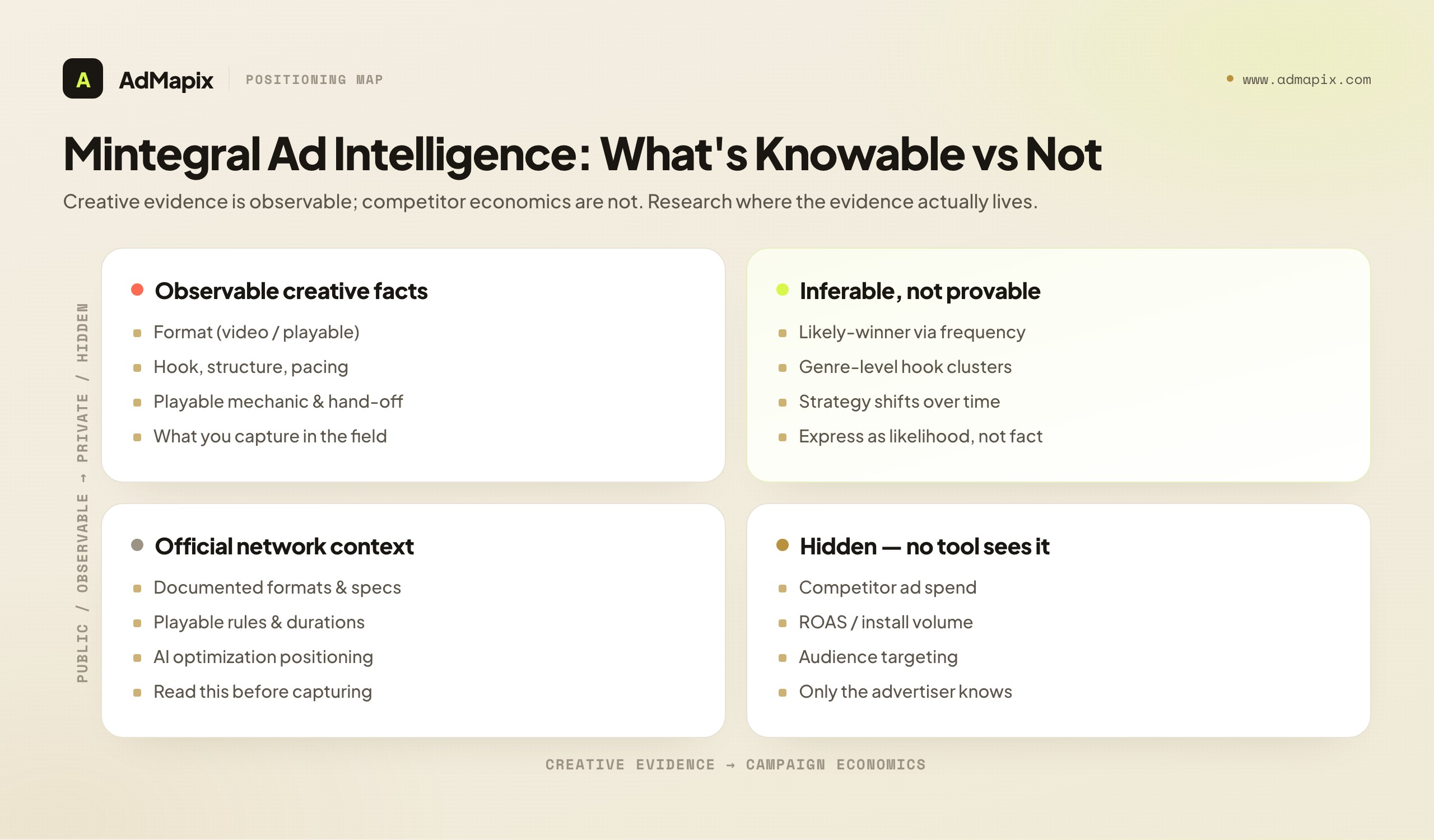
TL;DR — Mintegral Ad Intelligence in One Screen
- There is no public Mintegral ad library. Mintegral is a programmatic mobile network whose creatives run inside apps and games as video and playable ads, not entries in a searchable transparency archive. Your research is observational, not a database lookup.
- Mintegral ad intelligence = creative research, not spend lookup. You can study what competitors ship (hooks, mechanics, pacing, end cards). You cannot pull their spend, ROAS, install volume, or audience targeting from a visible ad.
- Visible creatives are hypotheses, not proof. A creative you see is evidence that it exists, not evidence that it won. Repetition over time is your strongest (still imperfect) signal of a likely winner.
- The network has two halves: official guidance and observed reality. Read Mintegral's own AppGrowth / creative-prep documentation to learn the rules of the format, then systematically log the real creatives you encounter in the field.
- Playables are Mintegral's signature surface. Interactive playable ads — not just video — are central to the network, and they require a different analysis lens (mechanic, friction, false-difficulty, store hand-off) than passive video.
- A repeatable capture system beats one heroic research sprint. The teams that win at Mintegral research build a standing library of tagged examples and refresh it on a schedule, so patterns emerge over weeks.
- AdMapix fits the step after collection. It is a cross-network creative-evidence layer: saving examples, breaking down video and playable structure, tagging by genre, and packaging recurring reports. It cannot show competitor spend, ROAS, or targeting — and we will say so plainly every time it matters.
What Mintegral Actually Is (and Why That Shapes Everything)
Before you can research Mintegral creatives effectively, you have to be precise about what Mintegral is, because the network's architecture is the reason its ad intelligence behaves so differently from the social platforms.
Mintegral is a programmatic mobile advertising and monetization platform owned by Mobvista, built primarily around games and apps. It operates on both sides of the marketplace. On the demand side, advertisers — mostly mobile game studios and app developers running user acquisition — buy installs and in-app events through Mintegral's AppGrowth product, which leans heavily on AI-driven optimization, programmatic bidding, and creative automation. On the supply side, Mintegral monetizes a large network of publisher apps and games by serving ads into their inventory: interstitials between levels, rewarded video that grants in-game currency, banners, and interactive playables.
That dual-sided, in-app structure is the whole story for ad intelligence. Because Mintegral creatives are delivered programmatically into third-party app inventory, there is no central, advertiser-facing showroom where every campaign is published for public inspection. Compare this to Meta's Ad Library or TikTok's Creative Center, which exist partly because of regulatory transparency obligations and partly as discovery surfaces — they are designed to be browsed. Mintegral has no equivalent obligation or product. Its creatives are an operational byproduct of media buying, not a published catalog. So when someone asks "how do I search the Mintegral ad library," the honest answer is: you cannot, because it does not exist in that form, and pretending otherwise will send you chasing a tool that cannot deliver.
This is not a knock on Mintegral. It is simply the nature of programmatic mobile-UA networks. The same is true of ironSource, Unity Ads, AppLovin, Moloco, and most of the in-app ecosystem. The transparency model that social platforms adopted never propagated to the programmatic mobile world, so creative research there has always been observational. Understanding that frees you from the wrong expectation and points you at the right method.
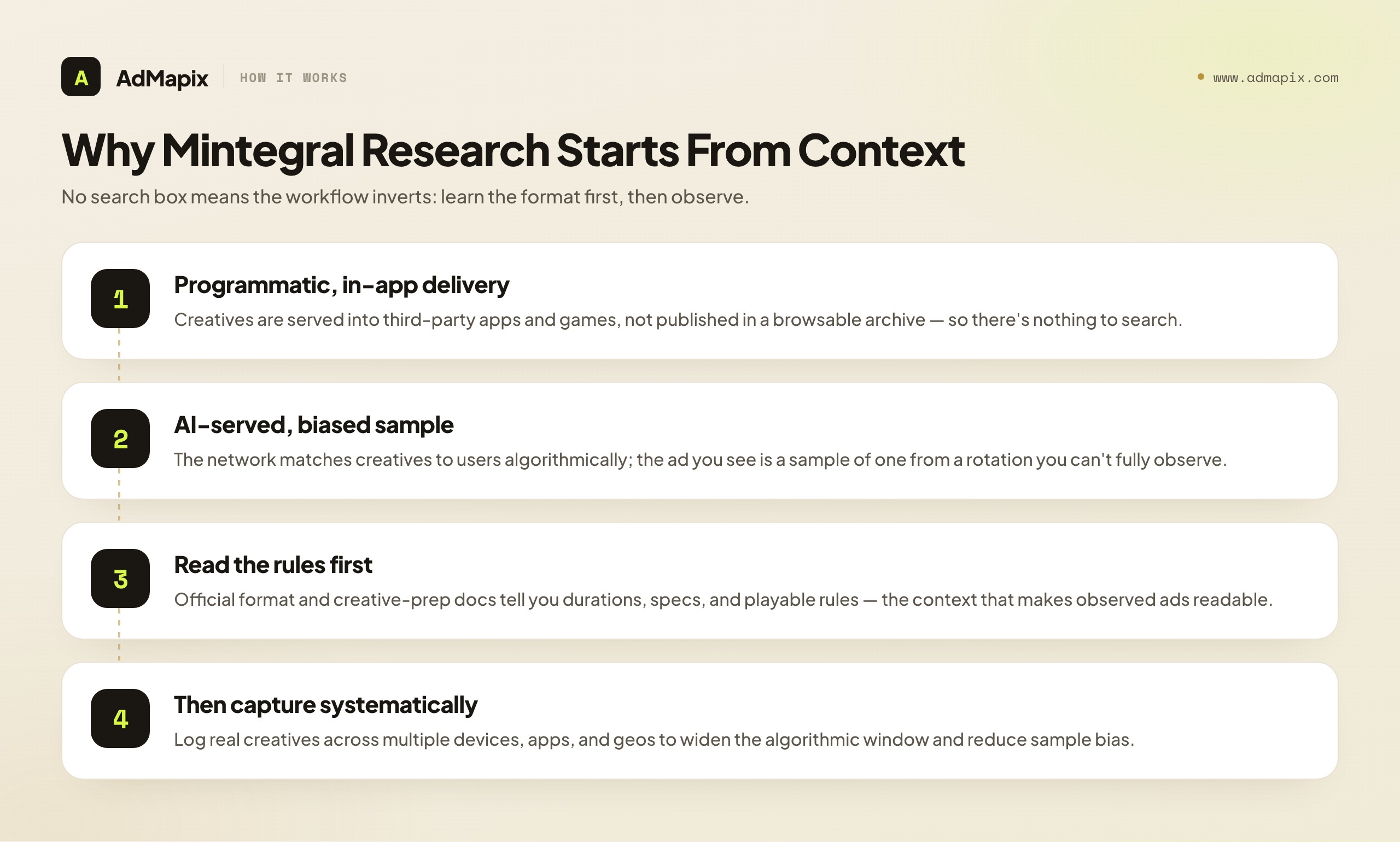
Why Mintegral Research Starts From Network Context, Not a Search Box
On the social platforms, research starts with a query: type an advertiser, get their creatives. On Mintegral, research starts with context — understanding how the network expects creatives to be built and where they will appear — and only then moves to collecting real examples. There are two practical reasons for this inversion.
First, the format constrains the creative more tightly than on social. A Meta advertiser can run almost anything: static image, carousel, long-form video, UGC testimonial, meme. Mintegral's inventory is dominated by a few specific formats with hard technical and behavioral constraints — rewarded video that must hold attention for a fixed duration, interstitials with a forced view window and a close button on a timer, and playables that have to load fast and teach a mechanic in seconds. If you do not understand those format constraints first, you will misread the creatives you observe, mistaking format-driven choices for strategic ones.
Second, the network's optimization layer does a lot of the creative selection for you — and hides it from you. Mintegral's AI matches creatives to users and inventory programmatically. That means the same advertiser may show wildly different creatives to different users, and the creative you happen to see is a sample of one from a rotation you cannot fully observe. On social, the ad library shows you the advertiser's whole active set. On Mintegral, you see whatever the algorithm decided to serve into the app you happened to be using, at the moment you were using it. Your sample is biased by your own device profile, geography, and the apps you test in.
So a sound Mintegral ad-intelligence workflow has two halves that feed each other. The official side — Mintegral's own AppGrowth documentation, creative-preparation guidance, format specs, and best-practice material — tells you the rules of the game: what formats exist, what durations and specs apply, how the AI optimization is positioned, and how the network frames "good" creative. The observed side — the real interstitials, rewarded videos, and playables you and your team capture in the field — tells you what competitors are actually shipping within those rules. Neither half is sufficient alone. Official guidance without observation is theory; observation without context is noise.
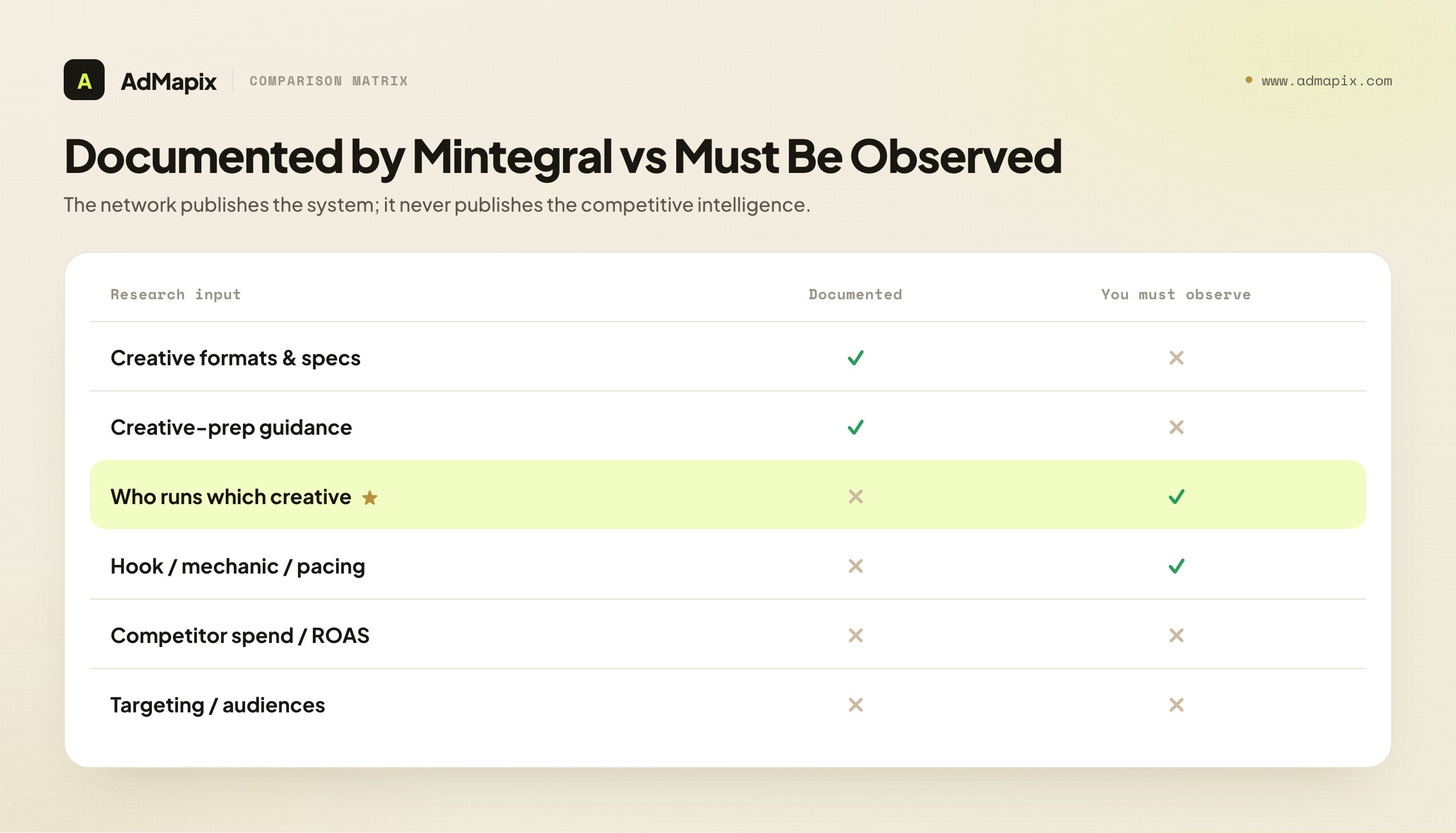
What Mintegral Officially Documents vs. What You Must Observe
The cleanest way to set expectations is to draw the line between what Mintegral itself makes available and what you have to assemble yourself. The table below is the boundary every Mintegral researcher should keep in mind.
| Research input | Documented by Mintegral | Must be observed / assembled by you |
|---|---|---|
| Creative formats (rewarded video, interstitial, playable, banner) | Yes — formats and specs are described in platform docs | Which specific competitor uses which format, and how often |
| Creative production / structure guidance | Yes — setup, structure, scaling, measurement are covered | The actual hook, mechanic, pacing, and end card of a live ad |
| AI optimization and UA positioning | Yes — described at a platform level | Whether a given creative is actually a winner for its advertiser |
| Technical specs (durations, dimensions, file size, playable rules) | Yes — published as creative requirements | How competitors push or bend those specs creatively |
| Competitor ad spend / budget | No — not published anywhere | Cannot be reliably inferred from a single visible ad |
| Targeting / audience segments | No | Cannot be inferred from a visible ad you happened to see |
| ROAS / install volume / retention | No | Cannot be inferred; only the advertiser knows |
| A complete per-advertiser creative feed | No — there is no public library | Built manually, sample by sample, over time |
The right mental model: Mintegral documents the system (formats, specs, optimization philosophy) but never the competitive intelligence (who spends what, who targets whom, who wins). The system knowledge is freely available and you should absorb it. The competitive intelligence has to be reconstructed from observed creatives — and reconstructed carefully, because the gap between "I saw this ad" and "this ad is a top performer" is wide.
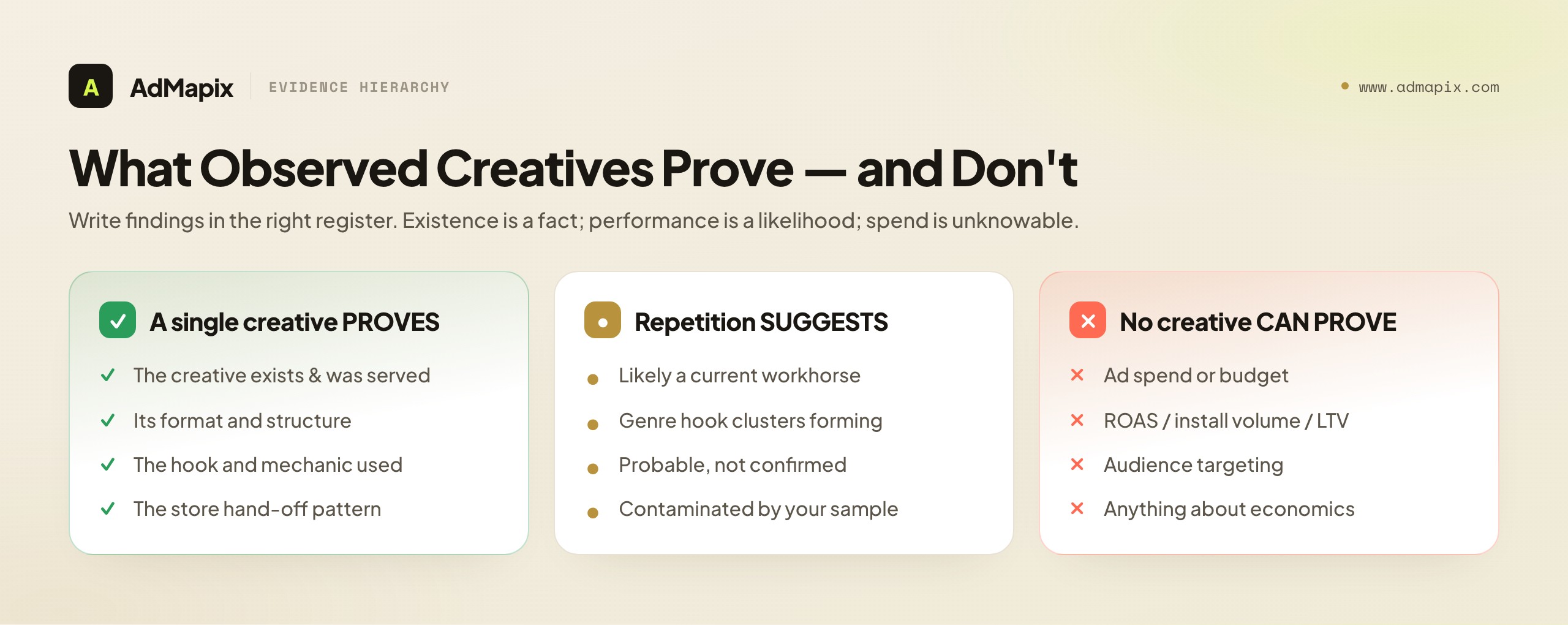
What Observed Mintegral Creatives Can and Cannot Prove
This is the single most important section, because it is where over-claiming destroys the credibility of an entire analysis. A competitive deck that asserts "Competitor X is spending heavily on this hook" based on having seen one ad three times is worse than no deck at all — it sounds authoritative and is unfounded.
Here is the honest hierarchy of what a visible Mintegral creative actually establishes.
What a single observed creative proves: that the creative exists and was served, at least once, to a device profile like yours, in an app like the one you saw it in, at a point in time. That is genuinely useful. It tells you the advertiser is active, what format they chose, what hook and mechanic they used, how they structured the spot, and what their store hand-off looks like. Those are real, citable creative facts.
What repeated observation suggests (but does not prove): that the creative is probably performing well. Mintegral's optimization tends to serve more impressions to creatives that convert, so a creative you see repeatedly, across multiple sessions and ideally multiple apps, is more likely to be a winner than one you saw once. This is your strongest practical signal — but it is correlational and contaminated by your own sample bias. You see a creative often partly because it works, and partly because your device profile matches its targeting. Treat repetition as a likelihood indicator, never as confirmation.
What no observed creative can prove: spend, budget, ROAS, install volume, retention, lifetime value (LTV), or audience targeting. None of these are encoded in the creative. You can see a polished, expensive-looking playable and have no idea whether it is profitable. You can see a cheap-looking video and not know it is the advertiser's top earner. The creative is the output of a media strategy; it does not carry the strategy's results. Anyone who tells you they can read spend off a creative is guessing and labeling the guess as data.
The discipline, then, is to write your findings in the right register. Say "we observed this hook repeatedly across two rewarded-video placements, suggesting it may be a current workhorse for this advertiser" — not "this is their top-spending creative." The first is defensible; the second is fiction. This honesty is exactly what separates a research function that earns trust from one that gets ignored after the first time a confident claim turns out to be invented.
The Eight-Step Mintegral Creative Research Workflow
With expectations set, here is a repeatable workflow that produces real, testable output from a network with no search box. The goal is not a one-time heroic sprint; it is a standing system that compounds.
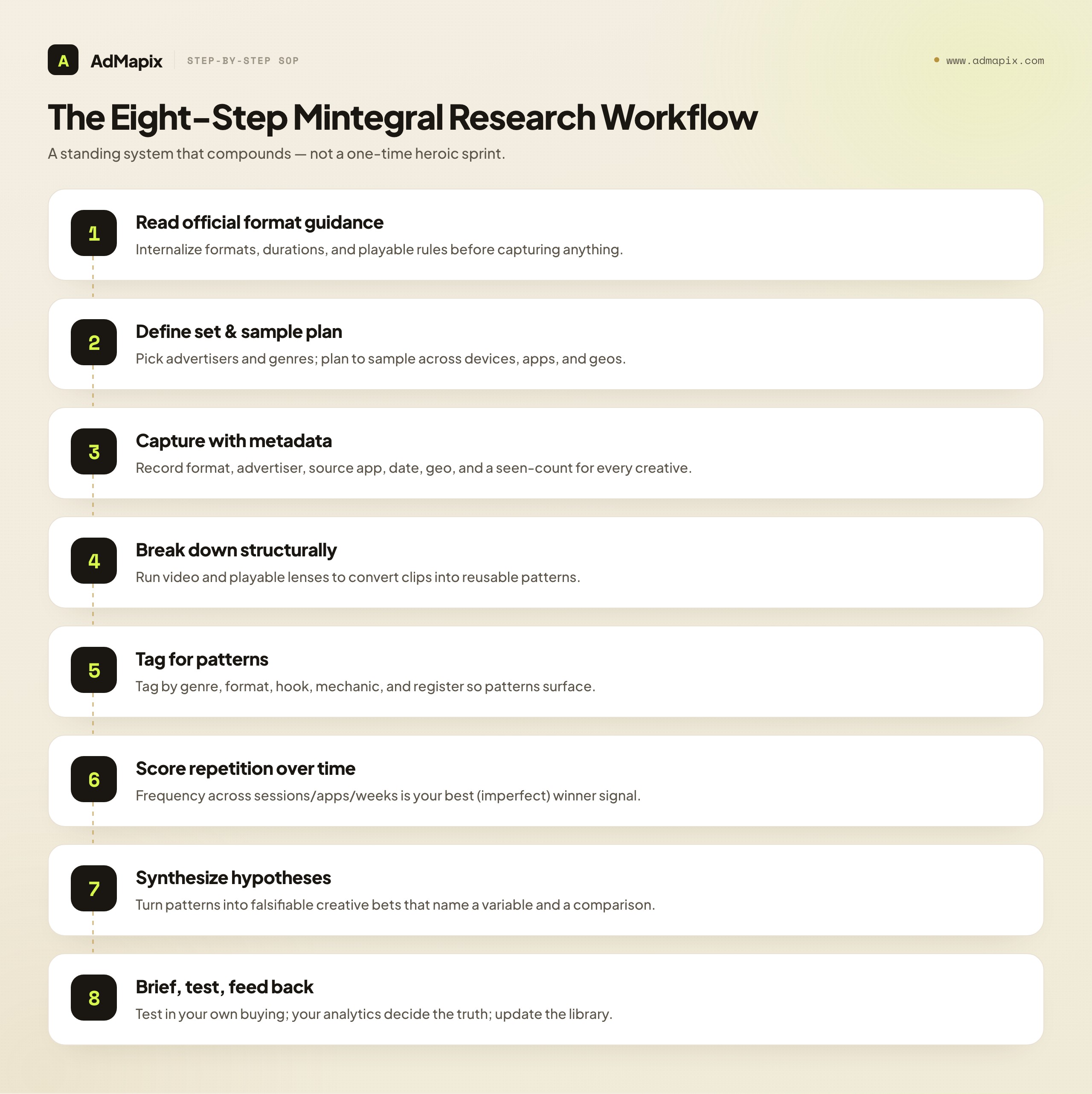
Step 1 — Read the official format and creative-prep guidance first. Before you capture a single ad, internalize Mintegral's documented formats, durations, dimensions, and playable rules. This is the context layer. It prevents you from misreading format-driven choices as strategy and gives you the vocabulary to describe what you see.
Step 2 — Define your competitive set and the device profiles you will sample from. Decide which advertisers and which genres you care about (hyper-casual, mid-core RPG, casino, fitness, utility). Your sample is biased by your device, so plan it: use multiple test devices or profiles, vary the apps you trigger ads in, and note geography. A single phone gives you a single, narrow window.
Step 3 — Capture creatives systematically, with metadata. When you encounter a Mintegral-served creative, record more than the video. Capture the format (rewarded vs. interstitial vs. playable), the advertiser, the app you saw it in, the date, the device/geo, and — critically — whether you have seen it before. Screen recordings beat memory. A capture without metadata is nearly useless three weeks later.
Step 4 — Break down each creative structurally. For video: hook (first 2–3 seconds), problem/promise, demonstration, social proof or escalation, and end card / call to action. For playables: load experience, the mechanic taught, the friction or false-difficulty design, the win/lose loop, and the store hand-off. Structural breakdown is what converts a clip into a reusable pattern.
Step 5 — Tag for patterns, not just storage. Tag by genre, format, hook type, mechanic, art style, and emotional register. Tags are what let patterns surface across dozens of examples. "Casino + fake slot machine + near-miss tension + tap-to-spin playable" is a pattern; an untagged folder of videos is a graveyard.
Step 6 — Score repetition over time. Maintain a simple frequency count. A creative seen once is a data point; a creative seen across multiple sessions, apps, and weeks is a likely workhorse. This longitudinal view is the closest you can responsibly get to "winner" detection without spend data.
Step 7 — Synthesize into testable hypotheses. Convert observed patterns into specific, falsifiable creative bets: "Rewarded-video competitors in our genre lead with a 2-second failure hook, not a feature; we should test a failure-led hook against our current feature-led one." A hypothesis names the variable and the comparison.
Step 8 — Brief, test, and feed results back. Hand the synthesized patterns to your creative team as a brief, run the tests in your own media buying, and measure with your own analytics — the only place real ROAS lives. Then fold the outcome back into your library so the next cycle is smarter. Mintegral research informs the brief; your test data decides the truth.
Reading Mintegral Video Creatives: A Structural Lens
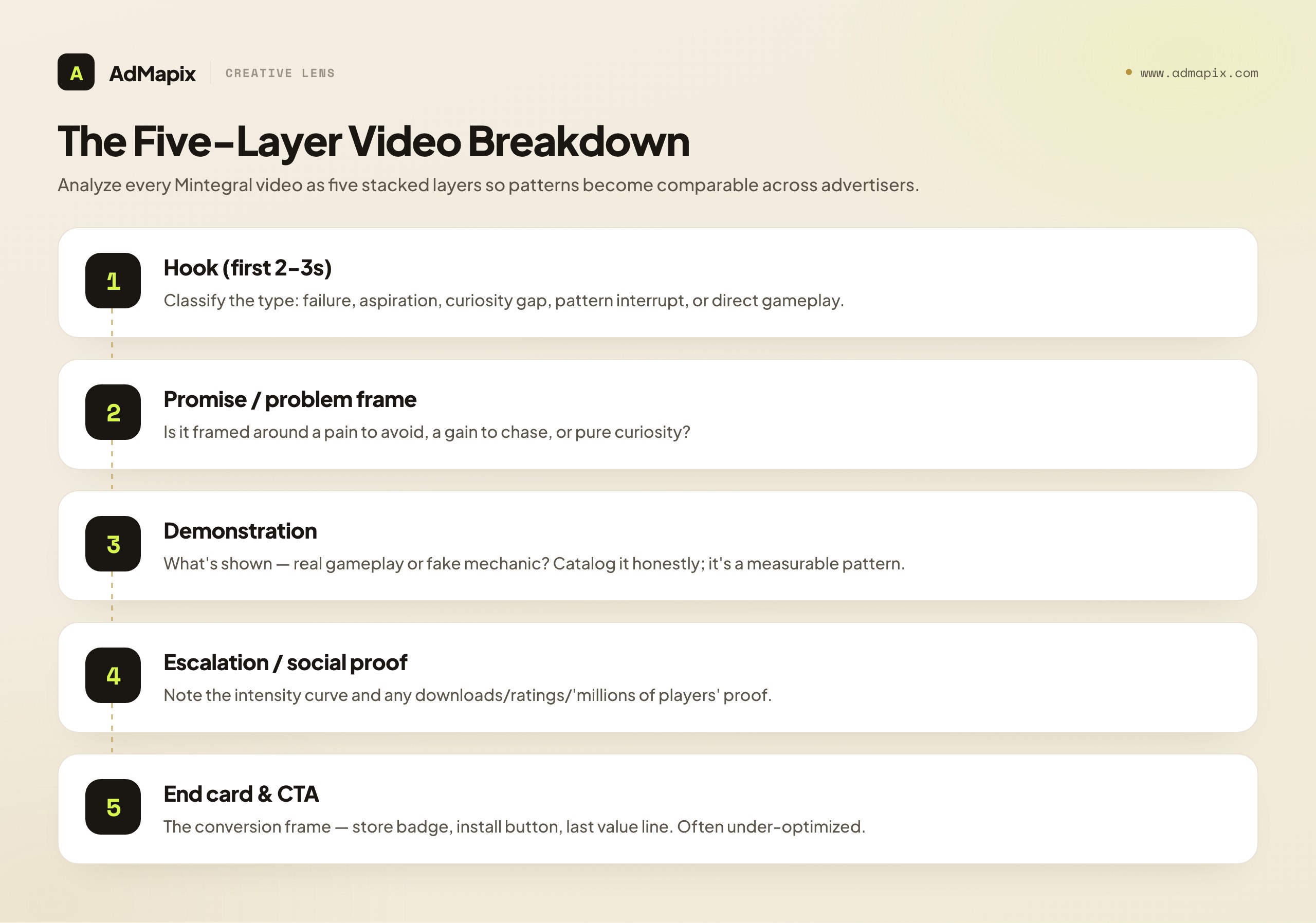
Video is the most common Mintegral surface, and it rewards a consistent breakdown method. Treat every observed video as five layers stacked in time, and analyze each layer separately so patterns become comparable across advertisers.
The hook (first 2–3 seconds). Mintegral video lives or dies in the opening. Because the format is interruptive — it appears between levels or in exchange for a reward — the creative has milliseconds to justify attention. Catalog the hook type: failure/frustration ("you've been playing it wrong"), aspiration ("become the strongest"), curiosity gap ("can you solve this?"), pattern interrupt (a surprising visual), or direct gameplay. Across a genre, hook types cluster, and the cluster tells you what the network's optimization has been rewarding.
The promise or problem frame. Right after the hook, most effective Mintegral videos establish a tension or a promise: a problem to solve, a goal to chase, a transformation to witness. Note whether the advertiser frames around a pain (avoid this), a gain (achieve this), or pure curiosity.
The demonstration. This is where the product or game is shown — sometimes accurately, sometimes deceptively. Mobile gaming is notorious for "fake gameplay" ads that show a mechanic the actual game does not contain. Whether you approve of the tactic or not, you must catalog it, because it is a dominant and measurable pattern in the space. Our deep dive on fake mobile game ads and the broader mobile game ads guide unpack why this persists and how it is structured.
The escalation or social proof. Many videos build intensity — more enemies, bigger numbers, a near-loss recovered — or insert social proof (downloads, ratings, "millions of players"). Note the escalation curve; flat creatives and steeply escalating creatives are different bets.
The end card and call to action. The final frame is the conversion moment: the store badge, the install button, the last value statement. End cards are surprisingly under-optimized by many advertisers, which makes them a frequent source of testable improvement for you.
Run every observed video through these five layers and your library stops being a pile of clips and becomes a comparable matrix. That matrix is where Mintegral ad intelligence actually lives.
Reading Mintegral Playable Ads: The Signature Surface
Playables deserve their own lens because they are central to Mintegral and behave nothing like video. A playable is a tiny, interactive demo — the user taps, swipes, or drags inside the ad itself — and the analysis questions are interactive, not cinematic. If you analyze a playable with a video checklist, you will miss the point entirely. Our playable ads guide and playable ad examples go deep; here is the research lens condensed.
Load and first interaction. Playables must load fast and invite a tap within seconds. Catalog how quickly the playable becomes interactive and what the very first interaction is. A playable that makes the user wait or guess is leaking conversions, and seeing that in a competitor's playable is a gift.
The taught mechanic. Every good playable teaches one core mechanic — merge, match, build, shoot, sort, pull-the-pin. Identify the single mechanic and whether the playable teaches it cleanly. The mechanic is the strategic choice; everything else is presentation.
Friction and false difficulty. Many playables deliberately make the user almost succeed, or let them "fail" in a way that motivates a retry inside the real game. Some block interaction until a forced tap. Catalog these manipulations honestly — they are widespread and they are testable variables.
Win/lose loop and emotional payoff. Does the playable end in a satisfying win, a cliffhanger, or a forced failure? The emotional state the user is left in shapes the install decision. Note it.
Store hand-off. The transition from playable to store is the conversion seam. Is it a clear button, an auto-redirect, a "continue in app" frame? Friction here kills otherwise-strong playables. Document the hand-off pattern for each competitor.
Because playables are interactive, capturing them is harder than capturing video — a screen recording shows the surface but not the interactive logic. When you log a playable, write a short interaction script describing what the user does and what the playable does in response. That script is the analyzable artifact.
Building a Standing Mintegral Creative Library
The teams that consistently win at Mintegral research do not rely on memory or one-off hunts. They build a standing, tagged library and refresh it on a cadence. Here is how to structure one so it compounds rather than rots.
Capture is continuous, not episodic. Set a rhythm — a weekly capture session across your test devices, plus opportunistic capture whenever a team member sees something notable in the wild. The value of a creative library is longitudinal; it is the change over time that reveals strategy shifts, seasonal pushes, and new entrants.
Metadata is mandatory at capture time. Every entry needs format, advertiser, genre, source app, date, device/geo, and a first-seen / last-seen pair for frequency. Metadata added later is metadata that never gets added. Build the capture template so these fields are required.
Tags are the retrieval engine. A library you cannot query is a hoard. Tag by hook type, mechanic, art style, emotional register, and pattern. The payoff is queries like "show me every failure-hook rewarded video in casino over the last quarter" — that query is an insight generator.
Frequency is your proxy for performance. Maintain a seen-count and a recency stamp. Sort by frequency to surface likely workhorses; sort by recency to spot fresh tests. Neither is spend, and you must keep saying so, but together they are the best free signal available.
Recurring reports turn the library into decisions. A library that nobody reads is overhead. Produce a recurring report — monthly is a sane default — that surfaces the top recurring patterns, new entrants, and notable shifts, and routes them to the creative team as briefs. The report is the product; the library is the raw material.
This is precisely the seam where a cross-network creative-evidence tool earns its place, which is the next section.
Where AdMapix Fits — and Where It Honestly Does Not
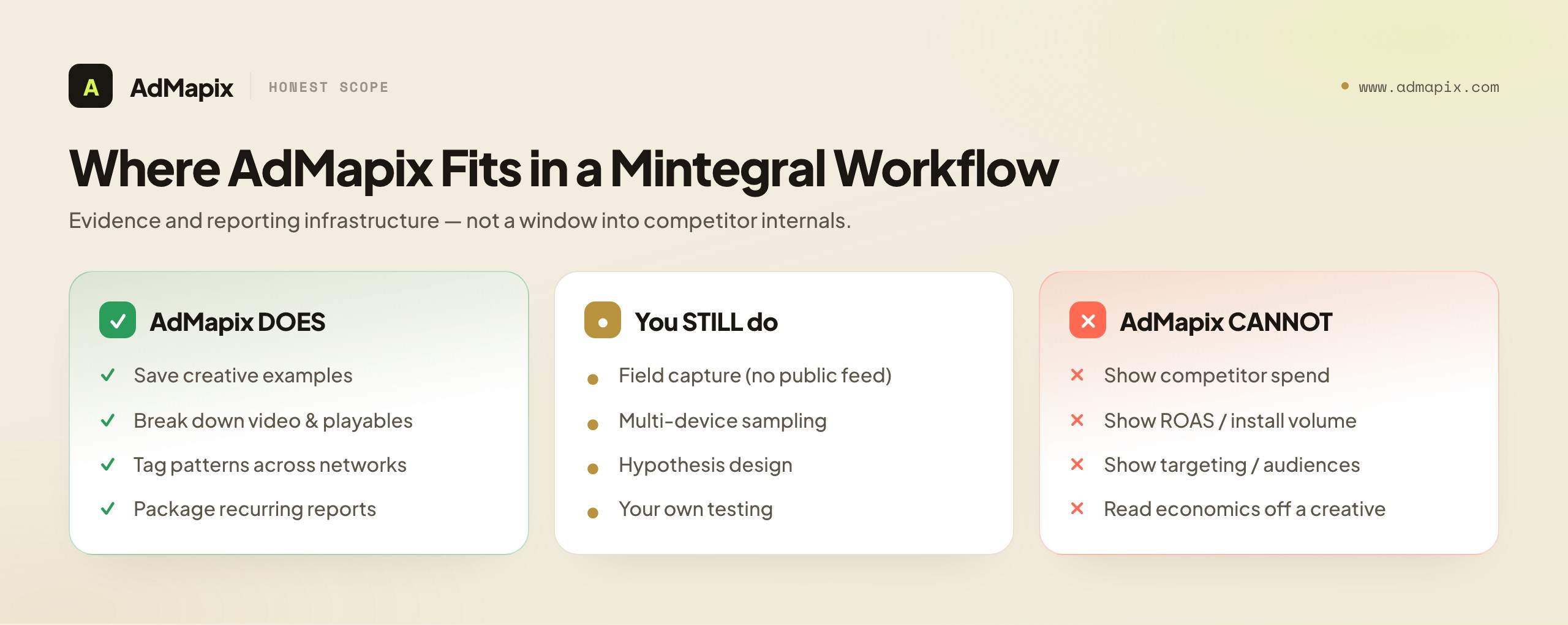
Let us be exact about this, because vague tool claims are how the whole category lost trust. AdMapix is a cross-network creative-evidence layer. It is good at the collection, breakdown, tagging, and reporting half of the workflow above. It is built to save creative examples, break down video and playable structure, tag patterns by genre and format, and package recurring reports you can hand to a creative team or a client. For a Mintegral researcher, that maps directly onto Steps 3 through 8 of the workflow: capture with metadata, structural breakdown, tagging, and recurring reporting.
What AdMapix is not, and cannot be, given how Mintegral works: it is not a Mintegral spend tracker, not a ROAS or install-volume source, and not a targeting or audience window. No tool can read those off a visible creative, because they are not in the creative. AdMapix does not magically acquire competitor budgets, returns, or audience segments for Mintegral or any other programmatic mobile network — that data simply is not public, and we will not pretend otherwise. If a vendor claims to show you competitor Mintegral spend or ROAS, treat that claim with deep skepticism and ask exactly how it is derived; for in-app programmatic networks, the honest answer is "it is modeled, and the model is unverifiable against ground truth."
So the right way to position AdMapix in a Mintegral workflow is as the evidence and reporting infrastructure around your own observation. You still do the field capture (the network has no public feed; nobody can skip that for you). What AdMapix accelerates is everything after capture: keeping the evidence organized, breaking it down consistently, surfacing patterns across networks (so you can compare a Mintegral hook to an AppLovin or Unity one), and producing the recurring report that turns the library into briefs. That is a real, useful job — and it is a different job from the impossible one of revealing competitor internals. For the wider tool landscape and how creative-evidence layers sit next to estimate-heavy suites, see best ad intelligence tools and best ad spy tools 2026.
Mintegral vs Other Mobile-UA Networks for Creative Research
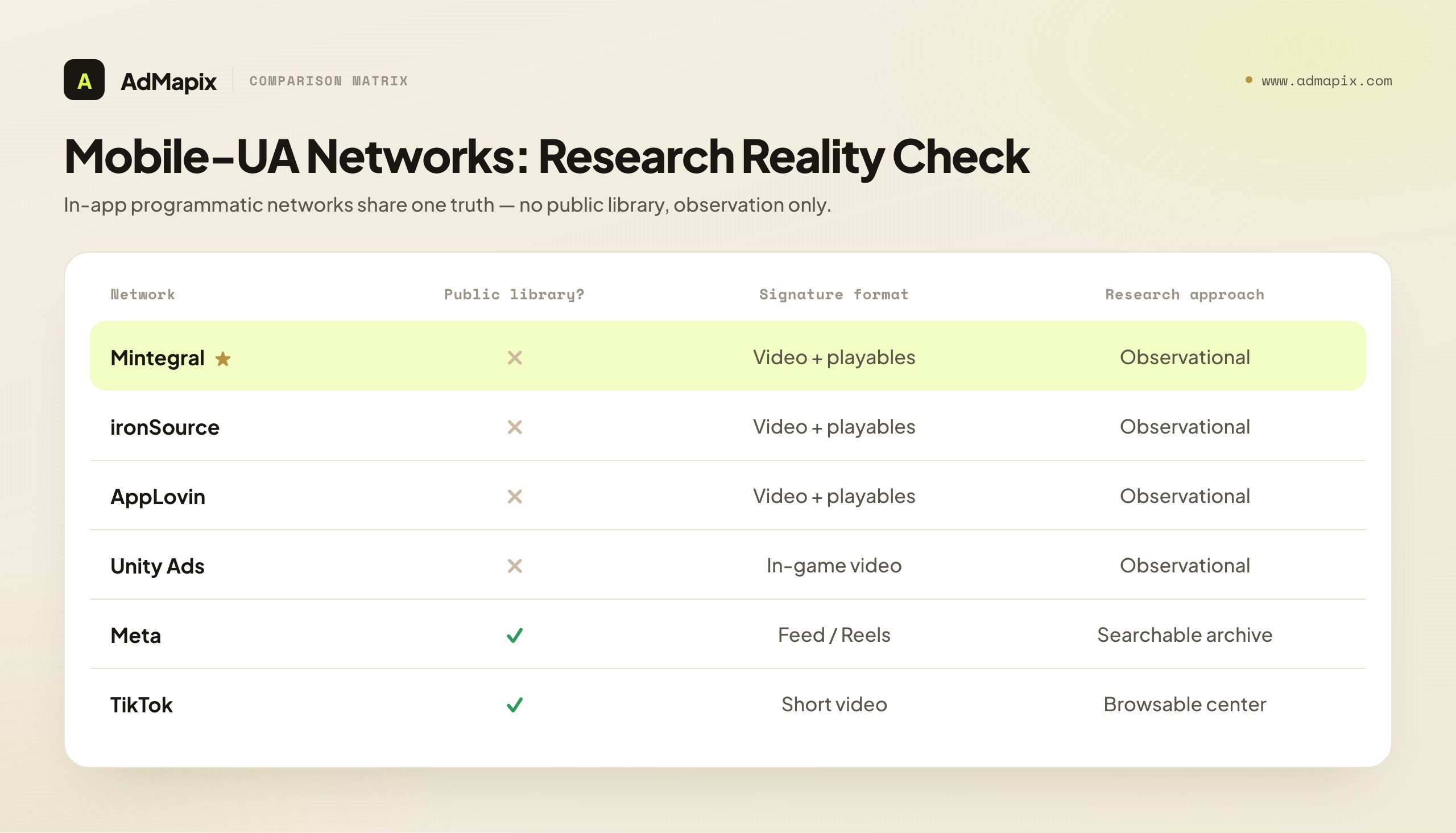
Mintegral is one node in a programmatic mobile ecosystem that all shares the same "no public ad library" reality. Understanding how the major networks compare for research purposes helps you allocate effort and set the right expectations per network.
| Network | Public ad library? | Signature format | Research approach |
|---|---|---|---|
| Mintegral | No | Rewarded video + playables | Observational capture + tagging; AI-served, biased sample |
| ironSource | No | Rewarded video + playables | Observational; similar in-app dynamics |
| AppLovin | No | Video + playables (AXON-optimized) | Observational; heavy algorithmic serving |
| Unity Ads | No | In-game video + playables | Observational; deep game inventory |
| Moloco | No | Programmatic in-app | Observational; ML-driven, opaque rotation |
| Meta | Yes (Ad Library) | Feed/Reels/Stories | Searchable archive; whole active set visible |
| TikTok | Yes (Creative Center) | Short video | Browsable discovery surface |
The pattern is stark: the in-app programmatic networks (Mintegral, ironSource, AppLovin, Unity, Moloco) are all observational, while the social platforms publish browsable libraries. This is why a unified creative-evidence workflow matters — your Mintegral research and your Meta research will use different collection methods (observation vs. library lookup) but should feed the same analysis and reporting system. For the network-by-network detail, see ironSource ad intelligence, Moloco ad intelligence, AppLovin ads spy tool, Unity Ads spy tool, and the umbrella mobile game ad spy tool overview.
Common Mistakes in Mintegral Ad Intelligence (and the Fixes)
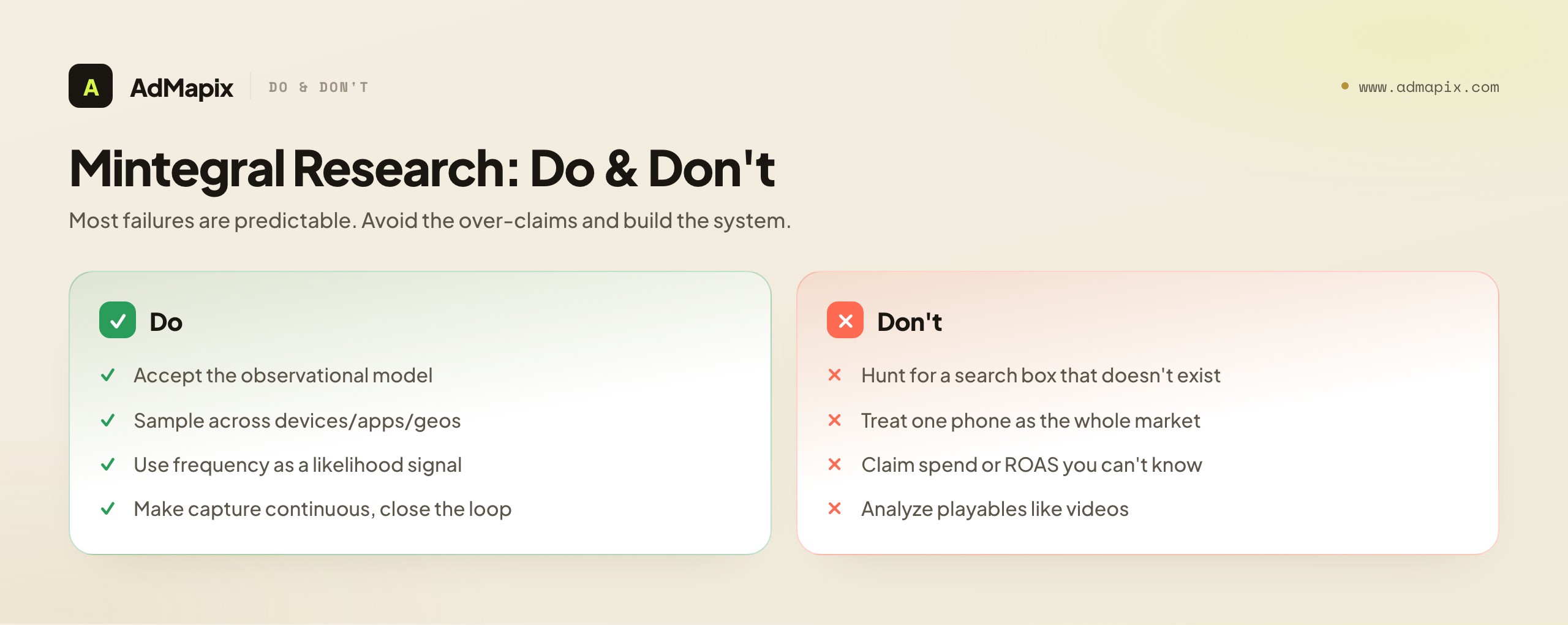
Most Mintegral research failures are predictable. Here are the recurring ones and how to avoid them.
Mistake 1 — Looking for a search box. Teams burn hours hunting for a Mintegral ad library that does not exist, then conclude "there's no data." There is plenty of data; it just has to be observed. Fix: accept the observational model from day one and build a capture system instead of a search habit.
Mistake 2 — Treating your sample as representative. Because Mintegral serves algorithmically, the creatives you see are skewed by your device, apps, and geography. A single phone gives a single, narrow slice. Fix: sample across multiple devices/profiles, apps, and geos, and explicitly note your sample's limits in any report.
Mistake 3 — Confusing "I saw it" with "it won." One observation proves existence, not performance. Fix: use frequency over time as your likelihood signal, and write findings in the language of probability, not certainty.
Mistake 4 — Capturing without metadata. A folder of unlabeled clips is worthless in three weeks. Fix: make format, advertiser, app, date, geo, and seen-count mandatory at capture.
Mistake 5 — Analyzing playables like videos. A cinematic checklist misses the interactive logic that makes a playable convert. Fix: use the interaction-script lens — load, mechanic, friction, loop, hand-off.
Mistake 6 — Claiming spend or ROAS. The fastest way to lose internal trust is to assert competitor budgets you cannot know. Fix: state plainly that spend, ROAS, and targeting are not observable, and confine your claims to creative facts.
Mistake 7 — One-and-done research. A single sprint produces a snapshot; strategy lives in the trend. Fix: make capture continuous and reporting recurring.
Mistake 8 — Not feeding results back. Research that never returns to test data cannot improve. Fix: close the loop — every brief produces a test, every test result updates the library.
A Worked Example: Researching a Hyper-Casual Competitor on Mintegral
To make this concrete, here is how the workflow plays out for a realistic (composite, illustrative) case: you run a hyper-casual puzzle game and want to understand how a rival is acquiring users through Mintegral.
Context first. You review Mintegral's documented playable and rewarded-video specs, so you know the duration windows and playable constraints your rival is working within. This is the rules-of-the-game layer.
Sample design. You set up three test profiles on different devices, install a handful of free hyper-casual and casual games (the apps most likely to serve competing puzzle ads), and run capture sessions over two weeks across two geographies. You are deliberately widening the algorithmic window.
Capture. Across sessions you log eleven distinct creatives from the rival: six rewarded videos and five playables, each with format, source app, date, geo, and a seen-count.
Breakdown. Running the video lens, you find their rewarded videos almost all open with a failure hook — a deliberately wrong move that frustrates — followed by a satisfying solve. Running the playable lens, you find their playables teach the same single merge mechanic with a forced near-win before the store hand-off.
Frequency. Two of the eleven creatives show up in nearly every session across both geos; the other nine appear sporadically. Those two are your likely workhorses — likely, because frequency correlates with performance but is contaminated by your sample.
Synthesis. The pattern is clear enough to bet on: the rival leads with failure-hook video and forced-near-win playables, both ending in a hard store push. Your current creatives lead with feature showcases and end softly.
Hypothesis and test. You write two falsifiable bets — "a failure-led video hook will beat our feature-led hook" and "a forced-near-win playable will beat our free-play playable" — and run them in your own buying. Your analytics, not the observation, will tell you the truth. Whatever the result, it goes back into the library, and your next research cycle starts smarter.
Notice what this example never claims: it never states the rival's spend, ROAS, or install numbers. It works entirely from creative evidence and frequency, expressed in the language of likelihood, and it ends with your test as the arbiter. That is responsible Mintegral ad intelligence.
How Often to Refresh, and What "Good" Looks Like
A reasonable cadence for most teams is a weekly capture session plus opportunistic captures, rolled into a monthly synthesis report. Hyper-casual and other fast-moving genres may justify a tighter loop because creative churn is rapid; mid-core and strategy genres can run slower because creatives live longer. The right cadence is the one that catches strategy shifts before they become obvious in your own performance data.
"Good" Mintegral ad intelligence is not a giant one-time deck. It is a living system with four properties: a broad sample (multiple devices, apps, geos), consistent breakdown (every creative run through the same lens), honest framing (creative facts and likelihood signals, never invented spend), and a closed loop (every insight ends in a test whose result updates the library). A team that has those four properties will out-research a team with a bigger budget and a sloppier method every time.
Understanding Mintegral's Formats in Depth
You cannot read a creative correctly without understanding the box it was built in, so it is worth spending real time on the formats themselves. Each Mintegral surface carries constraints that shape — and often dictate — the creative decisions you will observe, and confusing a constraint for a strategy is the most common analytical error.
Rewarded video. The user opts in to watch in exchange for an in-game reward (currency, an extra life, a hint). Because the view is voluntary and compensated, completion rates are high, which means the whole video matters, not just the first three seconds. This is the opposite of feed video, where the scroll can kill you instantly. When you analyze rewarded video, weight the middle and the end more heavily than you would on social — advertisers who understand the format build a satisfying arc across the full duration and place the store push at the moment of peak emotional payoff. If you see a rewarded video that front-loads everything and goes flat, that is often a creative ported from another channel without re-thinking the format.
Interstitial video. The full-screen ad that appears between actions — after a level, on app open, at a natural break. Unlike rewarded video, it is interruptive and uninvited, so the open has to earn the next two seconds before the close button becomes tappable. Interstitials reward strong hooks and tight pacing far more than rewarded video does. When you compare an advertiser's interstitial and rewarded creatives, you are seeing how well they tailor to format; many do not, and that gap is itself an insight.
Playable ads. Covered in depth above, but worth restating in the format context: playables are the highest-intent, highest-production surface, and they are where Mintegral's interactive identity lives. They carry strict load-time and file-size constraints, which is why you will see playables strip away everything non-essential to teach one mechanic fast. A bloated playable is a losing playable, and observing how a competitor prunes theirs to the bone is a masterclass in priority.
Banners and other formats. Lower-intent, lower-information surfaces. They rarely repay deep creative analysis, but note their presence — an advertiser leaning on banners alongside video and playables is signaling a broad, volume-oriented buy, while one running only premium playables is signaling a focused, quality-first approach. Even the mix of formats is a (soft) strategic signal.
The discipline is to always ask "is this choice format-driven or strategy-driven?" before recording it as an insight. A short hook in an interstitial may just be the format demanding it; a short hook in a rewarded video, where the user already opted in, is a more deliberate choice worth flagging.
Connecting Mintegral Research to the Broader Creative Strategy
Mintegral research does not live in isolation. It is one input into a creative strategy that should span every network you buy on, and its real value emerges when you connect it to the rest of your intelligence picture rather than treating it as a siloed exercise.
Cross-network pattern transfer. Hooks and mechanics that win on Mintegral often have analogues on AppLovin, Unity, and ironSource, because the in-app audience and the format constraints overlap heavily. When you spot a failure-hook pattern dominating Mintegral rewarded video in your genre, check whether the same pattern is appearing on the sibling networks. Convergence across networks is a much stronger signal than dominance on one — it suggests the pattern is winning broadly, not just in one network's algorithmic quirk. This is precisely why a unified analysis-and-reporting system across networks is worth building: it turns isolated observations into cross-validated patterns.
Social-to-in-app translation. The social platforms (Meta, TikTok) do have public libraries, so they are your cheapest source of broad creative trend data. Patterns you spot in the searchable social libraries can become hypotheses to look for — and adapt for — on Mintegral. A UGC-style hook trending on TikTok may translate into a rewarded-video opener on Mintegral with the right adaptation. Use the transparent networks as a trend radar and the opaque ones (Mintegral included) as a confirmation and adaptation layer.
Feeding the creative production pipeline. The endpoint of all research is shipped creative. Mintegral patterns should arrive at your creative team as briefs with specific, format-aware asks: "build a rewarded video with a failure hook and a peak-payoff store push at the 25-second mark," not "make a Mintegral ad." The more format-aware and pattern-specific your brief, the more your research compounds into better creative rather than evaporating into a deck nobody actions.
The honest boundary, restated. Across all of this, the boundary never moves: you are working with creative evidence, not competitor economics. Cross-network convergence makes a creative pattern more believable as a winner, but it still does not tell you anyone's spend, ROAS, or targeting. The strength of a connected creative-research practice is breadth and cross-validation of creative signal — not access to private performance data, which remains unavailable across every network discussed here.
A Practical Capture Toolkit and Sampling Discipline
The mechanics of capture deserve their own treatment, because the quality of your Mintegral research is capped by the quality of your sampling. Sloppy capture produces a narrow, biased pile of clips that looks like data and misleads like opinion.
Devices and profiles. Use at least two or three test devices with genuinely different profiles — different installed-app histories, different ages of account, ideally different operating systems. Mintegral's optimization personalizes by signal, so identical fresh devices will tend to converge on the same creatives, defeating the purpose. Variety in the device fleet is variety in the algorithmic window.
App selection. Trigger ads inside a spread of apps that are likely to carry your competitors' creatives — typically free games in adjacent genres, plus a few utility and casual apps. The publisher app shapes which advertisers' inventory you see, so a narrow app list narrows your sample. Rotate the apps over time as well; inventory and demand shift.
Geography and timing. If your competitors run in multiple regions, you need samples from those regions, which may require a device or network presence there. Timing matters too: creative rotations shift around seasons, launches, and weekends. A sample taken only on weekday mornings is a partial sample.
Recording and storage. Screen recording is the baseline for video; for playables, pair the recording with a written interaction script as discussed. Store everything with the mandatory metadata fields, and never let a capture into the library without them. The thirty-second discipline of tagging at capture time saves hours of useless archaeology later.
Sample-bias disclosure. Every report you produce from observational Mintegral data should carry an explicit note on its sample: how many devices, which apps, which geos, what date range. This is not bureaucratic hedging — it is what lets a reader weight your conclusions correctly and what protects your credibility when someone with a different sample saw different creatives. A report that hides its sampling is a report that will eventually embarrass its author.
Scaling capture across a team. When more than one person captures, standardize ruthlessly: a shared template with required fields, a shared tagging vocabulary, and a single library everyone writes to. The fastest way to wreck a multi-person research effort is to let each analyst invent their own tags and folders, because the patterns that matter only emerge when everyone's captures are comparable. Spend an hour up front agreeing on the tag taxonomy — hook types, mechanics, art styles, registers — and enforce it. The taxonomy is infrastructure; treat it like code, version it, and refine it deliberately rather than letting it sprawl. A disciplined small team with a shared taxonomy will produce sharper Mintegral intelligence than a large, uncoordinated one, because coordination is what converts scattered observation into pattern.
FAQ
Does Mintegral have a public ad library like Meta or TikTok?
No. Mintegral is a programmatic mobile advertising and monetization network, and its creatives are served into third-party app and game inventory rather than published in a browsable transparency archive. There is no search box where you type a competitor's name and pull their creatives. Mintegral ad intelligence is therefore observational — you capture the real creatives you encounter in the field and assemble your own library — rather than a database lookup.
Can Mintegral ad intelligence show me a competitor's ad spend?
No, and you should be wary of any tool that claims it can. Spend, budget, ROAS, install volume, and targeting are not encoded in a visible creative; they live in the advertiser's own systems and in Mintegral's private platform data. The most you can responsibly infer from observation is that a creative exists and, from repeated observation over time, that it is probably performing. Any specific spend figure attached to a Mintegral competitor is a model output, not a measurement, and should be treated as such.
What can I actually learn from observing Mintegral creatives?
A great deal about the creative itself: the format chosen (rewarded video, interstitial, playable), the hook, the structure and pacing, the mechanic a playable teaches, the use of social proof or fake gameplay, the escalation curve, and the store hand-off. You can also build a likelihood signal from frequency — creatives seen repeatedly across sessions, apps, and geos are more likely to be workhorses. What you cannot learn is anything about the campaign's economics or targeting.
How do I research Mintegral creatives without a search box?
Build a capture system. Read Mintegral's official format and creative-prep documentation for context, define your competitive set and sample across multiple devices/apps/geos, capture creatives with full metadata, break each one down through a consistent video or playable lens, tag for patterns, score by frequency over time, synthesize into testable hypotheses, and feed test results back into the library. It is observational and continuous, not a one-time query.
Why do the creatives I see differ from what my colleague sees?
Because Mintegral serves creatives programmatically, matched to user and inventory by AI. Your device profile, the apps you trigger ads in, your geography, and timing all shape which creatives the network serves you. You are each seeing a biased sample of a rotation neither of you can fully observe. This is why broadening your sample — multiple devices, apps, and geos — materially improves research quality.
Are Mintegral playables analyzed the same way as video?
No. Playables are interactive, so the analysis lens is different: load and first interaction, the single mechanic taught, friction and false-difficulty design, the win/lose loop, and the store hand-off. A cinematic video checklist (hook, demo, end card) misses the interactive logic that actually drives a playable's conversion. When you log a playable, write a short interaction script describing what the user does and how the playable responds, because that script — not just a screen recording — is the analyzable artifact.
How does AdMapix help with Mintegral research?
AdMapix is a cross-network creative-evidence layer that accelerates the post-capture half of the workflow: saving creative examples, breaking down video and playable structure, tagging patterns by genre and format, and packaging recurring reports. It lets you compare a Mintegral creative against examples from other networks in one system. What it cannot do — because no tool can, given how Mintegral works — is show competitor spend, ROAS, install volume, or targeting. It is evidence and reporting infrastructure, not a window into competitor internals.
Is observed Mintegral creative data reliable enough to act on?
It is reliable for creative decisions when handled honestly. Observed creatives are solid evidence of what competitors are shipping and how they structure it, and frequency over time is a reasonable proxy for likely performance. The reliability breaks only when teams over-claim — asserting spend or ROAS they cannot know, or treating a narrow personal sample as the whole market. Handle the data in the language of likelihood, broaden your sample, and always validate with your own tests, and it is more than reliable enough to drive a creative brief.
How does Mintegral research compare to researching ironSource, AppLovin, or Unity?
The method is nearly identical because all of these are in-app programmatic networks with no public ad library. The collection approach (observational capture across multiple devices/apps/geos), the analysis lenses (video and playable breakdowns), and the honest limits (no spend, ROAS, or targeting) are the same. What differs is the specifics of each network's documented formats and the inventory you sample from. A unified analysis-and-reporting system lets you run all of them through one pipeline while collecting each in its own way.
How often should I refresh my Mintegral creative research?
A weekly capture session plus opportunistic captures, rolled into a monthly synthesis report, suits most teams. Fast-churning genres like hyper-casual may justify a tighter loop; slower genres with long-lived creatives can run on a longer cadence. The point is continuity — the strategic insight is in the change over time, so a standing system beats periodic one-off sprints every time.
Related Reading
If you are building a cross-network creative research practice, continue with our competitor ad analysis framework for the underlying method, ironSource ad intelligence and Moloco ad intelligence for sibling networks, the AppLovin ads spy tool and Unity Ads spy tool guides, and the mobile game ad spy tool overview. For the wider landscape, see best ad intelligence tools, best ad spy tools 2026, and the advertising intelligence guide.
See what competitors are really running
Search 6M+ ad creatives, landing pages, and weekly spend across 200+ countries. No credit card, no commitment.
Related Articles
Playable Ad Analysis for Mobile Games: A Practical Method
A practical method for playable ad analysis in mobile games: how to reverse-engineer a competitor's playable by the job it is built to do, decode its structure beat by beat, infer which concepts are likely working, turn observations into testable briefs, and stay honest about what a public playable proves (structure and intent) versus what it never can (spend, installs, retention, ROAS).
Best Mobile Game Ad Formats Across Platforms: A 2026 UA Playbook
A platform-by-platform guide to the best mobile game ad formats in 2026: which formats do the heavy lifting on Meta, Google, TikTok, AppLovin, and Unity; why the right format depends on platform, genre, and funnel stage; a format-selection framework; a creative-testing cadence; and the honest limits of what competitor ads can and cannot tell you about which format wins.
Meta Ads Library vs Ad Intelligence Tools for Game UA (2026): Which to Use, When, and Why
A definitive 2026 comparison of the Meta Ads Library vs dedicated ad intelligence tools for mobile game user acquisition — where the free transparency library genuinely helps, the structural limits that create blind spots for game UA creative research, a side-by-side capability matrix, the exact decision criteria for when to add a paid intelligence layer, and an honest account of what neither can show.