Minea Ad Spy Review (2026): What It Does Well, Its Limits & When to Switch
A hands-on, honest Minea ad spy review for 2026 — what Minea genuinely does best (winning-products feed, multi-network ad library, influencer signals), where it runs out of room, who it fits, a tier-by-tier pricing reality check, a fair scoring model, and exactly when to add a creative-intelligence layer like AdMapix instead.
Minea Ad Spy Review (2026): What It Does Well, Its Limits & When to Switch
Updated June 21, 2026 — written and reviewed by the AdMapix Research team.
This Minea ad spy review is written for the person who already knows roughly what Minea is and now needs a straight answer: does it fit my workflow, and if not, what do I do instead? Minea is built for one job and does it well — helping ecommerce and dropshipping teams find a winning product and the ad selling it, in the same place. If your weekly question is "what should I test next, and who is already selling it?", Minea earns its subscription. If your question is "how is this competitor's video structured, and how do I brief my own version?", you will hit a wall. We are going to map exactly where the value lives and exactly where the wall is, then tell you what to add or switch to. A note on bias up front: AdMapix is our product. We separate our claims from what Minea's own pages state, and we will tell you plainly where Minea beats us. For the wider landscape, read this alongside our best ad spy tools 2026 roundup and our best ad intelligence tools overview; if you are comparing Minea against Dropispy specifically, see our Dropispy alternative guide.
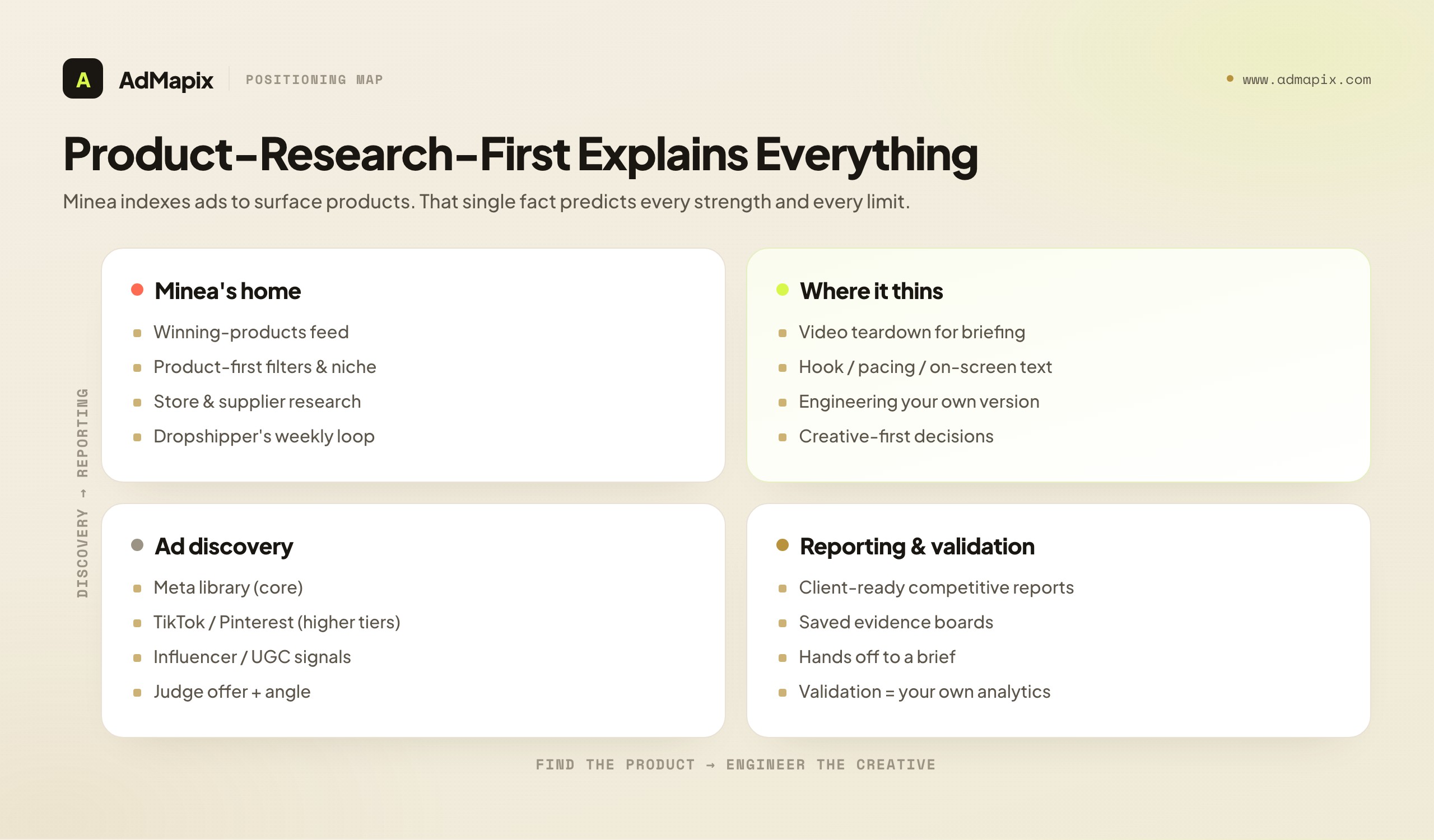
Here is the framing that makes this review useful rather than another feature dump: Minea is a product-research-first ad spy tool. That single fact explains every strength and every limit. Because it indexes ecommerce ads to surface products gaining traction, it is brilliant when product selection and ad discovery are the same decision — the dropshipping loop. Because it was built to surface ads rather than dissect them, it gets thin the moment your job becomes engineering a creative or reporting competitive strategy to a client. Keep that one distinction in your head and you can predict where Minea will delight you and where it will frustrate you, before you ever start a trial.
TL;DR — The Minea Verdict
- Minea is strongest as a combined winning-product and ad-discovery tool for ecommerce — not as a general creative-intelligence platform. The product and the ad sitting side by side is the whole point.
- Its core value is the daily winning-products feed plus a multi-network ad library (Meta, with TikTok and Pinterest signals and influencer/UGC data on higher tiers).
- It is a strong fit for dropshippers and product-led DTC brands, and a poor fit for app/SaaS marketers and teams whose main job is competitor creative strategy rather than product discovery.
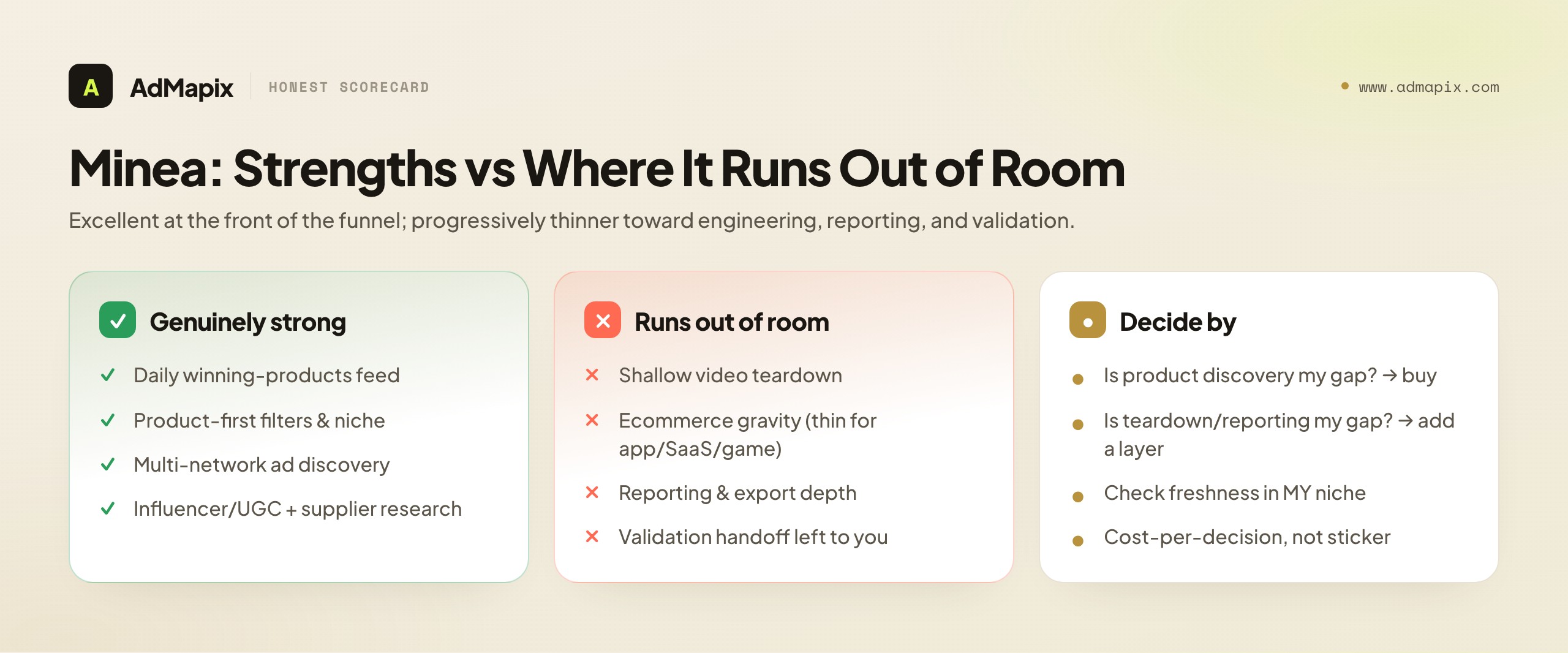
- Where it runs out of room: shallow video teardown, ecommerce gravity (thin outside physical products), reporting/export depth, and the validation handoff from "found an ad" to "briefed a creative."
- Add a creative-intelligence layer like AdMapix when the next decision depends on cross-network ad search, saved media, structured video breakdowns, and client-ready reports — not product discovery.
- Neither Minea nor AdMapix shows competitor ad spend, ROAS, impressions, or targeting. Those are not public. Any spend number you see is a model, not a fact.
- Buy on cost-per-decision and on whether your exact niche and geos are deep and fresh — not on the headline database size or the demo tier.
- Treat every signal as a hypothesis, never a result. A feed entry, an ad's longevity, and its engagement counts each point you toward a test — they are not the test, and the only profit proof lives in your own analytics after you launch.
- Run a 90-day plan, not a two-tab trial: calibrate the feed to your niche in month one, build the discovery-to-brief habit in month two, then compute cost-per-decision in month three and decide the stack with your own data.
What Minea Actually Does (and the One Fact That Explains It)
Minea indexes ecommerce ads to surface products that are gaining traction, rather than to map a competitor's full creative strategy. Per Minea's own site, the platform centers on a daily winning-products feed, filters for finding products by metrics and niche, a Meta ads library, store and supplier research, and — on higher tiers — TikTok and Pinterest coverage plus influencer/UGC ad signals. An ad spy tool, for reference, is software that collects the ads other advertisers are running so you can study what works without launching your own spend first.
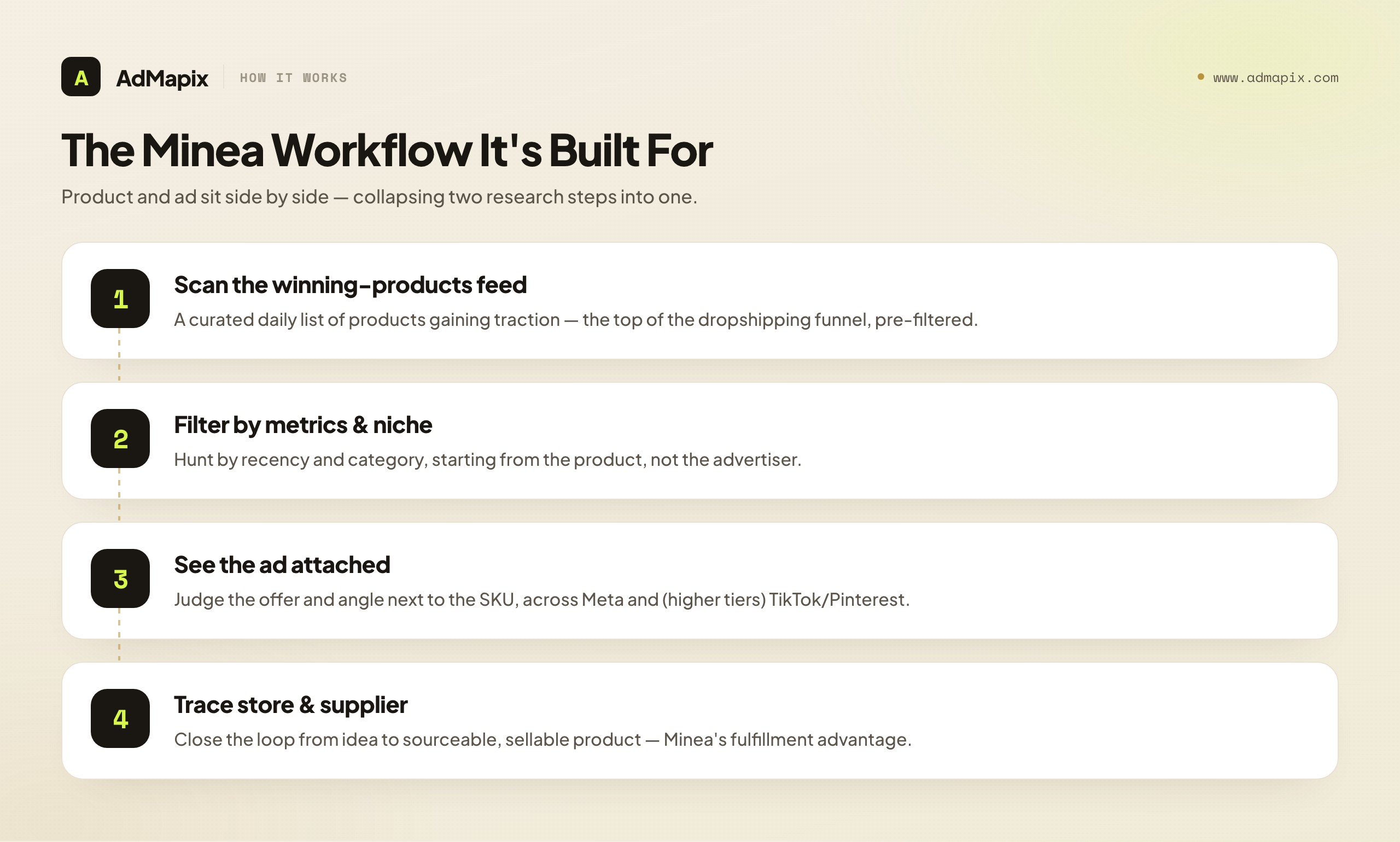
The practical effect of being product-research-first is that Minea answers "is this product selling, and who is running it?" faster than a general ad library does, because the product and the ad sit next to each other. You are not starting from "show me ads" and reverse-engineering the product; you are starting from "show me products with traction" and seeing the ad attached. For an operator who thinks in SKUs and offers, that adjacency is a genuine workflow advantage — it collapses two research steps into one.
This is also why a fair review cannot just score Minea against a general creative-intelligence tool and call it a day. They are aiming at different decisions. Minea is optimized for the product-selection decision; a creative-intelligence tool is optimized for the creative-engineering decision. Comparing them on a flat feature grid is like comparing a tape measure to a level — both are tools, both are useful, and which one you want depends entirely on what you are building. The rest of this review keeps that distinction front and center.
Where Minea Is Genuinely Strong
Let us give Minea its due in detail, because an honest review earns trust by praising the incumbent accurately before critiquing it. Minea is strongest when product selection and ad discovery are the same decision — which is exactly the dropshipping and product-testing loop.
The winning-products feed. This is Minea's signature. A curated daily list shortens the path from "I need a product idea" to "here is one with traction and a live ad selling it." For a dropshipper, that is the top of the entire funnel, and having it pre-curated daily is a real time saver versus scrolling ad libraries hoping to spot a pattern. The feed is opinionated in a useful way — it is trying to surface movers, not just new.
Product-first filters. You can hunt by metrics, niche, and recency, which suits operators who think in products rather than in advertisers. This is a subtle but important fit: most ad-spy tools make you start from an advertiser or a creative and work toward the product. Minea lets you start from the product, which matches how product-led ecommerce people actually think.
Multi-network ad library. Seeing the ad attached to the product helps you judge the offer and the angle, not just the SKU. Meta is the core; TikTok and Pinterest coverage on higher tiers widens the net to where ecommerce creatives increasingly live. The library is a discovery surface, and as a discovery surface it is solid.
Influencer and UGC signals. On higher tiers, Minea surfaces influencer and UGC-style ad activity, which is increasingly where ecommerce creative wins are born. For a product-led brand, knowing which creators and UGC angles are pushing a product is a real signal, not a vanity feature.
Store and supplier research. Tracing a product back to its store and its sourcing closes the loop from idea to fulfillment. For dropshippers especially, this is the difference between "interesting product" and "product I can actually source and sell," and bundling it into the same tool is convenient.
Put together, these strengths form a coherent product: a fast, product-first path from idea to a sourceable, ad-validated SKU. If that is your weekly job, Minea is not a compromise — it is well-aimed at exactly what you do.
Where Minea Runs Out of Room
Minea stops being enough the moment your job shifts from finding a product to engineering a creative or reporting on competitive strategy. This is not a knock — it is the predictable edge of a product-research-first tool. Four limits show up most.
Shallow video analysis. Minea shows you the ad; it does not break the video into hook, pacing, on-screen text, proof stacking, and format so you can brief your own version. For a product-discovery tool that is fine — dissection is not its job. But if your bottleneck is "I found a winning video, now how do I engineer my own," surfacing the ad is only step one, and Minea leaves the harder step on you.
Ecommerce gravity. The index and feed are tuned for physical products. That is a strength for dropshippers and a hard limit for everyone else. App marketers, SaaS teams, game UA buyers, and service businesses will find the product-led lens does not fit their decisions, because their "product" is not an ecommerce SKU and their creative patterns live in different networks and formats.
Reporting and export depth. A product-discovery feed is built to be consumed inside the tool, not exported into a client deck. For a solo dropshipper that is fine. For an agency that owes a client a competitive creative report every month, the gap between "I can see this in Minea" and "I can hand this to a client" is exactly the manual-assembly tax that eats Friday afternoons.
The validation handoff. Like every spy tool, Minea ends at "here is an interesting ad / product." Turning that into a tested hypothesis is on you, and Minea's product-first framing helps less here than a creative-first tool would, because the brief you need is about the creative, not the product.
The honest summary: Minea is excellent at the front of the funnel (what to test) and progressively thinner toward the back (how to engineer it, how to report it, how to validate it). Knowing where the thinning starts is the whole point of this review.
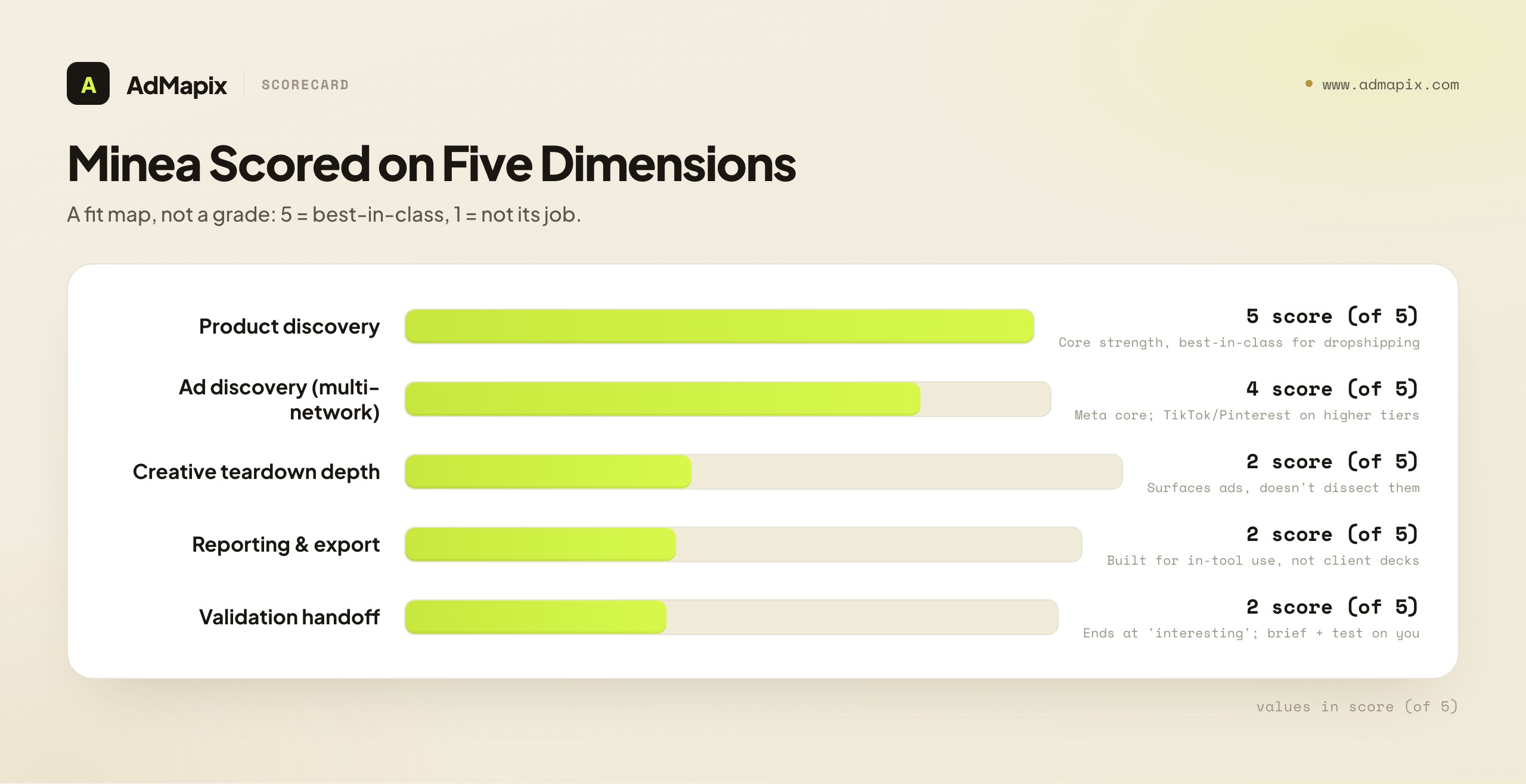
A Fair Scorecard: Minea on Five Dimensions
To keep this review honest rather than vibes-based, here is Minea scored 1–5 on the five dimensions that matter for an ad-intelligence purchase. A 5 means best-in-class; a 1 means not its job.
| Dimension | Minea score | Why |
|---|---|---|
| Product discovery | 5 | The winning-products feed plus product-first filters is its core strength and genuinely best-in-class for dropshipping |
| Ad discovery (multi-network) | 4 | Strong Meta library; TikTok/Pinterest and influencer signals widen it on higher tiers |
| Creative teardown depth | 2 | Surfaces ads but does not dissect video structure into a briefable breakdown |
| Reporting & export | 2 | Built for in-tool consumption, not client-ready competitive reports |
| Validation handoff | 2 | Ends at "interesting ad/product"; the creative brief and test are on you |
Read this scorecard as a fit map, not a grade. If your weighted priority is product discovery, Minea is a clear buy — it scores 5 on the thing you care about. If your weighted priority is creative teardown and reporting, the 2s are exactly where you will feel pain, and that is the signal to add a creative-intelligence layer. The tool is not "good" or "bad" in the abstract; it is well-suited to one job and poorly-suited to another, and the scorecard makes that legible.
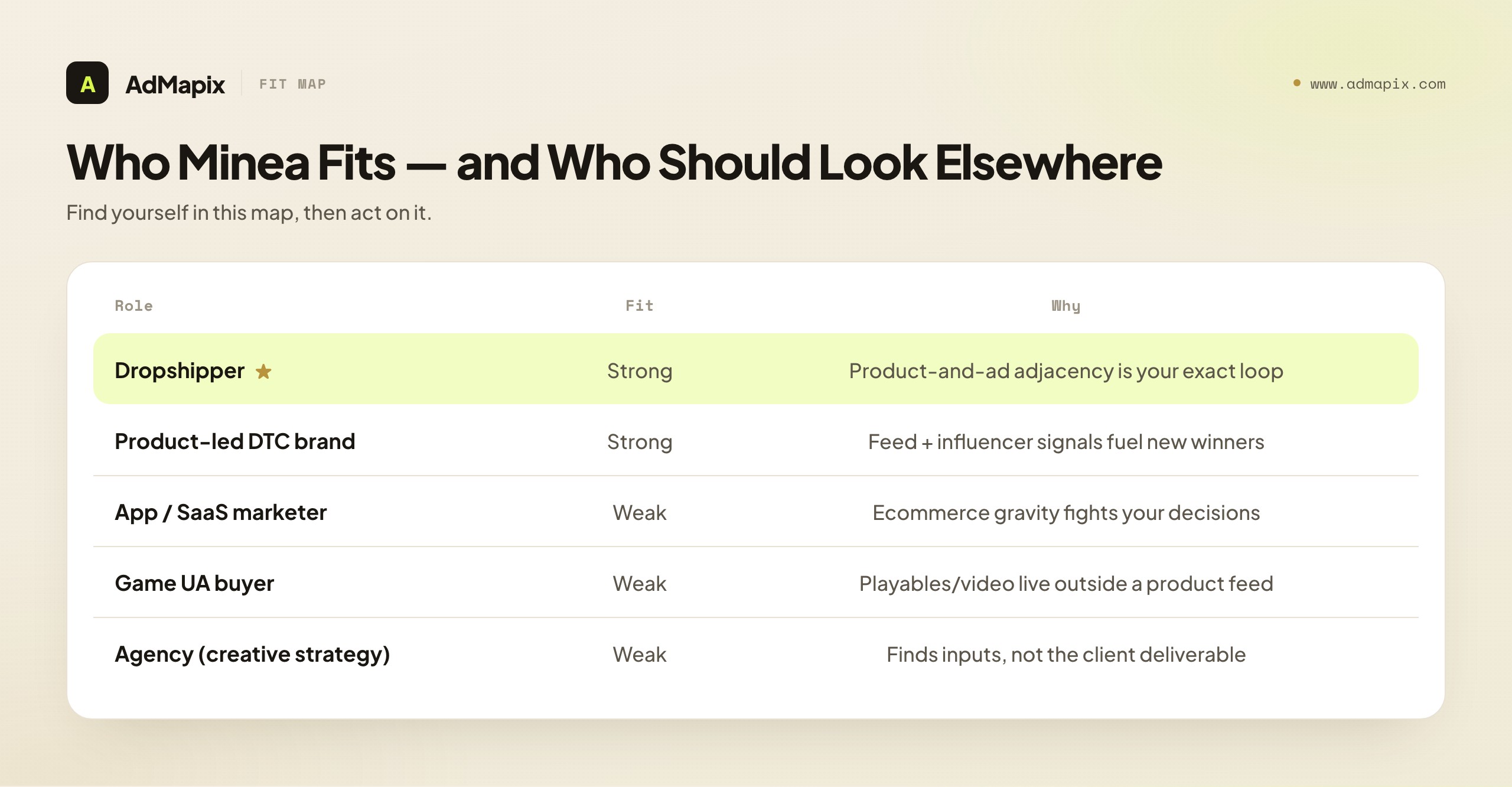
Who Minea Is For — and Who Should Look Elsewhere
The clearest way to use this review is to find yourself in this map and act on it.
Strong fit — dropshippers. If your week is product testing — find a mover, validate it has a live ad and a sourceable store, test it — Minea is squarely built for you. The product-and-ad adjacency is your exact workflow. Buy it.
Strong fit — product-led DTC brands. If you sell physical products and your growth depends on a steady pipeline of new winners, the feed plus influencer/UGC signals fits. You may eventually add a creative layer for engineering and reporting, but Minea is a fine front-of-funnel engine.
Weak fit — app and SaaS marketers. Your "product" is not an ecommerce SKU, and Minea's gravity is ecommerce. The product-first lens fights your decisions. Look at general creative-intelligence and platform-specific tools instead.
Weak fit — game UA buyers. Mobile-game creative lives in playables, video, and networks Minea is not centered on. A product-discovery feed is the wrong instrument. See our meta ads library vs ad intelligence tools comparison for the right stack.
Weak fit — agencies whose core deliverable is creative strategy. If clients pay you for "what is winning in the category and how do we engineer our version," Minea finds the inputs but does not produce the deliverable. You will need a creative-intelligence and reporting layer on top — which is where AdMapix fits.
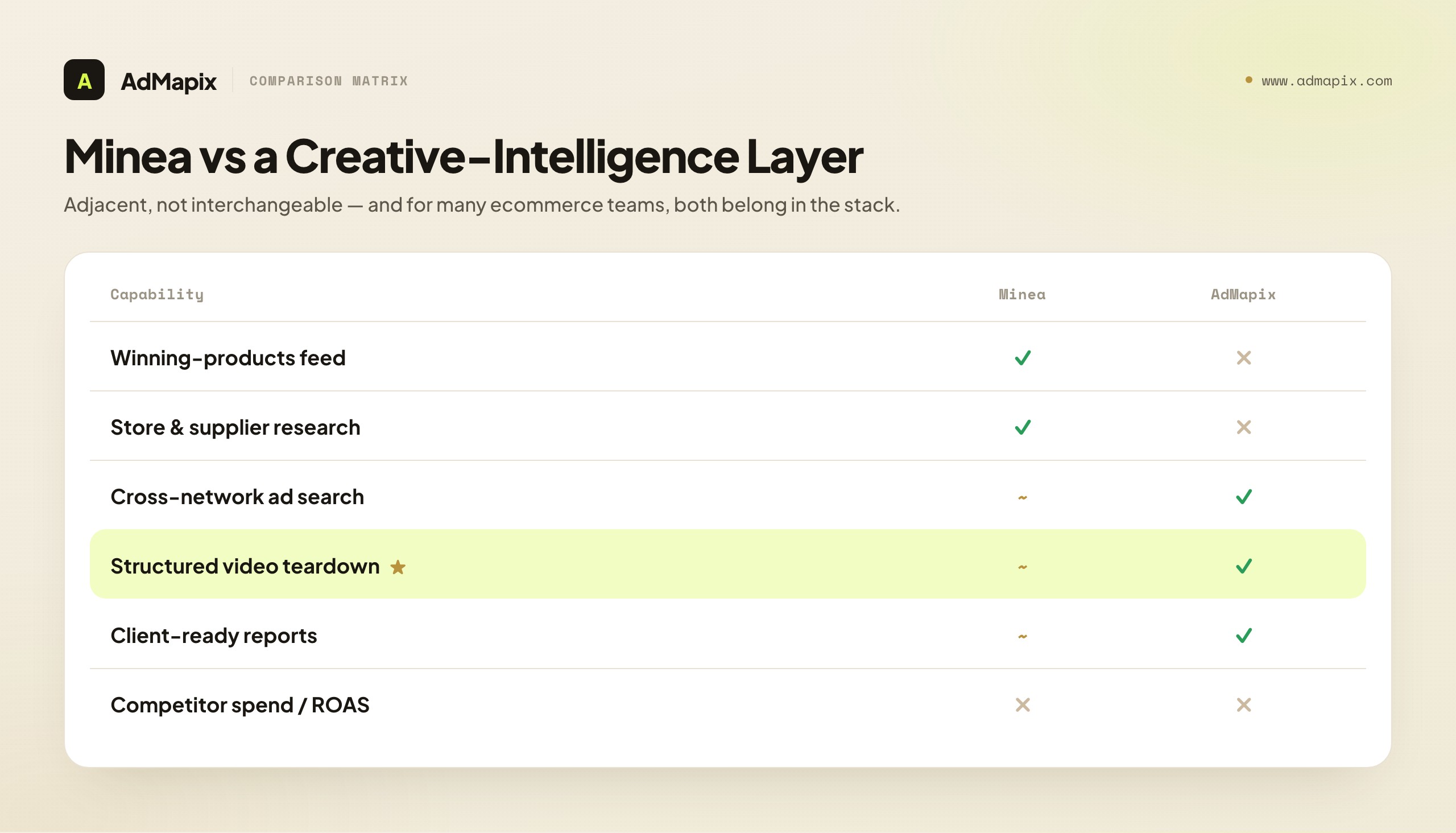
Minea vs a Creative-Intelligence Layer (AdMapix)
This is the comparison most "Minea review" readers actually want, so let us be precise and fair. Minea and AdMapix are not competitors fighting over the same job — they are adjacent tools that, for many ecommerce teams, belong in the same stack. Minea answers "what product should I test and who is selling it?" AdMapix answers "here is the creative, dissected, saved, and ready to report." One is product-discovery-first; the other is creative-evidence-first.
| Capability | Minea | AdMapix |
|---|---|---|
| Winning-products feed | ✓ | ✗ |
| Product-first filters & niche hunting | ✓ | ✗ |
| Store & supplier research | ✓ | ✗ |
| Cross-network ad search | ~ | ✓ |
| Structured video teardown | ~ | ✓ |
| Saved media boards | ~ | ✓ |
| Client-ready reports & export | ~ | ✓ |
| Competitor ad spend / ROAS | ✗ | ✗ |
Notice the bottom row again: neither tool shows competitor ad spend or ROAS, because that data is not public. We hold ourselves to saying this plainly — AdMapix is searchable cross-network creative evidence: saved ad examples, video breakdowns, and recurring reports. It cannot show you a competitor's spend, ROAS, impressions, or audience targeting, and we will never imply it can. Its strength is the creative-engineering and reporting layer that sits downstream of Minea's product discovery. For a dropshipper, the natural stack is Minea to find what to test and AdMapix to engineer and report on the creative — plus your own analytics to validate. See the ad creative database and competitor ad analysis framework for how the evidence layer turns into decisions.
Pricing Reality Check — Tiers, Gates, and Cost-Per-Decision
Minea, like most tools in this category, gates its strongest features (TikTok, Pinterest, influencer signals, deeper filters) to higher tiers, and the demo you see in sales is richer than the plan you will likely start on. Do not judge coverage or freshness from the demo. The buying questions that actually protect you are not about the sticker price.
| Buying question | Why it matters |
|---|---|
| Which networks are in my tier (not the demo)? | TikTok/Pinterest and influencer signals are often gated; the entry plan may be Meta-only |
| Is my niche and geo deep and fresh? | A product feed can be rich in one category and thin in yours |
| How recent is the winning-products feed for my niche? | Stale "winners" are last quarter's products; freshness is the whole value |
| What exports exist for reporting? | If research can't leave the tool, agencies pay a manual-assembly tax |
| Cost-per-decision vs my current setup? | The only comparison that reflects value, not vanity |
The reframe that cuts through pricing noise is the same one we apply to every tool: cost-per-decision. Estimate how many real decisions Minea drives per month — products validated or killed, tests launched, briefs started. Divide cost by that number. A higher tier that unlocks TikTok and surfaces an extra winning product per week is cheaper, in cost-per-decision terms, than a base tier that leaves you guessing on your primary channel. The headline price is the least informative number on the page.
A specific Minea trap to watch: the winning-products feed is the headline value, but its usefulness depends entirely on freshness in your niche. A feed that is hot in beauty and home goods but stale in your category is showing you someone else's opportunities. During a trial, check the dates and the niche fit of the feed for your products, not the impressive examples the demo highlights.
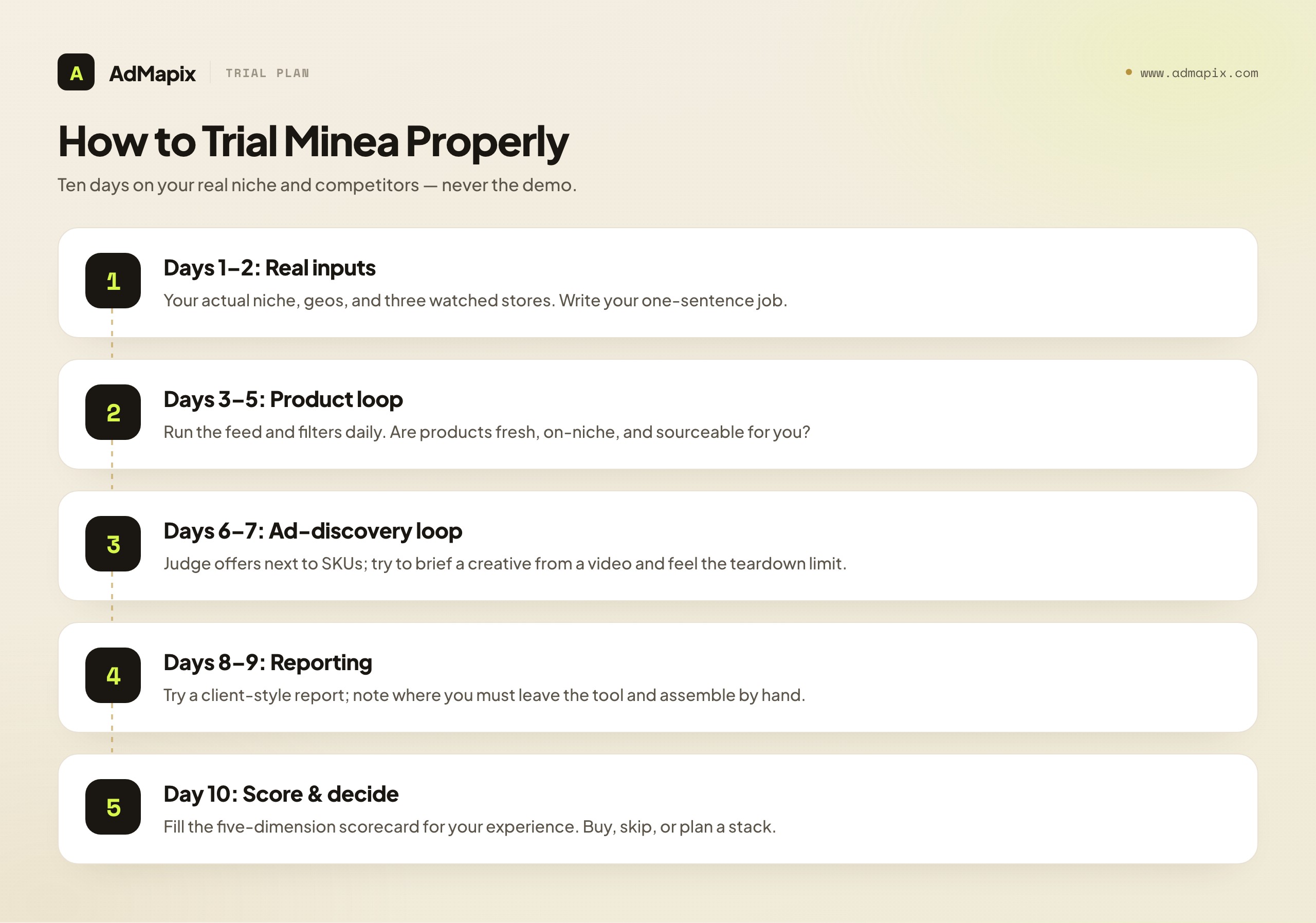
How to Trial Minea Properly
A real review should hand you a way to test the verdict, not just assert it. Run this ten-day trial on your actual products and competitors, never the demo.
Days 1–2: Set your real inputs. Define your actual niche, your target geos, and three competitors or stores you genuinely watch. Write your one-sentence job: "I need Minea to help me ___." Product discovery, ad discovery, or both.
Days 3–5: Run the product loop. Use the winning-products feed and filters for your niche daily. Are the products fresh and relevant to you? Could you source and test them? This is Minea's core — push it hard.
Days 6–7: Run the ad-discovery loop. Look at the ads attached to the products. Can you judge the offer and angle? Now test the limit: try to build a creative brief from a winning video. Feel where the teardown depth stops.
Days 8–9: Test reporting and handoff. If you are an agency, try to produce a client-style report from Minea alone. Note exactly where you have to leave the tool and assemble by hand — that gap is your AdMapix-shaped hole.
Day 10: Score and decide. Fill in the five-dimension scorecard for your experience. If product discovery scores high and that is your gap, buy. If teardown and reporting score low and those are your gaps, plan a stack: Minea plus a creative-intelligence layer.
The Honest Limits Every Ad-Spy Tool Shares
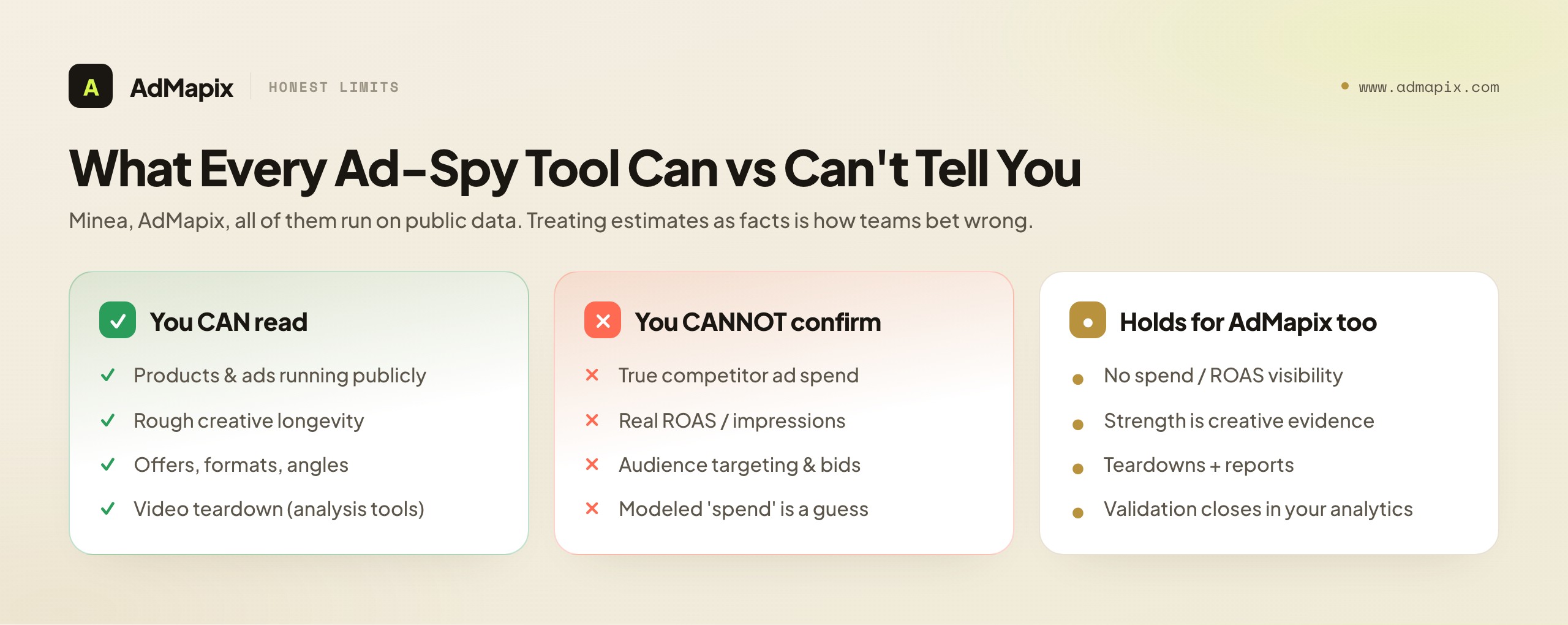
This section is non-negotiable in any review we publish, because it is where buyers get burned. Minea, AdMapix, and every tool in this category run on public data. That boundary defines what any of them can truthfully tell you.
What they can genuinely show: the products and ads advertisers are running publicly, rough creative longevity, formats and offers, and — for creative-intelligence tools — a structured teardown of why an ad might work. That is real, useful evidence.
What none of them can confirm: a competitor's true ad spend, real ROAS, actual impressions, or audience targeting and bids. Those numbers are not public. When a tool shows a "spend" figure, it is almost always a model — a hypothesis dressed as a fact. Read the label. Build a budget on a modeled spend number and you have built your budget on someone's estimate.
This applies to AdMapix without exception, and we say so directly: AdMapix shows cross-network creative evidence — not spend, not ROAS, not targeting. If your decision needs spend numbers, no tool in this review can truthfully give them to you, and you should treat anyone who claims otherwise with deep skepticism. The deepest limit of all: even perfect evidence cannot tell you what converts for you. That answer lives only in your own analytics after your own test. Every tool here, Minea included, is an input to a hypothesis, never the proof of a result.
Common Misreads of Minea (and How to Avoid Them)
A few recurring mistakes lead people to buy Minea for the wrong job, or to dismiss it unfairly.
Misread 1 — "Minea is a general ad-intelligence tool." It is not, and judging it as one is unfair to a tool that is excellent at a narrower thing. Minea is product-research-first. Score it on product discovery and it shines; score it on creative strategy and it looks weak — because that was never its target.
Misread 2 — "The winning-products feed works for any business." The feed is tuned for ecommerce physical products. App, SaaS, and game teams who buy expecting it to surface their kind of winner will be disappointed, not because Minea is bad but because they bought the wrong instrument.
Misread 3 — "I found a winning video in Minea, so I'm set." Finding the video is the easy half. Engineering your own version needs a teardown — hook, pacing, on-screen text, proof, CTA — and that is where Minea thins out and a creative layer earns its place.
Misread 4 — "The demo coverage is the coverage." The demo and higher tiers are richer than the entry plan. Always check network access, niche depth, and feed freshness on the tier you will actually buy.
Misread 5 — "More products in the feed is better." A bigger feed that is stale or off-niche for you is worse than a smaller one that is fresh and on-niche. Volume is not value; relevance and freshness are.
Avoid these and you will either buy Minea for the right job or correctly decide you need something else — both good outcomes from a review.
Minea Inside a Modern Dropshipping Stack
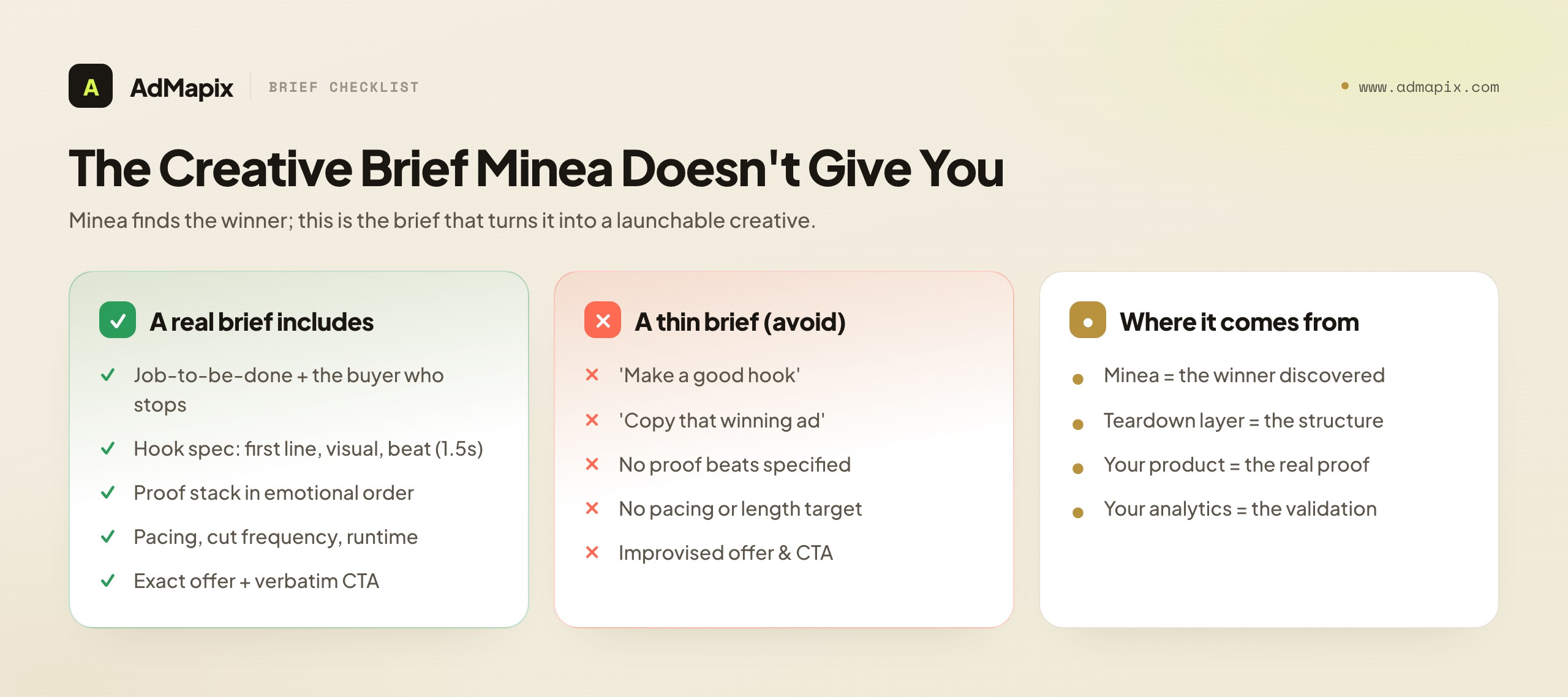
A tool review that stops at "is this product good?" leaves the most valuable question unanswered: where does Minea sit relative to everything else you run, and what does it hand off to? No serious ecommerce operator runs a single tool. You run a stack, and the value of any one tool is how cleanly it plugs into the others. So let us place Minea in the stack honestly, because that placement is what determines whether it earns its line item.
At the very top of a dropshipping stack is demand sensing — figuring out what categories and products are heating up before they peak. Minea's winning-products feed lives here, and it is a strong occupant. It answers "what is moving" faster than scrolling ad libraries because it pre-curates movers daily. But it is not the only input at this layer; experienced operators triangulate the feed against marketplace bestseller movement, search-trend tools, and their own returning-customer signals. Minea is a primary demand sensor, not the only one, and treating it as the single source of truth is the first way teams over-trust it.
The second layer is offer and angle discovery — once you know a product is moving, what offer and creative angle is actually selling it? This is where the ad attached to the product matters, and Minea does well here for Meta and, on higher tiers, TikTok and Pinterest. You can see the headline, the hook the advertiser leads with, the price framing, the bundle. This is genuinely useful raw material. The limit, again, is depth: you see that an angle exists, not a dissected breakdown of why the video works second by second. For a fast operator copying an obvious winner, "that an angle exists" is enough. For a team trying to out-execute a saturated competitor, it is not, and that is where a creative-intelligence layer enters the stack.
The third layer is creative engineering — turning a discovered winner into a brief your editor or UGC creator can actually execute. This layer is where Minea hands off rather than delivers. The brief needs a structured teardown: the hook in the first 1.5 seconds, the pacing of cuts, the on-screen text cadence, the proof stack (reviews, demonstrations, before/after), the CTA framing. None of that is Minea's job, and pretending it is sets you up to under-brief. A team that buys Minea expecting it to brief creatives will produce thin briefs and blame the tool; the honest move is to pair it with something built for teardown.
The fourth layer is testing and validation — launching the creative and reading what your own audience does. No spy tool, Minea included, plays here, because this is your first-party analytics. We hammer this point throughout the review because it is the single most common place operators go wrong: they treat the discovery tool's signal as a result rather than a hypothesis. Minea can tell you a product and angle are working for someone else. Whether they work for you is a question only your post-test data answers.
The fifth and final layer, for agencies and larger brands, is reporting — packaging what you found and what you tested into something a client or executive can read. Minea is built for in-tool consumption, so this layer is almost entirely a handoff. The gap between "I can see this in Minea" and "I can hand this to a client" is the manual-assembly tax we flagged earlier, and in a stack view it is glaring: Minea is rich at layers one and two, thin at three, absent at four and five. Map your own bottleneck onto these five layers and you will know instantly whether Minea is your missing piece or only part of it.
Minea vs the Free Alternatives: Is It Worth Paying At All?
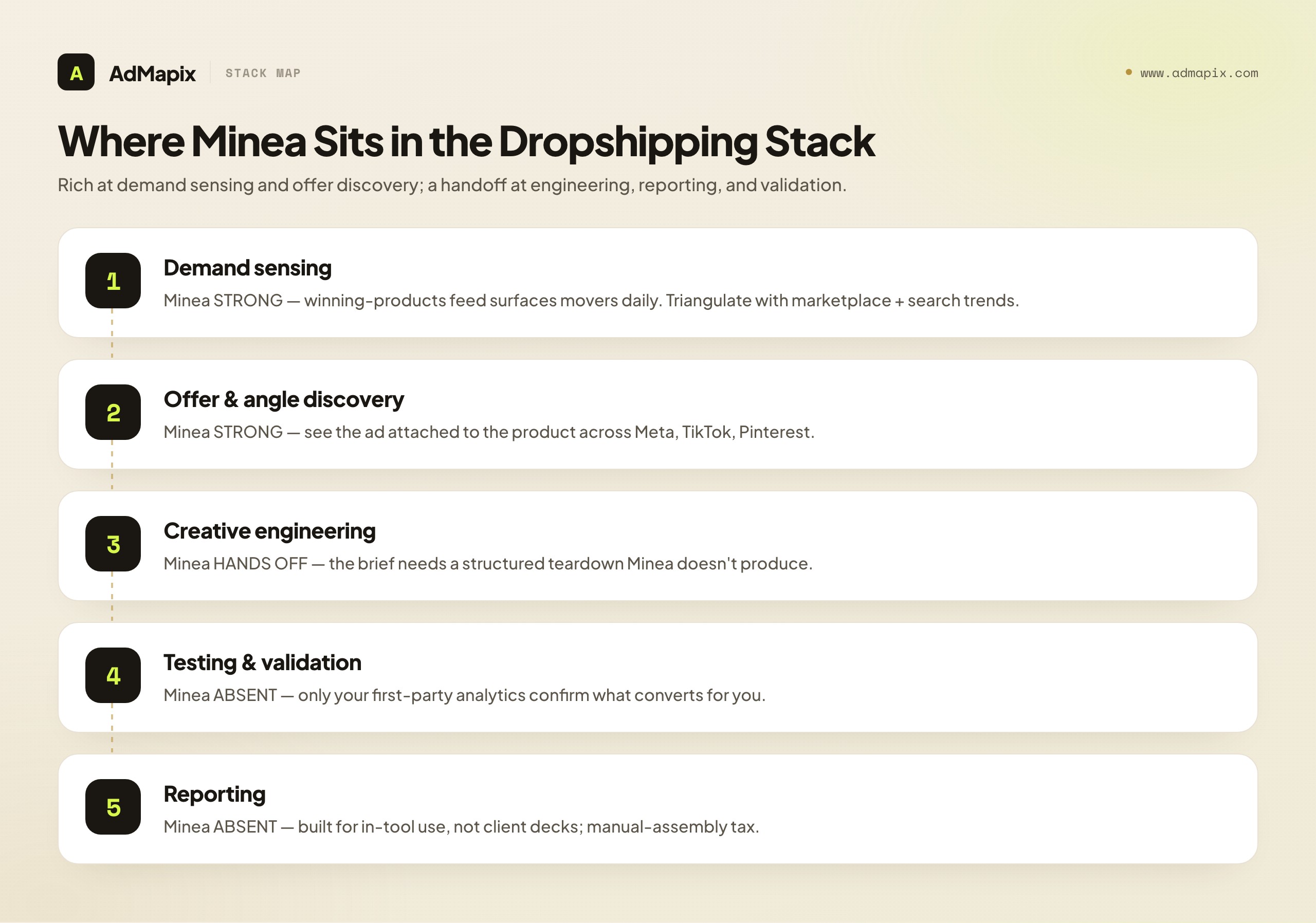
Every paid ad-spy tool has to justify itself against the free options, and a fair Minea review owes you that comparison. The two free baselines every operator should know are the official platform ad libraries and manual marketplace research. Both are real, both are useful, and both have limits that explain why paid tools like Minea exist.
The Meta Ad Library is free, official, and authoritative — it is Meta's own transparency surface showing ads currently running across Facebook and Instagram. You can read more about its scope on Meta's official Ad Library help page. For checking whether a specific advertiser is running ads, or browsing a known competitor's active creatives, it is the ground truth and you should use it. The European Union's Digital Services Act ad transparency rules have pushed platforms toward broader public ad disclosure, which means the free official surfaces keep getting richer. So why pay for Minea on top of a free, authoritative library?
The answer is discovery direction. The Meta Ad Library is built for verification — you go to it knowing the advertiser or keyword you want. It is poor at the opposite job: "show me products gaining traction that I have never heard of." There is no winning-products feed, no cross-store movement signal, no product-first filtering, no supplier trace. You cannot scan the library and have it tell you what is new and hot in your niche; you can only confirm what you already suspected. Minea's entire value proposition is solving that discovery-direction problem — turning the library's verification surface into a proactive movement feed. That is what you are paying for, and whether it is worth it depends on whether discovery, not verification, is your bottleneck.
Manual marketplace research — scrolling AliExpress order counts, TikTok hashtags, and bestseller pages — is the other free path, and plenty of successful operators built their first wins on exactly that grind. Its limit is time: it is slow, unsystematic, and easy to bias toward what you already like. Minea is, in effect, paying to compress that grind into a curated feed. If your time is cheap and your niche is small, the manual path may genuinely beat paying. If your time is expensive and you are testing across categories, the compression is worth real money. There is no universally correct answer — only your cost-per-decision math.
Here is the honest framing the review keeps returning to: free tools are excellent at verification and weak at proactive discovery; Minea is the reverse. The mistake is treating them as substitutes. The right stack uses the free Meta Ad Library and TikTok's library as ground-truth verification surfaces, and a paid discovery tool like Minea as the proactive movement engine that points you at what to verify. Paying for Minea makes sense precisely when your bottleneck is "I do not know what to test," not "I cannot confirm what a known competitor is running."
Building the Creative Brief Minea Doesn't Give You
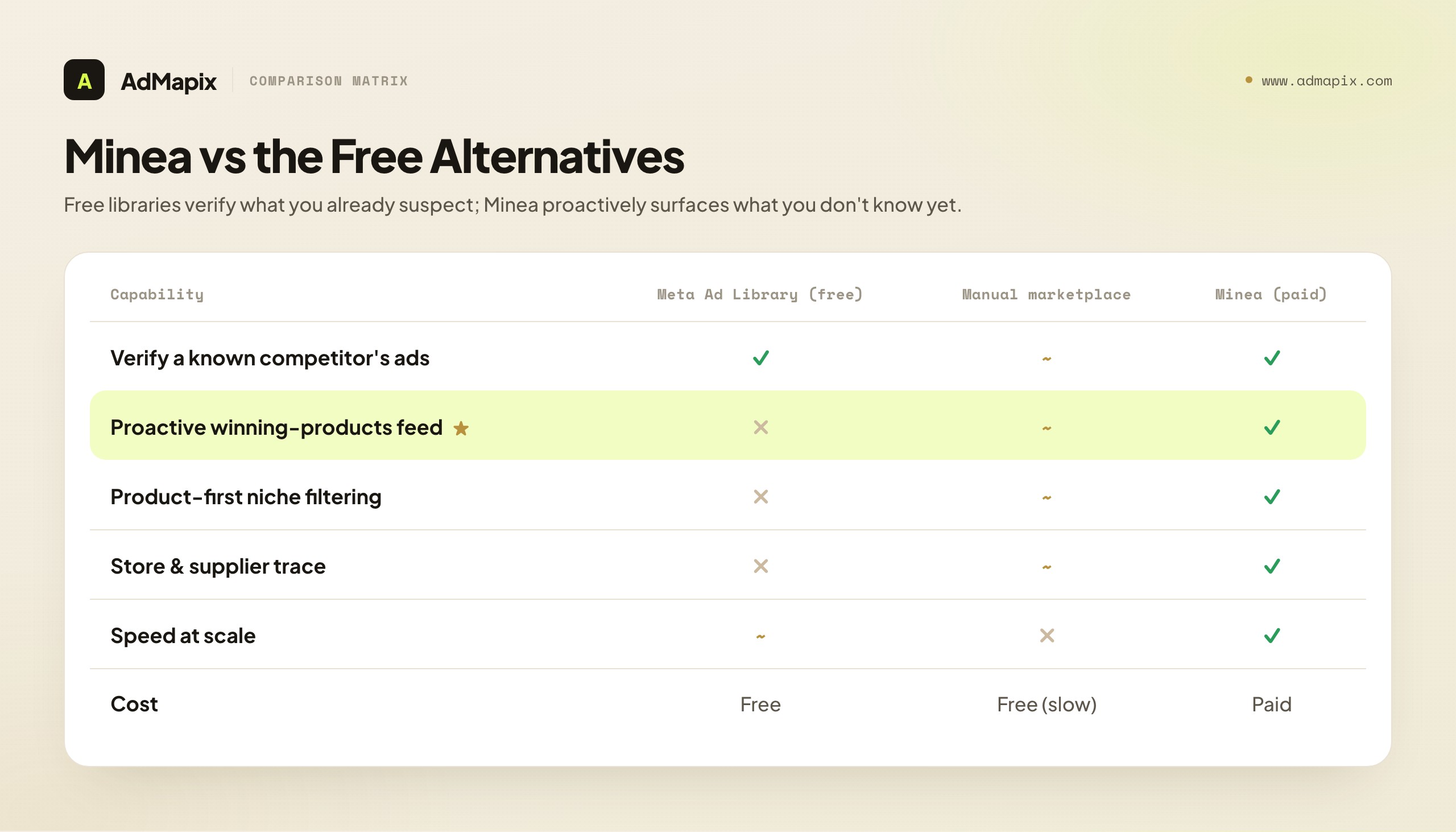
The single most actionable thing this review can offer is the brief Minea leaves you to write yourself. Because the tool ends at "here is a winning ad," the gap between that and a launchable creative is a brief — and most operators write thin ones. Here is the structure of a brief that actually transfers a winner into your own production, using whatever teardown layer you pair with Minea to fill the blanks.
Start with the job-to-be-done, not the format. Before describing a single shot, write the one job the creative must do: stop the scroll for a specific buyer with a specific pain. Minea showed you a product is moving; you still have to name who it moves for and why they stop. A brief that skips this produces pretty videos that do not convert, because they were engineered for a format, not a person.
Specify the hook in concrete terms. "Good hook" is not a brief. The hook spec needs the first line of on-screen text, the first spoken line, the opening visual, and the emotional beat — curiosity, pattern interrupt, problem agitation, or social proof — all inside the first 1.5 seconds. When you study a Minea-discovered winner, your teardown layer should hand you exactly these elements so you can re-engineer rather than vaguely imitate. The difference between a winner and a flop is usually decided in this window.
Map the proof stack. Ecommerce video lives or dies on believable proof. List, in order, the proof beats the winning ad uses: demonstration, before/after, review screenshots, expert framing, quantity-sold social proof. Your version needs its own proof in the same emotional order, sourced from your real product and customers — never faked. Minea shows you the competitor's proof beats exist; the brief makes them executable for your product.
Define the pacing and length targets. Note the cut frequency, the total runtime, and where the offer lands. Fast-cut UGC and slow demonstration are different machines; copying the angle but missing the pacing produces a creative that feels off without anyone being able to say why. A teardown layer that timestamps the structure makes this specifiable instead of a guess.
Write the offer and CTA verbatim. The final brief element is the exact offer framing and call to action — discount structure, urgency, guarantee, and the literal CTA words. This is the easiest thing to copy and the easiest to get subtly wrong. Specify it precisely so production does not improvise the most conversion-sensitive line in the whole creative.
A brief built this way is the bridge across the exact gap Minea leaves open. The review's recurring theme holds: Minea is a superb finder and a non-existent briefer, so the brief is where you either add a creative-intelligence layer or accept that you are doing the teardown by hand, on every single winner, forever.
A 90-Day Plan: Getting Real Value From Minea
Buying a tool is not the same as extracting value from it, and most subscriptions quietly fail not because the tool is bad but because nobody built a habit around it. Here is a 90-day operating plan that turns a Minea subscription into a repeatable decision engine rather than a tab you open twice and forget.
Month 1 — Calibrate to your niche. The first thirty days are not about finding winners; they are about learning whether Minea's feed is fresh and deep for you. Every day, open the winning-products feed filtered to your niche and geos, and log two things: how many entries are genuinely relevant, and how recent they are. By the end of the month you will have a hard, data-backed answer to the most important buying question — is this feed actually rich in my category? If month one shows a thin, stale, off-niche feed, you have learned something the demo would never have told you, and you can cancel before the annual commitment. If it shows a fresh, relevant feed, you have validated the core value and earned the right to build a habit on it.
Month 2 — Build the discovery-to-brief habit. With the feed validated, the second month is about flow. Pick a cadence — say, two product candidates per week — and run each one fully through the stack: discover in Minea, verify in the free Meta Ad Library, build the creative brief, and queue a test. The goal is not volume; it is a smooth, repeatable handoff from Minea's discovery to a launchable test. This is also where you will feel, concretely and repeatedly, exactly where Minea hands off and whether the manual brief-building is sustainable or whether you need a teardown layer to keep the cadence.
Month 3 — Measure cost-per-decision and decide the stack. The final month is the honest accounting. Count the real decisions Minea drove: products validated or killed, tests launched, briefs started. Divide your Minea cost by that number. Now you have a true cost-per-decision figure, not a guess. Compare it to the alternative — the free libraries plus manual grind — and to the upgrade question — does a higher tier with TikTok and Pinterest pay for itself in extra decisions? At ninety days you are no longer guessing about Minea; you are deciding with your own data, which is the only basis a tool decision should ever rest on.
This plan also surfaces the AdMapix-shaped hole if it exists. If, by month three, your bottleneck is consistently the brief and the report rather than the discovery, you have empirically located the layer Minea does not cover — and you can add a creative-intelligence tool with confidence, because you proved the need rather than assumed it.
Reading Minea's Data Honestly: Signals, Not Certainties
Every number and badge inside an ad-spy tool is a signal, and the difference between operators who win with these tools and operators who burn money is whether they treat signals as signals or as certainties. This section is the interpretive discipline that should sit behind every Minea session, because the tool can only ever hand you evidence — the judgment is yours.
A product in the winning-products feed is a signal that it is moving somewhere, not proof it will move for you. The feed surfaces traction in aggregate, across stores and geos that may have nothing to do with your audience. A product crushing it in one market with one price point and one creative angle can flop in yours for reasons the feed cannot see — different buying power, different saturation, different platform mix. Read a feed entry as "worth investigating," never as "guaranteed winner." The operators who lose money are the ones who skip the investigation because the feed gave them false confidence.
Ad longevity is a signal of probable profitability, not a measurement of it. A common heuristic across all spy tools is that long-running ads are likely winners, because advertisers tend to kill losers fast. That logic is directionally sound but not airtight: a long-running ad could be a brand-awareness play, a poorly-managed account, or an ad propped up by factors invisible to the tool. Use longevity as a tie-breaker among candidates, not as a verdict. And remember the deeper limit we keep returning to — you are seeing that an ad ran a long time, not what it earned, because earnings are not public.
Engagement counts are a signal of attention, not of conversion. Likes, comments, and shares tell you a creative captured attention, which is a real and useful thing. They do not tell you it captured sales. The internet is full of ads that went viral and sold nothing, and quiet ads that printed money. When you read engagement signals in Minea or any tool, treat them as a measure of the top of the funnel, and never confuse a high-attention creative with a high-converting one. Those are different outcomes driven by different mechanics.
Influencer and UGC activity is a signal of where creative energy is flowing, not a ranking of what works. On higher tiers, Minea surfaces influencer and UGC ad activity, which is genuinely valuable for spotting emerging angles. But "many creators are pushing this angle" can mean the angle is winning, or it can mean an affiliate program is paying out and creators are chasing commissions regardless of conversion. Read creator volume as a heat map of attention and effort, then validate the actual angle against your own test.
The unifying discipline is simple to state and hard to practice: in an ad-spy tool, everything is a hypothesis generator and nothing is a result. Minea is an exceptionally good hypothesis generator for ecommerce product discovery — that is high praise, not a hedge. The failure mode is not the tool; it is the operator who stops at the signal and skips the test. Hold that discipline and Minea earns its place. Drop it, and no tool, at any price, will save you from betting on someone else's data as if it were your own.
FAQ
Is Minea a good ad spy tool in 2026?
Yes, for the right job. Minea is genuinely strong as a product-research-first ad spy tool: the daily winning-products feed, product-first filters, and the ad attached to the product make it excellent for dropshippers and product-led DTC brands. It is a poor fit for app/SaaS marketers, game UA buyers, and agencies whose core deliverable is creative strategy, because its gravity is ecommerce product discovery rather than creative engineering or reporting. "Good" depends entirely on whether product discovery is your bottleneck.
What does Minea do better than other ad spy tools?
Its standout is the adjacency of product and ad. Most tools make you start from an ad or advertiser and work toward the product; Minea lets you start from a product with traction and see the ad selling it, with store and supplier research to close the loop to fulfillment. The daily winning-products feed and product-first filters match how product-led ecommerce operators actually think, and on higher tiers the TikTok, Pinterest, and influencer/UGC signals widen the net where ecommerce creatives increasingly live.
Where does Minea fall short?
Four places: shallow video teardown (it surfaces ads but does not dissect them into a briefable breakdown), ecommerce gravity (thin for app, SaaS, game, and service businesses), reporting and export depth (built for in-tool use, not client decks), and the validation handoff (it ends at "interesting product/ad" and leaves the creative brief and test to you). These are the predictable edges of a product-research-first tool, not random flaws — they appear exactly where the job shifts from finding to engineering and reporting.
Minea vs AdMapix — which should I use?
They are adjacent, not interchangeable. Minea answers "what product should I test and who is selling it?" AdMapix answers "here is the creative, dissected, saved, and ready to report." For many ecommerce teams the answer is both: Minea for product and ad discovery, AdMapix for the creative-engineering and reporting layer downstream, and your own analytics to validate. Crucially, neither shows competitor spend or ROAS — that data is not public. Pick Minea if your gap is product discovery; add AdMapix if your gap is teardown and client-ready reporting.
Does Minea show competitor ad spend or ROAS?
No. Competitor ad spend, ROAS, real impressions, and audience targeting are not public data, so no tool — Minea, AdMapix, or any other — can truthfully show them. Some tools present modeled spend estimates; read the label, because an estimate is a hypothesis, not a fact. Use such numbers as directional signal at most, and confirm what actually works inside your own analytics. Any vendor implying they can reveal a competitor's true spend deserves deep skepticism.
Is Minea good for app or game marketers?
Generally no. Minea's index and winning-products feed are tuned for ecommerce physical products, so the product-first lens fights the decisions app, SaaS, and game UA teams make. A game UA buyer in particular works in playables, video, and ad networks that a product-discovery feed is not centered on. For that audience, a general creative-intelligence tool plus platform-specific sources fits better — see our meta ads library versus ad-intelligence-tools comparison for the right stack.
How much does Minea cost, and is it worth it?
Minea tiers gate the strongest features — TikTok, Pinterest, influencer signals, deeper filters — to higher plans, and the demo is richer than the entry plan. Rather than anchoring on the sticker price, compute cost-per-decision: how many products you validate or kill, tests you launch, and briefs you start per month, divided by cost. A higher tier that surfaces an extra winning product per week is cheaper in cost-per-decision terms than a base plan that leaves your main channel uncovered. Worth it if product discovery is your bottleneck; less so if it is not.
Can I use Minea for creative strategy and competitor teardowns?
Only partially. Minea will find the competitor's ads, which is the input to a teardown, but it does not dissect the video into hook, pacing, on-screen text, proof, and CTA the way a creative-intelligence tool does. If competitor creative strategy is your core job — especially as an agency owing clients a "what's winning and how do we engineer ours" deliverable — you will need a creative-intelligence and reporting layer on top of Minea, not Minea alone.
How should I trial Minea before buying?
Run a ten-day trial on your real niche, geos, and competitors — never the demo. Days 1–2: set real inputs and write your one-sentence job. Days 3–5: run the product loop and judge feed freshness and niche fit. Days 6–7: run ad discovery and try to build a creative brief from a winning video to feel the teardown limit. Days 8–9: try to produce a client-style report and note where you must assemble by hand. Day 10: score Minea on the five dimensions for your experience and decide buy, skip, or stack.
Is the winning-products feed reliable?
It is reliable as a curated mover signal, but only as fresh and on-niche as your category. The feed's whole value is surfacing products gaining traction, which means stale entries are last quarter's winners and off-niche entries are someone else's opportunities. Reliability is therefore conditional: check the dates and the niche fit for your products during a trial, not the impressive cross-category examples in the demo. A fresh, on-niche feed is genuinely valuable; a stale or off-niche one is noise no matter how long the list.
Related Reading
To turn this review into a decision, read it next to our best ad spy tools 2026 roundup and the best ad intelligence tools overview for the full landscape. If you are weighing Minea against a Facebook-product-ad specialist, the Dropispy alternative guide covers that contrast. Use the competitor ad analysis framework and the ad creative database to build the creative-engineering layer Minea leaves open, and the creative testing framework to close the validation loop in your own analytics.
See what competitors are really running
Search 6M+ ad creatives, landing pages, and weekly spend across 200+ countries. No credit card, no commitment.
Related Articles

Playable Ad Analysis for Mobile Games: A Practical Method
A practical method for playable ad analysis in mobile games: how to reverse-engineer a competitor's playable by the job it is built to do, decode its structure beat by beat, infer which concepts are likely working, turn observations into testable briefs, and stay honest about what a public playable proves (structure and intent) versus what it never can (spend, installs, retention, ROAS).

Best Mobile Game Ad Formats Across Platforms: A 2026 UA Playbook
A platform-by-platform guide to the best mobile game ad formats in 2026: which formats do the heavy lifting on Meta, Google, TikTok, AppLovin, and Unity; why the right format depends on platform, genre, and funnel stage; a format-selection framework; a creative-testing cadence; and the honest limits of what competitor ads can and cannot tell you about which format wins.

Meta Ads Library vs Ad Intelligence Tools for Game UA (2026): Which to Use, When, and Why
A definitive 2026 comparison of the Meta Ads Library vs dedicated ad intelligence tools for mobile game user acquisition — where the free transparency library genuinely helps, the structural limits that create blind spots for game UA creative research, a side-by-side capability matrix, the exact decision criteria for when to add a paid intelligence layer, and an honest account of what neither can show.