Meta Ads Library vs Ad Intelligence Tools for Game UA (2026): Which to Use, When, and Why
A definitive 2026 comparison of the Meta Ads Library vs dedicated ad intelligence tools for mobile game user acquisition — where the free transparency library genuinely helps, the structural limits that create blind spots for game UA creative research, a side-by-side capability matrix, the exact decision criteria for when to add a paid intelligence layer, and an honest account of what neither can show.
Meta Ads Library vs Ad Intelligence Tools for Game UA (2026): Which to Use, When, and Why
Updated June 21, 2026 — written and reviewed by the AdMapix Research team.
Most teams searching for Meta Ads Library vs ad intelligence tools are not debating philosophy — they are trying to answer one very practical question: can the free option support real mobile game creative research, or will it leave blind spots that lead to bad testing decisions? If you run user acquisition, creative strategy, or performance marketing for a mobile game, the Meta Ad Library is absolutely worth using. It is free, fast, and genuinely useful for checking what competitors are currently running on Meta. But the moment your job requires cross-platform comparison, trend analysis over time, or a reliable sense of which publishers are increasing creative pressure, the free workflow starts to break. This article explains exactly where the Meta Ad Library helps, why it has fundamental limits for mobile game research, how it stacks up against a dedicated ad intelligence platform, and how to decide when the paid layer earns its budget. Read it alongside our best ad intelligence tools overview, the competitor ad analysis framework, and the advertising intelligence guide for the wider context this comparison sits inside.
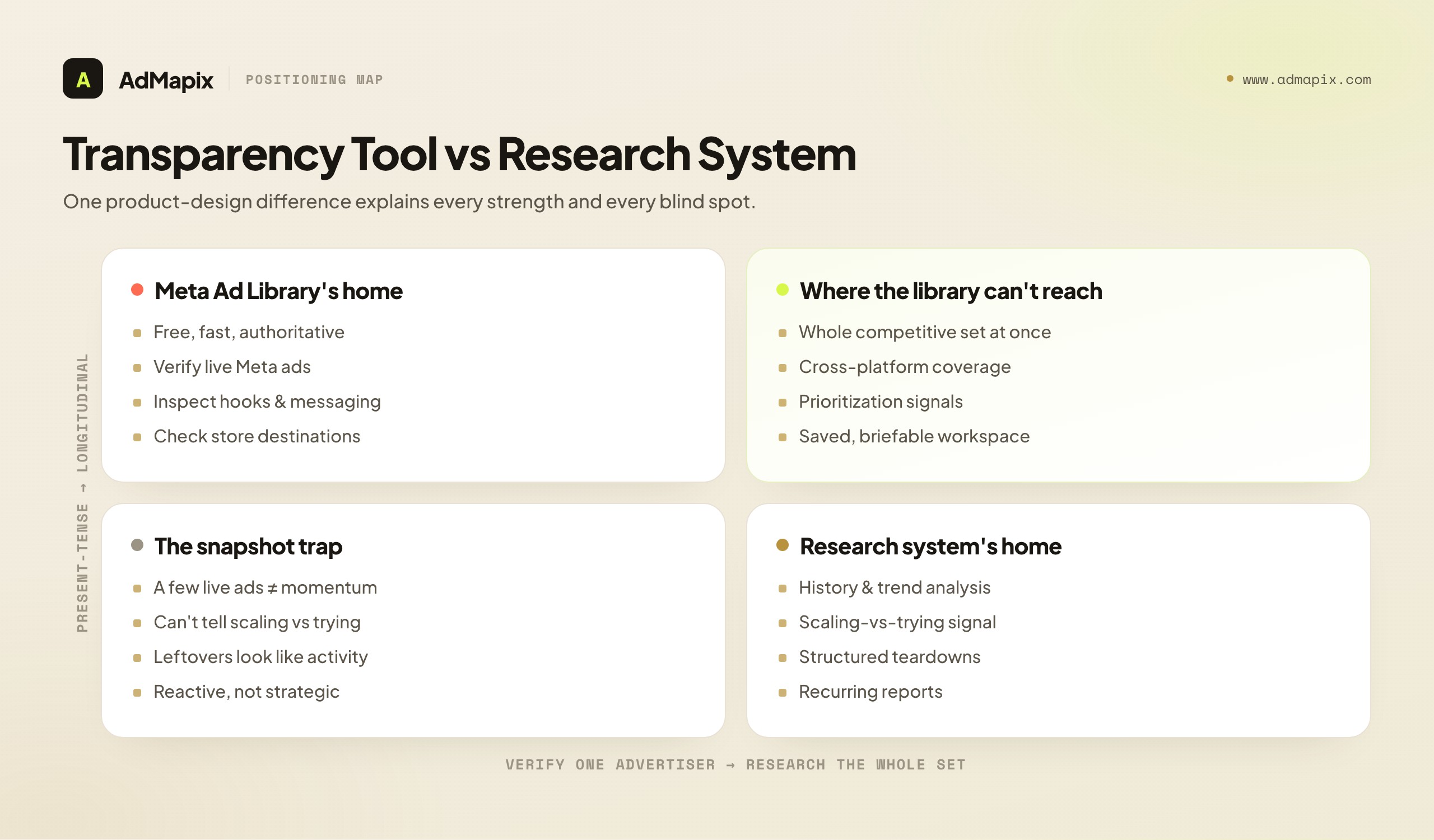
Here is the framing that makes this comparison useful rather than a feature list: the Meta Ad Library is a transparency tool, while a dedicated ad intelligence platform is a research system. That single product-design difference explains almost everything that follows — every strength of the free library and every blind spot, and every reason a game UA team eventually reaches for more. A transparency tool is built to answer "is this specific advertiser running this specific ad right now?" A research system is built to answer "what is happening across my competitive set, over time, across platforms, and what should I do about it this week?" Those are different jobs, and conflating them is the root cause of the bad decisions this guide is written to prevent. One honesty note carried throughout: AdMapix is our product, and it sits on the research-system side as searchable cross-network creative evidence. Neither it nor any tool — free or paid — can show competitor spend, ROAS, install volume, or targeting, because that data is not public. We will say so plainly wherever it matters.
TL;DR — Meta Ad Library vs Ad Intelligence Tools for Game UA
- The Meta Ad Library is a free transparency tool; a dedicated ad intelligence platform is a paid research system. That design difference explains every strength and every blind spot.
- Use the Meta Ad Library for fast verification of what a competitor is running on Meta right now, messaging and hook inspection, and checking store destinations. It is excellent and free for exactly that.
- Its structural limits for game UA: Meta-only (no TikTok, no ad networks where mobile-game creative lives), a near-present-tense snapshot (weak history), no cross-competitor prioritization, and no structured creative teardown or saved-research workflow.
- A dedicated intelligence tool adds cross-platform coverage, history and trend analysis, prioritization signals, structured creative breakdowns, saved boards, and recurring reports — the context that turns observation into a decision.
- Mobile-game creative is highly context-dependent (platform, country, format, audience maturity, store context), so a single Meta snapshot routinely misleads — a polished Meta video can hide that the real momentum is creator-style TikTok.
- Neither shows spend, ROAS, installs, or targeting. Those are not public. Any "spend estimate" is a model, not a fact. Validate every signal in your own UA analytics.
- Decide by the blind spots that cost you: if your research is single-platform, present-tense, and ad hoc, the free library is fine; if it is cross-platform, longitudinal, and prioritized, you have outgrown it.
- Read signals by strength: a live ad is weak (being tried, not winning), longevity is a moderate proxy, and variant count plus cross-platform consistency are the strongest public conviction signals — but every one is a hypothesis until your own UA analytics confirm it.
Why This Comparison Matters for Game UA Specifically
Creative research is not about collecting inspiration; it is supposed to improve decisions. For a mobile game UA team, a good competitor-research workflow should reliably answer questions like: which creative angles are competitors testing right now? Which platforms are they prioritizing? Are they scaling a concept or just trying a few variants? Is a creative burst tied to a launch, a live event, or a market expansion? And which competitors deserve attention this week versus which are just noise? If your research source cannot answer those questions, your team starts filling the gaps with assumptions — and that is where the expensive mistakes begin.
Consider three failure modes that recur in game UA. A team sees a polished Meta video from a rival and builds similar assets, only to learn later that the competitor's real momentum is coming from creator-style TikTok videos the Meta-only library never showed them. A second team notices a few active ads in the library and assumes a competitor is pushing hard, when in reality those are leftovers from an older campaign and the real activity moved elsewhere. A third team spends hours every week manually searching the library, taking screenshots, and updating spreadsheets instead of turning insight into briefs. Each of these is a direct consequence of using a transparency tool as if it were a research system.
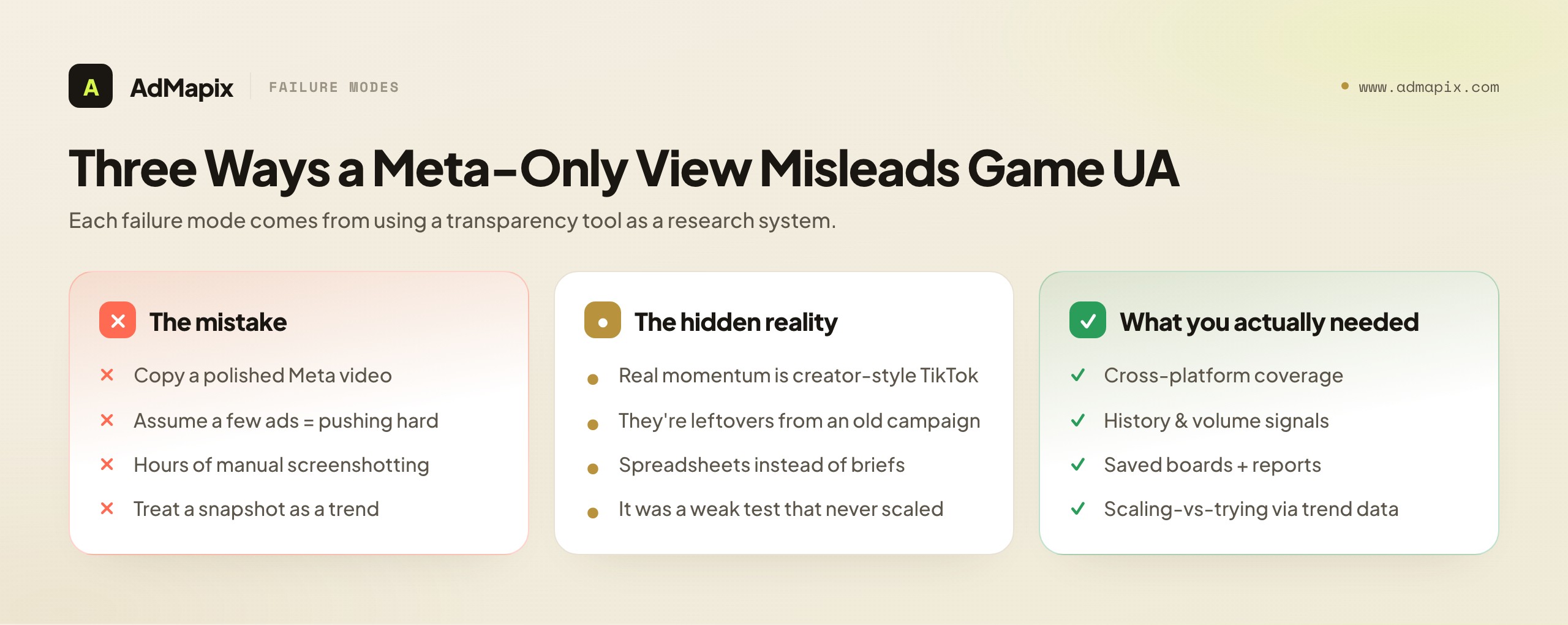
The deeper issue is that mobile-game creative performance is highly context-dependent. The same concept behaves differently depending on platform, country, format, audience maturity, and store context. A gameplay-heavy direct-response ad that works on Meta may need entirely different pacing and visual language to feel native on TikTok. A concept that looks exciting in a one-day snapshot may actually be a weak test that never scaled — you simply cannot tell from a present-tense view. Without history and prioritization signals, your research becomes reactive instead of strategic, and reactive creative research in a category as fast-moving as mobile games is a recipe for always being a step behind. That is why the difference between a free transparency library and a dedicated intelligence workflow matters for game UA in particular: it is not about having more screenshots, it is about having enough context to make the next testing decision with confidence.
What the Meta Ad Library Does Well
An honest comparison starts by giving the free tool full credit, because the Meta Ad Library genuinely solves a narrow problem quickly and well: it lets you inspect active ads on Meta's properties. For a mobile game team, that makes it strong for several specific jobs, and you should absolutely use it for them.
Checking whether a competitor is active on Meta. The fastest, most authoritative way to confirm a rival is currently running ads on Facebook and Instagram is the library itself — it is Meta's own transparency surface, so it is ground truth for Meta activity. No paid tool beats the source on this narrow question.
Reviewing messaging, hooks, and visual style. You can read the headlines, watch the videos, and study the visual language a competitor is using on Meta right now. For a quick read on how a rival is positioning a game or an offer, this is fast and free.
Checking landing pages and store destinations. The library lets you follow where an ad points — the app store listing or landing page — which is useful for understanding the full funnel a competitor is running on Meta.
Spotting obvious creative angles. If a competitor is leaning hard on a particular angle on Meta, the library makes it visible at a glance. For surface-level angle spotting, it does the job.
Getting fast, free inspiration. When you need a quick hit of what is live on Meta in your category, the library delivers immediately with no subscription, no setup, and no learning curve.
The honest summary is that the Meta Ad Library is excellent at present-tense, Meta-only verification. If your question is "what is this specific competitor running on Meta today," the library answers it perfectly and for free, and any UA team that skips it is leaving free value on the table. The limits appear only when your question grows beyond that narrow frame — which, for serious game UA research, it inevitably does.
Where the Meta Ad Library Breaks for Game UA
The library's limits are not bugs; they are the predictable edges of a transparency tool being asked to do a research system's job. Four structural gaps matter most for mobile game UA, and each one maps to a real decision a game team needs to make.
It is Meta-only. This is the largest gap for game UA. Mobile-game creative does not live only on Meta — it lives on TikTok, on Google and YouTube, and across ad networks like Unity, AppLovin, ironSource, and others where a huge share of game UA spend and creative actually runs. A Meta-only library is structurally blind to most of where your category competes. A team that researches only Meta is researching a fraction of the battlefield and drawing conclusions as if it were the whole thing. For the failure mode where a rival's real momentum is on TikTok, this is the exact cause.
It is a near-present-tense snapshot. The library is built to show what is currently running, with weak support for history and trends. For game UA, history is where the strategic signal lives: is a competitor scaling a concept (more variants, longer run, more spend pressure) or just trying it? Did a creative burst coincide with a launch or live event? You cannot answer "scaling versus trying" from a present-tense view, and that distinction is the difference between a concept worth copying and a dead-end test. Without history, you mistake noise for signal and snapshots for trends.
It has no cross-competitor prioritization. The library shows you one advertiser at a time; it does not tell you which of your fifteen competitors deserve your attention this week. For a game UA team watching a competitive set, the prioritization question — "who increased creative pressure, who launched something new, who went quiet" — is the one that should drive the weekly focus, and the library cannot answer it at all. You are left manually checking each competitor, which does not scale.
It has no structured teardown or saved-research workflow. The library shows the ad; it does not break it into hook, pacing, gameplay-versus-lifestyle framing, proof, and CTA, and it does not let you save, tag, and revisit research over time. So even when you find a winning game creative, turning it into a brief is fully manual, and last month's research evaporates. For a team that needs a durable, briefable research base, the library is a viewing window, not a workspace.
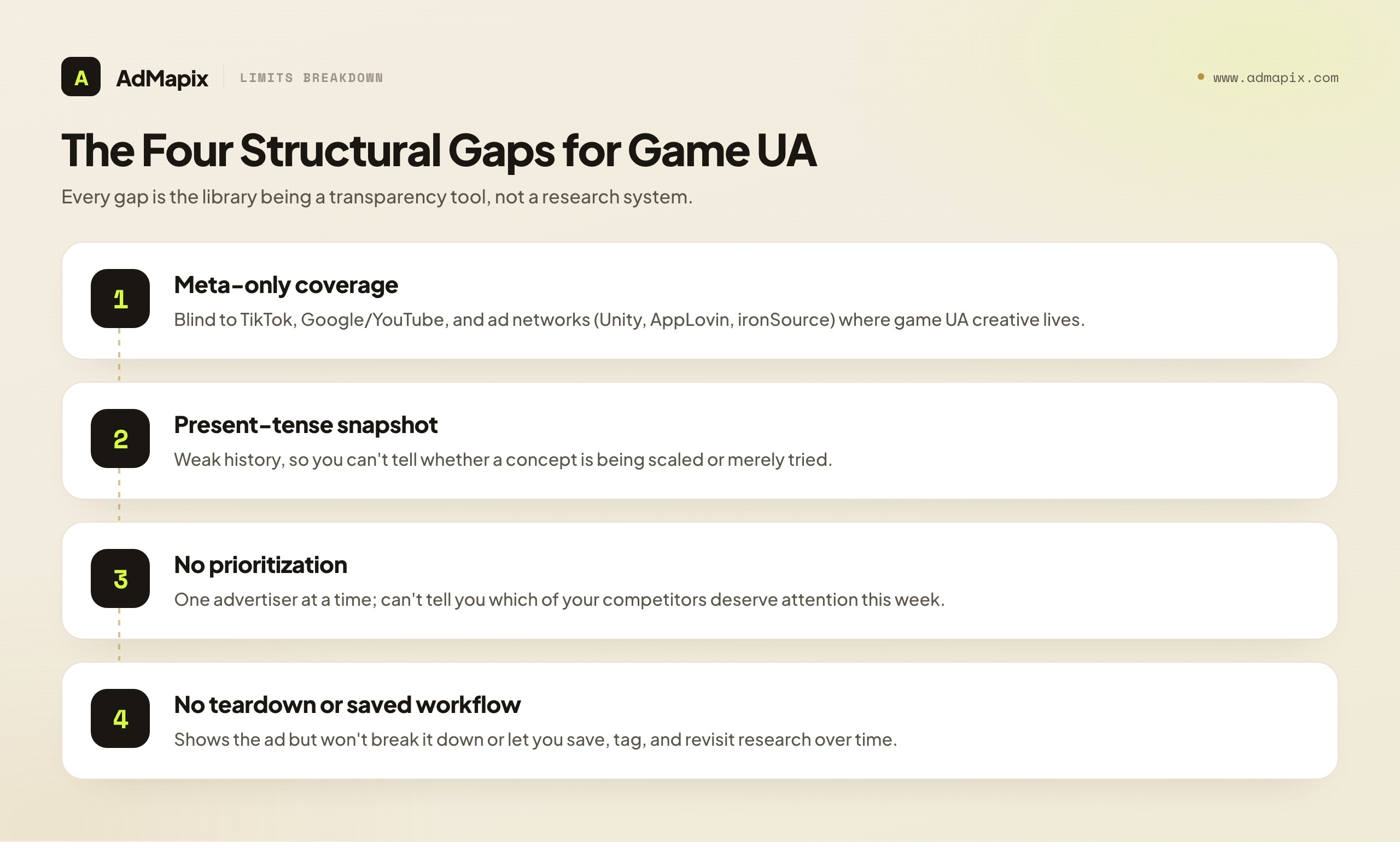
Notice the pattern: every limit is the library being a transparency tool rather than a research system. None of these is a flaw to be fixed in a future version — they are inherent to what a transparency surface is. The right response is not to wish the library were more; it is to recognize when your job has outgrown a transparency tool and needs a research system alongside it.
Side by Side: Capability Matrix
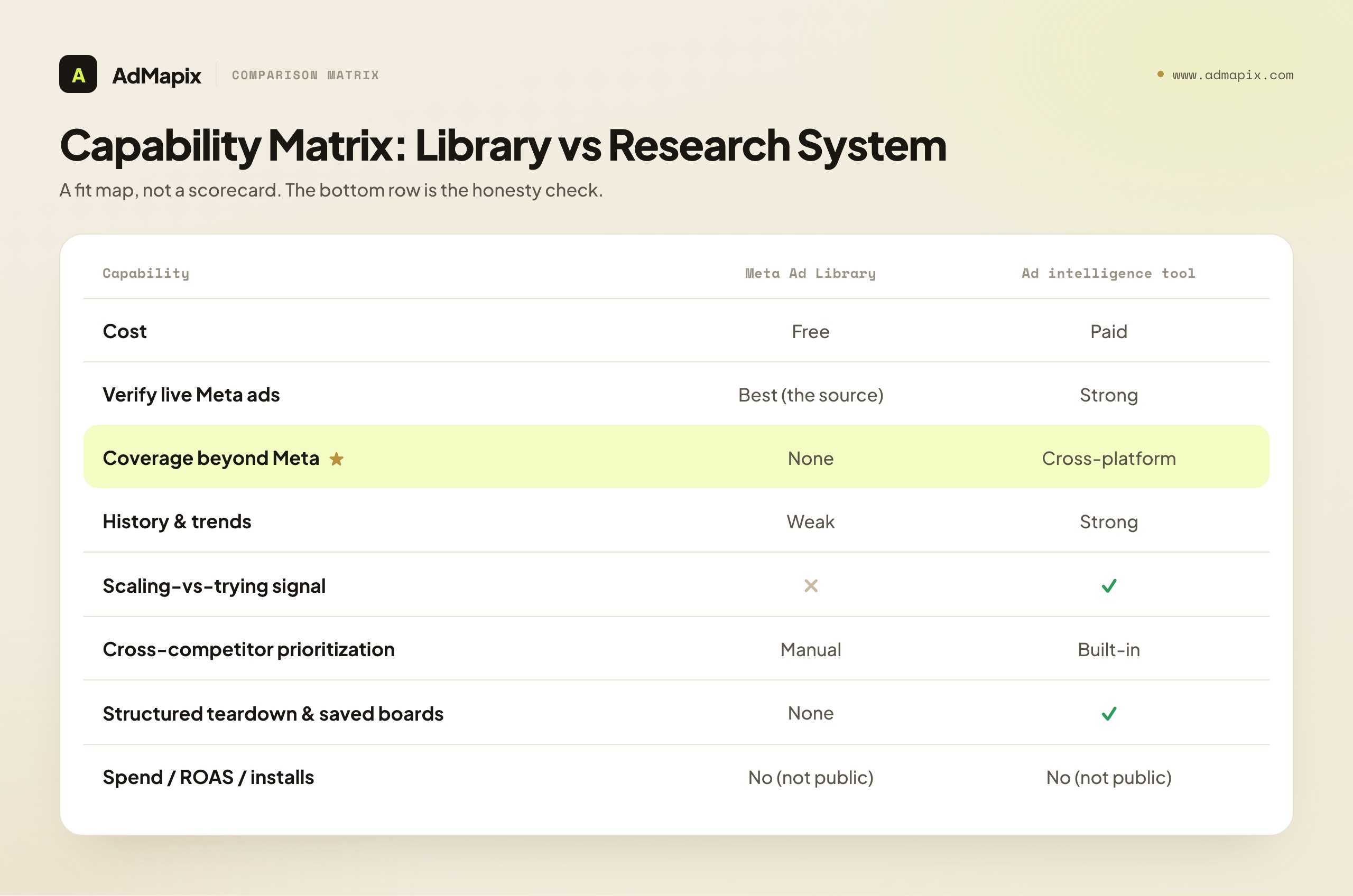
To make the comparison concrete, here is the Meta Ad Library against a dedicated ad intelligence platform across the capabilities that matter for game UA. Read it as a fit map, not a scorecard — the library wins decisively on the narrow job it is built for, and loses on the broad job it was never meant to do.
| Capability | Meta Ad Library | Dedicated ad intelligence tool |
|---|---|---|
| Cost | Free | Paid subscription |
| Verify a competitor's live Meta ads | Best-in-class (it is the source) | Strong (indexes the same data) |
| Coverage beyond Meta (TikTok, networks, YouTube) | None | Cross-platform |
| History & trend analysis over time | Weak (near present-tense) | Strong (longitudinal) |
| Scaling-vs-trying signal | Not available | Available via history & volume |
| Cross-competitor prioritization | Manual, one at a time | Built-in across your set |
| Structured creative teardown | None | Hook, pacing, format, proof, CTA |
| Saved boards & tagging | None | Durable research workspace |
| Recurring competitor reports | None | Exportable |
| Competitor spend / ROAS / installs | Not available (not public) | Not available (not public) |
The matrix makes the decision legible. If every row you care about is in the top third — verifying live Meta ads, fast and free — the library is all you need. If the rows that matter to you are coverage, history, prioritization, teardown, and reporting, you are looking at the job a research system does, and the free tool cannot reach it no matter how skillfully you use it. The bottom row is the equalizer and the honesty check: neither tool shows spend, ROAS, or installs, because that data is not public, and any paid tool implying otherwise is selling a model as a fact.
The Decision: When to Add a Paid Intelligence Layer
The practical question is not "which is better" — it is "when does my game UA research outgrow the free library?" Here is a clear decision rule built from the blind spots above. Add a paid intelligence layer when two or more of these are true for your team.
Your competitors are active beyond Meta. If a meaningful share of your category's creative runs on TikTok, Google/YouTube, or ad networks — which for mobile games is almost always the case — a Meta-only view systematically misleads you. The cross-platform gap alone justifies the paid layer for most serious game UA teams, because researching one platform in a multi-platform war is a structural disadvantage.
You need to know scaling versus trying. If your testing decisions depend on distinguishing a concept a competitor is scaling from one they are merely trying, you need history and volume signals the library does not provide. This single distinction — is the rival doubling down or dabbling — is often the highest-value signal in game UA, and it is invisible in a present-tense snapshot.
You watch a competitive set, not one rival. If you track more than a handful of competitors, the manual, one-at-a-time library workflow does not scale, and you need cross-competitor prioritization to focus your week. The bigger your competitive set, the more the prioritization gap costs you in wasted attention.
Research has to become briefs and reports. If your job requires turning research into structured creative briefs and recurring competitor reports — especially as a UA team reporting up or an agency reporting to a client — the library's lack of teardown and saved workflow makes every brief and report a manual rebuild. A research system pays for itself in the assembly time it removes.
Manual research is eating real hours. If your team spends hours weekly screenshotting and spreadsheeting, the paid layer's saved boards and reports convert that time into briefs. Do the cost-per-decision math: the subscription is often cheaper than the hours it replaces.
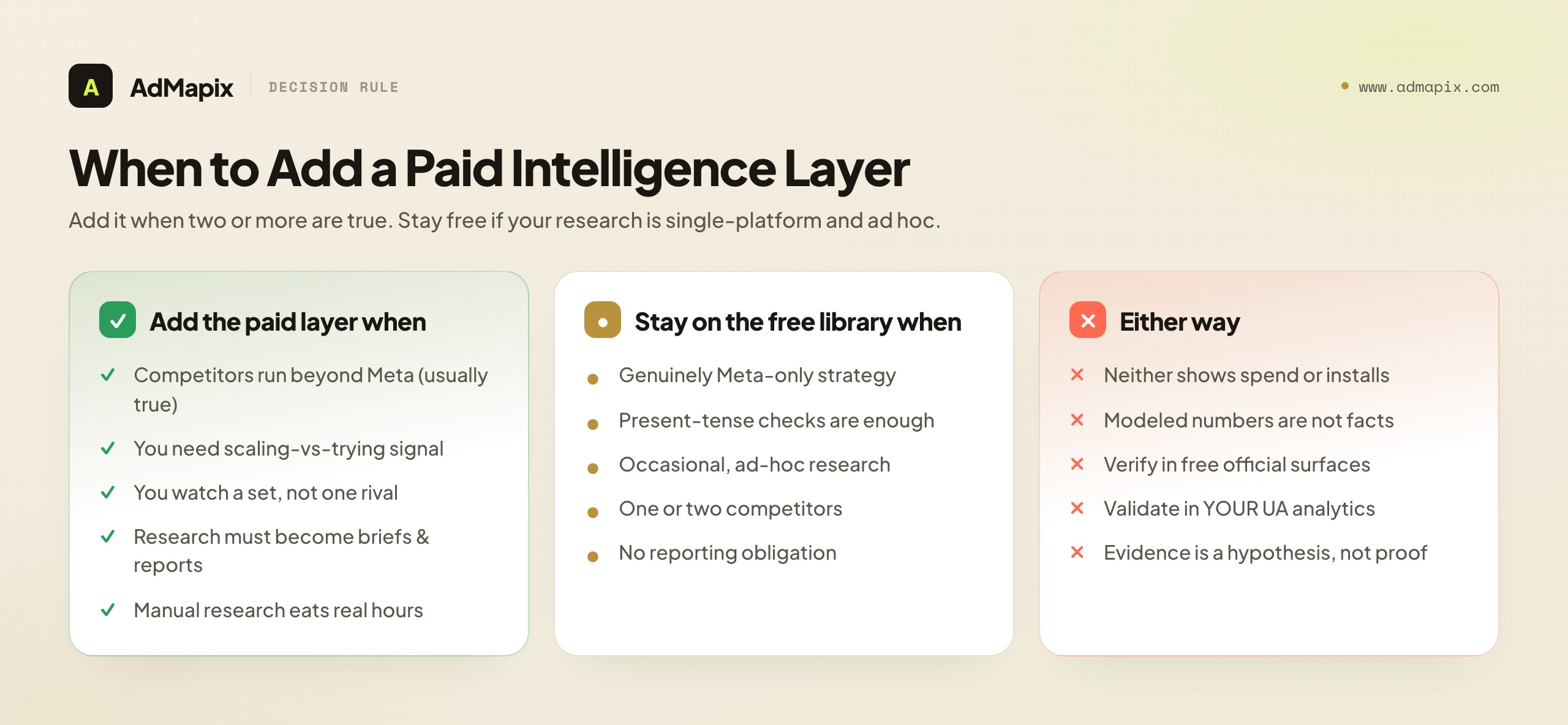
Conversely, stay on the free library if your research is genuinely single-platform, present-tense, and ad hoc — a small game, a Meta-only strategy, an occasional check. There is no virtue in paying for a research system you will not run. The decision is not about ambition; it is about whether the blind spots above are actually costing you decisions. If they are, the paid layer is a tool purchase that pays back. If they are not, the free library is the right answer and you should keep your budget.
How the Two Work Together in a Game UA Workflow
The framing of "versus" is useful for a buying decision, but in practice the best game UA teams use both, because they do different jobs and the free tool is excellent at its job. Here is the combined weekly workflow that uses each for what it is best at.
Start in the free libraries for verification. Open the Meta Ad Library — and TikTok's Creative Center and Google's Ads Transparency Center, the other free official surfaces — to confirm what your top competitors are verifiably running right now on each platform. This is your ground truth, and it is free. Never pay a tool to do verification the official surfaces do for free.
Use the intelligence layer for the cross-platform, longitudinal view. Where the free surfaces stop, the research system starts: query your whole competitive set across platforms, look at history to separate scaling from trying, and let prioritization signals tell you which competitors moved this week. This is the context the free libraries structurally cannot give you, and it is where the paid layer earns its budget.
Tear down the movers in the intelligence layer. Take the two or three most significant new game creatives and break them into hook, pacing, gameplay-versus-lifestyle framing, proof, and CTA. Save them to a board. You are turning raw ads into briefable structure — the input your creative team actually needs.
Report the pattern. Summarize the week's cross-platform movement into a recurring report a stakeholder reads in two minutes: who scaled what, what new angle appeared, what it might mean for your next test. The free library cannot produce this; the research system can.
Force the decision and validate in your UA analytics. For each finding, name the test, brief, or budget move it drives this week — then launch and read your own UA data. The competitor evidence was a hypothesis; your installs, cost per install, and downstream retention are the only proof of what works for your game. This last step is non-negotiable, because no tool, free or paid, can tell you what converts for you.
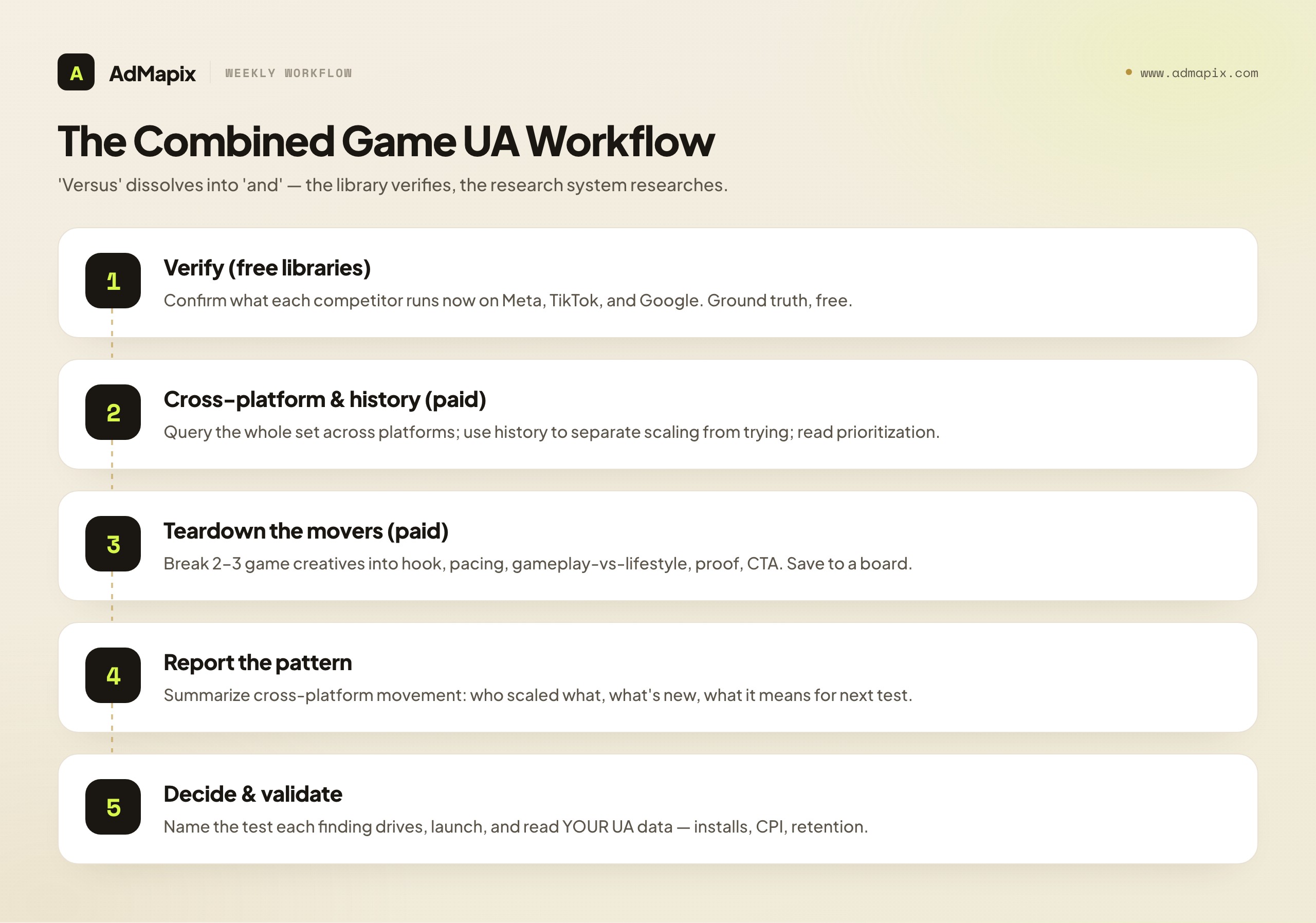
Run this combined loop and the "versus" dissolves into "and": the free library does fast, authoritative, single-platform verification, and the research system does the cross-platform, longitudinal, prioritized, briefable work the library cannot. Each plays to its strength, and the team gets the full picture for the cost of one subscription plus a free tool used well.
The Honest Limits Both Tools Share
This section is the one game UA buyers most often skip and most often regret, because it is where assumptions become budget mistakes. Both the Meta Ad Library and every dedicated ad intelligence tool — AdMapix included — run on public data. That boundary defines what any of them can truthfully tell you, and no feature set, free or paid, changes it.
What they can genuinely show: the ads advertisers are running publicly (the library for Meta, intelligence tools across platforms), rough creative longevity, formats, hooks, and offers, and — for research systems — structured teardowns and trend history. That is real, useful evidence for understanding competitor creative strategy, and it is enough to drive sharp testing hypotheses.
What none of them can confirm: a competitor's true ad spend, real ROAS or cost per install, actual install volume, or audience targeting and bids. Those numbers live inside the advertiser's private dashboards, and no public surface exposes them. Public transparency surfaces like the Meta Ad Library and Google's Ads Transparency Center, and broader frameworks like the European Union's Digital Services Act ad transparency rules, have expanded what is publicly visible about ads — the creative evidence — but they are not designed to, and do not, expose private performance. For the wider mobile market picture, reputable industry sources like Sensor Tower and data.ai publish modeled estimates, which are useful directionally but are explicitly models, not measurements. When any tool shows a "spend" or "installs" number for a competitor, read the label: it is a hypothesis dressed as a fact.
This applies to AdMapix without exception, and we state it directly: AdMapix is searchable cross-network creative evidence — saved ad examples, structured video breakdowns, and recurring reports — not a window into spend, ROAS, installs, or targeting, because those are not public. The deepest limit of all, true for every tool here and especially sharp in game UA where performance is so context-dependent: even perfect creative evidence cannot tell you what converts for your game. That answer lives only in your own UA analytics after your own test. Every tool in this comparison is an input to a hypothesis, never the proof of a result.
Common Mistakes Game UA Teams Make in This Comparison
A handful of recurring mistakes cause most of the bad decisions this comparison is meant to prevent. Name them to avoid them.
Mistake 1 — Treating a Meta-only view as the whole market. The most common and most costly error: researching only the Meta Ad Library and concluding you understand a competitor's strategy, when most game UA creative runs elsewhere. The fix is to use the free libraries on every platform you compete on, and a cross-platform research system to connect them.
Mistake 2 — Reading a snapshot as a trend. A few active ads today tell you nothing about whether a concept is scaling or dying. Without history you mistake leftovers for momentum and one-day tests for winners. Use longitudinal data to separate scaling from trying.
Mistake 3 — Paying for a research system you won't run. The opposite error: a small, Meta-only game buying an enterprise intelligence platform that sits idle. If your research is genuinely single-platform and ad hoc, the free library is the right answer. Buy the paid layer only when the blind spots actually cost you decisions.
Mistake 4 — Confusing creative evidence with performance. Competitor ads show what a rival chose to run, not what worked. In game UA, where performance is wildly context-dependent, this gap is enormous. The only proof of what works for your game is your own UA data after your own test.
Mistake 5 — Trusting modeled spend and install estimates as facts. Industry estimates and tool "spend" figures are models. They are useful directionally and dangerous when treated as measurements. Read the label, and never set a UA budget on a competitor's modeled number.
Mistake 6 — Skipping verification because you have a paid tool. A research system indexes public data; the official library is the source. Even with a paid tool, start verification in the free official surfaces — they are ground truth and they are free.
Avoid these six and the comparison resolves cleanly: use the free library for what it is best at, add the research system when the blind spots cost you, and validate everything in your own analytics.
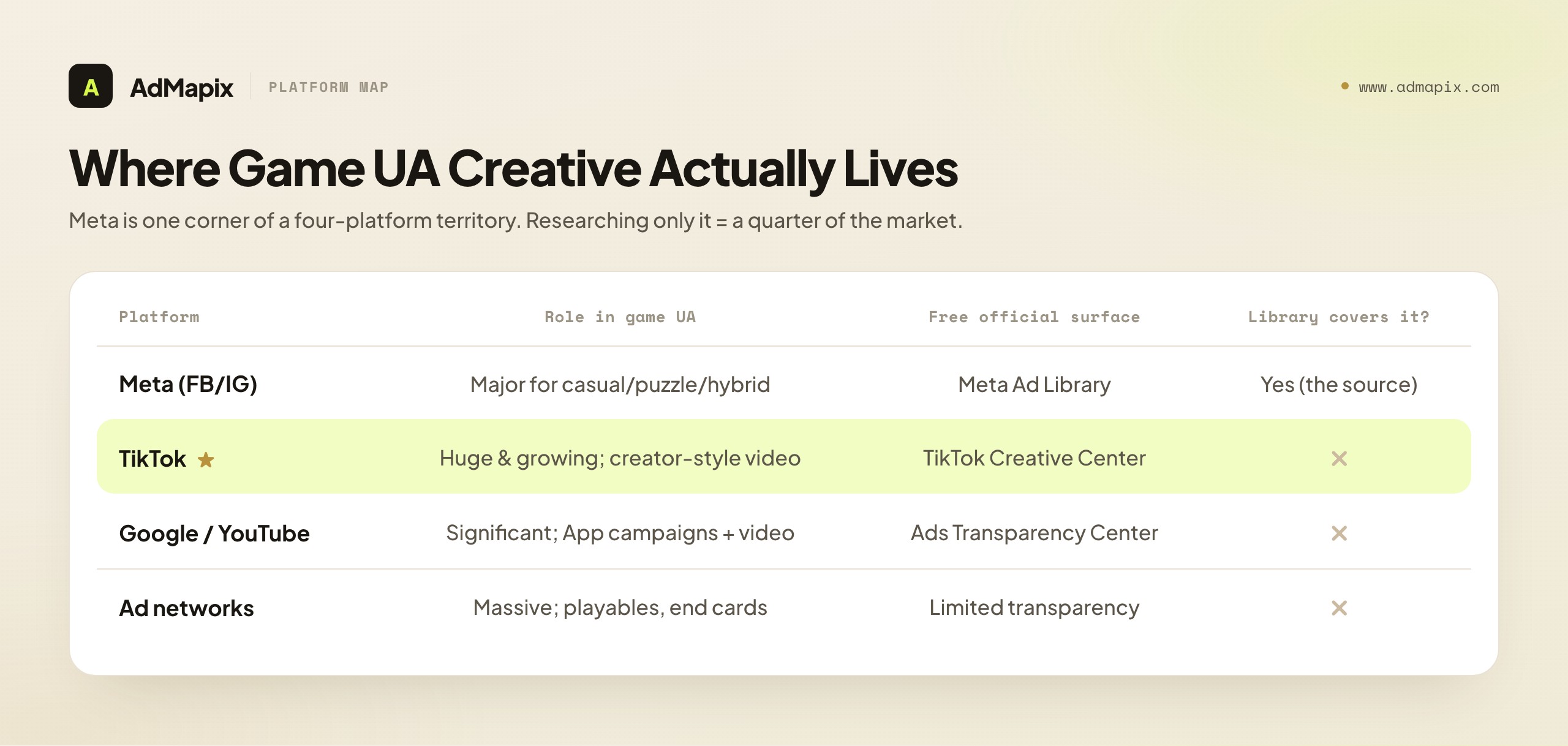
Where Game UA Creative Actually Lives: The Platform Map
The single strongest argument against relying on the Meta Ad Library for game UA is the platform map — the simple fact of where mobile-game creative runs. Walk through it and the Meta-only blind spot becomes impossible to ignore, because the library covers one corner of a much larger territory.
Meta (Facebook and Instagram) is a major channel for many game genres, especially casual, puzzle, and hybrid-casual titles where broad social audiences convert well. The Meta Ad Library covers this corner authoritatively and for free. For a casual game with a Meta-heavy strategy, the library genuinely is a large share of the relevant picture — which is precisely why some small teams reasonably stay on it. But even here, the better-resourced competitors are usually running on other platforms too, so a Meta-only view understates even a Meta-centric competitor's full activity.
TikTok is where an enormous and growing share of game UA creative lives, particularly for titles targeting younger audiences and for any game leaning on creator-style, native-feeling video. TikTok creative is its own craft — fast hooks, native pacing, sound-led — and the difference between a winning and losing TikTok game ad is often decided in the first second. The TikTok Creative Center surfaces trending and top ads for free, which is valuable, but it is a separate surface from Meta's, and a team checking only the Meta library is blind to the platform where the genre's creative innovation often happens first. The recurring failure mode — building Meta-style assets while the rival's momentum is on TikTok — comes straight from this gap.
Google and YouTube carry significant game UA, with YouTube video creative overlapping the social-video skills game teams already have, and Google's App campaigns reaching across the Google ecosystem. The Ads Transparency Center is the free official surface here, separate again from Meta and TikTok. For games with a strong YouTube creative strategy, ignoring this surface means missing a whole channel of competitor activity.
Ad networks — Unity Ads, AppLovin, ironSource, and others — are where a huge portion of mobile-game UA spend and creative actually concentrates, especially playables and interactive end cards that have no equivalent on social platforms. These networks have far less public transparency than the social platforms, which is exactly why a research system that indexes network creative is so valuable for game UA: it is often the only systematic view into a channel that is both massive and opaque. The Meta Ad Library does not touch this territory at all.
Lay these four together and the conclusion is unavoidable: for most mobile games, Meta is one platform among four or more where the category competes, and creative is platform-native on each. Researching only the Meta Ad Library is not "doing competitor research with a free tool" — it is researching a quarter of the market and treating it as the whole. The cross-platform coverage of a research system is not a luxury for game UA; it is the difference between seeing the battlefield and seeing one trench. This is the deepest, most specific reason the "Meta Ads Library vs ad intelligence tools" question, for game UA, almost always resolves toward needing both.
A Worked Scenario: Researching a Competitor's Live-Event Push
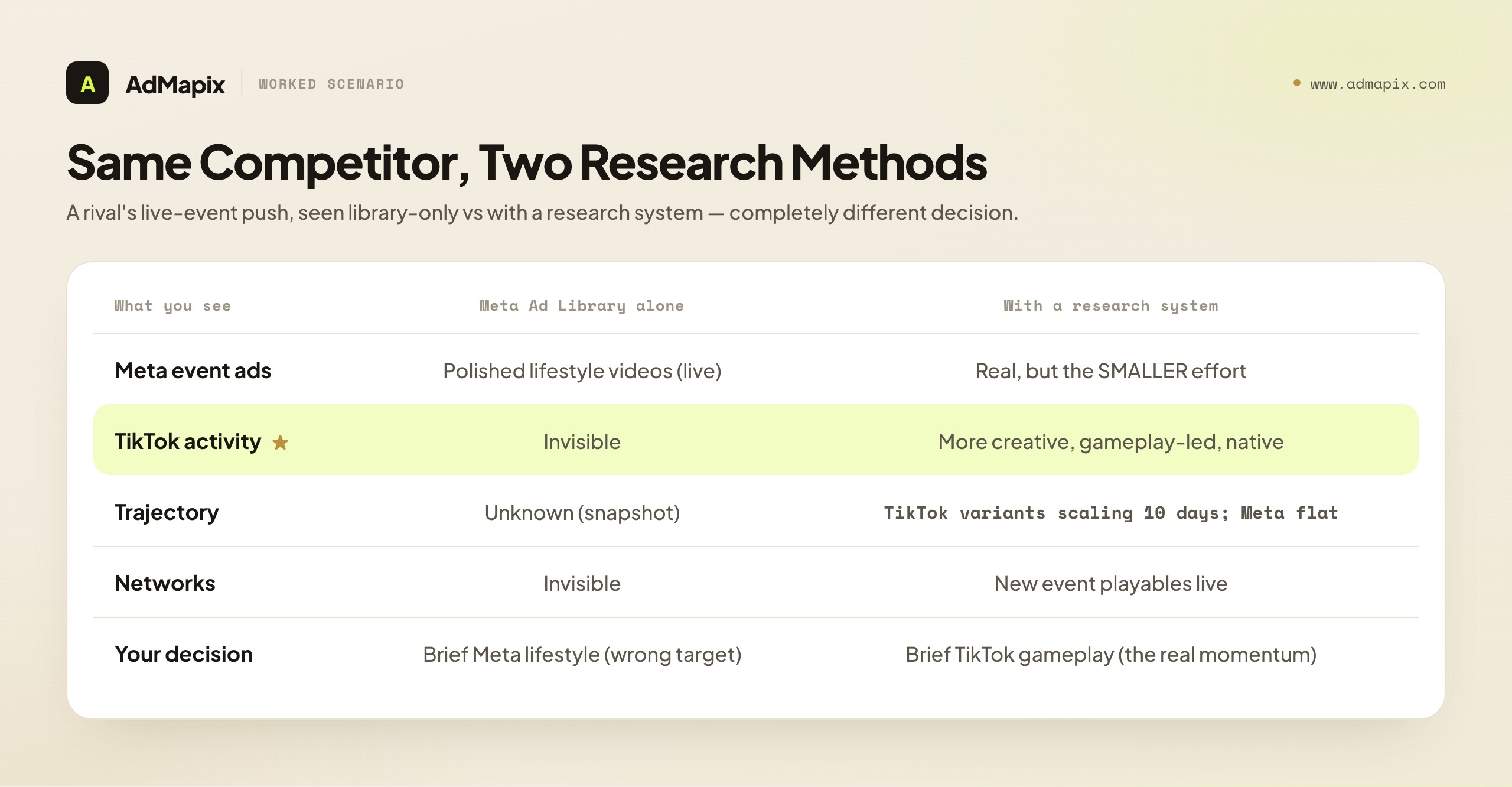
Abstract comparison lands harder as a concrete walk-through, so here is the same competitor researched two ways — Meta Ad Library alone, then with a research system alongside — on a realistic game UA situation. Say a rival casual game just launched a seasonal live event, and you want to understand their creative push and decide your response.
With the Meta Ad Library alone, you search the rival and see they have several new ads live on Meta themed around the seasonal event — polished, lifestyle-led videos with the event characters. You conclude they are pushing the event hard on Meta with a lifestyle angle, and you brief your team to build similar Meta lifestyle assets for your own competing event. That is the entire picture the library gives you, and it feels like enough. But look at what you could not see: whether this is a big scaled push or a small test, whether Meta is even their primary channel for the event, and what they are doing on the platforms the library cannot reach. You acted on a quarter of the picture, confidently.
With a research system alongside, the picture changes materially. You start with the same free Meta verification — good, the Meta lifestyle ads are real and live. Then the cross-platform view shows the rival is running far more event creative on TikTok than on Meta, and the TikTok creative is not lifestyle at all — it is fast, gameplay-led, creator-style video that feels native to the platform. The history view shows the TikTok variants multiplying over the past ten days while the Meta set has stayed flat, which tells you the scaling is happening on TikTok and the Meta lifestyle ads are a smaller, secondary effort. The network view shows new playables tied to the event going live on the ad networks. Now you know the real shape of the push: TikTok-led gameplay creative, scaling fast, with Meta and networks as supporting channels.
The difference in the resulting decision is night and day. The library-only team briefed Meta lifestyle assets — chasing the rival's weakest, smallest effort and missing the actual momentum entirely. The research-system team briefs fast gameplay-led TikTok creative as the priority, with Meta and a playable as supporting tests, and they read the rival's trajectory, not just a snapshot. Same competitor, same week, completely different and far better decision — driven entirely by cross-platform coverage and history the free library structurally cannot provide.
And the final discipline still holds for both teams: the competitor evidence, however complete, is a hypothesis. The research-system team has a far better hypothesis — TikTok gameplay creative is where this event is being won — but they still have to build their version, launch it, and read their own installs, cost per install, and event-participation metrics to know whether it works for their game. Better evidence makes a better hypothesis; only your own UA data makes a result. That is the whole comparison in one scenario: the free library gives a fast, narrow, present-tense view that routinely misleads game UA; the research system gives the cross-platform, longitudinal, prioritized view that produces a sound hypothesis; and your analytics gives the only proof.
Cost-Per-Decision: Is the Paid Layer Worth It for Your Game?
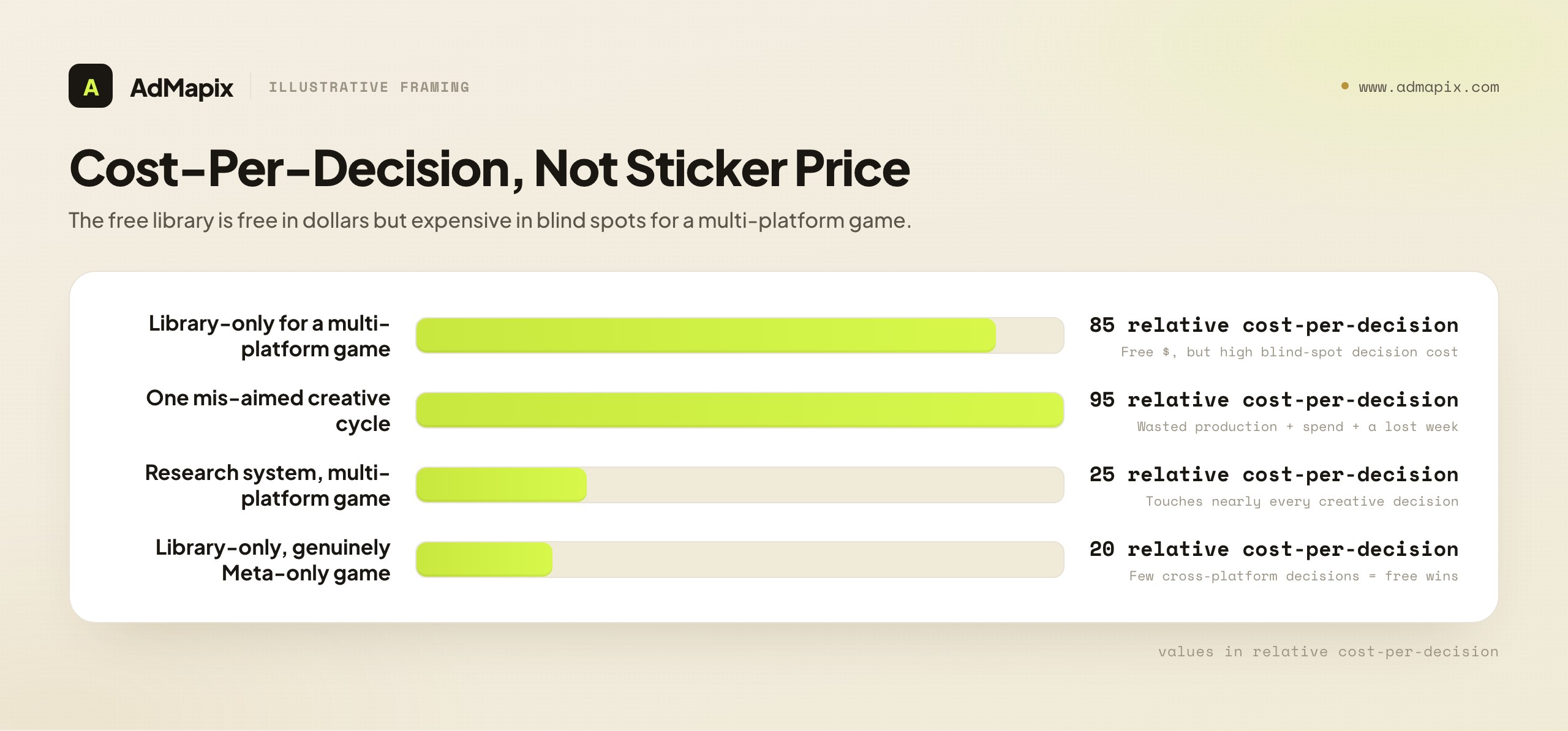
The "versus" question is ultimately a budget question, and the right way to answer it is cost-per-decision, not sticker price. The Meta Ad Library is free, so the comparison is really "is the paid research system worth its cost given what the free library already does?" Answer it by estimating the decisions the paid layer uniquely enables — ones the free library cannot.
Start by listing the decisions that depend on capabilities the library lacks: every cross-platform creative call, every scaling-versus-trying judgment, every weekly prioritization across your competitive set, every structured brief built from a teardown, and every recurring report. Count, honestly, how many such decisions your team makes per month. For a serious game UA team competing across Meta, TikTok, Google, and networks, that number is usually large — because nearly every meaningful creative decision depends on the cross-platform and history context the library cannot give. Divide the subscription cost by that number, and the cost-per-decision is typically low, because the paid layer is touching almost every creative decision you make.
Now run the same math for the failure cost — the decisions the library-only approach gets wrong. The worked scenario above is the template: a library-only team chasing a rival's smallest effort while missing the real momentum is not a free mistake, it is wasted creative production, wasted ad spend testing the wrong angle, and a lost week against a competitor who read the battlefield correctly. In game UA, where a single well-aimed creative concept can move your whole UA economics, one avoided mis-aimed creative cycle can pay for the research system many times over. The free library's true cost is not zero; it is the price of the blind-spot decisions it lets you make confidently and wrongly.
The reframe that cuts through it: the Meta Ad Library is free in dollars but expensive in blind spots for a multi-platform game; a research system has a dollar cost but a low cost-per-decision and removes the blind spots that drive expensive creative mistakes. For a small, genuinely Meta-only game making few cross-platform decisions, the free library wins the cost-per-decision math and you should keep your budget. For a game competing across platforms — which is most games — the paid layer's cost-per-decision is low and its blind-spot avoidance is high, and the math favors adding it. Compute it on your own decision volume, not on the sticker price, and the answer for your specific game becomes clear.
Reading Game Creative Signals Without Fooling Yourself
Whichever side of the comparison you land on, the value of any signal depends entirely on how you interpret it, and game UA has its own interpretive traps. This section is the discipline that keeps both the free library and a paid research system honest in your hands, because the most expensive mistakes come not from the tools but from over-reading what they show.
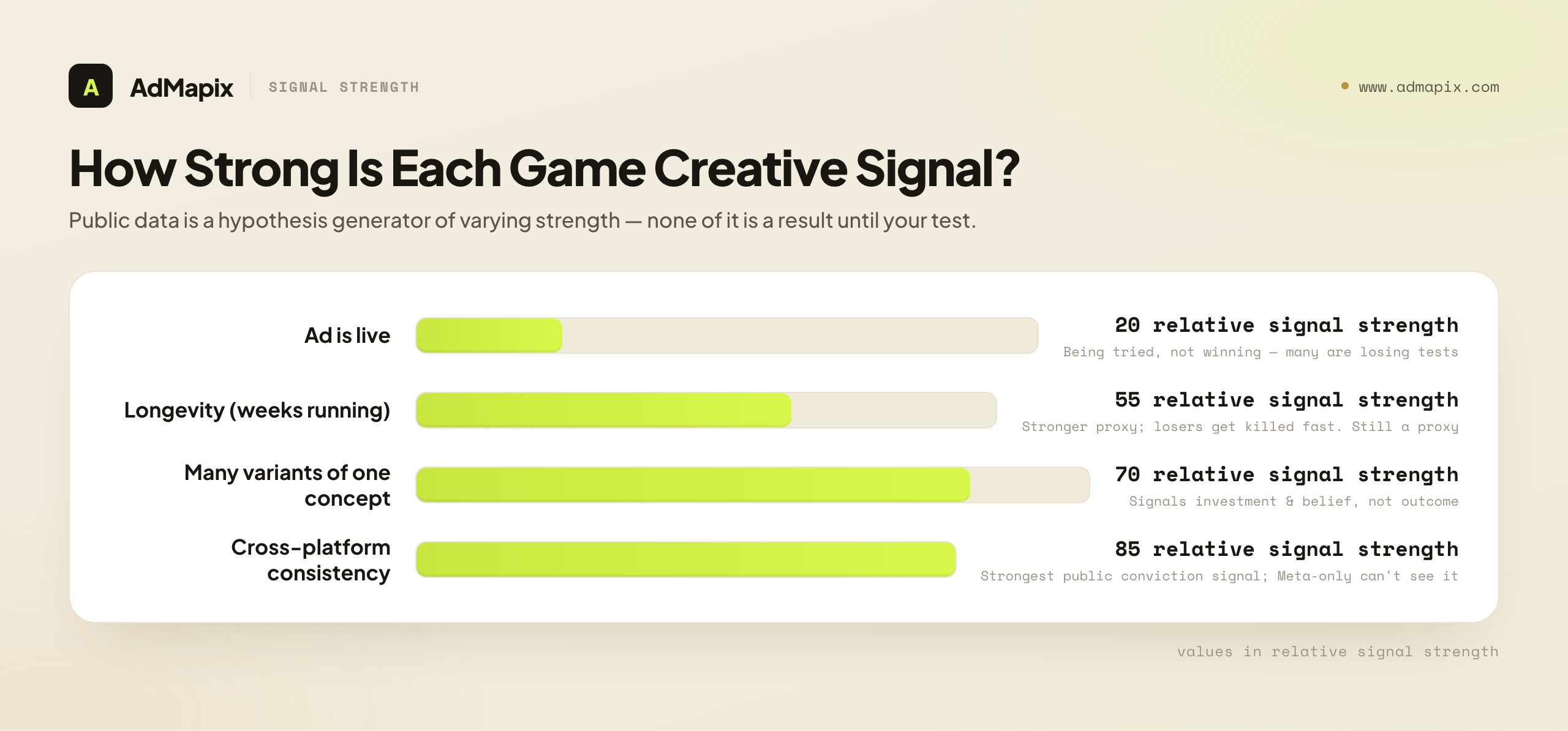
A live ad is a signal of activity, not of profitability. The most basic trap: seeing a competitor's ad live and assuming it is working. The ad being live tells you the advertiser chose to run it; it tells you nothing about installs, retention, or return on ad spend, because none of that is public. In game UA, where so much creative is rapid-fire testing, plenty of live ads are losing tests still in their measurement window. Treat "live" as "being tried," not "winning," and never scale your spend behind a competitor's ad just because it exists.
Longevity is a stronger signal, but still a proxy. An ad or concept that has run for weeks across multiple variants is more likely a winner, because game advertisers kill losers fast and scale winners. This is the most useful public signal you have, and a research system's history view is what makes it readable. But it remains a proxy — a long-running concept could be a brand play, a poorly-managed account, or sustained by economics you cannot see. Use longevity to prioritize what to study and test, never as a substitute for your own test.
Variant count signals investment, not outcome. When a research system shows a competitor running many variants of one concept, that signals they are investing in it — iterating, optimizing, treating it as a bet. That is a strong "this is worth studying" signal, because teams iterate on things that show early promise. But investment is not outcome; a heavily-iterated concept could still be a competitor stubbornly chasing a loser. Read variant proliferation as "they believe in this," then verify the structure works for your game in your own test.
Cross-platform consistency signals conviction. When the same concept appears, adapted, across Meta, TikTok, and networks, that is the strongest public conviction signal available — the competitor is committed enough to localize one idea to multiple platforms' native formats. This is exactly the signal a Meta-only view cannot see and a research system surfaces, and it is genuinely high-value for deciding what to study. Yet even here, conviction is not proof of profitability; it is proof of belief. Your test remains the arbiter.
The unifying discipline, true on every platform and in every tool: in game UA, public creative data is a hypothesis generator of varying strength — live is weak, longevity is moderate, variant count and cross-platform consistency are stronger — but none of it is a result. The research system gives you stronger, more readable signals than the free library, which is its real value. But the strongest signal in the world is still a hypothesis until your own UA analytics — installs, cost per install, retention, and event metrics — confirm it works for your game. Hold that discipline and both tools serve you well; drop it and you will scale spend behind competitors' guesses dressed up, by your own over-reading, as facts.
FAQ
Is the Meta Ad Library enough for mobile game UA research?
It depends on your scope. The Meta Ad Library is enough if your research is genuinely single-platform (Meta-only), present-tense, and ad hoc — for example a small game running a Meta-focused strategy and occasionally checking a rival. It is not enough once your research needs cross-platform coverage (TikTok, Google/YouTube, ad networks), history to tell scaling from trying, prioritization across a competitive set, or structured teardowns and reports. Most serious game UA teams outgrow the free library quickly, because mobile-game creative runs far beyond Meta and the strategic signal lives in history and cross-platform comparison the library cannot provide. Use it for free verification regardless; add a research system when the blind spots cost you decisions.
What is the difference between the Meta Ad Library and an ad intelligence tool?
The Meta Ad Library is a transparency tool — built to let you inspect a specific advertiser's currently-running ads on Meta. A dedicated ad intelligence tool is a research system — built to answer broader questions across competitors, platforms, and time. That product-design difference explains everything: the library is free and best-in-class at present-tense Meta verification, but it is Meta-only, near present-tense, one-competitor-at-a-time, and offers no teardown or saved workflow. A research system adds cross-platform coverage, history and trend analysis, cross-competitor prioritization, structured creative breakdowns, saved boards, and recurring reports. They are complementary, not interchangeable — the library verifies, the system researches.
Why is the Meta Ad Library a problem for game UA specifically?
Because mobile-game creative is highly context-dependent and runs across many platforms. The library is Meta-only, so it is structurally blind to TikTok, Google/YouTube, and the ad networks (Unity, AppLovin, ironSource, and others) where a large share of game UA creative actually lives. A team researching only Meta sees a fraction of the battlefield. Worse, the library is present-tense, so it cannot tell you whether a competitor is scaling a concept or just trying it — the single most valuable distinction in game UA. The result is teams that build assets mimicking a polished Meta video while the rival's real momentum is on creator-style TikTok the library never showed them.
Do ad intelligence tools show competitor ad spend or installs for games?
No. Competitor ad spend, ROAS, cost per install, actual install volume, and audience targeting are not public — they live inside the advertiser's private dashboards. No tool, free or paid, AdMapix included, can truthfully show them. Industry sources like Sensor Tower and data.ai publish modeled estimates that are useful directionally but are explicitly models, not measurements, and tool "spend" figures are the same. Read the label on every number: an estimate is a hypothesis dressed as a fact. Use modeled numbers as rough directional signal at most, and never set a UA budget on a competitor's estimated spend or installs. The only performance truth is your own analytics.
When should a game UA team pay for an ad intelligence tool?
Add a paid layer when two or more of these are true: your competitors are active beyond Meta (almost always true for games); you need to distinguish scaling from trying (which requires history); you watch a competitive set rather than one rival (so manual one-at-a-time research doesn't scale); your research must become structured briefs and recurring reports; or manual screenshotting is eating real hours weekly. Conversely, stay free if your research is genuinely single-platform, present-tense, and occasional. The decision is not about ambition — it is about whether the library's blind spots are actually costing you testing decisions. If they are, the subscription pays back; if not, keep your budget.
Can I use the Meta Ad Library and a paid tool together?
Yes, and the best game UA teams do. They are complementary. Start in the free official surfaces — Meta Ad Library, TikTok Creative Center, Google Ads Transparency Center — for fast, authoritative verification of what each competitor is running right now; never pay a tool to do free verification. Then use the paid research system for the cross-platform, longitudinal, prioritized work the free surfaces cannot do: query your whole competitive set, separate scaling from trying with history, tear down the movers into briefable structure, and produce recurring reports. The free tools verify; the paid system researches. Together they give the full picture for the cost of one subscription plus free tools used well.
What does AdMapix do in this comparison?
AdMapix sits on the research-system side as searchable cross-network creative evidence: it lets you search ad creatives across platforms, save media to boards, analyze video creatives into structured breakdowns, and turn patterns into recurring reports — the cross-platform, longitudinal, briefable layer the Meta Ad Library structurally cannot provide. Critically, AdMapix does not show competitor spend, ROAS, installs, or targeting, because that data is not public, and it will never imply it does. It is the searchable evidence base a game UA team builds briefs and reports on — an input to your testing hypotheses, validated in your own UA analytics, not a results oracle and not a spend tracker.
How do I tell if a competitor is scaling a creative or just testing it?
You cannot tell from the Meta Ad Library alone, because it is near present-tense — a snapshot shows the ad is live, not its trajectory. To distinguish scaling from trying you need history and volume signals: how long the concept has run, how many variants exist, whether activity is increasing or decreasing over time, and whether it is appearing across platforms. A dedicated research system with longitudinal data provides exactly this. The practical rule: a concept running for weeks with growing variant count across multiple platforms is probably being scaled (and worth studying); a concept that appeared briefly and vanished was probably a failed test (and worth ignoring). Confirm the actual structure in your own test before scaling spend behind it.
Does cross-platform really matter, or is Meta enough for games?
For mobile games, cross-platform matters enormously, and Meta alone is rarely enough. A large share of game UA spend and creative runs on TikTok, Google/YouTube, and ad networks like Unity, AppLovin, and ironSource — platforms the Meta Ad Library cannot see. Game creative is also platform-native: a concept that wins on Meta often needs different pacing and visual language to work on TikTok, so studying only Meta gives you a distorted view of both what competitors are doing and what good execution looks like on each surface. A team that researches only Meta is researching a fraction of where it actually competes, which is why cross-platform coverage is the single most common reason game UA teams move beyond the free library.
Related Reading
To turn this comparison into a working stack, read it next to our best ad intelligence tools overview and the advertising intelligence guide for the wider discipline. Use the competitor ad analysis framework to run the combined free-plus-paid weekly loop, the ad creative database to build the searchable cross-platform evidence layer, and the creative testing framework to close the validation loop in your own UA analytics — the only place the truth about your game's performance lives.
See what competitors are really running
Search 6M+ ad creatives, landing pages, and weekly spend across 200+ countries. No credit card, no commitment.
Related Articles
Playable Ad Analysis for Mobile Games: A Practical Method
A practical method for playable ad analysis in mobile games: how to reverse-engineer a competitor's playable by the job it is built to do, decode its structure beat by beat, infer which concepts are likely working, turn observations into testable briefs, and stay honest about what a public playable proves (structure and intent) versus what it never can (spend, installs, retention, ROAS).
Best Mobile Game Ad Formats Across Platforms: A 2026 UA Playbook
A platform-by-platform guide to the best mobile game ad formats in 2026: which formats do the heavy lifting on Meta, Google, TikTok, AppLovin, and Unity; why the right format depends on platform, genre, and funnel stage; a format-selection framework; a creative-testing cadence; and the honest limits of what competitor ads can and cannot tell you about which format wins.
Ad Creative Intelligence Workflow for Mobile UA Teams in 2026: Find, Analyze, Brief & Build
A complete 2026 ad creative intelligence workflow for mobile UA teams — the four-stage loop to find winning competitor creatives, analyze why they work, brief production from them, and build a sustainable competitive-intelligence system, with the data inputs, a fixed taxonomy, tiered competitor monitoring, an observation-to-hypothesis method, a structured brief format, a weekly operating cadence, team-size tool choices, and the learning log that makes each cycle compound.