Ecommerce Ad Spy Tools in 2026: The Complete Guide to Researching Competitor Product Ads
A complete 2026 guide to ecommerce ad spy tools — what to capture from every competitor product ad, the five-signal framework that turns screenshots into a test backlog, platform-by-platform coverage across Meta, TikTok, Google and native, a DTC creative-research workflow, offer and proof teardowns, landing-page and funnel analysis, how to choose between free ad libraries and cross-network tools, and what public data can and can't prove.
Ecommerce Ad Spy Tools in 2026: The Complete Guide to Researching Competitor Product Ads
By the AdMapix Research Team — Updated June 21, 2026
An ecommerce ad spy tool earns its keep when it converts a competitor's product ad into structured evidence you can test: the hero visual, the offer and price anchor, the promotion, the proof, the landing page, and the checkout friction. In 2026, with creative fatigue compressing the lifespan of a winning ecommerce ad to days and paid-social costs climbing, the store that decodes what's working in the market this week ships winners while everyone else recycles last quarter's hooks. This guide is for Shopify and DTC founders, dropshippers, agencies, and creative strategists who keep finding ads they want to copy but can't say why one is working. Read it and you'll know what to capture from every ad, which platforms to research, what public data actually proves, and how to turn five saved ads into a test backlog instead of a screenshot graveyard.
We've torn down tens of thousands of ecommerce creatives across DTC, dropshipping, and established brands, and the same pattern recurs: teams that "save good ads" without a system end up with a folder nobody reopens, while teams that read every ad on the same signals ship two to four winning tests a month. The edge is never access — anyone can open the Meta Ad Library or TikTok Creative Center. The edge is a capture framework that turns a creative into a decision. This guide is that framework, applied across every major ecommerce channel and store type. It's the hub: for the platform-specific deep dives, we point you to dedicated guides on Shopify ad spy research and dropshipping ad spy research as we go.
TL;DR — Ecommerce Ad Spy Tools in One Screen
- An ad spy tool is only useful when it turns competitor product ads into a structured brief: visual, offer, price anchor, proof, landing path, and the next test for your store. An ad that doesn't feed a decision is entertainment, not research.
- Capture the same five signals on every ad — product, offer, proof, landing, and test output — so patterns become comparable instead of anecdotal. Three ads logged the same way beat thirty saved at random.
- The landing page is the most-skipped signal and the most important. A scroll-stopping ad pointed at a slow, mismatched product page is a lesson in what not to copy — and you only see it if you click through.
- Public data proves structure, never economics. You can read the creative, offer, format, and landing page; you cannot read spend, margin, ROAS, or which SKU is profitable. Repetition is the one reliable free signal.
- Platform matters. Meta, TikTok, Google Shopping, Pinterest, and native each reward different creative, so research the channels you actually buy on.
- Store type changes the lens. DTC brands, dropshippers, and established retailers run different creative strategies — read each through its own economics.
- Every research session ends in a written test, not a bigger folder. "Test [variant] because [pattern]" is the deliverable.
What Ecommerce Teams Actually Need From Ad Research
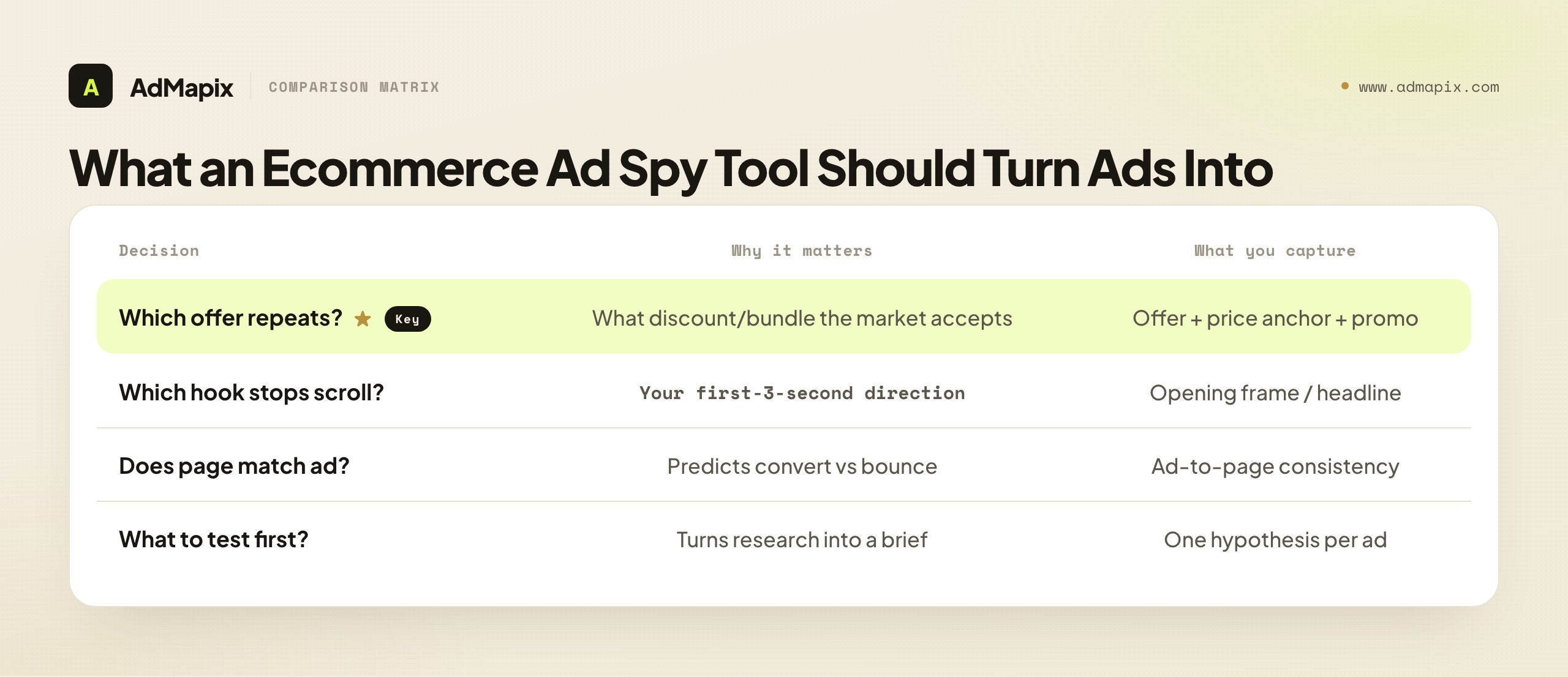
Most people searching for an ad spy tool don't need another folder of screenshots — they need to answer four decisions that change what they produce next week. An ad spy tool (a service that surfaces live or recent ads competitors are running) is the input; a test is the output.
| Decision | Why it matters for a store | What you capture |
|---|---|---|
| Which offer angle repeats? | Tells you what discount, bundle, or guarantee the market responds to | Offer + price anchor + promo |
| Which hook stops the scroll? | Sets your first-3-second creative direction | Opening frame / headline |
| Does the landing page match the ad? | Predicts whether traffic will convert or bounce | Ad-to-page consistency |
| What should we test first? | Turns research into a brief with a budget | One hypothesis per ad |
If an ad doesn't feed one of these columns, it's entertainment, not research. The mental shift that separates a profitable ad-research practice from a procrastination habit is treating every saved ad as a row in a table rather than a standalone image — a row that has to produce a hypothesis or it doesn't get saved. That discipline is the whole game, and everything else in this guide is built to support it.
What to Capture From Each Ad: The Five-Signal Framework
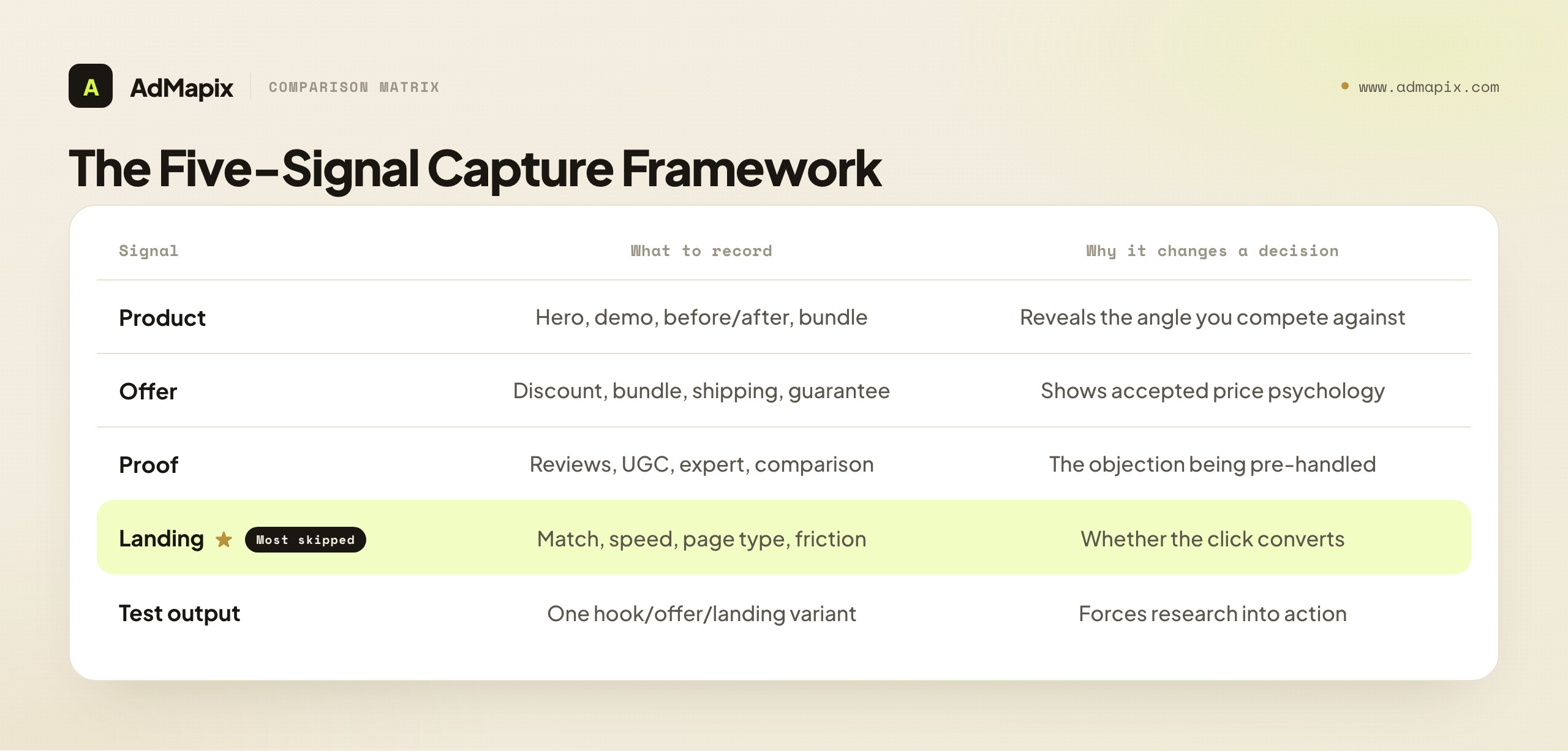
Capture the same five fields for every ad so patterns become comparable instead of anecdotal. Consistency is the entire point — three ads logged the same way beat thirty saved at random, because the value lives in the comparison across a tagged set, not in any single screenshot.
| Signal | What to record | Why it changes a decision |
|---|---|---|
| Product signal | Hero shot, demo, use case, before/after, bundle, category | Reveals the angle (problem-led vs. desire-led) you're competing against |
| Offer signal | Discount, free shipping, bundle, trial, guarantee, scarcity, seasonal promo | Shows the price psychology the market already accepts |
| Proof signal | Reviews, UGC, expert claim, comparison, trust badge | Tells you what objection the ad is pre-handling |
| Landing signal | Headline match, page speed, product vs. advertorial, checkout friction | Explains whether the click converts — most copied ads fail here |
| Test output | One hook, offer, or landing variant to try | Forces the research to end in an action |
The most common gap is the landing signal. A scroll-stopping ad pointed at a slow, mismatched product page is a lesson in what not to copy, and you only see it if you click through and log it. The rest of this guide deepens each of these five signals in turn, because each one carries its own craft — and a store that reads all five well, on the channels it actually buys, is doing 80% of what an expensive enterprise tool does, with discipline rather than budget.
The Product Signal: Reading the Angle
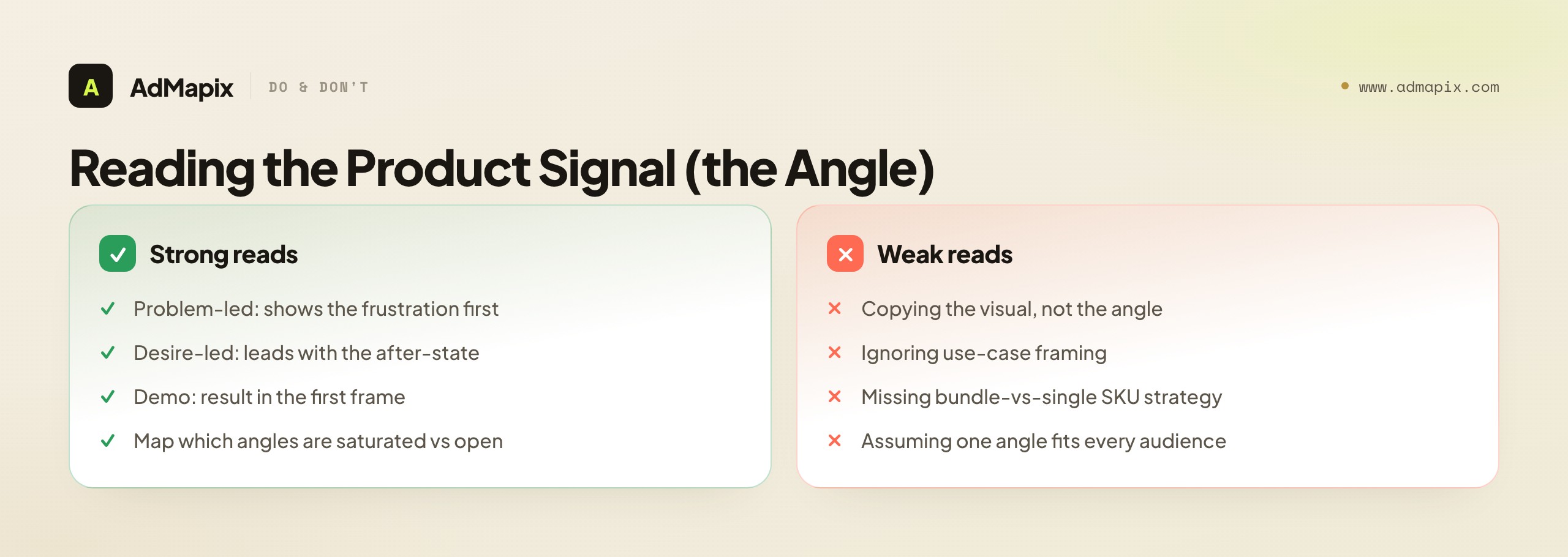
The product signal is the angle the ad takes on the product, and reading it correctly tells you which emotional lever the competitor has decided wins their market. The same product can be sold a dozen ways, and the hero treatment encodes the bet: a problem-led angle (the mess, the frustration, the before-state) versus a desire-led angle (the aspiration, the after-state, the lifestyle) versus a curiosity-led angle (the unusual mechanism, the "how does that work" hook).
What to read in the product signal:
- The hero treatment. Is the product shown solving a problem, delivering a transformation, or demonstrating a satisfying mechanism? Each implies a different audience temperature and a different creative brief.
- The use-case framing. A single product framed around one specific use case ("the water bottle for hot yoga") signals tight targeting; a product framed broadly signals a mass-market play.
- Before/after and demonstration. Visible-result products (beauty, cleaning, fitness, gadgets) lean on demonstration; the strongest versions show the result in the first frame.
- Bundle vs. single SKU. A bundle hero signals an AOV-led strategy; a single-SKU hero signals a tripwire or impulse play.
When you tear down a competitor's product signal, the strategic read is which angle the market clusters on — and where the gap is. If every competitor sells a category problem-led, a desire-led angle is an under-tested opening; if everyone is desire-led, the problem-led "stop dealing with X" hook may be the differentiated entry. The product signal isn't about copying the visual; it's about mapping which angles are saturated and which are open.
The Offer Signal: Decoding Price Psychology
The offer is frequently the real reason an ecommerce ad converts, more than the creative, so reading the offer signal tells you the price psychology the market has already accepted. Two stores can run identical creative and get opposite results because one offered "20% off" and the other offered "buy 2 get 1 free" — and the market responded to the structure, not the discount size.
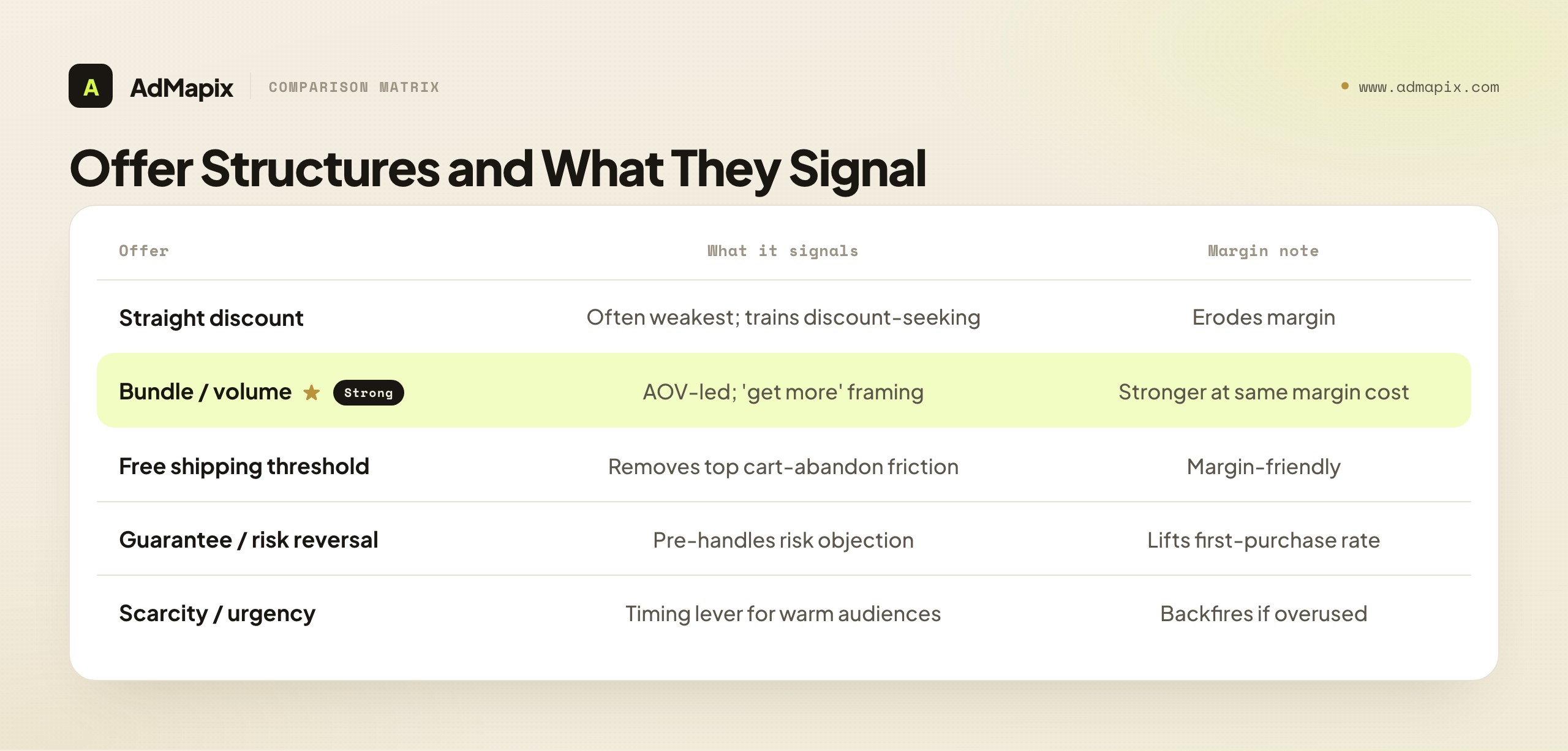
The offer structures worth tagging:
- Straight discount. Percentage or dollar off. The simplest, and often the weakest, because it trains discount-seeking and erodes margin.
- Bundle / volume. "Buy 2 get 1," "complete the set." Raises AOV and reframes the discount as getting more rather than paying less — usually stronger than a straight discount at the same margin cost.
- Free shipping / threshold. "Free shipping over $X." A powerful, margin-friendly lever because shipping is the most-abandoned-cart friction in ecommerce.
- Guarantee / risk reversal. "30-day money back," "love it or it's free." Pre-handles the risk objection, especially for higher-priced or first-purchase products.
- Scarcity / urgency. "Last batch," "ends tonight." A timing lever that works on warm audiences and backfires when overused on cold ones.
- Gift / free add-on. "Free [item] with your order." Reframes value without discounting the hero product.
The strategic read: log not just which offer a competitor runs but whether it repeats. An offer a competitor has run continuously for weeks is a stronger signal than a one-off flash sale, because sustained offers usually pencil out on their margin. But — and this is the line that protects your business — a competitor's offer assumes their margin, audience, and fulfillment. The same "buy 2 get 1 free" that's profitable for a vertically integrated brand can be a loss-maker for a dropshipper buying the same product at a worse cost. Borrow the offer structure as a hypothesis, then test it against your own unit economics before you scale it.
There's also a testing-order lesson buried in the offer signal. When you find several offer structures running across competitors, don't test them at random — test in order of margin safety first. A free-shipping threshold and a bundle are usually the safest to test because they protect or raise margin, so they're the right first experiments; a deep straight discount is the riskiest because it directly cuts margin and can train your audience to wait for sales, so it belongs last and only when the safer structures have plateaued. Reading a competitor's offer mix tells you the menu of structures the market accepts; your own margin math tells you the order in which to try them. Many stores get this backwards, leading with the discount because it's the most visible competitor offer, and erode their margin before they've tested the structures that would have protected it.
The Proof Signal: What Objection Is Being Pre-Handled
Proof is the ad's answer to the buyer's skepticism, so reading the proof signal tells you which objection the competitor has decided is the biggest barrier to purchase. Ecommerce buyers default to doubt — will it actually work, is it worth it, can I trust this store — and the proof type a competitor leads with reveals which doubt they're prioritizing.
The proof taxonomy, soft to hard:
- Star ratings and review counts. "4.8 stars, 12,000 reviews." Fast social proof; the volume signals category maturity and the rating signals quality.
- UGC and customer footage. Real people using the product. The dominant ecommerce proof format in 2026 because it reads as authentic and pre-handles the "does this work for normal people" doubt.
- Before/after and demonstration. Visual proof that bypasses skepticism entirely for visible-result products.
- Expert or authority claim. "Dermatologist recommended," "engineered by." Borrowed credibility for categories where expertise matters.
- Comparison. "Us vs. the leading brand." Handles the "why not the incumbent" objection head-on.
- Trust badges and guarantees. Secure-checkout, money-back, free-returns. Handles the transactional trust objection at the moment of purchase.
When you tear down a competitor's proof signal, ask whether the proof type matches the product's real objection. A high-consideration product leaning only on a star rating is under-proven; a visible-result product not showing the result is leaving its strongest proof on the table. Proof gaps in a competitor's creative are exploitable: if everyone in your category leads with star ratings and nobody shows real UGC demonstration, the UGC angle is an opening worth testing.
The Landing Signal: Where Most Copied Ads Die
The ad is the promise and the landing page is the delivery, and in ecommerce the gap between them is where most copied ads quietly fail — which is why a complete teardown always follows the click. Judging the creative alone hides the single most common reason a copied ad underperforms: the destination was never built to convert the traffic the ad sends.
What to capture in the landing signal:
- Headline and offer match. Does the page deliver exactly what the ad promised, or is there a message-match gap (the "50% off" ad landing on a full-price page)? Mismatch bleeds the click.
- Page type. Product page vs. advertorial vs. listicle vs. quiz funnel. The page type encodes the funnel strategy — an advertorial signals a cold-traffic education play; a straight product page signals warmer or higher-intent traffic.
- Page speed and mobile experience. Most ecommerce traffic is mobile; a slow or janky mobile page wastes the click no matter how good the ad was.
- Proof continuity. Does the page deepen the ad's proof (reviews, UGC, guarantees) or drop it, breaking the credibility chain at the moment of conversion?
- Checkout friction. Number of steps, forced account creation, surprise shipping costs — the friction the competitor either removed or left in place.
The most valuable thing the landing signal surfaces is a competitor's leak. When you find a store running a strong, scroll-stopping ad pointed at a slow, mismatched, or high-friction page, you've found a gap you can out-execute without outspending them — same ad angle, better destination, more conversions. That's the most actionable output of the entire research process: not "copy their ad," but "they're buying expensive clicks and wasting them at the door — beat them on the door."
Platform Coverage: Where to Research Ecommerce Ads
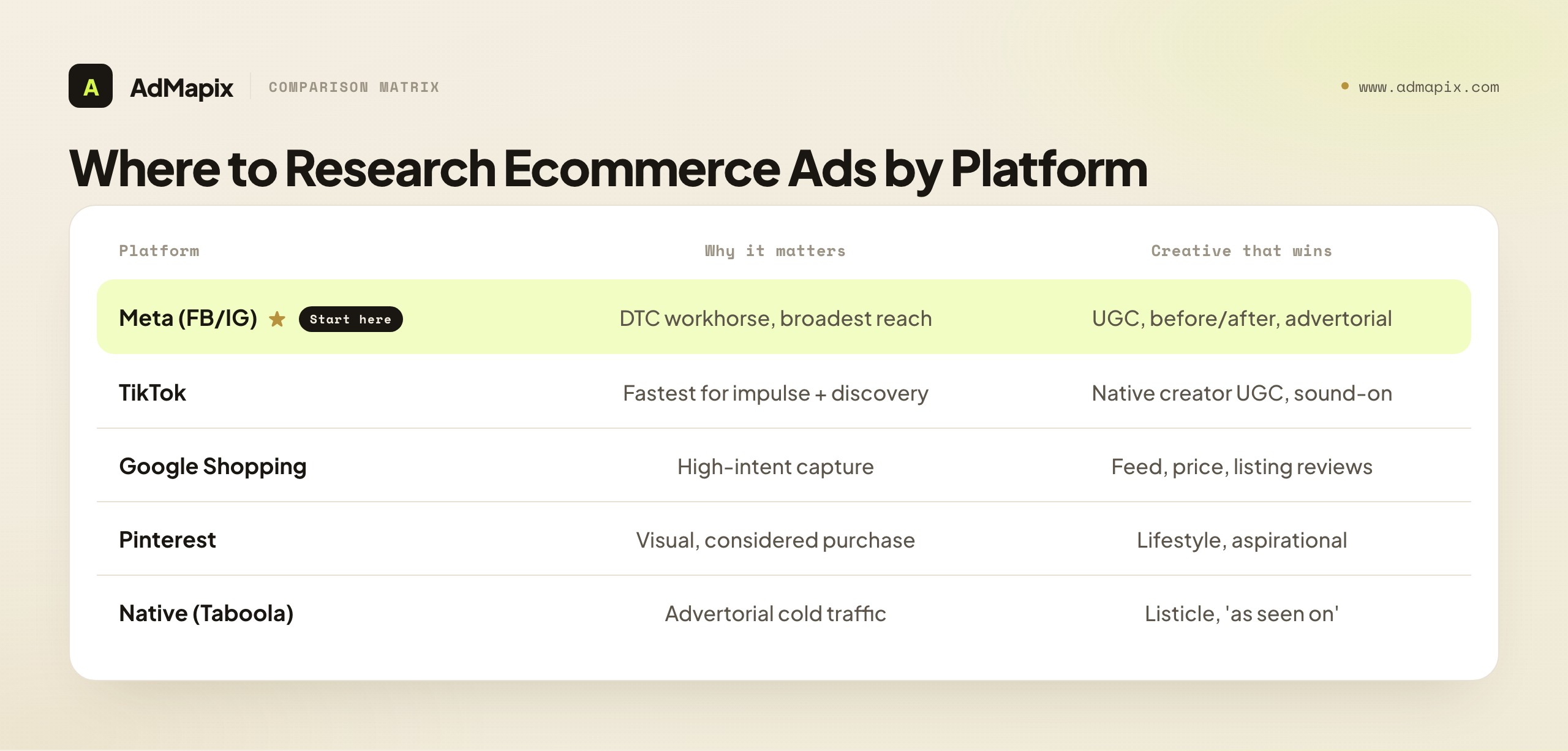
The five-signal framework is universal, but the channels you research should be the ones you actually buy on, because each platform rewards different creative and surfaces ads differently. A canonical ecommerce ad-research practice spans the major performance channels rather than living inside one platform's library.
| Platform | Why it matters for ecommerce | Where to research | Creative that wins |
|---|---|---|---|
| Meta (FB/IG) | The DTC workhorse; broadest reach | Meta Ad Library | UGC, before/after, carousel, advertorial |
| TikTok | Fastest-growing for impulse and discovery | TikTok Creative Center | Native creator UGC, sound-on, fast hooks |
| Google Shopping / Search | High-intent capture | Google Ads Transparency Center | Product feed, price, reviews in the listing |
| Strong for visual, considered-purchase categories | Pinterest ad research | Lifestyle, aspirational, idea-pin style | |
| Native (Taboola/Outbrain) | Advertorial and cold-traffic education | Native ad research | Listicle, advertorial, "as seen on" |
The practical read: don't spread research thin across every platform. Identify the one or two channels that carry most of your spend, research those deeply, and treat the others as secondary. A DTC brand whose acquisition is 80% Meta should master the Meta Ad Library workflow before dabbling in native; a TikTok-first impulse-product store should live in TikTok ecommerce ad research. Match the research channel to your buying channel, and the same five signals travel across all of them.
Store Type Changes the Lens: DTC, Dropshipping, and Established Brands
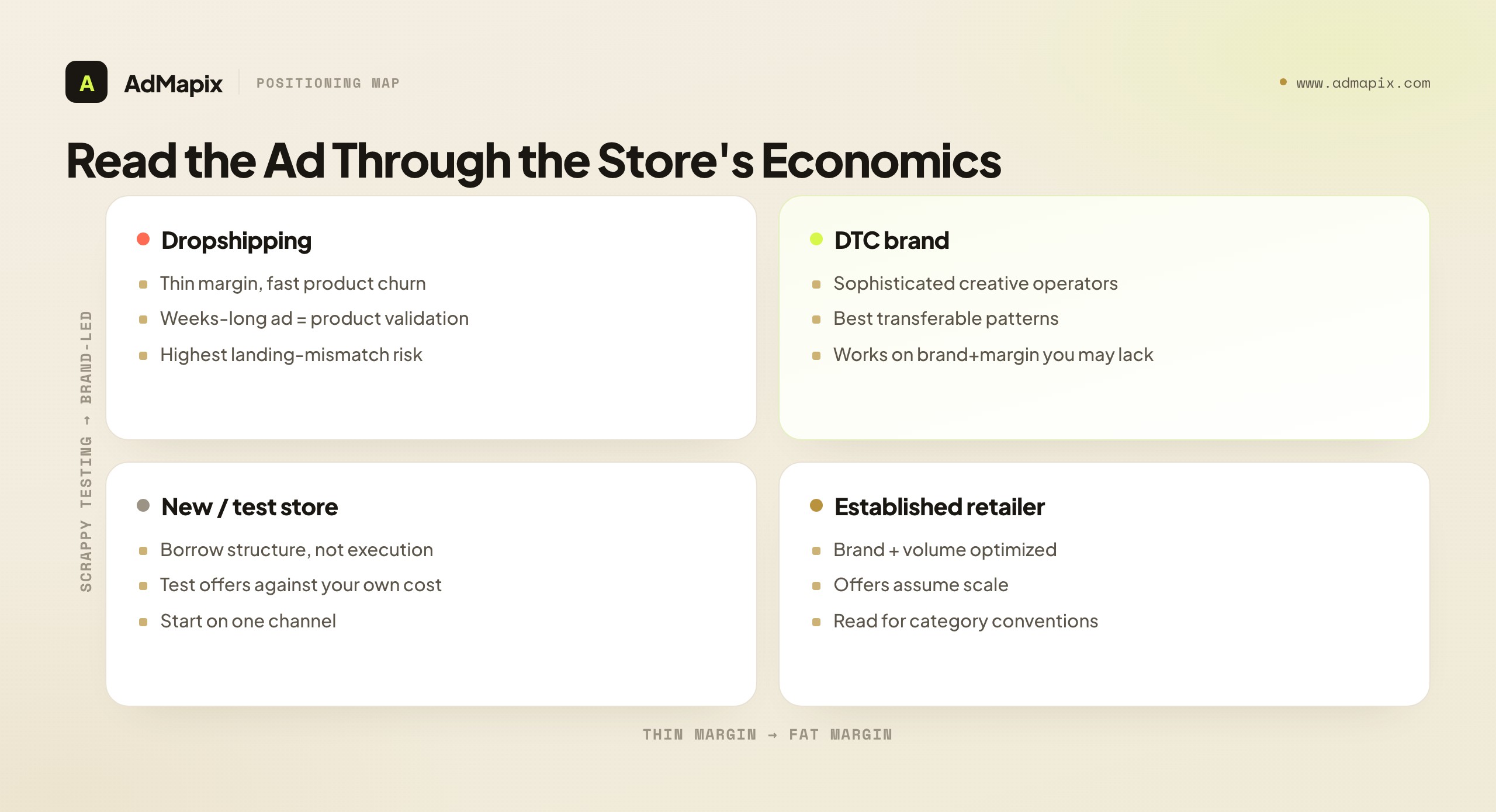
A competitor's creative only teaches you the right lesson if you read it through the right economics, and the biggest variable is store type. The same ad means something different depending on whether it's run by a venture-funded DTC brand, a margin-thin dropshipper, or an established retailer — and reading it through the wrong lens imports the wrong strategy.
DTC brand creative tends to invest in production quality, brand-building, and full-funnel motions: top-of-funnel UGC and advertorials to create demand, retargeting to convert it, and a polished landing experience. DTC creative research — studying how direct-to-consumer brands structure their hooks, offers, and proof — is a discipline of its own, because DTC brands are usually the most sophisticated creative operators in a category and the best source of transferable patterns. When you study DTC creative, you're learning from teams that test heavily and ship deliberately; their repeated patterns are your strongest free signal. The thing to remember is that a DTC brand's creative often works because of a brand and margin you don't have, so borrow the structure (the angle, the offer logic, the proof type), not the exact execution.
Dropshipping creative runs on different economics — thinner margins, faster product churn, and a heavier reliance on impulse and curiosity hooks. Dropshippers test products fast and abandon losers faster, so a dropshipping ad that's run for weeks is an unusually strong product-validation signal. But dropshipping creative also carries the highest mismatch risk, because the same product is sold by many sellers with different angles and different (often worse) landing pages. For the dropshipping-specific playbook, see our dropshipping ad spy guide.
Established retailer creative optimizes for brand and volume rather than scrappy testing, so it's often less instructive for a small store — the offers assume scale, the creative assumes brand recognition, and the patterns don't always transfer down to a challenger. Read established-brand ads to understand category conventions and what "premium" looks like, but don't mistake their playbook for one a small store can run.
The unifying discipline: before you act on a competitor's ad, identify what kind of store is running it, and ask whether their economics resemble yours. A play that's right for a funded DTC brand can bankrupt a dropshipper, and vice versa.
DTC Creative Research: Learning From the Best Operators
Direct-to-consumer brands are the most sophisticated creative operators in ecommerce, so DTC creative research deserves its own treatment — it's where the most transferable patterns live and where a disciplined store learns the fastest. Studying how DTC brands structure their creative is not the same as studying a random competitor's ad; DTC brands test at volume, kill losers fast, and ship deliberately, which means their repeated, long-running creatives are an unusually clean signal of what's working in a category.
What makes DTC creative worth studying as a discipline of its own:
- They run full-funnel motions. A serious DTC brand isn't running one ad — it's running a coordinated system: top-of-funnel UGC and advertorials to create demand, mid-funnel proof and comparison to build consideration, and bottom-funnel offer and retargeting creative to convert. Reading the whole system tells you more than any single ad.
- They iterate creative relentlessly. DTC brands treat creative as the primary lever (because targeting has narrowed post-privacy), so they ship many variants and let the survivors reveal the winning angle. When you see a DTC brand converge on one hook across many ads, that convergence is the output of a testing program you're getting for free.
- They invest in the landing experience. DTC brands usually build the destination as carefully as the ad, so studying their ad-to-page funnel teaches you what a complete, converting funnel looks like — a benchmark most small stores lack.
- They lead the creative formats. Advertorials, founder-story videos, native-looking UGC, quiz funnels — the formats that later become category-standard usually start with the sophisticated DTC operators. Watching them is a leading indicator of where your category's creative is heading.
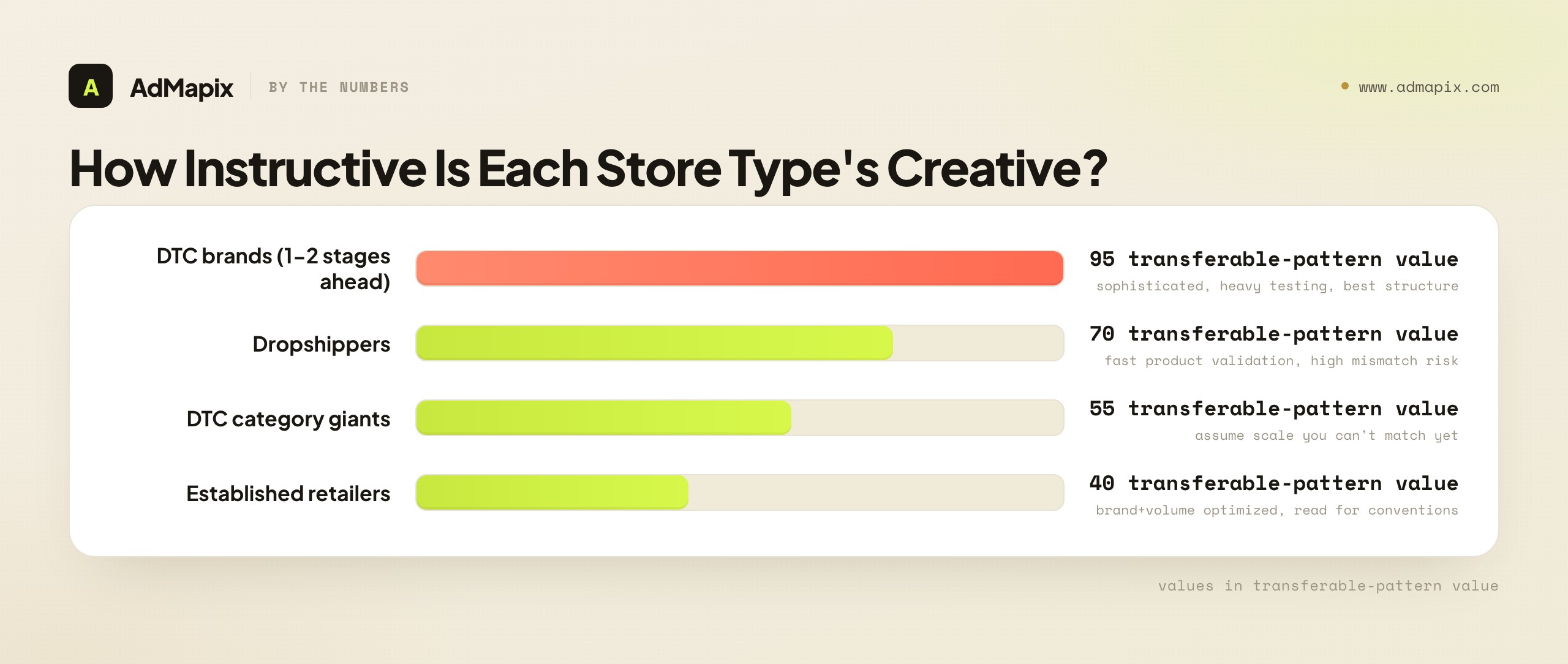
The discipline that makes DTC creative research pay off — and the warning that keeps it from bankrupting you — is the same: a DTC brand's creative often works because of a brand, a margin, and an audience you don't have. A funded brand can run a "buy now, pay later, free returns, 60-day guarantee" offer stack that a bootstrapped store can't afford, and a beloved brand can run a minimalist ad that converts on recognition alone. So study DTC creative for its structure — the angle, the offer logic, the proof sequencing, the funnel shape — and translate that structure to your own economics, rather than cloning an execution that depends on assets you don't possess. The brands worth studying most closely are the ones one or two stages ahead of you, not the category giants whose playbook assumes a scale you can't match yet.
A Five-Ad Workflow That Ends in a Brief
The workflow that produces decisions collects five deliberately different ads, logs them the same way, then writes one test. Do this for a single product category, not your whole catalog — depth on one category beats breadth across ten.
- The baseline. A clean, straightforward version of the product or offer. This is your control — the "normal" the market is used to, the bar everything else clears or fails to.
- The high-tension hook. A fail state, curiosity gap, or urgent offer that wins the first second. Note exactly what creates the tension.
- The format outlier. The same product sold in a different format (short video, advertorial, carousel, UGC). Format often matters more than copy.
- The repeated competitor pattern. A message, thumbnail, or offer that one competitor runs more than once. Repetition is your strongest free signal.
- The mismatch. An ad whose promise breaks at the landing page or checkout. The cautionary example is as valuable as the winners.
With five logged the same way, write one line: "Test [hook/offer/landing variant] because [pattern observed across ads]." That sentence is the deliverable, and it's what separates research from collection. The five-ad structure is deliberate — it forces you to capture the control, the winner, the format experiment, the proven pattern, and the cautionary tale, which together cover the full range of what you need to brief a test. Five ads chosen this way teach more than fifty saved at random.
How to Choose an Ecommerce Ad Spy Tool
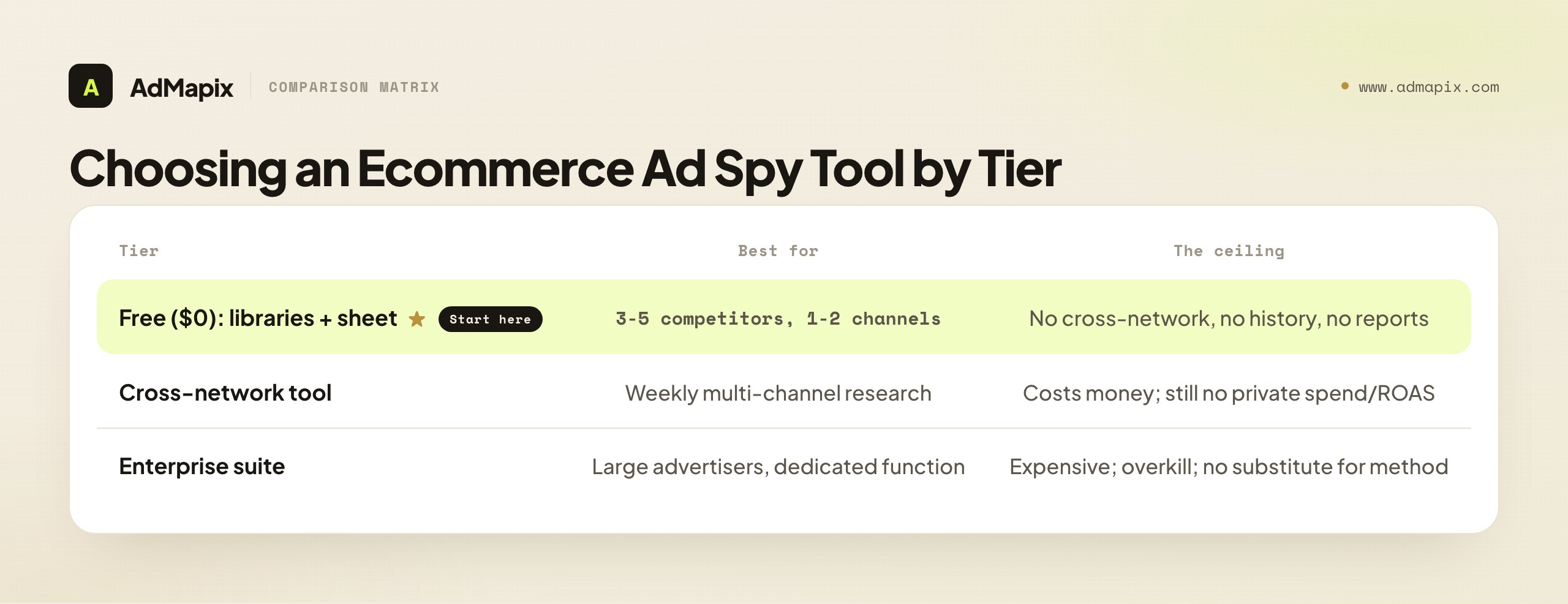
You don't need to buy anything to start, and you shouldn't over-buy. Match the tool to how many competitors and channels you track and whether you need history and reporting.
| Tier | What it covers | Best for | The ceiling |
|---|---|---|---|
| Free ($0) | Meta Ad Library + TikTok Creative Center + Google Transparency Center + a spreadsheet | Stores researching 3-5 competitors on 1-2 channels | No cross-network search, no history once ads go dark, no reporting |
| Cross-network tool | Search, save, tag, and report on creatives across networks | Teams researching weekly across multiple channels | Costs money; still can't reveal private spend or ROAS |
| Enterprise suite | Spend modeling, large-scale tracking, decks | Large advertisers with a dedicated function | Expensive; overkill for most stores; no substitute for the discipline |
The trap to avoid is buying an expensive suite to skip the methodology. Tools accelerate collection; they don't do the five-signal analysis or write the test. A disciplined operator with the free stack and this framework out-performs an undisciplined team with a five-figure subscription, every time. The right upgrade path is: start free, run the five-ad workflow weekly for a quarter, and only move to a cross-network tool when the competitor set grows past what a spreadsheet can hold or you need history and shareable reports. For the full landscape, see our roundup of the best ad spy tools in 2026.
What Public Ad Data Can and Cannot Prove
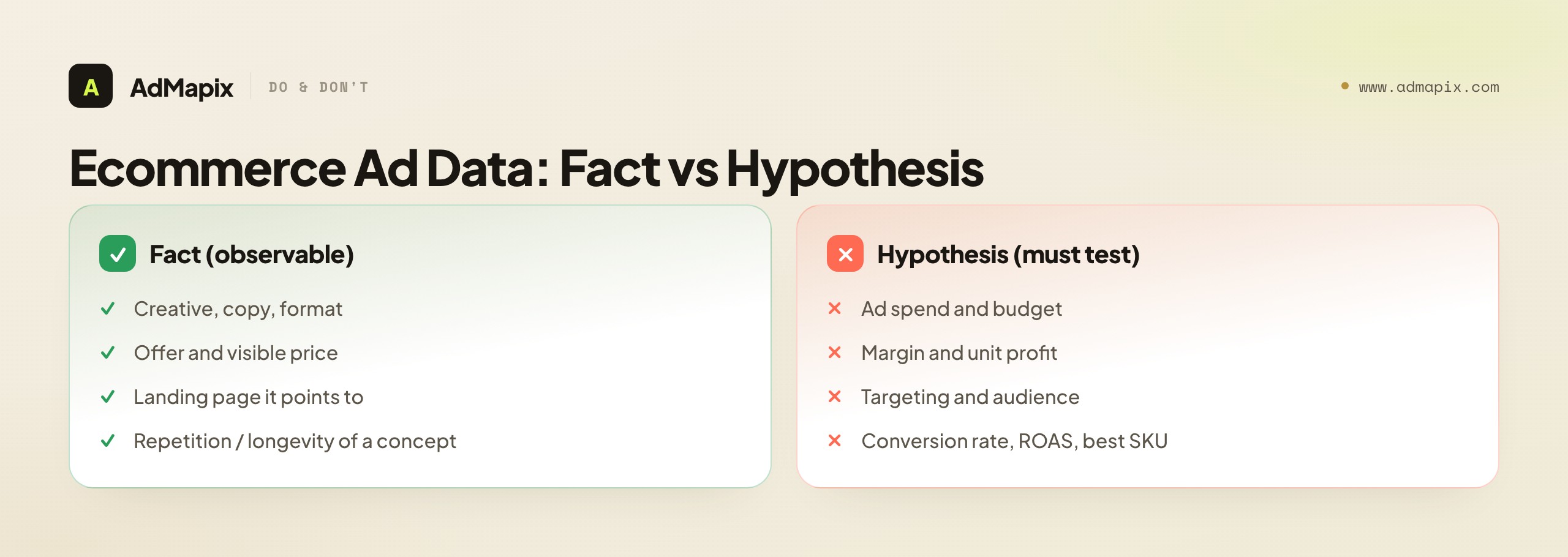
Public creative evidence is strong on structure and silent on economics — keep that line bright or you'll build a strategy on guesses. An ad library or spy tool shows you what was shown, not what worked.
| Public ad data CAN show | Public ad data CANNOT show |
|---|---|
| The creative and copy that ran | Ad spend or budget |
| The offer and visible price | Margin or unit profit |
| The format (image, video, carousel, advertorial) | Targeting and audience |
| The landing page it pointed to | Conversion rate or ROAS |
| How long / how often a concept repeated | Which SKU actually sells |
The one reliable inference is repetition: when a competitor runs the same offer or hook for weeks, or relaunches it across formats, that persistence is a soft signal it's paying off. Advertisers rarely fund losers for long, so a concept that's survived weeks of optimization is more likely to be working than a one-off. Even then, treat it as a hypothesis to test against your own margin, not a fact to copy. The discipline of separating the fact (the creative ran) from the inference (it might be profitable) is what keeps ecommerce competitive research honest and stops you from cloning a competitor's expensive mistake on the assumption that visible equals profitable.
Common Ecommerce Ad Spy Mistakes
- Copying without context. A winning ad assumes the competitor's margin, audience, and product. Your unit economics may not survive the same discount.
- Assuming private metrics. No spy tool reveals spend, targeting, or ROAS. Treat any "this ad is crushing it" claim without that data as a guess.
- Saving assets with no source data. An ad with no URL, date, format, or reason-for-saving is useless in a week. Log metadata or don't log it.
- Ignoring the landing page. The ad and its destination are one funnel. Judging the creative alone hides the reason a copy will fail.
- Reading every store the same way. A DTC brand, a dropshipper, and a retailer run different economics; the same ad teaches different lessons depending on who's behind it.
- Researching the wrong channel. Studying TikTok ads when you buy on Meta wastes effort; match the research channel to your buying channel.
- Collecting forever, testing never. Research with no test backlog at the end is procrastination with extra steps.
A Worked Teardown: From Competitor Ad to Store Test
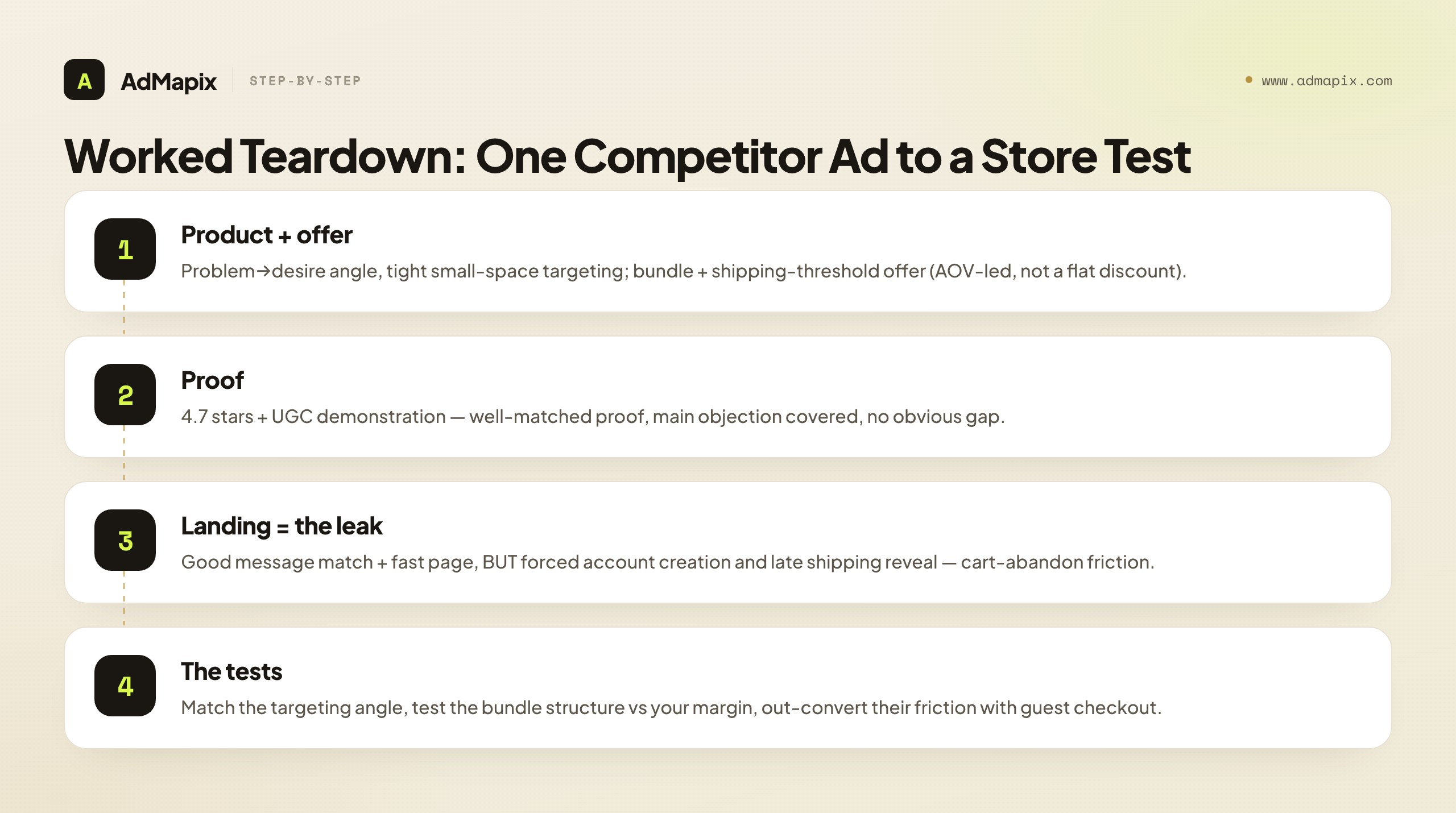
Principles stick when applied, so here's how a single competitor ad reads through the five-signal framework end to end. Say you sell a home-fitness product and you find a rival's ad running widely across Meta. You're not going to copy it — you're going to decode it and find the test.
Product signal. The ad opens on a tired person slumped on a couch, then cuts to them using a compact resistance system in a small apartment. You tag the angle: problem-led (the slump, the "no time, no space" frustration) pivoting to desire-led (the lean home-workout after-state). The use-case framing is tight — small-space, no-gym — which signals the competitor is targeting apartment-dwellers, not general fitness buyers. Note for your backlog: the small-space framing is doing the targeting work, and it's a specific angle you can match or counter.
Offer signal. The ad shows "Buy 2, get the resistance bands free + free shipping over $50." You tag it: a bundle plus shipping-threshold offer, not a straight discount. That's a sophisticated, AOV-led structure — it raises order value while framing the deal as "get more." Strong signal, and a structure worth testing against your own margin (a dropshipper buying these at a thin margin may not survive the free-bands add-on; a brand with better COGS will).
Proof signal. The ad carries "4.7 stars, 8,000+ reviews" plus three seconds of real customer UGC. You tag it: rating volume + UGC demonstration — well-matched proof for a mid-consideration fitness product, pre-handling the "does this actually work for normal people" doubt. No obvious proof gap to exploit here; they've covered the main objection.
Landing signal. You click through. The ad's "Buy 2 get bands free" offer is echoed in the page headline (good message match), the page is a fast-loading product page with the same UGC continued, but the checkout forces account creation before showing shipping cost. That's the leak. Strong ad, strong match, but forced account creation plus late shipping reveal is exactly the friction that abandons carts. You've found their gap.
The synthesis and the test. You now have a scored read and three hypotheses: (1) match the tight small-space targeting angle, since it's clearly chosen deliberately; (2) test the bundle-plus-shipping-threshold offer structure against your margin rather than a straight discount; and (3) exploit the leak — run a comparable ad to a guest-checkout, shipping-transparent page and out-convert their friction-heavy funnel. None of this required a private number. You read five signals, found the laddering and friction gaps, and turned a competitor's leak into your test.
The Ecommerce Creative Lifecycle: Why Winners Die in Days
Ecommerce creative fatigues faster than almost any other format, so understanding the lifecycle of a winning ad tells you how often to refresh and how to read a competitor's refresh behavior. A winning ecommerce ad in 2026 frequently has an effective lifespan measured in days to a couple of weeks before frequency climbs, the audience tunes out, and performance decays — which is why the stores that win aren't the ones with one great ad but the ones with a pipeline of tested concepts.
The lifecycle has a predictable shape: a new concept launches, finds its winners through early testing, scales while it's fresh, then decays as the targetable audience saturates and creative fatigue sets in. The decay is faster on Meta than on Google Search (where intent refreshes the audience constantly) and faster on broad-reach concepts than on niche ones. The practical consequences for research:
- A competitor's brand-new creative is a testing signal, not a winner yet. Don't chase a concept that launched yesterday; watch whether it survives the next two weeks.
- A long-running competitor concept is the strong signal. A creative that's been live and scaled for weeks has survived the fatigue curve, which is the closest thing to a free profitability proxy you get.
- New-ad velocity reveals budget and capacity. A competitor shipping fresh creative weekly is running a funded testing pipeline; one running the same three ads for months is either coasting or has found a durable winner worth studying closely.
- Refresh the hook and creative, hold the offer. Often the offer is still right but the creative has fatigued; rotating the hook and visual refreshes the ad without rebuilding the funnel.
When you tear down a competitor over time, log the launch and disappearance of their creatives, because the shape of the time series — not any single snapshot — is where the real intelligence lives. A concept that keeps relaunching across formats is a proven winner; one that flickered and vanished was a failed test. The ad libraries keep no archive of dead ads, so your own time-series log is the only record that a competitor's creative rose and fell.
A Weekly Ecommerce Ad-Research Workflow
The whole system runs in well under an hour a week, and the cadence is what compounds an edge over stores that research sporadically before a launch. Ecommerce creative moves fast, so weekly is the right resolution — frequent enough to catch new concepts and offer shifts, not so frequent that you're reacting to noise.
| Day / step | Focus | Action | Output |
|---|---|---|---|
| Monday — scan | New creative | Check your top 5 competitors' active ads across your buying channels | New concepts + offer changes logged |
| Wednesday — funnel | Landing pages | Click through new ads; log message match, page type, friction | Landing leaks + funnel patterns |
| Friday — synthesize | The test | Pick the single most meaningful pattern; write one test | One brief with a budget and a metric |
Three rules keep the loop honest. First, scan for deltas, not inventory — you're looking for what changed since last week (a new hook, a new offer, a tripled ad count), not a fresh catalog every time. Second, always click through — the landing signal is where the exploitable gaps hide, and skipping it halves the value. Third, end on a written test — the deliverable is one sentence ("test [variant] because [pattern]"), not a bigger folder. A store running this loop for a quarter builds something more valuable than any single insight: a history of what the category tested, what you tested, and what actually converted, which makes next quarter's decisions faster and sharper.
Reading the Seasonal and Promotional Calendar
Ecommerce ad costs and offer aggressiveness swing hard on a calendar, so reading a competitor's promotional rhythm is part of a complete research practice. The auction gets expensive and the offers get aggressive around the predictable peaks — Black Friday/Cyber Monday, the December holidays, back-to-school, and the category-specific moments (Valentine's for gifting, summer for outdoor, January for fitness) — and a store that plans against that calendar avoids overpaying at the peaks and capitalizes on the quiet stretches.
What to read in a competitor's seasonal behavior:
- Offer escalation timing. When does a competitor start discounting ahead of a peak, and how aggressive do they get? Logging this across a season tells you the category's promotional rhythm and lets you decide whether to match, undercut, or sit out the auction crush.
- Creative seasonalization. Do they swap to seasonal creative (holiday gifting angles, summer use cases), and how early? Early seasonal creative signals a planned, funded calendar; last-minute swaps signal reactive operators you can out-prepare.
- Post-peak behavior. The window right after a peak (early January, post-holiday) is frequently the cheapest auction of the year. A competitor who goes quiet then is leaving cheap inventory you can take; one who stays aggressive is chasing the post-peak intent.
The strategic move is to maintain a simple seasonal log alongside your creative research, so you enter each peak knowing the category's typical offer aggressiveness and timing rather than discovering it in real time. The same dollar buys very different efficiency depending on whether it lands in the pre-holiday auction crush or the quiet post-peak reset — and competitor research is how you map that rhythm before it costs you.
Building a Searchable Ecommerce Swipe Library
A folder of saved ecommerce ads is where good research goes to die. The asset that compounds is a searchable, five-signal-tagged swipe library where every entry is already scored, so it becomes a brief in minutes rather than being re-found weeks later under deadline. For ecommerce specifically, the tagging schema is what lets you sort by the dimension that transfers — the offer structure, the proof type, the angle — rather than by which random competitor you happened to save.
Every entry should capture: source URL, date, and advertiser; the product angle (problem/desire/curiosity-led); the offer structure and price anchor; the proof type; the landing page type and any message-match or friction leak; whether the concept repeats and how long it's run; and a status (untested → briefed → tested → result). The two fields that turn a swipe folder into a strategy tool are the leak/gap tag (landing friction, proof gap, offer mismatch) and the status — the first tells you what's exploitable, the second turns the library into a pipeline instead of a museum.
The payoff scales with the set. Once thirty or forty ecommerce ads are tagged this way, you can answer questions no screenshot folder can: which offer structures the category clusters on, which proof types are table stakes versus differentiators, which competitors consistently leak at the landing page, and which angles are saturated versus open. That market map is the strategic return on disciplined tagging, and it's invisible to anyone still scrolling a shared drive of un-annotated screenshots the night before a launch.
Staying on the Right Side of "Inspired By" vs. "Copied From"
Ecommerce ad research lives close to a legal line, and a complete practice knows where that line is, because the difference between borrowing a strategy and copying an asset is the difference between competitive intelligence and an infringement risk. The whole thrust of this guide — lift the structure, not the execution — isn't just better strategy; it's also what keeps your research defensible.
The distinctions that matter:
- Patterns and structures are free to learn from. An offer structure ("buy 2 get 1"), a hook pattern (problem-then-solution), a proof type (UGC demonstration), a funnel shape (advertorial-to-product-page) — these are ideas and approaches, not protected assets. Studying them and adapting them to your product is exactly what competitive research is for.
- Specific creative assets are not yours to take. A competitor's actual video footage, their photography, their copy verbatim, their unique illustrations — these are their work. Lifting the file or the exact wording isn't research, it's appropriation, and it carries real risk.
- Trademarks and brand names are a hard line. Using a competitor's brand name, logo, or trademarked terms in your own creative (beyond honest comparative reference where permitted) invites trouble. "Better than [Brand]" comparative claims have rules that vary by jurisdiction; if you go there, know them.
- Other people's customers and faces. UGC and testimonials feature real people who consented to that brand's use, not yours. You can't reuse a competitor's customer footage; you have to source your own.
The practical rule that keeps you safe and effective at once: your research output should be a brief in your own words about a strategy, never a copy of a file. When your swipe library stores patterns, structures, and your own analysis rather than re-hosted competitor assets used in your own ads, you're doing legitimate competitive intelligence. When it becomes a place to grab footage to reuse, you've crossed from research into risk. The structure-not-execution discipline this guide has hammered throughout is, conveniently, also the line that keeps your competitive research clean.
Turning Ad Research Into a Repeatable Team Process
Individual ad research produces occasional wins; a repeatable team process produces a compounding advantage, so the final upgrade is turning the workflow above into a standard operating procedure the whole team runs the same way. The difference shows up over a quarter: a solo operator's research lives in their head and dies when they're busy, while a team process accumulates a shared, searchable history that makes every subsequent decision faster.
The components of a repeatable ecommerce ad-research process:
- A shared swipe library with a fixed schema. Everyone tags the same five signals plus metadata the same way, so the library is searchable by anyone and patterns surface across the whole team's collection rather than fragmenting into private folders.
- An owned cadence. Someone owns the weekly scan, the landing-page click-through, and the Friday synthesis. Unowned research is research that doesn't happen; assigning the loop is what makes it reliable.
- A test backlog with a decision rule. Briefs flow from research into a prioritized backlog, and each test has a pre-set metric and a decision date (promote, kill, iterate). This closes the loop from "we saw a pattern" to "we shipped a test and learned."
- A feedback loop into the library. Test results — what won, what the winning angle was — flow back into the swipe library as tags, so the library becomes not just a record of competitor ads but a record of your own validated learnings. Over a year, that combined asset is worth more than any tool subscription.
For agencies and multi-store operators, this process scales by running one instance per client or store, with a shared schema so analysts can move between accounts without relearning the system. The cadence and depth flex by store size — a solo store might compress the whole loop into a focused weekly hour, an agency might run it per client with separate owners for collection and synthesis — but the spine is identical: scan for deltas, click through to landing pages, synthesize one test, run it against your own numbers, and feed the result back. What separates teams that compound an edge from teams that don't is rarely the tool; it's whether they actually run the loop consistently, week after week, instead of researching in panicked bursts before a launch. Consistency is the moat; the tools just make the loop faster.
When to Use AdMapix
AdMapix is the layer that turns scattered competitor ads into a searchable, taggable, reportable workflow — built for ecommerce and DTC teams who research ads weekly rather than once.
Use it when you want to:
- Search ecommerce ad creatives across networks with Search AdMapix instead of scrolling one platform's library.
- Save the standout examples to Media with their offer, format, and landing notes attached.
- Break down a competitor's winning video — pacing, hook timing, structure — in Video Analysis.
- Roll repeated patterns into a shareable Reports output for your team or client.
It's a good fit if you run paid social or native ads and need recurring competitor intelligence. It is not the right tool if you only need a one-time look at a single advertiser (a free platform ad library covers that), or if you want guaranteed performance metrics — no public-data tool can give you a competitor's spend or ROAS. AdMapix sits in the cross-network creative-intelligence slot: it removes the manual collection so your time goes to the five-signal analysis and the test-writing that actually move your store's numbers. Compare workflows on Pricing, and once the research becomes a weekly loop, start from Login.
FAQ
What is an ecommerce ad spy tool?
It's a service that surfaces the ads competitors are running so you can study their product visuals, offers, formats, and landing pages. The useful ones let you search across networks, save examples with metadata, and turn observed patterns into your own creative and offer tests rather than a blind copy. The goal is a test backlog, not a screenshot folder.
Can an ad spy tool show me a competitor's ad spend or ROAS?
No. Public ad data shows the creative, offer, format, and landing page, plus how long a concept ran. It cannot reveal spend, targeting, margin, or conversion rate. The strongest legitimate signal is repetition — concepts a competitor runs for weeks are likely paying off, but that's still a hypothesis to test against your own economics.
What should I capture from each ecommerce ad?
Capture five signals consistently: the product angle, the offer and price anchor, the proof type, the landing page (clicked through, not just the ad), and one test idea. Add the source URL, date, and format as metadata. An ad logged without those five signals and that metadata loses its value within days.
Is it safe to copy a competitor's winning ad?
Use it as a hypothesis, not a template. A competitor's ad assumes their margin, audience, and fulfillment. Borrow the structure — the angle, offer logic, or proof type — then test it against your own economics and landing page instead of cloning the creative outright. Copying the execution without the economics behind it is how stores lose money on "proven" ads.
Which platform should I research for ecommerce ads?
Research the channels you actually buy on. Meta is the DTC workhorse with the broadest reach, TikTok is fastest-growing for impulse and discovery, Google Shopping captures high intent, Pinterest suits visual considered-purchase categories, and native handles advertorial cold traffic. Master the one or two channels that carry most of your spend before spreading research thin.
How does ad research differ for dropshipping vs. a DTC brand?
Dropshipping runs on thinner margins and faster product churn, so a dropshipping ad that's run for weeks is a strong product-validation signal — but it carries high mismatch risk because many sellers run the same product. DTC brands are usually the most sophisticated creative operators, so their repeated patterns are the best source of transferable structure, though their execution often relies on a brand and margin a small store doesn't have. See our dropshipping and Shopify guides for the specifics.
Why does the landing page matter so much in ad research?
The ad and its landing page are one funnel, and most copied ads fail at the destination, not the creative. A scroll-stopping ad pointed at a slow, mismatched, or high-friction page wastes the click. Clicking through and logging the landing signal is how you find a competitor's leak — a strong ad with a weak page is a gap you can out-execute without outspending them.
How many ads should I study at once?
Five deliberately different ads in a single product category beat fifty saved at random. Collect the baseline (control), the high-tension hook, the format outlier, the repeated competitor pattern, and the mismatch — together they cover the full range you need to brief a test. Depth on one category beats breadth across ten.
How is AdMapix different from a platform ad library?
A platform ad library shows one network's ads with limited search and no place to organize findings. AdMapix searches creatives across networks, lets you save and tag examples, analyze videos, and generate reports — built for teams running recurring ad research rather than a single advertiser lookup. Neither shows private spend or ROAS, because that data isn't public.
How do I turn competitor ecommerce ads into something I can actually test?
Score each ad on the five signals (product, offer, proof, landing, test), collect the five-ad set for one category, look specifically for landing-page leaks and proof gaps you can exploit, then write one test: "Test [variant] because [pattern]." Run it against your own margin and traffic — your store's conversion and ROAS are the only performance data you can trust.
Related Reading
- Shopify Ad Spy Tools: Researching Shopify Store Ads — the Shopify-specific deep dive on this hub's framework.
- Dropshipping Ad Spy Tools: Validating Products and Angles — the dropshipping-specific playbook with its thinner-margin economics.
- Find Winning Products in the Facebook Ads Library — product validation through the Meta Ad Library.
- Facebook Ads Library: The Complete Guide — mastering the primary DTC research surface.
- Ad Hook Examples: 7 First-3-Second Patterns — the opener craft behind every scroll-stopping ecommerce ad.
- Spy on TikTok Ads for Ecommerce — the TikTok-specific research workflow for impulse and discovery products.
- Best Ad Spy Tools in 2026 — the full landscape of tools that fit different research needs.
Sources
- Shopify: Facebook ad examples — frames ecommerce ads around product visuals, offers, audience fit, landing pages, and creative testing.
- Shopify: create marketing campaigns — how to build marketing campaigns and activities for an online store.
- Meta Ads Library — the free public archive of active ads across Facebook and Instagram, the primary DTC research surface.
- TikTok Creative Center — TikTok's free hub for top ads, trends, and creative inspiration by industry and region.
- Taboola creative best practices — guidance on thumbnails, headlines, testing, and performance-creative iteration for native.
Official sources checked as of June 21, 2026. Platform docs and ad product pages change, so verify the source path before quoting details in a client report. AdMapix surfaces public ad creatives across networks; it does not include advertiser spend, targeting, or conversion data, which remain private.
See what competitors are really running
Search 6M+ ad creatives, landing pages, and weekly spend across 200+ countries. No credit card, no commitment.
Related Articles
Ad Hook Examples in 2026: 7 First-3-Second Patterns (with UGC Breakdowns)
A complete 2026 library of ad hook examples organized into seven repeatable patterns — problem, proof, objection, comparison, curiosity, offer, and transformation — with UGC hook breakdowns, platform-by-platform differences for TikTok, Meta, and YouTube, an industry-by-industry hook map, a hook-testing workflow that ships variants, the metrics that actually grade a hook, and a worked teardown that turns a competitor opener into a running test.
Outbrain Ad Spy Tool in 2026: Native Ad Research for the Open Web
How to research Outbrain native ads from public evidence in 2026 — what a spy tool can and cannot prove, how to decode headline-and-thumbnail hooks, advertorial landing paths, retargeting trails, and how to turn patterns into testable native campaigns.
Agency Ad Intelligence Tools in 2026: Turning Competitor Research Into Client Reports
A 2026 guide to ad intelligence for agencies — how to standardize competitor research across a client portfolio, the fixed capture field list and weekly workflow that survive staff turnover, how to structure a recurring client report, white-label and deliverable considerations, using competitor research to win new business and prove retainer value, the cross-client pattern advantage only agencies have, team roles and scaling, packaging research as a billable service, and the public-data.