AdMob Ad Spy in 2026: What You Can (and Can't) Research Without a Public Ad Library
An honest 2026 guide to AdMob ad research — why there's no public AdMob ad library, how to research in-app ads through legitimate observation, the format intelligence (rewarded, interstitial, app open, native, playable) you can actually study, AdMob's dual role as a monetization and serving platform, how mediation shapes what you see, the indirect research channels that fill the gap, and exactly where inference safely stops.
AdMob Ad Spy in 2026: What You Can (and Can't) Research Without a Public Ad Library
By the AdMapix Research Team — Updated June 21, 2026
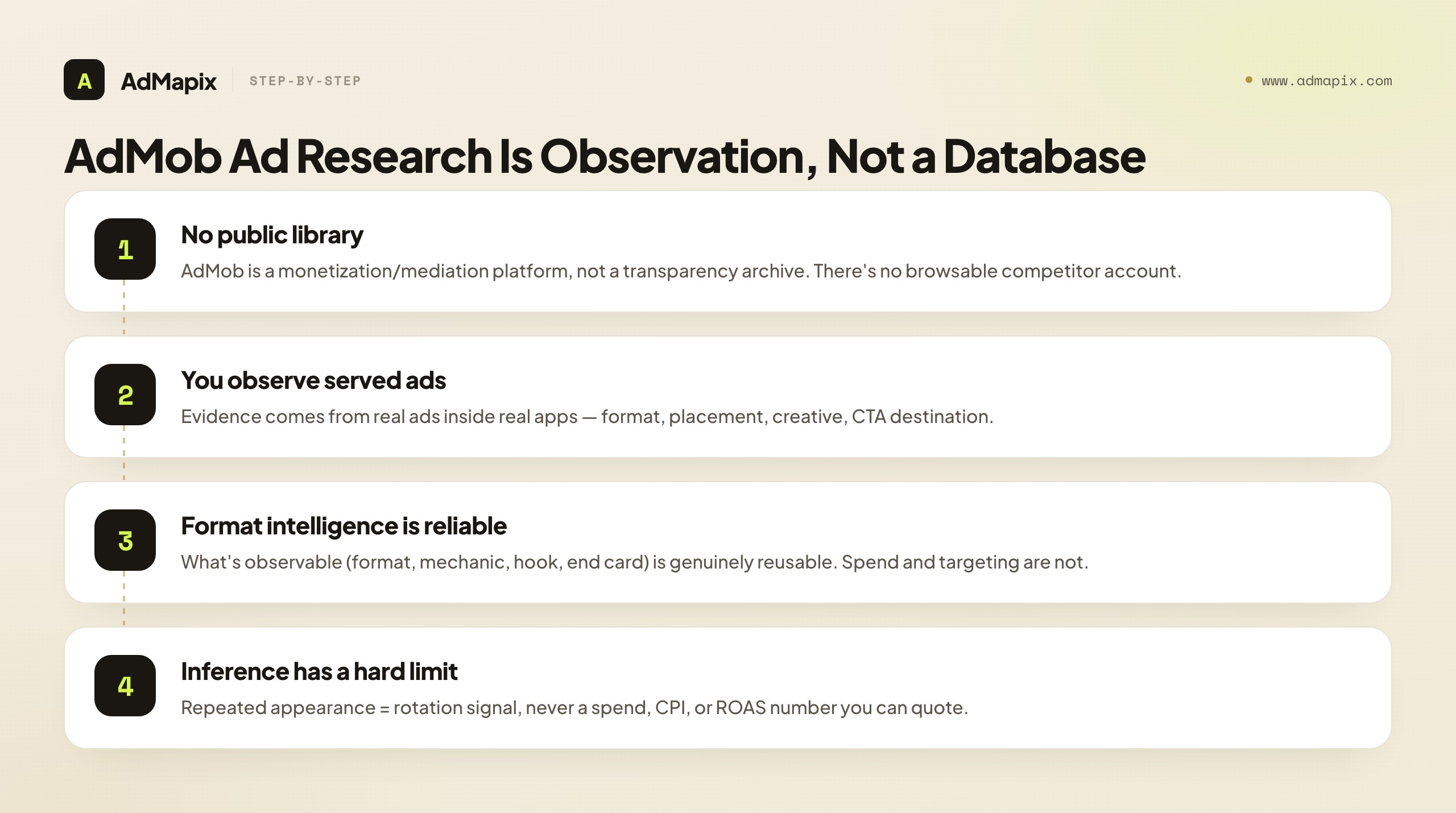
There is no public AdMob ad library you can open to see every advertiser's creatives, spend, or targeting. AdMob is an in-app monetization and mediation platform, not a transparency archive like the Meta Ad Library or the Google Ads Transparency Center. So "AdMob ad spy" really means researching the in-app ads you can legitimately observe inside apps and games: the format (rewarded, interstitial, native, app open), the moment they appear, the creative hook, the playable or video mechanic, and the store or landing path they push to. This guide is honest about that limitation up front, because the most common mistake in AdMob research is expecting a spy database that doesn't exist — and then overclaiming numbers no public source can provide. It's for app publishers, mobile game studios, UA teams, and monetization managers who want to know exactly what observable evidence proves, what it doesn't, and how to turn it into a creative test anyway.
We've researched mobile in-app advertising across casual, mid-core, and app verticals for years, and the honest reality is this: AdMob research is observation-based, not database-based, and the teams who do it well are the ones who respect that boundary rather than fighting it. You can't open an AdMob library and search a competitor's account — but you can systematically observe the ads running inside apps, read the format intelligence that's genuinely reusable, and convert it into creative tests. This guide shows you how to do that rigorously, and exactly where the inference has to stop.
TL;DR — AdMob Ad Research in One Screen
- AdMob has no public competitor ad library. You research the ads you can observe inside apps, not a searchable spend or targeting database — and any tool claiming otherwise is overpromising.
- AdMob is a monetization and mediation platform, not a transparency archive. It's built for publishers to earn, not for advertisers to be audited, which is structurally why no public library exists.
- Format intelligence is the reliable layer. Rewarded, rewarded interstitial, interstitial, native advanced, app open, video, rich media, and interactive ads each shape the creative differently — and format is the most reusable thing you can learn.
- Rewarded ads are the highest-signal format. The opt-in context gives the advertiser their longest, strongest pitch, making rewarded creatives the best place to reverse-engineer a hook, a playable mechanic, or an offer.
- A visible in-app ad proves the creative and placement exist — it never proves spend, CPM, CPI, targeting, or ROAS. Repeated appearance is a rotation signal, not a profitability number.
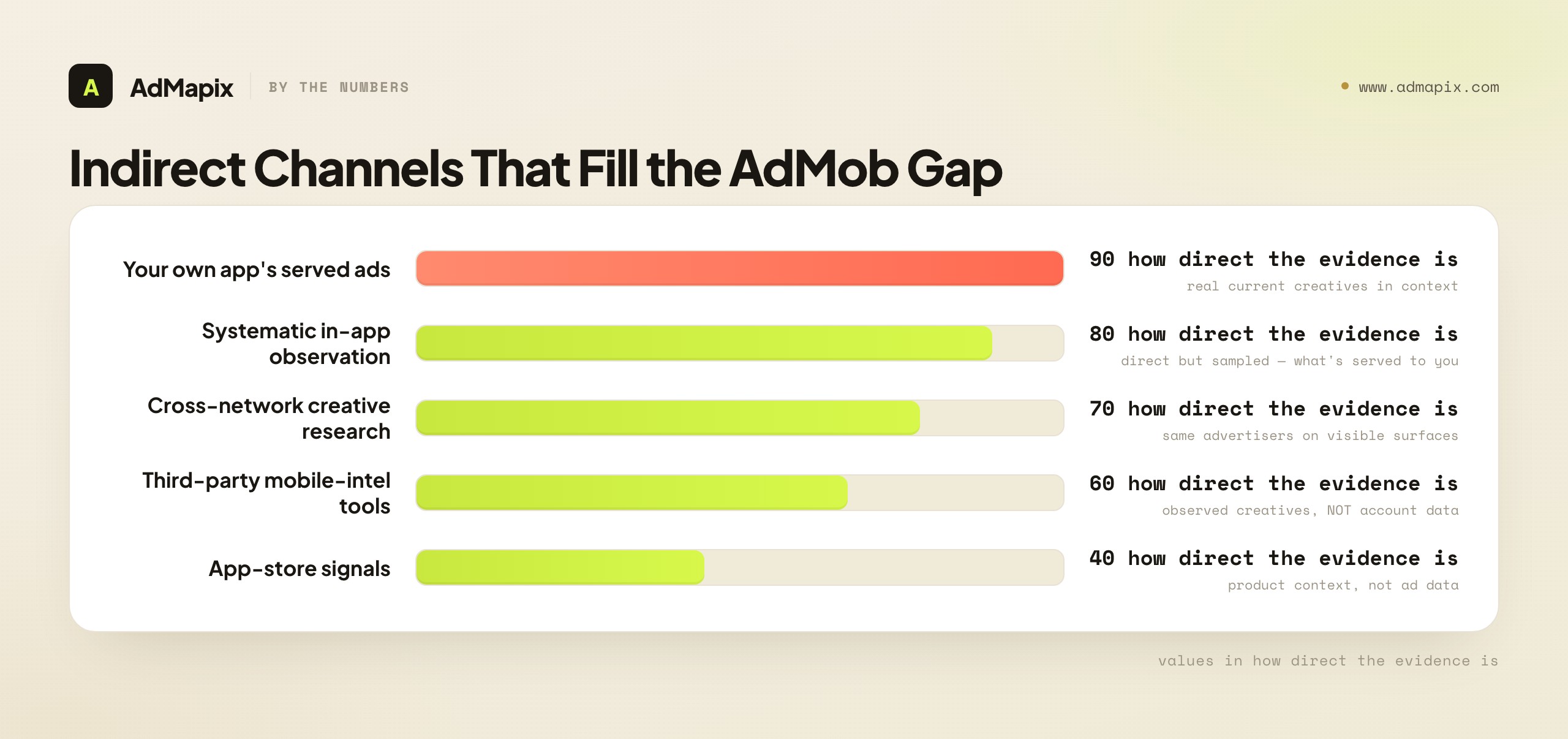
- Indirect channels fill the gap. Observing your own app's served ads, third-party mobile-intelligence tools, app-store signals, and cross-network creative research extend what you can legitimately learn.
- The output is a tagged creative library and a test backlog, not a screenshot folder — and every performance claim is labeled as a hypothesis until your own measurement confirms it.
Why AdMob Has No Spy-Style Ad Library
AdMob is built for publishers to monetize, not for advertisers to be audited — and that single structural fact is why no public AdMob ad library exists or is likely to. Its product surface is about ad units, mediation, and bidding, so the ads users see are served programmatically through AdMob and partner networks rather than published in a browsable archive. The Google AdMob overview frames the product around in-app ads, actionable insights, mediation, and formats like native, rewarded, banner, video, and interstitial. None of that exposes a competitor's account, budget, or audience.
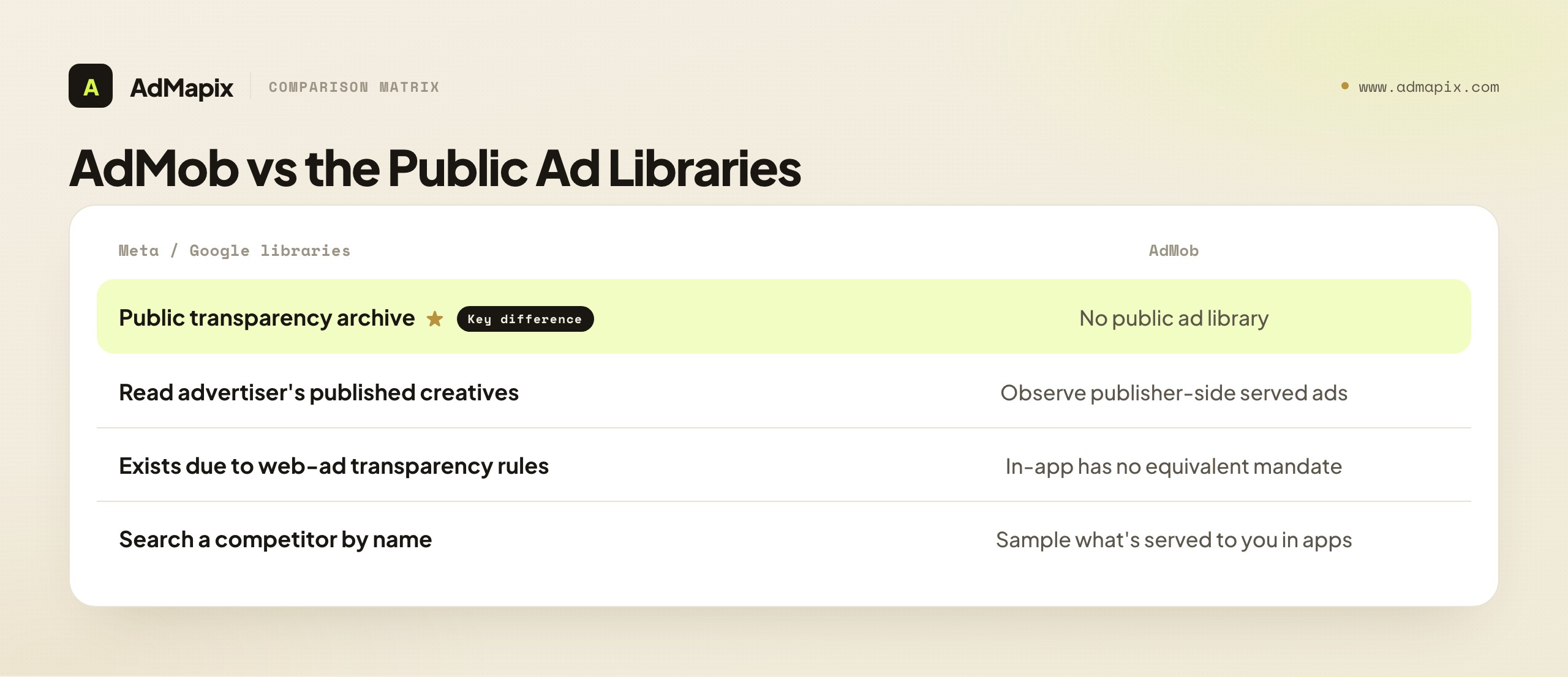
This is a genuinely different situation from Meta and Google's web advertising. The Meta Ad Library and the Google Ads Transparency Center exist largely because of regulatory transparency requirements (the EU Digital Services Act and related rules) that mandate public archives of who's running what. Those requirements landed on the big web-advertising surfaces; the in-app mediation ecosystem AdMob operates in doesn't have an equivalent public-archive mandate, so there's nothing comparable to browse. That's not a gap a tool can fill — it's a structural absence, and any "AdMob ad spy tool" promising a searchable database of competitor AdMob campaigns is either misrepresenting what it has or surfacing observed ads (which you can do yourself) and calling it a library.
The practical consequence: your evidence comes from seeing real ads inside real apps. You note the format, the trigger moment, the creative, and where the CTA sends you. Everything downstream of that is inference, and inference has limits this guide is careful to mark. Accepting the observation-based reality up front is what makes AdMob research honest and useful, rather than a frustrated hunt for a database that was never going to exist.
AdMob's Dual Role: Monetization vs. Serving
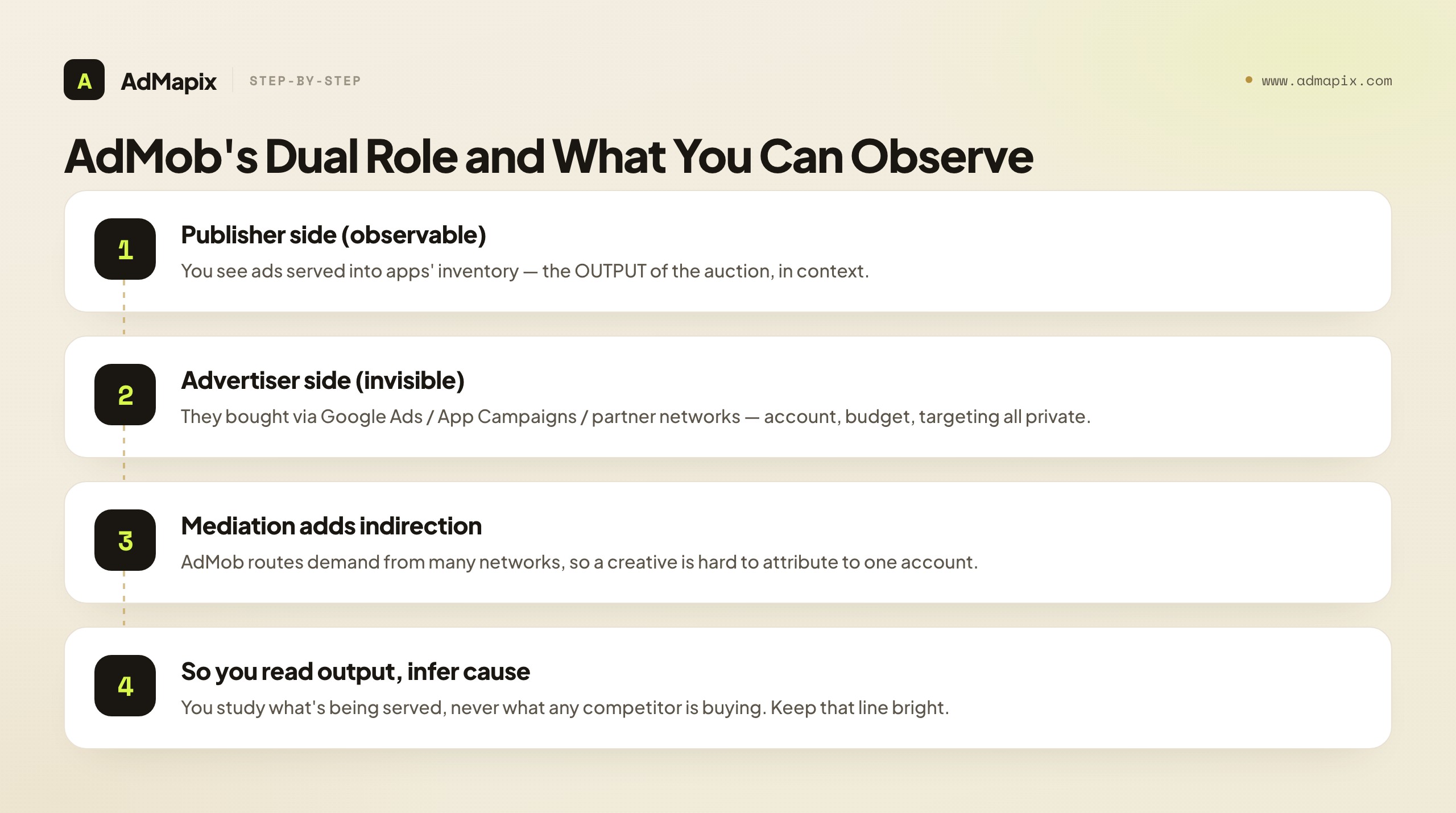
Understanding why AdMob research is observation-based requires understanding AdMob's dual role, because the platform sits on both sides of the in-app ad transaction in a way that shapes what's observable. AdMob is primarily a monetization platform for publishers (apps that show ads to earn revenue) and a mediation layer that routes demand from many ad networks — but the ads it serves come from advertisers buying through Google's broader ad stack and partner networks.
This dual role matters for research in a specific way:
- The publisher side is where you observe. When you see an ad inside an app, you're seeing the publisher's monetization in action — AdMob (or a mediated network) filled that ad slot with whatever advertiser won the auction. You're observing the output of the system, not any advertiser's account.
- The advertiser side is invisible. The advertiser who bought that placement did so through Google Ads, App Campaigns, or a partner network — and their account, budget, targeting, and bid strategy live in those private systems, not in AdMob's publisher-facing surface. There's no advertiser-facing transparency layer to read.
- Mediation adds a layer of indirection. Because AdMob mediates demand from multiple networks, the ad you see may have come through AdMob's own demand or through a mediated partner, which makes it even harder to attribute a given creative to a specific platform or account. You're seeing the end result of an auction across many sources.
The strategic takeaway: AdMob research reads the publisher-side output (what ads are being served in apps) and infers about the advertiser side, which stays private. This is the opposite of the Meta Ad Library, where you read the advertiser's published creatives directly. Knowing which side you're observing keeps your inferences honest — you're studying what's being served, not what any competitor is buying, and the gap between those two is exactly where overclaiming happens.
The Format Intelligence You Can Actually Research
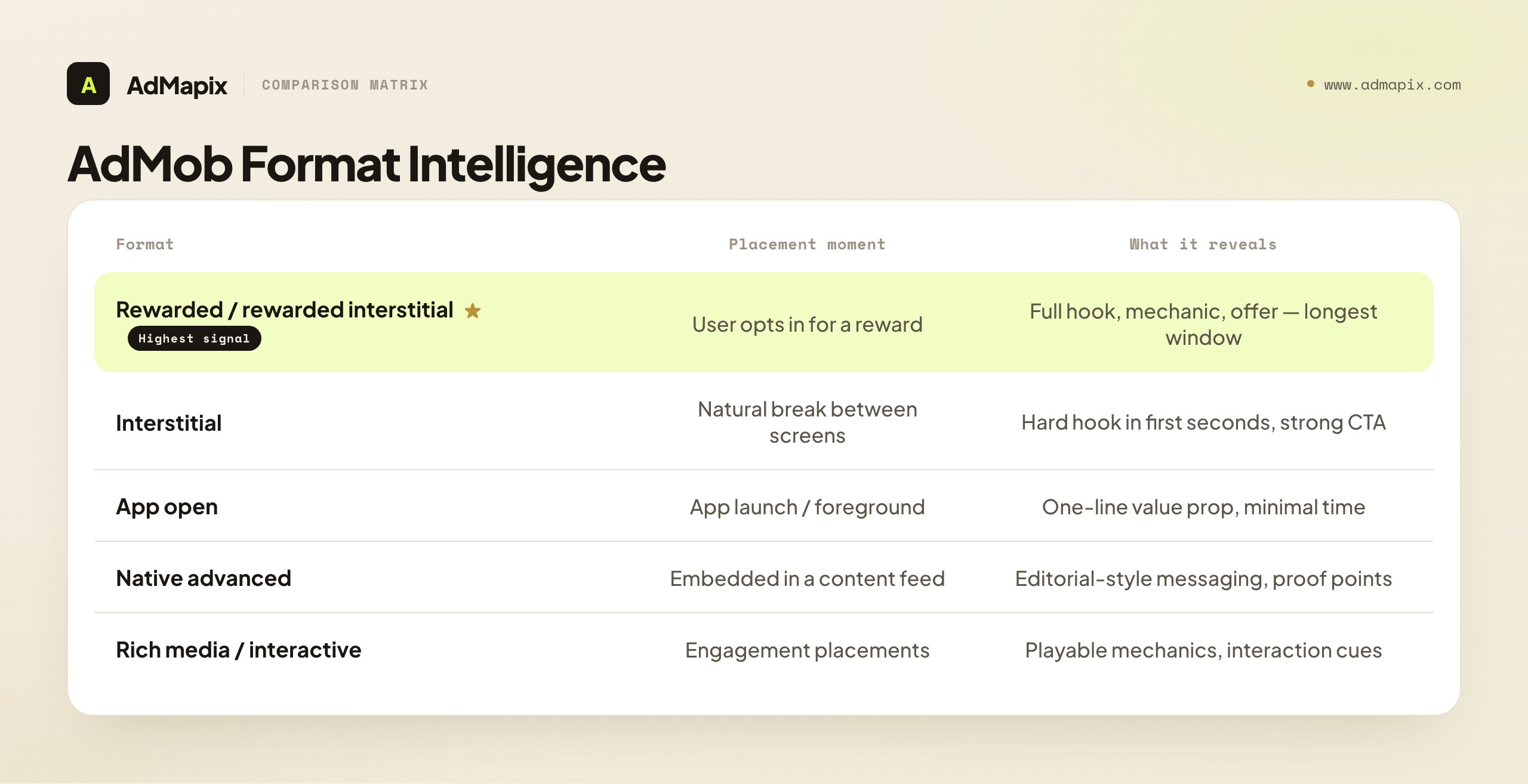
The most reusable thing you can learn from in-app ads is how formats are used, because format dictates creative structure — and format intelligence is the layer where AdMob research is genuinely reliable, since you're reading directly observable creative choices rather than inferring hidden economics. According to Google's ad units, formats, and types documentation, AdMob spans banner, interstitial, rewarded, native advanced, app open, video, rich media, and interactive ads. Each one shapes the creative differently: an app open ad has roughly one second to land a hook, while a rewarded video can run a full mechanic demo because the user opted in for a reward.
| Format | Typical placement moment | What it reveals about the creative |
|---|---|---|
| Rewarded / rewarded interstitial | User opts in for a reward | Full hook, mechanic, and offer; longest creative window |
| Interstitial | Natural break between screens | Hard hook in first seconds; strong CTA |
| App open | App launch or foreground | One-line value prop; minimal time to convert |
| Native advanced | Embedded in content feed | Messaging that mimics editorial; proof points |
| Video | Mediated across surfaces | Pacing, narration, and demo structure |
| Rich media / interactive | Engagement placements | Playable mechanics and interaction cues |
| Banner | Persistent on-screen | Minimal — a logo, an offer, a CTA |
Reading format intelligence is reliable because the format is observable and its constraints are documented — you can see exactly what a competitor did within the format's rules. The strategic value is recognizing how a competitor uses each format's strengths: an advertiser running rich, mechanic-heavy creative in rewarded placements is investing in qualified installs; one relying on banners is buying cheap reach. Mapping which formats a competitor's creative shows up in (across your own observation) tells you how they're thinking about the funnel — and that read is genuinely available from observation, unlike spend or targeting.
Even the lower-signal formats are worth reading for what their constraints force. An app-open ad has roughly a second of attention at app launch, so the creative has to land a single, instantly legible value prop — observing how a competitor compresses their pitch into that one second tells you what they think their core hook is, stripped of everything inessential. A native advanced ad mimics the surrounding content feed, so observing how a competitor makes their ad feel editorial — the proof points they lead with, the tone they adopt to blend in — reveals their messaging priorities in a low-friction context. A banner carries almost nothing (a logo, an offer, a CTA), but even there, which offer a competitor chooses to put on persistent, cheap inventory is a small signal about what they think converts at the bottom of the funnel. The discipline is the same across all formats: read what the format's constraints forced the competitor to prioritize, because a format that allows little forces a competitor to show you only what they consider essential — which is its own kind of clarity. Format intelligence isn't only about the rich rewarded creatives; it's about reading the whole spread of how a competitor matches creative to placement, and that full map is available entirely from observation.
Rewarded Ads: The Highest-Signal Format to Study
Rewarded ads are the single most valuable format to research, because the opt-in context gives the advertiser their longest, highest-intent creative window — which makes rewarded creatives the clearest place to reverse-engineer a hook, a playable mechanic, or an offer structure. Google's developer documentation on rewarded ads describes them as ads that let users earn in-app items by interacting with video ads, playable ads, and surveys.
Why rewarded is the format to study most closely:
- The user opted in, so the creative competes for completion, not attention. Unlike an interstitial that has to grab a reluctant user in the first second, a rewarded ad has a captive, reward-motivated viewer — so the advertiser can run a fuller pitch, a longer demo, a complete mechanic. That fuller pitch is more to learn from.
- It's where playable mechanics live. Rewarded placements are the natural home for playable ads (interactive demos), so studying rewarded creatives is where you see how competitors build their interactive hooks, mechanics, and end cards. For the deep dive on reading those, see our playable ad examples guide.
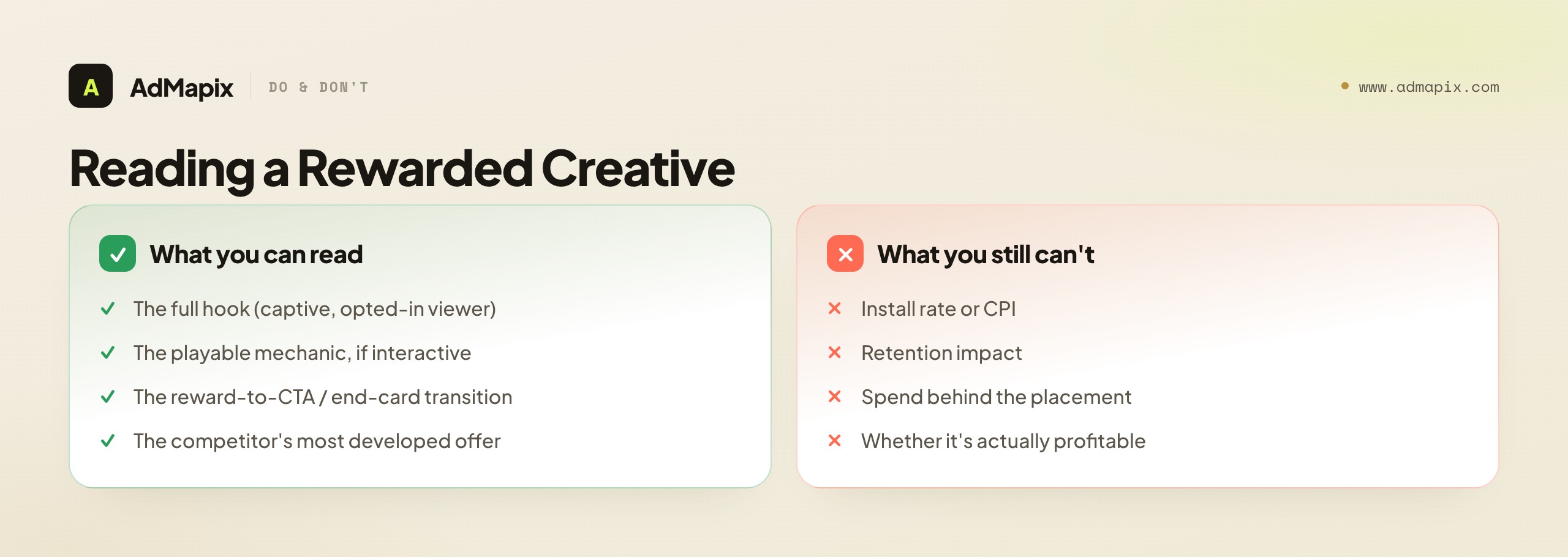
- The reward-to-CTA transition is readable. How a rewarded creative converts the captive, just-rewarded user into an install ask — the end card, the CTA timing, the offer — is one of the highest-leverage things you can observe, because that transition is where the conversion happens.
- It carries the strongest offers. Because the window is long and the viewer engaged, rewarded creatives often carry an advertiser's most developed offer and proof, making them the best place to read the competitor's positioning.
The strategic read: when you research rewarded creatives observed in apps, you're getting the richest, most complete view of a competitor's creative thinking that observation allows — the full hook, mechanic, offer, and end card in one place. Tag rewarded creatives most thoroughly, because they reward (so to speak) the deepest analysis, and they're where the transferable creative lessons concentrate.
The single highest-leverage thing to observe in a rewarded creative is the reward-to-CTA transition — the moment after the user has earned their reward, when the creative makes its install ask. This transition is where the conversion happens, and it's fully observable: you can watch whether the competitor hard-cuts to a generic store button (a leak) or flows the engaged, just-rewarded user into an interactive end card or a continued experience that carries the momentum into the CTA. Because you experienced the whole rewarded ad as a captive viewer, you can read this transition exactly as the competitor's real users do, which makes it one of the few places where observation gives you a near-complete view of a competitor's conversion craft. When your observation finds a strong rewarded creative with a weak reward-to-CTA transition, you've found a gap you can out-execute — and unlike a spend number, that gap is something observation genuinely shows you. This is why rewarded is the format worth the most observation time: it's not just the longest creative window, it's the one where the conversion-critical moment is most fully readable from the outside.
Playable and Interactive Creatives in AdMob
Playable and interactive ads are a major part of the AdMob format landscape, and reading them is its own discipline — covered in depth in our playable ad examples guide, but worth situating here because AdMob's rewarded and rich-media placements are where you'll observe most of them. A playable ad is a short interactive demo that lets the user try a slice of an app or game before installing, and it follows playable logic regardless of the network serving it.
When you observe a playable in an AdMob-served placement, the reads that matter are the same five-dimension teardown: the hook (the first interaction), the core mechanic (what the finger does, and whether it's faithful to the real app), the reward timing (how fast the first payoff lands), the guidance (how a new user is led without a tutorial), and the end card (the install ask). The AdMob-specific context is the placement — a playable in a rewarded slot reaches a captive, opted-in user, while one in an interstitial slot has to work harder for a reluctant viewer's attention. Logging the placement context alongside the playable teardown tells you how the competitor is matching creative to placement.
The honest boundary applies here too: observing a competitor's playable shows you its structure (the mechanic, the hook, the end card), which is genuinely useful, but it never shows you the playable's install rate, CPI, or retention impact. A playable a competitor runs across many sessions is in active rotation, which suggests it's working — but that's a rotation signal, not a performance number. Read the structure to generate hypotheses, then test a comparable concept on your own traffic to get the performance data observation can never provide.
There's one AdMob-specific advantage to observing playables this way: because you experience the playable as a real user (you tap through it, you reach the end card), you read it exactly as the competitor's audience does, which is a more complete view than a static screenshot of a web ad gives you. The interactivity that makes playables hard to capture as a screenshot is the same interactivity you get to fully experience through in-app observation — so for the playable format specifically, in-app observation is arguably a richer research method than a web ad library would be, because you're living the creative rather than viewing a still of it.
What Public Data Can and Cannot Prove
Observation gives you the creative and its context; it does not give you the account behind it. This distinction is the whole discipline of AdMob research, and it matters more here than almost anywhere else because there's no library to tempt you toward false precision — everything is inference from what you saw.
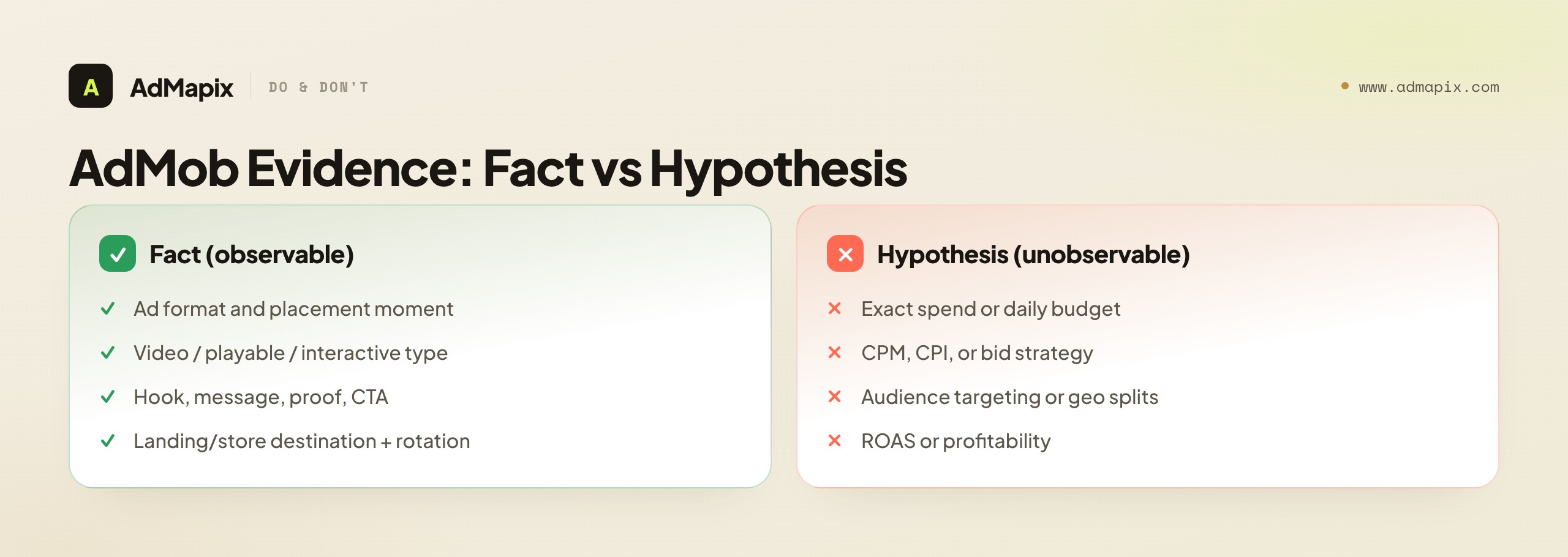
| You can study | You cannot prove |
|---|---|
| Ad format and placement moment | Exact spend or daily budget |
| Video, playable, or interactive type | CPM, CPI, or bid strategy |
| App category and surrounding context | Audience targeting or geo splits |
| Hook, message, proof point, CTA | ROAS or profitability |
| Landing or store destination | Account settings and mediation config |
| Repeated appearance (rotation signal) | Why a competitor chose the creative |
When you see an ad ten times across different sessions, that's evidence the creative is in active rotation and probably performing well enough to keep running. It is not proof of how much was spent, who was targeted, or whether it's profitable. Treat "this creative uses a playable mechanic" as a fact and "this creative is profitable" as a hypothesis — the hypothesis only becomes data when you run your own test and measure it. This boundary is the entire ethical and practical foundation of AdMob research: because there's no public spend data, every number you might want to quote is unobservable, so the discipline of separating the observed creative (fact) from its inferred performance (hypothesis) is non-negotiable. An AdMob research report that states a competitor's CPI or spend is fabricating it, because that data is structurally unavailable.
The Indirect Research Channels That Fill the Gap
Because AdMob has no direct ad library, serious in-app ad research combines several indirect channels — each legitimate, each partial — to build a fuller picture than observation alone provides. Knowing the channels and their limits is what separates rigorous AdMob research from frustrated guessing.
The indirect channels worth using:
- Observing your own app's served ads. If you run an app that shows ads, the ads served into your own inventory are a window into what advertisers are running in your category — you're seeing real, current creatives in context. This is one of the most underused channels: your own ad slots are a research feed.
- Systematic in-app observation. Deliberately spending time in competitor and category apps, noting the ads served, is the core observation method. It's manual and sampled (you see what's served to you, not everything), but it's direct evidence of live creative.
- Third-party mobile-intelligence tools. Some mobile-marketing-intelligence platforms collect and surface in-app ad creatives observed across many devices and apps, which extends your observation beyond what you'd see yourself. These are genuine research aids, but read their claims carefully — they surface observed creatives, not advertiser account data, and the same spend/targeting boundary applies. For the landscape, see Sensor Tower alternatives and the best ad spy tools in 2026.
- App-store signals. A competitor app's store listing, screenshots, ratings velocity, and update cadence are public signals that complement ad observation — they tell you about the product the ads point to, even though they're not ad data themselves.
- Cross-network creative research. Because mobile advertisers usually run across many networks (not just AdMob), researching their creatives on the surfaces that do have visibility (Meta, TikTok, Google) often reveals the same creative strategy you'd want to understand on AdMob. A competitor's winning mobile creative frequently appears across networks.
The honest framing: none of these channels gives you a competitor's AdMob account, and combined they still only show you observed creatives and public signals, never private spend or targeting. But used together — your own served ads, systematic observation, third-party tools, store signals, and cross-network research — they build a legitimate, useful picture of what's running in your category. The discipline is to be clear about what each channel can and can't show, and to never let the combination create false confidence about unobservable numbers.
A word specifically about third-party mobile-intelligence tools, because they're where the overclaiming risk concentrates. Some of these tools genuinely add value by collecting observed in-app creatives across many devices and apps — far more than you could observe yourself — and surfacing them in a searchable interface. That's a real research aid: it scales the observation channel. But read their marketing carefully, because the gap between "we surface observed creatives" (true and useful) and "we show you competitor spend and targeting" (impossible on AdMob) is exactly where some tools blur the line. A tool that claims to estimate a competitor's in-app ad spend is offering a model, not a measurement — and on AdMob, where there's no public ground truth to calibrate against, those estimates carry even more uncertainty than the spend estimates you see for web advertising. Treat any in-app spend estimate as a rough directional model at best, and never quote it as fact in a report. The useful thing these tools provide is scaled observation of creatives; the thing to discount is any claim of precise competitor economics. Judge a third-party tool on whether it surfaces and organizes real observed creatives well, not on whether it promises numbers no one can actually see — because the promise of those numbers is usually the tell that a tool is overselling what AdMob research can deliver.
How to Run Systematic In-App Observation
Because observation is the core AdMob research method, doing it systematically rather than randomly is what separates useful evidence from anecdote — a deliberate observation practice produces a comparable, searchable record where casual scrolling produces a vague impression. The method is manual and sampled by nature, but it can still be rigorous.
The practices that make observation systematic:
- Sample deliberately across apps and sessions. The ads served to you depend on the app, your device, your apparent profile, and the moment — so observe across multiple competitor and category apps, and across multiple sessions, rather than drawing conclusions from one app's one session. The more you sample, the more the patterns (which formats, which advertisers, which creatives recur) become reliable signal rather than a single fluke.
- Note the placement moment every time. An in-app ad is placement-dependent in a way web ads aren't: the same creative in a rewarded slot, an interstitial break, and an app-open moment is doing three different jobs. Logging where in the app experience the ad appeared is what makes the observation interpretable, and it's the field casual observation always skips.
- Capture the creative and the destination together. Record the format, the hook, the mechanic (if interactive), and where the CTA sends you (store page, deep link). The ad-to-destination pairing is as important in-app as on the web — a strong rewarded creative pointing at a weak store page is a leak you can read.
- Log rotation, not just presence. Note whether you've seen a creative before and roughly how often it recurs across your sessions. Repeated appearance is the closest thing to a performance signal observation offers — a rotation read, never a spend number, but genuinely informative about what's in active use.
The honest framing: systematic observation is still sampled — you see what's served to you, not the universe of what's running — so it's directional, not comprehensive, and you should hold its conclusions accordingly. But a disciplined observer who samples broadly, logs placement and rotation, and pairs creative with destination builds a far more reliable picture than someone who screenshots a few ads at random. The rigor is in the system, not in any single observed ad, which is the same lesson every chapter of competitive research teaches — but it matters most here, where observation is all you have.
AdMob Research by App Category
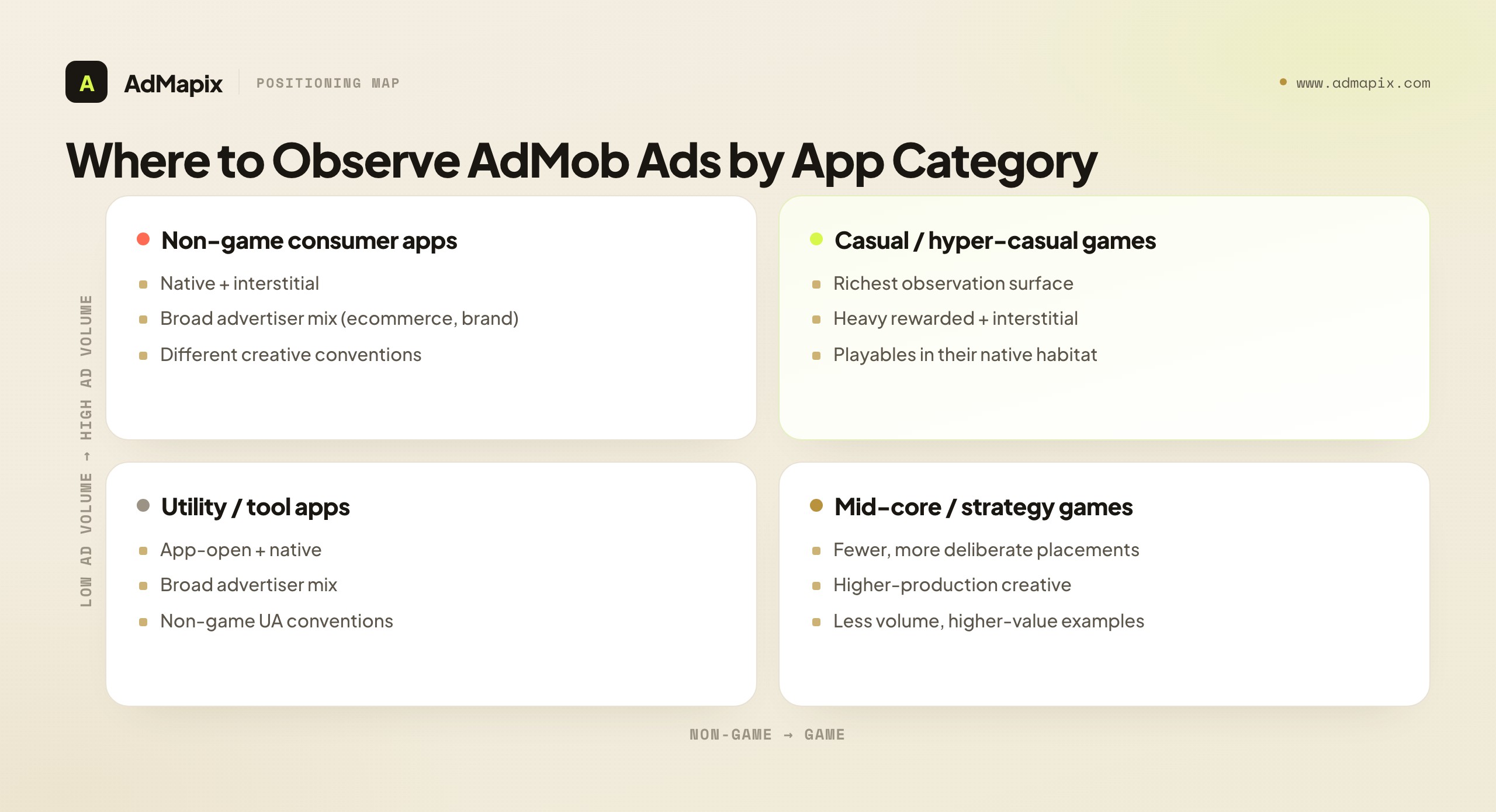
The observation method is universal, but what you'll see and what matters shifts by app category, so reading AdMob ads through the right category lens tells you which formats and signals to weight. The in-app ad landscape looks quite different in a casual game versus a utility app versus a non-game consumer app.
The category patterns worth knowing:
- Casual and hyper-casual games. The richest place to observe in-app ads, because these apps monetize heavily with rewarded and interstitial ads and the advertisers are often other games running playable and video creative. Rewarded placements here carry the fullest creative pitches, and the volume of ads served makes systematic observation productive. This is where to focus if you research game UA creative.
- Mid-core and strategy games. Fewer, more deliberate ad placements (heavy monetization can hurt retention for engaged players), so you observe fewer ads but often more sophisticated, higher-production creative aimed at committed players. The signal-to-noise is different — less volume, higher-value examples.
- Utility and tool apps. Often use app-open and native formats, and the advertisers skew toward a broader mix (not just games). Observing here tells you about non-game mobile advertising creative, which follows different conventions than game UA.
- Non-game consumer apps. Content, social, and lifestyle apps monetizing with native and interstitial ads show you a wide advertiser mix, including ecommerce and brand advertisers, whose creative conventions differ from app-install ads. A useful cross-category observation surface.
The strategic use: match your observation to the category you're researching. If you're a casual game studio, casual and hyper-casual apps are your richest observation surface, and rewarded playables are the format to study most. If you're a non-game app, utility and consumer apps show you the relevant advertiser conventions. Observing the wrong category surface — a brand advertiser studying hyper-casual game ads, say — fills your library with creative that doesn't transfer. Read the category first, then point your observation at the surfaces where the relevant advertisers actually run.
The In-App Creative Lifecycle
In-app creative — especially in the high-volume casual game space — cycles fast, so reading where a creative sits in its lifecycle tells you how to interpret what you observe and how fast you need to move. A creative you observe heavily across many sessions has survived enough to stay in rotation; one you see once may be a test that's about to disappear.
The lifecycle reads that observation supports:
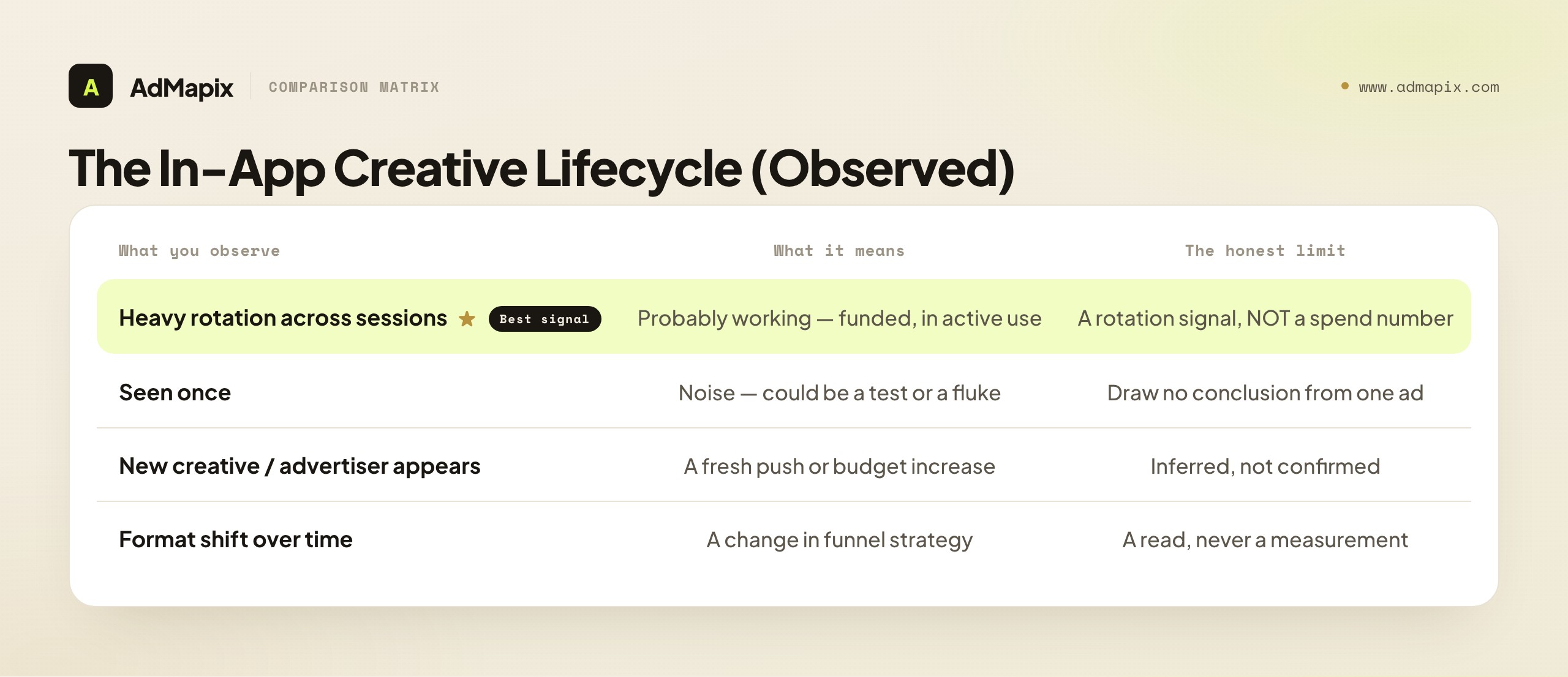
- Heavy rotation = a working creative (probably). When you observe a creative repeatedly across apps and sessions, it's in active, funded rotation — the closest thing to a performance signal observation offers. Advertisers don't keep serving losers, so sustained heavy rotation is a meaningful (if soft) read that the creative is working.
- A creative seen once is noise. A single observation tells you almost nothing — it could be a test, a low-budget concept, or a fluke of what was served to you. Don't draw conclusions from a single observed ad; the signal is in the repetition.
- New creative entering rotation is a signal of a fresh push. When you start seeing a new creative or a new advertiser appear across your observation, it often signals a new campaign or a budget increase — worth noting as a competitor making a move.
- Format shifts reveal strategy changes. When a competitor's observed creative shifts format (from interstitial video to rewarded playable, say), it signals a change in how they're thinking about the funnel — a strategic read available from observation over time.
The honest boundary, repeated because it's the whole point: rotation and lifecycle are observation-derived rotation signals, never spend or performance numbers. "I see this creative a lot" supports "it's probably working," not "they spend $X on it." Tracking the lifecycle over time — which creatives persist, which appear, which vanish — builds a directional read of a competitor's creative strategy, but it's always a read, never a measurement, on a platform where measurement of competitor activity is structurally unavailable.
A Workflow That Turns Observation Into Tests
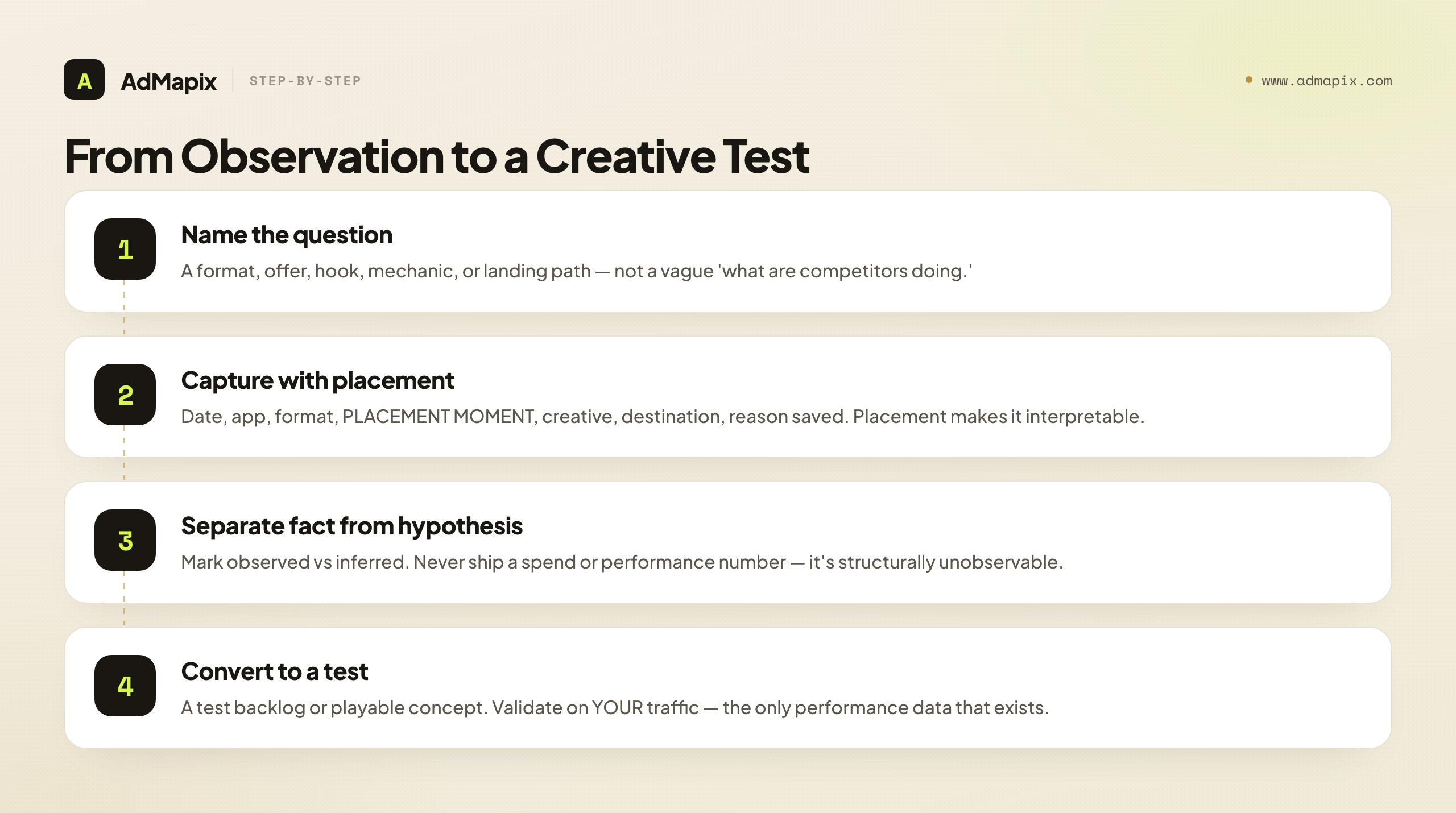
The point of AdMob ad research is not collecting ads; it's producing the next creative test. Anchor the work to a question, then capture evidence that survives being revisited a month later.
- Name the research question. Are you studying a format, an offer, a hook, a playable mechanic, or a landing path? A vague "what are competitors doing" produces a vague folder.
- Start from official context. Confirm what the format allows before you interpret the creative, so you don't credit the advertiser for something the format does for free.
- Capture each example with context. Save the date, the app where it appeared, the format, the placement moment, the creative asset, the landing or store path, and the reason you saved it.
- Tag the creative structure. Use consistent tags for hook, mechanic, message, proof point, CTA, and destination so the library is searchable later.
- Separate facts from hypotheses. Mark what you observed versus what you're guessing, and never ship a guess to a report as a finding — especially any spend or performance number, which is always unobservable.
- Convert patterns into a brief. End with a test backlog, a playable concept, or a localization note, not a screenshot dump.
The AdMob-specific discipline layered on this universal workflow is step 5, sharpened: because there's no public data to anchor any performance claim, the fact/hypothesis line has to be even brighter than in Meta or Google research. The capture (step 3) should always include the placement moment, because in-app ads are placement-dependent in a way web ads aren't — the same creative in a rewarded slot versus an app-open slot is doing a different job, and logging the placement is what makes the observation interpretable later.
The Cross-Network Advantage for Mobile Advertisers
The single most powerful move in AdMob research is to stop treating AdMob as the boundary, because mobile advertisers almost never run on AdMob alone — and researching the same advertisers on networks that do have visibility often reveals the creative strategy you couldn't read from AdMob observation. This is the practical answer to AdMob's missing library: go where the visibility is.
Why cross-network research fills the AdMob gap so effectively:
- The same advertisers run everywhere. A game studio or app advertiser running rewarded creative through AdMob is almost certainly also running on Meta, TikTok, and Google's other surfaces — and those surfaces have public ad libraries or creative-research visibility. The creative strategy you want to understand is usually observable somewhere, even if not on AdMob directly.
- Creative crosses networks. A winning playable or video concept rarely stays on one network; advertisers port proven creative across their channels. So a competitor's AdMob creative often appears, in some form, on a more visible surface where you can study it in full and with searchability AdMob can't offer.
- The full funnel becomes readable. Combining AdMob observation (in-app rewarded and interstitial creative) with cross-network research (the same advertiser's Meta and TikTok creative) gives you the whole creative motion — the in-app monetization-facing creative and the broader-reach social creative — rather than one slice.
- Visibility where it exists, observation where it doesn't. The discipline is to use each surface for what it offers: read the public libraries where they exist (Meta, Google web), observe systematically where they don't (in-app AdMob), and combine the two into a fuller picture than either gives alone.
The strategic synthesis: AdMob's lack of a public library is far less limiting once you treat the advertiser, not the network, as the unit of research. You want to understand a competitor's mobile creative strategy — and that strategy lives across networks, most of which are more visible than AdMob. Use AdMob observation for the in-app creative context it uniquely shows (the rewarded placements, the playable mechanics in their native habitat), and lean on cross-network creative research for the searchable depth and the broader strategy. The two together turn the AdMob blind spot into a manageable, partial-visibility problem rather than a dead end.
Building an In-App Observation Library
A scattered set of in-app ad screenshots is useless within a week, so the asset that compounds is a searchable, tagged observation library where every entry is captured with the placement context and creative structure that make it interpretable later. For AdMob research specifically, the library has to capture the placement moment and the rotation read, because those are the signals unique to in-app observation.
Every entry should capture: the date and the app it appeared in; the format and the placement moment (rewarded / interstitial / app-open / native); the creative — hook, mechanic (if interactive), message, proof, CTA; the landing or store destination; the rotation note (seen before? how often?); and a status (observed → briefed → tested → result). The two fields that make this an AdMob library rather than a generic swipe file are the placement moment (in-app creative is placement-dependent, so the same ad means different things in different slots) and the rotation note (the only performance-adjacent signal observation offers).
The payoff is the same as any creative library, with the AdMob caveat baked in. Once thirty or forty observed creatives are tagged this way, you can see which formats the category clusters on, which advertisers recur, which mechanics dominate rewarded placements, and which creatives persist in rotation versus vanish — a directional map of the category's in-app creative landscape. But the library should never contain a spend or performance number, because none is observable; what it contains is observed creatives, their placement context, and their rotation signals, turned into a searchable, briefable record. That honest, well-structured library is the realistic output of AdMob research — not a competitor's account, but a rigorous read of what's running in your category's in-app inventory.
A Worked Observation Example
Principles stick when applied, so here's how systematic observation runs for a single research question, end to end. Say you're a casual puzzle-game studio and your question is: which rewarded playable mechanics are competitors running in my category?
Sample. Over a week, you spend time in several casual and hyper-casual games (the richest observation surface for game ads), deliberately triggering rewarded placements (opting in for rewards) to see the rewarded creatives. You note each ad's app, the placement moment, the creative, and the destination.
Observe and capture. You see, repeatedly across sessions, three recurring rewarded playables from competitor puzzle games: one leads with a near-win merge mechanic, one with a fail-then-retry pin-pull (attached to a game whose real loop is a merge — a fake-mechanic tell), and one with a faithful slice of the actual puzzle gameplay. Each is captured with date, app, placement (rewarded), the mechanic, the end card, and the store destination. You log that all three are in heavy rotation — a rotation signal that they're working for someone.
Read the structure (fact) and infer (hypothesis). The facts: the three mechanics, their hooks, their end cards, their store paths. The hypotheses: the near-win and fail-then-retry playables are probably driving installs (heavy rotation), but the fake-mechanic one likely carries retention risk (the install-to-real-game expectation gap) — though you can't confirm any of that from observation. You mark the fact/hypothesis line explicitly.
Convert to a test. You don't copy any playable. You brief a test of the faithful-mechanic approach (the retention-safe one your fake-mechanic competitors aren't using) against a near-win variant, to be measured on your own install rate and day-1 retention. The observation generated the hypotheses; your own measurement — the only performance data that exists for your situation — will decide. That's the full method: systematic observation, rigorous fact/hypothesis separation, and a test that produces the numbers AdMob could never show you.
Reporting Honestly Without a Public Library
The absence of a public AdMob library raises the stakes on honest reporting, because there's no data source to anchor any claim — which means the discipline of separating fact from inference isn't just good practice here, it's the only thing standing between rigorous research and fabrication. For anyone reporting AdMob findings to a client, a team, or a stakeholder, the honesty isn't optional; it's the entire foundation of credibility on a platform where the tempting numbers simply don't exist.
The reporting practices that keep AdMob research honest:
- State the observation-based reality up front. Open any AdMob research deliverable by acknowledging there's no public library and the findings are observation-based and sampled. This isn't a weakness to hide — it's a rigor signal that you understand the platform, and it preempts the inevitable "can you get their spend?" question with an honest "no, and here's why no one can."
- Never quote a spend, CPI, or targeting number. These are structurally unobservable on AdMob, so any such number in a report is fabricated. The most damaging thing an AdMob research report can do is present an invented performance figure as data — it destroys credibility the moment a knowledgeable reader catches it, and a knowledgeable reader always will.
- Frame rotation as a rotation signal, explicitly. "We observed this creative repeatedly across sessions, which suggests it's in active rotation and likely working for the advertiser" is honest. "This is their top-performing creative with an estimated $X spend" is not. The difference is the explicit labeling of the inference.
- Show the method. Because the research is observation-based, showing how you observed (which apps, how many sessions, what you sampled) makes the findings credible and repeatable. Transparency about method substitutes for the data transparency the platform doesn't offer.
The strategic synthesis: on AdMob, honesty is a competitive advantage, not a constraint. Anyone can fabricate a spend number; a researcher who reports rigorously — observation-based, method-transparent, fact-and-inference clearly separated — produces findings that survive scrutiny and build trust precisely because they don't overclaim. The platform's lack of a public library, far from making rigorous research impossible, makes the rigor visible: a report that's honest about what observation can and can't show demonstrates exactly the expertise that a fabricated-number report only pretends to have. The teams and agencies that do AdMob research well are the ones whose reports a sophisticated reader can trust, and that trust is built entirely on the discipline of never claiming the unobservable. In a category with no public data, the honest researcher's rigor is the only credential that matters.
Common AdMob Ad Research Mistakes
- Expecting a spy database that doesn't exist. AdMob has no public ad library; treating "AdMob ad spy" as a searchable spend tool leads to disappointment and to trusting tools that overpromise.
- Confusing visibility with performance proof. A visible ad is a clue, not evidence of spend, targeting, ROAS, or profitability — and on AdMob there's no public data to even partially anchor that.
- Quoting spend or CPI numbers. These are structurally unobservable on AdMob; any report stating them is fabricating them.
- Saving assets without context. A file with no source app, date, placement, or reason-for-saving is dead weight within a week.
- Tagging every format the same way. Rewarded, native, app open, and playable creatives carry different signals and need different tags and placement notes.
- Copying before classifying. Identify the hook, mechanic, and placement-fit first; then decide whether the idea is worth testing.
- Reporting rotation as ROI. Seeing an ad repeatedly suggests it's working for someone, but it's not a profitability number you can quote.
When to Use AdMapix
AdMapix is for app and game teams who research in-app and cross-network ad creatives often enough that screenshots and browser bookmarks have stopped scaling. If you only check a competitor's ads twice a year, manual notes are fine and you don't need a tool. If you run weekly creative reviews, brief UA tests, or maintain a competitive library across a portfolio, that's where it earns its place.
Use Search AdMapix to find ad creatives across networks, Media to keep saved assets searchable, Video Analysis to break down pacing, motion, and interaction cues in video and playable ads, and Reports to turn repeated patterns into summaries a UA or creative team can act on. Pricing helps you compare what a solo marketer, an agency, or a UA team actually needs. Teams that do this every week can start from Login and keep the same research logic, just made repeatable.
It's honest about the same boundary this whole guide is built on: it is not a substitute for running your own tests, and it will not reveal a competitor's private AdMob spend or targeting, because no compliant tool can — that data isn't public. What it does is make the observation-and-cross-network research you can legitimately do faster and more organized, so your time goes to the creative analysis and the test, not the manual collection.
FAQ
Is there an AdMob ad library like the Meta Ad Library?
No. AdMob is a monetization and mediation platform, not a public transparency archive, so there's no browsable library of competitor AdMob creatives, spend, or targeting. The Meta Ad Library and Google Ads Transparency Center exist largely because of web-advertising transparency regulation that doesn't have an in-app equivalent. You research AdMob-served ads by observing them inside apps and organizing that evidence yourself.
Can any ad spy tool show a competitor's AdMob spend or targeting?
No compliant tool can. Public research surfaces visible creatives, formats, placement context, and landing paths. Exact spend, CPM, CPI, targeting, and ROAS live in private advertiser accounts and are not observable. Any tool claiming to show a competitor's AdMob spend is either misrepresenting what it has or surfacing observed creatives (which you can do yourself) and calling it account data.
How do I research AdMob ads if there's no library?
Through observation and indirect channels: systematically spend time in competitor and category apps noting the ads served, observe the ads served into your own app's inventory if you have one, use third-party mobile-intelligence tools that surface observed creatives, read app-store signals, and research the same advertisers' creatives on networks that do have visibility (Meta, TikTok, Google). Combined, these build a legitimate picture of what's running — but never of private spend or targeting.
Which AdMob format is most useful to study?
Rewarded ads, because users opt in and the advertiser gets a long, high-intent window — which means rewarded creatives carry the fullest hook, mechanic, offer, and end card. They're also where playable ads live, so they're the clearest place to reverse-engineer an interactive mechanic. Tag rewarded creatives most thoroughly; they reward the deepest analysis.
Why does AdMob have no public ad library when Meta and Google do?
Because the transparency regulations that produced the Meta Ad Library and Google Ads Transparency Center landed on the big web-advertising surfaces, and the in-app mediation ecosystem AdMob operates in doesn't have an equivalent public-archive mandate. It's also structural: AdMob is built for publishers to monetize, not for advertisers to be audited, so there's no advertiser-facing transparency surface to begin with.
What's AdMob's role — is it for showing ads or buying them?
Primarily showing them. AdMob is a monetization and mediation platform for publishers (apps that show ads to earn), and a mediation layer routing demand from many networks. The advertisers whose ads appear bought them through Google Ads, App Campaigns, or partner networks — those accounts are private. So when you observe an AdMob-served ad, you're seeing the publisher-side output of an auction, not any advertiser's account.
What should I save from each ad I observe?
The date, the app it appeared in, the format, the placement moment (rewarded, interstitial, app open, etc.), the creative asset, the landing or store destination, whether you've seen it before, and the next test idea it suggests. The placement moment is the AdMob-specific field that makes the observation interpretable later, because in-app creative is placement-dependent.
How do I know if a creative is actually working?
You can't confirm it from observation alone — on AdMob there's no public performance data at all. Repeated appearances across sessions suggest the creative is in active rotation and probably working for someone, but profitability is only proven when you test a comparable concept on your own traffic and measure your own install rate, CPI, and retention.
Can I research playable ads through AdMob observation?
Yes — rewarded and rich-media AdMob placements are where you'll observe most playables, and you can read their structure (hook, mechanic, reward timing, guidance, end card) by playing them. What you can't read is their install rate or retention impact. See our playable ad examples guide for the full teardown method; the AdMob-specific addition is logging the placement context the playable ran in.
How does AdMob research fit a broader UA competitive-intelligence practice?
It's one observation-based input among several. Because mobile advertisers run across many networks, AdMob observation is most powerful combined with cross-network creative research (on surfaces that have visibility), app-store signals, and your own test data. Treat AdMob observation as the in-app creative-context layer, and lean on cross-network research for the broader strategy picture — together they inform the creative tests that your own measurement then validates.
Related Reading
- Playable Ad Examples: Teardowns of Hooks, Mechanics & End Cards — the full teardown method for the playables you'll observe in AdMob placements.
- In-Game Advertising: Formats and Strategy — where AdMob and rewarded video sit in the wider in-game ad landscape.
- Mobile Game Ads Guide — the full creative and channel picture for mobile game UA.
- Paid User Acquisition: A 2026 Playbook — the UA strategy AdMob observation feeds.
- Sensor Tower Alternatives: Mobile Intelligence Tools Compared — the mobile-intelligence tools that extend in-app observation.
- Ad Hook Examples: 7 First-3-Second Patterns — the opener craft behind every in-app interstitial and app-open ad.
Sources
- Google AdMob overview — frames AdMob around in-app ads, mediation, bidding, and supported formats like native, rewarded, banner, video, and interstitial.
- Google AdMob ad units, formats, and types — documents banner, interstitial, rewarded, native advanced, app open, video, rich media, and interactive ads.
- Google Developers: rewarded ads — describes rewarded ads as letting users earn in-app items by interacting with video ads, playable ads, and surveys.
- Meta Ads Library — the public web-advertising archive that AdMob, by contrast, has no equivalent of, useful for cross-network research of the same advertisers.
Sources verified as of June 21, 2026. Platform docs and ad product pages change, so re-check each URL before using these details in a client report or quarterly plan. AdMapix surfaces public and observed ad creatives across networks; it does not expose advertiser spend, targeting, or conversion data, which remain private — and on AdMob specifically, no public spend or targeting data exists to surface.
See what competitors are really running
Search 6M+ ad creatives, landing pages, and weekly spend across 200+ countries. No credit card, no commitment.
Related Articles
Ad Hook Examples in 2026: 7 First-3-Second Patterns (with UGC Breakdowns)
A complete 2026 library of ad hook examples organized into seven repeatable patterns — problem, proof, objection, comparison, curiosity, offer, and transformation — with UGC hook breakdowns, platform-by-platform differences for TikTok, Meta, and YouTube, an industry-by-industry hook map, a hook-testing workflow that ships variants, the metrics that actually grade a hook, and a worked teardown that turns a competitor opener into a running test.
Meta Ads API Alternative in 2026: Ad Library API, Marketing API, or a Creative Layer?
A 2026 guide to choosing a Meta ads API alternative — what the Ad Library API, Marketing API, and Graph Ads Archive each actually expose and where they stop, how a creative-intelligence layer fills the saved-media, video-breakdown, and reporting gap, exactly what public Meta data can and cannot prove (creative yes; spend, targeting, and ROAS no), and a decision framework matched to the job you are doing.
Outbrain Ad Spy Tool in 2026: Native Ad Research for the Open Web
How to research Outbrain native ads from public evidence in 2026 — what a spy tool can and cannot prove, how to decode headline-and-thumbnail hooks, advertorial landing paths, retargeting trails, and how to turn patterns into testable native campaigns.