Ad Intelligence API: What Developers Need Beyond a Raw Ads-Library Endpoint in 2026
A developer-focused guide to ad intelligence APIs: what fields make a creative record queryable, why official ads-library endpoints stop short, the buy-vs-build tradeoff for a cross-network layer, and how to design a pipeline that survives schema and rate-limit changes.
Ad Intelligence API: What Developers Need Beyond a Raw Ads-Library Endpoint in 2026
Updated June 21, 2026.
An ad intelligence API is an interface that returns ad creatives as structured, queryable records — creative assets, ad copy, advertiser, placement, run dates, and a stable source URL — instead of an HTML page you have to scrape. The official ads-library APIs (Meta, Google) give you raw access to one network's transparency data; the work a team actually needs sits on top of that: cross-network search, normalized fields, deduplication, caching against rate limits, and an output that lands in a database or a report. This guide is for developers, growth engineers, and data teams who are about to wire an ads-library endpoint into a pipeline and want to know what to build versus what to buy. By the end you will know which fields matter, where official APIs stop, and how to design a workflow that survives schema and rate-limit changes. AdMapix is our product; we include it where the buy-side fits and keep API claims separate from what public ad data can actually prove.
TL;DR
- An ad intelligence API should return searchable creative records — asset, copy, advertiser, placement, dates, and a stable source URL — not a one-network HTML dump you scrape and re-parse on every schema change.
- The hard parts are not the endpoint itself. They are normalization, deduplication, asset rehosting, caching against rate limits, and cross-network coverage — exactly what a single official API does not give you.
- Official ads-library APIs (Meta, Google) prove an ad ran and show its creative. They cannot return spend, targeting, impressions, ROAS, or conversion rate, because that data is private. No API can.
- Buy vs build is a maintenance question, not a one-time-cost question. A self-built layer is one connector per platform, each of which breaks on the platform's schedule, not yours.
- Design for change. Map every platform field to your own normalized model, rehost assets before URLs expire, dedup across page IDs, and cache aggressively against rate limits.
- AdMapix fits teams that want cross-network creative search, saved media, video analysis, tagging, and report output without building and maintaining one connector per platform.
What a Raw Ads-Library Endpoint Actually Gives You
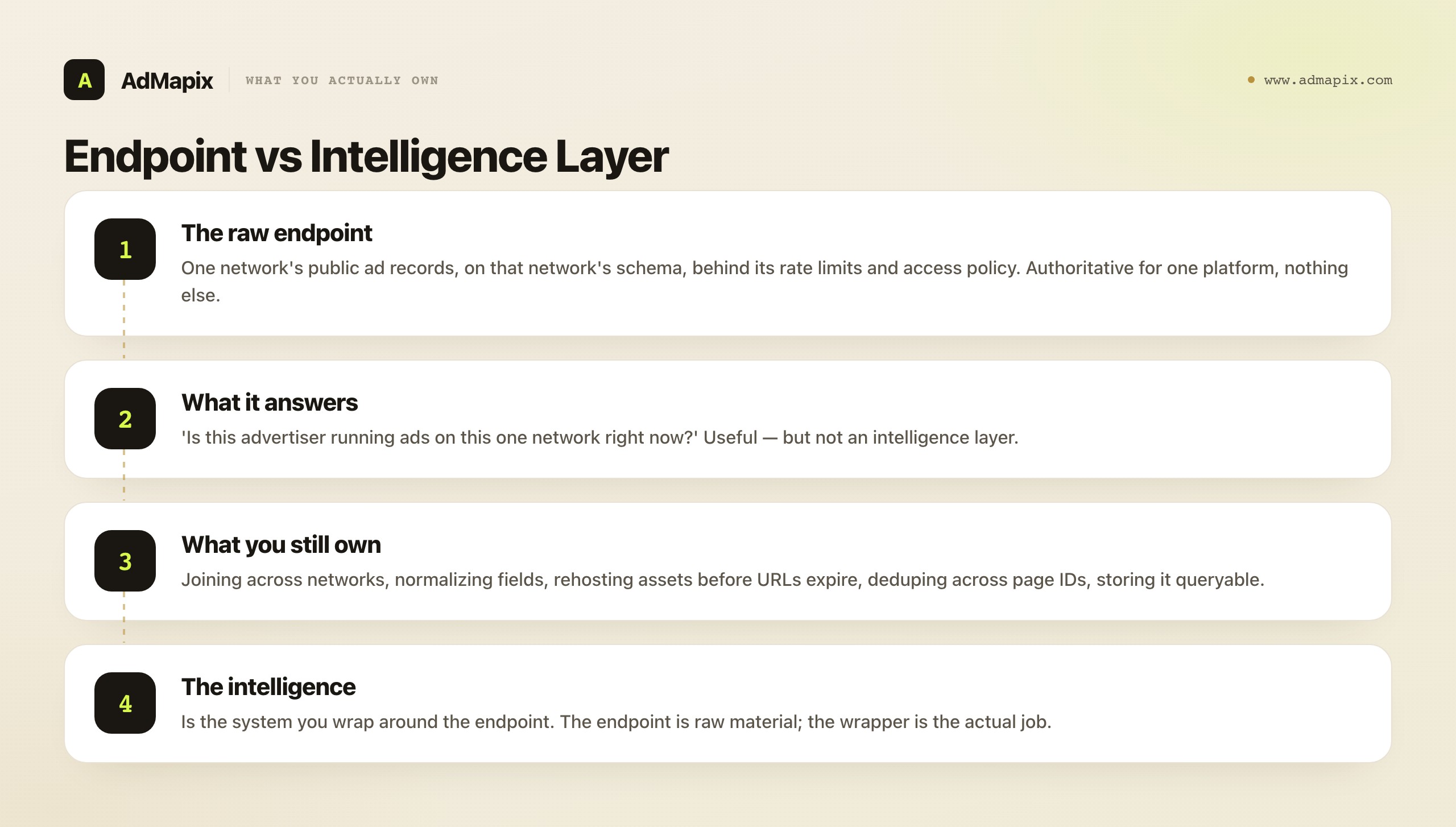
A raw ads-library endpoint gives you exactly one network's public ad records, on that network's own schema, behind that network's rate limits and access policy. The Meta Ad Library API returns archived ads from Meta; the Google Ads Transparency Center surfaces ads served through Google. Each is authoritative for its own platform and nothing else. That authority is real and valuable — these are first-party transparency surfaces, the ground truth for "what is publicly running on this network" — but the scope is exactly one network, and the shape of the data is whatever that platform decided to expose, in whatever structure they chose, subject to change without your involvement.
That is enough to answer "is this advertiser running ads on this one network right now," but it is not an intelligence layer. You still own everything between the JSON response and a decision: joining results across networks, mapping each platform's field names to a single model, downloading and rehosting assets before URLs expire, removing duplicate ads that appear under multiple page IDs, and storing it somewhere you can query later. The endpoint is the raw material; the intelligence is the system you wrap around it. A team that treats the endpoint as the finished product ends up with a brittle script that returns a single network's raw blob and breaks the first time the platform renames a field or rotates an asset URL.
The cross-network gap is the most consequential limitation, because it is the one no amount of effort on a single endpoint can close. Your competitors do not advertise on one network; they run Meta and Google and TikTok and more, often with different creative tuned to each. A single-network API gives you a single-network view, which is a structurally incomplete picture of any competitor's strategy. The most important and dangerous divergences — an angle that works on TikTok but never appears on Meta, a budget shift from one platform to another — are exactly the signals a single-network view hides by definition. Closing that gap means running and maintaining one connector per network and solving the cross-network normalization and identity problems so the same advertiser and the same concept can be recognized across platforms. That cross-network layer is the single biggest thing a raw endpoint does not give you, and it is the main reason "just call the API" understates the job so badly.
It is worth being precise about what "access policy" means here, because it shapes the whole build. Official ads-library APIs gate access behind approval, sometimes identity verification, region restrictions, and use-case review. They impose rate limits that are generous for occasional lookups and punishing for the kind of continuous, broad scanning a real intelligence pipeline does. And they reserve the right to change any of that. So even before you write code, the raw endpoint is not a stable foundation you build on once; it is a moving dependency you maintain continuously, and the maintenance is the actual job. Underestimating that is the single most common reason in-house ad-intelligence builds stall after the proof-of-concept.
The proof-of-concept trap is worth dwelling on because it is so seductive. A single engineer can wire up one network's ads-library endpoint in an afternoon, return some JSON, and demo a working "ad intelligence" prototype that looks like ninety percent of the job is done. It is not — it is more like ten percent. The afternoon demo handles the happy path on one network with fresh asset URLs and no rate-limit pressure. The remaining ninety percent is everything that makes the data durable and useful across time and networks: normalization, rehosting, dedup, entity resolution, caching, error handling, schema-change resilience, and onboarding for each additional source. The demo's deceptive completeness is exactly what leads teams to underestimate the build, greenlight it, and then watch it consume far more engineering than budgeted as each "edge case" turns out to be the actual work. When you evaluate buy-vs-build, mentally discard the afternoon demo; it tells you almost nothing about the real cost.
There is also a subtle data-shape problem. The records you get from a transparency endpoint are shaped for transparency — proving an ad ran — not for analysis. They are organized around individual ad disclosures, not around the questions an intelligence consumer asks: "show me every variant this advertiser is running of this concept," "how long has this creative been live," "what is new this week across my competitor set." Answering those questions requires reshaping the raw disclosures into an analysis-oriented model with derived dimensions the raw data does not contain. That reshaping — from disclosure-shaped to analysis-shaped — is a large part of what "intelligence" means here, and it is invisible if you only look at a single record in a demo.
The Fields That Make It "Intelligence"
An ad intelligence record is useful only when the creative is decomposed into typed, queryable fields rather than dumped as a blob. The single biggest mistake is storing the API response verbatim — you inherit the platform's schema and lose it the day they change it. The discipline that separates a durable system from a brittle one is to define your own record model up front, and to treat every platform's API as a source you map into that model, never as the model itself.
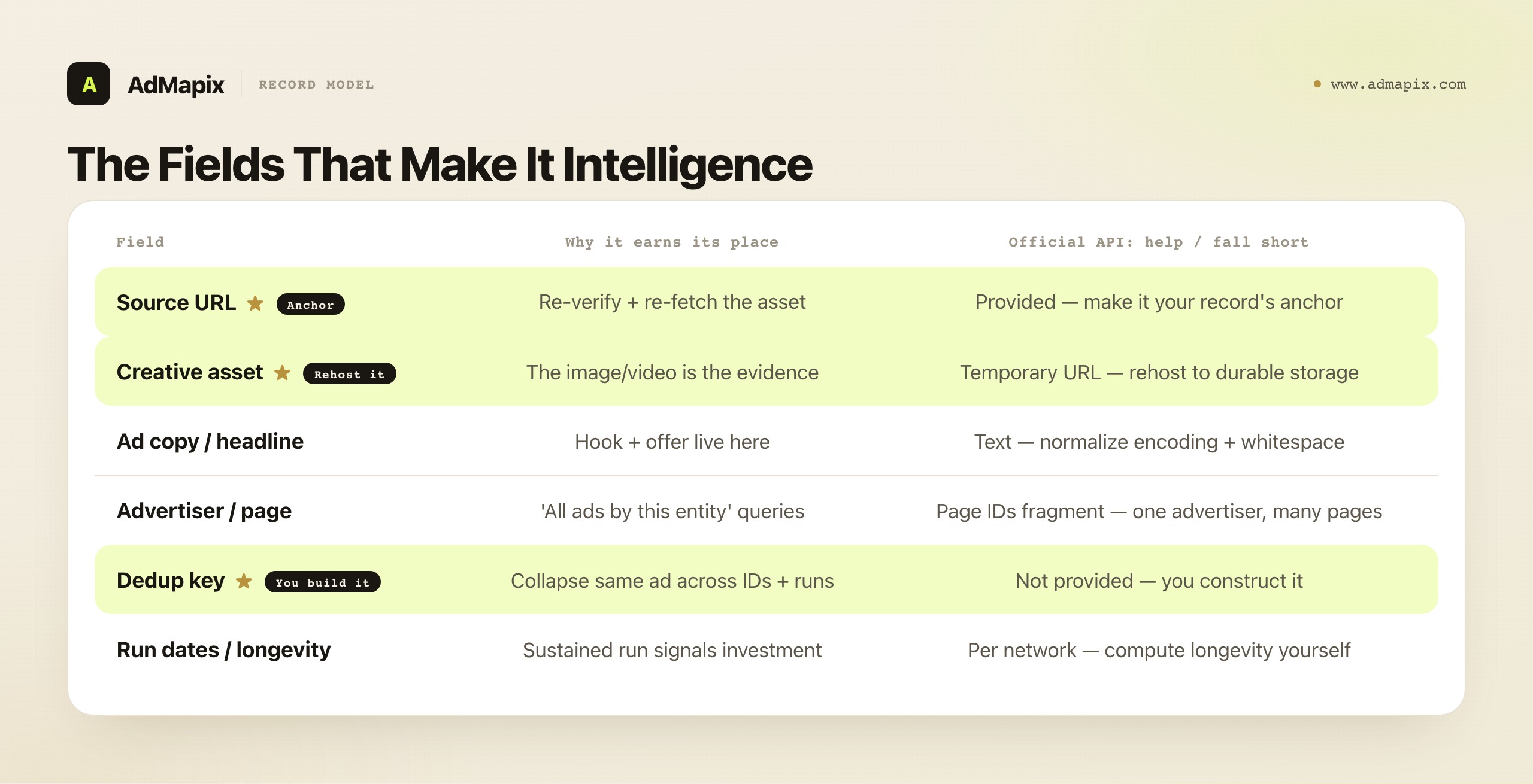
| Field | Why it earns its place | Where official APIs help / fall short |
|---|---|---|
| Source URL | Lets you re-verify the ad and re-fetch the asset | Provided, but treat it as the stable anchor of your record |
| Creative asset | The image or video is the core evidence | Provided as a temporary URL, not durable storage — rehost it |
| Ad copy / headline | The hook and offer live here | Usually provided as text; normalize encoding and whitespace |
| Advertiser / page | Enables "all ads by this entity" queries | Provided, but page IDs fragment — one advertiser, many pages |
| Placement / network | Lets you filter by where the ad ran | Per-network only; you supply the cross-network dimension |
| Run dates / longevity | Sustained run signals investment | Provided per network; compute longevity yourself |
| Format / media type | Static vs video changes how you analyze it | Sometimes provided; often must be inferred |
| Dedup key | Collapses the same ad across page IDs and runs | Not provided — you must construct it |
The table makes a pattern obvious: the official API gives you the atoms — a URL, an asset link, some text, a page ID, dates — but the intelligence is in the typed model, the derived fields, and the cross-network dimension you add on top. Source URL is the anchor: it is what lets you re-verify an ad and re-fetch its asset later, so it belongs at the center of your record, not as an afterthought. The creative asset is the core evidence, but the platform hands it to you as a temporary URL that will expire — store the URL and you will have a wall of broken images in a month, so you must download and rehost the asset into durable storage you control.
Two fields deserve special attention because they are where naive builds quietly fail. The first is the advertiser identity: a single real-world advertiser frequently runs ads under multiple page IDs, sub-brands, or regional entities, so "all ads by this advertiser" is not a simple field filter — it is an entity-resolution problem you have to solve, or your competitor view will be fragmented and incomplete. The second is the dedup key: the same creative often appears multiple times — across page IDs, across re-runs, across slightly different placements — and if you do not construct a stable key to collapse those, your counts are inflated and your "how many variants is this competitor running" signal is noise. Neither field is handed to you; both are the work.
The derived fields are where the most analytical value hides, and they are entirely your responsibility because no transparency API computes them for you. Longevity — how long a creative has been continuously live — is one of the strongest investment signals in public ad data, but the API gives you run dates, not longevity; you compute it by tracking the creative over time, which means your pipeline needs a notion of history, not just a current snapshot. Variant count — how many distinct executions of one concept an advertiser is running — depends on good dedup and good clustering of near-duplicates, and it is the signal most predictive of where a competitor is investing. Freshness — what is new since last scan — requires you to remember previous scans, which again means history. None of these is in a single API record; all of them emerge only when you store records over time and compute across them. A pipeline that only ever holds the latest snapshot can answer "what is running now" but not "what changed" or "what are they doubling down on," which are the more valuable questions. Design for history from the start, because retrofitting it later means reprocessing everything you have already collected.
This is also why the record model should be designed around your queries, not around the API's response. Start from the questions your consumers will ask — which advertisers, which concepts, which formats, what changed, how long — and design the typed fields and indexes that make those queries fast. If you instead let the API response dictate your schema, you end up with a model optimized for storing disclosures and terrible at answering questions, and every analysis becomes a slow, brittle re-parse. The model is downstream of the queries; the API is just one source you map into it.
Where Official Ads-Library APIs Stop
This is the most important section for anyone deciding what an ad intelligence API can and cannot do, because the limits are structural, not gaps a better vendor fills. Official ads-library APIs are transparency surfaces: they exist to prove that an ad ran and to show its creative. They are not performance surfaces, and no API — official or third-party — can turn them into one.
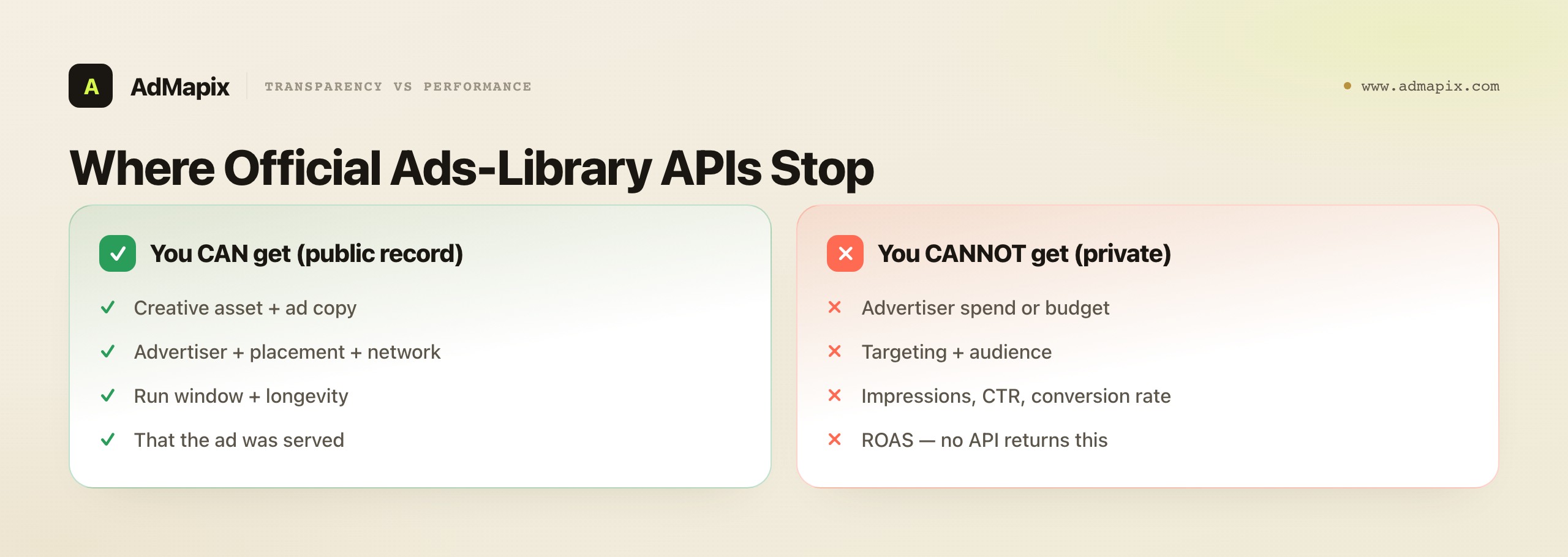
What you can get is the public record: the creative, the copy, the advertiser, the placement, the run window, and the fact that the ad was served. That is genuinely useful — it is the evidence base for competitive creative research. What you cannot get, from any API, is the private data: the advertiser's spend, their targeting, their impressions, their click-through rate, their conversion rate, or their ROAS. That information lives in the advertiser's own ad account and analytics, and it is not exposed by any transparency surface, because it was never meant to be. An API that claims to return competitor spend or performance from public data is either modeling it (and should say so, loudly, with error bars) or overselling.
This matters for system design, not just honesty. If your product or pipeline is built on the premise that the API will eventually return performance data, you are building on sand — that data is not coming, because the source does not contain it. Design instead for what the data can support: detecting that an ad is running, how long it has run, how many variants exist, what format and copy it uses, and how that compares across competitors and networks. Those are intent and investment signals, and they are real. Treat a heavily-run, long-lived, many-variant creative as strong evidence the advertiser is investing in it — but never as proof it performs, because the proof lives in a database the API cannot reach. We go deeper on this evidence-versus-proof line in our competitive analysis for paid advertising guide.
This is also the honesty test for any vendor in this space, ours included. Ask point-blank: "Does your API return competitor spend, impressions, or ROAS?" The correct answer is no, with an explanation of what it can return — the creative, copy, advertiser, placement, run window, longevity, and variant count. If a vendor answers yes, either they are modeling those numbers (and should say so prominently, with disclosed methodology and error bars) or they are misrepresenting what public data contains. A data team that takes a modeled estimate at face value and pipes it into a dashboard as fact is setting up the exact credibility failure described above. When a number cannot come from the source, treat any tool that claims to provide it with skepticism until you understand precisely how it was derived.
The practical rule for a data team: treat public ad data as a hypothesis source, and keep your own conversion and revenue data as the only source of truth for performance. The API tells you what competitors are doing; your analytics tell you what works. A pipeline that respects that boundary produces durable value; one that blurs it produces confident dashboards built on inferences the data cannot support.
It is worth understanding why the inference from "runs a lot" to "performs well" is reasonable but not certain, because that nuance is what keeps a data team honest. The inference rests on an assumption of advertiser rationality: a competent advertiser kills losing creatives and scales winning ones, so a creative that has run for weeks across many variants has probably cleared their internal performance bar. That holds often enough to make longevity and variant count genuinely useful signals. But it breaks in predictable ways — brand campaigns run on a calendar regardless of ROAS, large advertisers tolerate underperformers longer than lean teams, agencies sometimes keep creatives live to justify a retainer, and some advertisers simply optimize poorly. So the signal is probabilistic, not deterministic. The correct way to encode this in a pipeline is to surface the signal with its uncertainty — "this creative has high investment indicators" — rather than laundering it into a false-precision "performance score" that implies a measurement the data cannot provide.
The most reliable public signal, and the one worth building features around, is convergence: when several independent advertisers in a category all shift to the same format or angle in a short window, that pattern is much harder to fake than any single advertiser's choices, and it is a strong, defensible signal that the category is moving. A pipeline that detects cross-advertiser convergence gives a data team something genuinely actionable — an early warning of a format shift — without pretending to see anyone's private numbers. Build for convergence detection and longevity tracking; resist the temptation to ship a fabricated performance score, because the first time a customer checks it against reality, your credibility goes with it.
Buy vs Build: It's a Maintenance Question
The buy-vs-build decision for an ad intelligence layer is almost always framed the wrong way around. Teams compare the upfront cost of a subscription against the upfront cost of writing a connector, decide the connector is "free," and build. The real comparison is not upfront cost — it is ongoing maintenance, and that is where self-built ad-intelligence layers quietly become expensive.
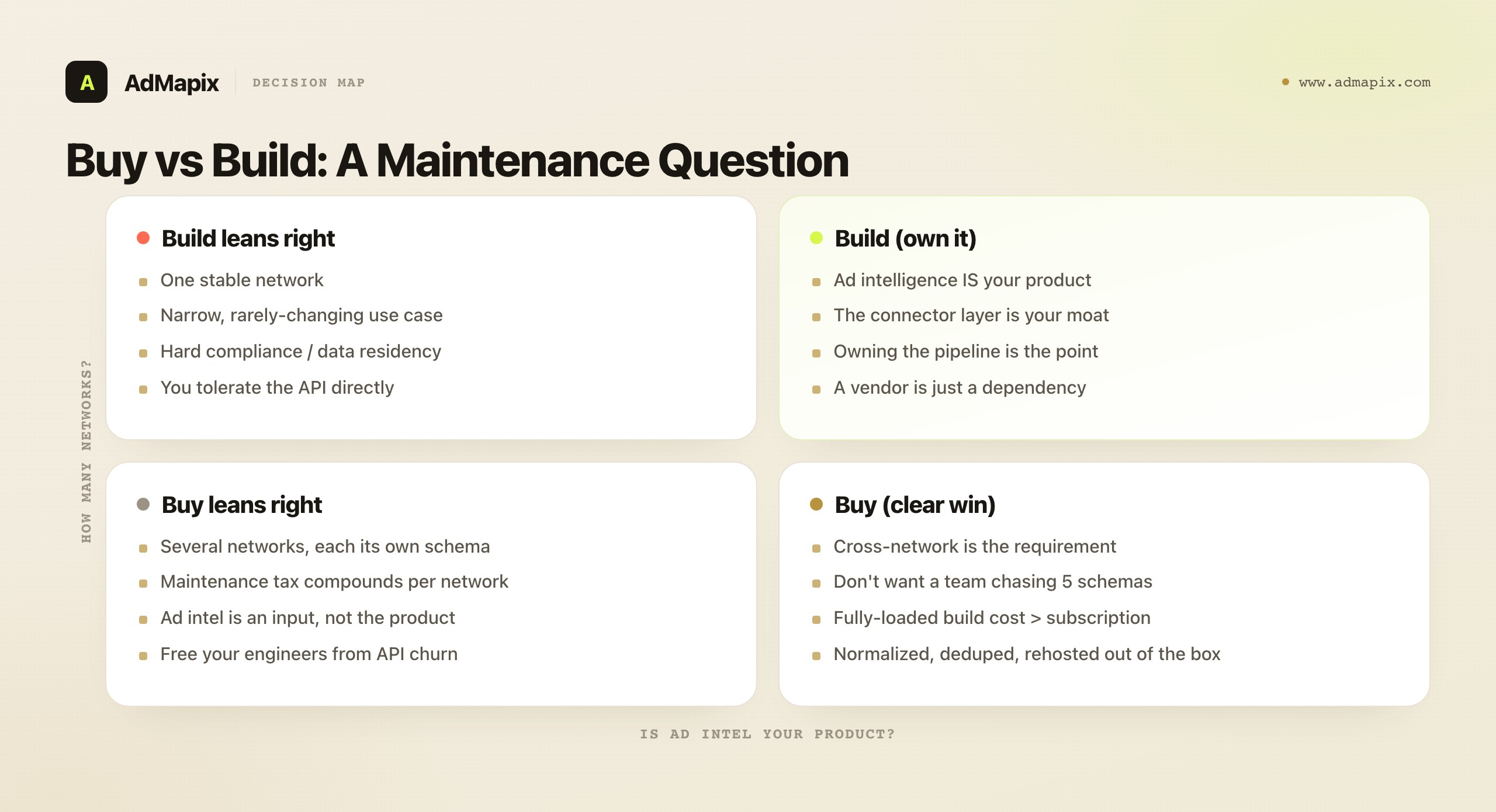
Here is the maintenance reality. A self-built cross-network layer is, at minimum, one connector per platform. Each connector depends on that platform's API schema, auth flow, rate limits, asset-URL behavior, and access policy — every one of which the platform can change on their schedule, with little notice, and without caring about your roadmap. When Meta changes a field, your Meta connector breaks. When Google rotates how asset URLs are signed, your rehosting breaks. When a platform tightens rate limits, your scanning cadence breaks. Multiply that by every network you cover, and the "free" connector becomes a standing maintenance tax that competes with your actual product work, forever.
That does not mean you should always buy. Build genuinely wins in specific cases: when you need only one network and can tolerate its API directly; when your use case is narrow and stable enough that the connector rarely changes; when you have hard data-residency or compliance requirements that force everything in-house; or when ad intelligence is your product and the connector layer is your core competence worth owning. In those cases, owning the pipeline is the right call, and a vendor would just be a dependency between you and the data you need to control.
Buy tends to win when ad intelligence is an input to your product rather than the product itself — when you want cross-network creative search, normalized fields, rehosted assets, dedup, and report output, but you do not want a team permanently assigned to chasing five platforms' schema changes. The honest way to make the call is to estimate the fully loaded cost of build: not just the initial connectors, but the engineer-weeks per year spent keeping them alive across schema changes, rate-limit shifts, asset-URL rotation, and new-network additions. Compare that against the subscription, and the math is usually clearer than the "the API is free" framing suggests. We map the broader tool landscape in our best ad intelligence tools guide if you are evaluating the buy side.
To make the maintenance tax concrete, walk through what "keeping a connector alive" actually entails across a year. A platform deprecates an API version: you migrate. A field is renamed or restructured: you update the adapter and backfill. Asset-URL signing changes: your rehosting breaks until you fix it, and any assets you missed during the outage are gone. Rate limits tighten: your scanning cadence drops and your freshness suffers until you re-tune. A new ad format appears that your parser does not recognize: you extend the model. Access terms change: your compliance posture has to be re-reviewed. None of these is catastrophic alone, but they arrive on the platforms' schedule, unpredictably, across every network you cover, and each one preempts whatever your engineers were supposed to be building. The cost is not the hours per incident; it is the context-switching and the standing on-call burden of a system that can break for reasons entirely outside your control. That is the real line item the "the API is free" framing omits.
There is also a hidden risk in the build path that rarely shows up in the spreadsheet: key-person risk. The engineer who built the connectors holds a lot of undocumented knowledge about each platform's quirks — the undocumented field that means something specific, the retry logic that works around a flaky endpoint, the dedup heuristic tuned over months. When that person leaves, the connectors become a fragile black box the rest of the team is afraid to touch, and the maintenance tax spikes precisely when you can least afford it. A bought layer externalizes that risk to a vendor whose entire business is keeping it working. None of this makes build wrong — it makes build a real, ongoing organizational commitment that should be entered into with eyes open, not a one-time cost that disappears after the initial sprint.
Designing a Pipeline That Survives Change
Whether you buy, build, or do both, the pipeline that survives is the one designed around a single principle: the platforms will change, so isolate the change. Every durable ad-intelligence system has the same shape — a thin, replaceable ingestion layer per source, feeding a stable, normalized core that the rest of your system depends on.
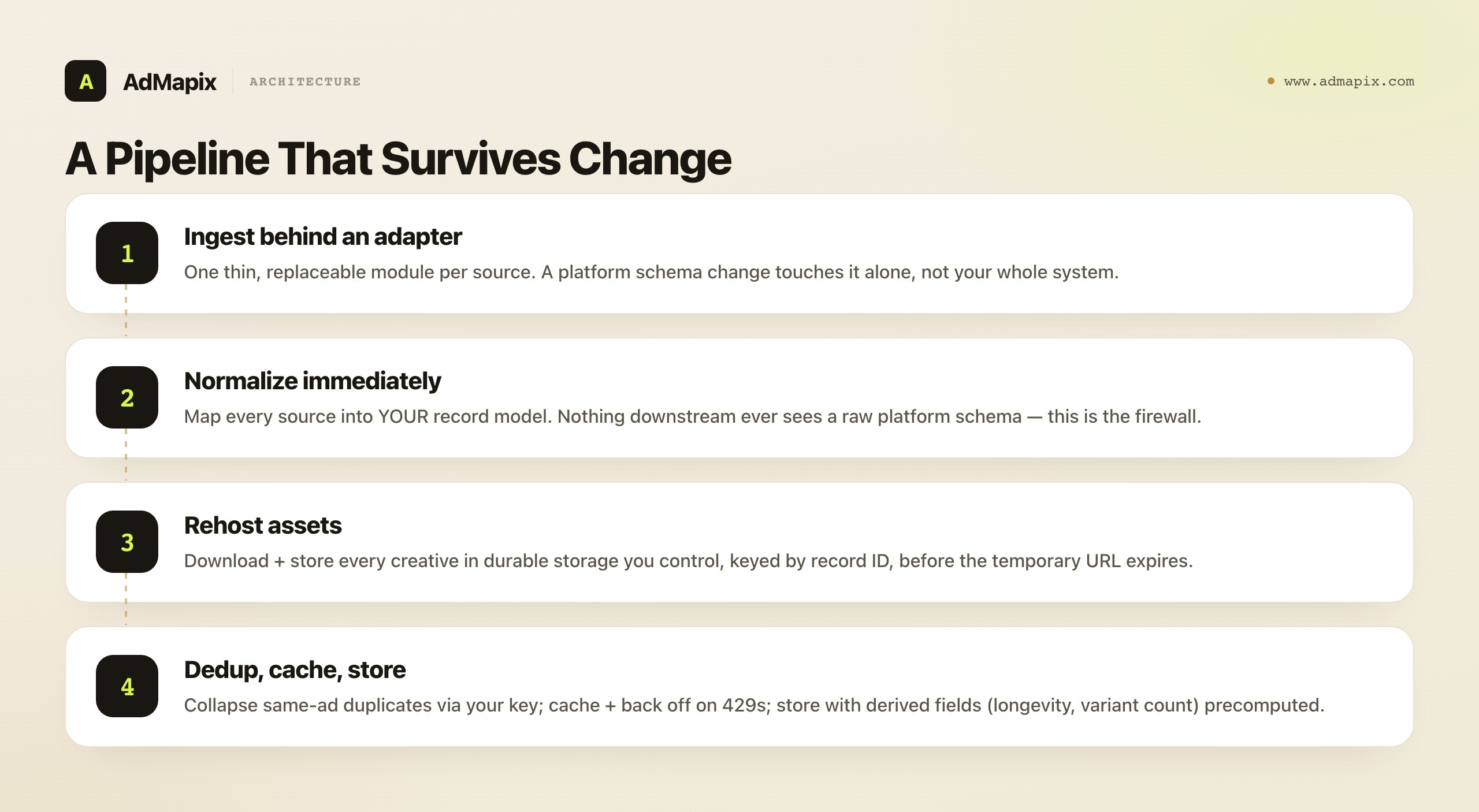
The architecture is a sequence of deliberate steps. Ingest per source behind an adapter, so a platform schema change touches one small module, not your whole system. Normalize every source's fields into your own record model immediately, so nothing downstream ever sees a raw platform schema — this is the firewall that keeps a Meta field rename from rippling through your database and reports. Rehost every creative asset into durable storage you control, keyed by your record ID, before the platform's temporary URL expires; store both the original source URL (for re-verification) and your rehosted URL (for serving). Dedup using your constructed key so the same creative across page IDs and re-runs collapses to one record with a run history, not many phantom records. Cache aggressively against rate limits — cache responses, back off on 429s, and never re-fetch what has not changed — because rate limits are the constraint that decides how broad your scanning can actually be. Store in a queryable shape with your derived fields (longevity, variant count, normalized advertiser) precomputed, so analysis is a query, not a re-parse.
The single most valuable design decision is the normalization firewall. If everything downstream depends on your model and only the thin adapter layer touches the platform's schema, then a platform change is a small, contained repair. If, instead, raw platform fields leak into your database, your reports, and your downstream code, then every platform change is a cross-cutting migration. The cost difference between those two architectures, measured over a year of platform churn, is enormous — and it is invisible at proof-of-concept time, which is exactly why so many builds get it wrong. Spend the design effort on the firewall; it is the cheapest insurance you will buy.
A practical way to enforce the firewall is to make the adapter layer the only code in your system that is allowed to know a platform's field names. Everything past the adapter speaks your model and nothing else. If you can grep your codebase for a platform-specific field name and find it only in one adapter file, your firewall is intact; if you find it scattered through your storage, analysis, and reporting code, the firewall has already leaked and the next platform change will hurt. Treat any reference to a raw platform field outside the adapter as a bug to fix immediately, not a convenience to tolerate, because each one is a future migration waiting to happen. This discipline is cheap to maintain from day one and expensive to retrofit, which is the usual shape of architectural decisions that matter.
Rate-limit handling deserves its own emphasis because it silently caps your ambitions. Official APIs are tuned for lookups, not for continuous broad scanning, so the breadth and freshness of your intelligence is bounded by how well you cache and how gracefully you back off. A naive scanner that hammers the endpoint gets throttled into uselessness; a disciplined one that caches, dedups before fetching, and respects backoff covers far more ground with the same quota. If broad, fresh, cross-network coverage is the goal, rate-limit discipline is not a detail — it is the design constraint everything else bends around. Our guide to ad spy tools by channel covers how coverage differs across networks, which is the dimension the official single-network APIs cannot give you.
A concrete pattern that pays off: separate discovery from detail fetching and cache each independently. Discovery — finding which ads exist for an advertiser or query — and detail fetching — pulling the full record and asset for a specific ad — have different change rates. An ad's existence and core metadata rarely change once observed, so once you have fetched an ad's detail, you should almost never fetch it again; you only re-run discovery to find new ads. Teams that conflate the two re-fetch everything on every scan, burn their quota on data that has not changed, and get throttled. Teams that cache detail aggressively and spend their quota only on discovery and genuinely new ads cover far more advertisers with the same limits. This single architectural distinction — discover cheaply and often, fetch detail once and cache forever — is often the difference between a pipeline that can watch a hundred competitors and one that chokes on ten.
The other discipline worth building in from day one is graceful degradation. Platforms have outages, rotate credentials, and change behavior without warning, so your pipeline will at some point get partial data, stale data, or no data from a given source. A well-designed system treats a source going dark as a known state, not a crash — it serves the last good data with a freshness timestamp, alerts you, and recovers automatically when the source returns, rather than failing the whole run because one network is down. This matters because a multi-source pipeline that is only as reliable as its least reliable source is effectively never fully up. Designing each source to fail independently and degrade gracefully is what makes a cross-network system trustworthy enough to build product on, and it is exactly the kind of unglamorous resilience work that the afternoon proof-of-concept never reveals.
How AdMapix Fits the Buy Side
We will be precise about where AdMapix fits, because the whole point of this guide is to help you make the buy-vs-build call honestly rather than oversell a product. AdMapix sits on the buy side of that decision: it is the cross-network creative layer you would otherwise build and maintain yourself — search across networks, normalized creative records, rehosted assets, deduplication, video analysis, tagging, and report output — delivered as a product so you do not have to assign a team to chasing each platform's schema changes.
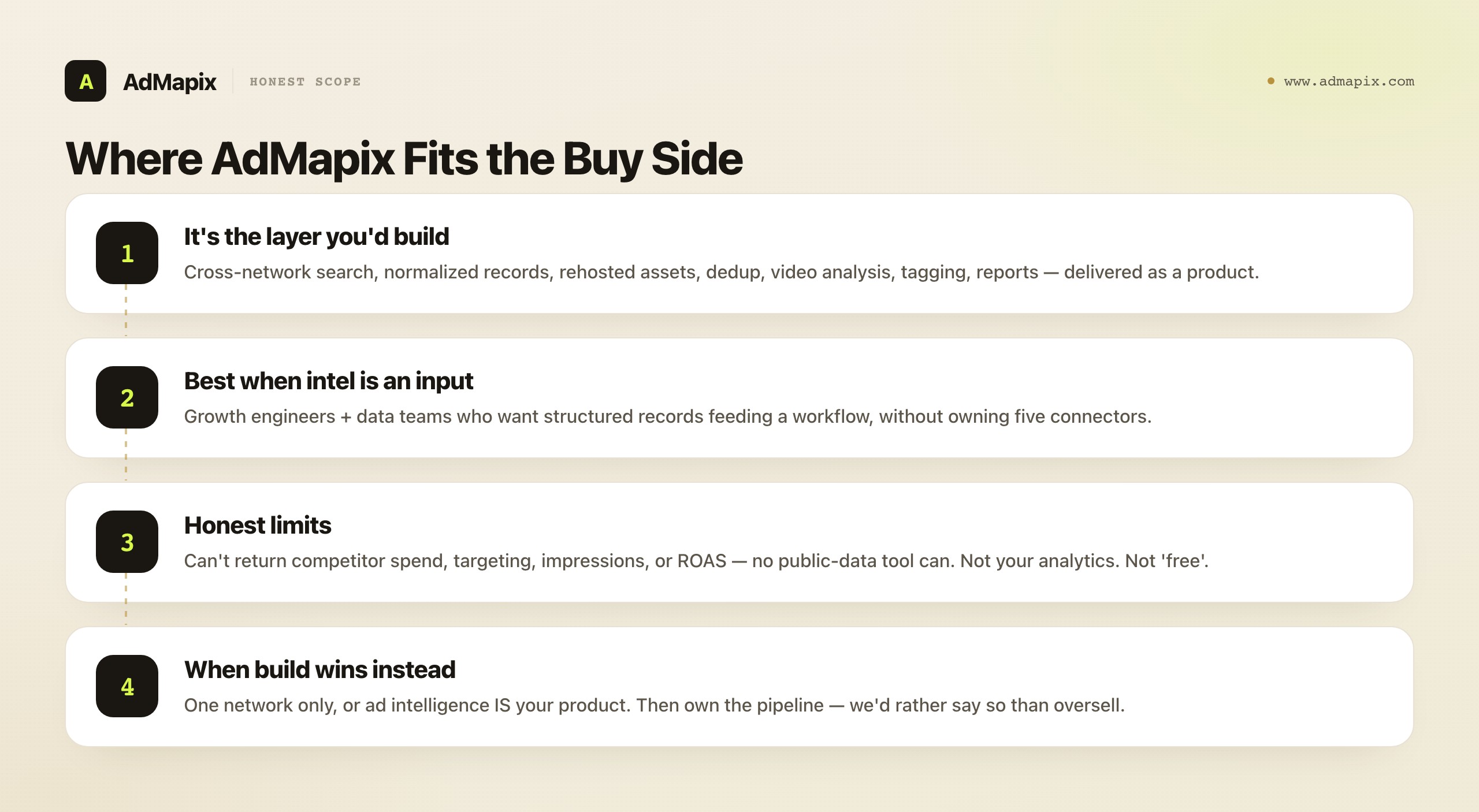
It is the right fit when ad intelligence is an input to your work rather than your core product: growth engineers and data teams who want cross-network creative search and structured records feeding a workflow, without owning five connectors. Where a raw single-network endpoint hands you one platform's blob behind its own rate limits, the buy-side layer hands you the normalized, deduplicated, cross-network records and the durable assets — the part that is actually the work. Use Search AdMapix for cross-network discovery, Media to keep the assets that matter, Video Analysis to break down hooks and structure where static-only records fall short, and Reports to package findings.
The video dimension deserves a specific note because it is where a records-only API, official or self-built, most often falls short. A transparency endpoint can tell you a video ad ran and hand you the file, but it does not break the video down into the structural detail that matters for paid social — the first-screen hook, the pacing, the offer framing, the moment the message lands. For static ads, a record plus the asset is most of what you need; for video, the asset is just the starting point, and the analysis is a separate, non-trivial capability. A team that needs video-level intelligence either builds that analysis layer on top of the raw asset (a substantial undertaking) or buys a layer that includes it. This is one of the clearer cases where the buy side adds something genuinely hard to replicate, because video breakdown is its own engineering problem distinct from the connector and normalization work.
We are honest about the limits, because they are the same structural limits that bind every tool in this space. AdMapix cannot return competitor spend, targeting, impressions, or ROAS — no public-data tool can, because that information is private. It is not a substitute for your own analytics, which remain the source of truth for performance. And we are not going to call it "free" — it is a paid product, and the entire buy-vs-build framing above is the honest case for when paying for it beats building, and when building beats paying. If you genuinely need one network only, or ad intelligence is your product, building may be right, and we would rather say so than pretend the buy side always wins.
Where the buy side clearly wins is the maintenance math: when the fully loaded cost of keeping a multi-network connector layer alive — across schema changes, rate-limit shifts, asset rotation, and new networks — exceeds the subscription, buying frees your engineers to work on your actual product instead of someone else's API churn. If you want to compare that tradeoff concretely, the advertising intelligence guide frames the broader workflow, and you can compare seats on Pricing or start from Login.
Authentication, Access, and Onboarding Realities
Before you architect anything, it is worth understanding the access friction that official ads-library APIs impose, because it shapes timelines and sometimes kills builds outright. The endpoint is not a public URL you simply call; it is a gated resource with onboarding, identity, and policy hurdles that vary by platform and change over time.
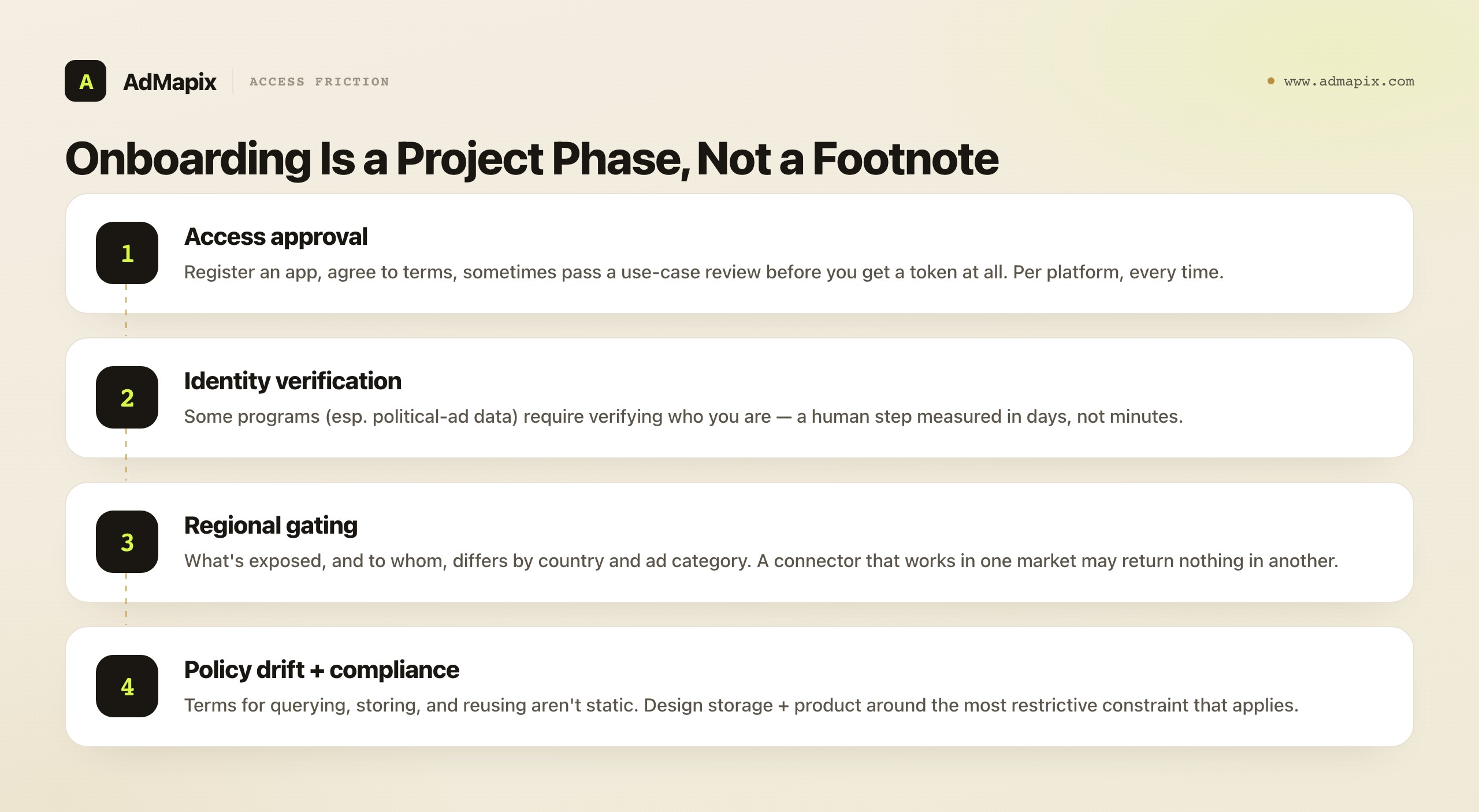
The friction comes in several forms. There is access approval: most ads-library APIs require you to register an app, agree to terms, and sometimes pass a use-case review before you get a token at all. There is identity verification: some transparency programs require verifying who you are, especially for political-ad data, which adds a human step measured in days, not minutes. There is regional gating: what is exposed, and to whom, differs by country and by ad category, so a connector that works in one market may return nothing in another. And there is policy drift: the terms under which you are allowed to query, store, and reuse the data are not static, and a use that was fine last year may be restricted this year.
The practical consequence is that onboarding is part of your project plan, not a footnote. A build that assumes "the API is just an endpoint" can stall for weeks at the access stage, before a single line of pipeline code matters. And because access is per-platform, every network you add reopens the onboarding cost — another registration, another review, another set of terms to track. This is a real and recurring component of the maintenance tax that the buy-vs-build math has to include. A bought layer absorbs this onboarding and policy-tracking burden on your behalf; a self-built one means your team owns it, per platform, indefinitely. Neither answer is automatically right, but pretending the access friction does not exist is how build timelines slip. The teams that estimate accurately are the ones that put onboarding on the project timeline as a real phase with real duration, separate from the engineering work, and that revisit it every time they add a network rather than assuming the first approval generalizes.
There is also a compliance dimension worth flagging for data teams. Because these are transparency surfaces with their own terms, how you store and reuse the data matters — caching durations, what you may redistribute, and what you may show to your own users can all be constrained. Read the terms for each platform you ingest, keep a record of what each one permits, and design your storage and product around the most restrictive constraint that applies. A pipeline that ignores this is not just brittle; it can be non-compliant, which is a worse failure mode than a broken connector. We touch on the broader governance of competitor data in our ad tracking and competitive research guide.
Common Mistakes Wiring an Ads-Library API
The failure modes here are predictable, which makes them avoidable. These are the mistakes we see teams make most often when they move from a proof-of-concept to a real ad-intelligence pipeline.
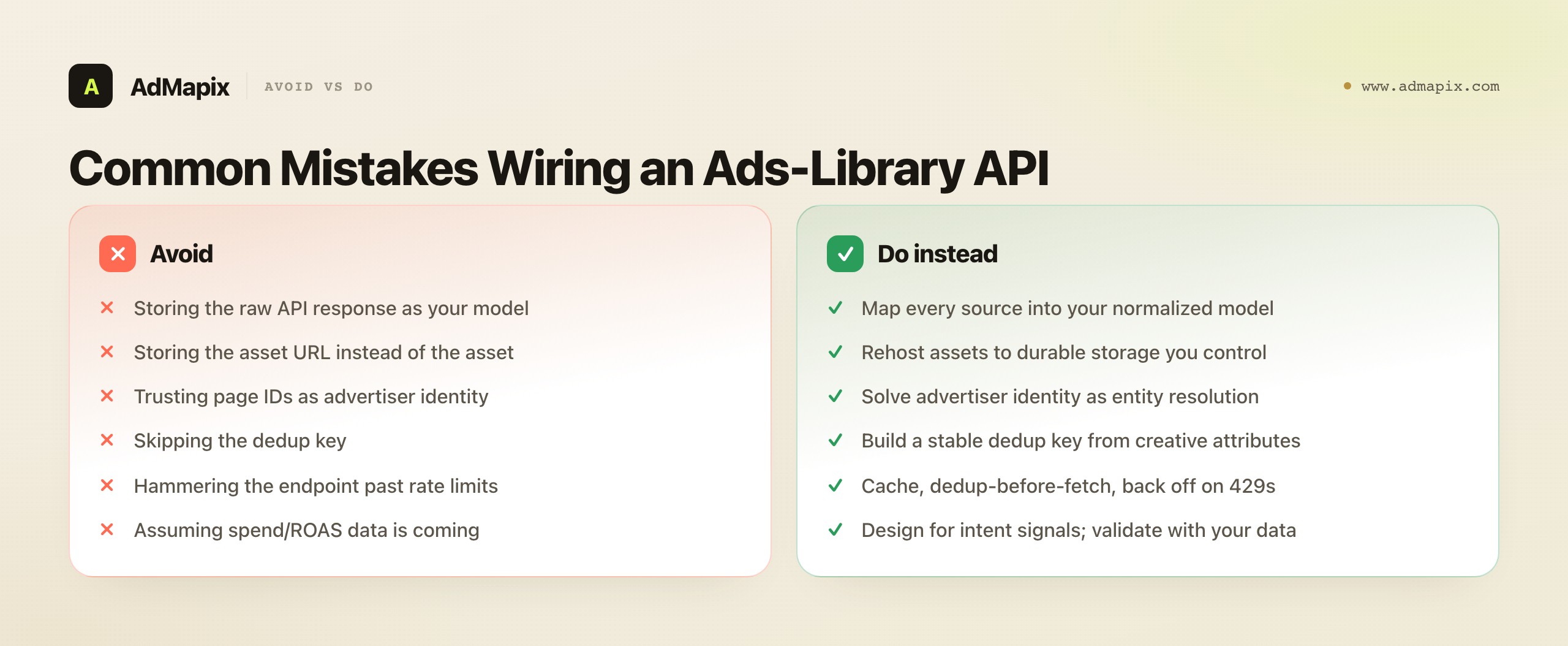
Storing the raw API response as your model. The root mistake. You inherit the platform's schema and lose it the day they change it, turning every platform tweak into a cross-cutting migration. Define your own normalized model and map every source into it through a thin adapter.
Storing the asset URL instead of the asset. Official APIs hand you a temporary asset URL that expires. Store the URL and you get a wall of broken images within weeks. Download and rehost every creative into durable storage you control, before the URL rotates.
Trusting page IDs as advertiser identity. One real advertiser runs ads under many page IDs, sub-brands, and regional entities. If you treat the page ID as the advertiser, your competitor view fragments. Solve advertiser identity as an entity-resolution problem, not a field filter.
Skipping the dedup key. The same creative appears across page IDs and re-runs. Without a constructed dedup key, your variant counts inflate and your investment signal becomes noise. Build a stable key from creative attributes so each ad maps to one record with a run history.
Hammering the endpoint. Official APIs are tuned for lookups, not broad scanning. A naive scanner that ignores rate limits gets throttled into uselessness. Cache responses, dedup before fetching, and back off on 429s — rate-limit discipline decides how broad your coverage can be.
Assuming performance data is coming. Building a product on the premise that the API will eventually return spend or ROAS is building on sand; that data is private and never appears. Design for intent signals — running, longevity, variant count, format — and validate performance with your own analytics.
Underestimating onboarding. Treating access approval, identity verification, and per-platform terms as a footnote rather than a project phase. Each network reopens the onboarding cost; plan for it, or watch the timeline slip before any code runs.
A Practical Decision Path
If you are about to wire an ads-library endpoint into a pipeline, run this order of operations before you write the first connector.
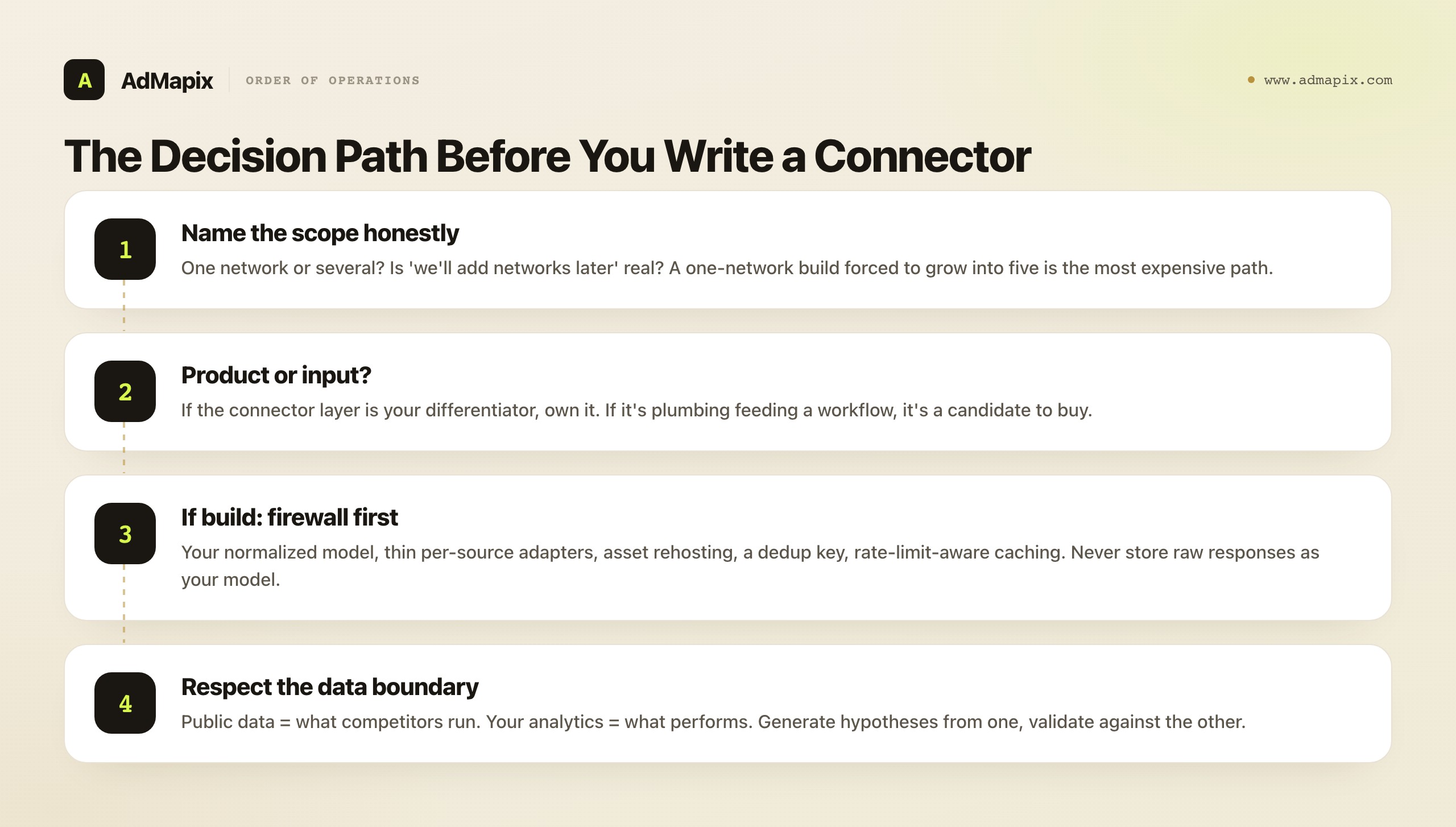
Start by naming the scope honestly. How many networks do you actually need — one, or several? One stable network with a tolerable API is a reasonable build; several networks, each with its own schema and rate limits, is where the maintenance tax compounds and buy starts winning. Be honest about whether "we'll add networks later" is real, because it usually is, and a one-network build that has to grow into a five-network build is the most expensive path of all.
Then decide whether ad intelligence is your product or an input. If the connector layer is your core competence and differentiator, own it. If it is plumbing feeding a workflow, the plumbing is a candidate to buy, so your team works on the differentiated part instead.
Next, if you build, design the firewall first: your own normalized record model, a thin per-source adapter, asset rehosting, a dedup key, and rate-limit-aware caching. Do not store raw platform responses as your model; that is the decision you will most regret. If you buy, evaluate the vendor on exactly the things that are hard to build — cross-network coverage, normalization quality, asset durability, dedup, and freshness under rate limits — not on raw record counts. A vendor with ten million records but weak dedup and stale freshness is worse than one with fewer, cleaner, fresher records, because record count is the easy number to inflate and the hard things are what you are actually paying to avoid building. Demand a trial against your real competitor set in your real markets, and judge it on whether the records are clean, deduplicated, current, and complete across the networks you care about — the same criteria your own build would have to meet.
Finally, in either case, respect the data boundary: the API and the layer on top of it tell you what competitors are running; your own analytics tell you what performs. Build the pipeline to generate hypotheses from public data and validate them against your owned conversion and revenue data. A system that honors that boundary produces durable value; one that pretends public data contains performance produces confident, wrong dashboards. Do that, and "ad intelligence API" stops being a single endpoint you scrape and becomes a designed system that survives the platforms changing underneath it.
The deeper lesson for any team approaching this is that "ad intelligence API" names a system, not an endpoint. The endpoint is the cheapest, most visible, least durable part of that system; the value lives in the unglamorous layers around it — normalization, history, dedup, entity resolution, rehosting, caching, graceful degradation, and the discipline to keep public-intent data separate from owned-performance data. Whether you build those layers or buy them, the decision should be made with the full system in view, not the afternoon demo. Teams that scope the system honestly either build something durable or buy with clear eyes; teams that scope only the endpoint build something brittle and are surprised when it breaks. The endpoint is where you start reading; the system is what you are actually deciding to own or rent.
FAQ
What is an ad intelligence API?
It is an interface that returns ad creatives as structured, queryable records — creative asset, ad copy, advertiser, placement, run dates, and a stable source URL — rather than an HTML page you scrape. The official ads-library APIs (Meta, Google) expose one network's public transparency data; a full ad intelligence layer adds cross-network search, normalized fields, deduplication, asset rehosting, and report output on top. The endpoint is the raw material; the intelligence is the system wrapped around it.
Can an ad intelligence API return competitor spend or ROAS?
No. Official ads-library APIs are transparency surfaces: they prove an ad ran and show its creative, copy, advertiser, placement, and run dates. They do not — and no API can — return the advertiser's spend, targeting, impressions, click-through rate, conversion rate, or ROAS, because that data is private and lives in the advertiser's own account. Any tool claiming to return competitor performance from public data is either modeling it (and should disclose that) or overselling what the data can support.
Should I build my own ad intelligence layer or buy one?
It is a maintenance question, not an upfront-cost question. Build when you need only one stable network, when ad intelligence is your core product, or when compliance forces everything in-house. Buy when ad intelligence is an input to your product and you do not want a team permanently maintaining one connector per platform across schema changes, rate-limit shifts, and asset rotation. Estimate the fully loaded annual cost of keeping connectors alive, not just the initial build, and compare that against the subscription.
Why does storing the raw API response cause problems?
Because you inherit the platform's schema and lose it the day they change it. If raw platform fields leak into your database, reports, and downstream code, every platform change becomes a cross-cutting migration. The fix is a normalization firewall: define your own record model, map every source into it through a thin adapter, and ensure nothing downstream ever sees a raw platform schema. Then a platform field rename touches one small module instead of your whole system.
How do I handle asset URLs that expire?
Rehost them. Official APIs hand you the creative asset as a temporary URL that will expire, so storing the URL leaves you with broken images within weeks. Download the asset and store it in durable storage you control, keyed by your record ID, and keep both the original source URL (for re-verifying the ad later) and your rehosted URL (for serving). Rehosting before expiry is one of the steps naive builds skip and then regret.
What is deduplication and why does it matter?
The same creative often appears multiple times — under different page IDs, across re-runs, in slightly different placements. If you do not collapse these into one record, your counts inflate and your "how many variants is this competitor running" signal becomes noise. Official APIs do not give you a dedup key; you construct one from stable creative attributes so the same ad maps to a single record with a run history. Good dedup is the difference between a real variant count and a misleading one.
Why are rate limits a design constraint and not just a detail?
Because official APIs are tuned for occasional lookups, not continuous broad scanning, so the breadth and freshness of your intelligence is bounded by how well you handle limits. A naive scanner gets throttled into uselessness; a disciplined one caches responses, dedups before fetching, and backs off on 429s to cover far more ground with the same quota. If broad, fresh, cross-network coverage is the goal, rate-limit discipline is the constraint the rest of the design bends around.
Do official ads-library APIs cover every network?
No. Each official API is authoritative only for its own platform — Meta's for Meta, Google's for Google — and many networks have limited or no public API at all. The cross-network dimension, joining and normalizing ads across platforms into one searchable model, is exactly what no single official API provides, and it is one of the main reasons teams either build a multi-connector layer or buy one. Coverage varies a lot by network, so verify it against the networks you actually care about.
Is public ad data reliable enough to act on?
Yes, for what it actually measures: that an ad is running, how long it has run, how many variants exist, and what creative and copy it uses. Those are real intent and investment signals. It is not reliable as performance data, because it contains none. The reliable practice is to use public ad data to form hypotheses — what competitors are investing in — and validate them against your own conversion and revenue data, which is the only source of truth for what actually works.
How does an ad intelligence API differ from an ad spy tool?
An ad intelligence API is the programmatic interface — structured records you query and pipe into a system. An ad spy tool is usually the application layer on top: a UI for searching, saving, and analyzing ads. They are the same underlying data viewed two ways: developers and data teams want the API to feed a pipeline; strategists and buyers want the tool to do research in a browser. Many products offer both. Choose by whether your consumer is a system or a person.
Key Takeaways
- An ad intelligence API should return normalized, queryable creative records across networks — not a single-network raw blob that you have to re-parse on every schema change.
- The hard, valuable parts are normalization, dedup, asset rehosting, rate-limit-aware caching, and cross-network coverage — exactly what a single official API does not give you.
- Official ads-library APIs prove an ad ran; they cannot return spend, targeting, impressions, or ROAS. No API can — that data is private.
- Buy vs build is a maintenance question: estimate the fully loaded annual cost of keeping connectors alive, not just the initial build.
- If you build, design the normalization firewall first so platform changes stay contained to a thin, replaceable adapter layer rather than rippling across your whole system.
- Respect the data boundary: public data tells you what competitors are running and investing in; your own analytics remain the only source of truth for what actually performs.
Sources
Official pages checked as of June 21, 2026. APIs, schemas, rate limits, and access policies change, so verify the current terms before you build against them.
- Meta Ad Library API — Meta's official interface for querying archived ads from its platforms, with its own access policy and rate limits.
- Google Ads Transparency Center — Google's surface for ads served through its platforms, authoritative for Google and nothing else.
- Meta Ad Library — the public transparency surface the API exposes; useful for understanding what fields exist before you build.
- TikTok Creative Center — a separate per-network transparency surface, illustrating how coverage and schema differ across platforms.
Disclosure: AdMapix is our own product. We include it on the buy side of the buy-vs-build decision — the cross-network creative layer you would otherwise have to build and maintain yourself — and we are explicit about when building is the better call. We do not describe it as free, and we do not claim it (or any API) can return competitor spend, targeting, or performance, because that data is private and no public-data tool can reach it.
See what competitors are really running
Search 6M+ ad creatives, landing pages, and weekly spend across 200+ countries. No credit card, no commitment.
Related Articles
Ad Creative Intelligence Workflow for Mobile UA Teams in 2026: Find, Analyze, Brief & Build
A complete 2026 ad creative intelligence workflow for mobile UA teams — the four-stage loop to find winning competitor creatives, analyze why they work, brief production from them, and build a sustainable competitive-intelligence system, with the data inputs, a fixed taxonomy, tiered competitor monitoring, an observation-to-hypothesis method, a structured brief format, a weekly operating cadence, team-size tool choices, and the learning log that makes each cycle compound.
Meta Ads API Alternative in 2026: Ad Library API, Marketing API, or a Creative Layer?
A 2026 guide to choosing a Meta ads API alternative — what the Ad Library API, Marketing API, and Graph Ads Archive each actually expose and where they stop, how a creative-intelligence layer fills the saved-media, video-breakdown, and reporting gap, exactly what public Meta data can and cannot prove (creative yes; spend, targeting, and ROAS no), and a decision framework matched to the job you are doing.
AI Creative Brief Template in 2026: Turn Competitor Evidence Into Testable Ads
A complete 2026 guide to the AI creative brief template — the nine fill-in fields that feed a model evidence instead of vibes, why the hook pattern is the highest-leverage input, how to gather example ads responsibly, the do-not-say list that keeps output honest, a prompt structure that uses the brief, how to rank output into a test backlog, a fully filled worked example, the limits of AI and public data, and where AdMapix fits.