
Best SpyFu Alternatives for PPC Keyword Research (2026)
Seven SpyFu alternatives compared by job, not by hype. Semrush, Similarweb, Ahrefs, SE Ranking, Ubersuggest, and Google's free Ads Transparency Center for PPC keyword and ad-copy research, plus AdMapix for the social and video creative research SpyFu does not cover. Prices checked on vendor pages in September 2026.
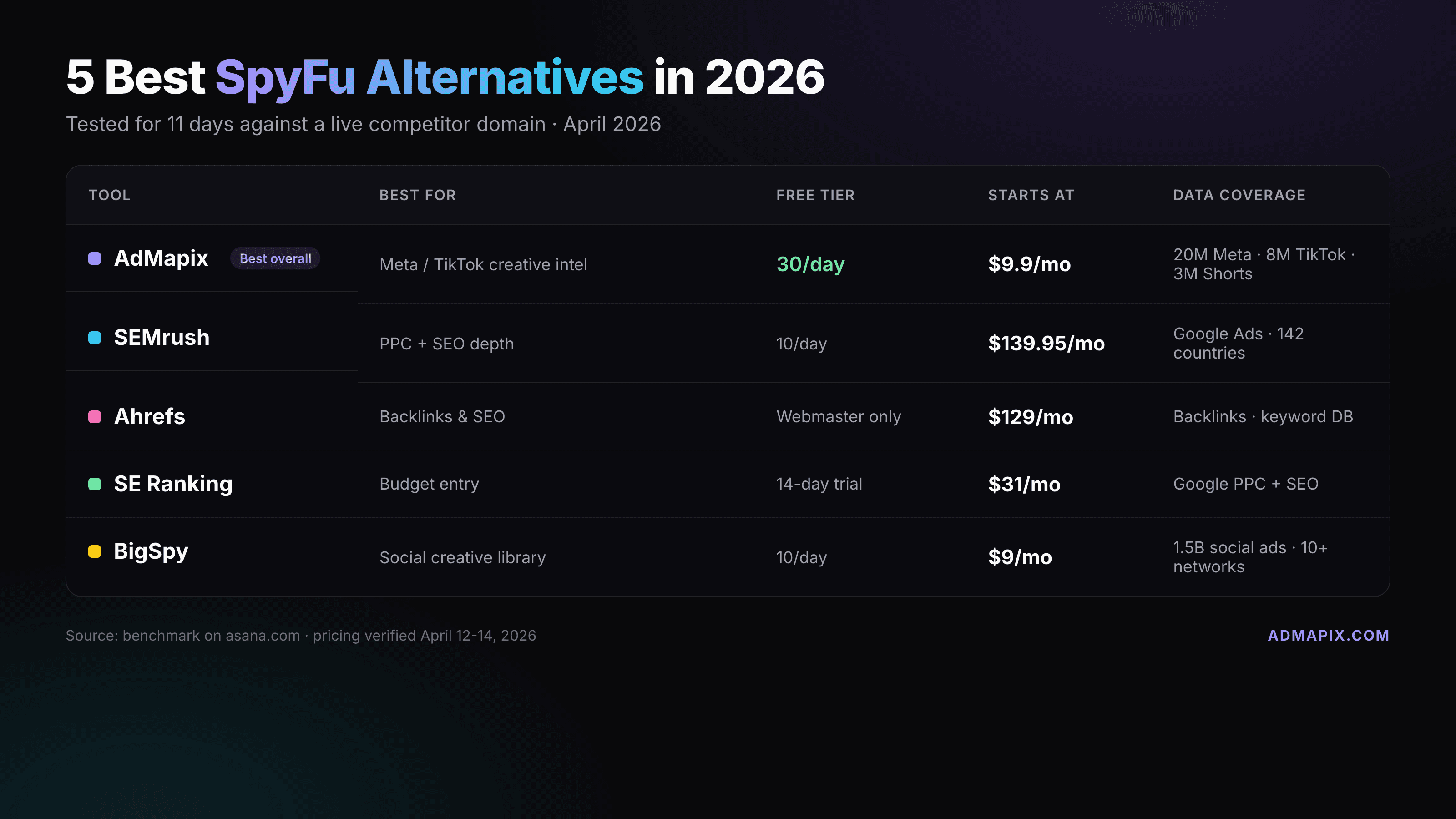
If you use SpyFu for Google Ads competitor keywords and want the closest like-for-like replacement, look at Semrush's Advertising Toolkit first, then Ahrefs or SE Ranking if you also need SEO in the same subscription. If you want a cheaper keyword tool, Ahrefs Starter or Ubersuggest will cover the basics, and Google's free Ads Transparency Center is worth adding alongside any of them to verify the actual ad creatives, even though it has no keyword data. If you need traffic-level competitor benchmarking rather than keywords, Similarweb is the tool. And if your real gap is social and video ad creative, which SpyFu has never indexed, a creative research tool such as AdMapix is a complement to a keyword tool, not a replacement for one.
This guide is organised by job: PPC keyword research, competitor ad-copy history, SEO overlap, budget tier, and creative research. Every entry price below was checked on the vendor's own pricing page in September 2026. Prices change often, so treat them as a starting point and confirm before you buy.
Why people look for a SpyFu alternative
SpyFu is a good tool at what it does. It focuses on Google search: paid keywords a domain bids on, the ad copy it has run over time, organic rankings, and keyword research with CPC and difficulty data. Its homepage currently advertises 38 countries and 18+ years of historical data. The reasons people go looking elsewhere are mostly about scope rather than quality.
- Coverage outside the US and UK is thinner. SpyFu's deepest data is in its core English-language markets. Teams advertising in continental Europe, Latin America, or Asia often find fewer keywords and shorter ad histories for their competitors than a Semrush or Ahrefs database returns.
- It is a search tool, full stop. SpyFu does not collect Meta, TikTok, YouTube, or display creatives. If your competitors moved budget to social video, SpyFu cannot show you what they are running there. Our guide to checking a competitor's Google Ads explains what search-only data can and cannot tell you.
- Some teams want one platform for SEO and PPC. SpyFu has SEO features, but teams that already pay for Semrush or Ahrefs often prefer to consolidate rather than keep a second tool for paid keywords.
- Some teams want a cheaper or free option. SpyFu's Basic plan is not expensive, but there are free and lower-cost tools that cover a subset of the same questions.
None of these are reasons to avoid SpyFu if it already fits your work. They are the questions to ask before you switch.
SpyFu alternatives at a glance
Prices checked September 2026 on each vendor's official pricing page. "Entry price" is the cheapest paid plan that includes competitor keyword or ad research. Annual figures are per month billed yearly.
| Tool | Best for | PPC ad-copy history | Keyword coverage | Entry price (checked Sept 2026) |
|---|---|---|---|---|
| Semrush | Closest like-for-like PPC replacement, plus SEO | Yes (Ad Copies, bidding data back to 2012) | Very broad, global | Advertising Toolkit Base $99/mo billed annually; SEO Toolkit $139/mo monthly |
| Ahrefs | SEO-first teams that also need paid keyword data | Yes (paid keywords, ads, paid pages in Site Explorer) | Very broad, global | Starter $29/mo; Lite $129/mo |
| SE Ranking | Mid-priced SEO suite with competitor paid research | Partial (competitor paid keywords and ads) | Broad | Core $129/mo monthly, $103.20/mo annual |
| Similarweb | Traffic and channel benchmarking, not keyword lists | Limited (paid search share, top paid keywords) | Traffic-led rather than keyword-led | Web Intelligence Starter from $125/mo billed annually, $199/mo monthly |
| Ubersuggest | Budget keyword research and basic competitor overlap | Limited | Moderate | Vendor page shows US$29 to US$99/mo across plans; see vendor pricing for per-plan figures |
| Google Ads Transparency Center | Free verification of what a brand is running right now | Current ads only, no keywords | None (it is not a keyword tool) | Free |
| AdMapix | Social and video ad creative research; not a PPC keyword tool | No (no Google search ads) | None (creative index, not keywords) | Starter $19.90/mo; free plan with 30 lifetime credits |
| SpyFu (baseline) | Google Ads competitor keywords and ad history | Yes | Broad in US/UK, thinner elsewhere | Basic $39/mo monthly, $29/mo annual |
A note on iSpionage, which many older "SpyFu alternatives" lists still recommend: its website now redirects to TapClicks and states the product shut down on 9 July 2025. It is not an option any more, and TapClicks says its former tools are not available on the TapClicks platform.
Semrush: the closest like-for-like replacement
Semrush's Advertising Research is the feature set most people are actually looking for when they search for a SpyFu alternative. Enter a competitor domain and you get Positions (the keywords it bids on and where its ads show), Position Changes, Competitors, Ad Copies with headlines, descriptions and landing pages, an Ads History timeline by month, and the landing pages a domain promotes most. Semrush states its paid bidding data goes back to 2012.
What it does well: breadth of keyword coverage across countries, and the fact that paid and organic research live in one interface. The Keyword Gap tool compares several domains at once, which is useful for the brand-bidding analysis described in our guide to competitor brand keywords in Google Ads.
Limits: it is a large product with many sub-tools, and Semrush now sells its features as separate toolkits. Advertising Research is part of the Advertising Toolkit, so check which toolkit your plan includes before assuming you have PPC data. The Pro tier of the Advertising Toolkit adds AdClarity for display, video, and social ad spend, but that is a separate dataset with its own limits (Semrush's help centre lists one geo, three months of history, and one channel on that tier).
Who it fits: agencies and in-house teams that want SEO and PPC competitor research from one vendor and can justify the price.
Entry price: Advertising Toolkit Base $99/mo and Pro $220/mo, both shown billed annually; SEO Toolkit from $139/mo monthly or $117.33/mo annual. Seven-day free trial. Checked September 2026 on semrush.com/pricing/advertising/ and semrush.com/prices/.
Ahrefs: SEO-first, with solid paid search data
Ahrefs is best known for its backlink index and organic keyword data, but Site Explorer also has a paid search section. Ahrefs describes it as showing competitor ad spend by country, the keywords they target with CPCs and ad positions, the landing pages and subfolders that receive the most ad traffic, and top-performing ads word for word.
What it does well: a clean interface, a keyword database that is competitive with Semrush, and the cheapest credible entry point among the big SEO suites now that a $29 Starter plan exists.
Limits: paid search is a secondary feature. There is no month-by-month ad history timeline of the kind SpyFu and Semrush provide, and the Starter plan is credit-limited, so heavy competitor research pushes you to Lite quickly. Ahrefs has no social or video creative data.
Who it fits: SEO-led teams that need paid keyword overlap a few times a month rather than daily PPC monitoring.
Entry price: Ahrefs Free; Starter $29/mo; Lite $129/mo; Standard $249/mo; Advanced $449/mo; Enterprise $1,499/mo with an annual commitment. Annual billing saves up to 17%. Checked September 2026 on ahrefs.com/pricing.
SE Ranking: a mid-priced suite with competitor paid research
SE Ranking positions itself as an all-in-one SEO platform, and its Competitive Research module includes competitor paid keywords and ad examples alongside organic data. It is the option most often chosen by freelancers and small agencies that want rank tracking, site audit, and competitor research in one bill.
What it does well: the plan structure is simple, the 14-day trial needs no credit card, and the agency pack and API are add-ons rather than separate tiers.
Limits: the paid-search dataset is smaller than Semrush's, and the historical ad view is less detailed. Pricing moved up in 2025 to 2026; the entry Core plan is now in the same bracket as Ahrefs Lite and Semrush's SEO Toolkit, so it is no longer the "cheap" pick it used to be.
Who it fits: small teams that would otherwise buy an SEO suite anyway and want competitor paid research as a bonus.
Entry price: Core $129/mo monthly or $103.20/mo billed annually; Growth $279/mo monthly or $223.20/mo annual; Enterprise custom. Add-ons include Agency Pack $69/mo and API $45/mo, both annual only. Checked September 2026 on seranking.com/pricing.html.
Similarweb: traffic and channel intelligence rather than keyword lists
Similarweb answers a different question from SpyFu. Instead of "which keywords does this domain bid on", it estimates how much traffic a site gets, from which channels, in which countries, and how that compares with competitors. Paid search is one channel in that view, with top paid keywords and paid-versus-organic share, but the keyword lists are shallower than in a dedicated PPC tool.
What it does well: market sizing, channel mix, and benchmarking a competitor's overall growth. If you want to know whether a rival grew through paid search, affiliates, or social, Similarweb is the tool.
Limits: for building a keyword list or reading a competitor's ad copy history it is the wrong tool. Self-service plans limit historical data to three months on the Starter tier and are worldwide-only without country filters at that level.
Who it fits: strategy and marketing leads who need the big picture more than the keyword detail.
Entry price: Web Intelligence Starter from $125/mo billed annually, or $199/mo month to month; Business and Enterprise are custom. Free trial and a limited free view on similarweb.com. Checked September 2026 on similarweb.com/pricing/ and similarweb.com/packages/web/.
Ubersuggest: the budget keyword option
Ubersuggest, from Neil Patel's team, covers keyword research, competitor keyword overlap, and rank tracking at the low end of the market. It also sells lifetime licences, which is unusual in this category.
What it does well: low cost, a free tier with limited daily searches, and a straightforward interface for people who do not need enterprise depth.
Limits: the competitor paid-search data is basic compared with SpyFu or Semrush. If ad copy history is the feature you rely on, Ubersuggest will feel thin.
Who it fits: solo operators and small businesses doing occasional keyword research.
Entry price: the vendor's pricing page shows a range of US$29 to US$99 per month across its Individual, Business, and Enterprise plans, with monthly, yearly, and lifetime billing and a one-time seven-day free trial on monthly subscriptions. Per-plan figures render client-side, so see vendor pricing at app.neilpatel.com/en/pricing for the exact tier you want. Checked September 2026.
Google Ads Transparency Center: free, and worth using alongside any tool
Google's own Ads Transparency Center shows the ads an advertiser has run on Google properties, by format and region, for verified advertisers. It does not show keywords, bids, or spend, so it is not a SpyFu replacement on its own. But it is free, first-party, and the fastest way to confirm what a brand is running right now before you trust a third-party estimate. Our Google Ads Transparency Center guide walks through how to search it and what its limits are.
Who it fits: everyone, as a verification step. Pair it with any keyword tool above.
Entry price: free.
AdMapix: for the creative research SpyFu does not do
AdMapix is not a PPC keyword tool and we will not pretend otherwise. It does not index Google search ads or keywords. What it does is index image, video, and playable ad creatives from mobile and social channels, with app-level attribution, ranking and download data, and AI analysis of creatives. If the reason you are leaving SpyFu is that your competitors' budget has shifted to social video, that is the gap AdMapix is built for.
What it does well: seeing the actual creatives a competitor app or brand is running, how long each has been in rotation, and which markets they target. Our overview of search ads intelligence explains where search-only data ends and creative data begins.
Limits: no Google search keywords, no ad-copy history for text ads, no SEO features. Keep a keyword tool for that.
Who it fits: growth and creative teams on mobile apps, games, and DTC brands that need creative intelligence next to a keyword tool.
Entry price: Starter $19.90/mo, Pro $49.90/mo, Enterprise $89.90/mo, plus a free plan with 30 lifetime credits. Checked September 2026 on admapix.com/pricing.
How to choose
- You want SpyFu's PPC features with more countries: Semrush Advertising Toolkit Base. It is the only alternative here with a comparable ad copy and ads history view.
- You mostly do SEO and need paid keywords occasionally: Ahrefs Lite, or Ahrefs Starter if you can live with credits. SE Ranking Core if you prefer its rank tracker and reporting.
- You need to know where a competitor's traffic comes from, not which keywords: Similarweb Web Intelligence Starter.
- You are on a tight budget: SpyFu's own annual Basic plan at $29/mo is still one of the cheapest full PPC research plans. Otherwise Ahrefs Starter at $29/mo or Ubersuggest, plus the free Ads Transparency Center for verification.
- Your competitors advertise on Meta, TikTok, YouTube, or in-app: keep a keyword tool for search and add a creative research tool. AdMapix covers that side; our best ad spy tools for 2026 roundup compares the creative-library options in more depth.
- You run an agency with many clients: Semrush or SE Ranking with the agency add-on, since both handle white-label reporting. Check per-seat costs, which vary widely between vendors.
FAQ
Is there a free alternative to SpyFu?
Partly. Google's Ads Transparency Center is free and shows an advertiser's current ads, but no keywords or spend. Ahrefs Free and Ubersuggest's free tier give limited keyword lookups. Google Keyword Planner is free with a Google Ads account for volume and CPC estimates. No free tool gives you a competitor's full paid keyword list with ad history, which is the specific thing SpyFu sells. If that is what you need, the cheapest paid routes are SpyFu Basic on annual billing at $29/mo or Ahrefs Starter at $29/mo.
What is better than SpyFu for PPC?
For competitor paid keyword and ad copy research, Semrush's Advertising Toolkit is the most complete alternative, with Ad Copies, Ads History, and position tracking across a large global database. Whether it is "better" depends on your markets and budget: SpyFu costs less and its US and UK history is deep, while Semrush costs more and covers more countries. For paid search on non-English markets, Semrush or Ahrefs will usually return more data.
SpyFu vs Semrush: which should I pick?
Pick SpyFu if your advertising is mainly US or UK Google Ads, you want a long ad history, and you want to spend under $50 a month. Pick Semrush if you need many countries, want SEO and PPC in one place, or your team already uses it. The Advertising Toolkit Base plan at $99/mo billed annually is the fair comparison point, not the $139/mo SEO Toolkit, which does not include Advertising Research.
What are the best SpyFu competitors for Google Ads?
For Google Ads specifically: Semrush Advertising Research for keyword and ad copy depth, Ahrefs Site Explorer paid search for teams already on Ahrefs, SE Ranking for a mid-priced suite, and Google's Ads Transparency Center as a free check on live ads. iSpionage, which used to be on this list, shut down in July 2025.
Which tools are similar to SpyFu?
The closest in scope are Semrush (Advertising Research) and, to a lesser degree, Ahrefs and SE Ranking. Similarweb overlaps on competitor analysis but leads with traffic rather than keywords. Creative research tools such as AdMapix are not similar to SpyFu; they cover a channel SpyFu does not, so they sit next to it rather than replacing it.
Related reading
If you are building out a competitor research process, start with how to check what competitors are running on Google Ads, then read the guide on bidding on competitor brand keywords before you act on what you find. For the broader picture, search ads intelligence explains how to combine keyword data with creative data, the Ads Transparency Center guide covers the free first-party source, and the ad spy tools comparison covers the creative-library side.
When you are ready to see the social and video creatives behind a competitor's growth, log in to AdMapix and search by app or brand.
Turn these observations into your next creative study
Open the creative library and select samples for your market, network and research question.
Related Articles
Candy Crush Ad Strategy: Puzzle Demos, Event Hooks, and End Cards
A dated US iOS sample connects 30 Candy Crush Saga advertising records to 27 video files and four playable files, with eight visual analyses and practical briefs that separate observed creative structure from untested performance hypotheses.
TikTok Shop Ads: Beauty References for Demonstrations, Proof, and Offers
Compare eight beauty creative references from a dated US skincare sample, distinguish demonstrations from claims and historical offers, and build original briefs without assuming verified TikTok Shop attribution or campaign performance.
Clash Royale Ad Strategy: Hooks, Gameplay, and Video Reuse
A bounded US sample links 72 Clash Royale advertising records to 57 video files and 12 playable files, with eight timestamped visual analyses and practical briefs that separate creative observations from unmeasured performance.