
AdWords Intelligence in 2026: A Google Ads Competitive Intelligence Playbook
A complete 2026 Google Ads competitive intelligence workflow: research competitors with public ads, decode Ad Rank and Auction Insights, infer keywords, dissect landing pages, score confidence, and turn findings into original PPC tests.
By the AdMapix research team. Updated June 21, 2026. Information only — not legal or financial advice.
AdWords Intelligence in 2026: A Google Ads Competitive Intelligence Playbook
"AdWords intelligence" is one of those searches that tells you something about the searcher: they are doing serious competitive research, and they are using slightly dated vocabulary to do it. AdWords became Google Ads back in 2018, but the old name still drives real search demand — and the underlying job is exactly the same. People want to know which advertisers are winning the high-intent searches that matter to them, what those advertisers are saying, where they send the click, and what to do about it.
This guide reframes "AdWords intelligence" as what it actually is in 2026: Google Ads competitive intelligence — a disciplined research process that turns scattered competitor observations into testable PPC decisions. We will keep "AdWords" as the legacy anchor, but everything here is built for the current Google Ads auction, the current Transparency Center, the current Auction Insights report, and the current set of public signals.
Here is the honest boundary up front, because it is the thing most "AdWords spy tool" pages get wrong: you cannot see a competitor's Google Ads account from the outside. Their exact bids, daily budgets, full keyword list, Quality Scores, conversion rates, and ROAS are private. What you can do — and do well — is assemble public ad evidence, controlled SERP samples, your own Auction Insights, keyword inference, and landing-page intelligence into an evidence board, score your confidence, and convert repeated patterns into original campaigns. That is the work. This guide is the playbook for it.
If you want the broad category overview, start with our advertising intelligence guide; if your question is specifically about visible search ads, read search ads intelligence. This piece focuses on the full Google Ads competitor research workflow behind the "AdWords intelligence" query.
<!-- admapix-data:v1 -->
Put Your Google Ads Read Against a Cross-Channel Baseline (AdMapix Data)
Auction Insights and the Transparency Center both give you a Google-only view. To investigate records on other channels, start with a cross-network creative sample: over the last 30 days the AdMapix index tracked 24.2M active image/video creatives across the indexed ad networks, 4.3M of them running in the US — 18% of the global pool.
Use records from both sources as leads to verify, checking advertiser identity, country and dates. Missing indexed creatives can reflect coverage or name-matching gaps; they do not establish a search-only strategy. Records in both sources do not reveal budget allocation or prove a full-funnel strategy.
Measurement note: these figures come from a public index of social and display creatives and exclude Google Search ads. The two are not additive. This is an out-of-channel reference point, not a replacement for Auction Insights.
Source: the AdMapix creative index, 2026-08-09 to 2026-09-08. All figures are counts of creatives active within that window, not lifetime totals. Create a free AdMapix account to inspect currently indexed records →
<!-- /admapix-data -->TL;DR — Google Ads competitive intelligence at a glance
- "AdWords" is a legacy term; the platform is Google Ads. Use the old word to capture search demand, but run the modern workflow against the 2026 auction.
- You cannot see private account data. No bids, budgets, full keyword lists, Quality Scores, or ROAS. Anything claiming otherwise is selling a directional estimate as a fact.
- Five evidence lanes drive everything: public ads (Transparency Center), controlled SERP sampling, your own Auction Insights, keyword inference, and landing-page dissection. Keep them in separate columns — never blend them.
- Decode Ad Rank before you judge a rival. Position is bid × auction-time quality × thresholds × context × assets — a competitor above you may have better quality, not a bigger budget.
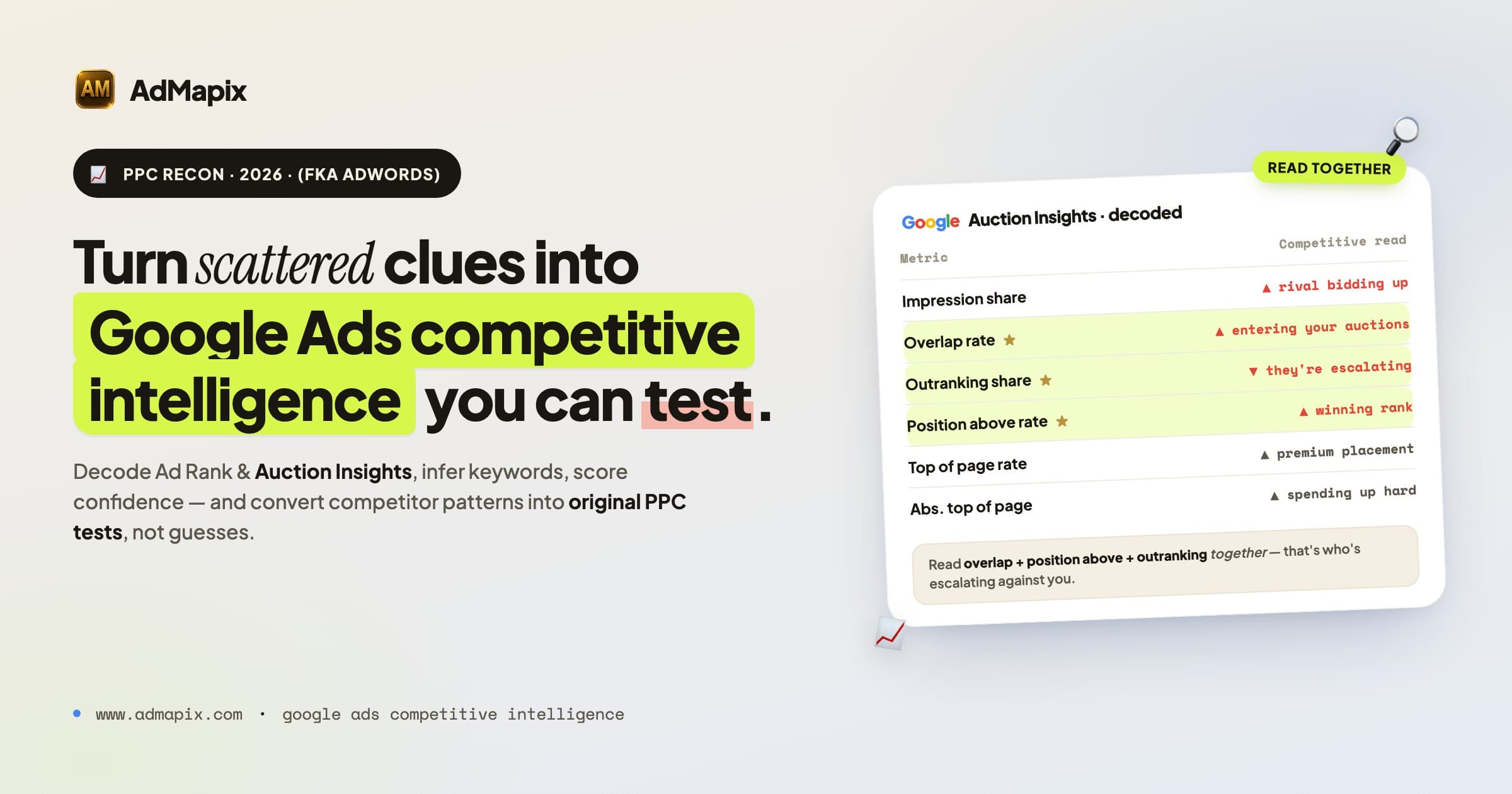
- Read Auction Insights as a system, not metric by metric. Overlap + position above + outranking share together tell you who is escalating against you.
- Score every finding and convert it to a test. Weight the evidence, sum to a confidence band, and map to monitor / test / build / defend — with original creative, never a clone.
- AdMapix preserves the history Google erases. Public ads disappear when campaigns stop; week-over-week cross-platform evidence is what an ad-intelligence layer snapshots.
1. What "AdWords intelligence" really means in 2026
AdWords intelligence is not a private window into another advertiser's account. It is a structured research process that converts public and account-side evidence into PPC decisions. The vocabulary is legacy; the discipline is current.
| Research layer | What it helps you understand | Where it comes from |
|---|---|---|
| Public ad examples | Which claims, offers, formats, and destinations competitors expose publicly | Transparency Center, ad libraries |
| Live SERP sampling | Which advertisers appear for your priority queries under controlled conditions | Manual/incognito checks, monitoring |
| Auction Insights | Which domains overlap in auctions your account is eligible for | Your Google Ads account |
| Keyword inference | Which commercial searches may deserve coverage | Keyword tools, SERP + landing-page evidence |
| Landing-page review | Whether the competitor's funnel supports the ad promise | Manual destination review |
| Reporting workflow | Which findings repeat enough to monitor or test | Your tracker |
The useful output is never "copy this competitor ad." It is a decision: monitor this rival, test this proof angle, build this landing page, defend this keyword group, brief sales on this positioning, or ignore this one-off signal. Everything below is in service of producing that decision with evidence and a confidence label attached.
2. What you can and cannot know
The single biggest mistake in AdWords intelligence is treating estimated or public signals as exact competitor account data. Get this boundary crisp before you collect anything, because it determines which claims you are allowed to make.
| Signal | You can use it for | You must NOT claim |
|---|---|---|
| Public ads | Message themes, visible creative, active-advertiser clues | Full keyword list, budget, or bid strategy |
| Search results | Who appeared for a query at a given time/location | Universal ranking across all users |
| Auction Insights | Overlap, impression-share context, position pressure in your auctions | Competitors outside your campaigns, exact bids |
| PPC tools | Directional keyword and competitor discovery | Exact spend, exact ROAS, private conversion data |
| Landing pages | Offer, proof, CTA, objections, funnel quality | Internal conversion rate or margin |
Google's own Ad Rank documentation is the reason for this boundary. Ad position depends on bid, ad and landing-page quality, Ad Rank thresholds, auction competitiveness, search context, and the expected impact of assets — six inputs, recalculated on every single search. From the outside you observe outcomes. You cannot see the inputs that produced them. We unpack all six in Section 4, because understanding them is what stops you from misreading a competitor's position as a budget signal when it is really a quality signal.
That boundary makes the work more useful, not less. Once your team stops hunting for impossible private data, it can focus on the evidence that actually improves PPC execution.
3. The five evidence lanes (and why you must keep them separate)
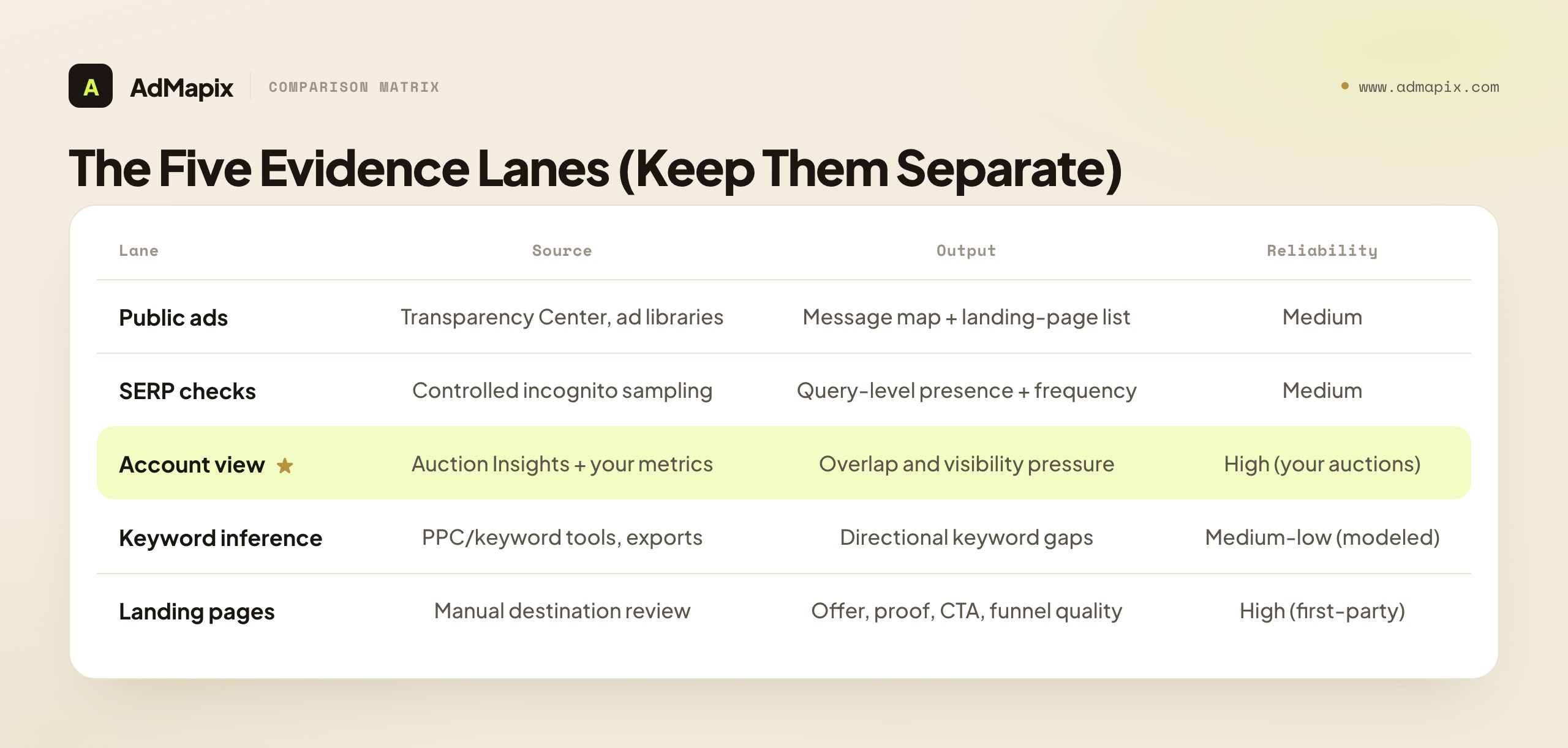
The cleanest Google Ads competitive intelligence workflow runs on five evidence lanes, each producing a different kind of output. The discipline that separates rigorous research from sloppy claims is keeping these lanes in separate columns and never silently merging them.
| Lane | Primary source | Output | Reliability |
|---|---|---|---|
| Public ads | Transparency Center, ad libraries | Message map + landing-page list | Medium |
| SERP checks | Controlled manual/incognito sampling | Query-level competitor presence | Medium |
| Account view | Auction Insights + your own metrics | Overlap and visibility pressure | High (your auctions only) |
| Keyword inference | PPC/keyword tools, exports | Directional keyword gaps and history | Medium-low (modeled) |
| Landing pages | Manual destination review | Offer, proof, CTA, funnel quality | High (it's first-party observation) |
Then bolt on two decision columns:
| Decision column | What belongs there |
|---|---|
| Confidence | Low / medium / high, based on repeated, cross-lane evidence |
| Next action | Monitor, test copy, build page, adjust assets, brief sales, or ignore |
Why the separation matters: without it, teams write notes like "the competitor is bidding on this exact keyword" when the evidence only shows an ad appeared for one query. The disciplined version reads: "Competitor appeared twice on this query over three days, points traffic to a dedicated comparison page, and overlaps with us in Auction Insights on the related campaign — medium confidence." The first is a guess; the second is intelligence. The lanes are how you tell them apart.
4. Decode Ad Rank before you judge a competitor
This is the section most "AdWords spy" guides skip — and it is the one that prevents the most expensive misreadings. Before you conclude a rival is "outspending you," you have to understand why their ad sits where it sits. Position is not a budget readout.
Google calculates Ad Rank from six official components, recomputed on every search:
| Component | What it is | Why it matters for competitive reading |
|---|---|---|
| 1. Your bid | Max you'll pay per click | The only input most people assume drives position — it doesn't, alone |
| 2. Ad + landing-page quality | Auction-time expected CTR, ad relevance, LP experience | A rival can outrank you on quality at a lower bid |
| 3. Ad Rank thresholds | Minimum rank needed to show at all | Dynamic; higher for navigational/YMYL queries |
| 4. Auction competitiveness | How many similar-rank ads compete | Explains volatility on hot terms |
| 5. Search context | Location, device, time, query nature, user signals | Why your SERP sample differs from another user's |
| 6. Expected asset/format impact | Sitelinks, callouts, snippets relevance + prominence | Strong assets can lift rank without a bid increase |
The decisive insight, straight from how the auction resolves: an advertiser with a Quality Score of 8 and a $3 bid can outrank an advertiser with a Quality Score of 4 and a $5 bid. Bid alone does not win. When you see a competitor consistently above you, the first hypothesis should be "better quality / better assets / better landing page," not "bigger budget." Investigate quality before you reach for the budget lever — raising your bid to fix a quality problem just burns money.
Two more facts worth internalizing. First, thresholds apply even with zero competition (enforced since 2017) — an ad can fail to show on a no-competition long-tail query simply because it didn't clear the bar; that is not evidence a rival blocked it. Second, the auction is probabilistic and resolves in ~100–300ms, running slightly different auctions for different user segments on the same query. This is precisely why a single SERP screenshot is weak evidence and why Section 6's controlled sampling method exists.
5. Build a query set before you check anything
Start with search intent, not the tool. A good query set is the spine of the whole workflow — it is the fixed measurement surface you sample against every week.
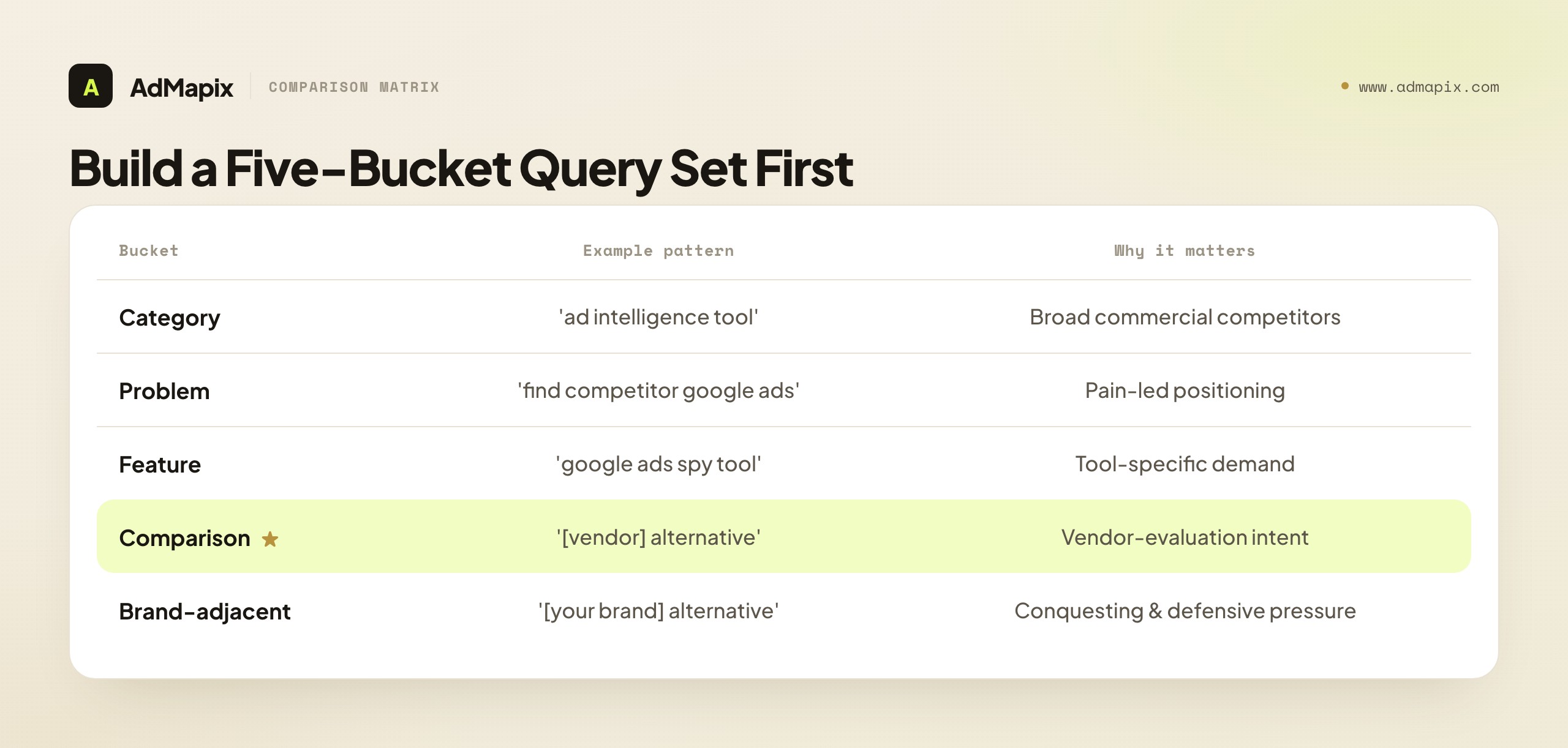
Build five buckets:
| Query bucket | Example pattern | Why it matters |
|---|---|---|
| Category | "ad intelligence tool" | Surfaces broad commercial competitors |
| Problem | "find competitor google ads" | Reveals pain-led positioning |
| Feature | "google ads spy tool" | Shows tool-specific demand |
| Comparison | "[vendor] alternative" | Captures vendor-evaluation intent |
| Brand-adjacent | "[your brand] alternative" | Identifies conquesting and defensive pressure |
For every query, record country, language, device, date, browser state, and whether the check was manual, tool-assisted, or account-side. A single SERP is a signal. A repeated pattern across days, sources, and landing pages is intelligence.
If you already run campaigns, connect this query set to your own account structure — but keep "query evidence" (what you observed publicly) and "keyword inference" (what you suspect they bid on) as separate columns. The queries you can observe publicly are not the same as the keywords a rival actually bids on, and conflating them is how false claims get into a deck.
6. SERP sampling done right: controlled, repeated, deterministic
Because the auction is probabilistic and personalized (Section 4), a casual search proves almost nothing. To make SERP checks usable as evidence, you have to control the variables. Here is the method.
| Control | Why | How |
|---|---|---|
| Incognito + no Google login | Personalization skews results | Fresh incognito window, no account |
| Fixed location | Geo changes the auction | Set location explicitly; use a consistent VPN node if needed |
| Fixed device class | Mobile vs desktop differ in thresholds and layout | Sample desktop and mobile as separate rows |
| Fixed time window | Time-of-day and seasonality shift thresholds | Sample at a consistent time; note it |
| Repeat across days | One auction ≠ market truth | 3+ samples per query before concluding presence |
The output of disciplined sampling is query-level competitor presence with a frequency: "Competitor A appeared on 4 of 5 samples for this query; Competitor B on 1 of 5." Frequency is the signal — a one-off appearance is noise, persistent appearance across controlled samples is a real pattern. Log the frequency, not just a yes/no.
7. Use the Google Ads Transparency Center as one evidence layer
The Google Ads Transparency Center is the public source for advertiser research across Google's ecosystem. It confirms whether a competitor is actively exposing public ad examples and lets you build a message map.
Capture these fields per advertiser:
| Field | Why it helps |
|---|---|
| Advertiser name (verified entity) | Confirms who is behind the ads |
| Recent ad activity | Separates active patterns from stale screenshots |
| Message theme | Price, speed, trust, category leadership, comparison? |
| Destination page | Connects the ad promise to the funnel |
| Format / market clues | Local experiments vs broad positioning |
The Transparency Center is one layer, not a complete intelligence platform. It shows you public creative and active status; it does not show keywords, spend, or performance. Pair it with SERP sampling, your Auction Insights, keyword tools, and landing-page review. For a full walkthrough, see our Google Ads Transparency Center guide.
8. Google Auction Insights: your sharpest account-side lane
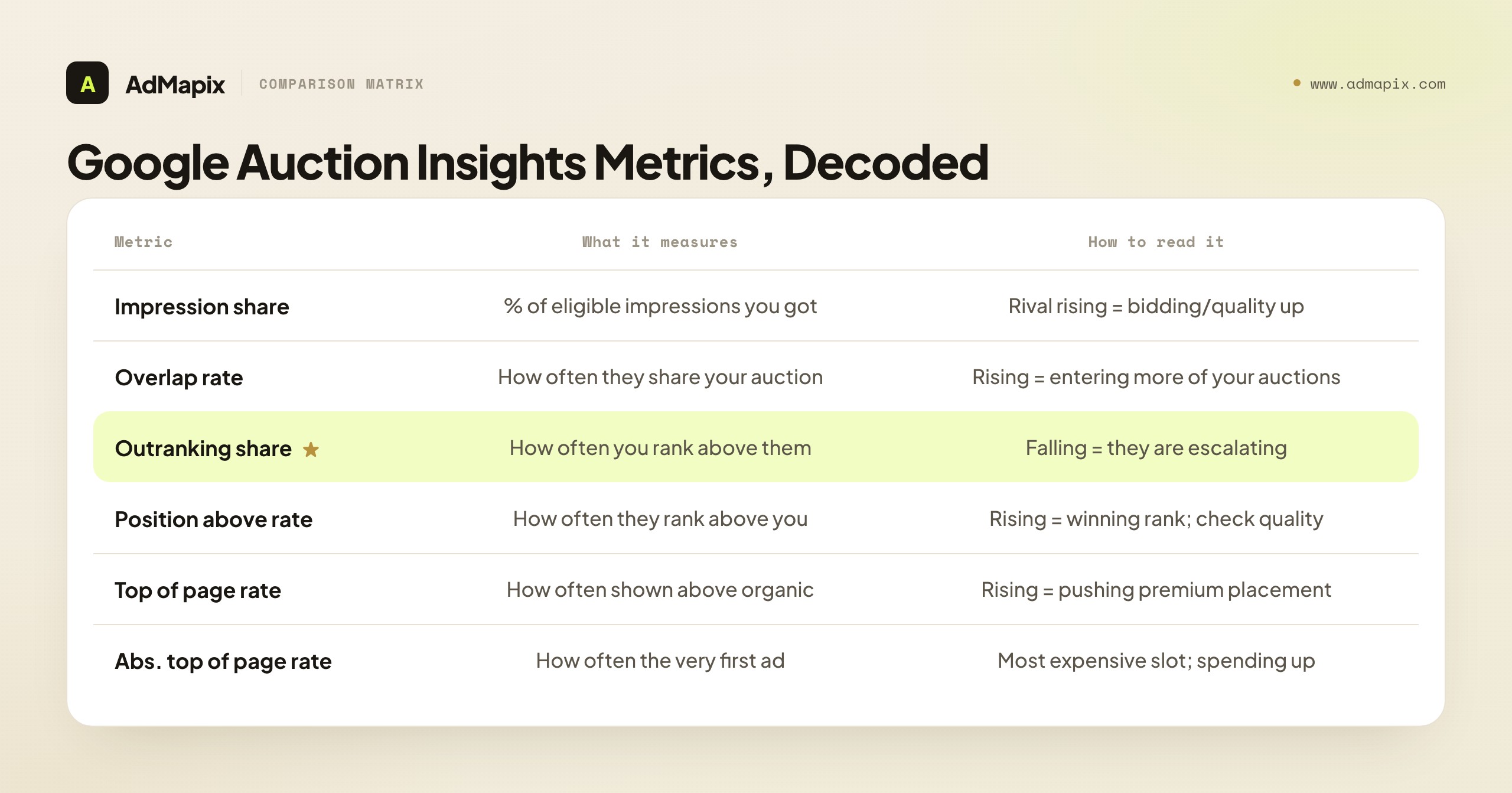
If you advertise on Google Ads, Auction Insights is the one place you see relative competitive pressure directly — in the exact auctions your account is eligible for. For Search campaigns it exposes six metrics. Here is what each measures and how to read it competitively.
| Metric | What it measures | How to read it |
|---|---|---|
| Impression share | % of eligible impressions your domain got | A rival's rising share on shared terms = more aggressive bidding/budget or better quality |
| Overlap rate | How often a competitor appeared in the same auction as you | "Who's fishing in the same pond." Rising = entering more of your auctions |
| Outranking share | How often you ranked above them (or showed when they didn't) | Your head-to-head win rate. Falling = they are escalating |
| Position above rate | How often their ad showed above yours | Rising = they're winning rank; check whether it's bid or quality |
| Top of page rate | How often a domain showed above organic results | Rising for a rival = pushing for premium placement |
| Absolute top of page rate | How often a domain was the very first ad | Most expensive slot; chasing it = spending up hard |
The pro discipline: never read one metric in isolation. The canonical combination is overlap rate + position above rate + outranking share, together.
- High overlap, low position-above (they enter your auctions often but rarely rank above you): a positive signal — you're beating an active rival.
- Rising overlap + rising position-above + falling outranking share (all three moving against you): a genuine escalation worth a defensive response.
Two hard caveats. First, position-above can be driven by Quality Score, not bid (Section 4) — investigate a rival's creative, assets, and landing pages before assuming a budget increase. Second, since Google's August 24, 2024 update, Auction Insights data cannot be exported to Looker Studio or third-party BI tools, and it only renders when your own impression share is ≥ 10% on the terms. You read it natively and log it manually — which is exactly why the weekly SOP in Section 12 exists. For the search-specific deep dive, use our search ads intelligence workflow.
9. Keyword intelligence: inference, not extraction
Marketers constantly ask whether AdWords intelligence can reveal a competitor's keyword list. The honest answer: you can infer likely keywords; you cannot extract their private list. Treat every keyword that comes from a tool, a SERP check, or a landing page as directional evidence, never as ground truth.
Here is how to build a defensible keyword inference from triangulated signals:
| Inference source | What it suggests | Confidence on its own |
|---|---|---|
| SERP appearance for a query | They likely bid on this or a close match | Low (one auction) |
| Repeated SERP appearance (3+ samples) | They actively target this intent | Medium |
| Landing-page H1 / copy matching a query | The page is built for that intent | Medium |
| Keyword tool "competitor keywords" export | Modeled overlap, directional | Low-medium (modeled) |
| Auction Insights overlap on a campaign | They compete where you bid on those terms | Medium-high (account-side) |
The power move is triangulation: a keyword that shows up in a repeated SERP sample and matches a dedicated landing page and appears in your Auction Insights overlap is a high-confidence inference. A keyword that only appears in a tool export is low-confidence. Score accordingly (Section 11). Never write "they bid on X" from a single source. For broader search-keyword workflows, pair this with best ad intelligence tools.
10. Landing-page dissection: where the real strategy hides
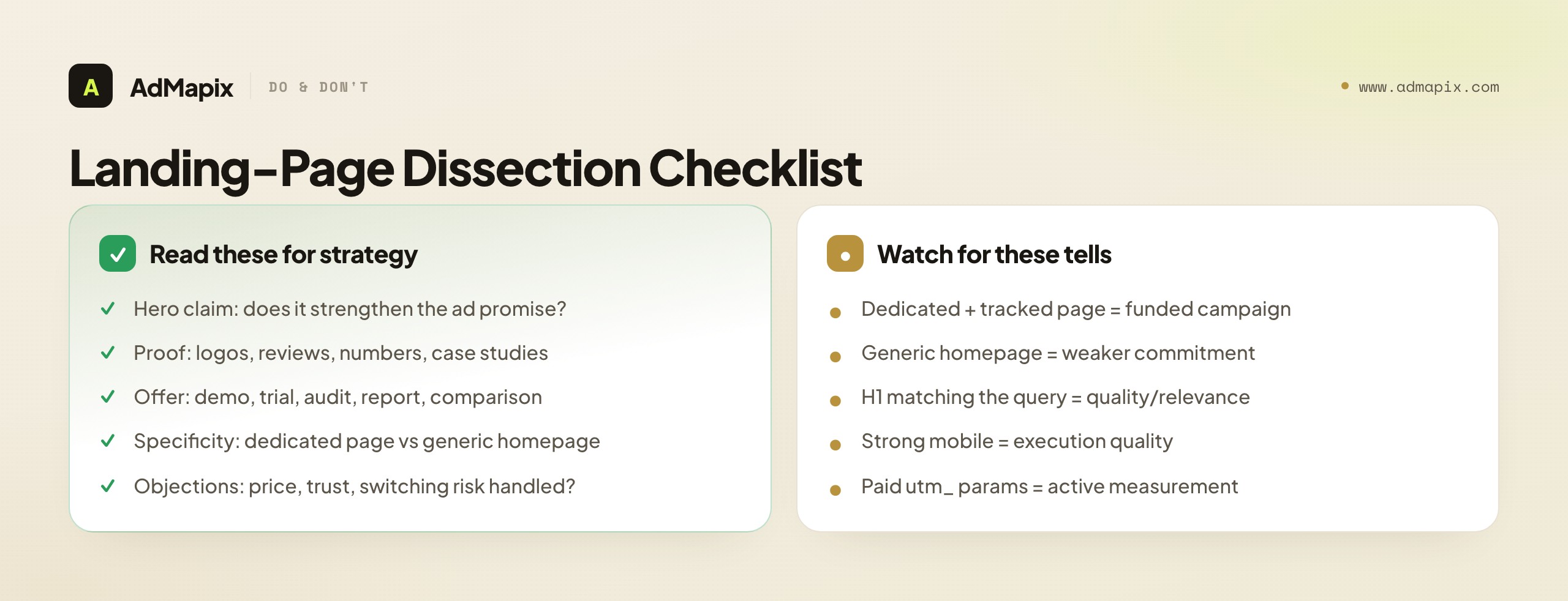
A search ad can look ordinary while the landing page carries the entire strategy. In Google Ads competitor research, the destination page is often the richest, most reliable evidence you have — it is first-party observation, not a model. Review it before you judge the ad.
| Page element | What to inspect | What it reveals |
|---|---|---|
| Hero claim | Does it repeat/strengthen the ad promise? | Message-to-LP coherence (a quality signal) |
| Proof | Logos, reviews, screenshots, numbers, case studies, compliance | How they overcome skepticism |
| Offer | Demo, trial, audit, report, pricing, comparison, migration help | What conversion they're optimizing for |
| CTA | Is the next action aligned with query intent? | Funnel friction level |
| Objection handling | Price, implementation, trust, data quality, switching risk | Which buyer anxieties they prioritize |
| Specificity | Dedicated campaign page vs generic homepage | Campaign seriousness and budget commitment |
| Mobile experience | Does it work for mobile paid traffic? | Execution quality |
The most actionable read: page specificity is a budget-seriousness proxy. If a competitor repeatedly routes commercial queries to a dedicated, tracked landing page while you send the same intent to a generic homepage, the opportunity is usually a landing page, not a higher bid. Dedicated pages with paid-style tracking params signal a campaign someone is actively funding and measuring.
11. Score confidence: a quantified model
Never publish a competitive finding without a confidence label. A claim with no confidence attached invites your team to either overreact or ignore it. This model turns "low/medium/high" into a number you can apply consistently.
Step 1 — Weight each signal
| Signal | Weight (if present & pointing up) |
|---|---|
| Auction Insights: rising overlap + falling outranking share | 3 |
| Dedicated, tracked landing page for a commercial query | 2 |
| Repeated SERP presence (3+ controlled samples) | 2 |
| Triangulated keyword (SERP + LP + overlap all agree) | 2 |
| Active public ads with a consistent message theme | 1 |
| Keyword-tool export overlap (modeled only) | 1 |
| Single SERP appearance | 1 |
Step 2 — Sum and map to action
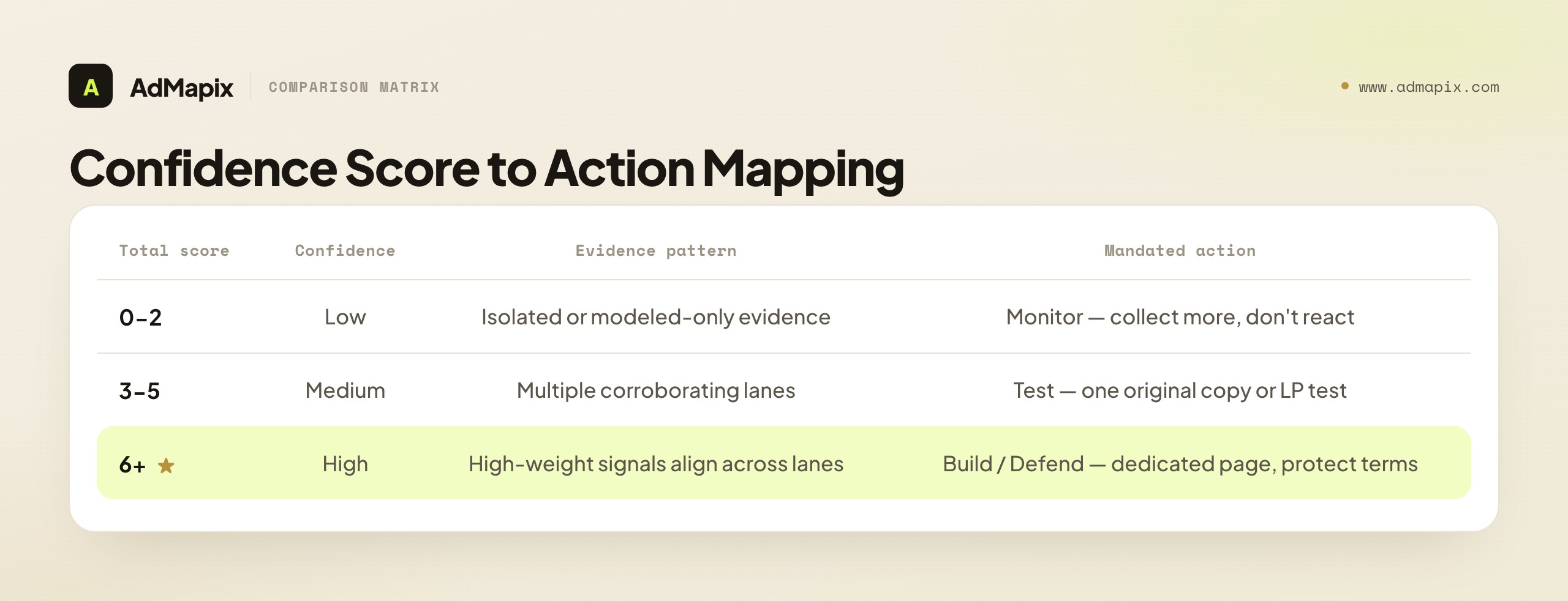
| Total score | Confidence | Reading | Mandated action |
|---|---|---|---|
| 0–2 | Low | Isolated or modeled-only evidence | Monitor — collect more, don't react |
| 3–5 | Medium | Multiple corroborating lanes | Test — one original copy or LP test |
| 6+ | High | High-weight signals align across lanes | Build / Defend — dedicated page, protect terms |
The model's job is not to make you certain. It is to make you clear enough to decide. A score of 2 says "interesting, keep watching." A score of 7 says "this is real, allocate a response." Writing the number down also enforces honesty: if you can't get past 2, you don't yet have a story — no matter how alarming one screenshot looked.
12. The weekly Google Ads intelligence SOP
A one-time audit is competitor guessing. Competitive intelligence is a repeatable weekly process that samples the same query set, the same fields, on the same cadence — so what you measure is change over time, the only thing that reliably maps to a rival's strategic shifts.
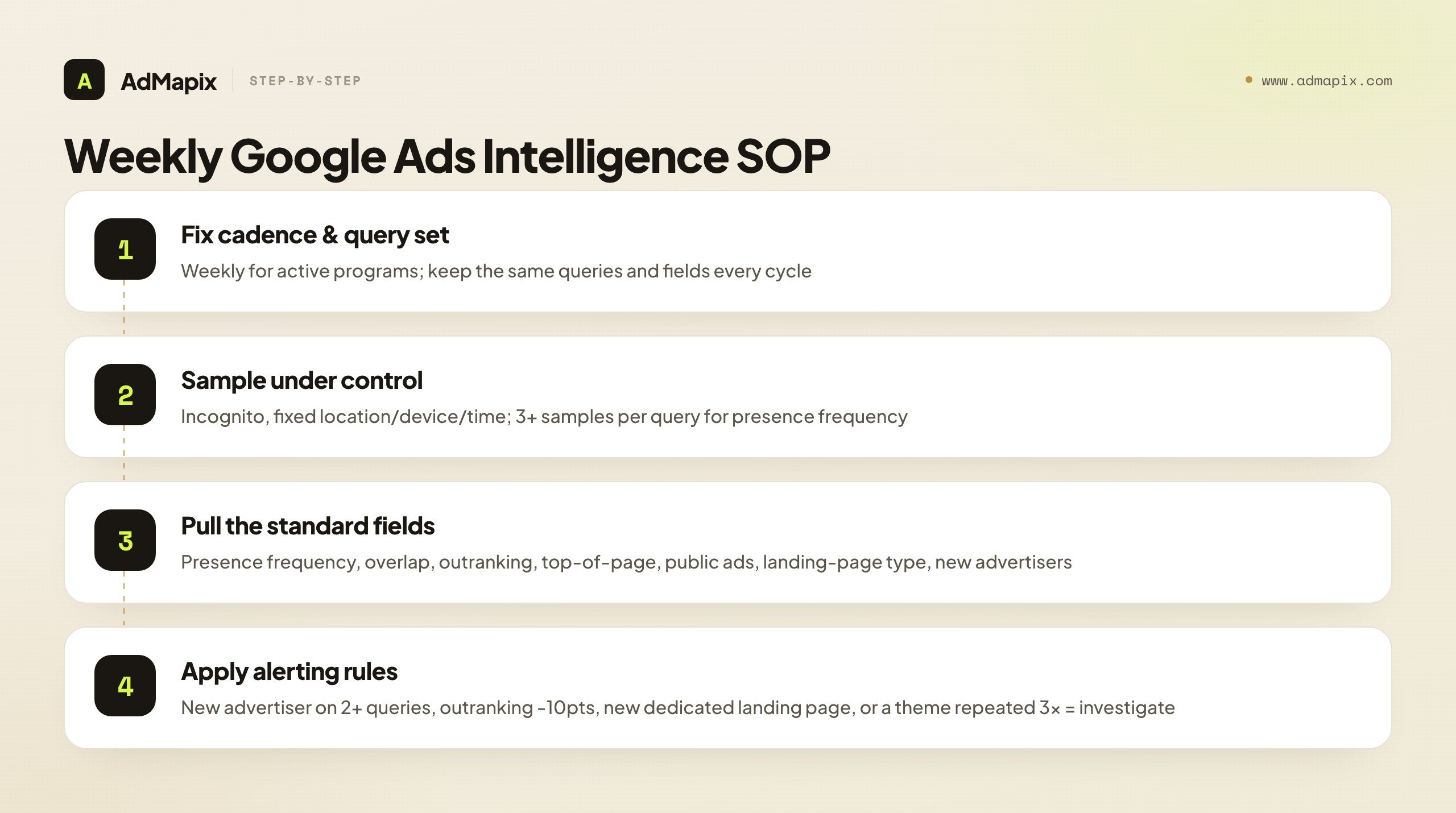
The cadence
| Frequency | Use when | Why |
|---|---|---|
| Weekly | Active, competitive PPC programs | Catches new advertisers, messages, and LP changes while actionable |
| Bi-weekly | Moderate competition | Balances coverage and effort |
| Monthly deep review | All programs | Message map + landing-page audit across the full set |
The fields to log every cycle
| Field | Source | What a change tells you |
|---|---|---|
| Query-level presence + frequency | Controlled SERP sampling | Who's targeting which intent |
| Overlap rate (per rival) | Auction Insights | Are they entering more of your auctions? |
| Outranking share (per rival) | Auction Insights | Are you losing the head-to-head? |
| Top-of-page rate (per rival) | Auction Insights | Are they pushing for premium placement? |
| Active public ads + message theme | Transparency Center | What are they actually saying? |
| Landing-page type + changes | Manual review | New dedicated pages = campaign seriousness |
| New advertisers on the query set | SERP sampling | Fresh entrants worth investigating |
Alerting rules (define in advance)
- A new advertiser appears on 2+ priority queries → investigate this week.
- Outranking share falls ≥ 10 points against a key rival → defensive review of shared terms.
- A rival launches a new dedicated landing page with paid tracking params → a real campaign is being funded; escalate.
- A message theme repeats across 3+ ads → it's working for them; design an original counter-test.
Log one row per competitor per week. Over a quarter that history becomes the asset Google itself does not keep — public ads vanish from the Transparency Center when campaigns stop. Preserving that cross-platform creative-and-message trail is what an ad-intelligence layer automates.
13. Turn intelligence into original PPC tests
AdWords intelligence is only valuable when it changes a decision you can test — and the test must be original, never a clone. Copying a competitor's exact phrasing cedes the initiative and often imports a message your funnel can't actually prove.
| Finding | Original PPC test (not a clone) |
|---|---|
| Competitors repeat a "speed" promise | Test a speed-led headline only if your page proves time-to-value |
| Competitors use comparison pages | Build a factual comparison page; measure qualified demo rate |
| Auction overlap rises on one campaign | Review assets + LP match before raising budget |
| Multiple ads lead with price | Test value framing vs price framing — don't copy discounts |
| Competitors use audit/report CTAs | Test a lower-friction report CTA on research-heavy queries |
| Their landing pages show stronger proof | Add specific, original proof to your paid destination pages |
The rule: extract the message mechanism (what buyer anxiety the competitor is addressing), then write your own proof-backed version. If a rival says "instant insights," ask what fear that soothes — slow tooling, analysis paralysis — and answer it with your evidence, in your voice.
14. Three worked examples
Example 1 — SaaS: a rival escalating on a comparison query
Evidence (one weekly cycle): Competitor appears on 4 of 5 controlled samples for "[vendor] alternative" (weight 2); Auction Insights overlap rose 41% → 57% and your outranking share fell 11 points (weight 3); they launched a dedicated /compare page with utm_campaign params (weight 2); the same "faster migration" theme repeats across 3 ads (weight 1).
Score: 2 + 3 + 2 + 1 = 8 → High confidence. Action: Build / Defend. Build your own factual comparison page (original, not a mirror), defend the comparison and brand terms where outranking share slipped, and audit your assets before touching bids — the position loss may be quality, not budget.
Example 2 — E-commerce: ambiguous, low-confidence signal
Evidence: A rival appears once on a category query (weight 1); a keyword-tool export lists overlapping terms (weight 1, modeled); Auction Insights shows impression share below 10% on those terms, so the report doesn't render (weight 0); no dedicated landing page found.
Score: 2 → Low confidence. Action: Monitor only. This is the output the model should sometimes produce. Sub-10% impression share suppresses the account-side lane, and a single SERP plus a modeled export is thin. The correct deliverable is "insufficient evidence — widen sampling," not a manufactured claim that "they're targeting our category hard."
Example 3 — Lead-gen: a quality story misread as a budget story
Evidence: A competitor sits consistently above you on a high-intent query. Naive read: "they outspend us." On inspection, their ad carries four sitelinks + callouts + a structured snippet, their landing page H1 exactly matches the query, and their page loads fast on mobile. Your ad runs no assets and points to a generic homepage.
The correct read: this is an Ad Rank quality + assets story (Section 4), not necessarily a budget story. The high-confidence action is to add relevant assets and build a query-matched landing page — likely lifting your rank without a bid increase. Raising your bid here would have burned money on a problem bidding can't fix. This is the misread the whole Ad Rank section exists to prevent.
15. Tool category comparison: what each can and can't show
"AdWords intelligence tool" spans several very different categories. Conflating them is how teams end up disappointed. Here is what each can and cannot actually show.
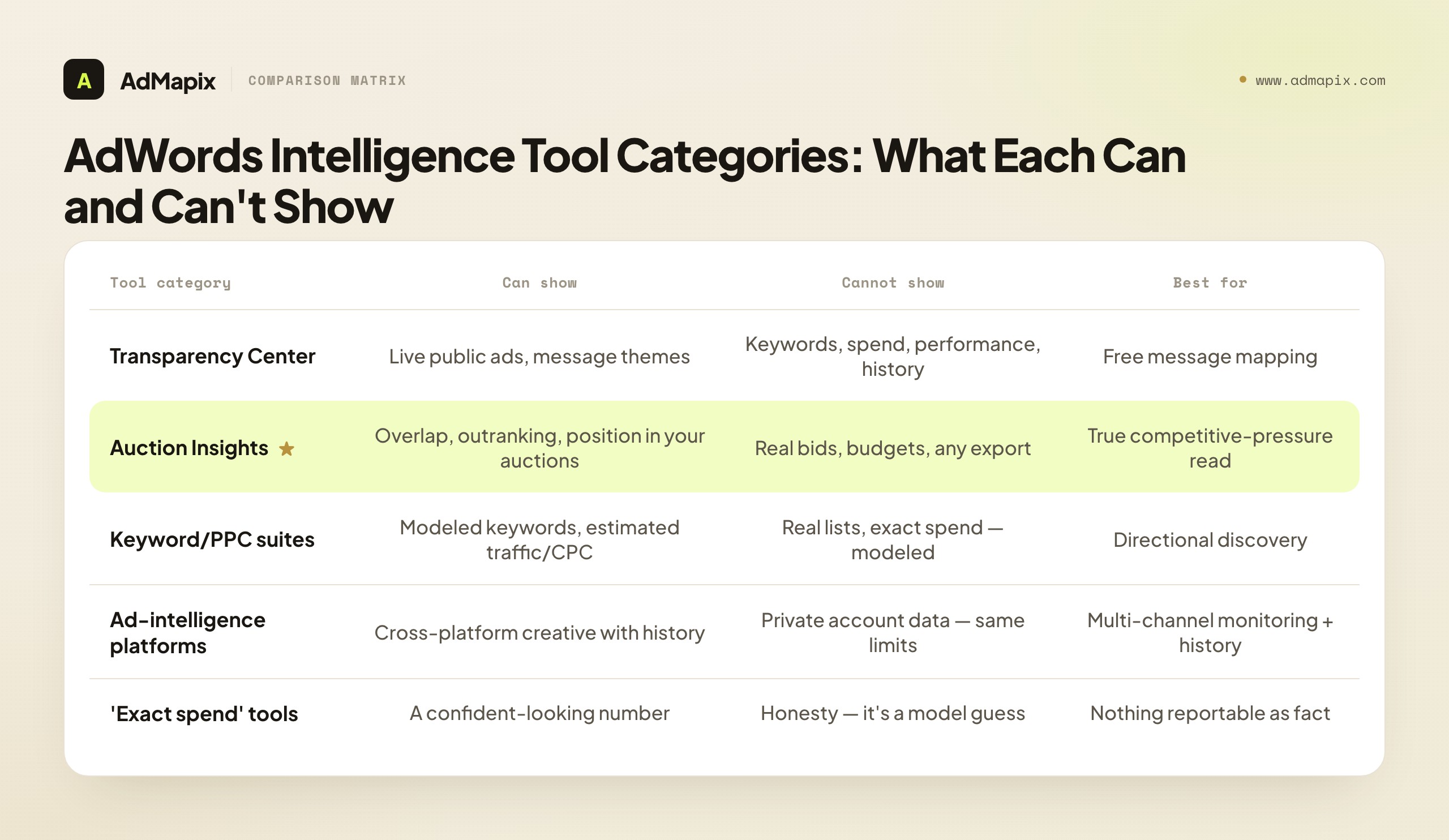
| Tool category | Can show | Cannot show | Best for |
|---|---|---|---|
| Transparency Center (Google native) | Live public ads, advertiser, message themes, destinations | Keywords, spend, performance, history after stop | Free message mapping, active-status checks |
| Auction Insights (Google native) | Overlap, outranking, position, top-of-page in your auctions | Real bids, budgets, non-shared auctions, any export | The one true competitive-pressure read |
| Keyword / PPC suites | Modeled competitor keywords, estimated traffic/CPC | Real keyword lists, exact spend — all modeled | Directional keyword gaps, discovery |
| Ad-intelligence platforms | Cross-platform creative with history, message trends | Private account data — same hard limits | Multi-channel monitoring, preserved history |
| "Exact spend / exact keywords" tools | A single confident-looking number | Honesty — it's a model guess sold as fact | Nothing reportable as fact |
Two judgments to carry away. First, keyword and spend figures from PPC suites are modeled — excellent for discovery and rough sizing, dangerous if quoted as a competitor's real list or budget. Second, the structural value of an ad-intelligence platform is history + cross-platform consolidation: native sources erase public ads when campaigns stop and silo each network, so what you pay for is a snapshotted, normalized, multi-network record over time — not access to private data, which no one has. AdMapix sits in that consolidation layer, normalizing Google, Meta, TikTok, YouTube and more into one searchable workspace; see pricing for monitoring tiers.
15b. Estimating competitive intensity without claiming a budget
The hardest discipline in AdWords intelligence is producing a directional read on how hard a rival is pushing — without ever pretending you can see their spend. You can't read a budget. But you can assemble a defensible competitive-intensity signal from observable behavior, as long as you label it as inference and never as a dollar figure. Think of it as a thermometer, not a bank statement.
Four observable behaviors, taken together, move the thermometer. Absolute-top-of-page pursuit: a rival that climbs into the absolute-top slot on your shared terms and holds it across weekly samples is paying the most expensive position in the auction — a behavior that correlates with budget commitment even though it never reveals the number. Coverage breadth: a competitor that newly appears across your category, problem, and comparison buckets in the same cycle has widened its footprint, which costs money to sustain. Landing-page proliferation: each new dedicated, tracked destination page is a campaign someone is actively funding and measuring; three new /compare and /use-case pages in a quarter is a louder signal than any tool's spend estimate. Asset and creative refresh rate: rivals iterating ad copy, sitelinks, and promotions frequently are investing creative resources, which tracks with overall program seriousness.
The right way to express this is a band, not a point. Instead of "Competitor A spends ~$40k/month" (which you cannot know and should never write), the defensible output is: "Competitor A's competitive intensity rose from low to medium-high this quarter — absolute-top rate up on three priority terms, two new dedicated landing pages, weekly copy refresh — direction is escalation, magnitude unknown." That sentence is honest, decision-useful, and survives scrutiny. The dollar figure does not. When a stakeholder demands a number, give them the direction and the evidence weight, and explain that any precise spend figure on the market is a model's guess dressed as a fact (Section 15). Intensity trends are real intelligence; spend point-estimates are theater.
15c. Reading seasonality and promotional pressure in the SERP
Competitive position is not stationary, and a huge amount of misread "escalation" is really just the calendar. Auction pressure swings hard around retail peaks (Black Friday/Cyber Monday, the December holidays), fiscal quarter-ends when performance teams spend to hit targets, and category-specific seasons — tax season for fintech, back-to-school for education apps, open-enrollment windows for insurance. If you sample a rival's position only during a peak, you will systematically overestimate their baseline aggression; sample only in a trough and you will miss a genuine push.
The fix is to annotate your weekly log with the seasonal context of each sample and to benchmark a rival's current position against their own same-period history rather than against last week. A competitor jumping to absolute-top in mid-November is doing what every retailer does; the same jump in a quiet February is a real strategic move worth escalating. Two practical reads follow. First, watch the post-peak reset: rivals who hold premium position after the seasonal crush has passed are the ones who actually changed strategy, not just rode the calendar — that persistence is your high-confidence signal. Second, promotional copy is a leading indicator: when a competitor's Transparency Center ads start carrying time-boxed offers ("ends Sunday," "Q4 pricing"), you are seeing a funded promotional push begin, often before their position visibly shifts. Logging the first appearance of promotional language gives you a few days of lead time to prepare an original counter-test rather than reacting late. The cross-cutting rule: never compare a peak-season screenshot to an off-season one and call the difference a budget increase — separate the calendar from the strategy before you score anything.
16. Common mistakes
The failure modes are predictable, which makes them preventable.
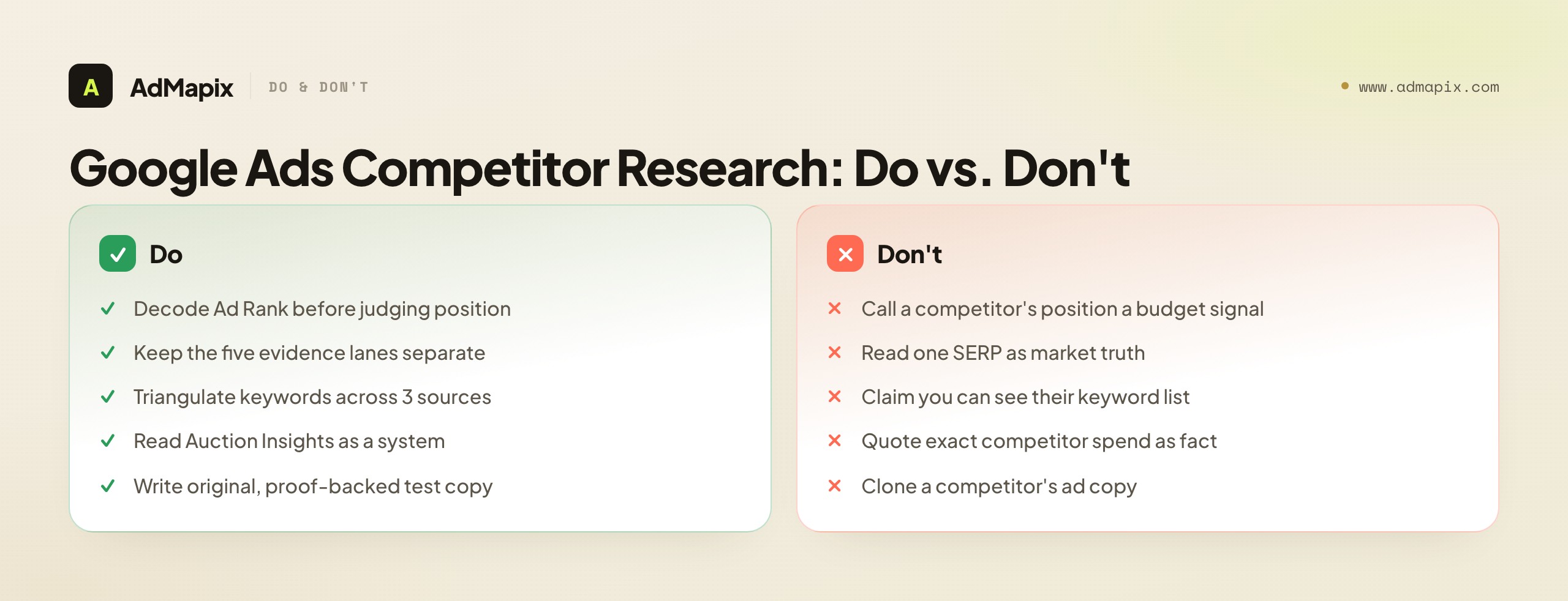
| Mistake | Better approach |
|---|---|
| Treating "AdWords" as a current, separate product | Use it for search demand; explain the live platform is Google Ads |
| Reading one SERP as market truth | Repeat controlled checks across time, market, and device |
| Calling a competitor's position a "budget" signal | Decode Ad Rank first — it's often quality or assets |
| Claiming you can see their keyword list | Infer and triangulate; label everything directional |
| Quoting exact competitor spend | Use estimates directionally, with a confidence band |
| Reading one Auction Insights metric alone | Read overlap + position above + outranking together |
| Copying competitor ad copy | Extract the message mechanism; write original, proof-backed copy |
| Ignoring landing pages | Review offer, proof, CTA, and page specificity |
| Blending all evidence types in one note | Keep the five lanes in separate columns |
| Doing it once and stopping | Run the weekly SOP; trends, not snapshots, drive decisions |
17. Bidding on Competitor Keywords and Brand Terms
One of the most-searched Google Ads competitive questions is also one of the most misunderstood: can you bid on a competitor's keywords — even their brand name? The short answer is yes, with one important limit, and knowing the rules in both directions (offense and defense) is core to any competitive intelligence practice.
What Google's policy actually allows. You may bid on a competitor's brand name as a keyword. Google does not restrict keyword targeting by trademark. What it restricts is trademark use in ad text: if a competitor files a trademark complaint, Google will disallow the trademarked term from appearing in the headline or description of ads run by non-authorized advertisers. So the common pattern is legal but constrained — rivals bid on each other's brand terms, but cannot write "Better than [Brand]" using the protected mark in the copy itself. Landing pages are a separate risk surface: sending brand-term traffic to a page that implies false affiliation invites both a Google complaint and a legal one.
Detecting who is bidding on your brand. This is where intelligence comes in. Three signals expose competitor brand bidding:
- Auction Insights filtered to your brand campaign — any domain showing impression share on your own branded terms is bidding on your brand.
- The Google Ads Transparency Center — search a rival advertiser and look for ad variants whose landing pages target your category or comparison queries.
- Manual SERP sampling on your brand name (incognito, fixed location) — note which competitors appear above or beside your brand listing over time.
| Question | Offense (researching rivals) | Defense (protecting your brand) |
|---|---|---|
| Who's bidding on the brand? | Auction Insights on rival brand terms | Auction Insights on your brand campaign |
| Is the trademark in the copy? | Transparency Center ad text | Monitor your mark in others' live ads, then file a complaint |
| Where does the traffic land? | Rival comparison / landing pages | Ensure your brand campaign owns the top slot |
| Trend over time | Rising overlap = escalation | Rising intruder share = budget at risk |
Defending your brand terms. If rivals are bidding on your brand, the fix is rarely to ignore it. Maintain a dedicated brand campaign with tightly matched ad copy and a high Quality Score — brand terms are cheap for you and expensive for intruders, so a well-optimized brand campaign usually holds the top slot at low cost while forcing competitors to overpay. Watch intruder impression share weekly; a sustained rise means a rival is committing budget to take your demand, which is itself a high-confidence competitive signal worth escalating in your review.
18. Putting it together: the end-to-end loop
Here is the whole method as one loop you can hand to an analyst.
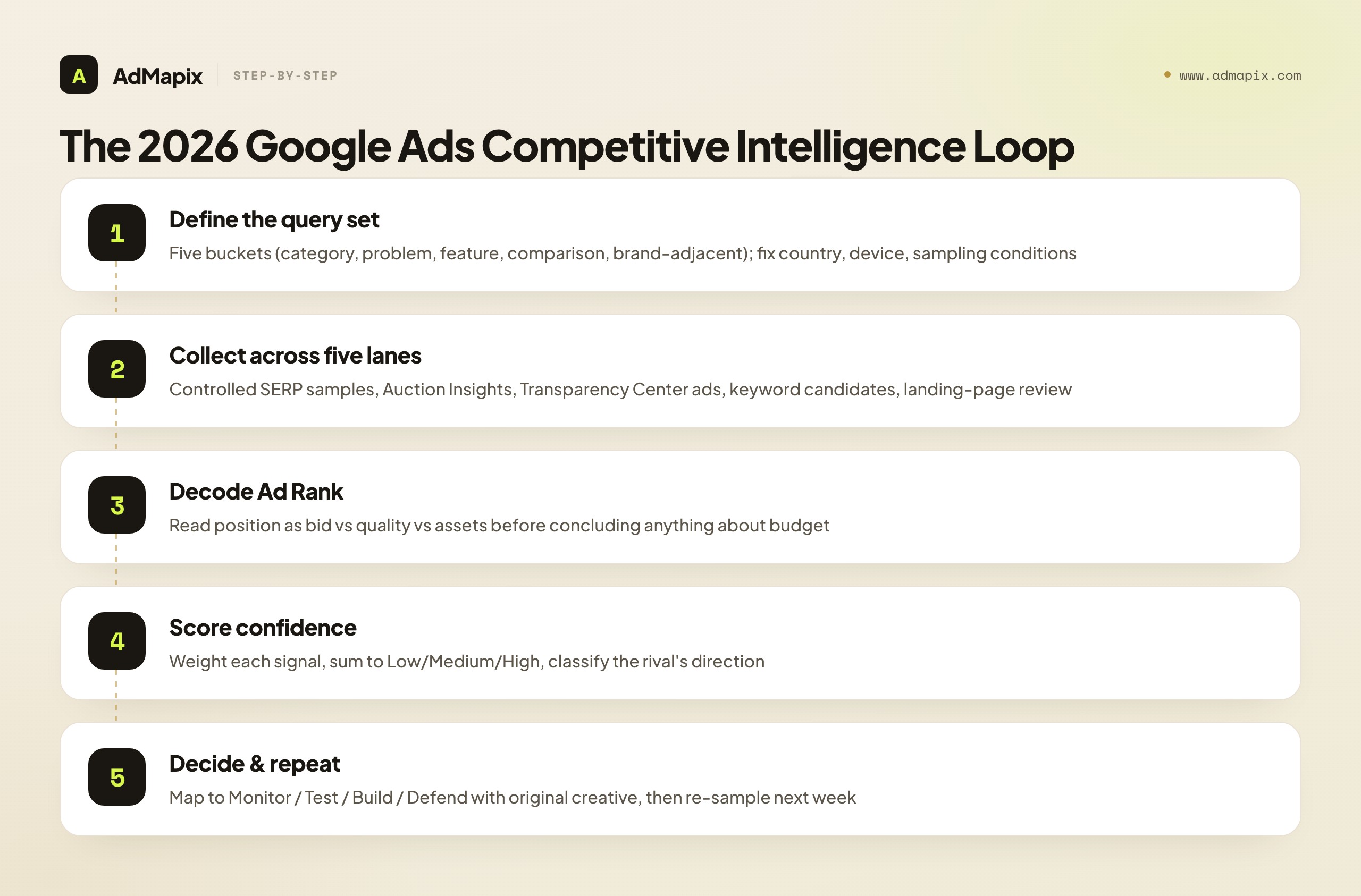
- Define — Build the five-bucket query set; fix country, device, and sampling conditions.
- Collect — Run controlled SERP samples, pull Auction Insights, capture Transparency Center ads, export keyword candidates, and dissect landing pages — on a fixed weekly cadence.
- Separate — Keep the five lanes in distinct columns; never merge public evidence with account data.
- Decode — Read position through Ad Rank (bid vs quality vs assets) before concluding anything about budget.
- Score — Weight each signal, sum to a confidence band, classify the rival's direction.
- Decide — Map the score to monitor / test / build / defend, with original creative.
- Repeat — Re-sample the same set next cycle. Trends are the intelligence.
Run that loop for a quarter and "I think a competitor is targeting us" becomes "Competitor A's overlap rose 16 points, outranking share fell 11, they launched a dedicated comparison page, and the same message repeats across four ads — high confidence, defend." That is the difference between an opinion and intelligence.
FAQ
Is AdWords intelligence the same as Google Ads competitor research?
In practical terms, yes. AdWords is the legacy product name (renamed to Google Ads in 2018); Google Ads is the current platform. People still search "AdWords intelligence," but the modern workflow is Google Ads competitor research: public ads, controlled SERP sampling, Auction Insights, keyword inference, and landing-page review, converted into PPC tests.
Can AdWords intelligence show a competitor's keywords?
It can help you infer likely keyword opportunities; it cannot extract a competitor's exact private keyword list. The defensible approach is triangulation — a keyword that appears in repeated controlled SERP samples, matches a dedicated landing page, and shows up in your Auction Insights overlap is a high-confidence inference. A keyword that only appears in a tool export is low-confidence and modeled.
Can I see a competitor's Google Ads budget?
No. Public ads, Auction Insights, and PPC tools do not expose exact competitor budgets, bids, Quality Scores, conversion rates, or ROAS. You can build directional estimates from public signals — but always attach a confidence label and never report a fabricated dollar figure as fact.
Why is a competitor above me — are they outspending me?
Not necessarily. Google's Ad Rank combines your bid with auction-time ad and landing-page quality, Ad Rank thresholds, auction competitiveness, search context, and the expected impact of assets. An advertiser with a Quality Score of 8 and a $3 bid can outrank one with a Quality Score of 4 and a $5 bid. Always investigate quality, assets, and landing-page match before assuming a budget increase — raising your bid won't fix a quality gap.
What is the best free source for AdWords intelligence?
Start with the Google Ads Transparency Center (public ads), controlled incognito SERP sampling (query-level presence), landing-page review (funnel quality), and your own Auction Insights if you run Google Ads (account-side overlap and position pressure). Together these cover public creative, search visibility, funnel quality, and competitive pressure — for free.
How do I read the Google Auction Insights report?
Read the metrics as a system, not individually. Rising overlap rate plus rising position above rate plus falling outranking share against a rival indicates escalation. High overlap with low position-above is a positive signal — you're beating an active competitor. Remember the report only covers auctions you're eligible for, only renders at ≥ 10% impression share, and (since August 24, 2024) can't be exported to third-party BI tools.
How often should I review Google Ads competitors?
Weekly for active PPC programs (sample priority queries and pull Auction Insights), with a deeper monthly review of message themes and landing pages. High-volatility markets may need more frequent checks. Whatever cadence you pick, keep the same query set and fields every cycle — changing your measurement surface destroys the period-over-period comparison.
Should I copy a competitor's high-performing ad?
No. Copying cedes the initiative and often imports a claim your funnel can't prove. Extract the message mechanism — the buyer anxiety the ad addresses — then write an original, proof-backed version in your own voice. Intelligence informs original creative; it doesn't license cloning.
Can ad-intelligence tools show data the native Google sources can't?
Not private data — no tool sees bids, budgets, keyword lists, or ROAS. What ad-intelligence platforms add is history (native sources erase public ads when campaigns stop) and cross-platform consolidation (one workspace across Google, Meta, TikTok, YouTube, and more, instead of tab-hopping). They preserve and normalize public signal over time; they do not unlock private accounts.
What's the single biggest mistake in AdWords intelligence?
Misreading a competitor's position as a budget signal. Google Ads position is driven as much by quality and assets as by bid, so "they're above us" usually does not mean "they outspend us." Decode Ad Rank first, fix quality and landing-page match before bids, and label every estimate with a confidence band. The second-biggest mistake is doing it once instead of running a weekly SOP.
How can I estimate how aggressively a competitor is spending if I can't see their budget?
You can't see the budget, but you can build a directional competitive-intensity read from observable behavior: how often a rival holds the absolute-top slot on shared terms, how many query buckets they newly cover, how many dedicated tracked landing pages they launch, and how frequently they refresh ad copy and assets. Express the result as a band with a direction ("intensity rose to medium-high; magnitude unknown"), never as a dollar figure. Any precise spend number on the market is a model's estimate, so quote trends and evidence weight rather than fabricating a budget.
Does seasonality affect how I should read competitor positions?
Heavily. Auction pressure spikes around retail peaks, quarter-ends, and category seasons (tax, back-to-school, open enrollment), so a rival jumping to top position during a peak is usually riding the calendar, not changing strategy. Annotate every weekly sample with its seasonal context and benchmark a competitor against their own same-period history, not last week. The real signal is a rival who holds premium position after the seasonal crush passes, plus the first appearance of time-boxed promotional copy ("ends Sunday"), which often leads a funded push by a few days.
How long before AdWords intelligence produces a reliable read on a competitor?
Plan on a full quarter of weekly cycles before you trust the trend. A single week tells you who showed up; a month starts to separate persistent patterns from noise; a quarter is where overlap, outranking share, landing-page changes, and message themes accumulate into a defensible story. Because the auction is probabilistic and seasonality distorts short windows, period-over-period change against a fixed query set — not any single snapshot — is what turns raw observation into intelligence you can act on.
Bottom line
"AdWords intelligence" is a legacy phrase for a current, essential discipline: Google Ads competitive intelligence. It is useful precisely when it stays honest about its limits — no private account data, no exact budgets, no extracted keyword lists — and channels that honesty into rigor: five separated evidence lanes, Ad Rank-aware reading of position, triangulated keyword inference, landing-page dissection, a quantified confidence score, and a weekly SOP that turns repeated patterns into original PPC tests.
Do that consistently and you stop guessing what competitors are doing and start making evidence-backed, testable decisions — which is the only kind of competitive intelligence that actually moves your numbers.
For a broader search workflow, read search ads intelligence. For a tool-level view, compare best ad intelligence tools. When you need ongoing monitoring instead of a one-off audit, start with AdMapix reports or review pricing.
Related reading
- Advertising intelligence guide — the category overview
- Search ads intelligence
- Google Ads Transparency Center guide
- Best ad intelligence tools
Authoritative sources
- Google Ads Auction Insights help — https://support.google.com/google-ads/answer/2579754?hl=en
- Google Ads — About Ad Rank — https://support.google.com/google-ads/answer/1722122?hl=en
- Google Ads Transparency Center — https://adstransparency.google.com/
Turn these observations into your next creative study
Open the creative library and select samples for your market, network and research question.
Related Articles
Google Ads Auction Insights vs Transparency Center: When to Use Each
A practical comparison of Google Ads Auction Insights and Google Ads Transparency Center for PPC competitor research in 2026.
How Often Does Facebook Ads Library Update? 2026 Timing & Delays
Direct answer to Facebook Ads Library update timing: how often it refreshes, why delays happen, what Meta documents, and how to monitor competitor ads without assuming real-time data.
Playable Ads: Examples, Development Workflow, and When to Use Them
A practical guide to playable ads for app marketers: examples, playable ads development workflow, technical QA, testing, and competitor research.