
AdSpy vs BigSpy vs AdMapix 2026: An Evidence-Based Comparison
Compare AdSpy, BigSpy, and AdMapix by current public pricing, documented search workflows, source coverage, saved-creative workflow, research outputs, and evidence limits. Reviewed August 13, 2026.
By the AdMapix research team · Reviewed August 13, 2026 · Vendor facts checked against public product pages and guides
Disclosure: AdMapix is our product. This comparison separates vendor claims from independently verifiable facts, links to primary sources, and avoids treating database size, engagement, or modeled estimates as proof of ad spend or ROAS.
Quick answer
- Choose AdSpy when your work is centered on Facebook and Instagram and you need its deep filters, including ad text, advertiser, landing-page technology, affiliate fields, and advert-comment search.
- Choose BigSpy when you want a broad multi-network creative library, descriptive and visual discovery, trend-oriented sorting, and a mature Swipe File workflow.
- Choose AdMapix when you want searchable creative records plus app, ranking, download, revenue, and market metadata in one product, with a separate hosted Deep Research workflow or structured Agent/API access.
The three products overlap, but they are not interchangeable. AdSpy is a focused Meta research database. BigSpy is a broad creative-discovery and collection system. AdMapix combines creative and app-market data with research outputs. Your primary decision should be based on the fields and outputs your team needs, not the largest number on a homepage.
Current comparison at a glance
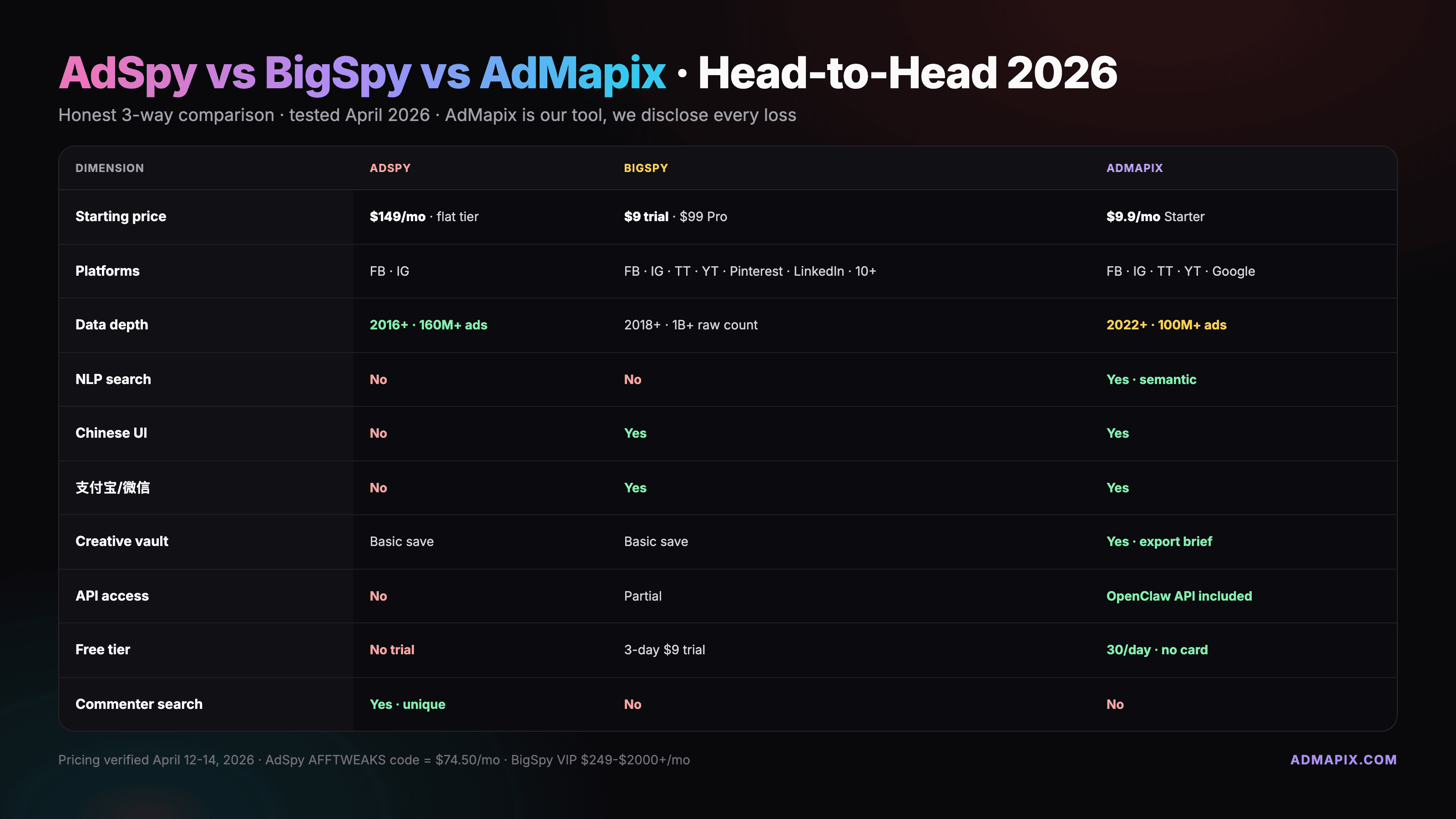
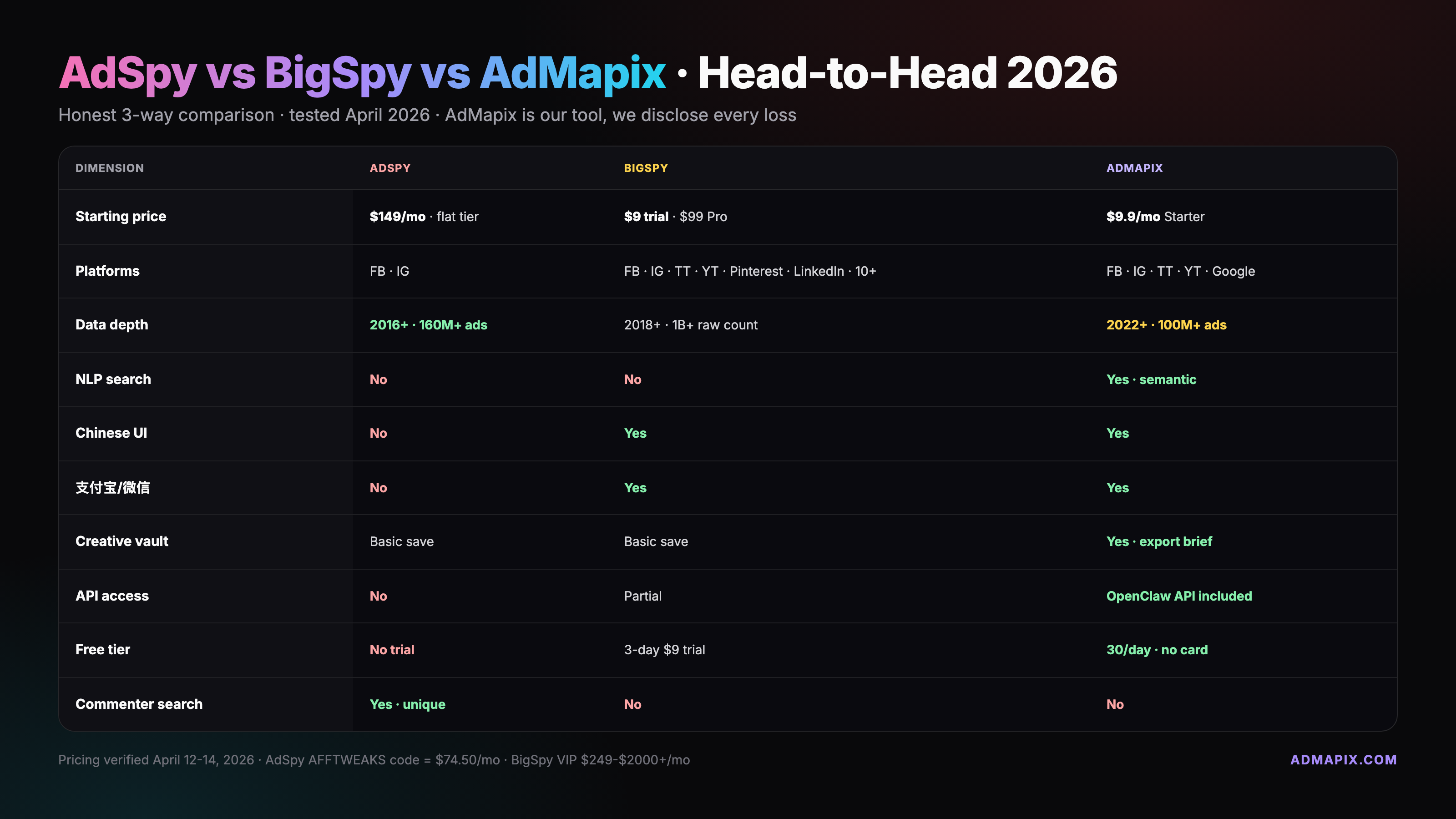
| Decision factor | AdSpy | BigSpy | AdMapix |
|---|---|---|---|
| Public price observed | $149/month | Free $0; Pro $149/month; VIP custom annual pricing | Free $0; Starter $19.90; Pro $49.90; Enterprise $89.90/month |
| Public trial/free access | Registration and subscription flow; verify current terms | Free plan; vendor FAQ lists a $1 three-day Pro trial | Free plan with 30 lifetime credits |
| Core research shape | Facebook and Instagram depth | Multi-network creative discovery | Creative records plus app and market intelligence |
| Search documented publicly | Text, advertiser, URL, comments, affiliate and landing-page filters | Ad Info Search, descriptive Feature Search, and Visual Search | Structured search and filters over available indexed records |
| Saved-creative workflow | Saved research within the product | Swipe File, boards, tags, ratings, downloads, Chrome extension | Verify the current web workflow against your use case |
| Programmatic/research output | Primarily interactive product | Primarily interactive product | Structured Agent/API data; hosted Web Deep Research is separate |
| Freshness statement | Vendor-controlled; verify in product | Vendor says data is updated daily | Snapshot is dated; no verified hourly SLA is published |
Prices and feature access can change by plan, industry, network, and region. Recheck each vendor's checkout before purchasing.
AdSpy: best for focused Meta research
AdSpy's official site currently presents one $149 monthly plan and describes a database focused on Facebook and Instagram. Its strongest differentiation is not merely record count; it is the range of Meta-oriented research fields.
AdSpy documents searches across ad text, advertiser name, URL, landing-page technology, affiliate network, affiliate ID, offer ID, and advert comments. That makes it useful for researchers who already know the type of Meta evidence they need and want to build precise queries around it.
Choose AdSpy when:
- Facebook and Instagram are the center of the workflow;
- comment text or affiliate fields are material to the research question;
- the team values granular filters more than multi-network breadth;
- a flat premium subscription is justified by frequent use.
Do not choose AdSpy solely because a third-party article says an ad “performed.” Ad duration, reactions, and comments are useful signals, but they do not reveal the advertiser's private profit, attribution window, or true return on spend.
BigSpy: broad discovery, AI search, and a real Swipe File
BigSpy's current public homepage shows a Free plan at $0, Pro at $149 per month, and custom annual VIP pricing. Its FAQ also describes a $1 three-day Pro trial. The same homepage reports 1B+ ad creative data points across 10 channels, 71 countries, and 23 languages, with daily updates. Those are vendor-reported figures and should be labeled as such.
The current product is materially stronger than older comparison articles suggest. BigSpy's Ad Library guide documents three discovery modes:
- Ad Info Search for keywords and business information;
- Feature Search for descriptions of visual content, people, actions, scenes, and styles;
- Visual Search using an uploaded image, video, or media URL.
It also documents relevance and similarity sorting, latest/last-seen/running-days signals, saved filters, and three deduplication modes. Its separate AI Search guide explicitly describes Chinese and English descriptive queries.
BigSpy also has a documented Swipe File workflow: a Chrome extension can save ads from major libraries into a cloud library, and saved creatives can be organized with boards, tags, ratings, filters, and downloads. That is a substantive collection workflow, not a simple favorites button.
Choose BigSpy when:
- multi-network creative discovery is the main job;
- visual similarity and descriptive discovery matter;
- a team needs a mature swipe-file collection workflow;
- trend sorting and broad browsing are more important than app revenue or ranking data.
The main caveat is evidence interpretation. BigSpy's Creative Score, estimated impressions, popularity, and vendor database totals are useful discovery aids, but none is the advertiser's audited spend or ROAS.
AdMapix: creative plus app-market research
AdMapix's current public plans are Free, Starter, Pro, and Enterprise. The Free plan includes 30 lifetime credits. Paid plans are $19.90, $49.90, and $89.90 per month with 300, 2,000, and 4,000 monthly credits respectively. Credits are billing units whose consumption varies by endpoint or AI task; one credit should not be described as one universal search.
The dated July 10, 2026 methodology snapshot records 91,350,717 searchable creative combinations, 174 country or territory filter labels, and 231 media labels. These figures need their definitions:
- “creative combinations” are not unique media files;
- record types can overlap and must not be summed into a total;
- a media label can represent an app, placement, publisher, or platform, so it is not automatically an ad network;
- the snapshot proves what was available on the observation date, not a guaranteed update interval.
AdMapix is most differentiated when creative research needs to connect to app and market questions. The Agent Skill returns structured raw data for creatives, apps, rankings, downloads, revenue, and market metadata. The hosted Web Deep Research product is a separate workflow that can collect data, analyze it, and render a report. Model-assisted conclusions still need to be read with their source period, assumptions, and limitations.
Choose AdMapix when:
- creative evidence must be combined with app rankings or market estimates;
- a team needs structured data for an agent or internal workflow;
- a hosted research report is more useful than a saved-creative board;
- the lower entry price matters and the available indexed fields fit the question.
Do not choose AdMapix on the assumption that every media label is a network, that the coverage number counts unique ads, or that any hourly freshness guarantee exists.
Head-to-head: search and discovery
The old “filters versus AI” framing is no longer accurate.
- AdSpy is strongest when the query is built around Meta-specific text, comments, advertiser, affiliate, or landing-page fields.
- BigSpy combines structured filters with descriptive Feature Search and Visual Search.
- AdMapix provides structured search over its available records and connects the result to app and market datasets; a host agent can translate a request into API parameters, but that orchestration should not be presented as a standalone website-search feature.
For a fair trial, give every tool the same research brief and score four things: result relevance, evidence fields, reproducibility, and time to a decision. Do not score only the number of results.
Head-to-head: coverage and freshness
Coverage claims are unusually easy to misuse. A “channel,” “network,” “media label,” “creative combination,” and “unique media file” are different units.
Use this checklist before comparing database size:
- What exactly is being counted?
- Is the number deduplicated?
- Which networks are available on the plan you will buy?
- Does the record include first-seen, last-seen, advertiser, country, and source fields?
- Is freshness a measured SLA or a vendor statement?
- Can you reproduce the result a week later?
BigSpy says its materials update daily. AdMapix publishes dated snapshots and no verified hourly SLA. AdSpy describes a growing database but buyers should confirm recency inside the product. These statements are not directly comparable and should not be forced into a single “hours of delay” table.
Head-to-head: saved creatives and team output
BigSpy has the clearest publicly documented saved-creative workflow of the three: extension capture, boards, tags, ratings, search, filters, and downloads.
AdSpy is better evaluated as a Meta research interface. AdMapix is better evaluated on structured data and research-report output. If your team's real deliverable is a creative board, test BigSpy's Swipe File. If it is an evidence-backed app or market report, test AdMapix's research flow. If it is a tightly filtered Meta evidence set, test AdSpy.
Decision framework by team type
Solo media buyer
Start with official free libraries and the free plans. Pay only after you can name the repeated task that the subscription removes. BigSpy gives broad browsing and collection; AdMapix has the lowest paid entry; AdSpy makes sense when Meta-specific filters are already revenue-critical.
DTC creative team
BigSpy is the strongest candidate when the deliverable is a shared inspiration library. AdMapix becomes more relevant when the team also needs app or market evidence and a report. Run both against one live brief before choosing.
Mobile app or game team
Compare BigSpy's Game/Tool search, top-creative filters, and visual discovery with AdMapix's app, ranking, download, and revenue datasets. The better choice depends on whether the weekly decision is “which creative pattern?” or “which app/market opportunity?”
Affiliate or Meta specialist
AdSpy remains distinctive for comment and affiliate-oriented fields. Verify that those fields are present and useful for the exact market before committing to the premium plan.
Agency
Agencies often need two layers: a discovery tool and a defensible client output. BigSpy can serve discovery and collection; AdMapix can serve structured research and reports; AdSpy can be added for Meta-heavy accounts. Standardize the source date and evidence caveats in every client deliverable.
FAQ
Is BigSpy still the cheapest paid option?
Not according to its public homepage reviewed August 13, 2026. The page shows Free at $0 and Pro at $149 per month, with VIP pricing customized annually. Its FAQ lists a $1 three-day Pro trial. Older Basic and Pro price ladders should not be treated as current without checking the live checkout.
Does BigSpy support descriptive or visual search?
Yes. BigSpy documents Feature Search for descriptive visual queries and Visual Search using images, videos, or media URLs. Its AI Search guide also describes Chinese and English descriptive input.
Does BigSpy have a swipe file?
Yes. Its current guide documents a Chrome extension, cloud library, boards, tags, ratings, filters, and downloads.
What can public ad intelligence prove?
It can show creative, advertiser, source, dates, engagement fields, and other visible or modeled signals depending on the product. It generally cannot prove private spend, attribution, margin, or ROAS. Treat scores and estimates as hypotheses for testing.
Which tool should I buy first?
Buy the tool that matches the weekly decision: AdSpy for deep Meta queries, BigSpy for broad creative discovery and collection, or AdMapix for creative plus app/market research. Test with the same brief and keep the one that produces the most reproducible evidence.
Sources and review policy
- AdSpy official product and pricing page
- BigSpy official homepage and pricing
- BigSpy FAQ
- BigSpy Ad Library guide
- BigSpy Swipe File guide
- BigSpy AI Search guide
- AdMapix pricing
- AdMapix methodology
- Direct AdMapix vs BigSpy comparison
This page should be rechecked after any material pricing, plan, search, coverage, or workflow change, and at least monthly while it targets a commercial comparison query.
Turn these observations into your next creative study
Open the creative library and select samples for your market, network and research question.
Related Articles
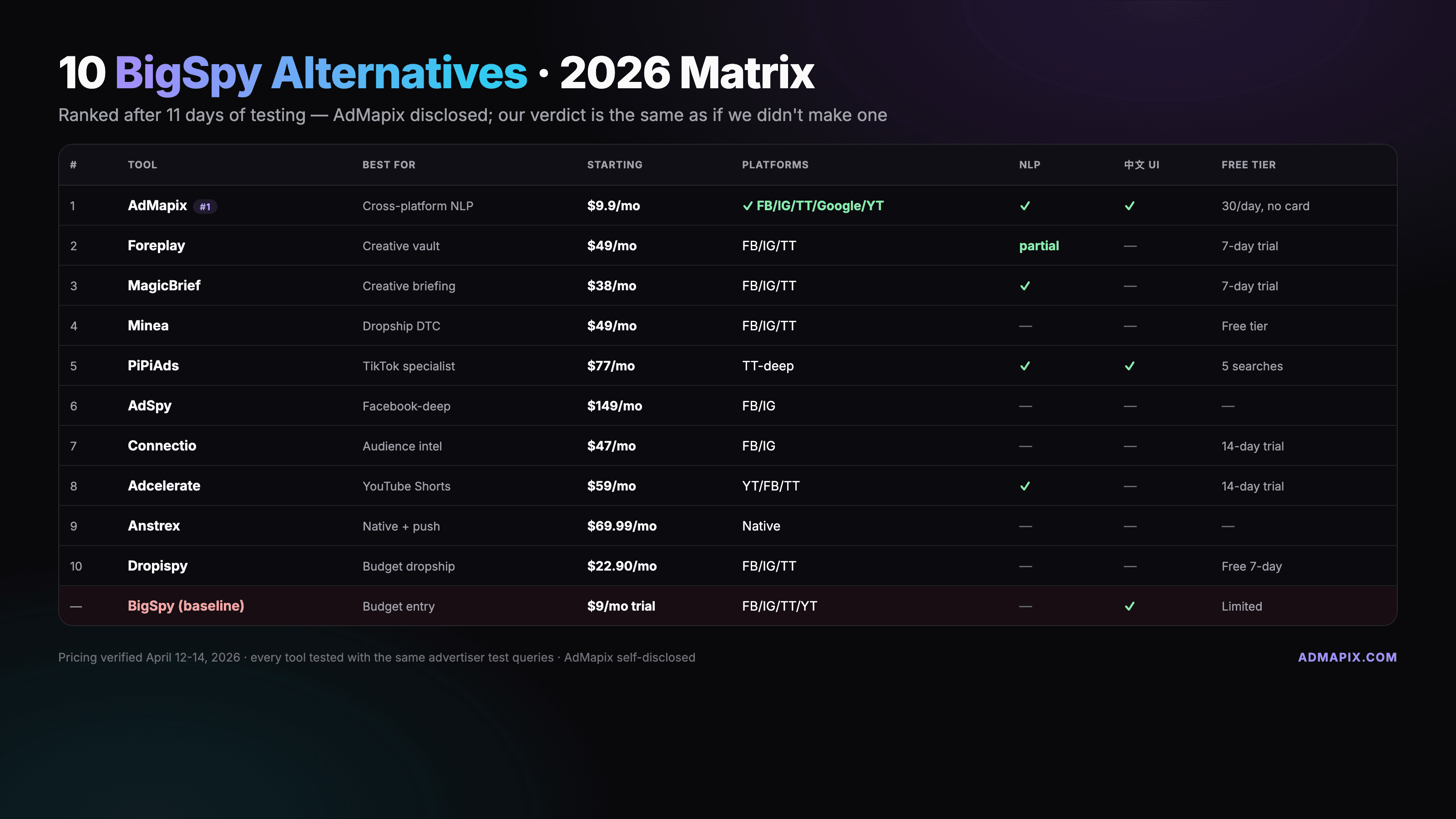
Best BigSpy Alternatives in 2026: Choose by Workflow
An evidence-based guide to BigSpy alternatives for Meta depth, app-market data, TikTok product research, PPC, display, native, and creative collection—with a migration checklist. Reviewed August 13, 2026.

Advertising Optimization Best Practices for Global Growth
A practical playbook on creative workflows, A/B testing, benchmarking, and budget allocation to improve ad performance across regions and platforms.
Ad Optimization Best Practices for 2026: A Practical Playbook
A data-driven guide to creative workflows, A/B testing, benchmarking, and budget allocation frameworks for optimizing digital ad performance.