
App Store Keyword Research:ASO 团队的实用关键词工作流
一套实用 app store keyword research 工作流:寻找 app store keywords、判断搜索意图、跟踪 app store rankings,并把 ASO 与 paid UA 连接起来。
App store keyword research 最好把关键词发现、商店页 metadata、视觉资产、实验和 ranking checks 放进同一套 operating system。
App Store Keyword Research:ASO 团队的实用关键词工作流
App store keyword research 指找到用户在 App Store 和 Google Play 内会搜索的词,并把这些词转化为更好的 metadata、screenshots、experiments 和 measurement。它不是简单从 app store optimization tools 里导出一张关键词表。
对 ASO 团队来说,真正有价值的产出是一张决策地图:
| 决策 | Keyword research 应该回答什么 |
|---|---|
| Metadata | 哪些词应该进入 app name、subtitle、keyword field、short description 或 long description |
| Creative | 哪些 app store keywords 需要截图或 preview 来承接 |
| Ranking | 哪些 app store rankings 需要按市场持续跟踪 |
| Localization | 哪些词会因国家、语言或 category 改变 |
| Paid UA | 哪些搜索意图适合用广告、custom pages 或 landing pages 测试 |
| Web SEO | 哪些 store-aware terms 需要 Google 搜索页面支撑 |
这篇文章会拆解一套 app store keyword research、app store keywords、app store rankings、app store optimization tools 和 app SEO 之间的工作流。如果你正在搭更完整的 app discovery system,可以先看 app SEO guide 和 paid user acquisition guide,再用本文作为 ASO keyword layer。
App Store Keyword Research 和普通 SEO 有什么不同
App store keyword research 比普通 SEO keyword research 更接近安装场景。用户在 Google 搜 “photo editor” 可能还在研究;但在 app store 里搜同一个词,通常已经在寻找可以安装的 app。
这会带来四个差异:
| 差异 | 实际影响 |
|---|---|
| Store search 更接近 install intent | 不只看 search volume,还要看 relevance 和 conversion |
| Metadata 空间有限 | 不能用一篇长文覆盖所有词 |
| Visual assets 很关键 | Screenshots、previews、icons 会影响关键词意图的转化 |
| Ranking 按市场变化 | App store rankings 会因国家、语言和 category 不同而变化 |
Apple 的 product page 指南强调 metadata、screenshots、previews、ratings、reviews、categories 和 localization 都会影响用户发现与评估 app。Apple 也说明 keyword field 总长度限制为 100 characters,并提醒不要使用无关词、竞争对手 app name 或重复词。Google Play 的 store listing experiments 页面强调可以测试 store listing text 和 graphics,并观察 installs 与 retention。
所以,app store keyword research 不能只停留在 volume。它必须决定写什么、展示什么、测试什么、跟踪什么。
Step 1:建立关键词来源
不要只依赖一个来源,因为没有任何单一工具能完整看到需求。
| 来源 | 提供什么 | 单独使用的风险 |
|---|---|---|
| Store search suggestions | 真实搜索语言 | 容易过度集中在明显 head terms |
| Competitor metadata | Category vocabulary 和 positioning | 可能复制竞品的弱假设 |
| Reviews | 用户痛点和 feature language | 噪声多,情绪偏差大 |
| Paid search / paid social terms | 广告转化语言 | 可能反映广告定向,而不是 store search |
| Search Console / SEO tools | App category 的 web demand | 未必等同于 app store 内搜索 |
| App store optimization tools | Volume estimates、difficulty、ranking history | 数据是模型化估算,需要验证 |
每个关键词不要只记录 phrase,还要记录决策字段:
| 字段 | 示例 |
|---|---|
| Keyword | “app store keyword research” |
| Intent | 学习 ASO keyword workflow |
| Surface | App Store、Google Play、Google Search 或 paid UA |
| Market | US、UK、JP、DE、BR 等 |
| Page 或 asset owner | Store metadata、screenshot、blog guide、landing page |
| Current rank | Not ranked、top 50、top 20、top 10 |
| Difficulty | Low、medium、high |
| Evidence | Suggestion、tool estimate、competitor、review、ad test |
这样可以避免一个常见错误:把所有关键词当成同一种任务。“App store keywords” 可能适合 ASO guide;“best calorie counter app for athletes” 可能适合 use-case landing page 加 store screenshots;“competitor alternative” 可能需要 comparison page 和 paid landing page。支撑这些关键词的 web content 仍然要遵守页面质量基本原则:Google 的 SEO starter guide 建议内容应有用、结构清晰、原创,并面向真实用户。
Step 2:区分 Store Intent 和 Web Intent
同一个词在不同搜索场景里的意图可能不同。
| Query | 可能的 store intent | 可能的 Google intent | 推荐 owner |
|---|---|---|---|
| app store keyword research | 学习流程或评估工具 | 学习 ASO workflow | 本文 |
| app store keywords | 理解 keyword field 和 ranking logic | 学 Apple/ASO mechanics | ASO support page 或 section |
| app store rankings | 看 rank movement 或 ranking factors | 学 tracking 和 benchmark 方法 | Ranking workflow section |
| app store optimization tools | 比较工具 | 比较 tool categories 和 workflows | Tool selection page 或 section |
| app seo | 连接 web search 与 app discovery | 更大的 SEO/ASO strategy | App SEO pillar |
目标不是把所有词都塞进一篇文章,而是判断搜索者到底想要:
| Intent | 最合适的内容或资产 |
|---|---|
| Learn | Guide、glossary、checklist、workflow |
| Compare | Tool comparison、alternative page、category report |
| Install | Store metadata、screenshots、app preview、product page |
| Troubleshoot | FAQ、support page、review-response insight |
| Validate | Report、benchmark、competitor analysis |
对 AdMapix 当前内容集群来说,本文承接 “app store keyword research”。App SEO guide 承接更广的 “app seo” 意图。Paid user acquisition 承接 paid campaign planning。这样可以降低 keyword cannibalization。
Step 3:按用户任务聚类 App Store Keywords
不要只按词形相似度聚类,要按用户想完成的 job 聚类。
| Cluster | 示例关键词 | Asset decision |
|---|---|---|
| Category | “habit tracker app”、“budget planner app” | App name、subtitle、first screenshots、category landing page |
| Feature | “receipt scanner”、“sleep sounds”、“AI photo enhancer” | Screenshot sequence、app preview、feature page |
| Use case | “budget app for couples”、“language app for travel” | Use-case copy、custom page、localized store assets |
| Problem | “stop overspending”、“learn vocabulary faster” | Blog guide、benefit-led screenshot、onboarding copy |
| Competitor | “app name alternative” | Comparison page、paid landing page、review mining |
| Locale | 本地市场表达 | Localized metadata、screenshots、experiments |
Keyword clustering 是 ASO 和 creative strategy 交汇的地方。如果高价值关键词是 feature-led,用户应该在第一屏看到这个 feature。如果关键词是 use-case-led,第一张截图应该展示使用场景。如果关键词是 problem-led,文案应该直接说清楚结果。
App store optimization tools 可以帮助收集和监控,但不应该替你做战略判断。工具负责 discovery 和 tracking,cluster map 负责决定改哪里。
Step 4:把关键词映射到 Store Metadata
不同平台的 metadata 规则不一样,不能用一张通用 checklist。
| 区域 | Apple App Store | Google Play |
|---|---|---|
| Name / title | 重要 discovery field,有字符限制 | 重要 discovery field,有字符限制 |
| Subtitle / short description | 用一句话说明 value 和 use case | 影响用户扫描,也可用于 store listing experiments |
| Keyword field | Apple 提供专门 keyword field,总长度 100 characters | Google Play 不使用同样的 hidden keyword field 模型 |
| Long description | 清楚解释 value,不要堆词 | 影响 relevance 和 conversion,但仍要可读 |
| Screenshots / previews | 对 conversion 和 search-result scanning 很关键 | 对 conversion 和 experiment learning 很关键 |
| Localization | Metadata、keywords、screenshots、previews 都应适配市场 | Listing text 和 graphics 可本地化并测试 |
Apple 在 App Store product page documentation 中明确提醒不要做不必要的 keyword stuffing,也不要使用无关关键词。这意味着 keyword field 不是垃圾桶,而是一个有限空间内的选择题。
优先级可以这样排:
| Priority | 判断方式 |
|---|---|
| 1. Relevance | 关键词是否准确描述 app 或核心 feature |
| 2. Intent strength | 查询是否暗示用户很快会安装或评估 |
| 3. Competitive gap | App 是否有机会进入有价值的 app store rankings |
| 4. Asset support | Screenshots 和 copy 是否能证明承诺 |
| 5. Market fit | 这个表达是否适合对应国家和语言 |
如果关键词不相关,不要用。如果相关但没有视觉资产支撑,要先决定是否更新产品叙事,而不是直接追 ranking。
Step 5:监控 App Store Rankings,但不要过度反应
App store rankings 有价值,但不是完整 ASO scorecard。
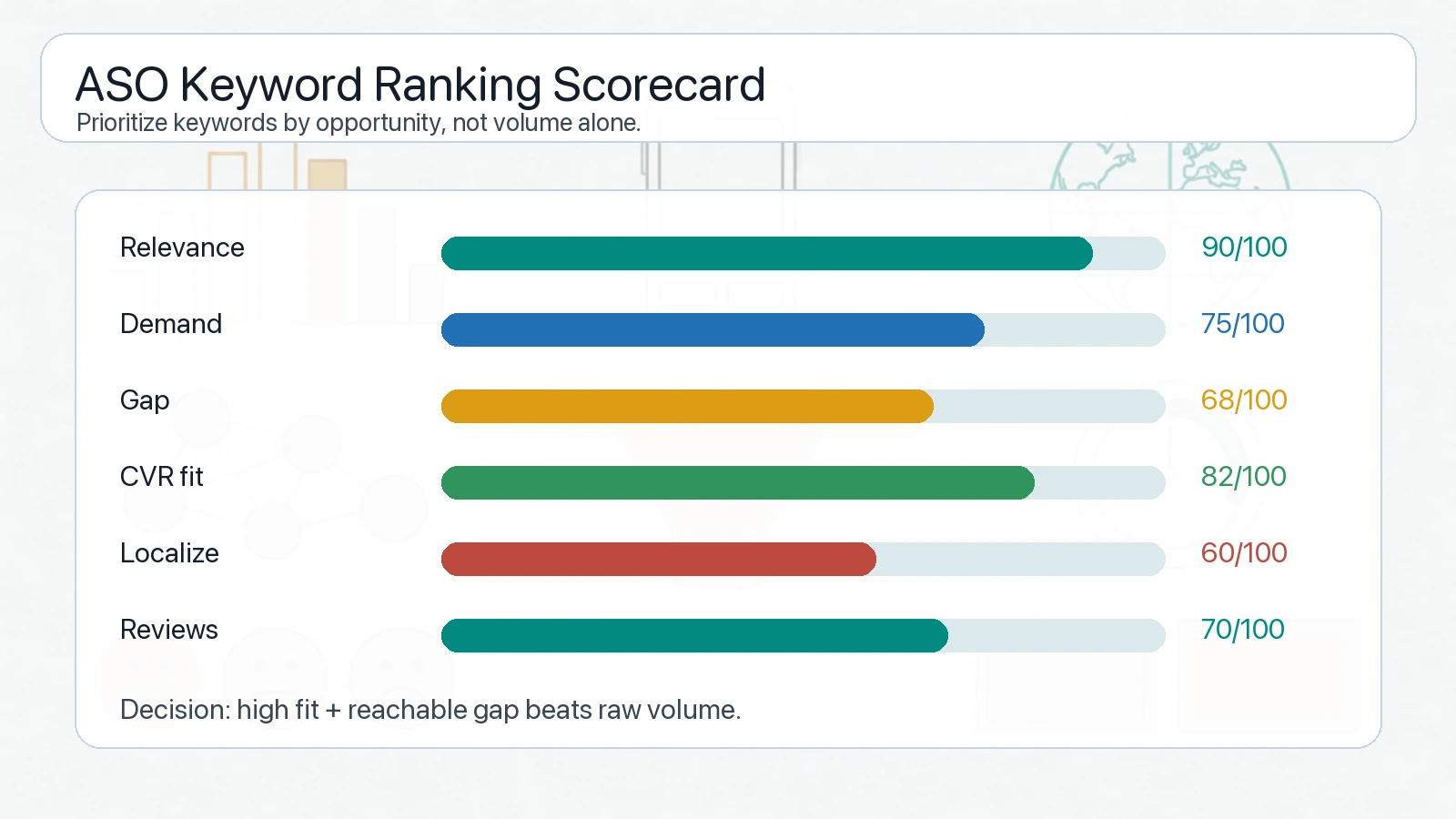
有用的 app store keyword scorecard 会把 rankings、conversion、localization、reviews 和 quality signals 放在一起。
建议按市场和 cluster 跟踪:
| Metric | 为什么重要 |
|---|---|
| Current keyword rank | 显示每个 target term 的 visibility |
| Rank movement | 判断 metadata 或 asset changes 是否有效 |
| Impression trend | 判断关键词是否有可触达 demand |
| Store conversion rate | 判断流量是否 qualified |
| Activation / retention | 判断 installs 是否有质量 |
| Rating / review language | 判断用户预期是否和产品匹配 |
不要因为每天的波动就修改策略。App store rankings 可能受竞争、季节性、ratings、store tests、ad campaigns 或市场变化影响。活跃测试可以按周看趋势,战略决策按月复盘更稳。
更好的问题不是 “今天排名是不是高了”,而是 “这个 keyword cluster 在 metadata 和 creative 调整后,是否带来了更高质量的 discovery”。
Step 6:把 App Store Optimization Tools 当成工作流工具
App store optimization tools 有用的前提,是它们帮助团队做决策,而不是制造更大的导出表。
评估工具时看 workflow:
| Tool capability | 应该检查什么 |
|---|---|
| Keyword discovery | 是否能找到 long-tail、competitor 和 localized terms |
| Ranking tracking | 是否能按 country 和 device 监控 app store rankings |
| Competitor analysis | 是否能比较 metadata、screenshots、ratings 和 category moves |
| Review mining | 是否能提取反复出现的用户语言和 unmet expectations |
| Localization support | 是否能按语言和市场拆分关键词 |
| Reporting | 是否能解释发生了什么,以及为什么重要 |
| Export and collaboration | SEO、ASO、creative、UA 是否能共用同一张 map |
最小可用 stack 可以很轻:
| Layer | Lightweight setup |
|---|---|
| Discovery | Store suggestions、competitor pages、review mining、一个 ASO tool |
| Prioritization | 带 intent、market、asset owner 的 shared keyword map |
| Tracking | Weekly rank 和 conversion snapshot |
| Creative testing | Apple product page optimization 或 Google Play store listing experiments |
| Feedback | Monthly review:rankings、conversion、retention、reviews |
如果团队也做 paid app campaigns,就应该把 ASO tools 和 creative intelligence 连接起来。用 AdMapix reports 研究竞品 messaging 和 creative patterns,再把已验证角度转化为 store screenshots、custom pages 和 landing pages。预算层面可以参考 pricing。
Step 7:把 App Store Keyword Research 连接到 Paid UA
Paid user acquisition 可以比 organic ranking 更快验证 keyword intent。
推荐反馈循环如下:
| Step | Output |
|---|---|
| 选择一个 keyword cluster | 例如 “AI photo enhancer” |
| 建立 message hypothesis | Speed、quality、privacy、style 或 one-tap workflow |
| 测试 creatives 和 landing pages | Paid social、search、custom page 或 web landing page |
| 衡量 downstream quality | Install conversion、activation、retention、trial start |
| 更新 store assets | Screenshots、subtitle、description、localization |
| 跟踪 ranking 和 conversion | 观察调整后的 app store rankings 与 store conversion |
这样可以避免 ASO 变成纯语义练习。关键词只有在产品能满足预期、store page 能完成转化时才有价值。
增长团队最好把这些系统连接起来:
| System | 作用 |
|---|---|
| App store keyword research | 找 install-intent language |
| App SEO | 捕捉 app category 周边更大的 search demand |
| Paid UA | 测试角度并加速学习 |
| Creative intelligence | 观察竞品正在强调什么 |
| Store experiments | 验证 store page 上的 text 和 graphics |
所以,keyword research 不应该只属于 ASO,应被 SEO、product marketing、creative 和 UA 团队共同使用。
App Store Keyword Research Checklist
改 metadata 前,用这张 checklist 过一遍:
| Check | Pass condition |
|---|---|
| Search intent | 每个 keyword 都有明确 install、compare、learn 或 problem intent |
| Platform fit | Apple 和 Google Play 字段分开映射 |
| Relevance | 没有不相关、商标或不当竞品词 |
| Asset support | 重要关键词承诺能在 screenshots 或 previews 中看见 |
| Localization | Priority markets 有单独 keyword 和 creative check |
| Ranking baseline | 改动前记录当前 app store rankings |
| Conversion baseline | 改动前记录 store conversion 和 quality metrics |
| Internal links | 支撑 SEO 页面指向正确 ASO 或 app SEO 页面 |
| Review loop | 积累足够 impressions 和 conversions 后复盘 |
如果没有 baseline,就推迟改动或把改动标记为 exploratory。多个字段、screenshots、paid campaigns 和 localization 同时变化时,ASO 结果很难解释。
FAQ
What is app store keyword research?
App store keyword research 是寻找和优先排序 app store 内搜索词的过程,并把这些词映射到 metadata、creative assets、localization、experiments 和 ranking tracking。
Are app store keywords the same as SEO keywords?
不是。App store keywords 更接近安装和 store evaluation intent。SEO keywords 通常包含更宽的教育、比较和 problem-aware searches。两者应该共享洞察,但不应该完全使用同一张关键词表。
How should I track app store rankings?
按 keyword、country、device 和 cluster 跟踪 app store rankings。同时观察 impressions、conversion、activation、retention 和 review language,避免只优化没有用户质量的 visibility。
Which app store optimization tools are most important?
最重要的 app store optimization tools 是能支持你工作流的工具:keyword discovery、ranking tracking、competitor metadata、review mining、localization、reporting 和 collaboration。单纯 database size 不够。
How does app store keyword research support app SEO?
App store keyword research 提供 install-intent language。App SEO 可以用这些语言搭建 web pages、guides、reports 和 comparison pages,在用户进入商店前捕捉更大的 search demand。
Conclusion
好的 app store keyword research 会把关键词表变成 operating system。它告诉 ASO 团队写什么,告诉 creative 团队展示什么,告诉 growth 团队测试什么,也告诉 SEO 团队哪些页面应该支撑 app discovery。
从核心 keyword map 开始,区分 store intent 和 web intent,按用户 job 聚类,映射到平台特定 metadata,并把 app store rankings 与 conversion quality 一起跟踪。然后把这套流程连接到 app SEO、paid user acquisition 和 competitive ad intelligence reports,让关键词工作不断复利,而不是停留在一张表里。
把观察变成下一次创意研究
打开素材库,选择与你的市场、渠道和研究问题相关的样本。
相关文章
App SEO:如何让 App 页面排名并支持 ASO
App SEO 指南:讲清楚 SEO for apps、ASO、app store keywords、内容集群、商店页实验和 paid UA 之间的关系。
Paid User Acquisition:App 增长团队的投放策略
一篇面向 app 团队的 paid user acquisition 指南,覆盖渠道策略、创意测试、预算规则、归因指标和竞品广告研究工作流。
Video Game Marketing:独立游戏和手游团队实战指南
面向独立游戏和手游团队的 2026 video game marketing 指南,覆盖定位、渠道、game ads、创作者、竞品研究和 30/60/90 天发布计划。