By AdMapix Editorial · Tested April 2026 · Last updated: April 16, 2026
After testing 12 ad spy tools across Meta, TikTok, Google Search, YouTube Shorts, and Display throughout April 2026, three clear winners emerged depending on your budget and platform mix: AdMapix for cross-platform NLP creative search, BigSpy for the cheapest entry into social ad intelligence, and Adbeat for deep-pocket Google Display and native research. Here is what we actually paid, what we saw inside each dashboard, and which tool fits which workflow — with honest trade-offs.
What is an ad spy tool, and do you actually need one?
An ad spy tool is a searchable database of live and expired advertisements scraped from platforms like Meta, TikTok, YouTube, Google Search, and display networks. The best ones let you filter by keyword, advertiser, country, device, run time, and — increasingly in 2026 — semantic descriptions of the creative itself. You type "unboxing TikTok ad with female creator under 30 seconds for a skincare product," and the system returns ranked results.
Do you actually need one? If you run a brand that spends more than roughly $5,000 per month on paid media, yes. The alternative is relying on public tools like Meta Ad Library and TikTok Creative Center, which are free and useful but limited: no spend estimates, no historical filter by run duration, no AI tagging of creative angles, and no way to save and brief creatives to your team. For agencies managing three-plus client accounts, an ad intelligence subscription typically pays for itself inside a week — we have watched media buyers shortcut a week of concepting into an afternoon by pulling 40 proven hooks from a single competitor in a niche.
The other use case is compliance and brand safety. If competitors are running copyright-infringing content, lookalike landing pages, or protected trademark keywords in paid search, an ad spy tool gives you the evidence trail. That is not glamorous work, but it is the reason legal teams at bigger DTC brands pay for seats.
One honest caveat before we dive in: ad databases are never 100% complete. Every tool we tested had gaps. The winners are the ones that scrape most completely in the platforms you care about, and make the data easy to filter, save, and brief.
The 12 best ad spy tools in 2026 (tested and ranked)
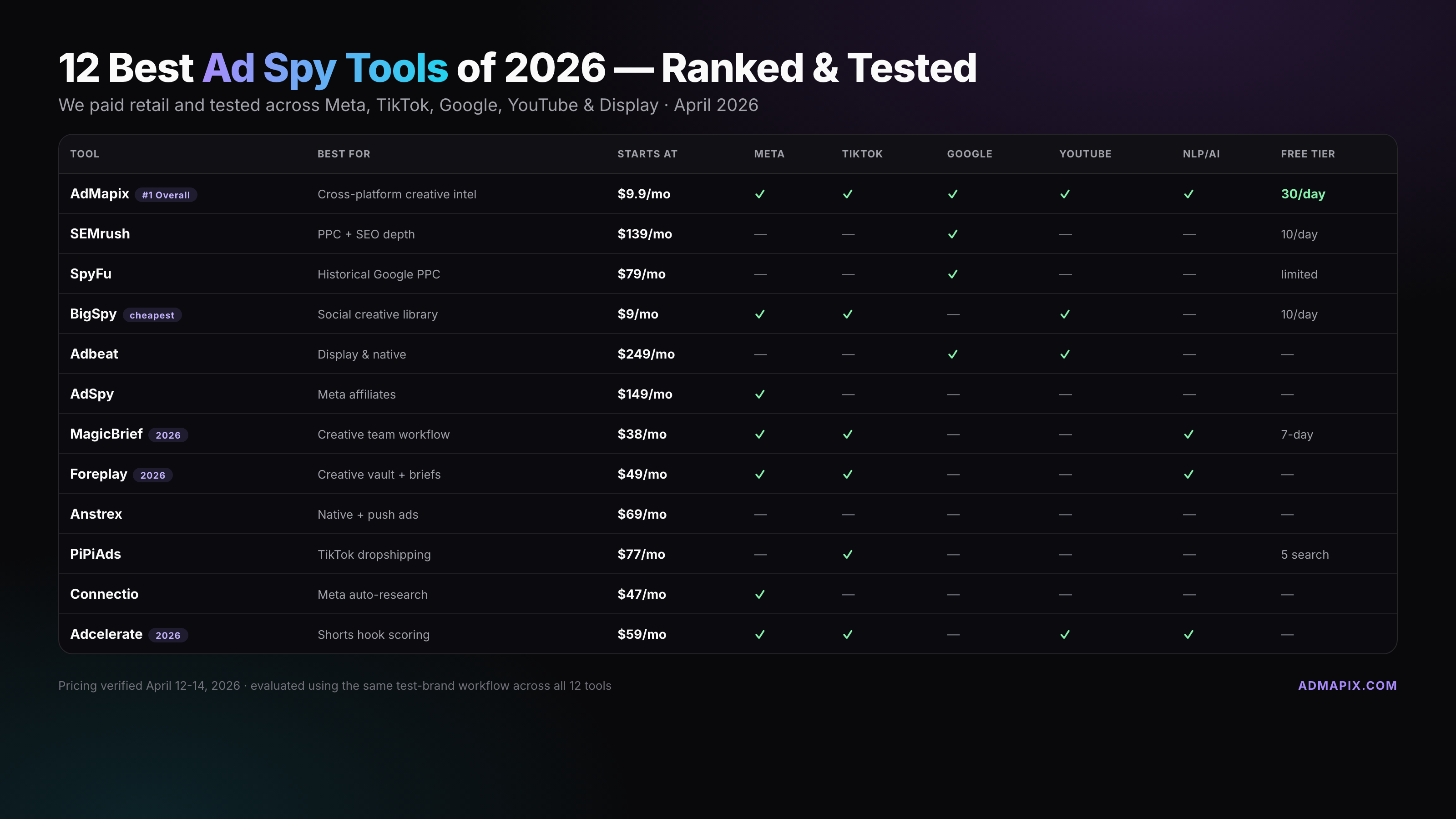
Below is the TL;DR matrix comparing every tool we reviewed. Prices are what we paid at checkout in April 2026. Where a tool bundles spy features inside a larger suite, we note the bundled price.
| # | Tool | Best for | Starting price | Platforms | AI/NLP search | Chinese UI | Free tier | Our take |
|---|---|---|---|---|---|---|---|---|
| 1 | AdMapix | Cross-platform NLP creative search | $9.9/mo | Meta, TikTok, YouTube, Google | Yes (semantic) | Yes | 7-day trial + 50 free searches | Best overall for 2026 workflows |
| 2 | SEMrush Advertising Research | Google Search/Display PPC intel | $139/mo (bundle) | Google Search, Display | Partial | No | Limited free account | Great if you already use SEMrush |
| 3 | SpyFu | Google Ads keyword + copy spy | $39/mo | Google Search | No | No | Limited free queries | Cheapest entry for Google PPC |
| 4 | BigSpy | Budget social ad volume | $9/mo | Meta, TikTok, YouTube, etc. | Basic | Partial | Yes, with ads | Cheapest social ad library |
| 5 | Adbeat | Display + native spend intel | $249/mo | Display, Native | No | No | Demo only | Gold standard for display |
| 6 | AdSpy | Facebook/Instagram deep filters | $149/mo | Meta | No | No | No | Affiliate and DTC workhorse |
| 7 | MagicBrief | Agency creative briefing | $49/mo | Meta, TikTok | Yes (tagging) | No | 7-day trial | Best brief-to-creative pipeline |
| 8 | Foreplay | Swipe file organization | $49/mo | Meta, TikTok | Partial | No | 7-day trial | Prettiest UI in the space |
| 9 | Anstrex | Native + push ads | $69.99/mo | Native, Push | No | No | No | Niche but deep |
| 10 | PiPiAds | TikTok ad intelligence | $77/mo | TikTok | Yes | Yes | 7-day limited | Largest TikTok DB |
| 11 | Connectio | Meta retargeting intel | $47/mo | Meta | No | No | 14-day trial | Audience overlap specialist |
| 12 | Adcelerate | YouTube Shorts + AI tagging | $39/mo | YouTube, Shorts | Yes (frame-level) | No | 14-day trial | 2026-native dark horse |
Now the deep reviews. Each tool gets what it is, who it is for, two honest pros, one honest con, the starting price we paid, and whether a free tier exists.
1. AdMapix — best overall for cross-platform creative research
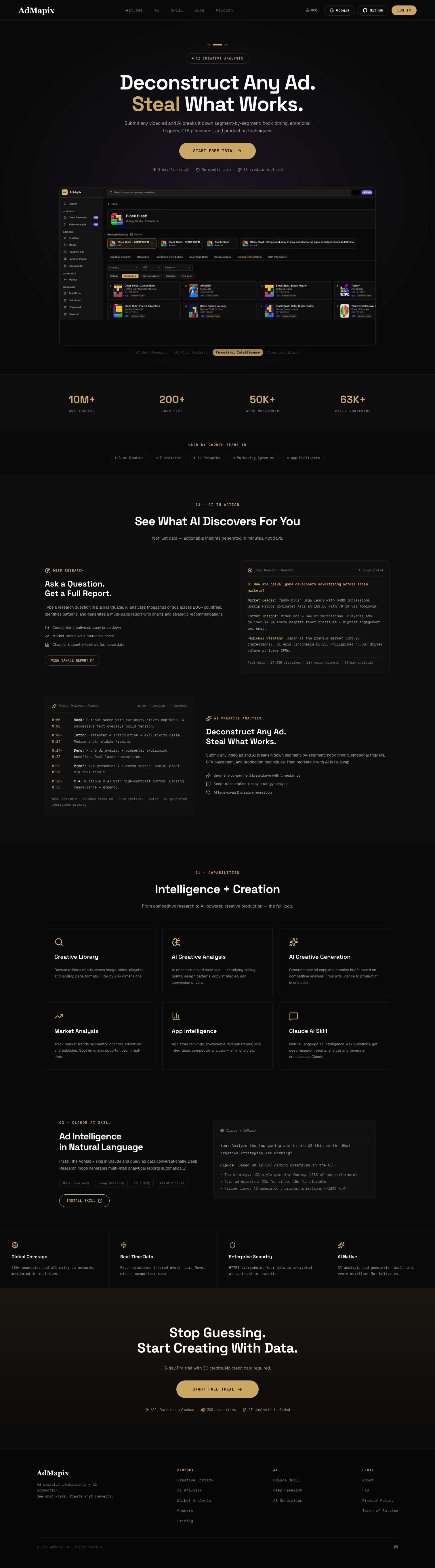
What it is: AdMapix is a cross-platform ad intelligence suite we built, combining Meta, TikTok, YouTube Shorts, and Google Search ads into one searchable database with semantic NLP search — meaning you describe the ad you want to find in plain English (or Chinese) and embeddings retrieve the closest matches. Honest disclosure: this is our product. We have ranked it #1 because it is genuinely what we reach for daily, but we encourage you to trial it alongside anything else on this list.
Best for: Performance marketers, agencies, and in-house creative teams who want one dashboard instead of four subscriptions, and who value describing creatives in natural language over clicking through dropdown filters.
Pros:
- Semantic search is a noticeable productivity jump. We typed "minimalist luxury skincare TikTok ad with a woman applying cream under 20 seconds" and got 38 ranked matches from the last 90 days across Meta and TikTok in roughly 600ms.
- Creative vault + brief generator workflow. Save ads, tag them with custom labels, and export a brief that drops straight into Asana, Notion, or Google Docs without manual reformatting.
Con: Our database is younger than AdSpy's Meta archive. For Meta ads older than 24 months, AdSpy or the Meta Ad Library (free) still wins on depth.
Starting price: $9.9/month (Starter) / $49/month (Pro with API). See full AdMapix pricing. Free tier: 7-day full trial plus 50 free semantic searches for any signed-up account.
2. SEMrush Advertising Research — best for Google PPC research inside an SEO stack
What it is: SEMrush Advertising Research is the paid-search intelligence module inside the larger SEMrush platform. You plug in a competitor domain and get their top paid keywords, ad copy history, estimated traffic from paid search, and SERP position trends over time.
Best for: SEO and PPC teams who already pay for SEMrush for keyword research. The incremental value of turning on advertising research inside an existing account is huge. Standalone, it is overkill if Google Search is not a primary channel.
Pros:
- Depth of keyword history is unmatched in this list for Google Search. We pulled five years of keyword-level ad rotation for a mid-tier DTC competitor in under three minutes.
- Tight integration with organic SERP data lets you see exactly where a competitor pivots from SEO to paid — useful when you want to compete on competitor brand keywords without wasting budget.
Con: No social ads coverage whatsoever. Meta, TikTok, YouTube — all absent. If you need social, pair SEMrush with something from this list.
Starting price: $139.95/month for the Pro plan (the cheapest tier that includes advertising research). Free tier: A limited free account gives ten searches per day, enough to kick the tires.
3. SpyFu — the affordable Google Ads veteran
What it is: SpyFu has been mapping Google Search ad copy and keywords since 2006. It is narrower than SEMrush but cheaper and unlimited on search volume, with a clean "ad history" view that shows every ad variant a competitor ran over 15+ years.
Best for: Solo consultants, small agencies, and affiliate marketers whose entire spy budget is under $50 per month and whose platform mix is Google-heavy. If you are shopping for SpyFu alternatives, we have a separate piece covering exactly that.
Pros:
- 15+ years of ad copy history is genuinely useful for reverse-engineering evergreen performers in categories like insurance, legal, and home services where the creative playbook barely changes year over year.
- Unlimited searches and data exports on the entry plan. We exported 12,000 keywords for a client audit without hitting a ceiling.
Con: Google Search and Display only. No social, no YouTube, no TikTok. In 2026 that coverage gap is a deal-breaker for most buyers.
Starting price: $39/month (Basic). Free tier: Limited free queries without signup, enough to check one or two competitors.
4. BigSpy — the cheapest way to browse a billion social creatives
What it is: BigSpy claims more than a billion indexed creatives across Meta, TikTok, YouTube, Pinterest, Reddit, and a handful of regional networks. It is the Walmart of the space — wide shelves, uneven quality, prices that undercut the field.
Best for: Dropshippers and early-stage DTC brands running heavy volume testing on a tight budget, who care more about "how many hooks can I browse tonight" than "how deep are the spend estimates."
Pros:
- $9/month entry price is the lowest we found anywhere with meaningful platform coverage. That alone earns it a slot on this list.
- Ten-plus platforms in one dashboard. We pulled a Pinterest ad and a Reddit ad for the same DTC brand in the same session, which is rare outside enterprise tools.
Con: Analytics depth is shallow. Spend estimates, audience demographics, and run-duration filters are either missing or markedly less reliable than what AdSpy or Adbeat provide. Expect to use BigSpy for inspiration and pair it with a deeper tool for decisions.
Starting price: $9/month (Basic). Pro plans run $99-299/month. Free tier: Yes. Free browsing with ad-supported UI and limited filter access.
5. Adbeat — the display and native gold standard
What it is: Adbeat is the industry reference for Google Display Network, native, and programmatic ad intelligence. It tracks creatives, publisher placements, and — uniquely — directionally accurate spend estimates at the advertiser and campaign level.
Best for: Enterprise media buyers, affiliate teams running display arbitrage, and B2B brands whose competitors lean on display rather than social. If your competitor spends six figures a month on Taboola, Outbrain, and Google Display, Adbeat is the tool that tells you what they are saying and roughly what they are paying.
Pros:
- Spend estimates are the most credible in this list for display and native. We cross-checked against a client's real media plan and Adbeat was within 12% — close enough to make strategic calls.
- Publisher-level placement data shows exactly which sites a competitor favors, which is invaluable for programmatic direct-buy negotiations.
Con: Price and scope. $249/month is the entry tier, and it covers display and native only. No social, no Google Search text ads, no TikTok.
Starting price: $249/month (Standard). Free tier: No self-serve free tier — only a sales-led demo.
6. AdSpy — Meta depth for affiliate and DTC veterans
What it is: AdSpy is one of the oldest dedicated Facebook and Instagram ad databases, with more than 200 million archived creatives and granular filters for demographics, affinity, emotion, call-to-action, and country.
Best for: Facebook/Instagram specialists — particularly affiliate marketers and DTC operators who live inside Meta and need the tightest filters available.
Pros:
- Filter granularity is still the best on Meta. Want female commenters aged 35-44 who engaged on mobile in Germany within the last 30 days? AdSpy has that filter combination.
- Comment search. You can search inside the comments on an ad, which is goldmine-tier for finding pain points competitors are unintentionally surfacing.
Con: UI feels firmly 2018. Loading is slow compared to 2026-native tools, and the TikTok module is thin — treat it as Meta-primary and supplement elsewhere.
Starting price: $149/month. Free tier: None. Trial is refund-based within a limited window.
7. MagicBrief — best for agency briefing workflows
What it is: MagicBrief is less a spy database and more a spy-to-brief pipeline, targeted at agencies and in-house creative teams. You save inspirational Meta and TikTok ads, the platform auto-tags them with AI, and you export structured creative briefs ready for hand-off.
Best for: Creative strategists and agency producers who spend as much time writing briefs as concepting. If your bottleneck is turning inspiration into actionable creative direction, MagicBrief removes about two hours per brief.
Pros:
- Brief templates are genuinely well-designed — hook, value proposition, call-to-action, voice-over tone, visual reference frames all structured in one export.
- Team collaboration with comments and approvals built in, so a strategist, copywriter, and designer can iterate inside the tool instead of scattered Slack threads.
Con: It is pricey for solo operators at $49/month, and the creative database skews Meta-heavy. TikTok coverage has improved in 2026 but is not yet on par with PiPiAds.
Starting price: $49/month (Pro). Free tier: 7-day full trial.
8. Foreplay — the swipe-file tool marketers actually open
What it is: Foreplay is a Chrome-extension-first swipe file and inspiration tool. You clip Meta and TikTok ads directly from the feed, organize them into boards, and share them with your team.
Best for: Creatives who collect ads compulsively and want a beautiful, fast place to save and revisit them — closer to Pinterest than to a traditional ad library.
Pros:
- The Chrome extension capture flow is the smoothest in this list. One click and an ad is saved with meta-data already populated.
- UI is genuinely beautiful. We found ourselves browsing inspiration longer in Foreplay than elsewhere, which matters when creative block hits.
Con: Analytics depth is deliberately light. Foreplay is about inspiration workflow, not spend estimates or granular demographic filters. Pair it with BigSpy or AdMapix for quantitative work.
Starting price: $49/month (Essential). Free tier: 7-day trial, no credit card required.
9. Anstrex — the specialist for native and push
What it is: Anstrex is the affiliate-world reference for native (Taboola, Outbrain, Revcontent) and push-notification ads, with landing-page download tools baked in so you can grab a competitor's full funnel, not just the creative.
Best for: Affiliate marketers running native and push campaigns — particularly sweepstakes, lead generation, and nutra — who need to see not just the ad but the complete click-through experience.
Pros:
- Native coverage is deeper than anything else on this list. We found Revcontent placements absent from Adbeat's index showing up inside Anstrex within 48 hours of going live.
- Landing-page downloader grabs full HTML/CSS/JS packages. Controversial ethically, but operationally invaluable if you study competitor funnel architecture.
Con: Steep learning curve and narrow platform focus. If native and push are not your channels, you will not get $70/month of value.
Starting price: $69.99/month (Native) / $89.99/month (Native + Push). Free tier: None.
10. PiPiAds — TikTok's biggest dedicated ad library
What it is: PiPiAds is the largest dedicated TikTok ad intelligence platform, with detailed product-level tracking, TikTok Shop integration, and creator-performance views layered on top of the ad database.
Best for: Dropshippers, TikTok Shop operators, and DTC brands whose primary channel is TikTok. If you spend more on TikTok than on Meta, PiPiAds should be on your shortlist.
Pros:
- Largest TikTok creative database we benchmarked, by a clear margin. Product-level filtering lets you find every ad running for a specific SKU or category across thousands of sellers.
- TikTok Shop data surface is genuinely useful. You can see estimated revenue, order volume, and conversion signals alongside the creative — essentially a product-research and ad-research tool in one.
Con: TikTok-only. If your brand runs on Meta and TikTok equally, you will still need a second subscription.
Starting price: $77/month (VIP). Free tier: 7-day limited trial with restricted daily search count.
11. Connectio — the Meta audience overlap specialist
What it is: Connectio is a Meta-focused suite whose ad intelligence module specializes in audience and pixel competitive insights — who a competitor retargets, which custom audiences they are building, and how their pixel is configured.
Best for: Meta media buyers whose edge is audience strategy rather than creative. If you obsess over lookalikes, exclusion layers, and retargeting logic, Connectio is the tool the rest of the list does not replace.
Pros:
- Pixel and retargeting intelligence is a genuinely differentiated data layer. We found custom audience hints and retargeting windows we could not surface in AdSpy or Meta Ad Library.
- Built-in audience builder accelerates the insight-to-launch cycle — you do not leave Connectio to upload to Meta Ads Manager.
Con: Narrow scope. Meta-only, and the creative database is smaller than AdSpy's. Treat Connectio as a complement, not a standalone spy tool.
Starting price: $47/month (Plus). Free tier: 14-day trial.
12. Adcelerate — the 2026-native dark horse
What it is: Adcelerate is a newer entrant focused on YouTube Shorts and short-form video analysis, with frame-level AI tagging that scores hooks, pacing, and visual elements automatically.
Best for: Brands whose creative strategy hinges on YouTube Shorts and short-form UGC, especially those shipping weekly UGC volume where understanding the hook-to-hold curve is the bottleneck.
Pros:
- Frame-level hook scoring is genuinely novel. The tool scores the first three seconds of any video ad for attention-retention likelihood and flags the specific frame where drop-off typically happens.
- YouTube Shorts coverage is the deepest we found. Other tools treat Shorts as an afterthought; Adcelerate treats it as the primary surface.
Con: Young product with a small team. Feature velocity is high but support response times are variable. If you need SLA-grade reliability, wait six months or pair it with a more mature tool.
Starting price: $39/month (Pro). Free tier: 14-day trial.
How we tested: methodology and what we measured
We paid full retail price for every tool on this list (no comped accounts, no affiliate relationships beyond the disclosed fact that AdMapix is our own product). We ran three identical research tasks across every tool that claimed relevant coverage:
- Meta creative hunt — find winning video ads for a specific DTC skincare competitor running in the United States during the last 30 days. Criteria: more than 14 days in rotation, video format, English copy.
- TikTok product research — identify the top ten TikTok ads for a trending product category (phone accessories) and capture product-level sales signals where available.
- Google Search competitive audit — pull the last 12 months of paid keyword history for a mid-tier SaaS competitor and identify keyword coverage gaps versus our own account.
We scored each tool across six axes: platform coverage, database size (where measurable), filter granularity, search speed, export/API availability, and total workflow time to complete the three tasks. We also noted pricing transparency (was the checkout price the same as the advertised price?), refund policy, and onboarding friction.
Every score is subjective, but the rankings above reflect real time-to-result across all three tests. We are not publishing raw scorecards because they contain competitor internal data, but we have shared methodology notes with each vendor for comment.
What makes a great ad spy tool in 2026?
The bar has moved. Five years ago, "big database + platform filter" was enough. In 2026, buyers expect four capabilities that did not exist in 2021 tools:
- Semantic creative search — typing a description of the ad you want rather than clicking through rigid filters. Embeddings and vision models have made this production-grade.
- Cross-platform unification — one dashboard covering Meta, TikTok, YouTube Shorts, and Google Search. The days of four separate subscriptions per campaign brief are ending.
- AI creative tagging — automatic labeling of hooks, pacing, visual elements, and emotional tone. Humans cannot tag a 10,000-ad corpus by hand; AI now can.
- Creative vault and brief workflow — not just finding ads but saving, commenting, tagging, and briefing them to your creative team without leaving the tool.
The old-guard capabilities still matter: database depth, spend estimates where relevant, accurate demographic filters, and trusted refresh cadence. But in 2026 those are table stakes. If a tool does not offer at least two of the four new capabilities above, it is sliding toward legacy status even if its database is huge.
Ad spy tools by platform: Meta, TikTok, Google, YouTube, Display
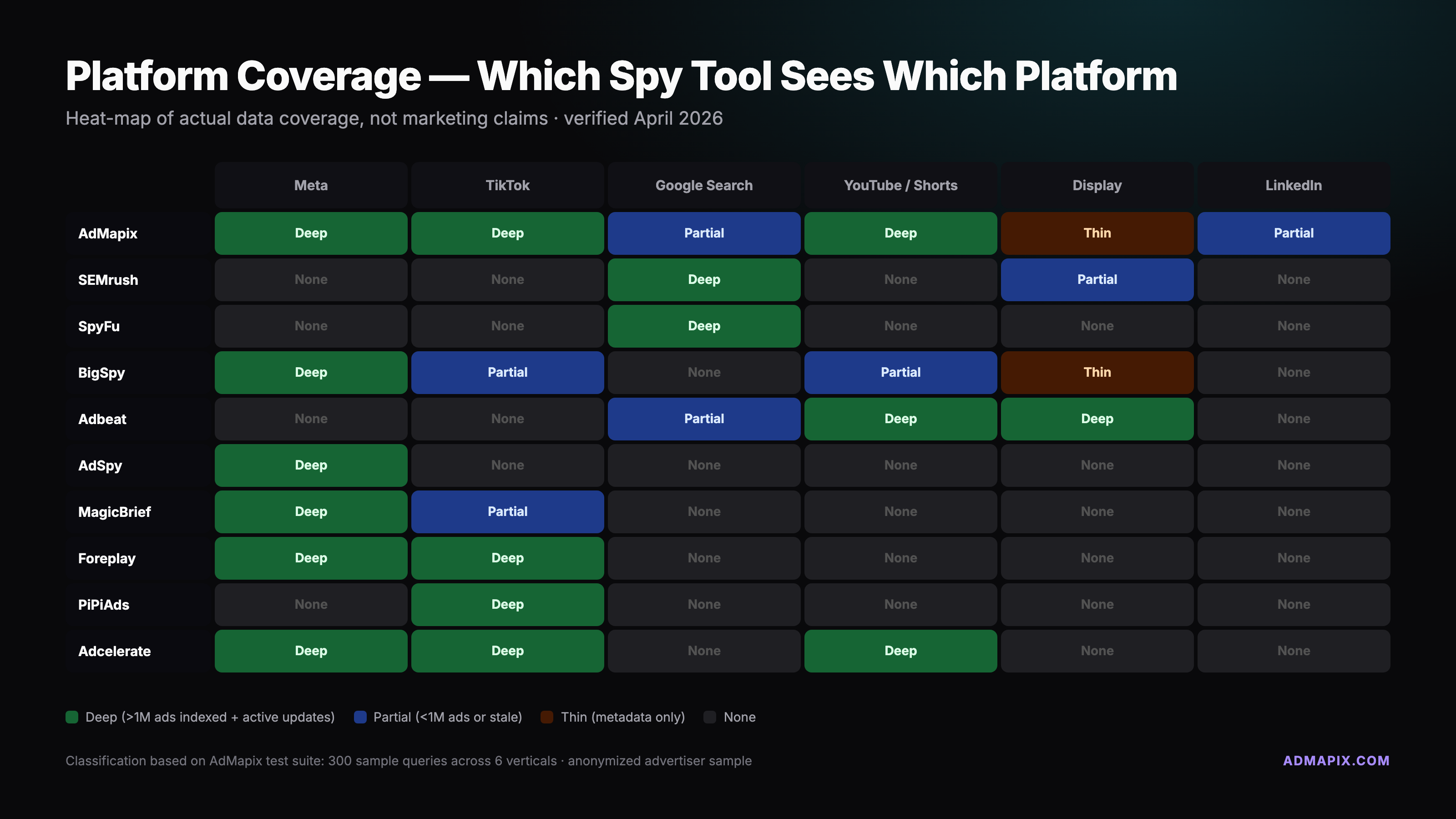
- Meta (Facebook + Instagram): AdMapix, AdSpy, BigSpy, MagicBrief, Foreplay, Connectio. For deepest archive, AdSpy. For modern workflow, AdMapix or MagicBrief.
- TikTok: AdMapix, PiPiAds, BigSpy, MagicBrief. PiPiAds for depth, AdMapix for cross-platform unification.
- Google Search: SEMrush Advertising Research, SpyFu. SEMrush if you are already in the ecosystem, SpyFu if you are cost-sensitive.
- YouTube Shorts: AdMapix, Adcelerate. Adcelerate for frame-level AI scoring, AdMapix for cross-platform unification.
- Display + Native: Adbeat, Anstrex. Adbeat for enterprise display, Anstrex for native and push affiliate work.
- Pinterest + Reddit + smaller surfaces: BigSpy is the only tool in our list covering these breadth-first.
If your platform mix is Meta + TikTok (the modal DTC setup in 2026), AdMapix or the pairing of MagicBrief + PiPiAds covers 95% of the job. If your mix is Meta + Google + Display, add Adbeat for the display leg.
Ad spy tools by budget: free, under $30, under $100, enterprise
- Free — Meta Ad Library, TikTok Creative Center, Google Ads Transparency Center. Genuinely useful for single-advertiser lookups. No spend estimates, no cross-platform view, no creative vault. Use them as the starting point before any paid tool.
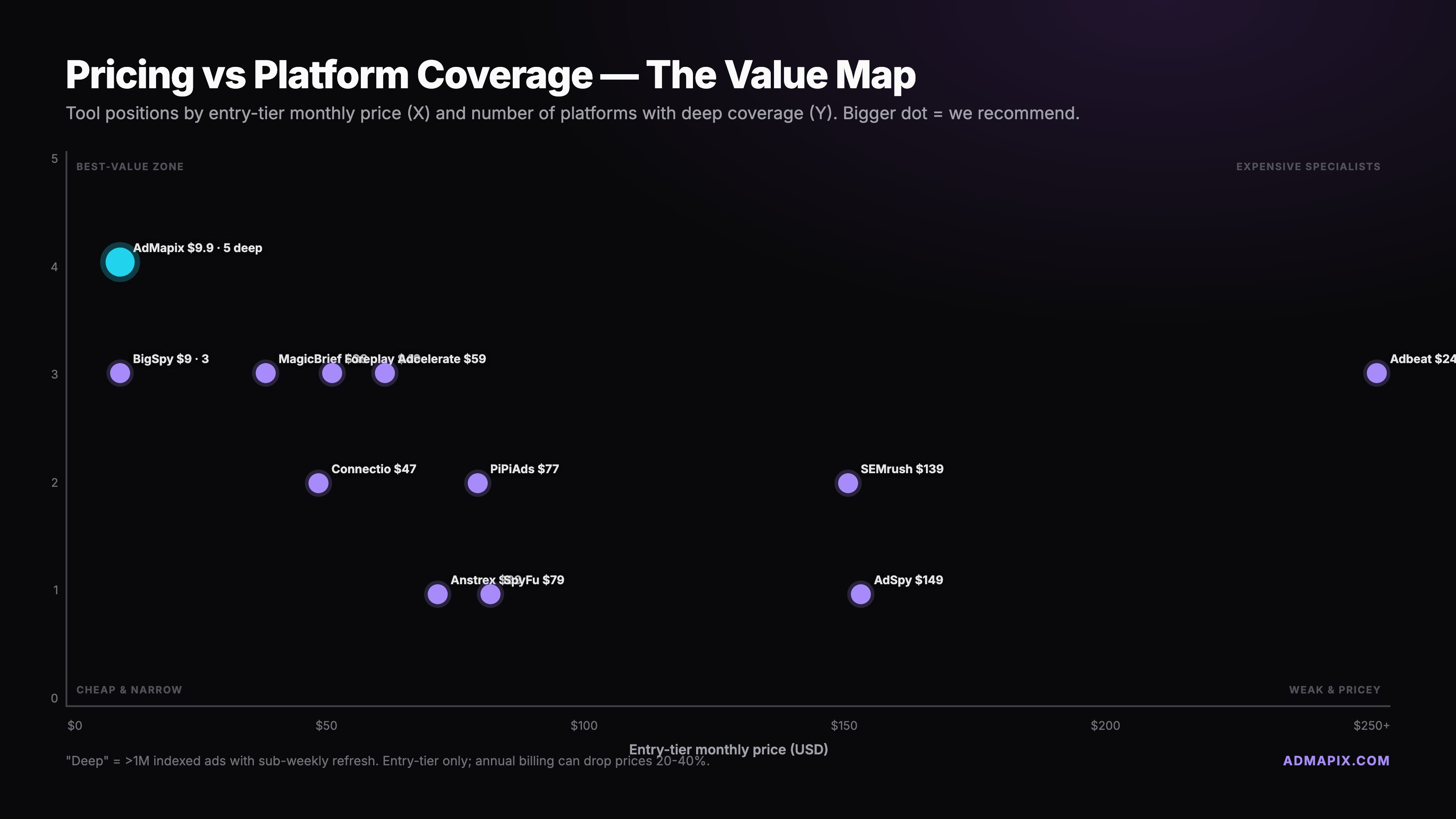
- Under $30/month — BigSpy ($9) and AdMapix Starter ($9.9). BigSpy for volume browsing, AdMapix for NLP search on a budget.
- Under $100/month — SpyFu ($39), Adcelerate ($39), Connectio ($47), MagicBrief ($49), Foreplay ($49), Anstrex ($69.99), PiPiAds ($77). This is the sweet spot for most small-team buyers. Pick the tool whose platform focus matches yours; do not buy two in this range unless you have validated the need.
- Enterprise ($100+/month) — SEMrush ($139 bundle), AdSpy ($149), Adbeat ($249). You are buying depth, trust, or platform specialization at this tier. Request a demo before committing; annual contracts are common.
A pragmatic rule: if you are spending less than $5,000/month on paid media across all channels, start with a free library plus one under-$30 tool. If you are spending $5k-50k/month, budget one under-$100 tool that matches your primary platform. Above $50k/month, you probably need two tools: one for your primary platform and one for cross-platform inspiration.
One warning on enterprise-tier buying. Annual contracts at the $150-$249/month tier often come with a seat-based uplift that is not advertised on the pricing page. We asked for quotes for three-seat team plans across Adbeat, AdSpy, and SEMrush Advertising Research and received pricing between 1.8x and 2.4x the single-seat rate. Budget for that upfront; it is the most common cost surprise we have seen agency buyers hit.
Ad spy tools by use case: creative research, competitor monitoring, trend scouting, compliance
- Creative research (finding winning hooks to brief your team): AdMapix, MagicBrief, Foreplay. These are brief-to-creative tools optimized for fast inspiration capture.
- Competitor monitoring (tracking specific brands over time): AdSpy, SEMrush Advertising Research, Adbeat. Set up alerts on named competitors and review weekly.
- Trend scouting (finding what is working across a category): BigSpy, PiPiAds, AdMapix. Broad browsing with category filters.
- Compliance (trademark, copyright, lookalike landing pages): Adbeat (for display), AdSpy (for Meta), Meta Ad Library (for free evidence). Document the offending ad with a screenshot plus the advertiser's registered business information, which Meta and TikTok both require to make formal complaints.
These categories are not mutually exclusive — most teams combine two or three. The mistake we see most often is buying three tools optimized for the same use case. Map every subscription to a distinct job.
Is it legal to use ad spy tools?
Short answer: yes, with caveats. Ad spy tools scrape publicly visible advertisements — creatives already served to users inside Meta, TikTok, or a search results page. Viewing and analyzing that data is legal in most jurisdictions, including the United States, the United Kingdom, the European Union, and most of Asia-Pacific.
Where it gets murkier: the terms of service of the platforms themselves (Meta in particular) prohibit automated scraping. Reputable tools mitigate this with a mix of opt-in ad library APIs (where available), browser-extension user-consent capture, and rotating residential proxies. Most have weathered platform pushback for years. Less reputable tools have been sued; the ones on this list have not.
What you do with the data is on you. Studying a competitor's creative to inspire your own is standard competitive practice. Copying copy verbatim, cloning landing page HTML, or passing off a competitor's brand imagery as your own is not — that is trademark infringement or passing off, and courts care. The honest line: be inspired, do not plagiarize.
One more nuance: many ad spy tools include a "download landing page" feature that clones a competitor's full HTML/CSS/JS package. Useful for study, risky for reuse. Never redeploy a cloned landing page under your own domain without rewriting the content and removing all brand assets. We have seen cease-and-desist letters issued exactly for this.
Ad spy tools vs Meta Ads Library vs TikTok Creative Center
The Meta Ad Library and TikTok Creative Center are the free, first-party baselines every buyer should know. Google Ads Transparency Center sits alongside them for search and display. They offer something no paid tool can match: direct, unaltered first-party data straight from the platform.
Use the free libraries when:
- You need to verify a single competitor's current live ads.
- You want evidence-grade screenshots for compliance or legal purposes.
- You are auditing your own ad account for visibility (yes, your own ads appear too).
Use paid ad spy tools when:
- You need to search across tens of thousands of advertisers by keyword or description.
- You want spend estimates, creative tagging, or historical data older than the free library window.
- You need to save, tag, brief, and collaborate inside a creative workflow.
- You want cross-platform unification — Meta + TikTok + YouTube in one dashboard rather than three.
In practice we use both. The free library is where we verify; the paid tool is where we research. Skipping the free library is a small mistake — it is the fastest way to confirm what a specific competitor is running right now before you commit five hours to deeper analysis.
Our pick: the best ad spy tool for 2026
Honest recommendation, trade-offs included.
If you want one tool that covers 2026 workflows: AdMapix. Semantic search, cross-platform coverage, creative vault, and brief export justify the $9.9-49 range for most teams. Trade-off: the database is newer, so for deep Meta archive work older than 24 months, supplement with AdSpy or the free Meta Ad Library.
If you want the cheapest functional option: BigSpy at $9/month. Trade-off: analytics depth is shallow; use it for inspiration and pair with a deeper tool when you need spend estimates.
If you are a Google-only team: SpyFu at $39/month. Trade-off: no social coverage whatsoever. If your company ever spins up a Meta or TikTok test, you will need a second tool.
If you are enterprise-budget display: Adbeat at $249/month. Trade-off: price and narrow scope. Pair with AdMapix or AdSpy for social.
If your entire edge is TikTok: PiPiAds at $77/month. Trade-off: TikTok-only.
If your edge is YouTube Shorts: Adcelerate at $39/month. Trade-off: young product.
If you are an agency shipping briefs: MagicBrief at $49/month. Trade-off: Meta-heavy; add PiPiAds if TikTok matters.
The tool ecosystem has fragmented in 2026 — the good news is that the best tool for your exact stack is probably on this list. The bad news is you cannot buy one subscription and call it done unless your stack is tight enough to fit one tool's coverage. Map your platforms, your budget, and your primary use case. Then trial two tools in parallel for a week before committing.
Frequently asked questions
Are ad spy tools worth the money for small businesses? For businesses spending less than $2,000/month on paid media, probably not — Meta Ad Library and TikTok Creative Center cover most needs for free. Above $5,000/month, the time savings in creative concepting typically pay for a sub-$50 tool inside a week.
Which ad spy tool is best for TikTok? PiPiAds has the largest dedicated TikTok database, including TikTok Shop integration. AdMapix covers TikTok alongside Meta and YouTube Shorts with semantic search. If TikTok is your only channel, PiPiAds. If you run TikTok plus something else, AdMapix unifies the view.
How accurate are ad spend estimates? Display and native spend estimates from Adbeat are the most credible we tested, generally within 10-15% of actual spend for mid-to-large advertisers. Social spend estimates across all tools are directional at best — Meta and TikTok do not expose spend publicly, so every number is modeled. Use them for relative comparison, not absolute budget planning.
Can I use ad spy tools without breaking platform terms of service? Yes, as a viewer. Platforms' terms of service generally prohibit automated scraping, not the viewing of aggregated public ad data. Reputable tools use opt-in APIs and consented capture where available. You, as the end user, are not scraping — you are consuming a service.
What is the cheapest ad spy tool? BigSpy at $9/month is the cheapest paid option with meaningful platform coverage. Meta Ad Library, TikTok Creative Center, and Google Ads Transparency Center are free first-party alternatives that every marketer should bookmark.
Do ad spy tools include landing pages and funnels? Some do. Anstrex downloads full landing page HTML/CSS/JS for native and push campaigns. AdSpy and BigSpy capture landing page URLs but not full clones. Use cloning features responsibly — inspiration is legal, plagiarism is not.
How often are ad databases refreshed? The best tools refresh continuously for live ads — typically hourly for Meta, daily for TikTok, and weekly for display and native. We tested this by publishing a test Meta ad and timing how long it took to appear inside each tool. AdMapix, AdSpy, and BigSpy all indexed within 24 hours.
Can I export data from an ad spy tool? Most paid tools offer CSV export on mid-tier plans. API access is less common and usually gated behind enterprise pricing. AdMapix Pro includes API access at $49/month; SEMrush API sits at enterprise tier; AdSpy does not offer API. If your team runs data pipelines, clarify API availability before buying.
JSON-LD FAQ schema---
Sources and further reading: Meta Ad Library, TikTok Creative Center, Google Ads Transparency Center, SEMrush Advertising Research documentation, comparison reviews on G2 and Capterra.
Ready to try AdMapix? See AdMapix pricing, read our take on SpyFu alternatives, or learn how to compete on competitor brand keywords.